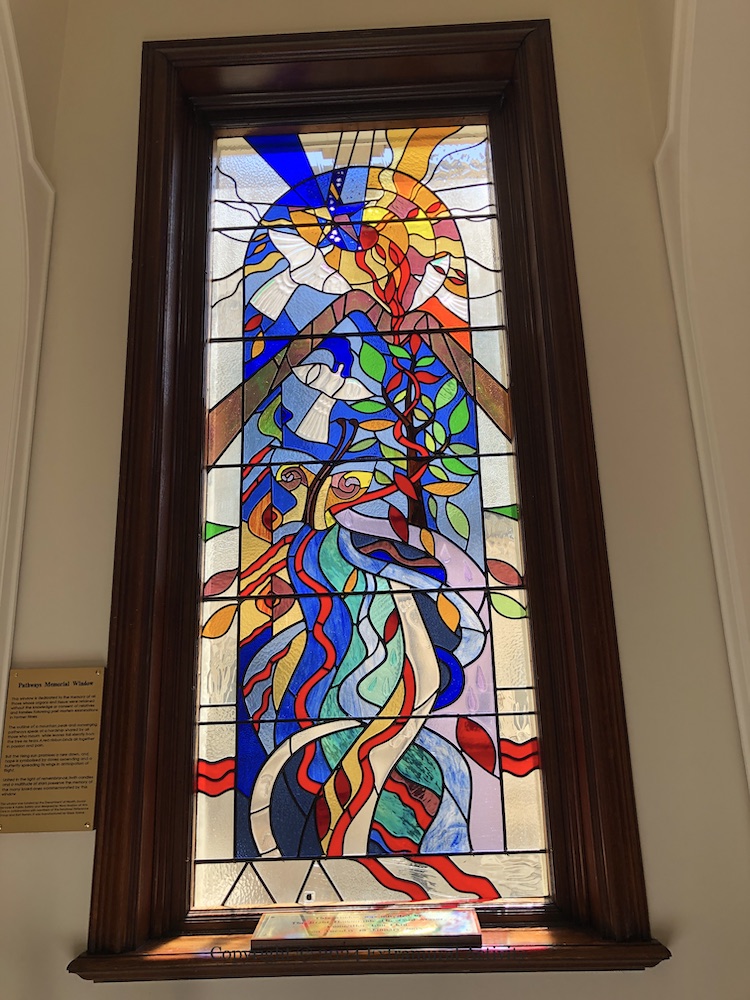
6: The Pathways Window – according to the guide, this window commemorates the pain caused to the relatives of deceased persons from whom organs were taken without consent.
“Pobal ag foghlaım, pobal ag forbaırt, pobal ag fás” [a community learning, developing, growing]
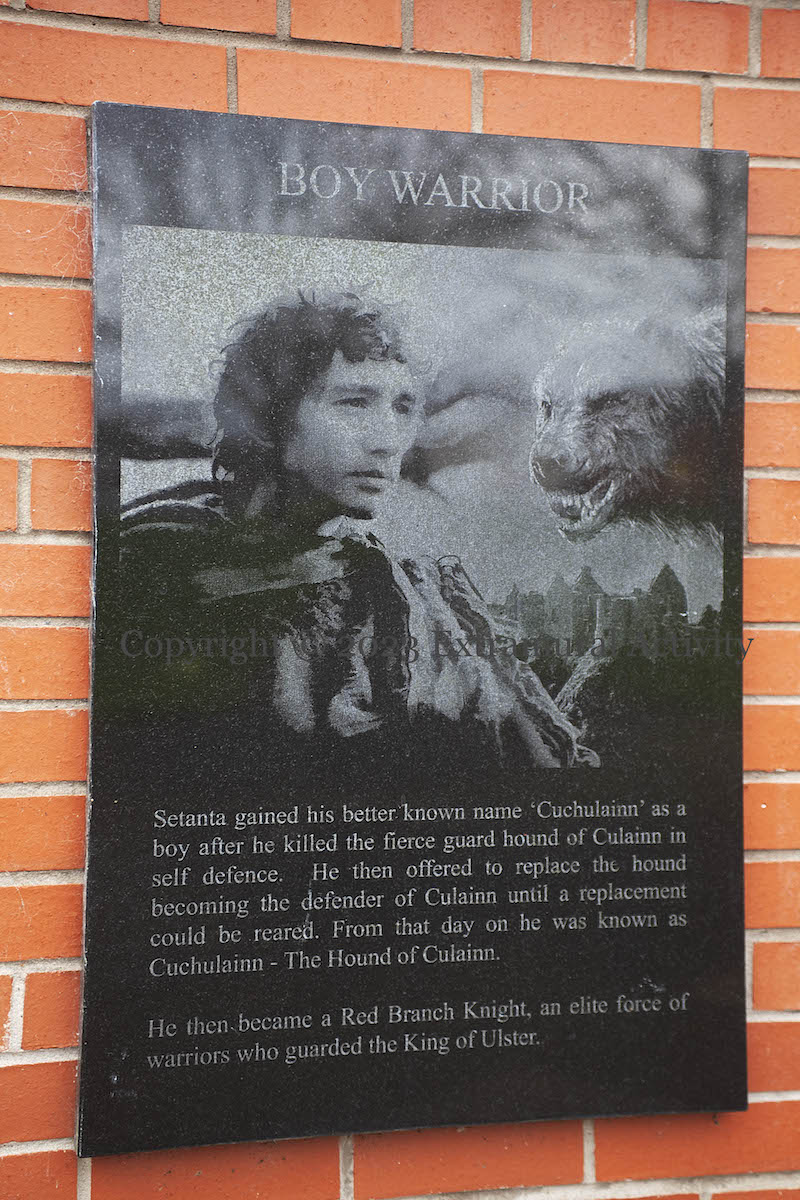
Students from “Naíscoıl & Gaelscoıl An Lonnáın (Fb) bun[aithe] 1999″ [Nursery-school and Irish-language [primary] school of the loney, founded 1999] are shown playing Gaelic games, Irish dancing, and playing traditional instruments (and the guitar). On the left are representations from Irish mythology: the Children Of Lear and Setanta killing Culann’s hound (and taking the name Cú Chulaınn in taking its place), along with hedge-row school (see Hedge Row School).
The origin of the name is unclear; the nearest loney [lane] was the “Pound” loney, so-called because of the animal pen just outside Barrack Street, used to store livestock before moving on to the markets the following day (Rushlight | Uachtar Na bhFál). (The Pound Loney is included in the mural in Durham Street – see Et In Arcadia Ego.)
The other well-known loney in Belfast is the “buttermilk loney” which was either/both what is now Ballysillan Park (that is, connecting Olpark with the horsehoe bend) or the top part of the loney that connected Wheatfield (the top of Ardoyne) to the Ligoniel junction and on towards the old Ligoneil House (there are a mixture of usages in this Belfast Forum thread); this image from the 1930s might show the lane in (what was still at the time) the hills above Oldpark; a new housing-development towards the top of the Ballysillan Park is euphemistically called “Buttermilk Loney”. (It is also said to have been a prior name of Skegoniell Avenue (Belfast History).)
(The Uachtar Na bhFál page also mentions “Turf” loney, “Mountain” loney, and “Killoney”.)
The history of the Irish word “lonnán” is unclear. Uachtar na bhFál says the word is of Scots origin (perhaps as “loanin”). (See this BelTel article on the opening of the Ulster-Scots centre in 2014.) Spelled “lonnen”, it is also a Geordie word (Heslop’s Northumberland Words | wiktionary). The Irish News and Belfast Live, working from the same (uncited) press-release about Páırc An Lonnáın (which is along the Westlink below Raıdıó Fáılte), state that “loney” comes from the English word “loaning”. The Irish word “lonnán” does not appear in Dinneen 1904; Dinneen 1953 defines it (hyper-specifically) as “a grassy recess running up into high basaltic cliffs”.
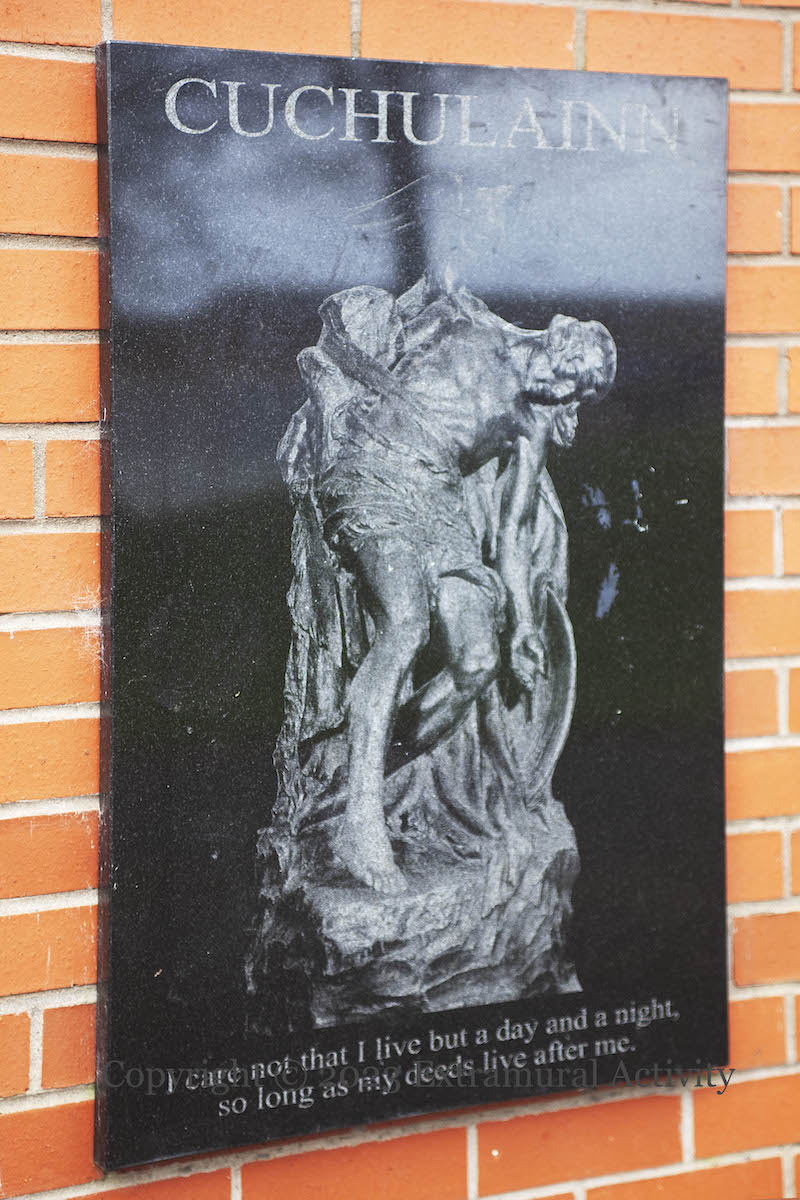
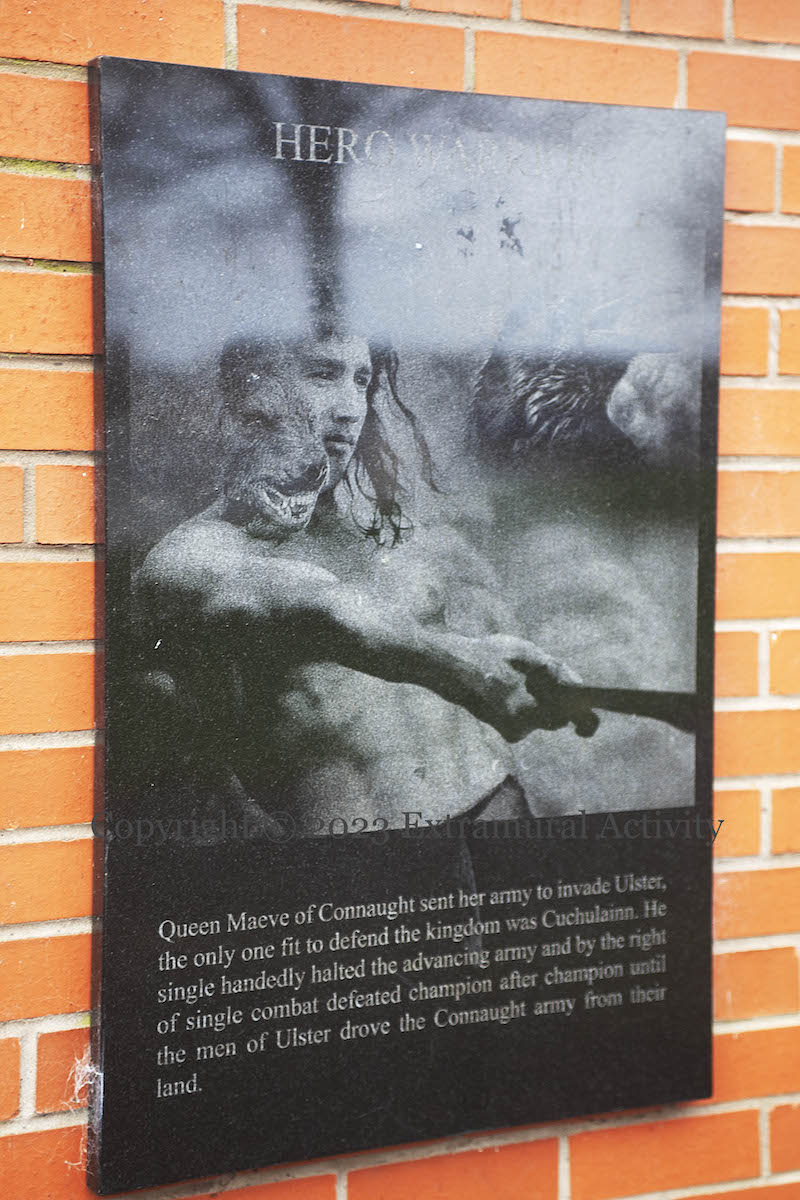
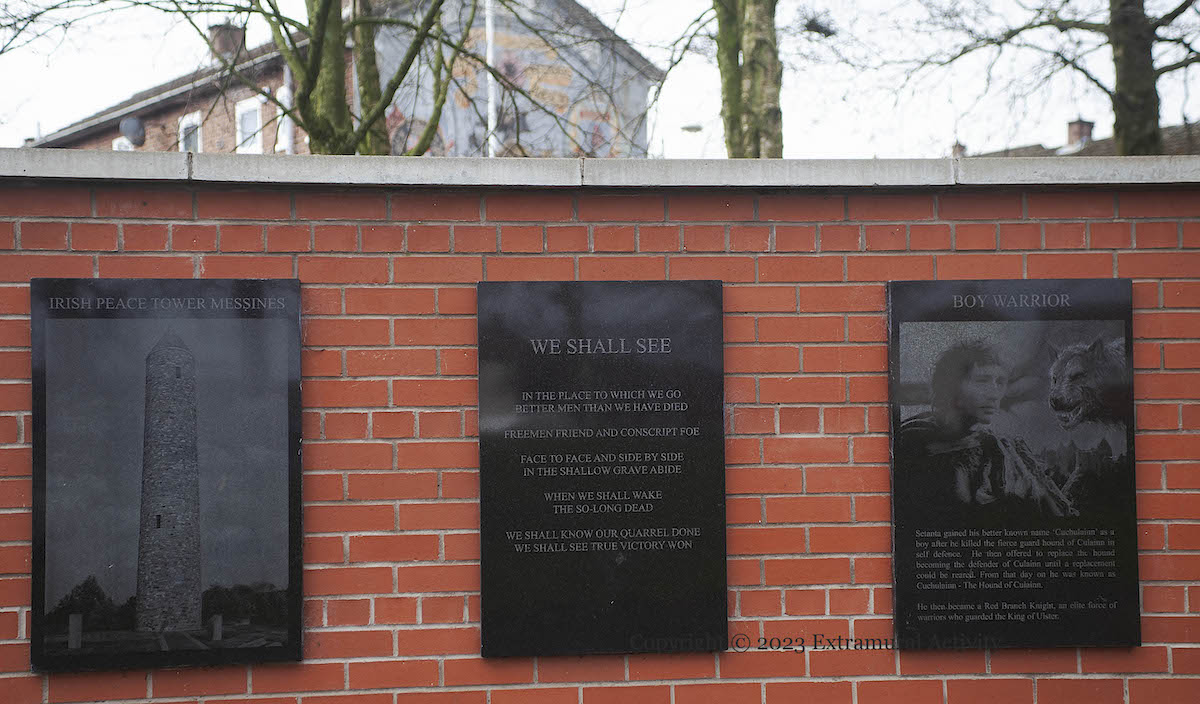
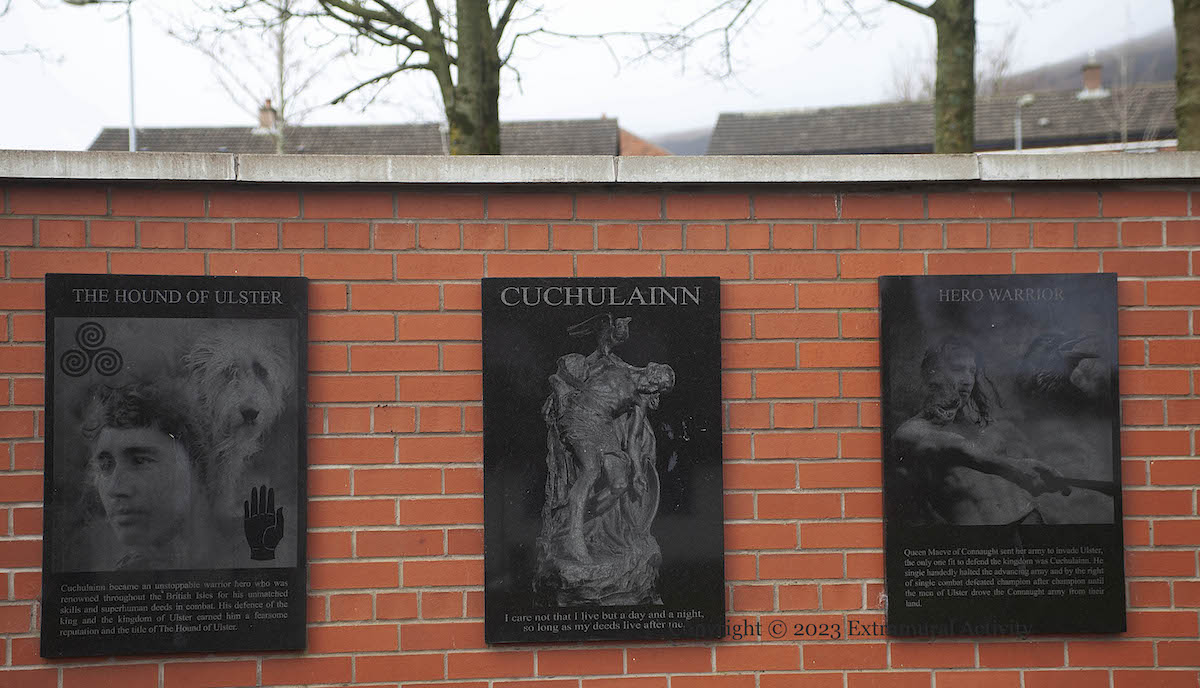
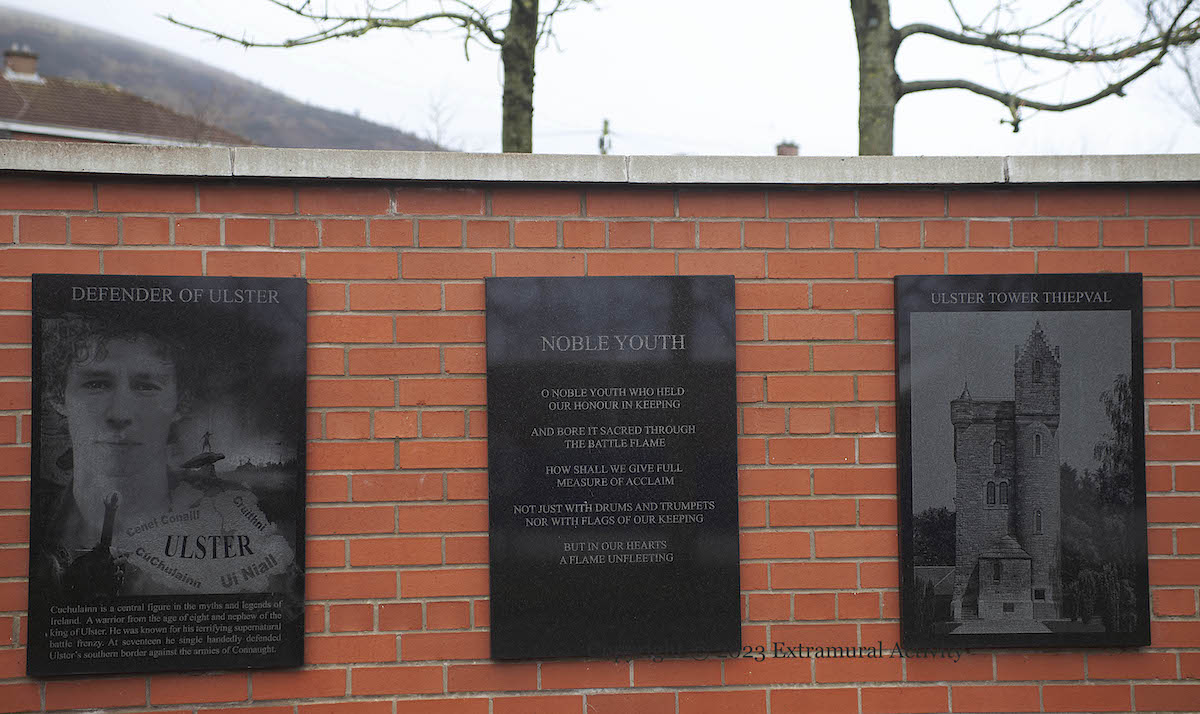
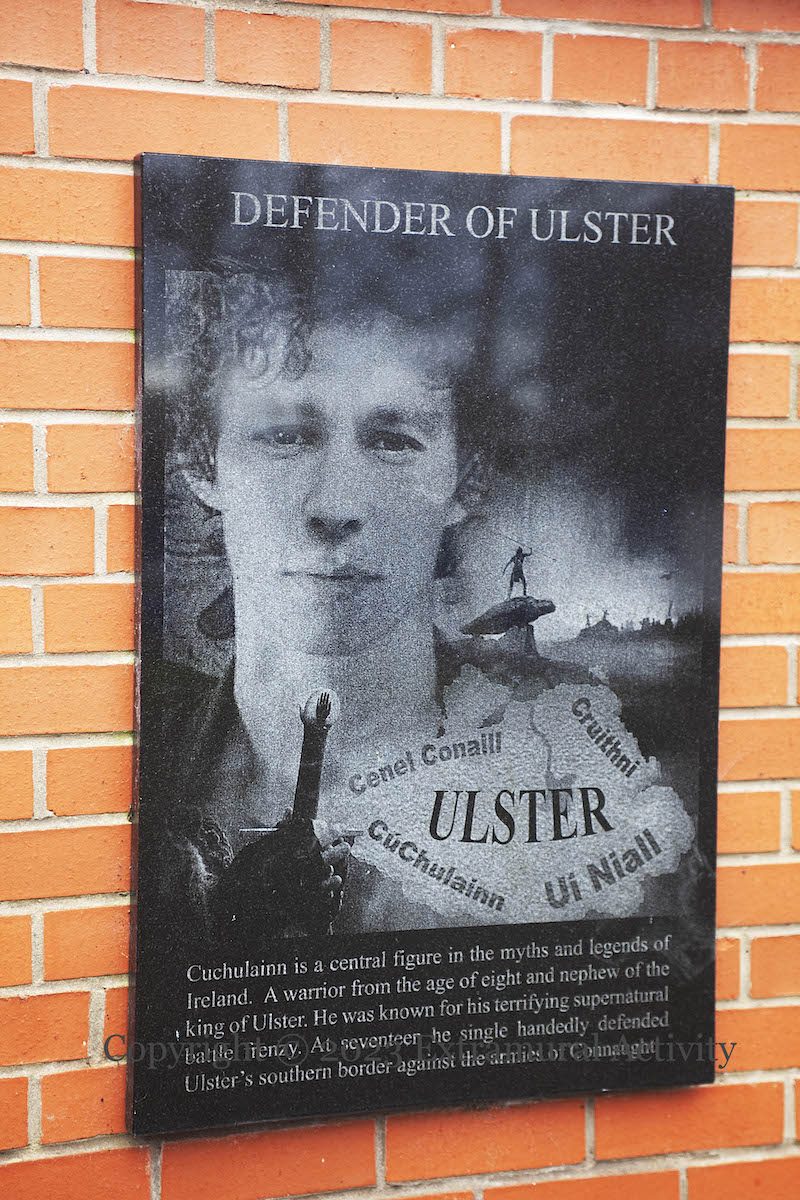
As the Visual History page on the role of Cú Chulaınn makes clear, in PUL muraling and iconography, Cú Chulainn serves as the “ancient defender of Ulster”, and the B Specials, UDR, and loyalist paramilitaries – primarily the UDA but also the UVF – then fit into that tradition. Using Cú Chulaınn as a precursor for service in the Ulster Division of WWI is unique to the panels on Highfield green, five of which are devoted to the hero Cú Chulaınn and four – two on each end – refer to the Great War.
The five Cú Chulaınn panels are (from left to right) Boy Warrior, Hound Of Ulster, Sheppard’s statue, Hero Warrior, and Defender Of Ulster – all shown individually in this post.
On the far left, there are two panels showing Messines tower and a few lines from a Ronald Lewis Carton poem Réveillé (though given a more ‘victorious’ ending) and on the far right, a few lines from Duncan Campbell Scott’s To A Canadian Lad Killed In The War and Thiepval tower. The words to I Vow To Thee My Country (lyrics) are along the bottom (see the wide shot, final image below).
The biographical panels focus on Cú Chulaınn’s age – the sixth panel emphasises that Cú Chulaınn was only 17 when he held off Maeve’s forces – which is perhaps a similarity with those who joined the 36th Division, but how the “defender of Ulster” is connected to the defense of Europe is obscure.
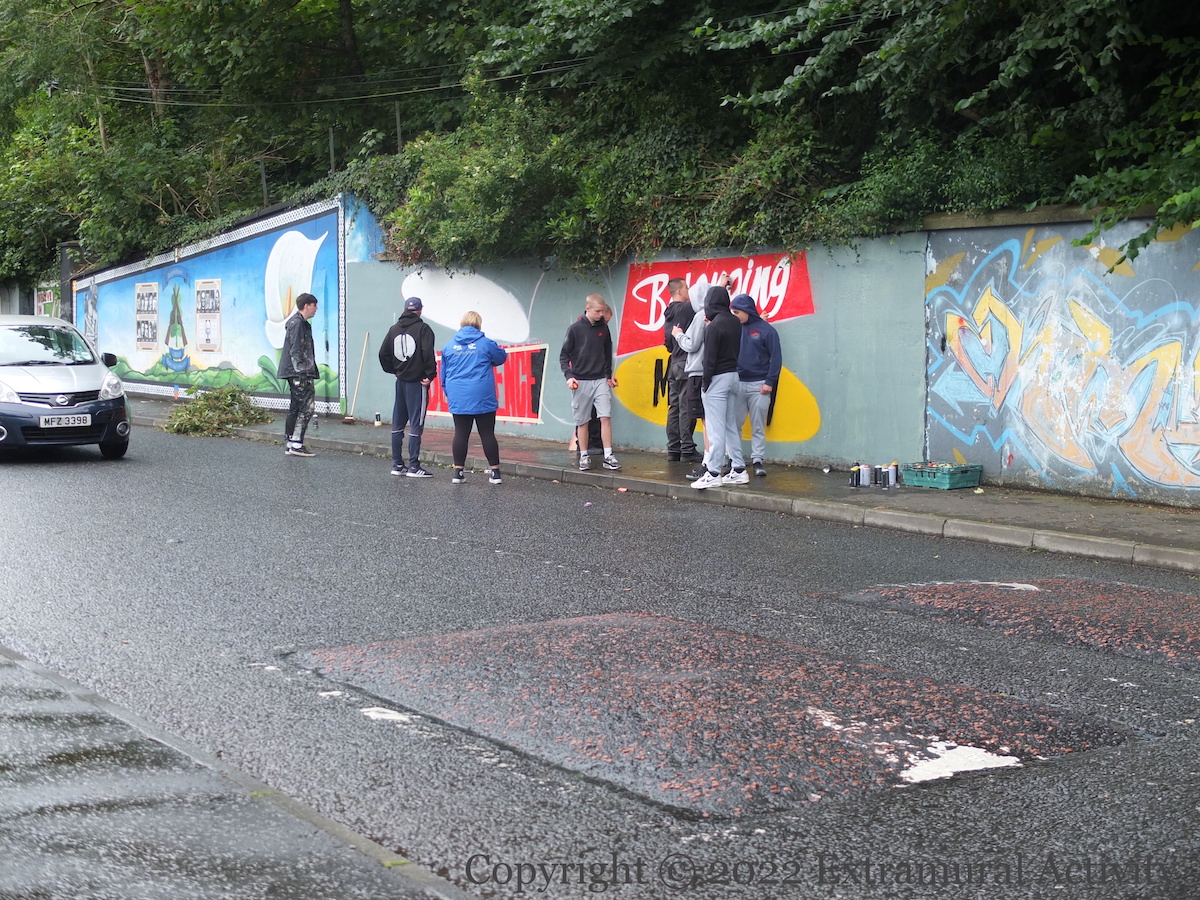
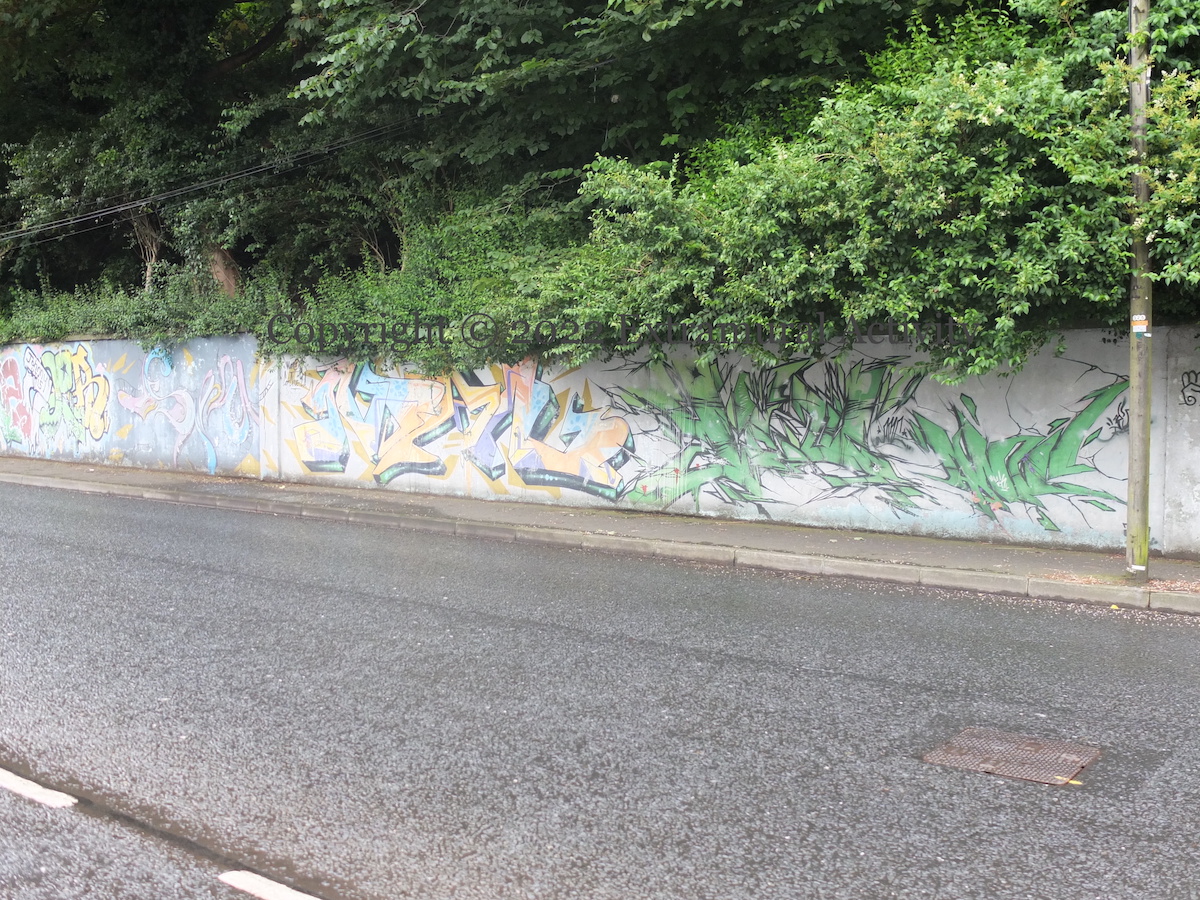
Here is a complete set of images from the Bogside end of the Brandywell. From left to right: “Nasc” by NOYS (ig) for Gasyard Féıle 2022, Long Tower Community Centre (see Brandywell Past And Present), a new “Brandywell” stencil by Peaball (ig), the Ryan McBride Foundation (tw), a new version of the Derry Brigade IRA mural (see previously Brıogáıd Dhoıre), Peaball and local youth at work, various pieces of wild-style writing and graffiti in support of Jason Ceulemans.
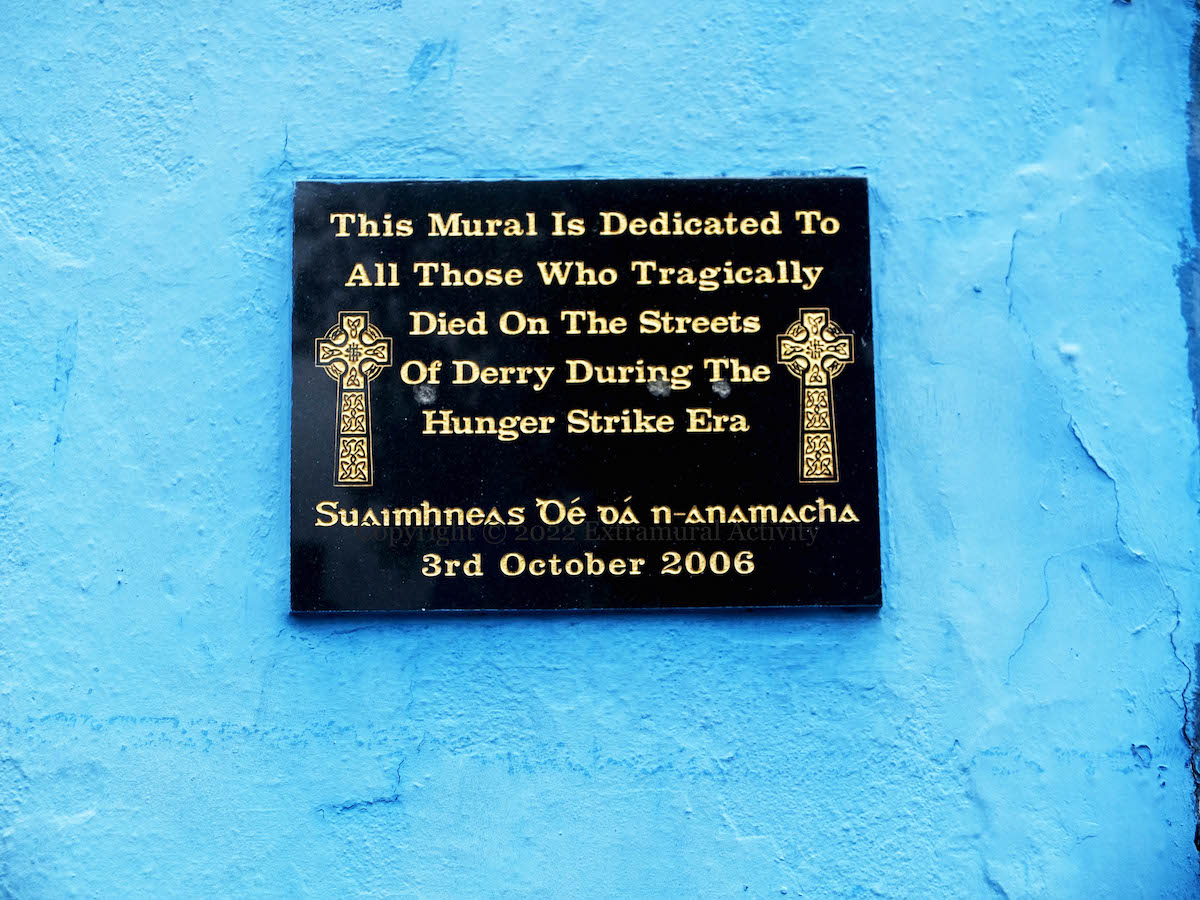
“This mural is dedicated to all those who tragically died on the streets of Derry during the hunger strike era. Suaımhneas Dé da nanamacha. 3rd October 2006.” The mural referred to is in fact the ‘crumbling cell’ mural (see M03350); the ‘Spirit Of Freedom’ mural was first painted in 2011 for the 30th anniversary (see X00999) – the 30th anniversary plaque remains, on the right of the mural. For the 40th anniversary of the 1981 hunger strike “40” has replaced the “30” in the bottom border – see the final image.
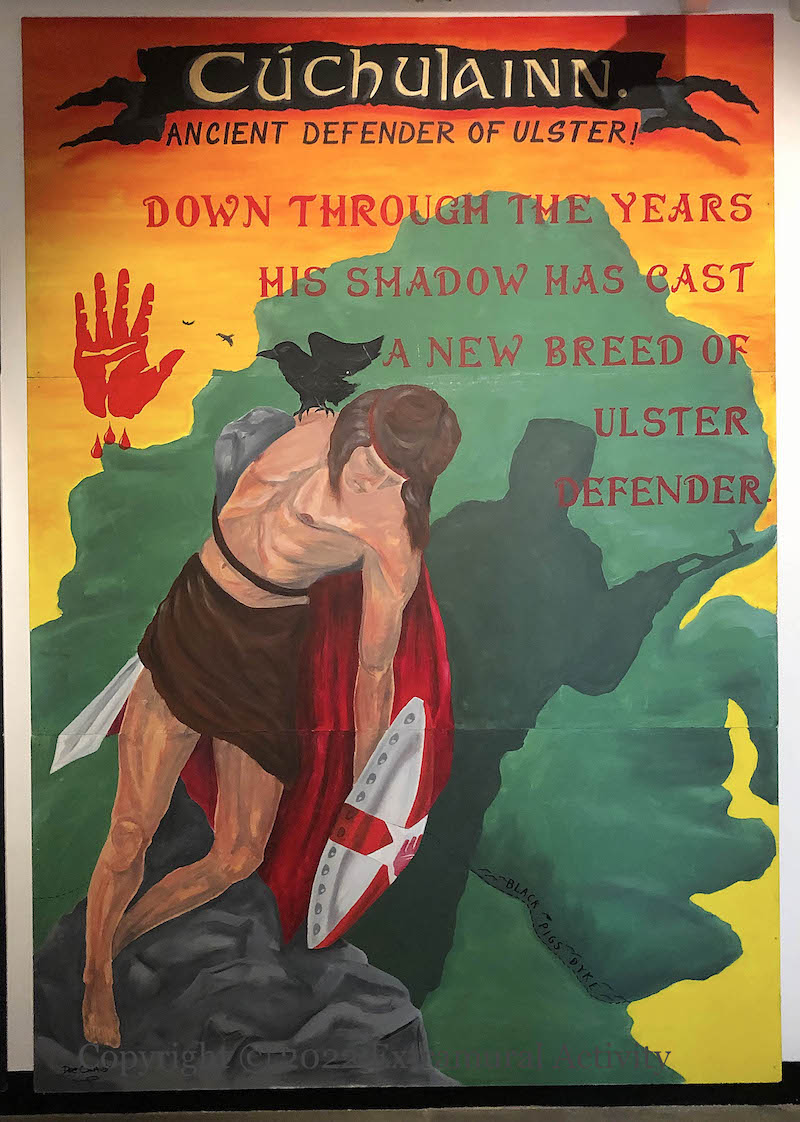
Here are a pair of large boards in the Ulster Museum on the theme of Cú Chulainn, one from each sect.
In the left-hand painting – the CNR piece, by Marty Lyons and a Short Strand artist – Francis Hughes of the IRA – in what we think is a unique break with tradition – takes the place of Cú Chulaınn, who became a symbol of the 1916 Easter Rising when Oliver Sheppard’s statue of Cú Chulaınn’s death was placed in the re-built GPO. Hughes has a tourniquet on his right leg, an assault rifle dangling from his wrist, and instead of the raven that signified Cú Chulaınn’s death there is the symbol of republican political prisoner, the lark, which appears in the apex of many other republican murals.
In the second of the pieces – the PUL piece, painted by Dee Craig – the raven sits on the shoulder of a Cú Chulainn who has a red cloak and carries a Northern Ireland shield. “Down through the years, his shadow has cast a new breed of Ulster defender”: a (loyalist) hooded gunman. Thus while Cú Chulaınn is the (surprising) “Ancient defender of Ulster!”, the UVF and UDA are its modern defenders, now that the B Specials and UDR are gone.
The dripping red hand in the top left is the ‘red hand of Ulster’; one version of the origin-story for the red hand is that the man who avenged Cú Chulaınn’s death made a bloody hand-print to indicate his completion of the deed. Most people, however, will think of the legend that in a race to be first to touch the land of Ulster one contestant (perhaps Érımón Uí Néıll) cut off his hand and threw it ahead of the others. (This legend was depicted in a lower Shankill mural and narrated in an east Belfast mural: The Strangest Victory In All History.)
The Black Pig’s Dyke is the collective name for a number of ditches built around 400 BCE, perhaps to prevent cattle-raiding. They share a common mythology: that they were created by huge black boar; they are on the Ulster-Connacht border, rather than the Ulster-Leinster border as shown in the painting, though there are similar earthworks in Down, Armagh (and Cork) (WP).
In April, the Workers’ Party (web | web | tw | Fb | Fb) suffered a leadership challenge and a split in which its sole elected representative – Ted Tynan on Cork county council – left the party (statement). This is only the latest in a long line of splits, going back to the formation of the modern Workers’ Party, from a split in Sinn Féin in 1970 (WP).
“National Commemoration Committee – erected in memory of all those comrades who dedicated their lives for the establishment of a democratic, secular, socialist republic. ‘I have given whatever I had to give for the party, the people of Ireland, and for a better world, but others have given more, much more. Comrades have given their lives’ – Tomás Mac Giolla TD. ‘For the unity of Protestant, Catholic and Dissenter.'”
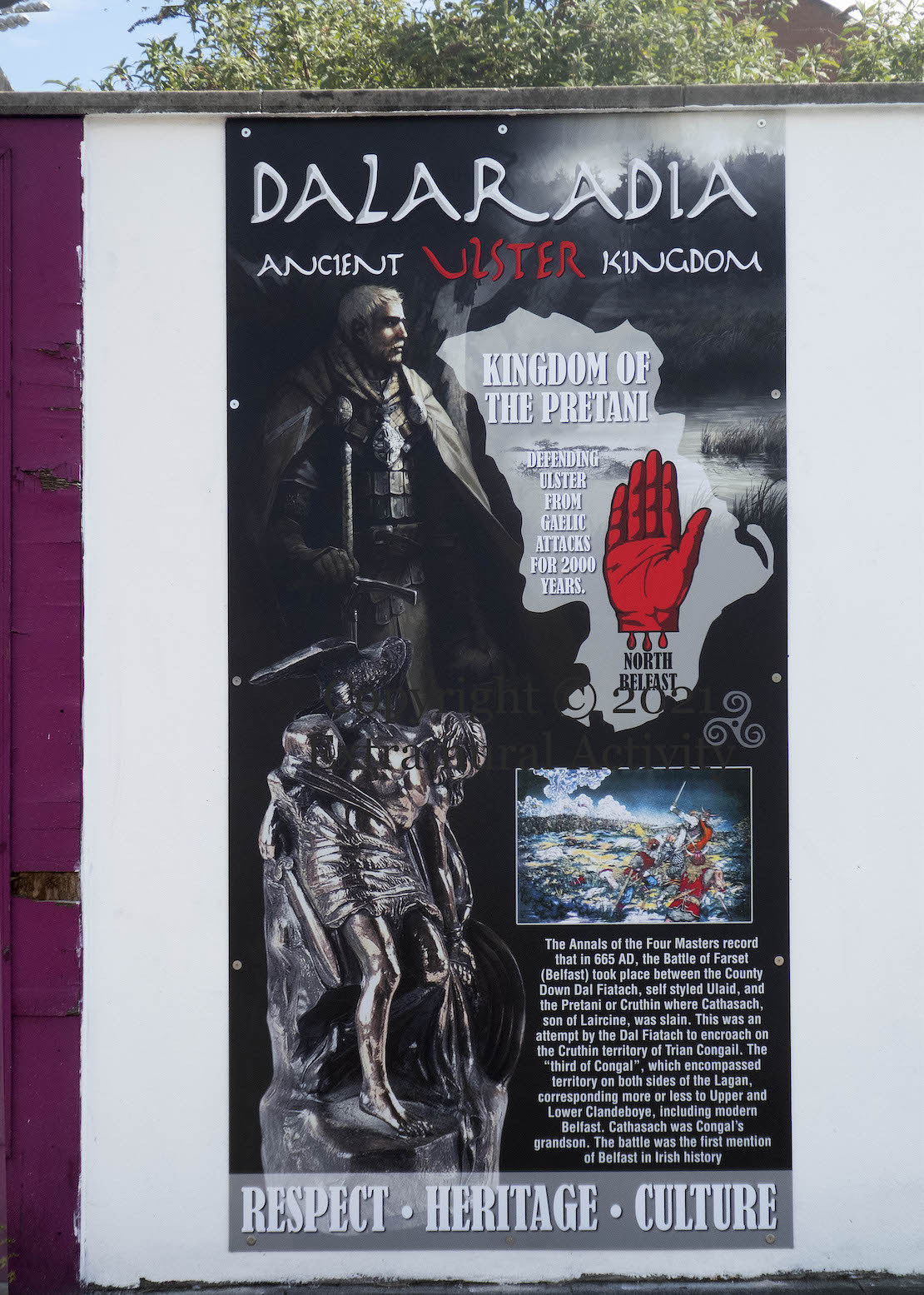
“The Annals of the Four Masters record that in 665 AD, the Battle of Farset (Belfast) took place between the County Down Dal Fiatach, self styled Ulaid, and the Pretani or Cruthin where Cathasach, son of Laircine, was slain. This was an attempt by the Dal Fiatach to encroach on the Curtain territory of Trian Congail. The “third of Congal”, which encompassed territory on both sides of the Lagan, corresponding more to less to Uppers and Lower Clandeboye, including modern Belfast. Cathasach was Congal’s grandson. The battle was the first mention of Belfast in Irish history.”
The battle scene shown is Jim Fitzpatrick’s vision of the battle of Moira (in 637), rather than “Bellum Fertsi”. The salience of this description of intra-Ulster fighting is that there is a contention that the Cruthin were Scots (Picts) thus allowing for the idea (employed especially by the UDA – see Ulster’s Defenders and Defender Of Ulster From Irish Attacks) that present-day northern Protestants have a heritage, and a history of fighting for what is roughly Co. Antrim, that pre-dates the plantations. For more information and a similar board, featuring the tower blocks of Rathcoole rather than Cuchulainn and the Battle of Moira, see Kingdom Of The Pretani. For the debate over a connection to the Picts, see WP.
The Annals date back to the 1630s though they mostly comprise a variety of earlier sources.
The image of the gentleman with the sword appears to be a stock fantasy image, used for at least two characters in Game Of Thrones fandom (Rhaegon Targaryen and Lord Cameron Umber).
The board on the right reads “Centenary of cultural expression 1921-2021. Sons Of Belfast LOL 743. Castleton Temperance LOL 867. The Memorial LOL 1197. Belfast Harbour LOL 1883. The Coote Memorial LOL 1921. Cave Hill Temperance LOL 1956.”
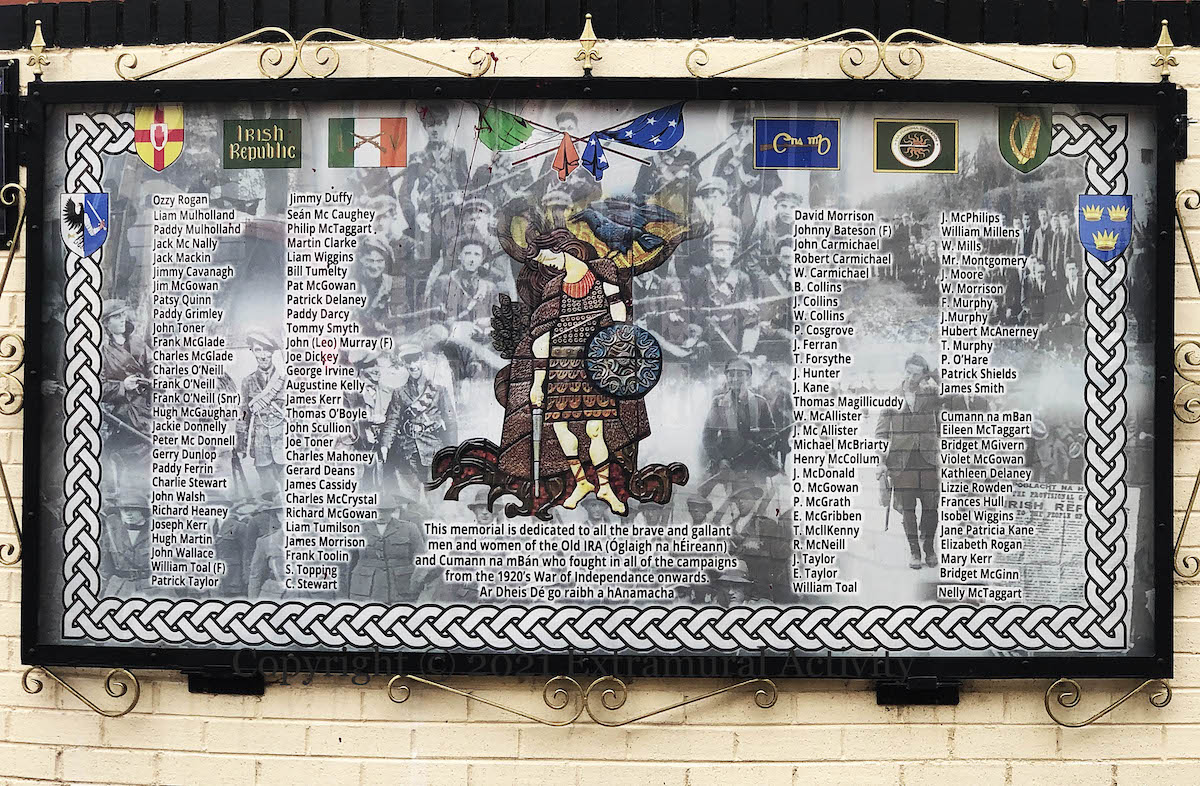
Cú Chulaınn stands dying; the raven on his shoulder will signal his death. “This memorial is dedicated to all the brave and gallant men and women of the Old IRA (Óglaıgh na hÉıreann) and Cumann Na mBán who fought in all of the campaigns from the 1920s War of Independence onwards.”
The Irish tricolour with crossed rifles was the flag of the Irish Volunteers (Óglaıgh na hÉıreann), the splits in which gave rise all the subsequent IRAs.
For a roll of honour 1916-1966, including some profiles, see Treason Felony.
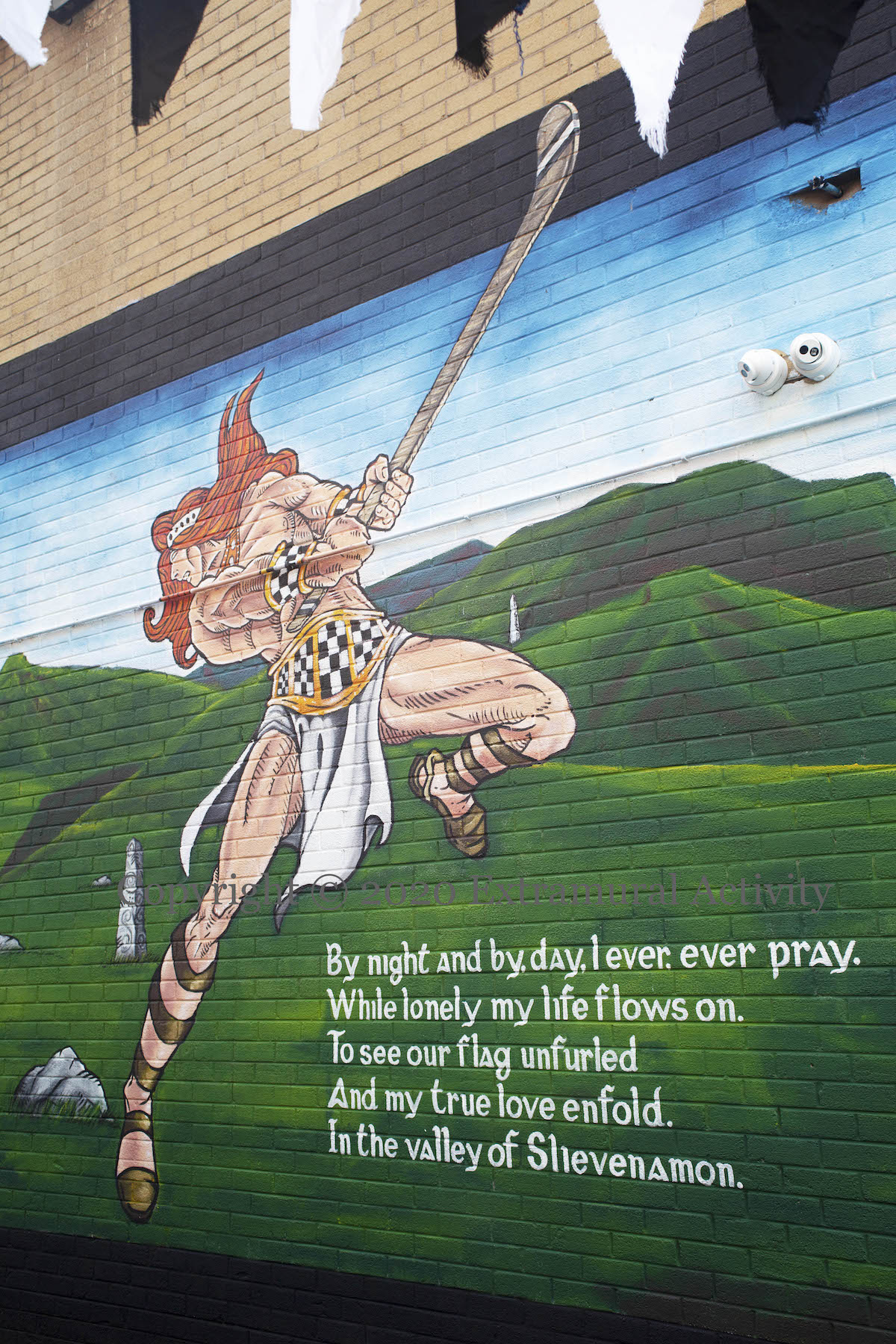
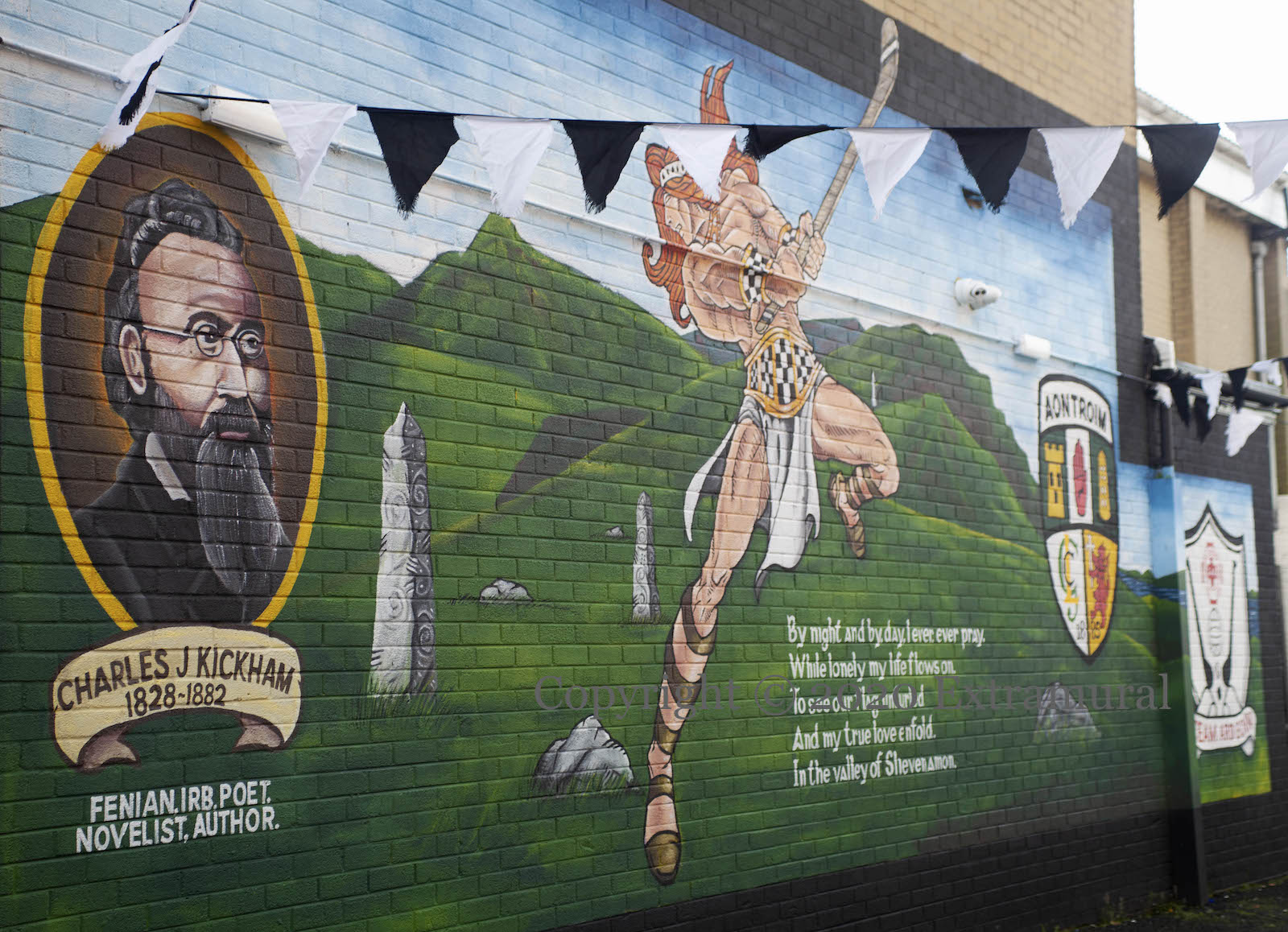
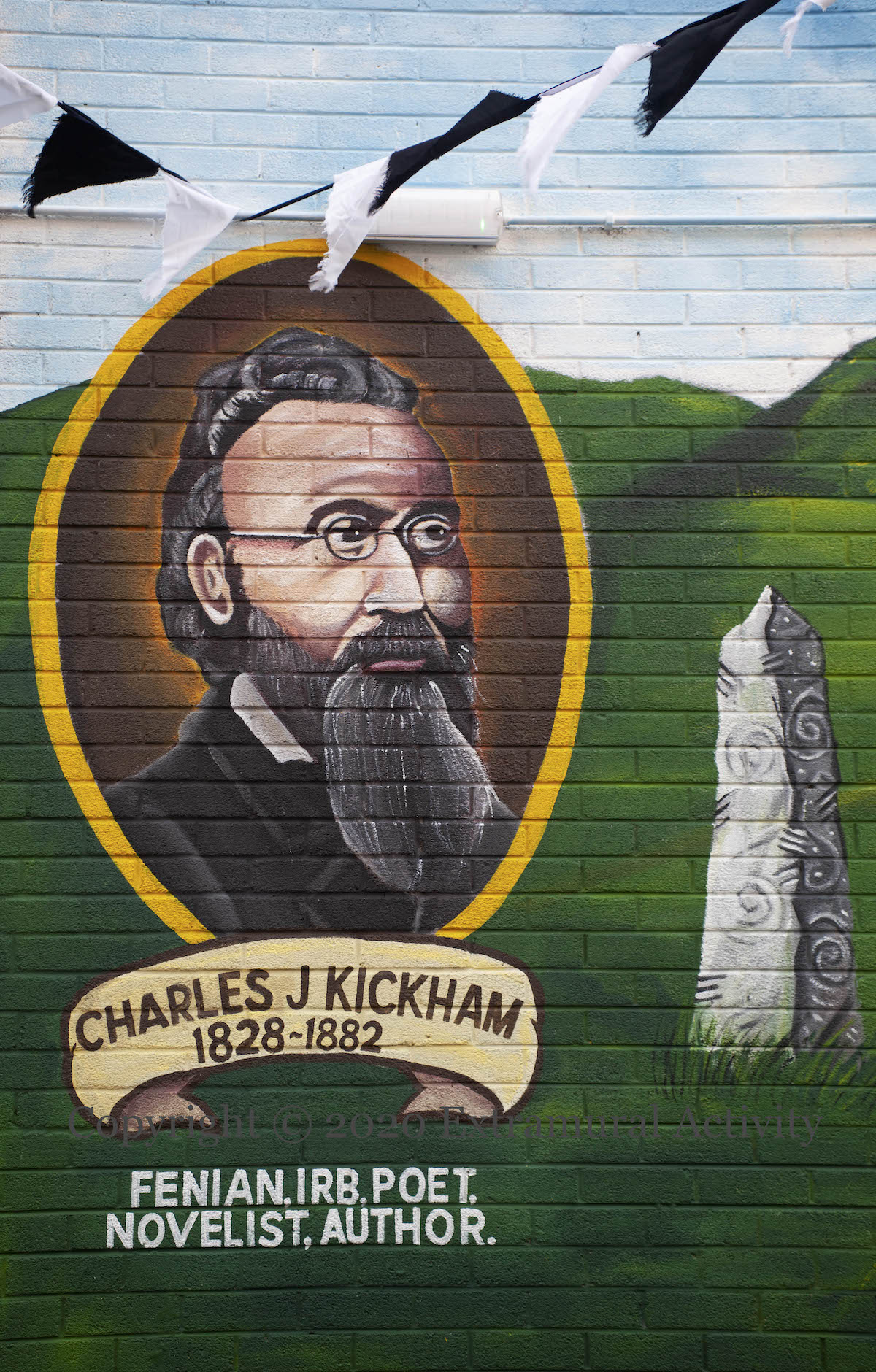
“By night and by day, I ever, ever pray/While lonely my life flows on/To see our flag unfurled/And my true love [to] enfold/In the valley of Slievenamon.” The lyrics are the final lines of The Valley Of Slievenamon, written by Charles J Kickham “fenian, IRB, poet, novelist, author” and much loved in Tipperary. The heroic hurler, however, is Cú Chulainn (rather than the midlands’ Fıonn Mac Cumhaıll). Ardoyne Gaelic games club Cıceam Ard Eoın (tw | Fb) was founded in 1907, 25 years after Kickham’s death.




















 Extramural Activity