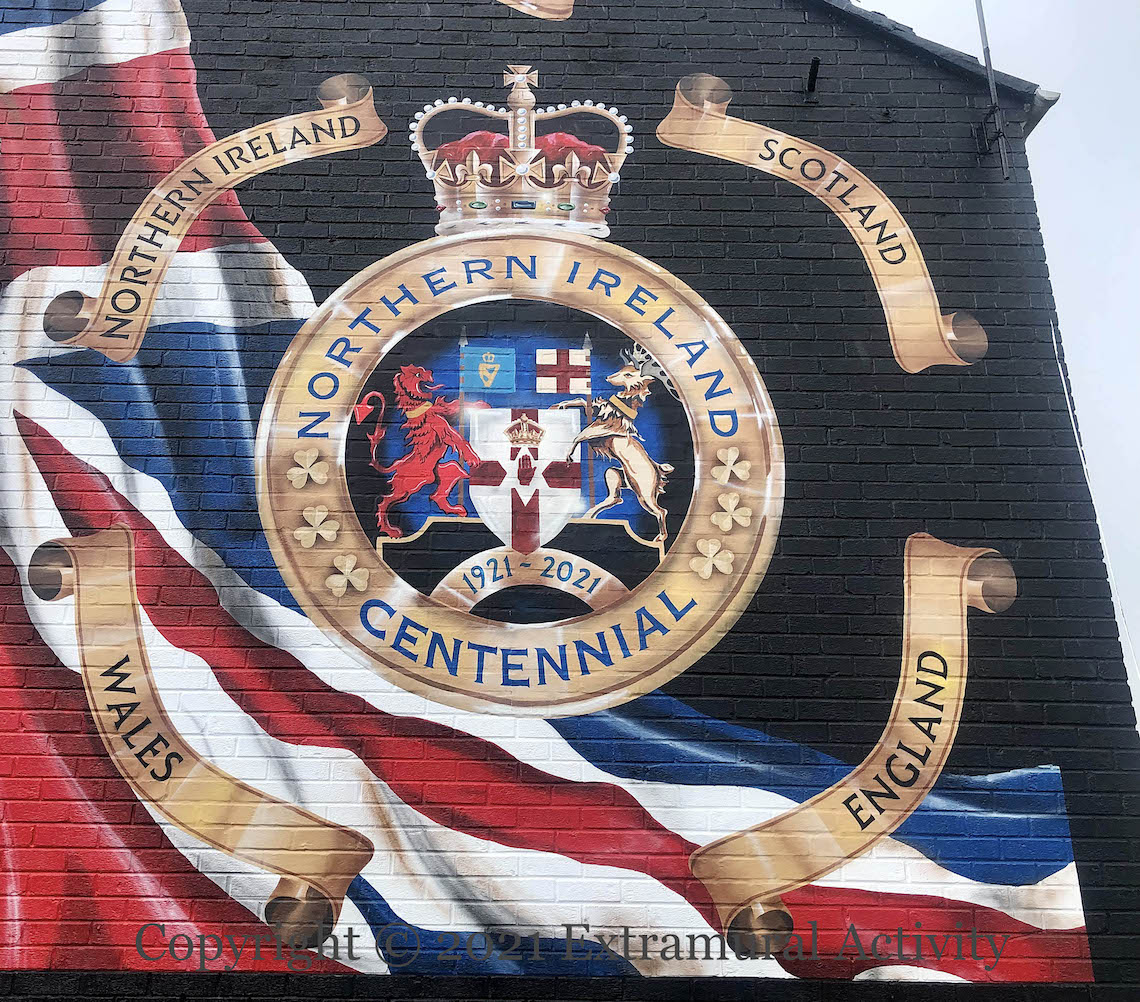
The Northern Ireland government’s coat of arms was approved for use in 1924, three years after the government was established. Its “supporters” – the red lion of Scotland and an Irish elk, carrying (respectively) Irish harp and De Burgh flags, and standing on a grassy mound with flax plants – were added later.
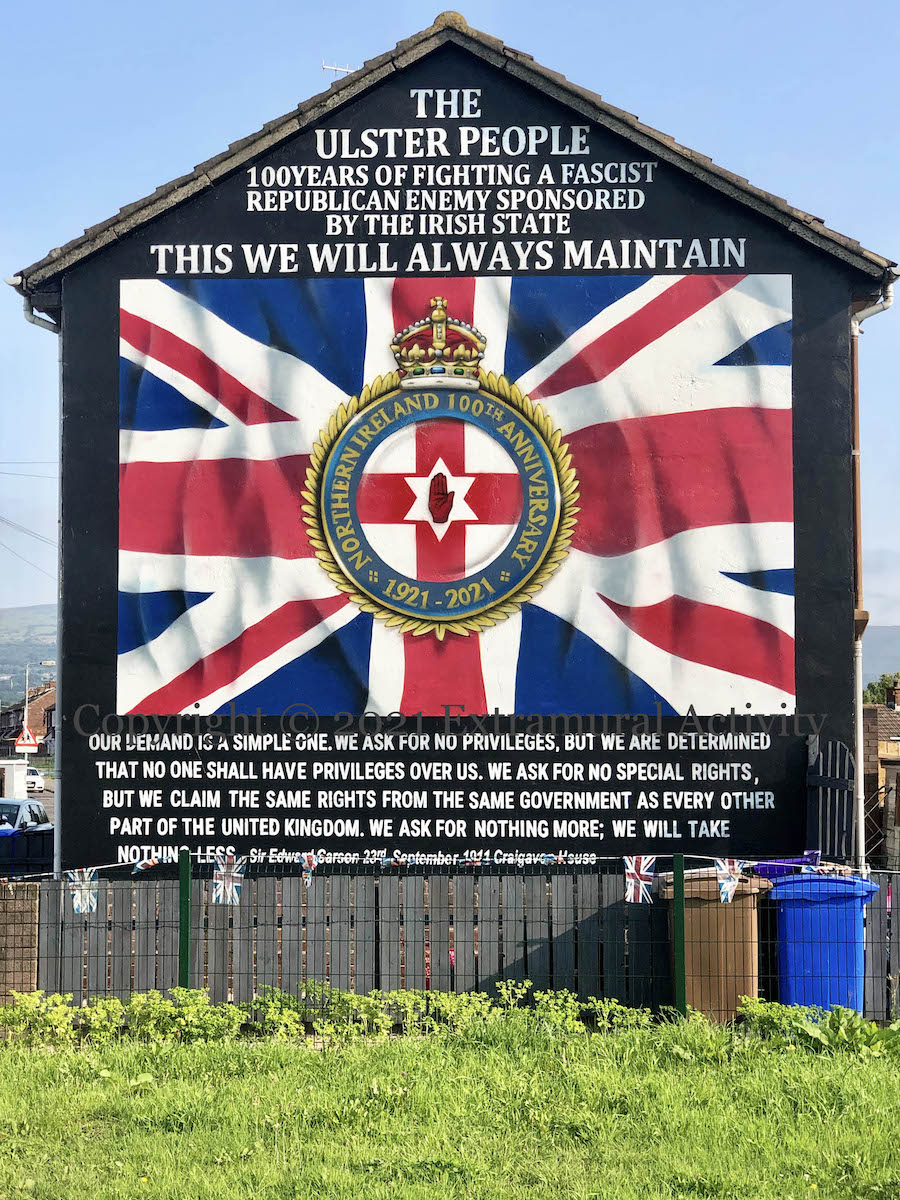
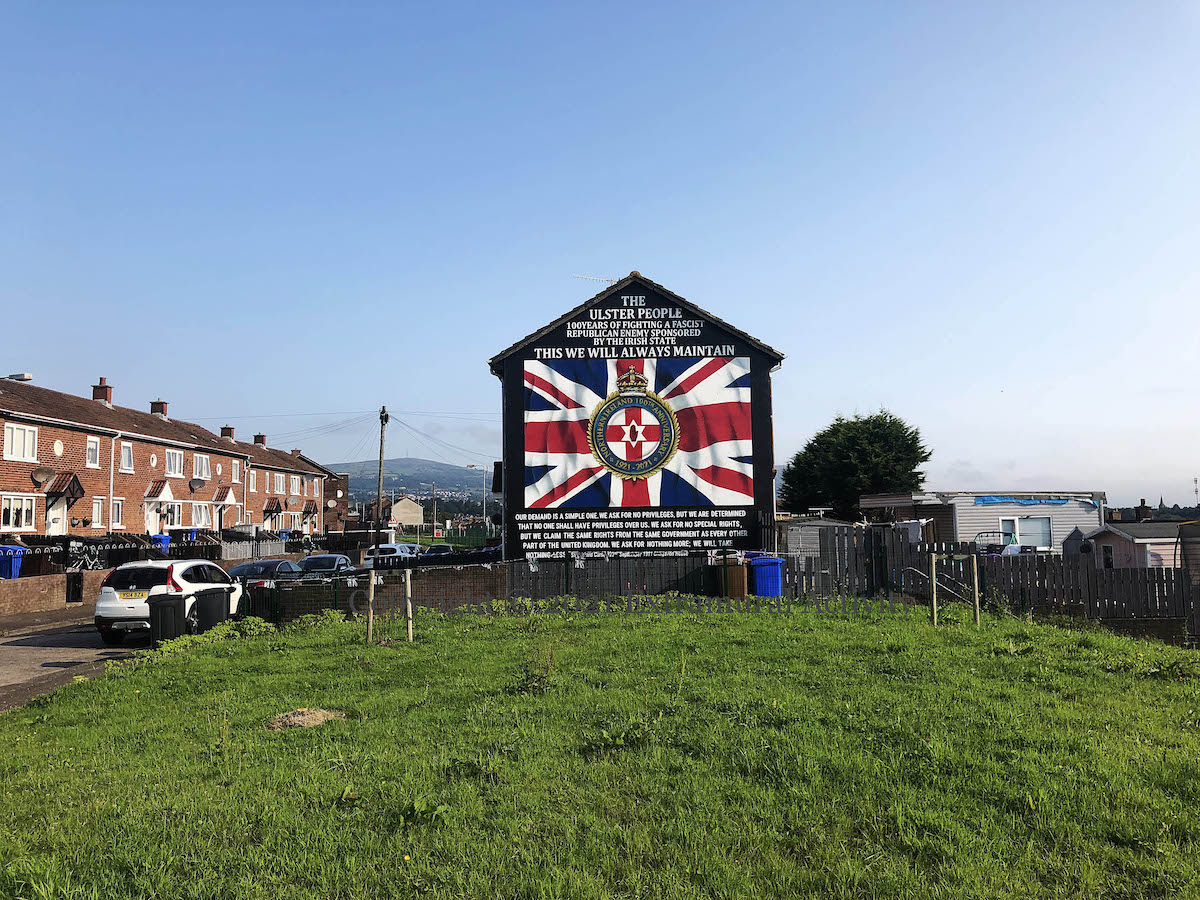
This mural celebrating the centenary of Northern Ireland’s creation, in the Woodburn estate, Carrickfergus, accurately shows the Tudor crown on the arms, as was used at the time of creation and prior to the Edwardian crown (WP).
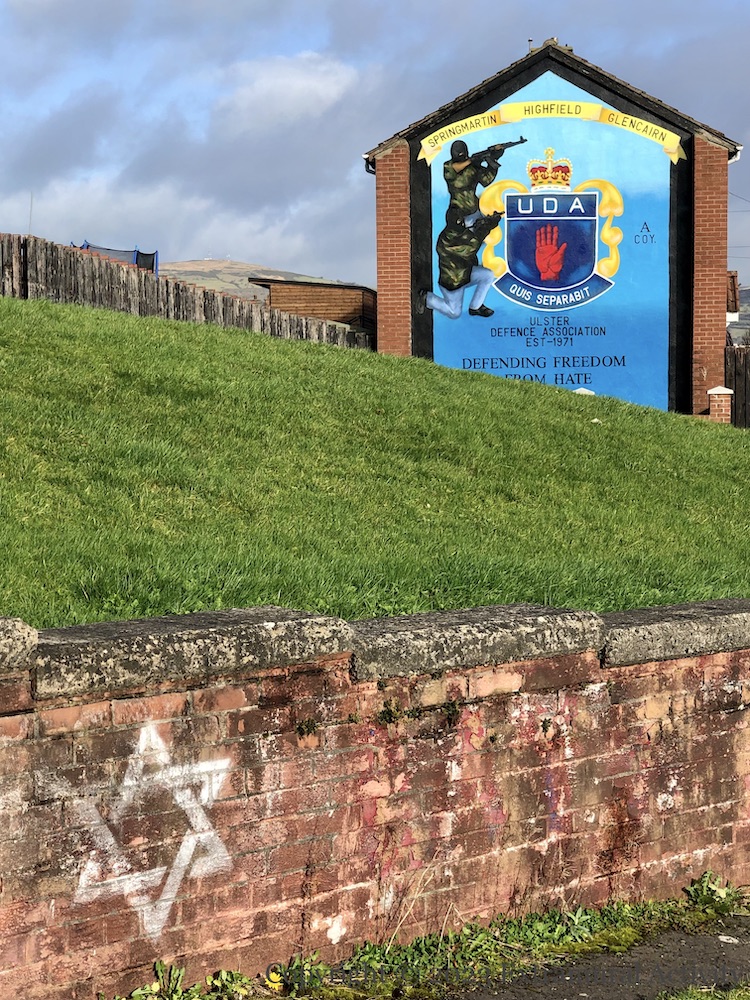
Compared to the UVF, the UDA more strongly detect an existential threat to loyalism and evince a siege mentality that provokes the need for armed resistance. Hence the more frequent presence of armed gunmen in UDA murals (which is also due in part to the UVF being able to “re-image” around the Ulster Volunteers and the Somme). With Brexit and the Protocol, however, armed gunmen have recently been appearing more frequently in UVF murals – see, for example, If Our Shores Are Threatened | Bang Up To Date | Our British Identity.
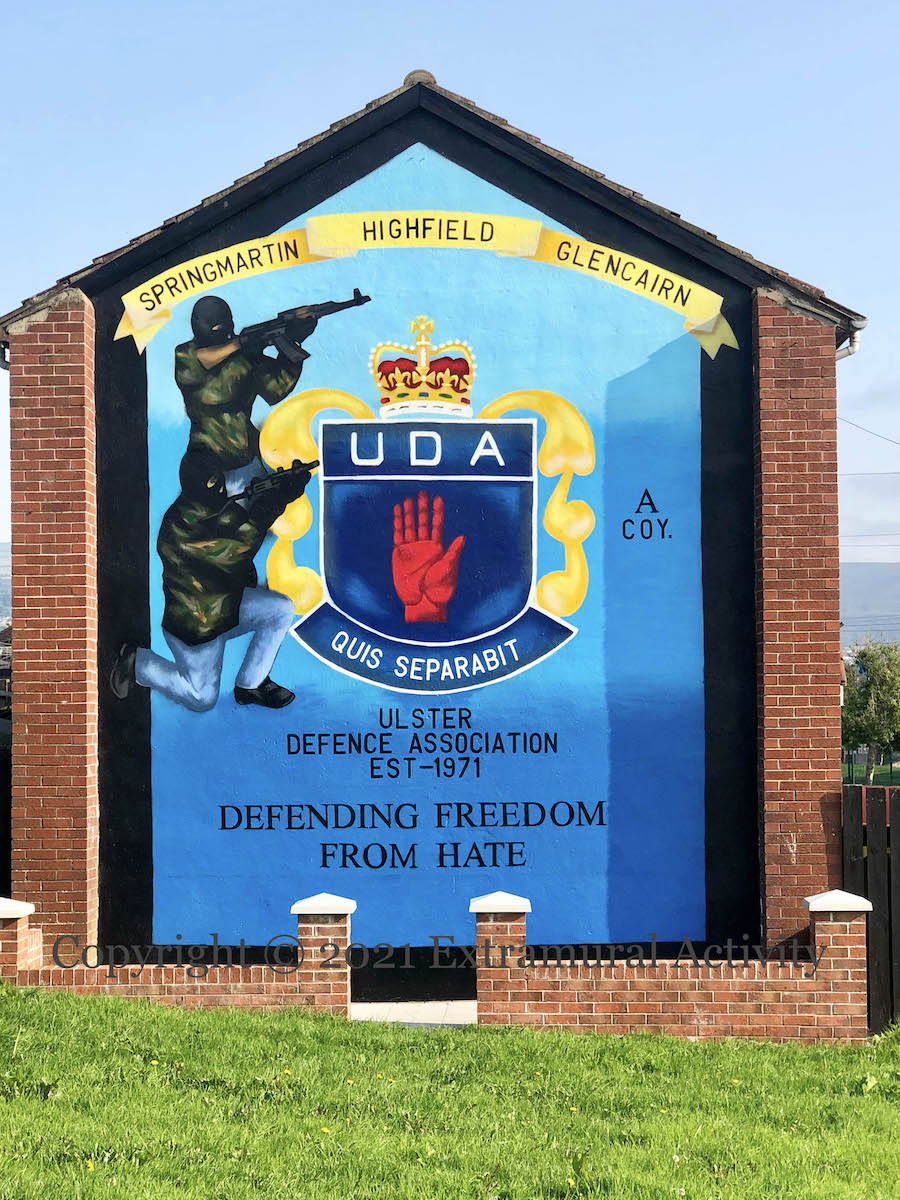
“Springmartin–Highfield–Glencairn Ulster Defence Association est. 1971. Defending freedom from hate.” As the companion mural (We Will Take Nothing Less) makes clear, the hate is coming from a “fascist republican enemy” (“Sinn Fein/IRA”, presumably) and the government of Ireland. Graphically, this mural is the same as the previous one on this wall: Under The Protection Of The UDA.
An estimated 100,000 people congregated at Craigavon House on the 23rd of September, 1911, to hear Edward Carson’s inaugural speech as Unionist leader (McNeill Ch. 4). In his speech he said “Our demand is a simple one. We ask for no privileges, but we are determined that no one shall have privileges over us. We ask for no special rights, but we claim the same rights from the same government as every other part of the United Kingdom. We ask for nothing more; we will take nothing less”. Ten years later, in 1921, Northern Ireland was created and it has survived to reach its centenary, despite (according to this mural) “100 years of fighting a fascist republican enemy sponsored by the Irish state.”
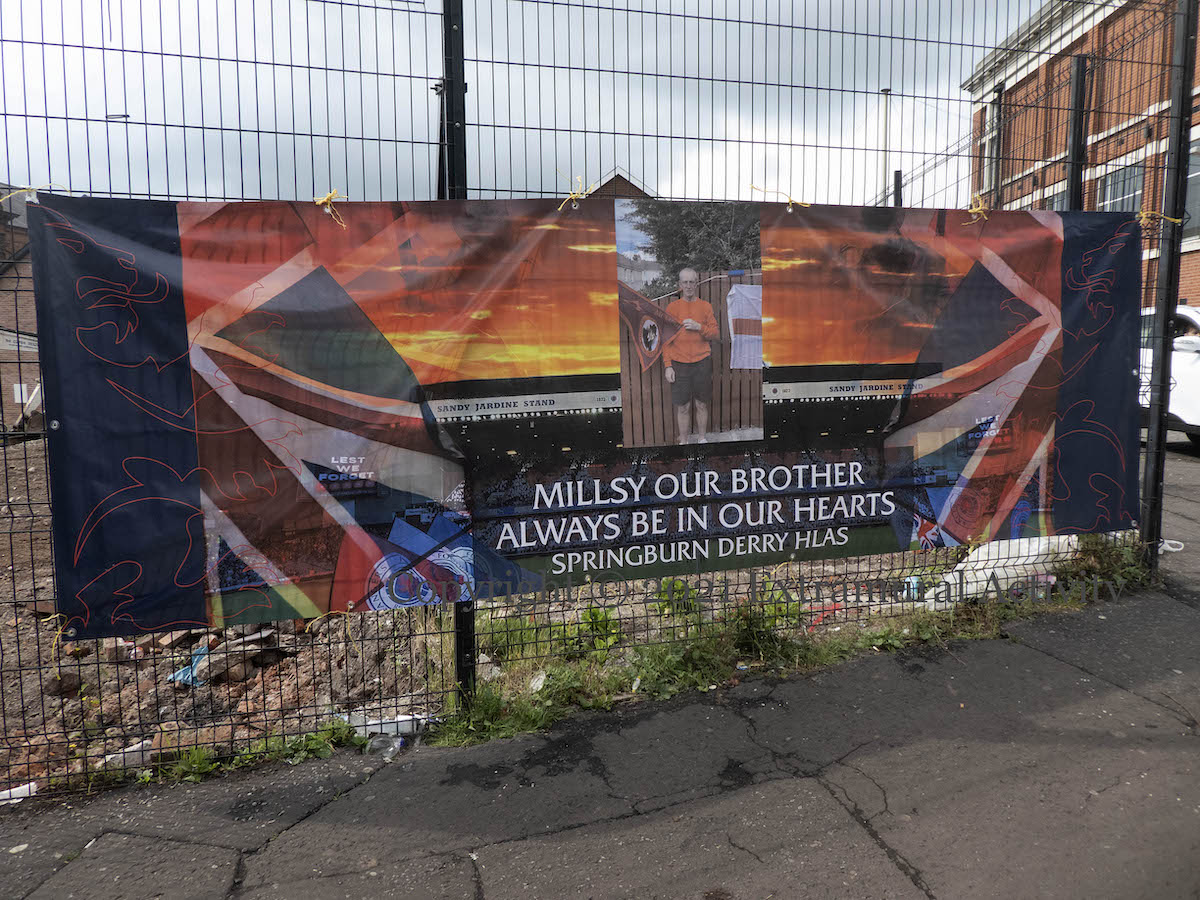
Another tribute to Scottish friends: “Millsy our brother, always be in our hearts. Springburn Derry (Fb)”. Please get in touch if you have any information about “Millsy”, from Springburn in Glasgow, Scotland and supporter of Rangers (the north stand at Ibrox is named after Sandy Jardine, star player for Rangers (and Scotland) in the 1970s (WP)).
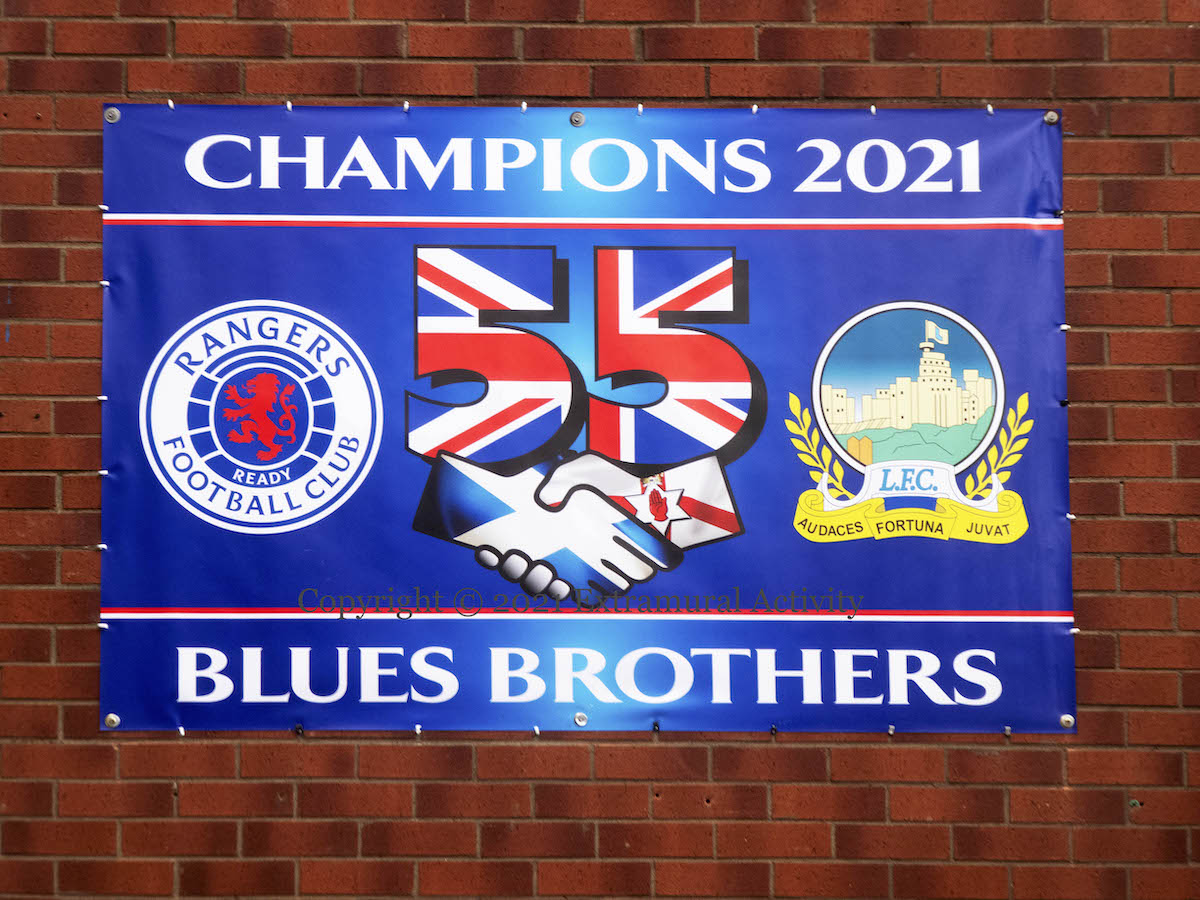
Local club Linfield are premier league champions for the 55th time, matching Glasgow Rangers in Scotland for the most league championships in the world. The celebratory tarp is at the Rangers Club on the Shankill Road.
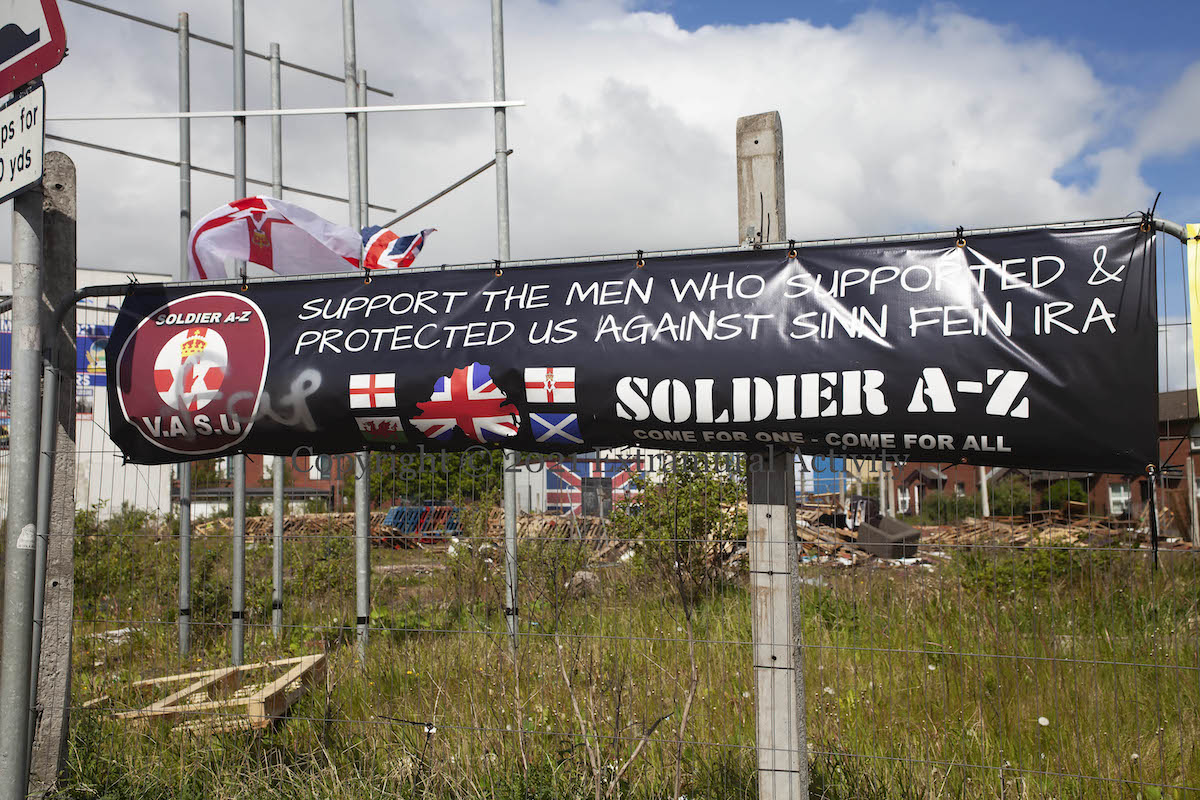
In April, UK Defence minister Johnny Mercer resigned/was sacked due to his protestations over the Overseas Operations bill (which passed on April 29th but does not apply to service in NI (BBC)) and the prosecution of two soldiers for a 1972 killing of Joe McCann – they were acquitted (BelTel). Cases against British Army soldier will continue to be investigated, however, unless there is legislation introduced by the British government to deal with “legacy” issues in Northern Ireland. This VASU tarp is next to the Boundary Way waste ground, site of the lower Shankill bonfire. “Support the men who supported & protected us against Sinn Fein IRA – Soldier A-Z.”
Both Clifton Street Orange Hall and the statue of King William pre-date the creation of Northern Ireland in 1921. The building opened in 1885 (ArchSeek | Belfast Media gives 1886) and the statue was unveiled before a crowd of 50,000 on November 11th, 1889 ((Melbourne) Advocate | (Sydney) Protestant Standard).
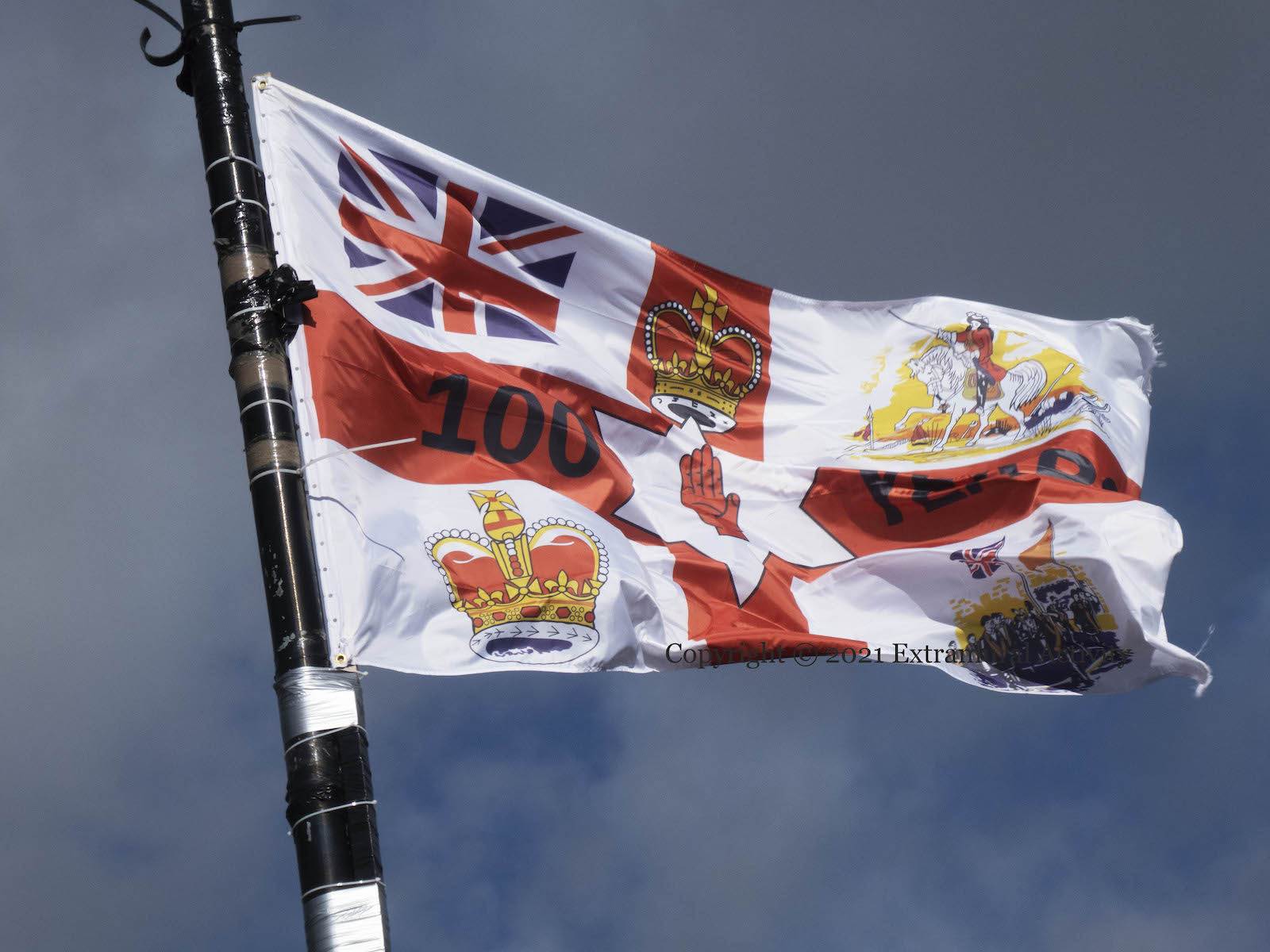
The fourth “Home Rule” bill, formerly known as the “Government of Ireland Act” was passed by the 11 November, 1920, and came into effect on May 3rd, 1921, partitioning Ireland into Southern Ireland and Northern Ireland (WP). There has been little to mark the centenary, perhaps due to distraction from Brexit and the DUP leadership change. The flag shown above celebrates the creation of the North, showing, clockwise from bottom left, the Crown, the Union Flag, King William at the Boyne, and Orangemen parading.
After a break for the funeral of the Duke Of Edinburgh, the Loyalist Communities Council has resumed its protest of Brexit with a banner campaign (Irish News). The banner seems to be offering viewers the choice of one of four affiliations (“Europe – UK – USA – Ireland – choose one or the other! It’s your decision!) but the “correct” answer is at the bottom (and in the faded background of the Covenant): “Ulster is British and this we will always maintain!” even though “Political leaders are not listening!” (including, perhaps, Arlene Foster and the DUP.) The Belfast Agreement (Good Friday Agreement) allows people in Northern Ireland to identify themselves as Irish, British, or both.
Banners have been placed in various PUL areas; this one is along the York Road. The launch of the campaign outside the Irish Secretariat Office in Linenhall St, which the Belfast Telegraph called “tiny” as it involved only the LCC’s David Campbell and David McNary, was interrupted by Gareth McCord (BelTel video) whose brother Raymond was beaten to death by the UVF in 1997, allegedly to cover up drug dealing by the Mount Vernon UVF (Magill).







 Extramural Activity