IRA volunteer (and marksman in the Irish Army) John Starrs was killed in a May 13th, 1972, gun battle with the British Army in William Street (Seachranaıdhe), near his plaque in Chamberlain Street, Derry, which is also home to Connolly House, home of the IRSP in Derry, and Junior McDaid house, home of Saoradh/IRPWA.
The Wolfe Tones will headline the 2015 Ardoyne Fleadh Cheoıl (Fb) on August 15th. Last year, The Druids caused controversy by advising British Army forces and loyalists to go “back to England” (BelTel).
Along the bottom are various of the posters/programme covers from years past: (left to right) the 1998 cover, by Sean Doran, was also painted in Ardoyne Avenue; Cú Chulaınn on the 1999 poster was painted in Ardoyne Avenue (S00089); the fiddler and bodhrán player appeared on a t-shirt; a classic Wolfe Tones poster shows the four faces in profile; Fleadh Érıu on the 1995 poster (under the go-kart’s left wheel) was painted on this wall in 1994; the 1996 Fleadh poster, also by Sean Doran; disappearing on the right is Doran’s 1997 cover.
The Ardoyne Fleadh Cheoıl emblem (on the go-karter’s t-shirt and under the text on the left) was used in Maıreann An Spıorad. The festival began in 1970.
A new mural will be launched as part of this year’s festival: Boxing Champions.
Englishman Clive Dutton was an urban planner who was best known for work in Birmingham, London (Newham), and Belfast. He produced “The Dutton Report” in 2004 and “The Big Plan” (pdf) (the cover of which is pictured in the mural) in 2013. In them, he proposed and then updated a plan to tackle economic deprivation in west Belfast by the creation of a ‘Gaeltacht Quarter’ or ‘Ceathrú Gaeltachta’. He died on June 8th at the age of 62 and the mural above has been painted in remembrance.
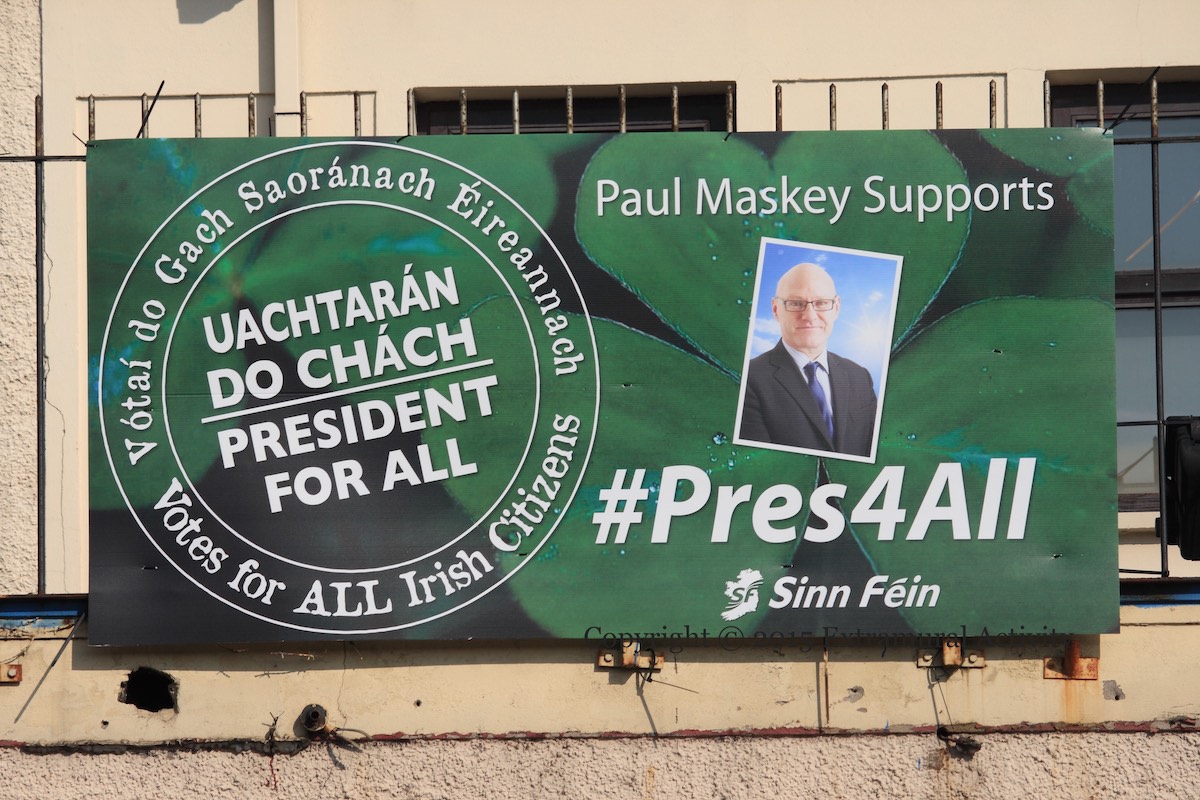
“Paul Maskey supports votes for ALL Irish citizens.” Eligibility for voting in the Presidential election is based on eligibility for voting in Dáıl elections, which requires being a resident in a Dáıl constituency. As such, non-residents – whether in Northern Ireland or elsewhere – are not eligible. The matter was among those take up by the recent Constitutional Convention and a reply from the government is expected by the end of May (WP). Maskey is the incumbent for West Belfast in May’s Westminster election.
On the railings of the shuttered O’Connor’s/Rebel’s Rest, Falls Road, Belfast.
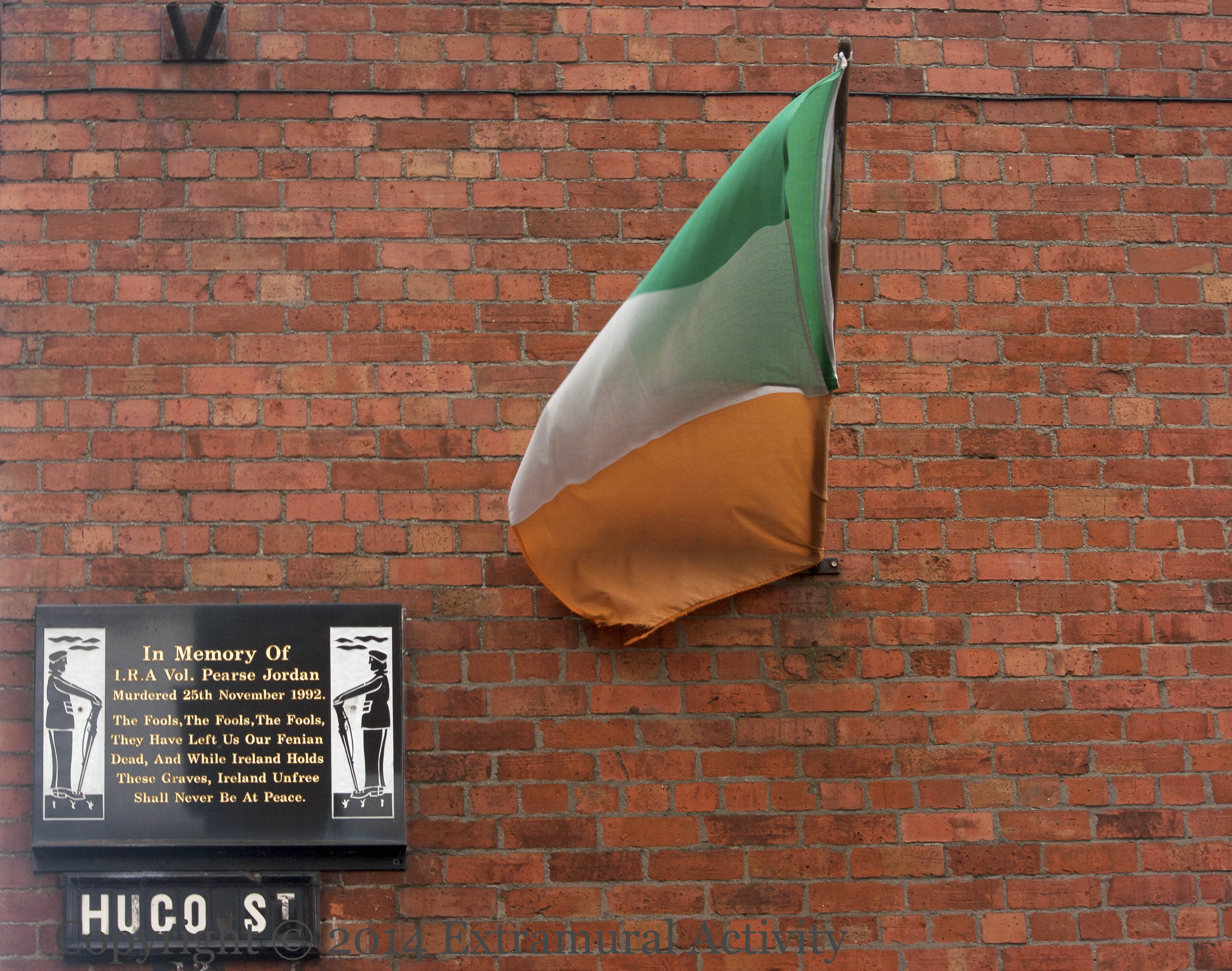
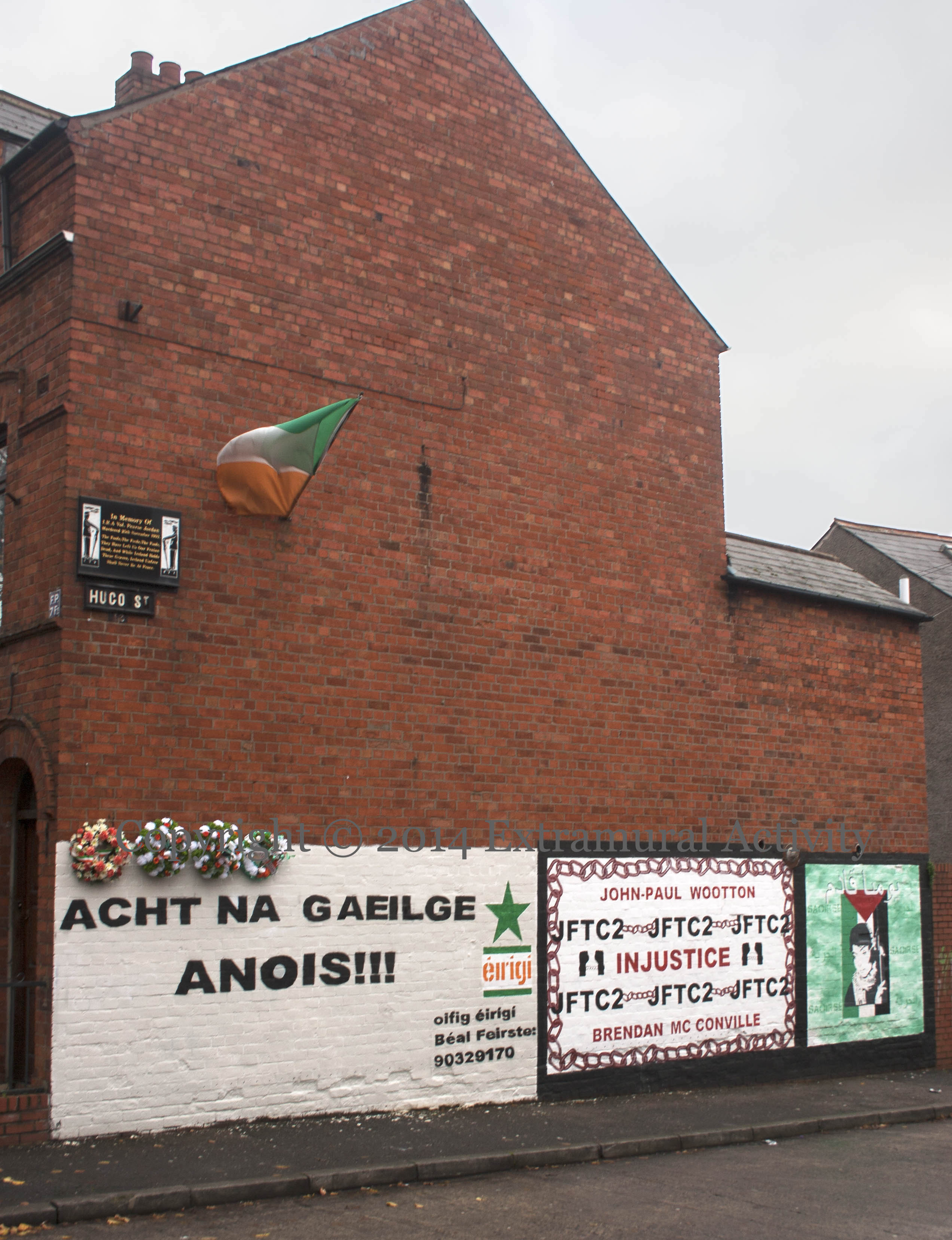
The Belfast Telegraph reports that an Irish language bill will be published in the near future, though the DUP have already rejected such an Act. (For more background and discussion see Brian Walker’s post a few days ago on Slugger.) The éırígí stencil above, calling for “Acht Na Gaeılge Anoıs!!!” – “An Irish Language Act Now!!!”, is in Hugo Street below a tricolour and a plaque in the memory of Pearse Jordan (see the second image, below). The wide shot shows the two other pieces on this side of the street, a ‘Justice For The Craigavon 2’ stencil (featured previously in Justice) and Palestinian skyjacker Leila Khaled.
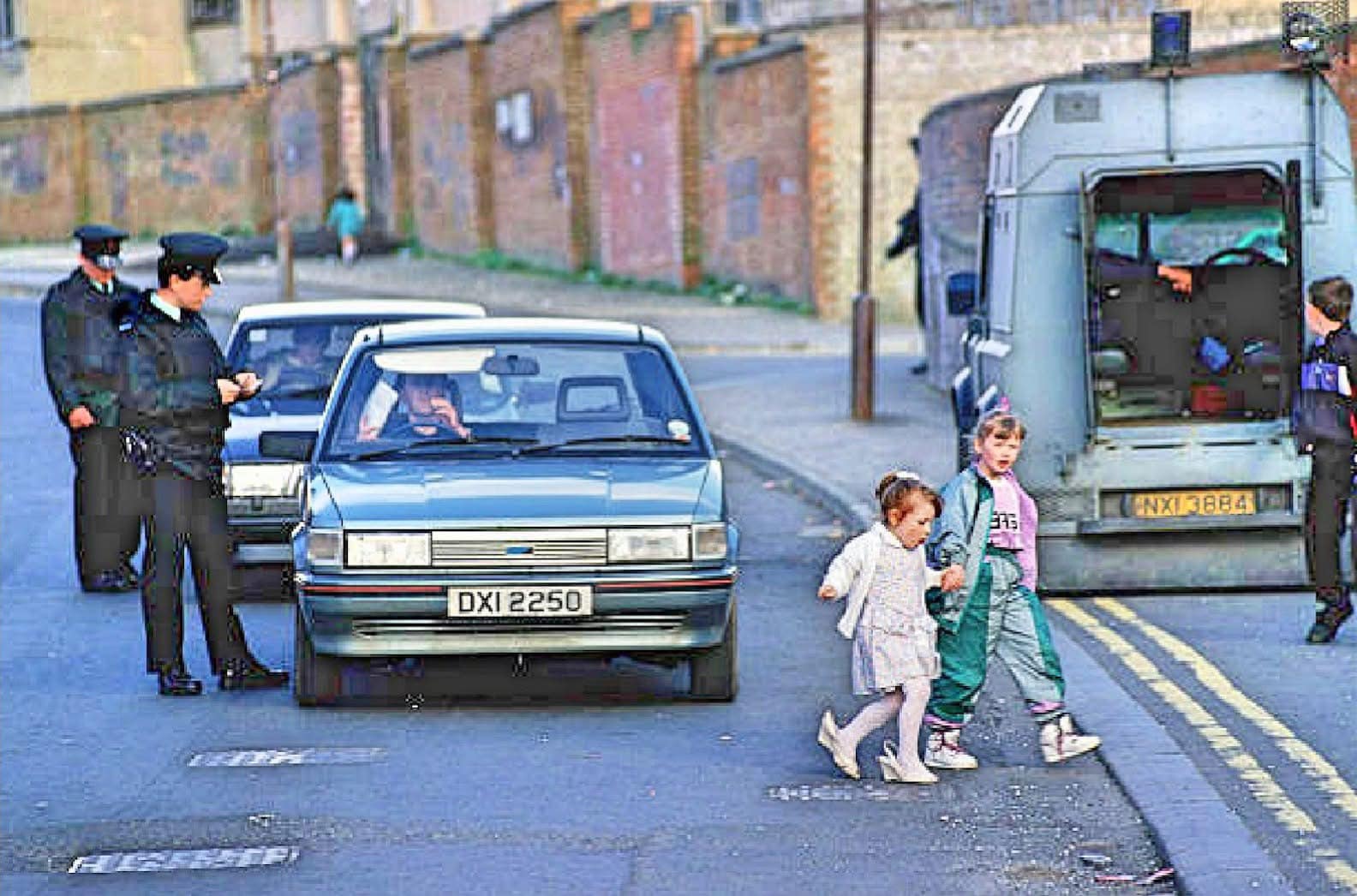
A young girl wearing an adult’s pushes a pram in the first of a dozen panels from the new ‘Fáılte go dtí Ard Eoın’ mural in Ardyone Avenue. The image is perhaps based on the (unattributed) photo, shown below the images of the mural.
2-3: The woman on the right is a spinner – her job is to ensure that the fibres of threads being wound together to make a strong thread do not break. The occupation of the man on the right is unknown. Please comment or send an e-mail if you recognize his occupation.
5-6: Two panels featuring boxers, possibly Freddie Gilroy and Eamonn Magee — leave a comment or e-mail if you can identify either.
8: Holy Cross church on the Crumlin Road.
9: A British soldier patrols the streets while a girl walks home from school and a boy plays hurley. This is one of the panels in the long mural at the shops on Ardoyne Avenue.
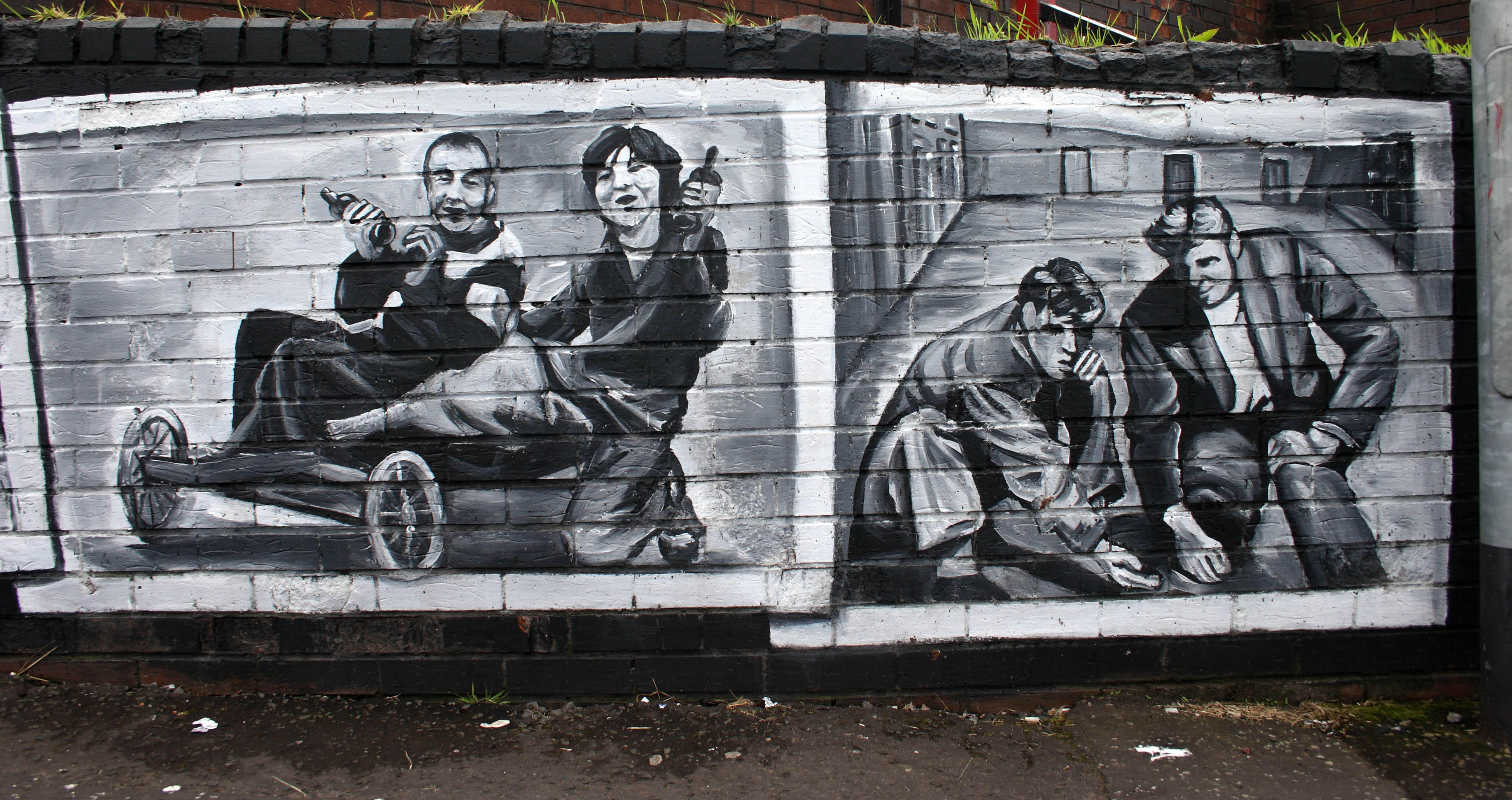
10-11: Two go-karters appear to be brandishing bottles as they ride while, to their left, two (rather stylish?) youths appear to be banging bin-lids.
“Is fearr Gaeılge brıste ná Bearla [Béarla] clıste” means “Broken Irish is better than clever English”.
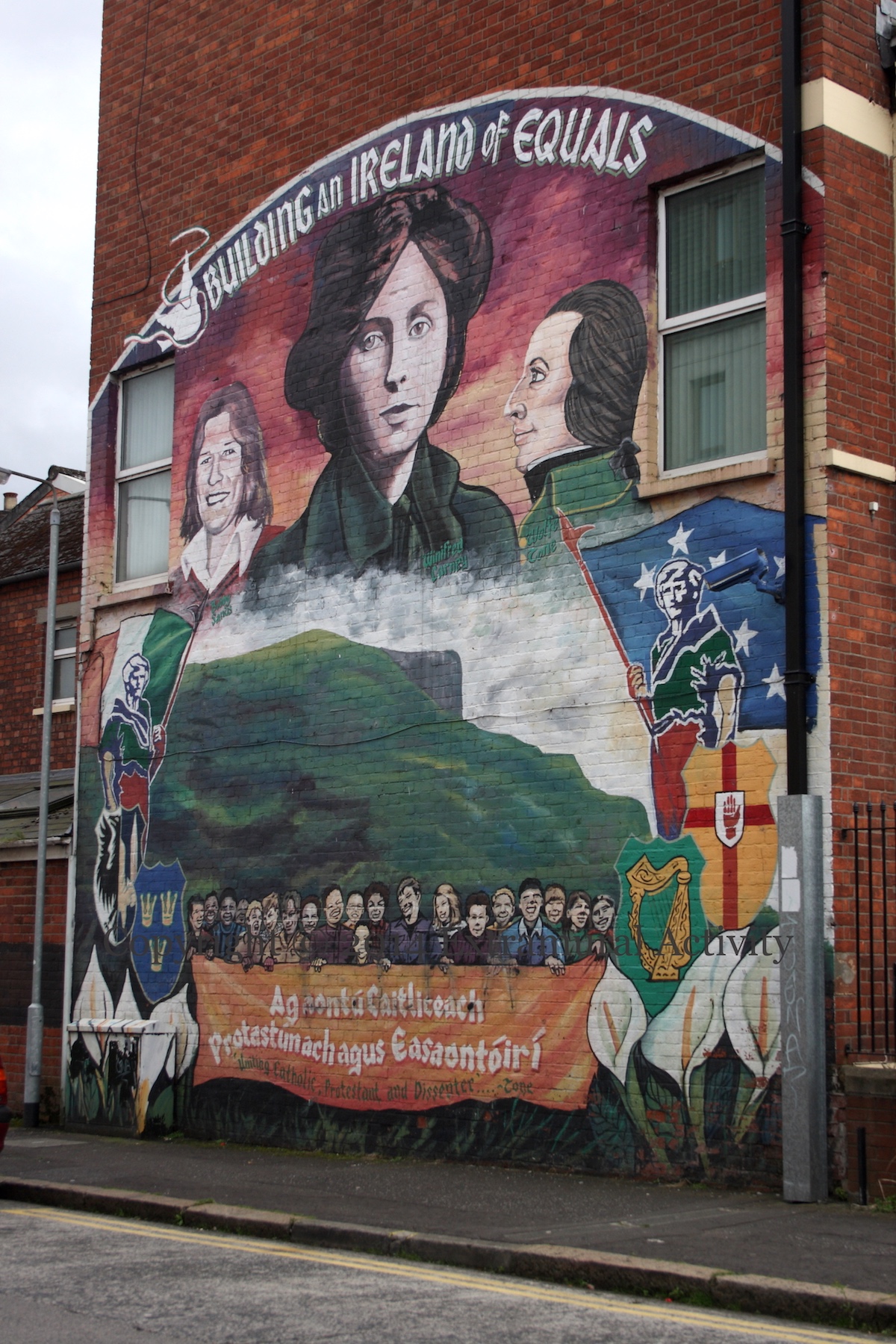
The aspect of Cave Hill commonly known as Napoleon’s Nose is shown sheltering the people of Newington, surrounded by heroes and emblems of the past – Bobby Sands, Wolfe Tone, and in the centre, Winifred Carney. This republican mural is both internally directed (at Newington and the New Lodge) and externally, being on the main Antrim Road (Oceanic avenue, on the side of the Sinn Féin office) which is a main artery between the city and points north.
“Ag aontú Caıtlıceach, Protastúnach agus Easaontóırí.” – “Uniting Catholic, Protestant, and Dissenter.” In An Argument On Behalf Of The Catholics Of Ireland (1791), Wolfe Tone of the United Irishmen wrote, “To subvert the tyranny of our execrable government, to break the connection with England, the never-failing source of all our political evils, and to assert the independence of my country, these were my objects. To unite the whole people of Ireland, to abolish the memory of past dissensions, and to substitute the common name of Irishman, in place of the denominations of Protestant, Catholic and Dissenter, these were my means.”
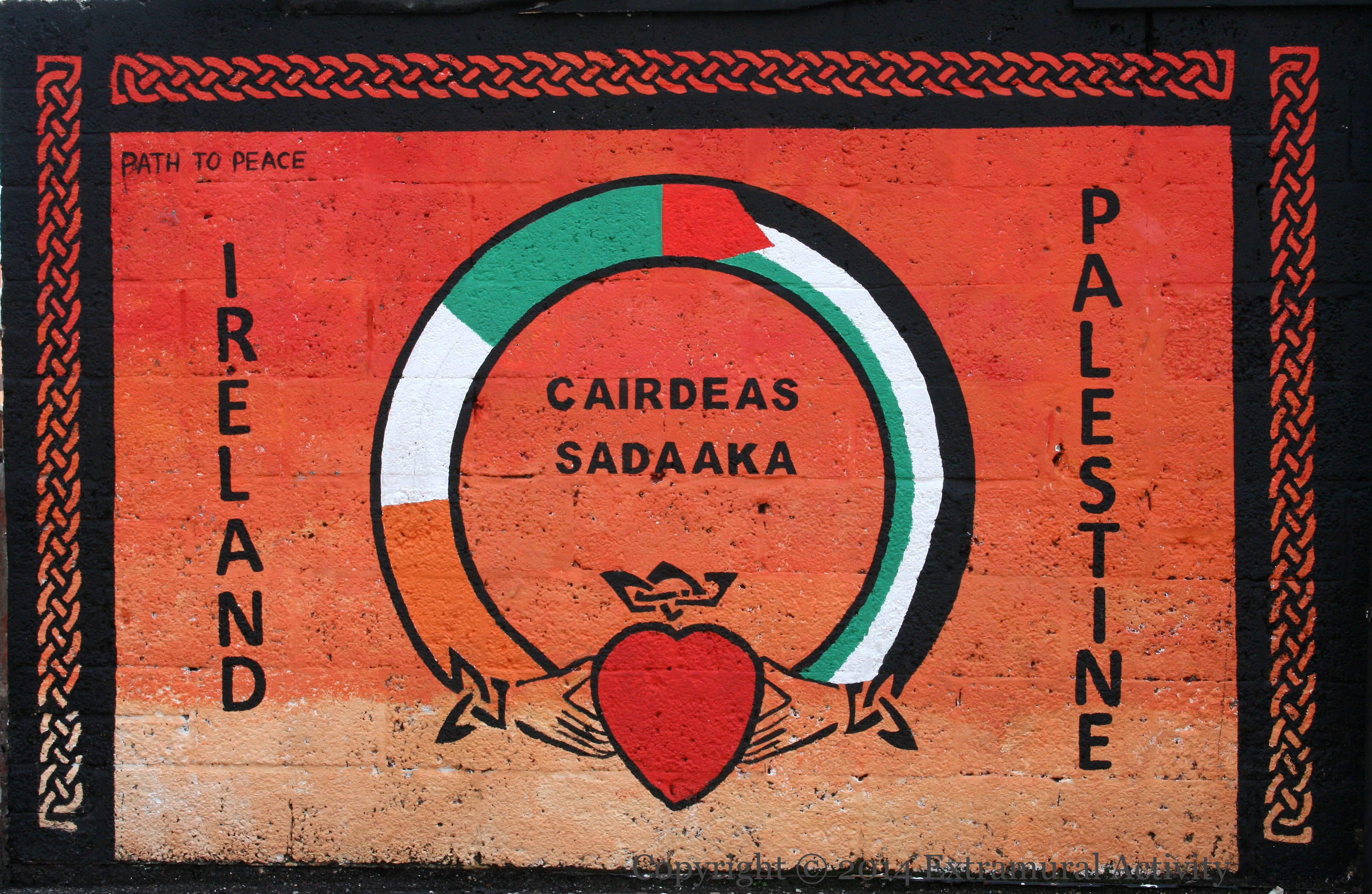
A Claddagh ring connotes friendship (caırdeas – sadaaka), love, and loyalty, here between Ireland and Palestine. The band is composed of their two flags. The wide shot, below, shows the adjacent “Free Palestine” mural, also featuring the Palestinian flag.
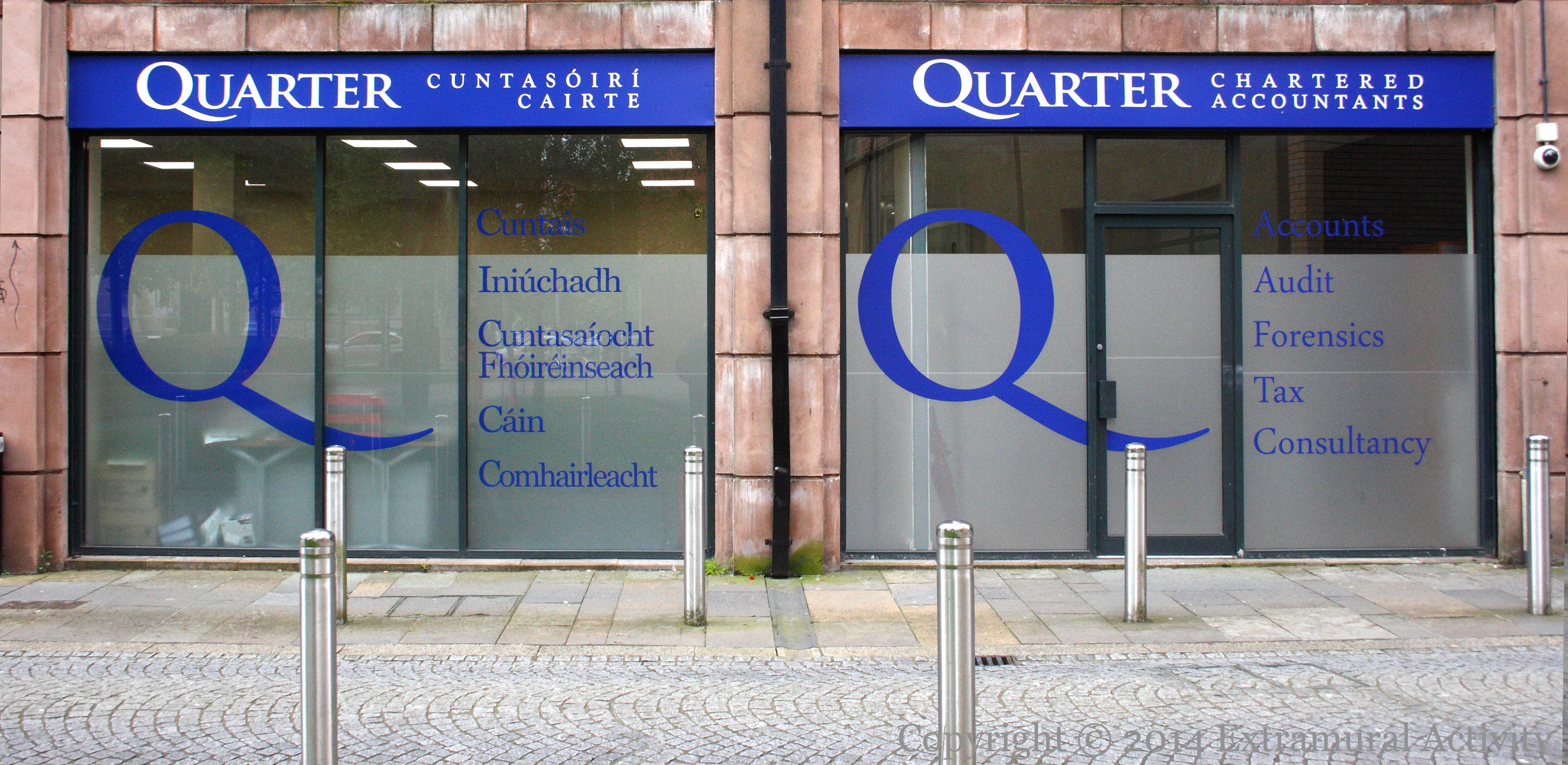
Belfast has seven geographical quarters and an eighth one in the form of Quarter Accountants/Cuntasóırí in Belfast’s city centre. Notably, the signage is in both English and Irish; the business is in the Cathedral Quarter rather than the Gaeltacht Quarter.










 Extramural Activity