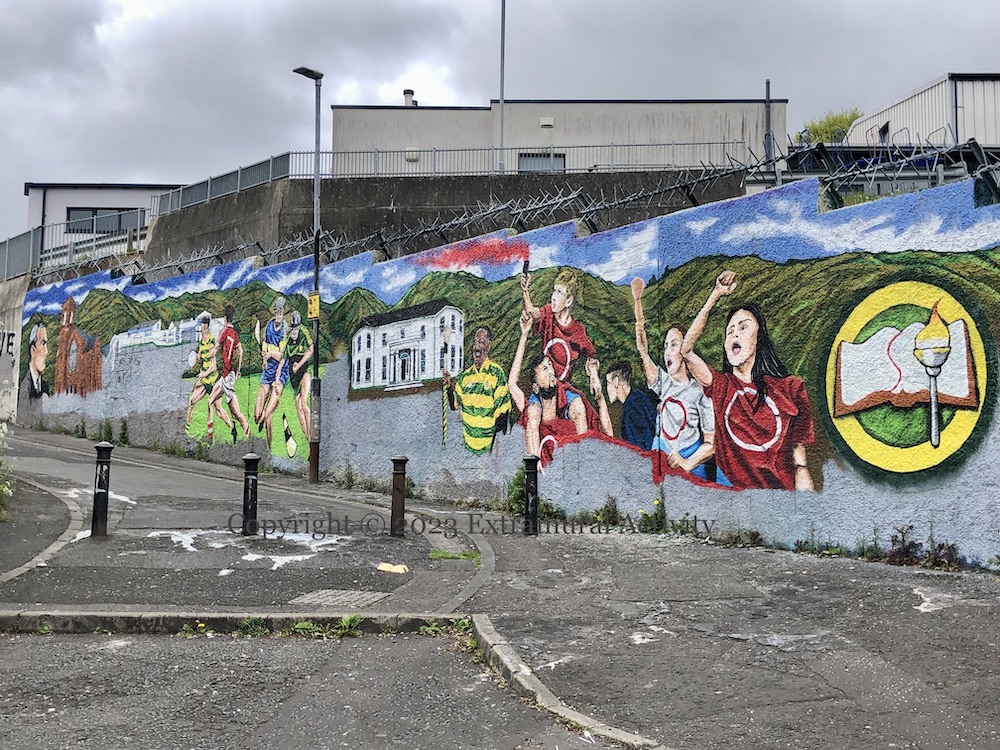
It is a year since the new policy on bilingual street signs was made public; by September there had been 500 applications (Belfast Media) but by January of this year no new signs had been erected and 600 applications were awaiting decision (Belfast Live | Irish News from Feb). One new sign – shown here – was erected in February on Clifton Street (Belfast Media).
“Pobal ag foghlaım, pobal ag forbaırt, pobal ag fás” [a community learning, developing, growing]
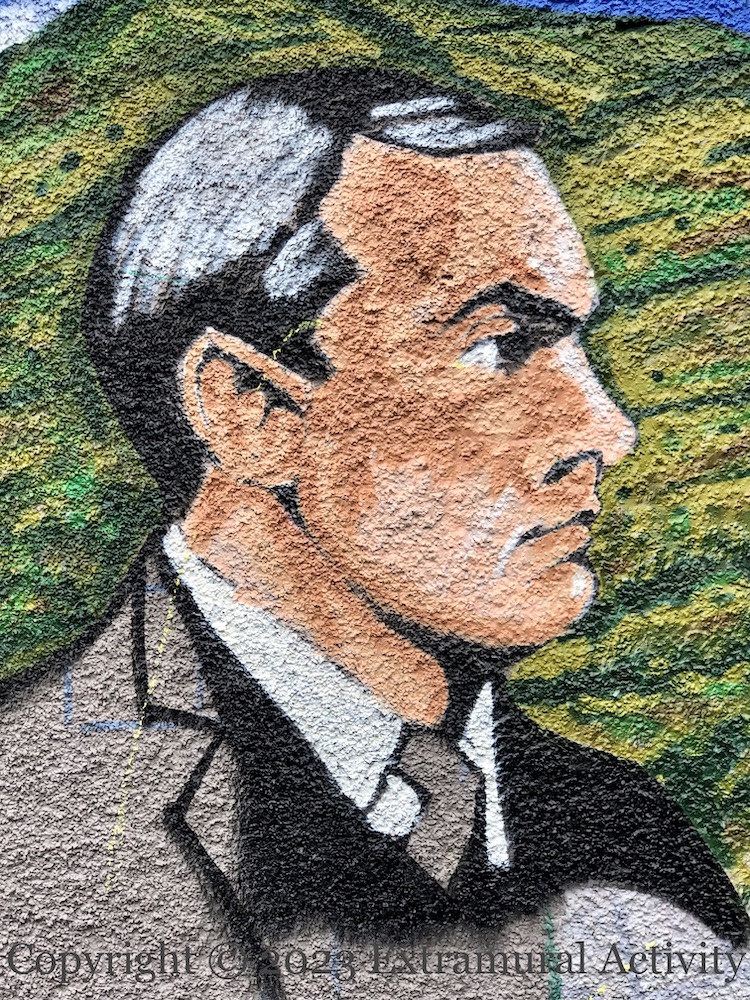
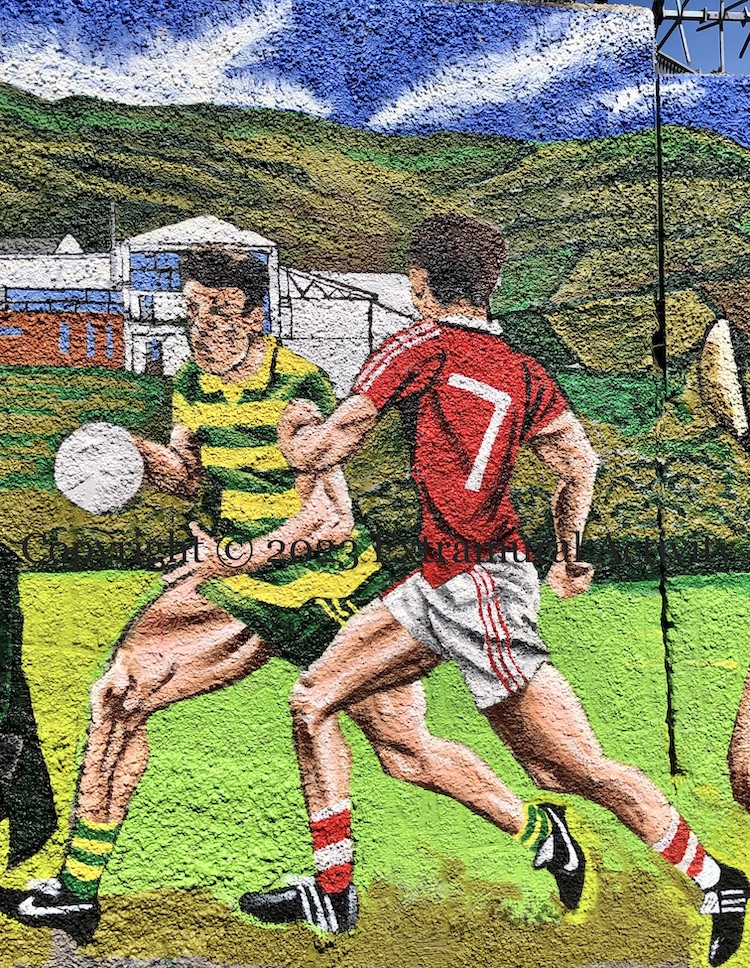
Students from “Naíscoıl & Gaelscoıl An Lonnáın (Fb) bun[aithe] 1999″ [Nursery-school and Irish-language [primary] school of the loney, founded 1999] are shown playing Gaelic games, Irish dancing, and playing traditional instruments (and the guitar). On the left are representations from Irish mythology: the Children Of Lear and Setanta killing Culann’s hound (and taking the name Cú Chulaınn in taking its place), along with hedge-row school (see Hedge Row School).
The origin of the name is unclear; the nearest loney [lane] was the “Pound” loney, so-called because of the animal pen just outside Barrack Street, used to store livestock before moving on to the markets the following day (Rushlight | Uachtar Na bhFál). (The Pound Loney is included in the mural in Durham Street – see Et In Arcadia Ego.)
The other well-known loney in Belfast is the “buttermilk loney” which was either/both what is now Ballysillan Park (that is, connecting Olpark with the horsehoe bend) or the top part of the loney that connected Wheatfield (the top of Ardoyne) to the Ligoniel junction and on towards the old Ligoneil House (there are a mixture of usages in this Belfast Forum thread); this image from the 1930s might show the lane in (what was still at the time) the hills above Oldpark; a new housing-development towards the top of the Ballysillan Park is euphemistically called “Buttermilk Loney”. (It is also said to have been a prior name of Skegoniell Avenue (Belfast History).)
(The Uachtar Na bhFál page also mentions “Turf” loney, “Mountain” loney, and “Killoney”.)
The history of the Irish word “lonnán” is unclear. Uachtar na bhFál says the word is of Scots origin (perhaps as “loanin”). (See this BelTel article on the opening of the Ulster-Scots centre in 2014.) Spelled “lonnen”, it is also a Geordie word (Heslop’s Northumberland Words | wiktionary). The Irish News and Belfast Live, working from the same (uncited) press-release about Páırc An Lonnáın (which is along the Westlink below Raıdıó Fáılte), state that “loney” comes from the English word “loaning”. The Irish word “lonnán” does not appear in Dinneen 1904; Dinneen 1953 defines it (hyper-specifically) as “a grassy recess running up into high basaltic cliffs”.
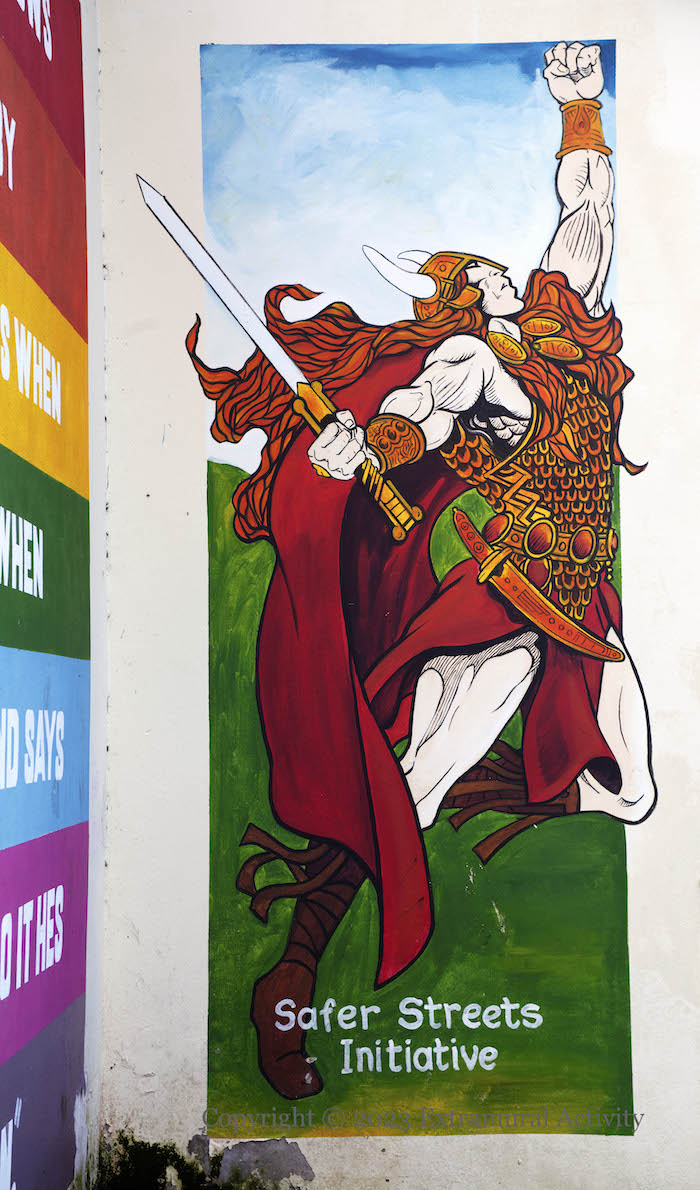
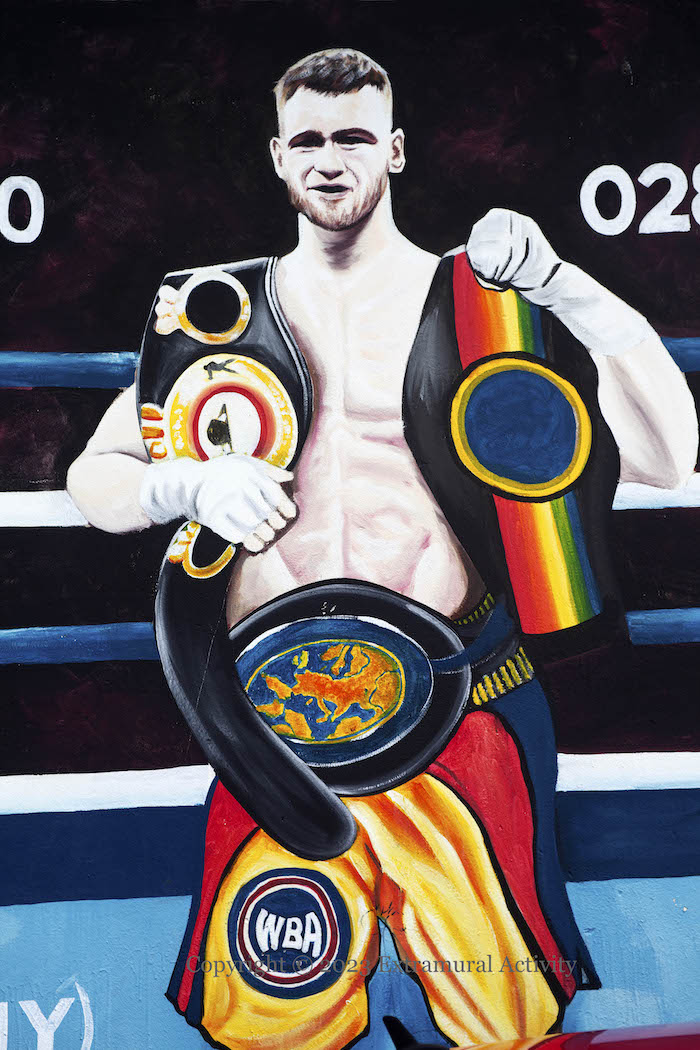
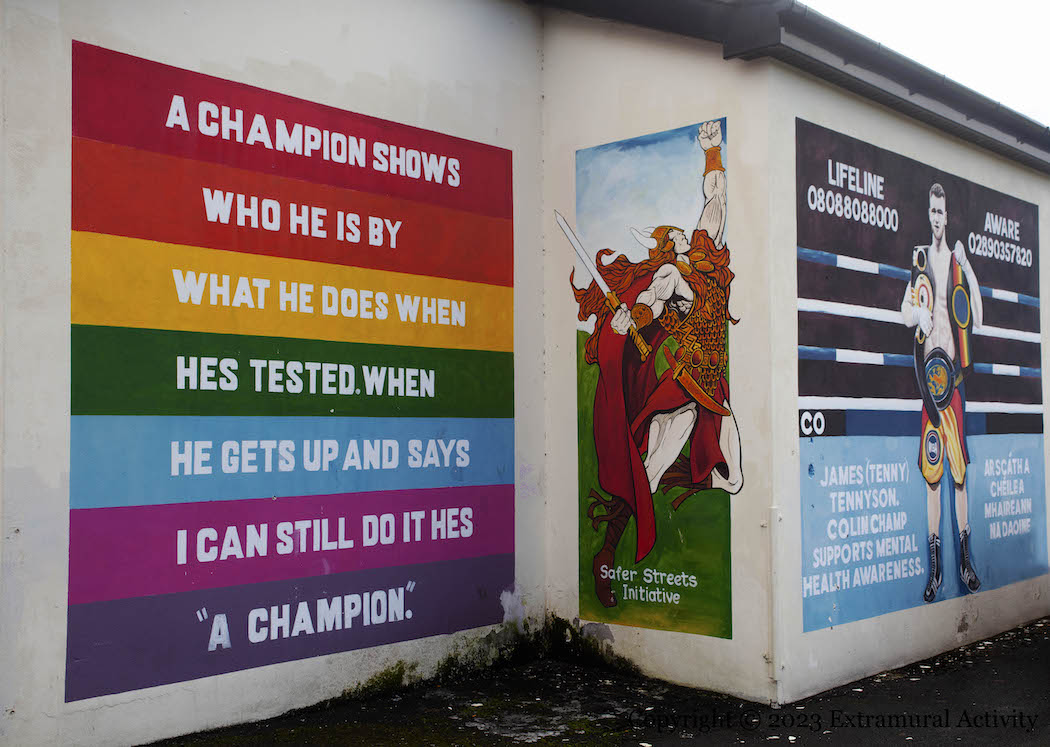
“A champion shows who he is by what he does when he’s tested. When he gets up and says “I can still do it”, he’s “a champion.” In Irish mythology, the Tuatha invade Ireland and battle the Fır Bolg. They are successful but their king Nuadha loses his arm and with it his kingship of the Tuatha. He had it replaced with an arm made of silver and regained his position. He is used here as an inspiration for those struggling with mental health, who are encouraged to call Lifeline or Aware.
(A history of Nuadha in murals is included in the Visual History page on Jim Fitzpatrick.)
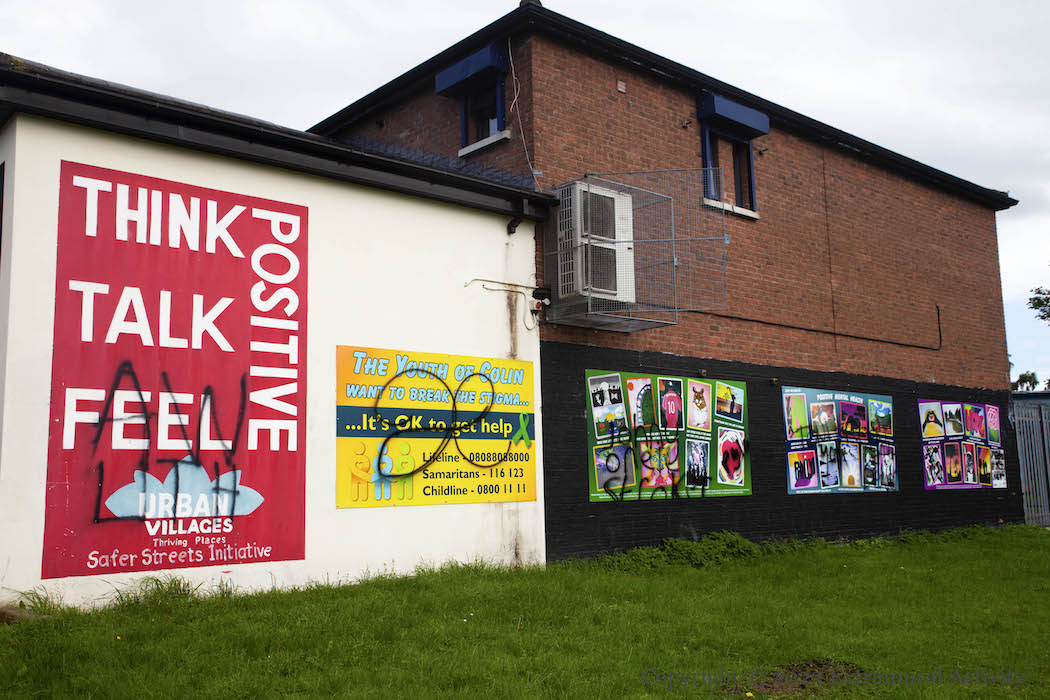
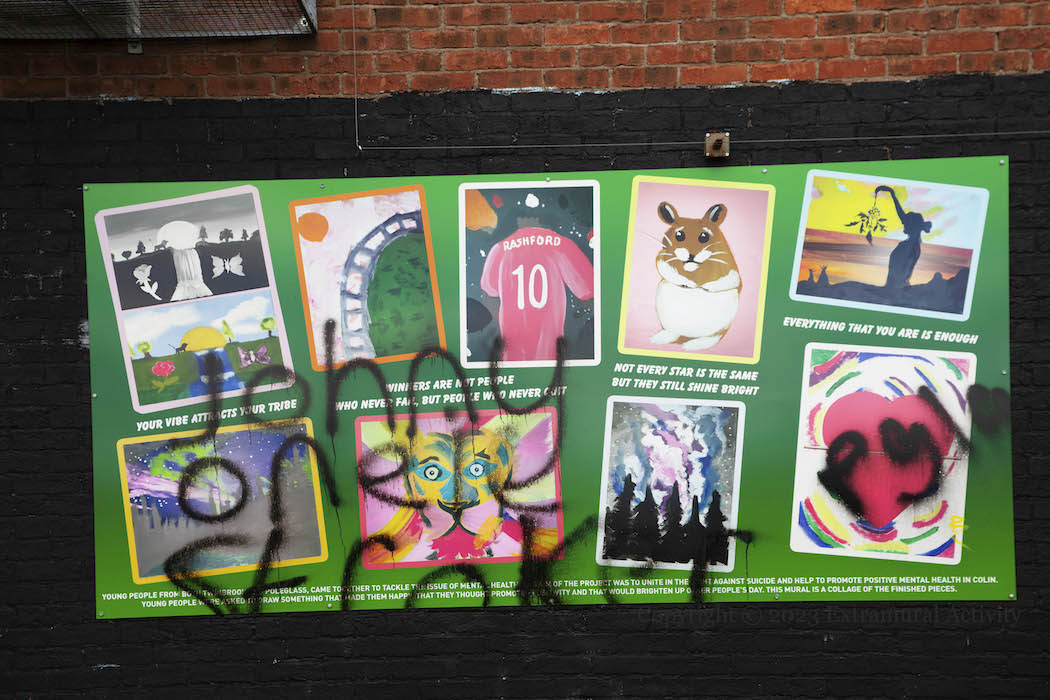
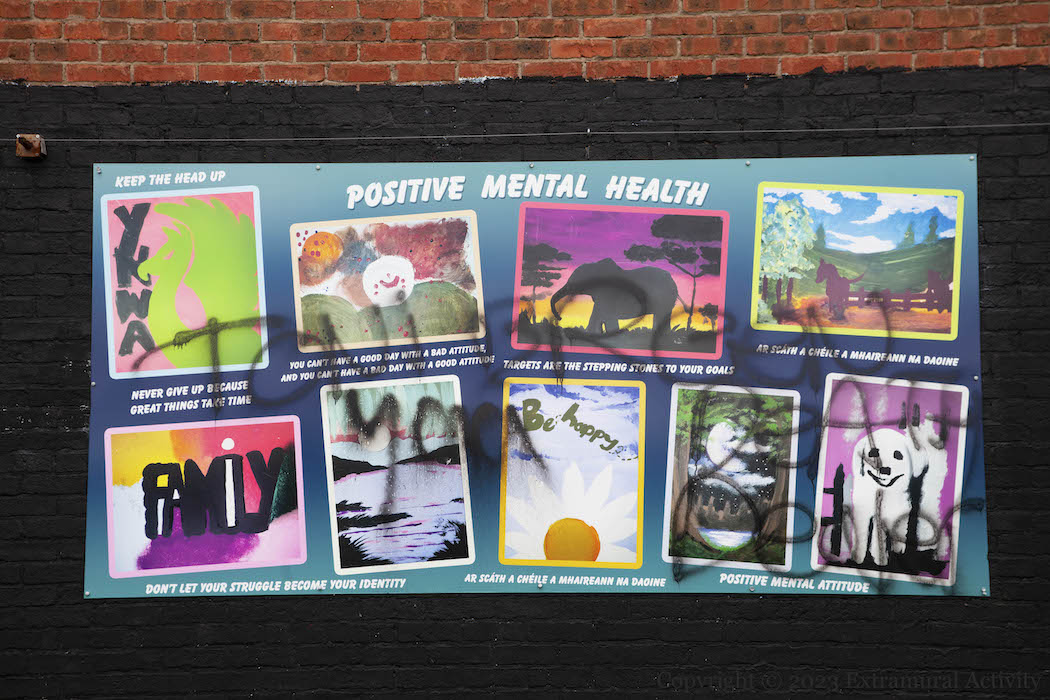
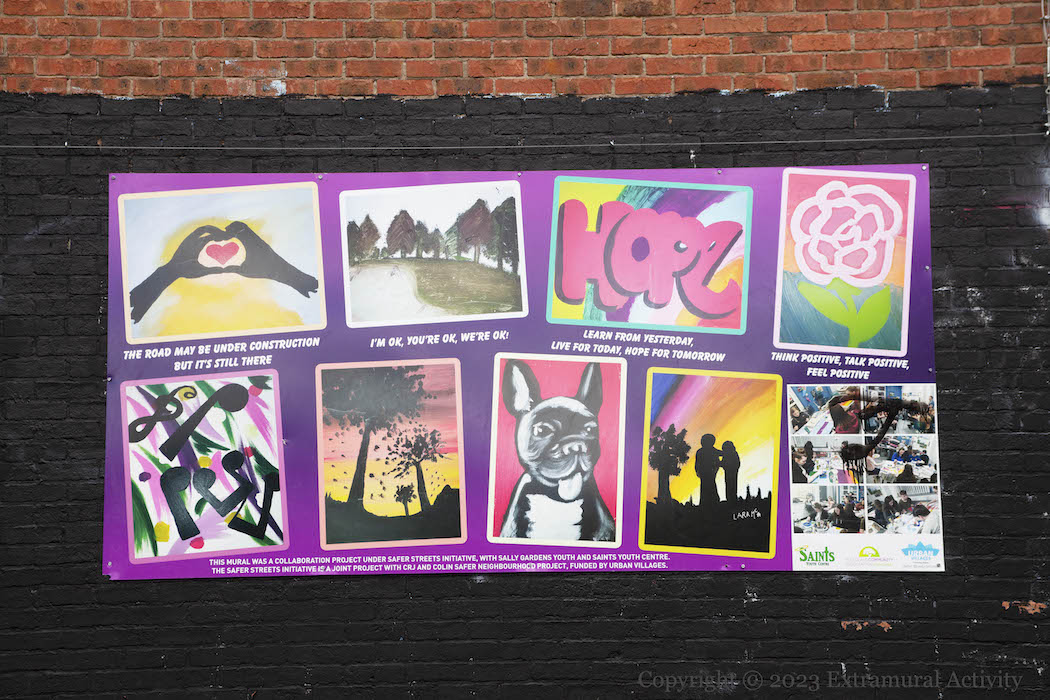
The modern-day hero accompanying Nuadha is boxer James “The Assassin” Tennyson, current Irish super-featherweight champion. There are also four mental health boards (shown below) around the corner from Urban Villages Colin Safer Streets Initiative with messages such as “Think, Talk, Feel – Positive”, “Everything that you are is enough”, “Learn from yesterday, live for today, hope for tomorrow”,
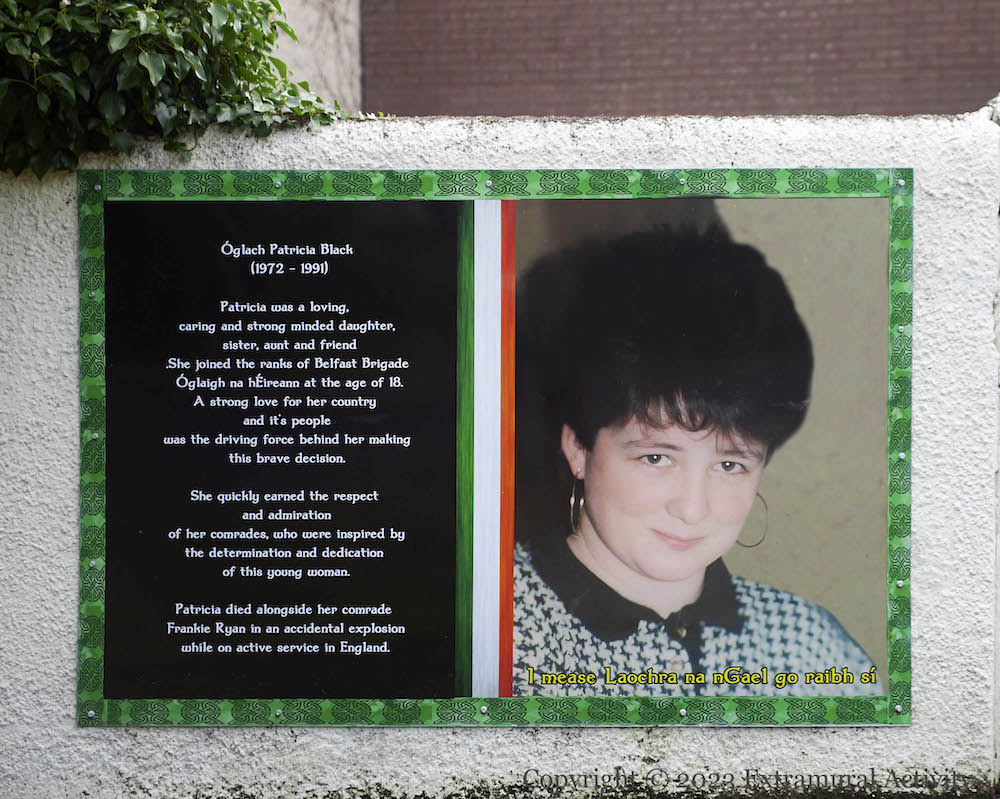
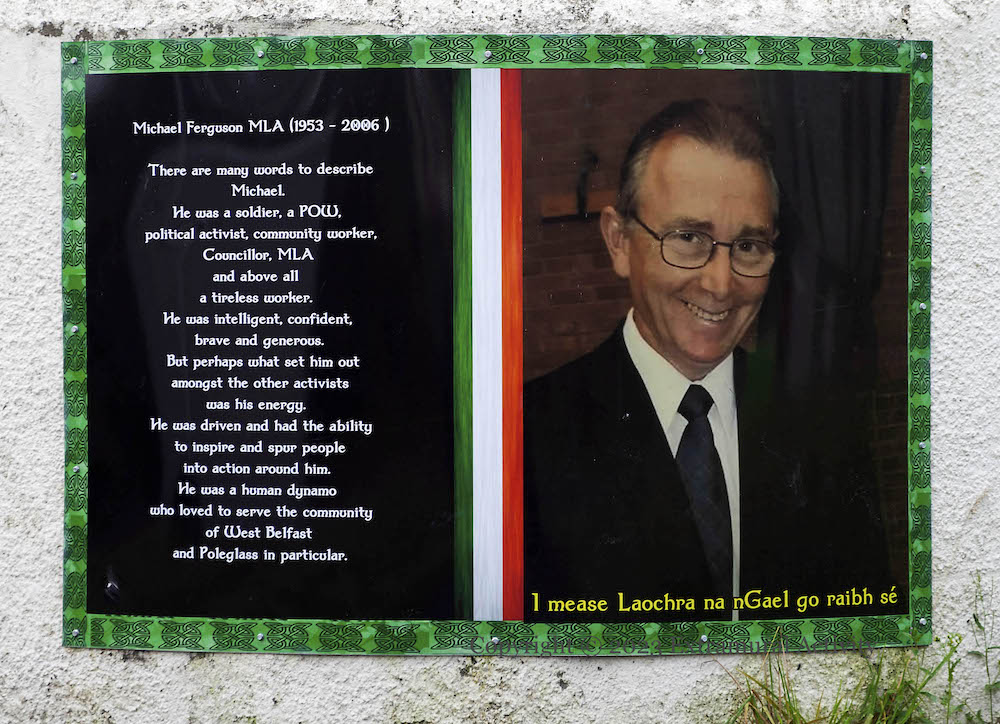
“I measc laochra na nGael go raıbh sıad.” Profiles of Patricia Black, Frankie Ryan, Michael Ferguson, and Sean Keenan were added in late 2021 (video of launch) to the pair of existing monuments that memorialise them in Colin/Poleglass (for which see The Undauntable Thought on Peter’s site).
Black and Ryan were IRA volunteers killed by in a premature bomb explosion near London (An Phoblacht).
Michael Ferguson and Seán Keenan were activists and Sınn Féın councillors. Both died in 2006 of cancer (Irish Times | Bel Tel).
On Pantridge Road, which runs down to Michael Ferguson roundabout (An Phoblacht).
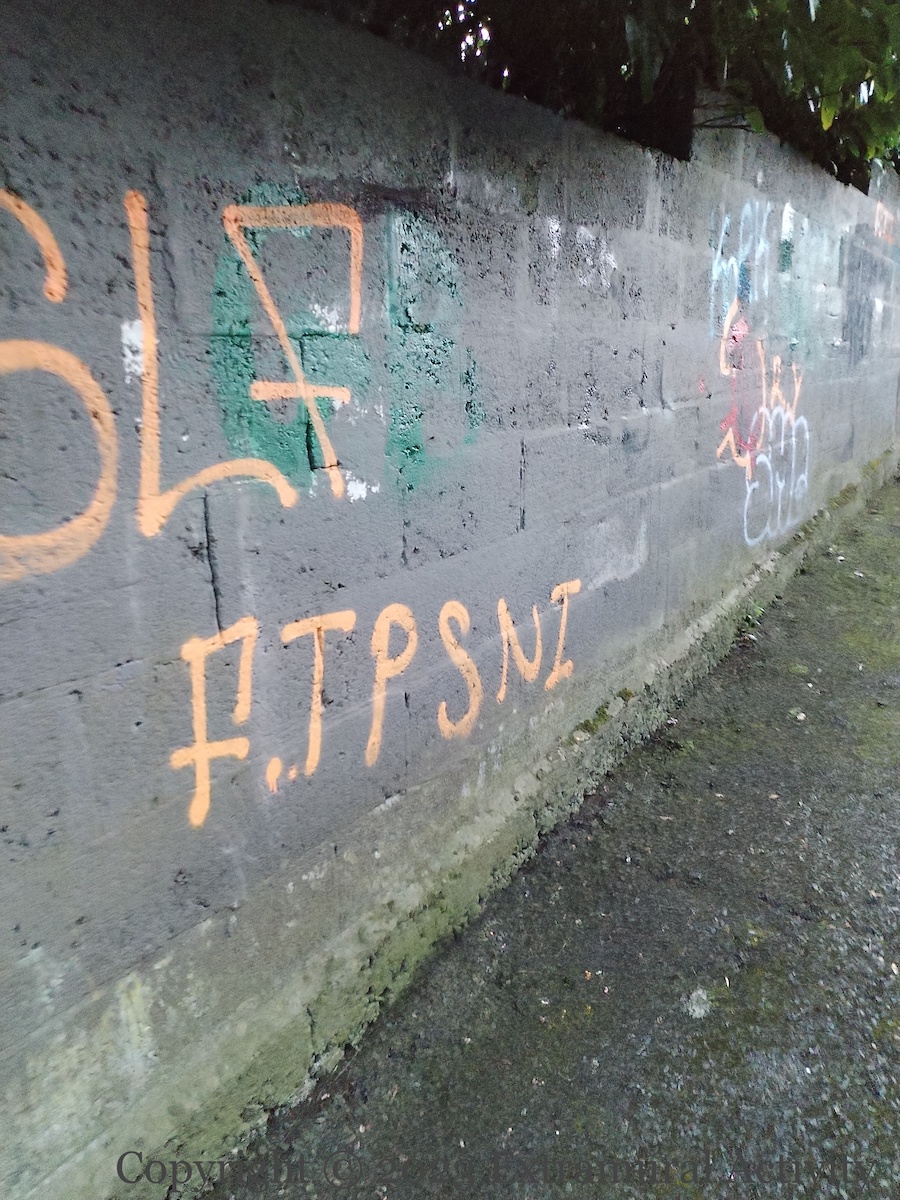
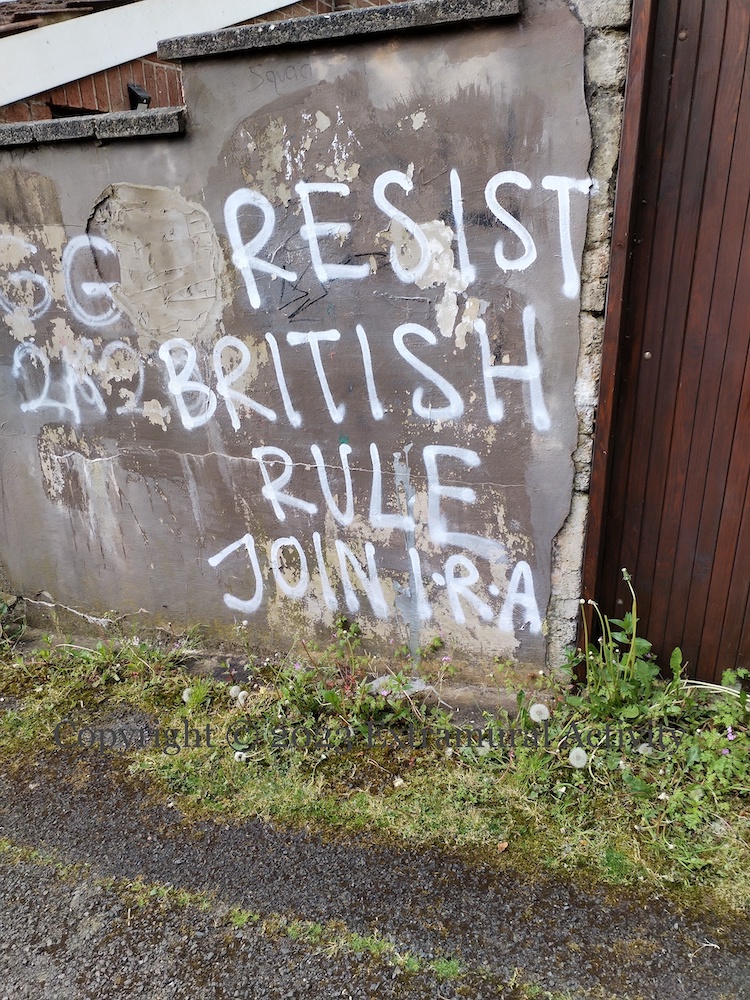
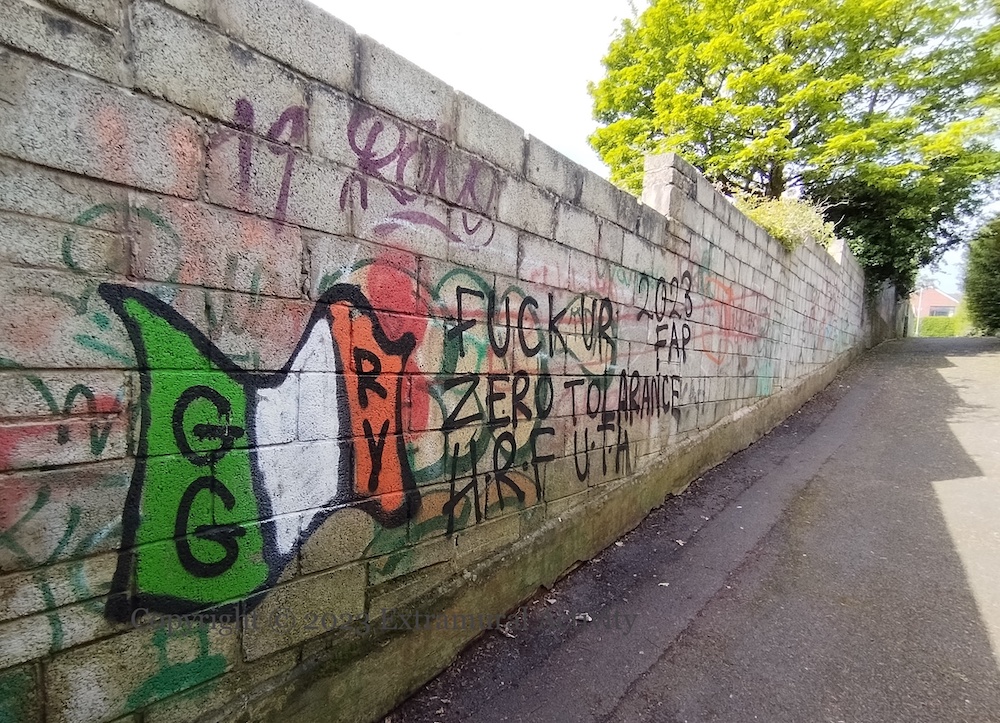
Here is a gallery of ten images of republican graffiti (and some basic muraling) from Glengormley, particularly the Elmfield area (see previously Glengormley Republican Youth).
Above: “This is republican Glengormley – GGRY”/”Is é seo Gleann Ghormlaıthe [mis-spelled in the graffito as “Ghormlıath”, perhaps by attraction to the English “ley” – the Irish ending comes from “flaıth” rather than “lıath”] poblachtach [mis-spelled with a final “t”, perhaps by attraction to the Irish “poblacht”].
Among the various images below: “resist British rule” along with an exhortation to join the IRA and Fianna (the sunburst); attacks on the IRSP/INLA (though a hammer and sickle are included); politically, attacks on the PUP and a threat that the “fascists” in the National Party “will be crucified”.
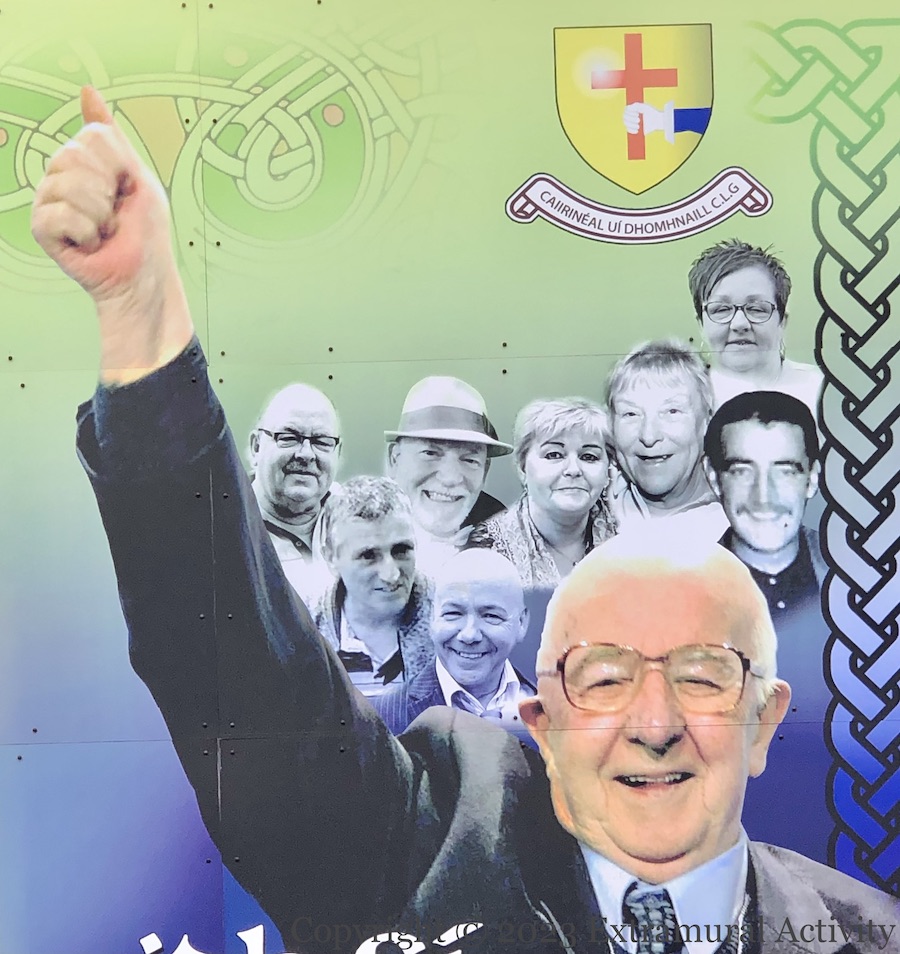
“Mol an óıge agus tıocfaıdh sí [encourage youth and it will flourish, or less literally, youth responds to praise].” The emblems in the corners are of two local GAA clubs “Naomh Eoın” and “Caıırınéal [Caırdınéal] Uí Dhomhnaıll” – the “Joe Cahill Annual Tournament” was held at Easter at their two pitches.
Joe Cahill joined the Fianna in 1937 and was involved in the republican movement from then until his death in 2004, including being in Tom Williams’s company in 1942, and was later a founder member and Chief of Staff of the Provisional IRA.
The Citizens’ Assembly is a group of 99 randomly-chosen Irish citizens, plus a chair, that considers large-scale issues over the course of months. It began in 2016 by taking up the Eighth Amendment on abortion, the “pensions timebomb” fixed-term parliaments, voter turnout and referendums, and climate change – it is not restricted, like its predecessor the Constitutional Convention, to constitutional issues (WP). The 2020-2021 Assembly considered gender equality and biodiversity loss. Sınn Féın called for an Assembly on Irish unity at its November (2022) Ard Fheıs (Irish Examiner | Derry Journal | youtube panel) and Belfast City Council passed an SDLP motion to recommend that the Taoıseach form an Assembly (News Letter); in December, the Dublin City Council approved a measure calling for an Assembly to consider the topic (SF).
“The Irish government should establish a citizens’ assembly on Irish unity/tıonól na saoránach ar aontú na hÉıreann.” Sınn Féın’s preferred outcome of such a process is given at the bottom of the board: “#Time4Unity/Am d’Aontacht”. The images show the board in north Belfast (Limestone Road).
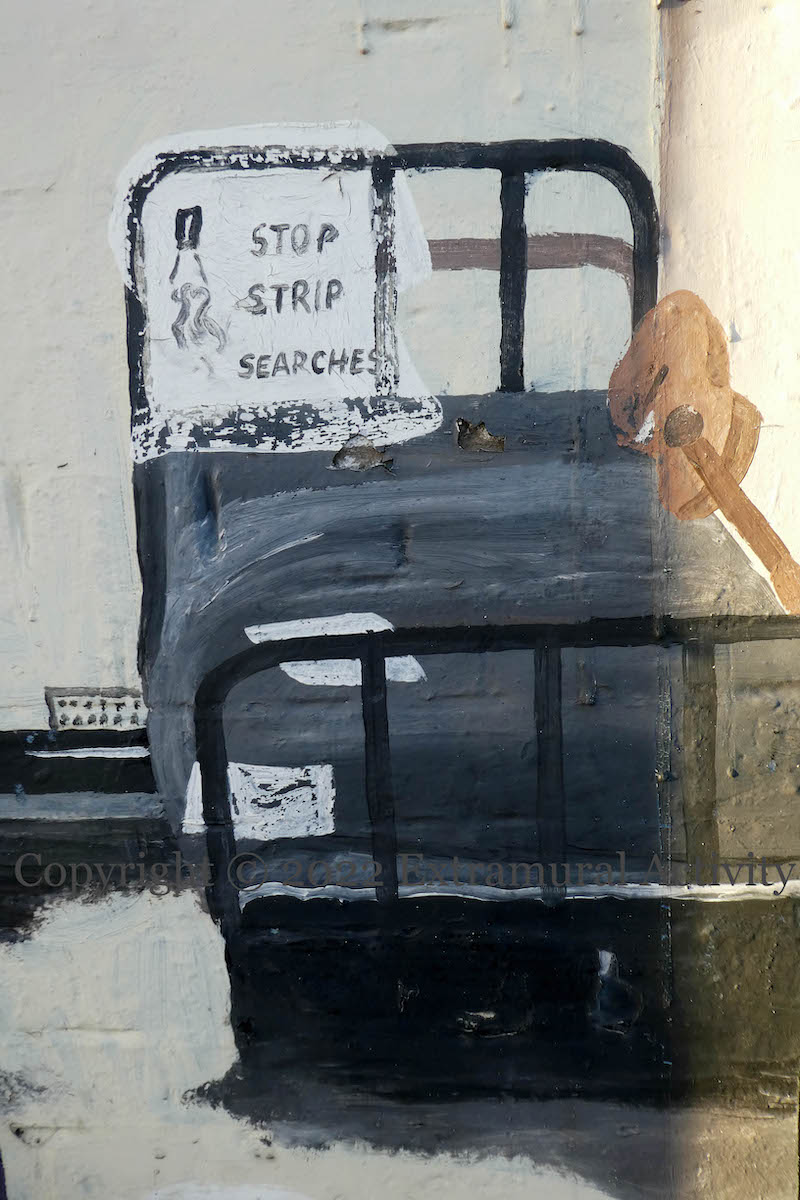
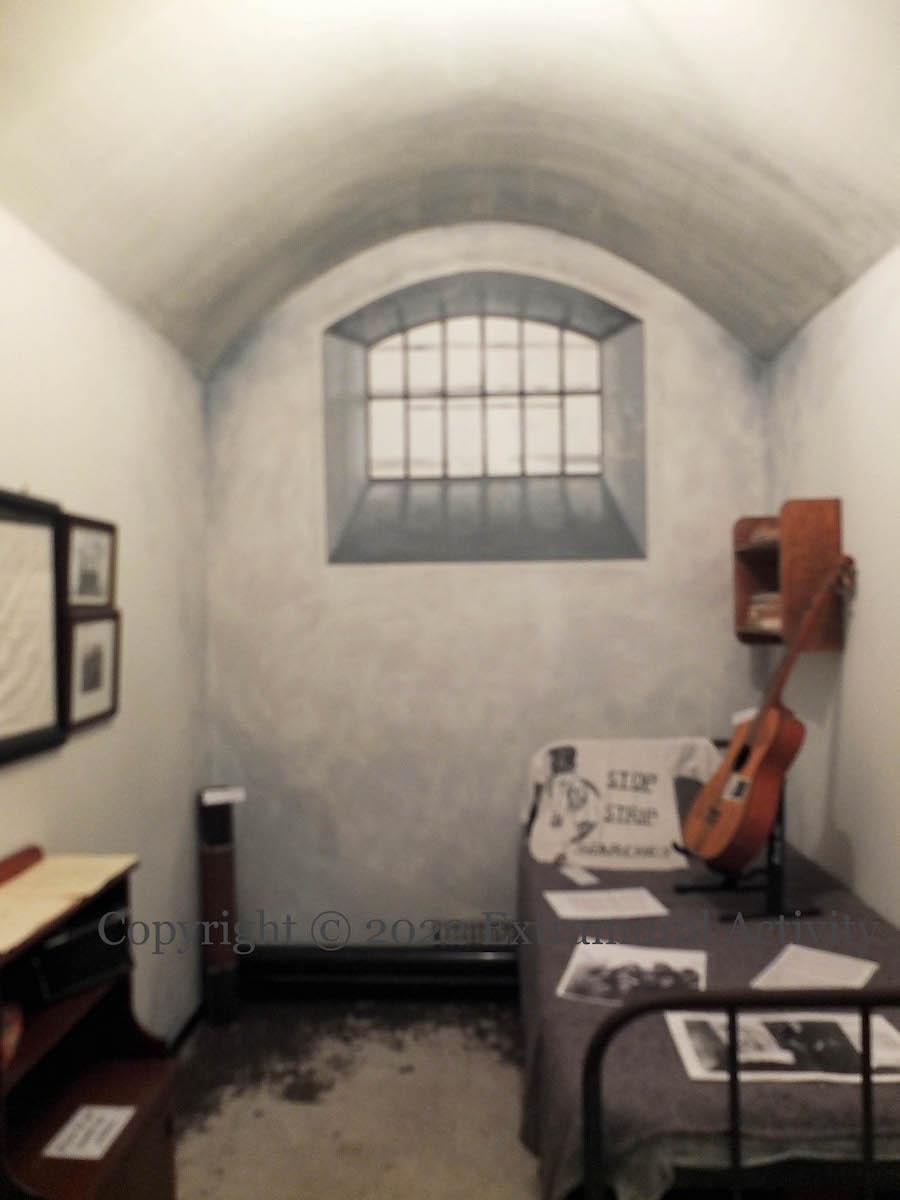
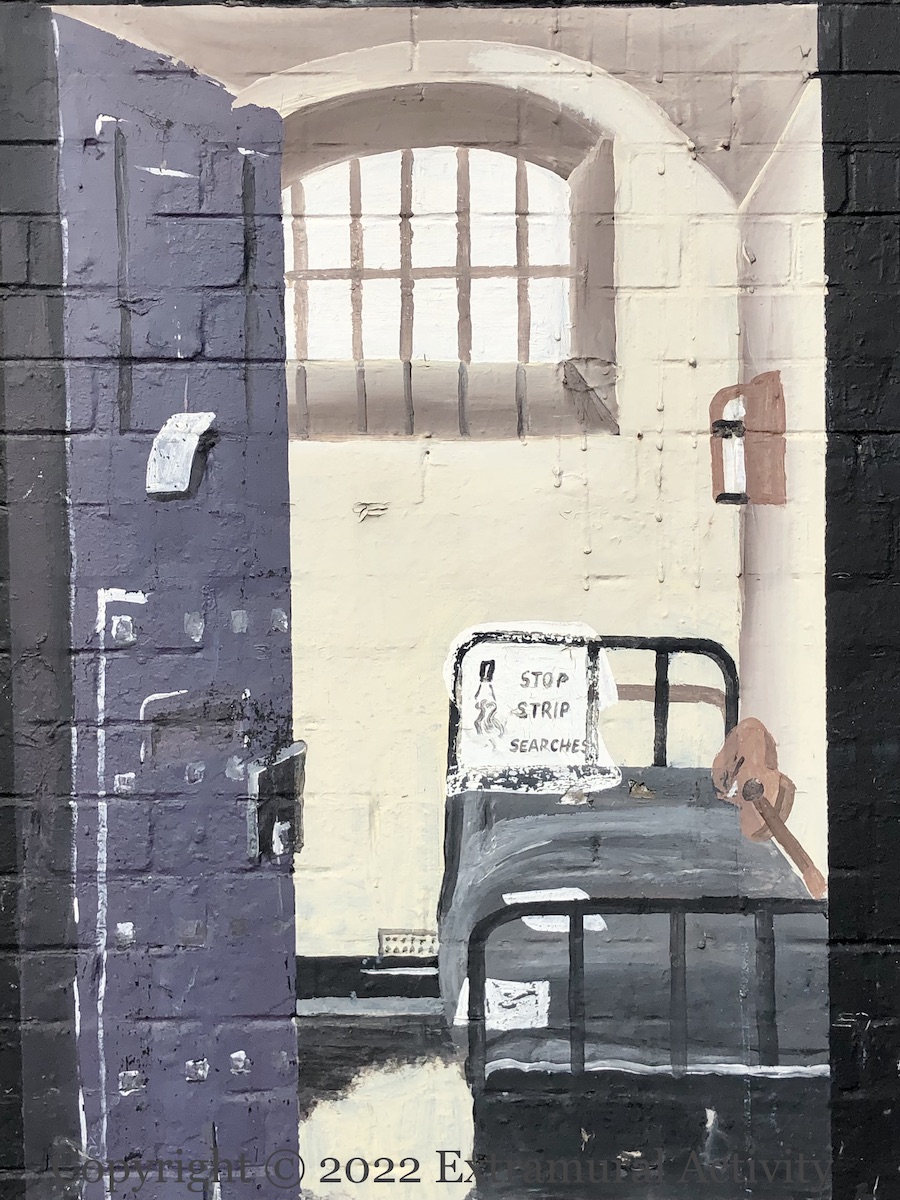
We have featured this ‘bookmark’-dimensioned mural on the so-called “International Wall” before (in 2018) but today include an image (the third one, below) of the replica cell inside the museum itself; a sharper image (and the source for the painting) can be seen on the home page of the Museum’s web site.
Creggan sports centre opened in October 2009 (Leisure Opportunities) and part of the architecture was to cover the brick exterior with five plain-white panels along Central Drive. These have been taken over by Saoradh/IRPWA, this year to protest the extradition, internment, and treatment of republican prisoners, commemorate the 1981 hunger strikers, support Palestine, and threaten drug dealers.