A Panorama Of Republicanism

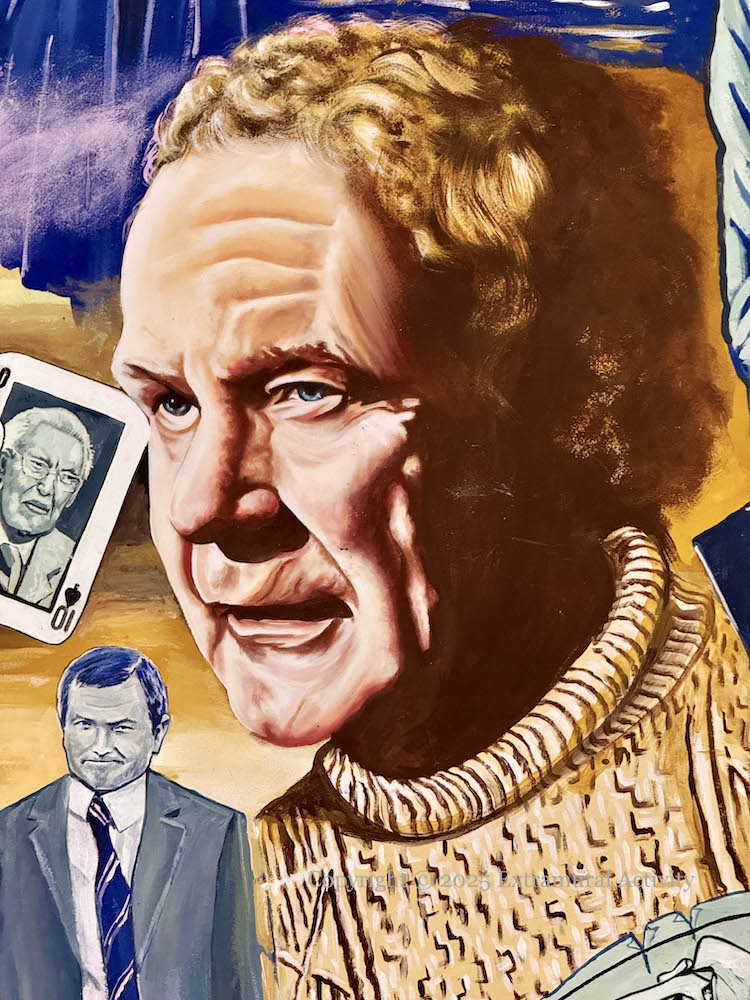
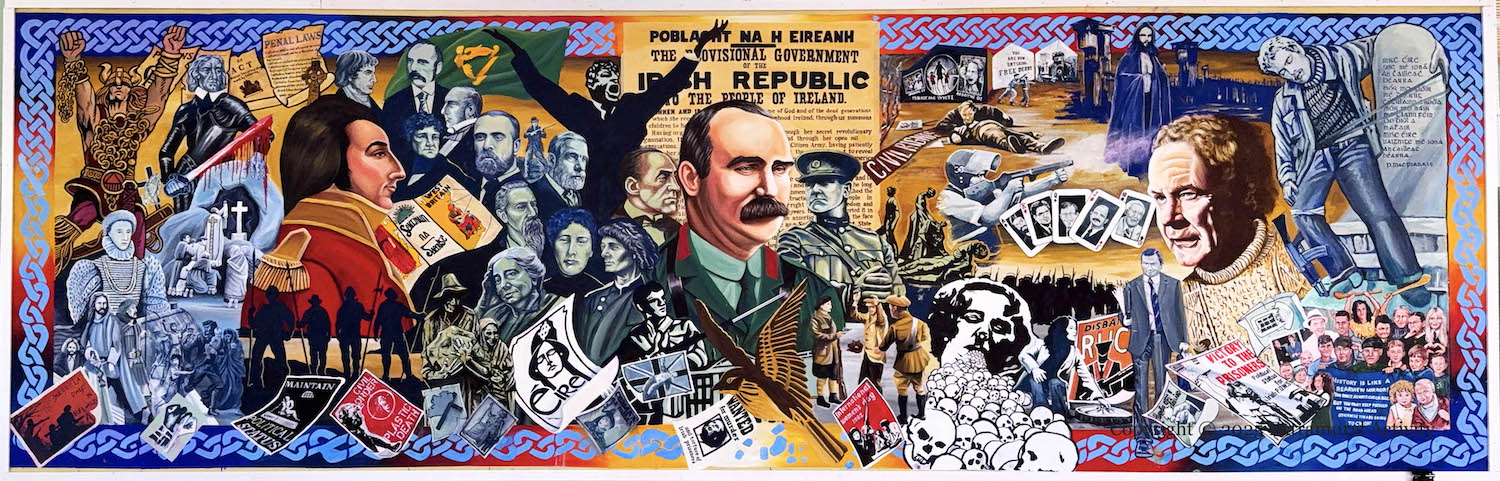
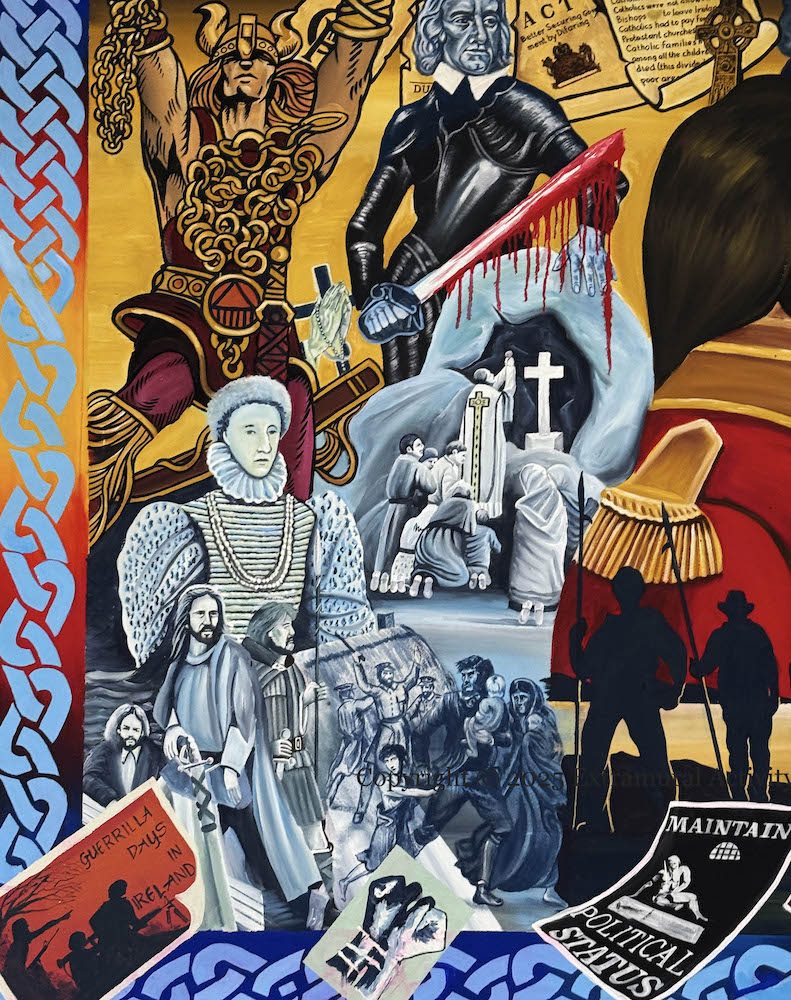
Féıle An Phobaıl (web) is now headquartered in the renovated (BCC) St Comgall’s on Divis Street in Ionad Eileen Howell, and during this year’s (2025) festival is home to an exhibition called “Vibrant Colours, Violent Past”, the centrepiece of which is a 20-foot-long panoramic history of republicanism, with Wolfe Tone, James Connolly, and Martin McGuinness as pivotal figures.

A full legend of who’s who is given in the leaflet at the bottom of this entry. It also explains the genesis of the project, as follows:

“A few years ago I met a great friend of Ireland and art collector Darius Anderson from California who was here on a trip with his wife Wendy and hoping to see some new work by Irish artists, not only work destined for gallery walls but having been fortunate to be included on one of local guide Dee Morgan’s tours he developed a love for and focus on our world-recognised mural art tradition.

“Then last year on another trip here I was able to introduce Darius to my life-long friends and probably the most prolific contributors to our local landscape.

“From a casual meeting alongside Marty and Micky at work repainting the Vol. Kieran Doherty mural in Andersonstown came an inspired suggestion that we accept a challenge from him to tell our story graphically on a canvas rather than the usual brick wall, not just on canvas to hang on a wall in his gallery in L.A. but a canvas to cover the entire wall 20ft x 7ft!

“Excited by our positive response Darius wondered could we invite some loyalist artist/activist to contribute a similar large canvas celebrating the history of the British, Unionist, Loyalist community here.

“That was last July. This exhibition is a result of that meeting but also a chance for the public to remind themselves of our often colourful and unfortunately violent past. – Danny D, Muralist/Activist”

“History is like a rearview mirror! You must always check back but you must keep focused on the road ahead, otherwise you are going to crash!” (Similar wording was used in a piece – Painting From The Same Palette – painted by Danny D and Mark Ervine in 2008.)

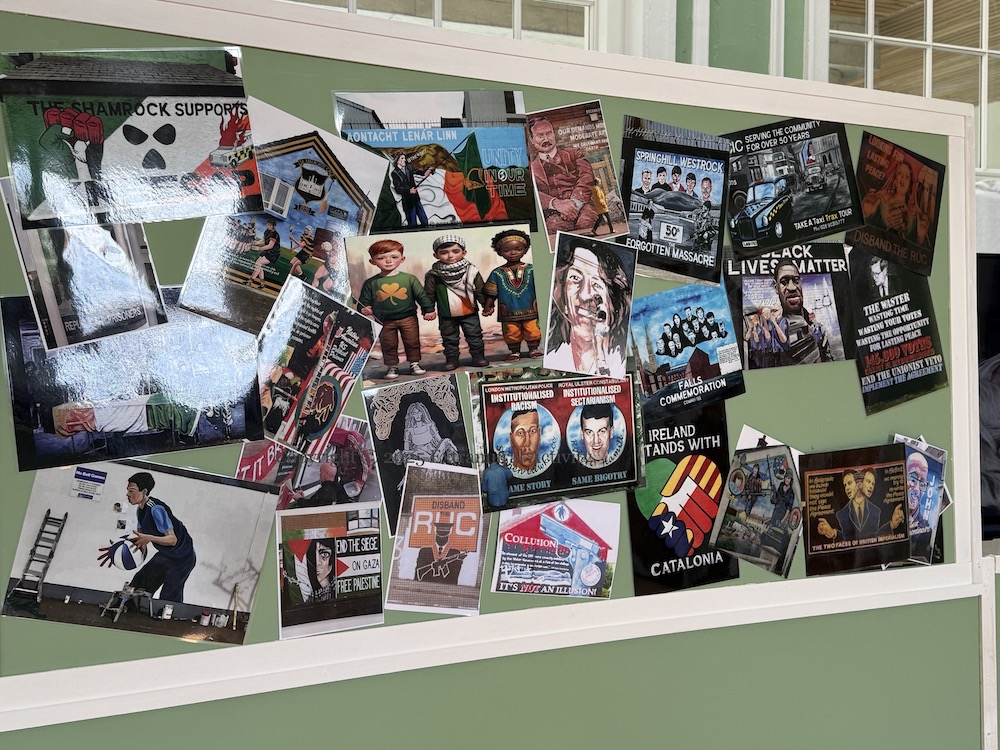
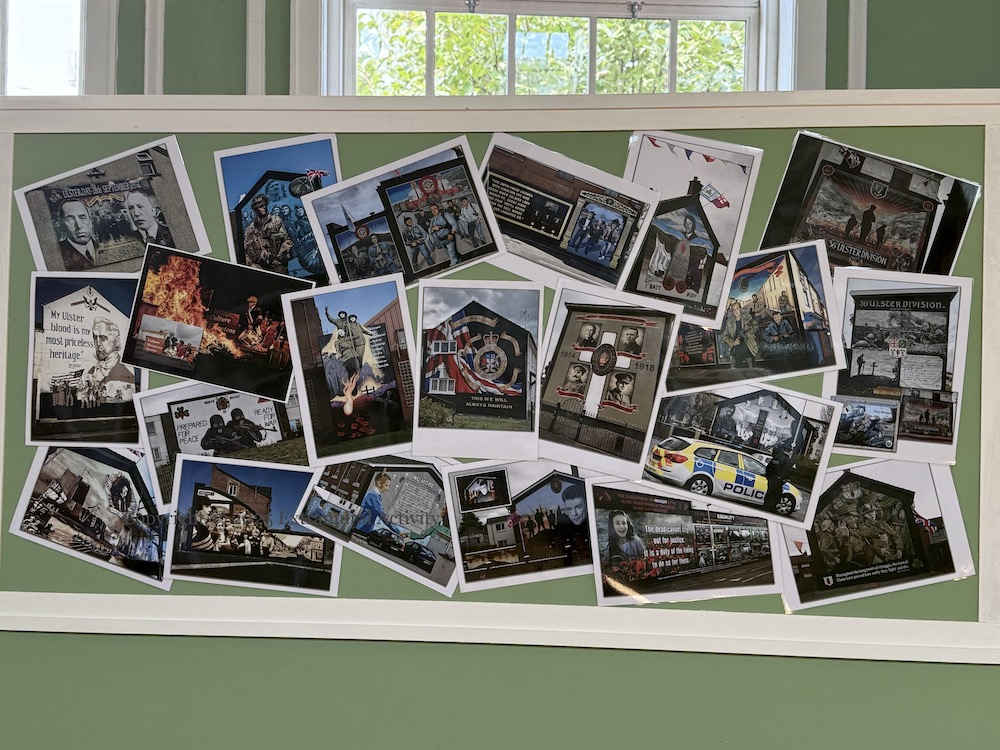
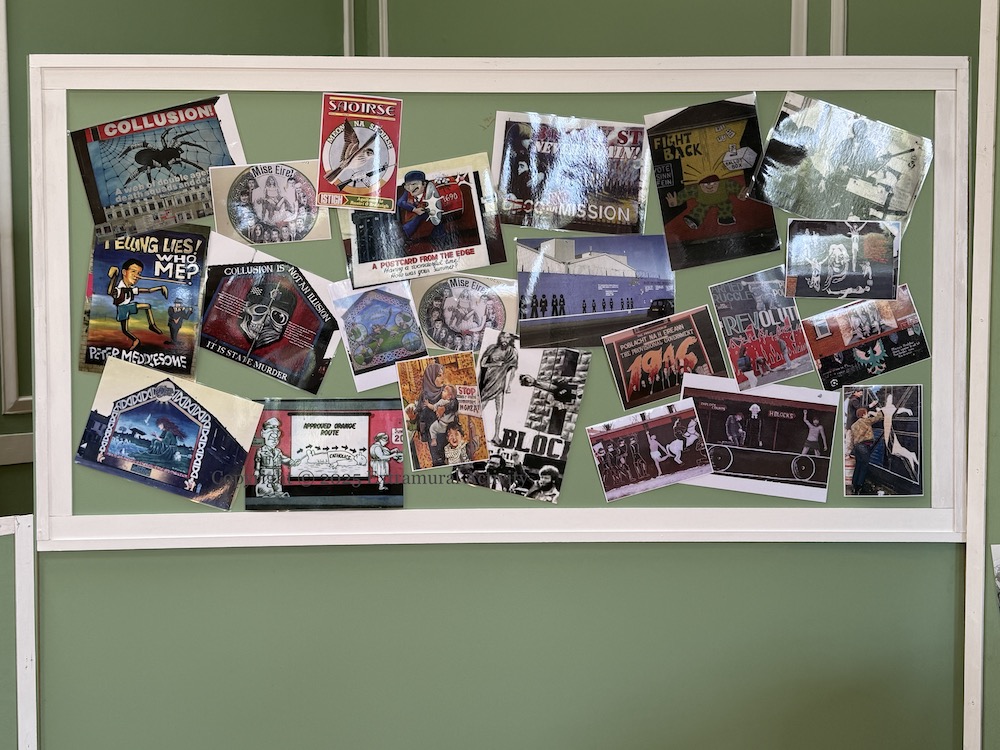
The exhibition was launched on August 1st and also included four display boards featuring murals by Danny D (CNR) and Dee Craig (PUL) (Fb).
Display boards:
Images from the launch on August 1st, along with the two-sided leaflet:

Click image to enlarge
Copyright © 2025 Seosamh Mac Coılle
Panorama: X15618 X15619 X15620 X15621 [X15622] X15623 [X15624] [X15625] X15626 [X15627] X15628 X15629 X15630 X15631 X15632
Displays: [X15633] X15634 X15635 X15636 X15637
Launch & Leaflet: X15638 [X15639] [X15640] X15641 X15642 [X15643] [X15644] [X15645] X15646 X15647

The INLA

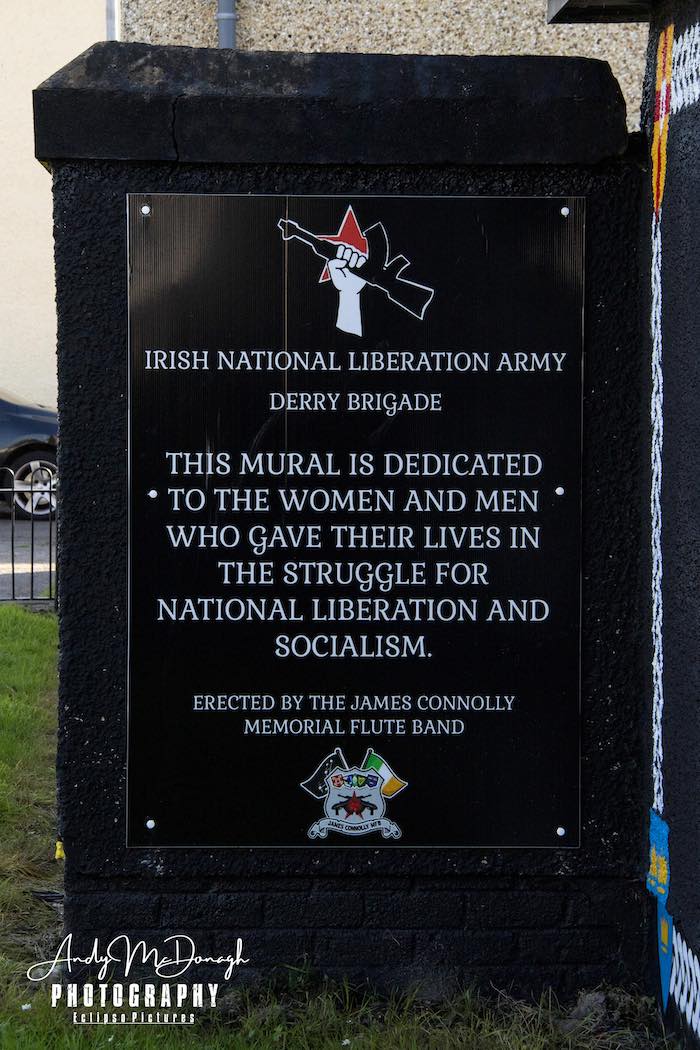
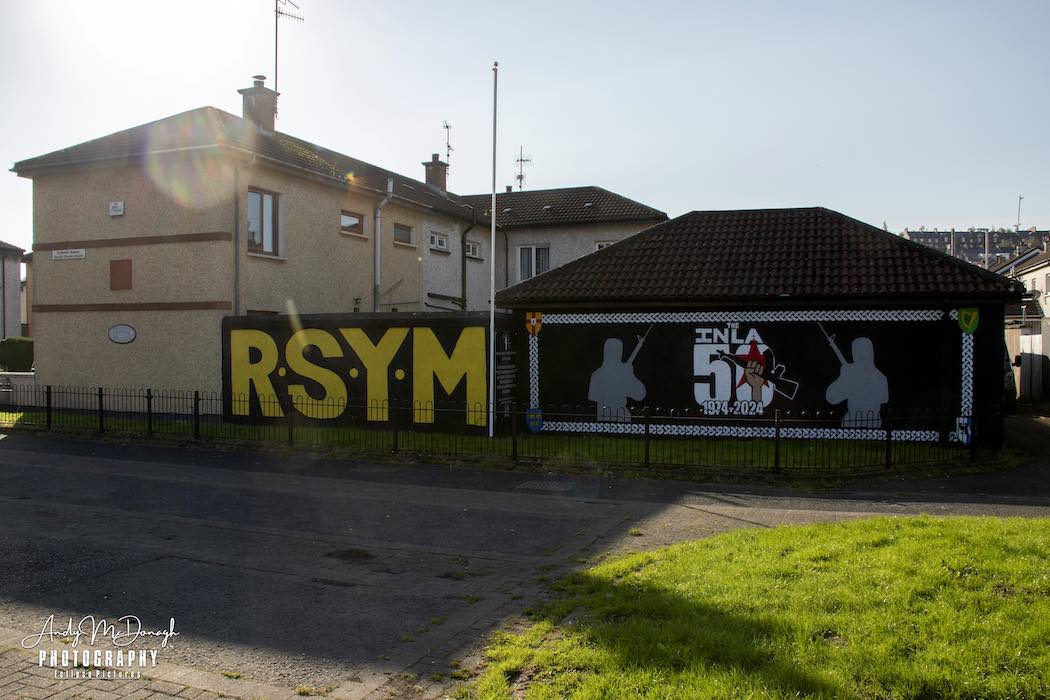
Commemorations of the INLA’s fiftieth anniversary have so far been limited to graffiti – see Saoırse Go Deo in Derry and Let The Fight Go On in Belfast – but here we have two deliberately painted panels in the Bogside (specifically Meenan Square) (one replacing The Way We Were).

“Irish National Liberation Army, Derry brigade. This mural is dedicated to the women and men who gave their lives in the struggle for national liberation and socialism. Erected by the James Connolly Memorial flute band.”

Click image to enlarge
Copyright © 2024 Andy McDonagh/Eclipso Pictures (ig | Fb)
X15207 X15208 X15209 X15210

Conscience

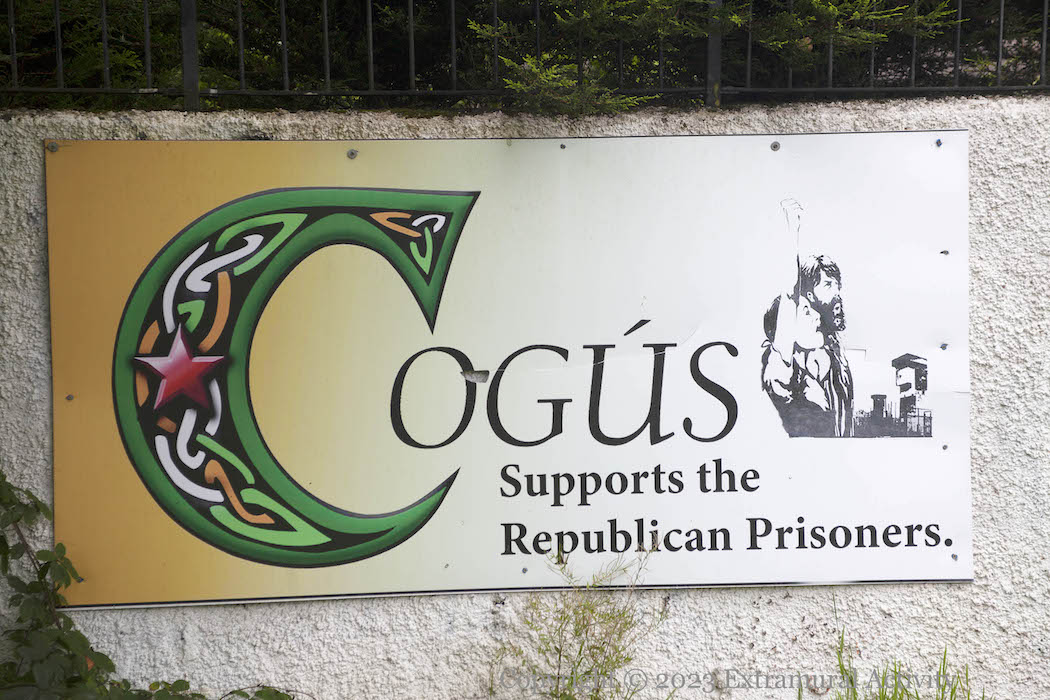
“Cogús supports the republican prisoners”. Cogús (Fb) is (was?) the prisoners’ welfare arm of the RNU. The board above — using a vintage illustration going back to 1981’s I’ll Wear No Convict’s Uniform — replaced More Blacks, More Gays, More Irish on Pantridge Road, Dunmurry, joining the “Join RNU” and mental health boards shown below.

Click image to enlarge
Copyright © 2023 Seosamh Mac Coılle
X14116 X14117 X14118 X14115

Pride Of Glencolin

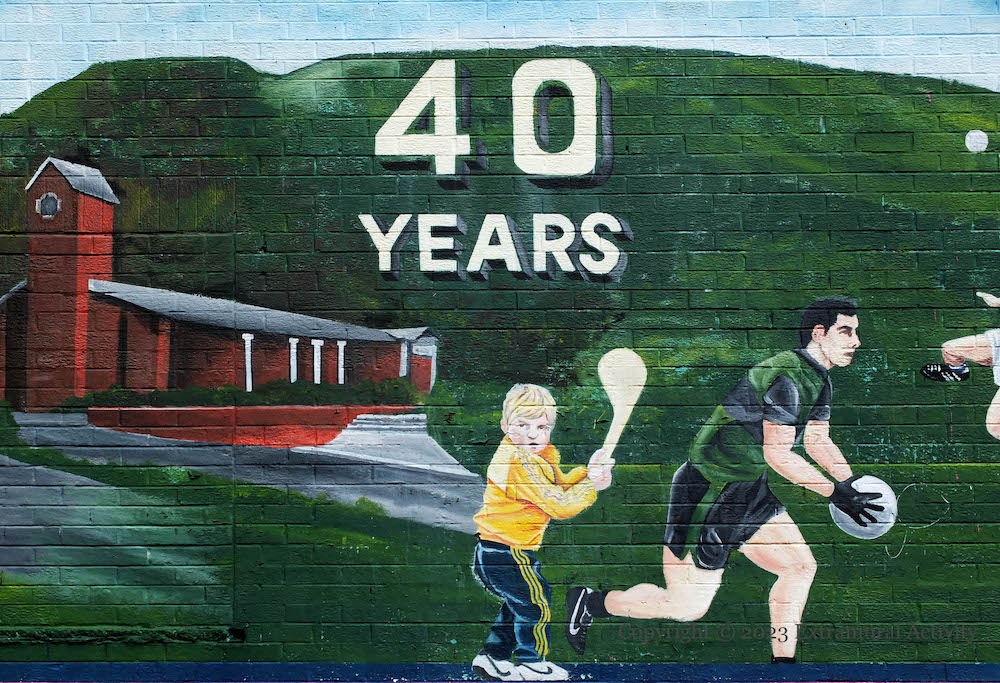
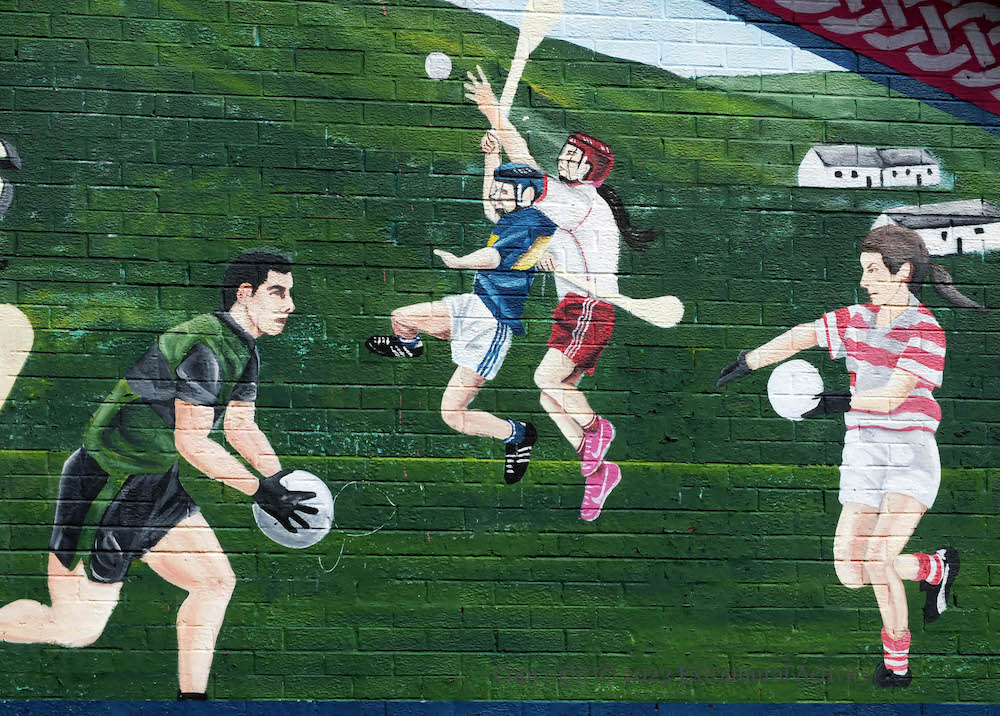
Glencolin estate was built next to Moyard House (which in 1984 became home to the Roddy’s (web), shown in the image directly below) on the Glen Road in 1979 (Belfast Forums). For the fortieth anniversary of “eastát Ghleann Collaınn” the mural at the entrance to the estate was (belatedly) repainted. The composition of the mural remains as in the previous version, with the Roddy’s and Oliver Plunkett church in the shadow of Dubhaıs and Slıabh Dubh; they are now joined by images of Gaelic games. The Bobby Sands quote has been removed.

The 2018 side-wall shows boxer Brendan Irvine — “the wee rooster” — who represented Ireland in the Tokyo (2020) and Rio (2016) Olympics at flyweight (Olympics).

Click image to enlarge
Copyright © 2023 Seosamh Mac Coılle
X14124 [T01499]
[X14125] X14126 X14127 XX14128
X14103 [X14104]

Éıreannaıgh Sınne!

“Ní coırpıgh sınne! Éıreannaıgh sınne! [we are not criminals; we are Irish people] “There is that much to be done that no select or small portion of people can do; only the greater mass of the Irish nation will ensure the achievement of a socialist republic, and this can only be done by hard work and sacrifice.” – Bobby Sands [Hunger strike diary, March 14th, 1981]” With photographs of the ten deceased 1981 hunger strikers.

Falcarragh Drive, Lenadoon, Belfast.

Click image to enlarge
Copyright © 2023 Seosamh Mac Coılle
X14119

Pobal Ag Fás

“Pobal ag foghlaım, pobal ag forbaırt, pobal ag fás” [a community learning, developing, growing]

Students from “Naíscoıl & Gaelscoıl An Lonnáın (Fb) bun[aithe] 1999″ [Nursery-school and Irish-language [primary] school of the loney, founded 1999] are shown playing Gaelic games, Irish dancing, and playing traditional instruments (and the guitar). On the left are representations from Irish mythology: the Children Of Lear and Setanta killing Culann’s hound (and taking the name Cú Chulaınn in taking its place), along with hedge-row school (see Hedge Row School).

The origin of the name is unclear; the nearest loney [lane] was the “Pound” loney, so-called because of the animal pen just outside Barrack Street, used to store livestock before moving on to the markets the following day (Rushlight | Uachtar Na bhFál). (The Pound Loney is included in the mural in Durham Street – see Et In Arcadia Ego.)

The other well-known loney in Belfast is the “buttermilk loney” which was either/both what is now Ballysillan Park (that is, connecting Olpark with the horsehoe bend) or the top part of the loney that connected Wheatfield (the top of Ardoyne) to the Ligoniel junction and on towards the old Ligoneil House (there are a mixture of usages in this Belfast Forum thread); this image from the 1930s might show the lane in (what was still at the time) the hills above Oldpark; a new housing-development towards the top of the Ballysillan Park is euphemistically called “Buttermilk Loney”. (It is also said to have been a prior name of Skegoniell Avenue (Belfast History).)

(The Uachtar Na bhFál page also mentions “Turf” loney, “Mountain” loney, and “Killoney”.)

The history of the Irish word “lonnán” is unclear. Uachtar na bhFál says the word is of Scots origin (perhaps as “loanin”). (See this BelTel article on the opening of the Ulster-Scots centre in 2014.) Spelled “lonnen”, it is also a Geordie word (Heslop’s Northumberland Words | wiktionary). The Irish News and Belfast Live, working from the same (uncited) press-release about Páırc An Lonnáın (which is along the Westlink below Raıdıó Fáılte), state that “loney” comes from the English word “loaning”. The Irish word “lonnán” does not appear in Dinneen 1904; Dinneen 1953 defines it (hyper-specifically) as “a grassy recess running up into high basaltic cliffs”.

For more ‘in-progress’ shots, see the Paddy Duffy collection.

May 19th:

Click image to enlarge
Copyright © 2023 Seosamh Mac Coılle
X12568
X12369 [X12388]
X12370
X12372 [X12373]
X12371 [X12389]
X12566 X12567 X12565 Marty Lyons
X12569

Hunger Strikers, Volunteers, Comrades

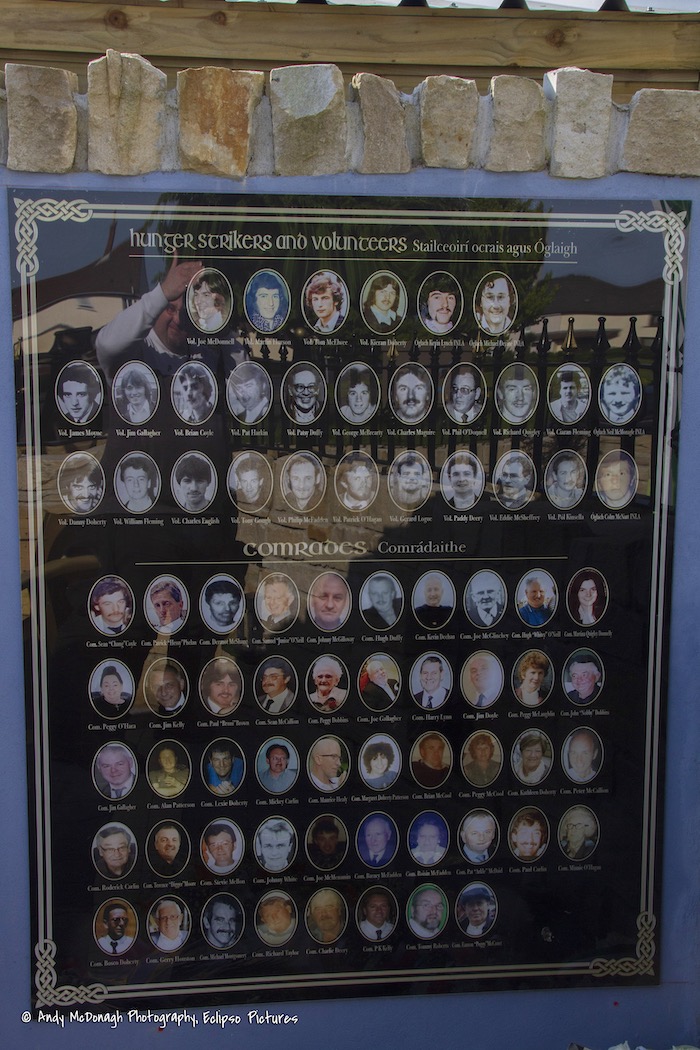
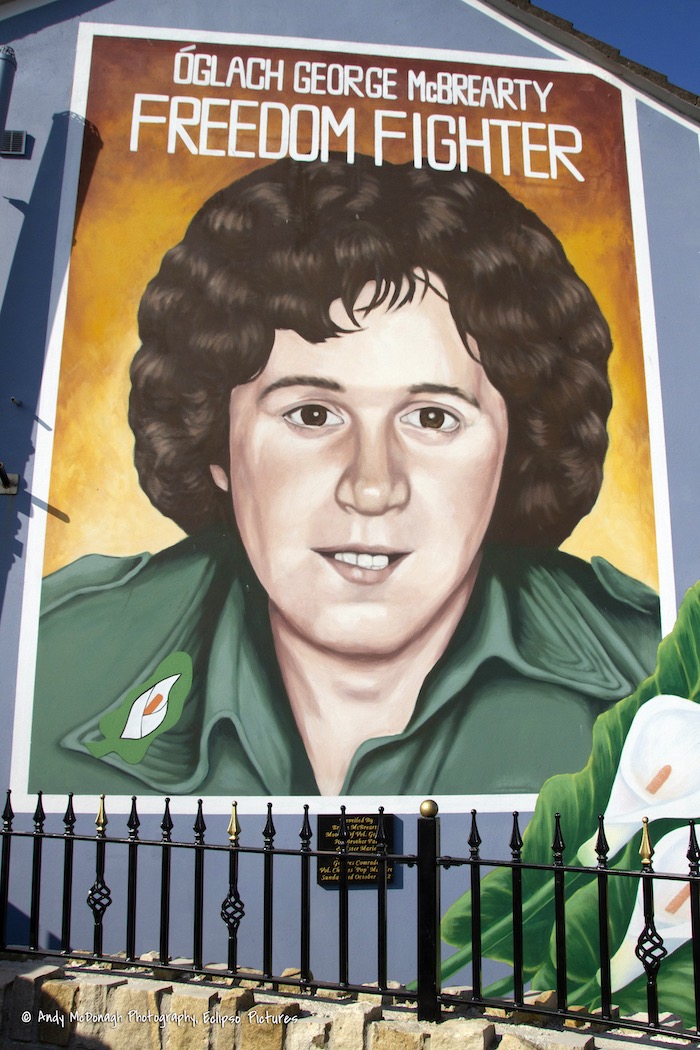
“At this place of reflection, we proudly honour our heroic volunteers, who made the ultimate sacrifice for the freedom & sovereignty of Ireland and the Irish people. We salute our many comrades, who spent numerous years in captivity, and who’s [sic] lives were often blighted by the experience. Never forgetting the WOMEN & MEN of Creggan and the Derry district, who stood steadfastly with the volunteers. BEIR BUA.” The 12 Troubles-era hunger strikers and 43 Derry brigade members are at the top of each panel with 115 named comrades/comrádaithe (and three unnamed) below (and on the side wall – first image below), with each name preceded by “Com.” as though establishing a new category of activist.

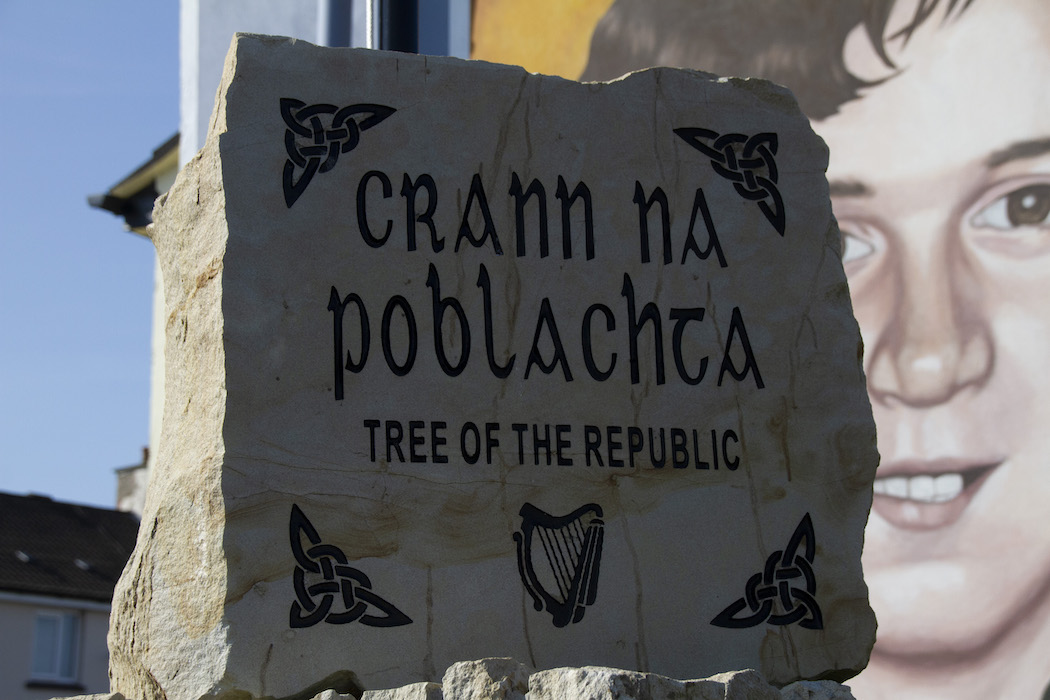
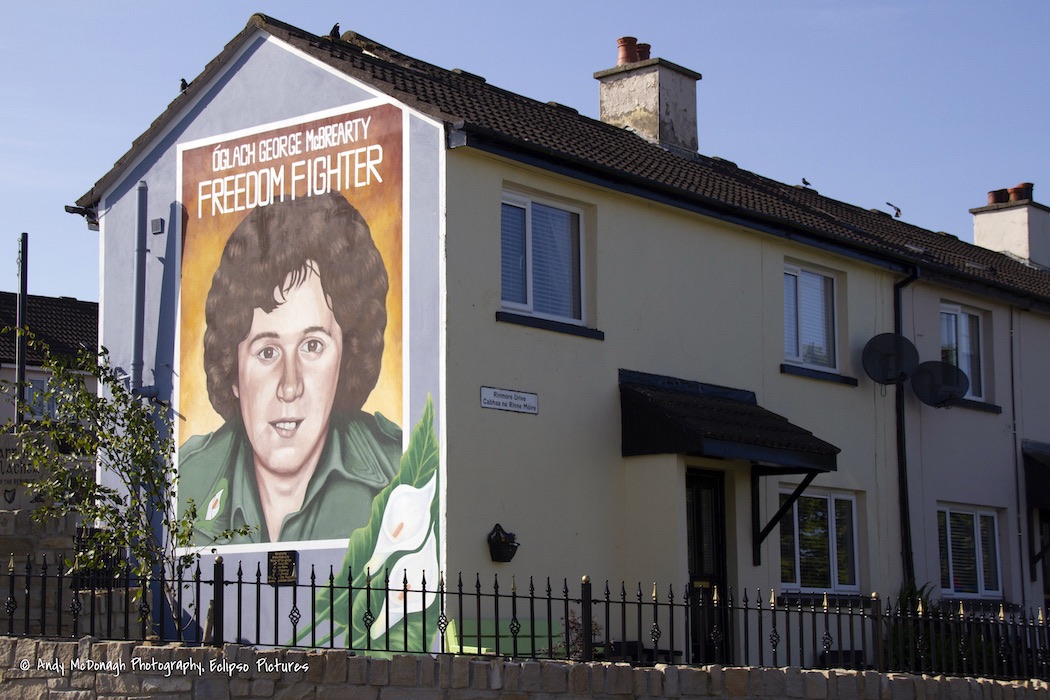
The memorial garden is next to the George McBrearty mural and Crann Na Poblachta in Linsfort Drive, Creggan.

Click image to enlarge
Copyright © 2023 Andy McDonagh/Eclipso Pictures (ig | Fb)
X12499 X12502 X12500 X12503 X12501

Óglach George McBrearty

A ceremony to mark the forty-second anniversary of the deaths of IRA volunteers George McBrearty and Charles “Pop” Maguire – shot by the SAS on May 28th, 1981 – was held last Sunday (May 28th) in the garden of remembrance in Linsfort Drive, Creggan (Derry Now). On patrol in Creggan with two other IRA men, McBrearty and Maguire pursued and a car whose driver they suspected of being an SAS soldier and eventually stopped it at the bottom of Couch Road/Southway at the edge of the Brandywell. The driver shot McBrearty as he approached the car and Maguire was shot by the driver and/or by other undercover soldiers from 14th Intelligence who emerged from two other cars. A third volunteer was injured. (Lost Lives 2330)

The “Crann Na Poblachta”/”Tree Of The Republic” – a silver birch – was originally planted in front of the previous mural to George McBrearty mural in Rathkeele Way (see Freedom Fighter For The Republic) (Derry Journal). Both that mural and this one were painted by ‘Bogside Artist‘ Kevin Hasson.

There is a plaque to McBrearty & Maguire near the spot where they were killed on Coach Road/Southway (see M01544).

Click image to enlarge
Copyright © 2023 Andy McDonagh/Eclipso Pictures (ig | Fb)
[X12504] X12506 X12508 X12507 X12505

Mol An Óıge

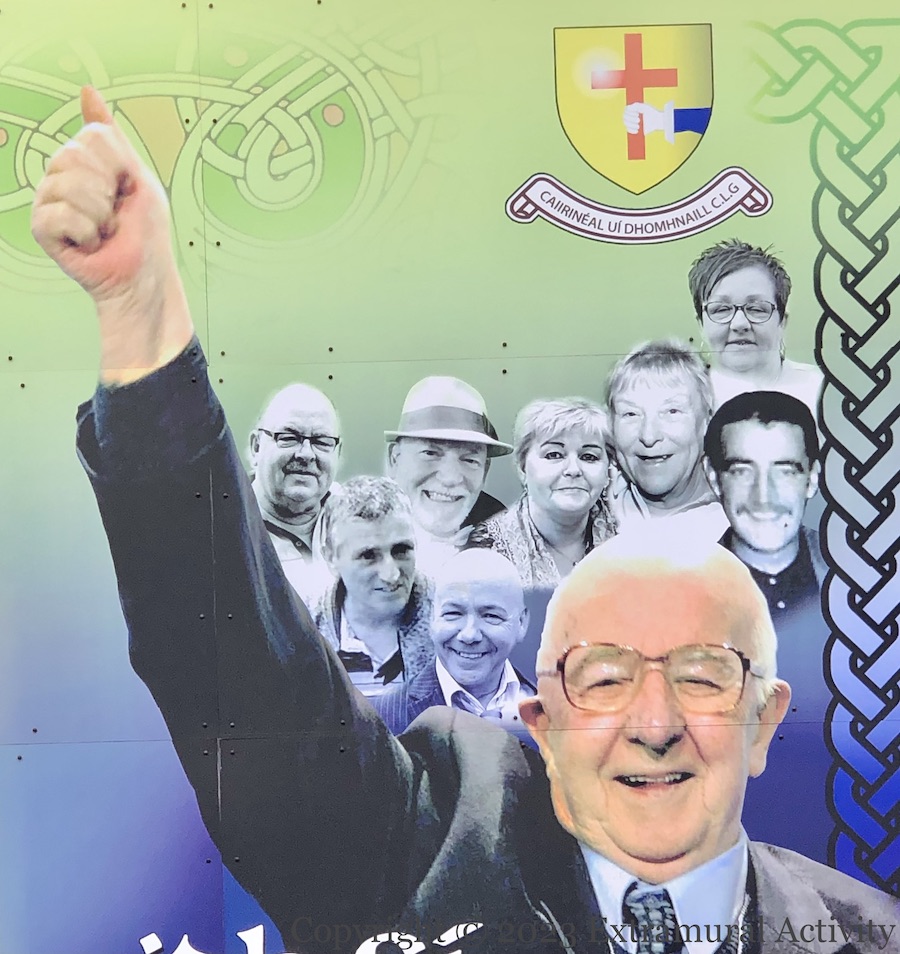
“Mol an óıge agus tıocfaıdh sí [encourage youth and it will flourish, or less literally, youth responds to praise].” The emblems in the corners are of two local GAA clubs “Naomh Eoın” and “Caıırınéal [Caırdınéal] Uí Dhomhnaıll” – the “Joe Cahill Annual Tournament” was held at Easter at their two pitches.

Joe Cahill joined the Fianna in 1937 and was involved in the republican movement from then until his death in 2004, including being in Tom Williams’s company in 1942, and was later a founder member and Chief of Staff of the Provisional IRA.

The new board was launched on April 4th. This is the third Joe Cahill mural on this wall – see previously Joe, Tom, Frank (2005) and Perpetual Cup (2013). The long-time plaque on the wall has been removed.

Click image to enlarge
Copyright © 2023 Seosamh Mac Coılle
[X12326] X12327 X12328 beechview park

Now As The Dawn Is Breaking

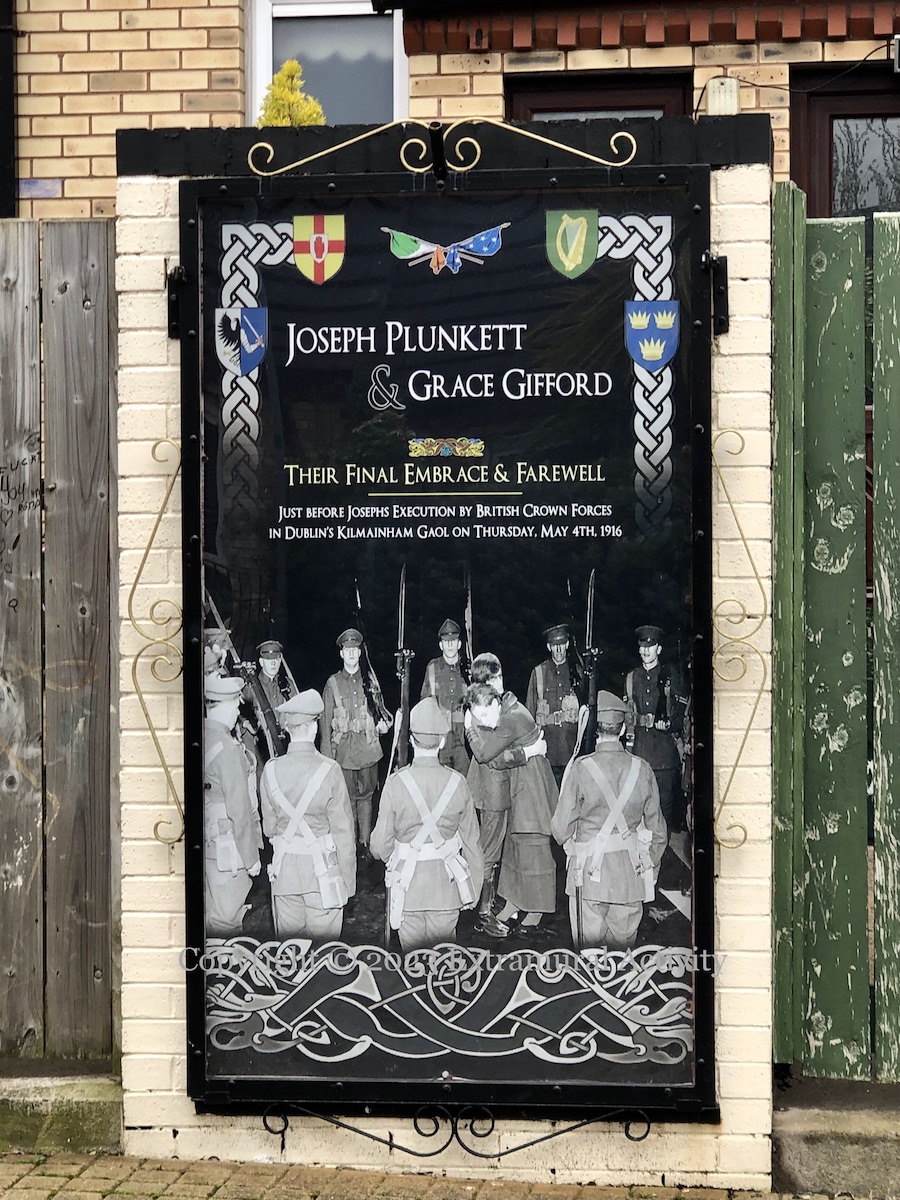
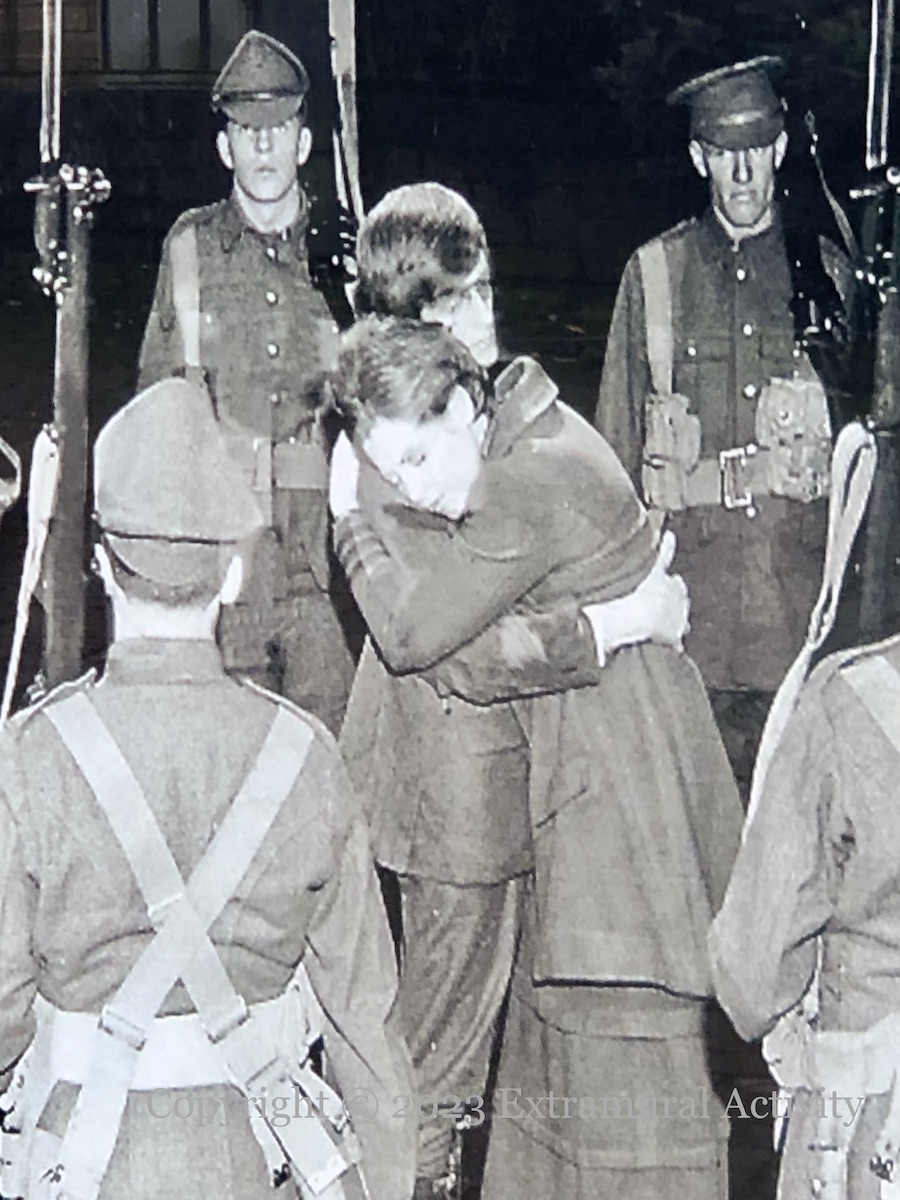
“Joseph Plunkett & Grace Gifford – their final embrace & farewell.” May 4th is the anniversary of the execution of Joseph Plunkett, one of the planners of the Easter Rising in 1916. Seven hours before he faced the firing squad, he married Grace Gifford. The photograph is from a re-enactment for a 1966 RTÉ programme Insurrection (RTÉ). The ballad Grace, written by Seán and Frank O’Meara in 1985, is now internationally known (here is Jim McCann’s 1985 performance).

This is one of various recent additions to the many memorials in Ard An Lao, Béal Feırste/Ardilea, Belfast. This replaces the board seen in Continuing Their Legacy.

Click image to enlarge
Copyright © 2023 Seosamh Mac Coılle
X12170 [X12169] X12168 X12171 X12172 X12173
“Just before Joseph’s execution by British forces in Kilmainham gaol on Thursday May 4th, 1916”