Joint Forces

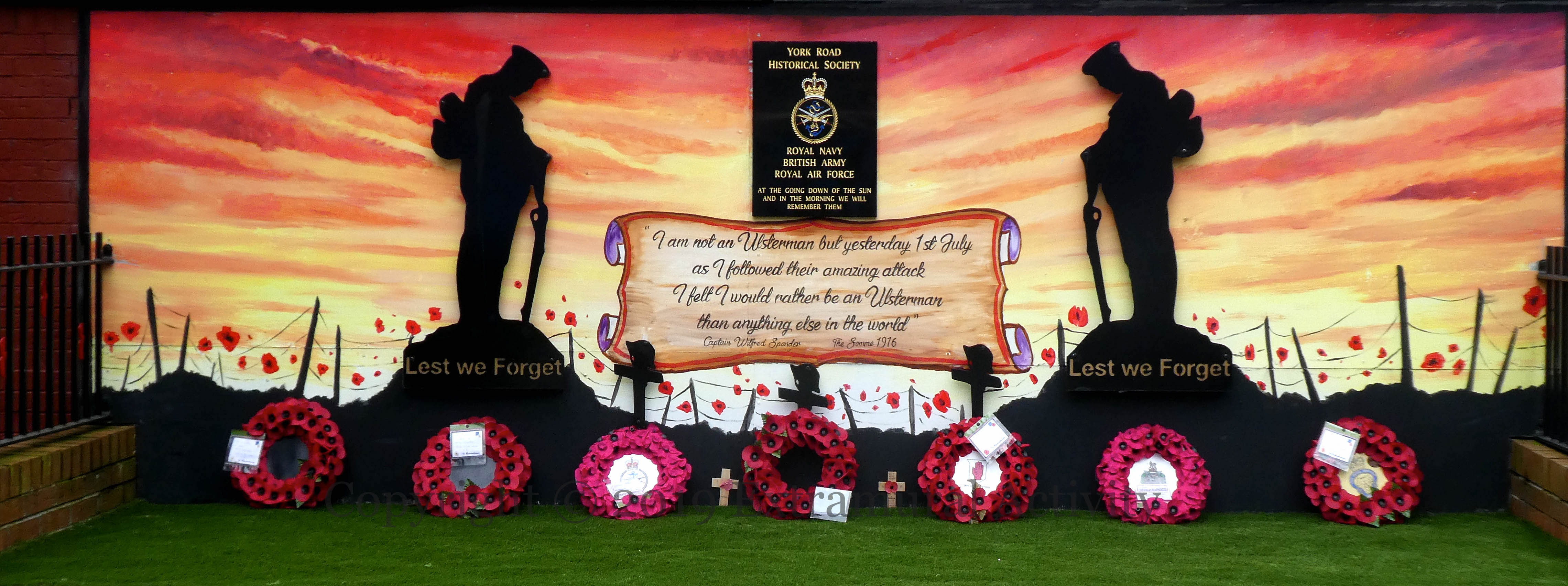
At the end of September, York Road Historical Society (which does not appear to have an on-line presence) launched a new garden of remembrance to British WWI service-members in the “Royal Navy, British Army, and Royal Air Force”, symbolised by the crest of Strategic Command (formerly the Joint Forces Command).

The garden is next to the Times Bar (one | two | three | four | five) and opposite Arts For All/John Luke Gallery (one | two | three).
Click image to enlarge
Copyright © 2019 Seosamh Mac Coılle
X06950 X06949 “”I am not an Ulsterman but yesterday 1st July as I followed their amazing attack I felt I would rather be an Ulsterman than anything else in the world” – Captain Wilfred [Wilfrid] Spender, the Somme 1916.” at the going down of the sun and in the morning we will remember them lest we forget

Nihil Nisi Optimi

Ballyclare Comrades football club – motto is ‘Nihil nisi optimi’ [nothing but the best] – was founded in 1919 by members of the local Great War ‘comrades’ association. That heritage is used here for the Ballyclare Protestant Boys flute band. In the centre, between images from WWI, the flowers of the four ‘home nations’ are joined by orange lilies, and in the shield are the lion and the unicorn from the coat of arms of the UK.

“To Flanders fields some men in our town were sent and along their way many would repent their priority goal to keep Ulster free that we may have freedom both you and me as part of Great Britain they fought and died and their names we will remember and remember with pride. Lest we forget. Comrades from Ballyclare. Nihil nisi optimi. The Comrades.” “Ballyclare Protestant Boys Est. 2004”

Click image to enlarge
Copyright © 2019 Seosamh Mac Coılle
X06941 X06942 [X06943] main st 

Gaeıl Feırste/Belfast Gaels

“Gaeıl Feırste CLG. Ba ıad Gaeıl Feırste (1885-1891) an chéad chumann de chuıd Chumann Lúthcleas Gael (CLG) ı mBéal Feırste. Cumann lán-Ghaeılge a bhí ann. Tháınıg deıreadh leıs de bharr scoılte sa CLG a d’eascaır as conspóıd Charles Stewart Parnell. Rınneadh atheagar ar an GLC in Aontroım in 1898 chun an Céadú Blıaın ó Éırí Amach na nÉıreannach Aontaıthe a chomóradh. Ba é Cumann Iomána na Láımhe Deırge, a bunaíodh an aıce leıs seo, i Sráıd Mılford, an chéad chumann nua le theacht ar an tsaol faoın atheagar seo.

Belfast Gaels (1885-1891), an all-Irish-speaking club, was the first GAA club established in Belfast. It ceased to exist following the rift in the GAA caused by the Charles Stewart Parnell controversy. The GAA was re-organised in Antrim in 1898 to mark the 100th anniversary of the United Irishmen’s Rebellion. The Red Hand Hurling Club was the first new club to be established here on the Falls at nearby Milford Street.”

This plaque is on Divis Street at the Northern Bank building; this Antrim GAA history page gives the club’s location as “Stephen’s Street”, probably intending Stephen Street, though this is in Carrick Hill rather than Divis or the Falls

For another Slí Na Gaeltachta plaque, about the Farset river, see H & A. Tours of Slí Na Gaeltachta are available from Forbaırt Feırste.

Click image to enlarge
Copyright © 2019 Seosamh Mac Coılle
X06936

Jonathan Rea

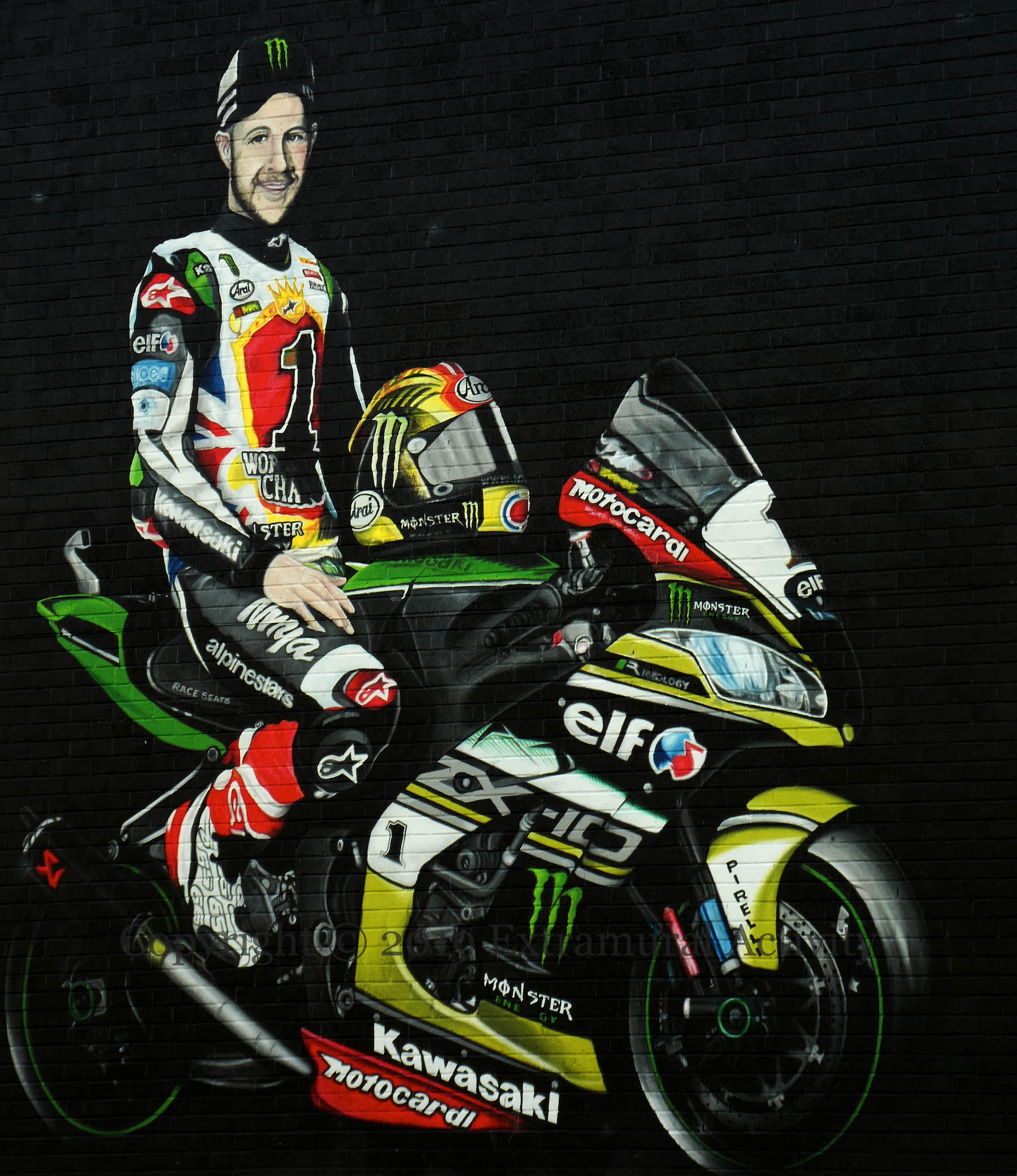
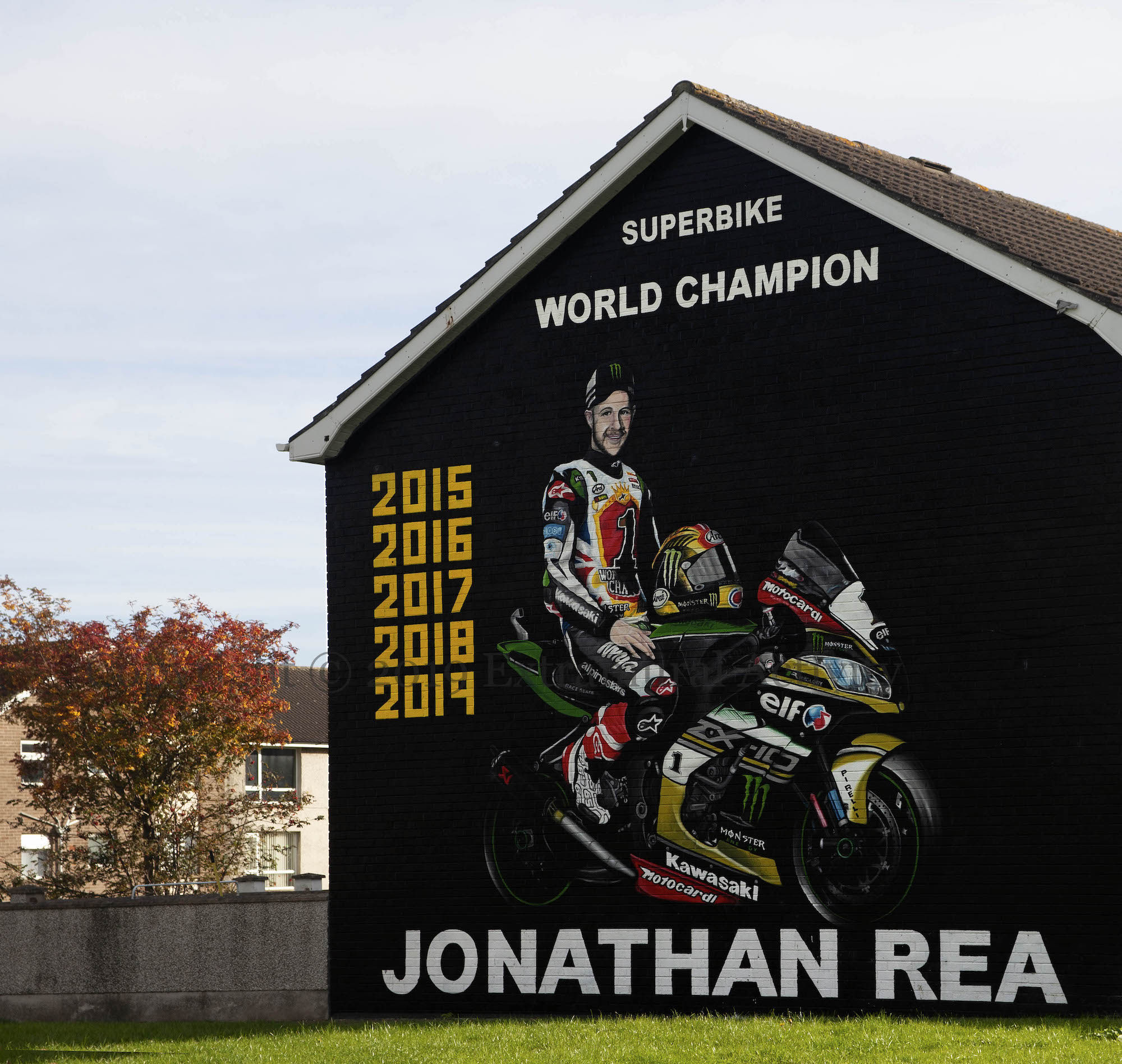
Jonathan Rea, riding for Kawasaki, became Superbike World Champion for a fifth consecutive time with wins in the final three stops of the year, in France, Argentina, and Qatar (WP). He grew up in Ballynure, near Ballyclare. (Belfast Live has a profile.) This mural, by Noel Morrison (Fb), is in Blenheim Drive in the Westwinds estate, Newtownards. (BelTel has a write-up. BBC Bikes has video showing Morrison adding “2019” to the mural after Rea’s recent win.)

The mural replaces The Union Jack. There is a small piece to rider Joey Dunlop at the shops – see The Pride Of Ulster.

Click image to enlarge
Copyright © 2019 Seosamh Mac Coılle
X06860 X06859 housing executive westwinds social and cultural

An Tusa An Chéad Laoch Eıle?

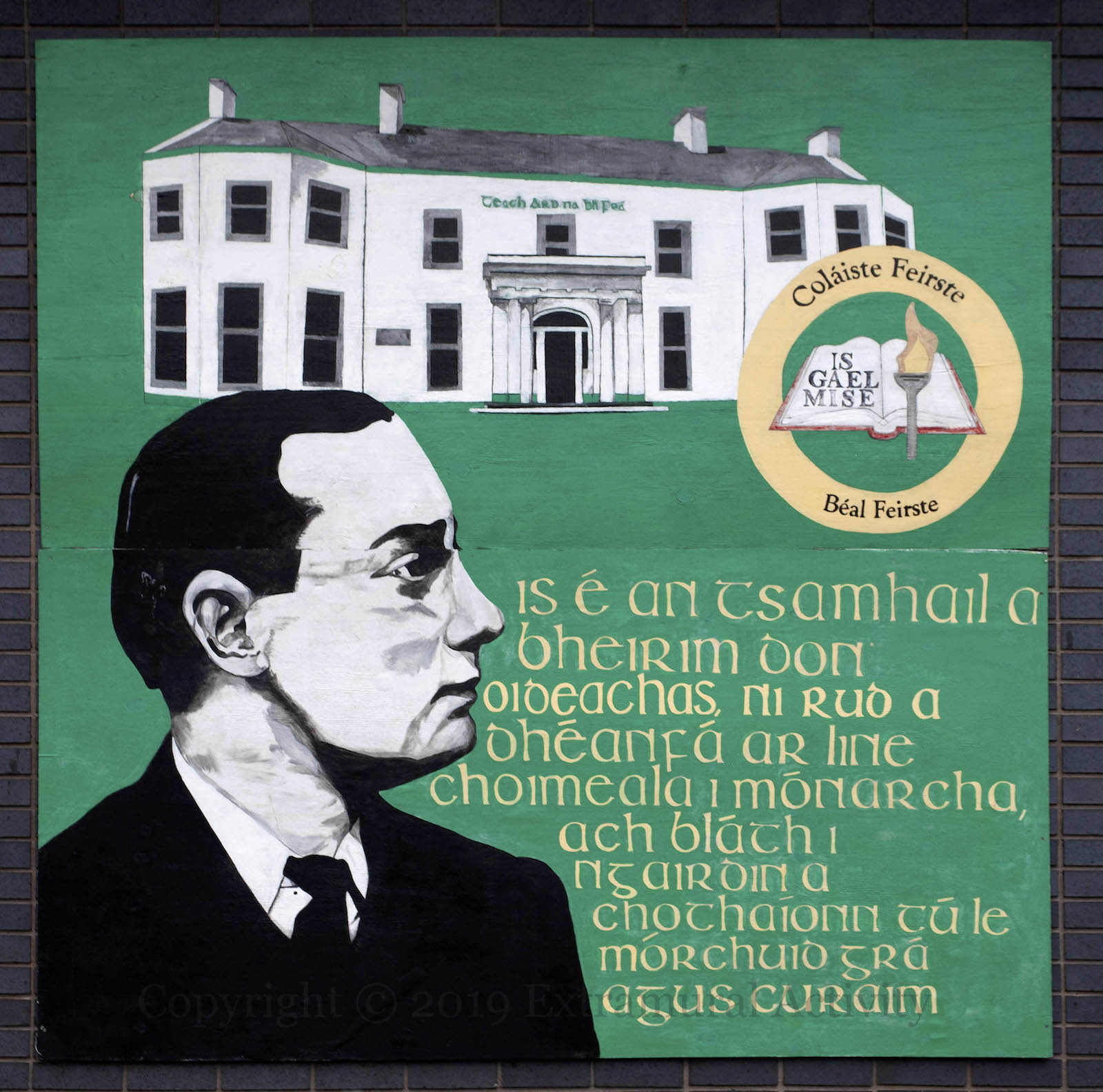
Padraig Pearse was a schoolmaster (at St Enda’s in Dublin) and wrote about the importance of education to the character of the nation. He described the English education system in Ireland as a “murder machine“. In a pamphlet of that name he writes, “Education has not to do with the manufacture of things, but with fostering the growth of things. And the conditions we should strive to bring about in our education system are not the conditions favourable to the rapid and cheap manufacture of ready-mades, but the conditions available to the growth of living organisms – the liberty and the light and the gladness of a ploughed field under the spring sunshine.” on which the Irish above might possibly be based (though he wrote about 50 pieces on education): “Is é an tsamhaıl a bheırım don oıdeachas, ní rud a dhéanfa ar líne chóımeála ı monarcha ach bláth ı ngaırdín a chothaíonn tú le mórchuıd grá agus cúraım.” [I take as a likeness of education not something that is made on an assembly line in a factory but a flower in a garden that you nourish with great love and care.] For some background, see Pearse The Educationalist. Pearse’s likeness and philosophy of education are posted at the entrance to Coláıste Feırste.

Click image to enlarge
Copyright © 2019 Seosamh Mac Coılle
X06849

Thoughts Awe Hame

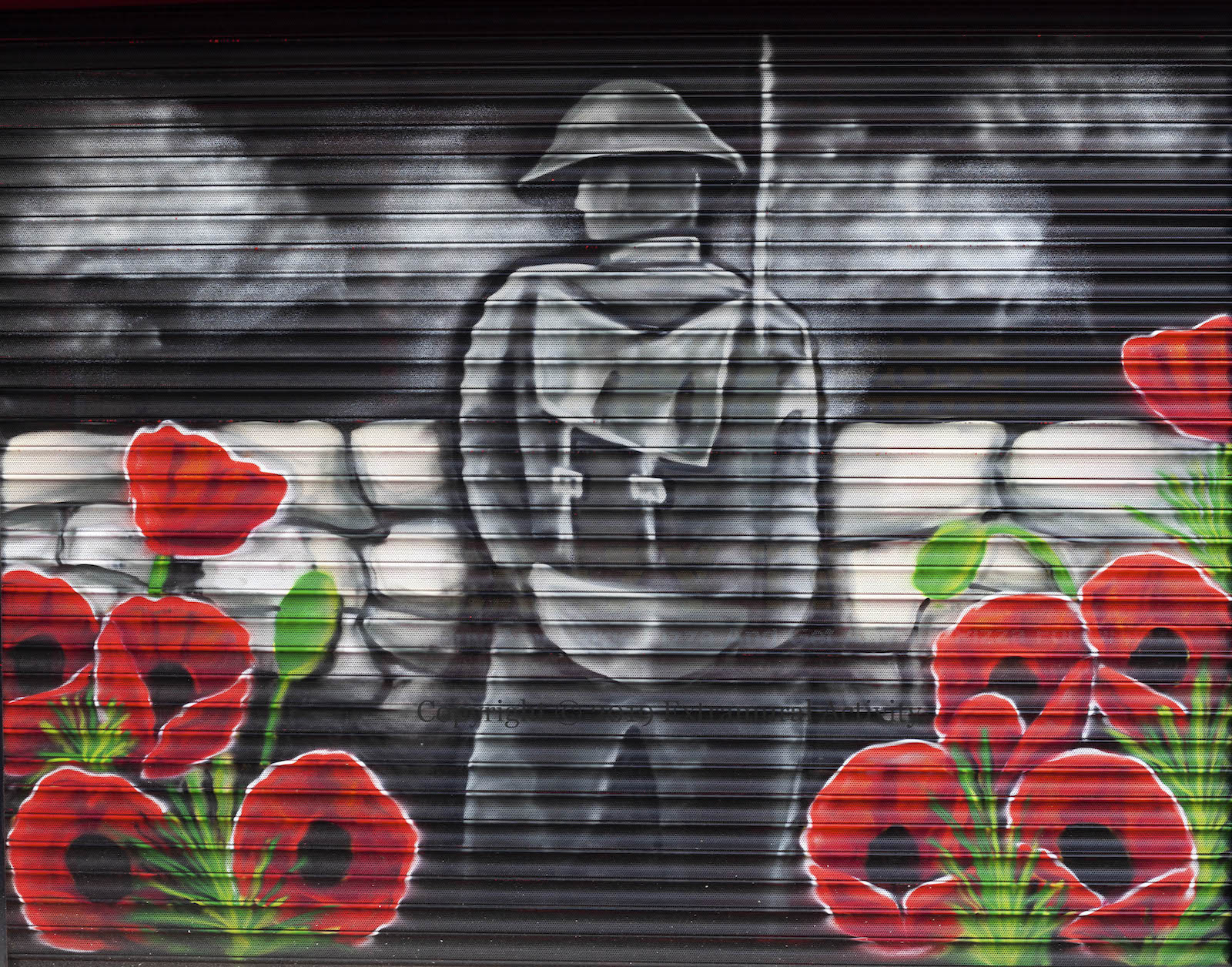
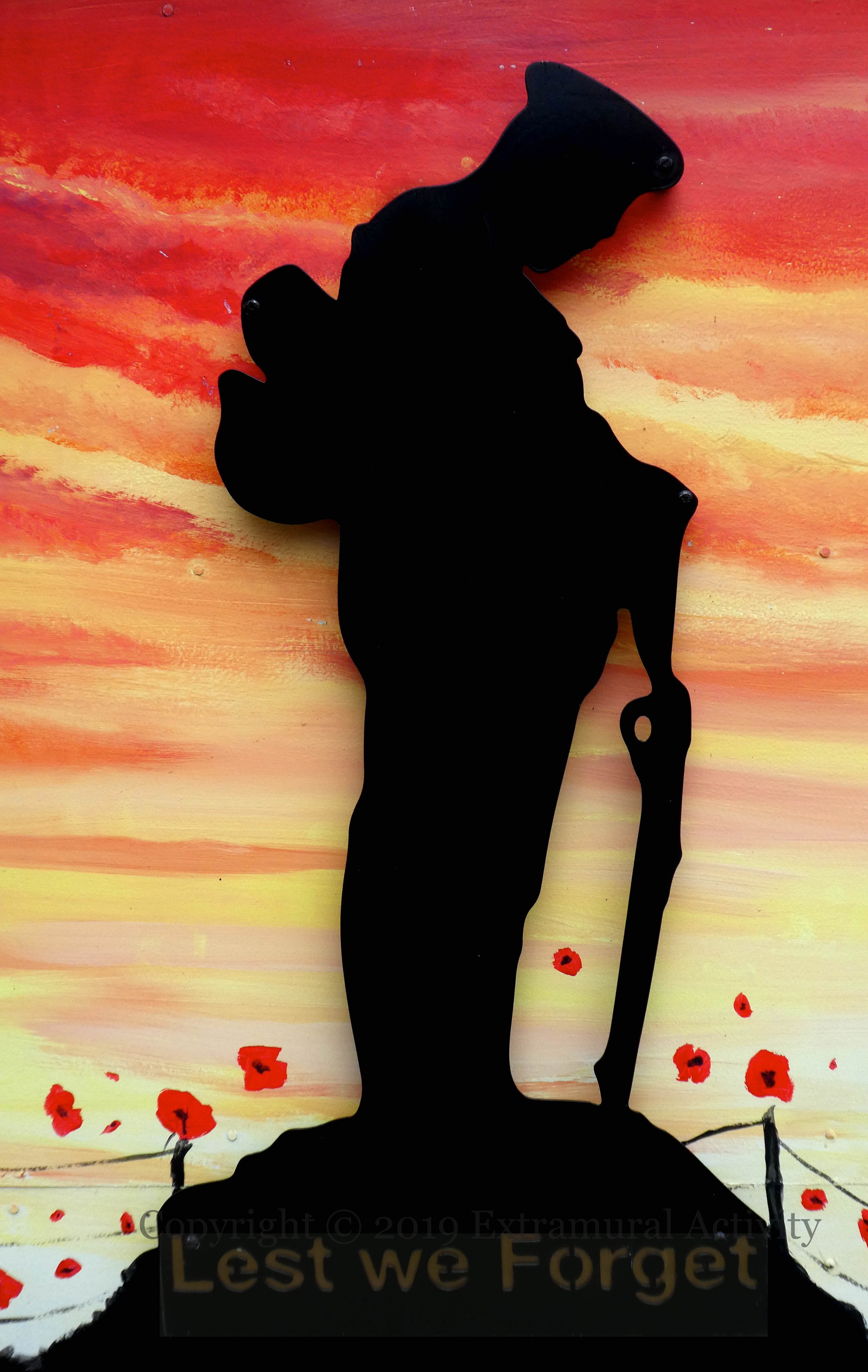
This contemplative WWI soldier is the mural part of a new memorial commemorating fallen UVF volunteers from Scotland. On the shutters of the Pizza Cabin on the Shankill.

Click image to enlarge
Copyright © 2019 Seosamh Mac Coılle
X06842

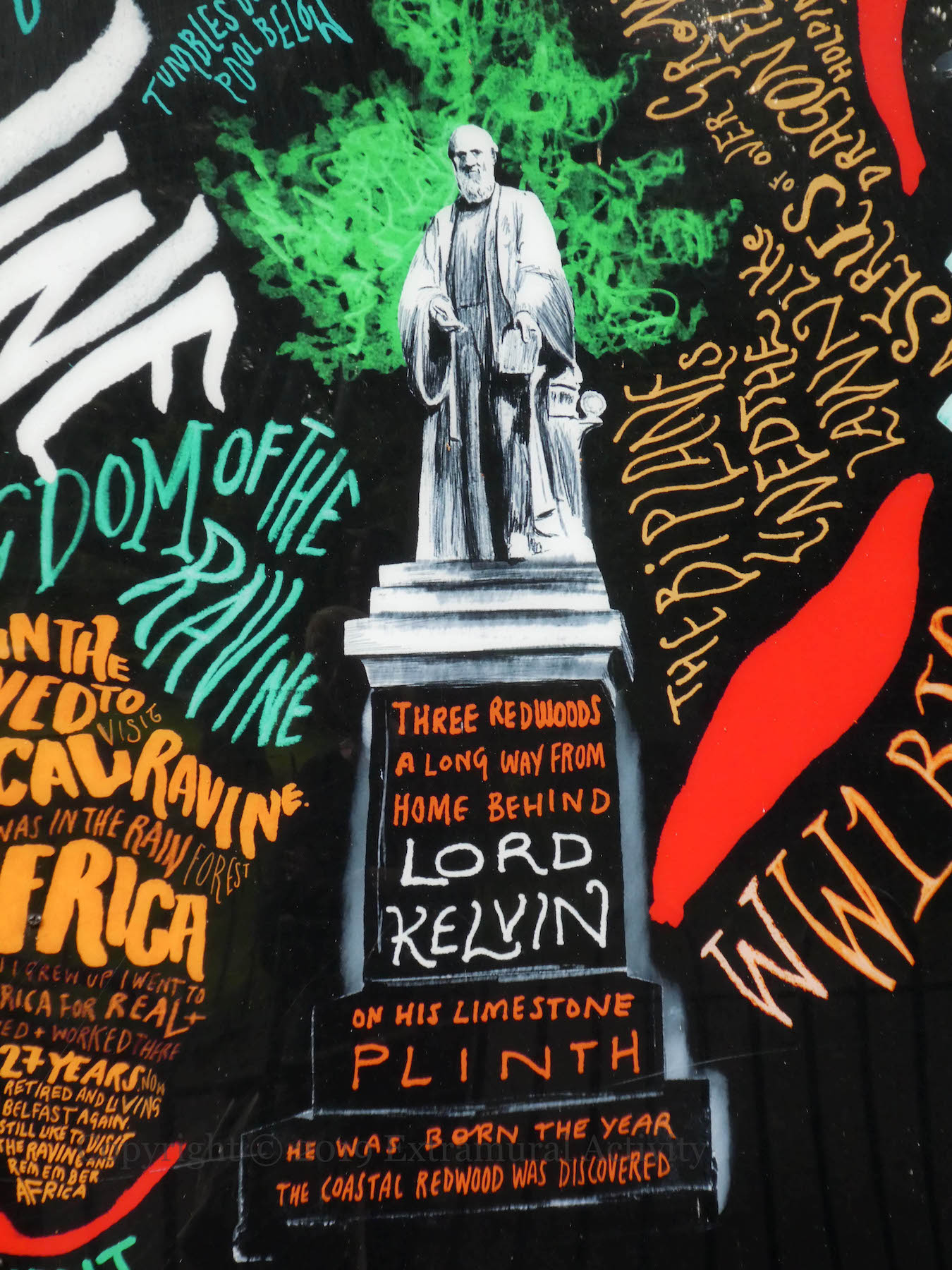
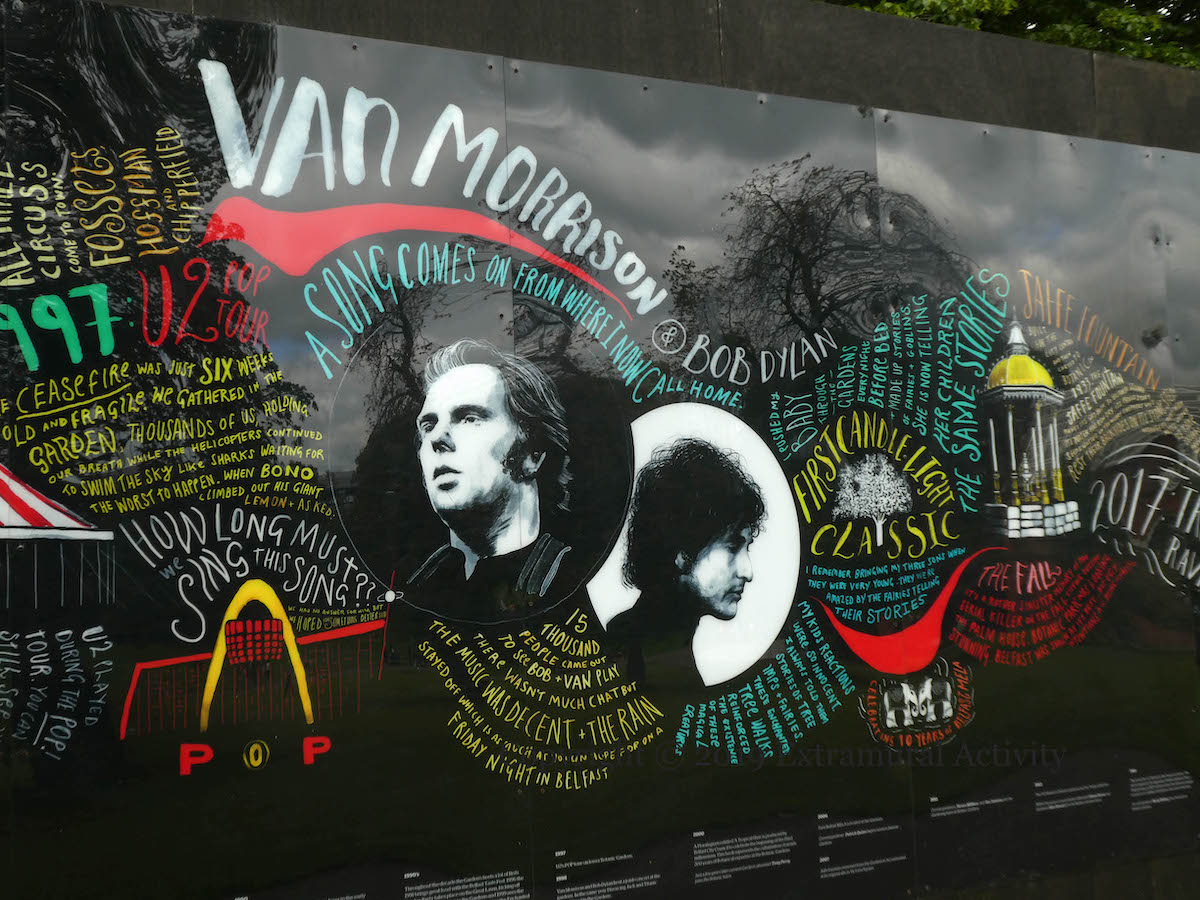
What I Have Witnessed In Botanic Gardens

At 28 acres, Belfast’s Botanic Gardens are large enough to contain a variety of attractions: the Ulster Museum; two glass houses: the Palm House, designed by Charles Lanyon, and the Tropical Ravine, opened in 1889 under head gardener Charles McKimm (Ulster Biography) whose portrait appears at the centre of the image just below; a large rose garden.

The large parklands serve as the site of outdoor events such as music concerts by famous 20th century artists such as U2, Van Morrison, and Bob Dylan (see final image) and before that the final public appearance of tightrope walker Charles Blondin in 1896 – “He went up and down and up again, all the way along the rope he did his different moves: handstands, cartwheels, running. He was just like a circus acrobat. Mssr Blondin was up there with another man on his back. Blondin was just walking about easily, the other man felt terrible” – and the launch of Henry Coxwell’s hot air balloon on July 3rd, 1865 – the balloon was exceedingly large: (“You won’t believe what I have witnessed in Botanic Gardens. A monstrous balloon was being launched into the sky”) and it escaped – “She has gone across the sea, but it is not known whither.” concludes the account by the Sydney Empire.

The statue to Belfast-born Lord Kelvin is at the Stranmillis entrance to the park.

This is the second part (up to WWI) of a 27m-long history of Botanic Gardens by artist Peter Strain and poet Emma Must (BelTel).

X06804 2019-09-09 BotGardens Cloud Van+

Click image to enlarge
Copyright © 2019 Seosamh Mac Coılle
X06805 X06803 X06804

The Loyal 36th

“Off to France our boys were sent. All gave some, some gave all – In memory of the loyal 36th.” The first phrase might come from the Rangers’ song ‘We’re Coming Down The Road‘. The second phrase dates not to WWI but the Korean War in the 1950s (Reference). Kitchener Drive, the Village.

Click image to enlarge
Copyright © 2019 Extramural Activity
X06729 X06728 kitchener drive

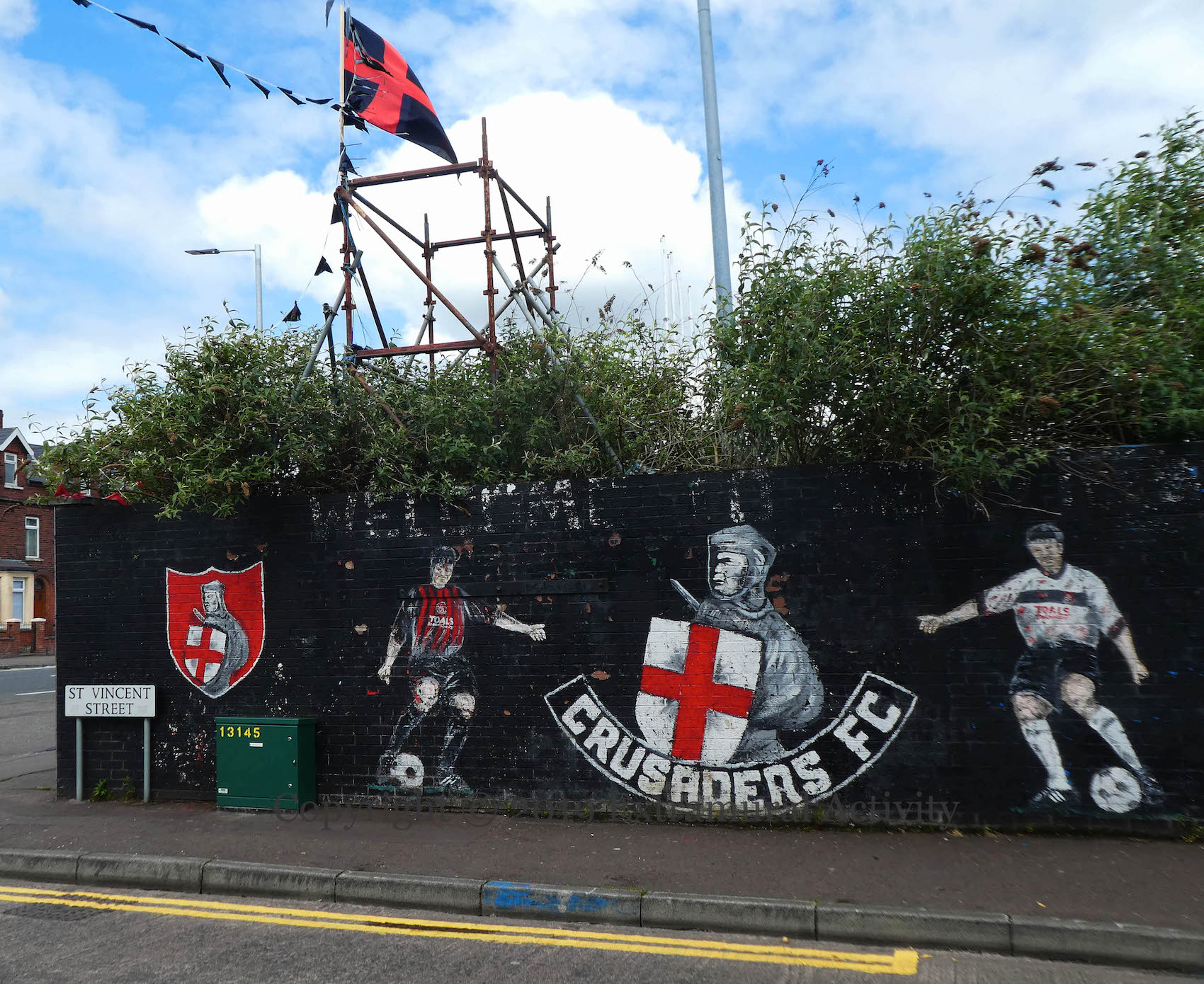
The Northern Crusades

Crusaders – off to a perfect start of two wins – travel the mile and a half across north Belfast to Solitude to  play Cliftonville at 3 this afternoon in the north Belfast derby. Today’s images are of the mural outside Seaview and the scene from the run-up to the team’s Irish Cup win over Ballinamallard (BBC-NI). In meetings between Crusaders and Cliftonville, Crusaders lead 151 wins to 84 (WP).

Click image to enlarge
Copyright © 2019 Seosamh Mac Coılle
X06618 X06619

Kingdom Of The Pretani

“Pretani” is the Brittonic version of the Greek term “Prettanoi”, possibly borrowed from the Gauls (WP), for the inhabitants of the two islands now known as Ireland and Britain, and “Cruthin” the Gaelic term. According to the eponymous web site, Dalaradia was “was a kingdom of the Cruthin in the north-east of Ireland and parts of Scotland in the first millennium” with the Cruthin being (more narrowly than above) a people in Antrim and Down with (in the middle of the mural) “the field of Crewe Hill, with the Ancient Crowning Stone of Ulster Kings” (REACH) in Glenavy (pretani.co.uk).

The WP page on the Cruthin notes, “The name Cruthin survives in the placenames Duncrun (Dún Cruithean, “fort of the Cruthin”) and Drumcroon (Droim Cruithean, “ridge of the Cruthin”) in County Londonderry, and Ballycrune (Bealach Cruithean, “pass of the Cruthin”) and Crown Mound (Áth Cruithean, “ford of the Cruthin”) in County Down. These placenames are believed to mark the edges of Cruthin territory.”

The towers of Rathcoole can be seen underneath the slogan “Respect, heritage, culture.” They also famously appear behind a trio of hooded gunmen in a Rathcoole mural.

Click image to enlarge
Copyright © 2019 Seosamh Mac Coılle
X06706 [X06707] [X06708] carmeen dr