On Her Their Lives Depend

2013-05-19 OnHerTheirLives+

Women Munition Workers during the First World War are celebrated in this 2011 mural on Inniscarn/Iniscarn Drive in Rathcoole. A ‘Canary Girl’ readies for work as a TNT shell maker. The term stems from the fact that TNT can turn the skin a yellow-orange colour.

The recruitment poster on which the mural is based is shown below. British Pathé has some footage of women working in a munitions factory, presumably in England somewhere. BBC has a page on a massive explosion at the Chilwell (Nottingham) factory. An image of workers amongst shells in 1915 can be seen at http://smnmcshannon.hubpages.com/.

Click image to enlarge
Copyright © 2013 Seosamh Mac Coılle
X01100
Tullycarnet Memorial

2013-05-22 TullMemLeft+

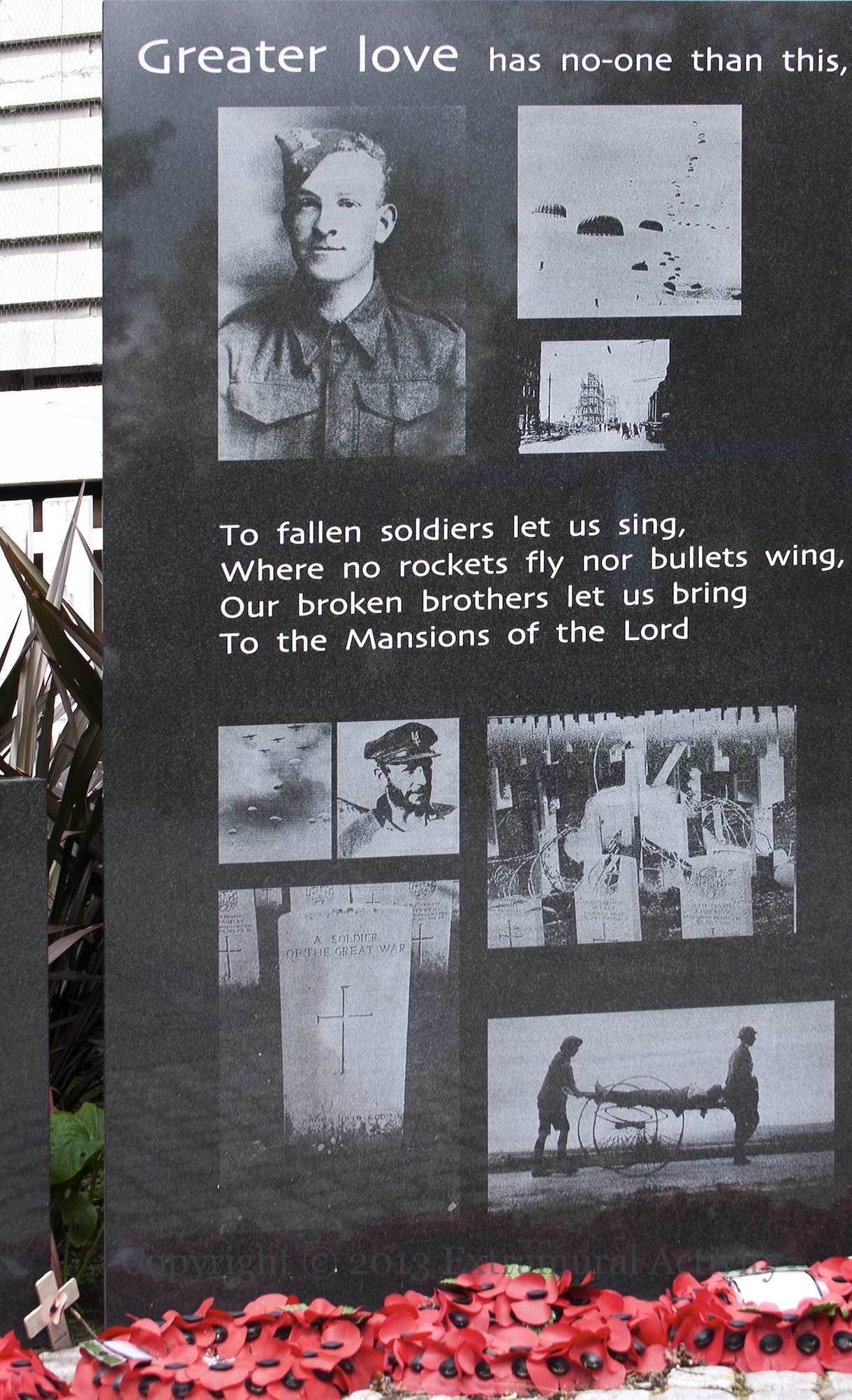
A three-stone memorial to army soldiers from both World Wards in Tullycarnet, featuring a line from the gospel of John (“Greater love has no-one than this, that a man lay down his life for his friends” 15:13) and a song by Randall Wallace for the 2002 movie We Were Soldiers called ‘The Mansions of the Lord’: To fallen soldiers let us sing, where no rockets fly nor bullets wing, our broken brothers let us bring, to the mansions of the Lord. No more weeping, no more fight, no prayers pleading through the night, just divine embrace, eternal light, in the mansions of the Lord. Where no mothers cry and no children weep, we will stand and guard though the angels sleep, Oh through the ages safely keep, the mansions of the Lord.”

By Ross Wilson with support from the International Fund For Ireland (IFI)

For a wide shot, see War And Peace.

2013-05-22 TullMemMiddle+

2013-05-22 TullMemRight+

Click image to enlarge
Copyright © 2013 Seosamh Mac Coılle
X01110  X01111 X01112

Many Did Not Return

2013-05-19 15thBatt+

This mural and memorial in Rathcoole commemorates soldiers from the north Belfast area who went to France in 1915 as part of the 15th (North Belfast) Royal Irish Rifles, and in particular the five whose faces appear in the apex of the mural: Magookin, La Harpur, Forrester, Baird and Templeton.

The information board is reproduced below.

2013-05-19 15thBattInfo+

Click image to enlarge
Copyright © 2013 Seosamh Mac Coılle
X01098 X01099

Hollow Promises

2013-05-03 LongWomansGrave+

The Long Woman was 7ft tall, a Spaniard of Ulster heritage who died of disappointment after eloping with Lorcan and returning with him (to the Omeath area of County Louth, just on the south side of Carlingford Lough and south of Newry) and having the same trick pulled on her that Lorcan’s brother had pulled on him when divvying up their inheritance — you can be owner of the land as far as you can see … while standing in a hollow.

Click image to enlarge
Copyright © 2013 Seosamh Mac Coılle
X01082
The Long Woman’s Grave or “The Cairn of Cauthleen” is the grave of a Spanish noble woman who married Lorcan O’Hanlon, the youngest son of the “Cean” or Chieftain of Omeath. On the death of the Cean he ordered that his lands be divided between his two sons, Conn óg and Lorcan. However Conn óg tricked his brother Lorcan by bringing him up to the Lug or hollow in the mountains at Aenagh, telling him that he would give him the land “as far as he could see”. The mist and the bleakness of the hollow was Lorcan’s only legacy. However Lorcan owned a ship and begun trading in the East, making his fortune and becoming prosperous. On one of his voyages to Cadiz, Spain he bravely saved the lives of a Spanish nobleman and his daughter. Lorcan was enchanted by Cauthleen, a descendent of the great O’Donnells of Ulster and fell in love with her. The pair made a handsome couple; she was 7ft tall, only three inches smaller than Lorcan. Cauthleen was already engaged to be married but was wooed by Lorcan’s professions of love and the promises of the good life that they would have back in Omeath. The pair eloped when the couple arrived in Carlingford Lough the locals were enchanted by this tall beauty adorned with jewels. The couple set along the mountain path until they came to the Lug or Hollow in the rocks. Lorcan bade his bride to stand in the centre and look around as far as she could see as he “Was Lord of all she could survey”. Cauthleen looked around, so great was her disappointment and the realisation of what she had left behind in Spain, she fell to the ground and died. Lorcan was horrified that his duplicity had caused his bride to die and flung himself into the murky waters of the marsh at the crossroads. His body was never recovered. The locals found the long womans’ body, and dug a grave for Cauthleen in the “Lug Bhan Fada” (Long woman’s hollow) where she lay. Each person laid a stone on the grave to raise her burial cairn and here she sleeps today in the hollow of her disappointment and unfilled promises.

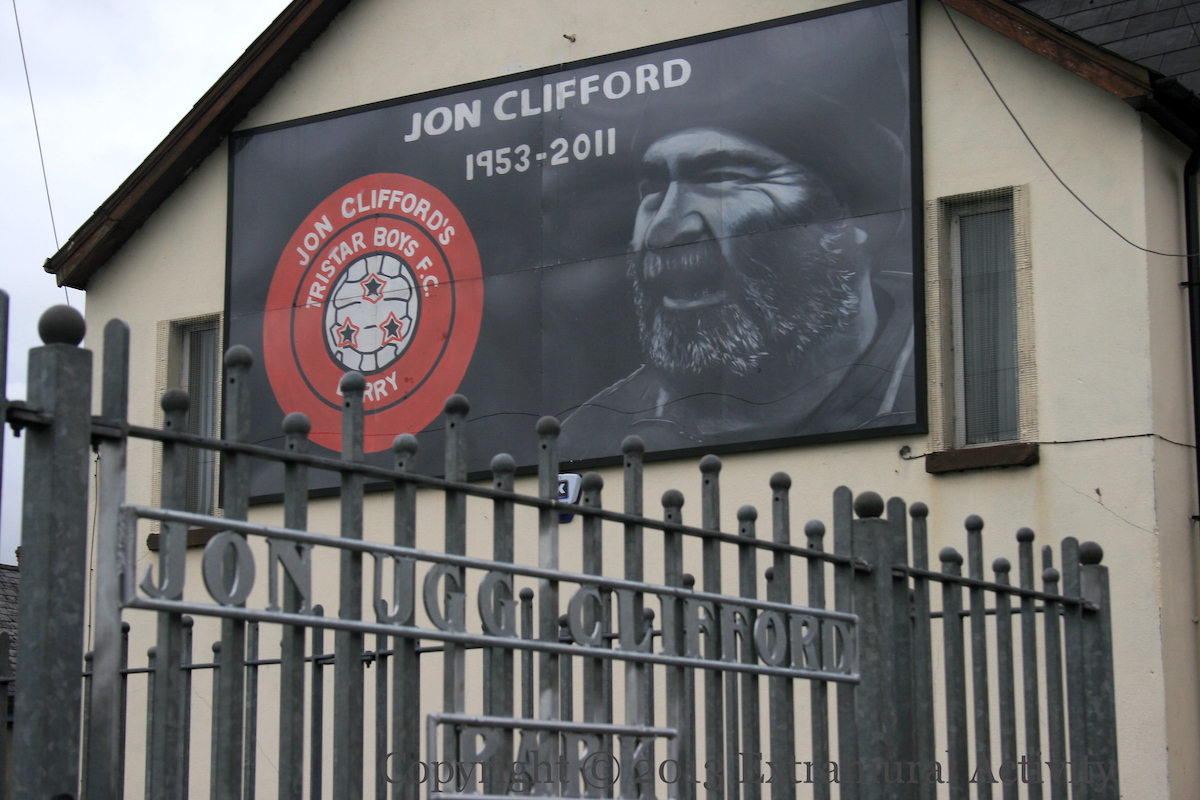
Jon Clifford

Jon “Ugg” Clifford died in 2011, having founded Tristar Boys FC (web) in 1974. Bull Park in Creggan has been renamed in his honour and this new board mounted above the park.

(BelTel | Derry Journal)

Click image to enlarge
Copyright © 2013 Seosamh Mac Coılle
X05236

The Walled City Marathon

“You are now entering the final stage of the walled city marathon 2013″. Free Derry Corner is partially covered with a tarp for the marathon.

Click image to enlarge
Copyright © 2013 Seosamh Mac Coılle
X05235

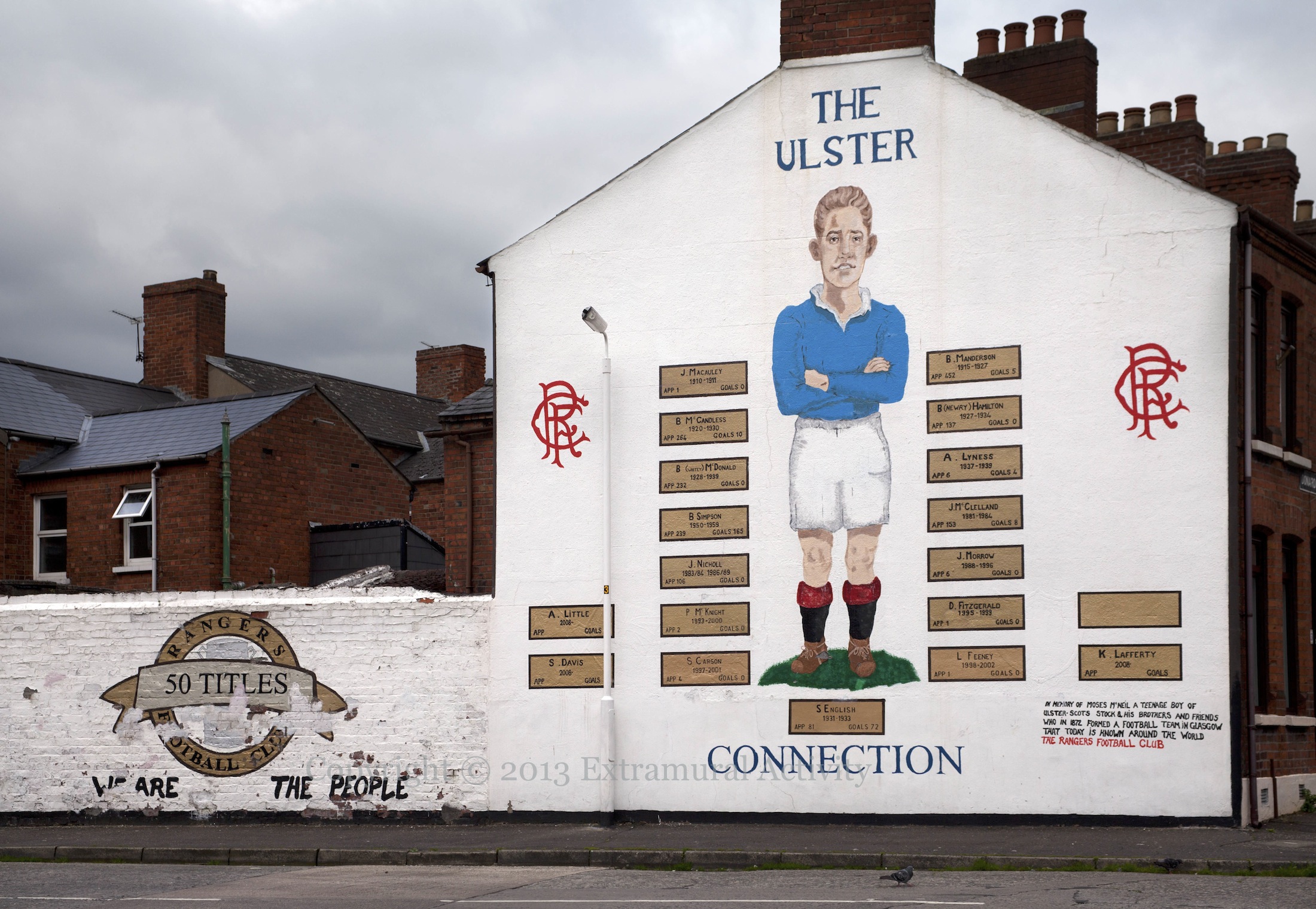
The Ulster Connection

2013-05-09 RangersConnection+

A mural in east Belfast listing local players who have played for Rangers, in Glasgow, Scotland. Featured in the centre is S. English, who scored 72 goals in 81 appearances, including 44 in the 1931-1932 season. Additional player plaques have been added since 2008, as well as the dedication in the lower right corner: “In memory of Moses McNeill, a teenage boy of Ulster-Scots stock & his brothers and friends who in 1872 formed a football team in Glasgow that today is known around the world as the Rangers Football Club “.

Click image to enlarge
Copyright © 2013 Seosamh Mac Coılle
X01089 we are the people in memory of moses mcneil a teenage boy of ulster-scots stock & his brothers and friends who in 1872 formed a football team in Glasgow that today is known around the world as the rangers football club, 50 title

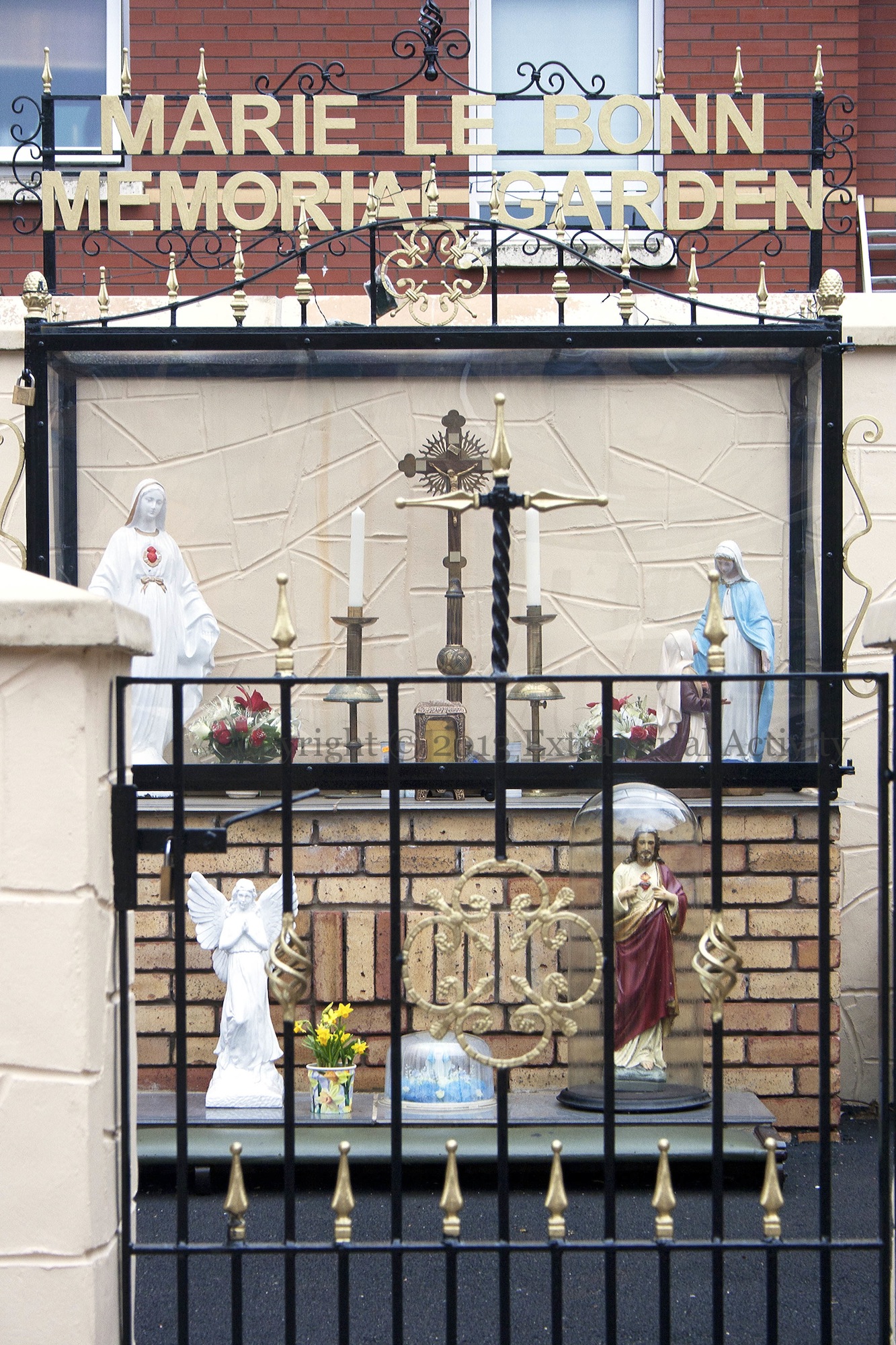
Marie Le Bonn

2013-04-23 ArdAnLao2+

Shown is a small memorial garden in Clós Ard An Lao/Ardilea Close. There is no record at all, on-line at least, of a Marie Le Bonn. “Marrowbone” is sometimes thought to be a corruption of “Marie Le Bone” (and “Marylebone” in London is derived from the church of St Mary’s on the bourne (stream) (WP)) but a more likely derivation, given the location, is Machaıre Botháın, the plain of the (shepherd’s) hut. But Mary The Good is more in keeping with the shrine.

Click image to enlarge
Copyright © 2013 Seosamh Mac Coılle
X01066

Sir Edward Bingham

2013-03-29 BangorBingham+

This is a mural in his home town to rear admiral Sir Edward (“Barry”) Bingham, OBE, born in Bangor and recipient of the Victoria Cross (featured in the apex of the roof) for service in WWI.

“Rear Admiral Edward Bingham VC OBE, son of Lord Clanmorris, was born in Bangor and served in the Royal Navy during the First World War. He was awarded the Victoria Cross for his actions in engaging the German fleet during the battle of Jutland. The Bingham family name adorns various settings in the town where he is remembered with pride. Rear Admiral Bingham’s Victoria Cross was purchased by North Down borough council and is on display at the North Down museum.”

This mural is adjacent to a Red Hand Commando mural.

The context shot, below, shows the two together, as viewed through the uprights of a community monument just across the road, featuring old photographs and documenting the history of the local community.

There is a ‘category’ tracking murals with windows.

2013-03-29 BangorWide+

Click image to enlarge
Copyright © 2013 Seosamh Mac Coılle
X01030 X01032 messines hms nestor for valor born 26th July died 24th Sept 1939

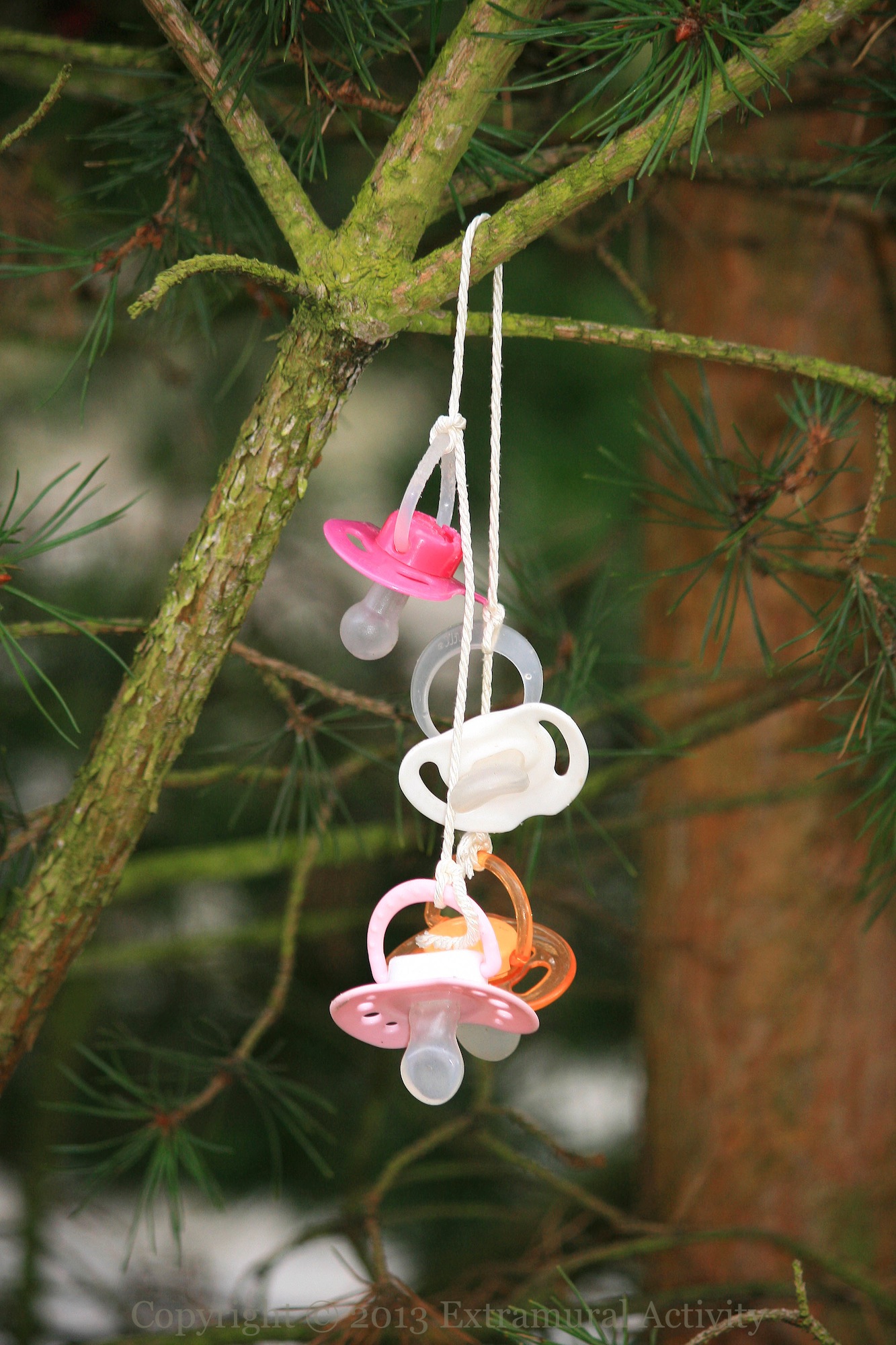
Pacifiers

2013-03-24 Dummies1+

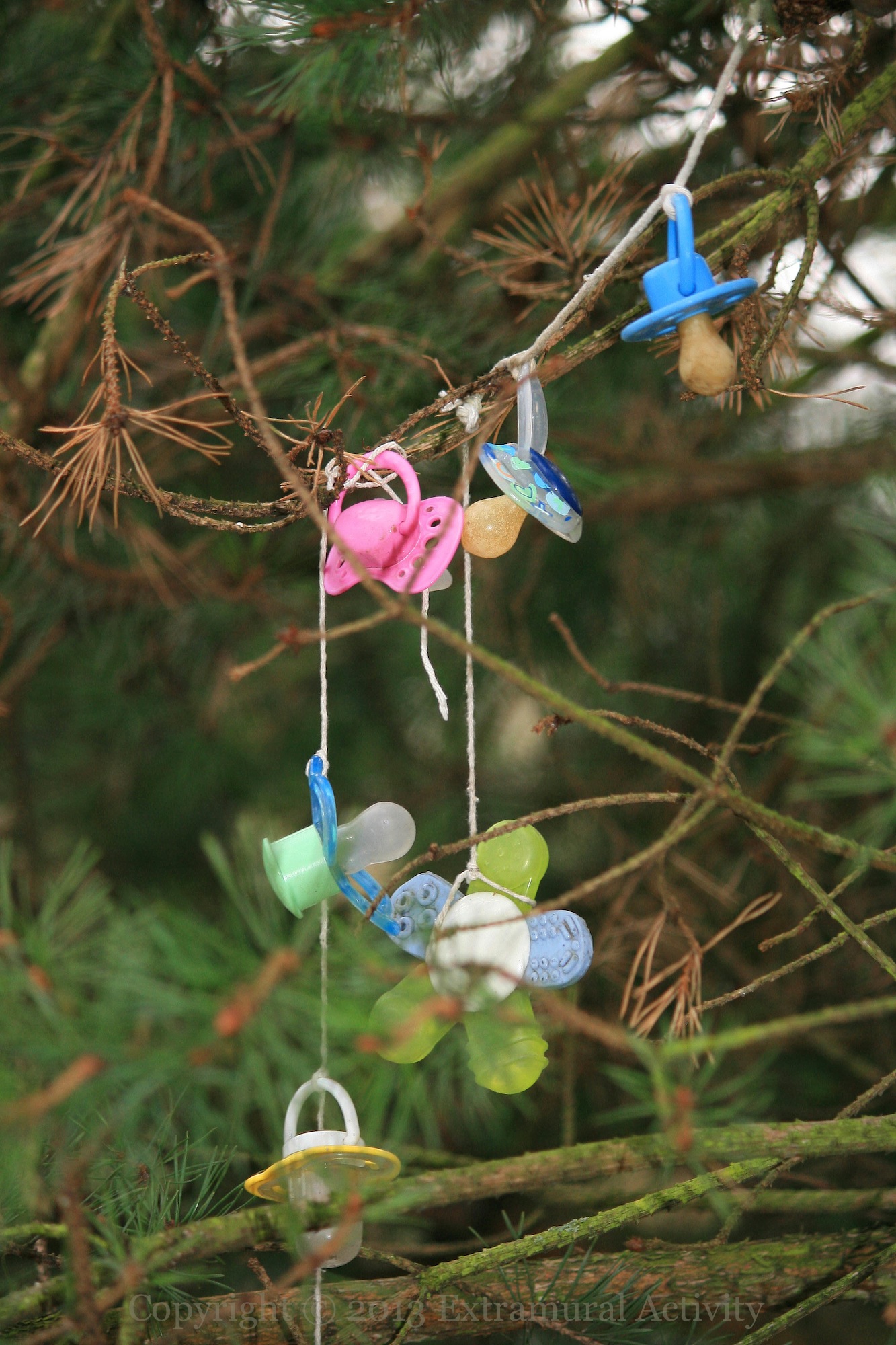
According to this page from Early Christian Sites In Ireland, trees next to wells were considered holy, and “rags were tied to trees, or objects left there, in the belief that, while they remained, the prayers were still effective”. These pacifiers (or dummies, as they are commonly known) were spotted hanging from trees in the Waterworks. Are these the holy trees of our Late Christian period? Or just a sign that drugs can be procured?

2013-03-24 Dummies2+

Click image to enlarge
Copyright © 2013 Seosamh Mac Coılle
X01024 X01025