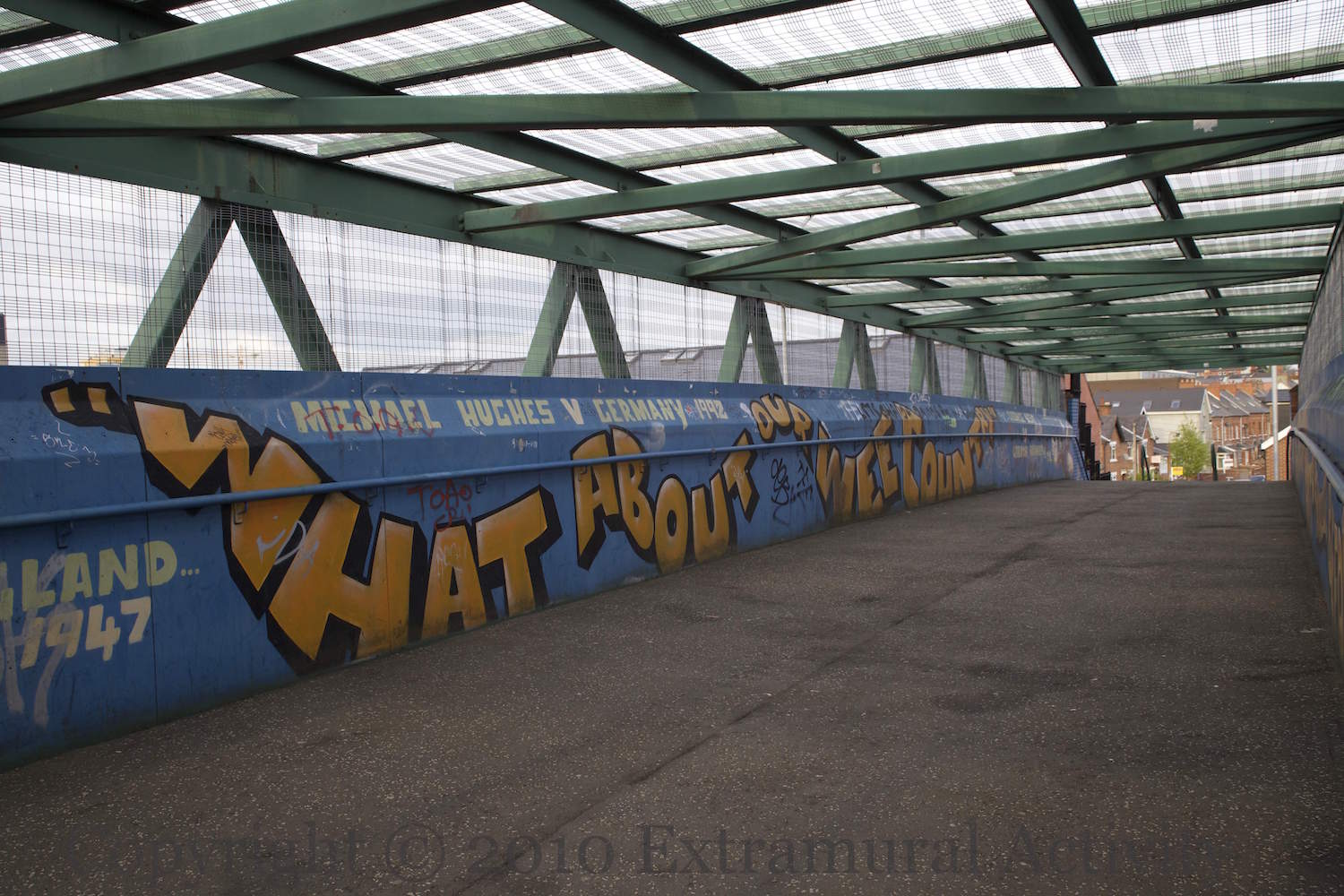
Highlights from Northern Ireland’s (football team) history on the footbridge from Windsor Avenue to Windsor Park (stadium). “N. Ireland v England 1947″,”Michael Hughes v Germany 1992”, and “George Best v Gordon Banks”. By Blaze FX.
The summer of 1969 is generally taken to be the beginning of the Troubles in Belfast and the most famous symbol of the August riots is the burning of Bombay Street. The street was (and is) just below the old Cupar Street, where many streets drop down from the Shankill (you can see the distribution of PUL and CNR houses in the Visual History page on the west Belfast “peace” line). This event is commemorated in nationalist murals (see e.g. No Mission) but for a statement from the PUL perspective, see Can It Change?
The mural is based on a Frankie Quinn photograph “Belfast 1984”.
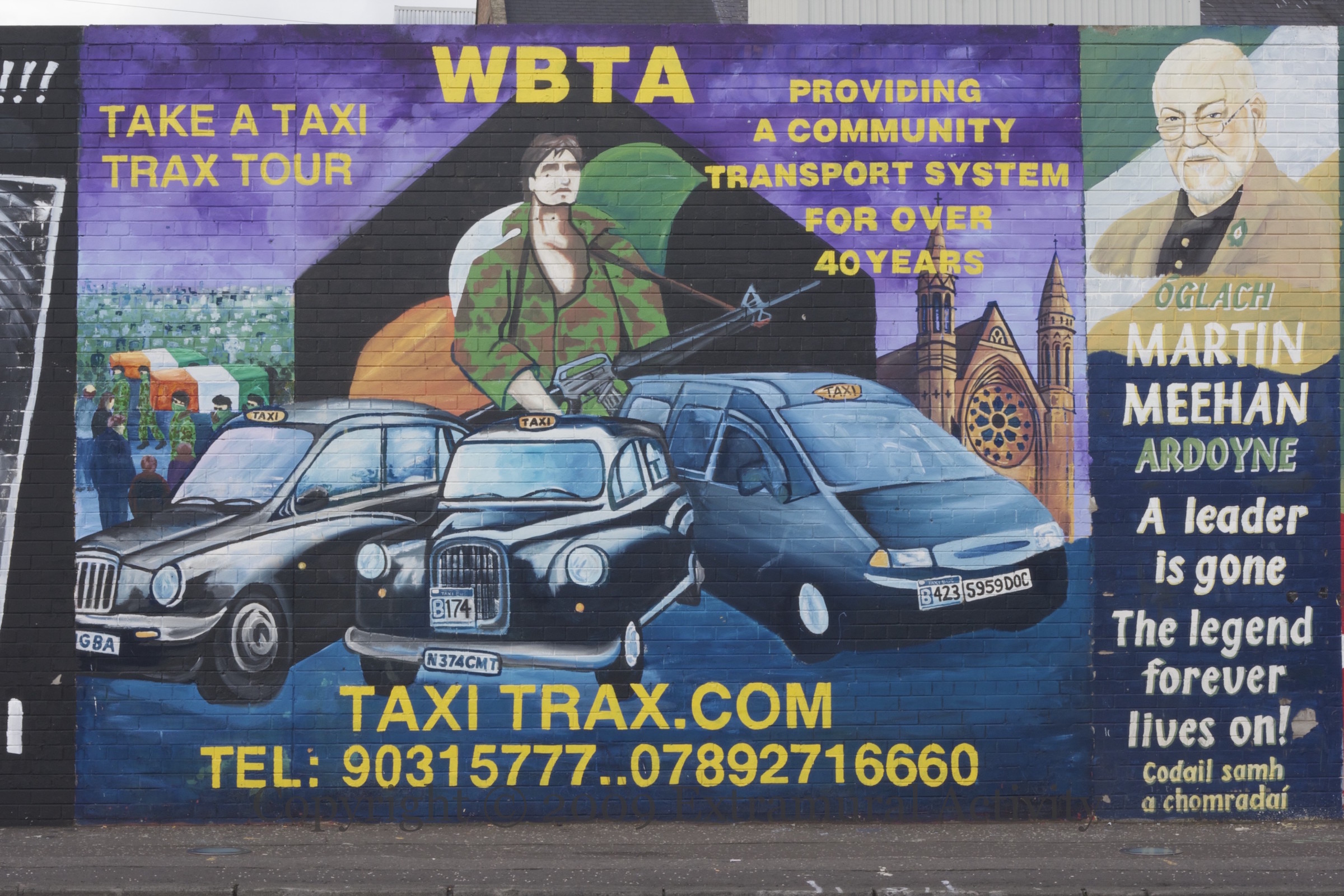
“Providing a community transport system for over 40 years.” The West Belfast Taxi Association (WBTA) have had a mural on the International Wall since at least 2006, offering tours of west Belfast and the murals in particular. Martin Meehan was originally OIRA but switched to the Provisionals after the split. He was the first person convicted of membership of the PIRA and spent 18 years in prison during the Troubles (WP). “Codaıl samh a chomradaí.”
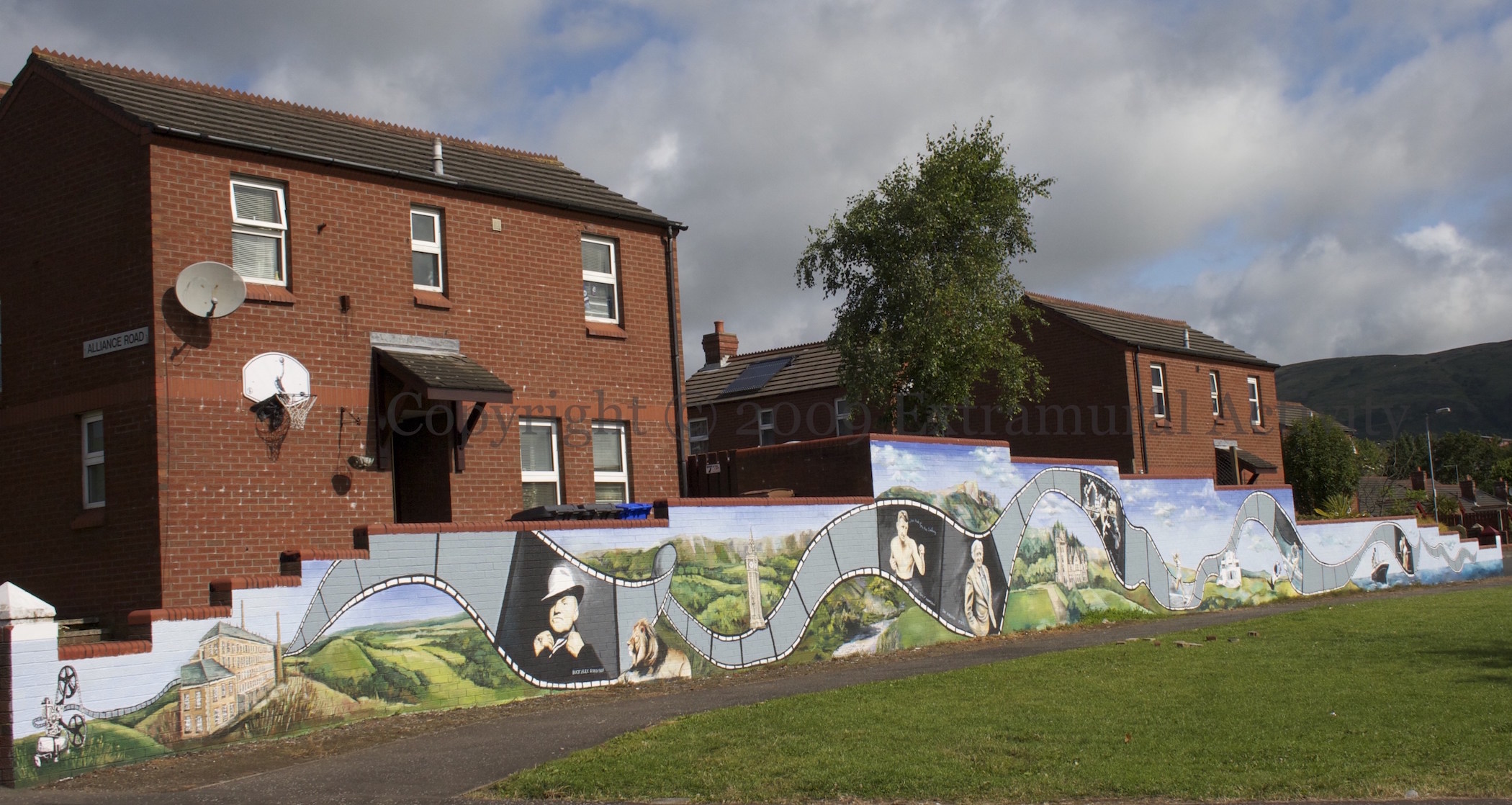
“Artist Daniela Balmaverde has worked with older members of the local community to reminisce and to appreciate those from North Belfast who have made an impact on our broader society. A multiplicity of initiatives has altered the face and conditions of life in this community with Re-Imaging making a positive contribution to a long-term process. The project was launched by the Lord Mayor on August 2009 This project was funded through the Re-Imaging Communities programme of the Arts Council of Northern Ireland and delivered by Belfast City Council with the support of Lower Ormeau Road Resident’s Action Group. This project is supported by the Shared Communities Consortium.”
The figures in the mural include Buck Alec Robinson, Rinty Monaghan, Sam McAughtry, Sir James Galway, Dame Mary Peters, Norman Whiteside, and Wayne McCullough. The mural replaced is the one equating the American Confederates with the Ulster Covenant in Alliance Crescent.
“Councillor Liam MacCarthy, Ireland’s forgotten son. Gael, patriot. Winners of the All-Ireland hurling championship are awarded a trophy named after MacCarthy.
This is an unusual mural in terms of form: it is a mix of mural and board and the knot-work border does not go around the top, so that the hurley players extend the painting and not do not break the frame of the painting.
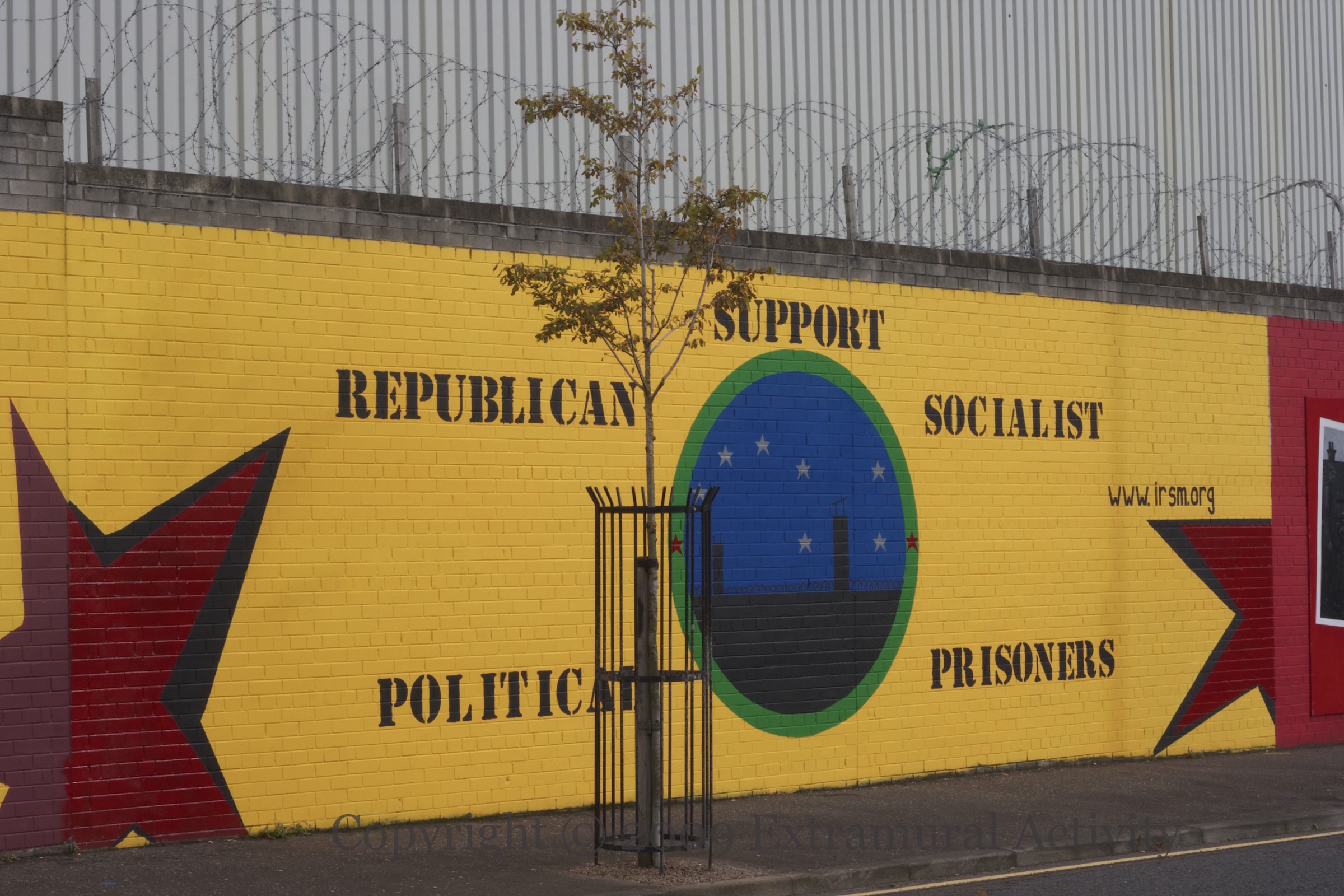
“Askatasuna [freedom]. 700 political prisoners! Political parties banned! Incidents of torture! Civil rights abused! Not Spain, not France. Self-determination for the Basque country.” Also highlighted on the map are Galicia and Catalonia.
This mural on the International Wall commemorates the Manchester martyrs, Philip Allen, Michael O’Brien, Michael Larkin.
The three were publicly hanged on November ?23rd?, 1867, for the killing of a Manchester policeman, Charles Brett. Brett was inside a prison van carrying two IRB leaders when it was set upon by 30 or more people (depicted in the small insert at the top of the mural). The attendant escort fled, leaving Brett inside; he was killed by a bullet fired into the lock. Five people were convicted, one of whom, O’Meagher Condon, shouted “God save Ireland” during the trial; this was turned into an extremely popular song in memory of the three (Wolfe Tones version). Their graves were discovered in 2003 (Irish Times) and a campaign is being waged to repatriate their corpses (Sınn Féın).
“Bring them back to Irish soil. Three Irishmen, one an American citizen, were falsely accused, convicted and hung on the 24th November 1867 in Manchester where their bodies still lie. God save Ireland.”
Picasso’s Guernica (WP) was recreated on The International Wall (Divis Street) in 2007 and now (2009) a reference to the deaths in Gaza has been added on the right, in the form of two bombs — one with a swastika and “Guernica ’37” and the other with a Star Of David and “Gaza 2009” — above and below the information plaque (which can be seen in the Peter Moloney Collection).




 Extramural Activity