For the third time, these two panels – one of the signing of the Covenant in 1912 and the other of soldiers in collarettes and sashes defending their trench against a German attack – are visible at Barrington Gardens. They were originally on the gable at the corner before it was demolished (see July 1st); during re-development they were placed on a metal frame (see Out Of The Rubble).
These UDA 2nd battalion D company boards are in the lower Kilcooley estate, Bangor. This piece is co-branded as “North Down/West Belfast”, even though it is only metres away from a (North Down/East Belfast) North Down Defenders board. See Ulster Defence Unions for more on the tensions between the rival UDA factions.
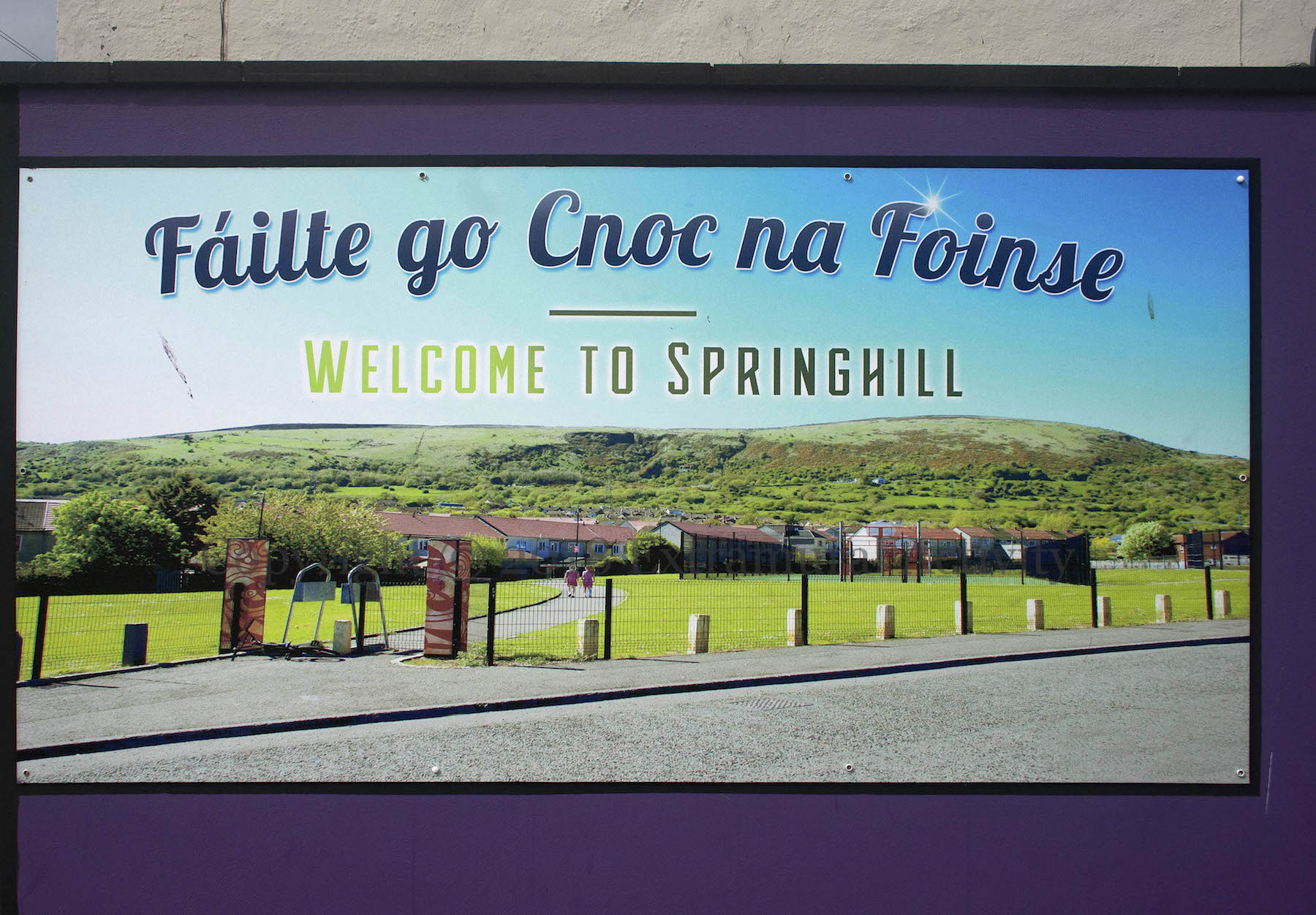
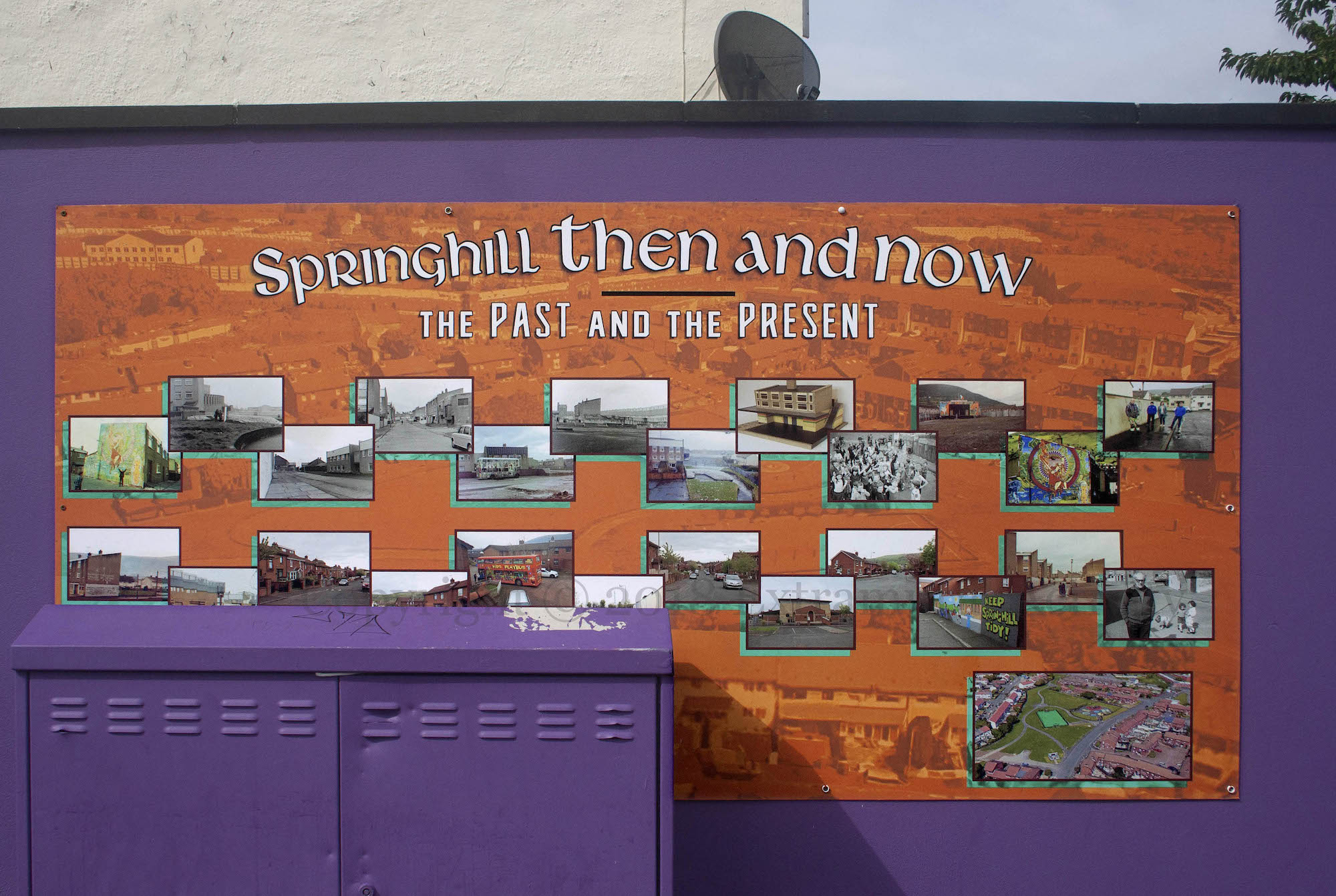
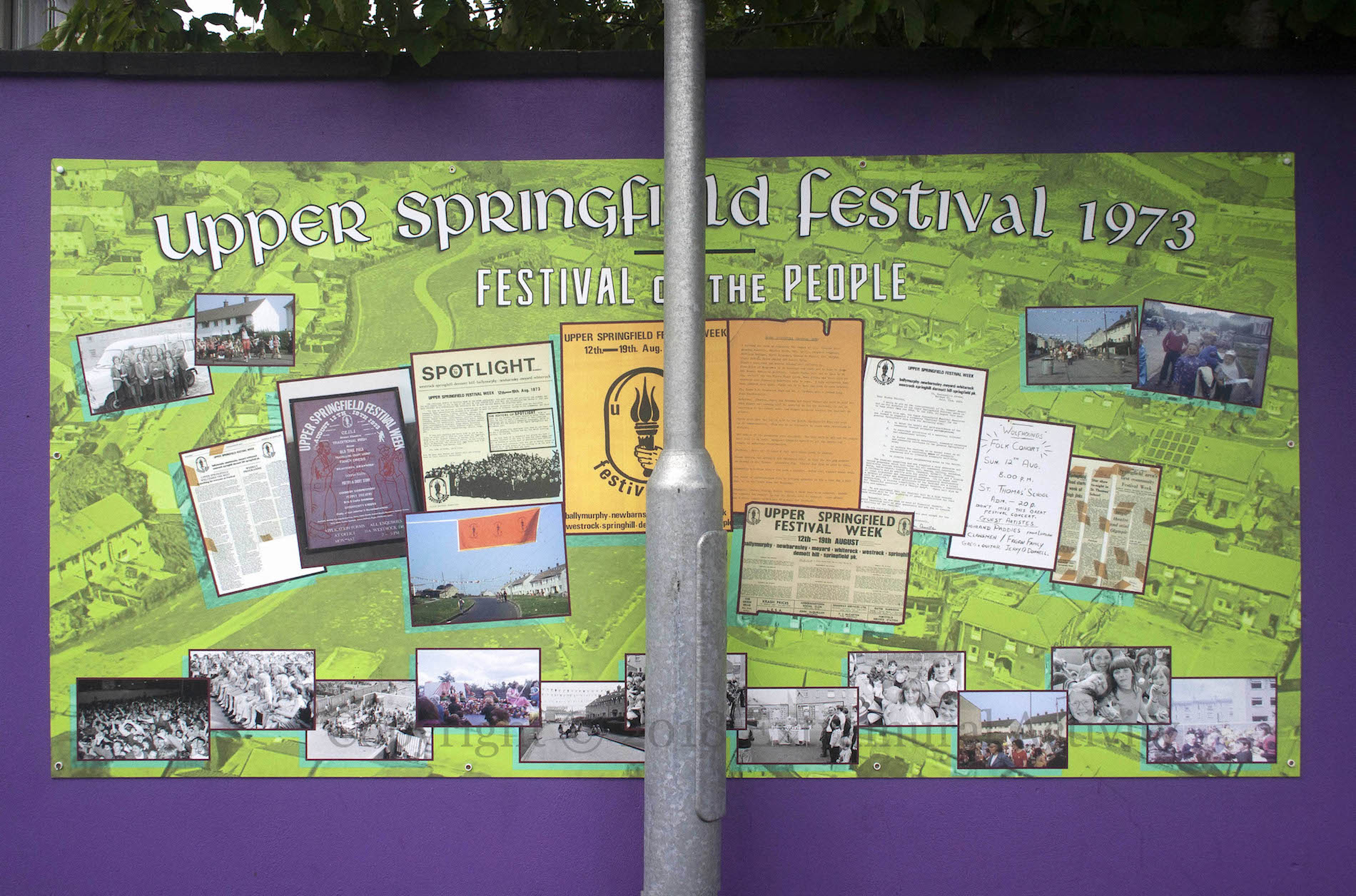
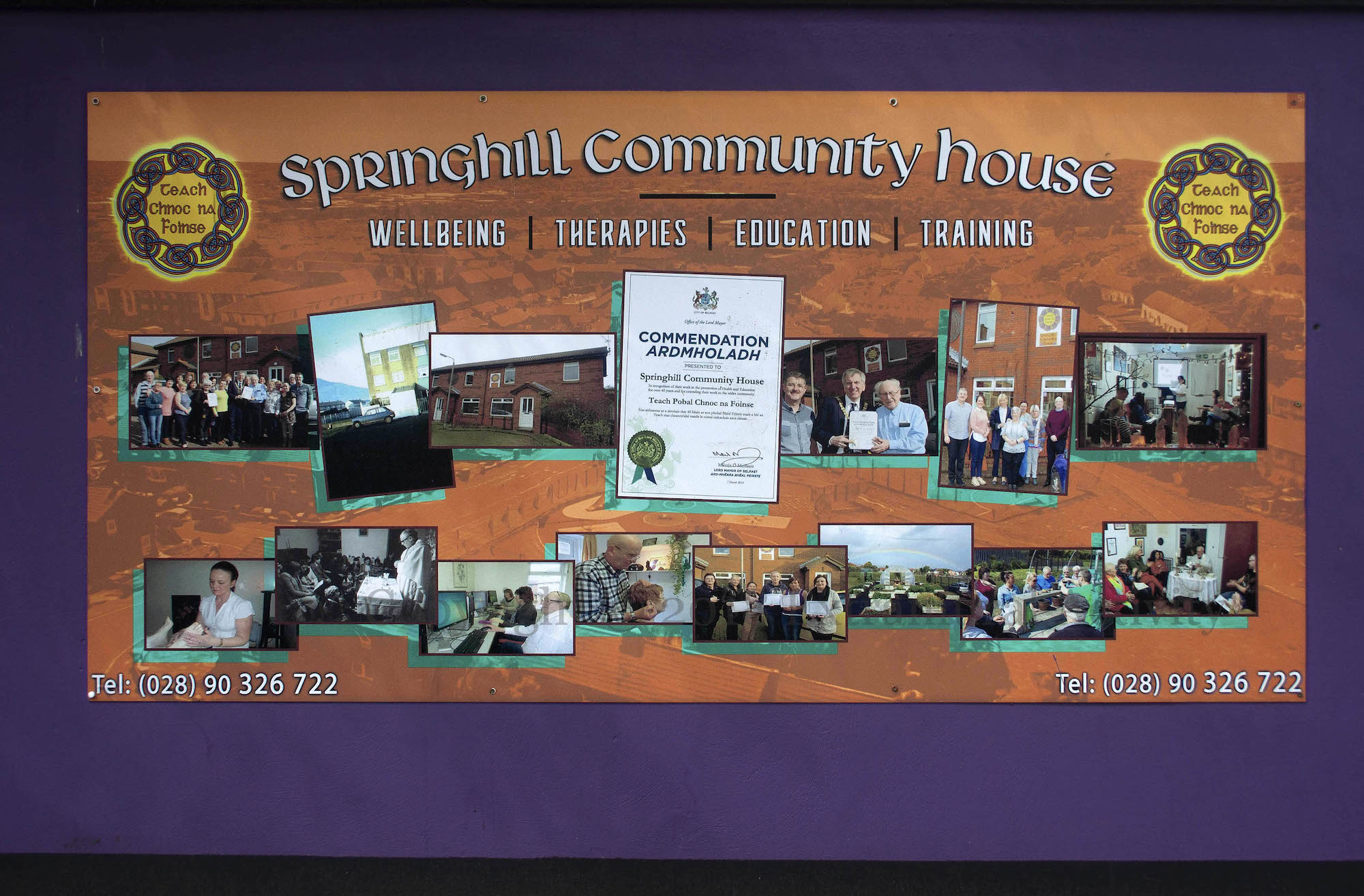
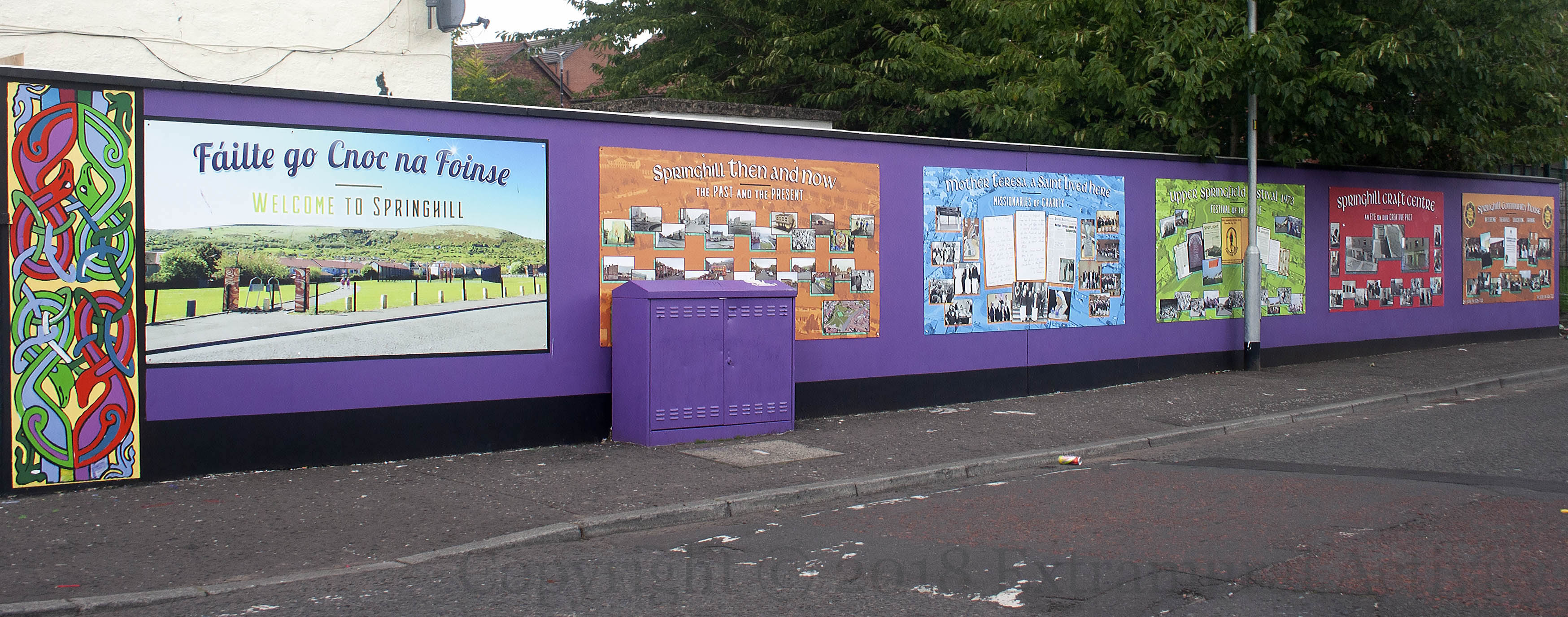
“Fáılte go Cnoc na Foınse – Welcome to Springhill.” There are a dozen new boards on either side of the Ballymurphy entrance to Springhill, highlighting positive aspects of the community, such as the work of Mother Teresa and four Missionary Sisters Of Charity from 1971-1973, the Upper Springfield Festival of 1973 (later revived in 1988 and years following as the Springhill Festival), Tara Stores and The Craft Centre, set up as a form of local enterprise in an area of mass unemployment, and the Springhill Community House, still in operation today but going back to Des Wilson and Noelle Ryan. There is no explicit mention of the 1972 Springhill-Westrock Massacre, though there is a picture of Fr Noel Fitzpatrick on the south side of the street, which will be featured in a separate post.
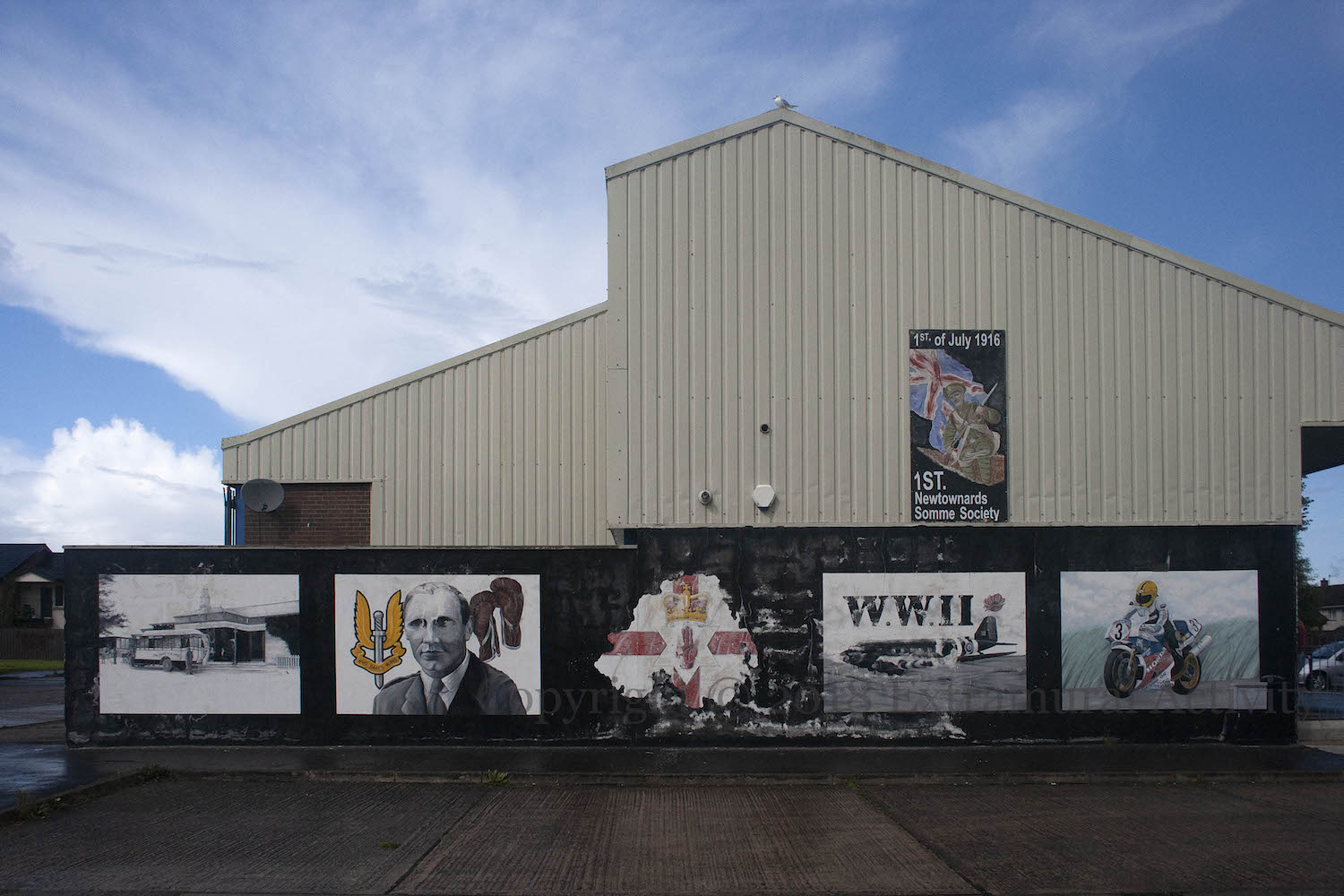
Here are six panels from the shops in the Westwinds estate in Newtownards, which have replaced a UVF mural (Help Us To Help You).
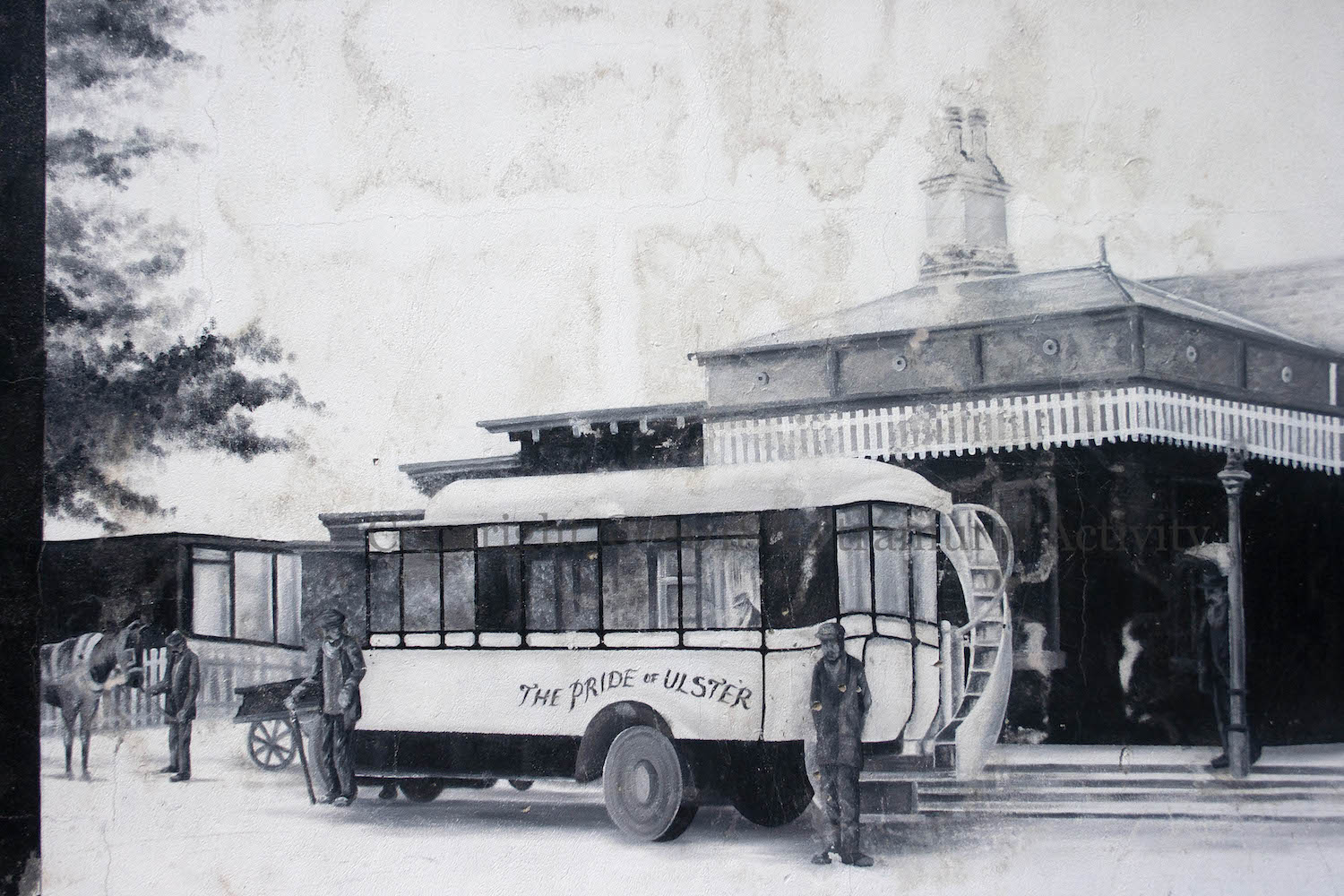
Little is known about the omnibus called “The Pride Of Ulster”, except that this picture shows it at Newtownards Railway Station, Victoria Avenue, c. 1920. SAS soldier and boxer (and rugby-player) Blair “Paddy” Mayne, DSO, is portrayed in the second panel. (For more, see these posts about Mayne from 2013 and 2014.).
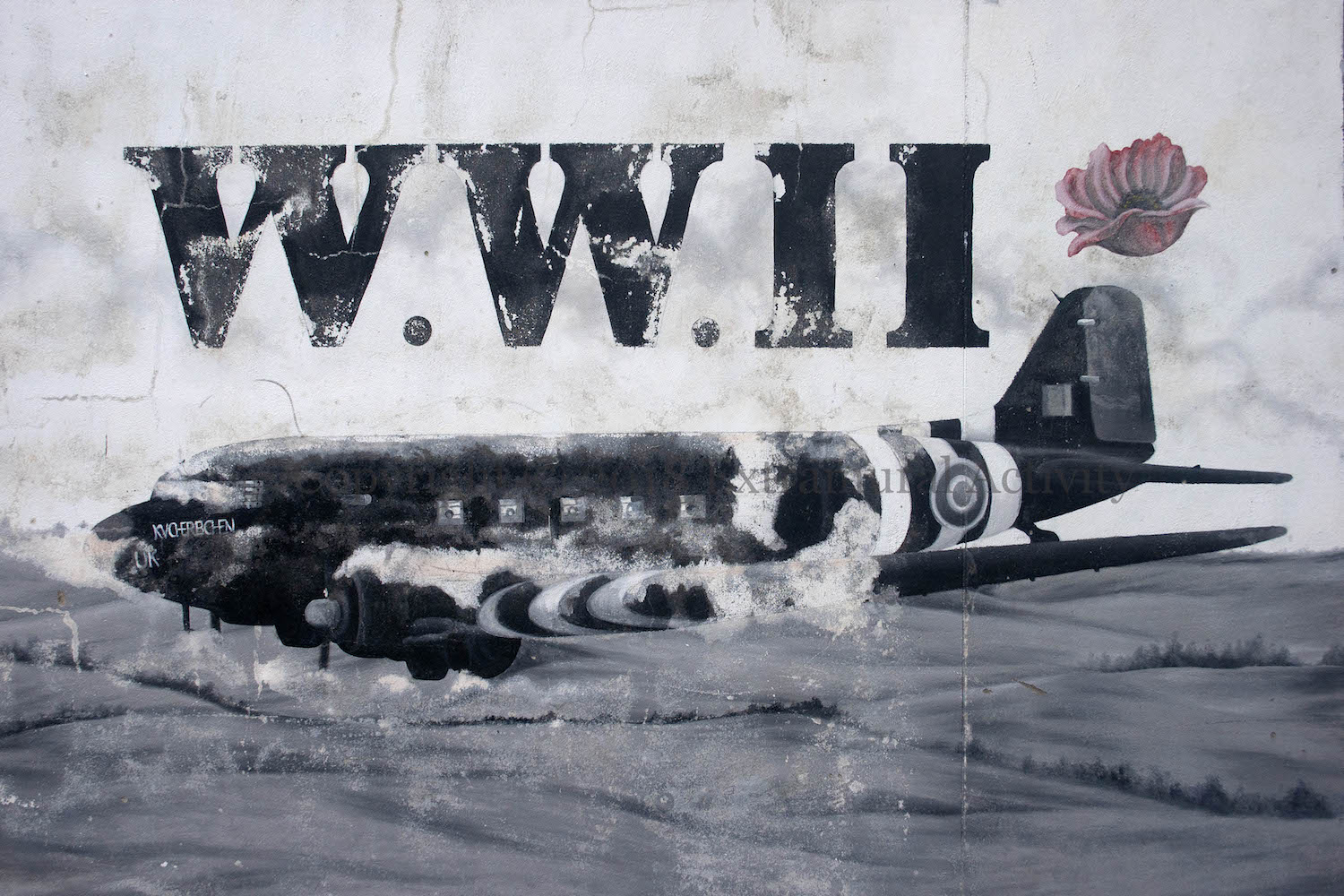
On the other side of the Ulster Banner in the centre is a WWII Douglas Dakota C-47, specifically “FZ692 of No. 233 Squadron, around the D-Day period in 1944. This aircraft, which was named “Kwicherbichen” by her crews, was involved in Para-dropping operations on the eve of D-Day and subsequently in re-supply and casualty evacuation missions into and out of forward airfields in the combat areas” (RAF).
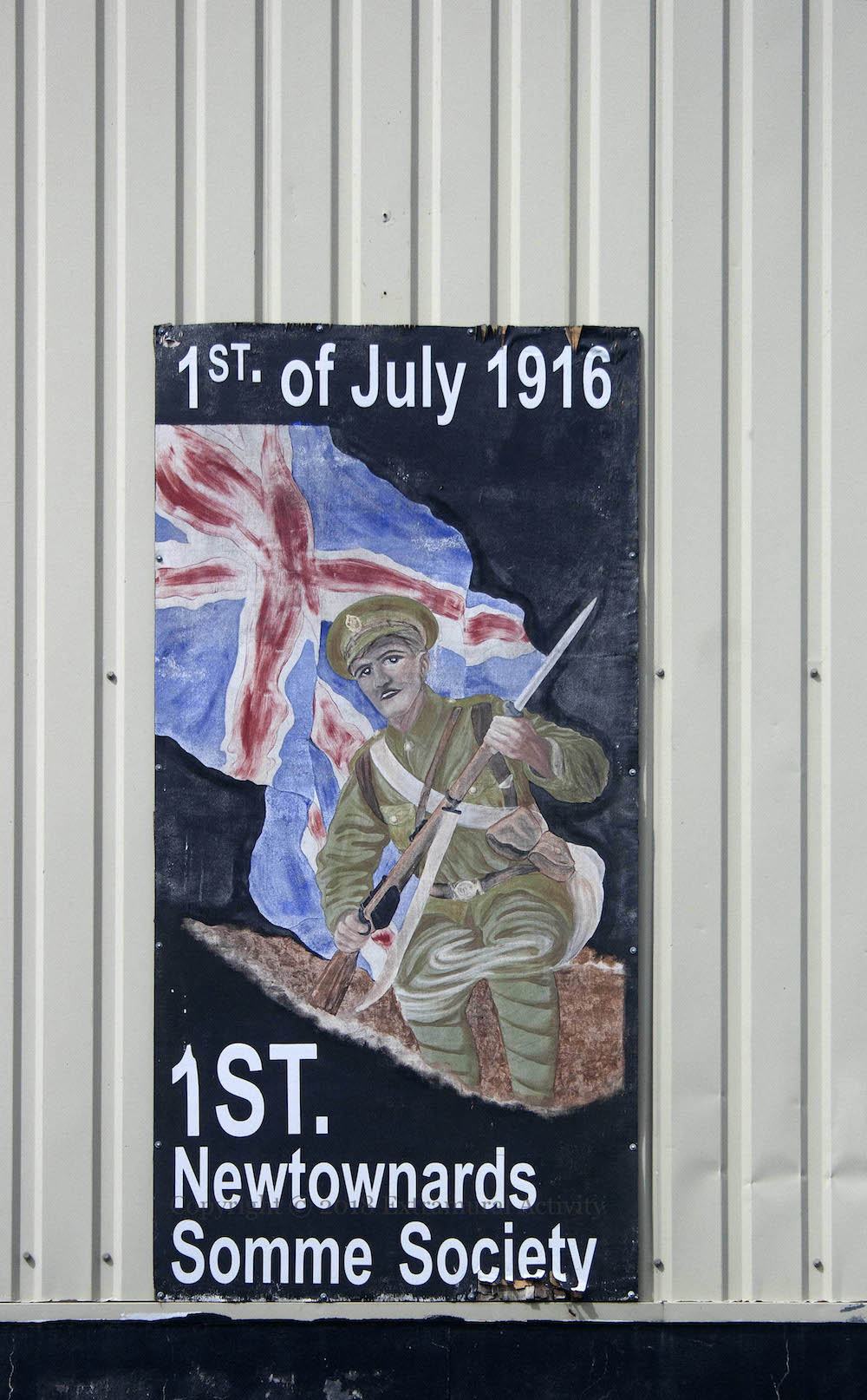
Motorcyclist Joey Dunlop is on the far right (see Race Of Legends), and above them all is a WWI board from the 1st Newtownards Somme Society (based in the Somme museum in Conlig?).
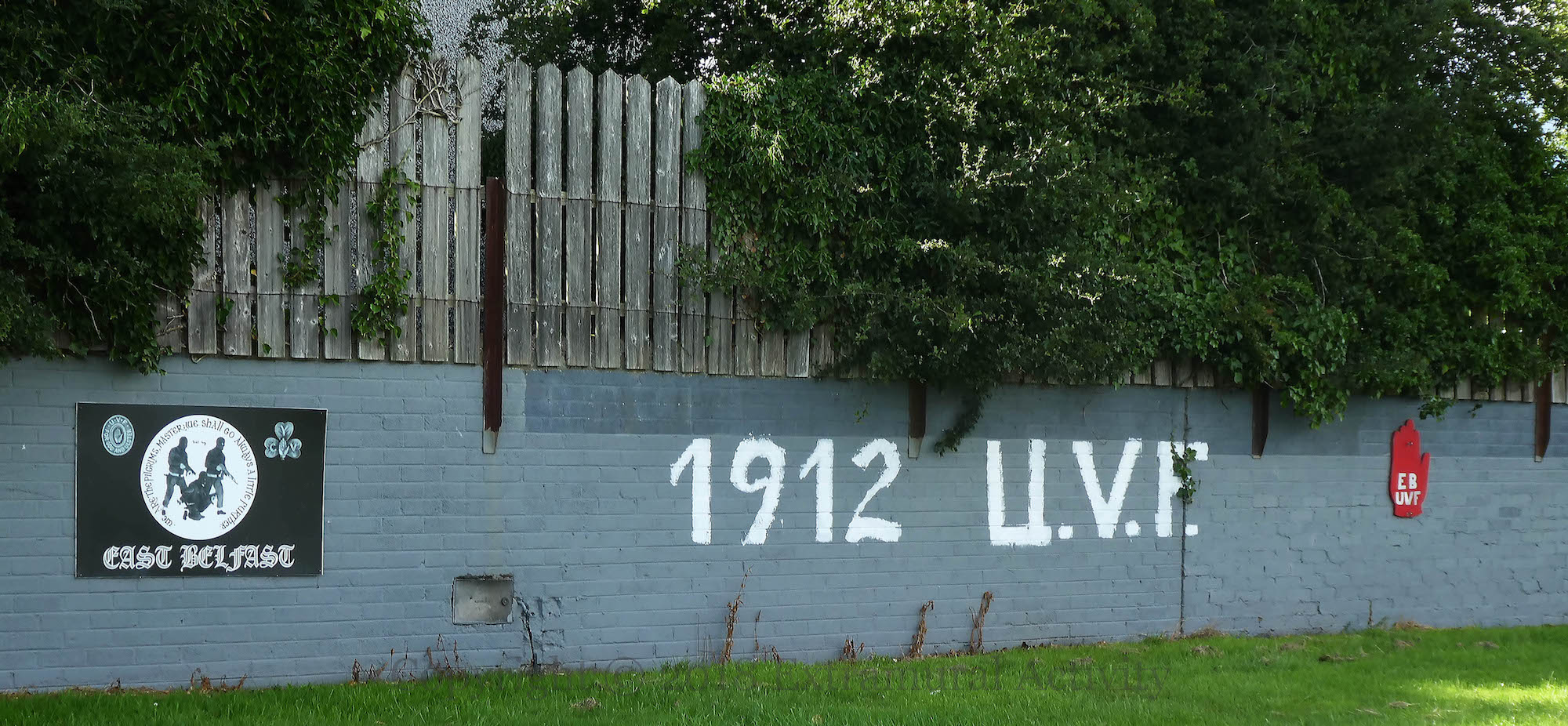
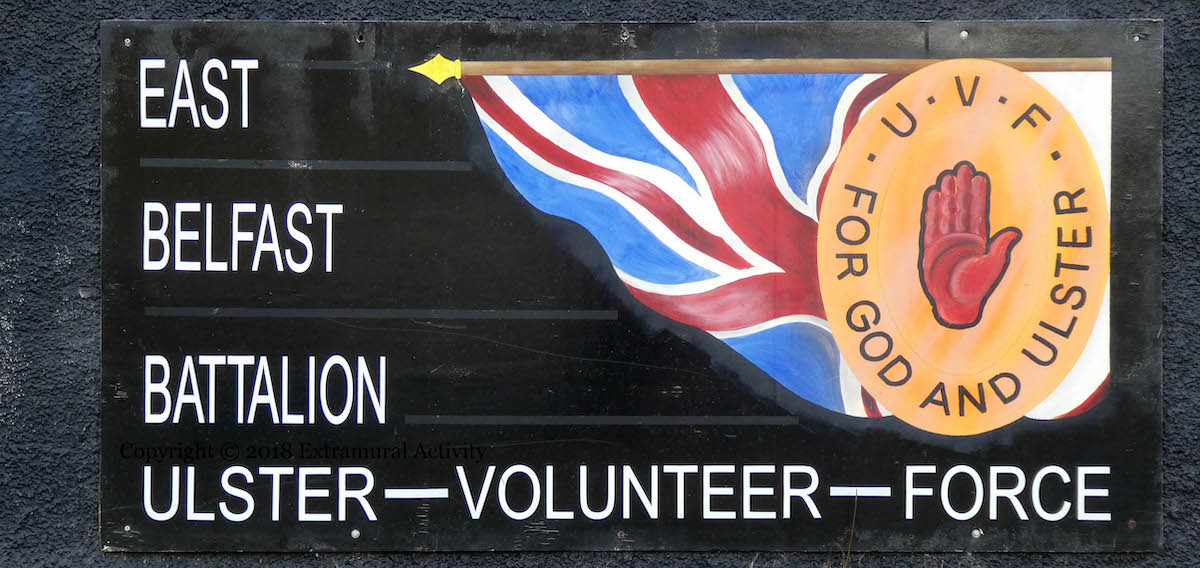
This post updates a 2017 one (Always A Little Further) from Whitehill, Bangor, with the addition of “1912 UVF” between the two “East Belfast UVF” boards, suggesting a softening of message. Similarly, a long “Ulster Volunteer Force” has been blacked out directly across the street.
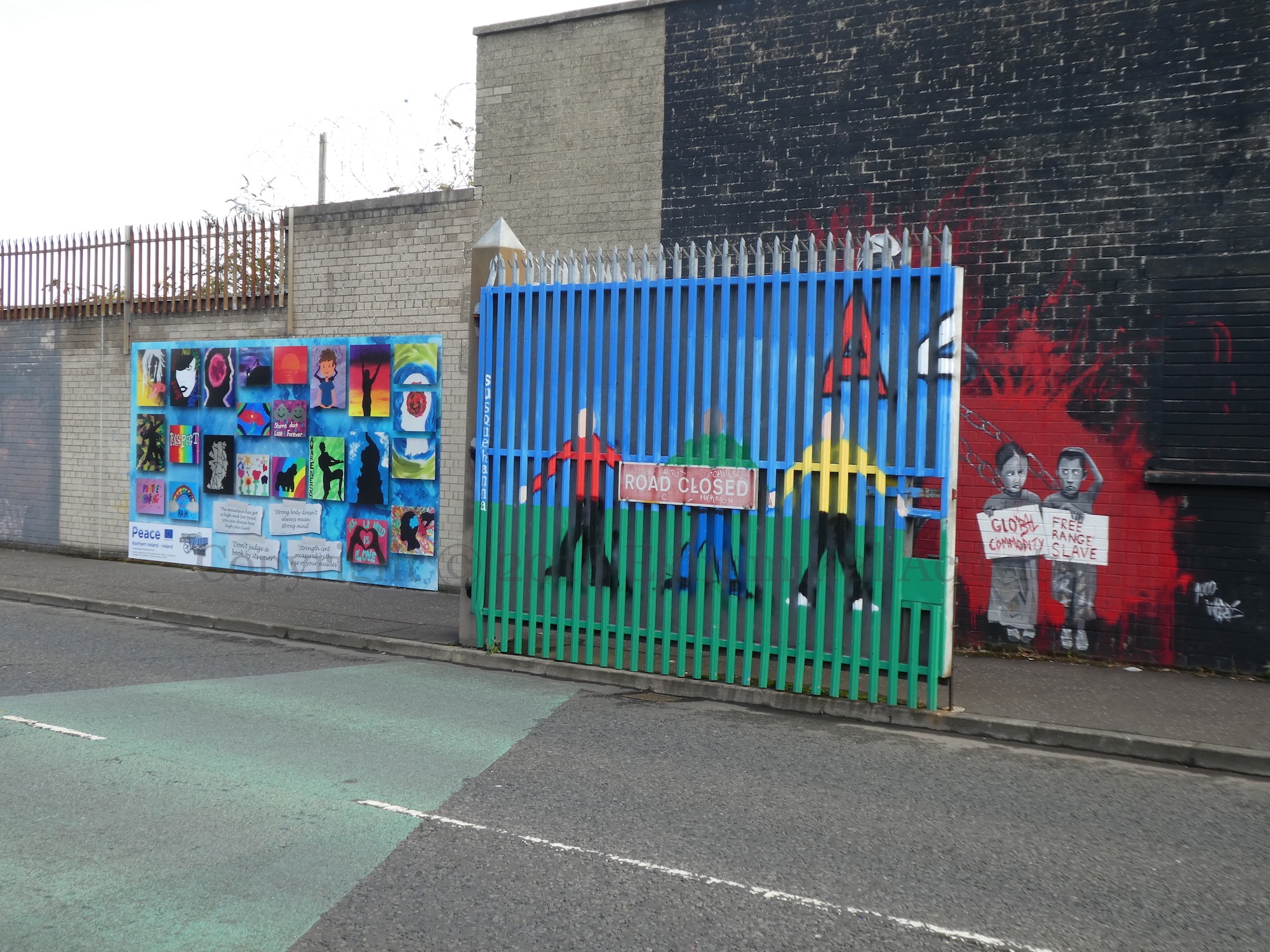
“… but so is hope.” World Mental Health Day was October 10th, and in support of the cause and their “elephant in the room” report (with Belfast Youth Forum and Children’s Law Centre), the Northern Ireland Youth Forum (Fb | tw), with the support of Peace IV funding, produced this mural on Northumberland Street, just above the security gates.
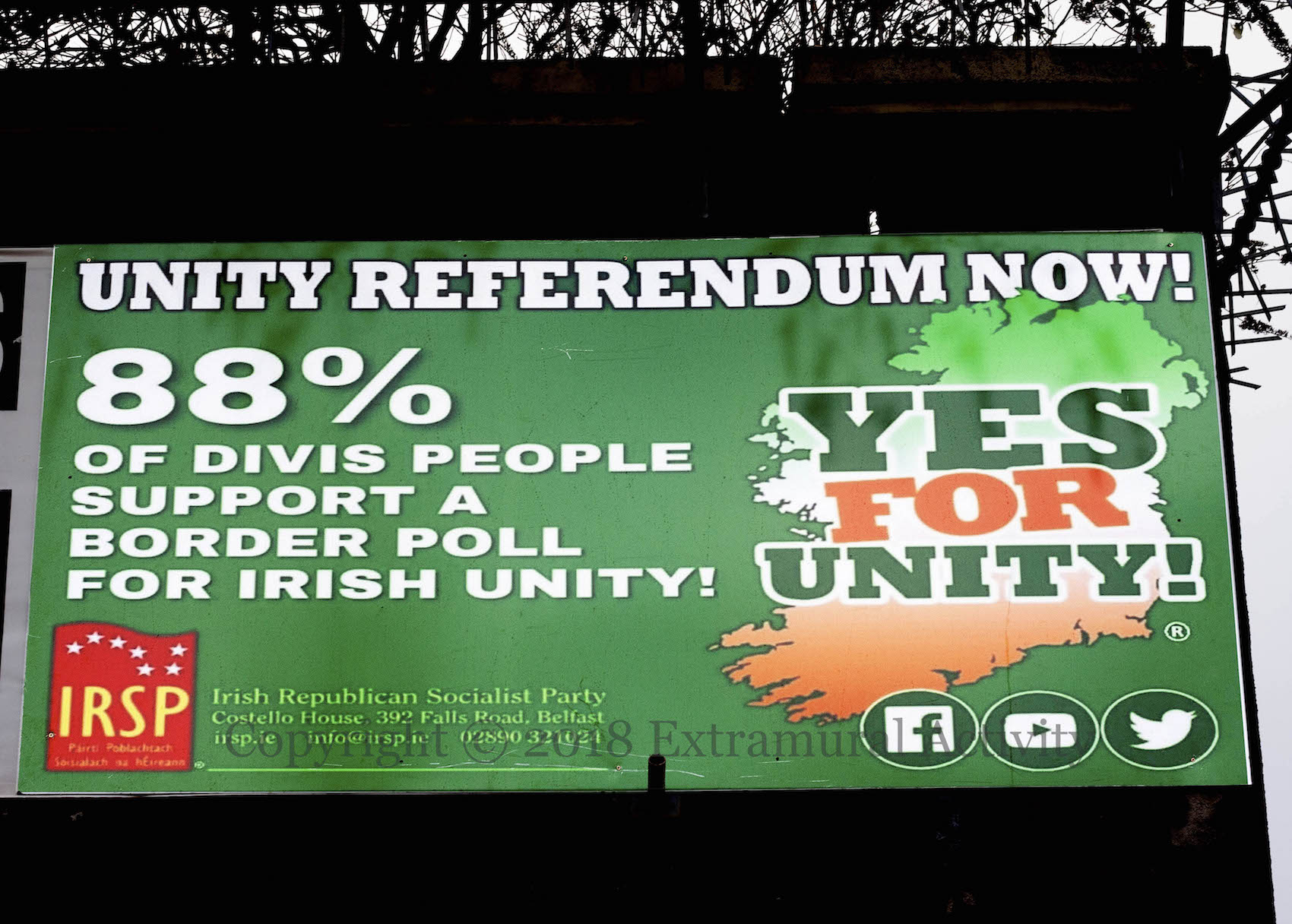
The IRSP last month (September, 2018) launched a campaign on Facebook, youtube, and twitter to poll various districts on the question of a border poll. “Unity referendum now! British occupation has been a disaster for the people of Ireland. A united Ireland is the way forward for all the people of Ireland.” The one above is on the fence around the North Queen Street play park; the one below (“88% of Divis people”) is below Divis tower.
This hooded gunman from the East Belfast UVF – like the series of stencils featured previously in EB UVF – is on a wall in Newtownards’s Westwinds estate. Below is a EB UVF mural at the bottom of Bowtown, not far from the West Belfast UDA mural in Greenwell St. The UVF and UDA also compete in the Glen estate; compare Today’s Local with Our Heritage In Your Hands.
Questions about EB UVF lawlessness in north Down arose over the summer with a “business opportunity” presented to local hostelries (Belfast Live | ITV).
“In memory of our fallen INLA volunteers, upper Springfield area: Hugh Ferguson, Ronnie Bunting, Noel Little, Hugh O’Neill, Micky Kearney, John McColgan, Paddy “Paddybo” Campbell. Comrades: Barry “Baz” McMullan, Sean “Shanto” fleming, Harry O’Hara, Paul Collins, Bernado Brownlee, Emmanuel Kelly, Michael Conlon, Billy Lynch, James “Harpo” Murray, John Kennaway. Saoırse go deo [freedom forever].” Ferguson was the first member of the INLA to die, in 1975 in the feud with the OIRA. Bunting and Little/Lyttle (both Protestants) were shot dead in 1980 in Bunting’s Andersonstown home by masked gunmen from the UDA or SAS with RUC complicity.
The emblem on the flats at the mini-roundabout (where Glandore and Skegoneill avenues meet) depicts a tree and a face, perhaps a reference to the name “Skegoneill” or ‘the earl’s thorn bush” after the place at which Anglo-Norman earl William de Burgo was assassinated in 1333 (PlaceNamesNI).