“Today is yesterday’s tomorrow”. Vintage images of Sandy Row, including the Ulster Spinning Company and the Royal Bar, make up this “Heritage – Culture – Identity” board on Donegall Road. The central image is part of this photo montage.
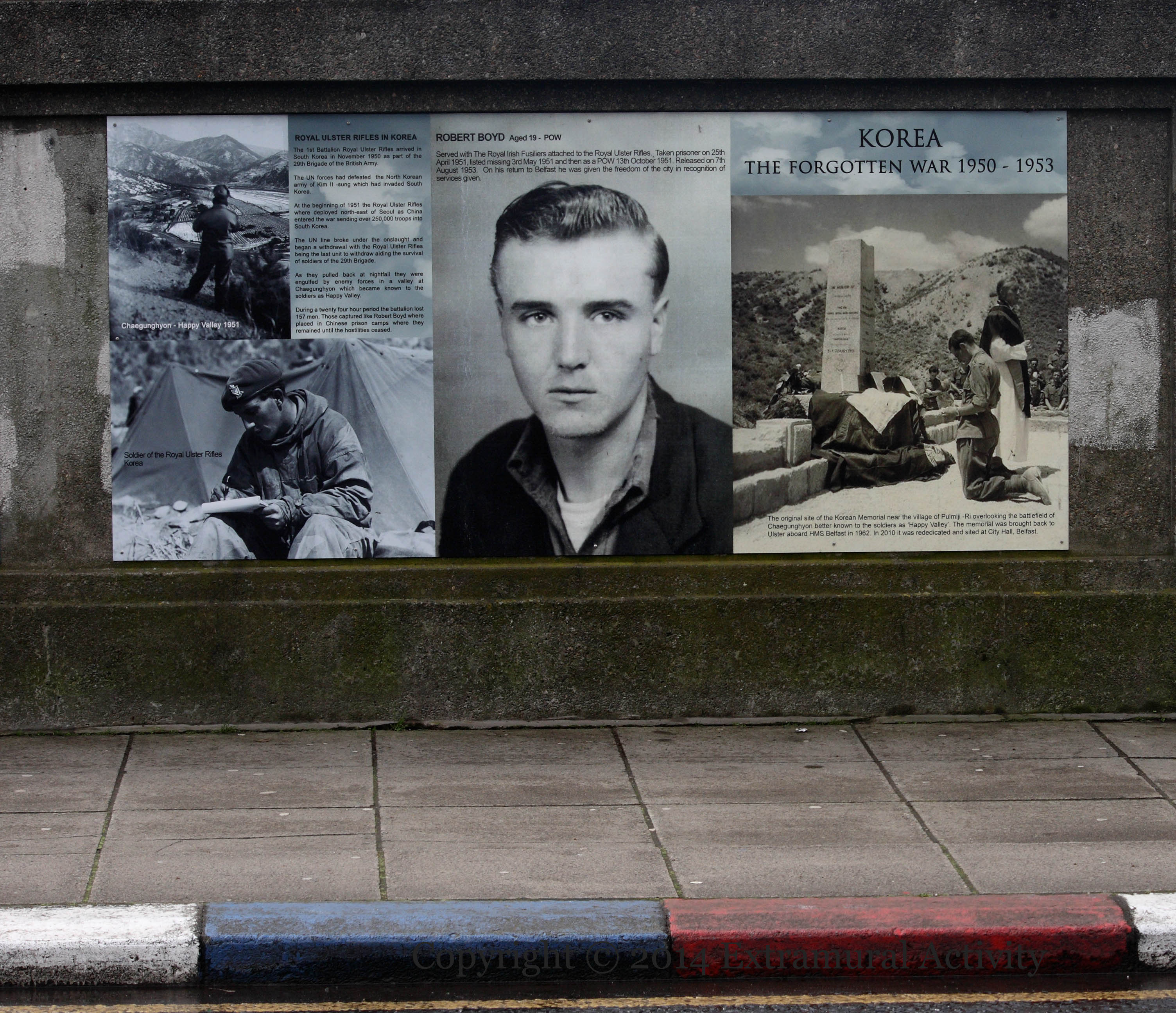
James Magennis, above, from east Belfast, won the Victoria Cross for service in WWII (as described in a post about a mural based on the image on the right in Tullycarnett). Robert Boyd, according to the image below, was awarded the freedom of the city of Belfast for service in Korean War. Two panels, one from each side of the Donegall Road bridge.
“Royal Ulster Rifles in Korea. The 1st battalion arrived in South Korea in November 1950 as part of the 29th brigade of the british army. The UN forces had degeated the North Koran army of Kim Il sung which had invaded south korea. At the beginning of 1951 deployed north-east of seoul as chine entered the war sending over 250,000 troops. The UN line broke under the onslaught and began a withdrawal being the last unit to withdraw aiding the survival of soldiers of the 29th brigade. As they pulled back at nightfall they were engulfed by enemy forces in a valley at Chaegunghyon which became know to the soldiers as Happy Valley. During a twenty four hour period the battalion lost 157 men. Those captured like Robert Boyd where were placed in Chinese prison camps where they remained until the hostilities ceased. Robert Boyd aged 19 POW. Served with the royal irish fusiliers. Taken prisoner on 25th April 1951, listed missing 3rd May 1951 and then as a POW 13th October 1851. released on 7th August 1953. On his return to Belfast he was given the freedom of the city in recognition of services given. The original site of the Korean Memorial near the village of Pulmiji-Ri overlooking the battlefield brought back to Ulster abroad HMS in 1962. In redidicated and sited at city hall.
“How I love you all. I wonder what you are doing at home. I must not do that. It is hard enough sitting waiting. We may move at any minute. When this reaches you for me there will be no more war, only eternal peace and waiting for you.” – A letter home from the Somme. July 1st, 1916 saw the start of the Battle Of The Somme. The 36th (Ulster) division lost over 5,000 men in an initial successful attack near Thiepval Wood, but were driven back that evening. The board above is on the north side of the (second) Donegall Road railway bridge.
Community and anti-bullying board at the junction of Hallidays Road and the Limestone Road welcoming people to Tiger’s Bay. You can see two images of the boards in progress on the Dean Clarke Foundation’s Fb page. The foundation is also involved in the community garden which can be seen in a previous post on a H&W workers mural and which sits across from the b&w Belfast Blitz mural.
“Youth has no age – Pablo Picasso”. Above is one of the panels on Donegall Road, just above the City Hospital railway stop, celebrating the Sandy Row community.
“To put bread on the table, those days are gone, when we all had to to Willie Allen’s pawn.
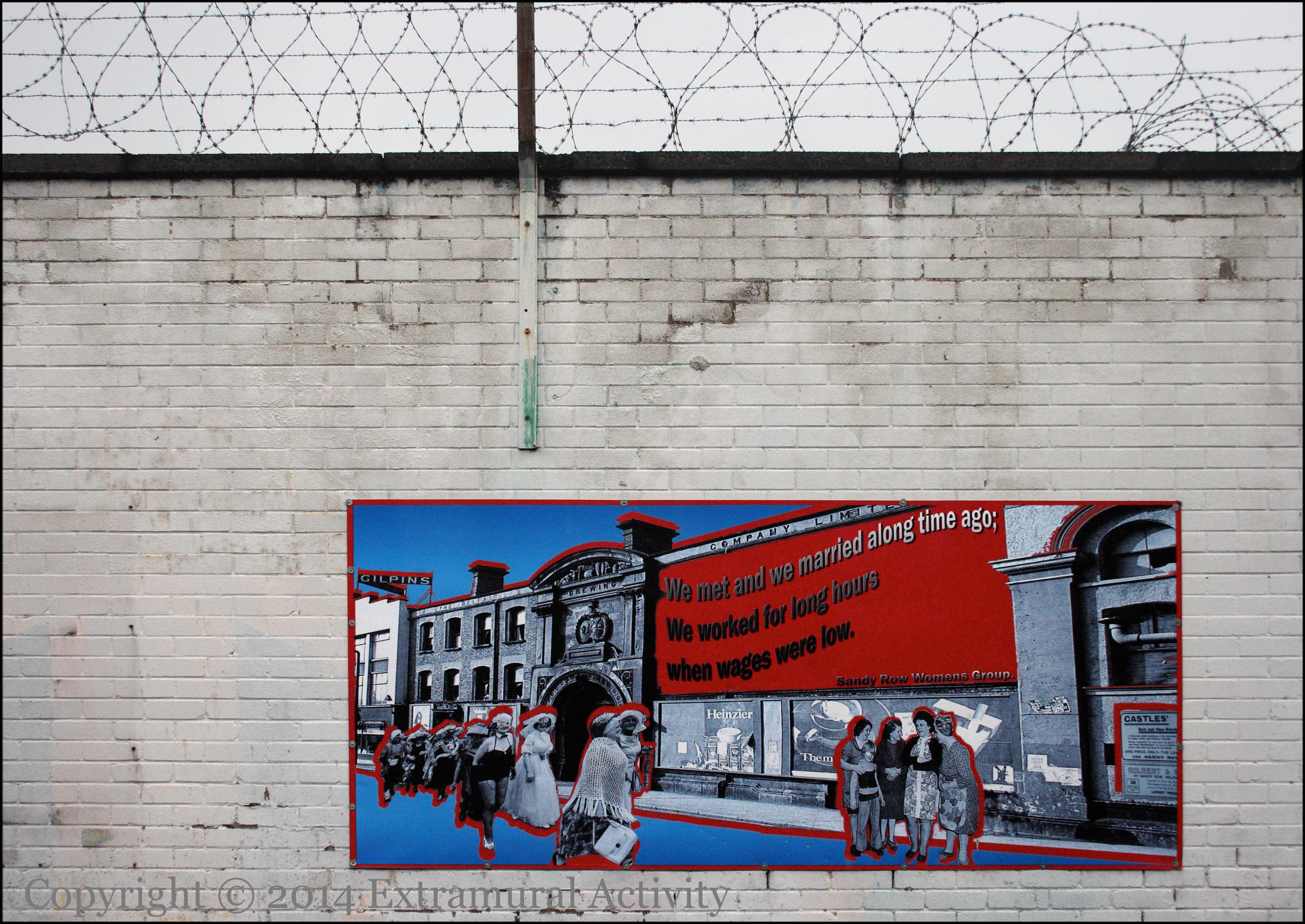
We met and we married along time ago; we worked for long hours when wages were low.”
Above and below are boards 3 and 4 of the ‘Sandy Row memories’ at the end of Blythe Street, showing Murray’s Tobacco Factory (in Linfield Road/Sandy Row, which closed in 2005 before being refurbished and opening in 2012 as Murray’s Exchange) and the old Belfast & Ulster Brewing building (unchanged image here), home to the south Belfast Ulster Volunteers (Sandy Row History) and most recently (until 2007) the home of Gilpin’s Furniture.
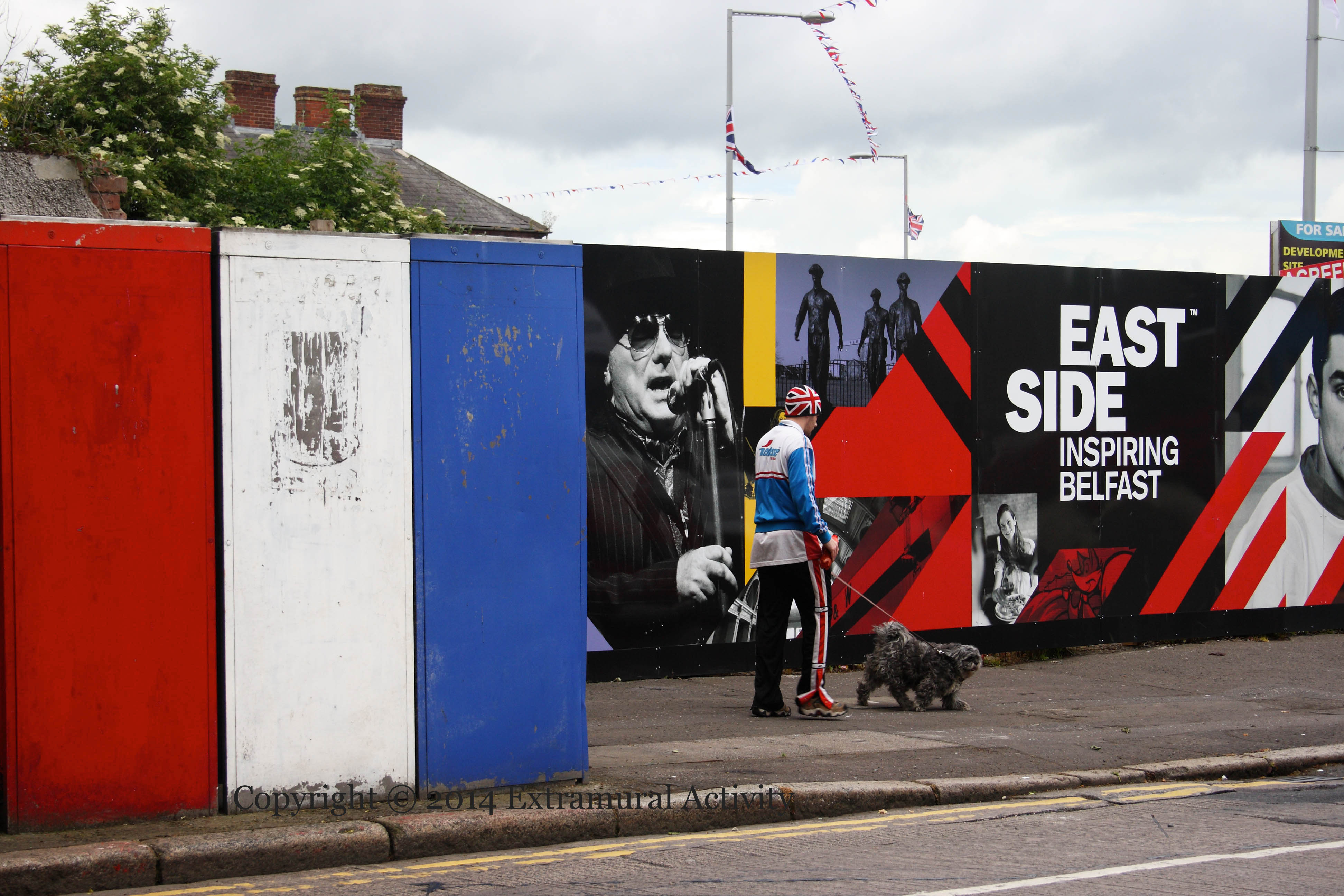
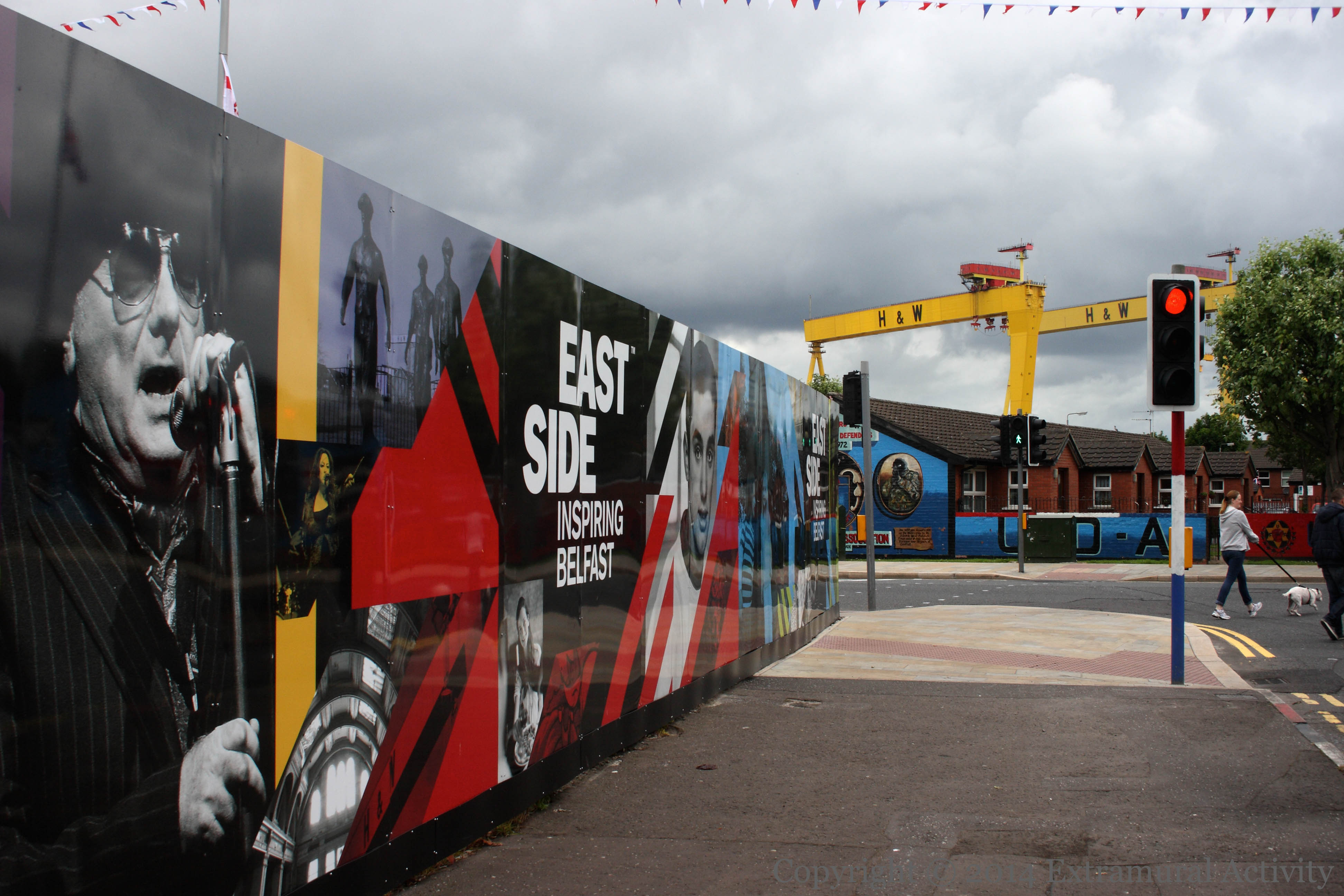
The waste-ground at the corner of Templemore Avenue and Newtownards Road (where the flyers featured in Harland & Why were posted) was given a face-lift with images of east Belfast heroes Van Morrison and George Best and the words “East Side – Inspiring Belfast”. The red-white-and-blue is supplied by the phone-boxes and the passer-by.
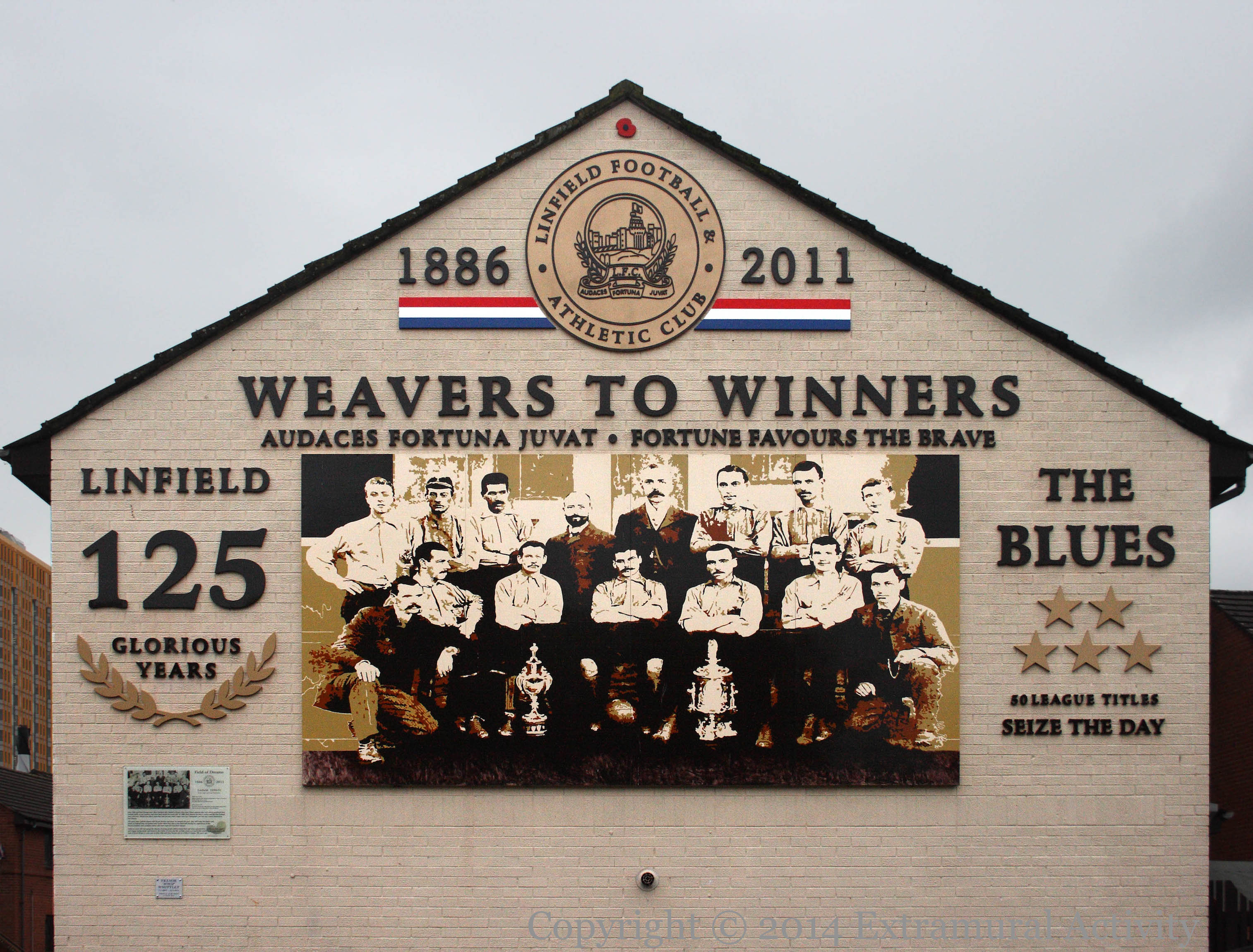
“Weavers To Winners” – Linfield Football And Athletic Club was founded in 1886 by workers at the Ulster Spinning Company’s Linfield mill and they became Irish League champions in the 1890-1891 season. The names of the players in the photograph are given in the shot of the information plaque, below. The work was designed by Ross Wilson.
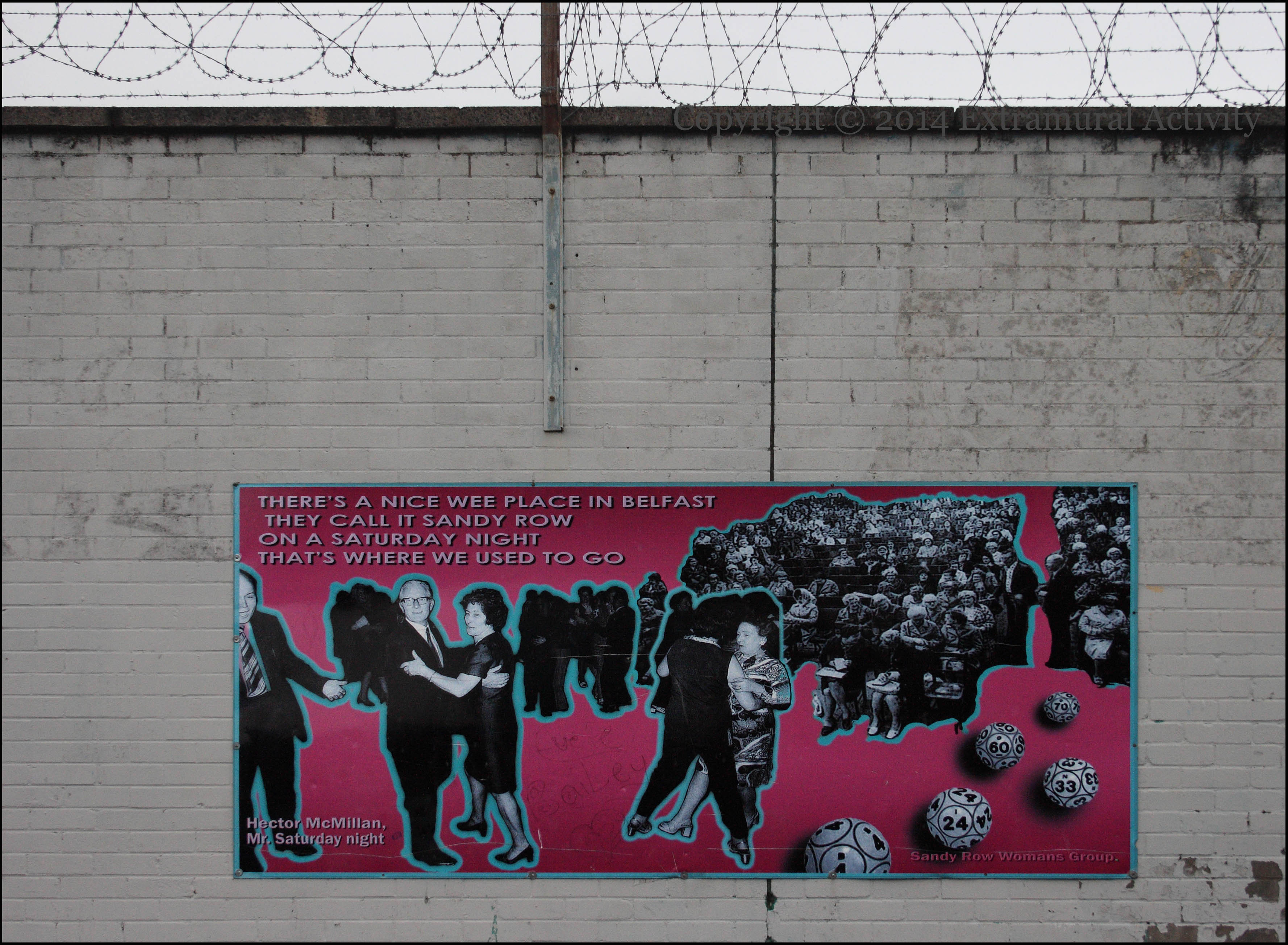
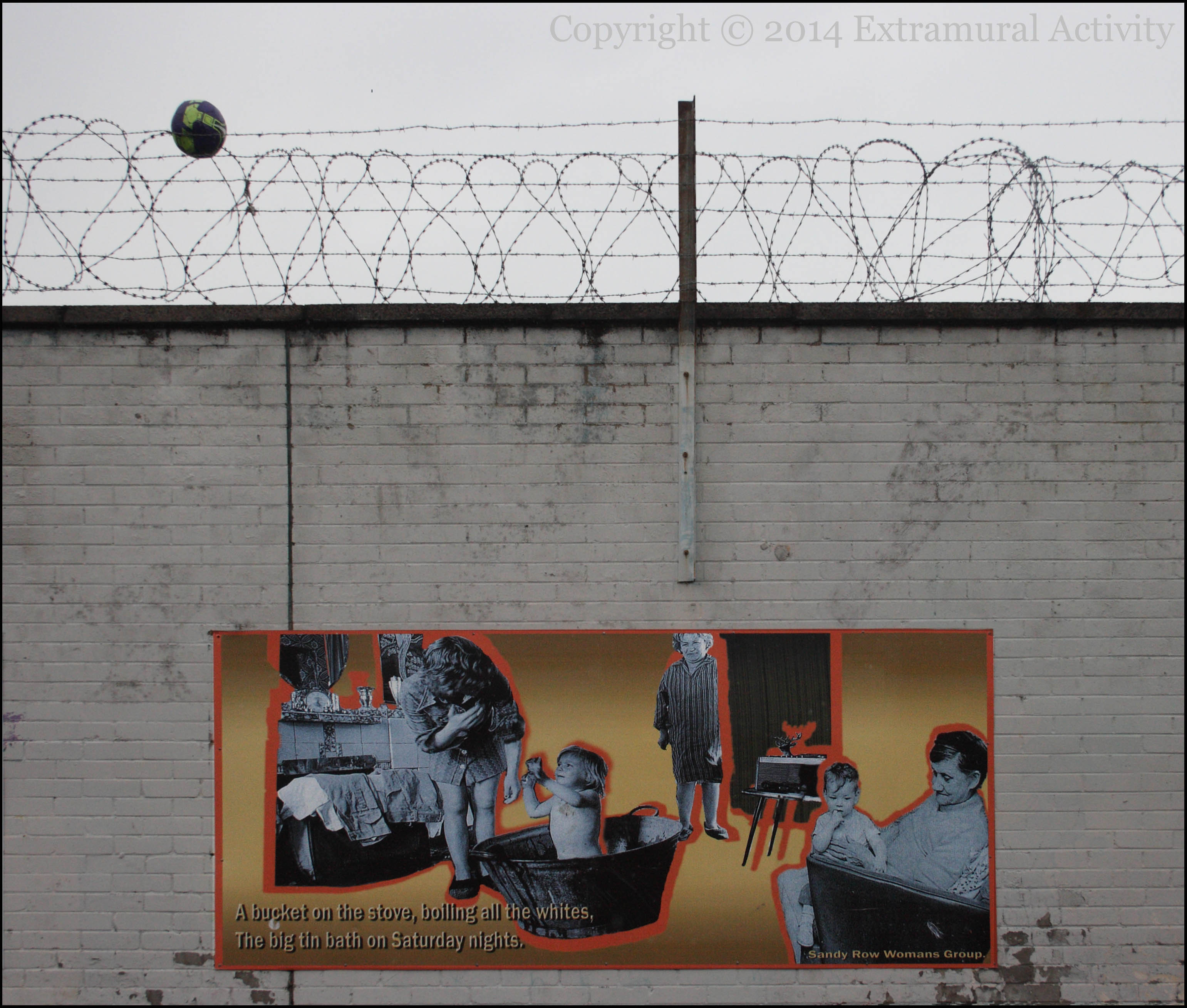
“There’s a nice wee place in Belfast, they call it Sandy Row. On a Saturday night, that’s where we used to go. A bucket on the stove, boiling all the whites, the big tin bath on Saturday nights.”
Here are the first two (of four) boards at the blind end of Blythe Street which together illustrate a short poem about Sandy Row in days gone by. The first, above, shows dancing and bingo (which took place in the Sandy Row Orange Lodge? – The Row You Know: Memories Of Old Sandy Row (ISBN 0953053504) by Donna McCann and published by Nicholson & Bass contains an image with the caption “Saturday night dance at the Orange Hall – Hector McMillan about to break into song”.)
The second, below, shows scenes from home: clothes in front of the fire, a child in a tin bath, a wireless radio, and a grandmother dandling a child.






 Extramural Activity