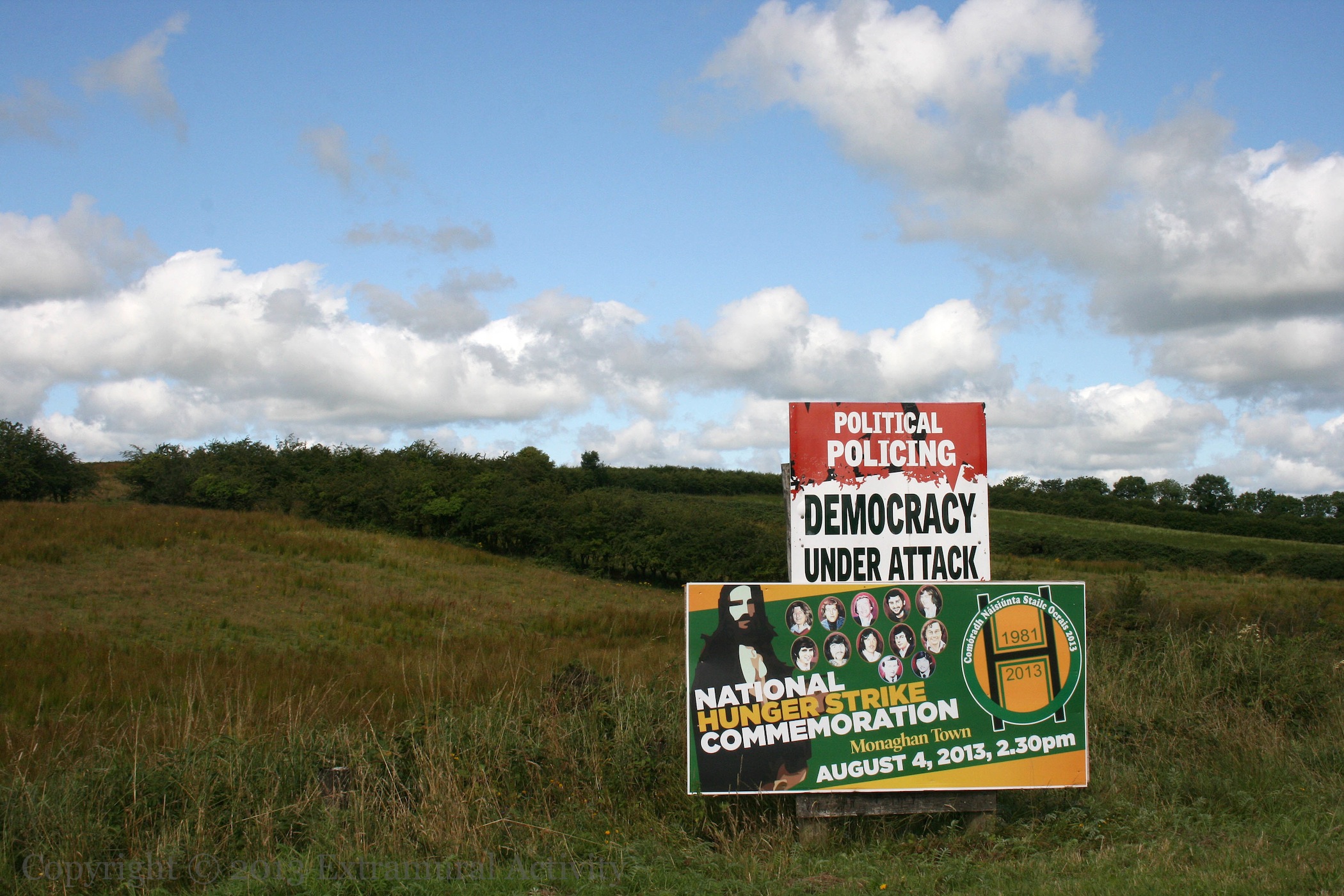
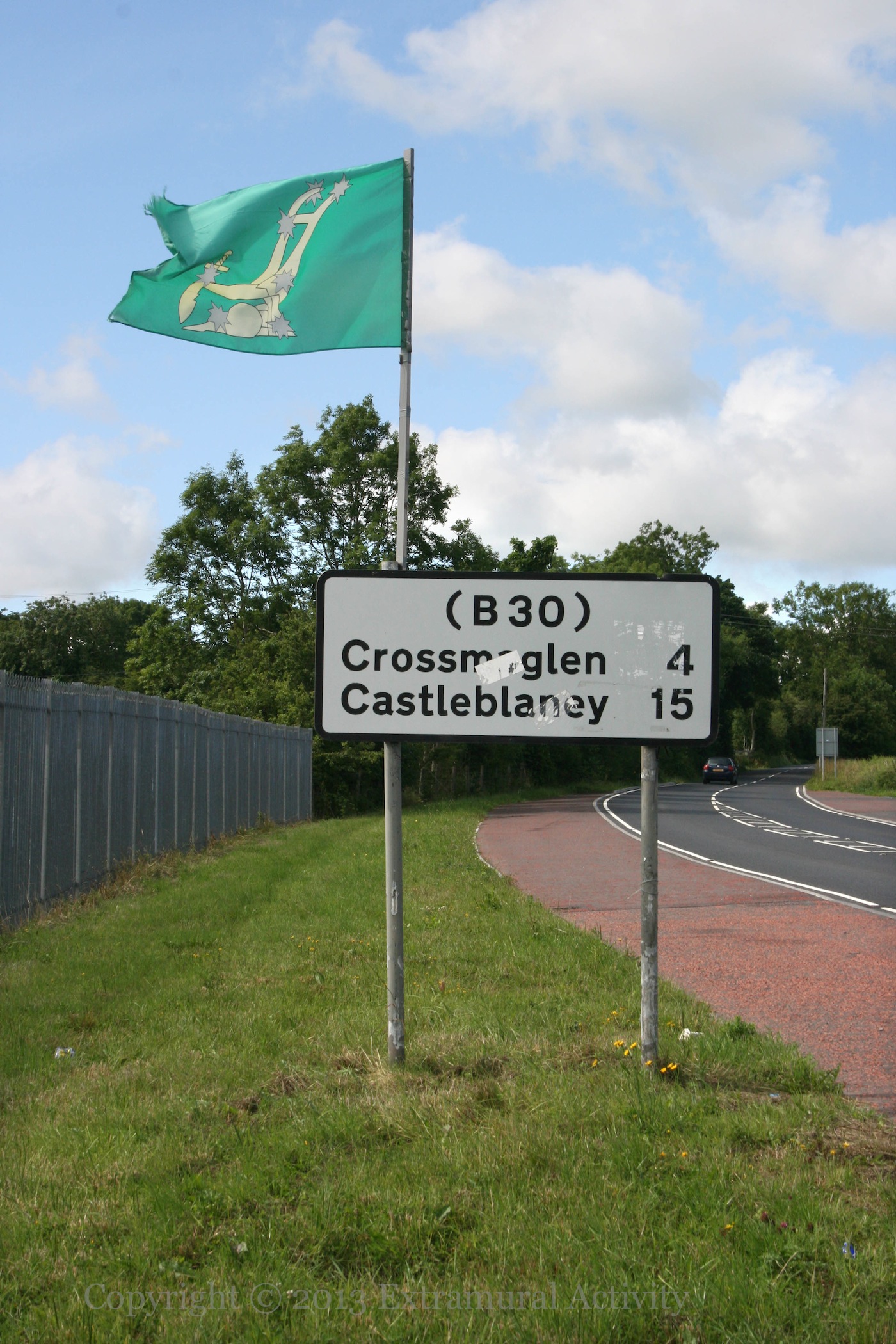
Two images today from the crossroads at the intersection of Crossmaglen-Newry and Newtownhamilton-Dundalk roads (a.k.a. Ford’s Cross, Silverbridge). The first shows a hunger-strikers board from this year over a much older ‘democracy under attack’ board (see D02009). The second shows the plough and the stars flying above the mileage sign. There is also a memorial, with a tricolour flying overhead, at this crossroads
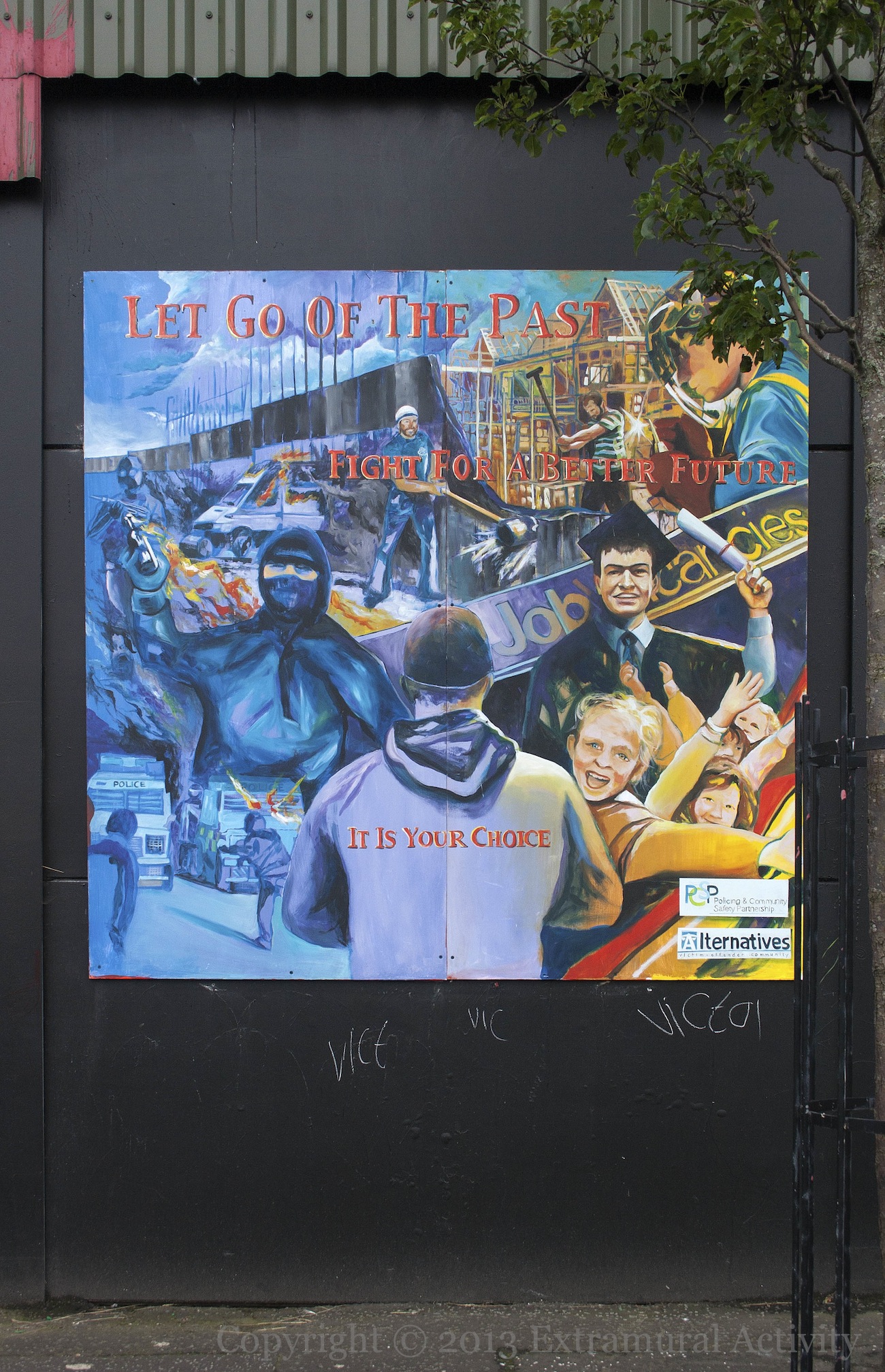
Board on the Cupar Way side of the “peace” line showing, on the left hand side, rioters with petrol bombs attacking the police, the “peace” line, and a burning vehicle, and, on the right, construction workers, university graduates, and happy children. “Fight for a better future. It is your choice.” For more information, see Daniela Balmaverde.
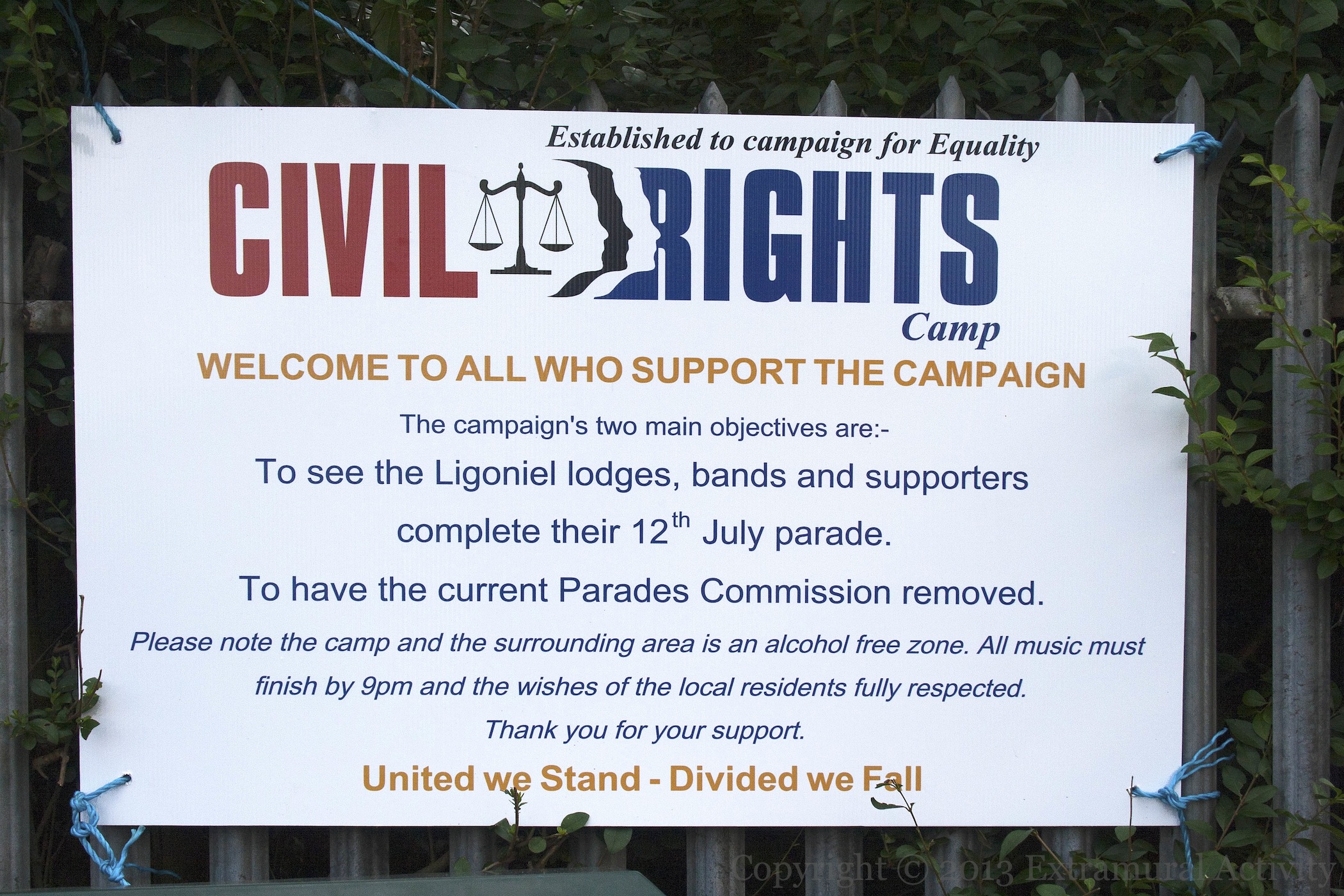
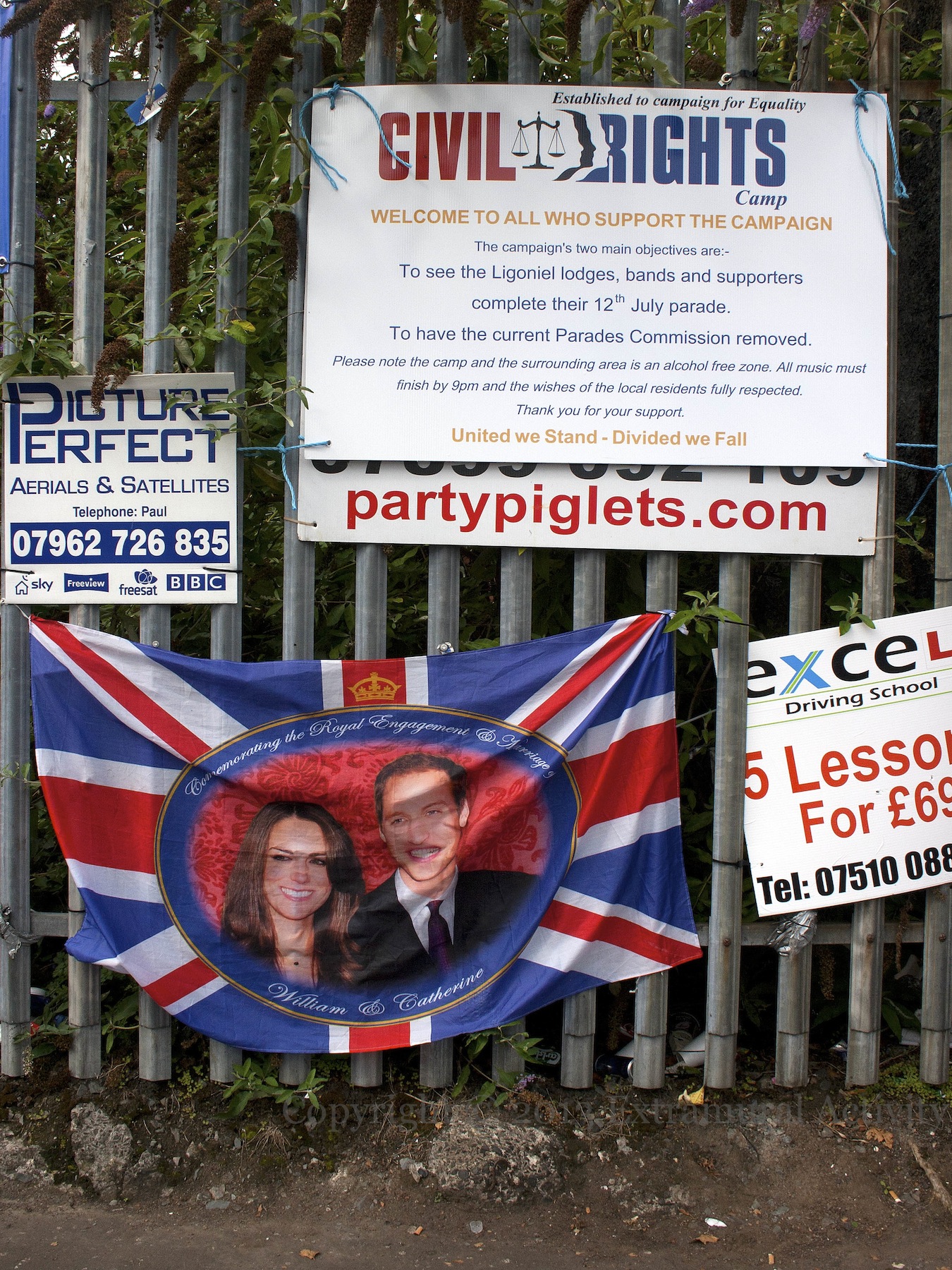
The language of “civil rights” and “equality” is being used at the Twaddell site, as can be seen in the placard shown here there are three copies of this sign: the second image, below, is of one on the north side of the street (visible in the previous set of Twaddell pictures) and the third image shows an additional copy on the electrical box on the south side of the street.
“Established to campaign for Equality. Civil Rights. Welcome to all who support the campaign. The two main objectives are to see the Ligoniel lodges, bands and supporters complete their 12th july parade; to have the current parades commission removed. Please note the camp and the surrounding area is an alcohol free zone. All music must finish by 9 p.m. and the wishes of the local residents fully respected. Thank you for your support. United we stand – divided we fall.”
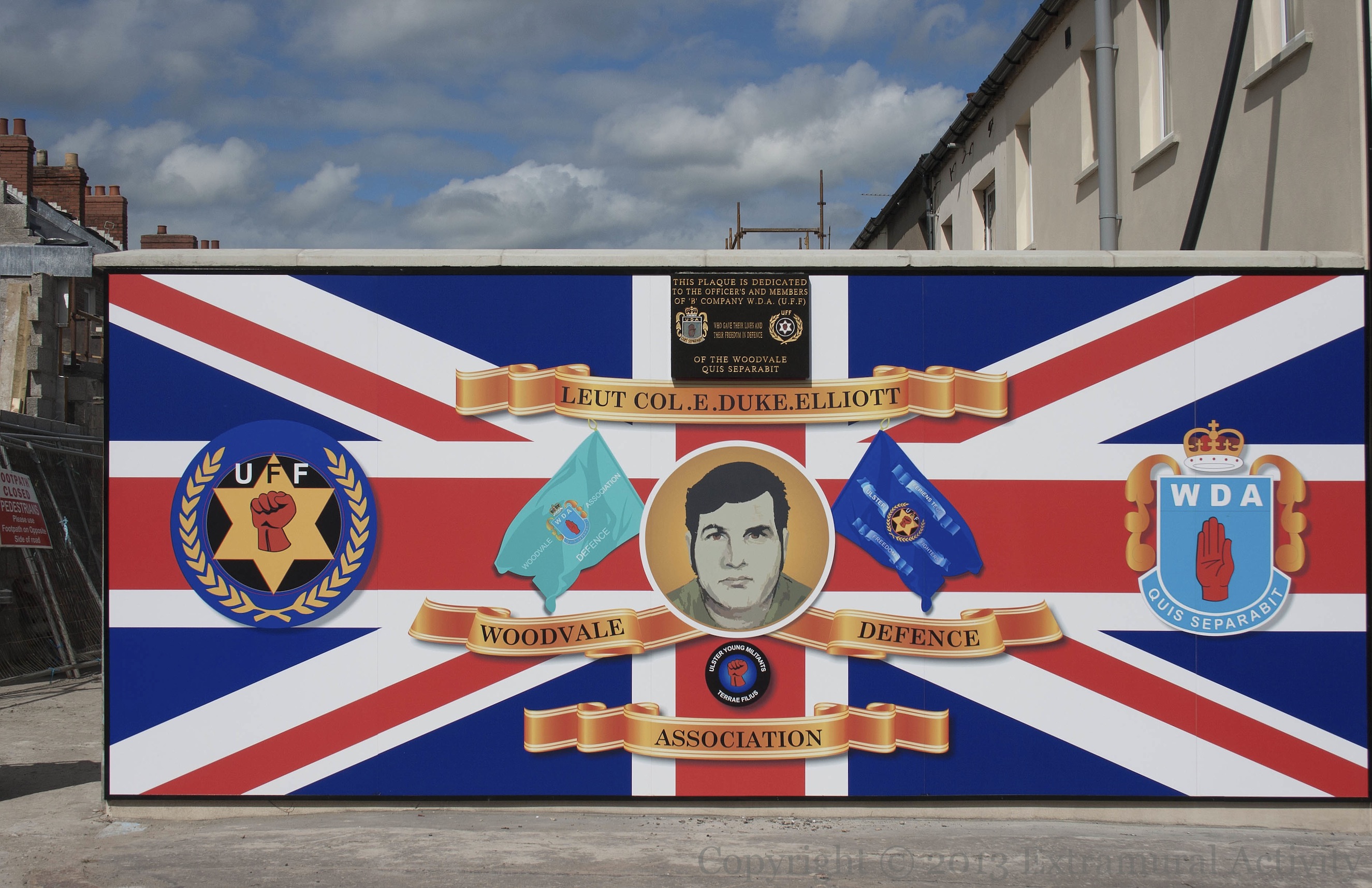
As mentioned in UDU-WDA-UDA-UFF, the end wall of Columbia Street was knocked down, taking with it a former Duke Elliott/UDA mural, which has now been replaced with boards (rather than murals) commemorating the history of the UDA and Elliott. Elliott lived one street over, in Leopold Street (WP). He was killed in 1972, at age 28, in a dispute with other UDA members.
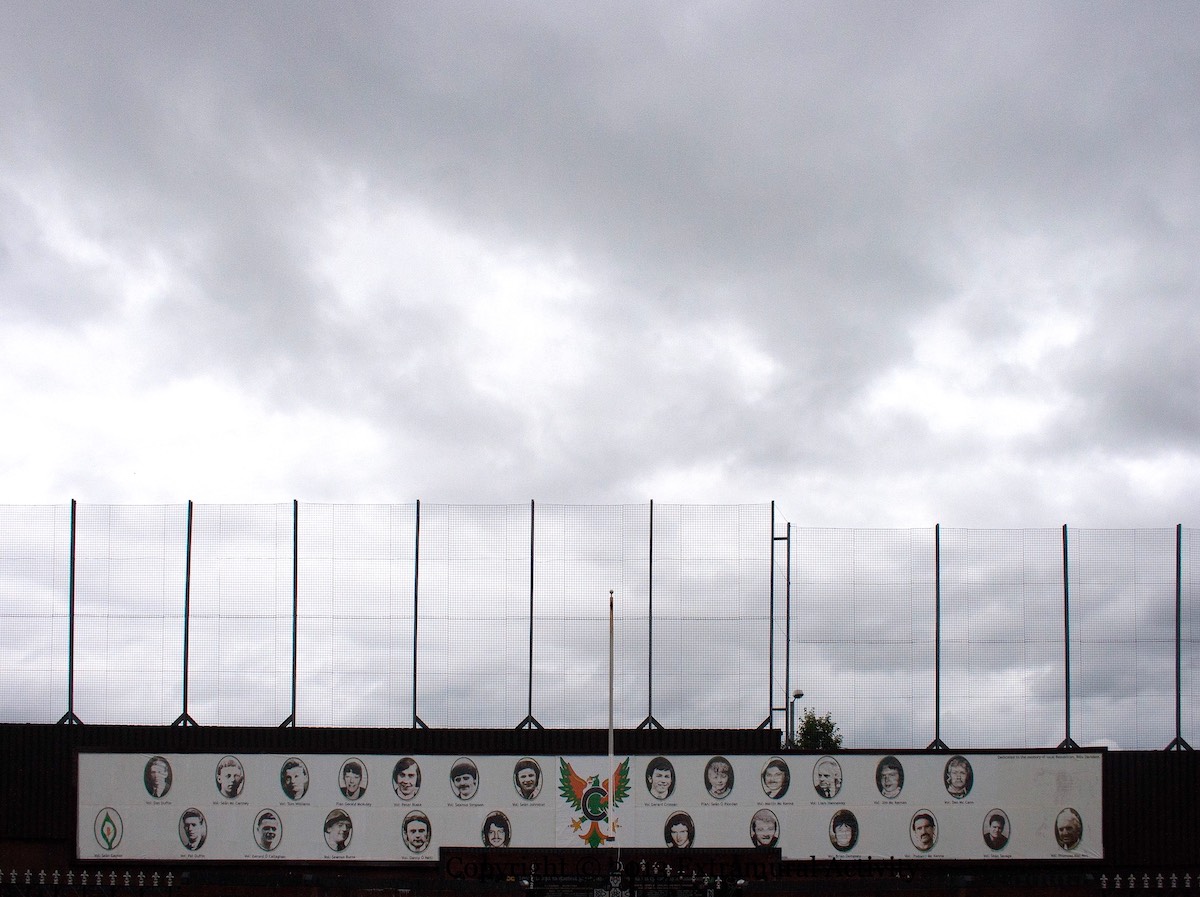
The back wall of Clonard Martyrs Memorial Garden – that is, the so-called “peace” line – is decorated with portraits of twenty-five local óglaıgh and fıanna who died from 1920 to 1992 (though an Easter lily takes the place of Sean Gaynor on the far left).
Left: Dan Duffin, Seán McCartney, Tom Williams, Gerard McAuley, Peter Blake, Seamus Simpson, Seán Johnston, Seán Gaynor, Pat Duffin, Gerard Ó Callaghan, Seamus Burns, Danny Ó Neill, Tom McCann.
Right: Gerard Crossan, Seán Ó Riordan, Martin McKenna, Liam Hannaway, Jim McKernan, Dan McCann, “dedicated to the memory of local republican, Billy Davidson”, Tony Lewis, Joe McKenna, Brian Dempsey, Finbarr McKenna, Seán Savage, Prionsais Mac Áirt.
They are also listed on one of the plaques inside the garden – see the second images in Clonard Martyrs.
The gable wall at the end of Columbia Street (on Ohio Street) has been rebuilt and the old WDA/Duke Elliott mural has been replaced. Above is the right side of the piece, which describes the transition from the Woodvale Defence Association to the Ulster Defence Association to the Ulster Freedom Fighters, and grounds all three in the Ulster Defence union of 1893.
In the second image, below, Ewart’s mill, on the Ardoyne side of the Crumlin Rd, can be seen in the background. From the WP page on the Crumlin Rd … “The mill was built for William Ewart, a cotton trader and politician who switched his interests to the production of linen, which at the time became the leading industry in the city. During the Second World War the mill was converted from the production of linen to the manufacture of munitions.” There is a statue diagonally across the street (at the corner of Cambrai and Crumlin Roads) of a millworker.
In 1971 in order to combat an increasingly aggressive republican movement, the WDA amalgamated with a number of other defence groups in form the UDA. This ensured a more organised and coherent response to the onslaught faced by the citizens of Northern Ireland.
The UFF was established in 1973 to take the war to republicanism. With tenacity, courage and resilience the members of the UFF distinguished themselves in battle by striking at the very heart of republican movement and ensuring that the attacks faced by their community didn’t go unanswered.
2013: The genesis of these groups can be traced right back to the formation of the UDU in 1893. Formed to resist Home Rule in the late 19th and 20th centuries, the UDU adapted the motto Quis Separabit. This motto was used by ulster defenders throughout the period known as “the troubles”.
There is a campaign under way to repatriate south Armagh man Michael Campbell from Lithuania on humanitarian grounds (Newry Times). Campbell was given 12 years in 2012 for attempting to purchase weapons (An Phoblacht).
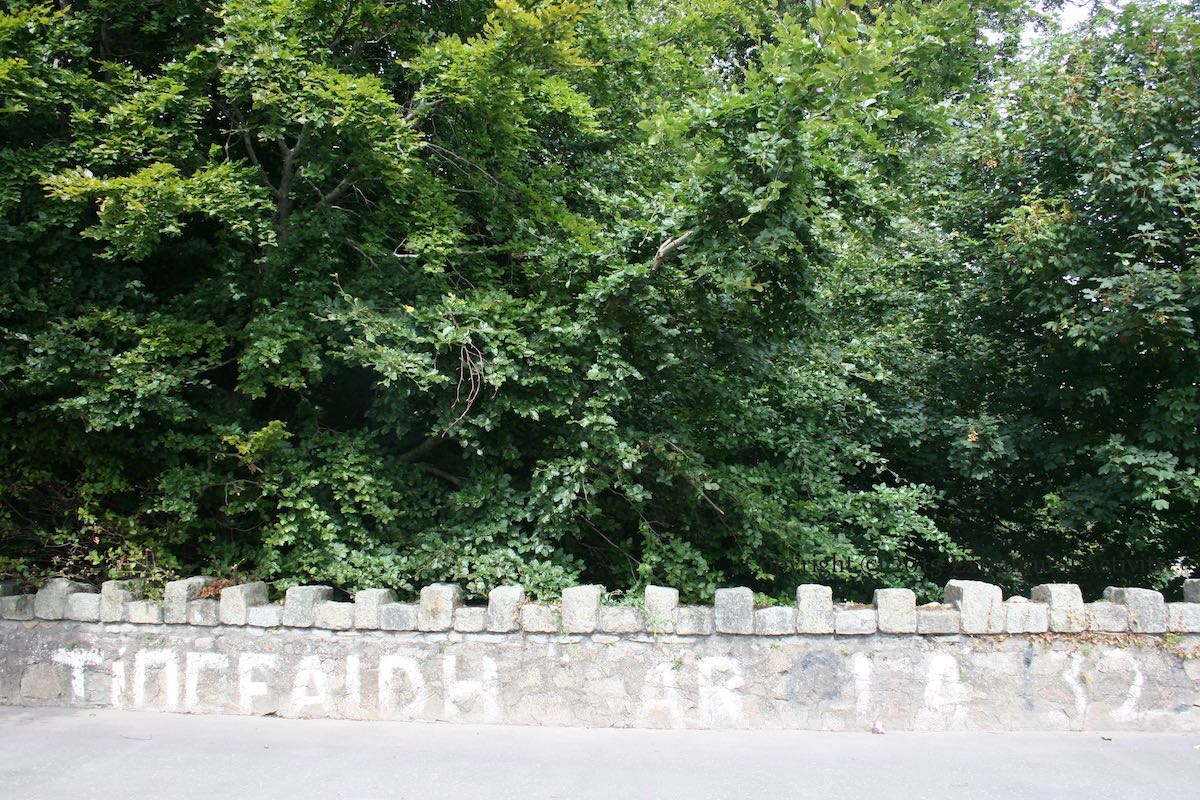
The “Tıocfaidh Ár Lá 32” is out on Camlough Road at the Cloughreagh estate.
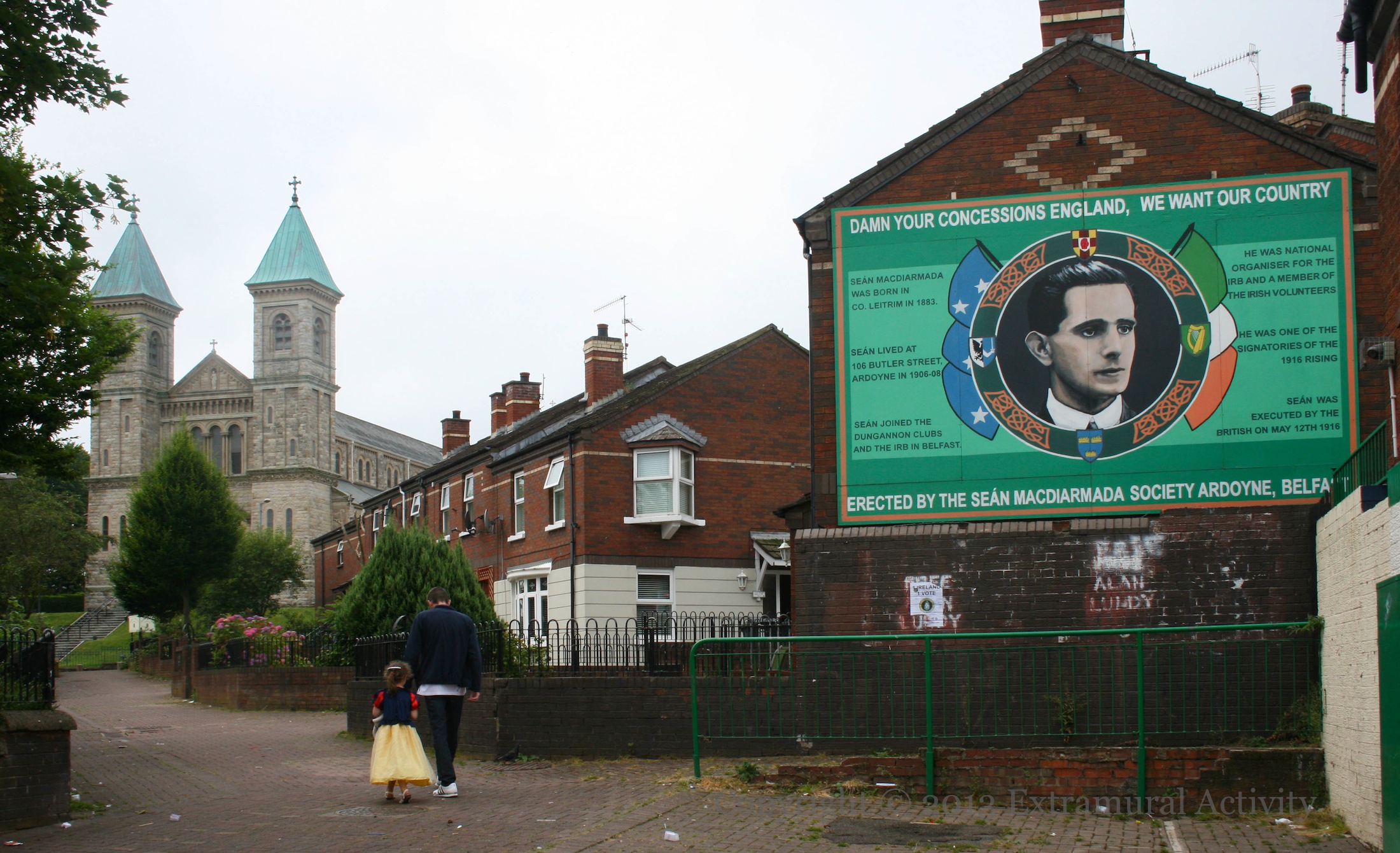
This board to Seán Mac Dıarmada in Ardoyne details his exploits leading up to and including the 1916 uprising and his earlier connection with the local area.
Below, a wide shot showing the end of Butler Walk and the Holy Cross church in the background. Painted by Rısteard ÓMurchú.





 Extramural Activity