The Settlement Of The True Protestant Religion

“God save the King.” When Charles acceded to the monarchy last September upon the death of Elizabeth II, he also became head of the Church Of England. Among the first oaths he took as king was one to preserve the Church Of Scotland, which is Presbyerian rather than Anglican. There does not appear to be any oath relating specifically to any denomination in Ireland, and so the Shankill mural above borrows from the Church Of Scotland oath. It stops short of the references to Scotland:

“I, Charles the Third, by the Grace of God of the United Kingdom of Great Britain and Northern Ireland and of my other Realms and Territories, King, Defender of the Faith, do faithfully promise and swear that I should inviolably maintain and preserve the Settlement of the true Protestant religion …” [… as established by the Laws made in Scotland in prosecution of the Claim of Right and particularly by an Act intituled “An Act for securing the Protestant Religion and Presbyterian Church Government” and by the Acts passed in the Parliament of both Kingdoms for Union of the two Kingdoms, together with the Government, Worship, Discipline, Rights and Privileges of the Church of Scotland.] (Royal UK)

For more on the UK monarch’s roles as head of the various churches, see Gentle Reformation and Constitution Unit.

At yesterday’s coronation, Charles swore an oath similar to the above, but referring to the Church Of England, and swore that he was a faithful Protestant (Country Life).

See previously: May The King Live Forever.

“King’s corner” because across the Shankill from the QEII mural in Crimea Street. Also in imitation of Conor’s Corner.

Click image to enlarge
Copyright © 2023 Seosamh Mac Coılle
X12269 King’s Corner North Howard Street

England’s Bloody Empire

“India, Jamaica, Palestine, Aden, Malaysia, Kenya, Derry, Ballymurphy, Shankill, Kosovo, Afghanistan, Iraq … England’s bloody empire.”

A new UK monarch, Charles III, formerly the Prince Of Wales, will be crowned today (see May The King Live Forever). Charles has been colonel-in-chief of the Parachute Regiment since 1977 (BBC). He is shown above with General Mike Jackson – see From The Top Down | Jail Jackson.

The list of areas listed above as sites of British Army atrocities includes the (Protestant) Shankill in Belfast where, on the same night of September 1972, two local men – Richie McKinney and Robert Johnston – were shot and killed by the parachute regiment (Eamon McCann | Irish News | AP video of the public protests and UDA statement on the killings).

The killings resurfaced recently when flyers in support of the regiment’s “Soldier F” – accused in connection with Bloody Sunday in Derry in January that same year – that had been posted on the Shankill were torn down – see Stop The Witch Hunt.

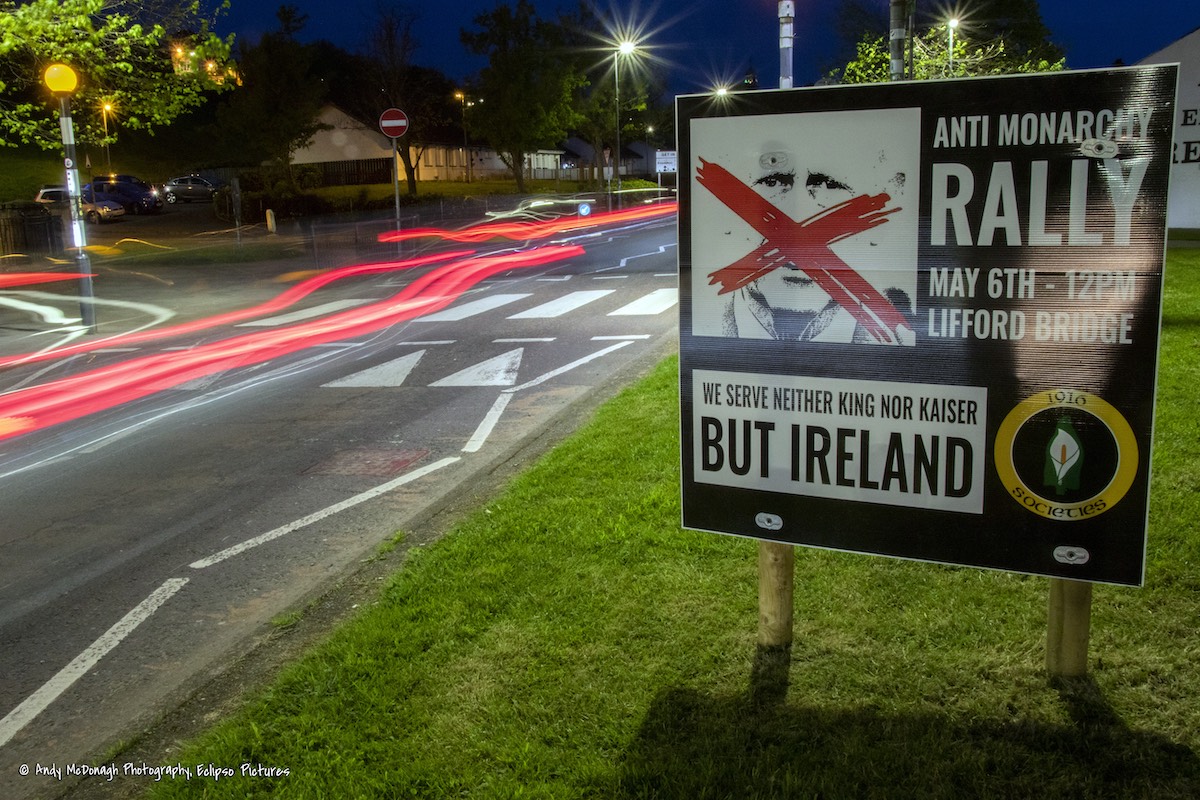
In the middle image: an “anti-monarchy rally” organised by the 1916 Societies (Fb) takes place at noon in Lifford. “We serve neither king nor kaiser but Ireland.

Click image to enlarge
Copyright © 2023 Andy McDonagh/Eclipso Pictures (ig | Fb)
X12257 X12259 X12258 BloodySundayMarch.org free derry corner

Now As The Dawn Is Breaking

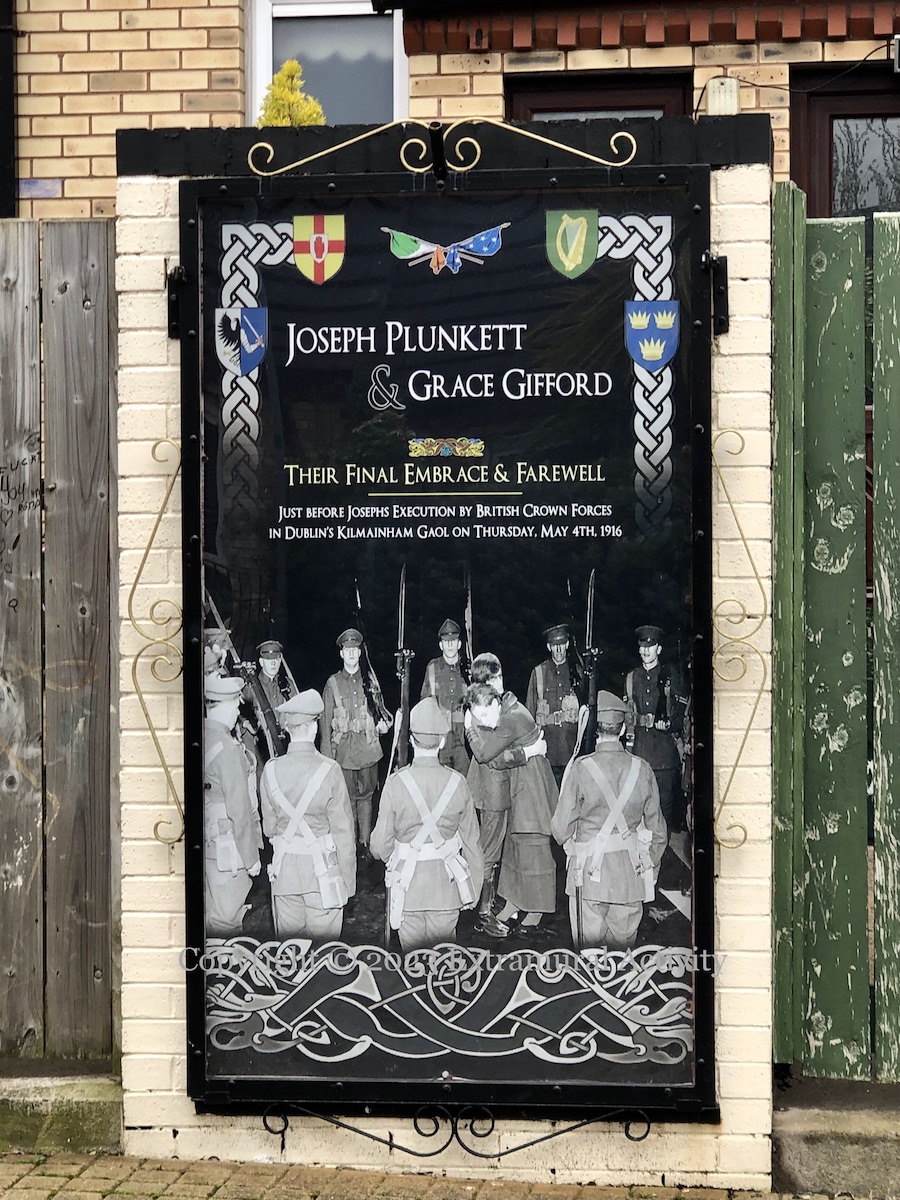
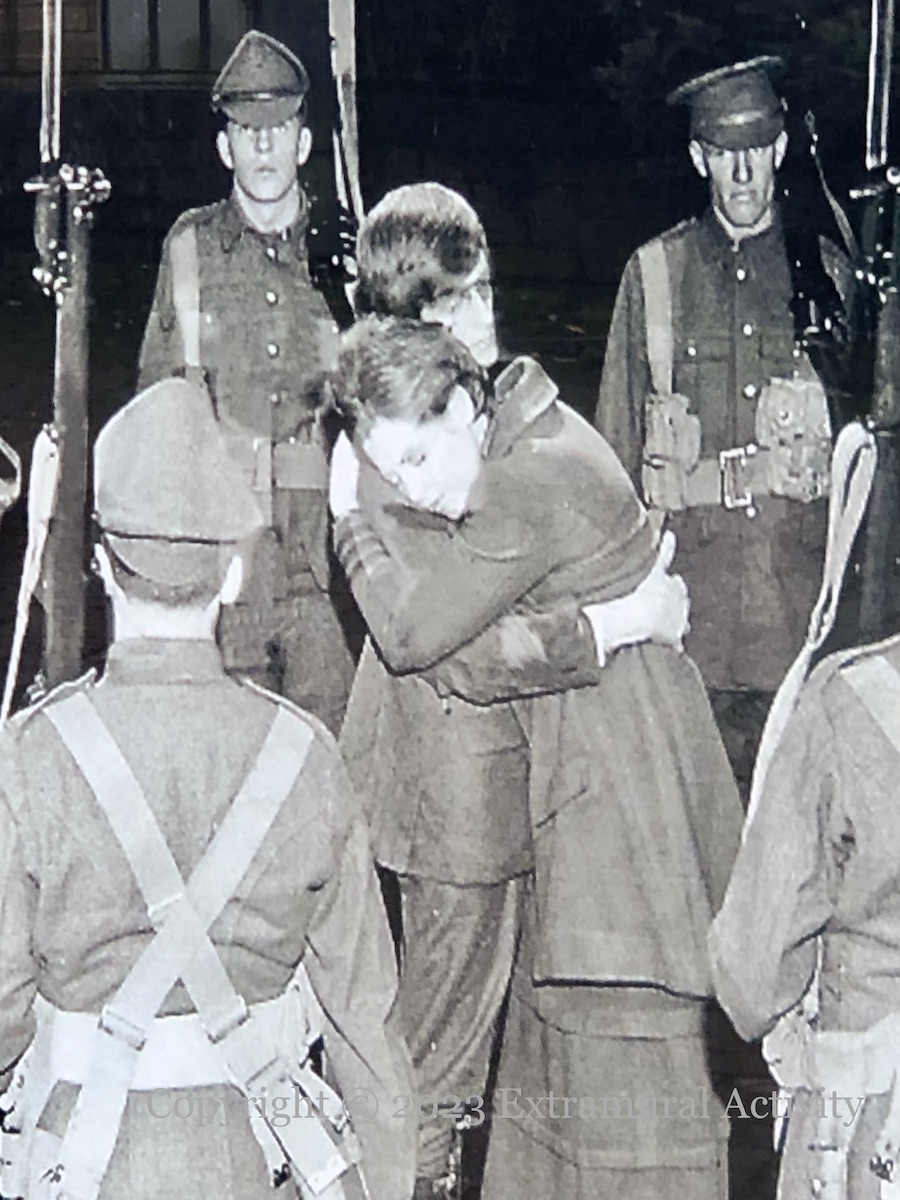
“Joseph Plunkett & Grace Gifford – their final embrace & farewell.” May 4th is the anniversary of the execution of Joseph Plunkett, one of the planners of the Easter Rising in 1916. Seven hours before he faced the firing squad, he married Grace Gifford. The photograph is from a re-enactment for a 1966 RTÉ programme Insurrection (RTÉ). The ballad Grace, written by Seán and Frank O’Meara in 1985, is now internationally known (here is Jim McCann’s 1985 performance).

This is one of various recent additions to the many memorials in Ard An Lao, Béal Feırste/Ardilea, Belfast. This replaces the board seen in Continuing Their Legacy.

Click image to enlarge
Copyright © 2023 Seosamh Mac Coılle
X12170 [X12169] X12168 X12171 X12172 X12173
“Just before Joseph’s execution by British forces in Kilmainham gaol on Thursday May 4th, 1916”

No Apartheid

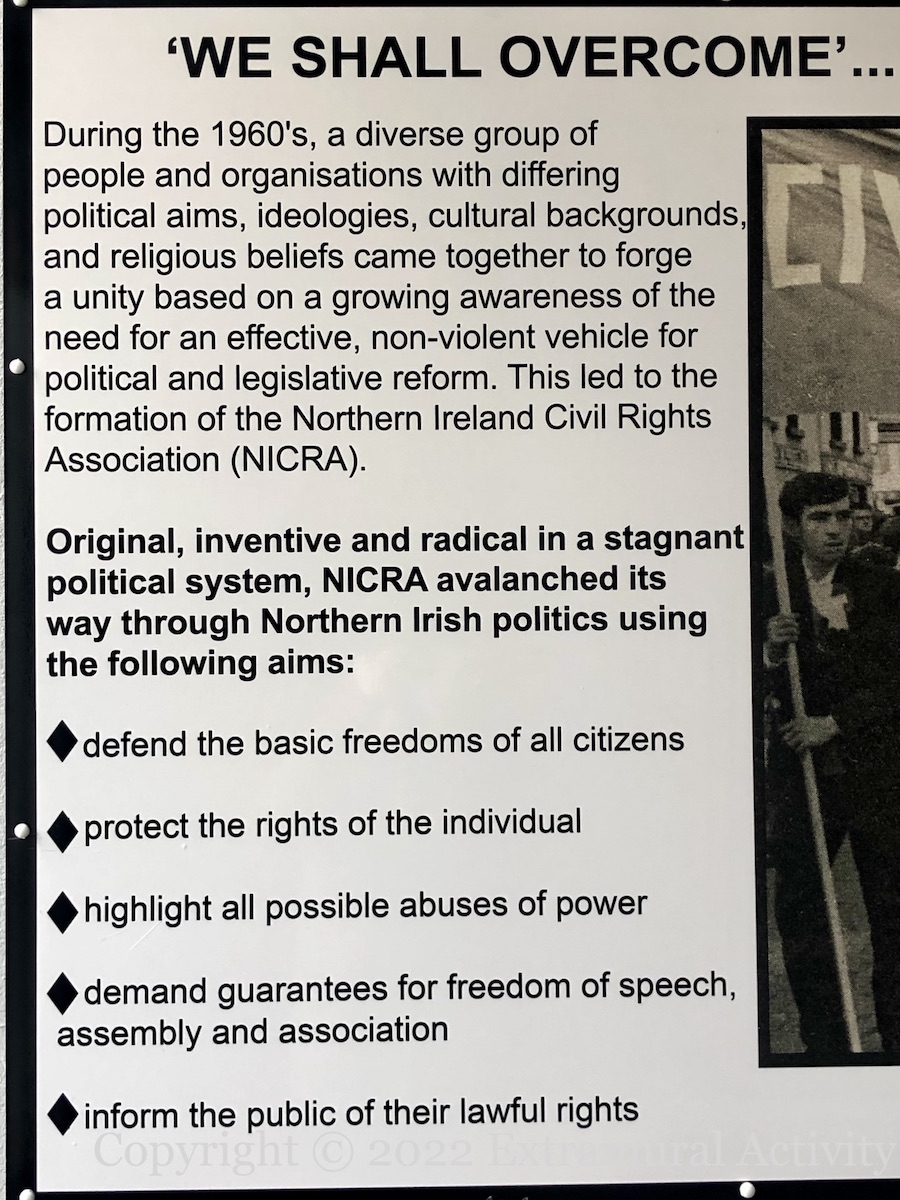
“The Civil Rights 50th Anniversary Committee pay homage to all the courageous people who participated in the Civil Rights campaign” with a commemorative board in the alley of Donegall Street Place, in front of the Jim Larkin statue and ICTU mural. The photograph shows the start of the march from Coalisland to Dungannon on March 24th, 1968. The participants are identified on the CAIN page about NICRA. (See also the remarks from vice-chair Dympna McGlade at Slugger.)

“We shall overcome – the history of the struggle for civil rights in Northern Ireland 1968-1978. During the 1960’s, a diverse group of people and organisations with differing political aims, ideologies, cultural backgrounds, and religious beliefs came together to forge a unity based on a growing awareness of the need for an effective, non-violent vehicle for political and legislative reform. This led to the formation of the Northern Ireland Civil Rights Association (NICRA). Original, inventive and radical in a stagnant political system, NICRA avalanched its way through Northern Ireland politics using the following aims: defend the basic freedoms of all citizens; protect the rights of the individual; highlight all possible abuses of power; demand guarantees for freedom of speech, assembly and association; inform the public of their lawful rights. Through activism, marches and peaceful disobedience, the NICRA demands were addressed to varying degrees and paved the way for major legislative, political and social reform in Northern Ireland. These demands included: ‘one man, one vote’; an end to gerrymandering of electoral wards; the prevention of discrimination in the allocation of government jobs and council housing; the removal of the Special Powers Act and the Disbandment of the Ulster Special Constabulary (The B Specials).”

Click image to enlarge
Copyright © 2022 Seosamh Mac Coılle
X09939 X09938 X09940 X09936 [X09937]

Who Is The Terrorist?

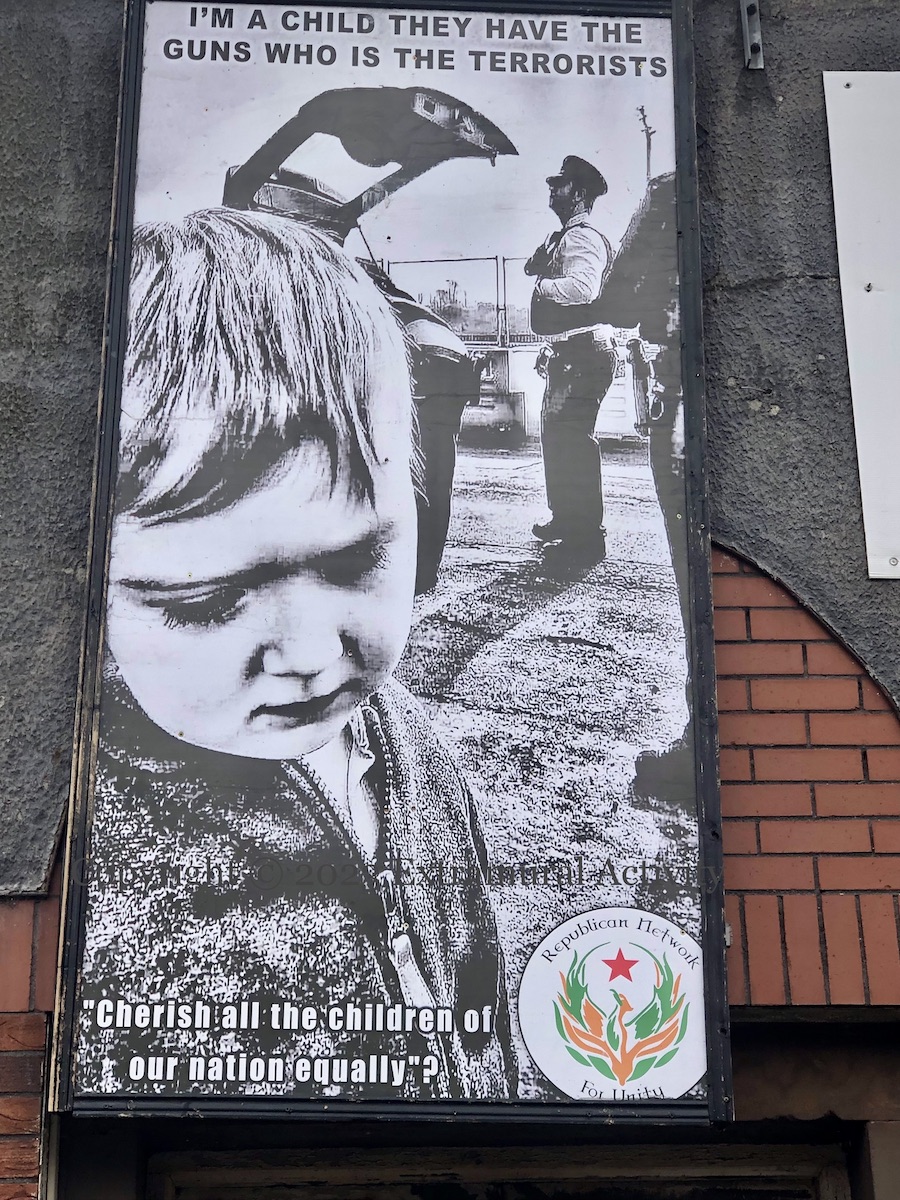
“I’m a child. They have the guns. Who is the terrorists? ‘Cherish all the children of our nation equally’? ” The quote is from the 1916 Proclamation (CAIN); it has been used inclusively for various classes (see Cherish | The Children Of The Nation) but here is applied to children.

Anti-Agreement republicans have complained about being searched in the streets and in their homes, sometimes in front of children. (There is a Facebook group on the issue.)

RNU (ig | Fb) board in Divis Street, west Belfast.

Click image to enlarge
Copyright © 2023 Seosamh Mac Coılle
X12211 X12212

Our Political Circumstances

Here are three new pieces above the security gates on Northumberland Street, coving over the “Deserted! Well, We Can Stand Alone” graffiti in the last remaining spot on the wall without a mural. From left to right:

Arthur Guinness: “Black Protestant Porter” as a description of Guinness stems from Arthur Guinness’s opposition to the 1798 rebellion (Indo). The Union Star (newspaper in Belfast – A Planet Of Light And Heat) called Guinness a spy and advised that “United Irishmen will be cautious of dealing with any publican who sells his drink.” (An Phoblacht).

Gusty Spence, a former commander of the UVF, read out the ceasefire statement of the “Combined Loyalist Military Command” (UVF, RHC, and UDA): “Let us firmly resolve to respect our different views of freedom, culture and aspiration and never again permit our political circumstances to degenerate into bloody warfare – Gusty Spence, loyalist ceasefire [statement in full], 13 October, 1994.”

“Welcome To The Shankill Road – we are proud, resilient, welcoming”: The original ‘three hands’ was on Northumberland Street, just above this spot – see Proud, Defiant, Welcoming – which was then reproduced in reduced form in Gardiner Street – see Welcome To The Shankill Road.

This is the most conciliatory statement ever made by loyalism and the decision to put it on Northumberland Street, especially in the context of the internationally famous and associated-with-Ireland Guinness and the “welcome” mural, suggests that the trio is directed at tourists rather than locals.

For the 36th Division board to the far left, see XXXVI; for Kitchener, see To All Foreign Nationals Across The Empire; for the mental health board to the right, see Pain Is Real.

Click image to enlarge
Copyright © 2023 Seosamh Mac Coılle
X12251 X12252 X12272 X12230
“Arthur Guinness (1725-1803) – unionist, visionary, thinker, philanthropist. Arthur Guinness was born into an Irish Protestant Family, whose spiritual home lay in the townland of “Guiness” near Ballynahinch, Co. Down [BBC]. He was “directly opposed to any movement toward Irish independence” and wanting “Ireland to remain under British control.”
“The Guinness family being staunch Unionists and Anti Home Rulers, a descendent of Arthur Guinness Lord Iveagh was a major contributor of funding to the Ulster Unionists Council who in turned funded the Ulster Volunteer Force arms fund of 1913. One year later 1914, the UVF would land 25,000 rifles and 2 million rounds of ammunition on Ulster shores.
“At the outbreak of the First World War, employees of Guinness St Jame’s gate Brewery were encouraged to join the British forces. Over 800 employees served in the Great War serving on land, on sea and in the air all over the world. During Ww1 if you worked for Guinness they paid your brewery wages in full to your wife or mother for the entire time you were enlisted. This was in addition to your military salary.
“The Guinness family formed an Orange lodge in County Wicklow that is still in existence to this day. One of the great Southern Irish Protestant families.”

The Rising

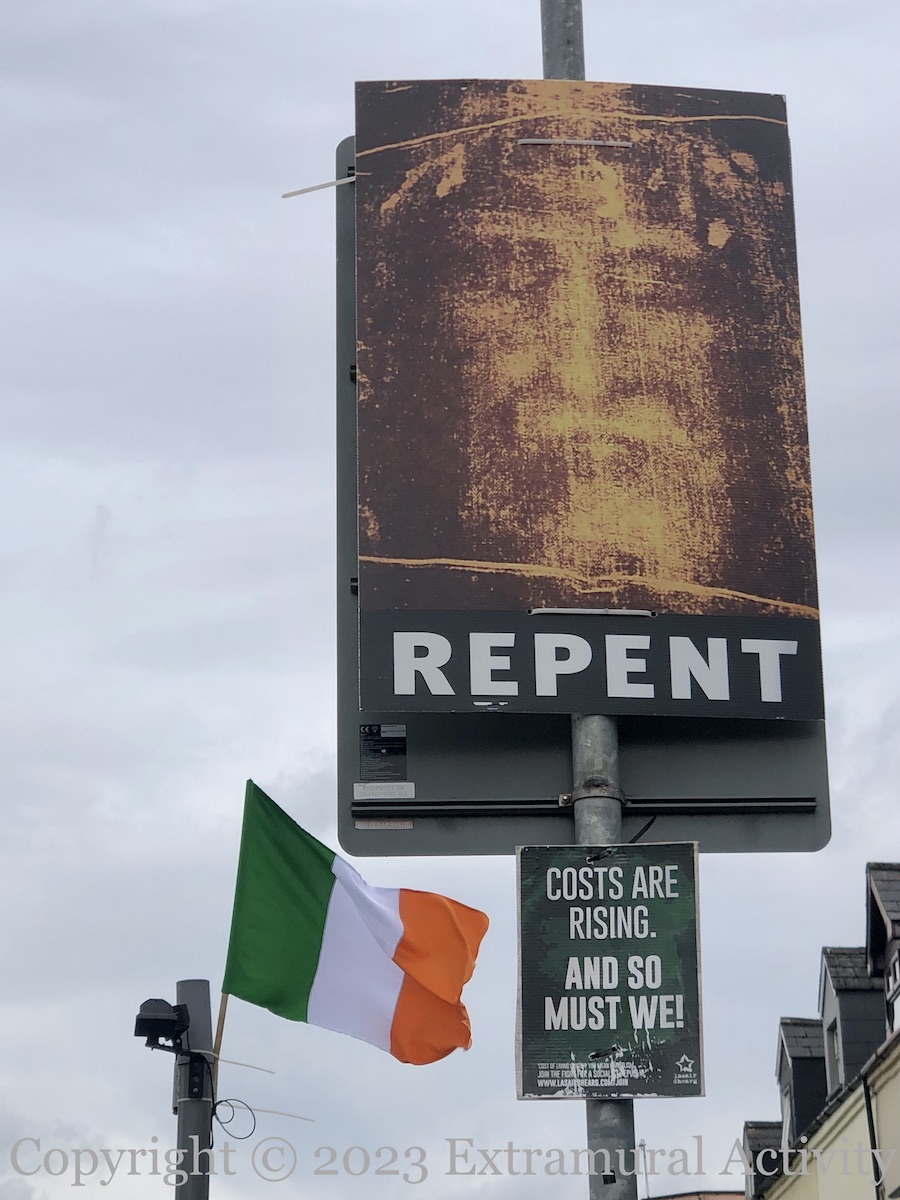
CNR west Belfast, but not that rising. Rather these two placards on the Falls Road encourage reactions to risings of the Christian kind – we should “repent” our sins even as they forgiven; the shroud of Turin dates to roughly 1300 but is a symbol of Jesus of Nazareth in the tomb between crucifixion and resurrection – and of the inflationary kind – Lasaır Dhearg (web) declares “Costs are rising. And so must we!”

Falls Road, west Belfast.

Click image to enlarge
Copyright © 2023 Seosamh Mac Coılle
X12179 X12192

Honour Ireland’s Patriot Dead

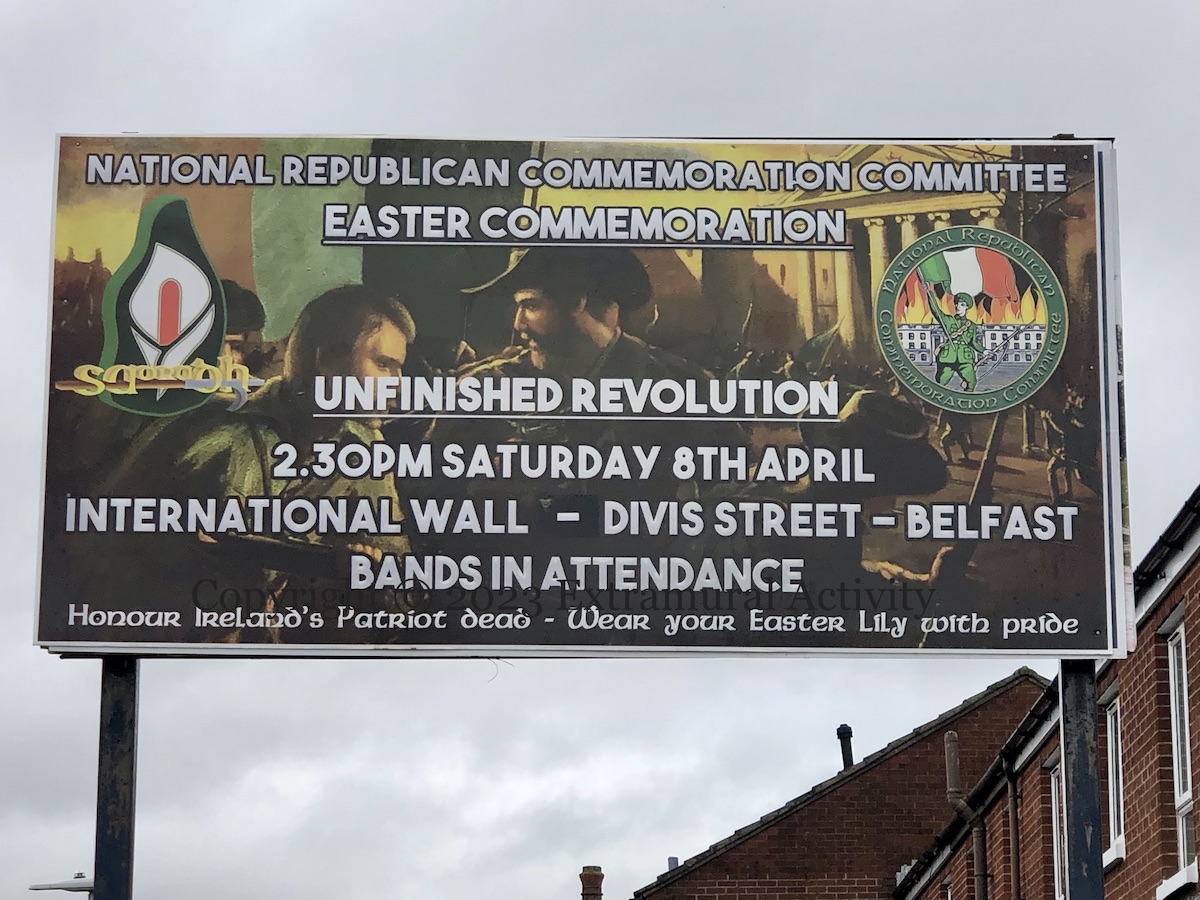
There are dozens of Easter Rising commemorations happening this weekend – see Belfast Media for a full calendar. Above is a board for Saoradh’s (web) Easter parade on Saturday 8th. Below is the Falls/D Company gathering.

“National Republican Commemoration Committee Easter commemoration. Unfinished revolution. 2.30 pm Saturday 8th April. International wall, Divis Street, Belfast. Bands in attendance. Honour Ireland’s patriot dead, wear your Easter lily with pride.”

Havana Way, north Belfast.

Click image to enlarge
Copyright © 2023 Seosamh Mac Coılle
X12175 X12206 [X12205] X12274 X12187 X12188

Past, Present, Future

Four generations of UK royalty: the previous Queen Elizabeth II, the current King Charles III, the heir apparent William, baron Carrickfergus – here written as “baron of Carrickfergus” (also the prince of Wales), and his nine-year-old son George. Charles’s coronation will be on May 6th, 2023.

Ballyearl Terrace, Newtownabbey.

Click image to enlarge
Copyright © 2023 Seosamh Mac Coılle
X12149 X12150 X12148 X12147

Demand Better

An IRSP (web) electoral board joins the Miriam Daly tribute at the end of Oakman Street (see previously History Is Written By The Winners). Dan Murphy took 2.5% of the first-preference votes in the 2022 Assembly elections (WP) on a platform focusing on housing: “Demand better! Housing – Equality – Community. Someone who stands up to landlords in Beechmount (e.g.), fighting for affordable rents, fighting for our community.”

The IRSP first painted on this Oakman Street gable in 1996, with the original Daly mural. Before that, in 1986, there was an IRA anti-touting message (see M00413).

Click image to enlarge
Copyright © 2023 Seosamh Mac Coılle
X12165