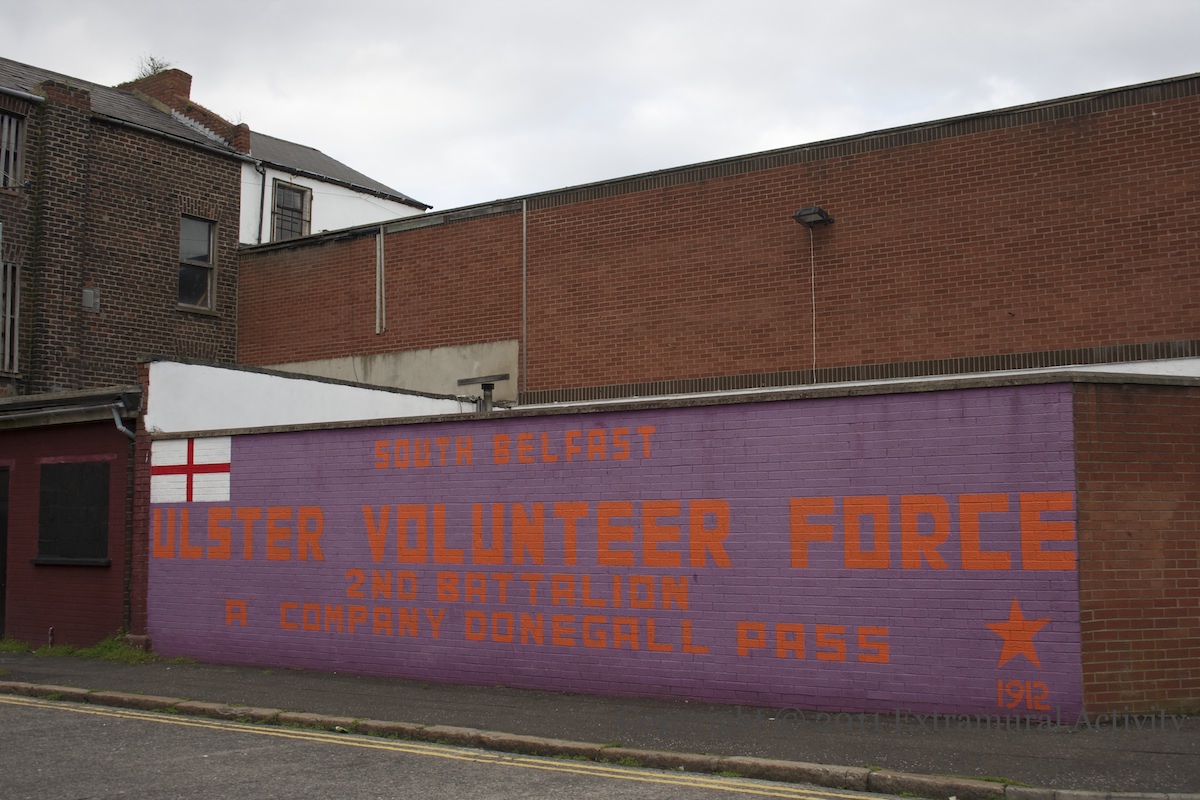
South Belfast Ulster Volunteer Force 2nd Battalion “A” Company Donegall Pass, with the flag of England (St. George’s Cross) in one corner and in the other an orange star with “1912” written below, the year the Ulster Volunteers were founded. The colour-scheme is the reverse of the Orange Order’s: its flag has the purple star of the Williamites on an orange field.
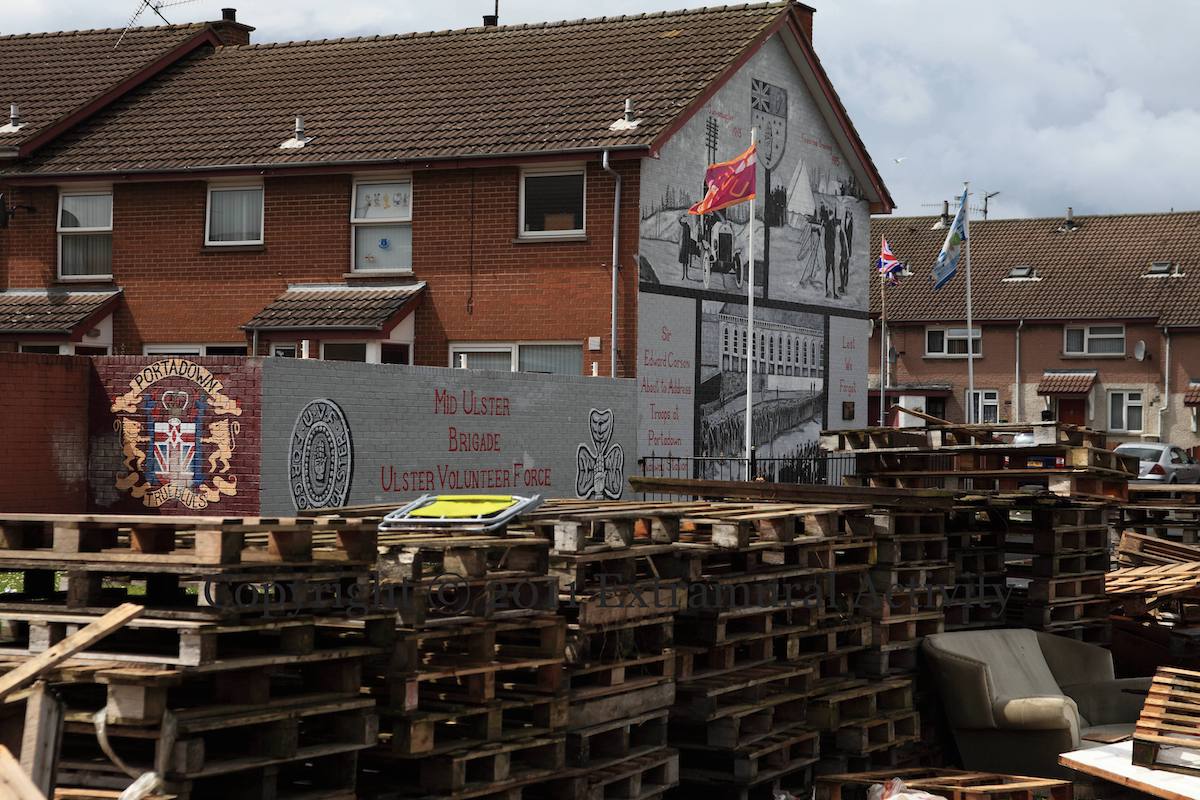
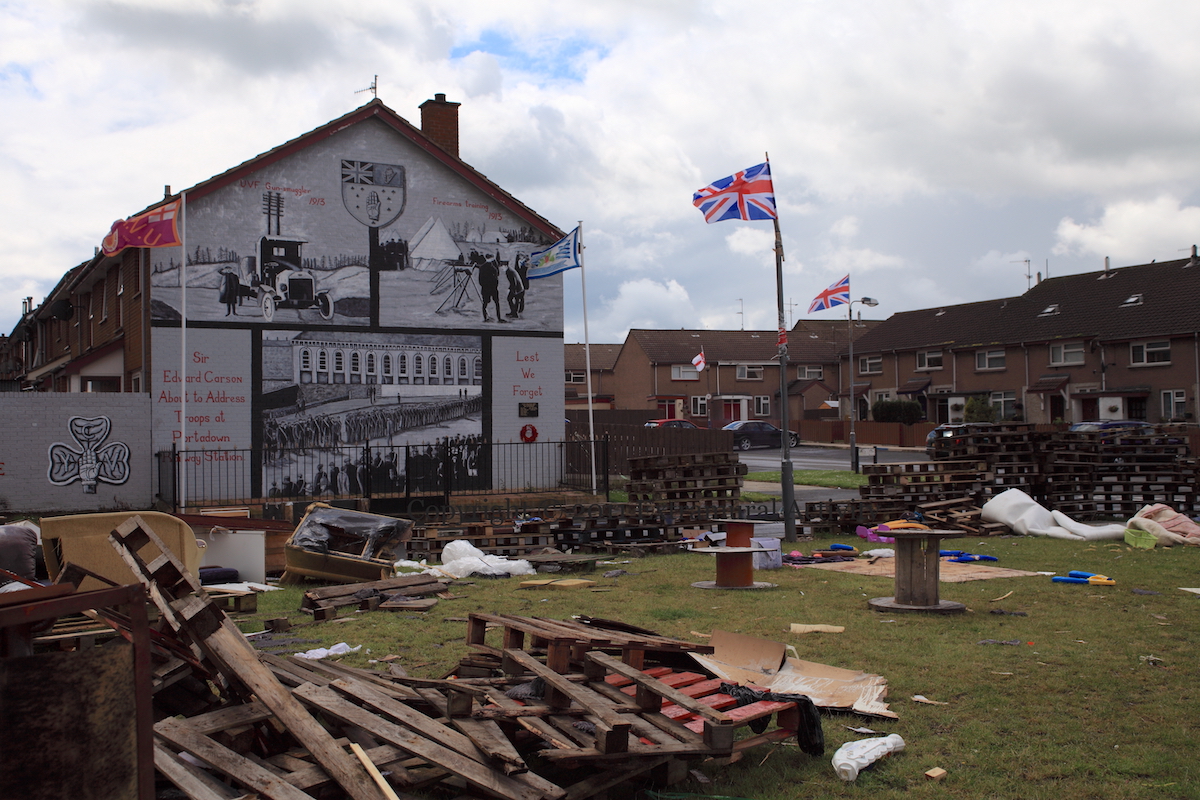
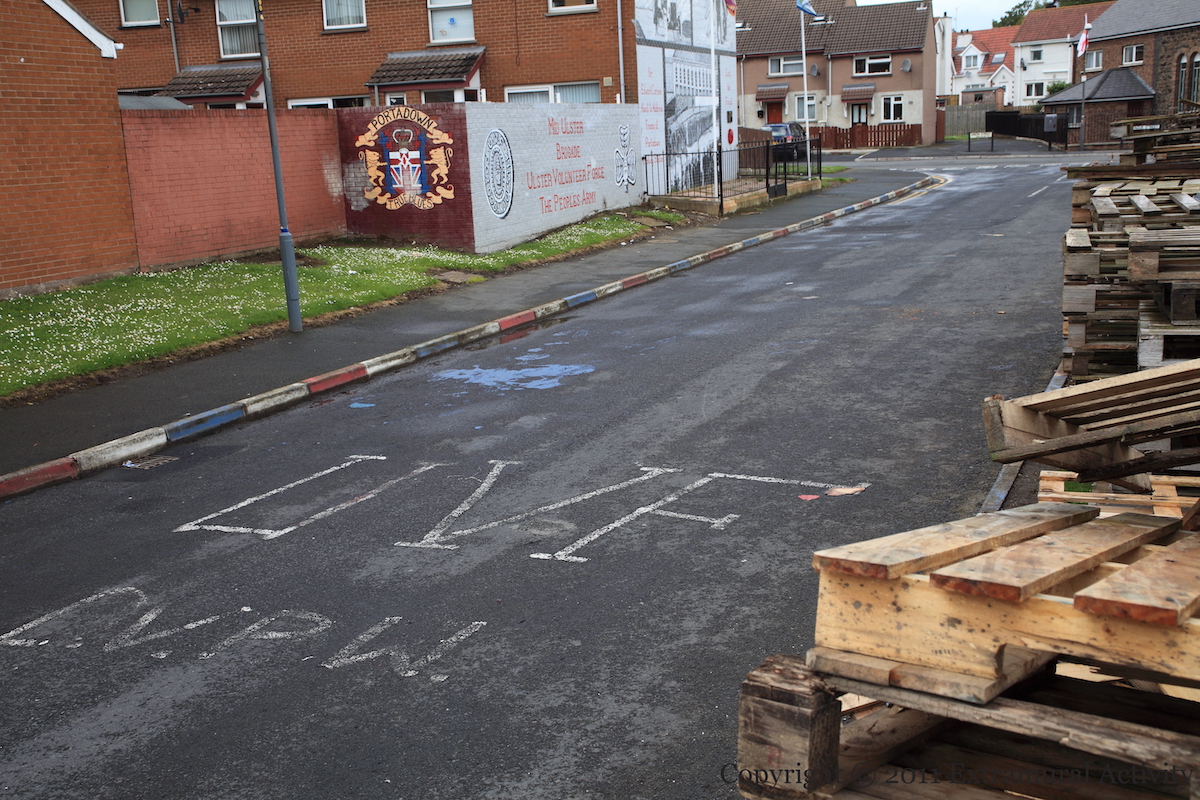
Pallets are collected for Eleventh night in the Edgarstown estate, in front of the murals on Union Street: from left to right: Portadown True Blues, Mid Ulster UVF, and the Ulster Volunteers. In the final image, “LVPW” [Loyalist Volunteer Prisoners’ Welfare] on the tarmac is modified (by the rival UVF) to become “DVPW” – “D” for “drugs”.
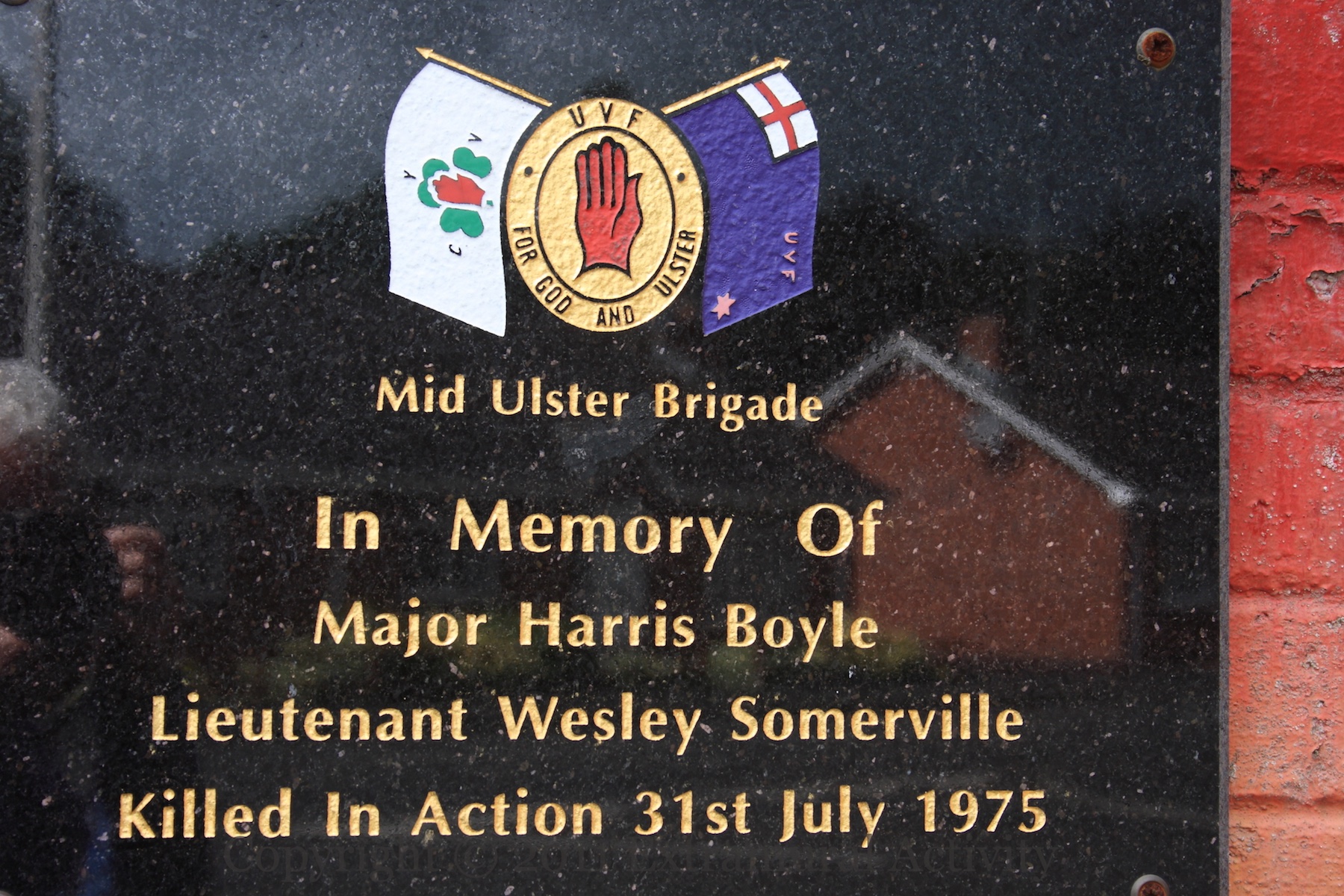
Harris Boyle and Wesley Somerville were UDR soldiers and UVF volunteers. They were “killed in action” when the bomb they were planting on the minibus of the Miami Showband went off prematurely. Of the pair, only Somerville’s arm, with its “UVF Portadown” tattoo remained identifiable (WP). The plaque is in Princess Way/Gloucester Avenue, Portadown.
Since 2014, the poster erected each year in Moygashel to honour Somerville has drawn criticism: 2014, 2015, 2016, 2017, and 2018.
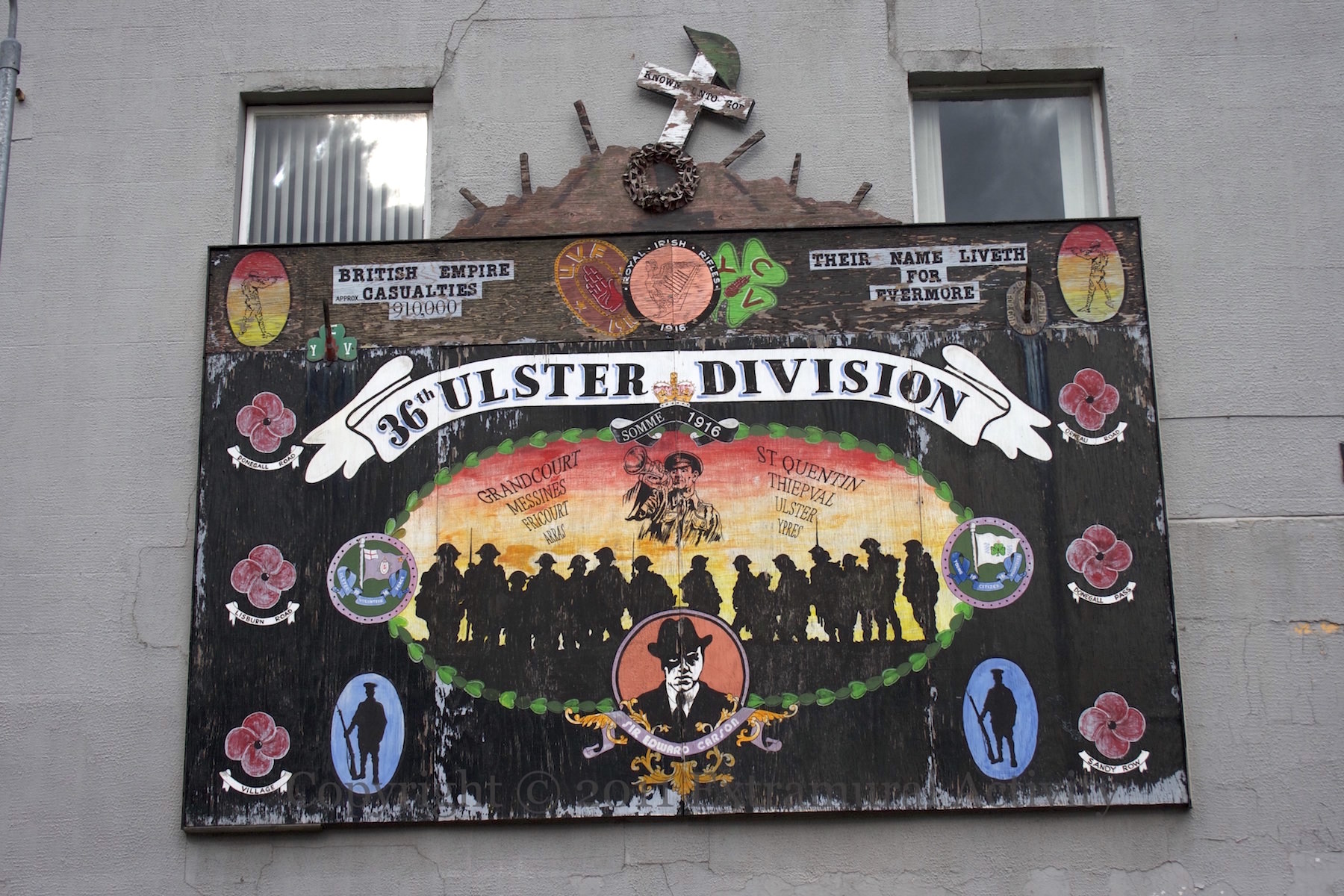
The apocryphal book of the Bible ‘Ecclesiasticus’ reads, “their bodies are buried in peace, but their name liveth for evermore” (44:14). The last clause is here applied to 910,000 “British empire casualties” from the Great War, including the Ulster Volunteers and Young Citizen Volunteers raised by “Sir Edward Carson” (here looking like Al Capone) which became the 36th (Ulster) Division and particularly the Royal Irish Rifles and fought at the Somme 1916.
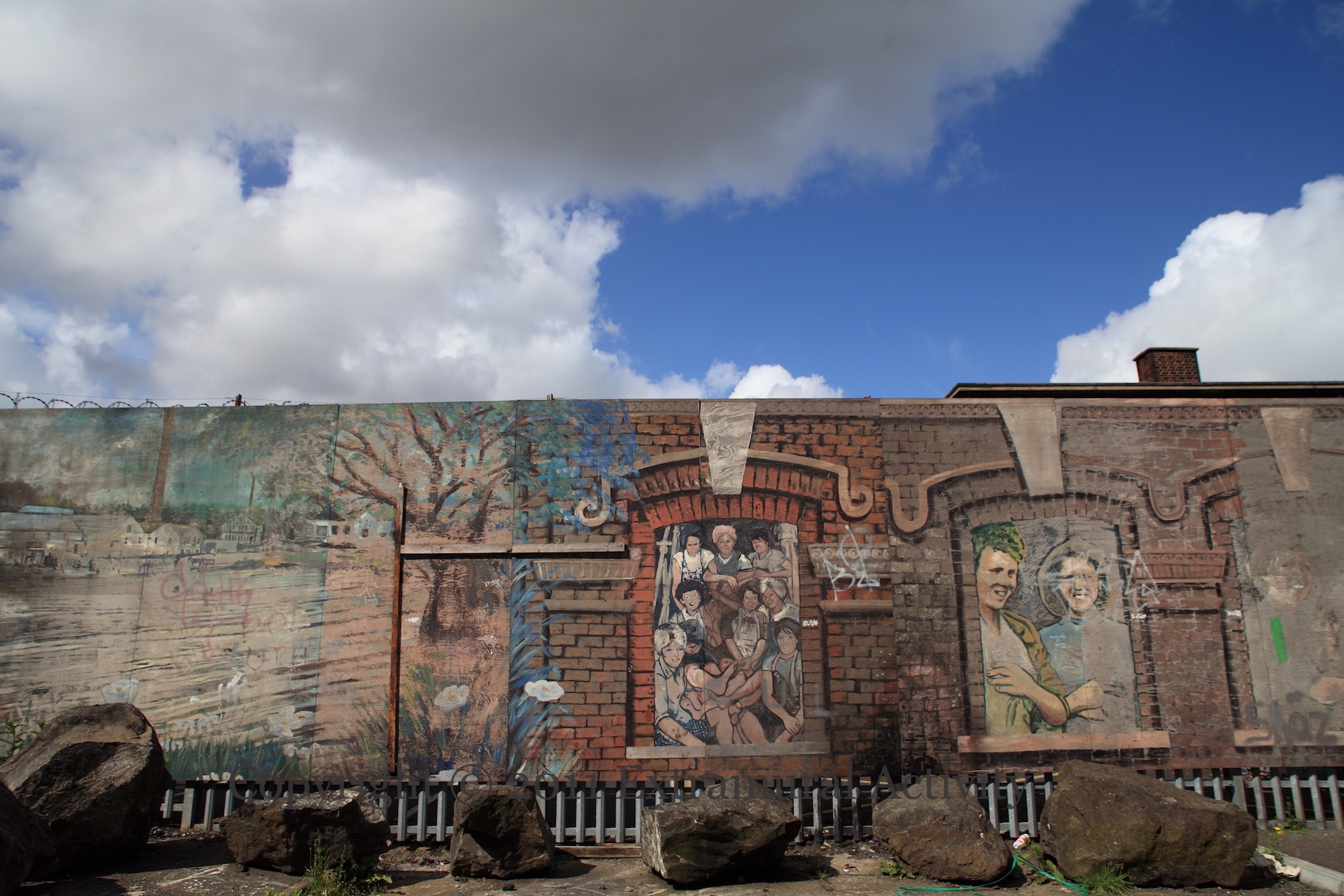
The upper end of Conway Street and Conway Mill itself were redeveloped from 2008 to 2012. In 2011, the year these pictures were taken, a piece of the old mural remained. (The part in the second image was the last to go.) For another piece of the mural, see Mill Committee.
“Understand the past – and build a better future, le cheıle, “Catholic, Protestant, and Dissenter” – Wolfe Tone”. The past that is to be understood is the 40th anniversary of the Battle Of St Matthew’s (“Cath Naomh Máıtıú” in the “4” on the left) which took place in June 1970. Two Protestants and a Catholic died; the battle was a founding moment in the history of the Provisional IRA (“Óglaıgh na hÉıreann” in the “0”) (WP). St Matthew’s church is depicted on the right.
In the centre is a Tricolour with a modified version of the ‘raised arms’ illustration of ‘everyone has their part to play’ (e.g. Emancipation Of Women has a paintbrush, hammer, and book in addition to a rifle; one in Derry has paintbrush, spanner, coloured pencils (at the end of a shorter arm), rifle, book, and placard – see The Destructive Talents Of The RUC). Here we have a dove – perhaps in place of the rifle – pencil, and spanner.
For information about the 2010 launch, see Glór Mhıc Aırt.
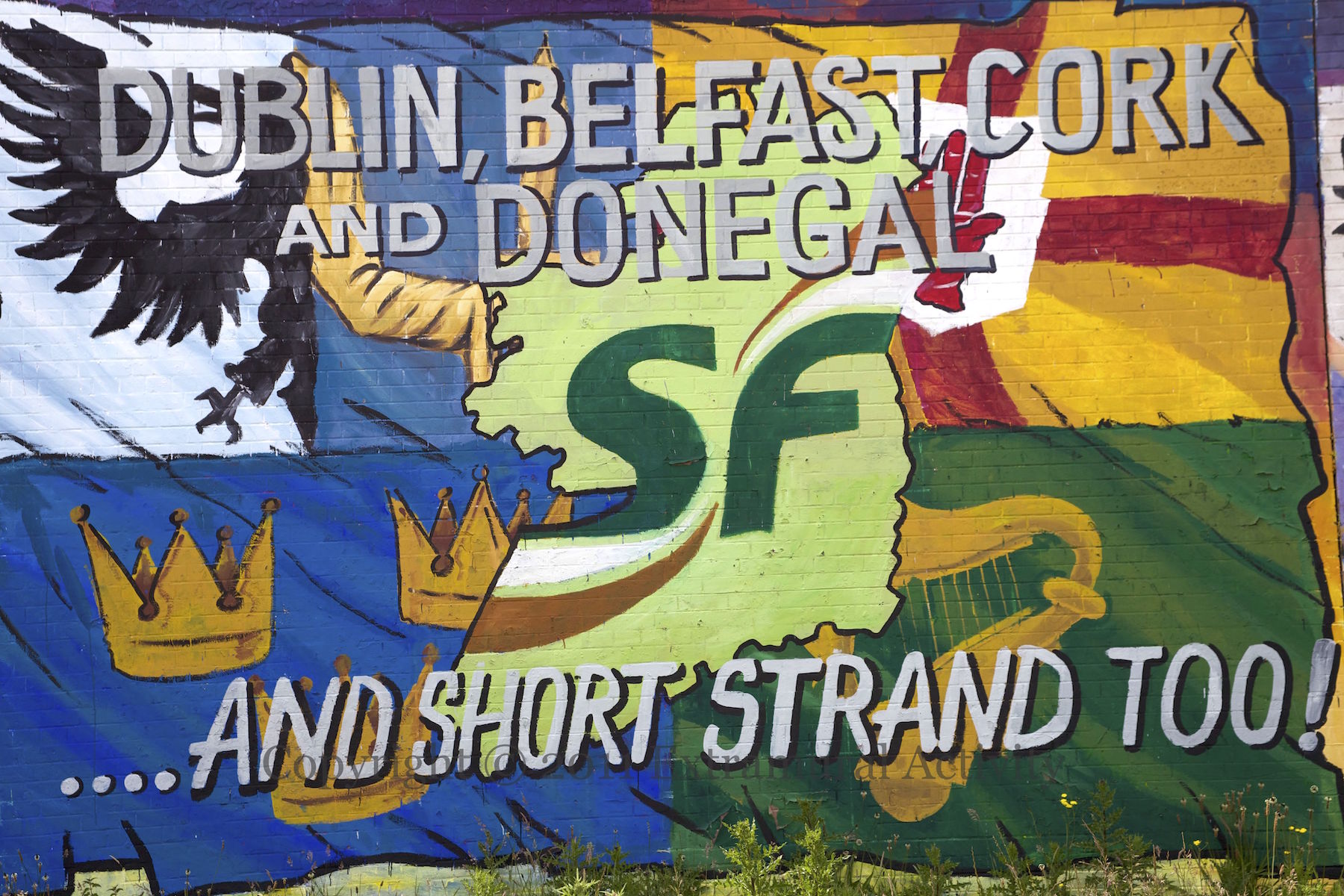
“Dublin, Belfast, Cork And Donegal” was a Sınn Féın media slogan in 2011, borrowing a line from (the song) On The One Road (here’s a Wolfe Tones rendition) and touting the fact that its candidates stand for election in both the Republic and Northern Ireland.
Sınn Féın candidate and Short Strand local Nıall Ó Donnghaıle was elected to Belfast City Council in the 2011 elections and served as Belfast’s youngest Lord Mayor (aged 25) from 2011 to 2012.







 Extramural Activity