Bloody Friday

On July 21st, 1972 – Bloody Friday – 19 IRA bombs exploded in the course of an hour, killing 9, six of them at the Oxford Street bus station, including 15-year-old William Crothers from Parker Street in east Belfast who worked for Ulsterbus as a parcel-boy. The others were three more employess – William Irvine, Thomas Killops, and John Gibson – and two British Army soldiers – Stephen Cooper (32 Squadron) and Philip Price (Welsh Guards). (BBC | WP | Paper Trail | BBC documentary)

“In memory of the fallen Friday 21st July 1972 Oxford [Street] Bus Station Belfast. Lest we forget”

Major Street, Belfast. Replaces Templemore Avenue Primary.

Click image to enlarge
Copyright © 2022 Seosamh Mac Coılle
X11564 X11562 X11563

Maggie McAnaney

A plaque was mounted this (2022) summer to Maggie McAnaney, who died when a gun went off at an IRA checkpoint near Burnfoot, Co. Donegal, a month before the Civil War began (Derry Journal). This is an unusual use of the phrase “active service”, as McAnaney was travelling to a picnic at the time, rather than on exercises or preparing munitions; the phrase would later come to be associated primarily with a premature bomb explosion.

“In proud and loving memory of Margaret “Maggie” McAnaney, Cumann na mBan, died on active service at Burnfoot on 31st May 1922, aged 18 years. The McAnaney family home was situated on Bishop Street. Fuaır sıad bás ar son saoırse na hÉıreann.”

Derry Journal has images from the launch.

Click image to enlarge
Copyright © 2022 Seosamh Mac Coılle
X10825 Bishop St

Welcome To Our Homeland

Here are two Sons Of Kai tarps in “the C-double-O” (Rathcoole), celebrating fifty years of the flute band. For the controversy over the name (and date of formation) see The Famous.

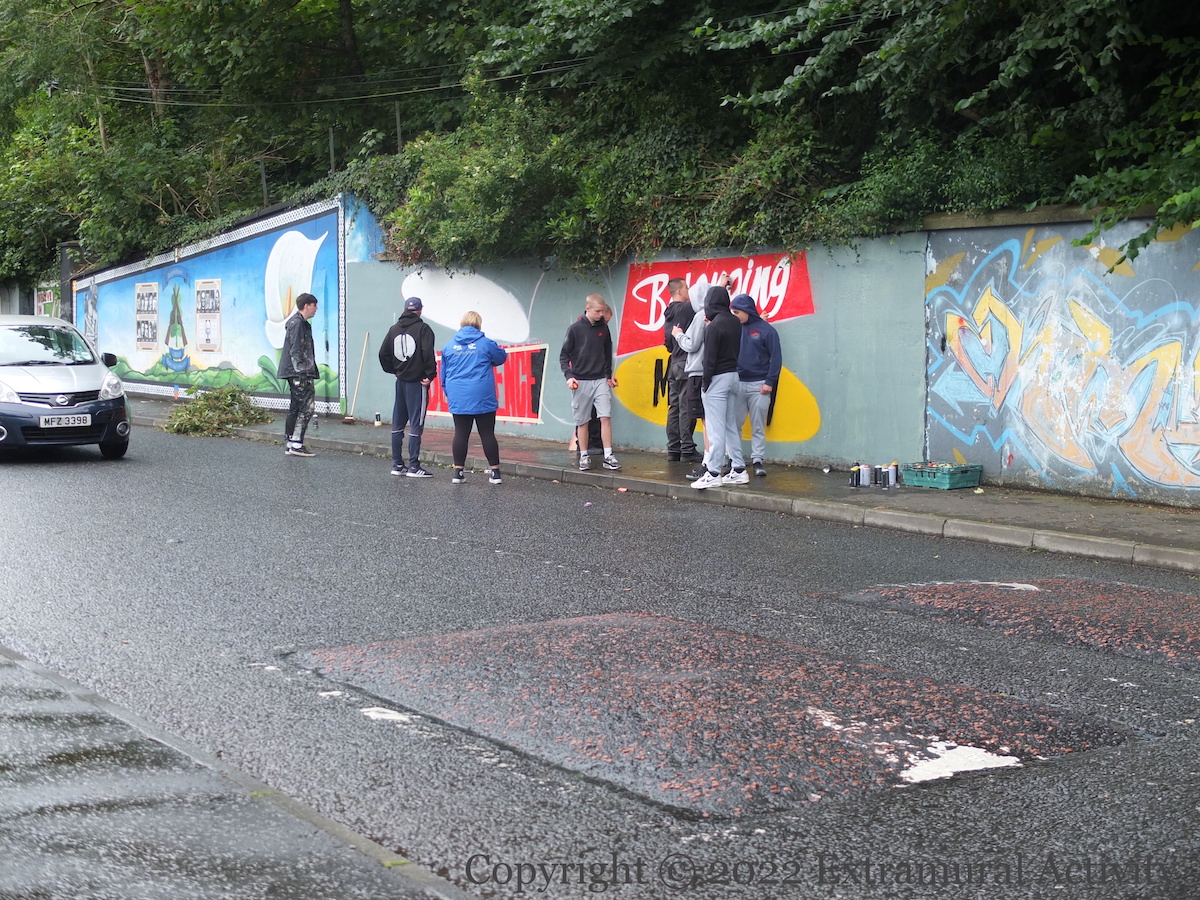
In the background of one of the wide shots can be seen (the latest version of) the Marky Quail mural.

Click image to enlarge
Copyright © 2022 Seosamh Mac Coılle
X11675 X11676 X11673 X11674 X11664 X11665 [X11666] Derrycoole Way

Neighbourhood Watch

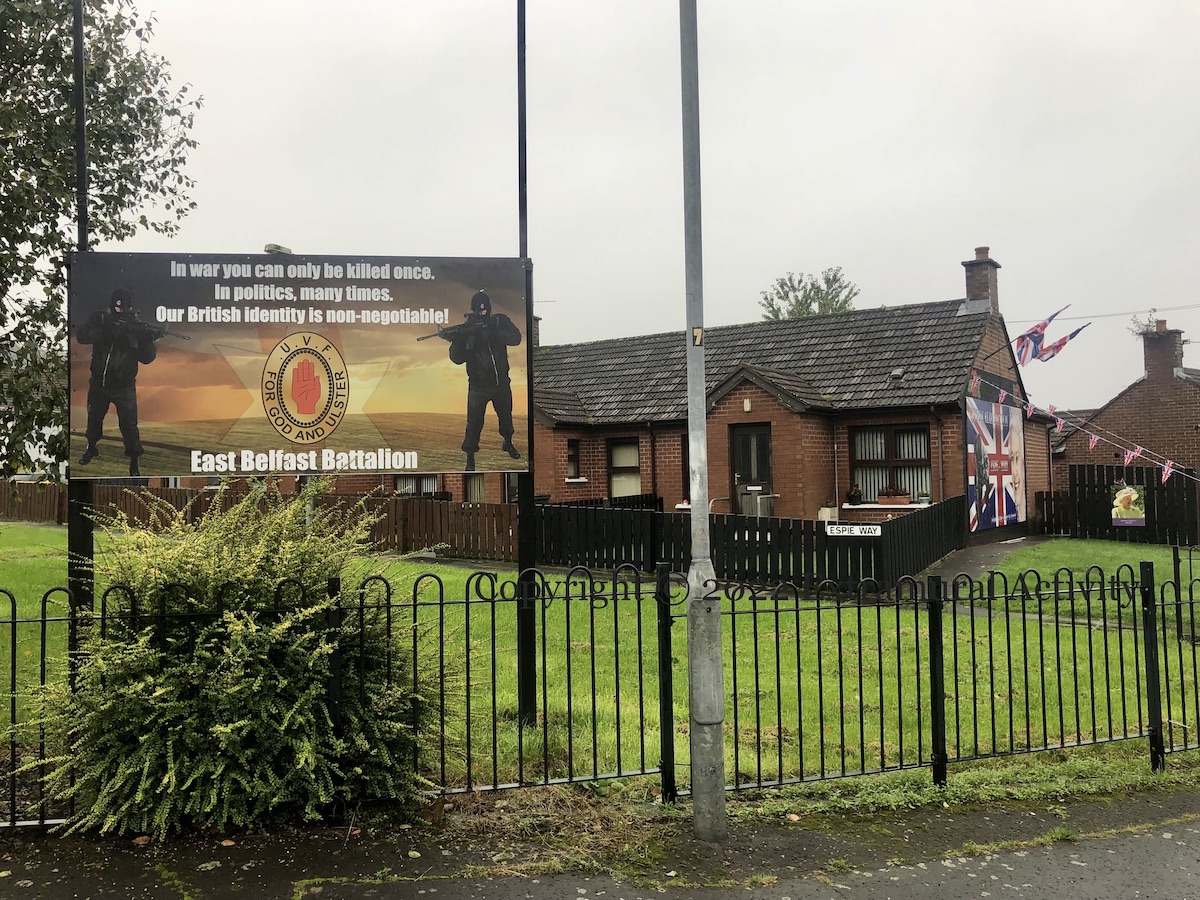
A hooded UVF volunteer has been added to the shops at the bottom of the Glen estate in Newtownards (compare with 2018). It’s unclear (to us) who such a threatening image is directed at: the residents of the estate (in both a controlling and defending function), and/or the UDA at the top of the estate, and/or the East Belfast UVF, and/or outside observers.

Click image to enlarge
Copyright © 2022 Seosamh Mac Coılle
X11219 X11218 Glenard Rd

Our Day Will Come

“Either ballot or gun, our day will come – PIRA.” This graffiti dates back to at least 1998 (see C01268) and probably to the breakdown of the ceasefire in 1996; the same slogan was present in Wall St (Carrick Hill) in 1996. It is still visible on the Falls Road in 2022.

Click image to enlarge
Copyright © 2022 Seosamh Mac Coılle
X11348 X11347

Bowtown UVF

The “east Belfast” board shown above is on the east side of Bowtown while the two pieces of fresh “north Down” graffiti are on the west side, perhaps indicating that the tension between the two UVF factions – persists. The east Belfast faction was suspected in the bus burning in response to the Protocol in 2021 (BBC | Tele).

See previously in various Newtownards estates: Always A Little Further (Whitehill) | East East Belfast (Westwinds & Bowtown) | EB UVF (Westwinds). For the UDA factions in the Glen estate, see Ulster Defence Unions.

The phrase on the board is also used in an east Belfast mural: “We seek nothing but the elementary right implanted in every man … the right, if you are attacked, to defend yourself …”

Click image to enlarge
Copyright © 2022 Seosamh Mac Coılle
X11282 X11279 X11280 Bowtown Cr

A Letter To The 22

“I gcuımhne na nÓglach a fuaır bás ar son saoırse [in memory of the volunteers who died for freedom].” The “22” are the familiar 12 deceased Troubles-era hunger-strikers, plus 10 from 1917 to 1946: Thomas Ashe, Terence McSwiney, Michael Fitzgerald, Joseph Murphy, Joe Witty, Dennis Barry, Andy O’Sullivan, Tony Darcy, Jack McNeela, Sean McCaughey.

“‘A Letter To The 22: You have not gone away. You are in the hearts/and on the lips of your people./The old speak of you with knowing tongue. The middle/aged, as those who walked beside you./The young men and women with a passion not unlike your own./Your names can be heard on the wind taken from the mouths/of men who tend their flocks on Slieve Gullion, Cnoc Phádraıg, Glenshane./They echo in small graveyards in/Cork, Kerry, Galway, Mayo, Tyrone, Antrim, Derry and Armagh./They are heard among your people at the mass gate on/Sunday, in the crowd at the hurling game, around the hearth when/the bottle is cracked and song in sung. Your image can be seen/on the faces of happy smiling children for whose freedom you gave your all./You are in our prayers, you have not gone away, you never will’ – Colum Mac Gıolla Bhéın

For the same 22, see Staılc Ocraıs. Replaces a painted mural to Joe McDonnell.

Click image to enlarge
Copyright © 2022 Seosamh Mac Coılle
X11560 X11561 Suffolk Rd

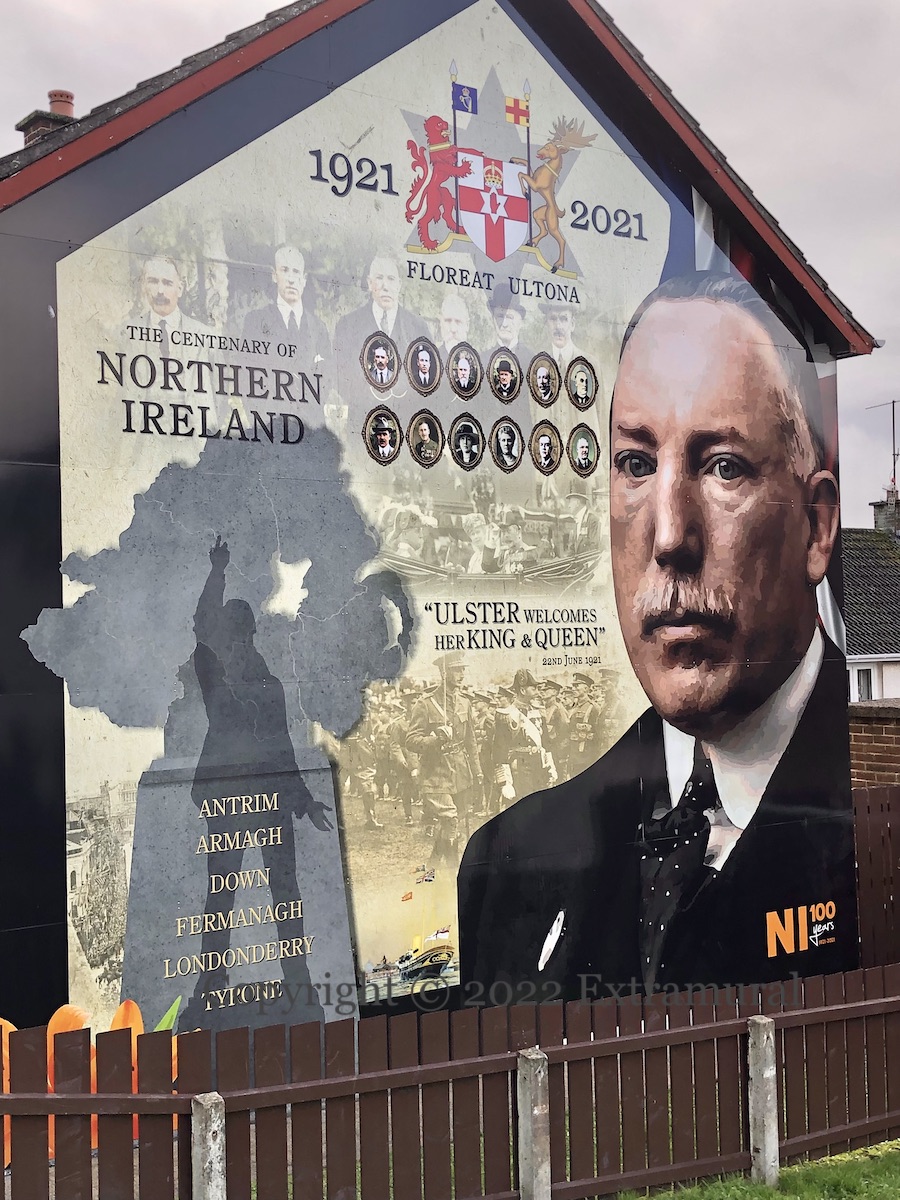
Floreat Ultona

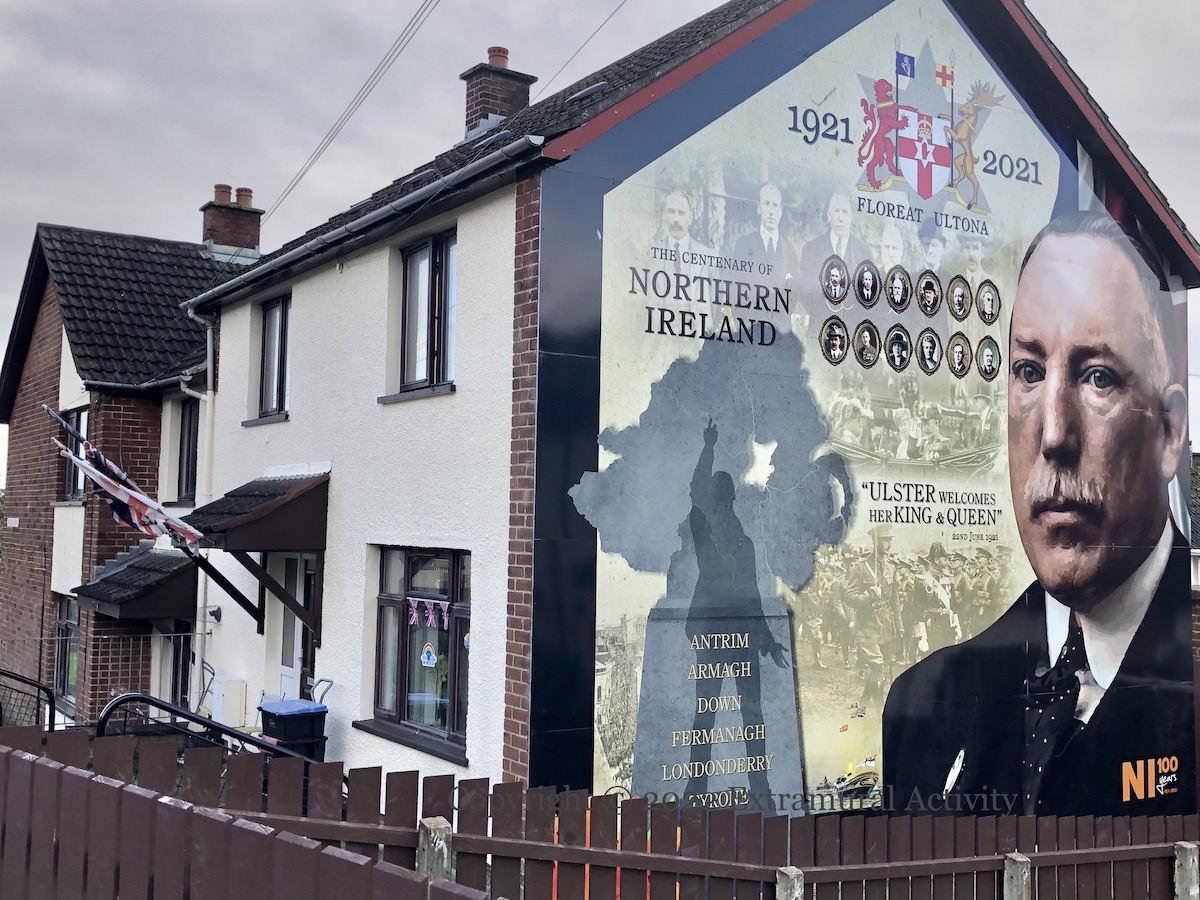
“May Ulster flourish” as the newly created Northern Ireland under “Sir James Craig, 1st Viscount Craigavon, Prime Minister of Northern Ireland”. The Northern Ireland parliament was opened in 1921 and the coat of arms adopted in 1924 (WP); the Special Constabulary (including the B-Specials) had been formed prior to and in preparation for partition – the quote from Carson (also seen in an east Belfast mural) is from July 12th, 1920.

The text on the board is the same as at WP: “The Ulster Special Constabulary (USC; commonly called the “B-Specials” or “B Men”) was a quasi-military reserve special constable police force in what would later become Northern Ireland. It was set up in October 1920, shortly before the partition of Ireland. It was an armed corps, organised partially on military lines and called out in times of emergency, such as war or insurgency. It performed this role most notably in the early 1920s during the Irish War of Independence and the 1956-1962 IRA Border Campaign. During its existence, 95 USC members were killed in the line of duty. Most of these (72) were killed in conflict with the IRA in 1921 and 1922. Another 8 died during the Second World War, in air raids or IRA attacks. Of the remainder, most died in accidents but two former officers were killed during the Troubles in the 1980s. The Special Constabulary was disbanded in May 1970, after the Hunt Report, which advised re-shaping Northern Ireland’s security forces and demilitarizing the police. Its functions and membership were largely taken over by the Ulster Defence Regiment and the Royal Ulster Constabulary.”

This Belfast Live article (which has images from the launch) leads with the headline that this new board replaces a UVF mural, but there hasn’t been anything on this wall since a large “UDA” lettering in 1999. The adjacent wall, which has now been painted over, previously (in 2010) had a UVF flag which had been vandalised with “Jesus Christ Is Lord Of All’ graffiti by 2017.

Click image to enlarge
Copyright © 2022 Seosamh Mac Coılle
X11554 X11555 X11556 X11557 [X11558] X11553

A Long Chalk

Three more pieces from this summer’s Chalk Art And Community Festival in east Belfast.

Click image to enlarge
Copyright © 2022 Seosamh Mac Coılle
X11404 X11394 X11393

Fife And Drum

Here is one of the pieces from the East Belfast Chalk Art and Community Festival that took place on July 9th: a parade of five, with fife and drum.

Click image to enlarge
Copyright © 2022 Seosamh Mac Coılle
X11403 [X11395] [X11397] X11398 X11399 X11395 [X11396] [X11400] X11401 X11402