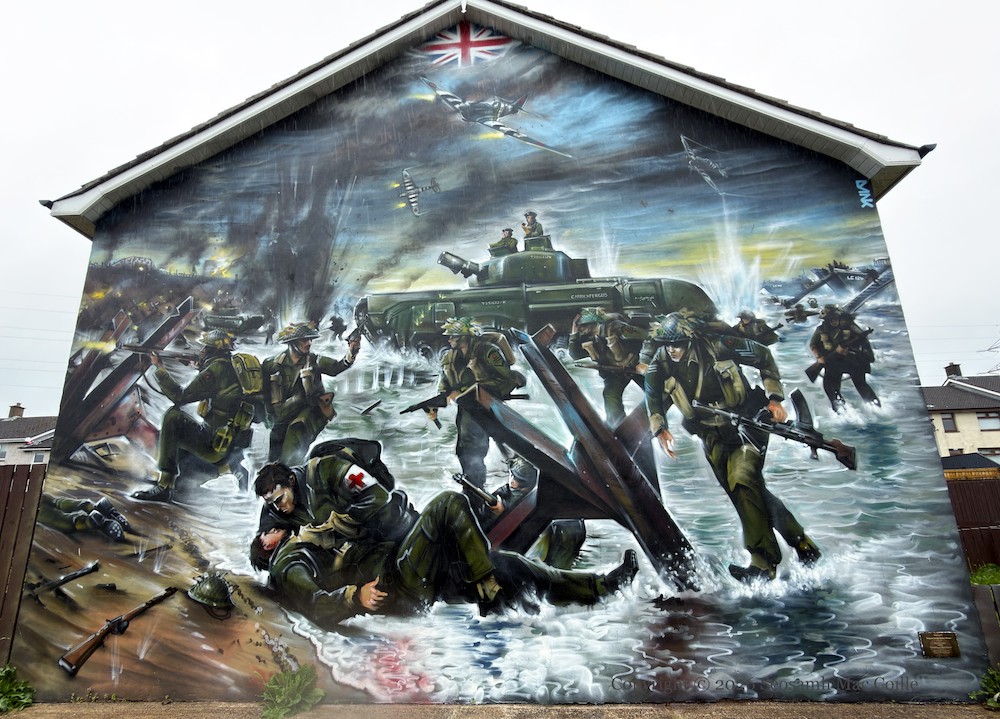
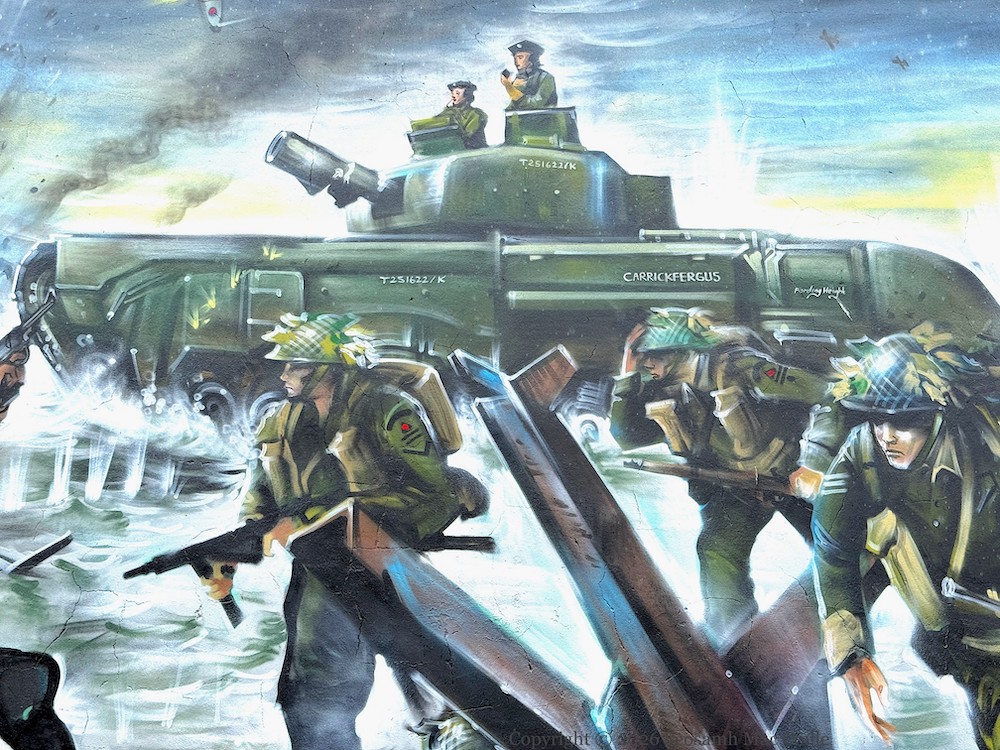
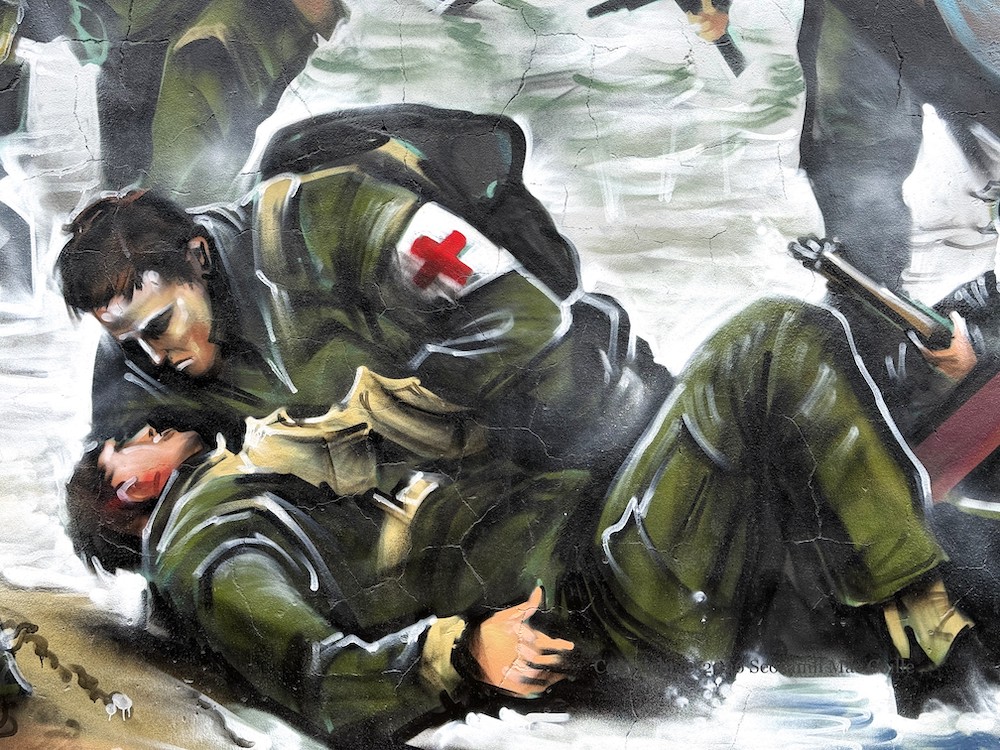
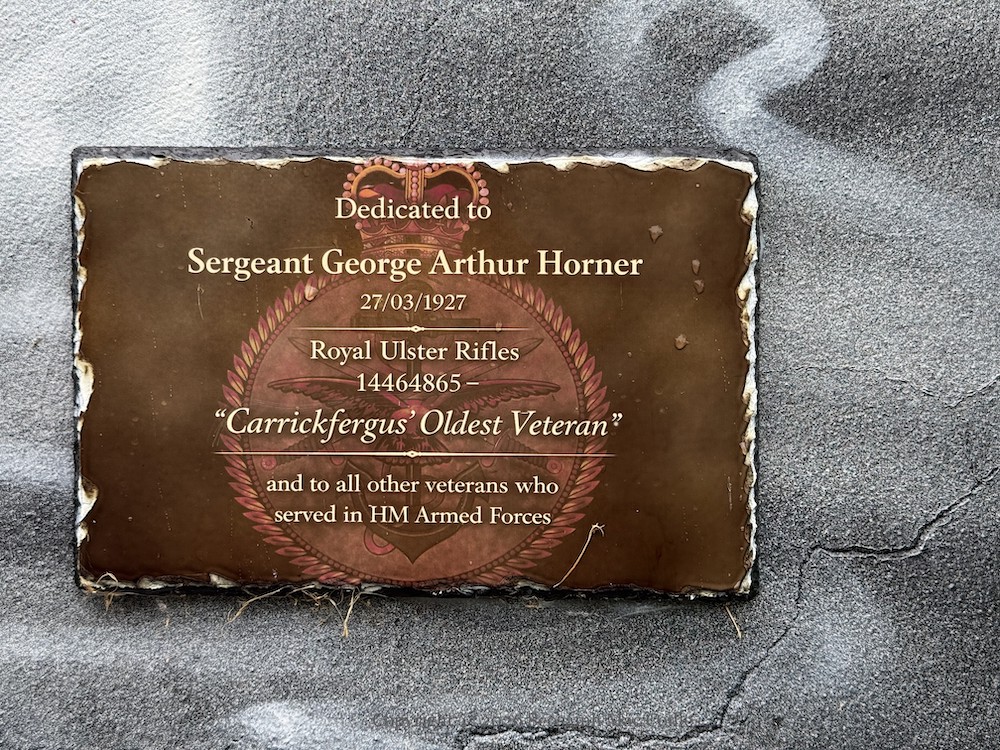
The plaque in the bottom-right corner reads, “Dedicated to Sergeant George Arthur Horner 27/03/1927 Royal Ulster Rifles 14464865 — “Carrickfergus’ Oldest Veteran” and to all other veterans who served in HM Armed Forces.” Horner turned 99 a few days after this mural of D-Day was unveiled (on March 22nd) and he was awarded the freedom of Mid- And East-Antrim Borough (web). He served in the second battalion of the Royal Ulster Rifles, and landed on Sword Beach during the D-Day landings in June 1944 (Fb).
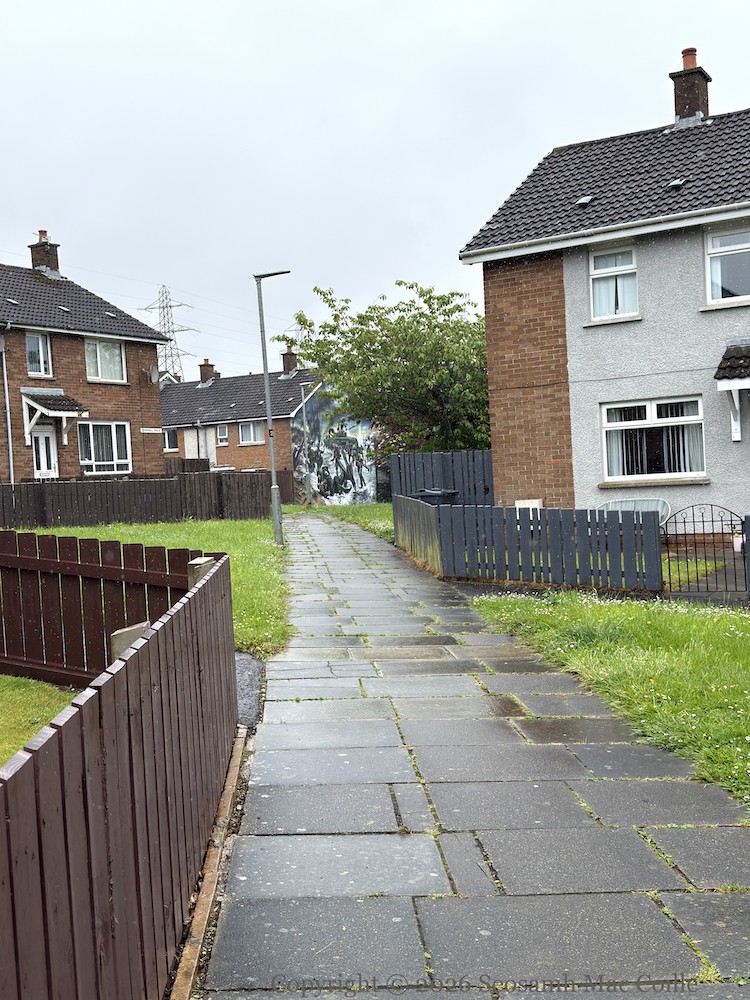
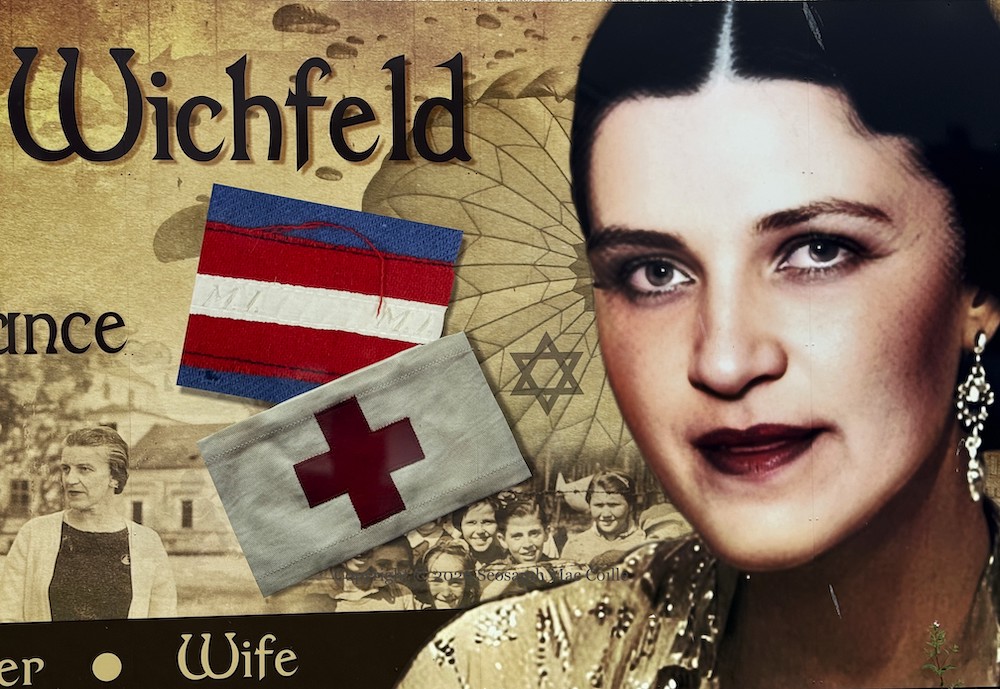
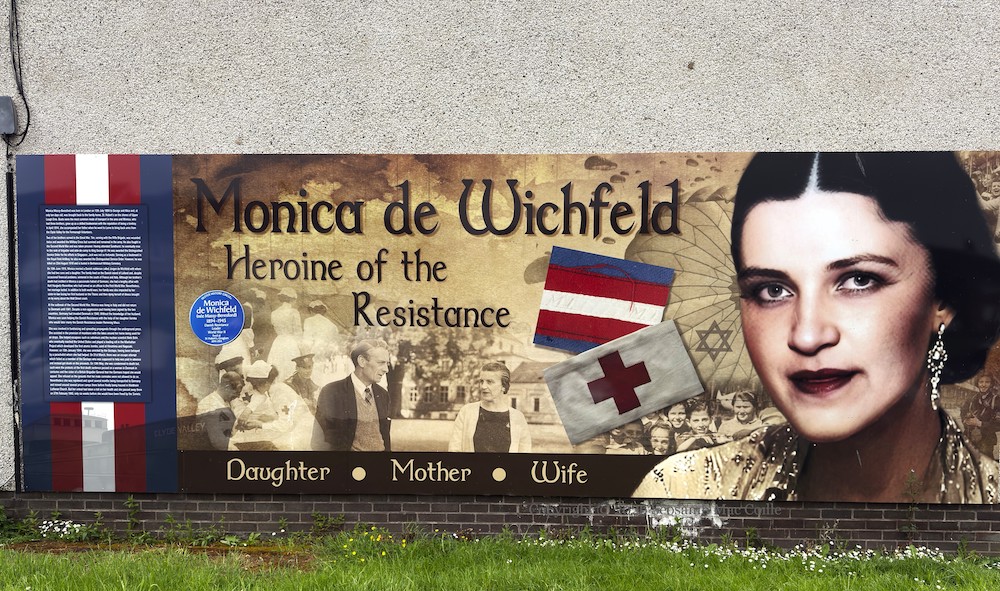
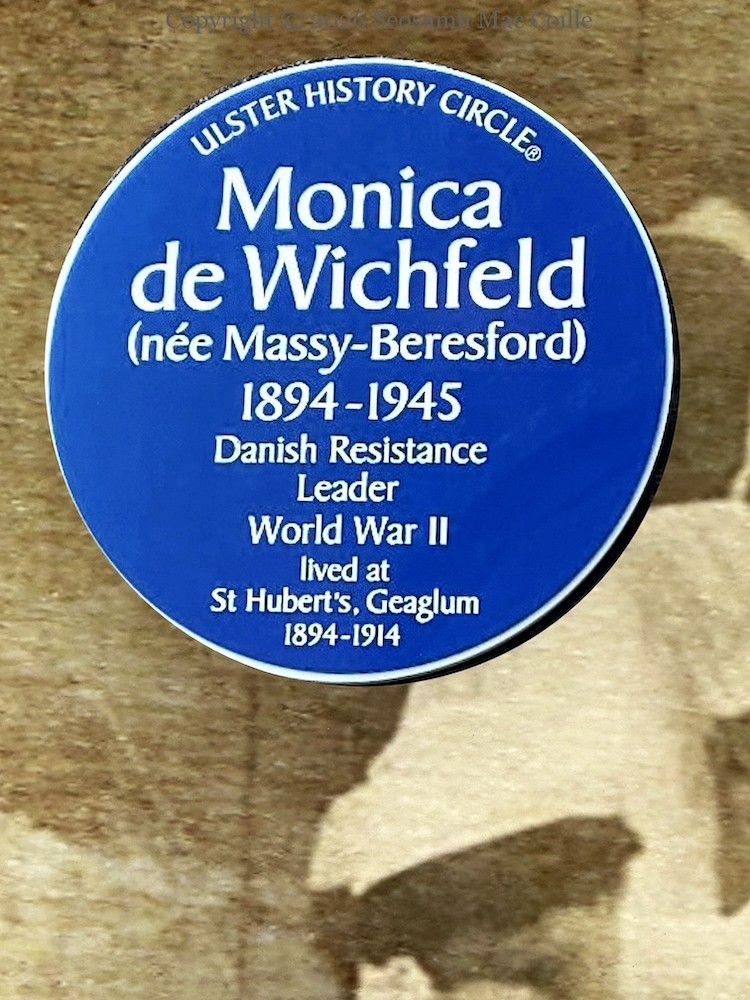
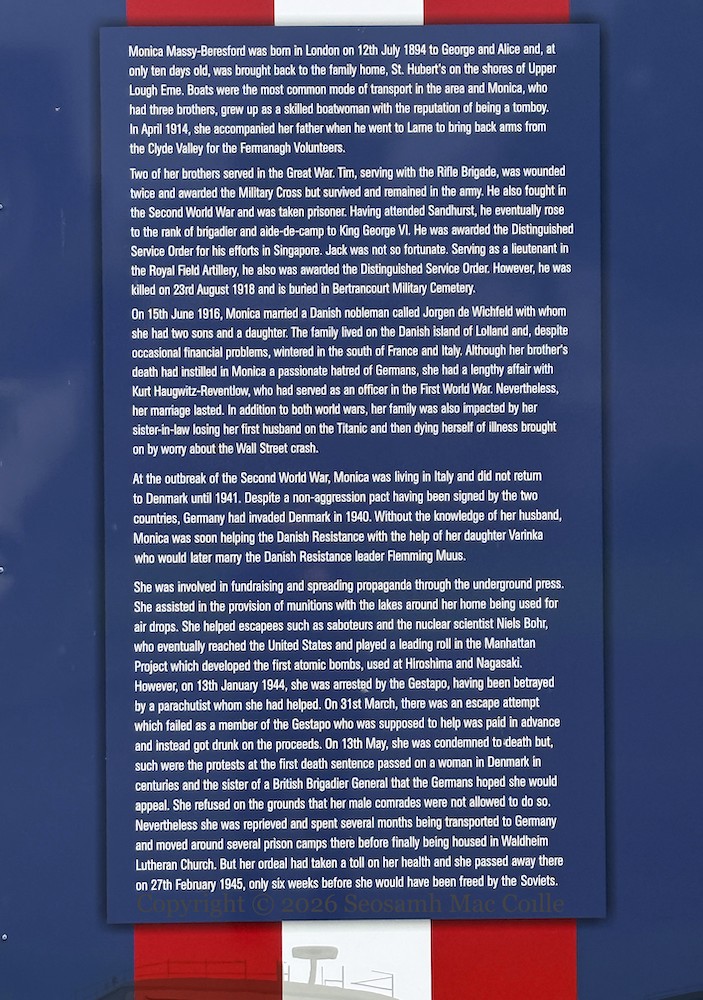
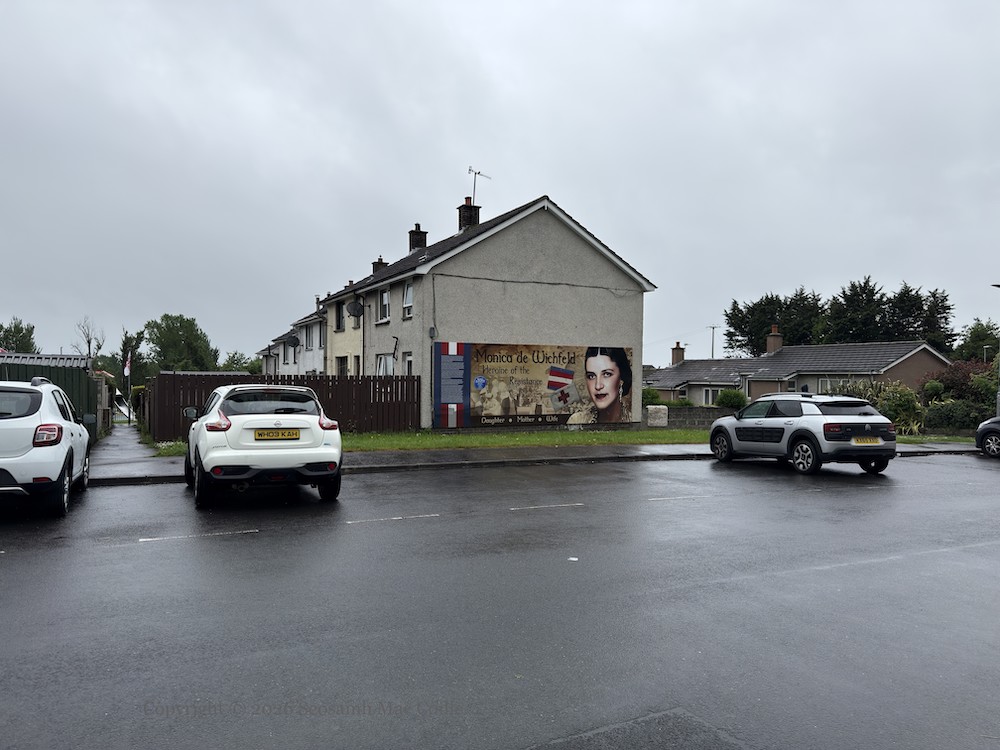
“Monica de Wichfeld, heroine of the resistance, daughter, mother, wife”. The blue plaque to Monica Massy-Beresford is at the Kinawley Holy Trinity church in Derrylin, Fermanagh, (Street View), near where she grew up. She moved to Denmark upon her marriage and had a long and varied career in the Danish resistance to the German occupation in WWII, raising money for the Communists, using her estate to shelter fleeing families and receive arms and train volunteers, and eventually heading the regional group on Lolland (WP).
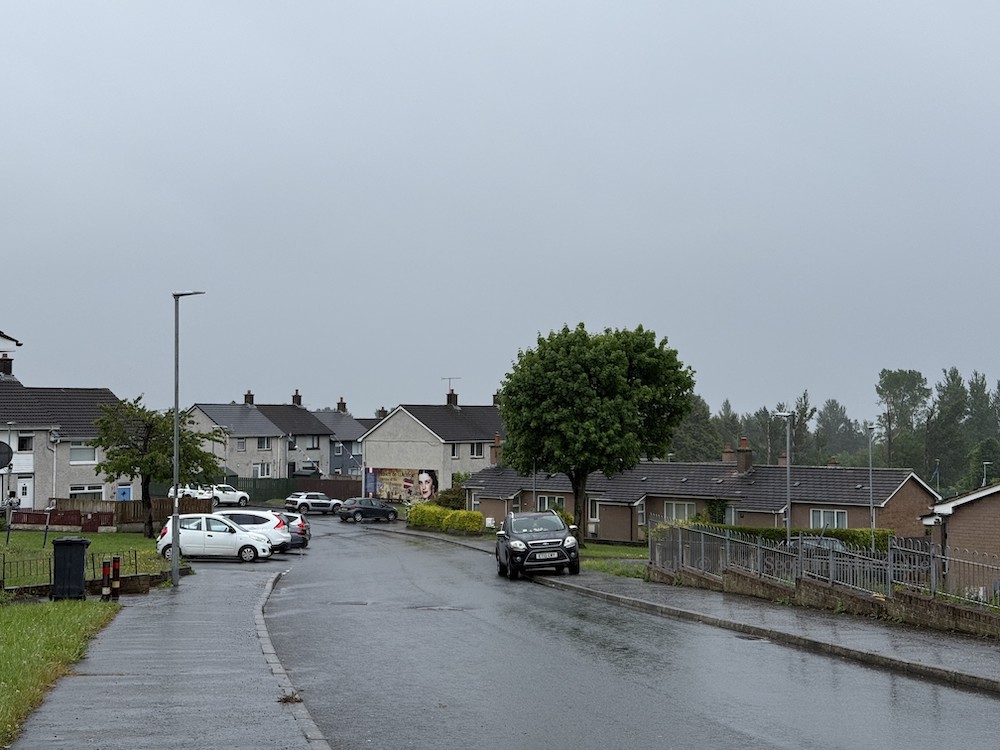
Castlemara Drive, Carrickfergus
“Monica Massy-Beresford was born in London on 12th July 1894 to George and Alice and, at only ten years old, was brought back to the family home, St Hubert’s on the shores of Upper Lough Erne. Boats were the most common mode of transport in the area and Monica, who had three brothers, grew up as a skilled boatwoman with the reputation of being a tomboy. In April 1914, she accompanied her father when he went to Larne to bring back arms from the Clyde Valley for the Fermanagh Volunteers. … On 15th June 1916, Monica married a Danish nobleman called Jorgen de Wichfeld with whom she had two sons and a daughter. The family lived on the Danish island of Lolland and, despite occasional financial problems, wintered in the south of France and Italy. Although her brother’s death had instilled in Monica a passionate hatred of Germans, she had a lengthy affair with Kurt Huagwitz-Reventlow, who had served as an officer in the First World War. Nevertheless, her marriage lasted. … At the outbreak of the Second World War, Monica was living in Italy and did not return to Denmark until 1941. Despite a non-aggression pact having been signed by the two countries, Germany had invaded Denmark in 1940. Without the knowledge of her husband, Monica was soon helping the Danish Resistance with the help of her daughter Varinka who would later marry the Danish Resistance leader Flemming Muus. “She was involved in fundraising and spreading propaganda through the underground press. She assisted in the provision of munitions with the lakes around her home being used for air drops. She helped escapees such as saboteurs and the nuclear physicist Niels Bohr, who eventually reached the United States and played a leading roll [role] in the Manhattan Project which developed the first atomic bombs, used at Hiroshima and Nagasaki. However, on 13th January 1944, she was arrested by the Gestapo, having been betrayed by a parachutist whom she had helped. On 31st March, these was an escape attempt which failed as a member of the Gestapo who was supposed to help was paid in advance and instead got drunk on the proceeds. On 13th May, she was condemned to death but, such were the protests at the first death sentence passed on a woman in Denmark in centuries and the sister of a British Brigadier General that the Germans hoped she would appeal. She refused on the grounds that her male comrades were not allowed to do so. Nevertheless she was reprieved and spent several months being transported to Germany and moved around several prison camps there before finally being housed in Waldheim Lutheran Church. But her ordeal had taken a toll on her health and she passed away there on 27th February 1945, only six weeks before she would have been freed by the Soviets.”
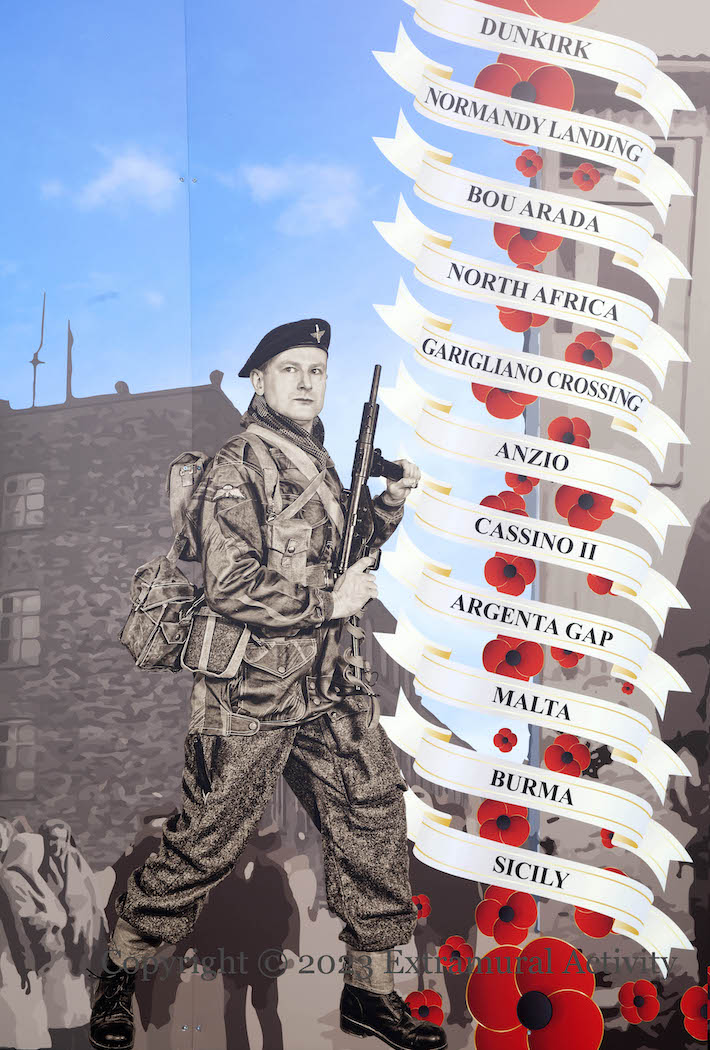
The 1st Ranger Battalion was formed in 1942 as the United States Army’s equivalent to the British Army’s Commandos and – after training at a camp in Carrickfergus – it saw action in France (at Dieppe (SOF History), resulting in the first US casualties of the war – WP), Algeria, Tunisia, and Italy. (There are four information panels at the Sunnylands shops about the formation and training of the unit.)
The insignia shown – which is here placed on top of the beret patch – is the insignia of the modern (75th Regiment) Rangers, with the lightning-bolt indicating the unit’s quick-strike abilities (SOF History); these are also alluded to by the motto “sua sponte”, meaning “of its/their own accord”.
This new art is by Dan Kitchener (web) in Victoria Parade, Carrickfergus, just outside the train station, produced in co-operation with Wonder Arts, the Communities In Transition programme from the Executive Office (web) and Carrickfergus Alternatives’ Peace Impact Programme (Fb).
It has been criticized by street-artist Wee Nuls (web) as glorifying conflict (ig), a charge the artist rejects, saying that it was produced in co-operation with locals and has been well received by them (MSN). (See also the reactions on the Let’s Talk Loyalism Fb page.)
The tank might be the M4 Sherman “Fury”. The tank appeared in the 2014 film of the same name (Bovington Tank Museum) used by the 66th Armor Regiment under the command of Brad Pitt; the film is perhaps the inspiration for the image (e.g. the scene in which the town of Kirchohsen is captured – youtube).
“Great love hath no man than this: to lay down his life for his friends – John 15:13”
Wreaths were laid for Remembrance Sunday at the base of the stone on Marine Highway in Carrickfergus, “erected in A.D. 1972 as a memorial to those citizens of the borough who gave their lives in two World Wars, 1914-1918, 1939-1945 and in subsequent conflicts.”
Among those laying wreaths were Mid- And East-Antrim Borough Council, UDR Veterans’ Association, RBP 17, PSNI, Woodburn junior LOL 258, Retired Police Officers’ Association, Ulidia Integrated College, DUP, PUP, UUP, ABOD, Royal Arch Purple, and others.
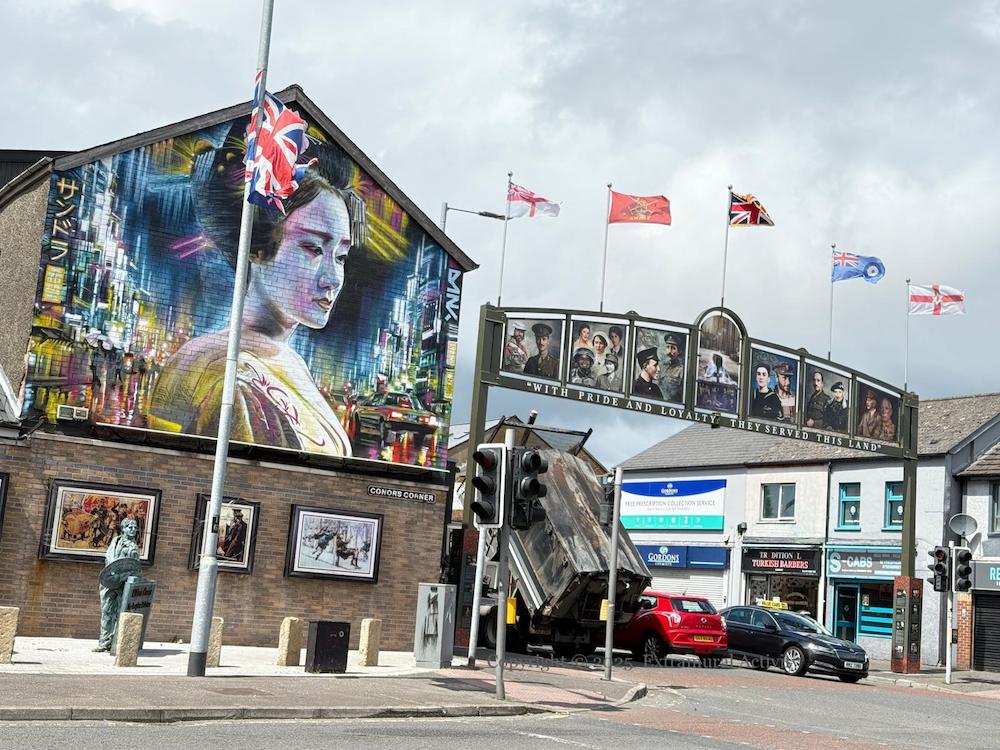
“The ‘Ulster Military Memorial Arch’ was funded by the generosity of the local business community, local residents, and our friends from Scotland. The arch was designed entirely by the people of the Greater Shankill, and erected to coincide with the 80th anniversary of VE Day 8th May 1945 – 8th May 2025. Our servicemen and women are proudly remembered.” For images of the VE Day launch, see the BelTel.
Pictured on Peter’s Hill side of the arch (bearing the quote “With pride and loyalty they served this land”) are (left to right) … Private Bernard McQuirt (a VC winner in 1858 during the Indian Rebellion) and Lt Colonel John Henry Patterson Monica De Wichfeld (raised in Fermanagh and Danish resistance member), Jessie Roberts (a nurse for the Ulster Volunteers and (in WWI) for the Volunteer Aid Detachment, serving in Birmingham and in Wimereux, France; she gets a very long entry on the info panels around the legs of the arch, as her biography is not available on-line), a (unidentified) nurse, Corporal Channing Day (a medic killed in Afghanistan, 2012), Princess Elizabeth Private William Frederick McFadzean and Sergeant Robert Quigg the tomb of “the unknown warrior” (central panel) Leading Seaman James Joseph Magennis and Lt Colonel Robert Blair ‘Paddy’ Mayne Field Marshal Alan Francis Brooke and Field Marshal Bernard Law Montgomery Field Marshal Sir Henry Hughes Wilson and Sir James Craig
On the other/Shankill side of the arch, bearing the quote “Throughout the long years of struggle … the men and women of Ulster have proved how nobly they fight and die”, the ‘WWII’ panel includes (top right) Warrant Officer David O’Neill, a Canadian Air Force pilot hailing from Ballymena, lost in 1943, and the ‘Northern Ireland’ panel features (left) Corporal Heather CJ Kerrigan, a UDR Greenfinch killed by the IRA in 1984. These two are also profiled in the info panels around the legs of the arch, along with Corporal Bryan James Budd, a 3rd Para soldier killed by friendly fire in Afghanistan, 2006.
Also included is JF Willcocks’s poem Poppies (sometimes called The Inquisitive Mind Of A Child): Why are they selling poppies, Mummy? Selling poppies in town today./The poppies, child, are flowers of love. For the men who marched away./But why have they chosen a poppy, Mummy? Why not a beautiful rose?/Because my child, men fought and died in the fields where the poppies grow./But why are the poppies so red, Mummy? Why are the poppies so red?/Red is the colour of blood, my child. The blood that our soldiers shed./The heart of the poppy is black, Mummy. Why does it have to be black?/Black, my child, is the symbol of grief. For the men who never came back./But why, Mummy are you crying so? Your tears are giving you pain./My tears are my fears for you my child. For the world is forgetting again.”
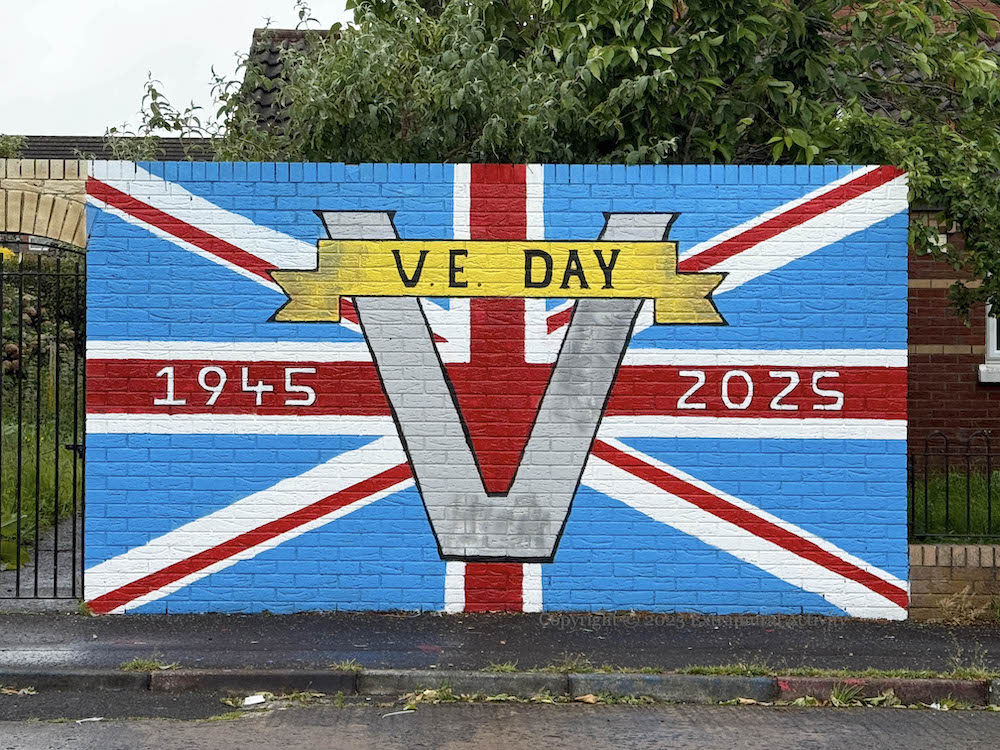
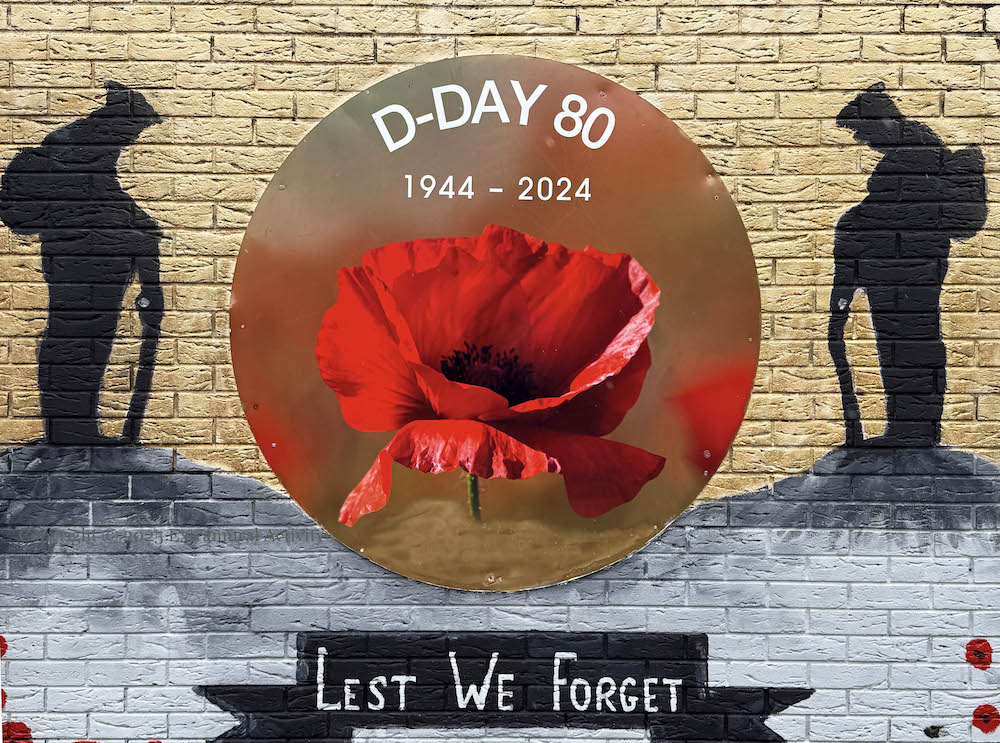
39 Allied divisions – 12 of them British – participated in the Normandy Landings – officially “Operation Neptune” – that took place on June 6th, 1944; in planning for the operation, the original “D-Day” was June 5th, but bad weather postponed it until the following day, when 160,000 troops stormed the beaches of the Bay Of The Seine. By the end of August, Paris had been liberated, and by the following May, victory in Europe had been achieved. 2024 was the eightieth anniversary of D-Day and 2025 the eightieth anniversary of VE Day, on May 8th.
This D-Day board and VE Day mural are in Edlingham Street, Tiger’s Bay, north Belfast. Also included below is a WWI memorial electrical box opposite, though as can be seen from the board (immediately below) the ‘graveside mourner’ silhouette is becoming a generic symbol of lost UK forces.
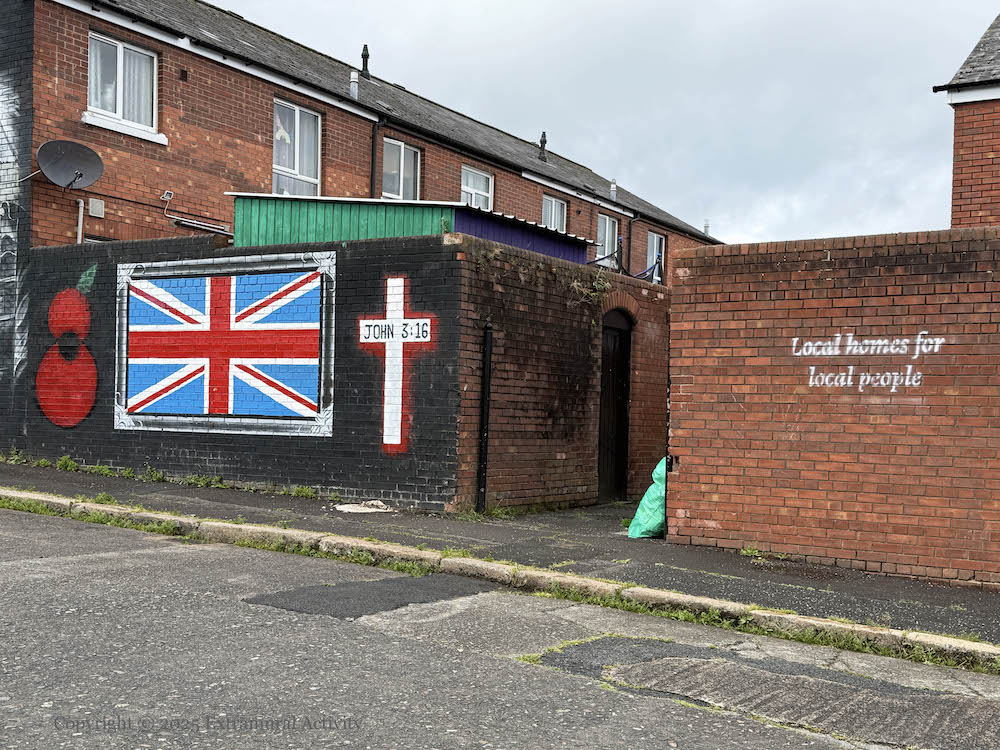
God so loved the world that he gave his only begotten son (John 3:16). And, greater love hath no man but to lay down his life for his friends (John 15:13, often used in the context of military sacrifice). But local homes are for local people. (The use of a stencil is a step up in sophistication.)
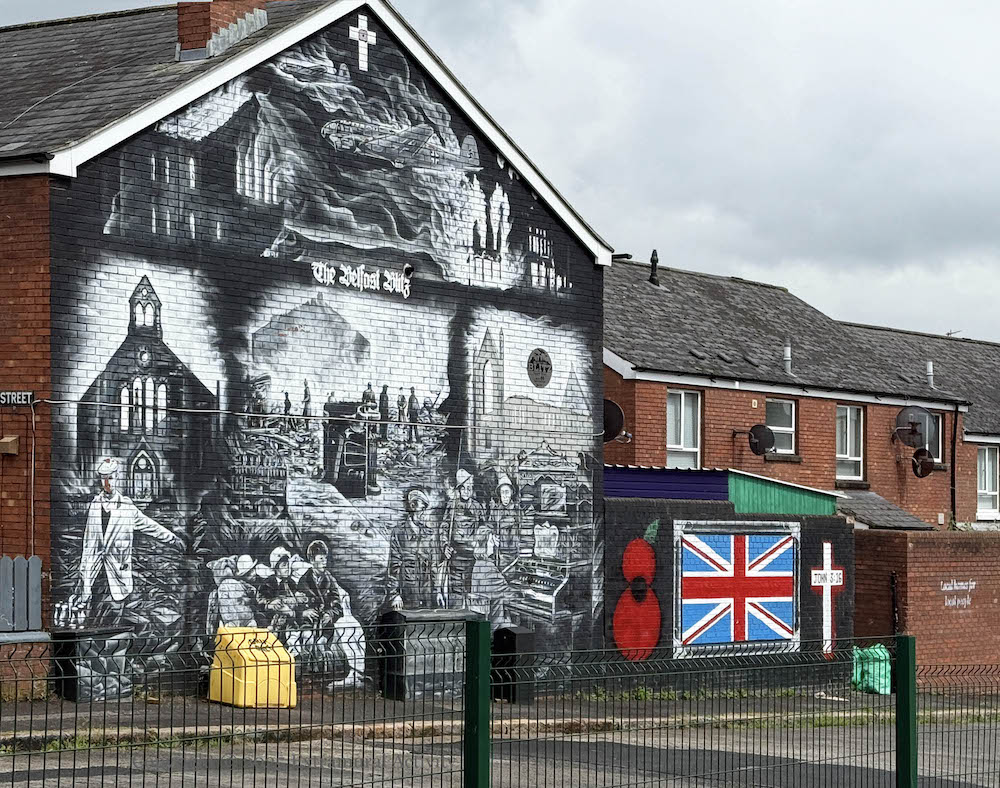
The Union Flag fills the empty frame where there used to be a list of locals who died in The Belfast Blitz.
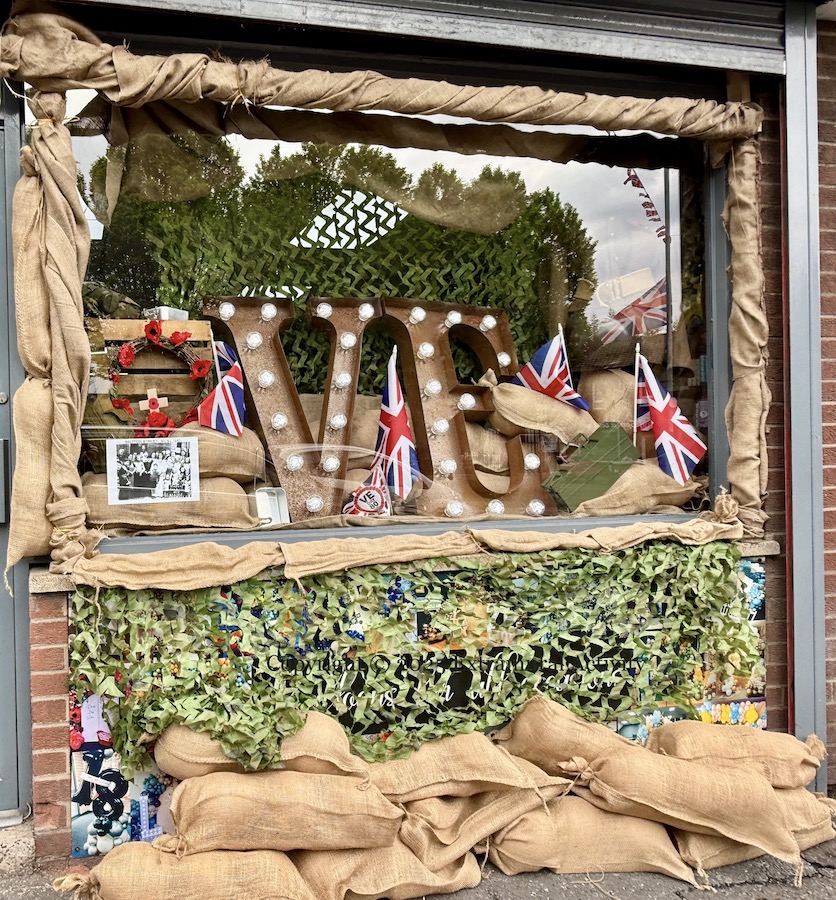
World War II ended in Europe at 11 p.m. on May 8th, after Germany’s unconditional surrender to the Allied forces. The date was dubbed “Victory In Europe Day” or “VE Day” and this year (2025) marks its eightieth anniversary. For the occasion, this Shankill Road shop-window has been decorated with sandbags and camouflage netting, along with a vintage photograph of the residents of nearby “Wiltton” [Wilton] Street from the summer of 1945.
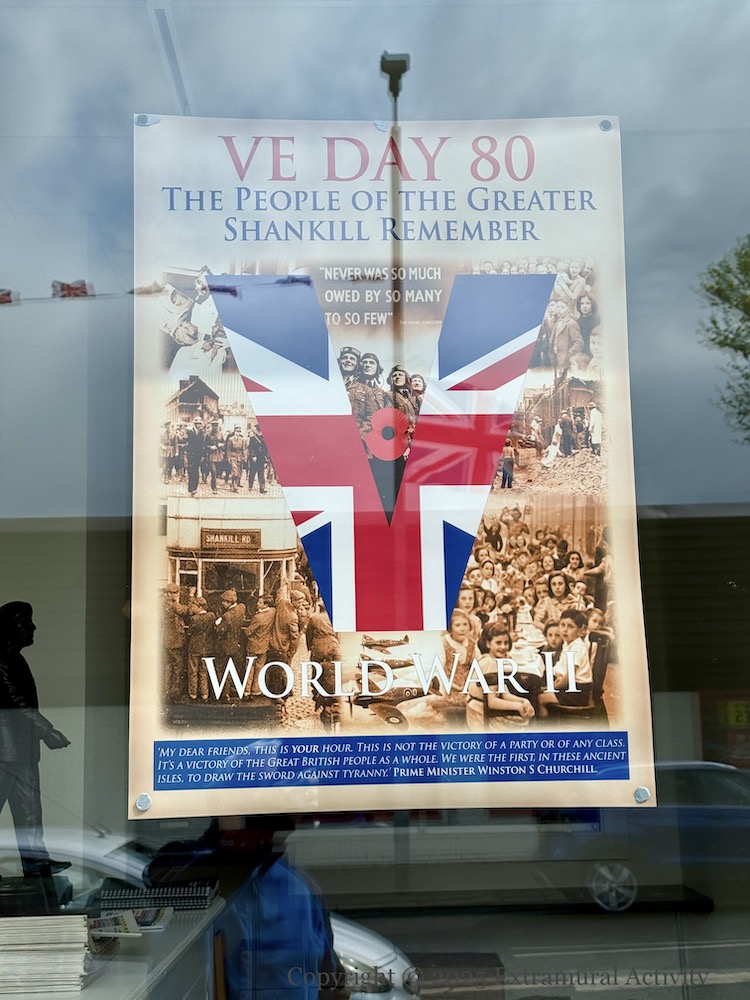
The text on the poster (lower down the road) reads: “‘My dear friends, this is your hour. This is not the victory or of any class, it’s a victory of the Great British people as a whole. We were the first, in these ancient isles, to draw the sword against tyranny.’ – Prime Minister Winston S Churchill”. The lines come from brief remarks Churchill made to the crowds assembled at the Ministry Of Health in London – the text can be found at Forces News; Pathé newsreel of Churchill’s earlier radio announcement of the end of the war can be found on youtube.
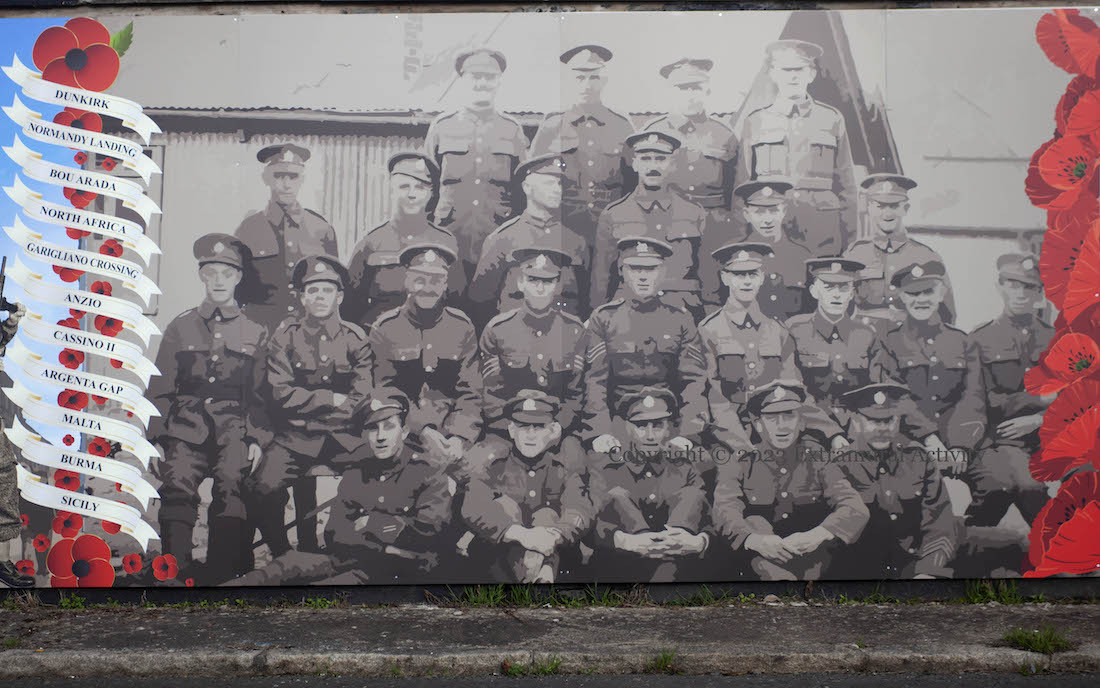
After WWI, the Royal Irish Rifles became the Royal Ulster Rifles (and later became part of the Royal Irish Rangers). This board prioritises WWI as the Rifles were part of the 36th Division. The hero of WWI portrayed in the central panel is William McFadzean, awarded the VC for falling on two live grenades in the trenches on July 1st, 1916. McFadzean is familiar from many previous murals both individually and in the company of other VC winners; for his family home in Cregagh, see Rubicon.
Alongside McFadzean, the hero of WWII is Blair “Paddy” Mayne, who was only briefly in the Ulster Rifles before making his name in the Parachute Unit (later, and better, known as the SAS). His many medals of honour are shown in an old Newtownards mural though he was denied the VC.
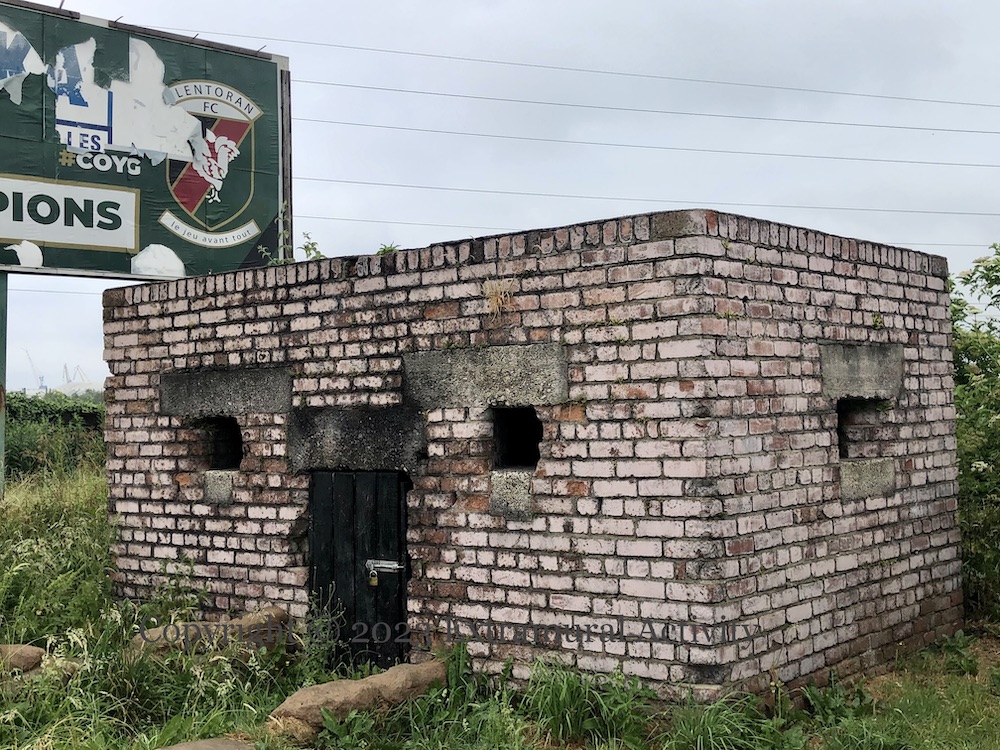
During the second World War, six basic designs for pillboxes, numbered from ‘Type 22’ to ‘Type 27’ were promulgated by the division of Fortifications And Works as part of anti-invasion planning (WP). This Type 24 is still standing in a corner of the Oval grounds in east Belfast. This image – showing the door – is of the rear of the pillbox; the anticipated line of attack was along Belfast Lough.
“The Oval’s Type-24. In the early hours of the 5th of may the German Luftwaffe (air force) attacked a number of targets in the heart of Belfast. This ‘Type 24’ military pillbox was one of the defence positions around the city which was manned on that morning by a platoon of soldiers of the Gloucestershire Regiment who were based at nearby Victoria Park. … The Oval, the home of Glentoran Football Club was reduced to smouldering rubble as bombs and incendiary mines landed on an area perceived by German intelligence to be an oil storage facility adjacent to both Harland and Wolff shipyard and Short Brothers aircraft factory.”











 Extramural Activity