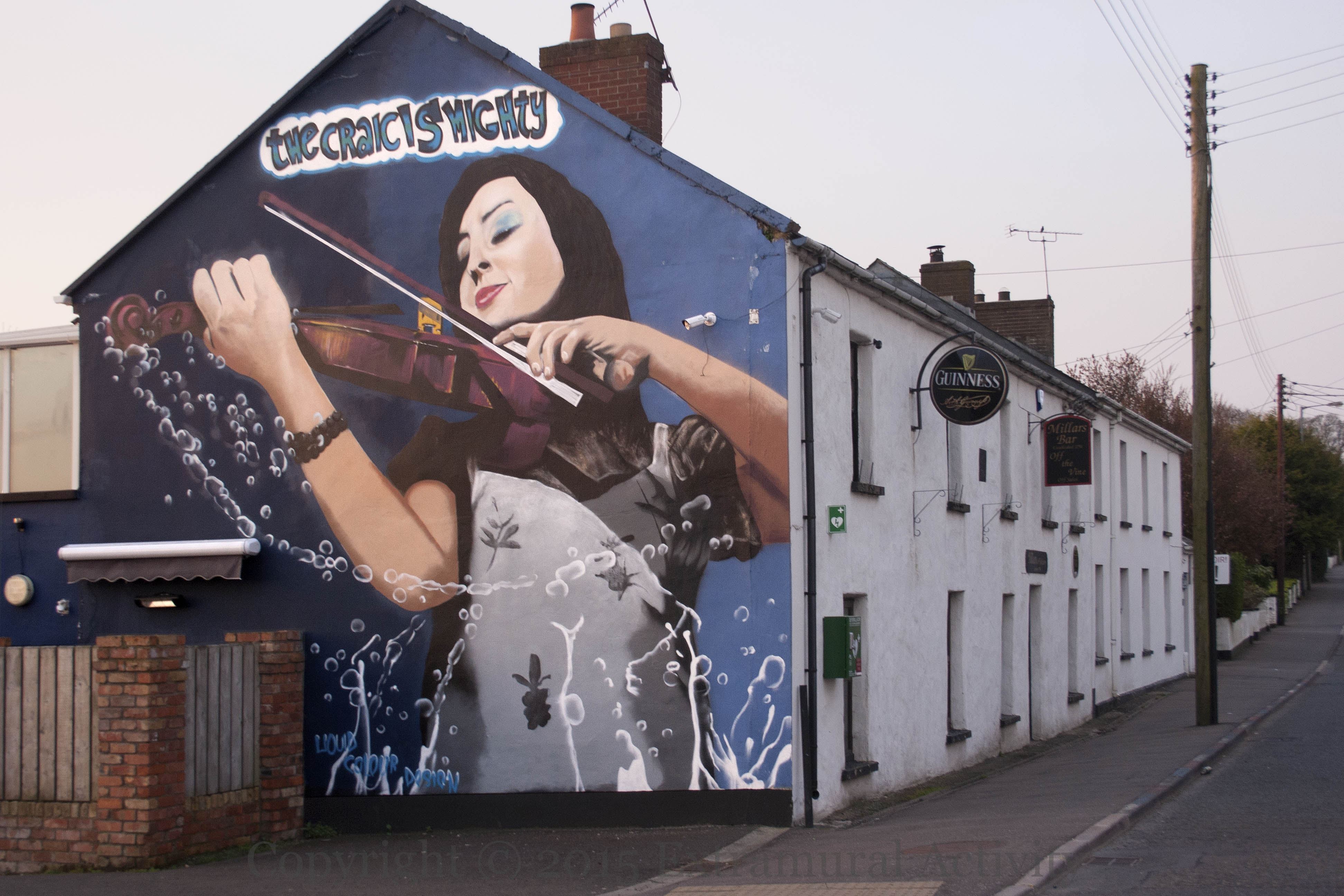
Fiddling in the north of Ireland is common to both Nationalist and Unionist communities and the “old Antrim” style is influenced by Scottish playing (USFO).
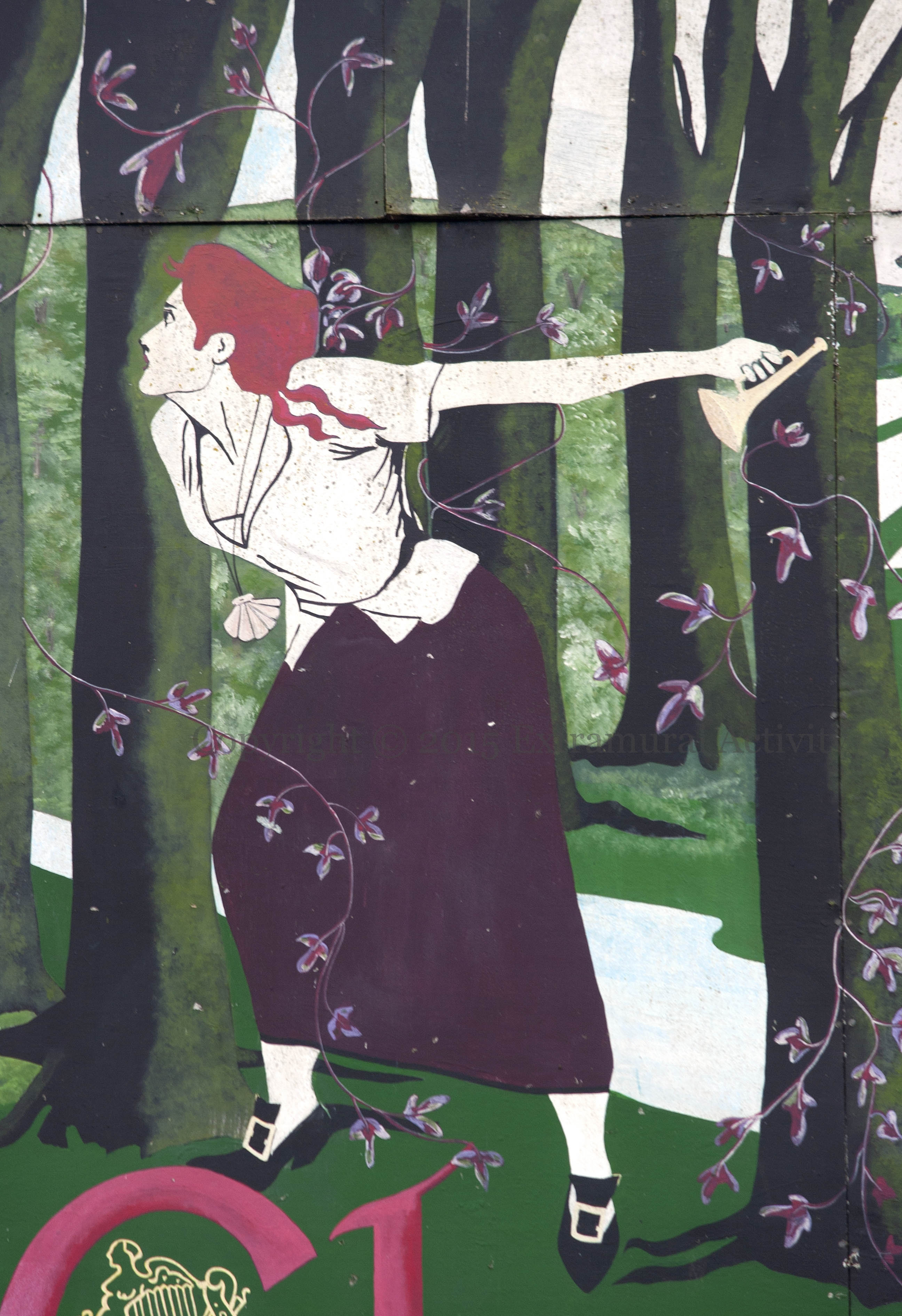
“Were you at the rock?” A red-headed lass (from an illustration in the Weekly Freeman of December 19th, 1891, commemorating 1798) with a horn stands watch for others at a mass rock – a stone in a remote location for Catholic worship, made necessary by a Penal law of 1695 which forbade the religious practice of Catholicism and “dissenter” forms of Protestantism (that is, anything other than Anglicism) (source). The harp, with a “cap of liberty” rather than a crown (WP), together the slogan “Equality – It is new strung and it shall be heard” is the emblem of the Society of United Irishmen (WP). On the other side of the mural (seen below) linen lies in the fields bleaching and a farmer and wife plough the land with a team of horses and distribute seed.
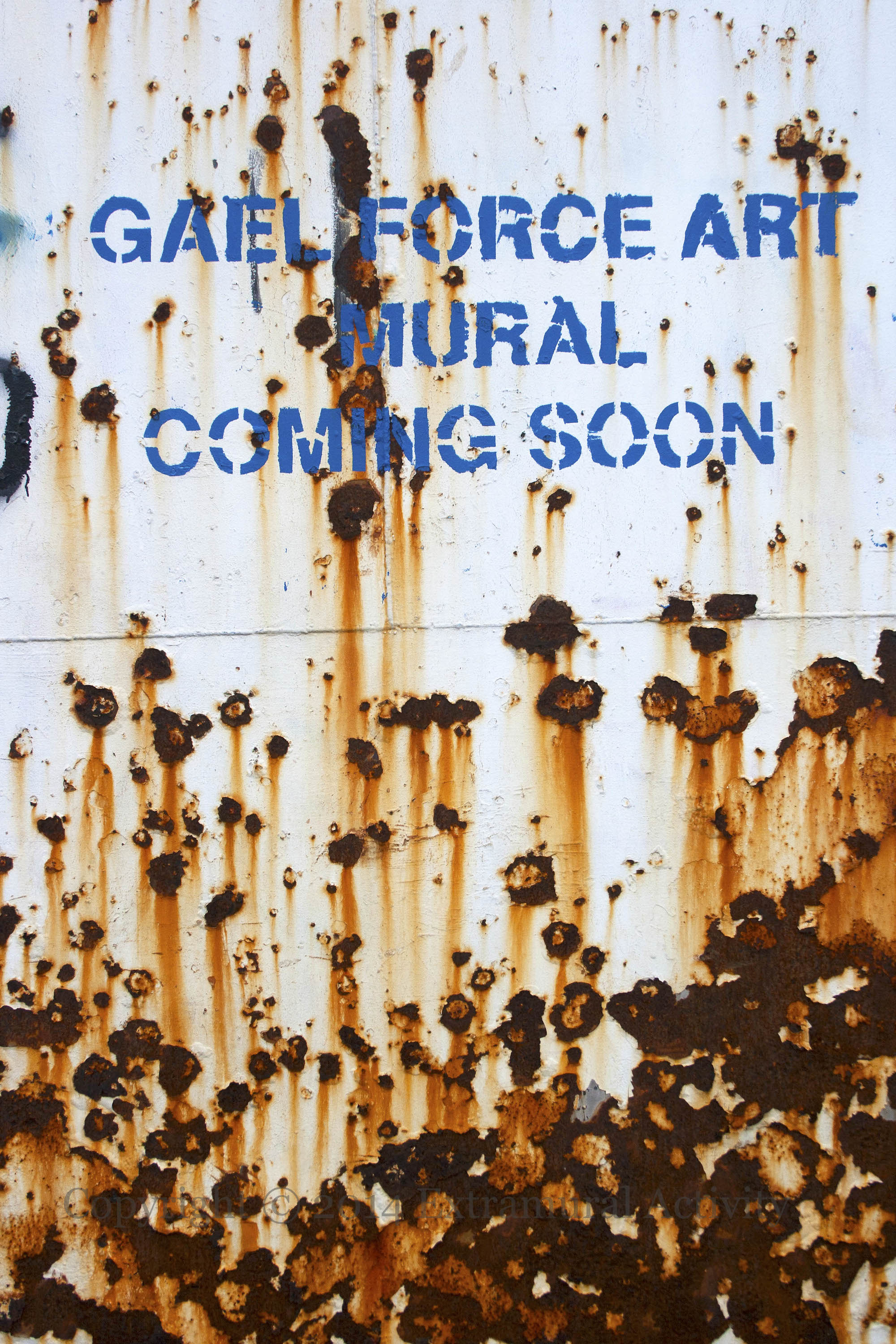
This stencil is at the top of Springhill Avenue, painting grounds of Gerard ‘Mo Chara’ Kelly and Gael Force Art. Mo Chara is in fact currently working on the Falls Road at McQuillan Street, painting a mural of the GPO in flames in 1916.
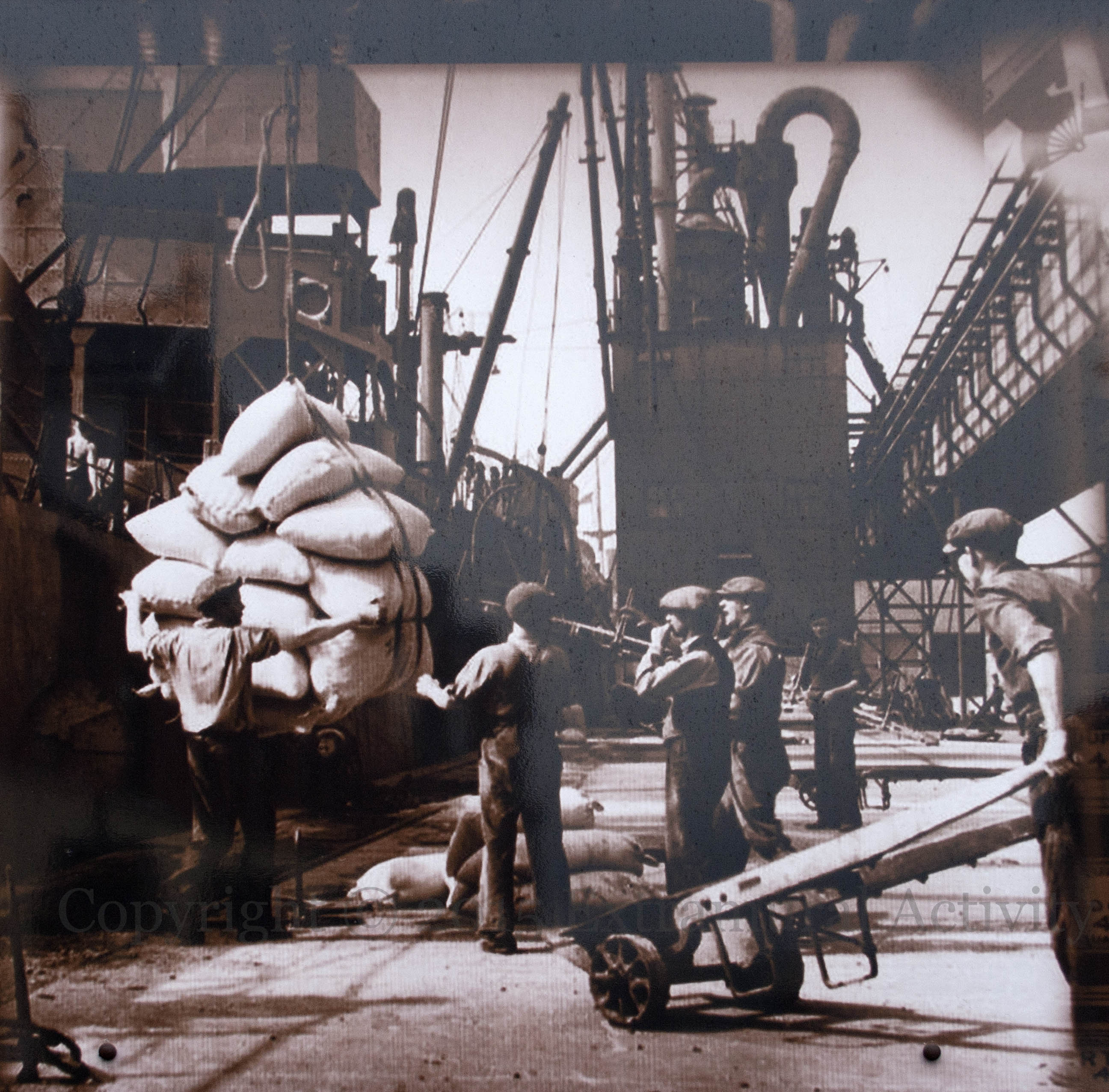
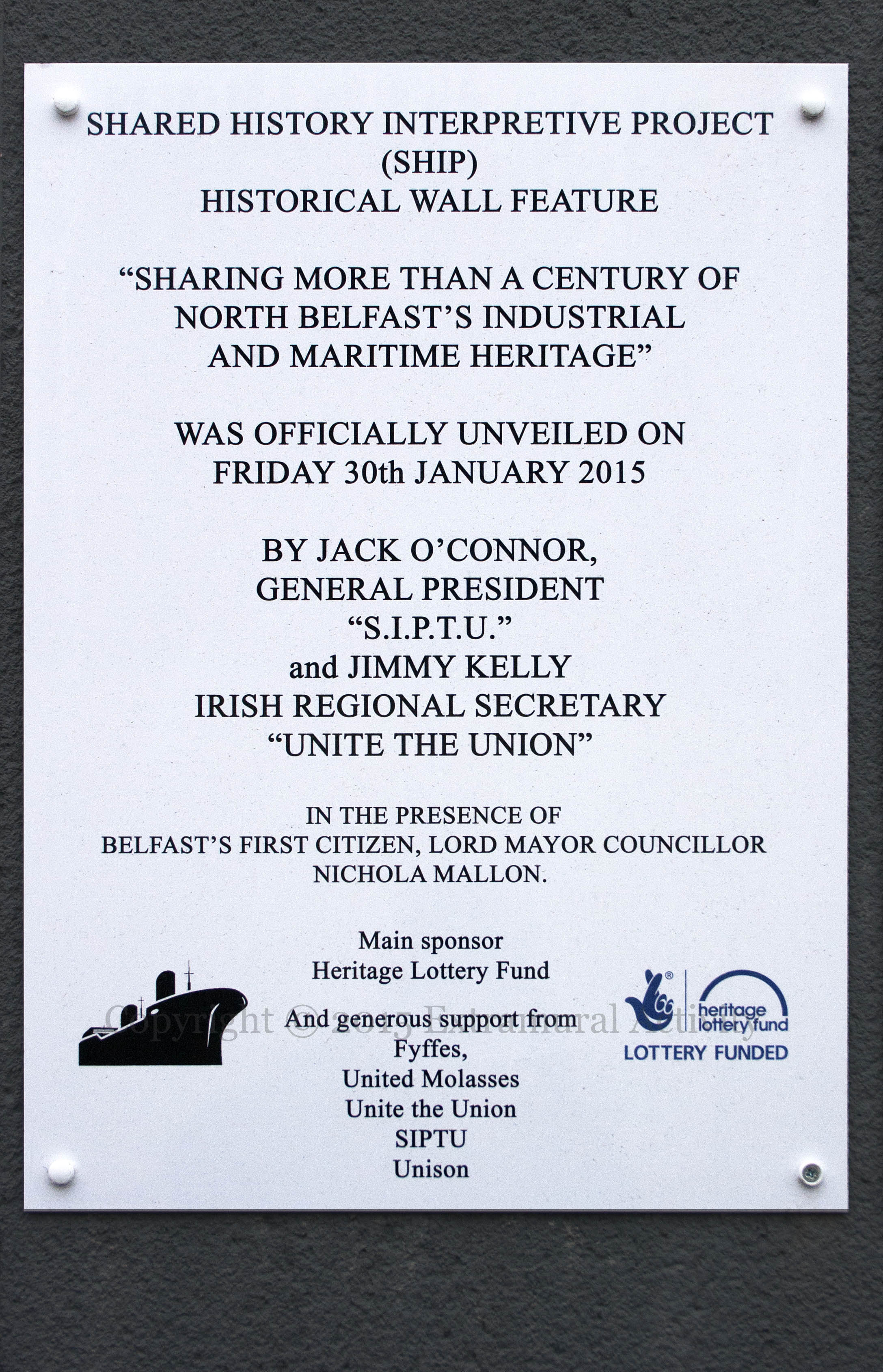
A new “historical wall feature” was unveiled by the Shared History Interpretive Project (SHIP) on the outside of the Dockers Club in Pilot Street in Sailortown. The new piece is a montage of about 60 images of vintage photographs, a census form, and posters of industrial life. In the top-middle (behind the lamppost) there can be seen an image of the board this one replaces, which featured two carters pulling away a heavy load, similar to the carter in the image above. Another addition in the new work is the inclusion of Billy McMullen (1888-1982) and John Quinn (1876-1935) alongside Winifred Carney (1887-1943), James Connolly (1868-1916), and Jim Larkin (1876-1947). Both McMullen and Quinn are Belfast trades unionists. Quinn’s headstone in Milltown Cemetery was featured previously, in Forgotten In Life, Remembered In Death. More information about all five, as well as photographs of dockers and of the unveiling, can be found at the SHIP web site.
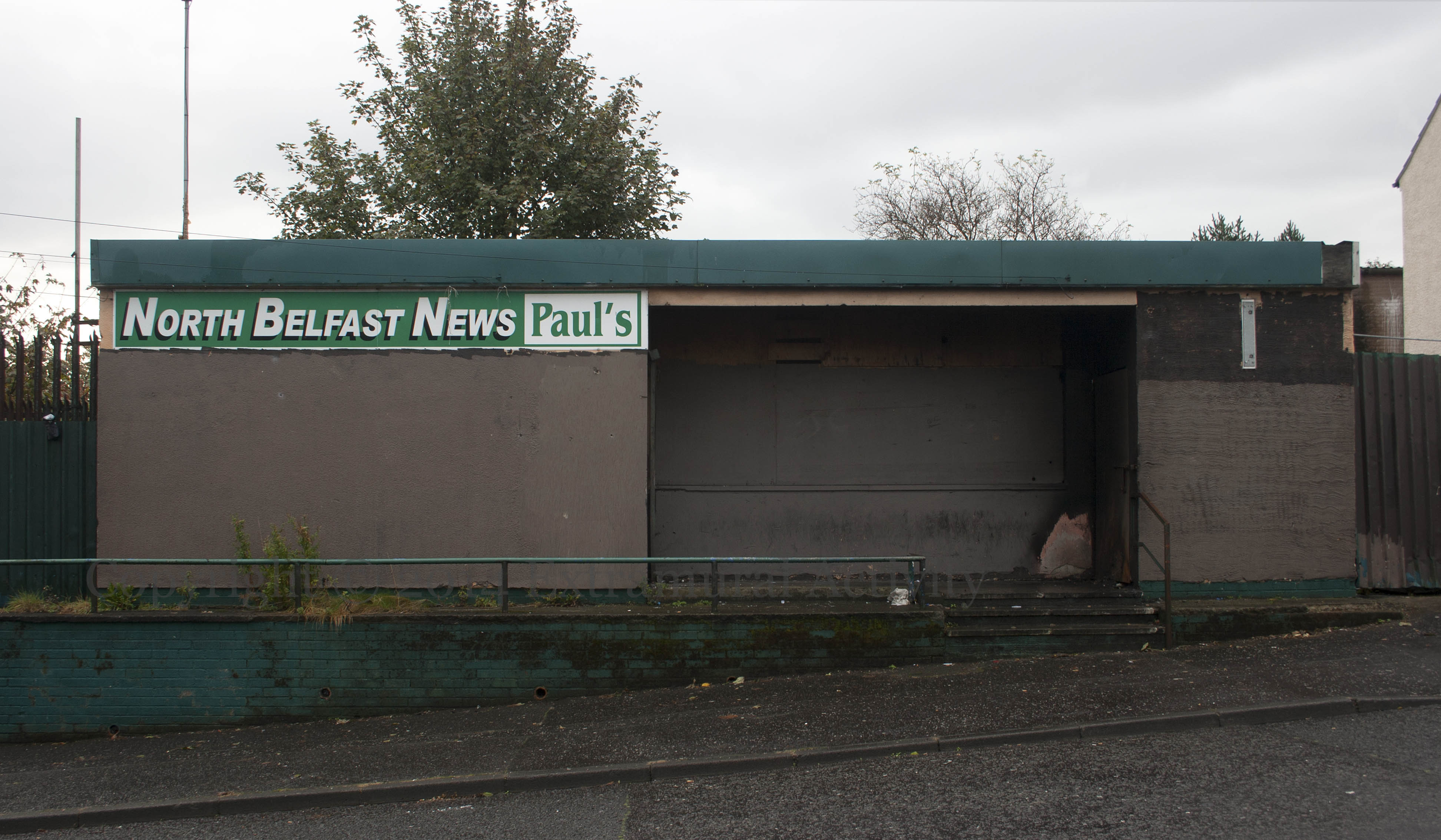
The Bawnmore area lies just beyond the border of Belfast, north of the city council along the Shore Road. While the area has seen many large retail chains erect stores over the last few decades, the local businesses have closed. Above, the Boundary Bar, which was burnt out in 2007, now with fake window dressing; below, Paul’s newsagents around the corner in Mount Street.
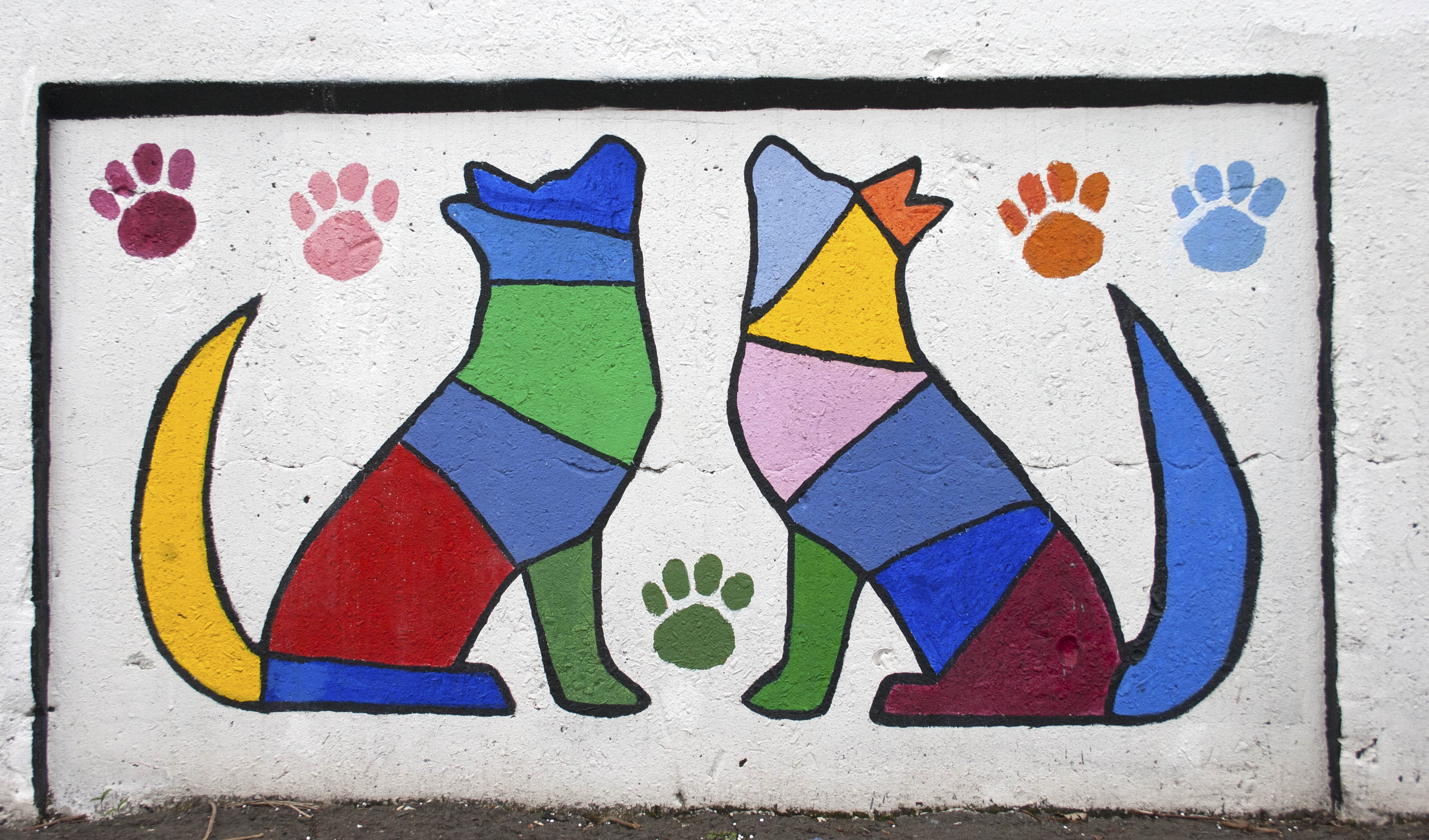
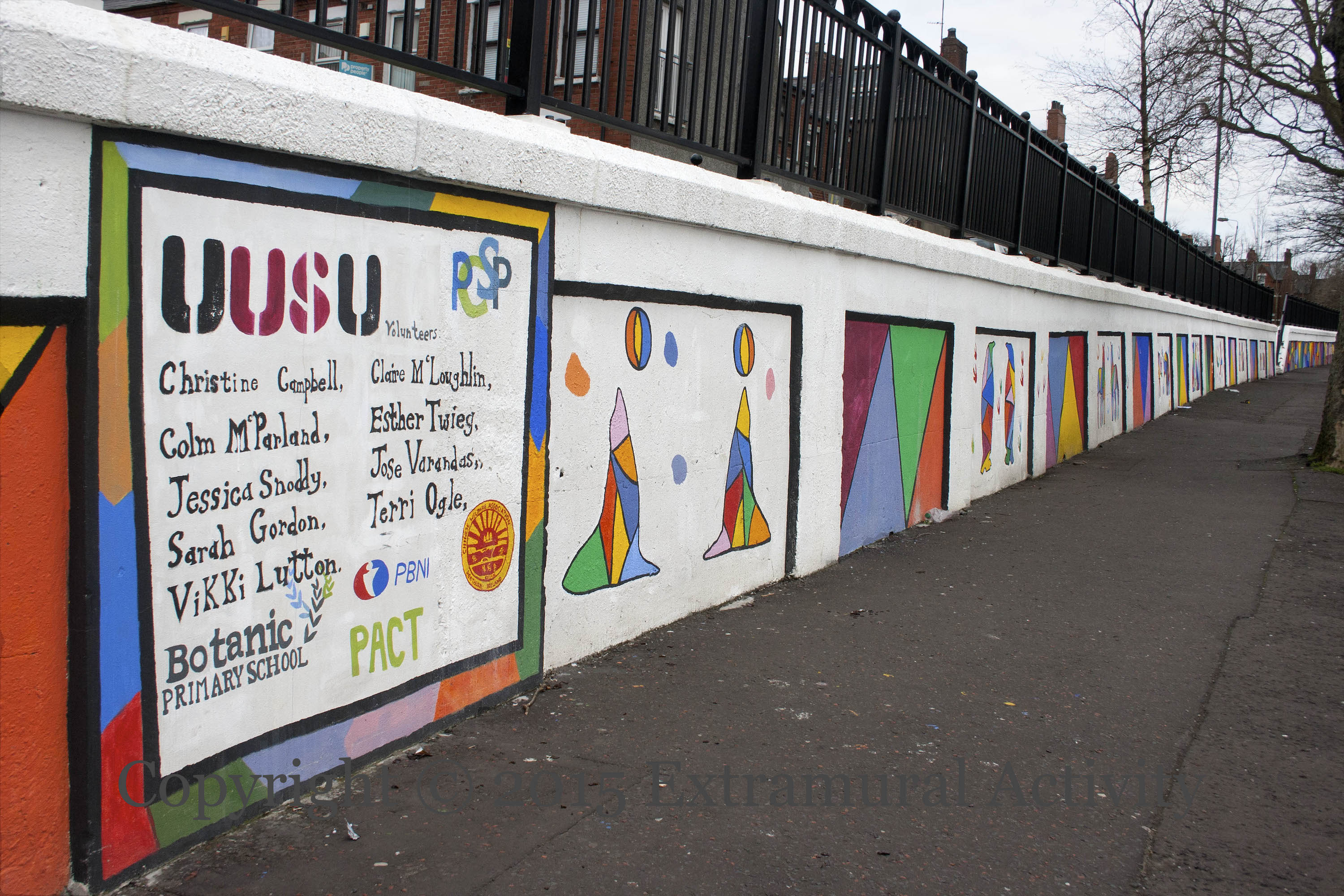
Children from Botanic Primary school and art students from University of Ulster Student Union painted a series of animal pairs (created by Vikki Lutton) and geometric panels on the wall of the Stranmillis embankment. Above we have wolves, below there are elephants, and in the wide shot, sea lions. ‘In progress’ images from UUSU | P4 schoolchildren.
UUSU was also responsible for the Seamus Heaney mural (The Hunting Heart).
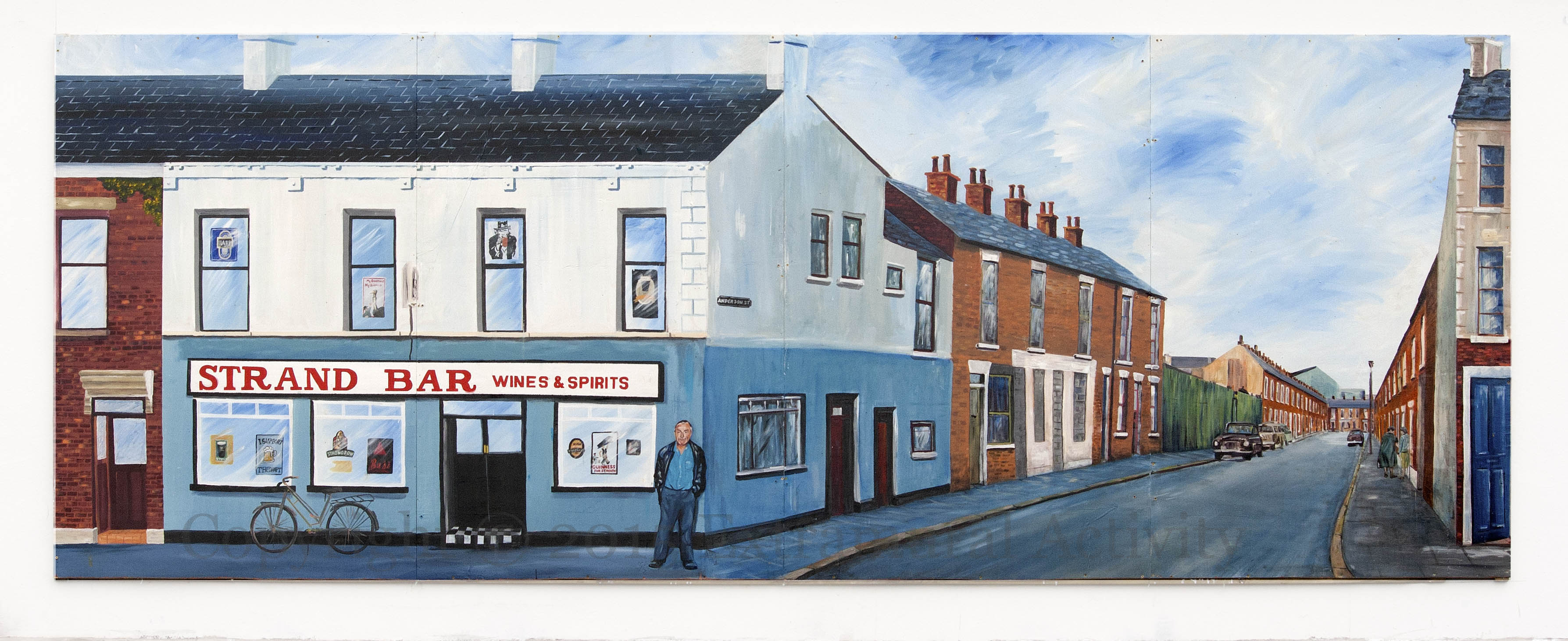
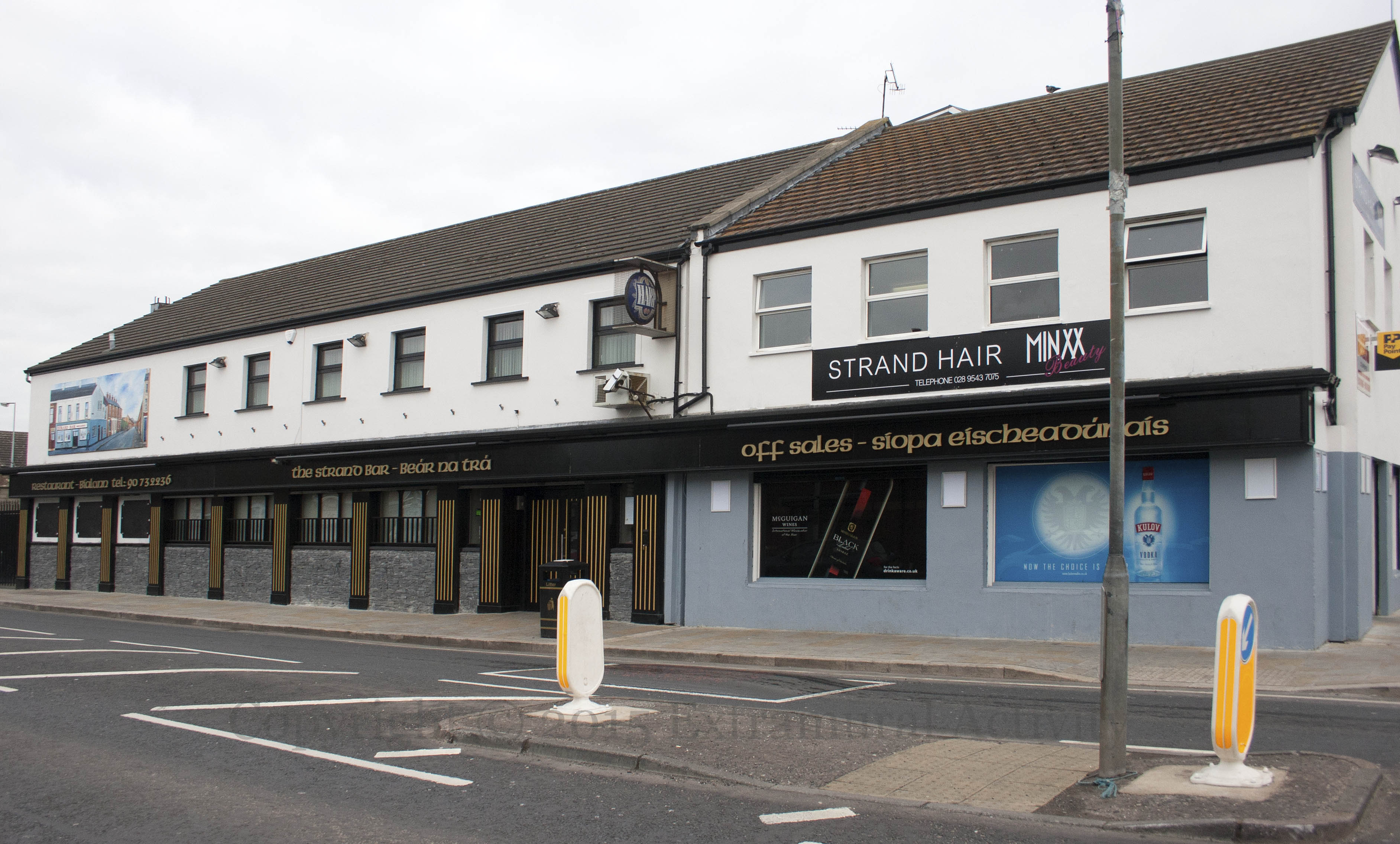
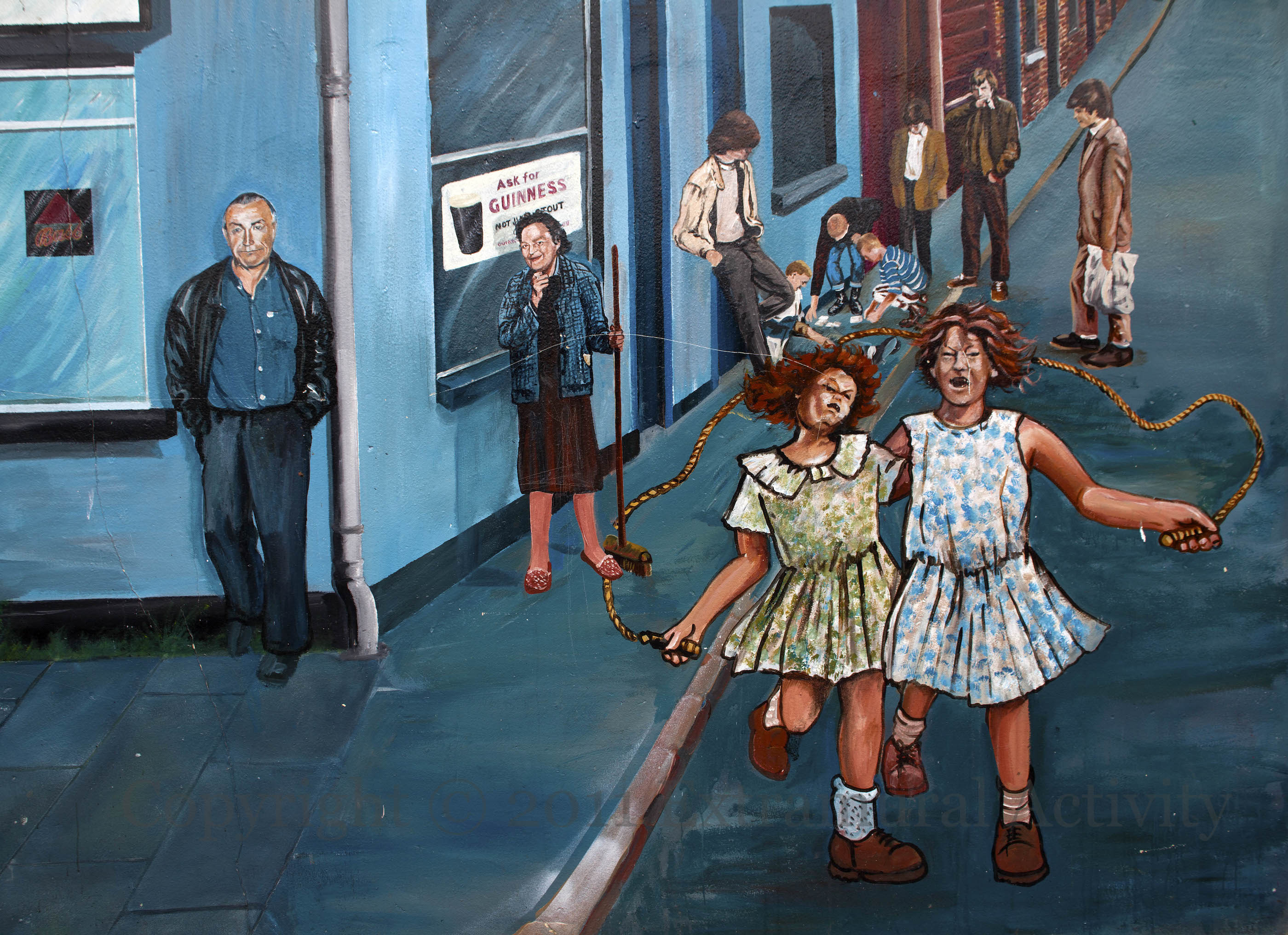
After adding windows to the downstairs, The Strand Bar has reinstated the mural previously at the front in the form of a painted board (above) showing the original bar in Anderson Street (the current Arran Street), which was attacked by the UVF in 1975 with the loss of six lives. The relative size can be gauged from the wide shot, below. The previous mural can be seen in the bottom two images. For photographs of the original bar, see the BelfastForum.
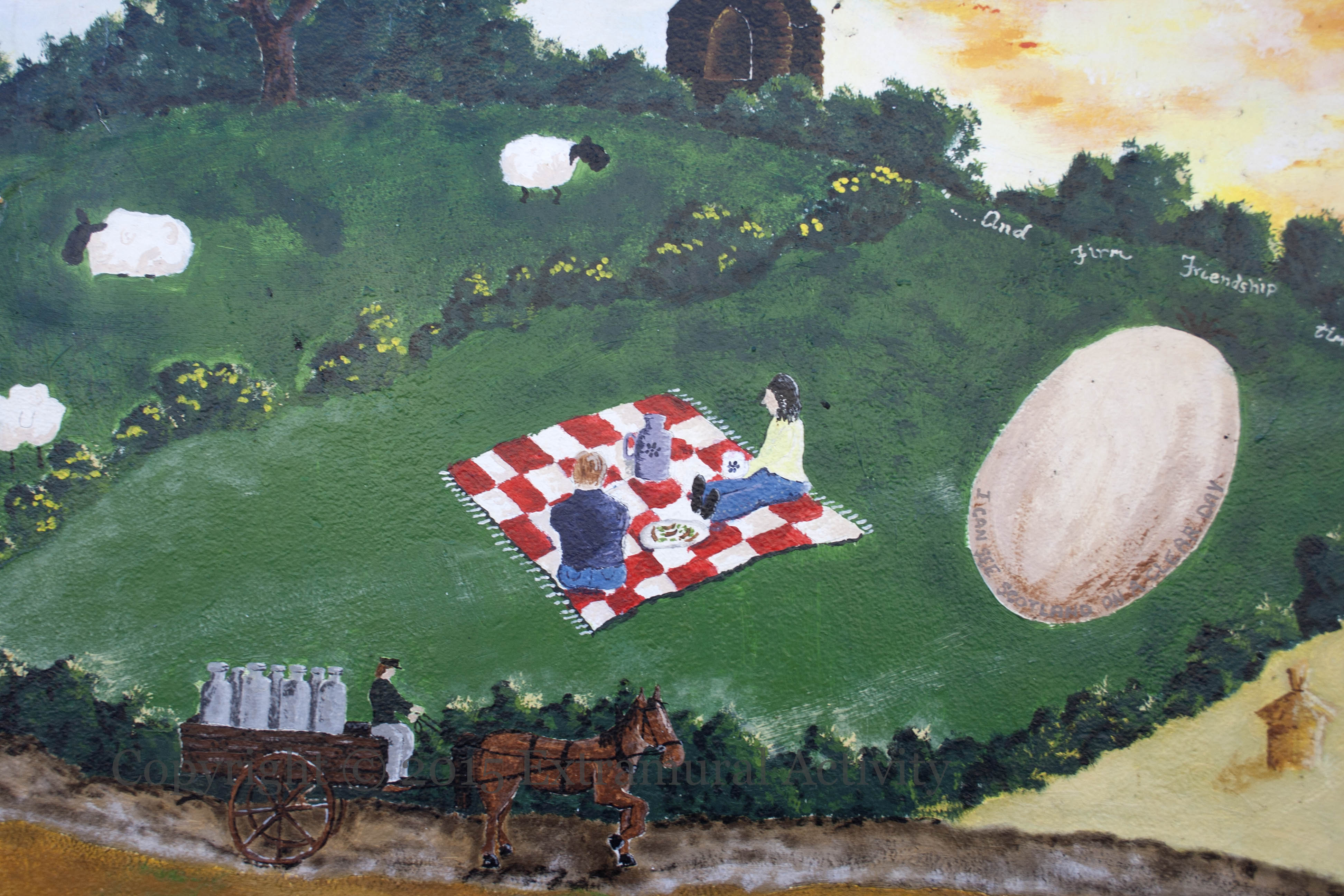
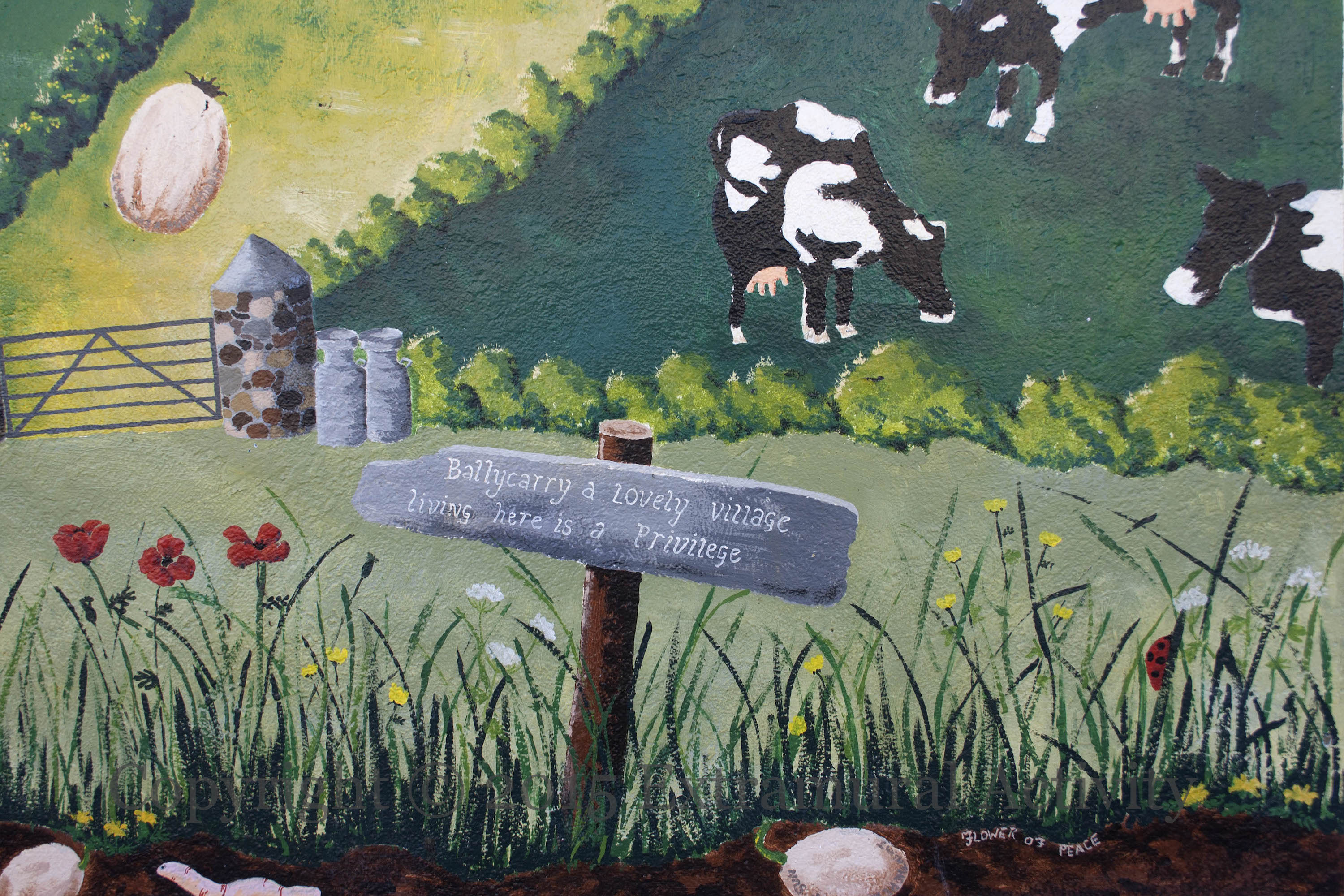
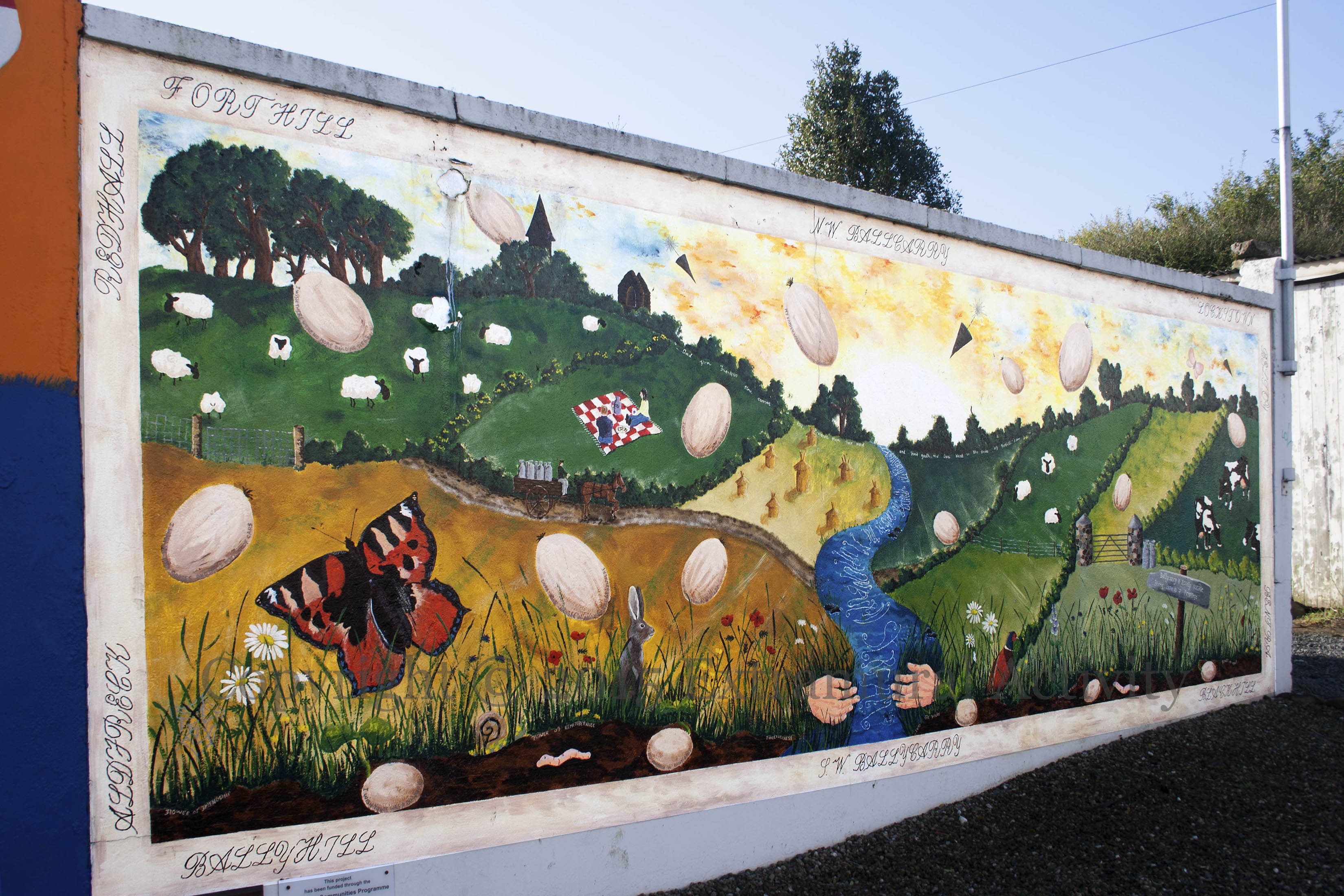
Ballycarry village sits in County Antrim countryside surrounded by the townlands of Ballyhill, Redhall, Forthill, Blackhill, Aldfreck, Lochstown, Beltoy, Bentra. The large pale oval to the right of the picnickers is one of many “seeds” falling from the sky and settling into the earth, which by growing make Ballycarry a pleasant place: “I can see Scotland on a clear day”. The Mutton Burn Stream (lyrics | music from the Ulster-Scots agency) is a song written by Ballycarry resident William Hume (QUB) about the river to the north-west of the village (WP). More about Ballycarry from the BBC’s Ulster-Scots page.







 Extramural Activity