“Trophies come and go but legends last forever.” Scott Harvey and Lee Findlay have taken over as the management team of Northern Amateur Football League premier division team East Belfast FC (Fb) (Belfast Live) due to sequestration in connection with the UVF show of strength in Pitt Park in February, 2021 (Belfast Live). The club’s home field is East Park where the mural above stands to former greats (from left to right) Billy Caskey, Billy Humphries, Sammy McCrory, Ian Lawther, Walter Bruce, Roy Coyle, Tom Casey, and Warren Feeney.
The 36th (Ulster) Division Memorial Association (Fb) put on a play called From The Shipyard To The Somme (Fb | watch on youtube) in Connswater Community Centre in 2013. It follows a group of men from east Belfast who joined the Ulster Volunteers in Belfast but are now training at Abercorn barracks in Ballykinlar (later an internment camp) as members of the 36th Division, before going to the Battle Of The Somme in France.
Belfast – with one tenth of the population – provided about a third of the Irish soldier to participate in WWI. In the shipyards, Harland & Wolff responded to the slow-down in production not by putting everyone on short time but by letting go of employees, particularly unskilled employees, for whom the wages of soldiering were competitive (particularly if married), while skilled men were reclassified as “munitions workers” needed to fulfill war contracts (History Ireland | Long Kesh Inside Out).
Of some interest in this Mersey Street NI Centenary board is the use of St Patrick’s saltire (in the background). The saltire is an anglo symbol of Ireland and was included in the Union Flag when the union was between Britain and Ireland and thus – like the word “Ulster” – has been reduced to meaning Northern Ireland after partition.
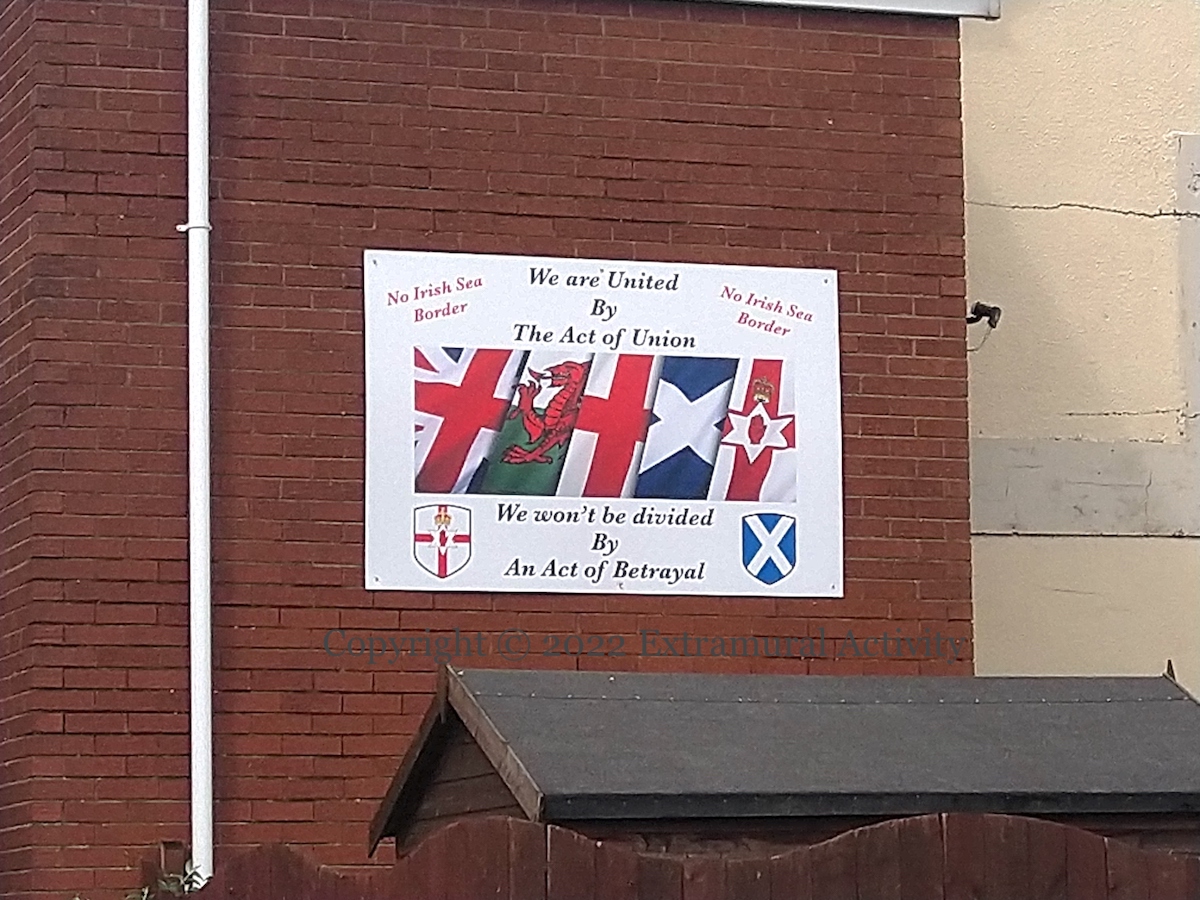
There is also an anti-Irish Sea border board on the next house along – see An Act Of Betrayal. This features the Union Flag together with flags representing the “home countries”: the Welsh dragon, the English St George’s Cross, the Scots St Andrew’s Saltire, and the Northern Irish Ulster Banner.
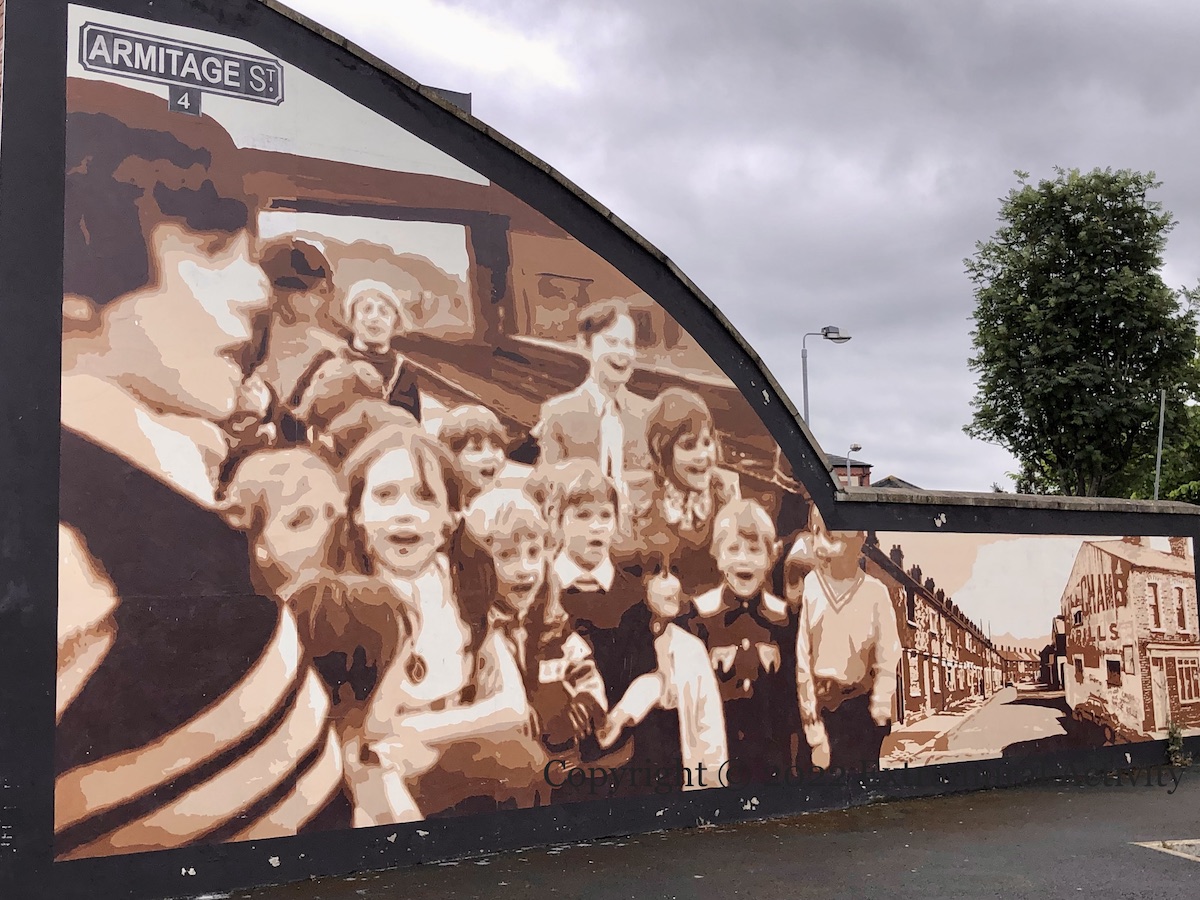
Michael Blakstad’s Children In Crossfire is a justly famous documentary portraying the lives of children in Creggan (Derry) and various areas of Belfast, such as Ballymurphy & Springmartin, Divis, and the area around Gawn St in east Belfast. The documentary is on youtube and an image from it (c. 28m 13s) is depicted in this mural (Connswater Chronicle) at the foot of the Dee Street overpass into what is now the “Titanic Quarter”.
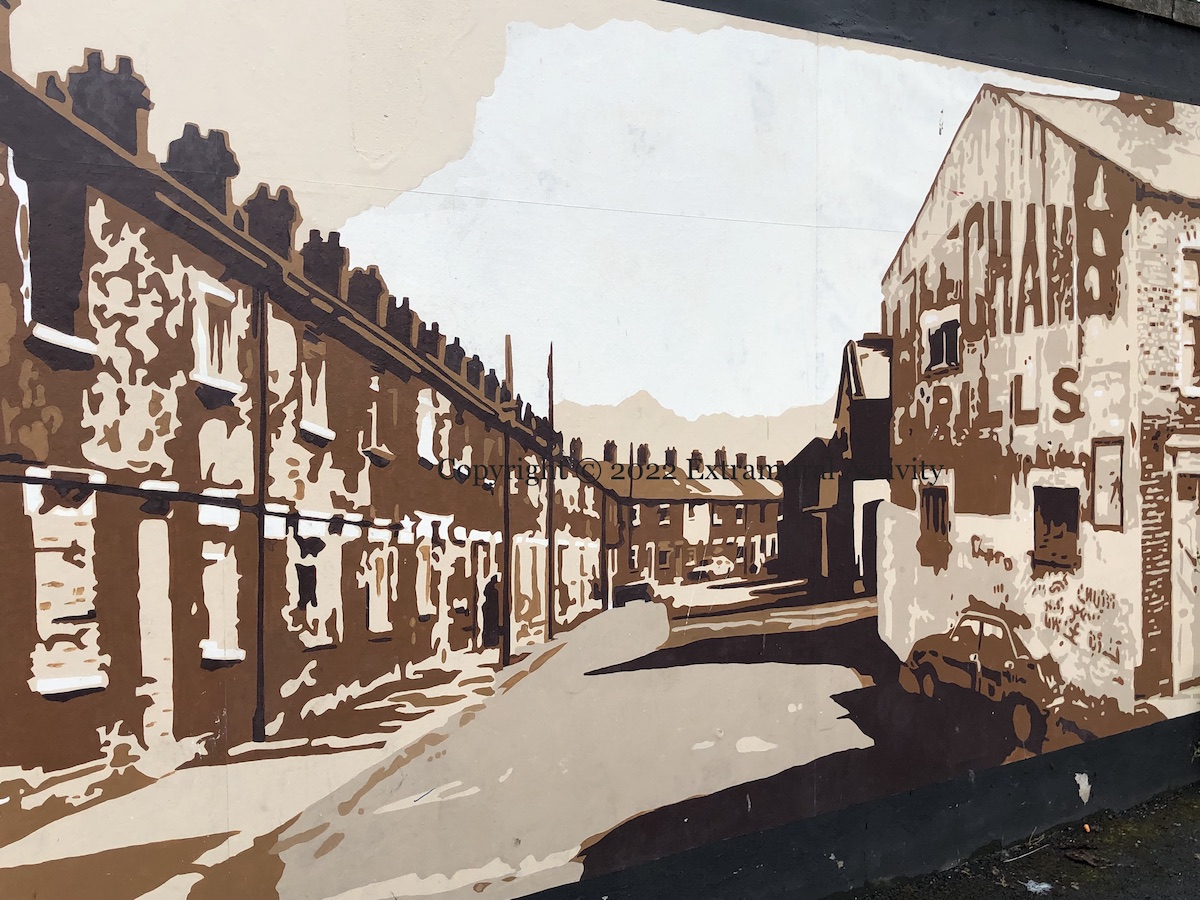
The panel to the right shows the original Armitage Street; the area has been redeveloped and the street was built over with a cluster of houses named Armitage Close.
By Dee Craig with support from the Housing Executive, City Council, and Connswater Homes.
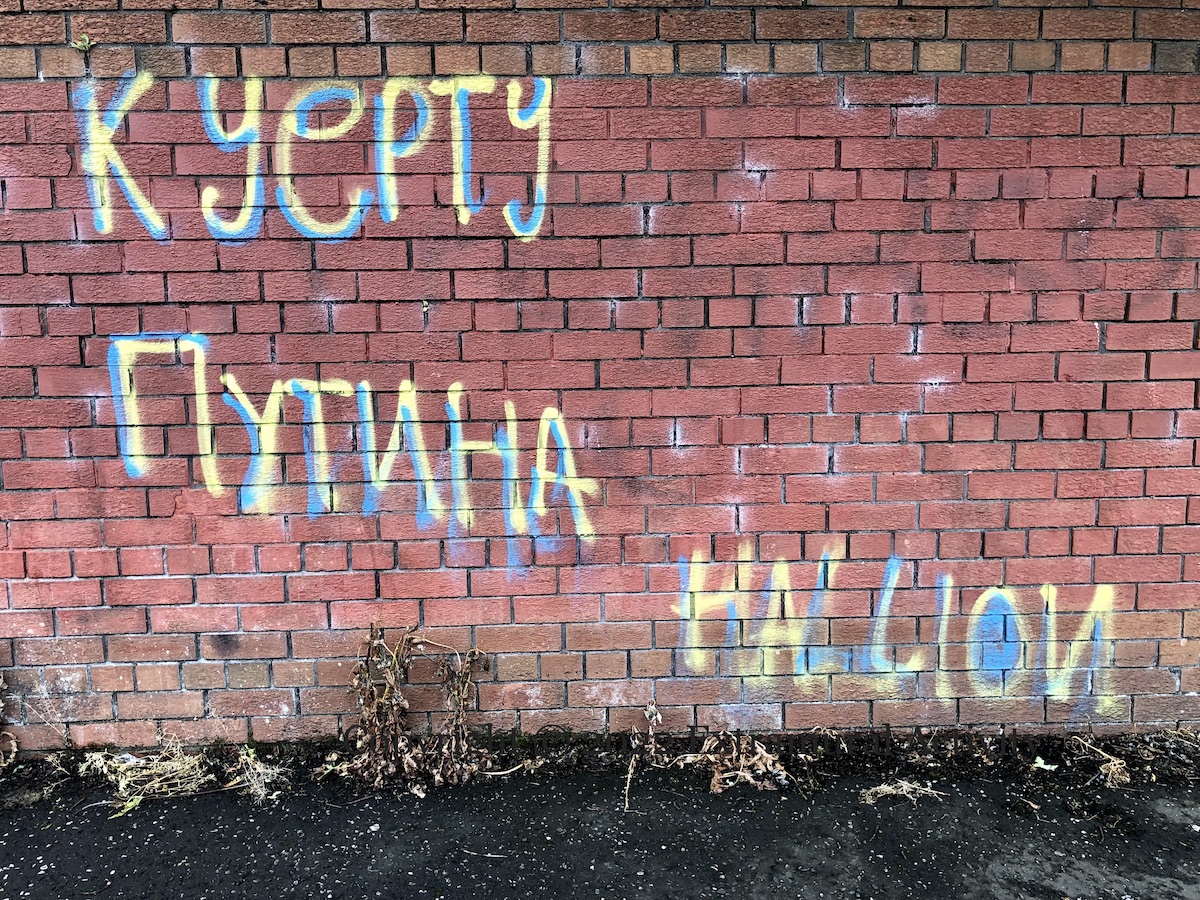
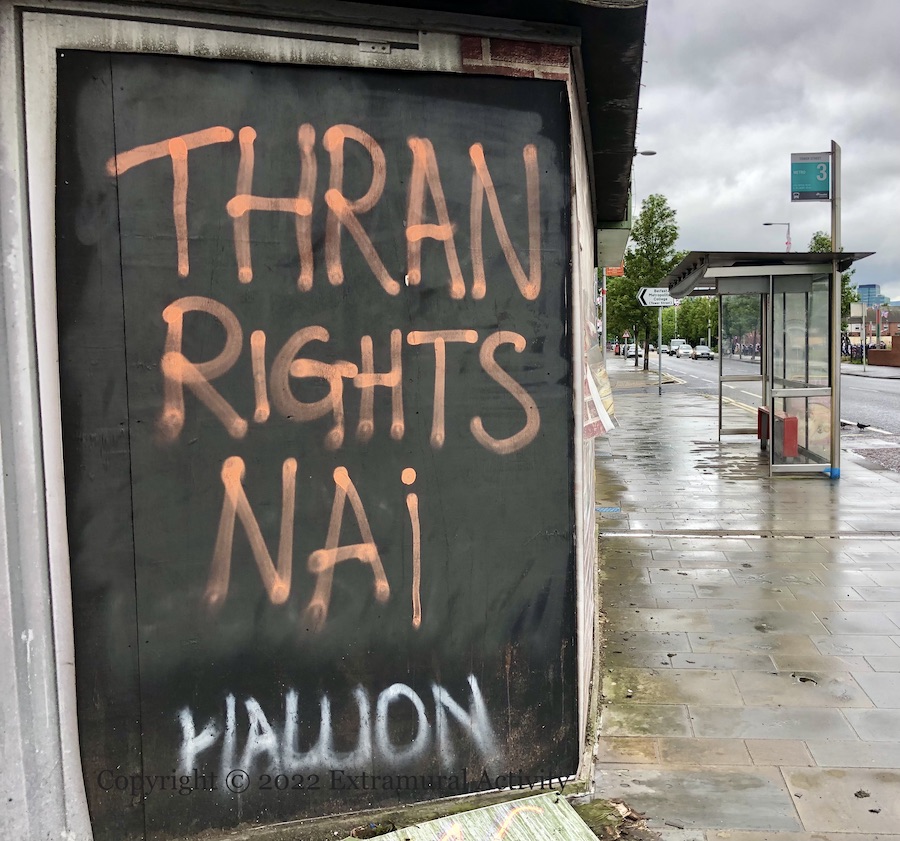
Topical commentary from East Belfast graffitist Hallion: Above, “к черту Путина”, in the blue-and-yellow of Ukraine, is Russian for “To hell with Putin” (or something a bit stronger); below, “Thran rights nai” – “thran” is an Ulster-Scots word meaning “stubborn” or “contrary” (entry for thra – the related verb – at Hamely Tongue) but perhaps here standing for Ulster-Scots in general and commenting on the tortured history of what is now (as of May 2022) the ‘Identity & Language’ bill (BBC) covering Irish/Gaeilge and Ulster-Scots/Ulstèr-Scotch in Northern Ireland. “Hallion” is itself is a Scots/north England word, meaning a scoundrel or rapscallion (MW | etymonline).
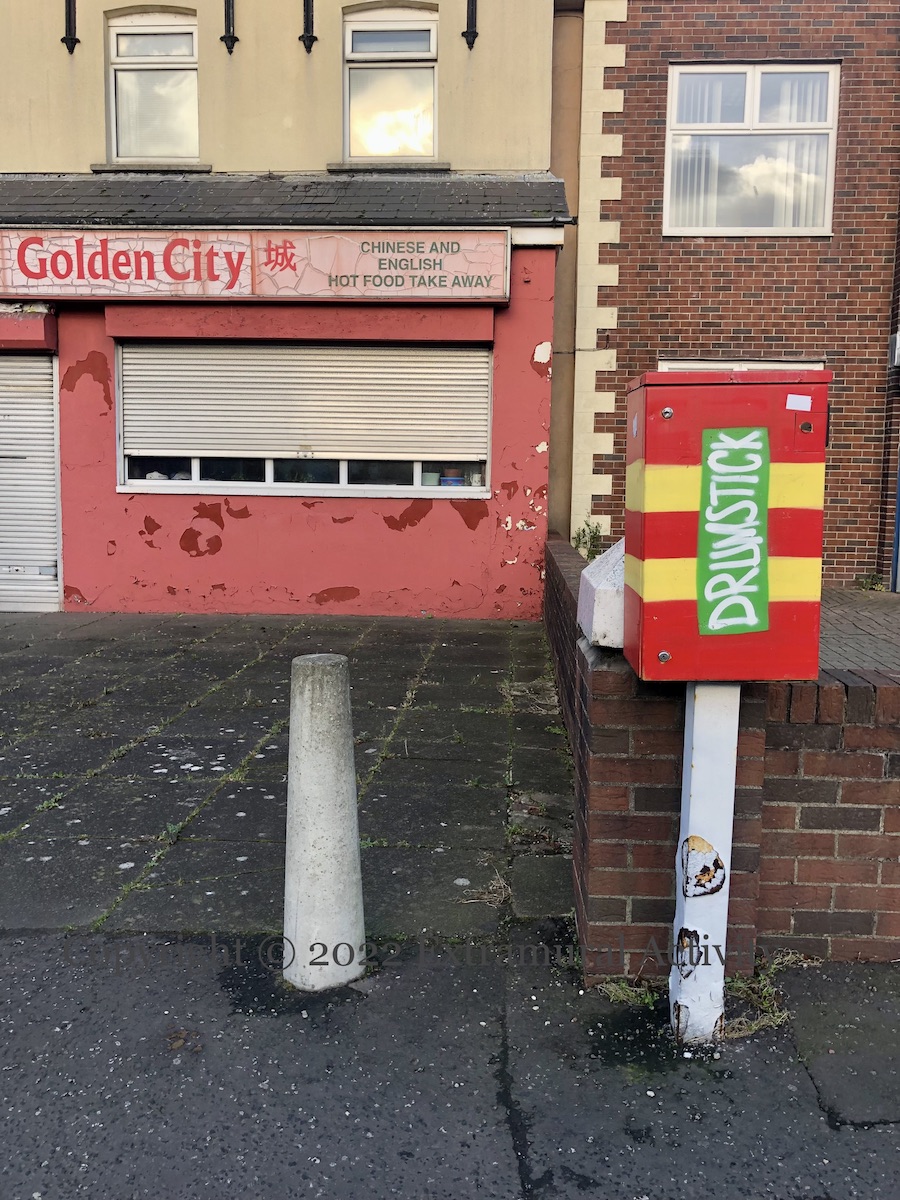
This signal box on the Holywood Road, Belfast, has been repainted by FGB (ig) to look like a Drumstick – not the musician’s tool or the chicken leg but the chewy lolly. The Drumstick dates back to 1957 (swizzels.com). Swizzels makes not just Drumsticks but also Refreshers, Double Lollies, Love Hearts, Double Dips, Lipsticks, and Whistles.
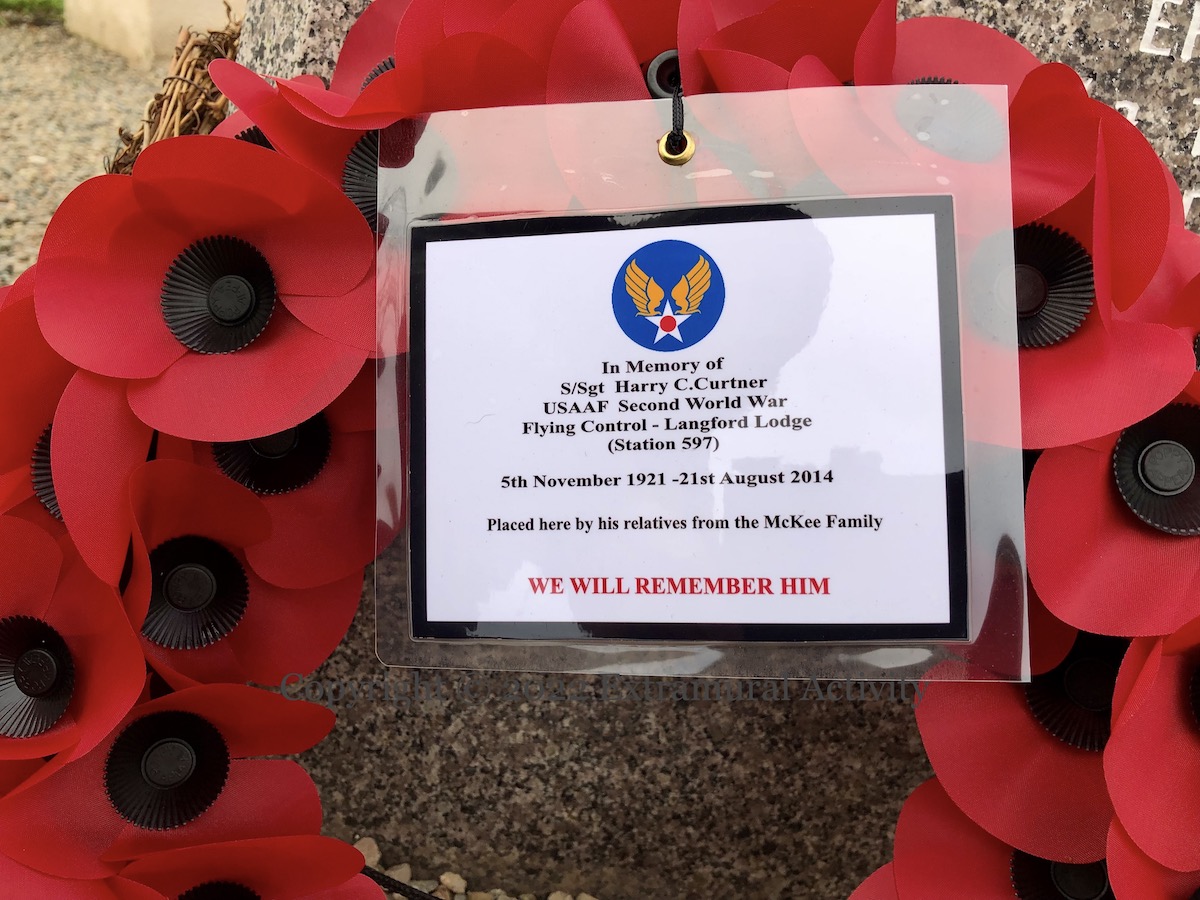
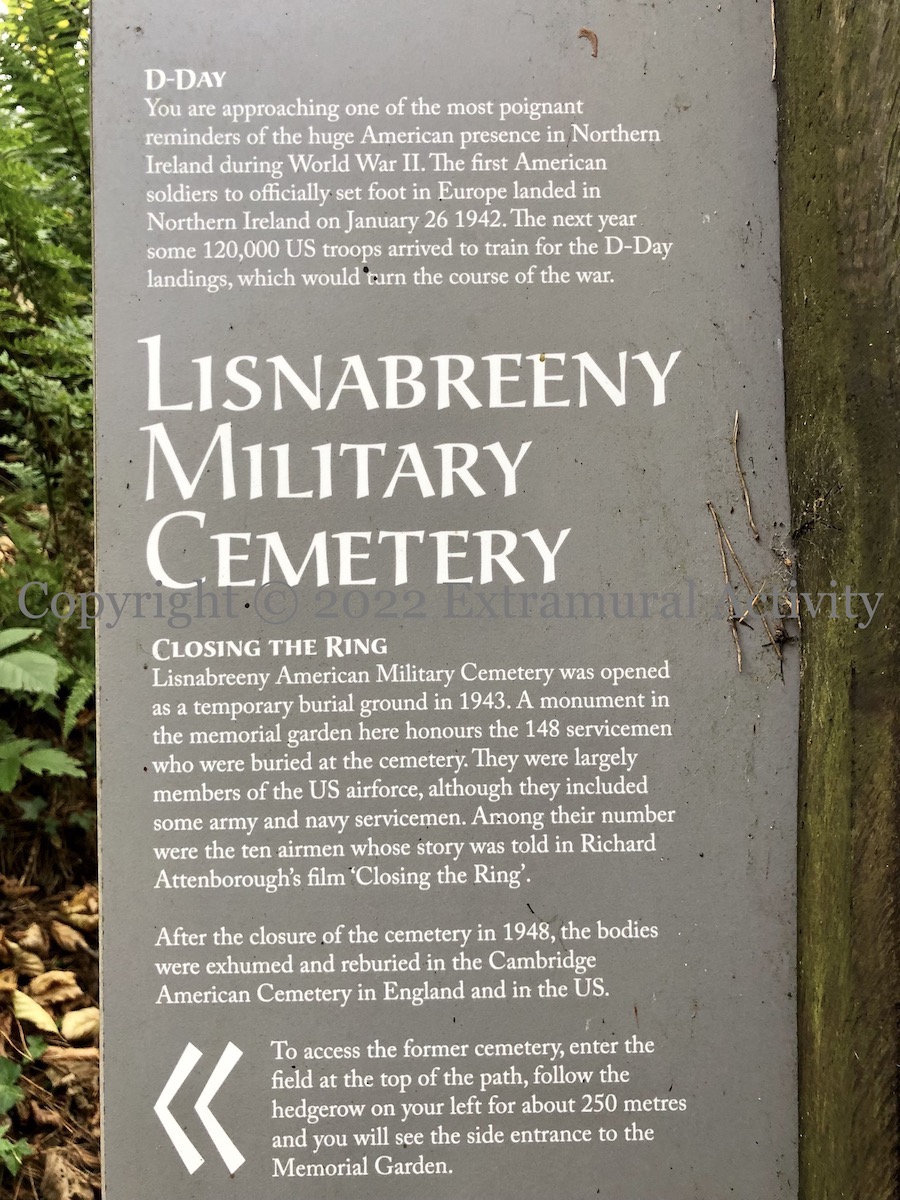
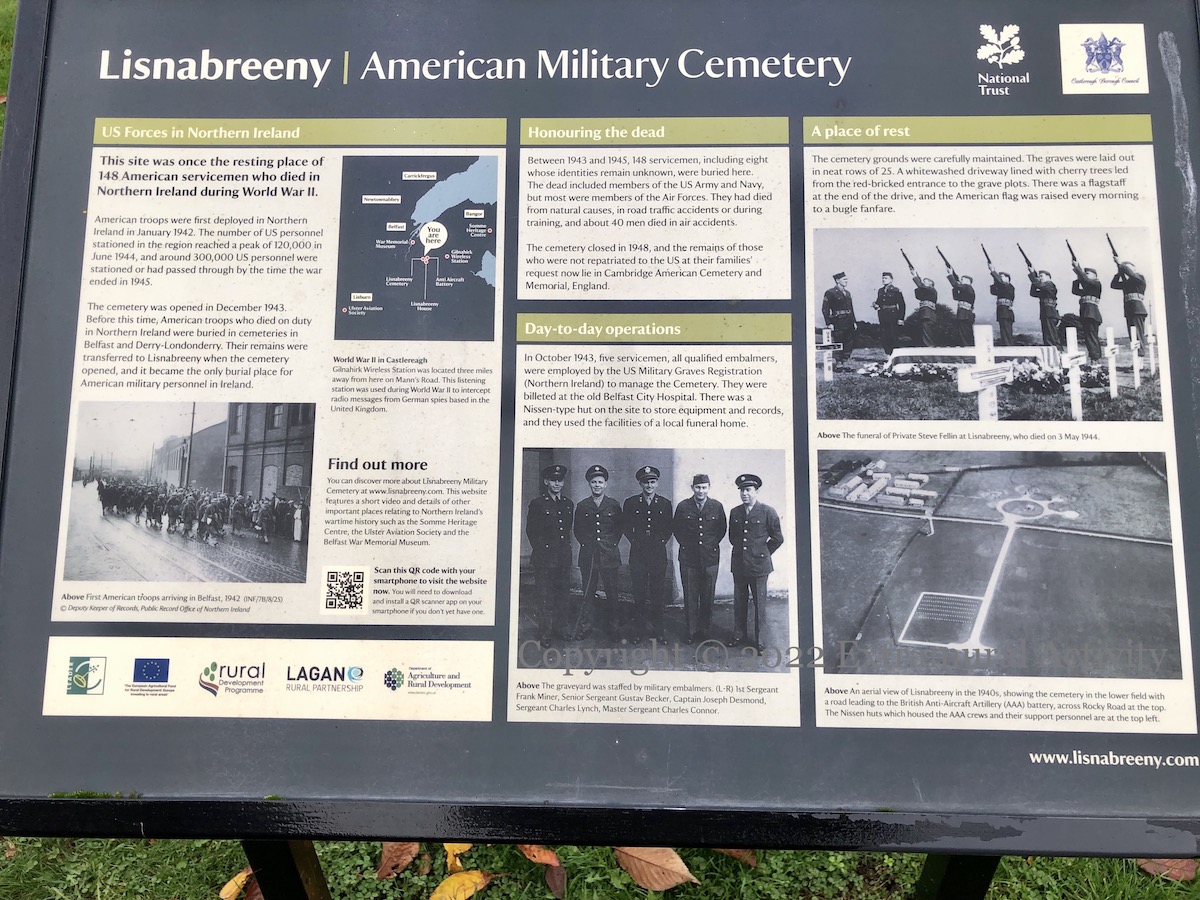
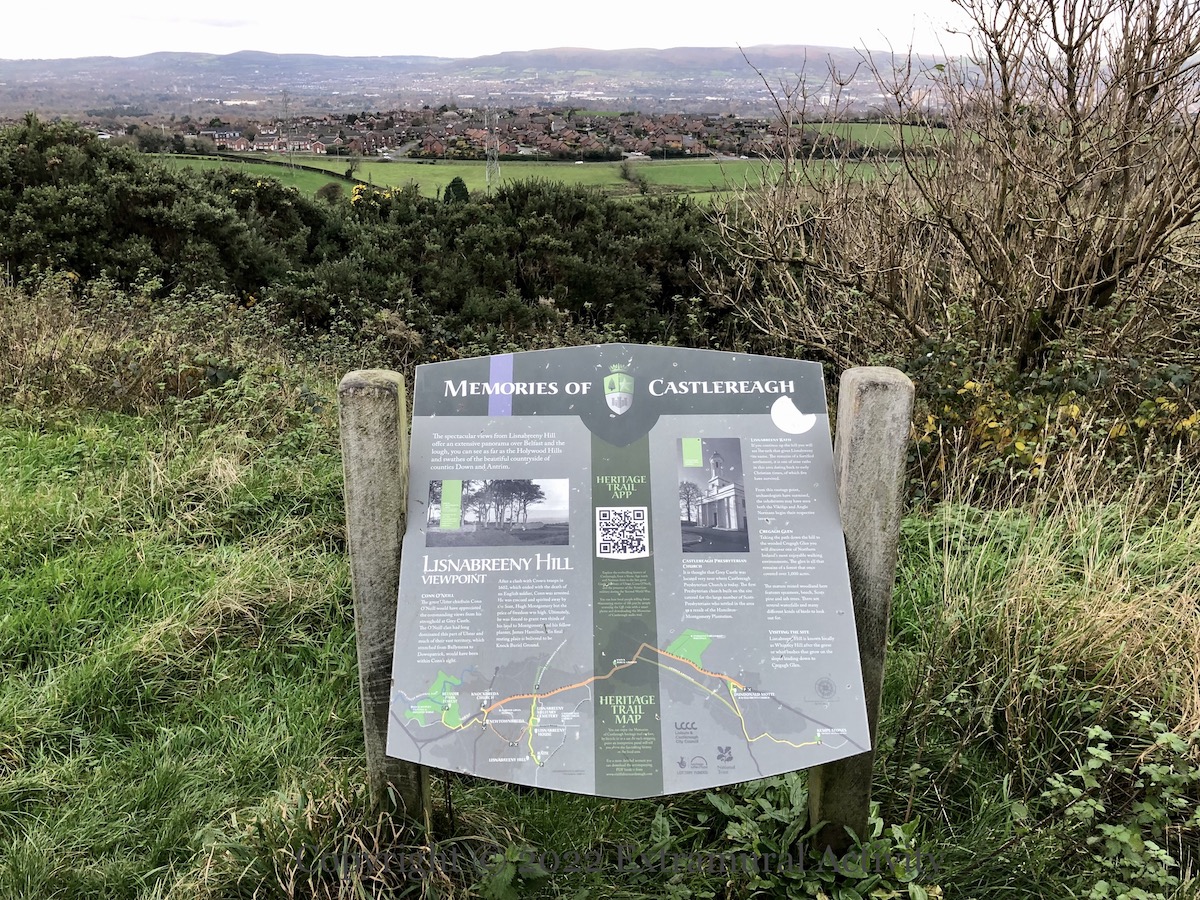
The 148 US servicemen who were buried at Lisnabreeny, in the Castlereagh hills, died in Northern Ireland, and about 40 of them in air accidents, including the ten who died on June 1st, 1944, when a B-17 travelling from Newfoundland crashed into Cave Hill, killing all ten men on board (Wartime NI). The names of all 148 are listed on three sides of the memorial stone; their remains were repatriated or moved to the cemetery in Cambridge, England in 1948.
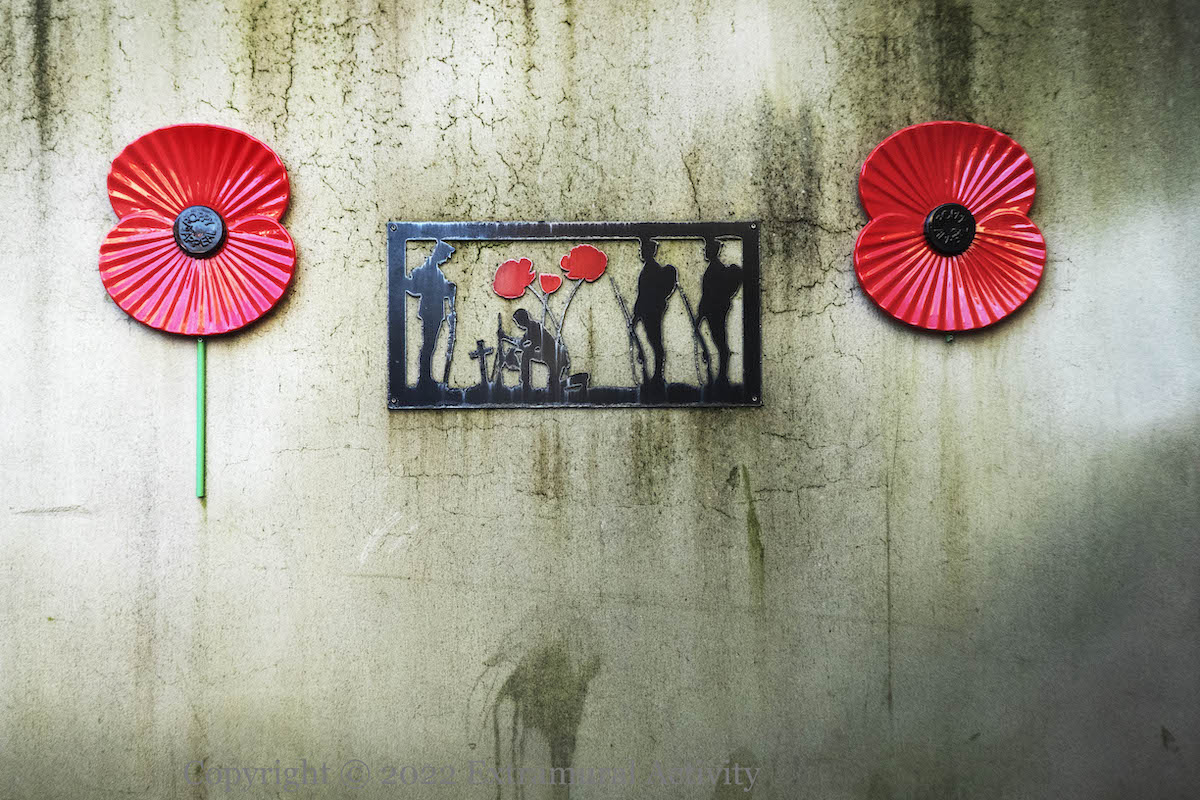
This is a small memorial to the fallen British soldiers tucked away in Ogilvie Street, Belfast, that serves to remind the locals always to keep the sacrifice of the 36th Division always in mind. Below is the board next to it, originally seen in 2013.
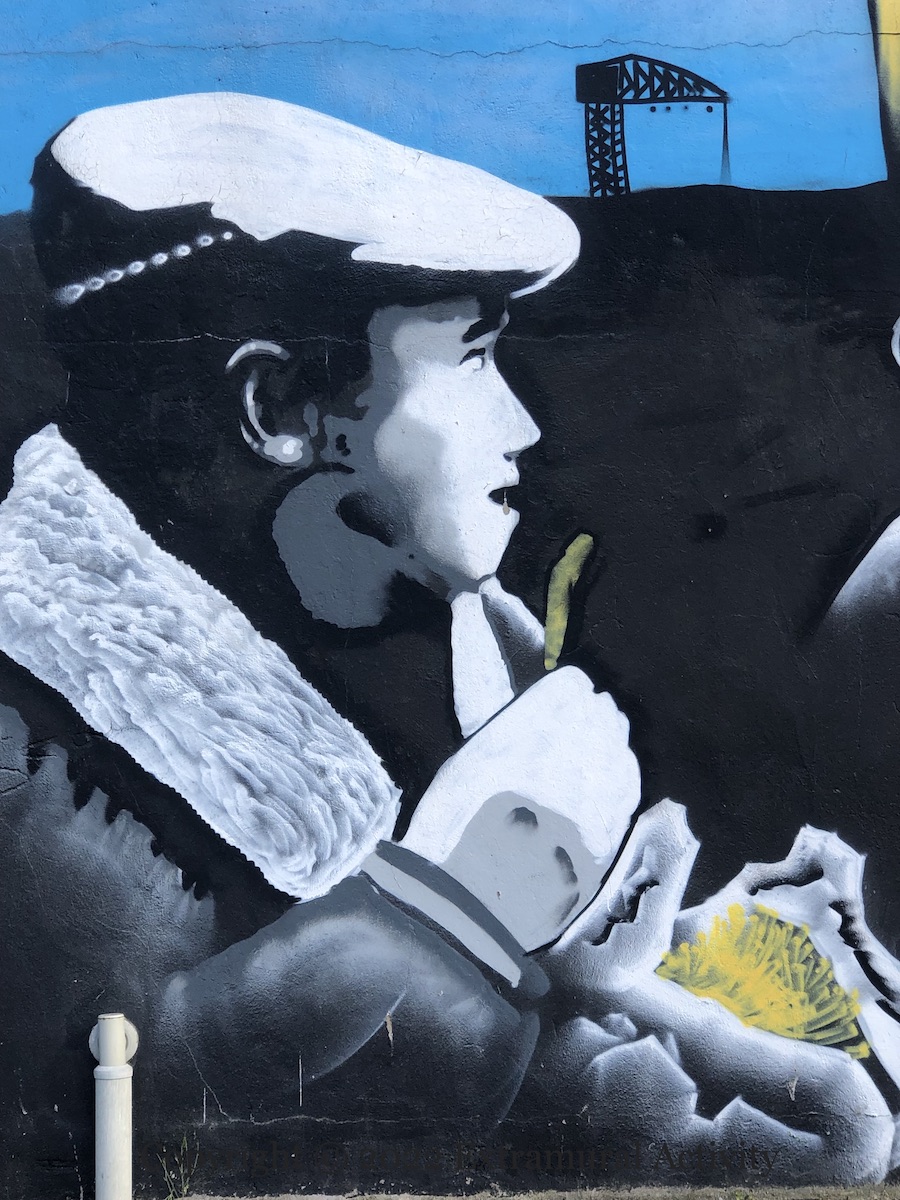
It’s been a long time since workers walked en masse from east Belfast to the shipyard, but fish and chips remain popular, though the number of chippies has fallen from about 35,000 in 1920 to 10,500 today (BBC | Dockside). This mural is on the side of the ‘Chipyard’ in Strandtown.
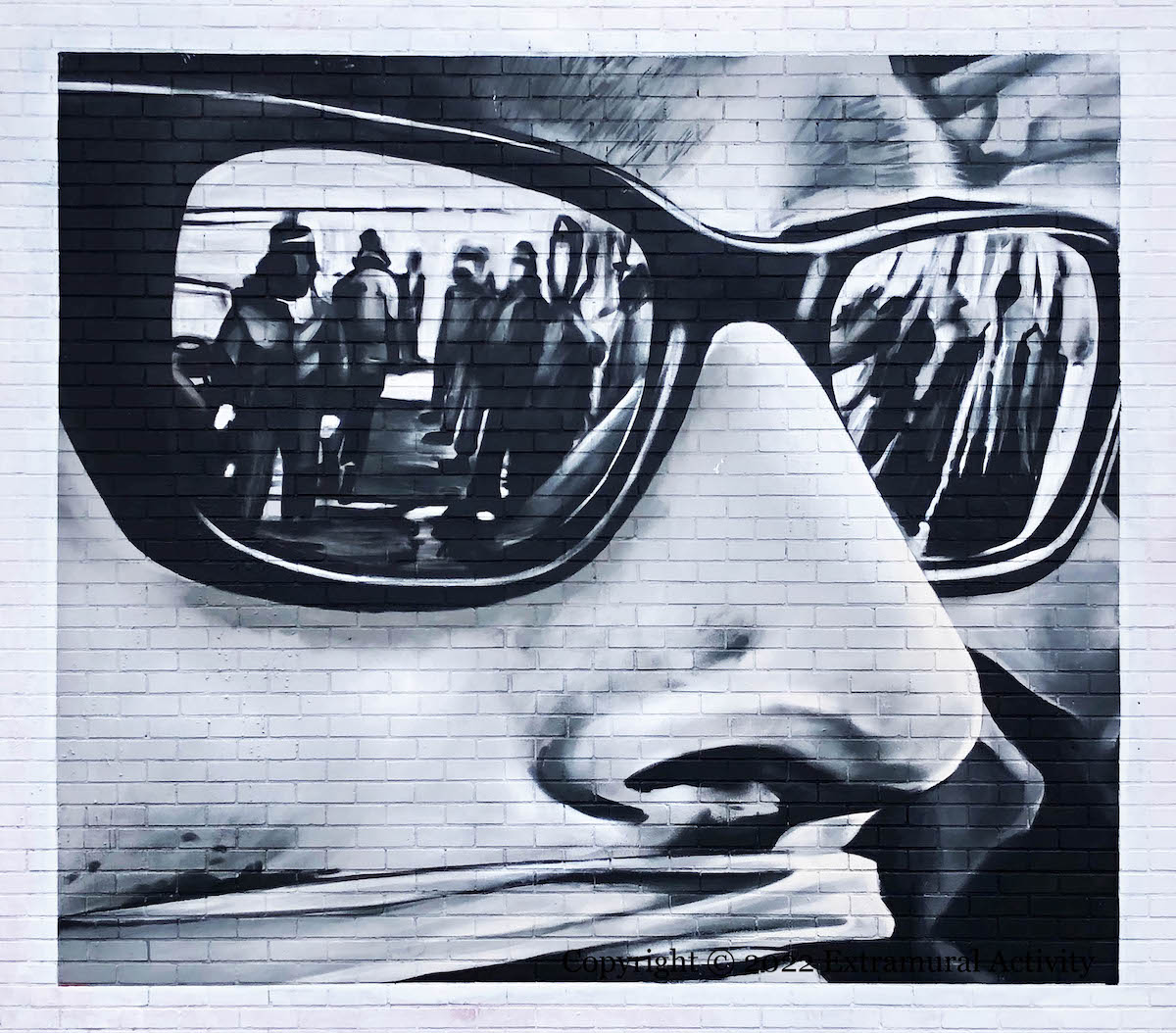
Perhaps because of the Covid pandemic, this mural of UDA volunteers on parade reflected in the sunglasses of one of their comrades took months to complete (it was started in late 2020 and was still unfinished last summer). It replaces the previous “UFF Formed 1973” mural – see Northern Island.
The photograph reproduced is from the 1974 Ulster Workers’ Strike; it appeared on the cover of Don Anderson’s Fourteen May Days (CAIN).












 Extramural Activity