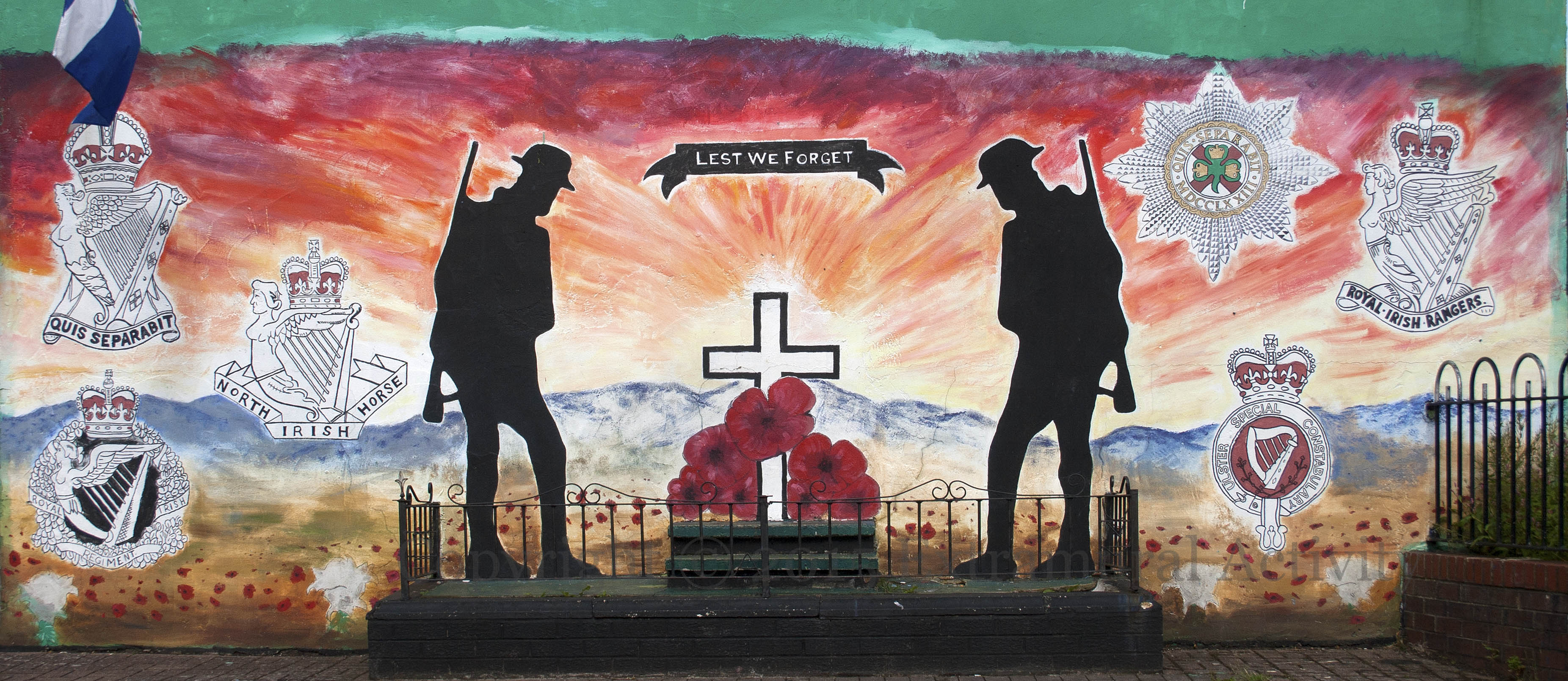
Like yesterday’s array of flags, the adjacent mural of army badges around a burial scene from the first world war features some lesser-seen items. On the left, alongside the Royal Irish Rifles (top left) and the (modern-day) Royal Irish Regiment (at the time of WWI the harp was plain and there was no garland), we see the emblem of the North Irish Horse, a cavalry unit in the Territorial Army. On the right, the emblem of the Royal Irish Rangers (which was folded into the Royal Irish Regiment in 1992) is joined by the star of the Irish Guards (above) and the emblem of the Ulster Special Constabulary or B-Specials (below). Only the Royal Irish Regiment and the Irish Guards remain as regiments of the British Army; “The Horse” now forms squadrons of other units. Of the six, four served in WWI; the B-Specials were formed in 1920 and the Rangers in 1968.
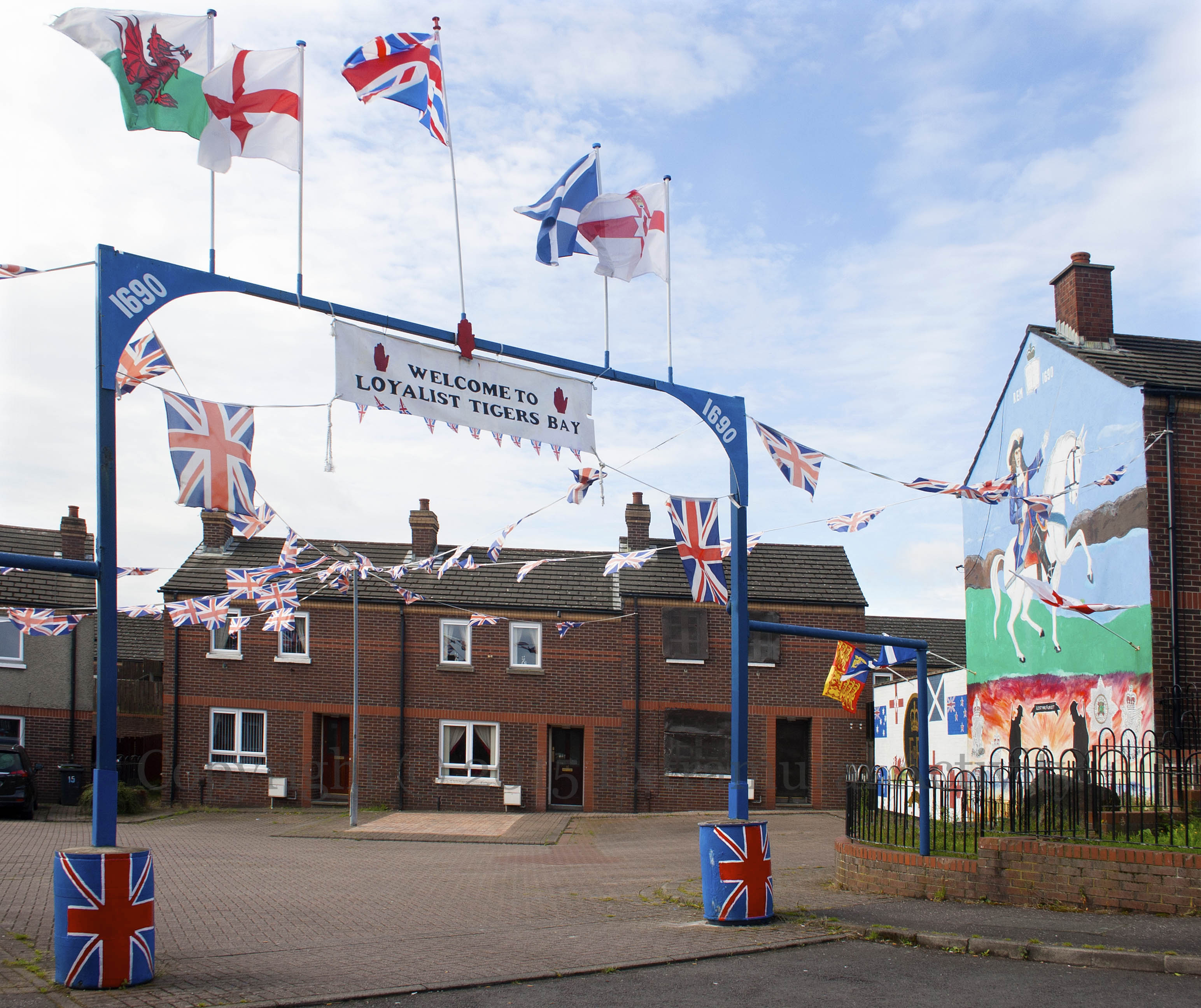
Genesis 35:11 reads (NIV) “And God said to him, “I am God Almighty; be fruitful and increase in number. A nation and a community of nations will come from you, and kings will be among your descendants.” The flags of Northern Ireland, Scotland, Wales, and England are joined in the mural above by those of Australia and (a simplified version of) the Falkland Islands (on the left) and New Zealand and Canada (on the right). The flag flying in the centre is the Royal Standard, flown on the building or vehicle where the monarch – currently EIIR, Elizabeth II Regina, Queen Elizabeth the second – is.
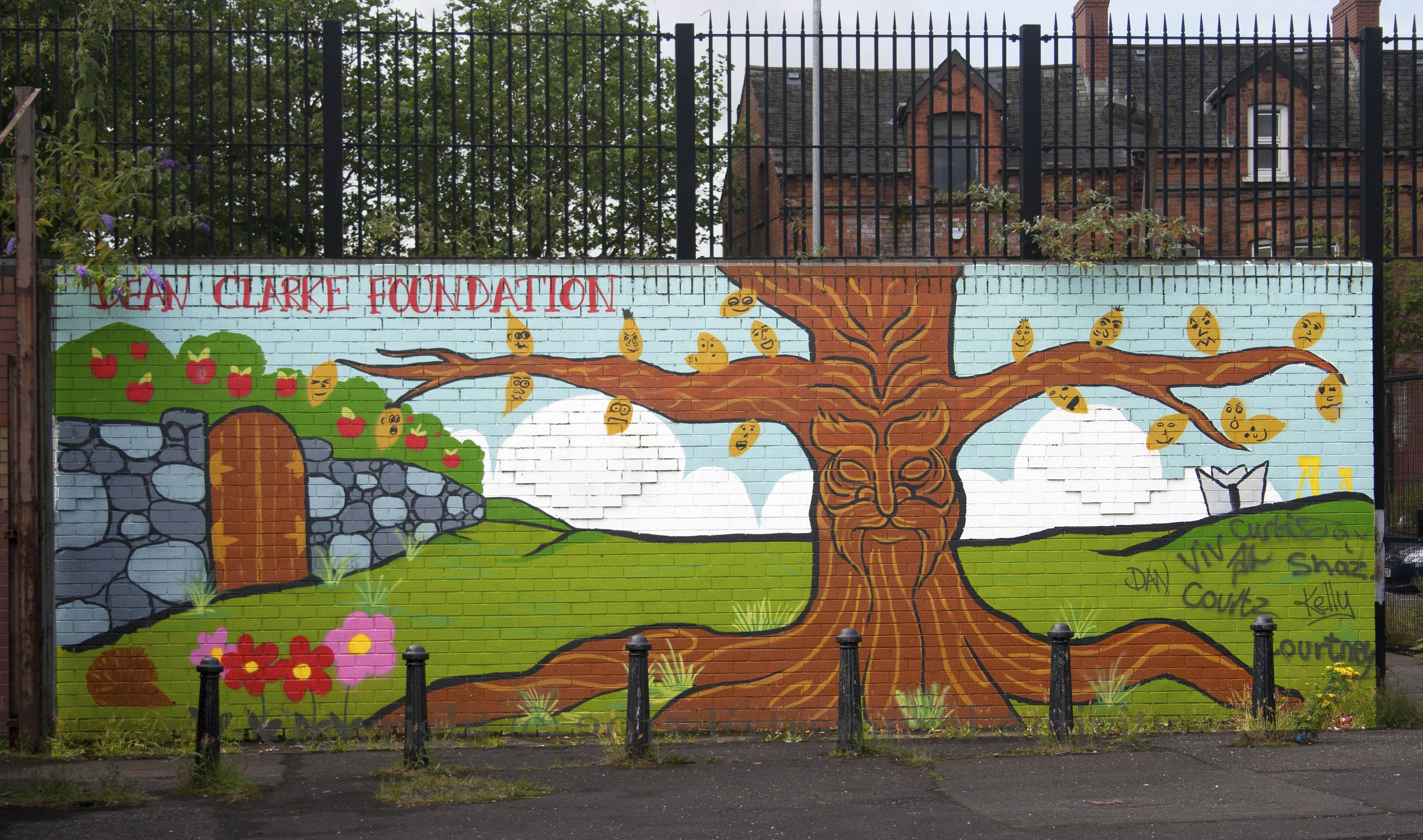
Treebeard the Ent (from Lord Of The Rings) watches over the young people of north Belfast’s Tigers Bay. Dean Clarke, age 16, hanged himself on November 4th, 2007, after a week in hospital recovering from an overdose of ketamine (which he believed to be Valium). The Dean Clarke Foundation (Fb) was founded by his mother Alison in order to provide activities and outings for young people. (BBC-NI | Tele) The foundation is also involved in the Tigers Bay community garden (see Work Ethic).
The Wolfe Tones will headline the 2015 Ardoyne Fleadh Cheoıl (Fb) on August 15th. Last year, The Druids caused controversy by advising British Army forces and loyalists to go “back to England” (BelTel).
Along the bottom are various of the posters/programme covers from years past: (left to right) the 1998 cover, by Sean Doran, was also painted in Ardoyne Avenue; Cú Chulaınn on the 1999 poster was painted in Ardoyne Avenue (S00089); the fiddler and bodhrán player appeared on a t-shirt; a classic Wolfe Tones poster shows the four faces in profile; Fleadh Érıu on the 1995 poster (under the go-kart’s left wheel) was painted on this wall in 1994; the 1996 Fleadh poster, also by Sean Doran; disappearing on the right is Doran’s 1997 cover.
The Ardoyne Fleadh Cheoıl emblem (on the go-karter’s t-shirt and under the text on the left) was used in Maıreann An Spıorad. The festival began in 1970.
A new mural will be launched as part of this year’s festival: Boxing Champions.
The hunger strikers tarp has been removed from the Ard Eoın memorial garden (see 2013) and the forty portraits have been moved over from the mural on Ardoyne Avenue after the plaster fell off (see one | two).
However, the two long-standing pieces remain the same. As can be seen in the image below, the cross goes back to 1976. “This garden of remembrance was unveiled by Nora Connolly O’Brien, daughter of James Connolly, Easter Tuesday 1976. It is dedicated to the memory of Óglaıgh Na hÉıreann and Fıanna Éıreann volunteers, Sınn Féın, and members of our community who lost lives since 1969. ‘Ireland unfree shall never be at peace.’ In loving memory of all from the Ardoyne, Bone and Ligoniel who died because of Ireland’s troubles.”
Above, the phoenix is used as a symbol of resistance in one of the oldest memorial plaques in Belfast (1993) with the names of deceased IRA volunteers and locals: “Oft from prison bars, oft from battle flashes/Oft from heroes’ lip, oftenest from their ashes.”
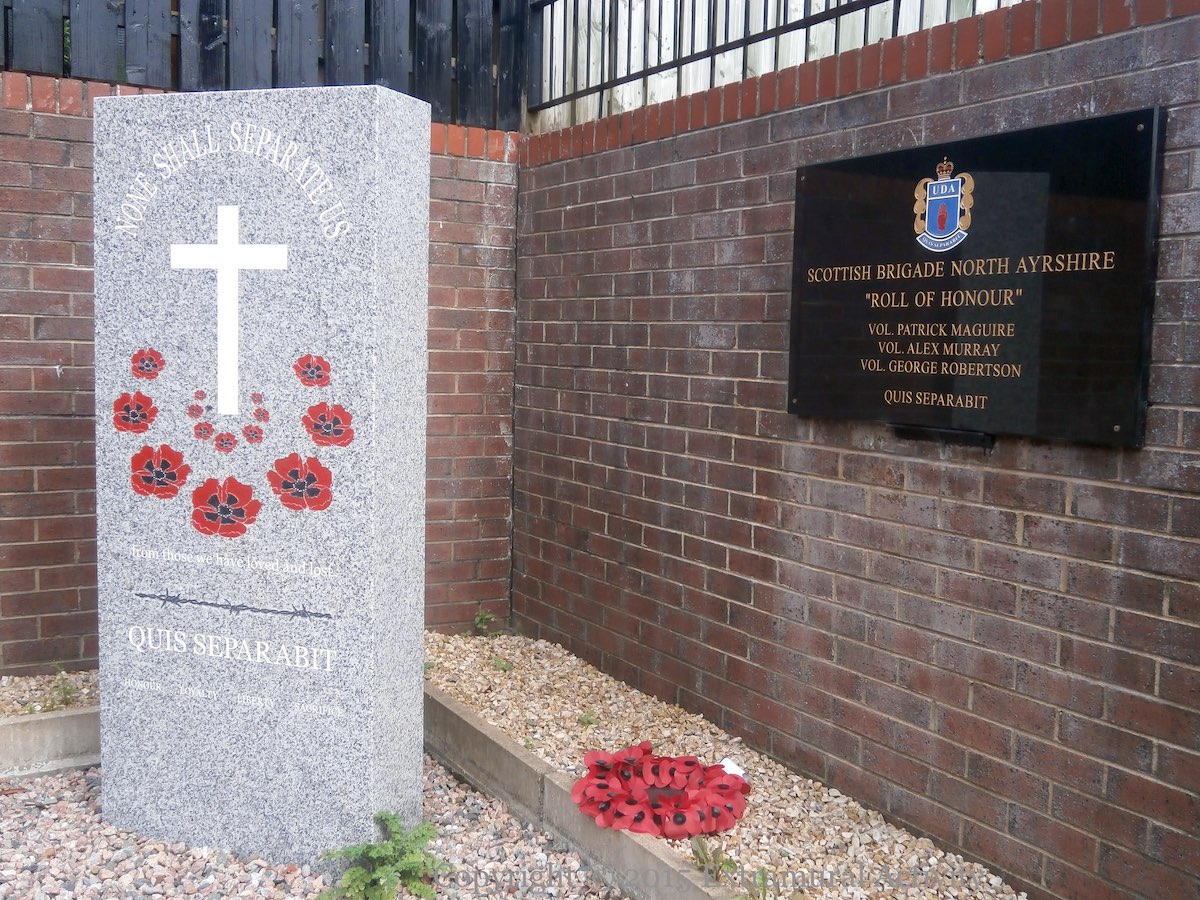
“None shall separate us from those we have loved and lost. Quis separabit. Honour – loyalty – liberty – sacrifice.” A standing stone has been added to the UDA memorial garden in Cosgrave Heights, next to the plaque to the “Scottish Brigade North Ayrshire roll of honour” that was added (circa 2012) to the pair to the North Belfast Brigade that were present in 2008 (see M04397).
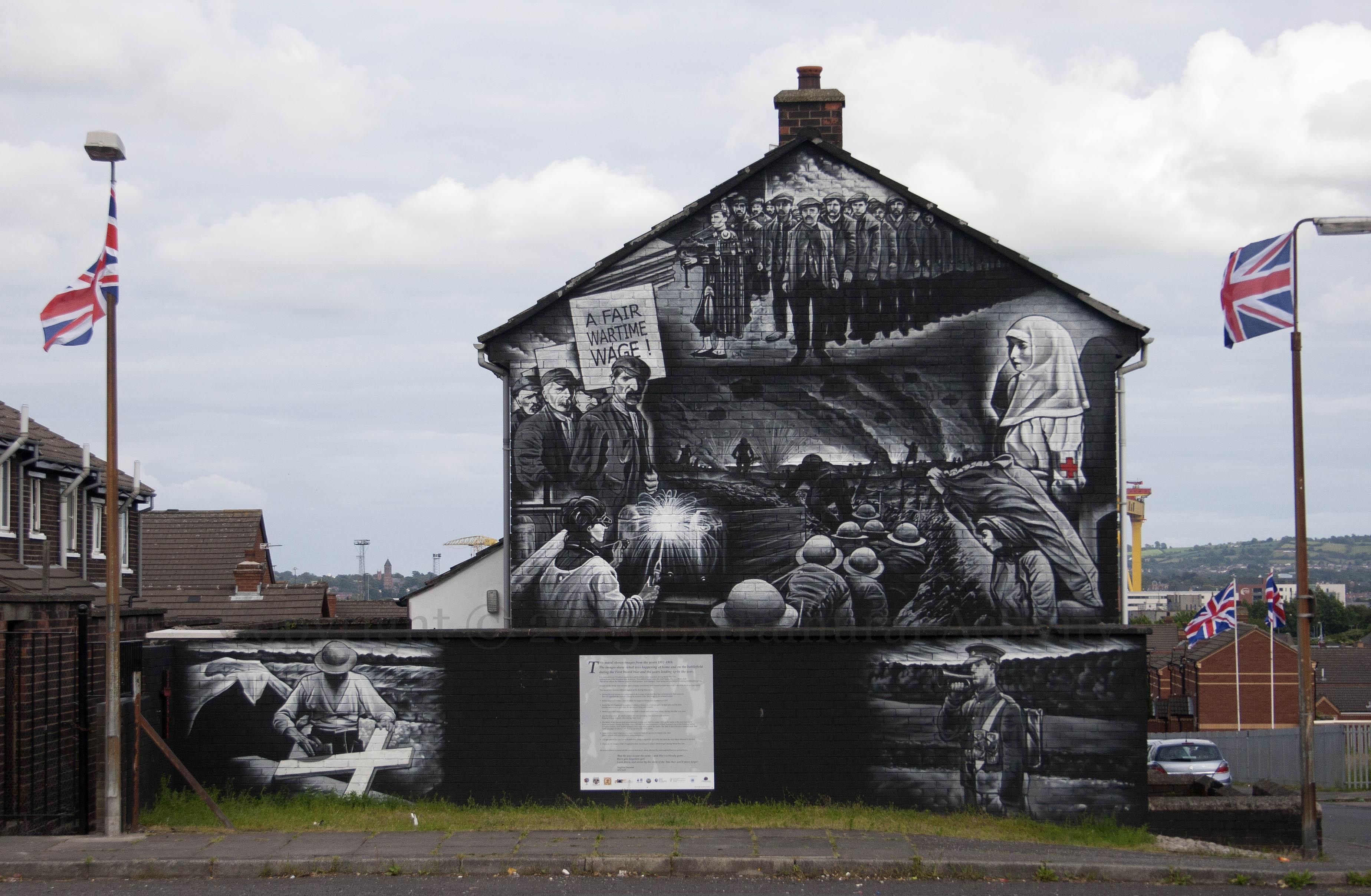
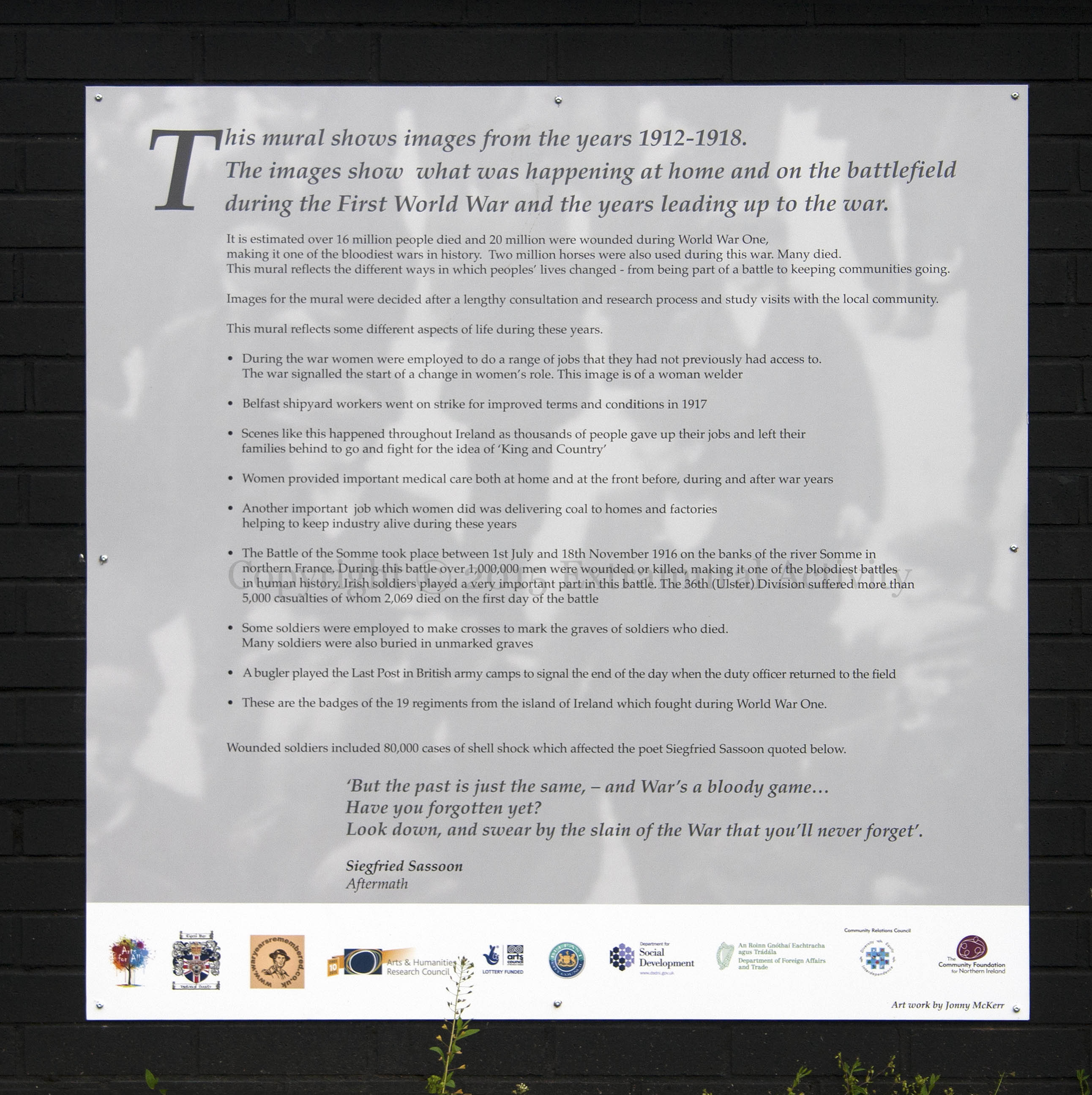
June 15th saw the official ‘Arts For All’ launch of a mural shown all the way back in January. For the launch, artist Jonny McKerr added backgrounds to the cross-maker and bugler on the low wall in front, and the information-board in the centre was added. For background and the images on which the mural is based, see The Home Front (and also The Undertaker).
Every day, men would line up in schooling pens on the various docks of the port of Belfast to be hired by foremen. As mentioned on the left-hand side of the board above (recently erected on the New Lodge side of the Duncairn “peace” line) the rise of the shipping container in the 1970s spelled the end of the docker: “from 3000 listed dockers in 1970, the number had fallen to 280 by 1985.” Author and poet John Campbell recalls his first day on the docks in 1952, unloading cement, in this NVTv video.
“This artwork celebrates the unique contribution that generations of dockers have made to the port and City of Belfast.”
“It was a physically demanding job, the hours were long, the conditions were tough and the availability of work was not constant. Without the Dockers, however, the Port of Belfast would not have been able to grow. / Transportation of goods by containers led to a revolution in working practices at Belfast Docks and the number of dockers decreased dramatically. From 3000 listed dockers in 1970, the number had fallen to 280 by 1985. Behind these figures lay the human story of vast social changes in the harbour area as well as the gradual dissappearance [sic] of an entire community who had earned their living from the sea and also through the loading and unloading of ships. These were the Dockers and their families, many of whom lived in Sailortown. / The workforce of dockers spanned both traditions. Red button and Blue button. Dockers had a common allegiance to the Port of Belfast which provided a living for men and families from both communities. / The work was backbreaking, yet the Docks educated us about life, integrity, discipline, about standing up for our rights, about having pride in our identity as working men, as Dockers. / The Dockers[‘] working environment was repressive and hazardous with large numbers experiencing industrial injuries. Others lost their lives or were badly injured in horrific accidents at work. Many suffered chronic long term illnesses, others died prematurely having contracted asbestosis. Many Dockers became politically aware in the formation of trade unions and social reforms. The Dockers Trade Union, Irish Transport and General Workers[‘] Union (ITGWU) organised by Jim Larkin (1909) and James Connolly (1910-11) celebrated its centenary in 2009.” OBU one big union