Mural from mid-2011 on the “international wall” (Visual History) featuring a quote from early (1976) hunger-striker Frank Stagg (WP), along with portraits of Stagg, Michael Gaughan (d. 1974 WP) and the 10 strikers who died in 1981. The images of Stagg and Gaughan, along with a Tricolour and a copy of the Proclamation of the Irish Republic, are here concealed by a placard announcing a rally commemorating the hunger strikers.
This mural takes the place of a pro-Basque mural (and the Martin Meehan bookmark) in the second half of 2011. There is currently no Basque mural on the wall.
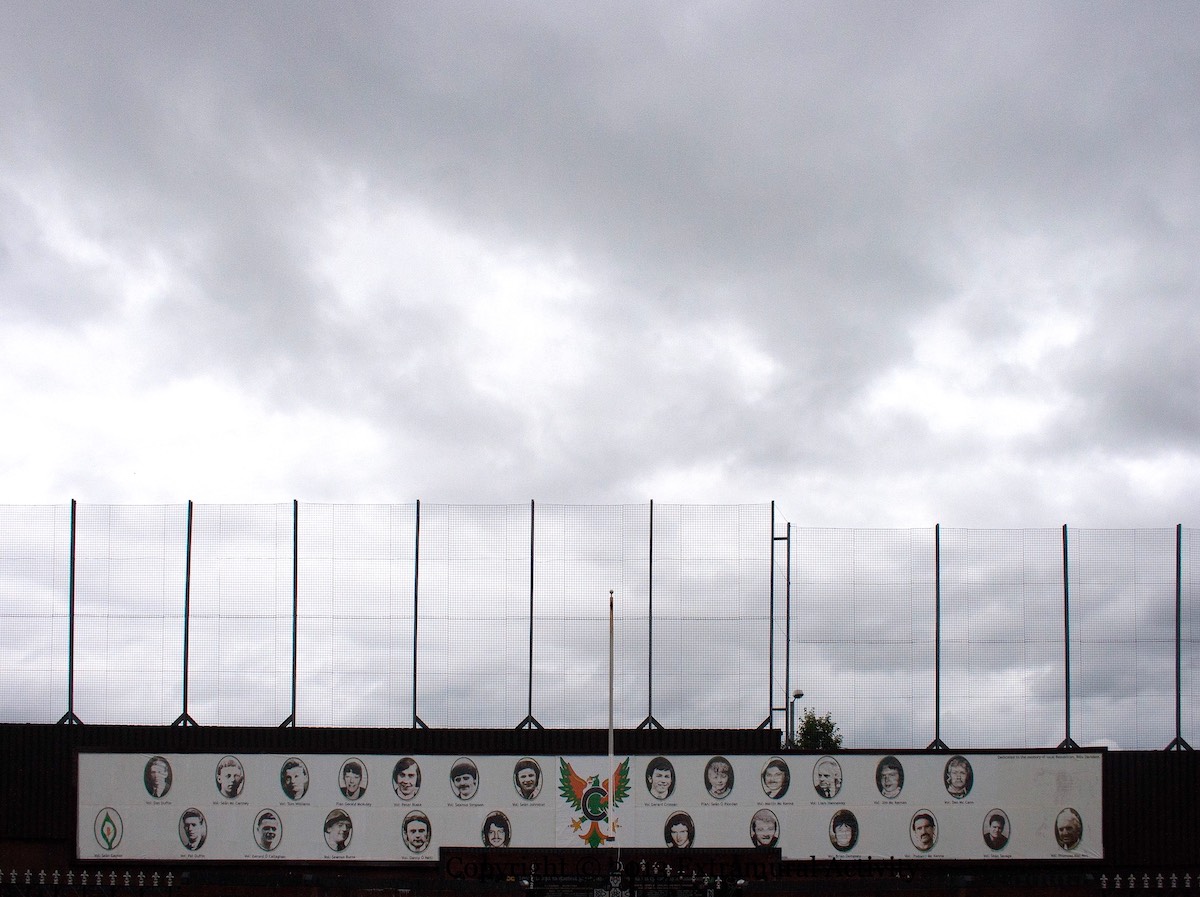
The back wall of Clonard Martyrs Memorial Garden – that is, the so-called “peace” line – is decorated with portraits of twenty-five local óglaıgh and fıanna who died from 1920 to 1992 (though an Easter lily takes the place of Sean Gaynor on the far left).
Left: Dan Duffin, Seán McCartney, Tom Williams, Gerard McAuley, Peter Blake, Seamus Simpson, Seán Johnston, Seán Gaynor, Pat Duffin, Gerard Ó Callaghan, Seamus Burns, Danny Ó Neill, Tom McCann.
Right: Gerard Crossan, Seán Ó Riordan, Martin McKenna, Liam Hannaway, Jim McKernan, Dan McCann, “dedicated to the memory of local republican, Billy Davidson”, Tony Lewis, Joe McKenna, Brian Dempsey, Finbarr McKenna, Seán Savage, Prionsais Mac Áirt.
They are also listed on one of the plaques inside the garden – see the second images in Clonard Martyrs.
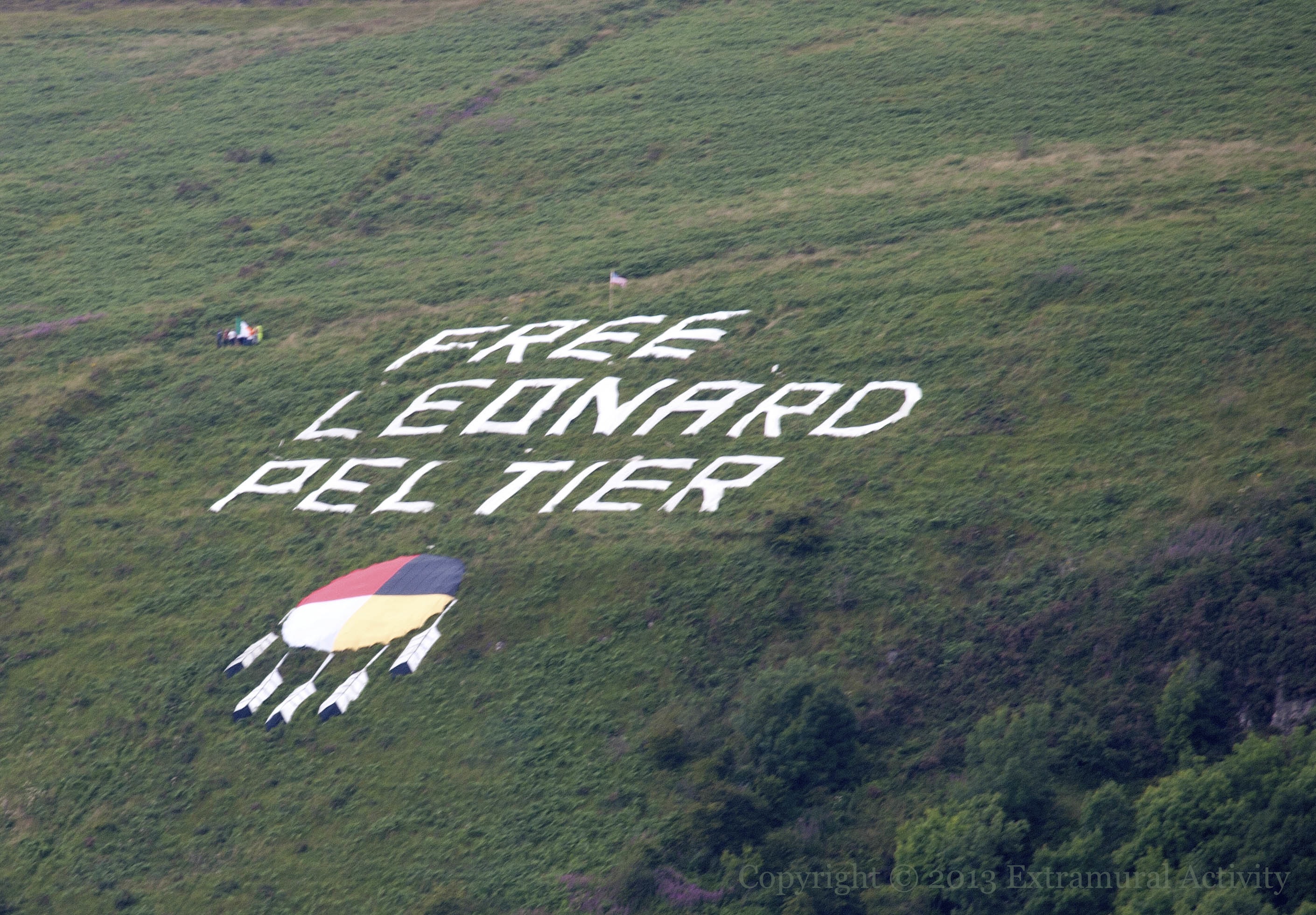
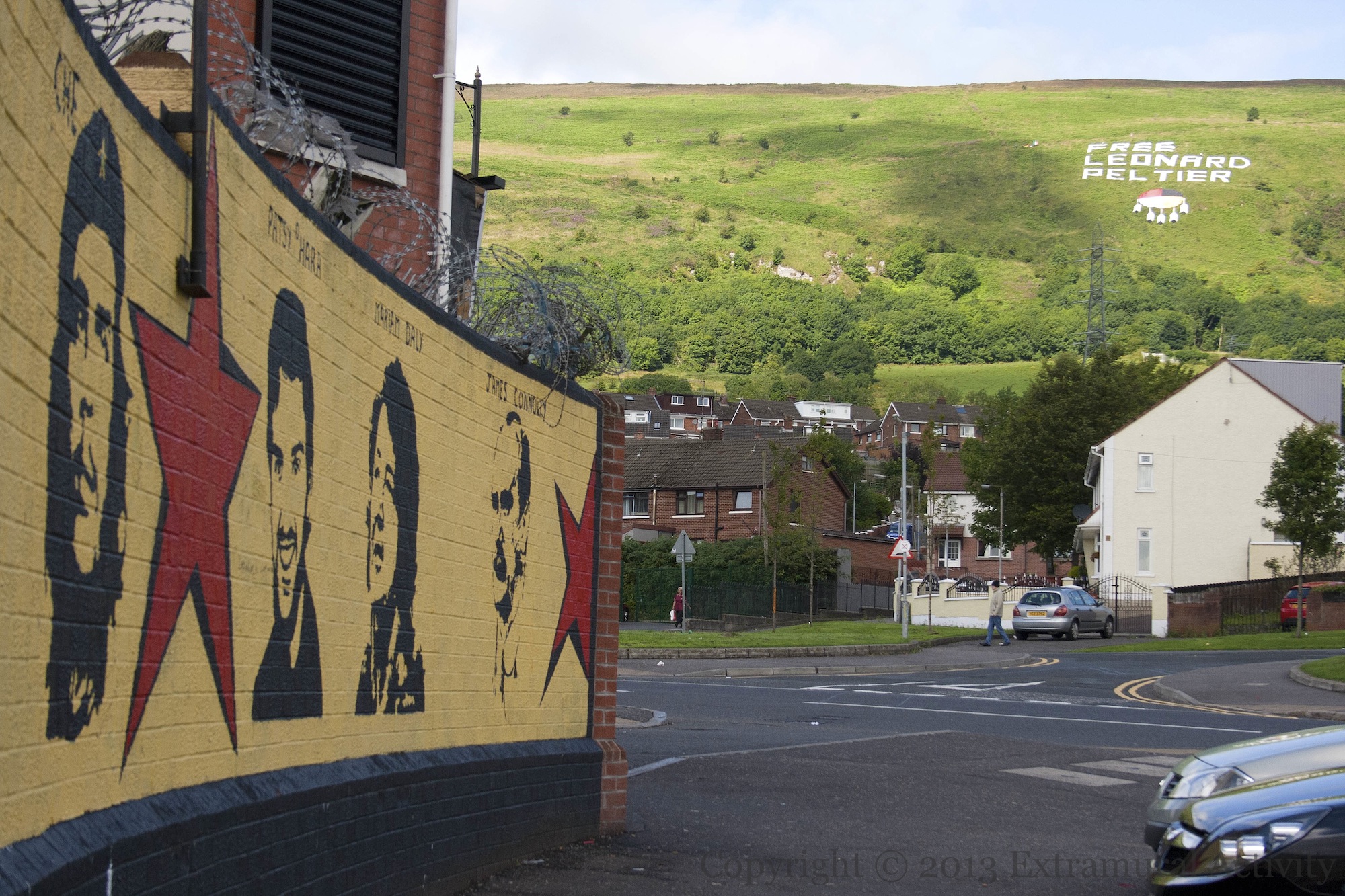
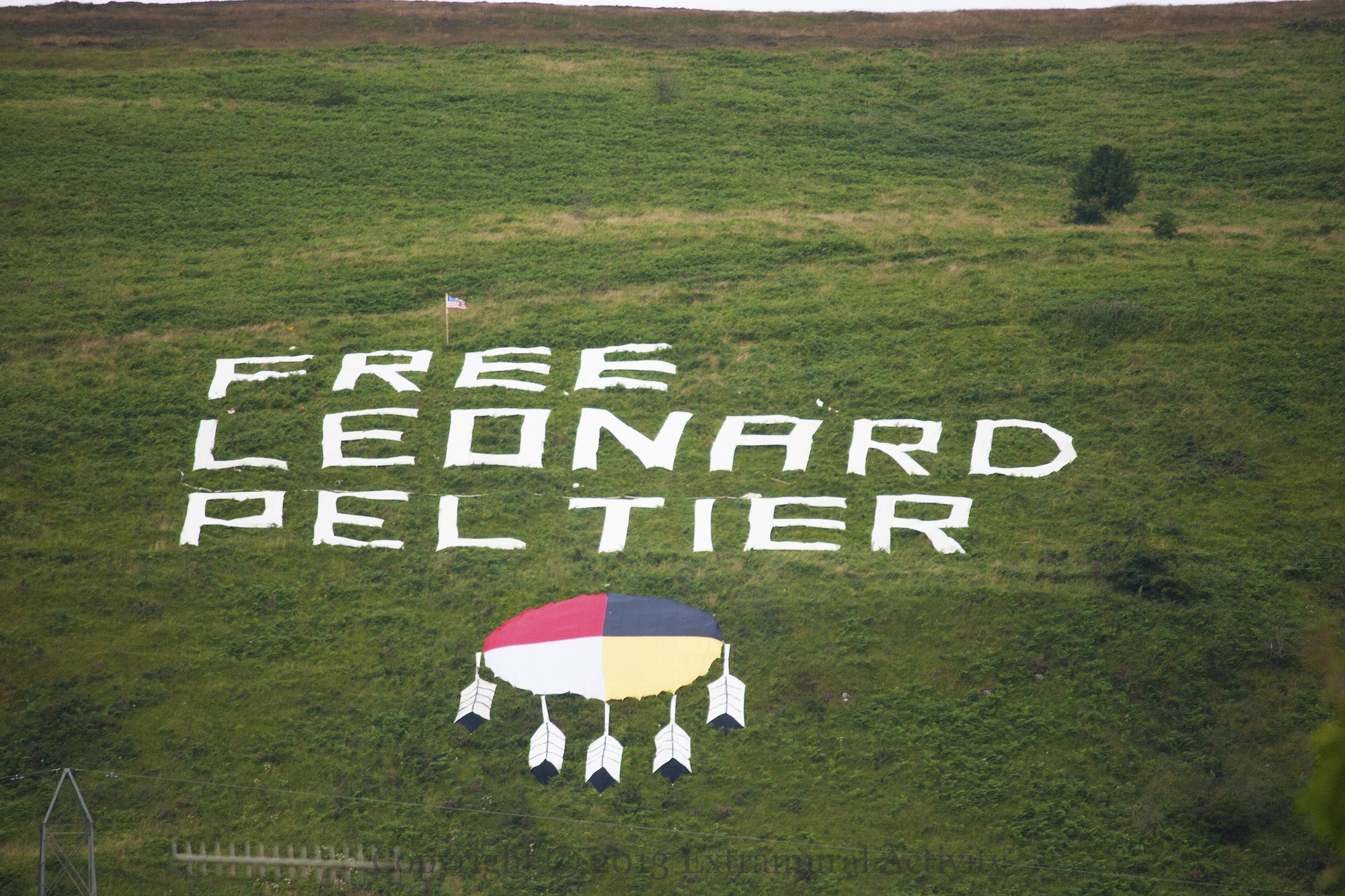
A message for the U.S. government on the side of Black Mountain this week, concerning the incarceration of Leonard Peltier for the shooting deaths of two FBI agents in South Dakota (WP). A U.S. flag flies at the top of the lettering, and the scale of the piece can be gauged from the small crowd of people standing off to the left. Below is a straight-on shot and, before that, a view from the corner of the shops at the Springfield/Whiterock junction.
The gable wall at the end of Columbia Street (on Ohio Street) has been rebuilt and the old WDA/Duke Elliott mural has been replaced. Above is the right side of the piece, which describes the transition from the Woodvale Defence Association to the Ulster Defence Association to the Ulster Freedom Fighters, and grounds all three in the Ulster Defence union of 1893.
In the second image, below, Ewart’s mill, on the Ardoyne side of the Crumlin Rd, can be seen in the background. From the WP page on the Crumlin Rd … “The mill was built for William Ewart, a cotton trader and politician who switched his interests to the production of linen, which at the time became the leading industry in the city. During the Second World War the mill was converted from the production of linen to the manufacture of munitions.” There is a statue diagonally across the street (at the corner of Cambrai and Crumlin Roads) of a millworker.
In 1971 in order to combat an increasingly aggressive republican movement, the WDA amalgamated with a number of other defence groups in form the UDA. This ensured a more organised and coherent response to the onslaught faced by the citizens of Northern Ireland.
The UFF was established in 1973 to take the war to republicanism. With tenacity, courage and resilience the members of the UFF distinguished themselves in battle by striking at the very heart of republican movement and ensuring that the attacks faced by their community didn’t go unanswered.
2013: The genesis of these groups can be traced right back to the formation of the UDU in 1893. Formed to resist Home Rule in the late 19th and 20th centuries, the UDU adapted the motto Quis Separabit. This motto was used by ulster defenders throughout the period known as “the troubles”.
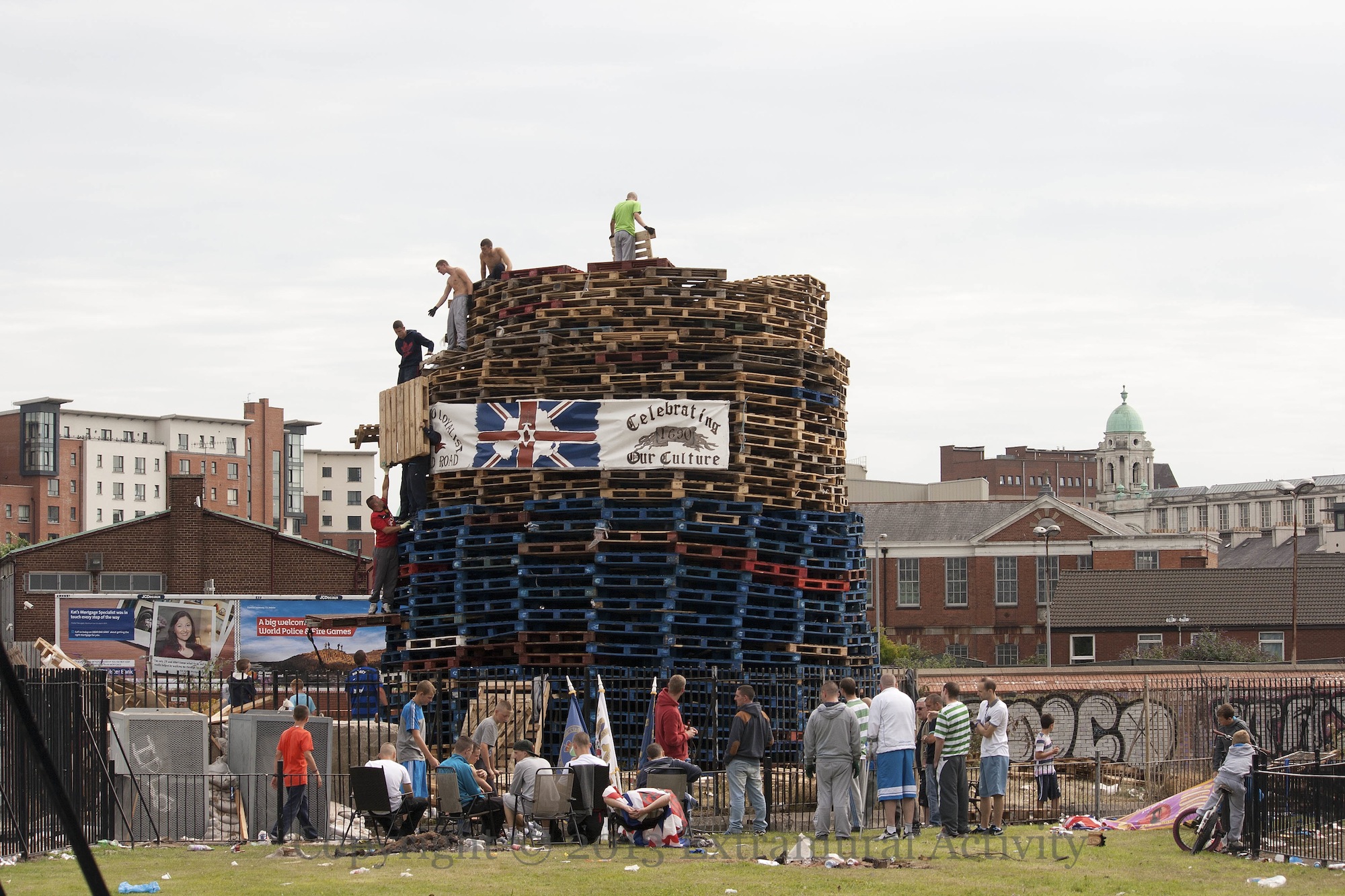
Three images of flags on two republican bonfires, built to commemorate the introduction of internment in 1971. According to news reports (e.g. BBC-NI), the ‘Celebrating Our Culture’ banner on this bonfire at the base of Divis tower had been stolen from Linfield Road in south Belfast (it hung to the left of the mural to the left in this image) but was subsequently removed from the bonfire (whether or not it was returned is not reported). The image above is from Thursday (Aug. 8th). (Last year’s bonfire also had stolen PUL banners: see M08775.)
The flag in the second image (an Ulster flag with a tricolour in the corner and the words ‘The Only Ulster’ on the bottom) was on the Divis bonfire during construction on Wednesday but removed by Thursday. The third image is of a bonfire in Beechmount (between Corpus Christi and St. Paul’s schools) flying the flags of various loyalist groups, as well as the Union flag and the Northern Ireland flag.
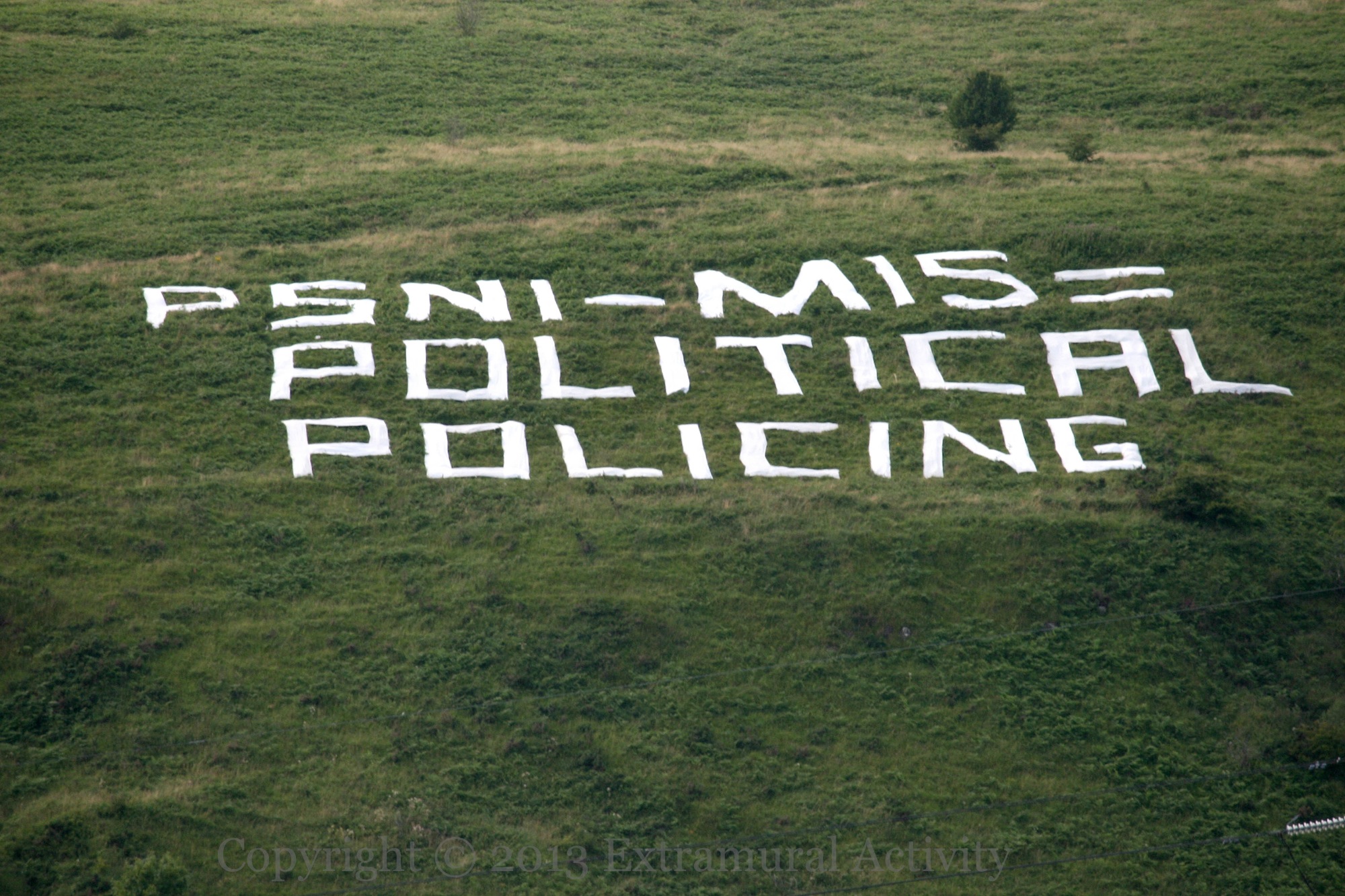
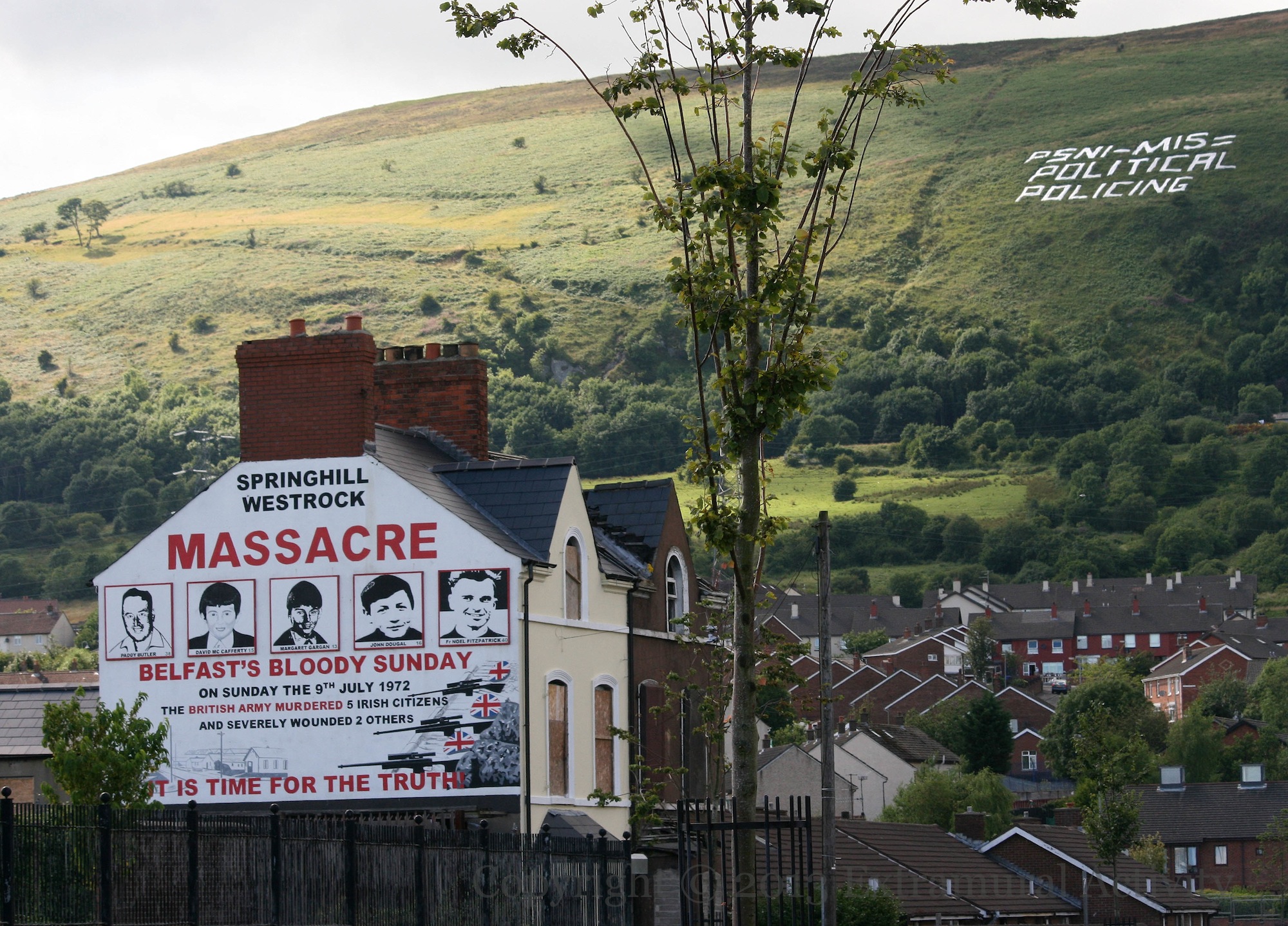
Above is the latest political slogan to appear on Black Mountain, over New Barnsley and Ballymurphy: PSNI-MI5 = Political Policing, referring to the presence of British Military Intelligence in Northern Ireland. The Springfield Road barracks is in the right foreground. A close-up and the view from the other side of the road can be found below.
The lettering went up on August 1st and was down no later than the 7th. A new sign is supposed to go up today (Aug 9th), in support of Leonard Peltier, according to the Gaelforce facebook page.
Poster from the 1916 Societies (Fb), specifically the West Belfast Joe McKelvey Society, named after the anti-treaty IRA commander (WP). (There is also a society named after McKelvey in his home town of Stewartstown, Co Tyrone. (Fb)) The flag (shown below) is in the Republican Museum, Conway Mill.
“No blacks, no Irish, no dogs, no POWs – sponsored by SDLP/TUV” (Traditional Unionist Voice). The reference of this board in Turf Lodge is a June motion in the NI Assembly to bar anyone convicted of a serious offence from serving as a ministerial adviser (the trigger case being Mary McArdle). Passage of the bill was secured when SDLP members supported the motion.
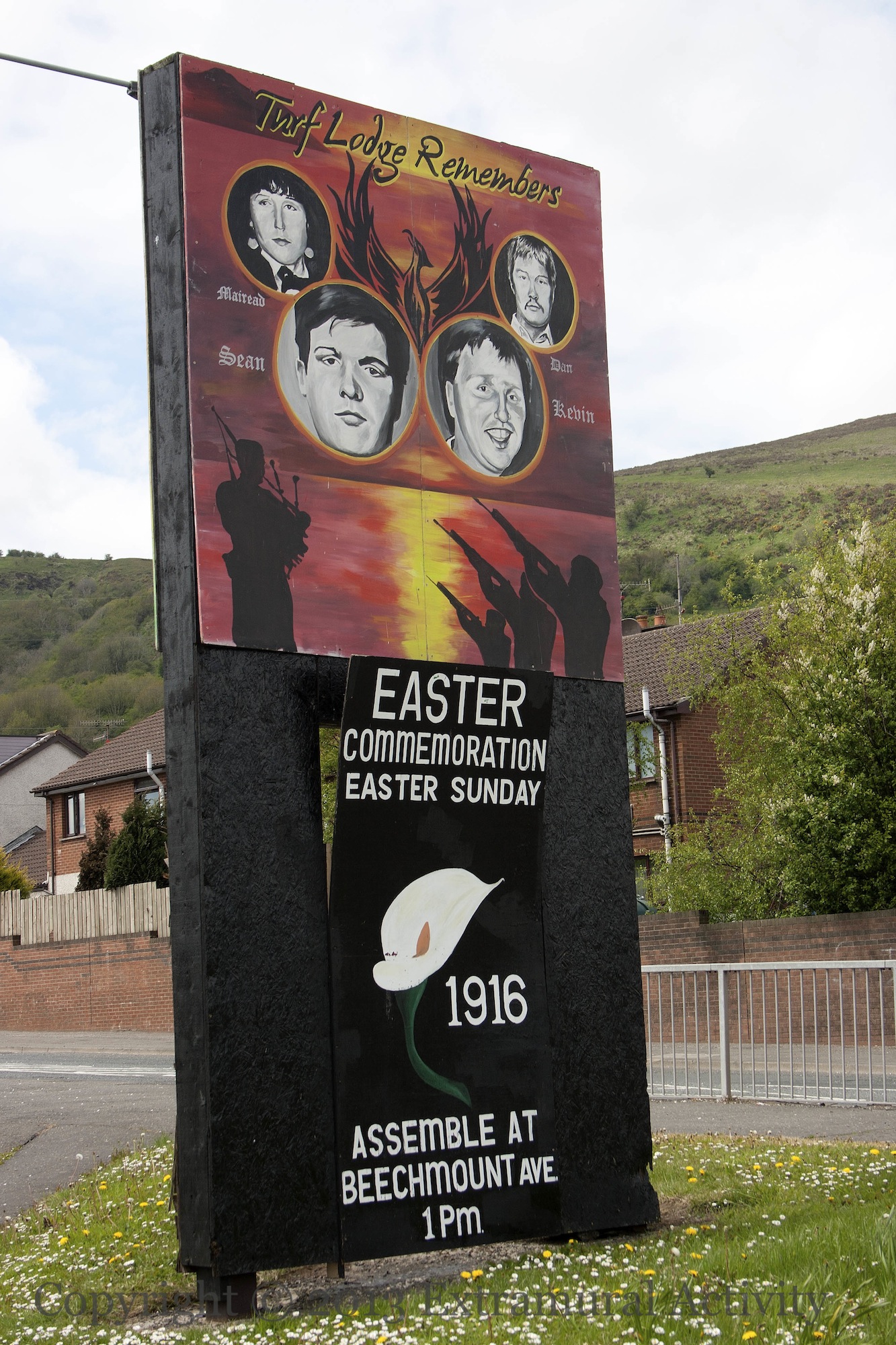
The eastern side of the H-Block ‘H’ at the top of Monagh Road as it was in May, 2013, with a board in memory of the Gibraltar three (Dan, Mairead, Sean ) and another volunteer killed a few days later (Kevin) (for background, see both 25 Years In Progress | Completed) and announcing an Easter Sunday rally commemorating the 1916 Rising.







 Extramural Activity