“A scramble for the window seat/Steam curls as the whistle blows/Clickety clack train on track.//Remember your neighbourhood in the late afternoon sun/The district was a different place then/All you owned was a box full of toys and a smile on your face.”
The York Road railway station was a few minutes’ walk below Ritchie Street – site of this mural and community garden – until it closed in 1992. The original line was to Ballymena and then Coleraine and London-/Derry, with service to Carrick and Larne added later. It was badly damaged in WWII and its final demise came with the opening of Belfast Central in 1976 (WP). It was replaced with Yorkgate in 1992 which no longer serves as a terminus (WP), but the line still runs along behind the end of the streets along York Road and the Grove area of the Shore Road.
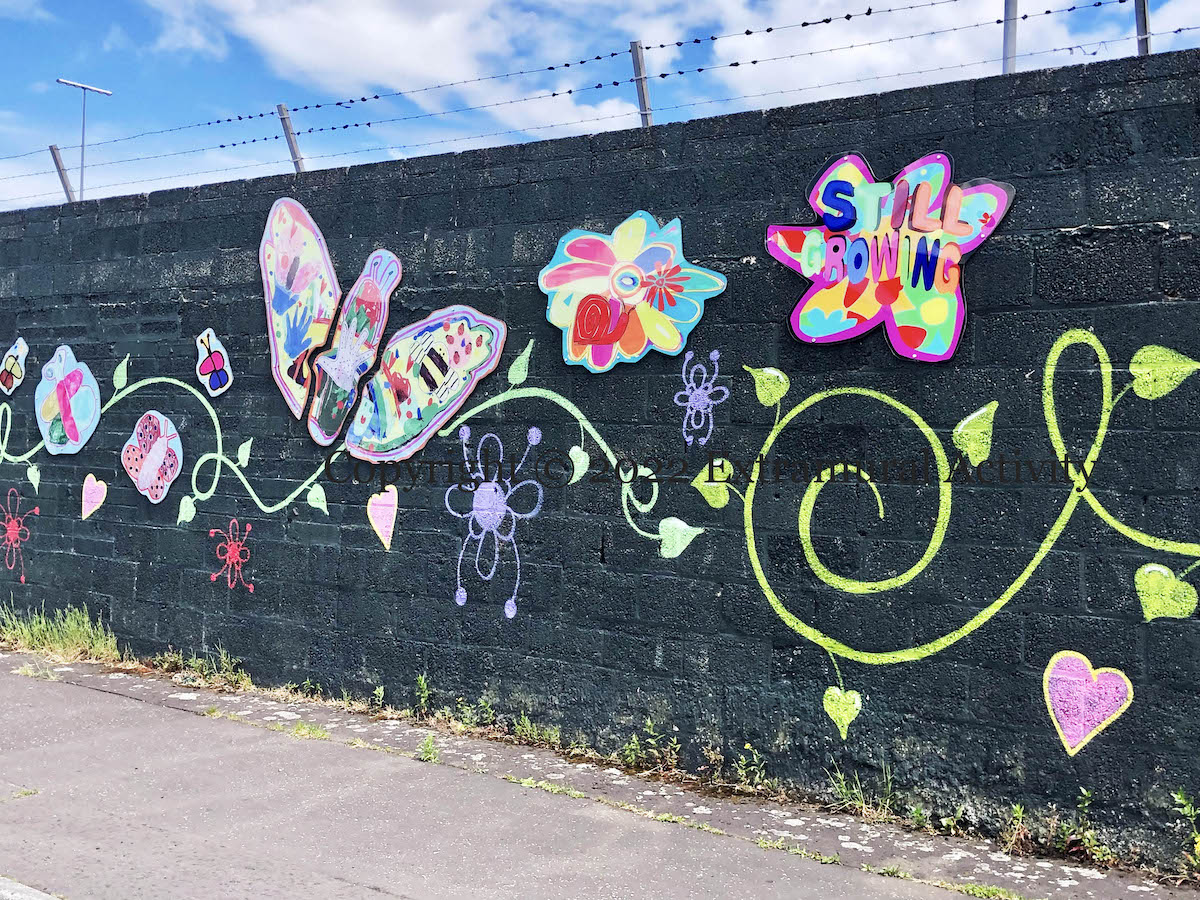
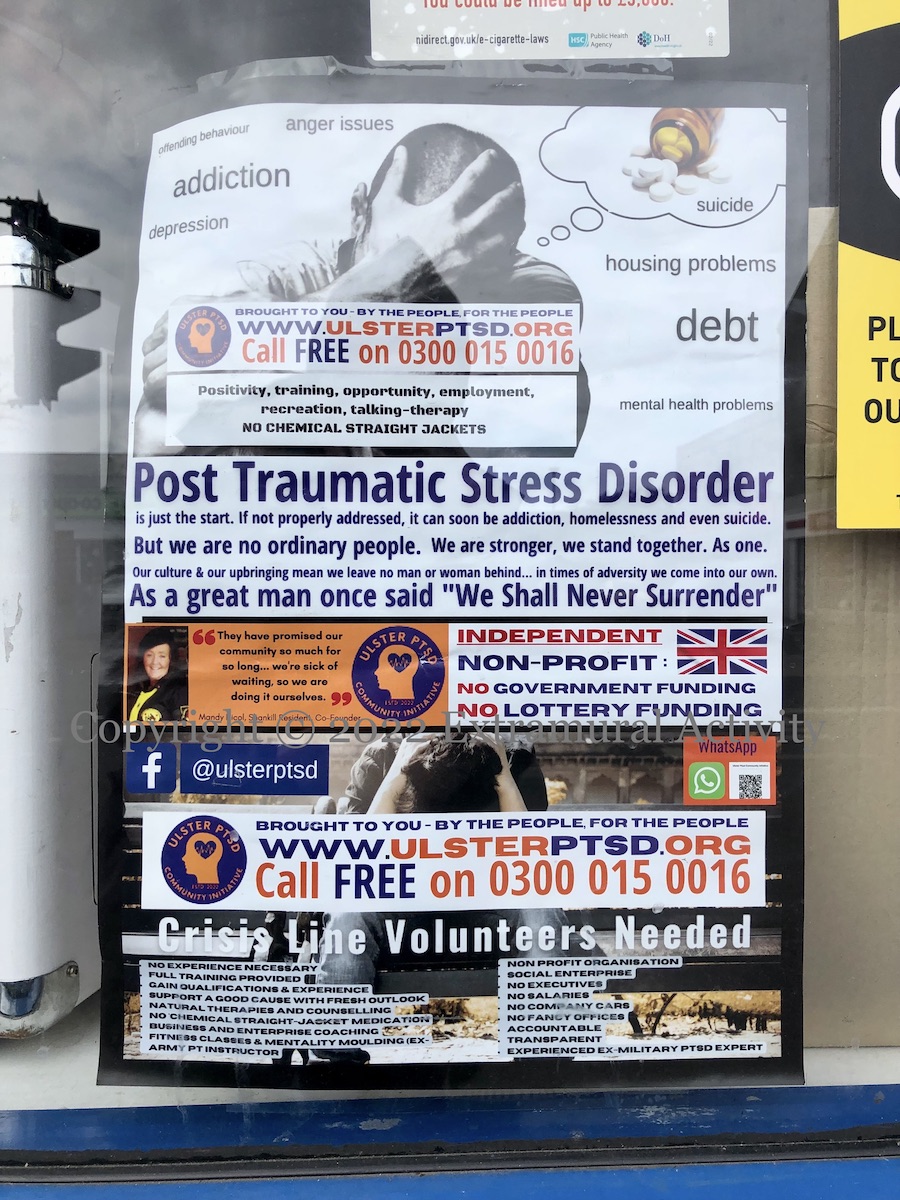
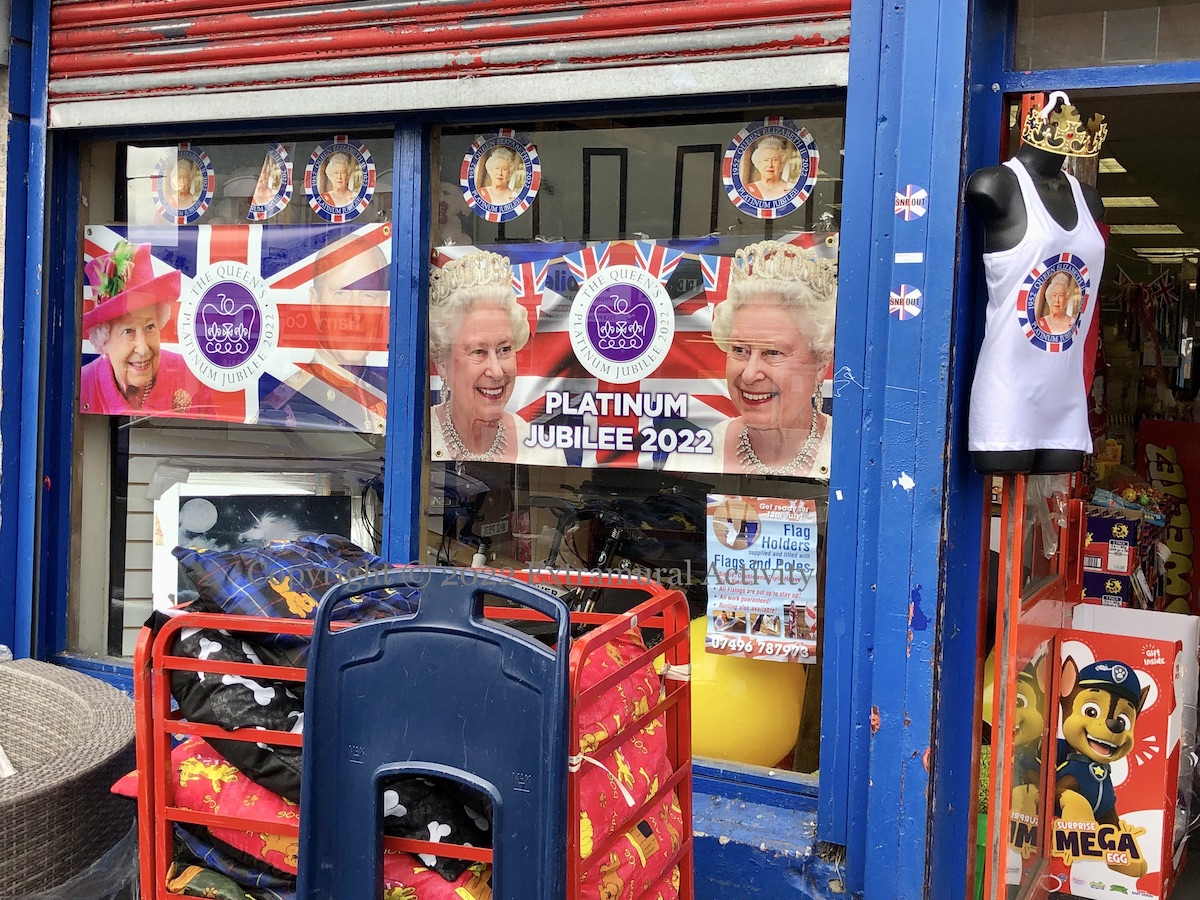
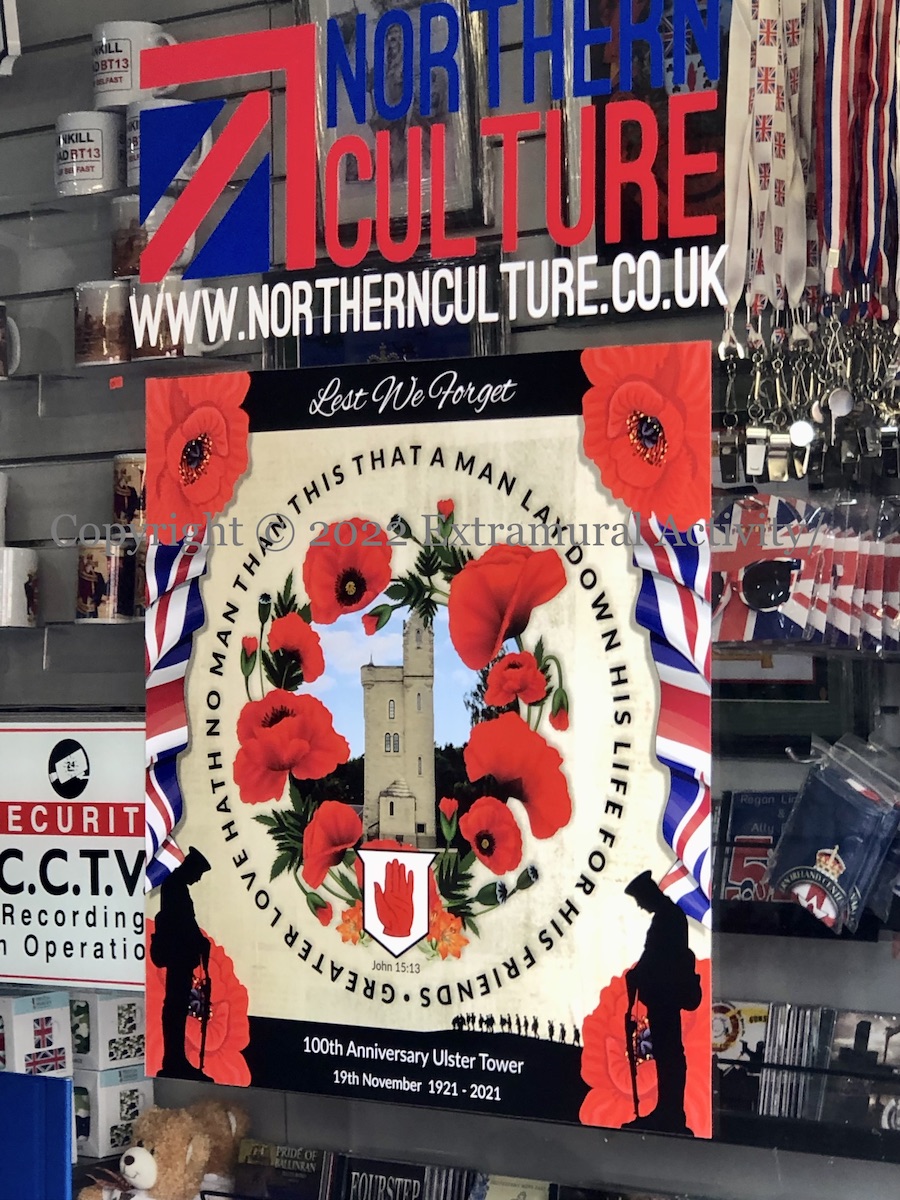
An Orange parade to celebrate the centennial of Northern Ireland – postponed last year on account of the pandemic – will take place today, with roughly 130 bands marching from Stormont to Belfast city centre (Belfast Live). There is not much indication of the parade in posters or murals, perhaps because the anniversary itself has passed. If we read the community’s concerns from the displays in the window of this Shankill Road shop (just above the old Beresford St and the Mussen Cortège mural), they include the NI centenary and the murder of Lee Rigby (WP) (image above), PTSD (second image), the upcoming platinum jubilee of Queen Elizabeth (third) – we will have more jubilee photos over the coming week, and the centenary of the Ulster Tower WWI memorial (see e.g. Our Heritage In Your Hands).
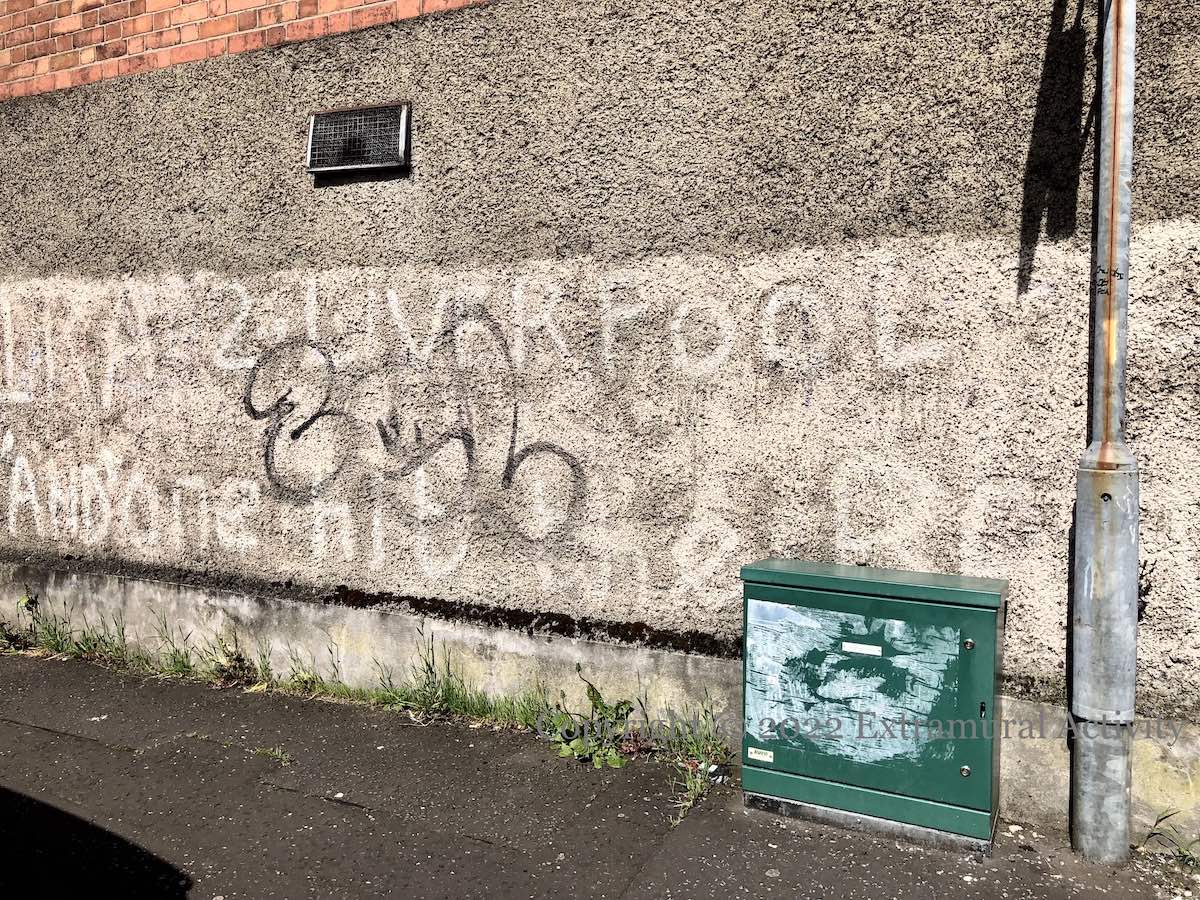
“IRA 2, Liverpool 0, and one hit the bar.” This is 35-year-old graffiti that seems to be more durable than the paint that was used to white it out.
In 1987 IRA gunmen burst into the Liverpool Bar & Lounge on Donegall Quay – named for the nearby ferry terminal to Liverpool (Belfast Forum) – and killed two off-duty RUC detectives – Michael Malone and Ernest (Stanley) Carson – and injured two others (AP). The case came back into the public eye In 2016 when a man was arrested in connection with the shooting (RTÉ | News Letter); he was later released (BBC).
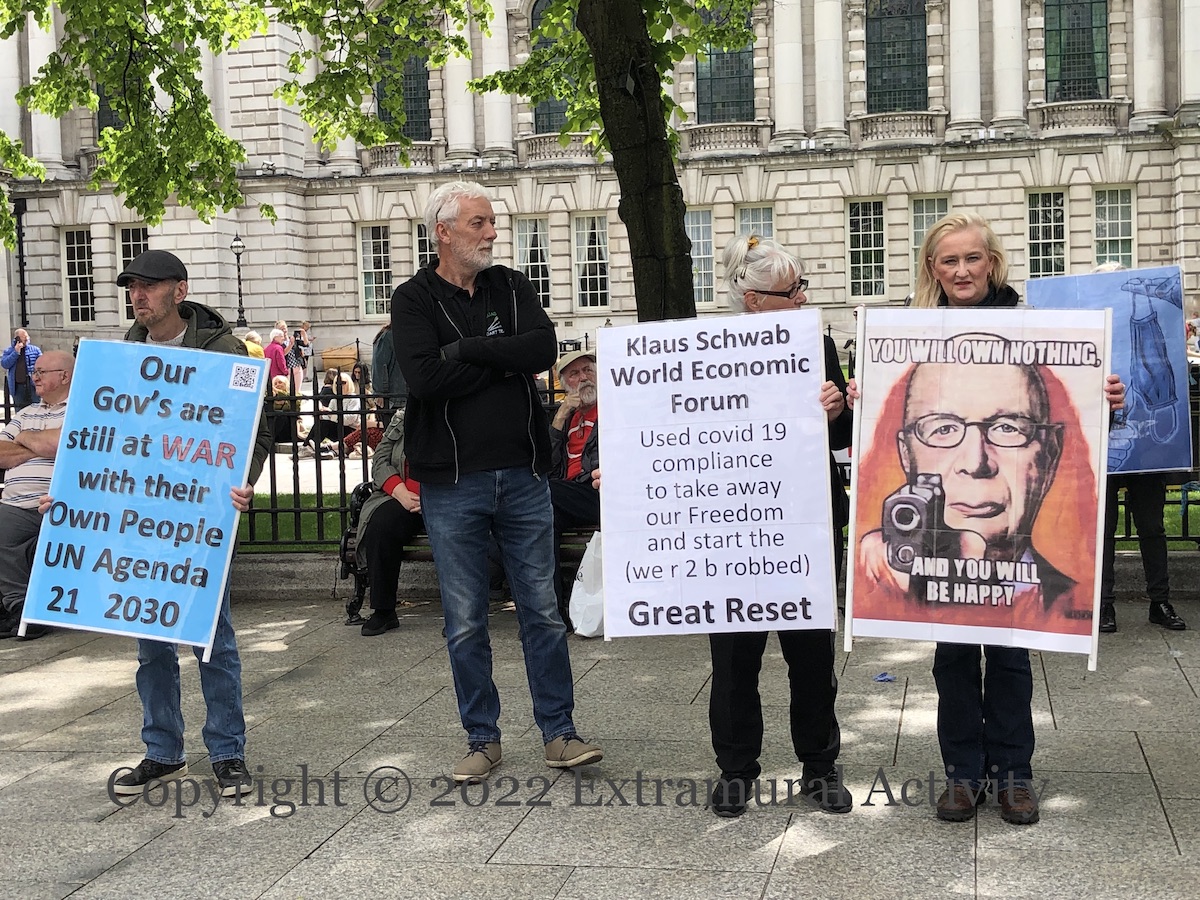
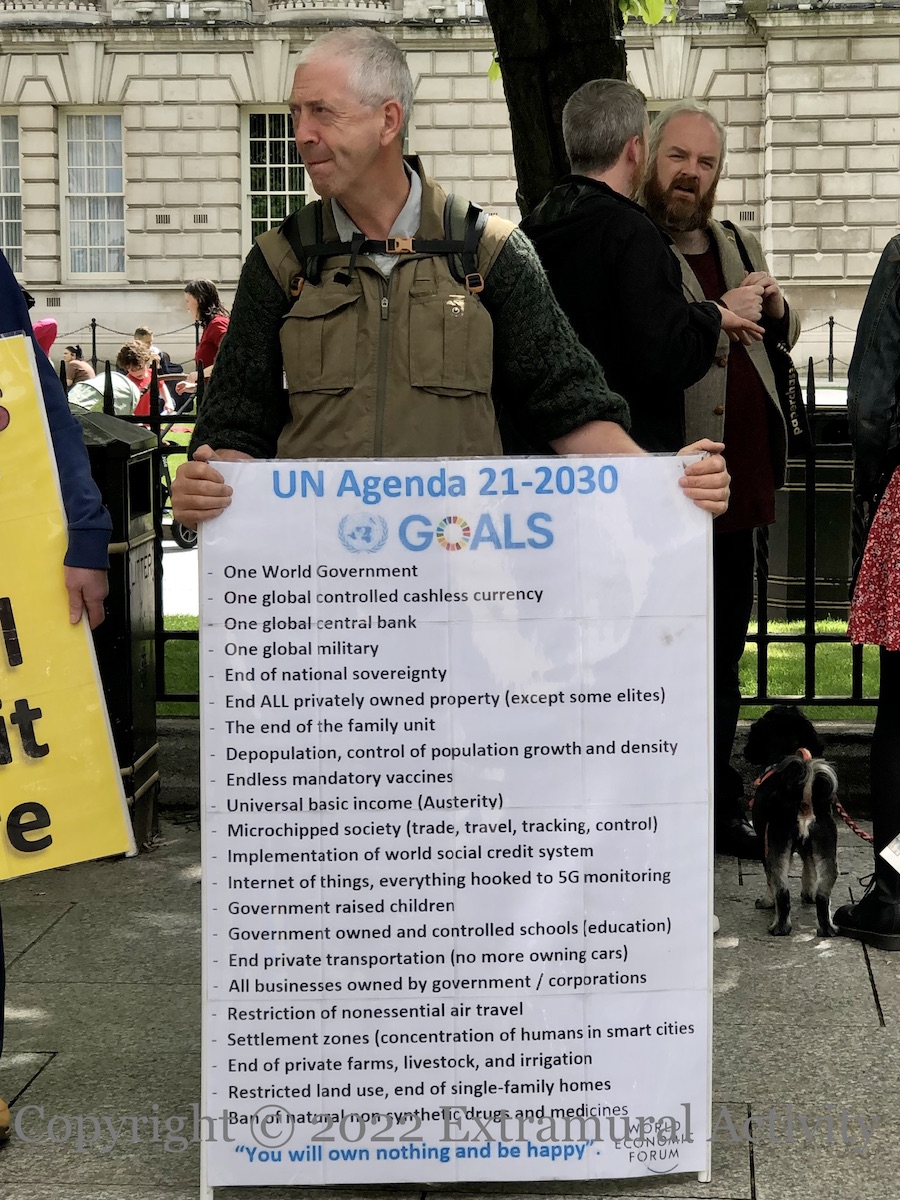
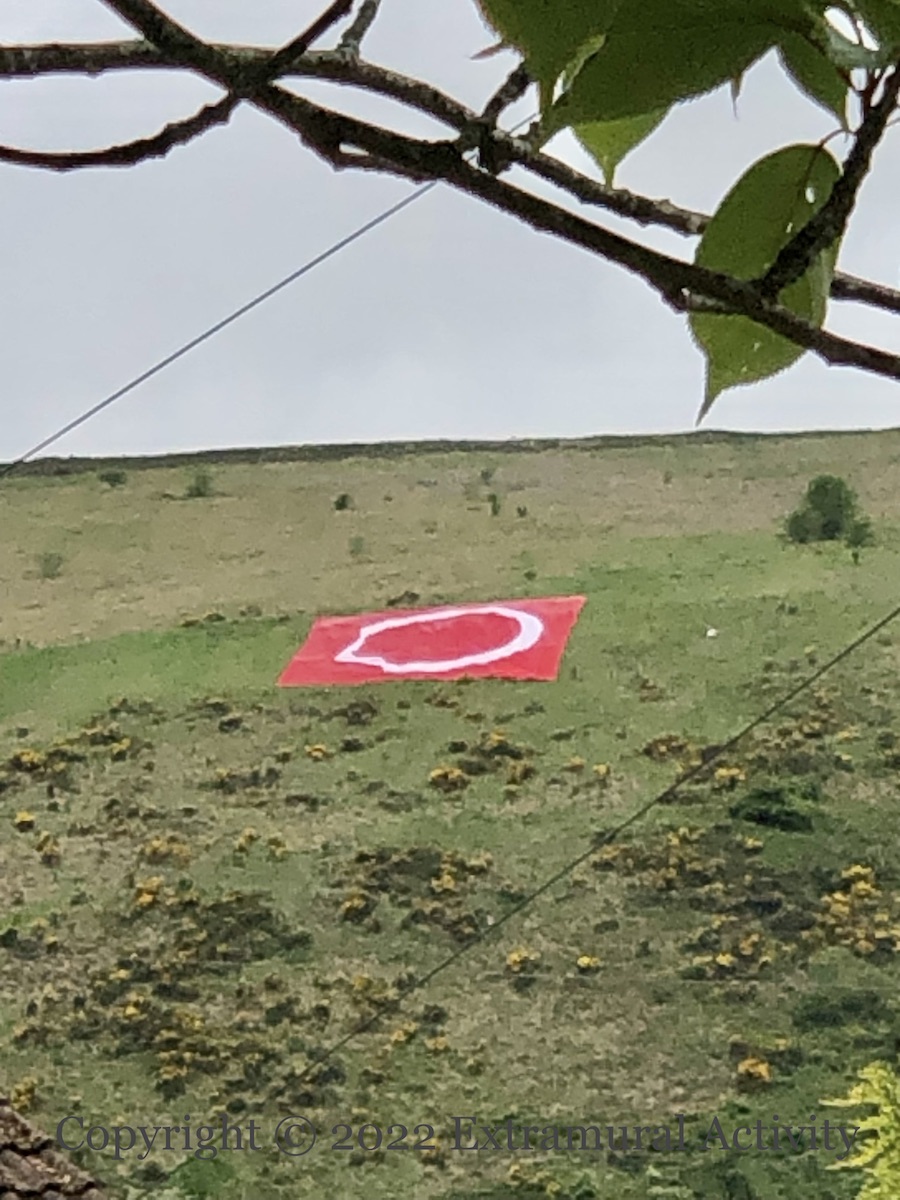
While 17,000 people in red t-shirts – many of them young (see image below) – were marching for an Irish Language Act (Acht Gaeılge) (BBC | Belfast Live | BelTel | youtube video | organised by An Dream Dearg tw), a dozen grey-hairs were outside city hall protesting the 2022 meeting of the World Economic Forum (which ends tomorrow in Davos). Among the … hypotheses … presented: “Zi great rezet needs war” (a German-ised – and thus more sinister – version of The Great Reset (WEF video); “Pfizer knew their vaccine would kill” (a headline from The Light newspaper); a cashless society will mean a social credit score; devices on the internet of things will be hooked up to a “5G monitoring system”; UBI is “Austerity”; an end to privately-owned businesses; an end to single-family homes; a global government, currency, central bank, and military; an end to all privately-owned property (more threateningly put as “You will own nothing and you will be happy” (meme) at the barrel of a gun).
Today’s post is bookended by two images of the emblem of An Dream Dearg – a white ring or fáınne on a red background – flying over the top of the ‘Rock and on Slıabh Dubh.
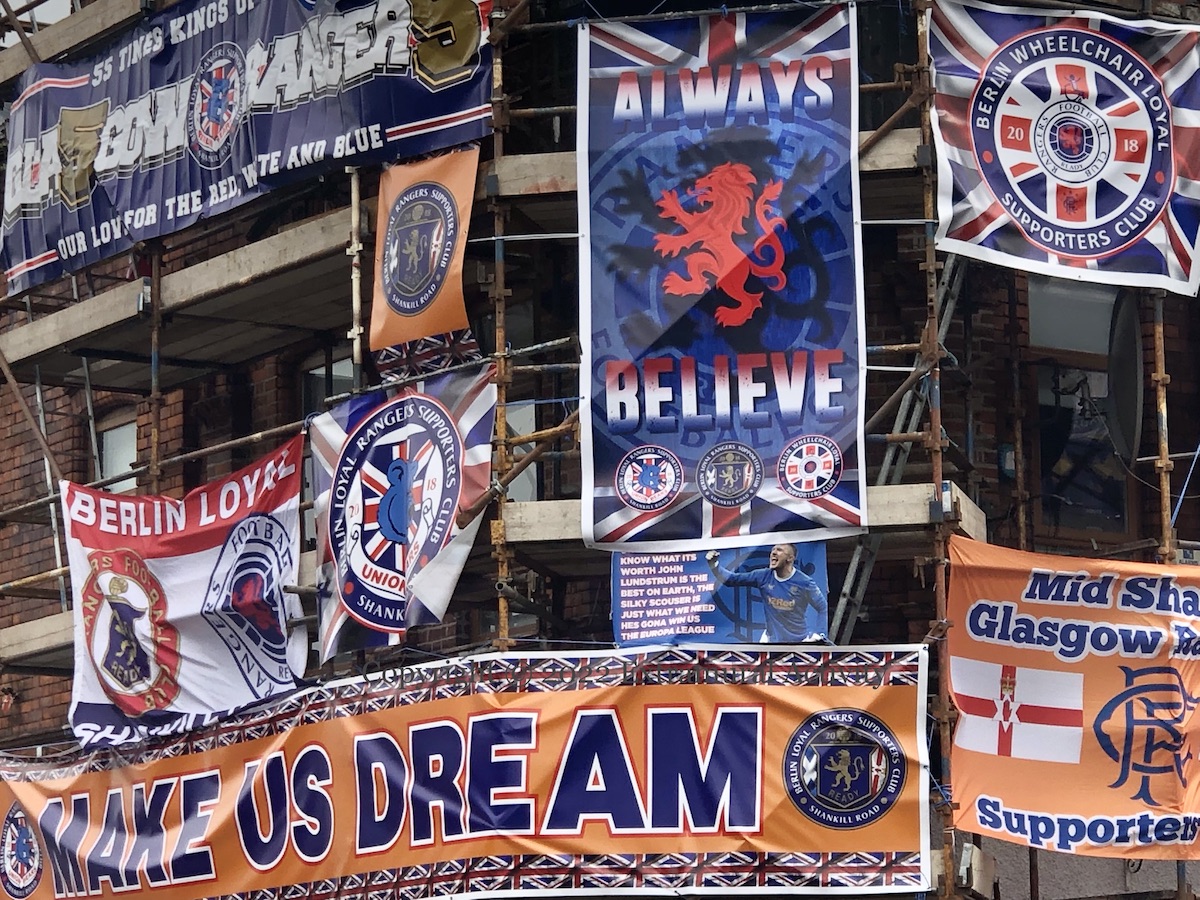
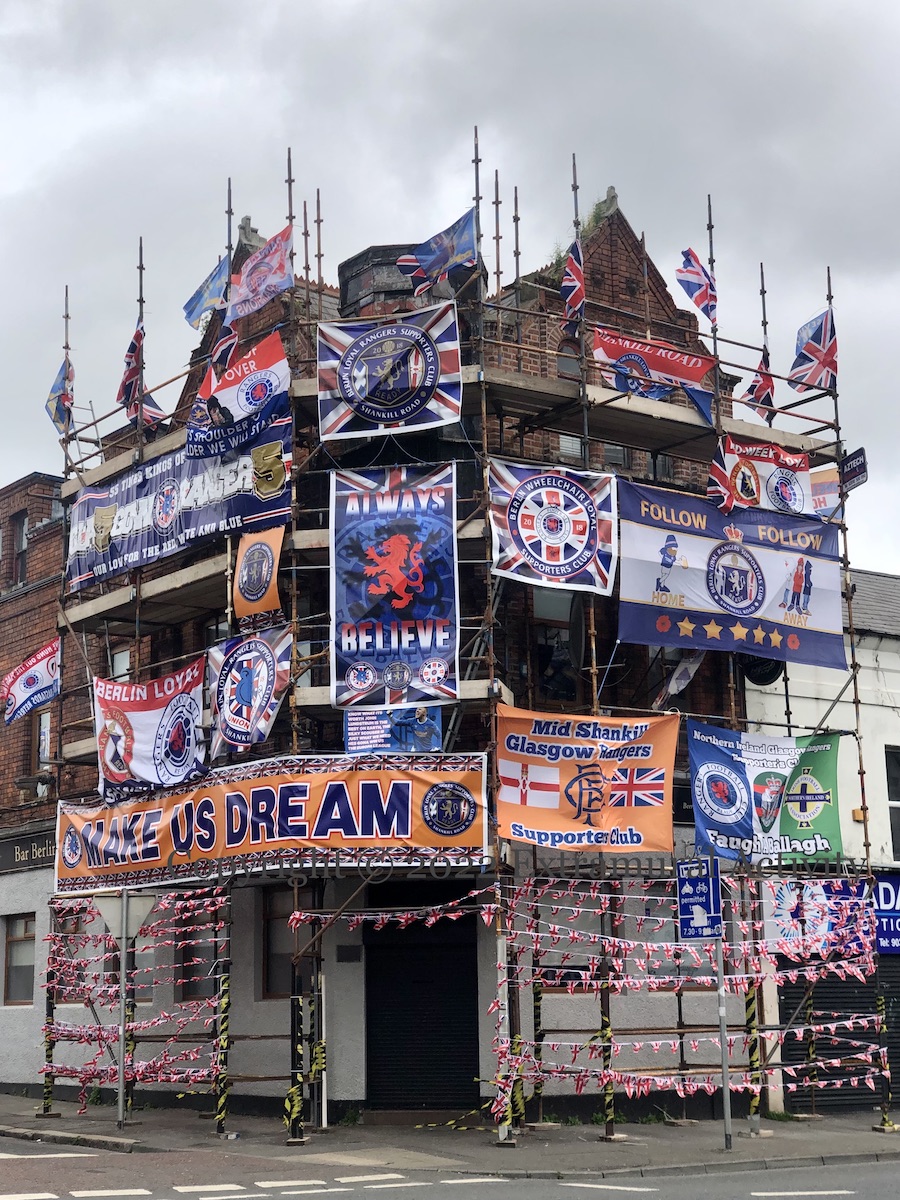
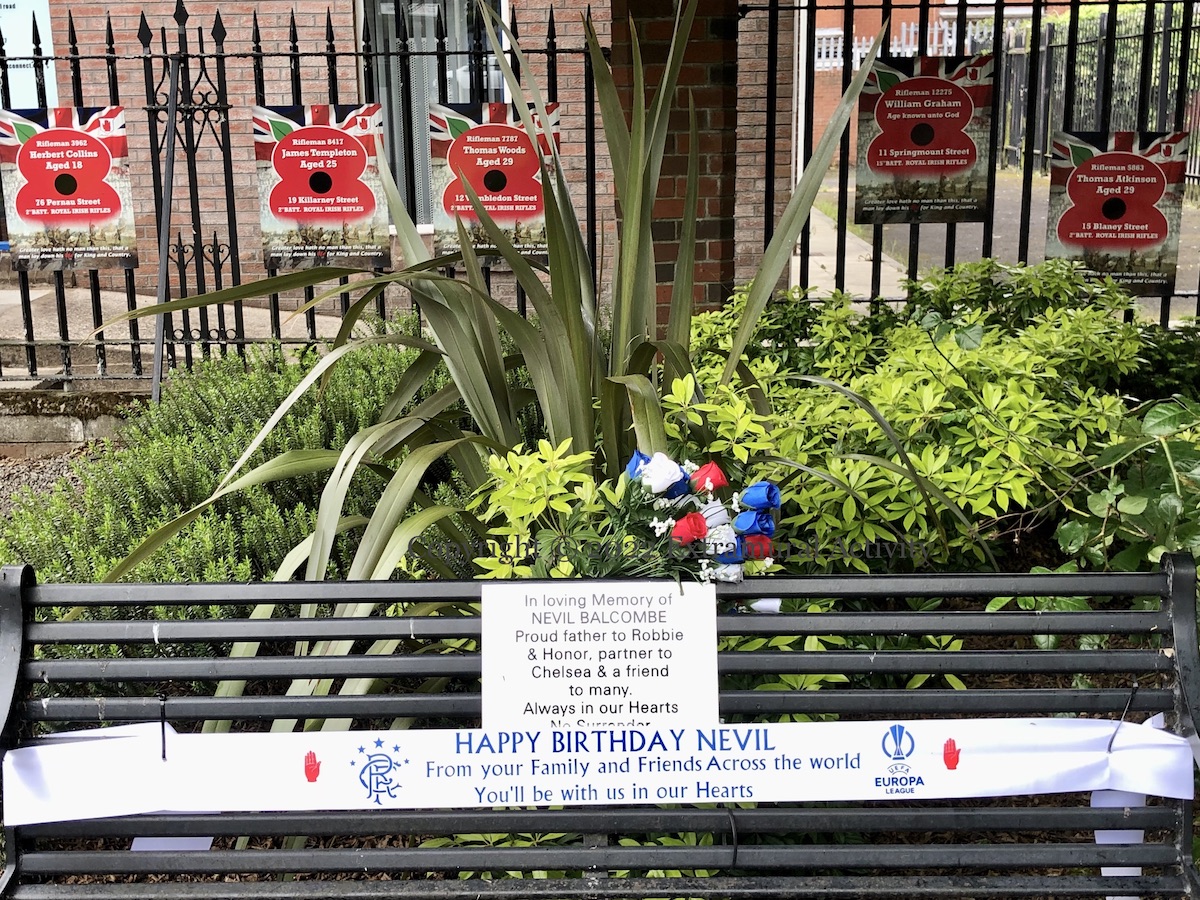
There was plenty of support in Belfast for Scottish club Glasgow Rangers as they travelled to Seville last week to compete in the Europa League (previously the “UEFA Cup”) final – the initial images in today’s post show a huge number of banners outside the Berlin Bar on the Shankill (see previously Inter City Regiment), a scarf in the West Kirk Presbyterian (Fb) graveyard (see Who Went To War And Never Returned), and – on the Shore Road in north Belfast – the flag of the Netherlands pressed into service for its red, white, and blue.
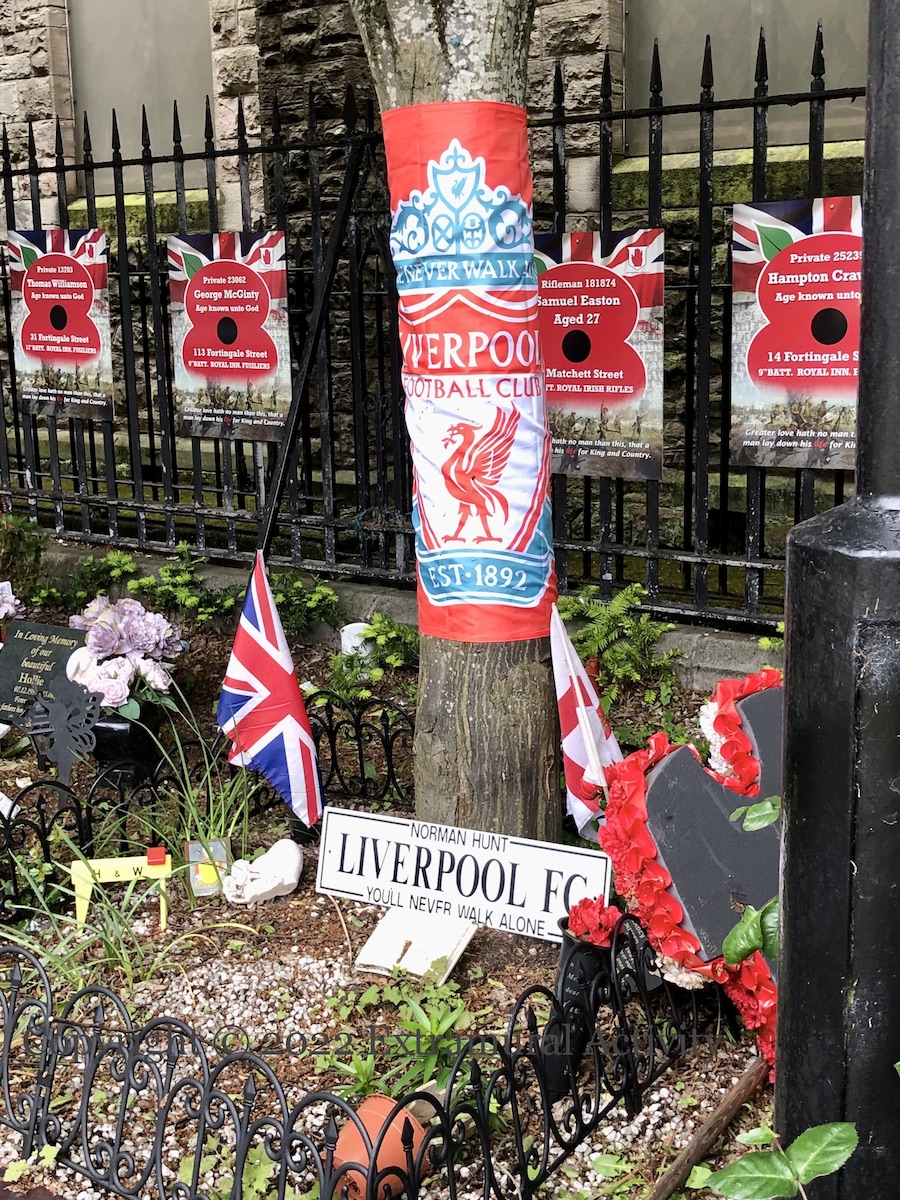
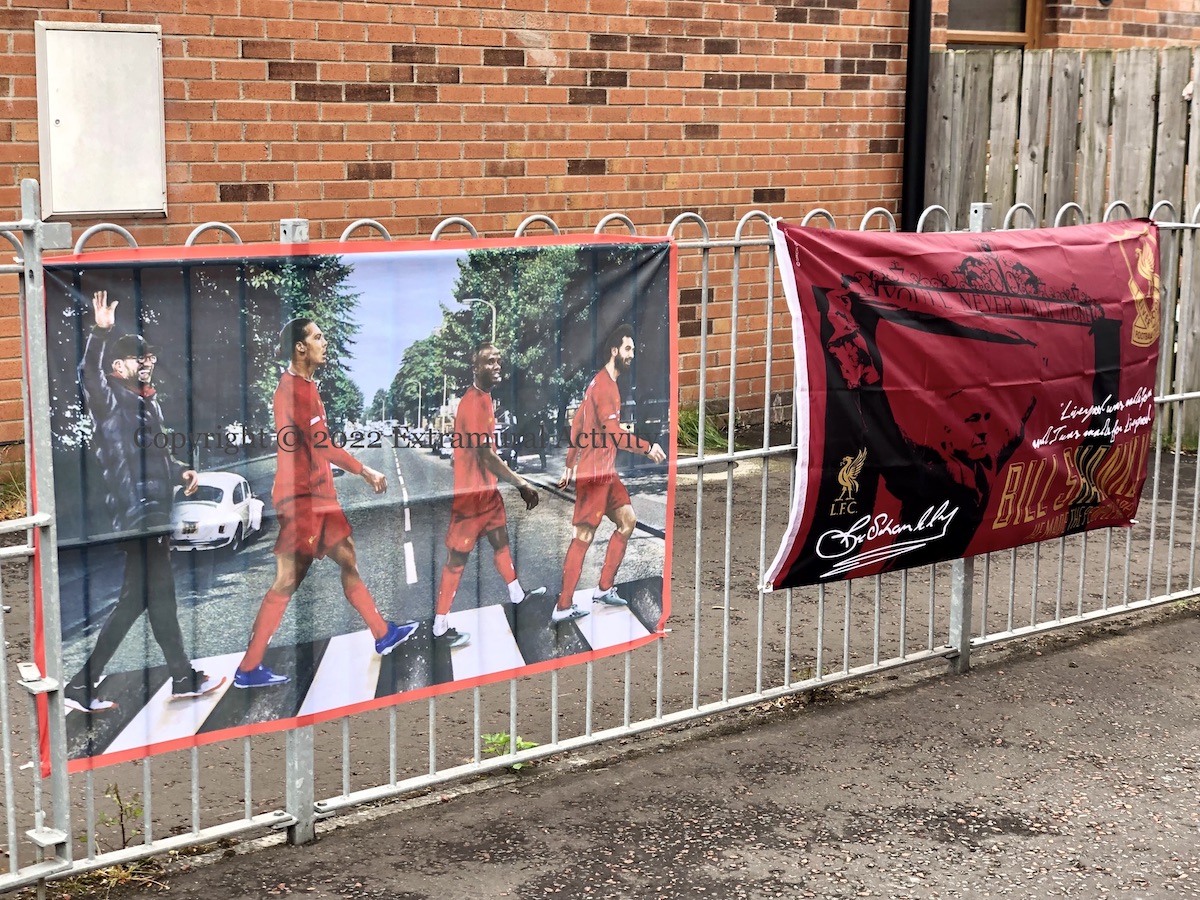
Rangers lost on penalties to Eintracht Frankfurt and attention now turns to Liverpool’s match against Real Madrid this Saturday in the Champions League final in the Stade De France in Paris. There is already some support for Liverpool on display in Belfast, as illustrated by the West Kirk graveyard (again) and a flag of the manger and stars à la Abbey Road in the Village (south Belfast) – the “Fab Four” are manager Jürgen Klopp of Germany, and players Virgil Van Dijk of The Netherlands, Sadio Mané of Senegal, and Mo Salah of Egypt. Here is a list of all the Liverpool supporters clubs in NI.
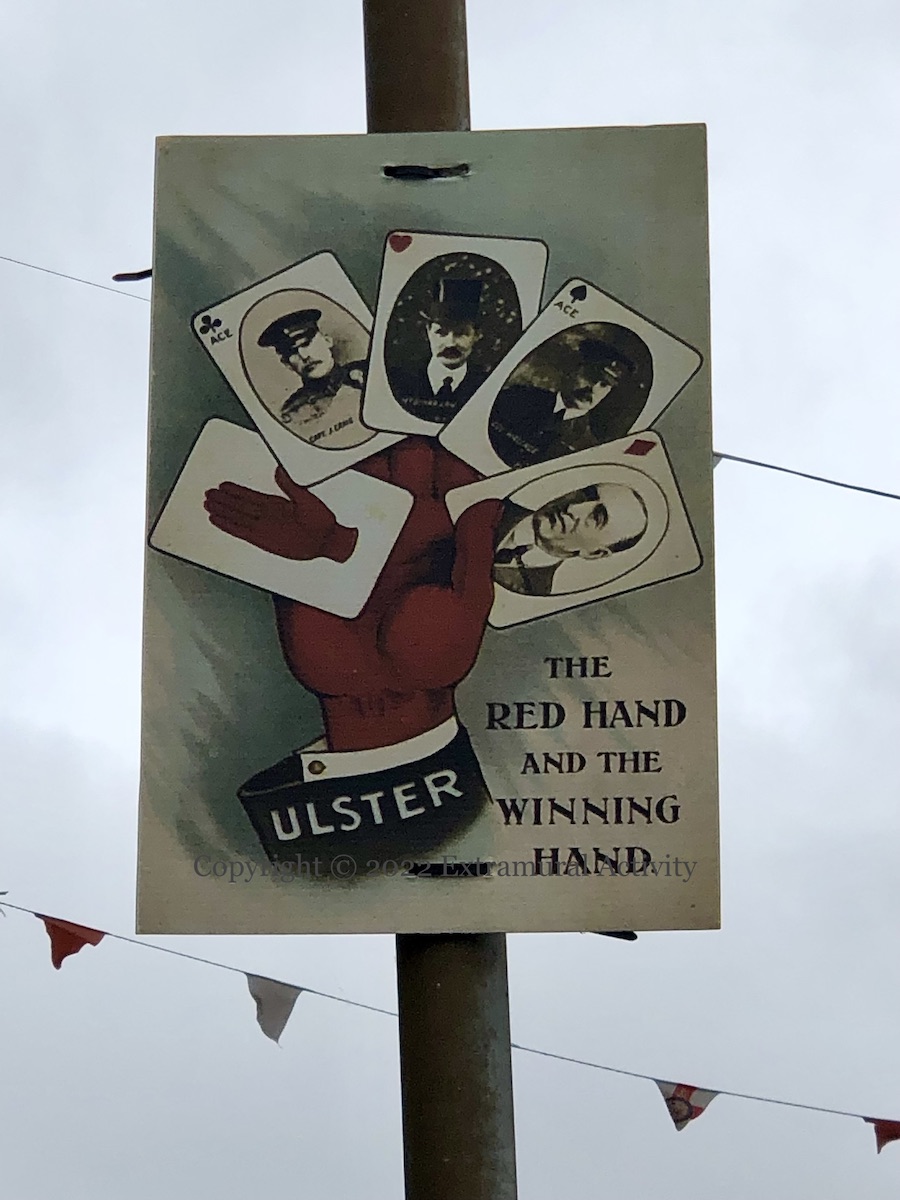
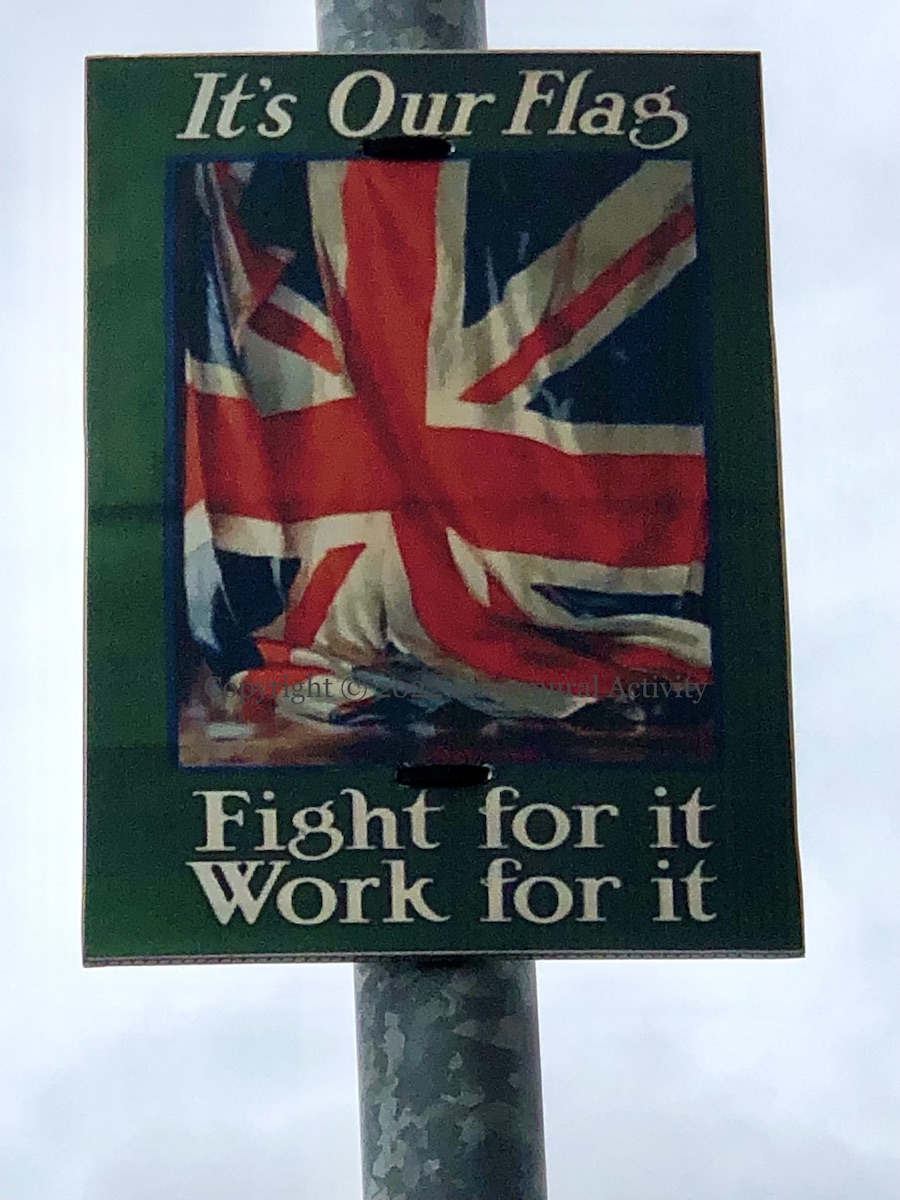
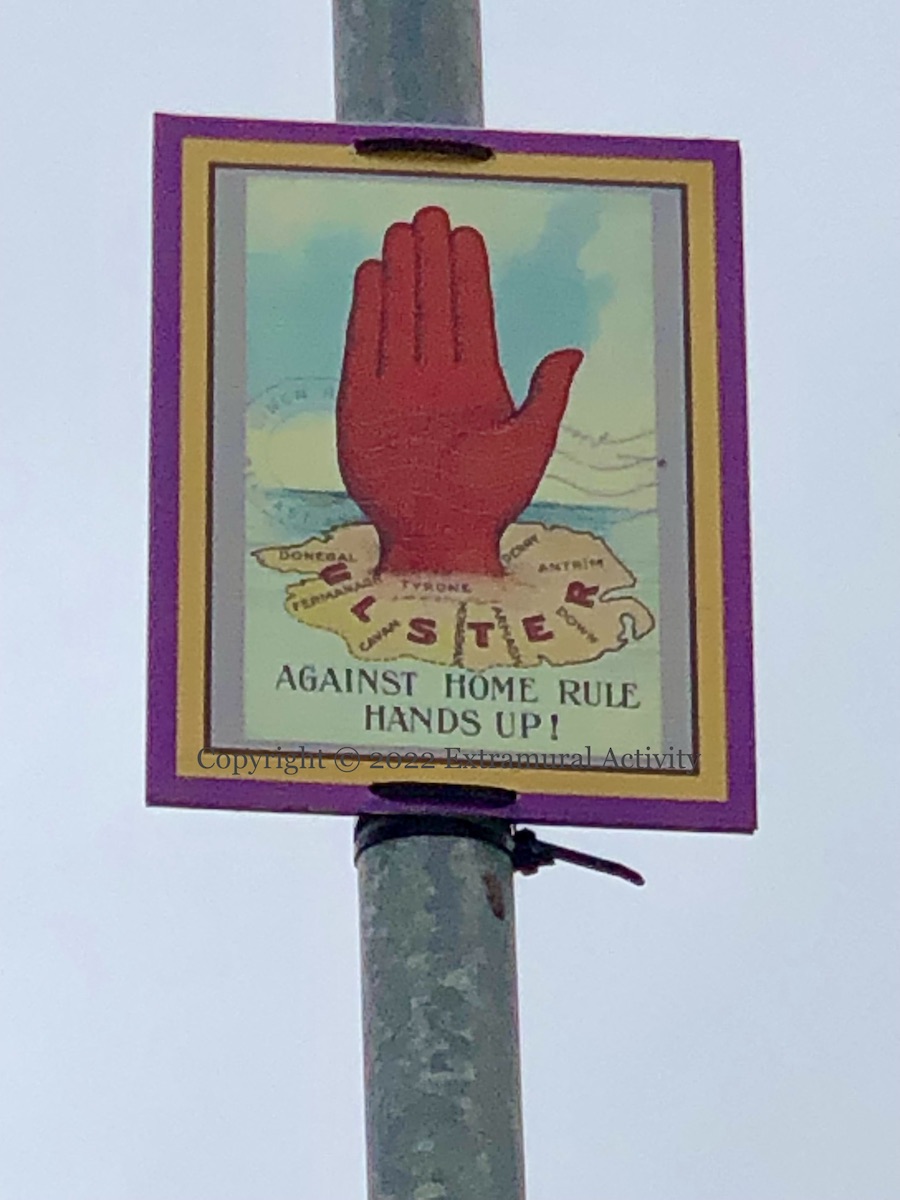
Three images of Home Rule vintage are resurrected on Village lamp-posts to fit the situation of the current moment:
“The red hand and the winning hand” is an anti-Home Rule postcard (NMNI) featuring Craig, Bonar Law, Wallace, and Carson as the four aces, in addition to the red hand itself as joker or wild card. Carson and Craig need no introduction; Andrew Bonar Law was the leader of the (opposition) Conservative Party at the time of the third Home Rule bill (WP), while Colonel Robert Hugh Wallace was grand master of the Belfast Orange Order and as such the main organiser of protests against the bill (DIB).
“It’s our flag – fight for it, work for it” is an Australian recruitment poster from WWI (NMNI).
“Against home rule – hand up!” shows a nine-county Ulster, including Donegal, Cavan, Monaghan (and “Derry”) with the red hand emanating from Tyrone, the Red Hand County, symbol of the O’Neills (WP).
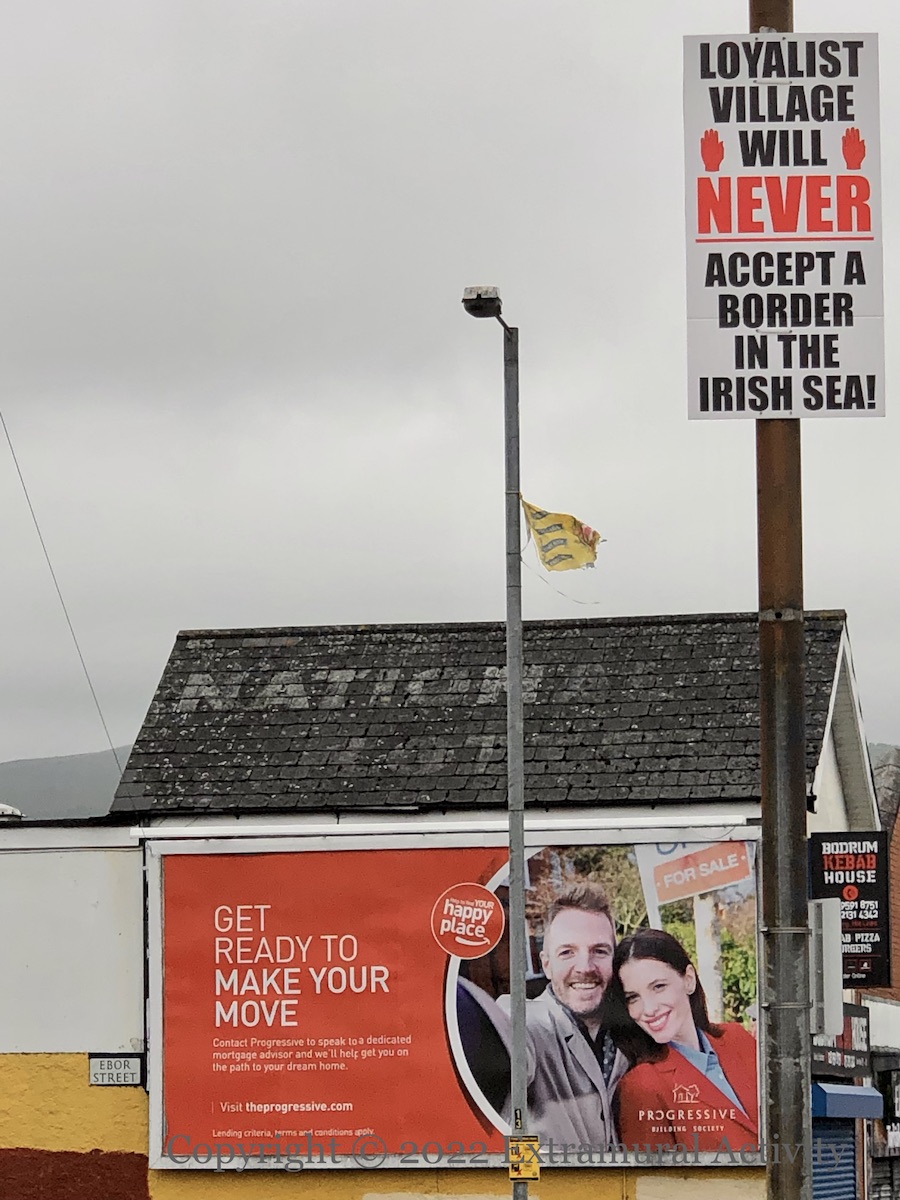
Here are two signs of protests at the NI Protocol along with the third version of graffiti complaining about parking spaces being taken by people working at the Boucher Road complexes. The original version (in 2020) threatened that “your car will be burnt” (Street View). It’s not clear whether it’s new construction or existing businesses that are the target, though the Boucher Road area has been busy, with a refit of B&Q (BelTel) and new Lidl being built next to the Olympia (BelTel) (not to mention the stage for the Ed Sheeran concerts (Newsletter)).
“Loyalist Village says NO! to an Irish Sea border”, “Loyalist Village will never accept a border in the Irish Sea.”
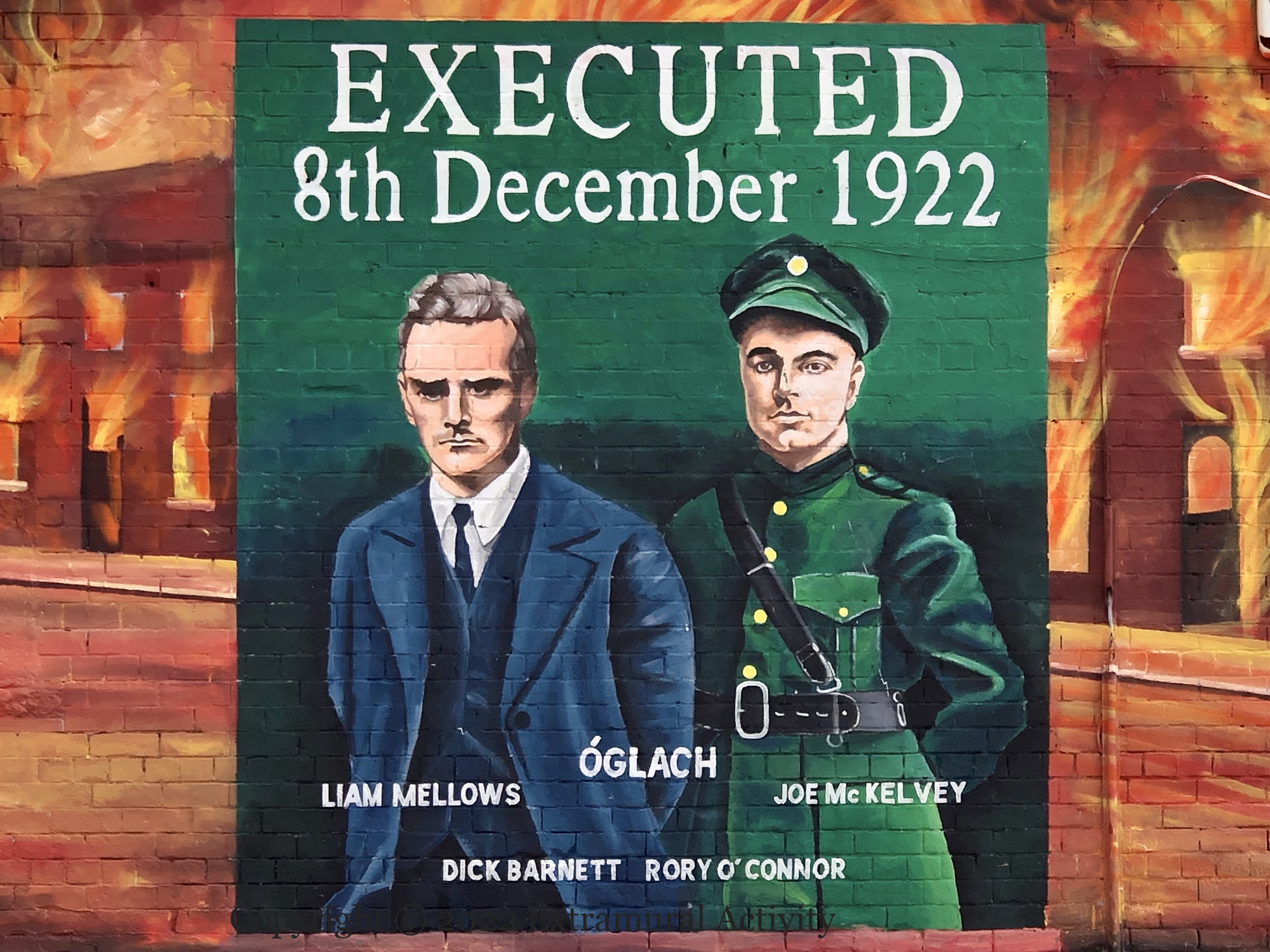
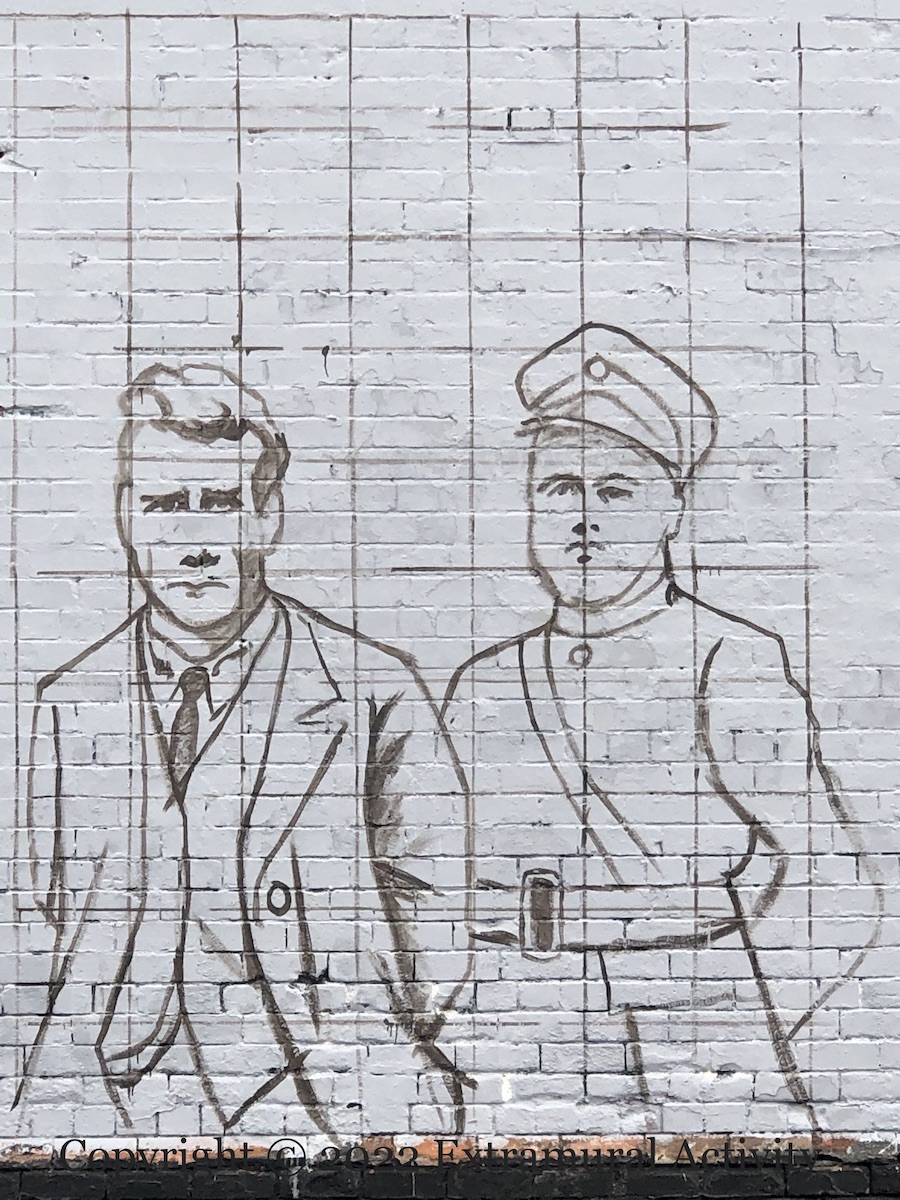
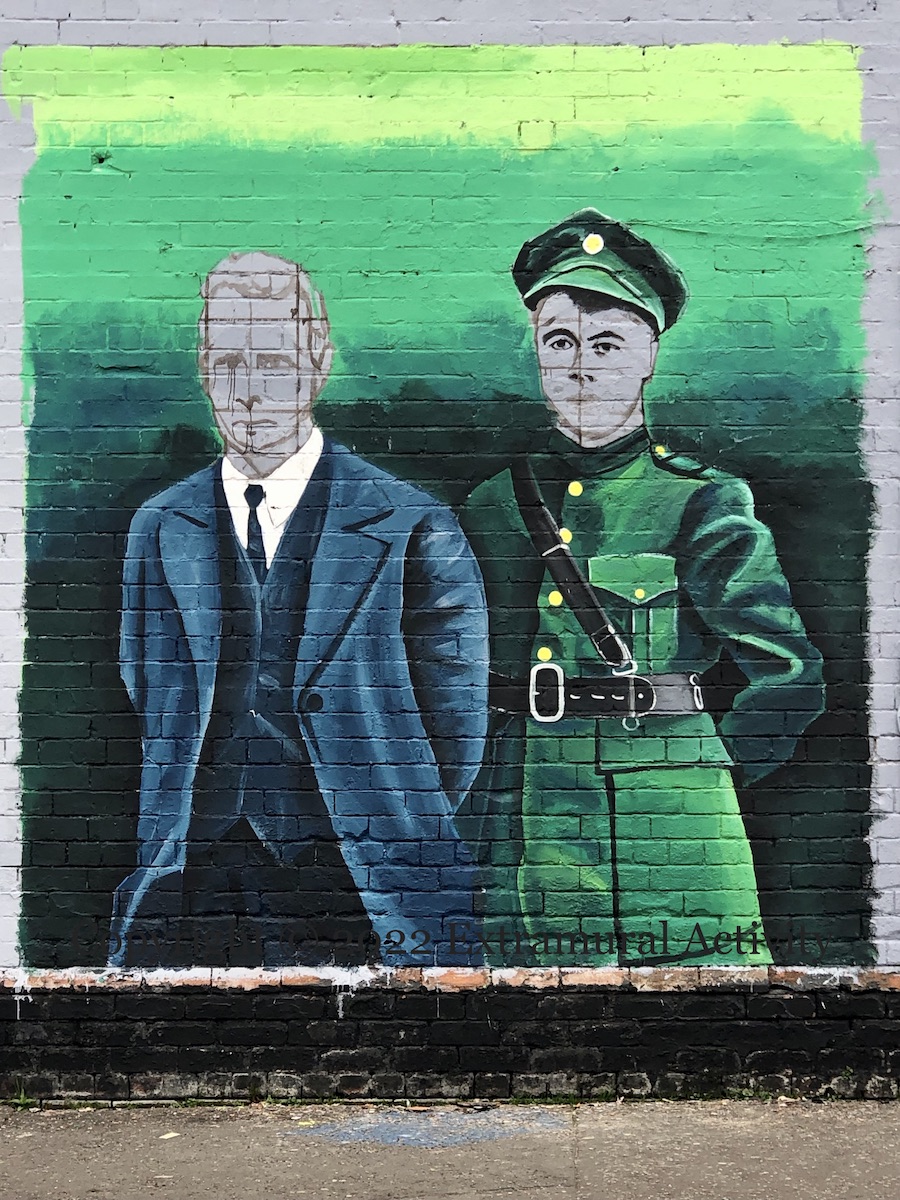
On October 18th, 1922, the third Dáıl/second Provisional Government Of Southern Ireland approved – in the absence of anti-Treaty members – a bill entitled the “Army Emergency Powers Resolution” which introduced martial law, including martial courts with the death penalty for anyone found in possession of an illegal firearm – “illegal” meaning not sanctioned by the nascent pro-Treaty Free State. Under these powers, seven IRA volunteers were executed on November 17th and 19th, followed on the 24th by Erskine Childers (a member of the team that negotiated the Treaty but subsequently against it). In response, the IRA declared that TDs who had voted for the bill were fair game, and on December 7th Seán Hales of Cork was shot and killed. In reprisal, the government ordered the execution of four more volunteers, one from each province: Liam Mellows, Joe McKelvey, Dick Barnett, Rory O’Connor. The four had been arrested five months earlier, on June 30th, 1922, at the start of the Civil War, after surrendering the Four Courts. By the end of the war, 81 executions had taken place. (An Phoblacht | Irish Times | The Irish Story | WP | WP)
For the left-hand side of the wall, on the shipyard clearings and the McMahon murders, see Belfast Butchery.
“Belfast Pogroms 1920-1922.” Against the backdrop of the first Dáıl, the War Of Independence, and the debate in Westminster over the fourth Home Rule bill (it would be passed in November 1920), northern Protestants began to assert their de facto independence from the rest of Ireland – both in economic and in military terms.
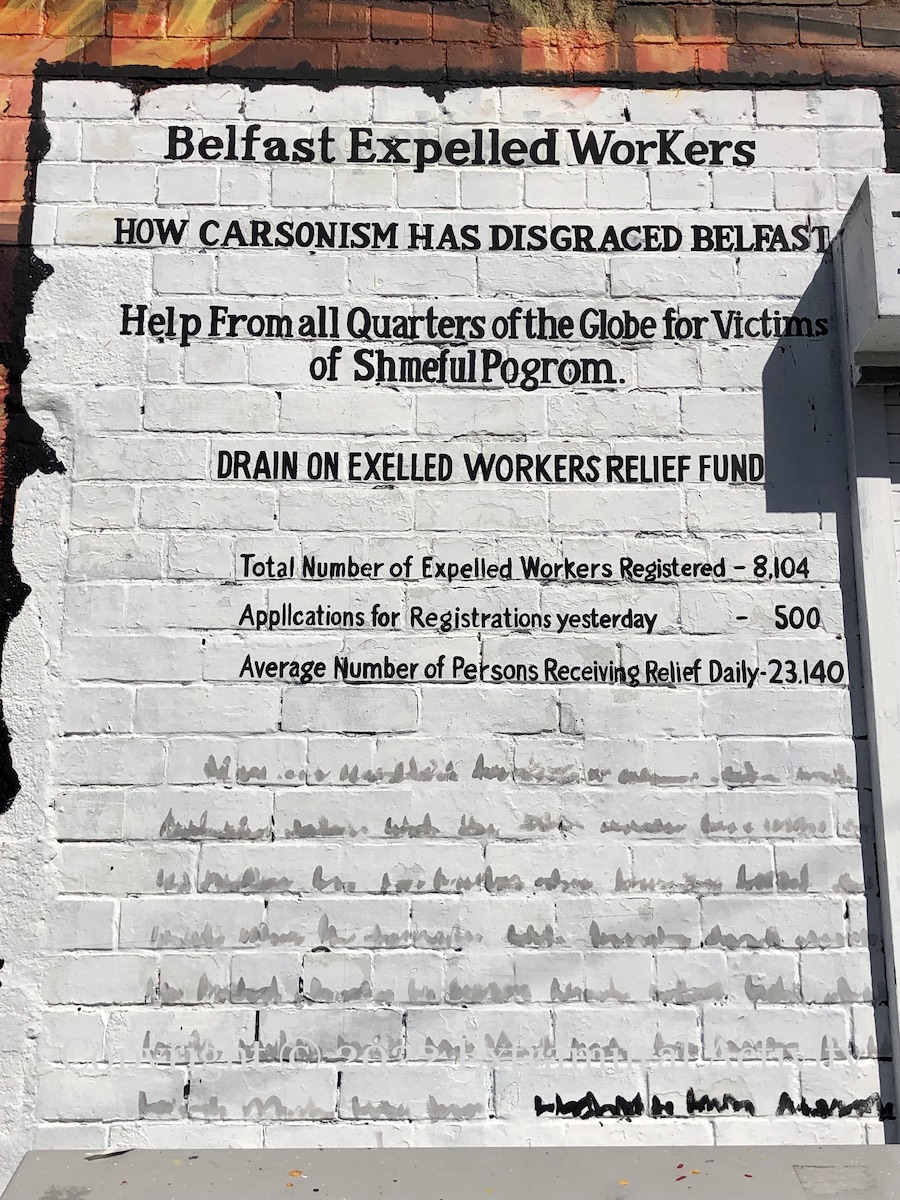
On July 12th, 1920, Edward Carson spoke to a crowd in Derry and, addressing the government in Westminster, said “if you are yourself unable to protect us from the machinations of Sınn Féın, and you won’t take our help; well, then, we tell you we will take the matter into our own hands.” (Treason Felony). Nine days later, the “clearings” of Catholics from Belfast shipyards and mills began, with about 5,700 Catholics and 1,850 socialists (“rotten Prods“) being expelled from Workman Clark and Harland & Wolff yards, and in total 10,000 workers from yards and mills over the next two weeks (History Ireland). In combination with the straitened economic circumstances of the time (post WWI) thousands (23,140 according to this mural, which reproduces a flyer derived from the Irish News of October 6th, 1920 – via The Irish Story’s account of the start of the “Belfast Pogrom”) were on relief.
Militarily, in October, 1920, the Ulster Special Constabulary was established (drawing on members of the Ulster Volunteers, which had been reconstituted in June 1920, and the 21,000 members of the Ulster Imperial Guards (WP)) as an alternative to the Royal Irish Constabulary in fighting actions by the IRA in Belfast, Derry, and elsewhere in the north. On March 23rd, 1922, two officers of the Specials were killed in Belfast city centre by the IRA. In reprisal, two Catholic civilians were killed in the Short Strand, and in the early hours of March 24th, a party of five men, four dressed in RIC uniforms, burst into the home of Catholic businessman Owen McMahon and shot McMahon, his six sons, and one of his employees – only two of the sons survived. District Inspector John Nixon of the RIC was suspected of leading the attack on the McMahon household – see The RIC Murder Gang and Pat And Dan Duffin. (The headlines are from the Freeman’s Journal of March 25th, 1922 – see Joe Baker’s 80-page account of the murders of summer 1922; the photograph of the McMahon corpses that is reproduced in the mural can be seen at Slugger.)
This is the first half a new mural in Ascaıll Ard Na bhFeá; the “1922” part can be seen in Executed.
“Belfast Expelled Workers – How Carsonism has disgraced Belfast – Help from all quarters of the globe for victims of sh[a]meful pogrom – Drain on Ex[p]elled Workers[‘] Relief Fund. Total number of expelled workers registered – 8,104; Applications for registrations yesterday – 500; Average number of persons receiving relief daily – 23,140.”
“Belfast Butchery – Horrif[y]ing story of massacre of McMahon family – Dying man[‘]s declaration – Murderers dressed in police uniform and spoke with Belfast accents.”














 Extramural Activity