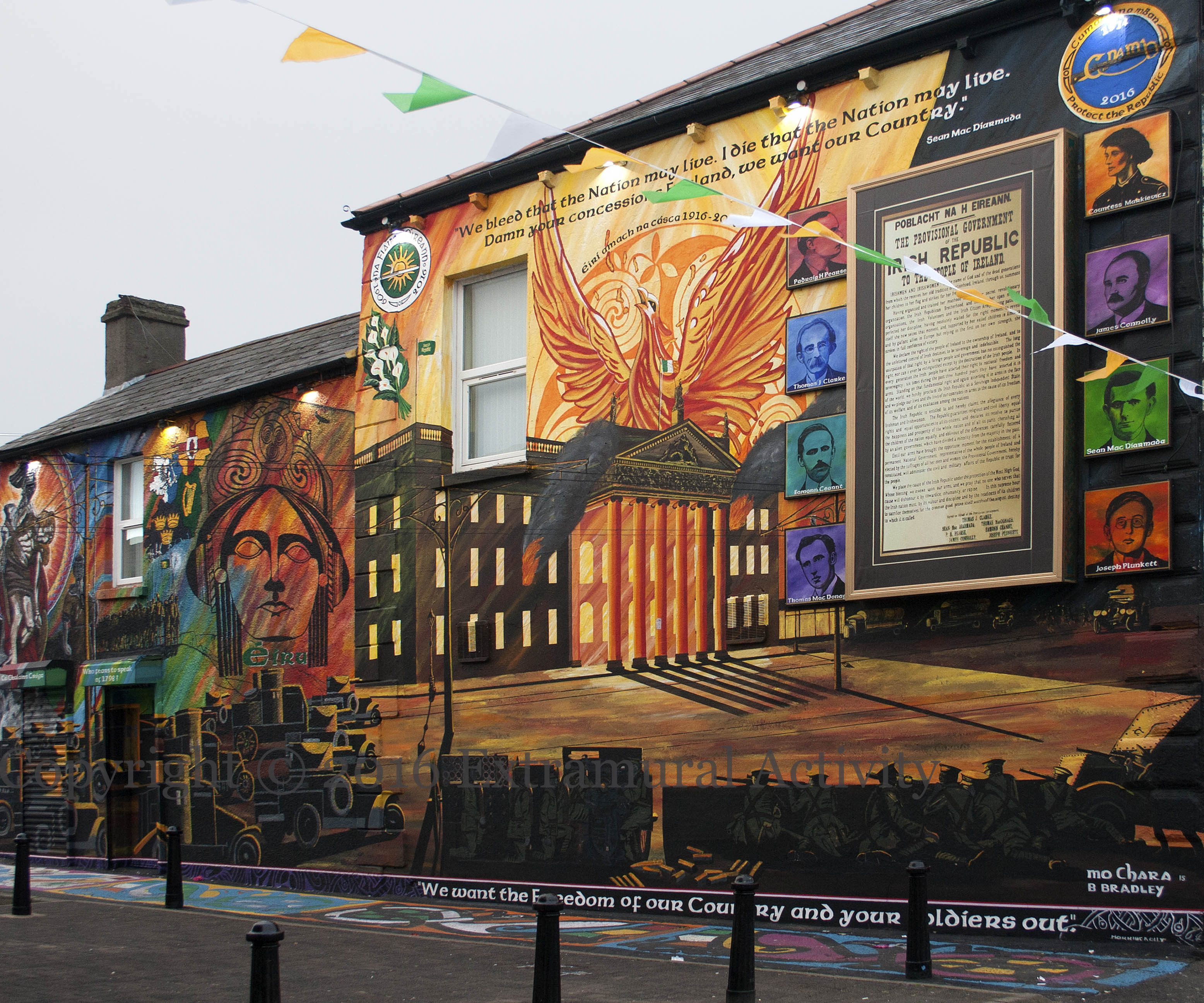
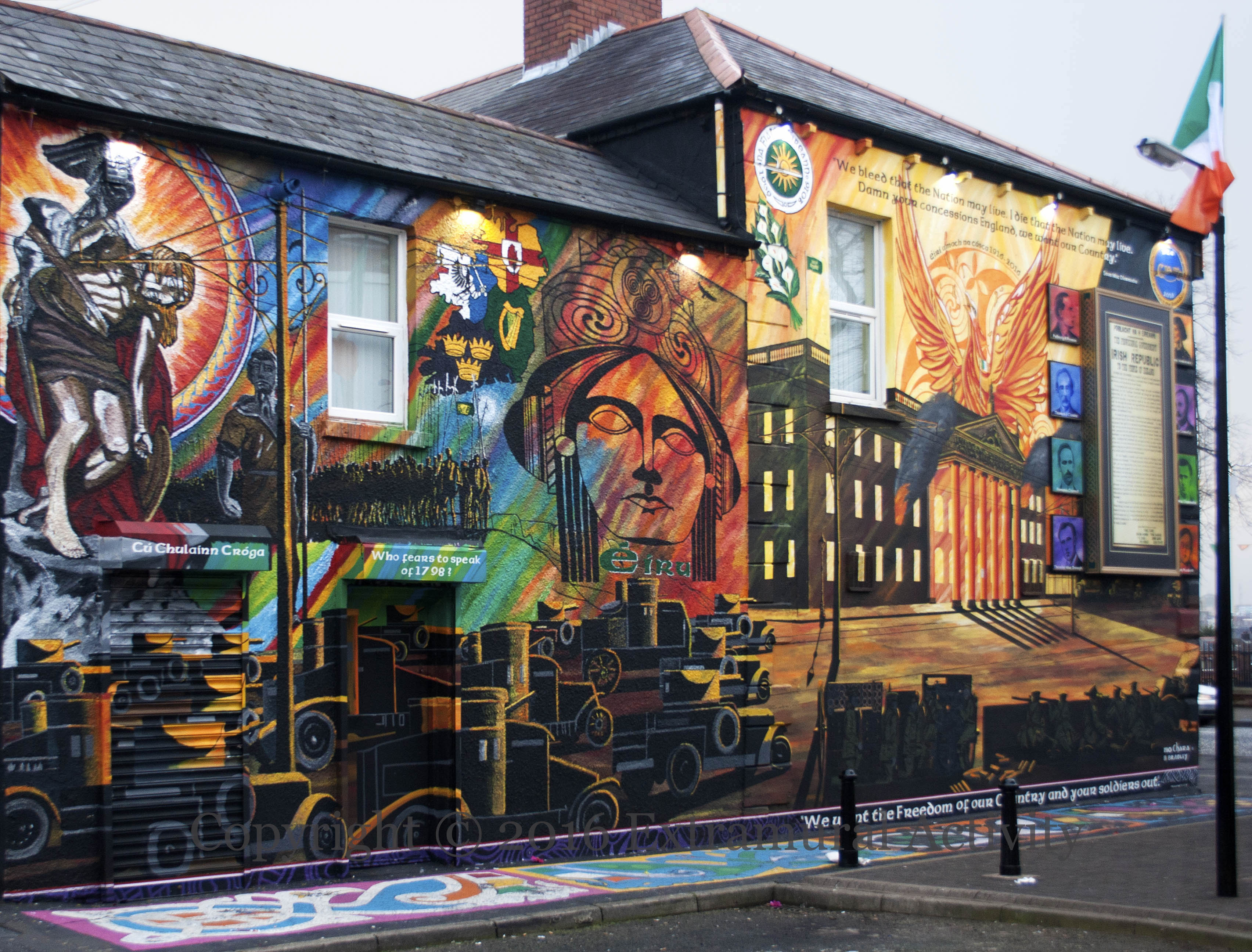
The Linsfort Drive (Creggan) memorial garden (see M02663 and M02775) is featured in the centre of this board of IRA volunteers from the 2nd battalion of the Derry Brigade. There are two similarly designed boards to the 1st battalion in Westland Street and in Lecky Road.
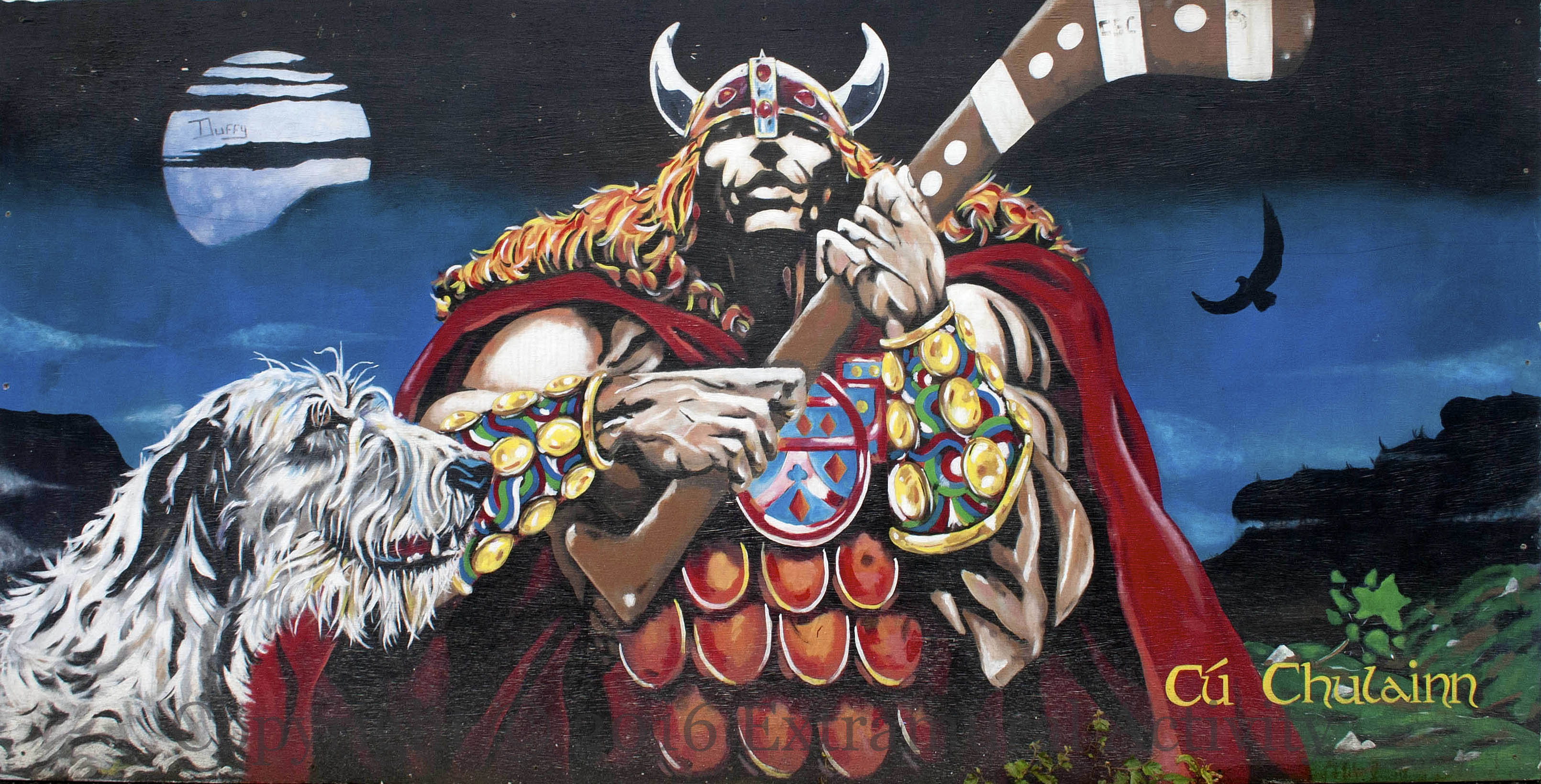
“Cú Chulaınn” is Irish for “Culann’s Hound” after the boy Setanta killed the smith’s hound and promised to take its place until another one was raised. In one version of the legend, Setanta kills the original hound by driving a slıotar (hurley ball) down its throat – hence the hero is shown here holding a camán (hurley stick) rather than a sword. In the original picture on which this mural is based, the hero is not Cú Chulaınn but Jim Fitzpatrick’s vision of Nuada Silverarm and he carries a sword.
On the right hand side, Tuan the hawk/eagle/sea-raven bears witness to all of Irish history.
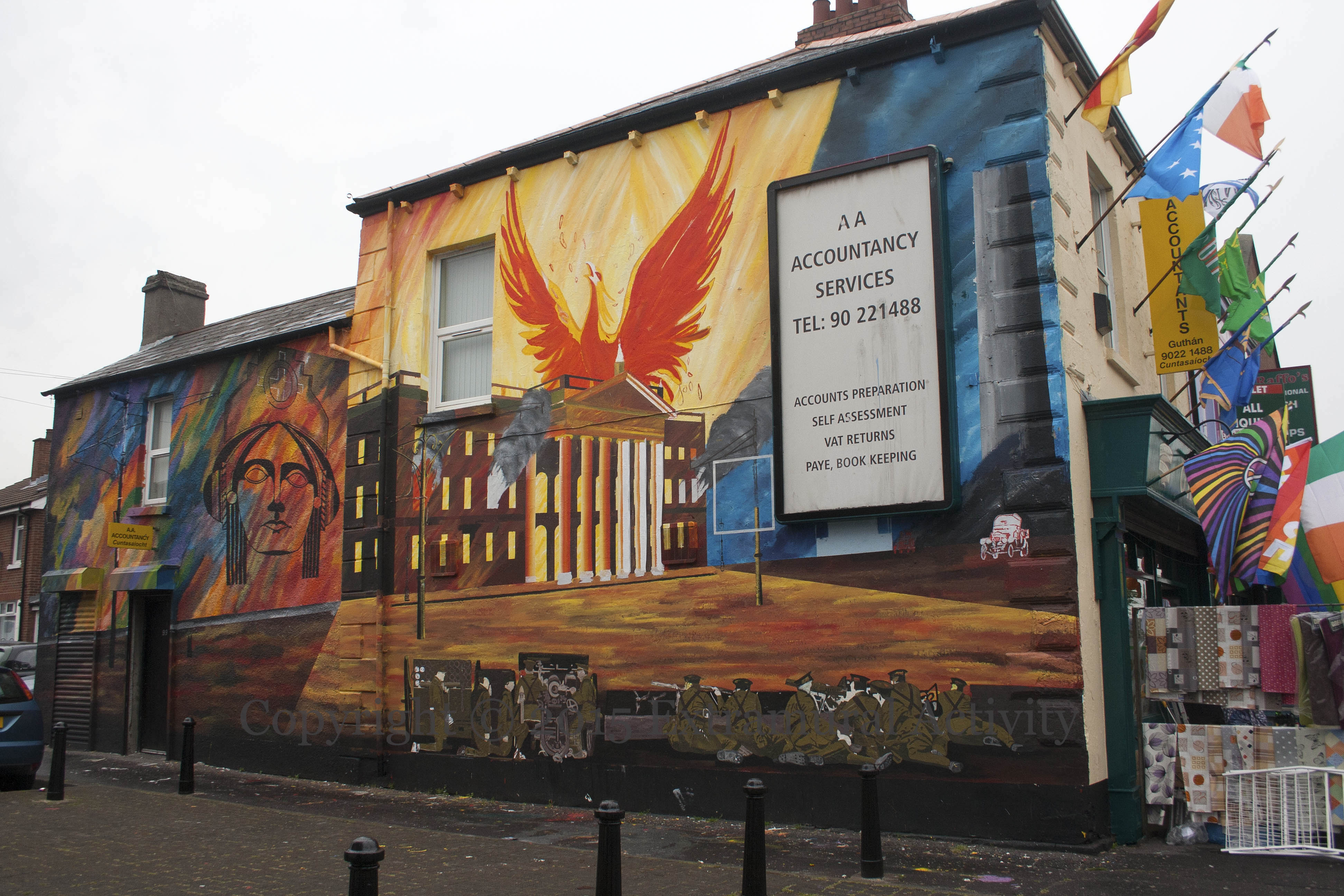
Arrayed against the forces of the British Army (which are shown in armoured cars and in sniping positions in the foreground of the mural, along the whole length of the wall) are various symbols of Irish nationalism: Oliver Sheppard‘s 1911 statue of Cú Chulaınn dying; the pikemen of the 1798 Rebellion (featured yesterday: Éırí Amach 1798); the four provinces of Ireland; Érıu the mythological queen of Ireland/Éıre as designed by Richard J King/Rísteard Ó Cíonga; Easter lilies; the emblems of Na Fıanna Évreann and Cumann Na mBan on either side of a quote from (The Mainspring) Sean MacDiarmada “We bleed that the nation may live; I die that the nation may live. Damn your concessions, England: we want our country”; a phoenix rising from the flames of the burning Dublin GPO (inspired by Norman Teeling’s 1998 painting The GPO Burns In Dublin); the GPO flying an ‘Irish Republic’ flag; portraits of signatories and other rebels — (left) Padraig H. Pearse, Thomas J Clarke, Eamonn Ceannt, Thomas MacDonagh, (right) Countess Markievicz, James Connolly, Sean MacDiarmada, Thomas Plunkett; the declaration of independence, placed over the advertising box of AA Accountants – see the in-progress shot below. For more work-in-progess images, see yesterday’s post, Éırí Amach 1798. At the very bottom is a quote from the mother of Gerard ‘Mo Chara’ Kelly, Harriet Kelly: “We want the freedom of our country and your soldiers out.”
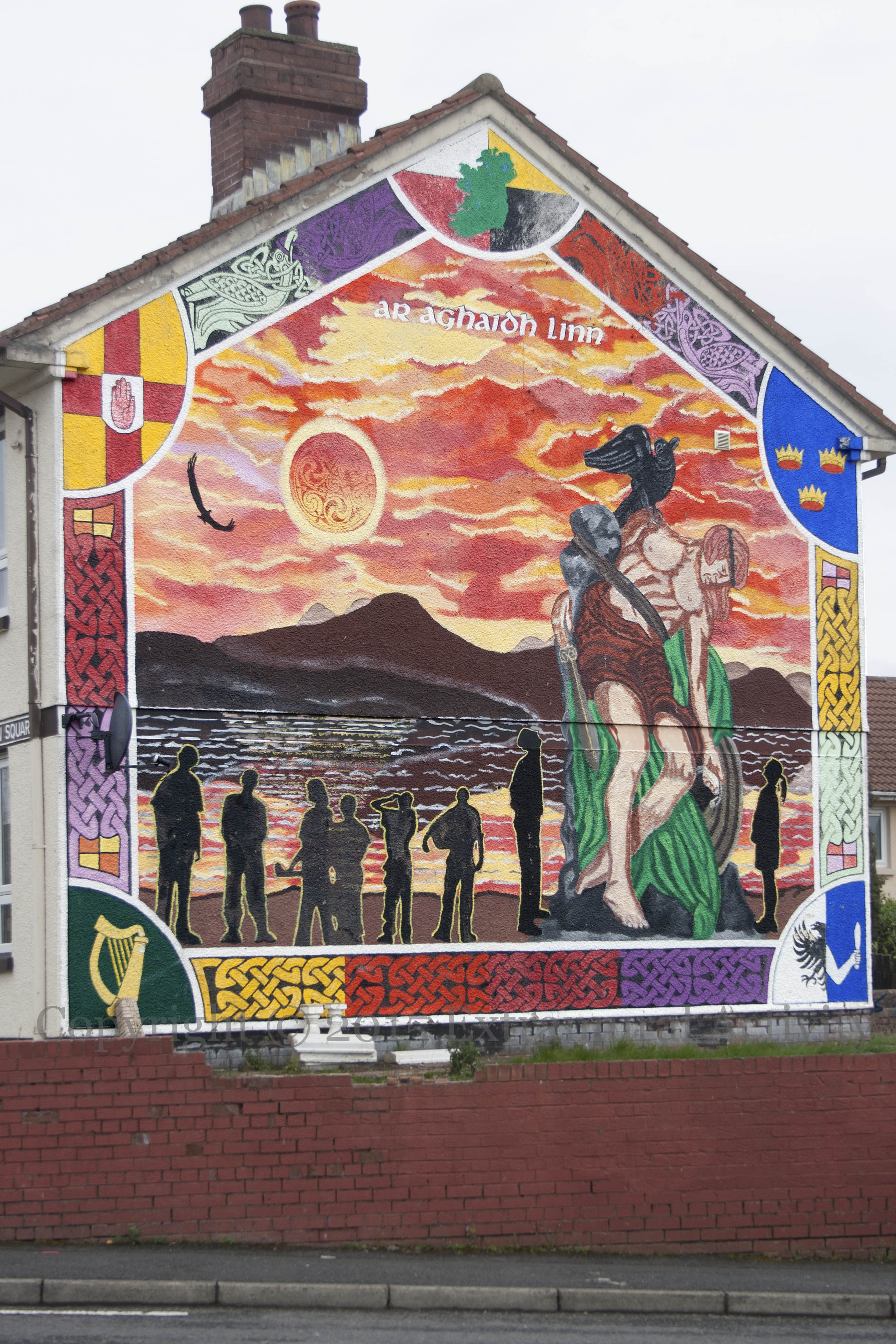
“Ar aghaıdh linn [Onward]” Silhouetted figures, one carrying a hurley, take inspiration from a dying Cú Chulaınn and gaze across a body of water, perhaps Carlingford Lough towards the mountains of Mourne – Cú Chulaınn’s traditional place of death is in County Louth, outside Dundalk. Tuan the hawk historian, who has seen all of the conquests of Ireland, flies overhead.
In the Cattle Raid of Cooley/Táın Bó Cúaılnge, the hero Cú Chulaınn, the main figure in the stained glass above, single-handedly defends Ulster by engaging in series of Queen Medb’s men in hand-to-hand combat as they attempt to secure the famous Ulster bull, which Medb wants in order to match her husband in possessions. Cú Chulaınn is eventually vanquished and the bull taken but, as can be seen at the bottom of the glass, the bulls fight each other and both die.
The piece is by Martin Donlin from East Sussex (pictured here at the unveiling in March 2012). According to Donlin’s Fb page, the old Irish at the bottom (“bendachtar cech óen mebraıgfes go hındraıc táın amlaıd seo ‘s ná tuıllfe cruth aıle furrı”) can be translated as “a blessing be upon all such as faithfully keep the Táın in memory as it stands here and shall not add any other form to it”. Here is a Flickr set of the piece in development.
A seven-year old Setanta become Cú Chulaınn (Culann’s Hound) after killing the beast by driving a sliotar (the ball used in hurling) down its throat. Detail from a mural in Roumania Rise, off Ross Road. Wide shot of the whole below. The lettering reads “Mol na nóıge agus tıocfaıdh sí [sic]” [as written: praise the young and it [sic] will flourish; usually the phrase is “Mol an óıge …” “praise youth …”]
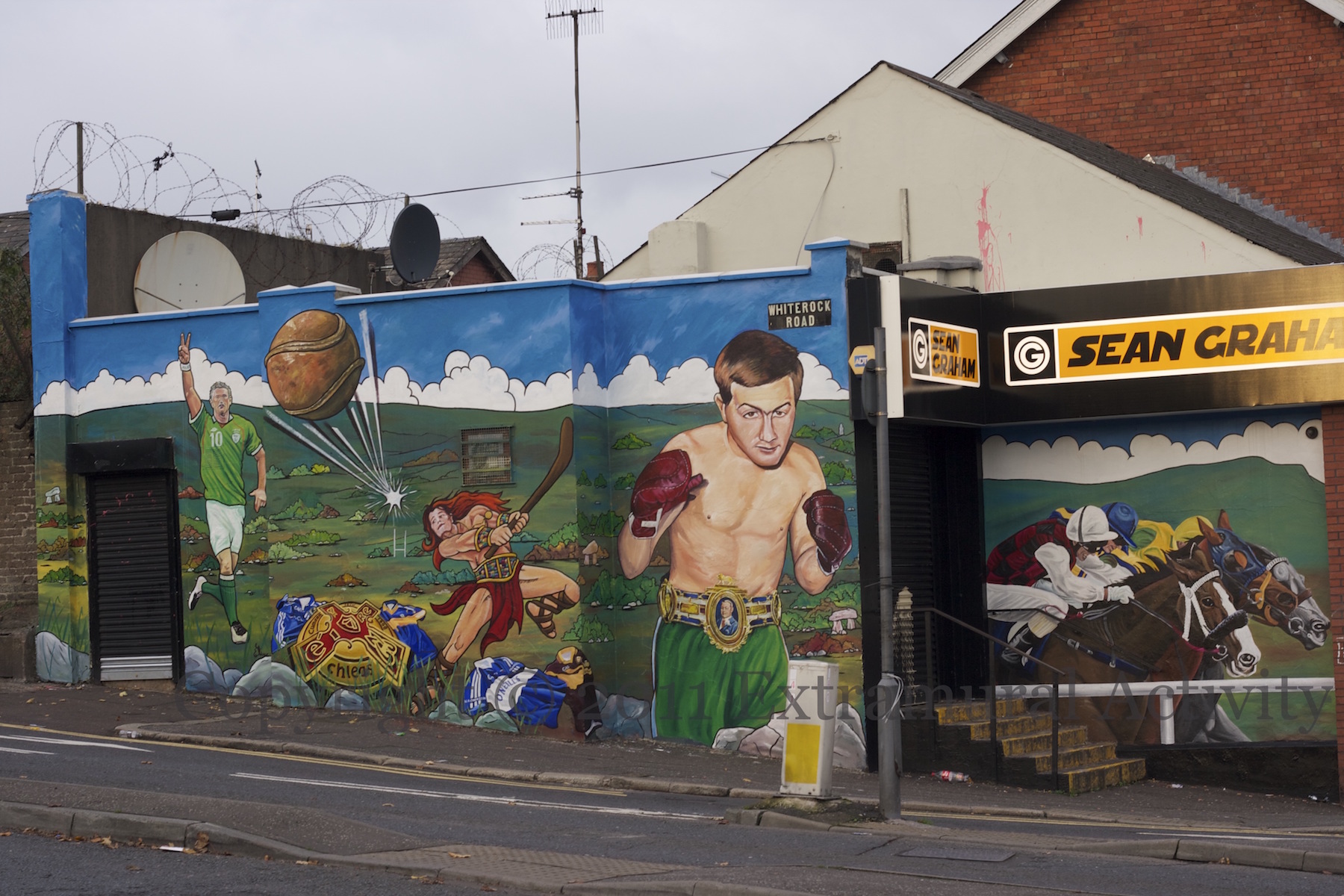
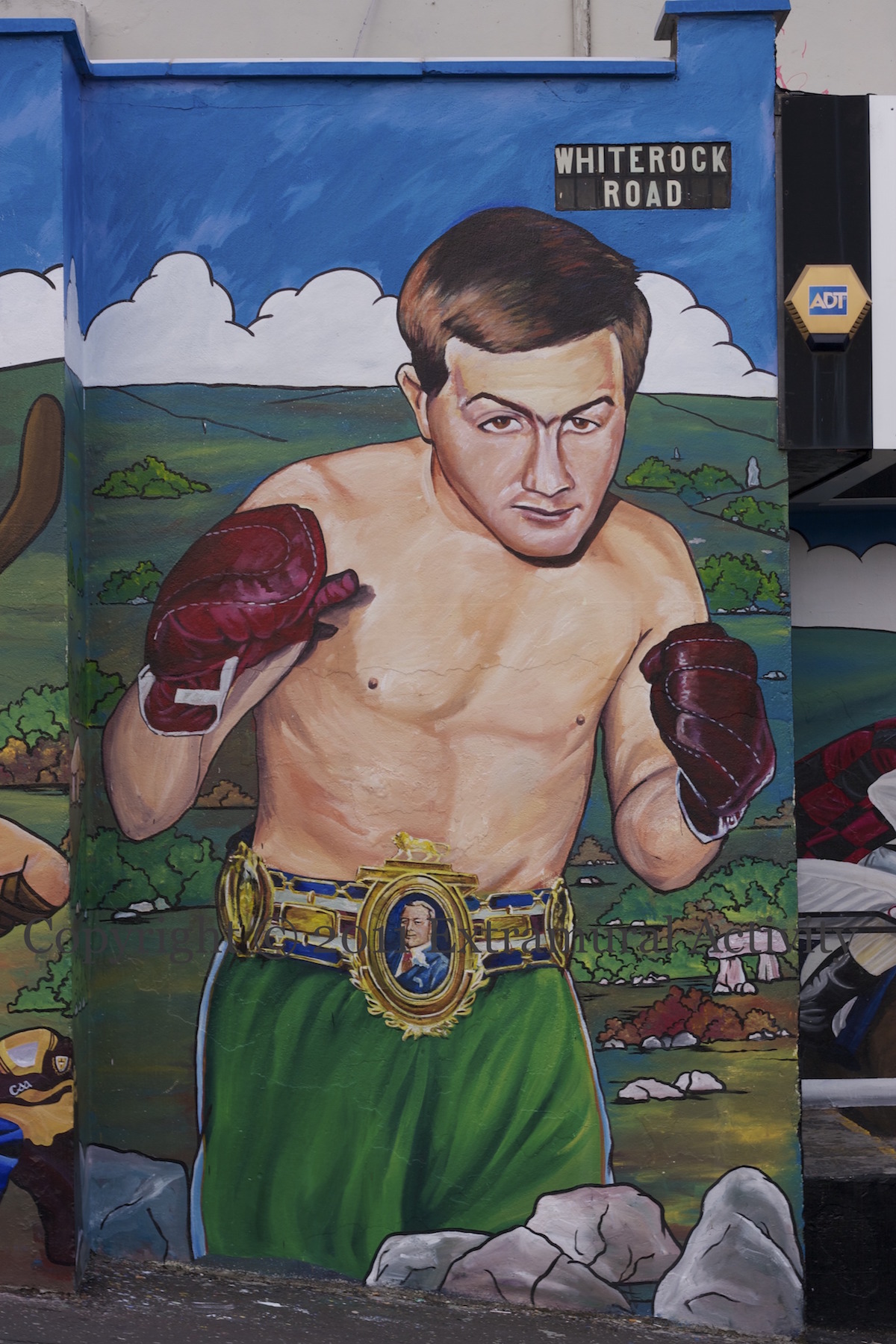
Sporting mural on the side of Sean Graham’s bookmakers. Ireland’s leading goal-scorer Robbie Keane is on the left. Cú Chulaınn plays hurling in the centre. (See also the mural on Casement Park M05144.) The boxer on the right is John Caldwell, a champion from the 1950s and 1960s from Cyprus Street (WP). Painted by a Short Strand artist at the junction of Whiterock and Falls roads.
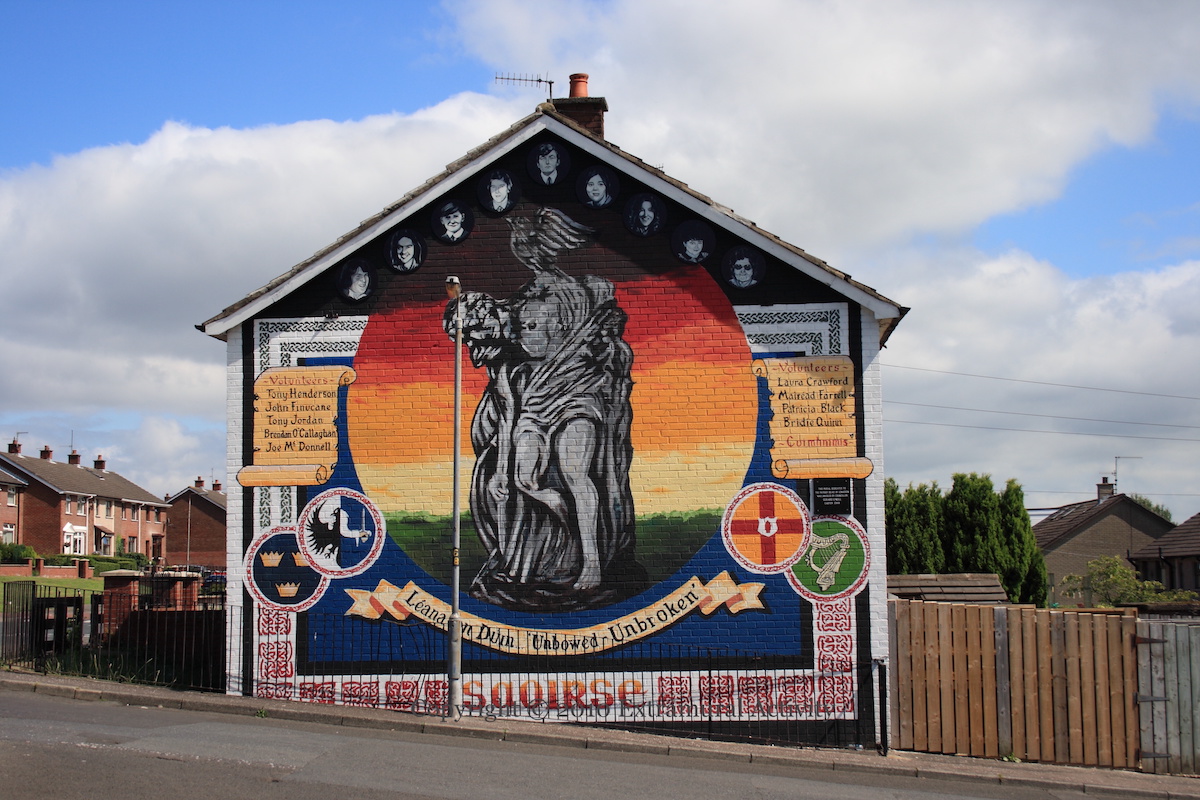
The main Lenadoon mural is refreshed and more portraits and a plaque added (on the right). The dying Cú Chulainn (as portrayed in bronze by Oliver Sheppard, in a statue installed in the GPO in 1935) is used as a symbol for the locals from Lenadoon (including IRA volunteers) who fought for freedom (“saoırse”). They are listed on the scrolls to each side and in the portraits in the apex: Tony Henderson, John Finucane, Brendan O’Callaghan, Joe McDonnell, Laura Crawford, Maıréad Farrell, Patricia Black, Bridie Quinn (previously listed as Bridie O’Neill).
For the previous version (though without the three faces it initially had, of O’Callaghan, McDonnell, and Farrell) see M01934.
“Ballymurphy unbowed, unbroken” with images of Ballymurphy including the mural of McCrudden-O’Rawe–Jordan and memorial garden on Divismore Way (left) and Springhill (right). The male figures in the foreground are unnamed but the four in jackets are presumably Stone, McWilliams, McCracken, and Dougal after their mural in Springhill Drive was blanked; the female activists on the left of Cú Chulaınn are Mary Austin, Kathleen Clarke, Annie McWilliams. “This mural was unveiled by Gerry Adams MP 2nd May 2010.”
“Ní thıg leat Éıre a chloígh, ní thıg leat fonn saoırse mhuıntır na hÉıreann a mhúc[h]adh.” [“You cannot subdue Ireland; you cannot extinguish the desire for the freedom of the Irish people.”]







 Extramural Activity