Since 1982 (and perhaps earlier) Beechmount Avenue in west Belfast has been known as “RPG Avenue”, after the rocket-propelled grenade launchers used by the IRA. The tarpaulins shown in the first two images (from a recent dedication at the memorial garden across the street) here recall the 80s, with images of armed volunteers and of the support for the blanket men and hunger strikers from “Beechmount/Iveagh H Block-Armagh Committee”.
The first (above) was previously used in 2001 – see J1054. The final image, taken in June of this year, shows that the street still retains its unofficial name and also gives the names of various volunteers from A Coy, 2nd Battalion, including Pat McGeown, a hunger striker whose family intervened when he lapsed into a coma, and who was elected to Belfast City Council in 1993 and died in 1996 of a heart attack.
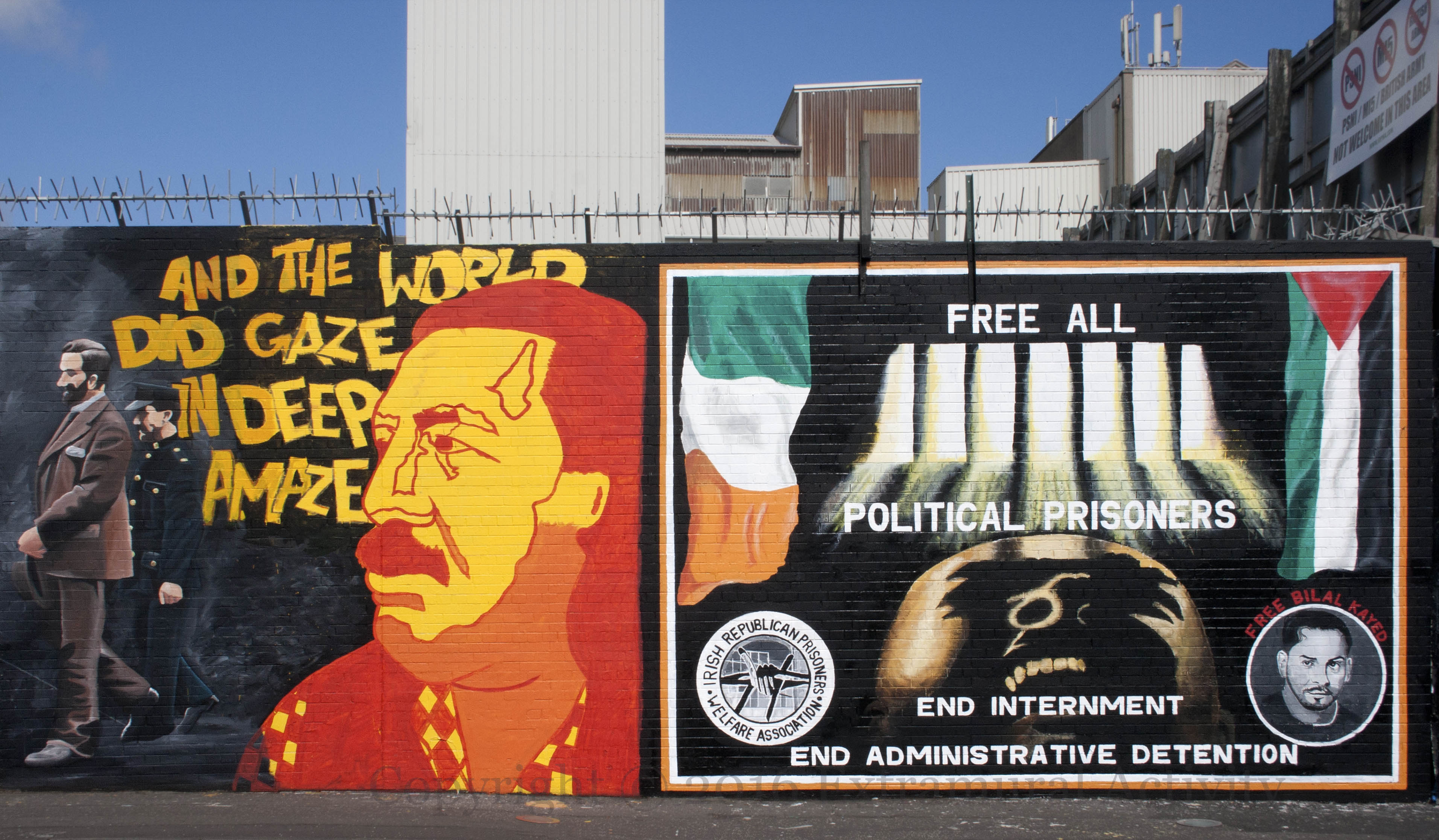
Palestinian prisoner and hunger striker Bilal Kayed last week called off his hunger strike after 71 days of fasting, after reaching an agreement with his Israeli captors for his release in December, after a six-month “administrative’ extension to his original 14.5 year sentence (Alternative News). Hence the slogan “End internment, end administrative detention” (alongside “Free all political prisoners” and the IRPWA emblem). Update: Kayed released 2016-12-12.
The mural is at the right-hand end of the so-called International Wall in west Belfast. For the controversy over the painting of the mural adjacent to the historical panels on the rest of the wall, see The World Did Gaze In Deep Amaze.
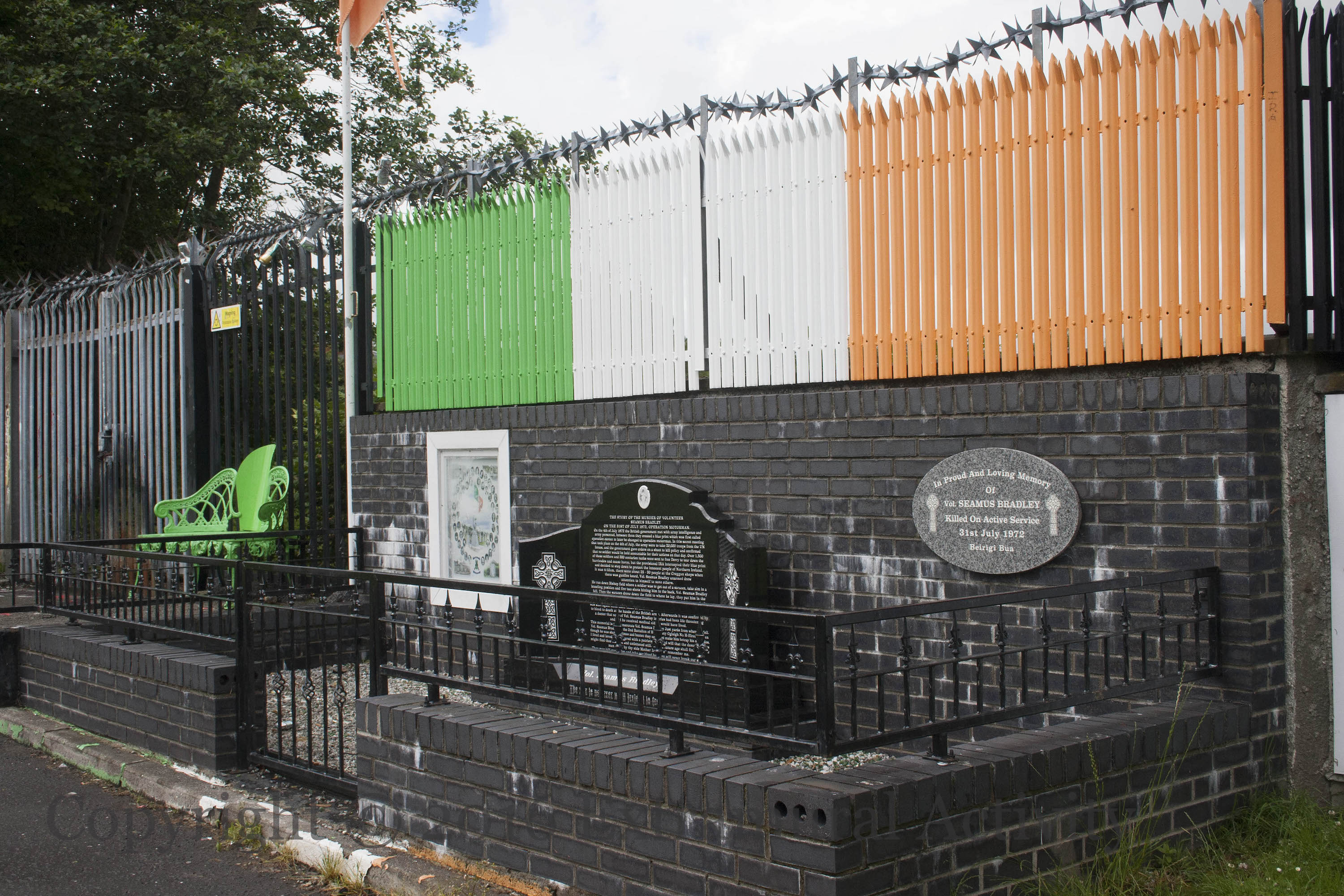
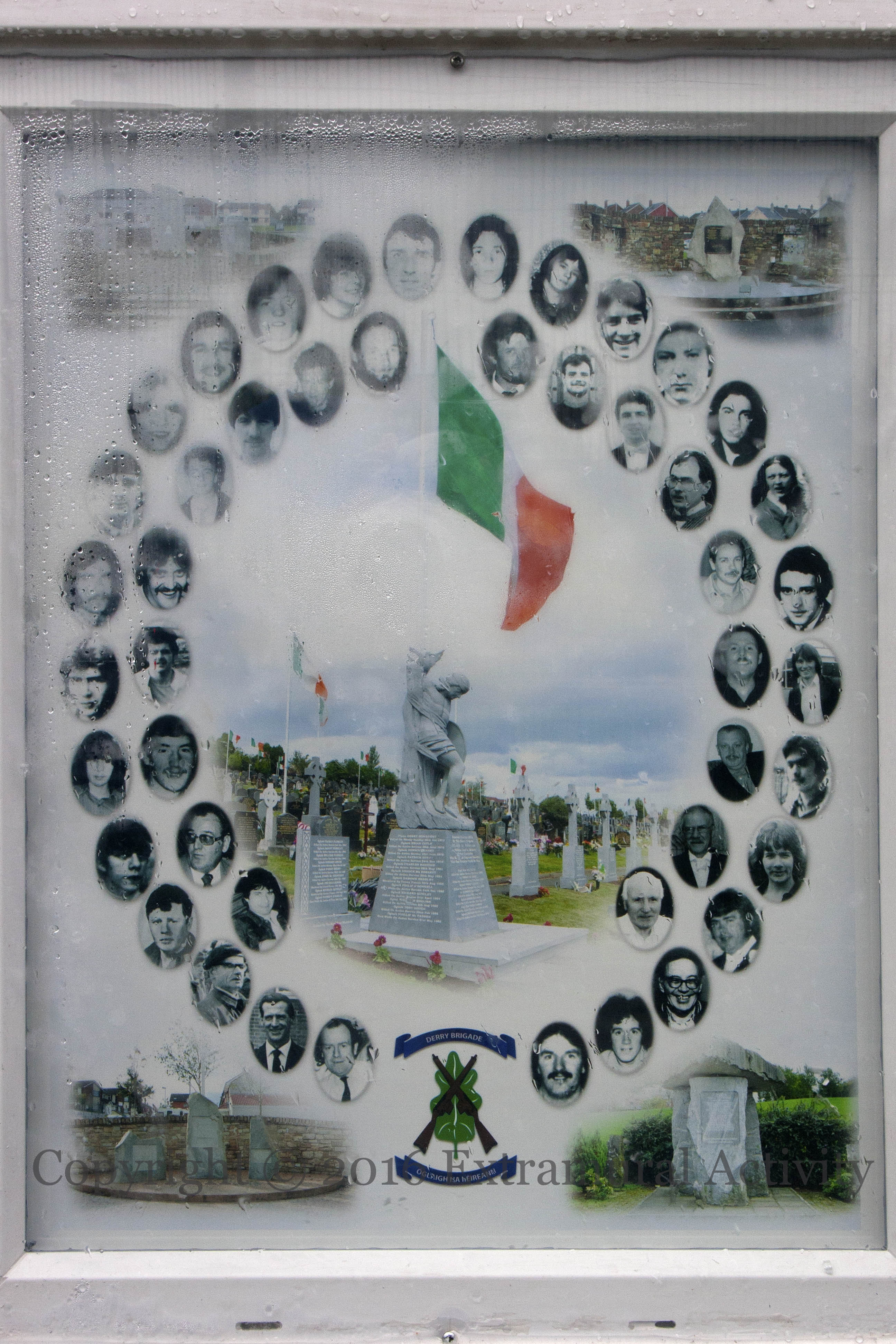
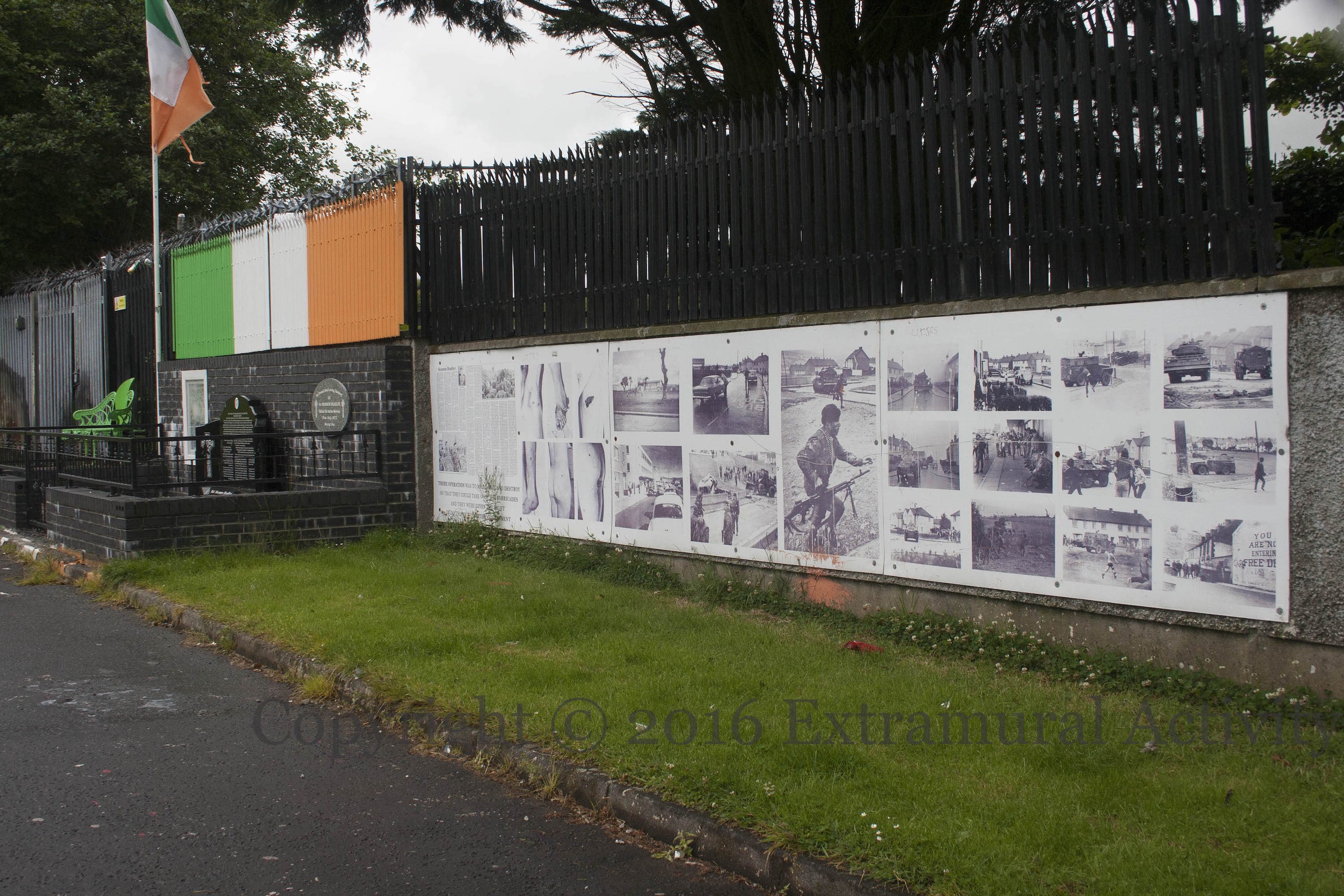
This memorial, which includes two stones, a glassed-in set of portraits of Derry Brigade members (second image), tricoloured railing and flag, commemorates the death of IRA volunteer Seamus Bradley. The stone on the right says that he was killed on active service, but the central headstone (third image) tells the story of an unarmed Bradley trying to distract the attention of British Army soldiers attacking people at the Creggan shops. To the right of the memorial is an extensive board of photographs and information relating to the treatment Bradley received, similar to the collection in front of the Operation Motorman mural in Rossville Street. (The oval plaque was on the wall of the Creggan Neighbourhood Centre – see M01604 – before it was demolished in 2013. (CAIN))
On the 4th of July 1972 the British government met with army intelligence and army personnel, between them they created a blue print which was first called operation carcan to later be changed to operation motorman. In this secret meeting that place on the 4th of July, the army were to take 20,000 troops from the UN forces, and the government gave orders on a shoot to kill policy and confirmed that no soldier would be held accountable for their actions on that day. Over 1,500 of these soldiers and 300 centurion tanks were sent to free Derry to tear down the barricades and cause havoc, but the provisional IRA intercepted their blue print and decided to step down to protect the innocent people of Northern Ireland. It was 4:10am, there were 25 – 30 people at the Creggan shops when there was gunfire heard, Vol. Seamus Bradley unarmed drew attention to himself to save others. He ran down Bishop field where a soldier was to get out of a saracen, take aim in a kneeling position and fire two shots hitting him in the back, Vol. Seamus Bradley fell. Then the saracen drove down the field to where he lay, they put him in the saracen and took him away to St. Peter’s school, no one knew what happened after that. All they know is that he was interrogated, the pictures tell their own story. He was shot again three more times at close range, he was tortured and beaten and left to bleed to death at the hands of the British army. Afterwards it was confirmed by a doctor that none of Seamus Bradley’s injuries have been life threatening and had he received medical aid he would have lived.
This memorial is to commemorate Vol. Seamus Bradley just yards from where he fell. Vol. Seamus Bradley on the 2nd Battalion of B company Oglaıgh Na H-Éıreann, even though he was shot five times and beaten they could not make him betray his comrades. I lived and loved and laboured with a patriot’s heart and will that the dawning years might make you fearless and unfettered still. When a future age shall find thee free men stand by thy side Mother Ireland o” remember me. They may kill our bodies and take our blood but they will never break our spirits. killed on active service beırıgí bua
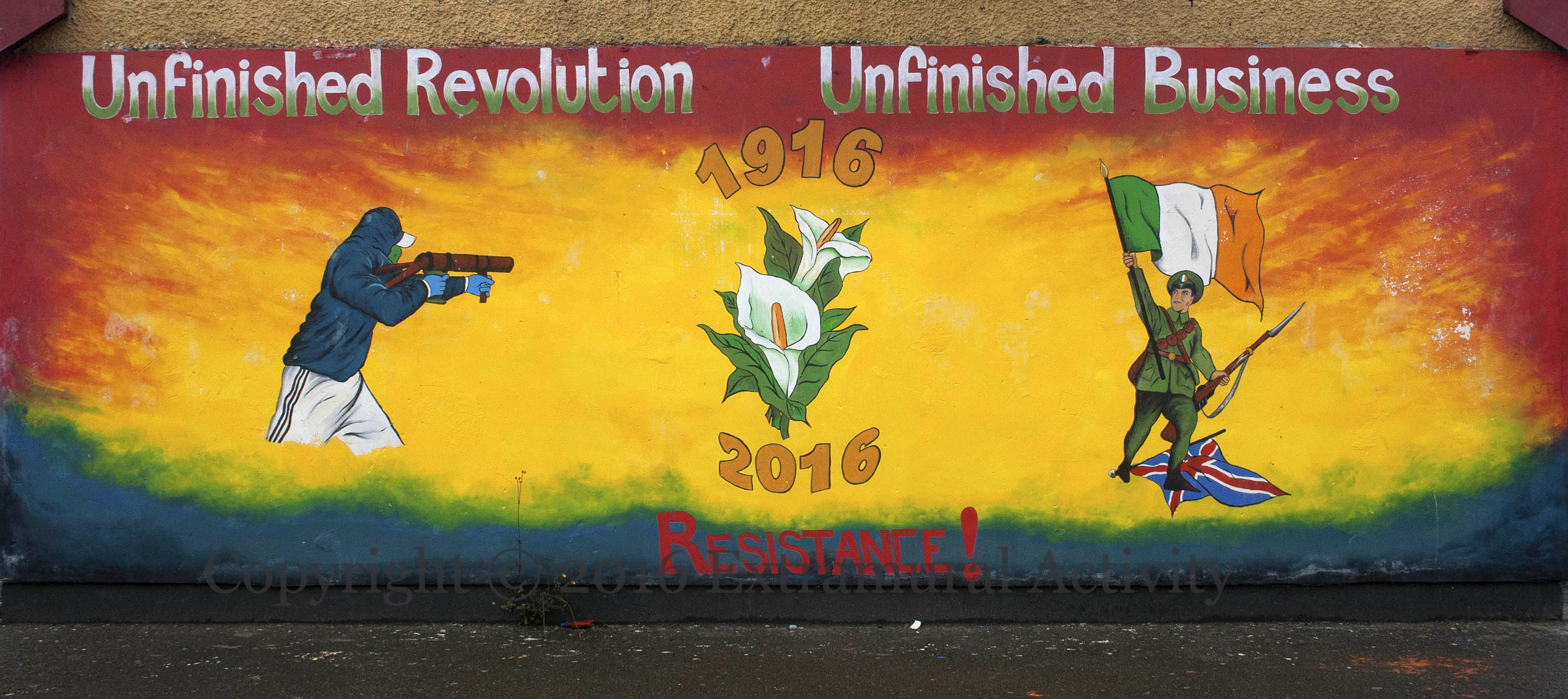
Here are three images of a new mural in the Creggan area of Derry preaching continued “Resistance!” on account of the “unfinished business” of raising the Irish Tricolour and trampling on Britain’s Union Flag and the “unfinished revolution” of 1916’s Easter Rising (reproducing a postcard of the era).
For the modern-day figure on the left, who is wielding a home-made rocket-launcher used in a 2014 attack on police, see 2015’s Resistance board in Ardoyne.
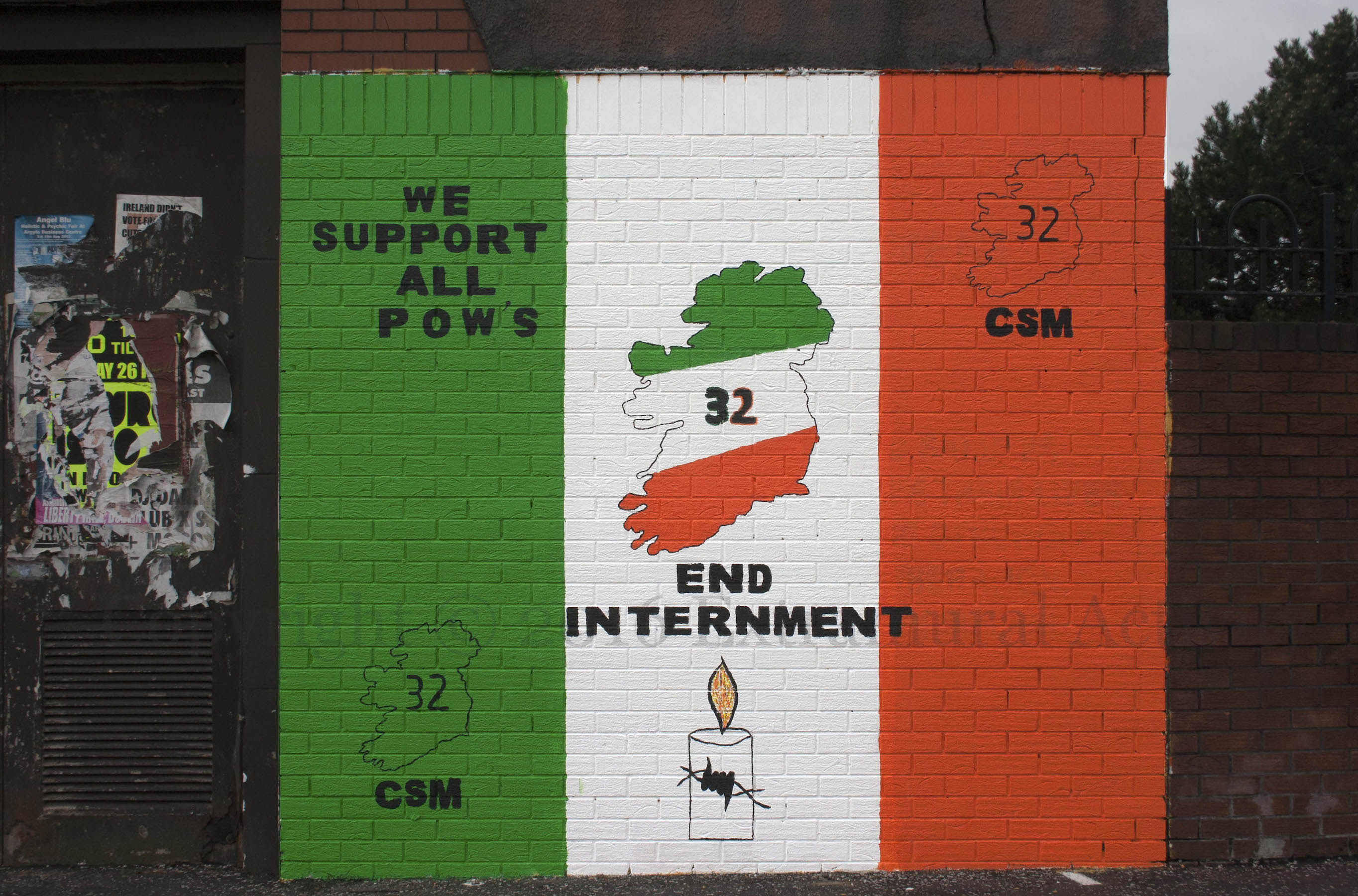
In quick succession to the Easter Rising centenary mural in the same spot, there comes this 32 County Sovereignty Movement mural, with the island of Ireland in green, white, and orange, and (representing prisoners) barbed wire and a candle.
Connolly House – Belfast headquarters of Sınn Féın – for the centenary of the Easter Rising bears the same banner as flew on the ITGWU’s Liberty Hall (in Dublin) during the first world war (see image below) until the building was destroyed during the Rising: We serve neither king nor kaiser, but Ireland! The house was purchased by Sınn Féın in 1983 and brought to its current condition in 2007 (Irish Times).
For a previous appearance of the slogan, on the shirts of a Glasgow flute band, see Business As Usual.
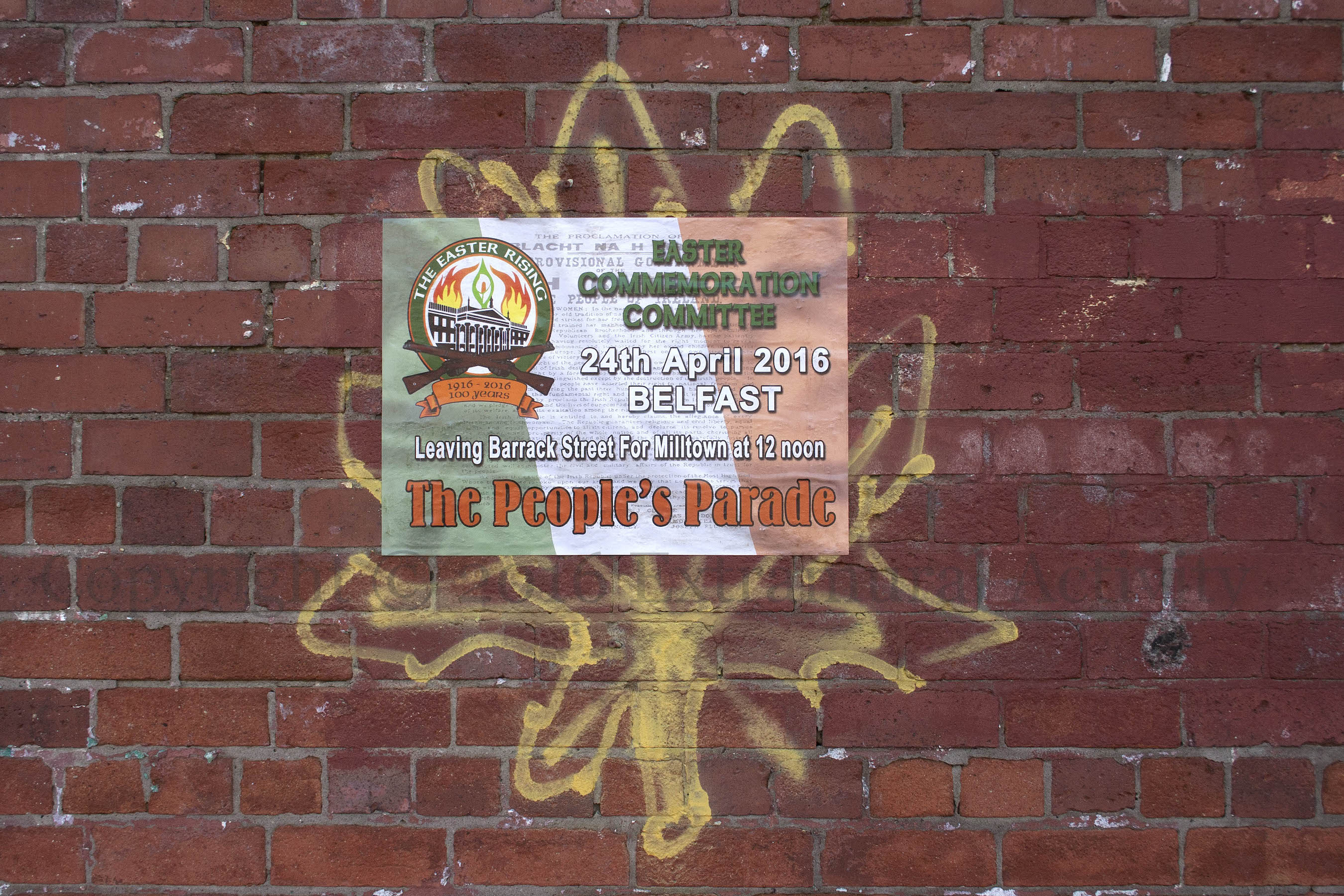
Two competing posters for two competing dates for two (competing?) Easter Rising parades: the People’s Parade (above) was held today, April 24th, the date of the Rising in 1916; the other was held on this year’s Easter Sunday, March 27th, as the parade is annually held on Easter Sunday.
While taking part in the Easter Rising centenary parade, members of the James Connolly 1st Republican Flute Band from Glasgow (tw) pause on the Falls Road during a squall. Embroidered on the rear of their shirts are the words “We serve neither king nor kaiser, but Ireland”, the slogan which hung outside the ITGWU’s Liberty Hall during the first world war. Image courtesy of Bronagh Bowerman.
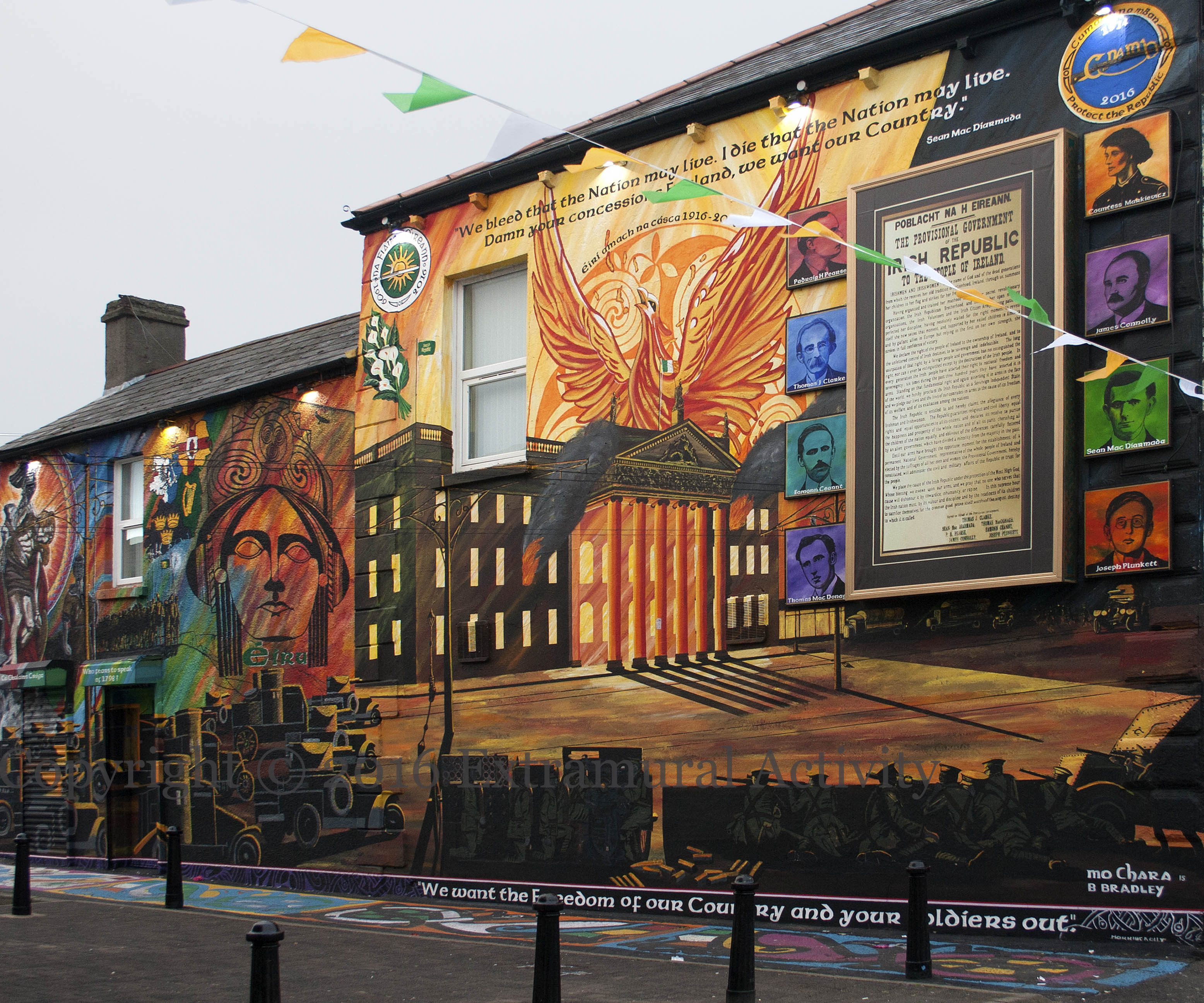
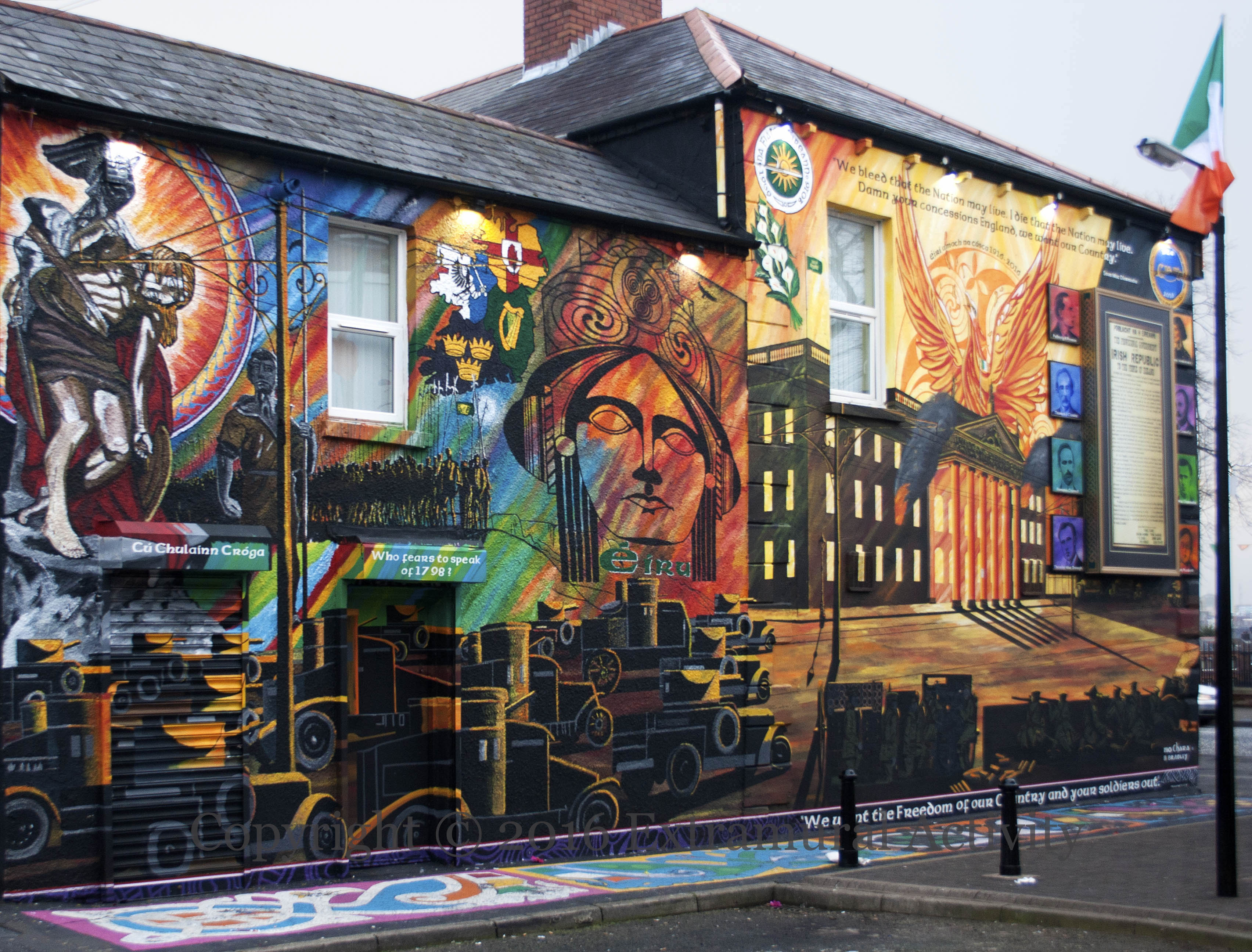
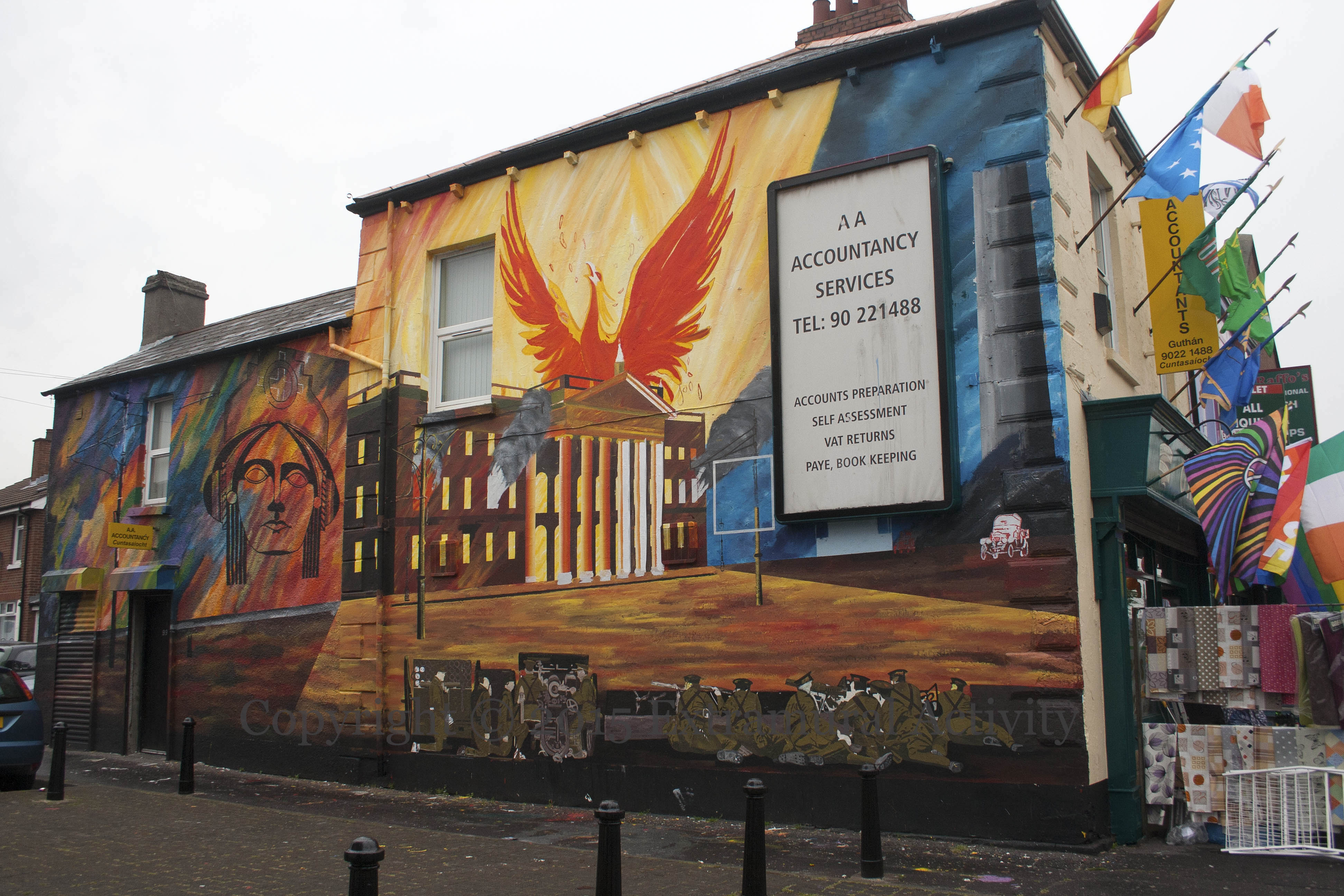
Arrayed against the forces of the British Army (which are shown in armoured cars and in sniping positions in the foreground of the mural, along the whole length of the wall) are various symbols of Irish nationalism: Oliver Sheppard‘s 1911 statue of Cú Chulaınn dying; the pikemen of the 1798 Rebellion (featured yesterday: Éırí Amach 1798); the four provinces of Ireland; Érıu the mythological queen of Ireland/Éıre as designed by Richard J King/Rísteard Ó Cíonga; Easter lilies; the emblems of Na Fıanna Évreann and Cumann Na mBan on either side of a quote from (The Mainspring) Sean MacDiarmada “We bleed that the nation may live; I die that the nation may live. Damn your concessions, England: we want our country”; a phoenix rising from the flames of the burning Dublin GPO (inspired by Norman Teeling’s 1998 painting The GPO Burns In Dublin); the GPO flying an ‘Irish Republic’ flag; portraits of signatories and other rebels — (left) Padraig H. Pearse, Thomas J Clarke, Eamonn Ceannt, Thomas MacDonagh, (right) Countess Markievicz, James Connolly, Sean MacDiarmada, Thomas Plunkett; the declaration of independence, placed over the advertising box of AA Accountants – see the in-progress shot below. For more work-in-progess images, see yesterday’s post, Éırí Amach 1798. At the very bottom is a quote from the mother of Gerard ‘Mo Chara’ Kelly, Harriet Kelly: “We want the freedom of our country and your soldiers out.”
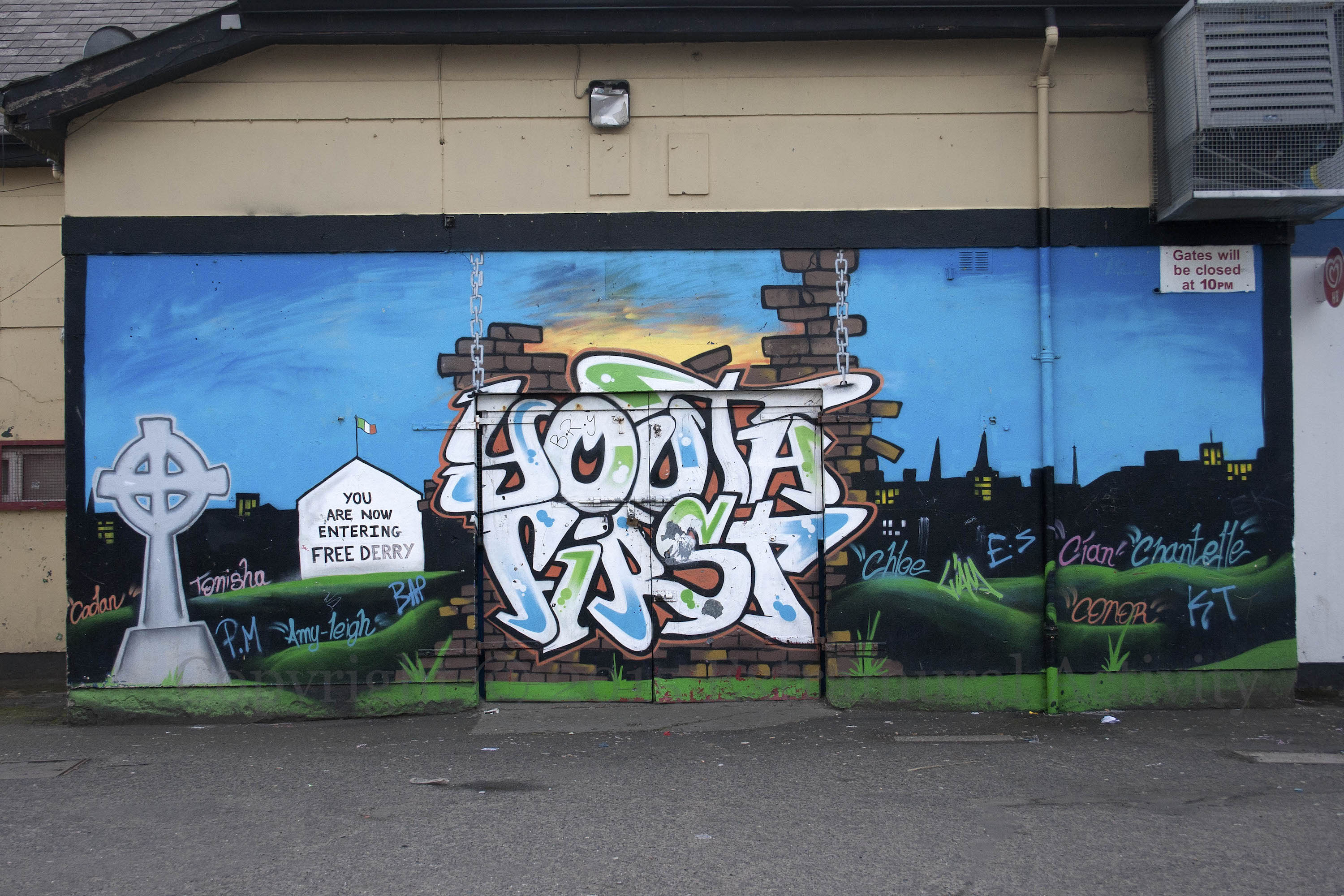
Here are two murals from the Youth First (Tw) group in and around their Bogside home in Meenan Square. In the image above, a young mother sporting both a nappy pin and an Easter lily tends to her infant child while casting a look back at Free Derry corner and the silhouettes of marchers and washing on a line. The image below also shows Free Derry corner and the skyline of the city.










 Extramural Activity