These are images of people collecting for Andy Allen Veterans Support (web) on the Shankill, Belfast. At its peak (in 1973) the UDR had more than 9,000 personnel (Statista). The UDR was amalgamated into the Royal Irish Regiment in 1992 and a 2005 estimate put the number of its veterans at about 58,000 (Veterans Services NI).
“All gave some; some gave all.” During its twenty-two years of operation, 197 UDR soldiers were killed. The scroll on the left gives the dates of the regiment’s operation: 1970 (April 1) was the year it replaced the Special Constabulary, and 1992 (May 31) was the year seven of the nine battalions were amalgamated with the Royal Irish Rangers’ two battalions to form the (modern) Royal Irish Regiment (WP) – the piper in the top right is carrying a flag of the Royal Irish Regiment.
The inscription on the plaque reads: “Ulster Defence Regiment mural, dedicated on the 19th March 2016 by Chairman Roy Burton, Carrickfergus Glasgow Rangers Supporters Club [and] Chairman Stephen Weir, Carrickfergus Ulster Defence Regiment Association CGC. Lest we forget.”
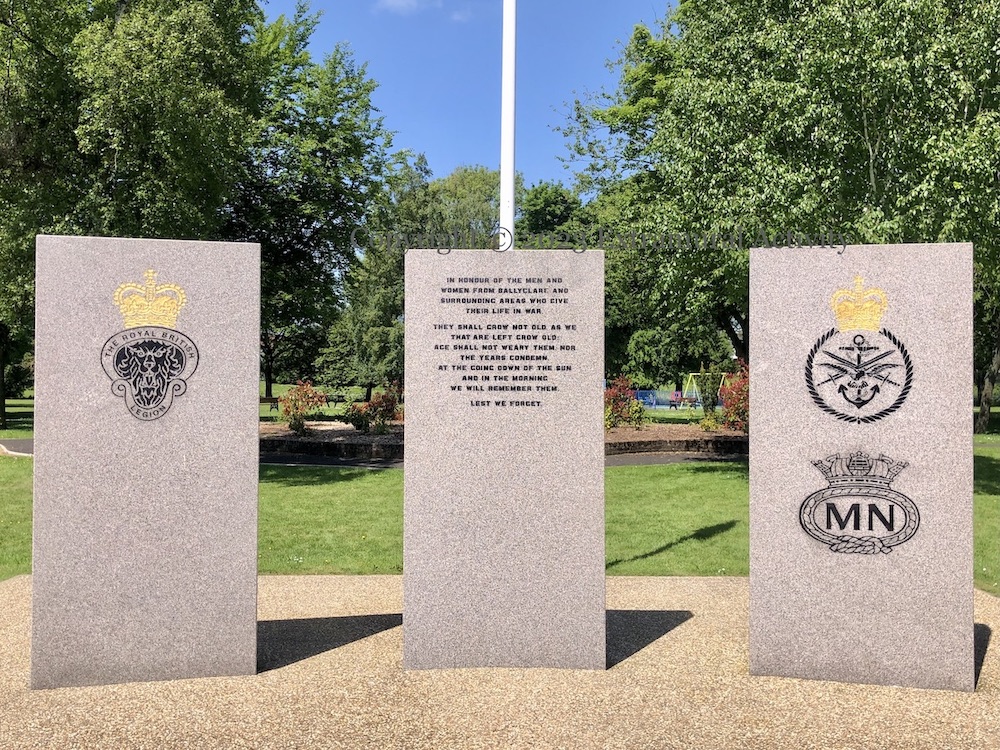
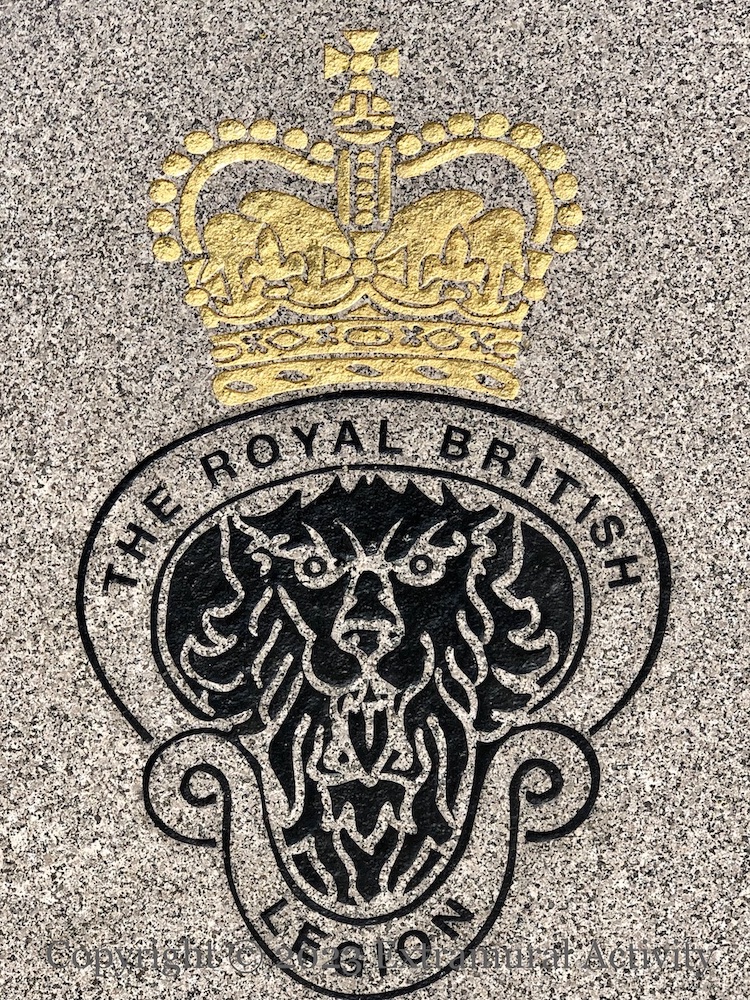
“In honour of the men and women from Ballyclare and surrounding areas who gave their life in war. ‘They shall grow not old as we that are left grow old, age shall not weary them nor the years condemn, at the going down of the sun and in the morning, we will remember them’. Lest we forget.” With emblems of the Royal British Legion (left), Navy and Merchant Navy (right), and a separate stone for the UDR “When danger threatened, some made the supreme sacrifice”.
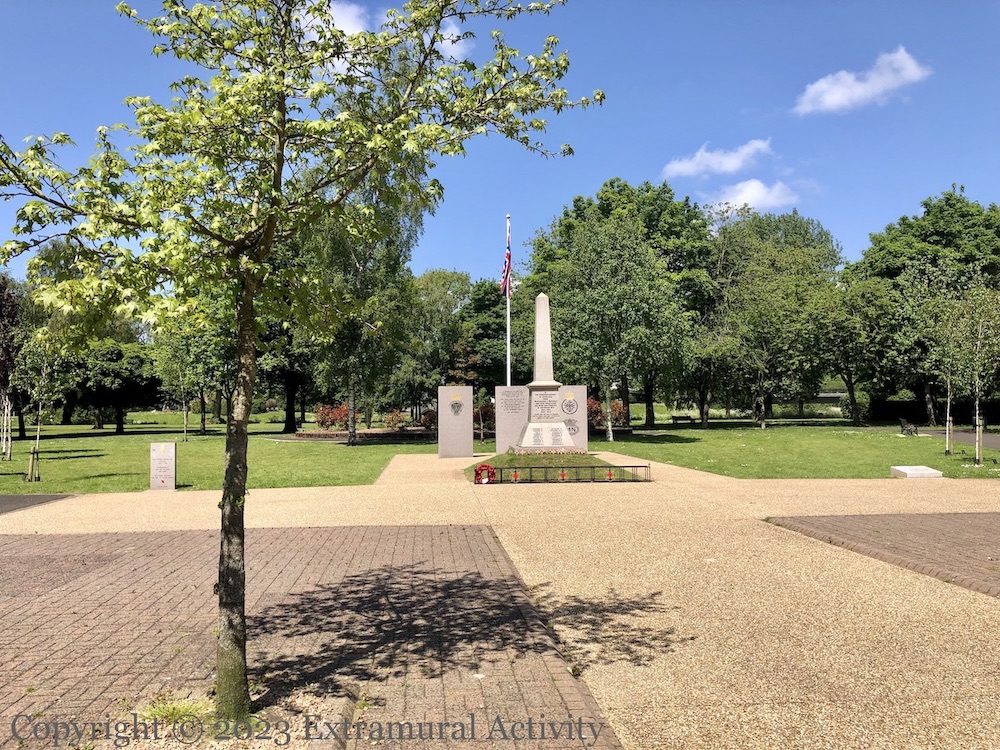
The main obelisk is dedicated “in the honoured memory of those men from Ballyclare & District who gave their lives for King and country in the Great War 1914-1918, 1939-1945. ‘Look not on this in sorrow but in pride and may ye live as nobly as they died.”
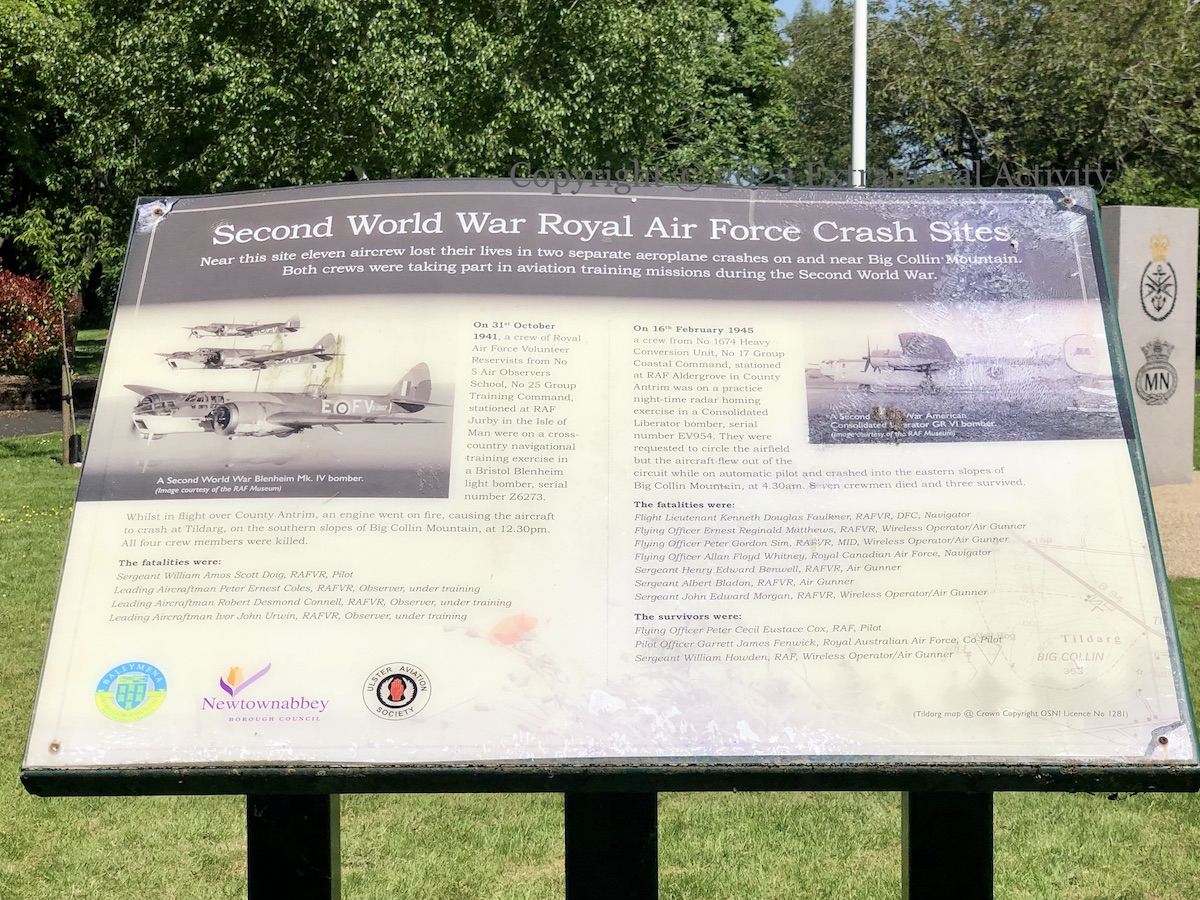
The remaining image shows the info board describing two aeroplane crashes around Big Collin Mountain, in which eleven airmen died while on training flights, one the result of an engine fire, the other crashed into the side of the mountain.
Ballyclare War Memorial Park, Ballyclare Road, Ballyclare. There are also separate murals in Erskine Park to the locals who died in WWI and in WWII.
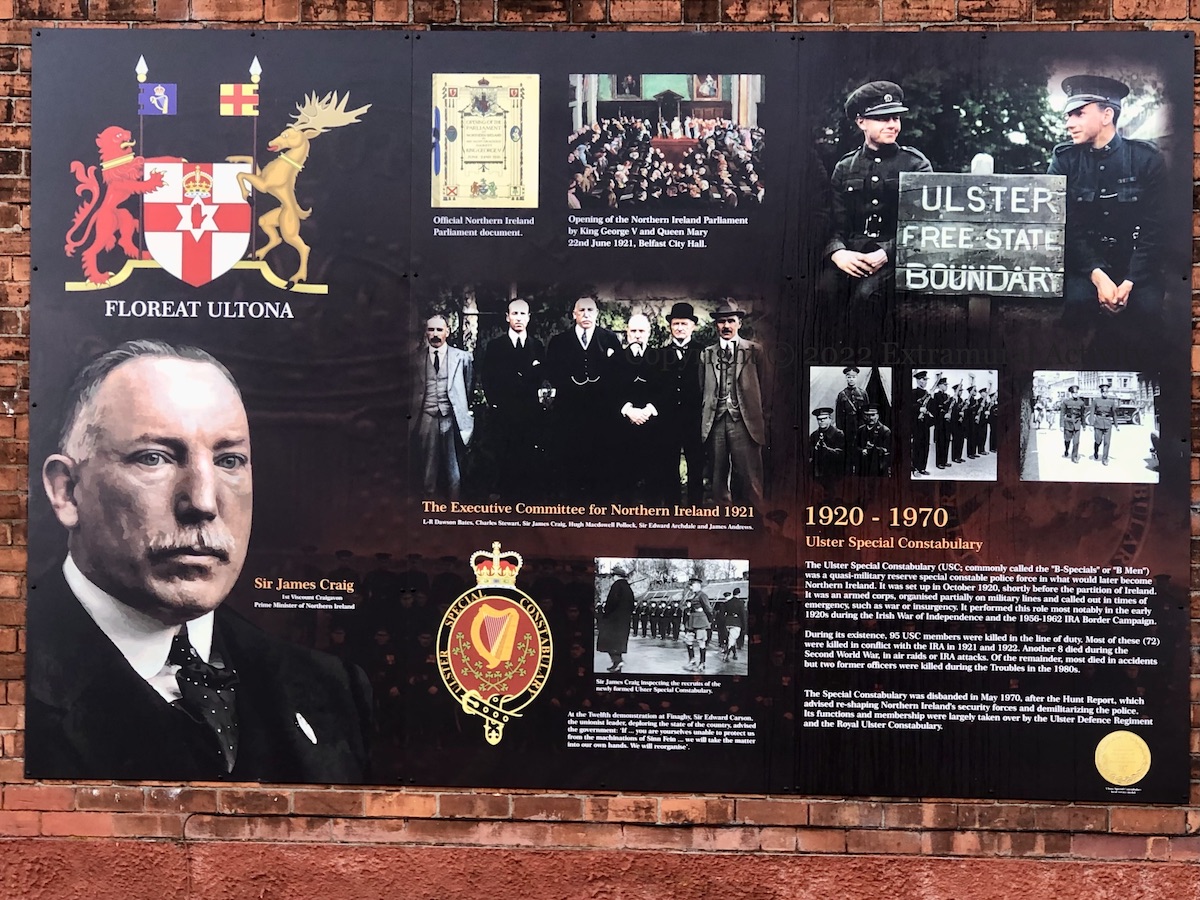
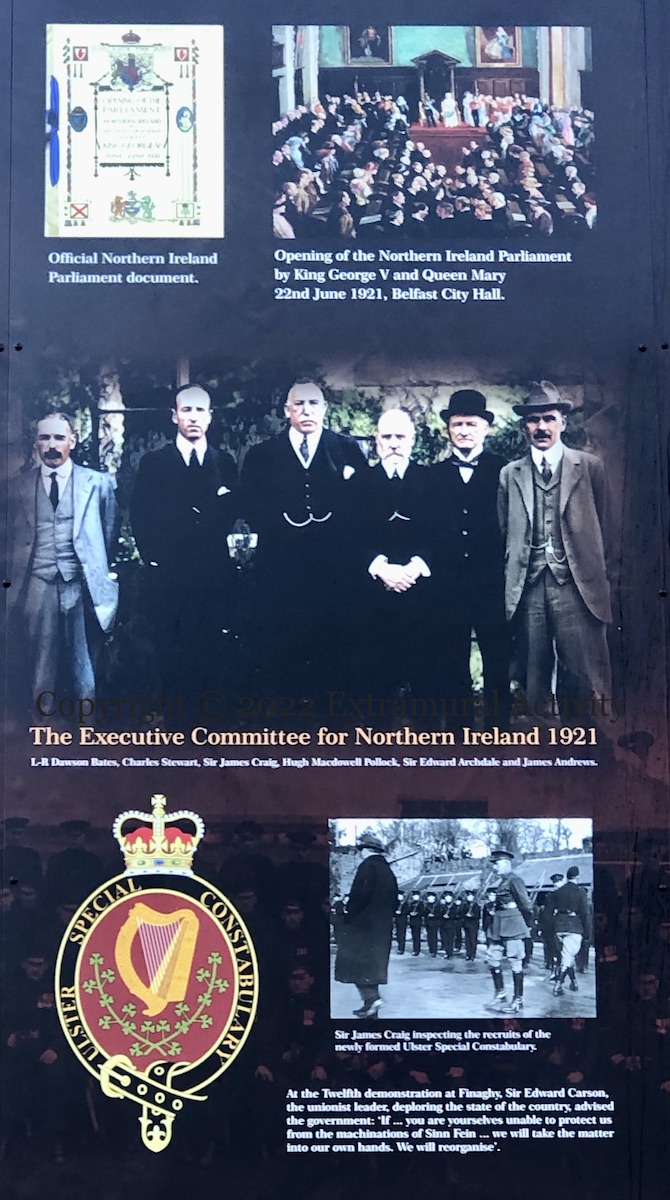
“May Ulster flourish” as the newly created Northern Ireland under “Sir James Craig, 1st Viscount Craigavon, Prime Minister of Northern Ireland”. The Northern Ireland parliament was opened in 1921 and the coat of arms adopted in 1924 (WP); the Special Constabulary (including the B-Specials) had been formed prior to and in preparation for partition – the quote from Carson (also seen in an east Belfast mural) is from July 12th, 1920.
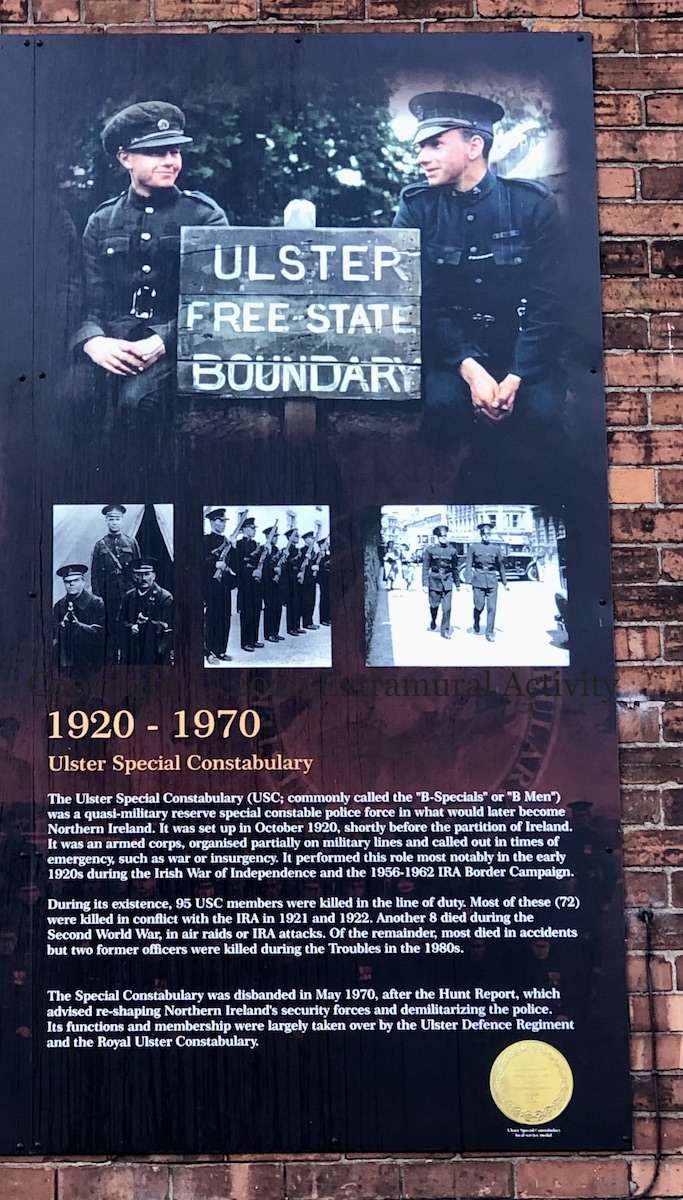
The text on the board is the same as at WP: “The Ulster Special Constabulary (USC; commonly called the “B-Specials” or “B Men”) was a quasi-military reserve special constable police force in what would later become Northern Ireland. It was set up in October 1920, shortly before the partition of Ireland. It was an armed corps, organised partially on military lines and called out in times of emergency, such as war or insurgency. It performed this role most notably in the early 1920s during the Irish War of Independence and the 1956-1962 IRA Border Campaign. During its existence, 95 USC members were killed in the line of duty. Most of these (72) were killed in conflict with the IRA in 1921 and 1922. Another 8 died during the Second World War, in air raids or IRA attacks. Of the remainder, most died in accidents but two former officers were killed during the Troubles in the 1980s. The Special Constabulary was disbanded in May 1970, after the Hunt Report, which advised re-shaping Northern Ireland’s security forces and demilitarizing the police. Its functions and membership were largely taken over by the Ulster Defence Regiment and the Royal Ulster Constabulary.”
This Belfast Live article (which has images from the launch) leads with the headline that this new board replaces a UVF mural, but there hasn’t been anything on this wall since a large “UDA” lettering in 1999. The adjacent wall, which has now been painted over, previously (in 2010) had a UVF flag which had been vandalised with “Jesus Christ Is Lord Of All’ graffiti by 2017.
Cyril Smith was a Catholic from Carrickfergus and a Royal Irish Ranger. The original cairn in his memory tells the story of his death at age 21 in 1990. For commentary, see this Irish Times piece.
“We support all Ulster’s soldiers.” The UDA and the UDR brought under the same umbrella of “Ulster’s defenders” in Charles Drive, Ballyclare. The UDR was established in 1970 to relieve the RUC and B Specials of military operations and was disbanded in 1992, in part because it was only 3% Catholic and 5-15% of members had links to loyalist paramilitaries (Irish News).
“Better to die on your feet, than to live on your knees in an Irish Republic.” The Ulster Special Constabulary was originally divided into three categories A, B, and C but after the 1922 only the B Specials remained as a reserve force for the RUC. The USC was disbanded in 1970 after its controversial behaviour in the riots of 1969, on some occasions failing to protect Catholics and in a few cases joining in with loyalists. It was replaced by the UDR (as a reserve military force), which lasted until 1992 – it was amalgamated with the Royal Irish Rangers to become the Royal Irish Regiment.
Between its construction in 1841 and decommissioning in 2003, Ebrington Barracks served as a home to many military units, including those whose emblems are at the bottom of the mural above (from left to right): the Royal Irish Rifles, Royal Inniskilling Fusiliers, Royal Irish Rangers, UDR, and the Royal Irish Regiment.
HMS Ferret and HMS Sea Eagle are not in fact ships but a part of Ebrington barracks given to the navy to serve as a “stone frigate” during (Ferret) and after (Sea Eagle) WWII. HMS Londonderry was an anti-submarine frigate but does not appear to have a particular connection to Ebrington (please comment if you know otherwise).
The Northern Ireland General Service medal – in the middle of the mural – was awarded to any soldier who served at least 30 days during Operation Banner, the deployment of British troops in Northern Ireland from 1969 onwards.
Privates Fred Starrett and James Cummings died in an IRA bombing on Belfast’s Royal Avenue on February 24th, 1988. Both Orangemen, their deaths are commemorated every year by a parade from east Belfast to the city centre. Shown in today’s post are the panels from a new UDR commemorative wall in east Belfast.
The fourth panel is a collage of UDR activities (on the streets, on base, manning check-points, in boats, helicopters, with dogs) with a few pieces of republican signs as backdrop (Free Derry Corner, “Provies rule”, “Such is British justice – remember 9th August”) and the fifth shows soldiers searching for arms near some outbuildings.









 Extramural Activity