The “Pilgrims” mural on the Newtownards Road has been replaced with an almost-identical representation on boards. As far as we know, this is the fourth instance of this design. Other instances of this mural are: Mersey St c. 1997-2007 (T00240); Tamar St (c. 2002-2005) (M02337); a small version above Cheepers c . 2006 (M02920); and the previous version in this spot on Newtownards Road, 2011-2022 (X00905). The existing mural was significantly faded; the companion “Elementary Right” mural on the other side of the Newtownards Road is less faded but (as can be seen in the final image, below) the paint is peeling away in places.
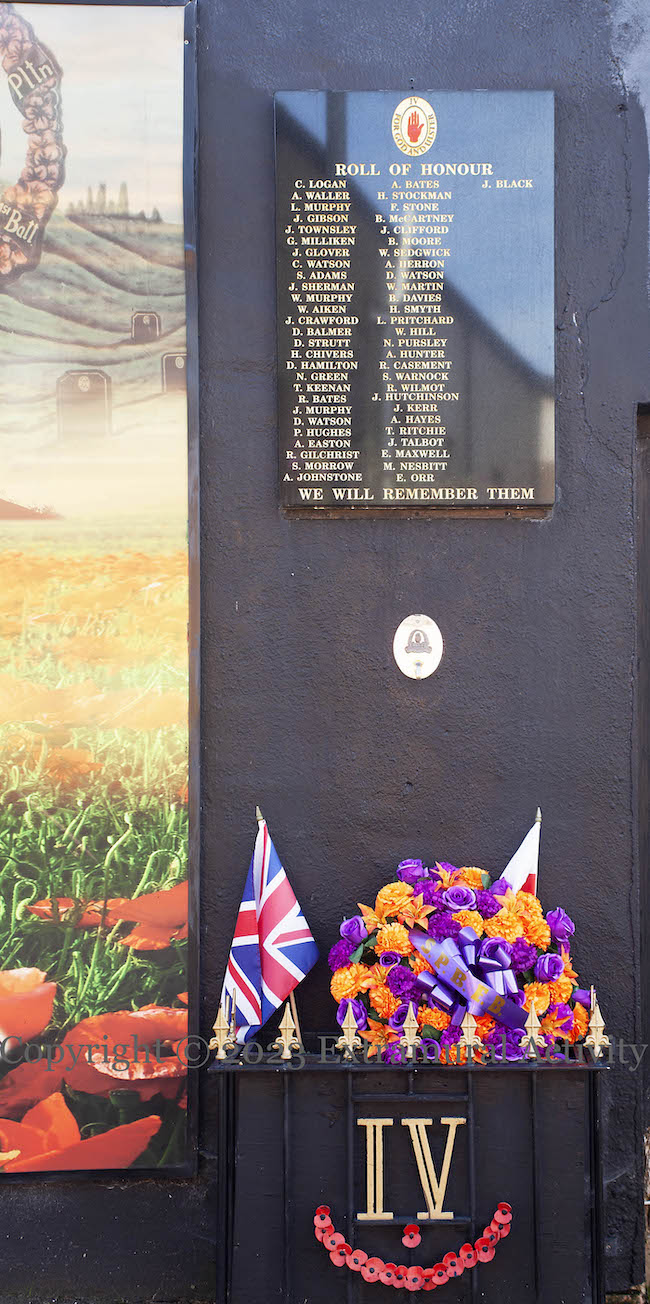
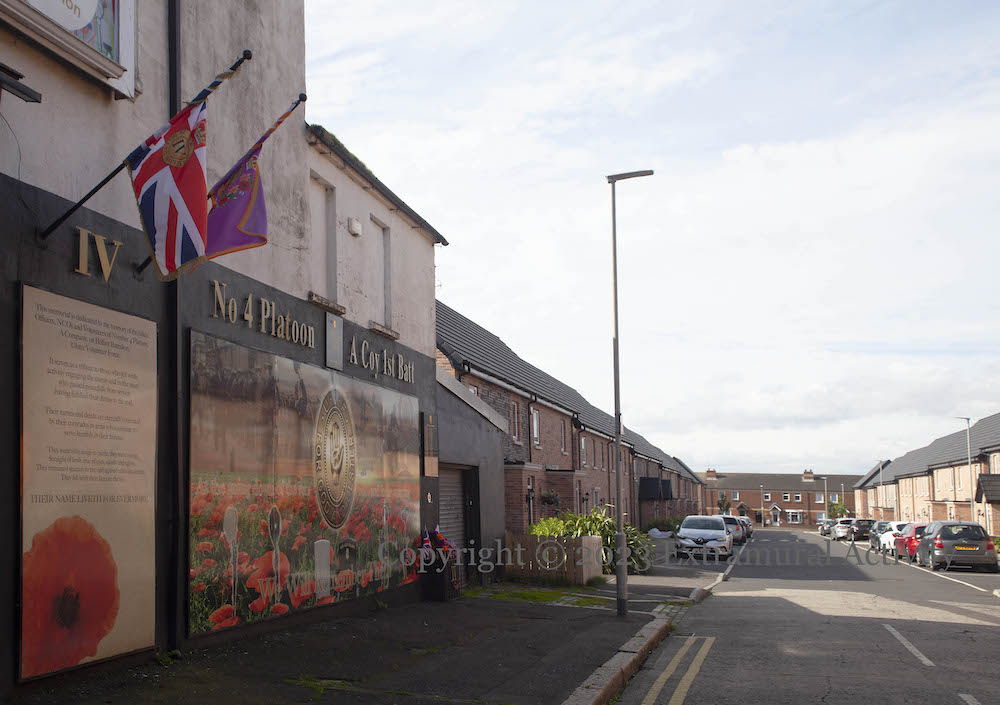
The UVF (A company, 1st battalion, platoon 4) mural in Glenwood Street was in the news last week after Jude Whyte of the Victims And Survivors Forum (web) drew attention to it because of its inclusion of some members of the Shankill Butchers (Irish News). The gang-members included in the plaque are given in a previous post – Platoon IV.
Some outlets (e.g. Sunday World) are reporting that the plaque is new but, while a few names of platoon have volunteers been recently added – Nesbitt, Orr, and Black – the plaque, including the names of various members of the gang, has been on the wall since 2017.
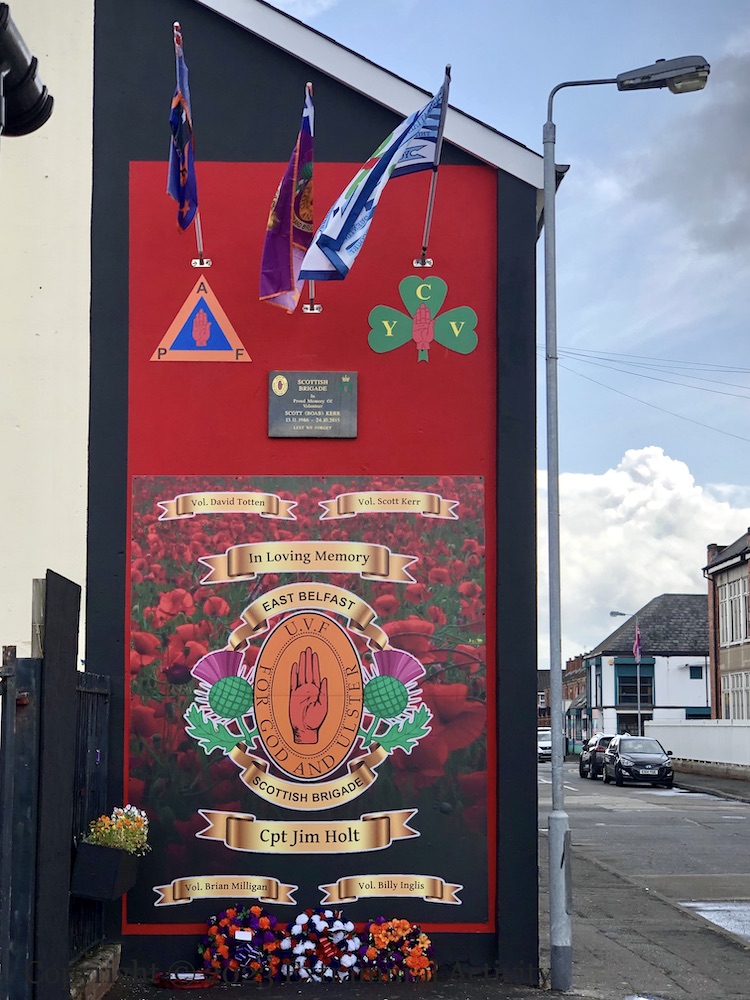
The hand-painted UVF Scottish Brigade mural (see Boab Kerr) in Beechfield Street/Tower Street has been replaced by this new printed board. The plaque to Kerr has been retained, but four names have been added – David Totten, Brian Milligan, Billy Inglis, and Jim Holt, who is now the most prominent. Holt died in February 2021 (ACT Fb).
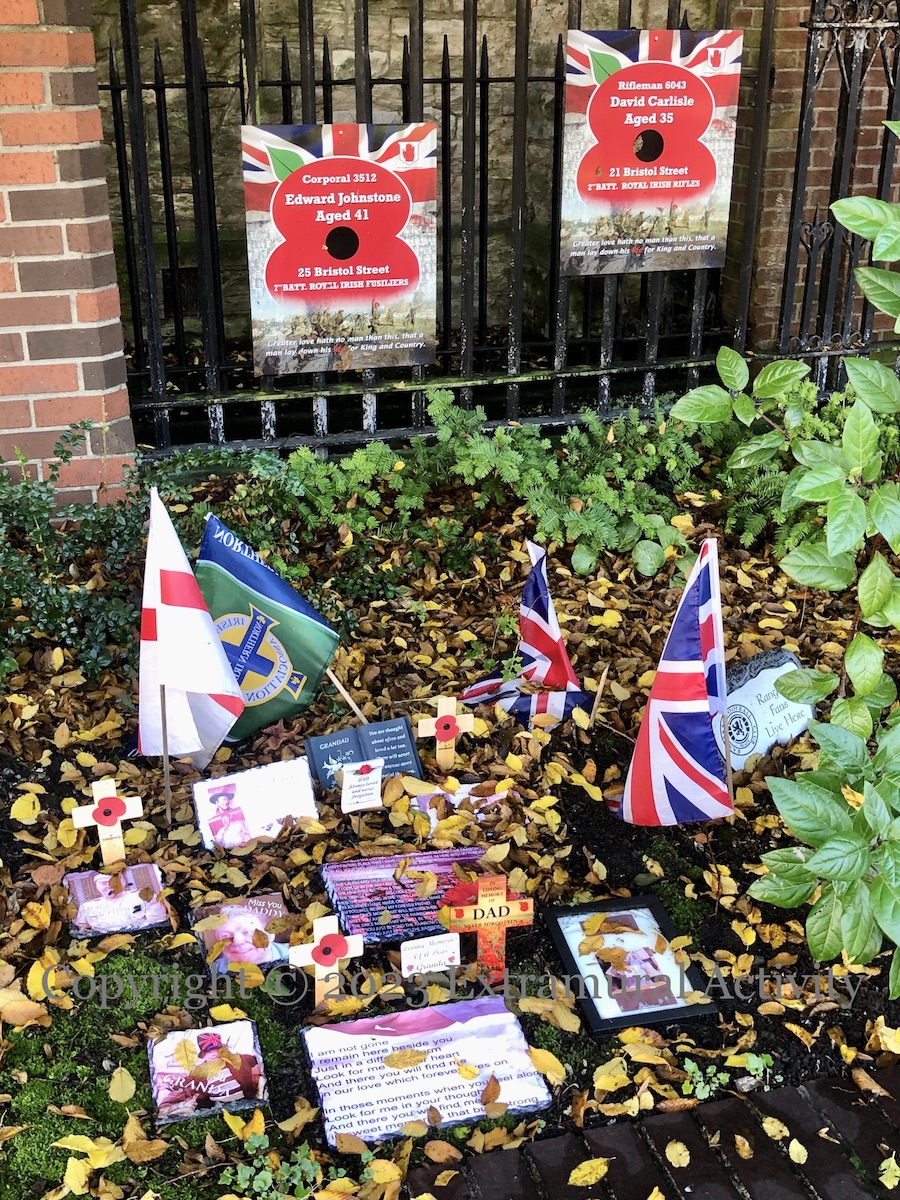
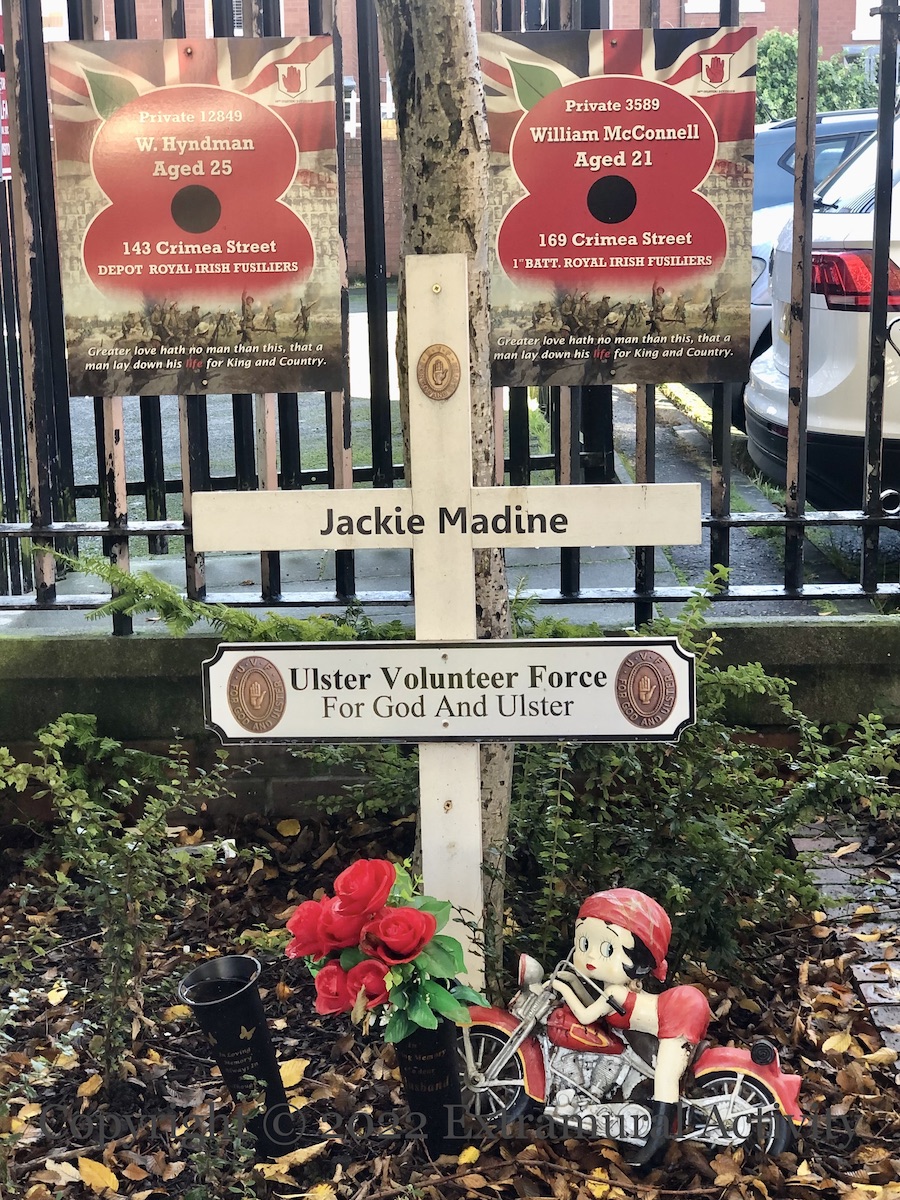
The Shankill Memorial Garden next to West Kirk Presbyterian is home to memorials to WWI (see Who Went To War And Never Returned) and the Shankill Bombing (see In The Shadow Of Death) . It has also become the site of many small memorials to local people, including volunteers in the UVF. For “S Company” see S Company, C Company.
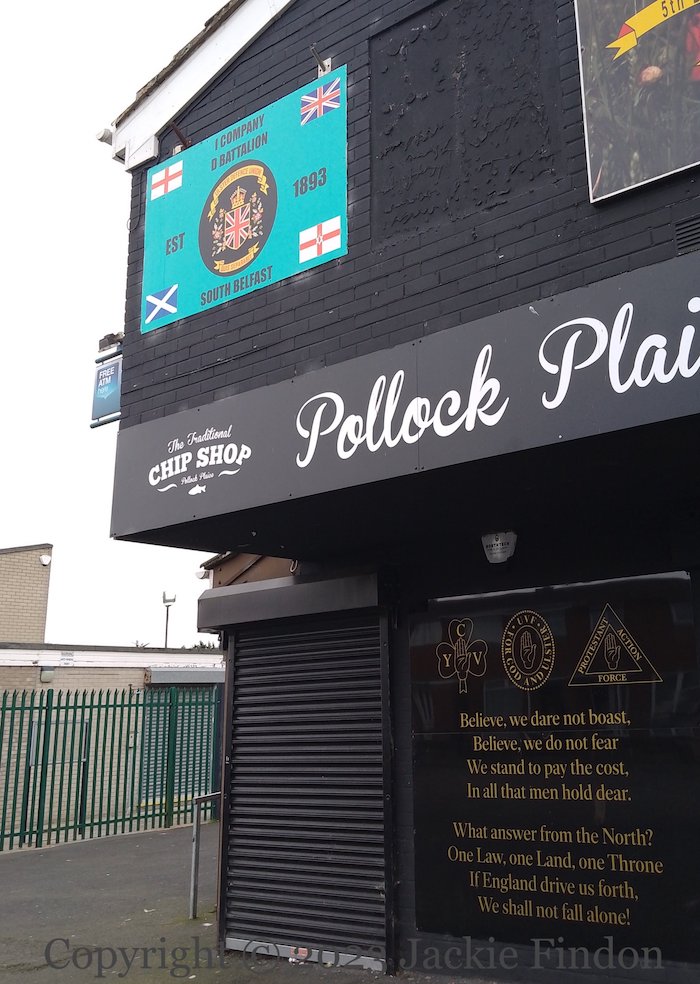
These are the boards at the chip shop (formerly a Spar and before that a Mace) in the centre of the Mourneview estate, Lurgan.
Above, in Mourne Road, a gallery of photographs of the Craigavon Protestant Boys (Fb) past and present, with a plaque in memory of Victor Stewart. “Our only crime is loyalty.”
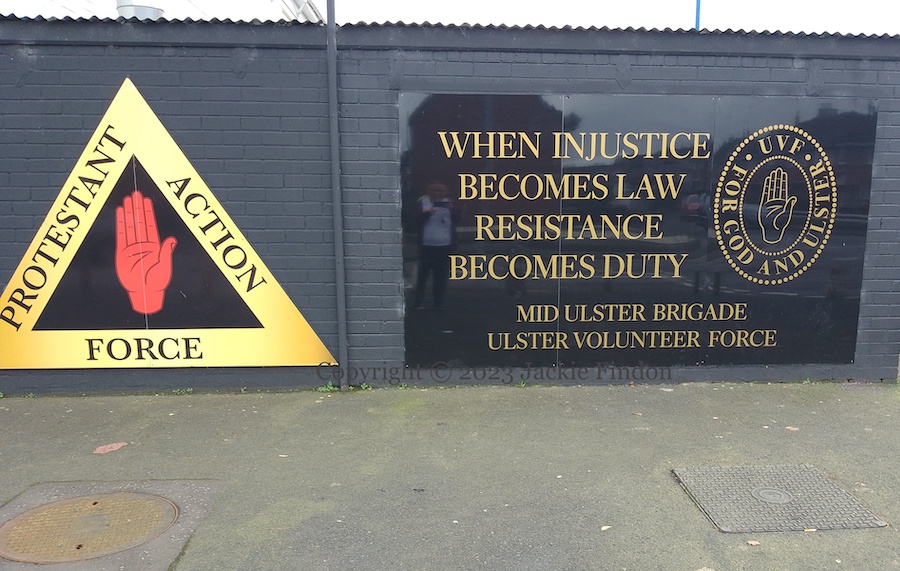
Below are the images from the front of the shop, in Pollock Drive:
First/right: “When injustice becomes law resistance becomes duty.” The same panel was seen in Ballyclare, though for the 1st East Antrim battalion rather than the Mid Ulster brigade.
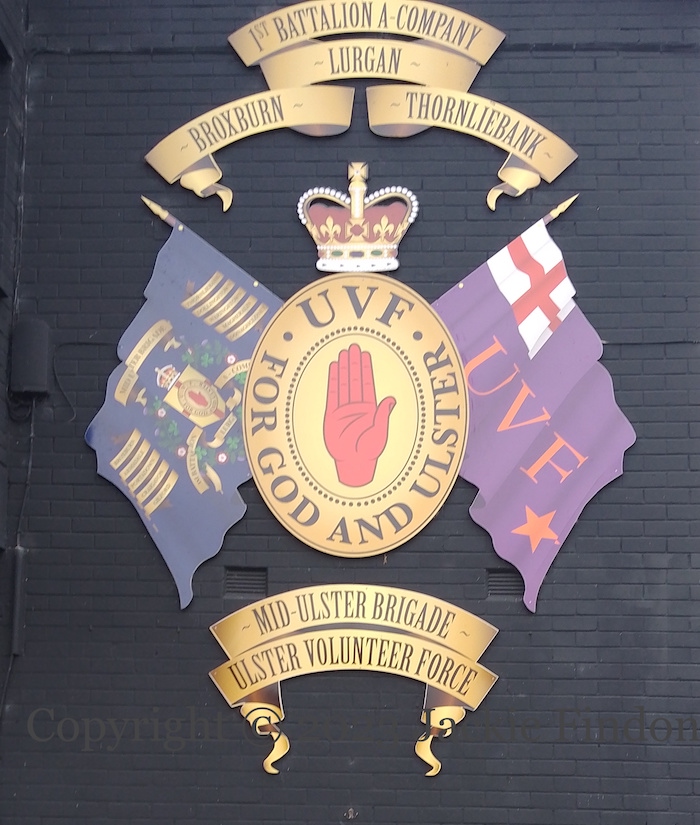
Next: A company, 1st battalion, Mid Ulster brigade UVF – Lurgan as well as Broxburn (outside Edinburgh) and Thornliebank (near Glasgow).
Next: A tribute to the Ulster Volunteers from the area: the 9th battalion Royal Irish Fusiliers joined the 108th brigade in the 36th (Ulster) Division; the 5th battalion joined the 31st brigade and the 10th (Irish) Division. This board goes back to (at least) 2011.
Next: “Believe, we dare not boast,/Believe, we do not fear/We stand to pay the cost,/In all that men hold dear.//What answer from the North?/One Law, one Land, one Throne/If England drive us forth,/We shall not fall alone!” Kipling’s poem Ulster.
All of the preceding pieces are UVF/PAF, but the last, high up on the left, is a UDU board in the top left of the wall, to 1 company, D battalion, South Belfast.
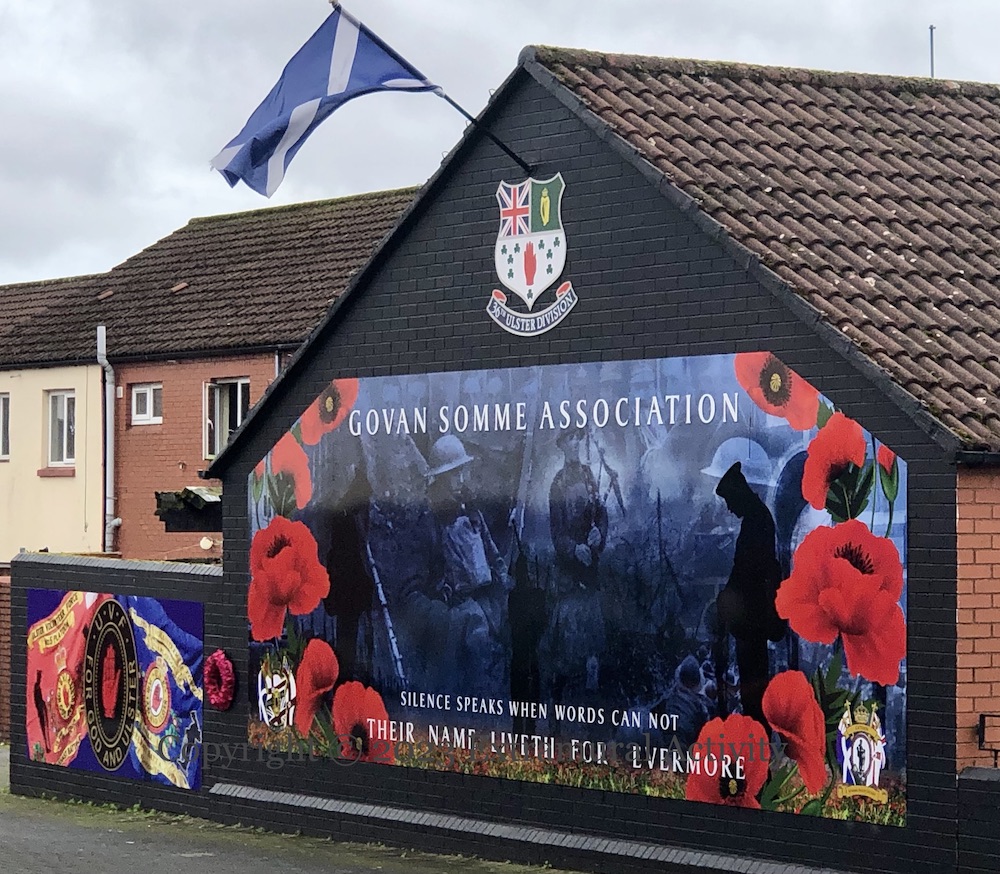
There was previously a (painted) mural on this wall – see Passchendaele Court – but this latest display is a large printed board, with photographs blended together and framed by graveside mourners, poppies, and the emblems of the Pride Of Govan flute band and the Govan Somme Association (Fb), which also supported the previous mural.
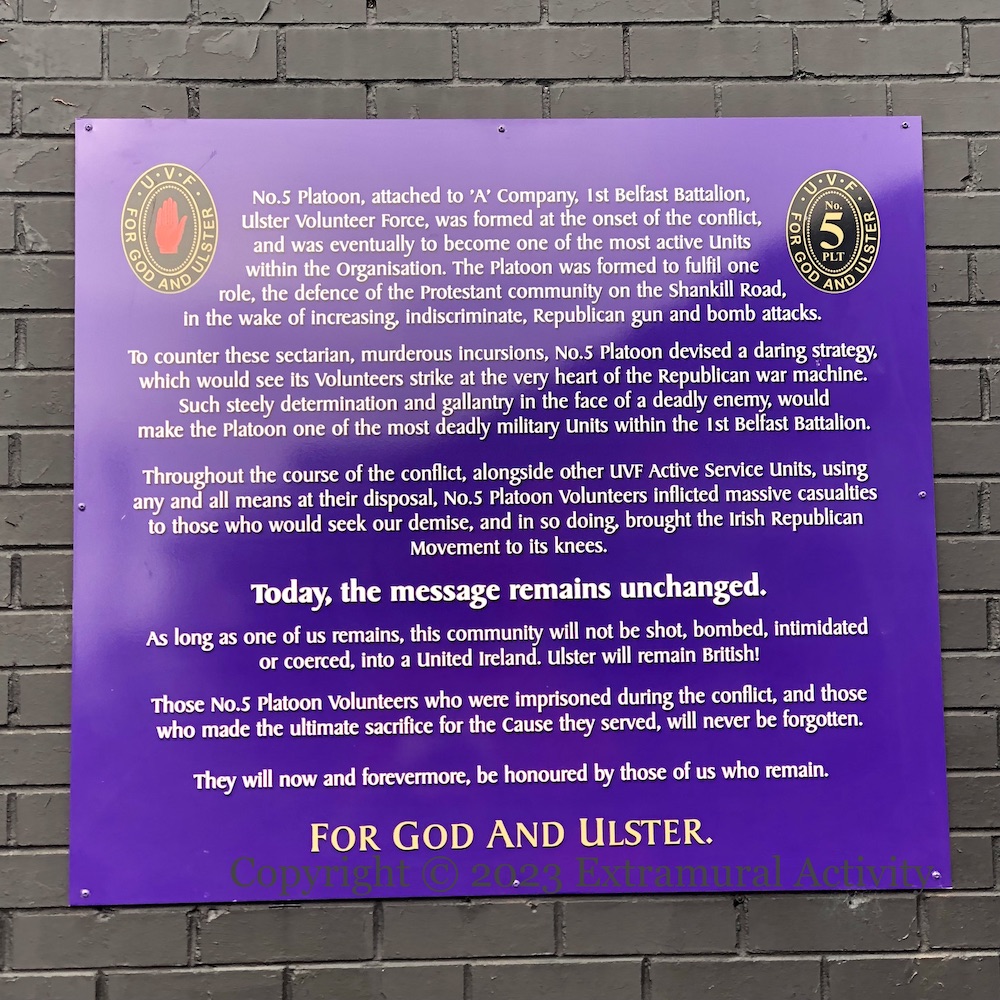
To the left, as seen in the final images, is a smaller UVF (1st Battalion) A Company 5th Platoon board – like the other new board in the street We Will Always Be Ready (and on the other side of Conway Street – see When Needed We Shall Rise Again).
There are three hooded gunmen on the main panel of this new installation along Conway Street, Belfast, and the side panel is a gallery of 14 photographs of hooded gunmen, flanked on either by two more hooded gunmen.
Please note: the photograph above has been photoshopped for colour. The true colour (orange) can be seen in the wide shot, below.
“No. 5 Platoon, attached to ‘A’ Company, 1st Belfast Battalion, Ulster Volunteer Force, was formed at the onset of the conflict, and was eventually to become one of the most active Units with the Organisation. The Platoon was formed to fulfil one role, the defence of the Protestant community on the Shankill Road, in the wake of increasing, indiscriminate, Republican gun and bomb attacks. To counter these sectarian, murderous incursions, No. 5 Platoon devised a daring strategy, which would see its Volunteers strike at the very heart of the Republican war machine. Such steely determination and gallantry in the face of a deadly enemy, would make the Platoon one of the most deadly military Units within the 1st Belfast Battalion. Throughout the course of the conflict, alongside other UVF Active Service Units, using any and all means at their disposal, No. 5 Platoon Volunteers inflicted massive casualties to those who would seek our demise, and in so doing, brought the Irish Republican Movement to its knees. Today the message remains unchanged. As long as one of us remains, this community will not be shot, bombed, intimidated or coerced, into a United Ireland. Ulster will remain British! Those No. 5 Platoon Volunteers who were imprisoned during the conflict, and those who made the ultimate sacrifice for the Cause they served, will never be forgotten. They will now and forevermore, be honoured by those of us who remain. For God and Ulster.”
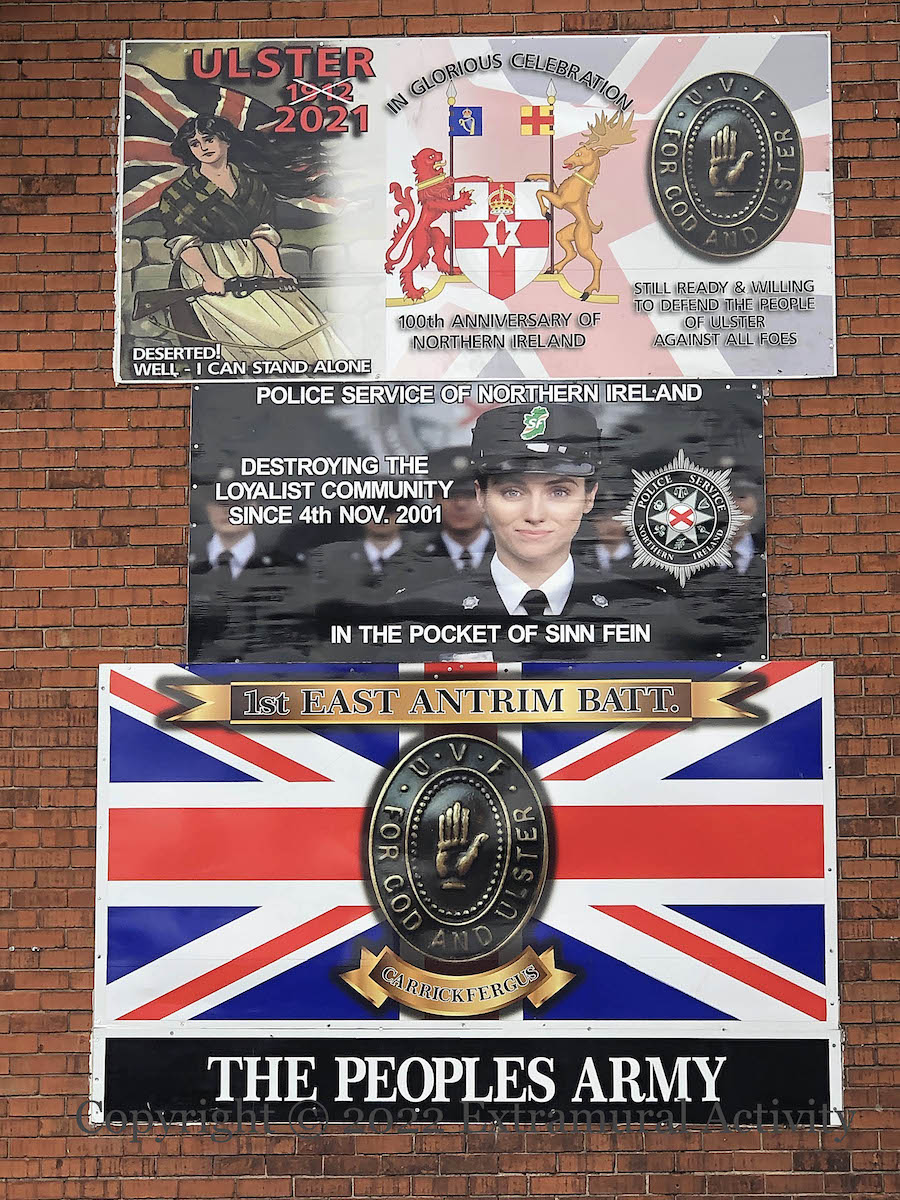
The UVF 1st East Antrim Battalion is “Still ready & willing to defend the people of Ulster against all foes” including the British government that – even as Northern Ireland marks its centenary – has “deserted” it over the NI Protocol that involves checks on goods moving between Britain and Ireland (whether north or south) but no (new) checks on goods moving between north and south (gov.uk). The “still” goes all the way back to 1912, when the British government of the day proposed (for a third time) “Home Rule” for Ireland and the Ulster Volunteers were formed – though the original “deserted” postcard and previous murals show the date as 1914.
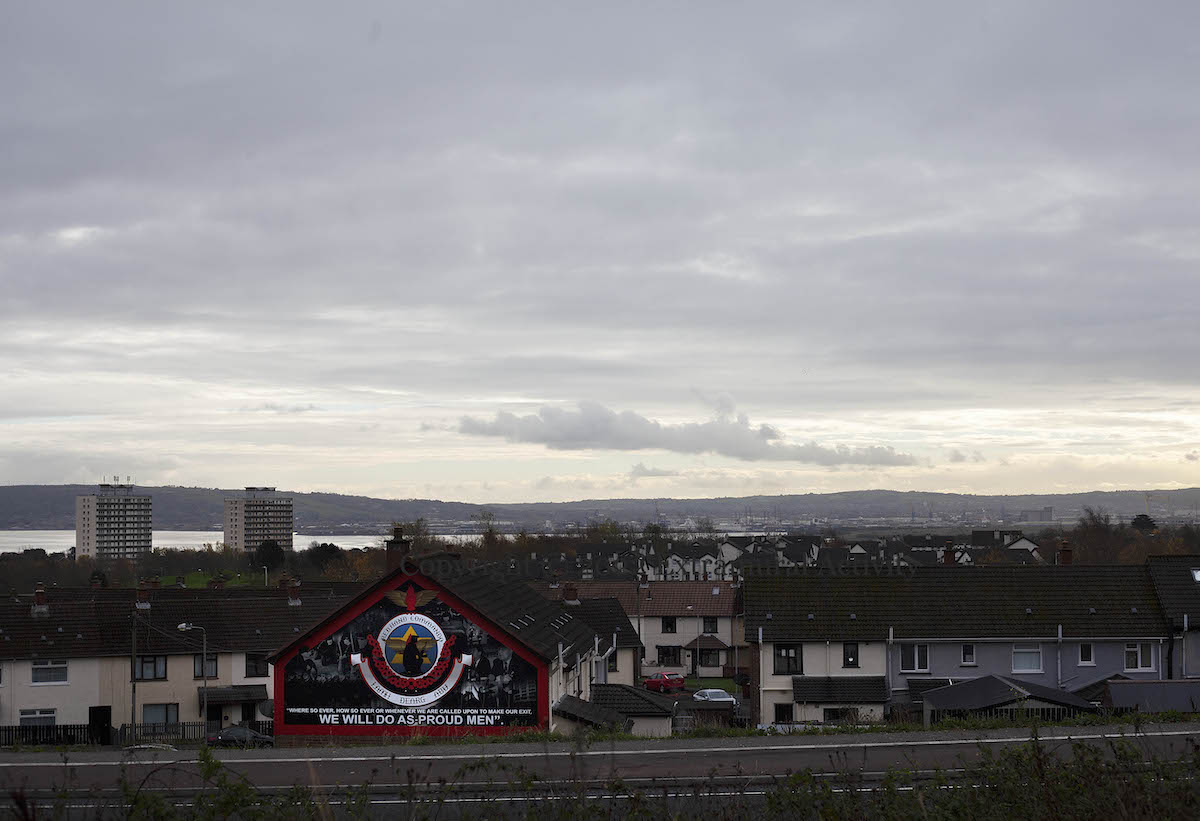
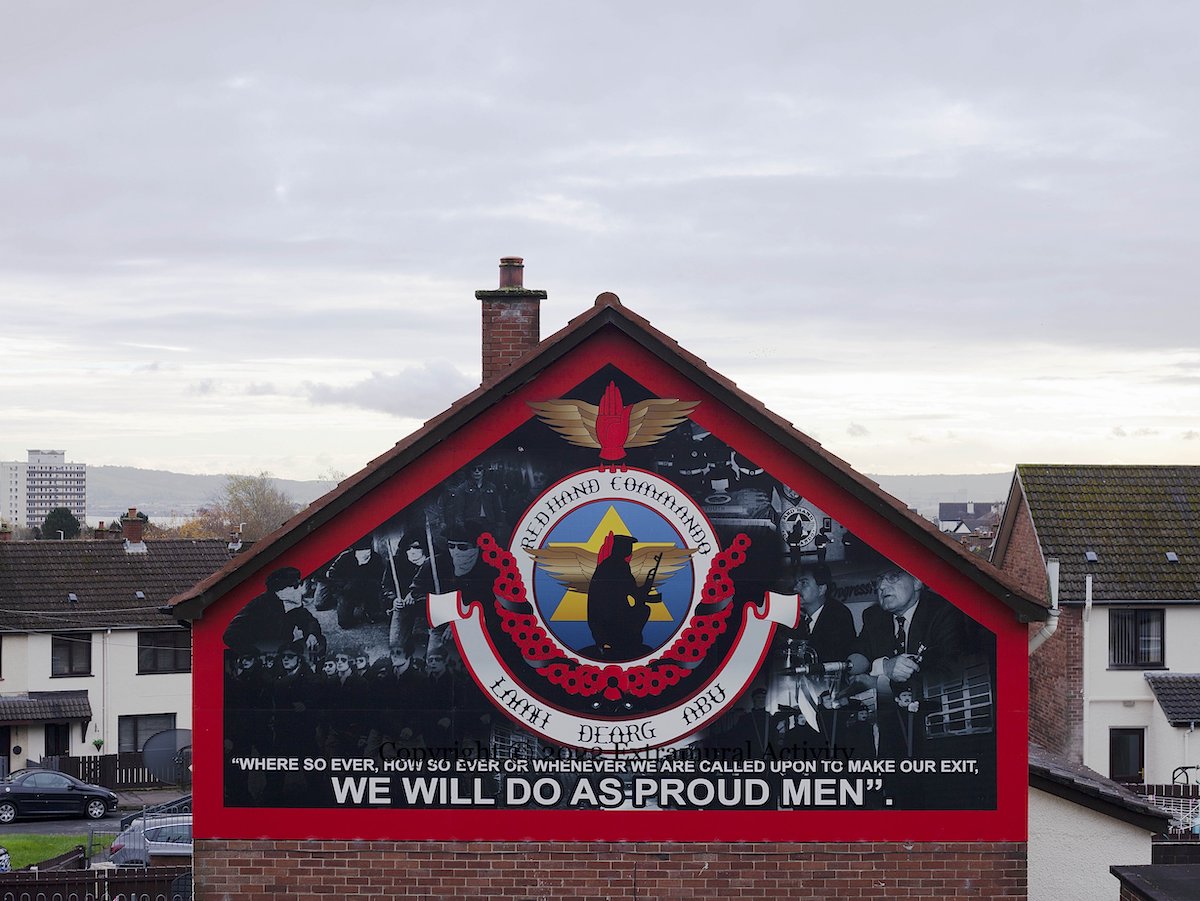
“Where so ever, how so ever or whenever we are called upon to make our exit, we will do as proud men.” This is quite a different message from the one produced within the Rathcoole estate for the 50th anniversary of the Red Hand Commandos, which stated that despite its venerable age, the four Rathcoole companies of the RHC “Await In The Shadows“. (That mural also depicted the kneeling men with sticks (on the left of today’s mural) and the linked post also contains the original photograph.)
It’s not clear who or what within loyalism might call upon the RHC to stand down; loyalist rhetoric at the moment is full of anger at the protocol and warnings/threats about of a return to violence (e.g. BelTel | BBC).
For the use of “Lamh Dear Abu” as the slogan, see Ulster Says “Tá”.
Agriculture minister Edwin Poots’s directive to stop checks on goods coming from Britain to Northern Ireland – which did not come into practical effect – was struck down on Friday, and reverting the policy to what it was under the NI Protocol and Brexit deals. The High Court judge who handed down the decision did so on the grounds that Poots’s directive was politically motivated (BBC) – in other words, it was taken as part of the DUP’s opposition to the Protocol, which next (in February, 2022) involved collapsing the executive.
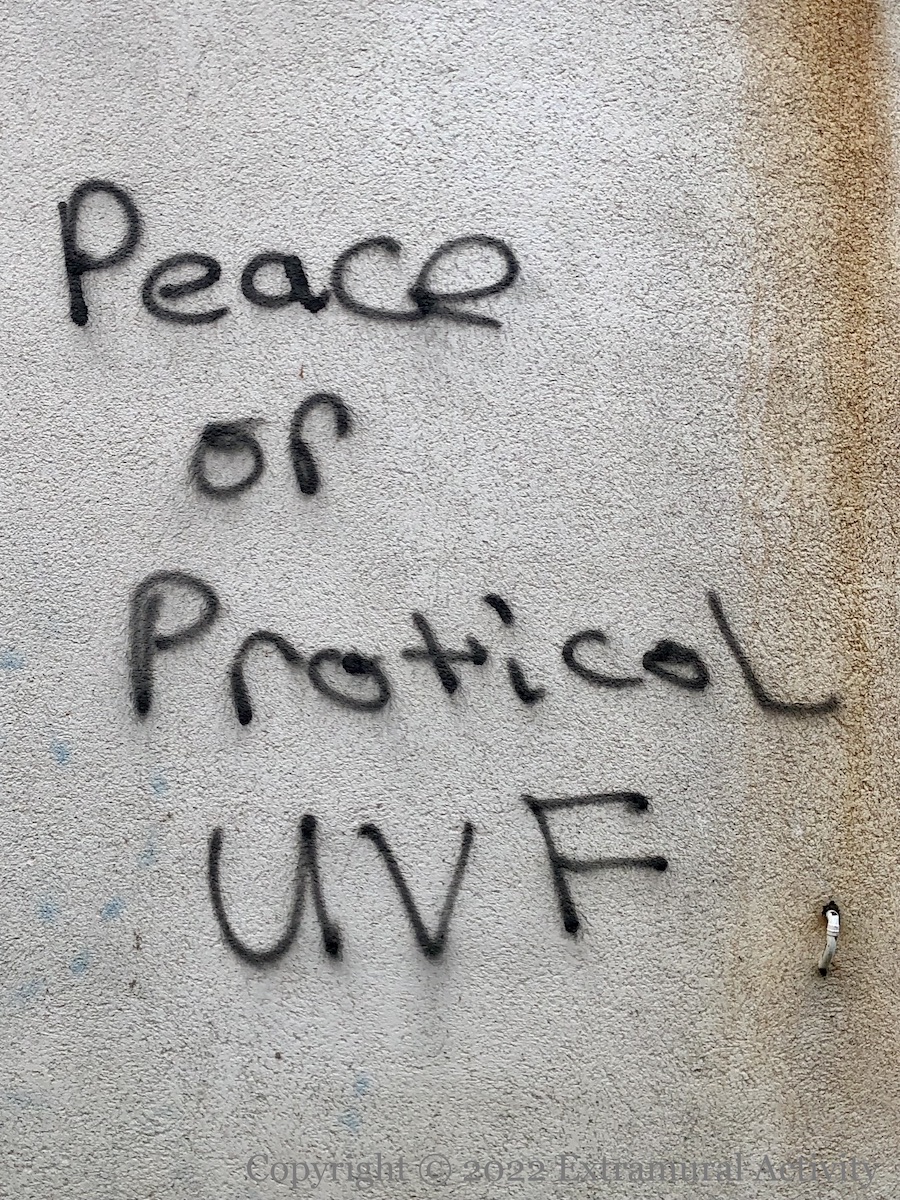
Sales from GB to NI increased 7% (about 1 billion pounds in value) in the year after the Protocol came into effect (BBC | BelTel) but money isn’t everything (the “erosion of our identity” is “non-negotiable“) and protests persist, offering the bargain of “the peace” (i.e. the Belfast/Good Friday Agreement) or “the proticol”. Efforts continue by the UK government to reach a new deal with the EU and/or to pass a bill allowing unilateral changes (News Letter).

















 Extramural Activity