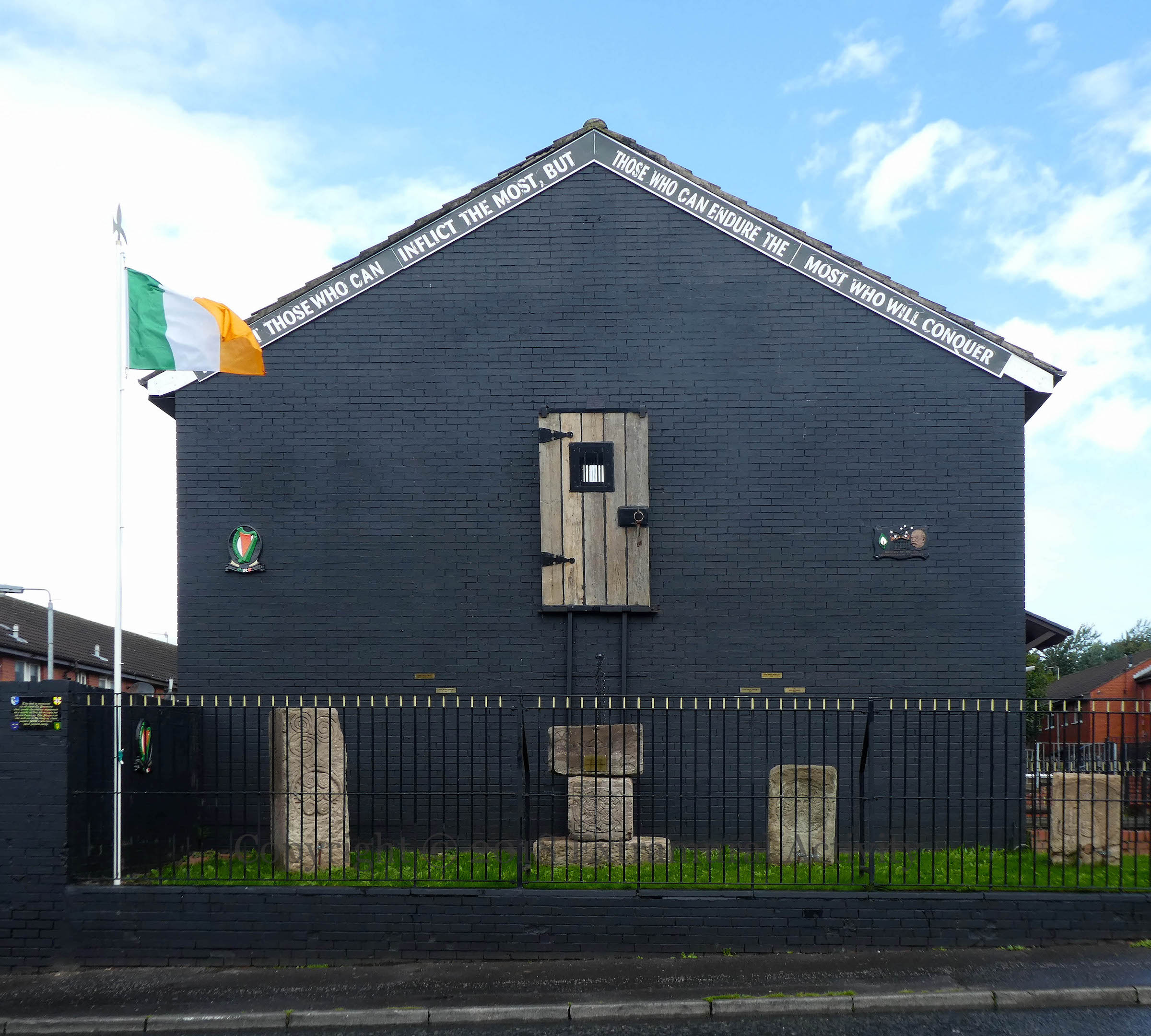
“This wall is dedicated to all those ex prisoners that found themselves imprisoned as a result of British occupation of our country. The plaques on the wall are in memory of those former POW’s who have since passed away.” There are five plaques already on the wall, to Patrick Quinn 2017, Buller Holland 2007, Henry McErlean 2015, Martin Meehan 2007, Seán McCaughey 1946.
Robert Ballagh’s 1916 Proclamation was first painted as a mural by Mo Chara Kelly and Rısteard Ó Mhurchú in 1991 for the 75th anniversary of the Easter Rising (see Cáısc 1916 which also contains the Ballagh piece). That version stood for ten years on the Whiterock Road. It has reproduced again in Ard An Lao above the hunger strikers, after the removal of several plaques (see All Our Dead). “With special thanks to Hugo Óg Wilkinson”.
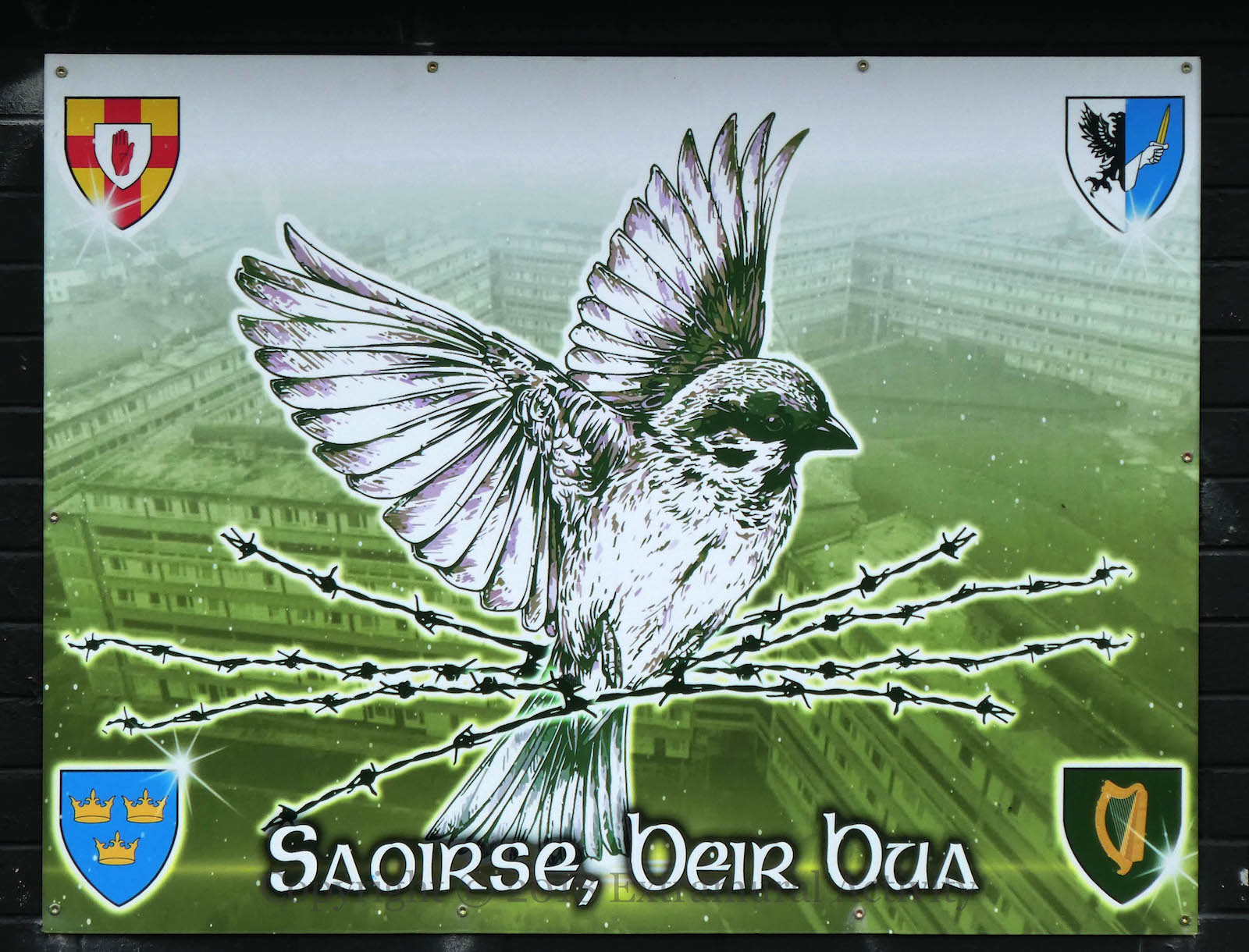
In the background of this board can be seen the old Divis flats. The flats were built to replace the tightly-packed streets of the lower Falls. After the first three blocks were completed in 1969, there was a plan to have a mixture of flats all the way up to Dunville Park (“Phase 2” in this 30-minute BBC video on the flats, which also includes the story of its eventual demise.
On top are the words “saoırse [freedom]” and “beır bua [seize victory]”, along with imagery of the four provinces and a lark in barbed wire.
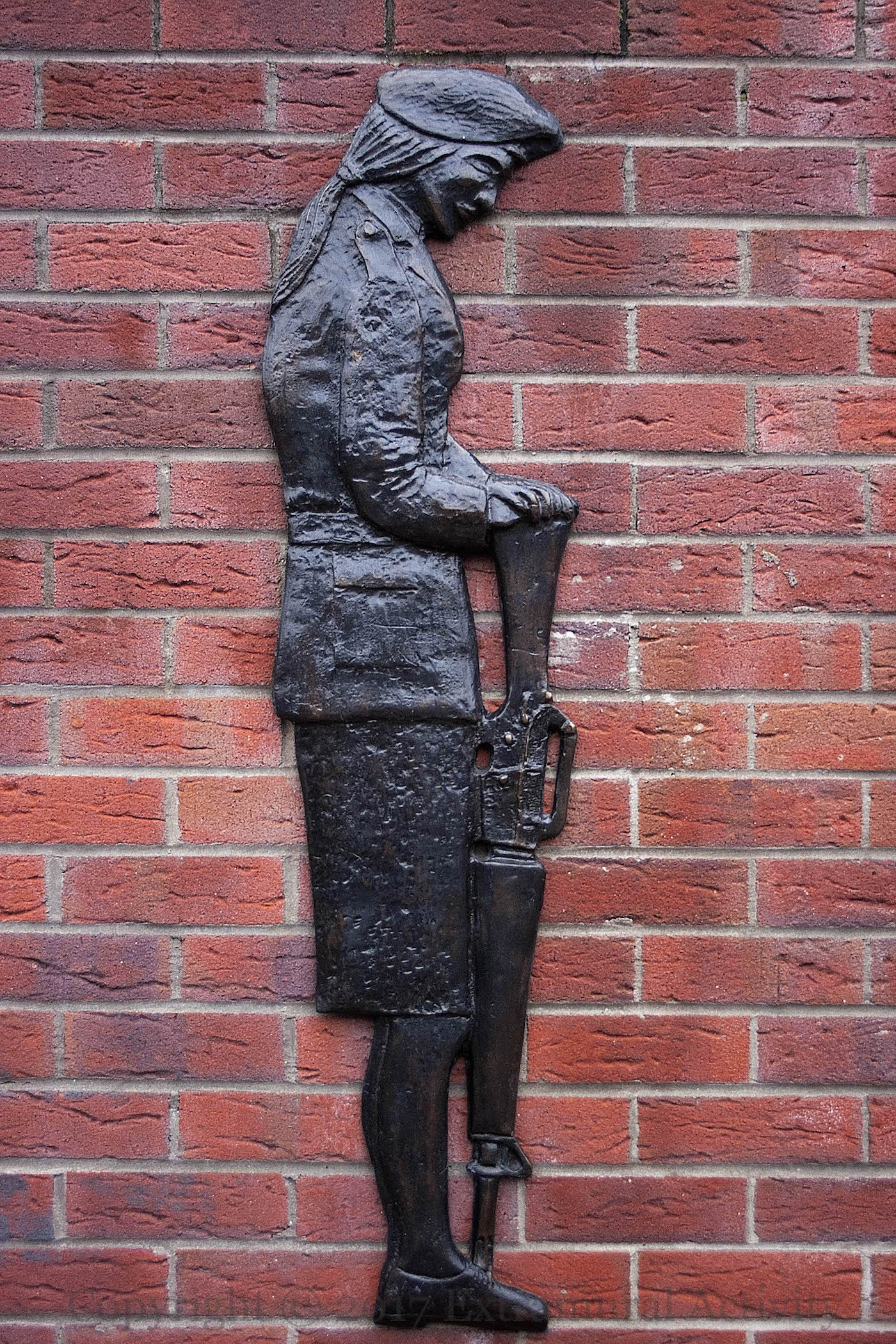
Here, from left to right, are all of the metalworks in the memorial garden on Ascaıll Ard Na bhFeá by sculptor and painter Hugh Clawson. On the stone (above) an IRA volunteer – with the emblem of the Easter lily on his beret – rests in the arms of Mother Ireland and her harp. Then two featuring the lark as the ‘spirit of freedom’ (from The Lark And The Freedom Fighter). In the first, the lark breaks through the bars of a prison cell, and in the image below, it flies in front of an “H” made of bricks, carrying a bin lid. (For a lark carrying a rifle, see Lark Of War and Armed Resistance.) Clawson’s name can be seen on the bars. In the second, a lark carries a binlid, used by locals to signal the presence of British Army troops. “In memory of all Irish martyrs who have died on hunger strike in the fight for Irish freedom. Their inspiration and courage will always be remembered by the republican movement and republican family (mid Falls).” One female and one male volunteer stand with bowed heads. A pair of hands joined in prayer in the Beechmount memorial garden: “in memory of those innocent people from this area who have died in this struggle for Irish freedom”. Finally, a scene of protest, in front of the Free Ireland mural at the bottom of the street. “In memory of the all the unsung heroes off [sic] this area who’s [sic] hardship, sacrifice and support during this struggle for Irish freedom will never be forgotten by the Belfast Brigade óglaıgh na h-éıreann.” The plaque depicts the work of print-makers (“Smash H-Block Armagh”), marchers carrying portraits of hunger strikers (“Mid Falls supports the women of Armagh”), bin-lid rattlers, and muralists. The tarp above reads “Cuımhníonn Lár na bhFál – Mid Falls remembers” Out of picture to the right of the wide shot is Bobby Sands’s quote “Our revenge will be the laughter of our children.” See M04415.
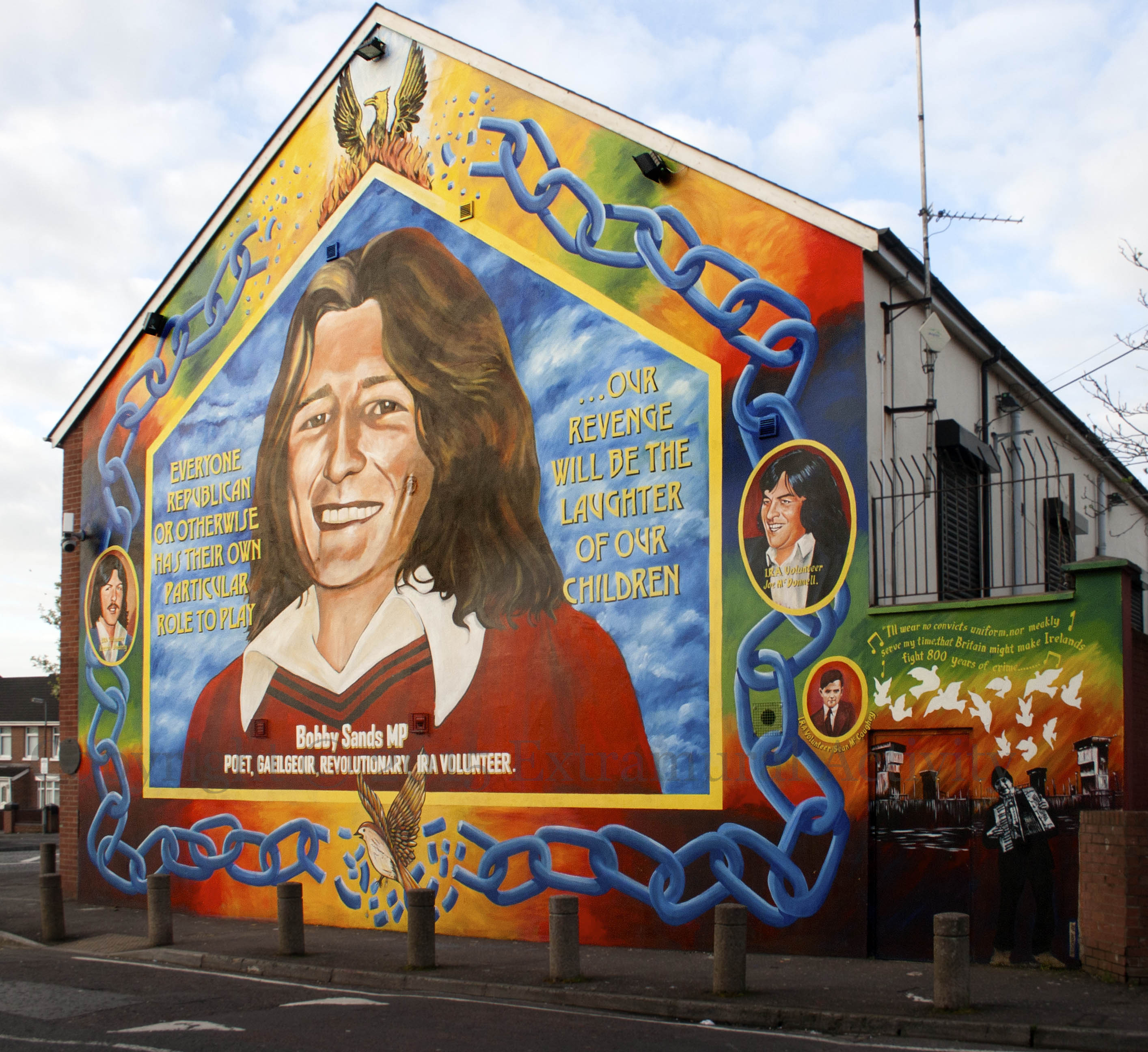
The Bobby Sands mural in Sevastopol Street has been given a facelift, including the blocking-up of a vent on Sands’s left cheek. Kieran Doherty and Joe McDonnell have been added in place of the 1798 medallions on each side. On the side-wall are Sean McCaughey, ten doves representing the 1981 hunger-strikers, and Long Kesh. Aerosol‘s accordion-player stencil has been also been retained.
Ag sráıd Sevastopol cuımhnıtear ar Bobby Sands ı múrmhaısıú a aithnıtear ar fud an domhaın. Ba scrıbhneoır, file, réabhlóıdí agus díograıseoır Gaeılge é Sands. Fuaır sé bas 5 Bealtaıne 1981 tar éıs 66 lá ar stailc ocraıs. As ucht na dıograıse a thaıspeáın Sands agus a chomhchımí ı leıth fhoglaım na teanga faoı choınníollacha uafásacha Bhlocanna H na Ceıse Fada, spreagadh glúın úr chun dul ı mbun athghabháıl na Gaeılge.
Here at Sevastopol Street Bobby Sands is remembered in a mural which has become world-renowned. Sands, a writer, poet, revolutionary and Gaelic enthusiast, died on May 5th 1981 after 66 days on hunger strike. Sands and his fellow prisoners inspired a new generation to reclaim the Irish language enthusing them by the huge efforts they put into learning Irish in the horrendous conditions on the H Blocks of Long Kesh.
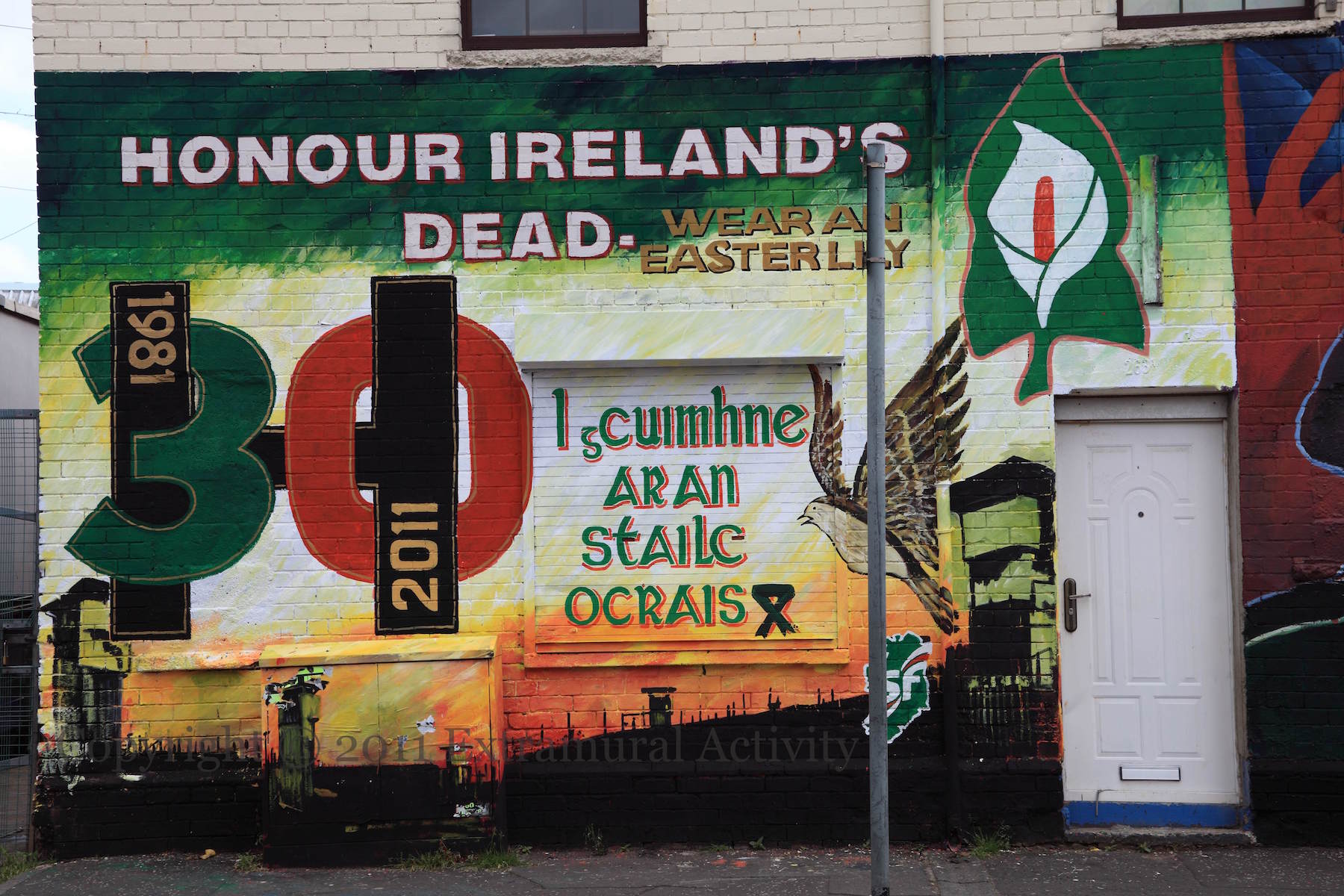
Mural in Beechmount Avenue/Ascaıll Ard na bhFeá commemorating the 30th anniversary of the hunger strike. The watchtowers of Long Kesh provide a lower border, joined by symbols of republican prisoners the lark and the green ribbon, as well as the Easter lily and Sınn Féın logo. “Honour Ireland’s dead – wear an Easter lily”. “I gcuımhne ar an staılc ocráıs. [In memory of the hunger strike.]” Replaces the previous Honour Ireland’s Dead which did not feature the hunger strike.
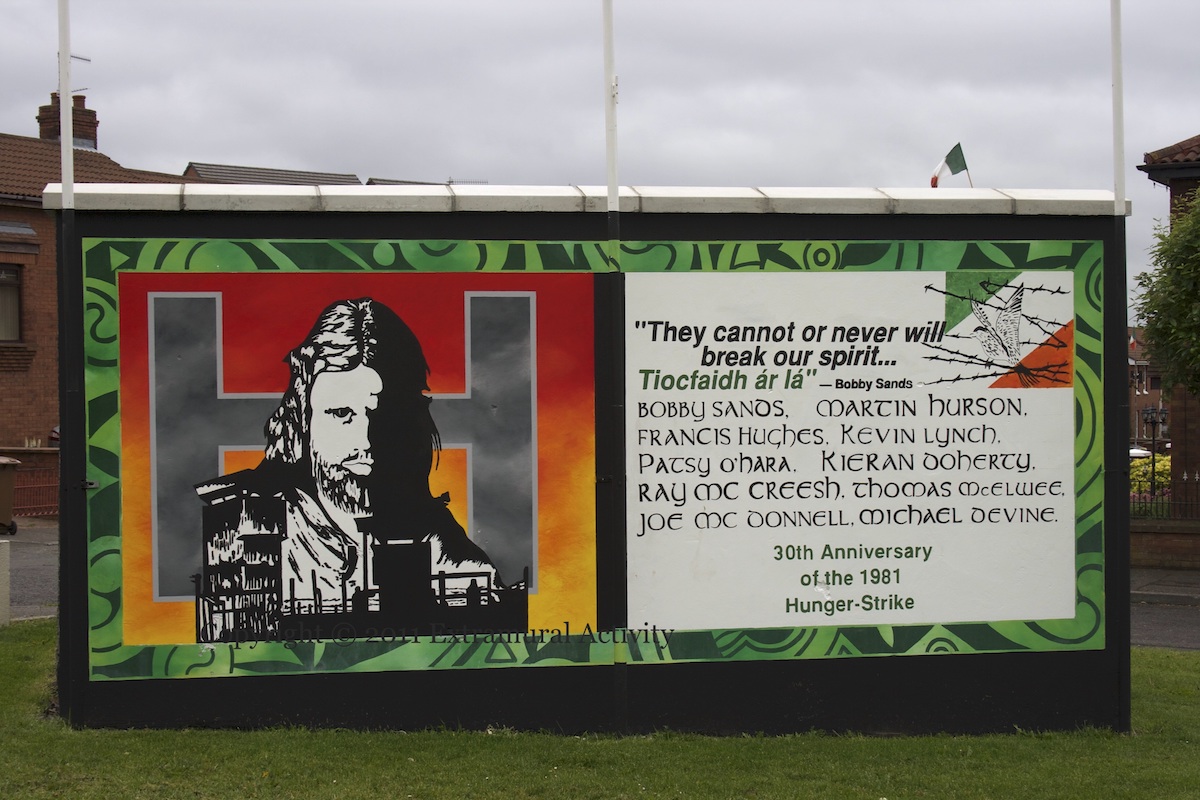
“They cannot or never will break our spirit … Tıocfaıdh ár lá” – Bobby Sands. For the 30th anniversary of the 1981 hunger strike in which ten republican prisoners died in the H Blocks.
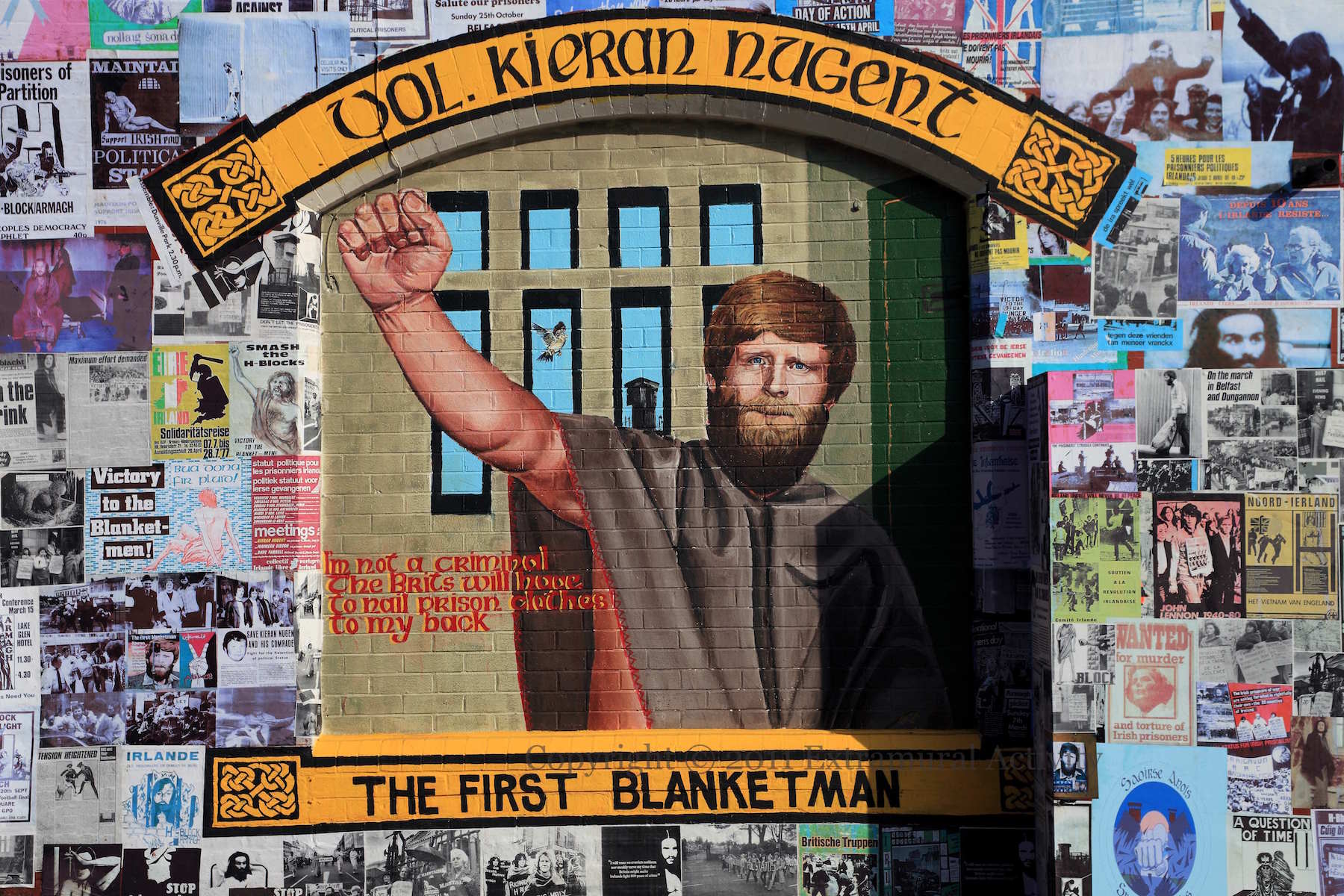
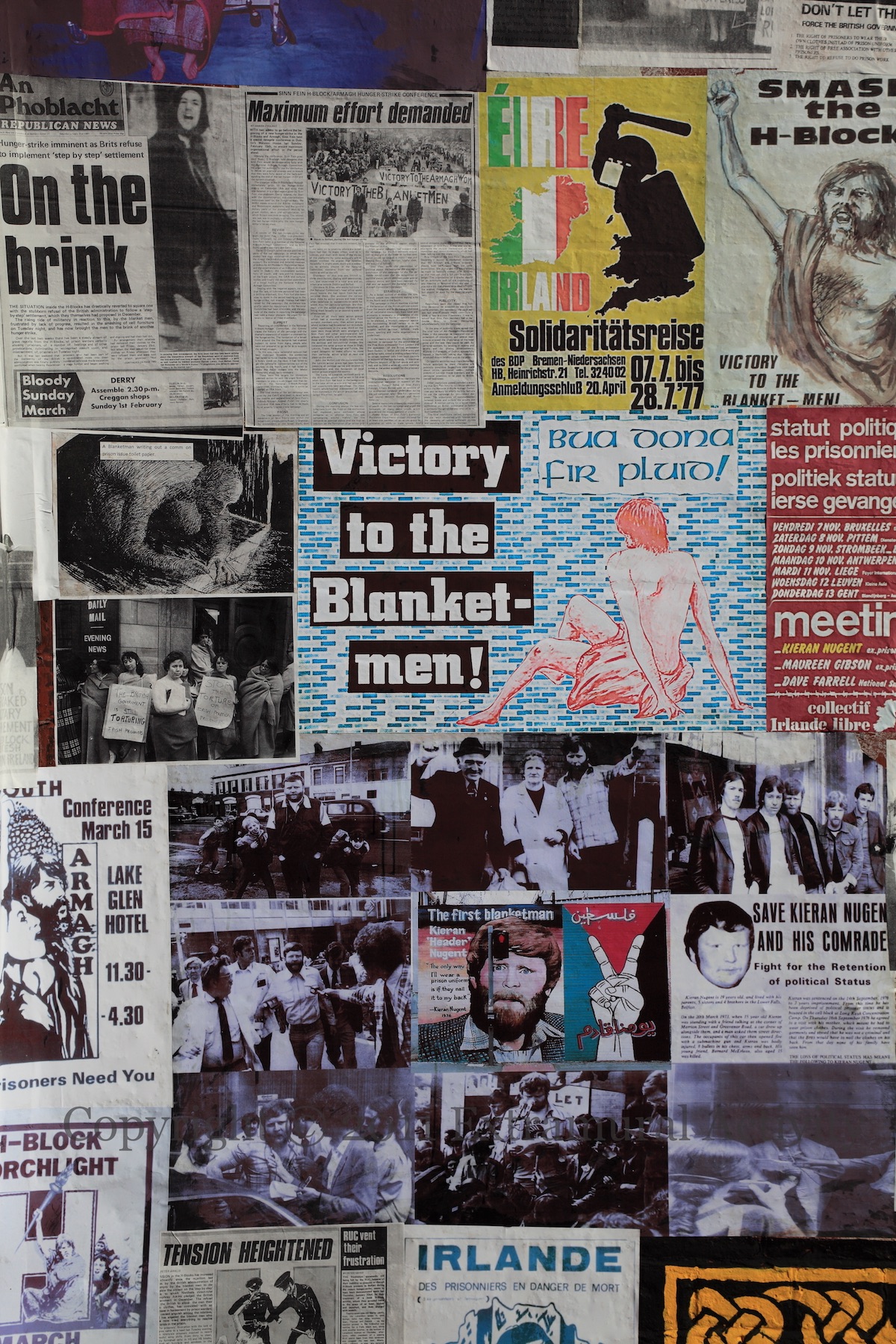
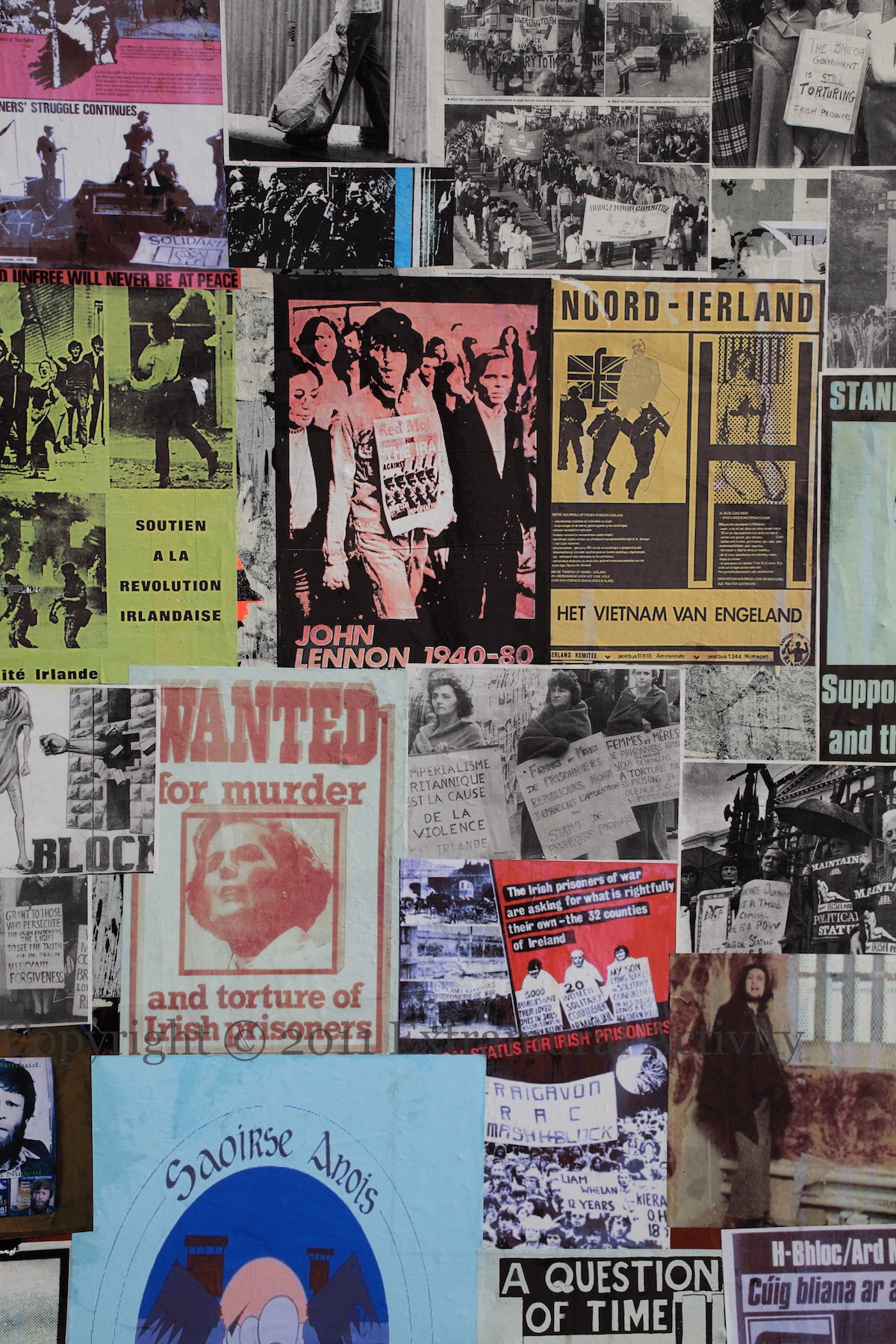
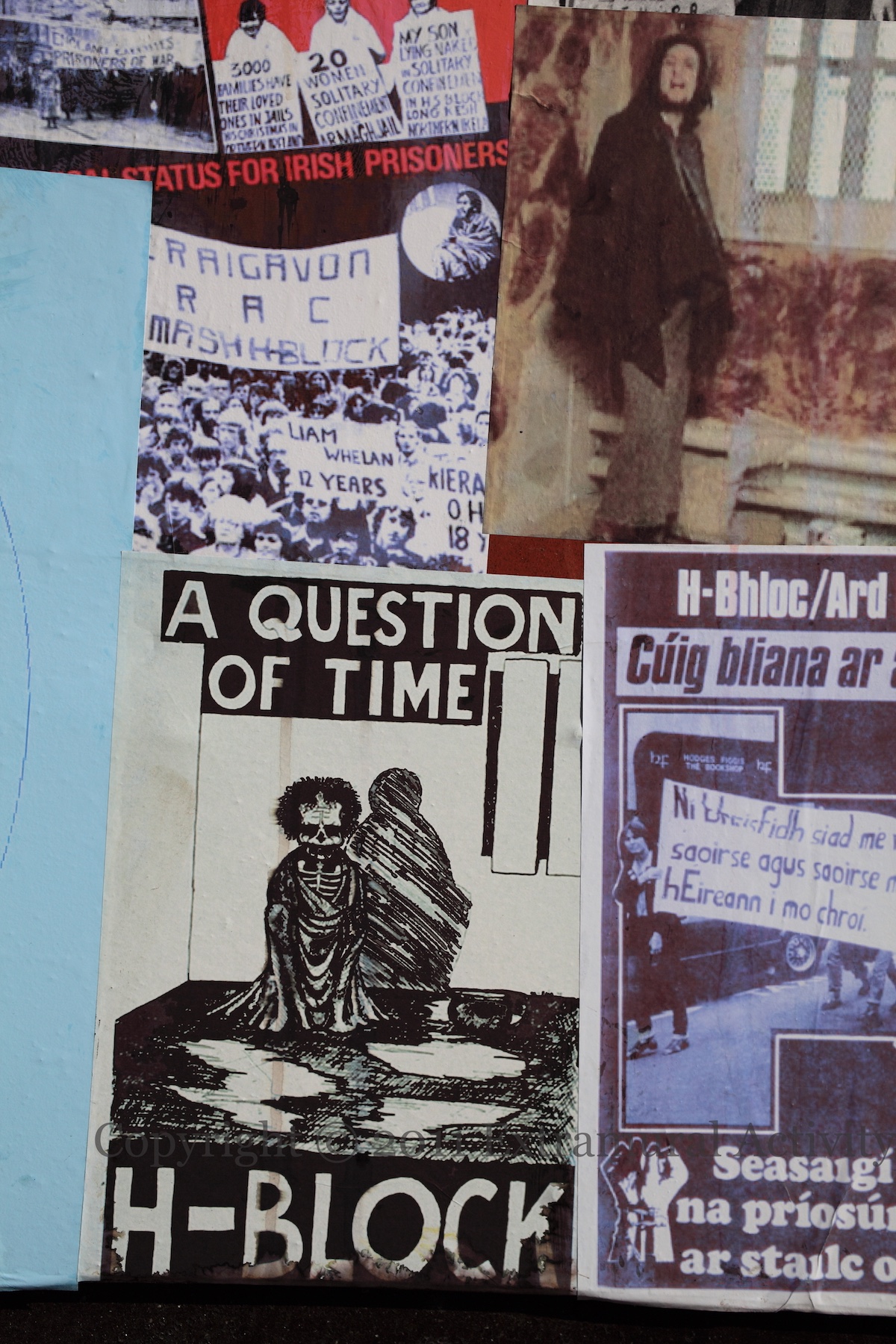
When the mural to “the first blanketman” Kieran Nugent mural (in the Rock streets) was re-done in February 2011, it was initially framed with a terrific selection of posters from the period, many of them from continental Europe, about Kieran, the blanket protest, and hunger striker.
“I’m not a criminal. The Brits will have to nail prison clothes to my back.” For the previous mural, and some background about Nugent going “on the blanket”, see M02550.
Joe Cahill joined the Fianna in 1937 and was involved in the republican movement from then until his death in 2004, including being in Tom Williams’s company in 1942 and later a founder member and Chief of Staff of the Provisional IRA. In the centre of the image he is at the end of the table at the August 13, 1971, press conference to comment on the introduction of internment (CAIN). He is honoured in the mural above alongside his brothers Tom and Frank Cahill. (Pat O’Hare is painted between Tom and Frank.)
In the top left are small boards with portraits of Ned Maguire Snr, Ned Maguire Jnr, Sam Holden, Dal Delaney, Rita McParland, Paddy Meenan, Paddy Corrigan, Sean Wallace, John Petticrew, Alex Crowe.
“Never will they label our liberation struggle as criminal – Bobby Sands [March 6th Diary].”











 Extramural Activity