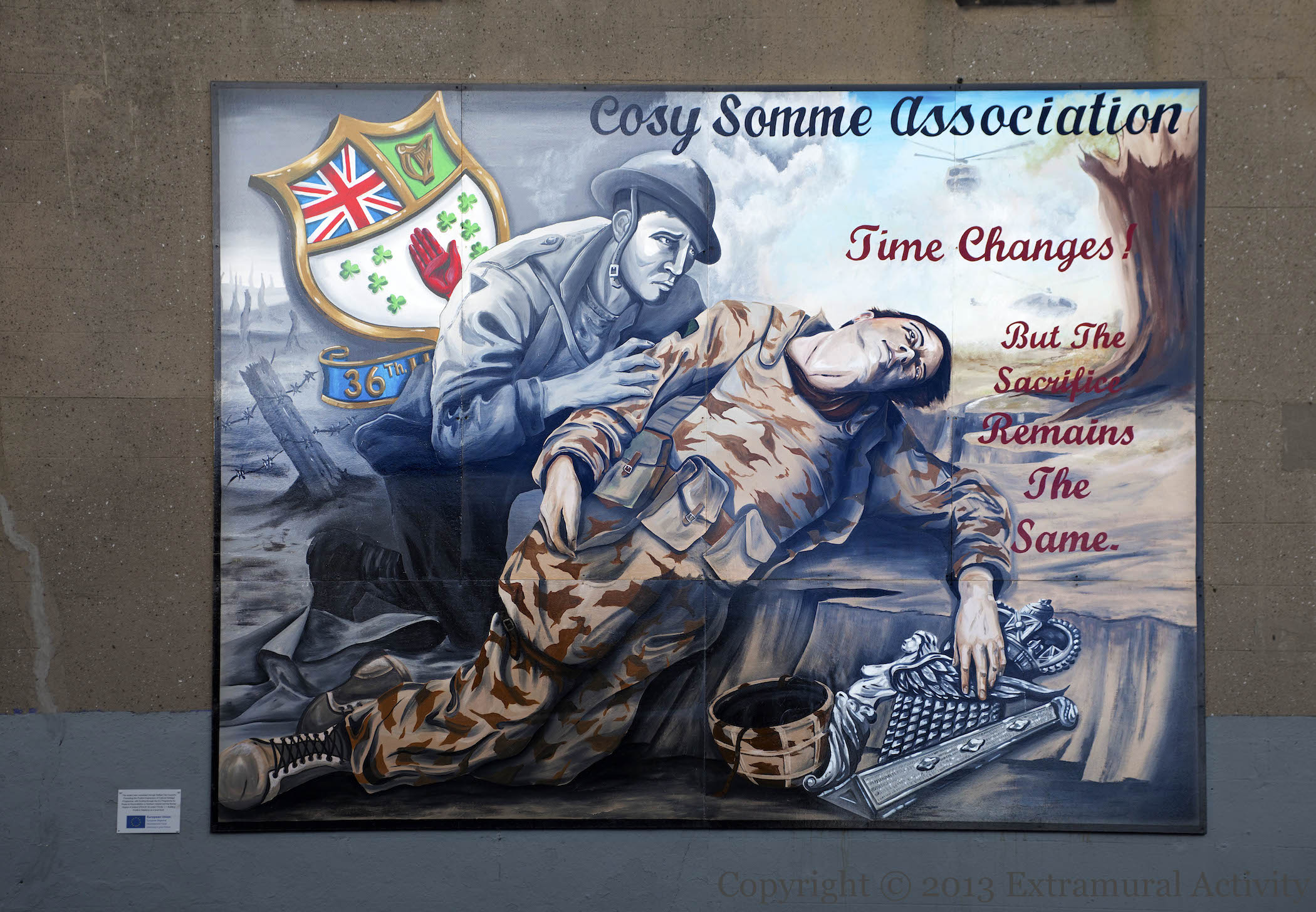
“Time changes! But the sacrifice remains the same.” Pictured is a board in Ogilvie Street in east Belfast, sponsored by the EU and the Cosy Somme Association, showing, in black and white, a WWI soldier, who is comforting another solider, in modern gear and in colour. The emblems of the 36th (Ulster) division and Royal Irish Rifles are also shown.
The colourful mural above is in Pearl Street, in the Willowfield area of east Belfast. It shows children playing and talking, depicted inside of a series of cogs.
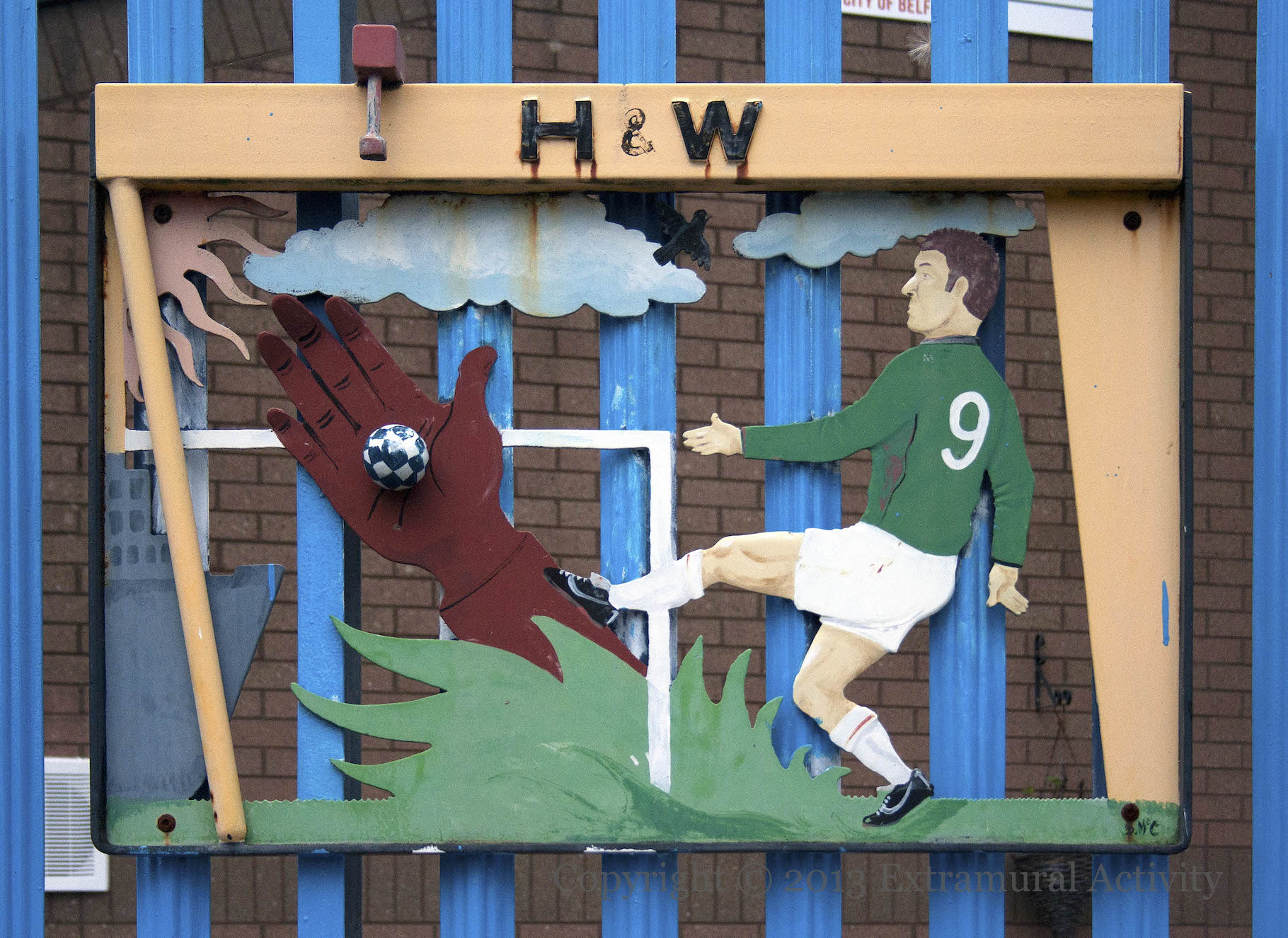
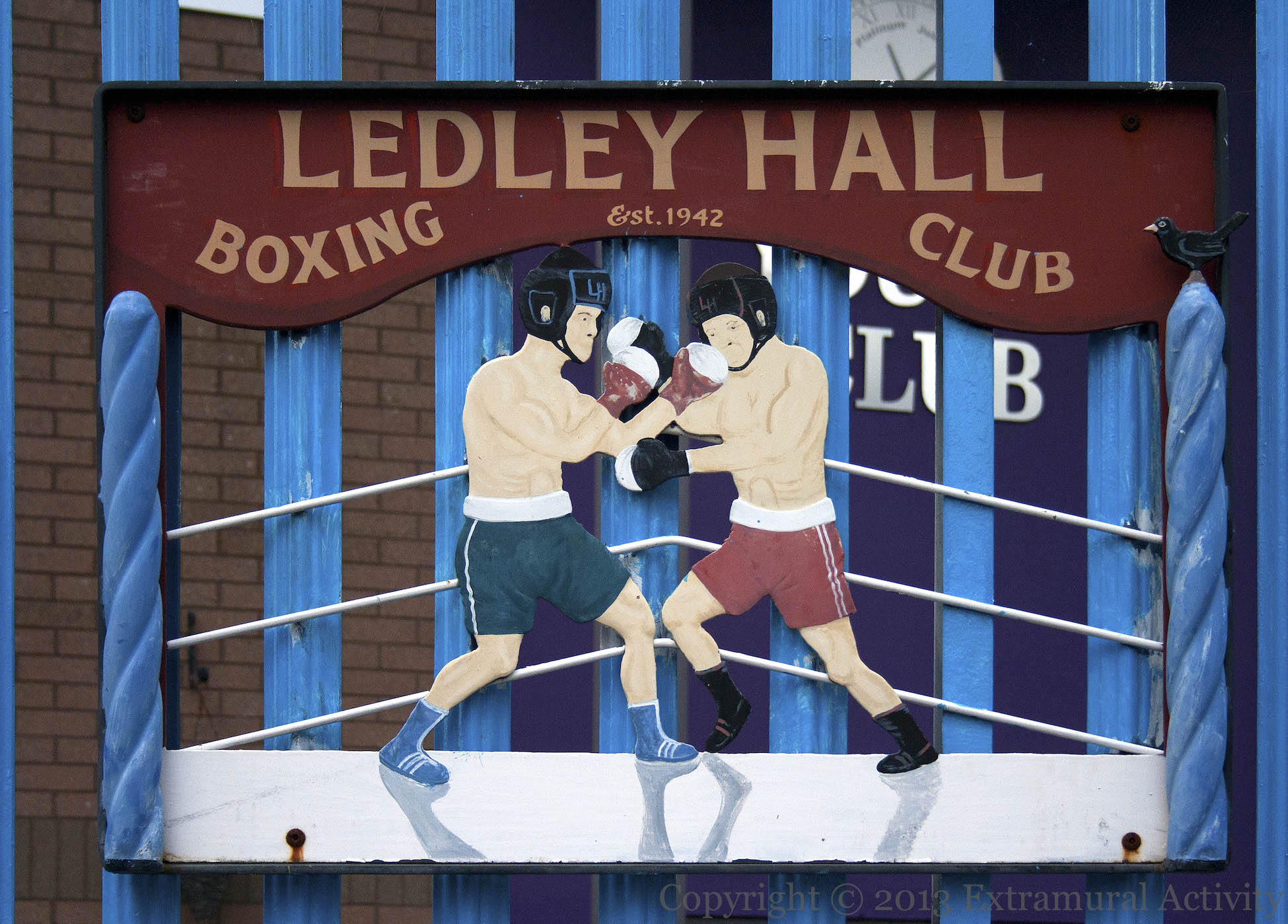
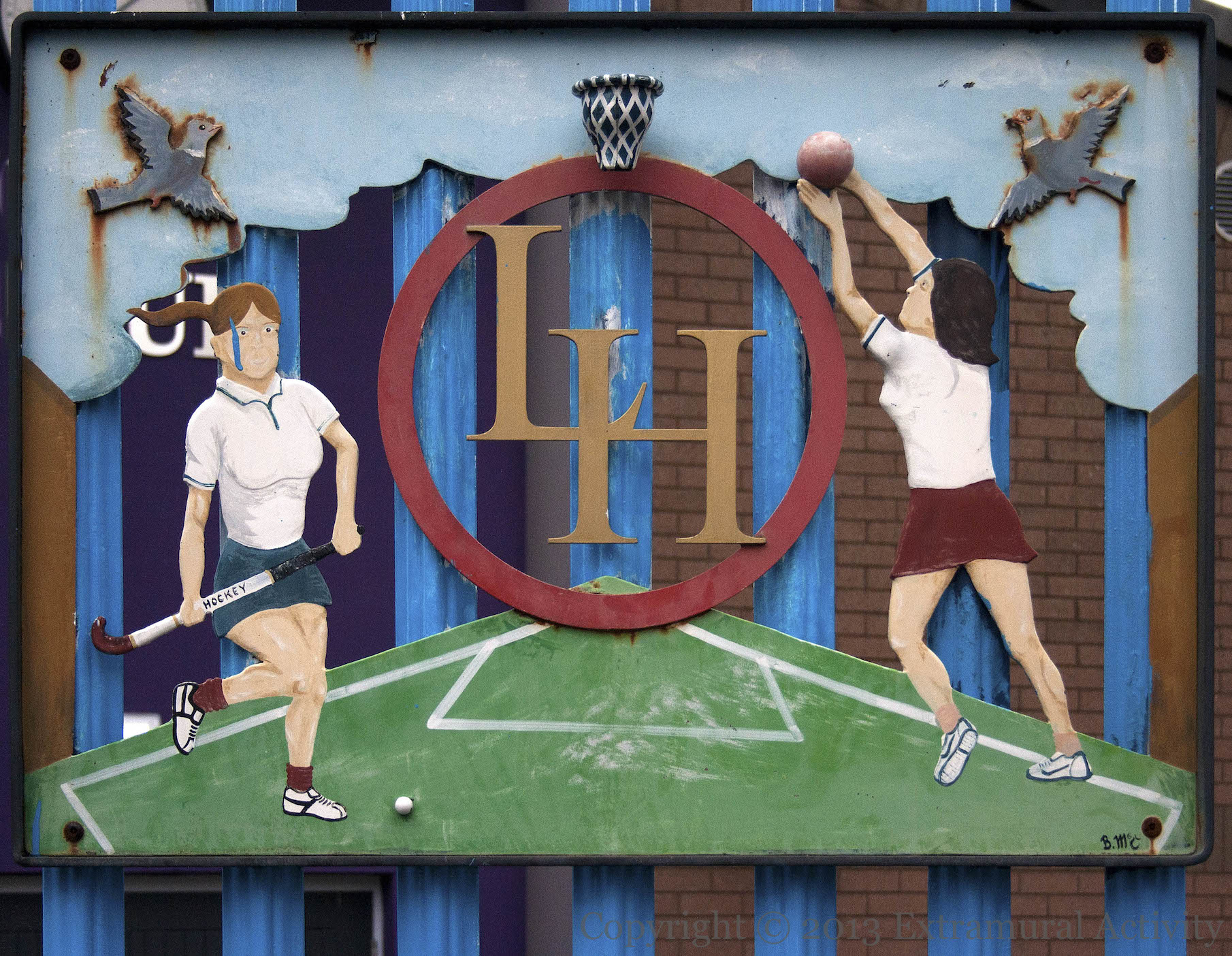
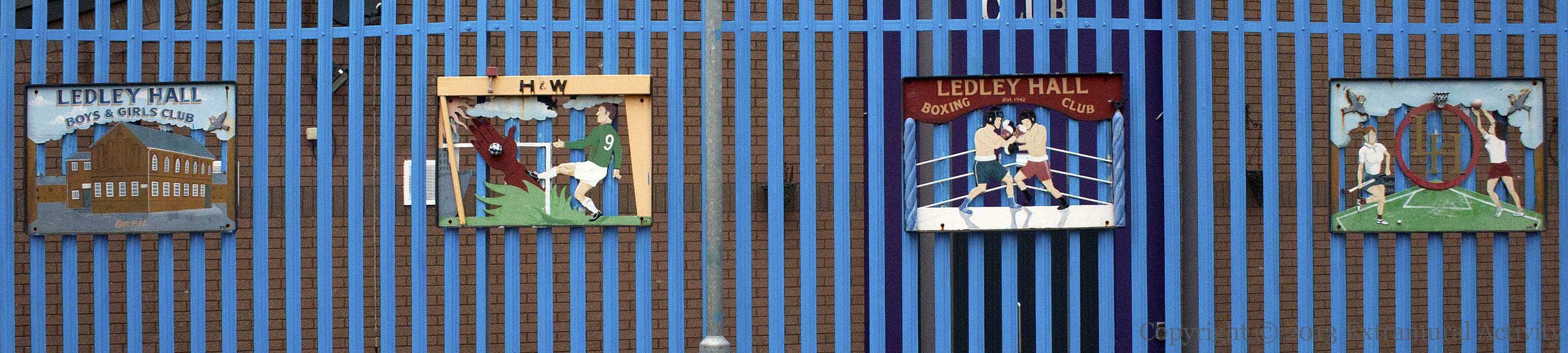
Here are four small painted metal-work pieces, signed “B McC”, on the railings of the Ledley Hall Boys & Girls Club, just off Beersbridge Road in east Belfast. The pieces show the building, soccer being played in the shadow of Harland & Wolff – the goal is prevented by a giant red hand – and two boxers boxing – the club was originally a boxing gym (est. 1942), and girls playing hockey and netball.
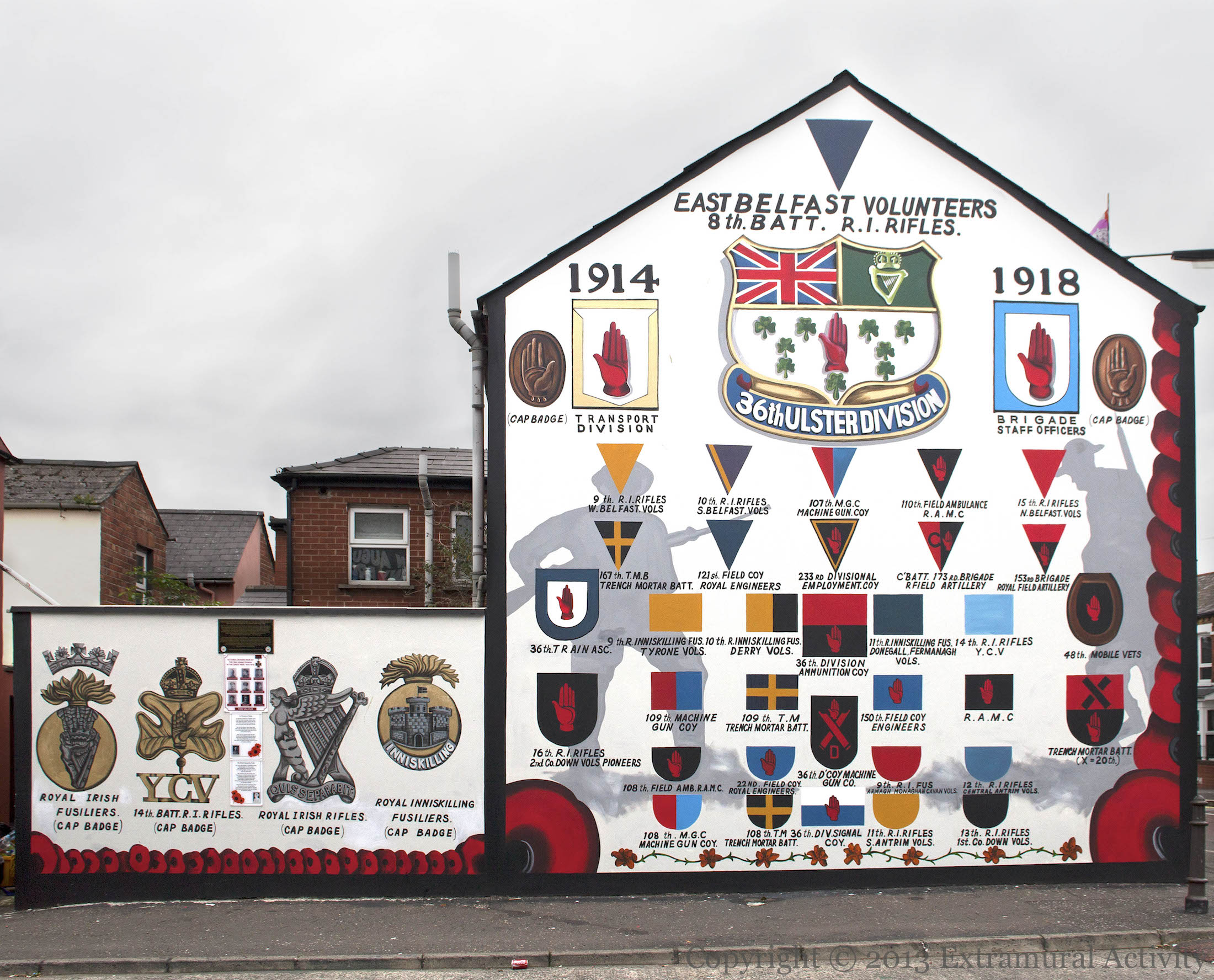
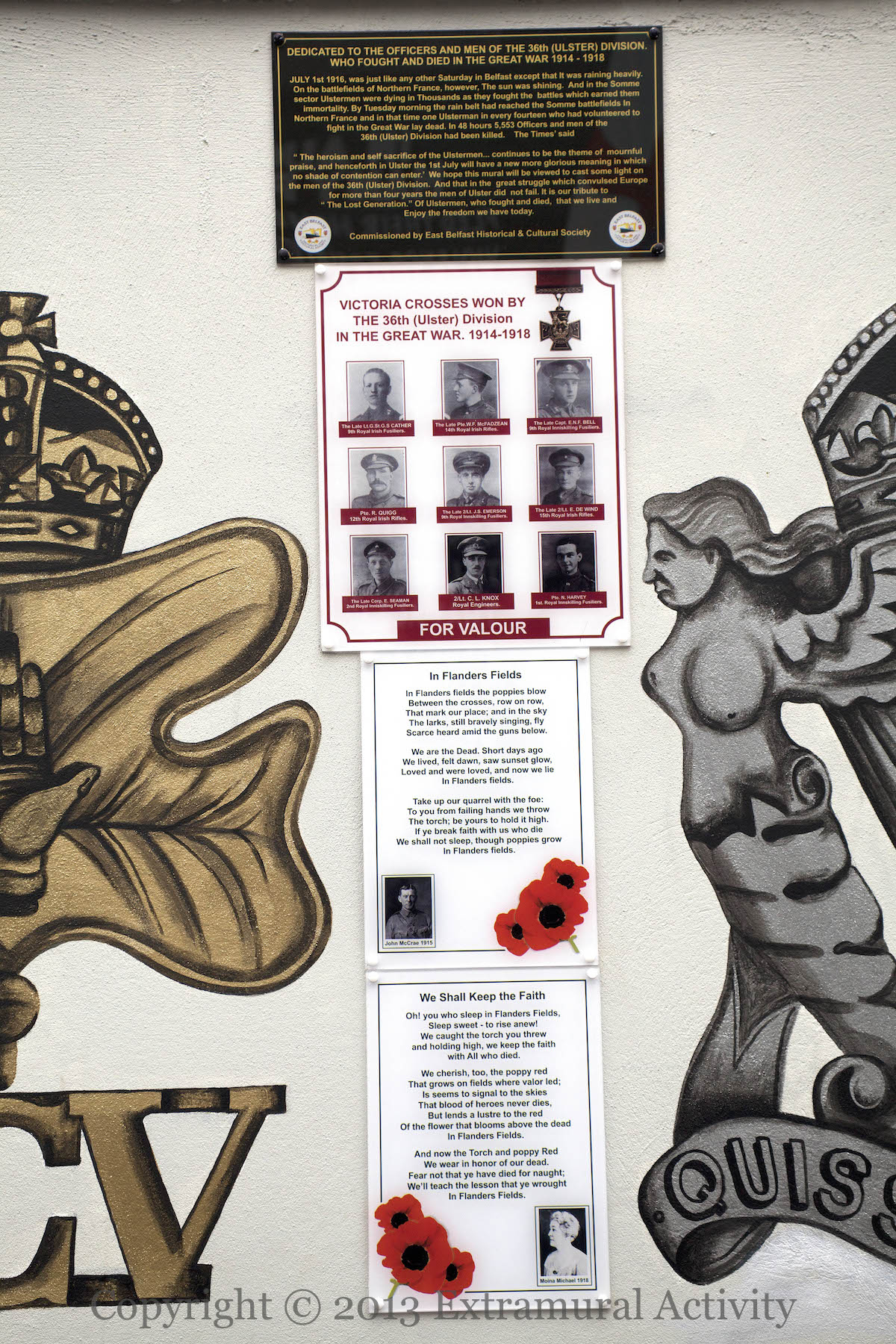
This mural and its accompanying plaques, at the mouth of Canada Street, commemorate WWI and celebrate the Victoria Crosses won by members of the 36th (Ulster) Division “For valour”: Cather, McFadzean, Bell, Quigg, Emerson, De Wind, Seaman, Knox, and Harvey. The main mural features insignia of more than thirty units of types ranging from machine gunners to vets. Repainted version of East Belfast Volunteers.
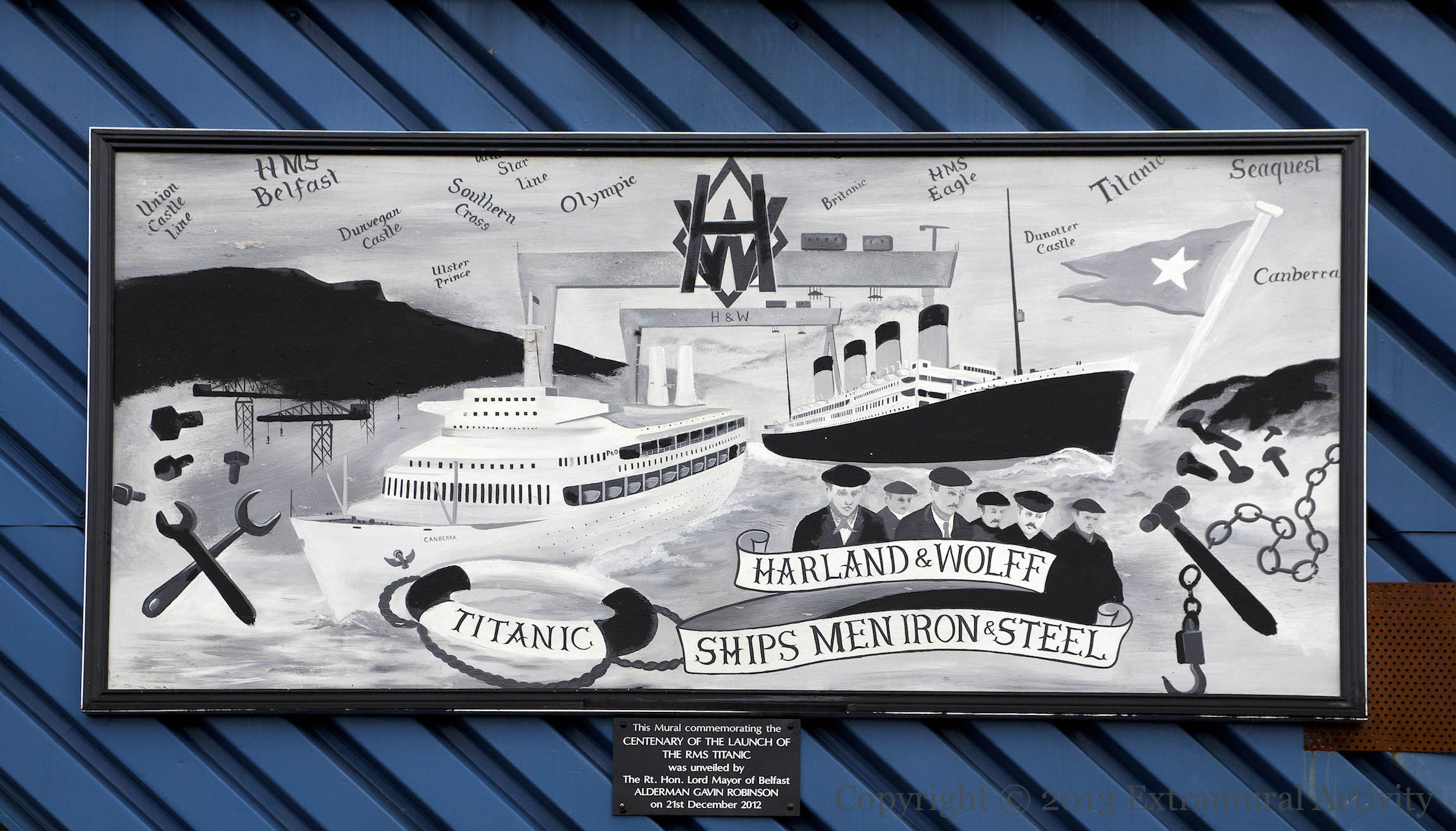
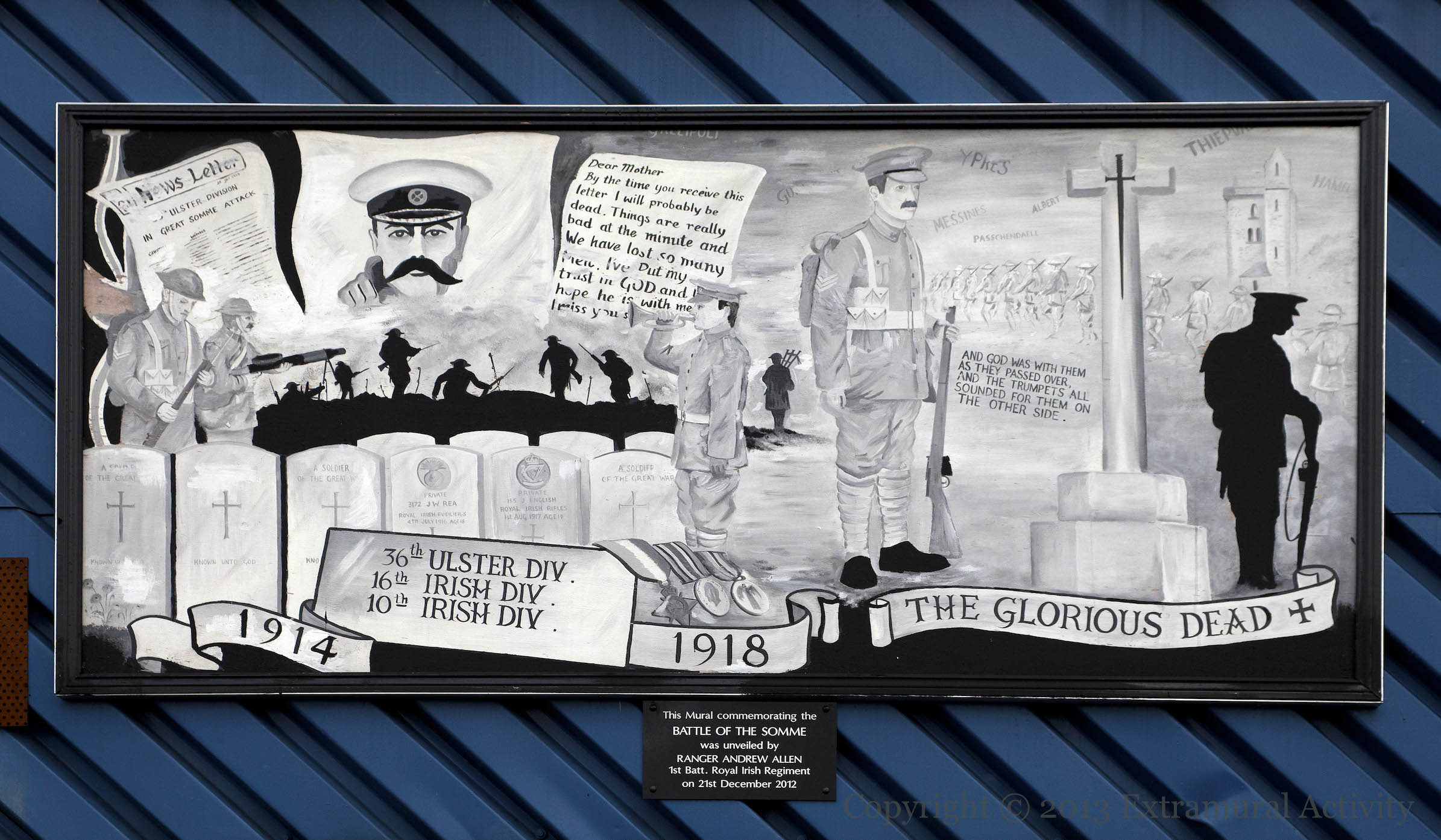
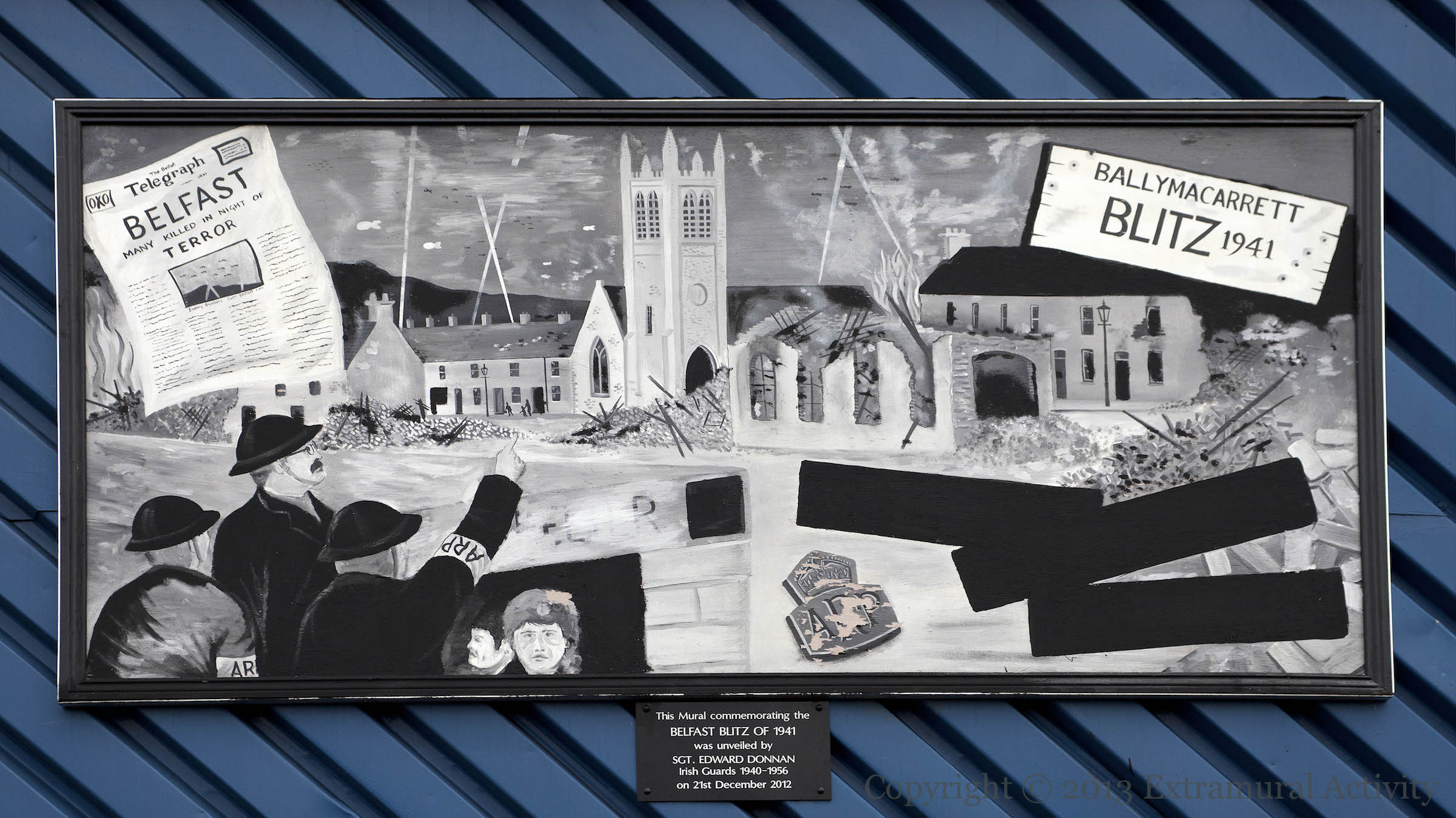
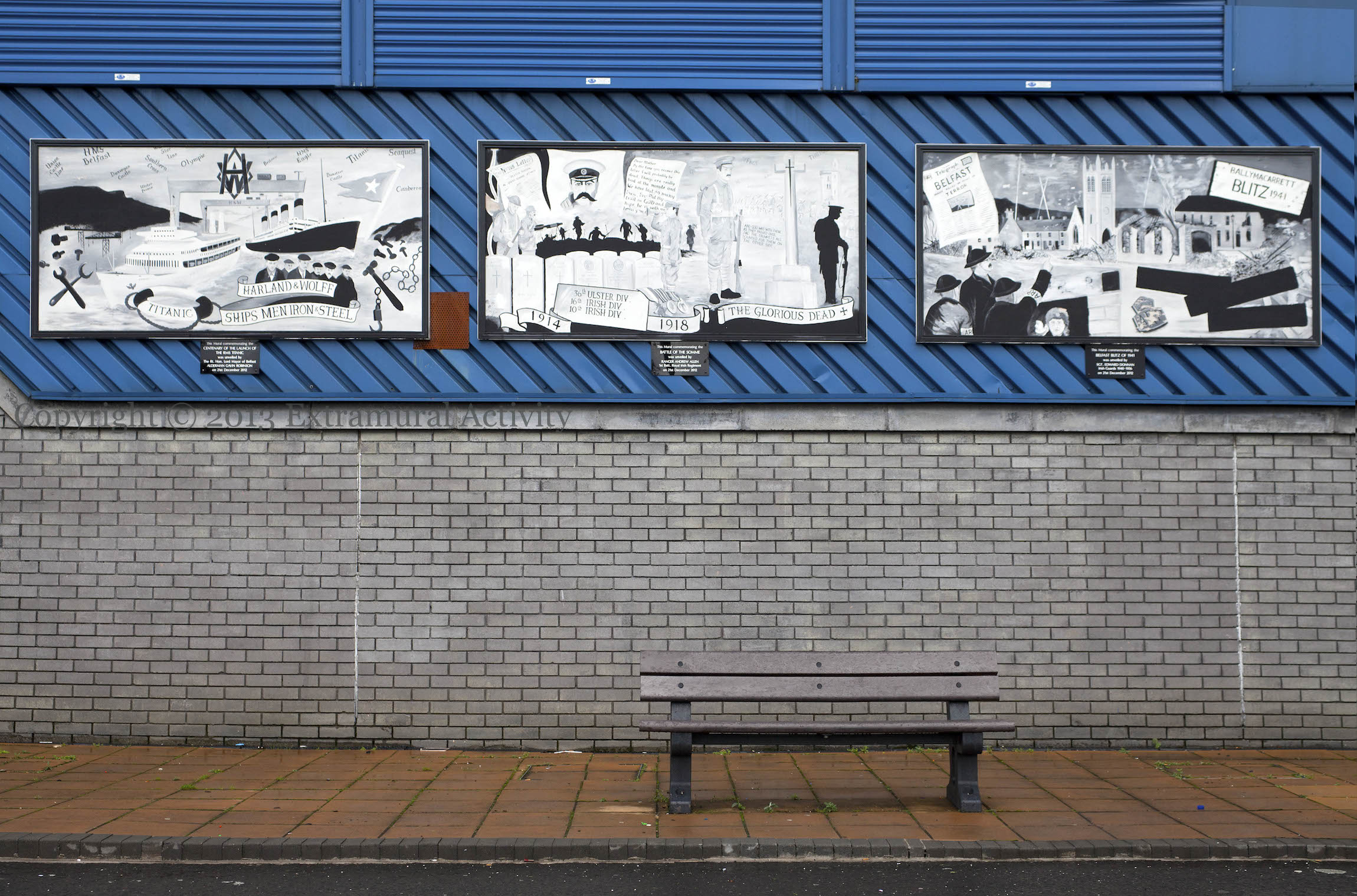
These three painted boards, in frames, on the exterior of the Connswater Community Centre, were unveiled this past December (2012). The first commemorates Titanic, the second the Somme, and the third the WWII Blitz.
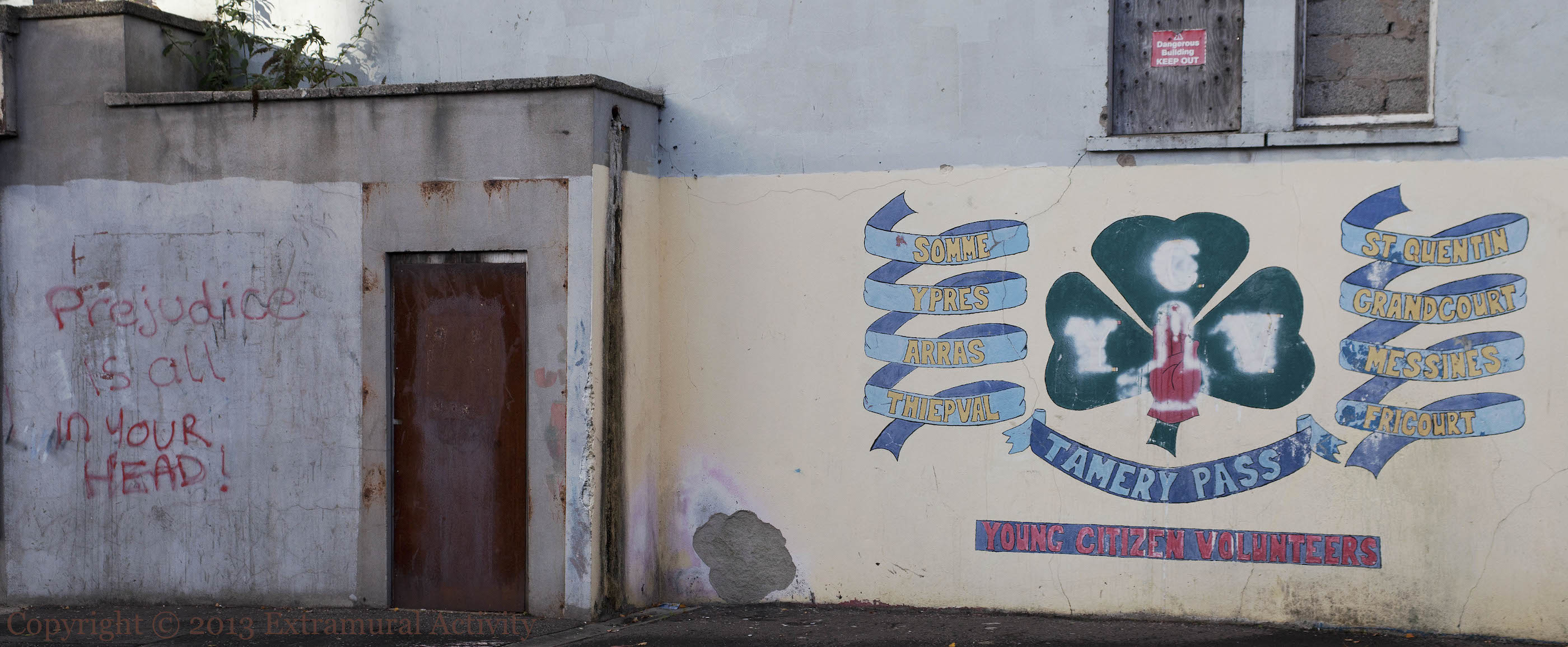
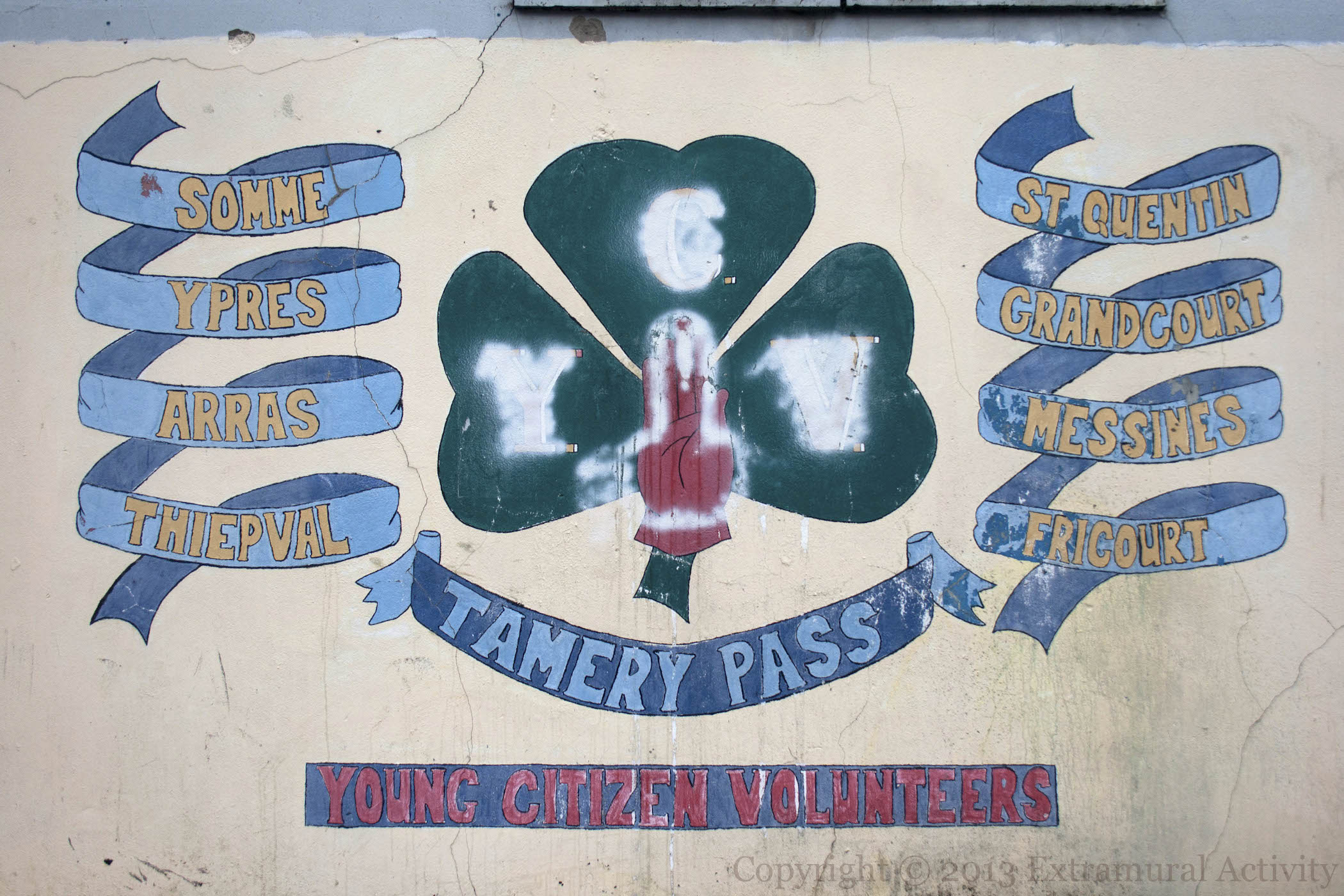
Graffiti next to a mural commemorating various battles of WWI reads “Prejudice is all in your head!” The Young Citizen Volunteers (YCV) were formed in 1912 and in 1914 became a battalion of the UVF.
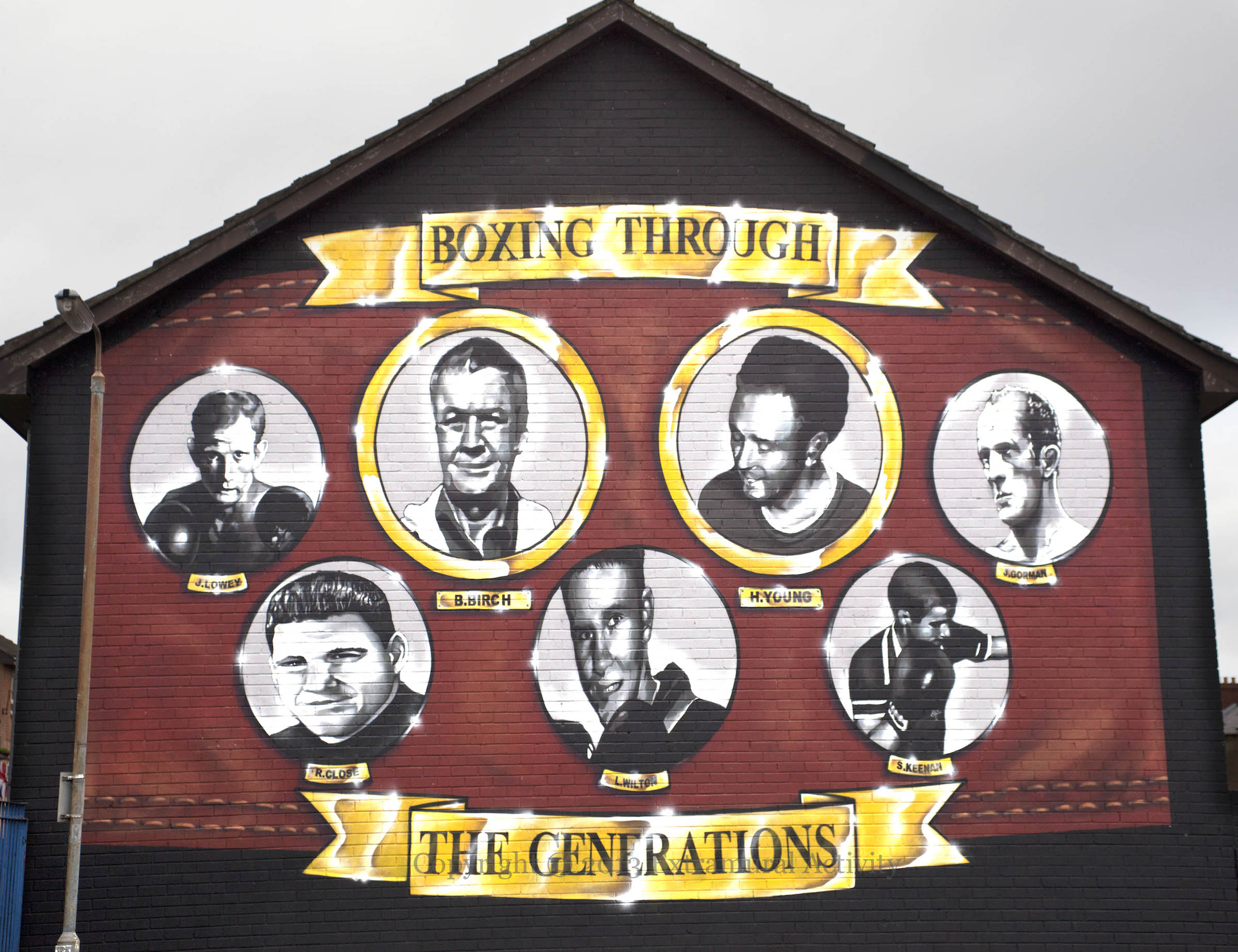
Above is a new mural in Templemore Street, at the eastern edge of the residential part of the Albertbridge Road. The mural features seven boxers: John Lowey, Billy Birch (’47-’54), Herbie Young, James Gorman, Ray Close (who fought Chris Eubanks to a draw for a World belt in 1993), Luke Wilton (’08-present), and Stephan Keenan. Information on-line is sparse, so please comment or e-mail.
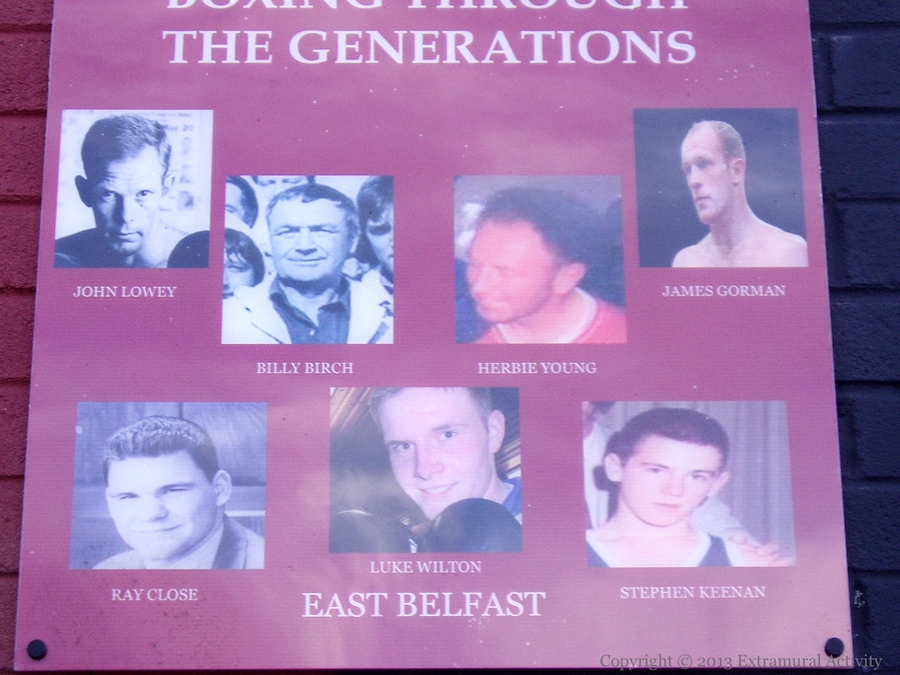
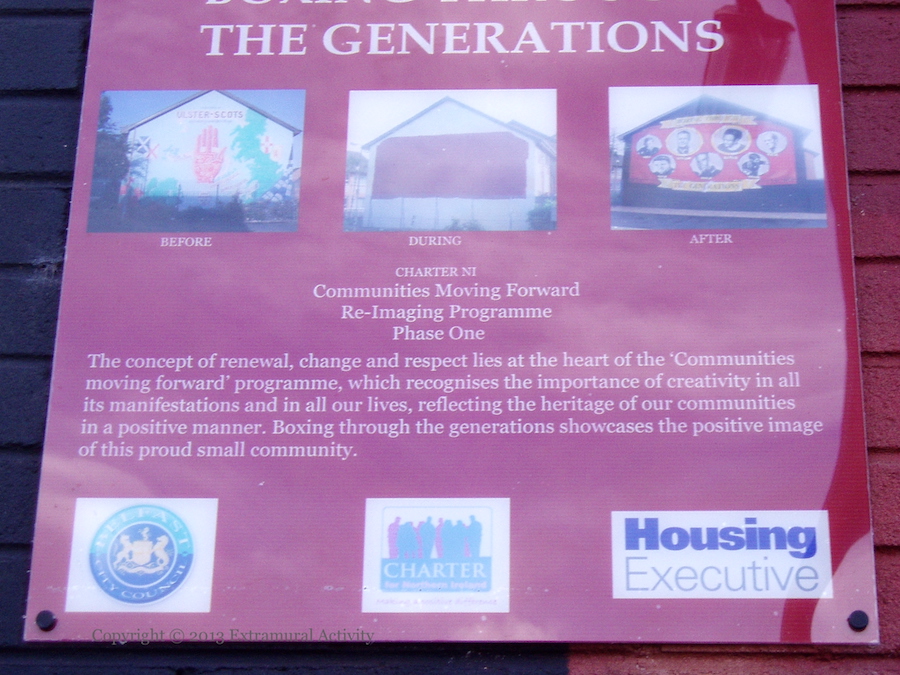
Update: 2013-12-24 Two plaques have been added to the piece above, one showing the photographs upon which the portraits in the mural were based (except Keenan’s), and the other describing the process by which the Ulster-Scots mural was replaced as part of a project by Charter NI (along with the city council and the housing executive). It reads: “Communities Moving Forward Re-Imaging Programme Phase One. The concept of renewal, change and respect lies at the heart of the ‘Communities moving forward’ programme, which recognises the importance of creativity in all its manifestations and in all our lives, reflecting the heritage of our communities in a positive manner. Boxing through the generations showcases the positive images of this proud small community.” (Also: NIHE press release)
“Time Is Running Out” – Graffiti (including some fake clock hands) has been added to Rita Duffy’s ‘Banquet’ piece on the Cupar Way “peace” line. The whole board was featured previously.
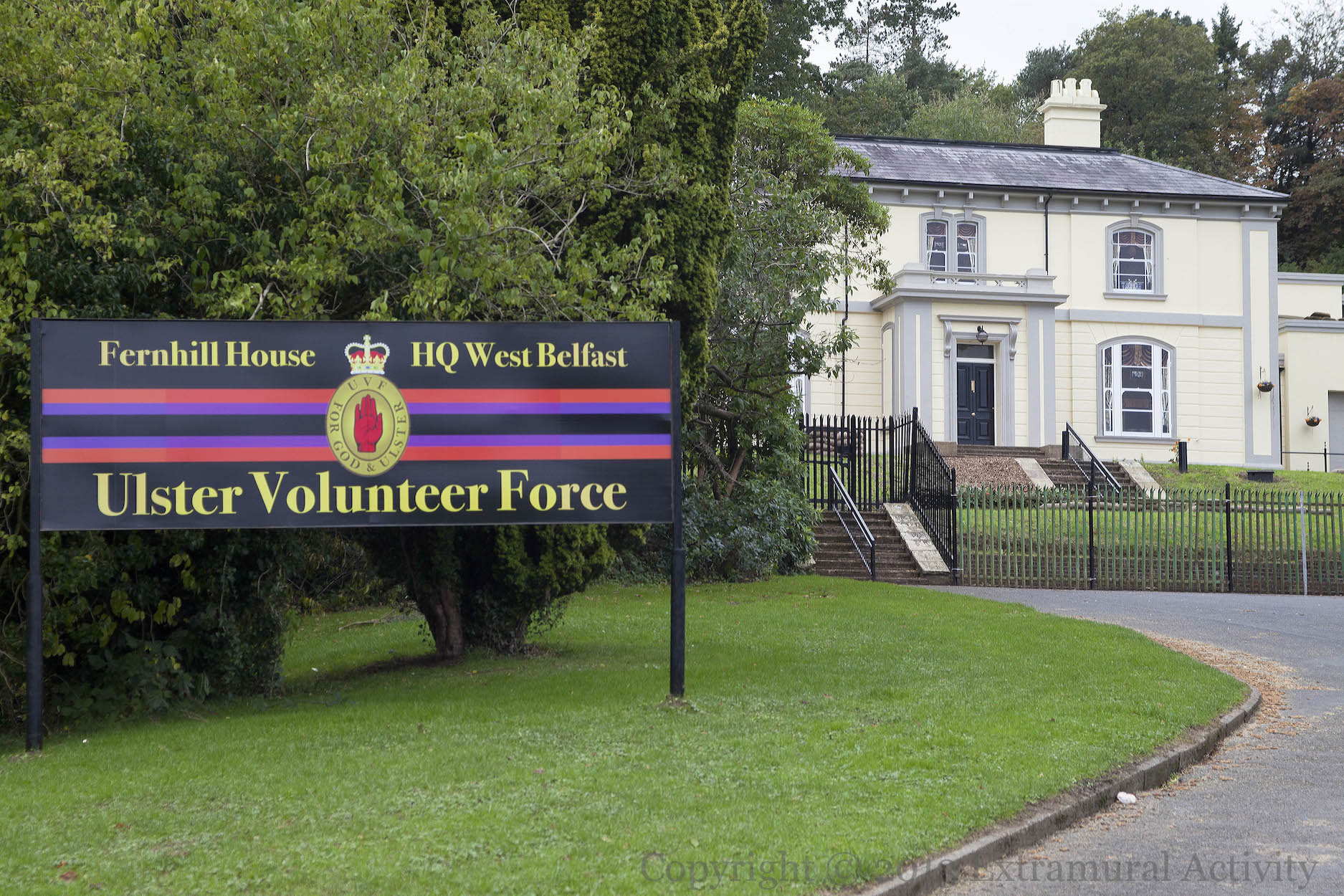
As part of the preparations for the centenary celebrations of the Ulster Volunteer Force, Fernhill House, in Glencairn Park to the west of the Ballygomartin Road, was refurbished. The house and park served as headquarters and training ground for the Ulster Volunteers. For images and video of the parade, which included people dressed in period costume, see the Tele. The name and insignia of the Volunteers — a red hand and the phrase ‘For God and Ulster’ — were re-used in the mid-nineteen-sixties, when the modern UVF was established.
In the course of its history, the UDA has flirted with the idea of an independent Northern Ireland and of a repartitioned Northern Ireland. This mural in Avoniel Street, just off Albertbridge Road in east Belfast, shows a Northern Irish island, supporting two masked gunmen, beneath a red fist. The Ulster Freedom Fighters (and its youth organisation, the Ulster Young Militants) was formed in 1973 to give legal cover to the UDA; the UFF was banned immediately, the UDA in 1992.





 Extramural Activity