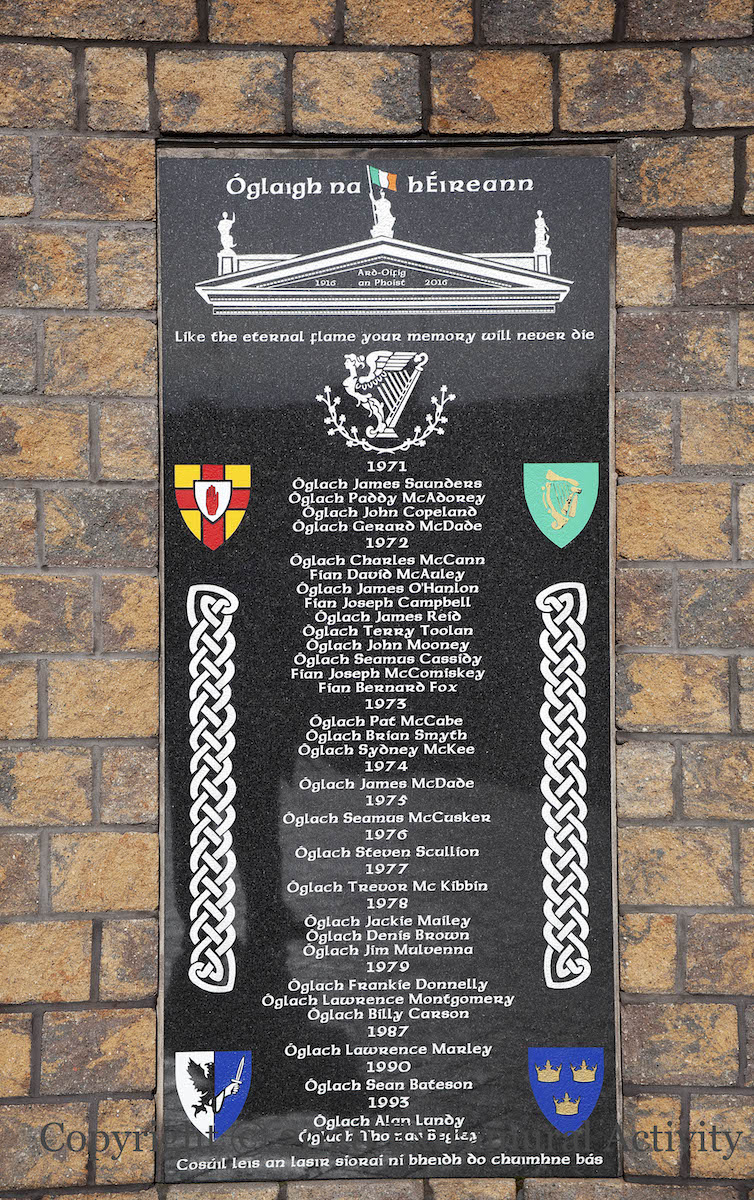
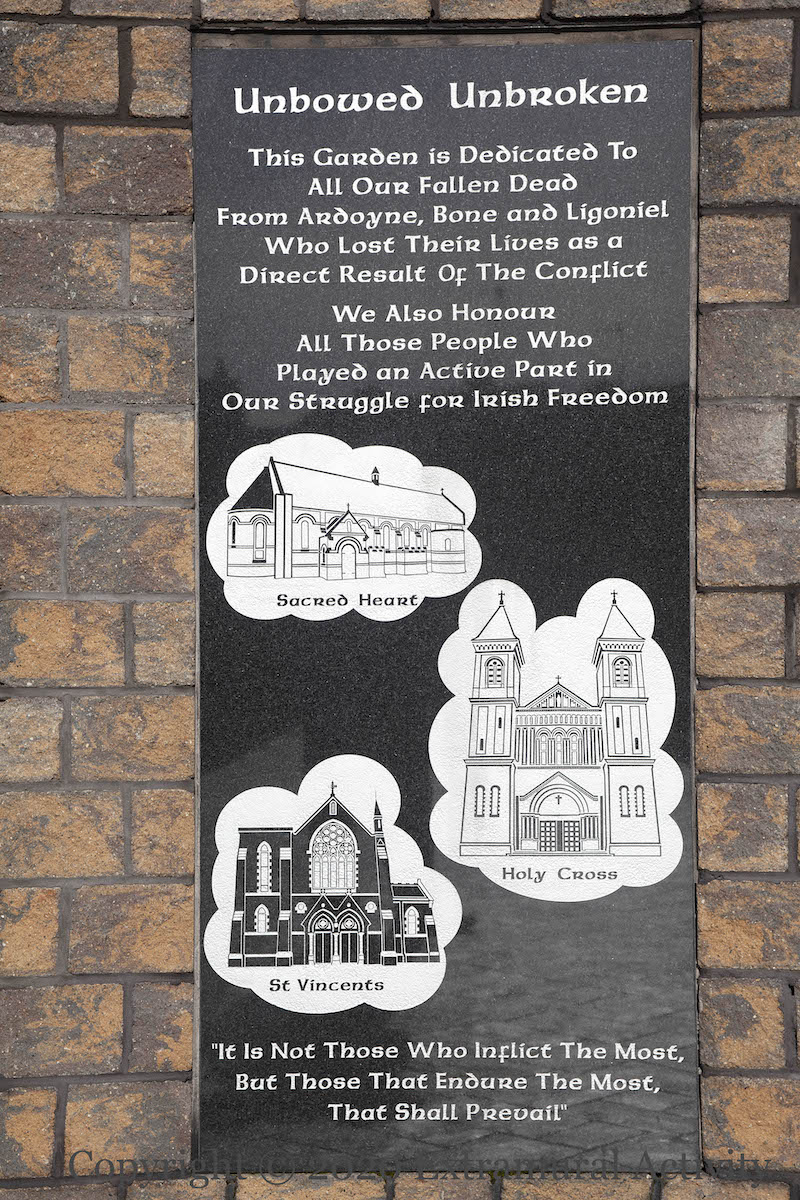
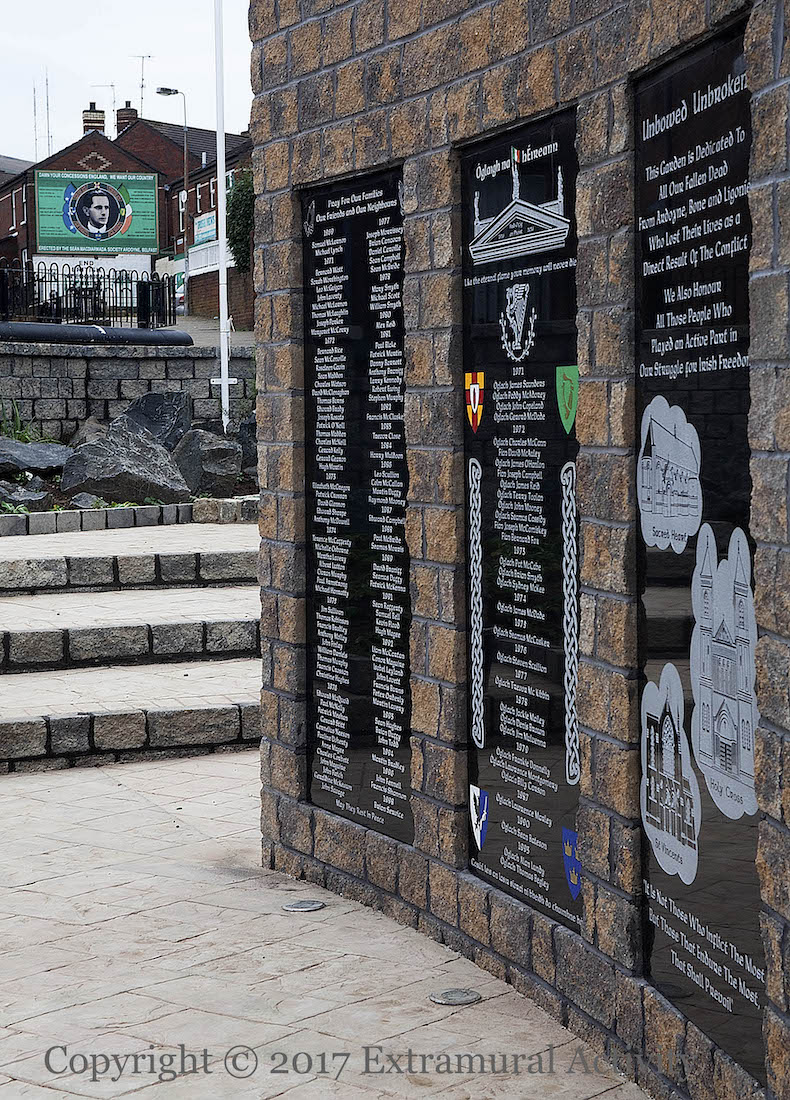
“Like the eternal flame your memory will never die.” “Unbowed, unbroken – this garden is dedicated to all our fallen dead from Ardoyne, Bone, and Ligoniel who lost their lives as a direct result of the conflict. We also honour all those people who played an active part in our struggle for Irish freedom. ‘It is not those who inflict the most, but those that endure the most, that shall prevail’ [Terence McSwiney]”. The central plaque shows the pediment and statues on “ard-oıfıg an phoıst” (the GPO in Dublin, 1916) and the Maid Of Erin harp (of 1798). The celtic cross was previously in the memorial garden at the corner of Berwick Road – see Freedom Hath Arisen.
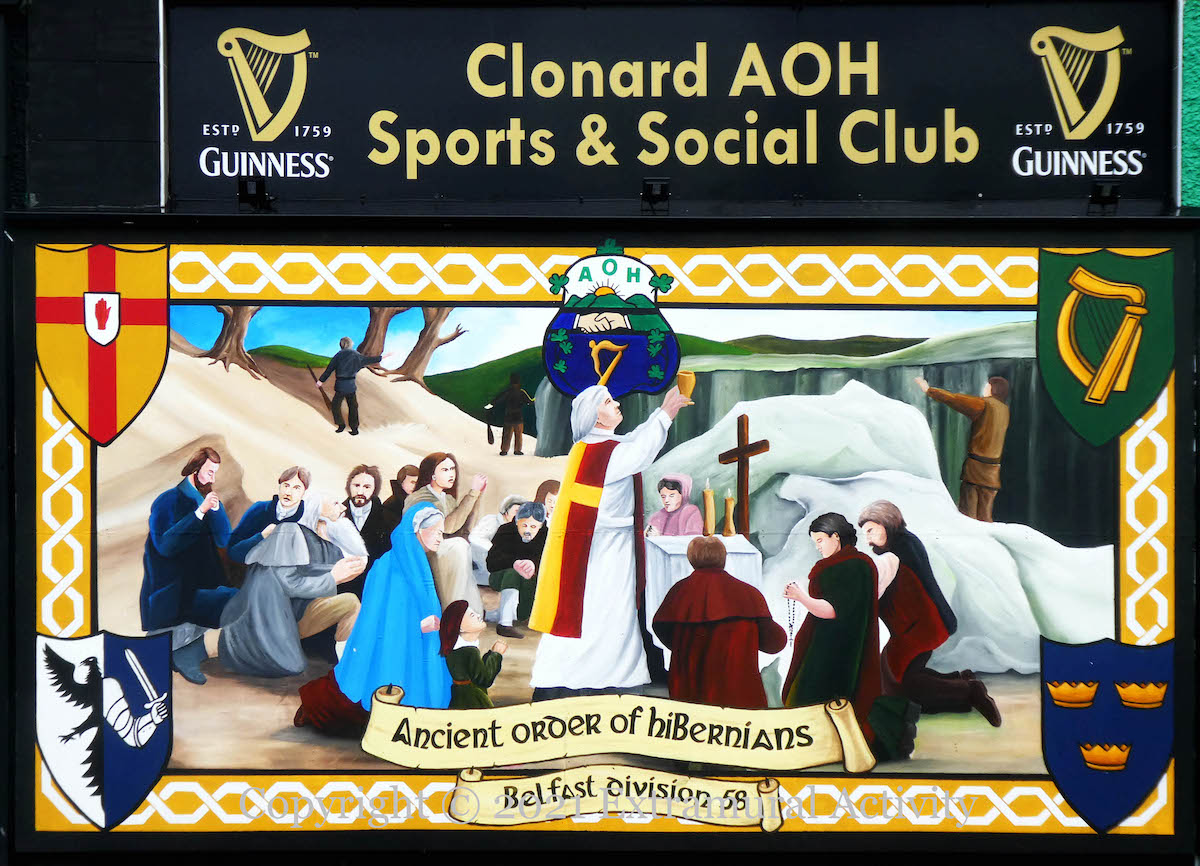
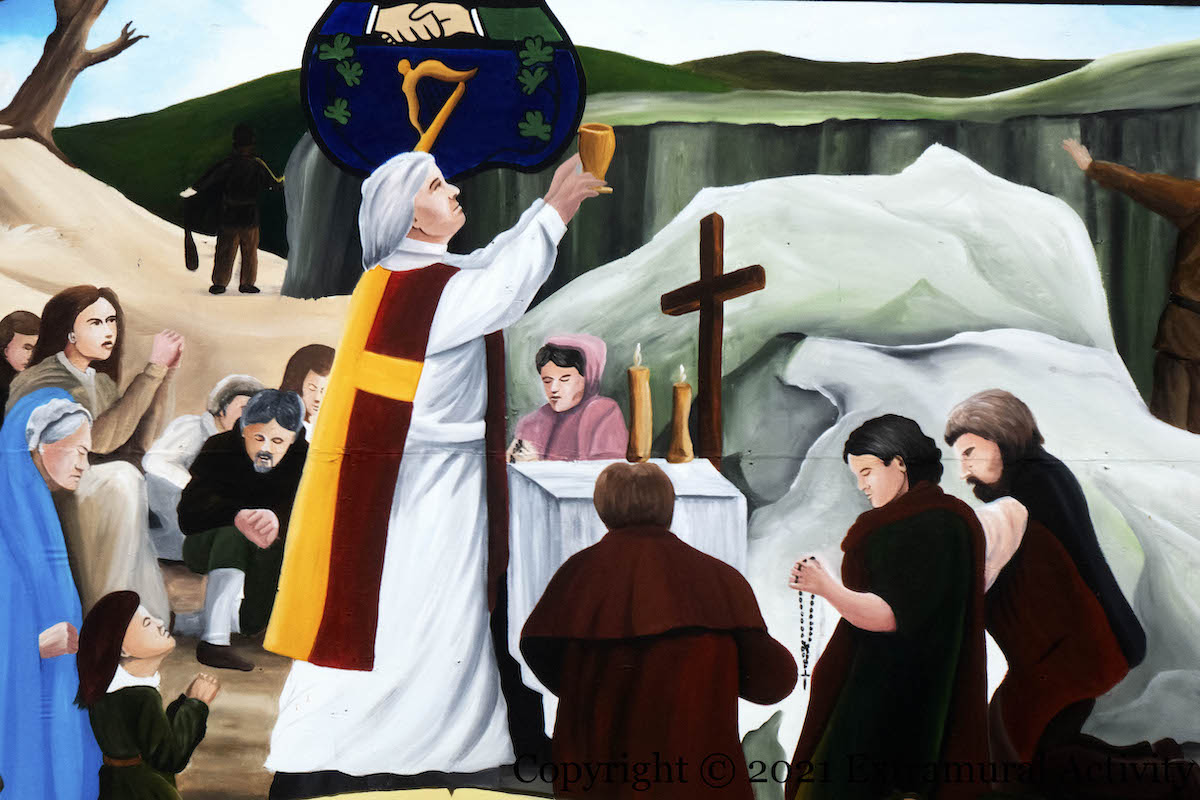
A Penal law of 1695 forbade the practice of Catholicism and “dissenter” forms of Protestantism –anything other than Anglicism, forcing people and priests to worship in secret. Although the precise date of the founding of the Ancient Order Of Hibernians is shrouded by the existence of various other Catholic fraternal and defensive organisations such as St Patrick’s Fraternal Society and the Ribbonmen – the AOH history page gives 1838 in Pennsylvania – the order traces its roots back to Penal times and in particular to the Defenders in 1784, which arose to protect Catholics from the (Protestant) Peep-O-Day Boys and in defiance of Penal laws forbidding Catholics to bear arms (WP). The Belfast division (58) of the AOH is in Clonard Street.
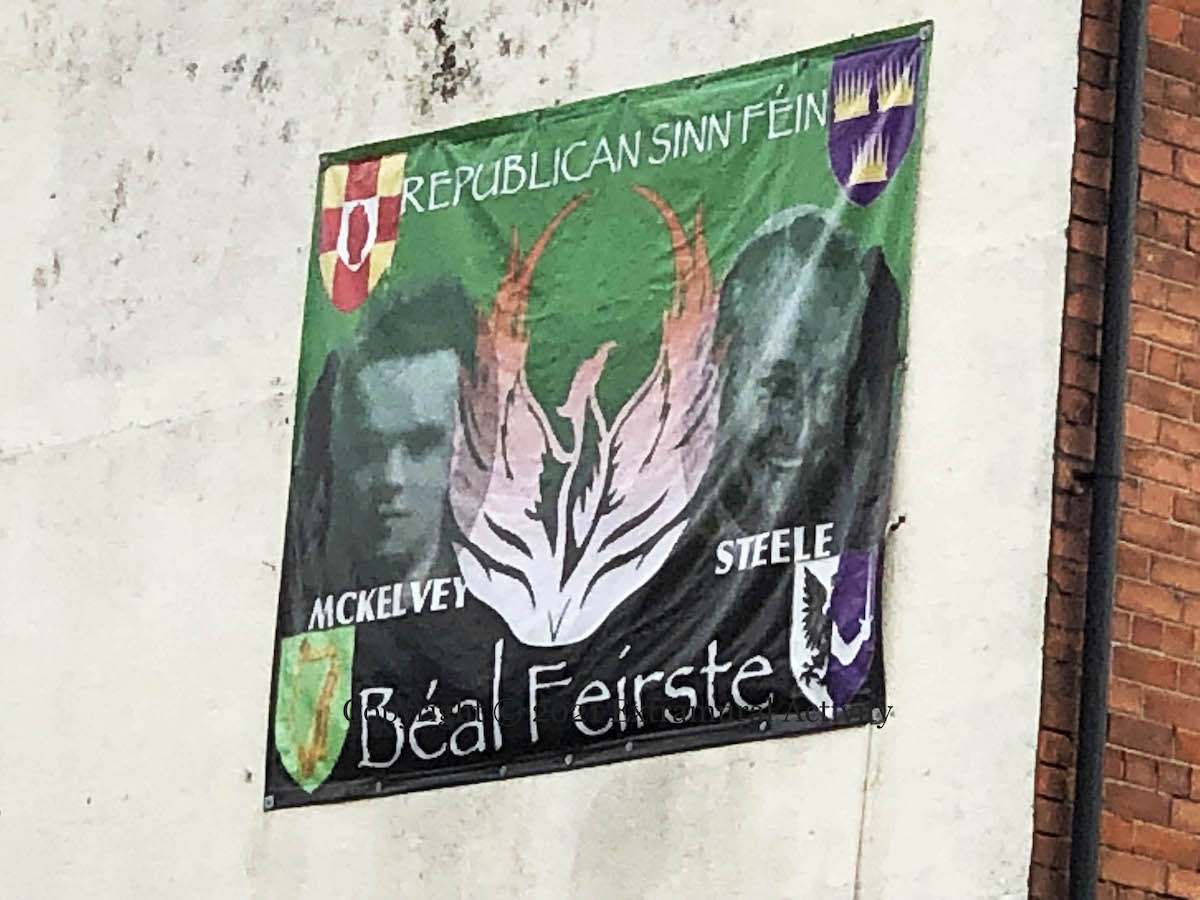
This tarp, above the office of Sınn Féın Poblachtach and the Happy House on the Falls Road, celebrates two previous generations of IRA leadership. Joe McKelvey was commander of the Belfast Brigade of the IRA in the War Of Independence but against the Treaty; he was executed in December, 1922, for occupying the Four Courts in June (WP). Jimmy Steele was a leader in the Belfast IRA from the 1920s to 1960s and the first editor of Republican News; he died shortly after the split (WP).
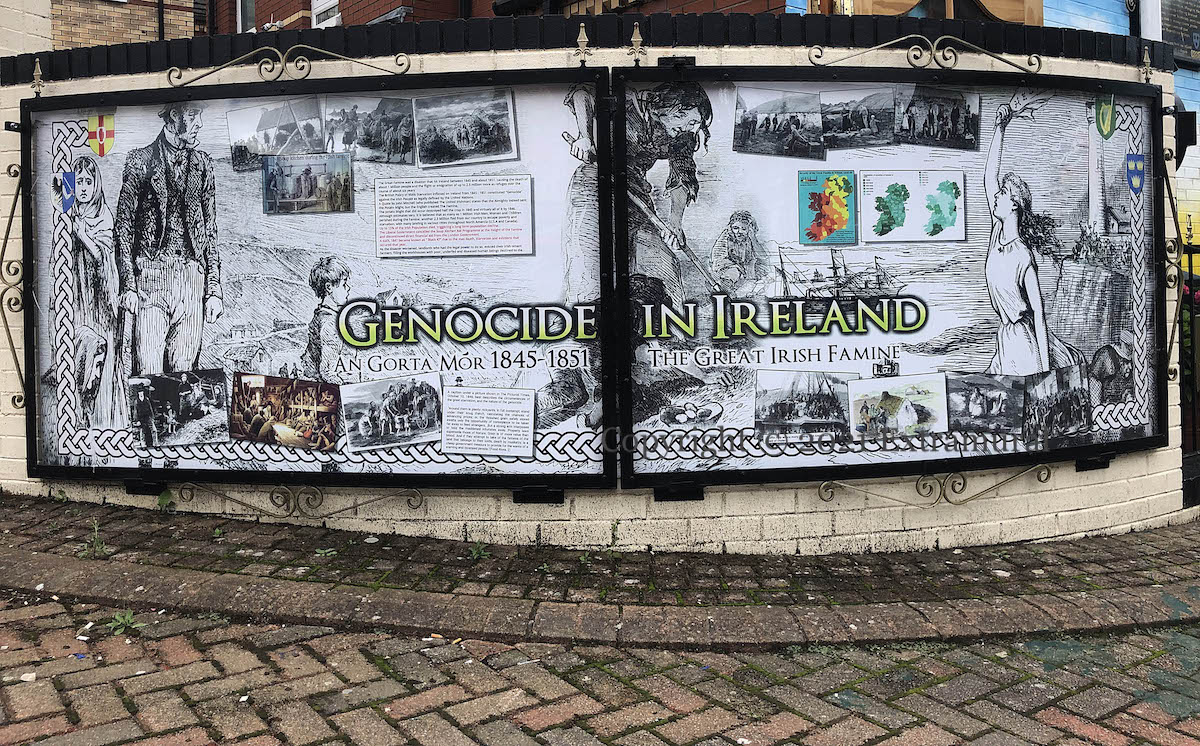
Photography was still in its infancy in 1850 and would not appear in newspapers until the 1880s (LoC). Instead, newspapers used illustrations to bring their stories to life. This board in Ard An Lao (Ardoyne/Bone) – “An Gorta Mór [The Great Hunger] 1845-1851 – The Great Irish Famine” – combines three of them to serve as a background for other images and information.
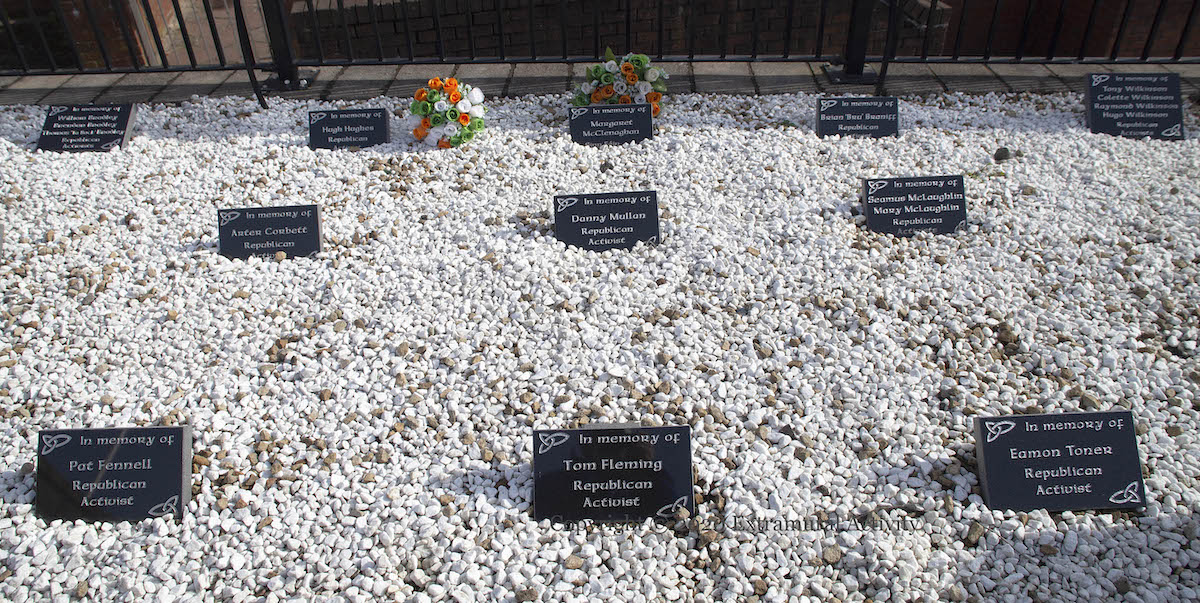
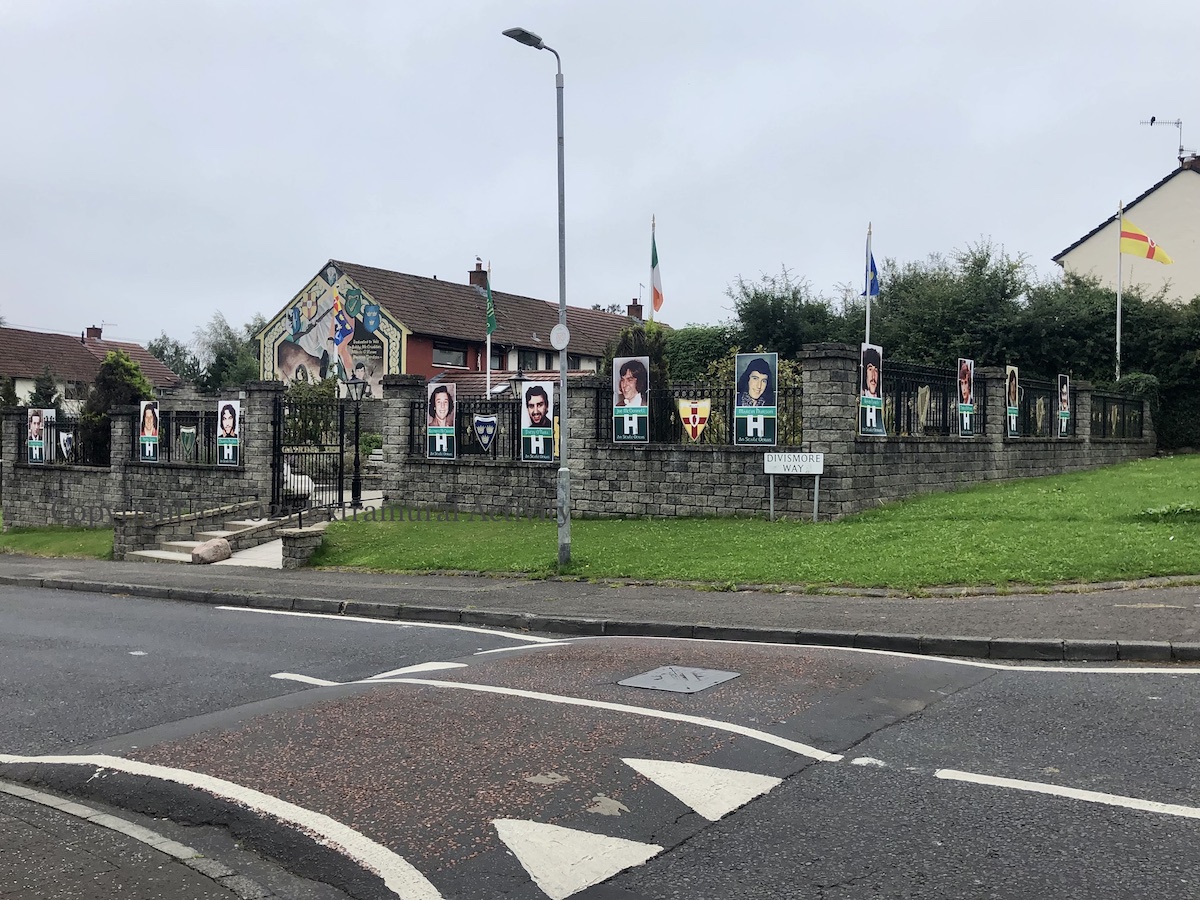
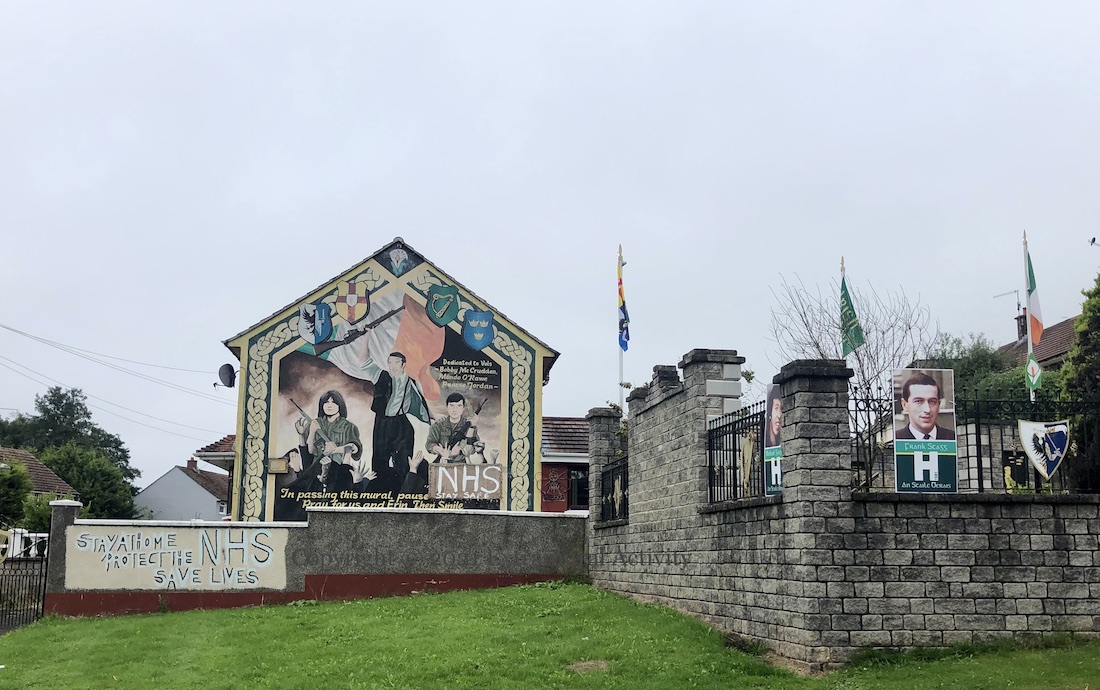
For the 40th anniversary of the 1981 Hunger Strike, portraits of the deceased ten (plus Frank Stagg and Michael Gaughan from the 1970s) were placed on the railings of the Ballymurphy memorial garden. There is a new (compared to 2006 and 2008) set of plaques, erected in 2017:
“A Letter To The 22: You have not gone away, you are in the hearts and on the lips of your people. The old speak of you with knowing tongue. The middle aged, as those who worked beside you. The young men and women with a passion not unlike your own. Your names can be heard on the wind taken from the mouths of men who tend their flocks on Slieve Gullion, Cnoc Phadraıg, Glenshane. They echo in the small graveyards in Cork, Kerry, Galway, Mayo, Tyrone, Antrim, Derry and Armagh. They are heard among your people at the mass gate on Sunday in the crowd at the hurling game, around the hearth when the bottle is cracked and song is sung. Your image can be seen on the faces of happy smiling children for whose freedom you gave your all. You are in our prayers you have not gone away, you never will. Mıse le meas Colm Mac Gıolla Bheın 2006. This monument was erected by the Ballymurphy Ex POWs in memory of the 22 hunger strikers who died for the cause of Irish freedom. It was unveiled on the hundredth anniversary of Thomas Ash[e] who was the first republican to die on hunger strike in 1917. He died after five days while being force fed. Thomas Ash[e] an these 21 brave Irish men stood by their beliefs and refused to be criminalised. Fuaır sıad bás ar son shaoırse na hÉıreann. I measc laochra na nGael go raıbh sıad.”
In April, the Workers’ Party (web | web | tw | Fb | Fb) suffered a leadership challenge and a split in which its sole elected representative – Ted Tynan on Cork county council – left the party (statement). This is only the latest in a long line of splits, going back to the formation of the modern Workers’ Party, from a split in Sinn Féin in 1970 (WP).
“National Commemoration Committee – erected in memory of all those comrades who dedicated their lives for the establishment of a democratic, secular, socialist republic. ‘I have given whatever I had to give for the party, the people of Ireland, and for a better world, but others have given more, much more. Comrades have given their lives’ – Tomás Mac Giolla TD. ‘For the unity of Protestant, Catholic and Dissenter.'”
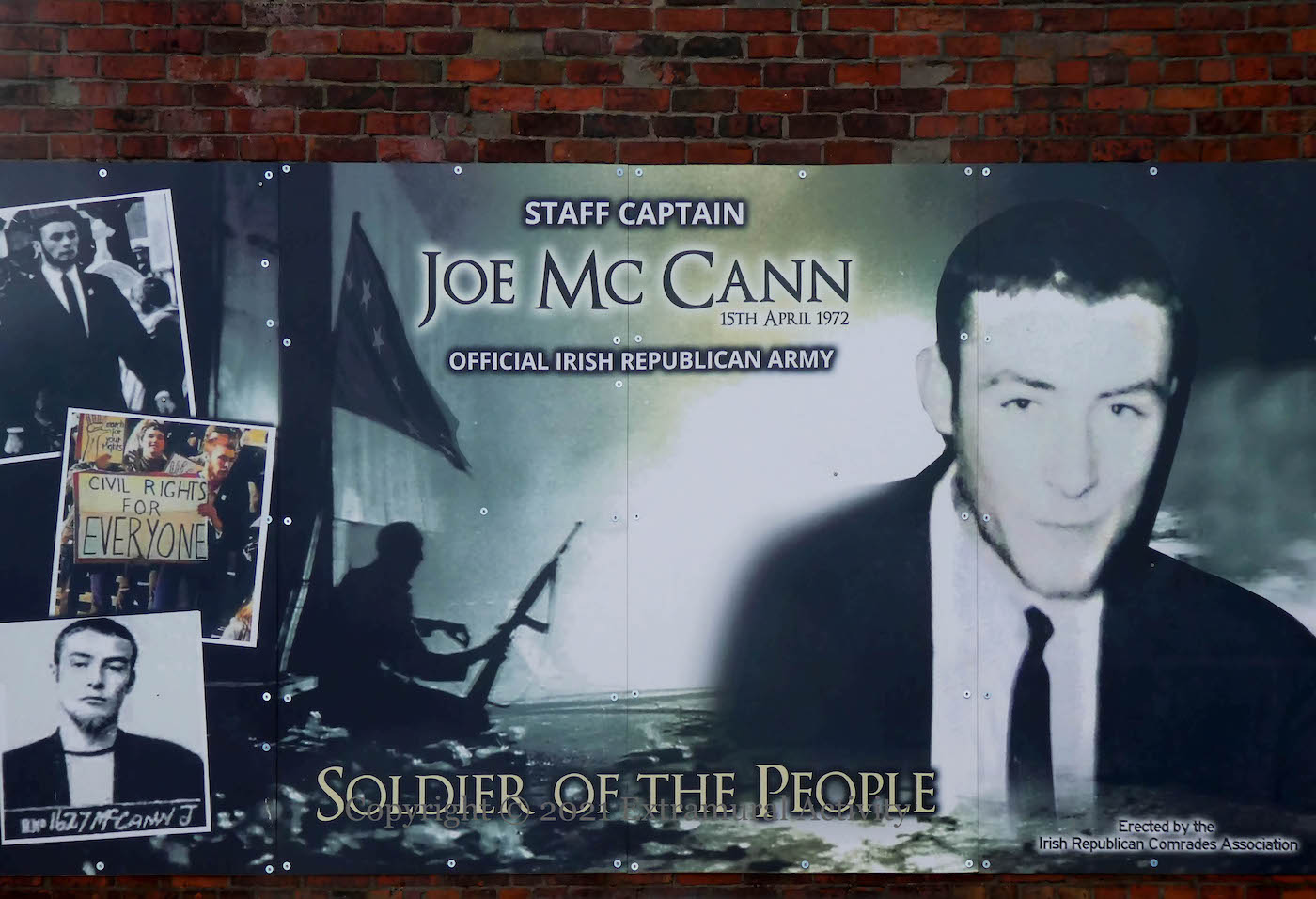
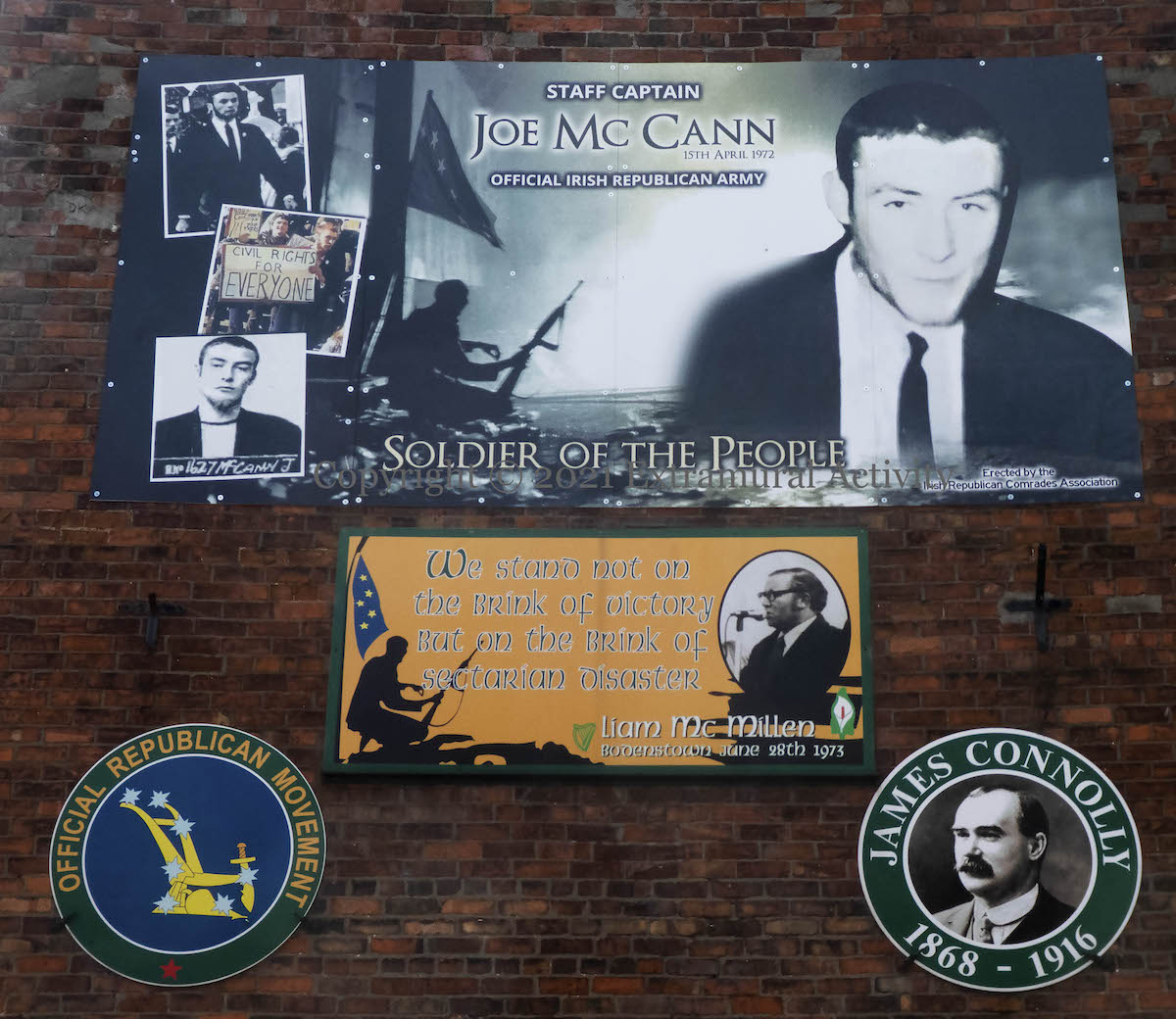
Joe McCann was IRA/OIRA OC in the Markets area of Belfast. He was famously photographed among burning buildings in Inglis’s bakery, during protests against the introduction on internment, crouched beneath a Starry Plough and holding an M1. (For more, see Battle Of The Markets, which features the same photograph.) For McCann’s death the following year (on April 15th, 1972) see Joe McCann. This new board replaces a tarp in the same location: see On The Brink Of Sectarian Disaster.
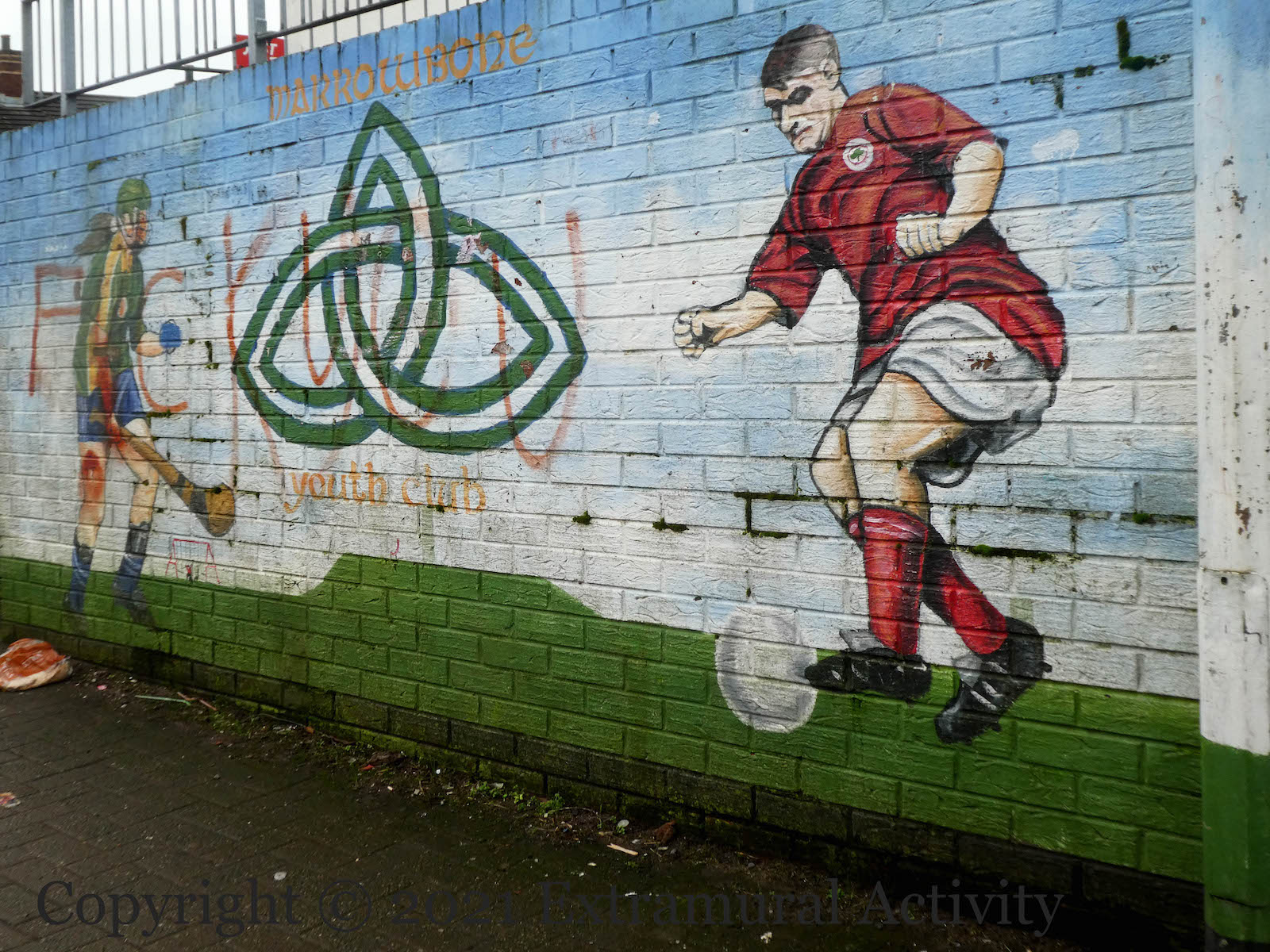
Máirtín Ó Dochartaigh, one of the founders of Club Óıge Mhachaıre Botháın in 2001, died in 2011. The club was renamed in his honour in ?2020? as Cumann Óıge Uí Dhochartaıgh (Fb | ig) (An Phoblacht). The mural, bearing the original name of the club, dates back to 2012.
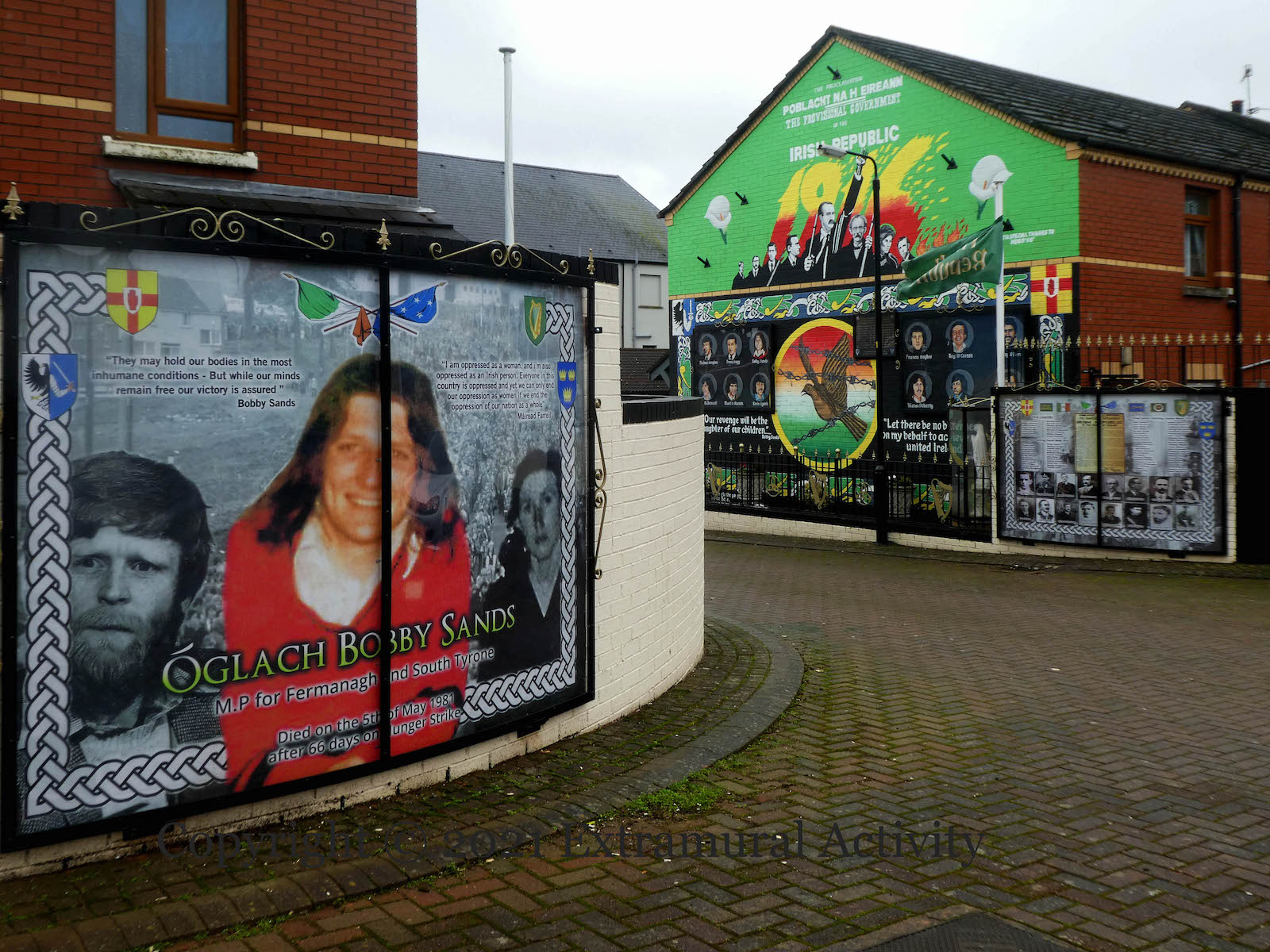
Mairéad Farrell (on the right of the image above) was arrested for planting a bomb at a hotel in Dunmurry in April 1976, one month after Special Category Status for republican prisoners had been revoked. Kieran Nugent (on the left) began the “blanket” protest in September that year and Farrell was the first person to join the protest, when she arrived in Armagh women’s prison to begin her fourteen year sentence. She later took up a dirty protest and joined the 1980 hunger strike. She stood for election in 1981 (in Cork), but, unlike “Óglach Bobby Sands, MP for Fermanagh and South Tyrone”, was not successful. (WP)
“I am oppressed as a woman and I am oppressed as an Irish person. Everyone in this country is oppressed and yet we can only end our oppression as women if we end the oppression of our nation as a whole.” Máiread [sic] Farrell
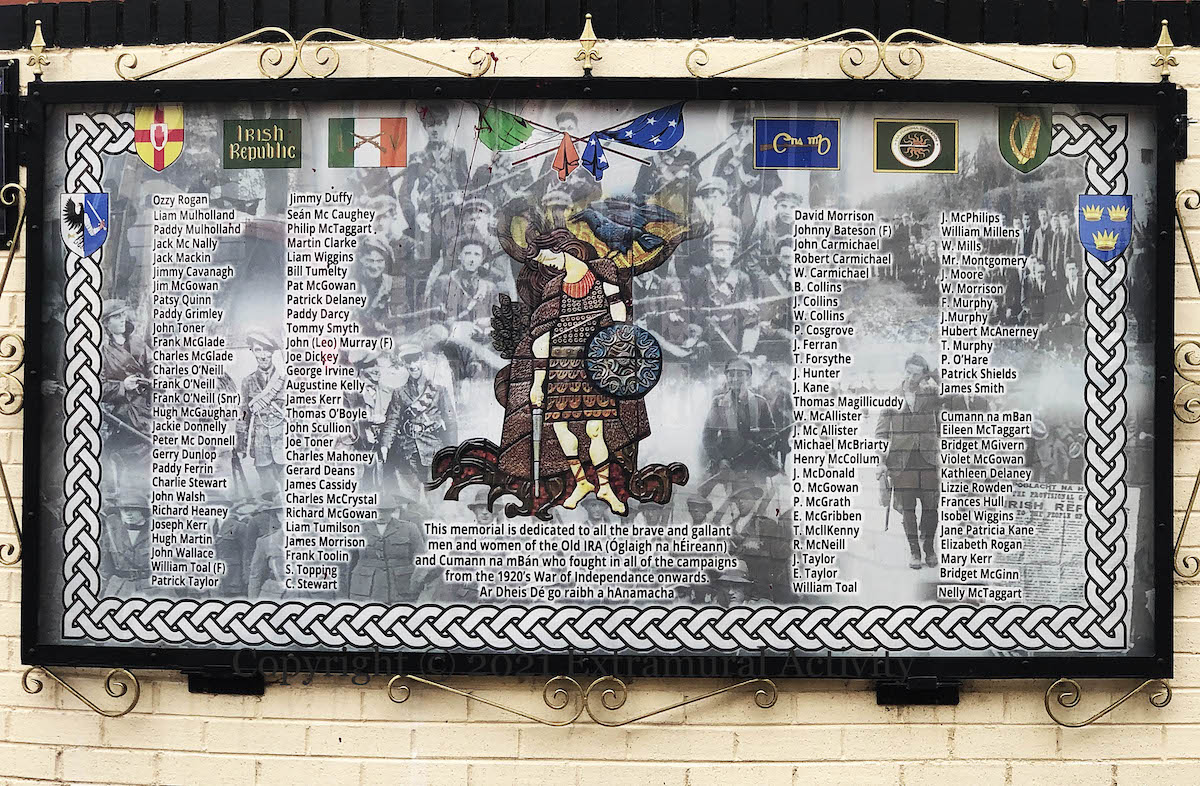
Cú Chulaınn stands dying; the raven on his shoulder will signal his death. “This memorial is dedicated to all the brave and gallant men and women of the Old IRA (Óglaıgh na hÉıreann) and Cumann Na mBán who fought in all of the campaigns from the 1920s War of Independence onwards.”
The Irish tricolour with crossed rifles was the flag of the Irish Volunteers (Óglaıgh na hÉıreann), the splits in which gave rise all the subsequent IRAs.
For a roll of honour 1916-1966, including some profiles, see Treason Felony.










 Extramural Activity