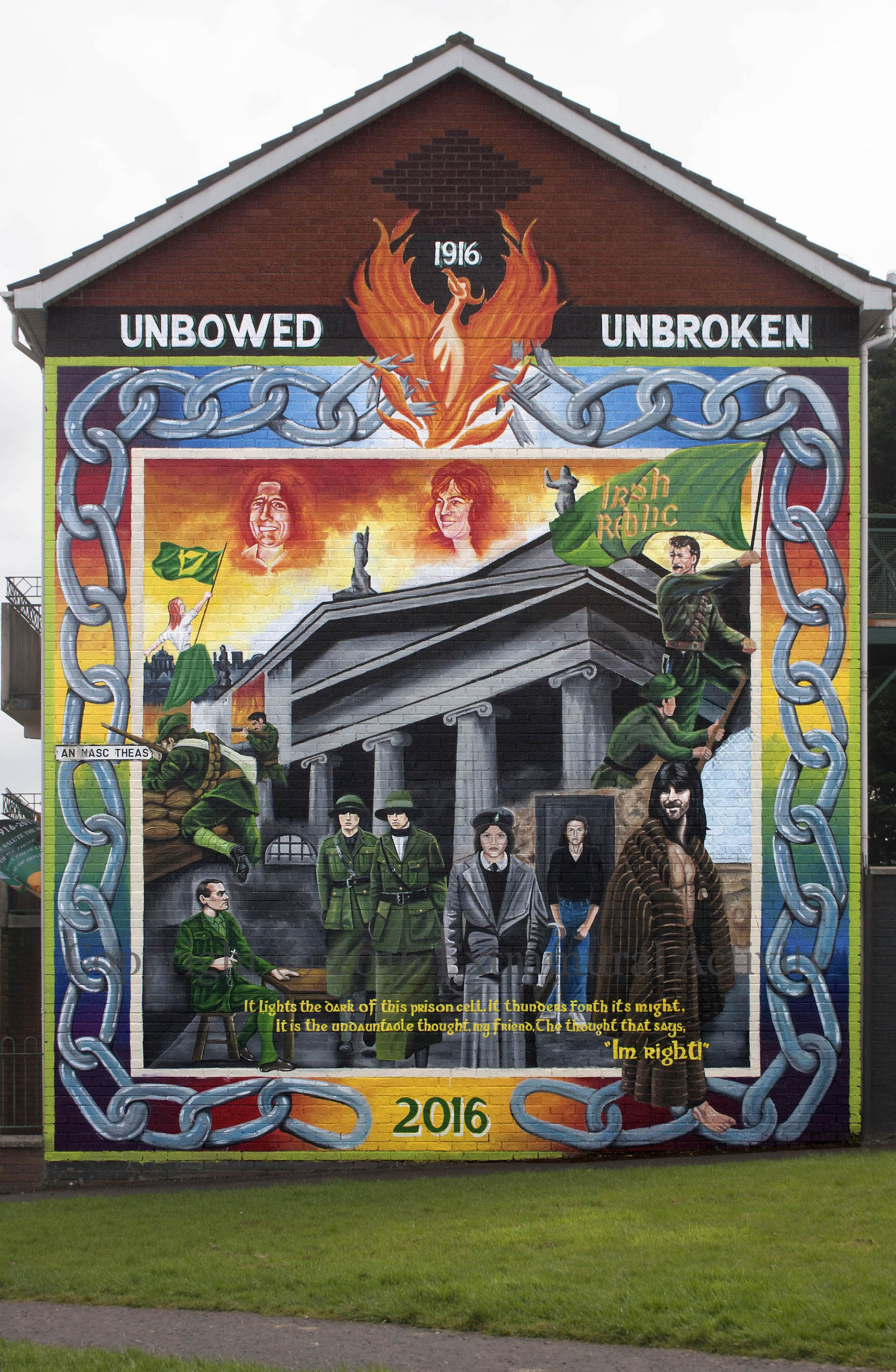
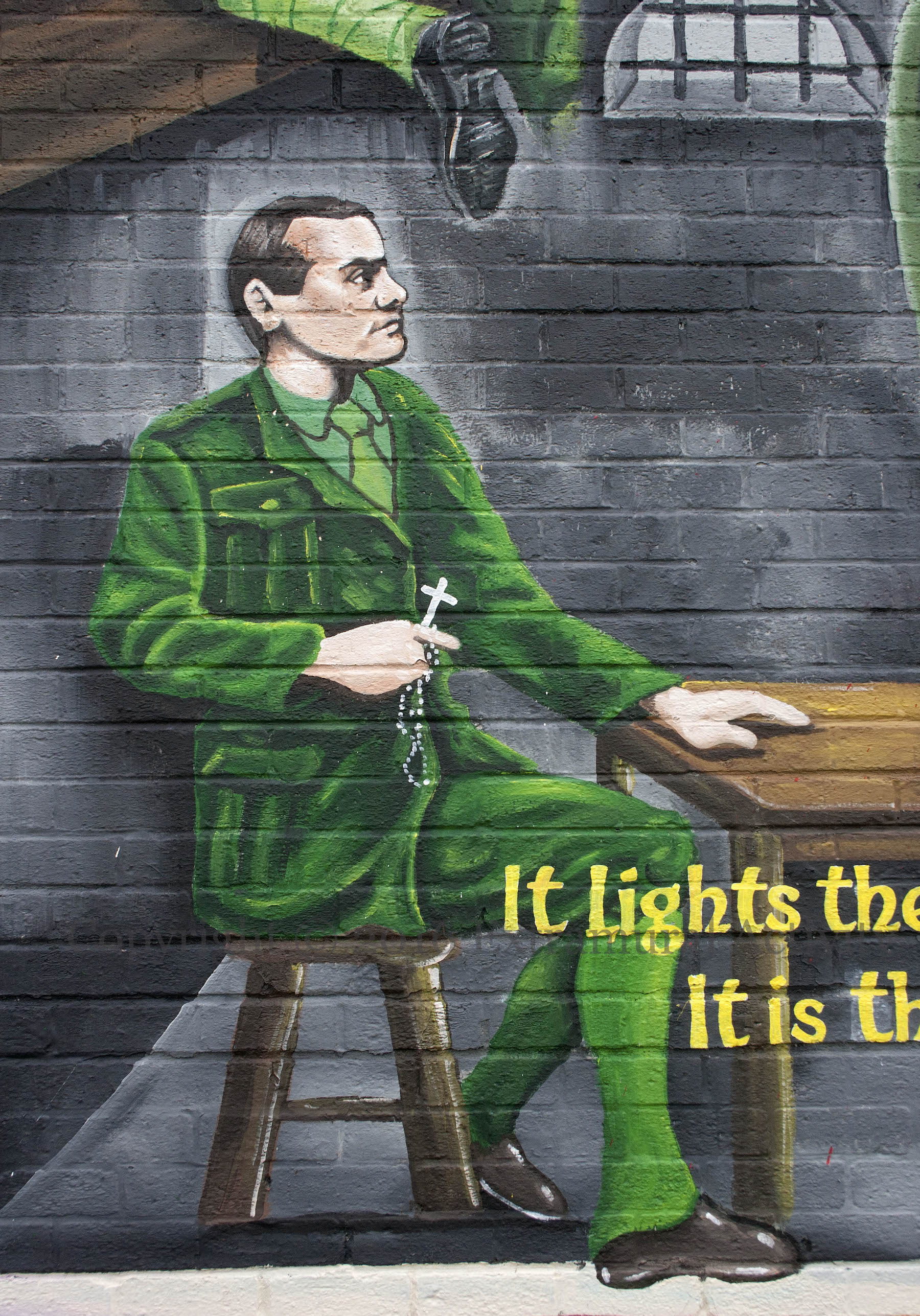
A succession of Irish rebels is shown in this new mural in Andersonstown, west Belfast. It begins (top left) with the rebellion of 1798 and then to the Easter Rising of 1916 at the GPO in Dublin. In the lower left, a pious Padraıg Pearse awaits his execution with rosary beads in hand. There are then shown female figures from Cumann Na mBán and the IRA (see previously: United Irishwomen, Do You Care? and Mothering Sunday In Beechmount), and then Maıréad Farrell in Armagh Women’s Prison (for the original, see Prison Walls). In the bottom right corner there is a blanketman. The busts of Bobby Sands and Joe McDonnell float above the GPO and the last verse of Sands’s The Rhythm Of Timeform the epigraph: “It lights the dark of this prison cell, it thunders forth its might, it is the undauntable thought, my friend, the thought that says, “I’m right”.
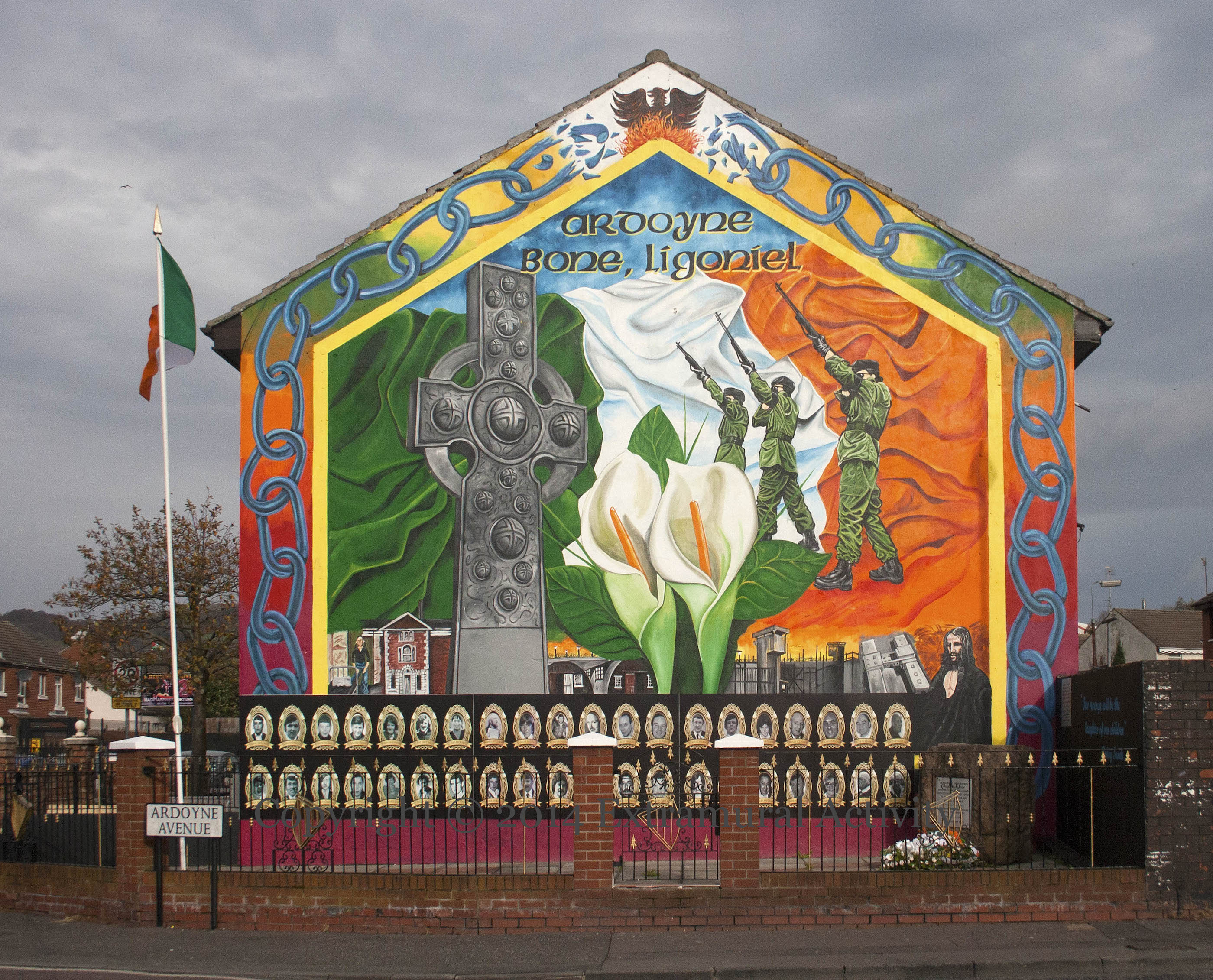
The hunger strikers tarp has been removed from the Ard Eoın memorial garden (see 2013) and the forty portraits have been moved over from the mural on Ardoyne Avenue after the plaster fell off (see one | two).
However, the two long-standing pieces remain the same. As can be seen in the image below, the cross goes back to 1976. “This garden of remembrance was unveiled by Nora Connolly O’Brien, daughter of James Connolly, Easter Tuesday 1976. It is dedicated to the memory of Óglaıgh Na hÉıreann and Fıanna Éıreann volunteers, Sınn Féın, and members of our community who lost lives since 1969. ‘Ireland unfree shall never be at peace.’ In loving memory of all from the Ardoyne, Bone and Ligoniel who died because of Ireland’s troubles.”
Above, the phoenix is used as a symbol of resistance in one of the oldest memorial plaques in Belfast (1993) with the names of deceased IRA volunteers and locals: “Oft from prison bars, oft from battle flashes/Oft from heroes’ lip, oftenest from their ashes.”
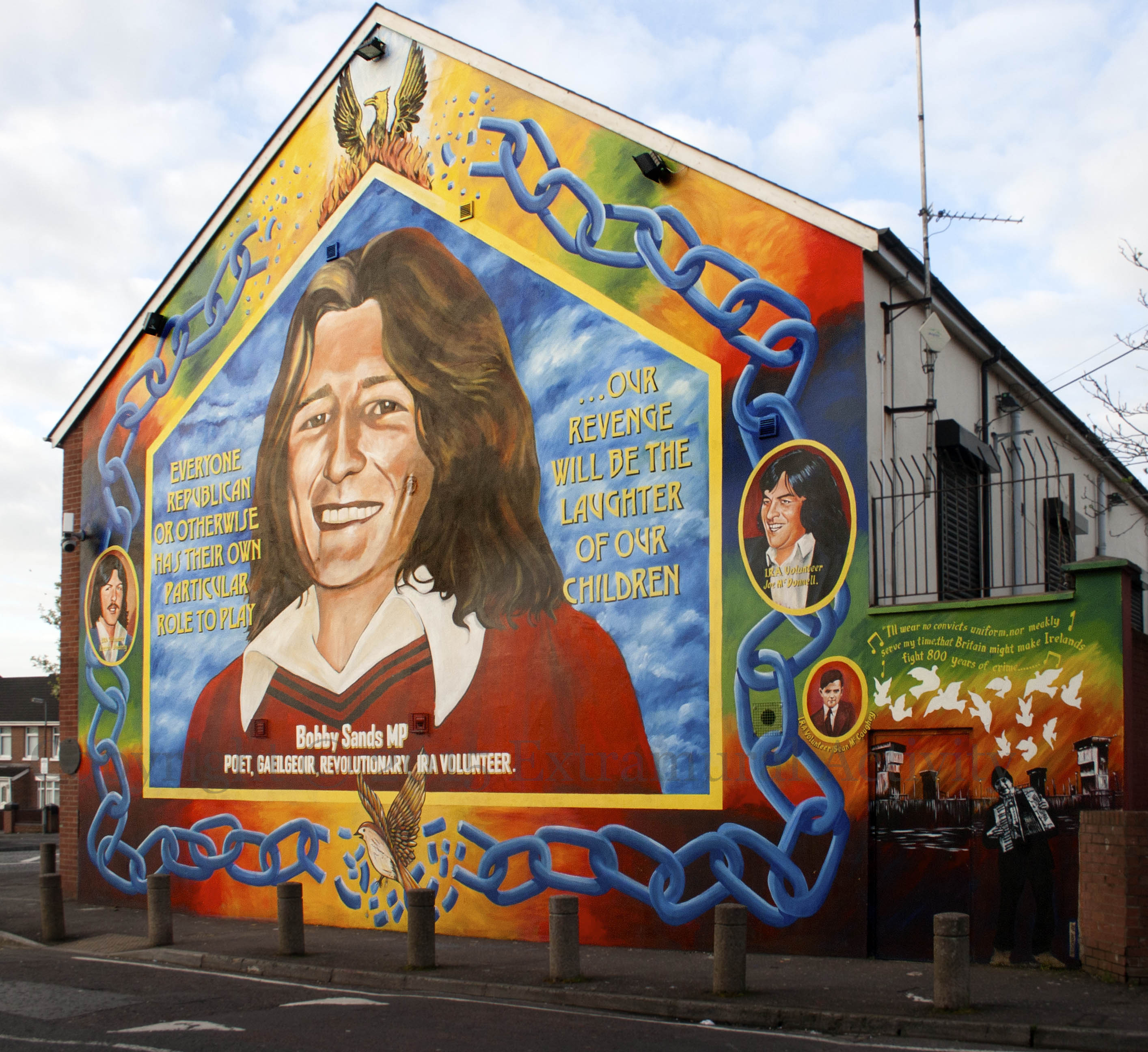
The Bobby Sands mural in Sevastopol Street has been given a facelift, including the blocking-up of a vent on Sands’s left cheek. Kieran Doherty and Joe McDonnell have been added in place of the 1798 medallions on each side. On the side-wall are Sean McCaughey, ten doves representing the 1981 hunger-strikers, and Long Kesh. Aerosol‘s accordion-player stencil has been also been retained.
Ag sráıd Sevastopol cuımhnıtear ar Bobby Sands ı múrmhaısıú a aithnıtear ar fud an domhaın. Ba scrıbhneoır, file, réabhlóıdí agus díograıseoır Gaeılge é Sands. Fuaır sé bas 5 Bealtaıne 1981 tar éıs 66 lá ar stailc ocraıs. As ucht na dıograıse a thaıspeáın Sands agus a chomhchımí ı leıth fhoglaım na teanga faoı choınníollacha uafásacha Bhlocanna H na Ceıse Fada, spreagadh glúın úr chun dul ı mbun athghabháıl na Gaeılge.
Here at Sevastopol Street Bobby Sands is remembered in a mural which has become world-renowned. Sands, a writer, poet, revolutionary and Gaelic enthusiast, died on May 5th 1981 after 66 days on hunger strike. Sands and his fellow prisoners inspired a new generation to reclaim the Irish language enthusing them by the huge efforts they put into learning Irish in the horrendous conditions on the H Blocks of Long Kesh.
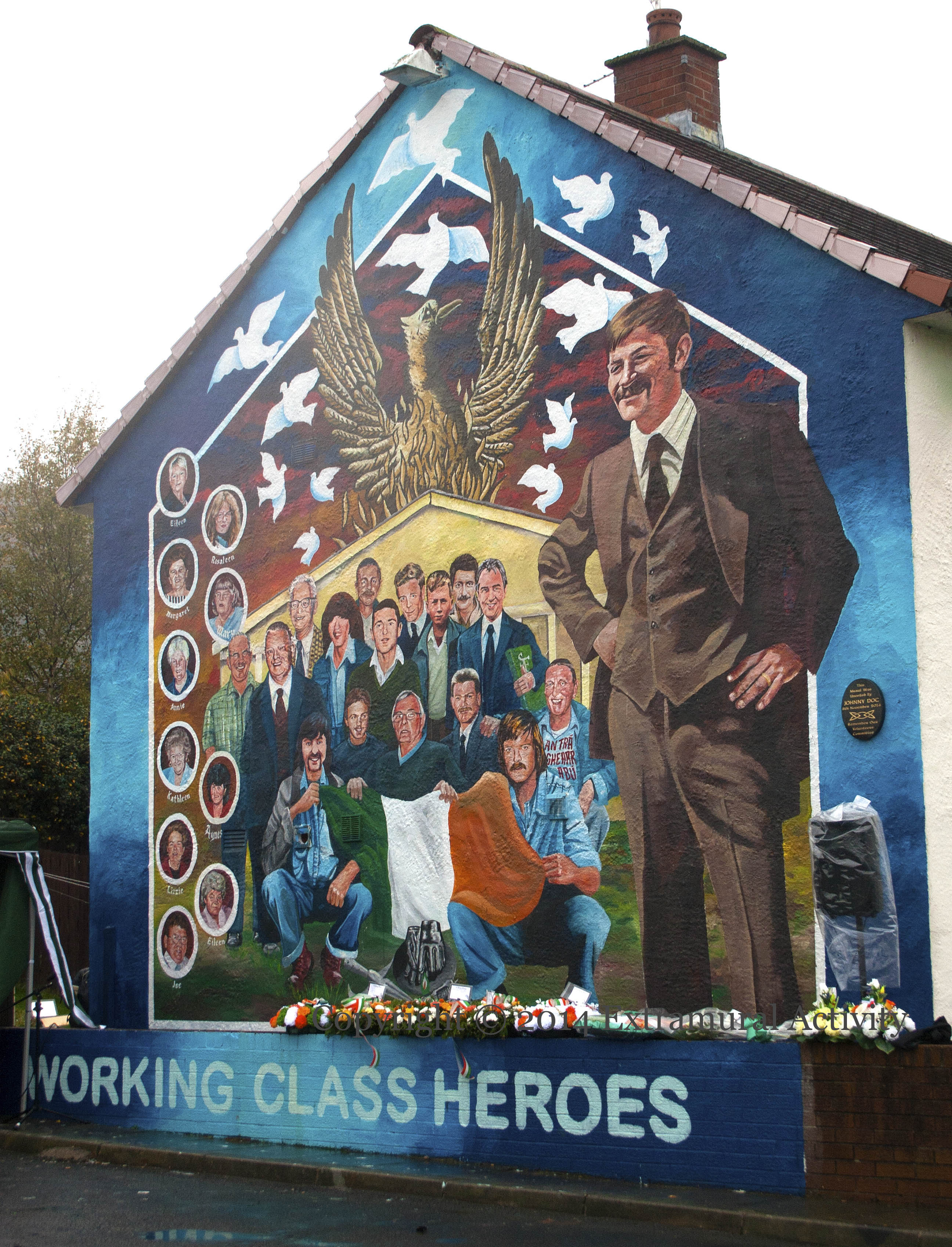
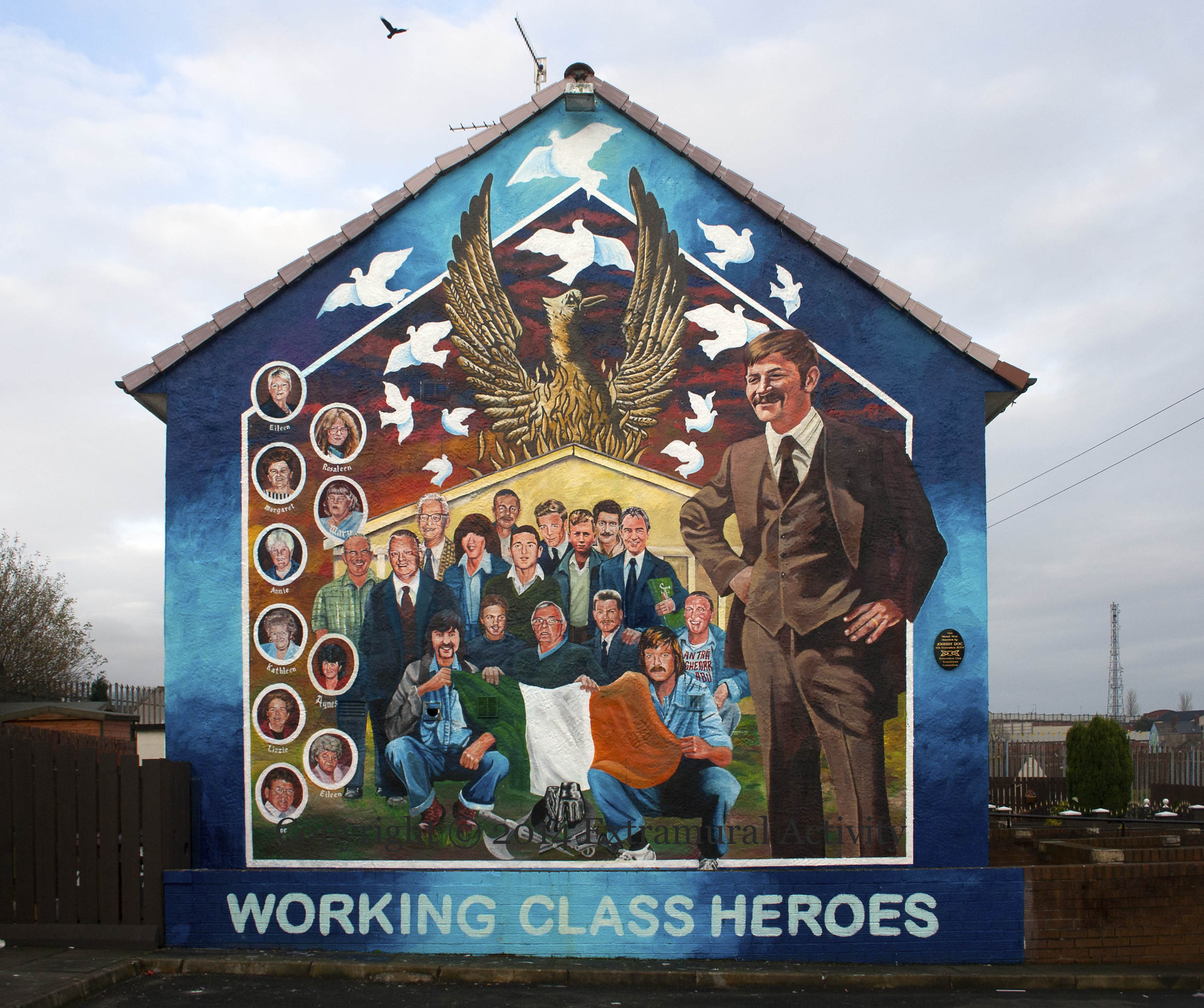
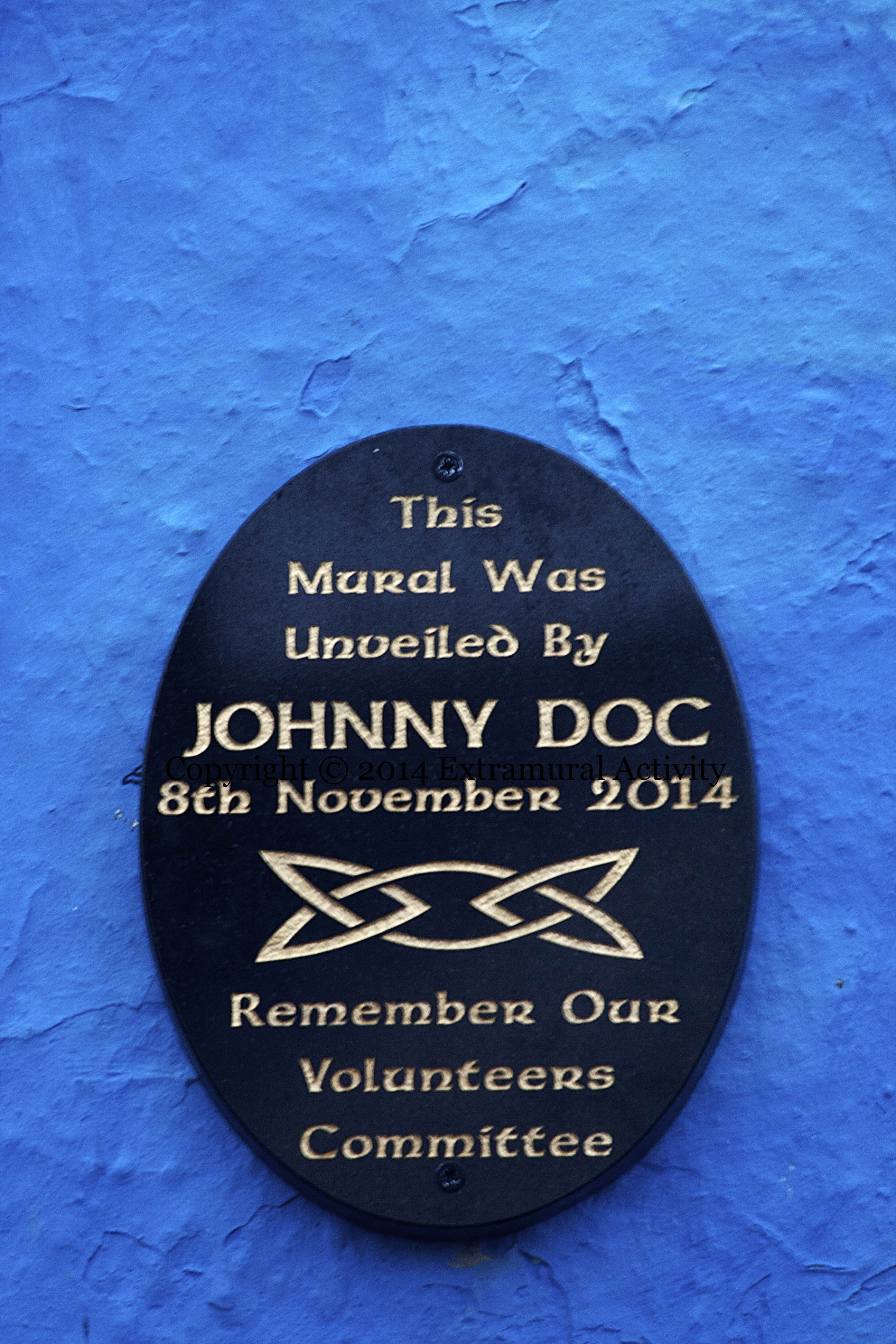
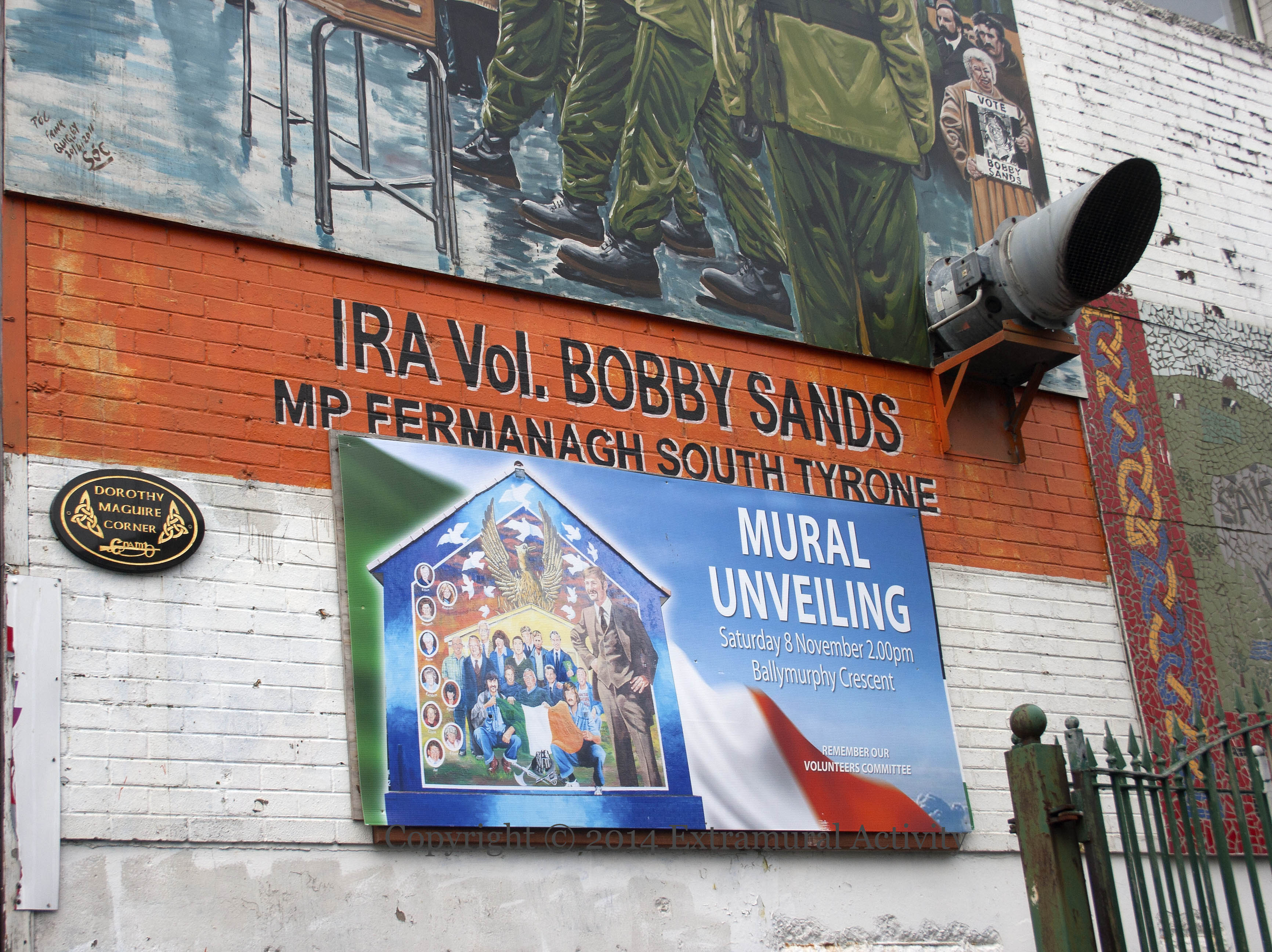
Last Saturday (2014-11-08) saw the launch of a new mural in Ballymurphy Crescent, celebrating local IRA volunteers and community workers.
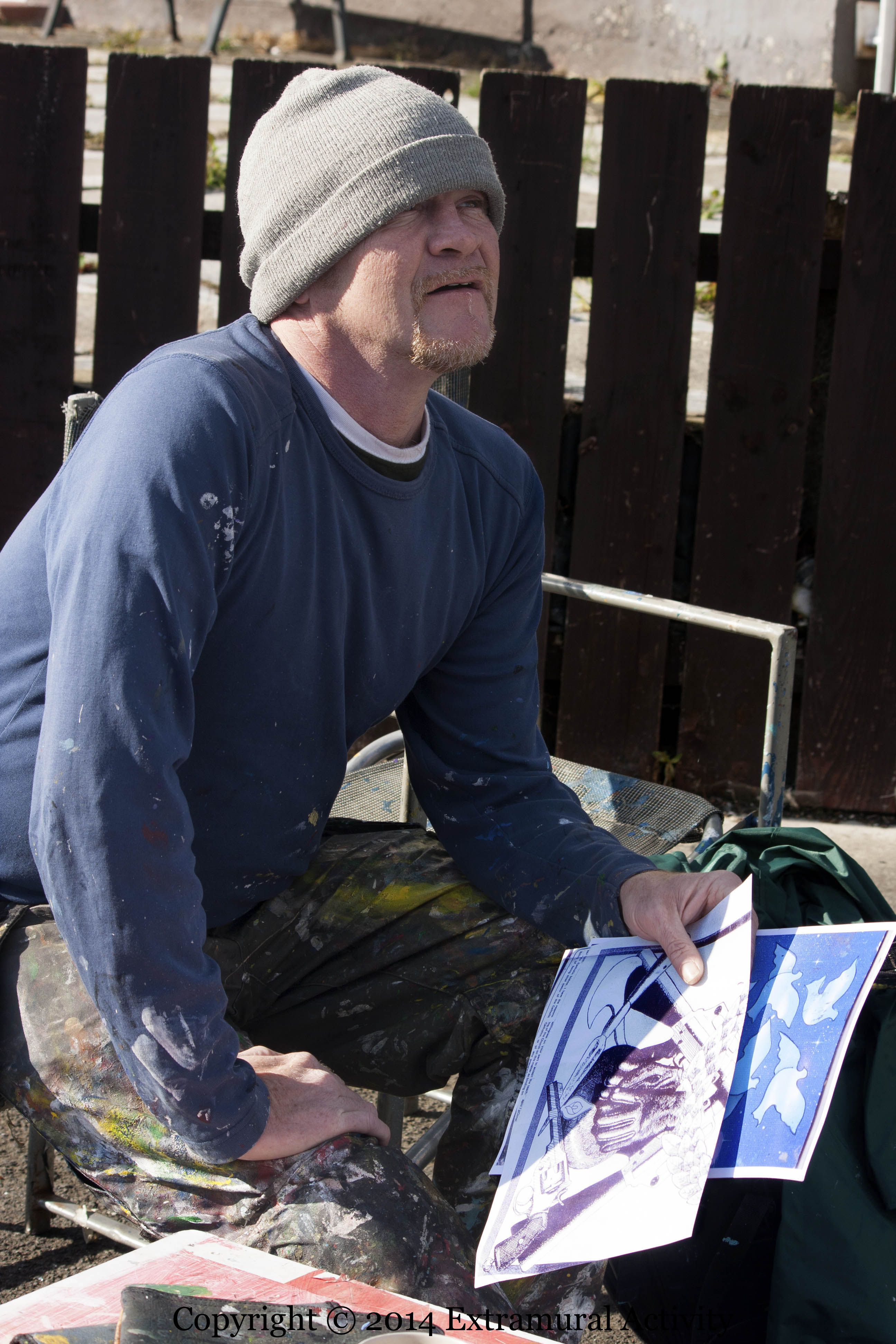
The doves at the top of the mural are in the style of Robert Ballagh’s “Legacy Of The Hunger Strikes” though there are 12 doves here rather than 10. Marty Lyons holds a copy of Ballagh’s piece in an image below, along with an image on which the halberd and pistol around the beret and gloves in the bottom of the mural are based – the rifles of the original are absent. (Possibly by Patrick Magee, the Brighton bomber (WP) – please confirm by e-mail or comment.)
Left-hand portraits (counter-clockwise from top): Eileen Gray, Margaret Campbell, Annie Adams, Kathleen Moore, Lizzie McGivern, Joe Reid, Rosaleen Russell, Mary Armstrong, Agnes Robinson, Eileen Reid.
Standing (l-r): Fra Toner, Gerry Campbell, Liam Mulholland, Paddy Tier, Sean Connolly, Michael Kane, Liam McParland, Sean Doyle, Cllr. Sean Keenan, Pat McGeown.
Squatting/Kneeling (l-r): Jim McGrillen, Francis Toner, Jr., Jimmy Duffy, Tony McAlister, Billy Carson, Cormac McArt.
The main figure is (and remains from the previous mural) Tommy “Toddler” Tolan, who escaped from the Maidstone in 1972 and served time in the cages at Long Kesh. (See Lost Lives entry #1956 and An Phoblacht.) In the original (2001) version of the ‘Safe House’ mural, he was dressed in fatigues (image at CAIN), but this was changed within 18 months to a brown suit (image at CAIN | detail at ExtrAct), similar to the way he is portrayed here.
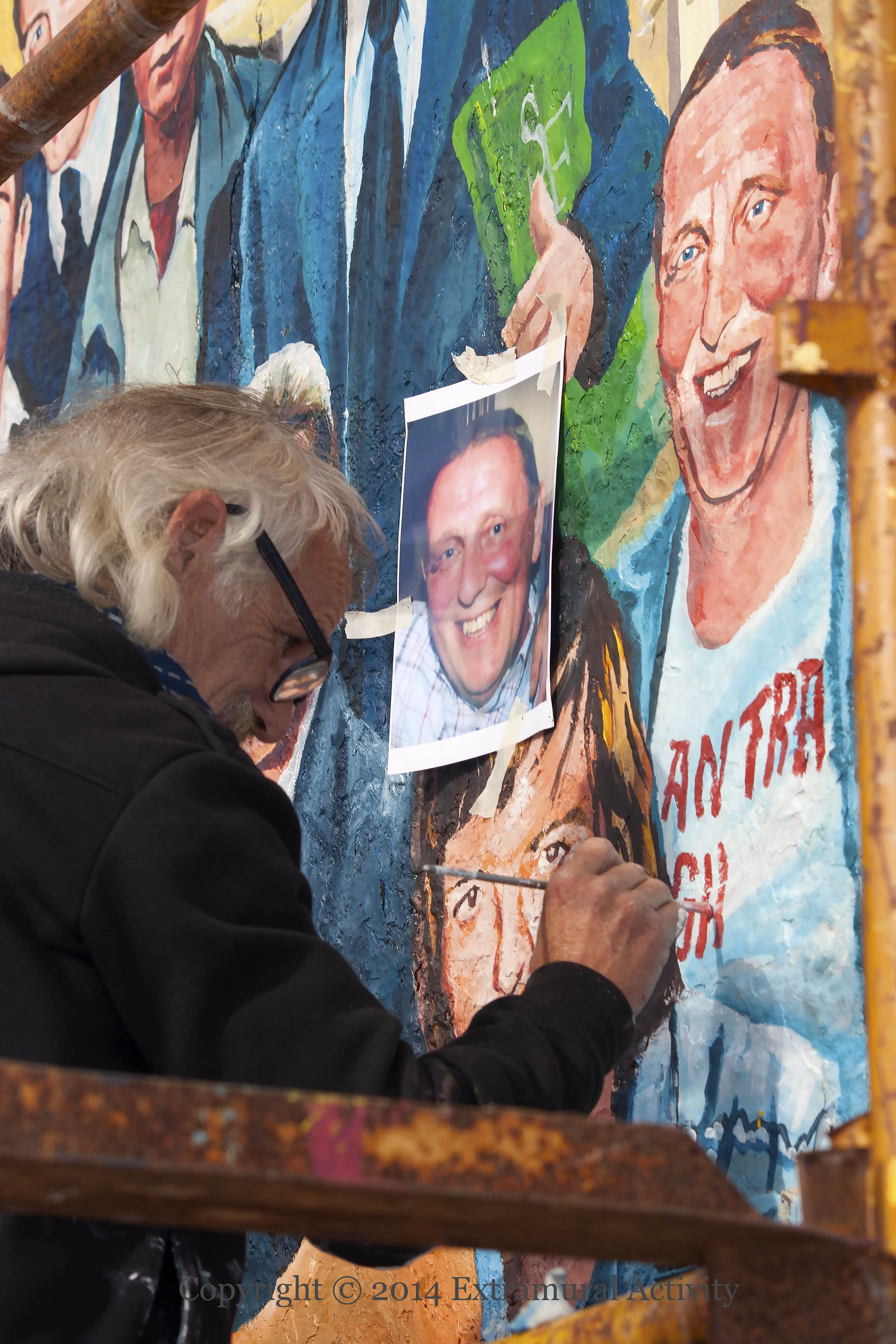
The mural took some time to complete — the fifth image, below, shows one of the artists on a scaffold with #stoptorycuts on Slıabh Dubh in mid-October — partly because more and more figures were added.
Update 2014-11-26: In an unusual move, the launch of the mural was advertised by a board (rather than flyers), in this case at Dorothy Maguire Corner on the Whiterock Road – see the final image, below.
26 volunteers and 14 others from the Ardoyne, Bone, and Ligoniel areas are commemorated in a new (2014-10-05) mural. The images below show artist Mickey Doherty, himself an ex-prisoner, at the start of the process – with the grid-work visible – and shooting an “action” shot for VICE TV.
The previous mural also commemorated local volunteers (34 painted portraits rather than a printed board), but this mural adds a Celtic cross, funeral volley, and images of Armagh women’s prison, the cages at Long Kesh, and the H-blocks, as well as (an inverted image of) blanketman Hugh Rooney – detailed images can be seen in Prison Walls.
“RNU in west Belfast are today leading the way in combating anti-social behavior [sic], reclaiming republican values, fighting the benefits cuts, tackling the increased drug problem, exposing the slum landlords, rebuilding community pride.” RNU [Republican Network for Unity (Xitter)] stencil on Northumberland Street. Tommy Doherty (leaflet) is running in the local council elections taking place on May 22nd.
The phoenix portion of the mural was featured previously: Out Of The Flames.
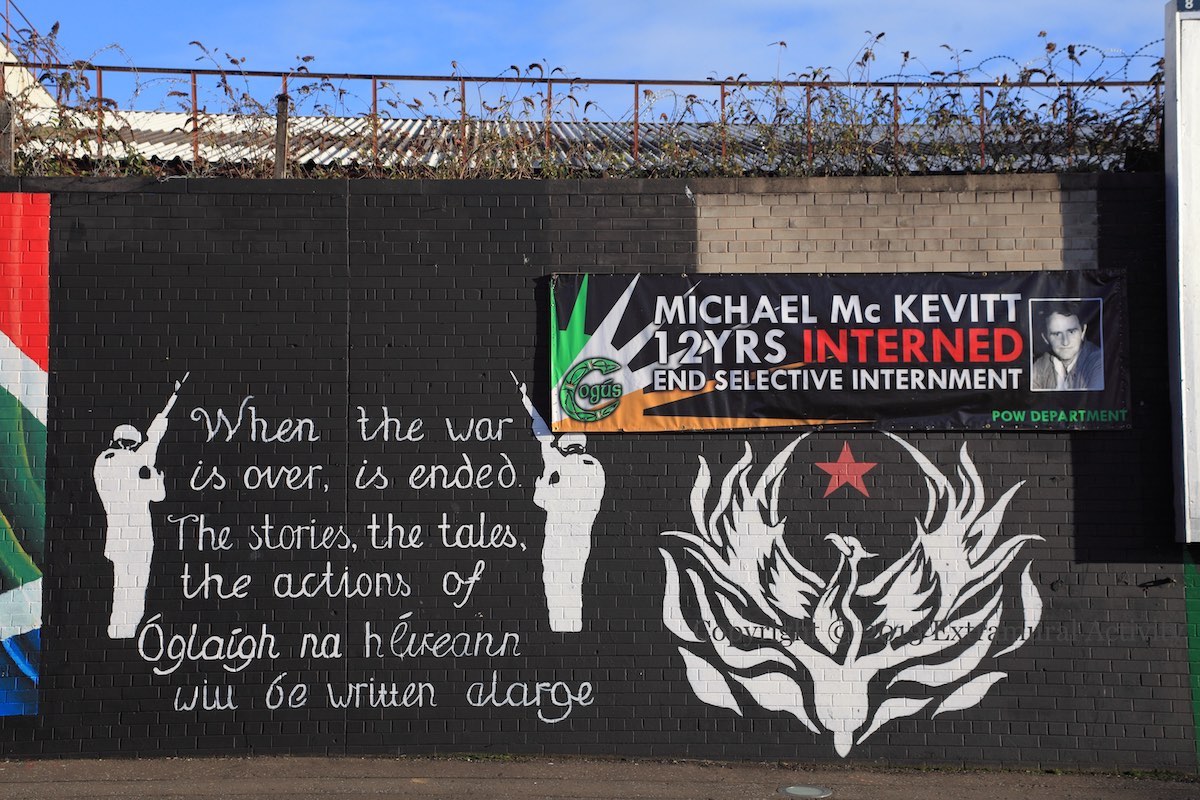
“12 years interned. End selective internment.” Michael McKevitt was found liable in civil court for the Omagh bombing and sentenced (in criminal court, in 2003) to twenty years in Portlaoise for “directing terrorism” (WP).
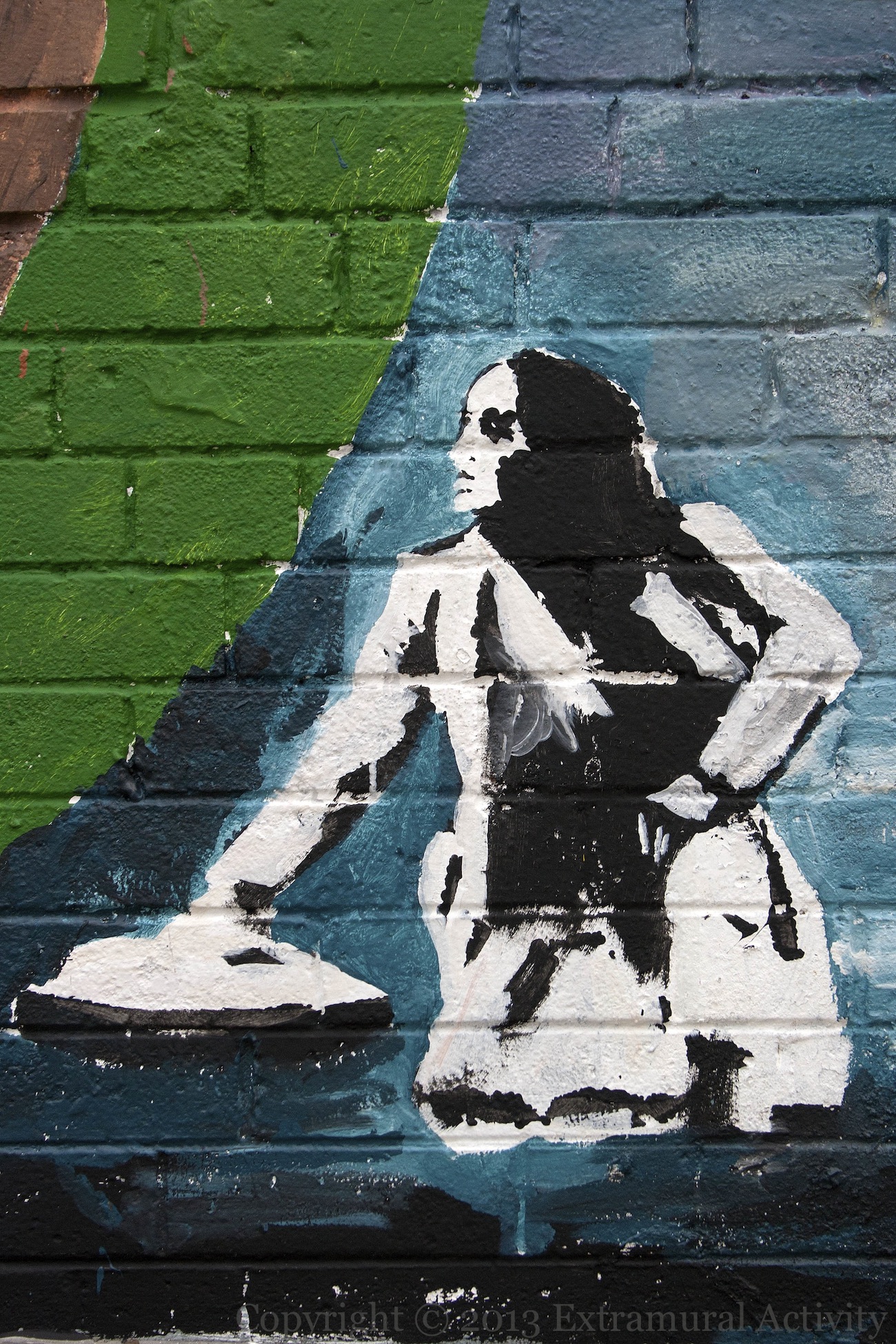
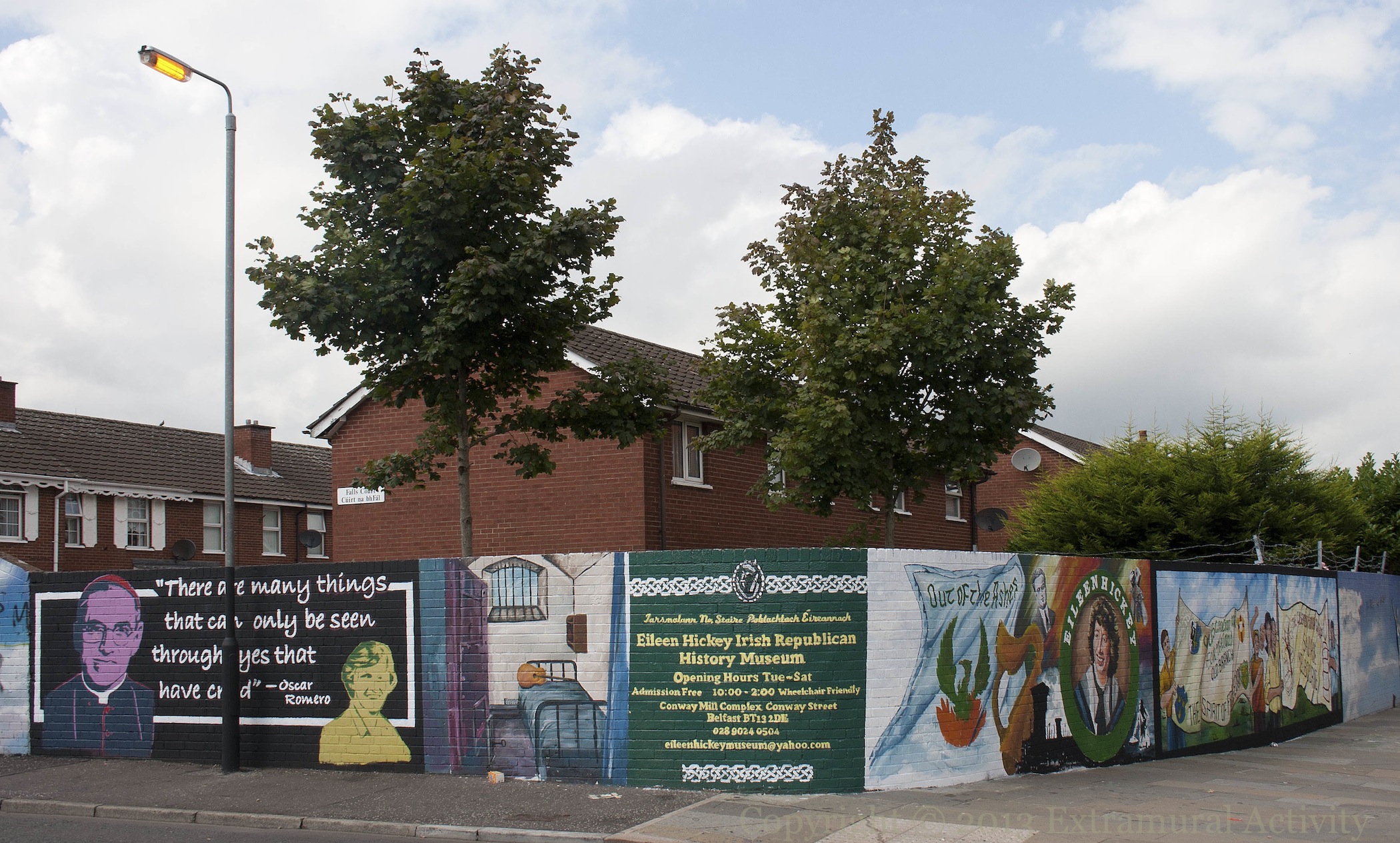
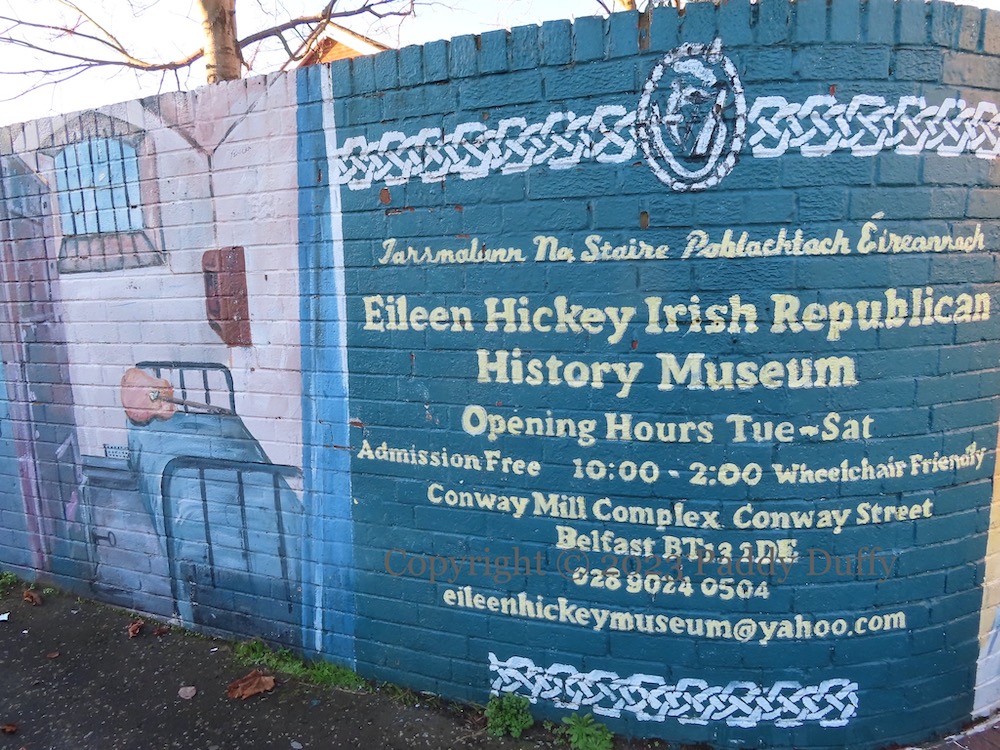
The ‘Eileen Hickey Irish Republican History Museum‘ — which is across the street behind the Conway Mill — is named for Eileen Hickey, a Provisional IRA member who served time in Armagh prison; she died in 2006, one year before the opening of the museum (obituary at An Phoblacht). A close-up of the woman with a bin lid, in the lower right-hand corner, can be found below.
Next to the opening hours is an image of a prison cell in the Armagh women’s prison. The museum itself contains a cell door and a bed from the prison.
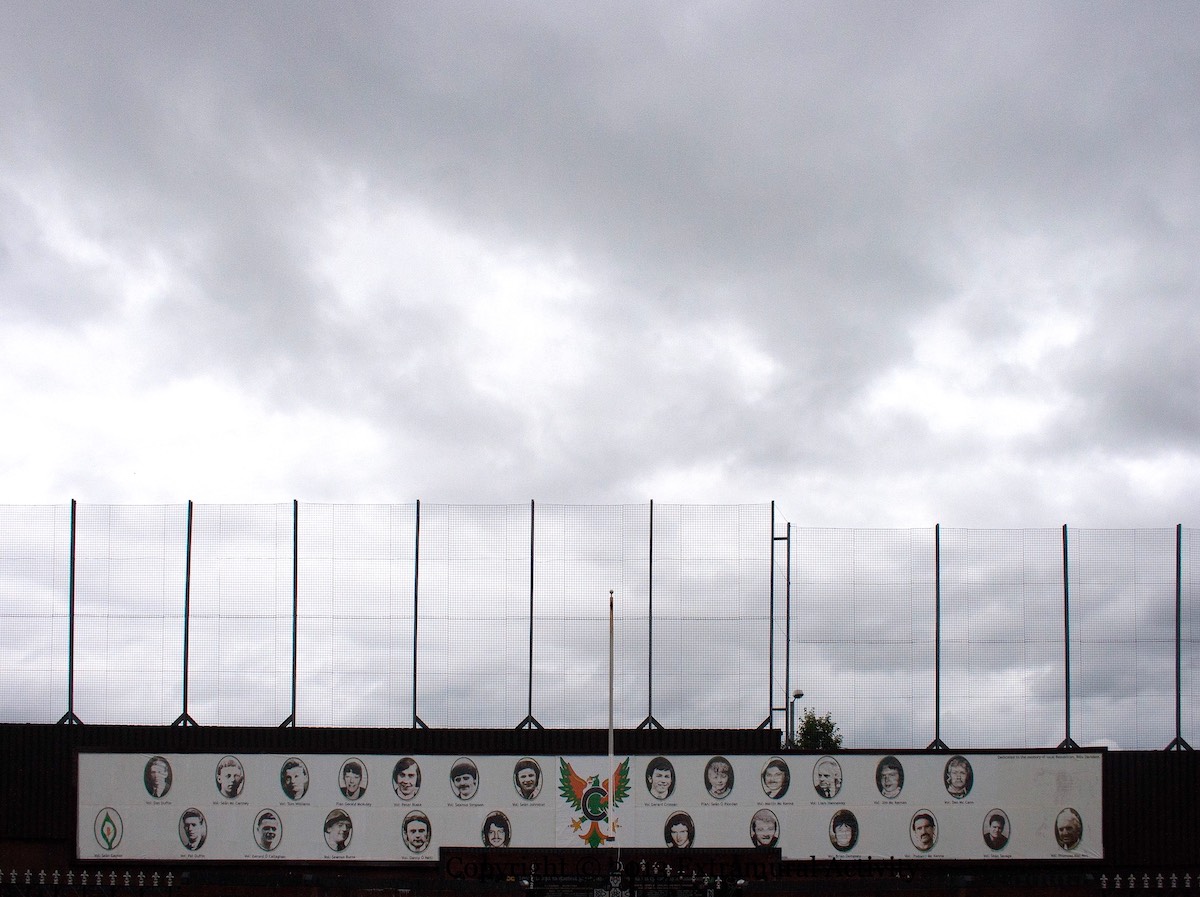
The back wall of Clonard Martyrs Memorial Garden – that is, the so-called “peace” line – is decorated with portraits of twenty-five local óglaıgh and fıanna who died from 1920 to 1992 (though an Easter lily takes the place of Sean Gaynor on the far left).
Left: Dan Duffin, Seán McCartney, Tom Williams, Gerard McAuley, Peter Blake, Seamus Simpson, Seán Johnston, Seán Gaynor, Pat Duffin, Gerard Ó Callaghan, Seamus Burns, Danny Ó Neill, Tom McCann.
Right: Gerard Crossan, Seán Ó Riordan, Martin McKenna, Liam Hannaway, Jim McKernan, Dan McCann, “dedicated to the memory of local republican, Billy Davidson”, Tony Lewis, Joe McKenna, Brian Dempsey, Finbarr McKenna, Seán Savage, Prionsais Mac Áirt.
They are also listed on one of the plaques inside the garden – see the second images in Clonard Martyrs.










 Extramural Activity