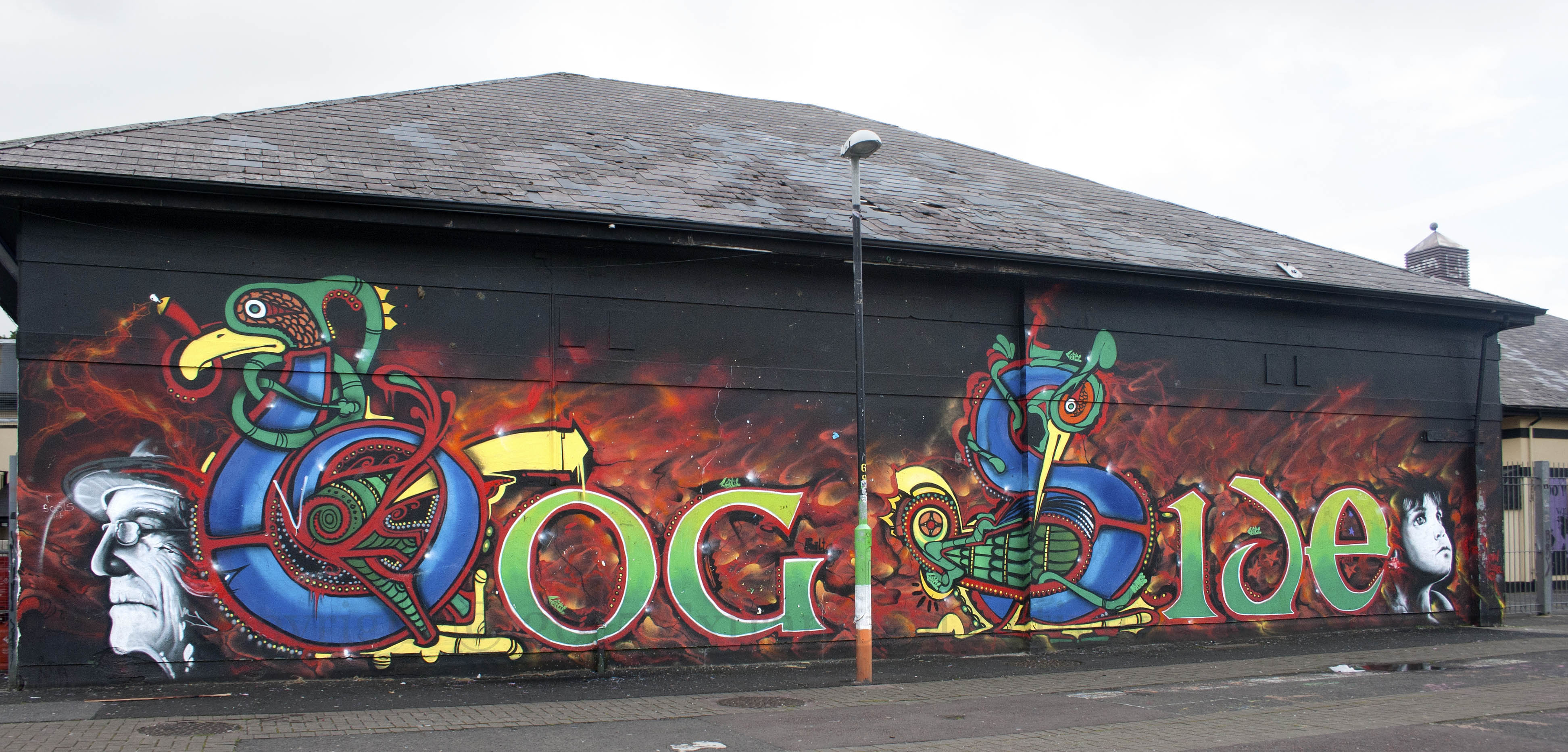
The Bog Side

2015-08-24 Bogside+

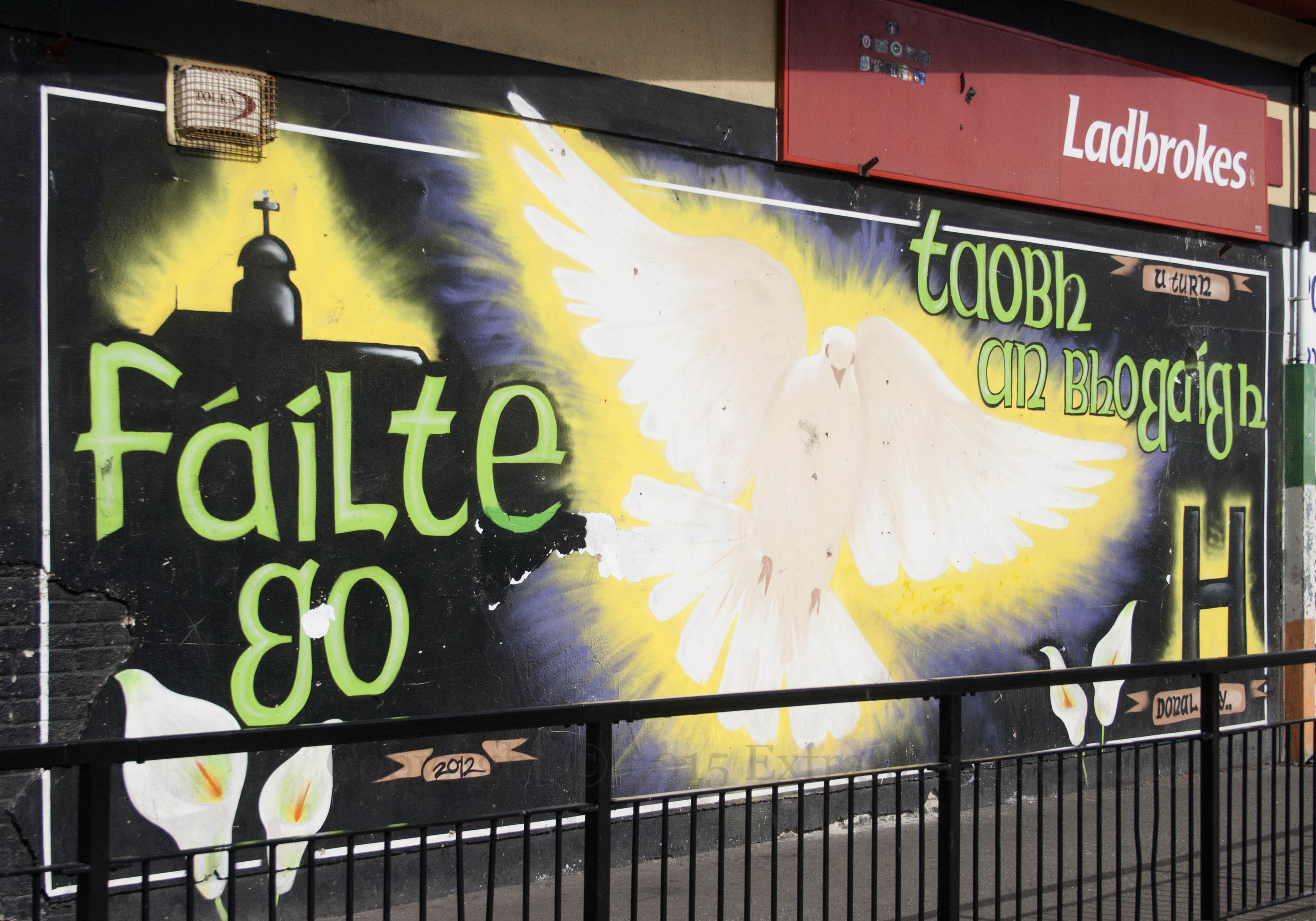
The eastern side of what was the island of Derry is called the Water side and the western side, although originally under water, became the Bog side in about 1600. The two murals shown here are on either side of the shops adjacent to the Bogside Inn. There is an excellent history of the area from 1162 to the construction of Rossville flats in 1966 at the Museum Of Free Derry.

The piece above is by RAZER (ig).
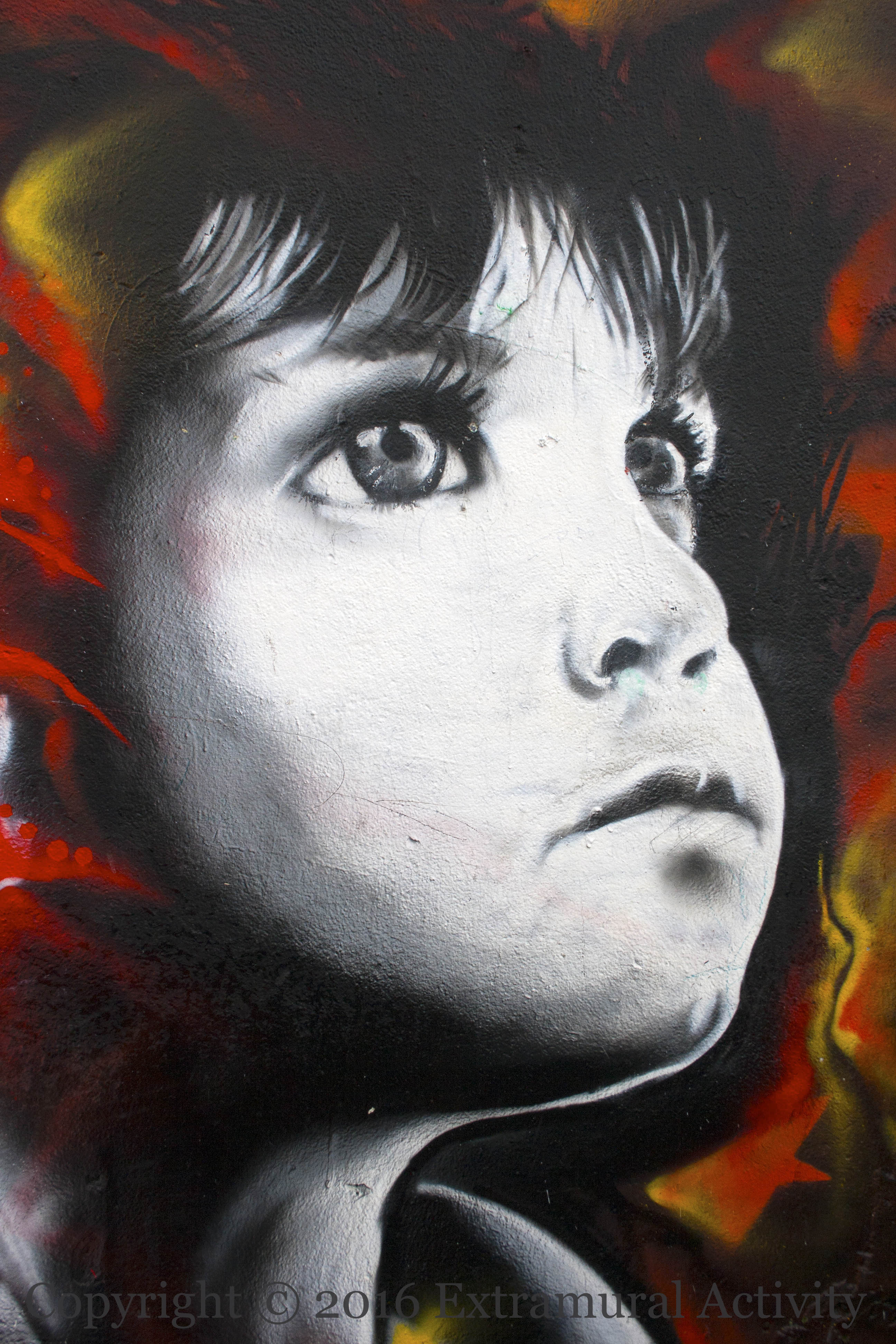
03591 2016-06-30 Bogside Child+.jpg

2015-08-23 TaobhAnBhogaigh+

Click image to enlarge
Copyright © 2015 Seosamh Mac Coılle
X02746 X03591 X02745 fáılte go taobh an bhogaıgh lily H-Block dove of peace celtic design
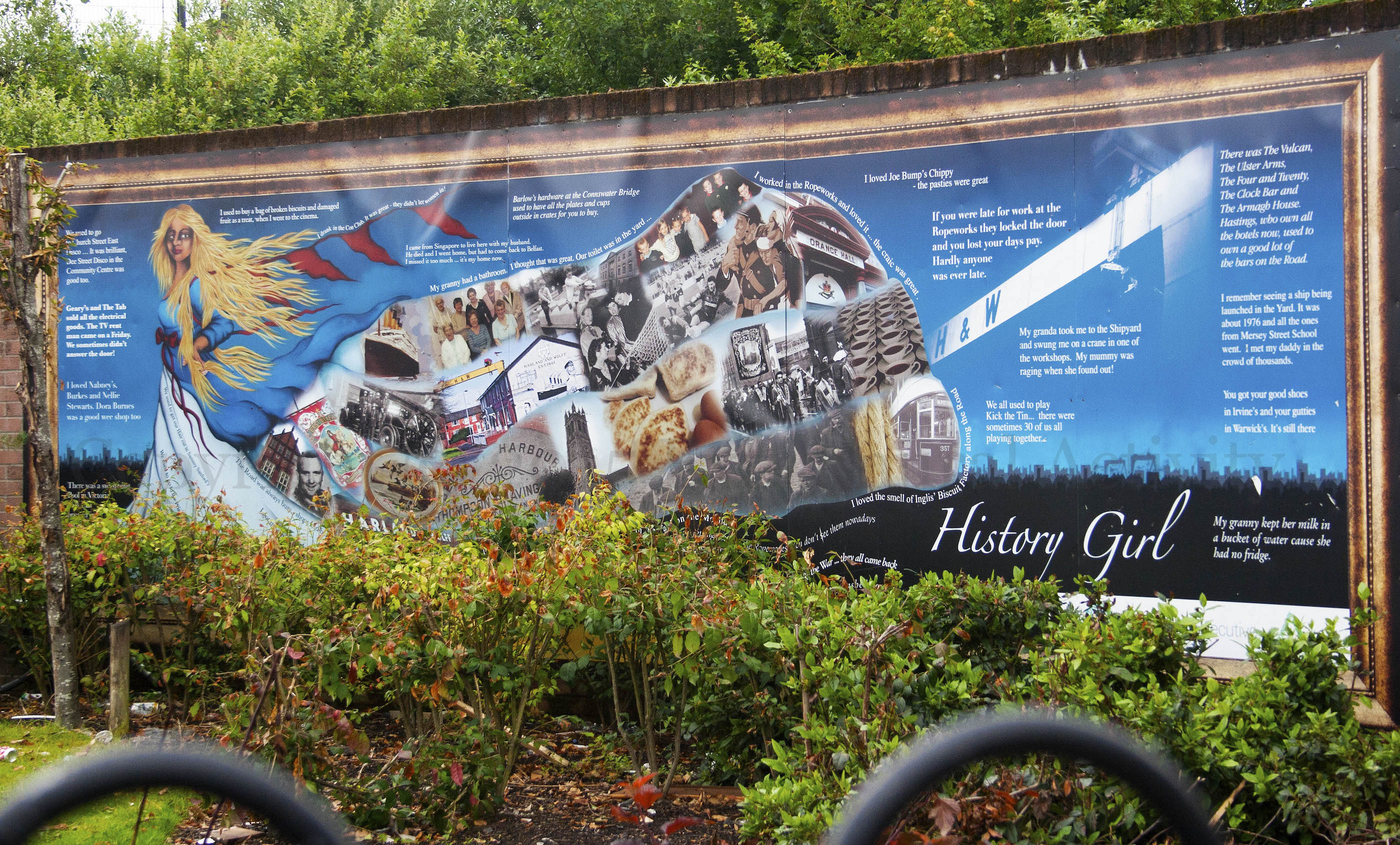
In The Crowd Of Thousands

2015-07-29 HistoryGirlFull+

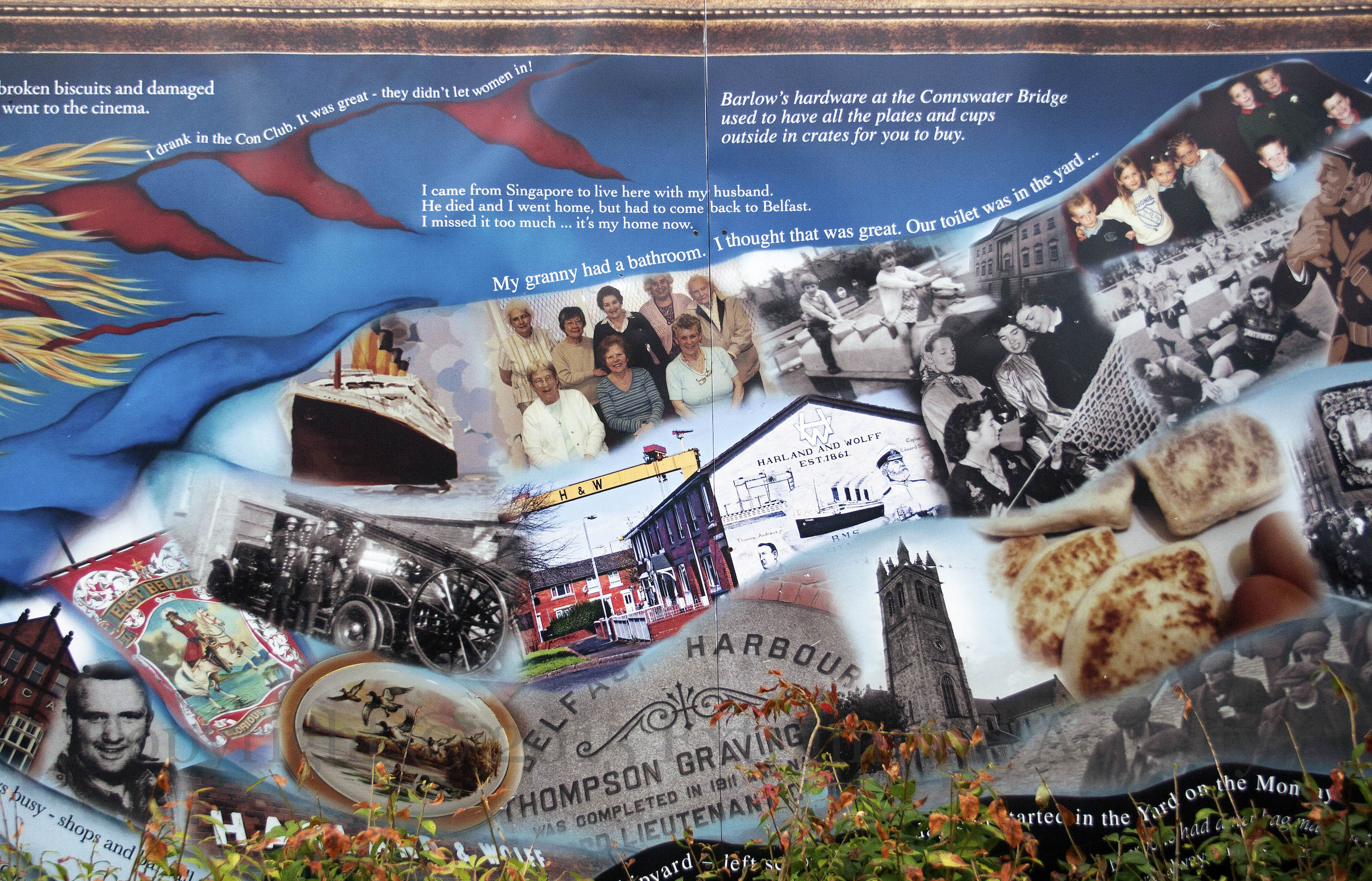
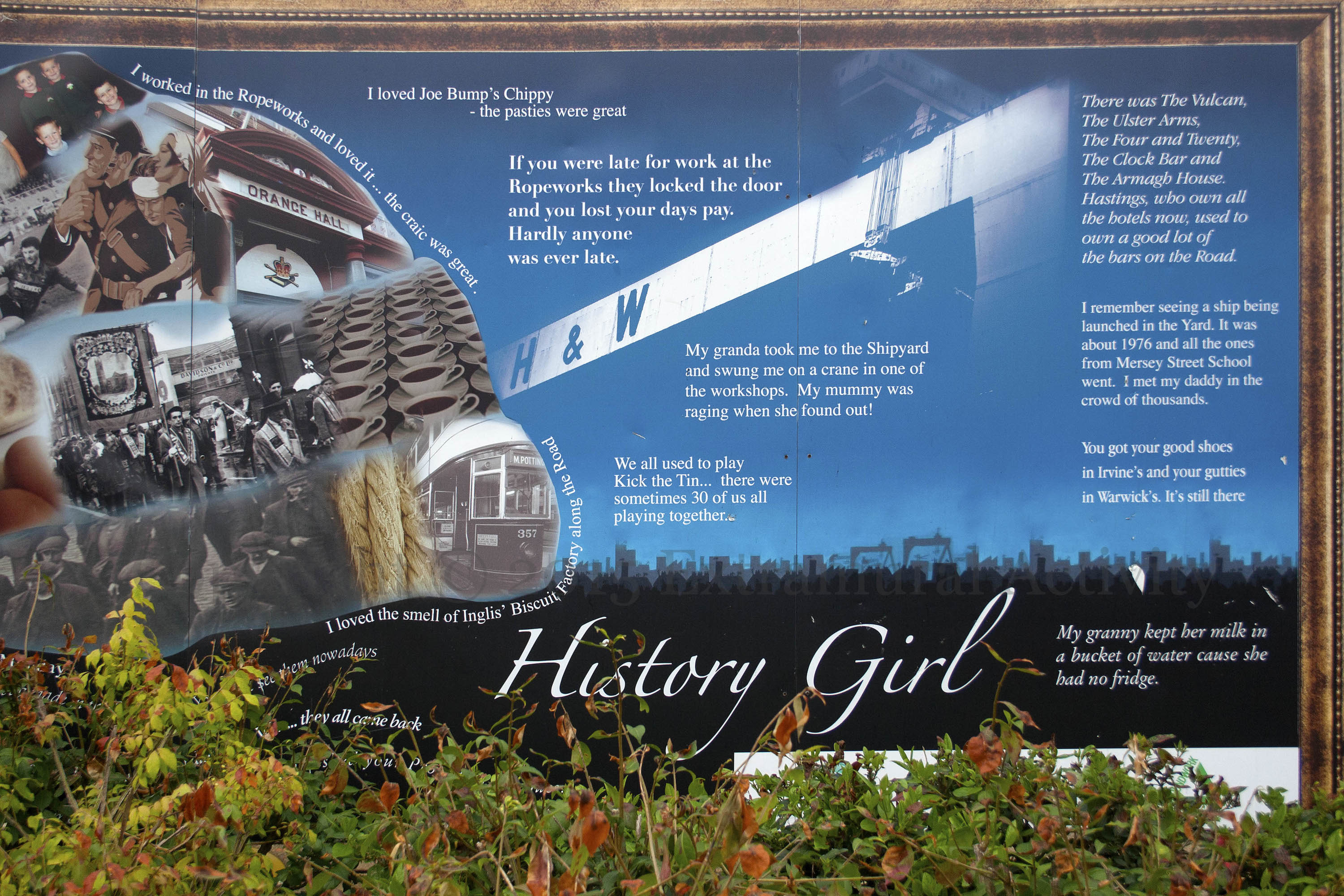
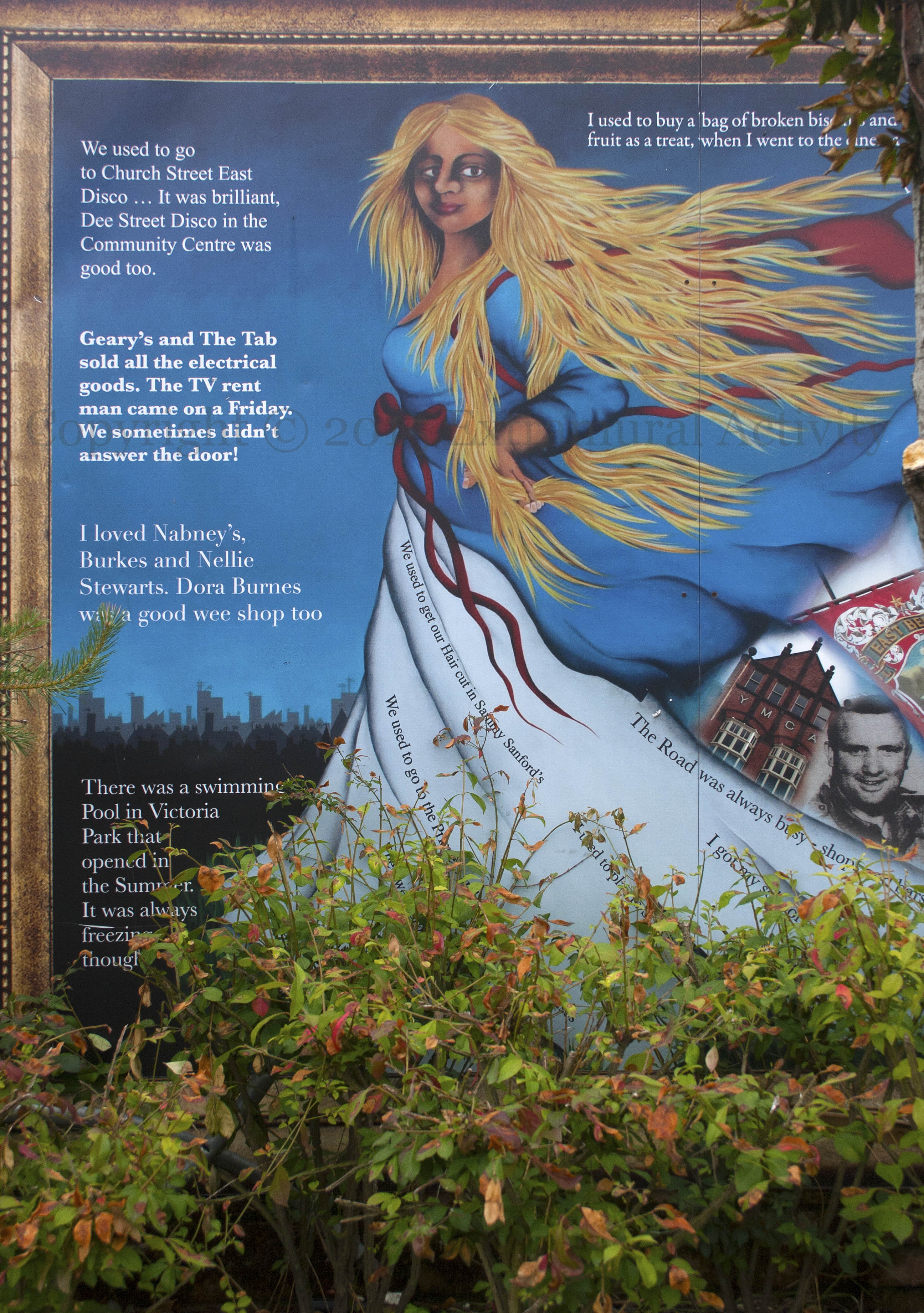
Memories from the History Girl mural in east Belfast’s Thistle Court. (Close-ups below.)

  • We used to go to Church Street East Disco … It was brilliant. Dee Street Disco in the Community Centre was good too.
  • Geary’s and The Tab sold all the electrical goods. The TV rent man came on a Friday. We sometimes didn’t answer the door!
  • I loved Nabney’s, Burkes and Nellie Stewarts. Dora Burnes was a good wee shop too.
  • There was a swimming pool in Victoria Park that opened in the summer. It was always freezing though!
  • I used to buy a bag of broken biscuits and and damaged fruit as a treat, when I went to the cinema.
  • We used to get our hair cut in Sammy Sanford’s.
  • The Road was always busy – shops and bars all the way along.
  • Barlow’s hardware at the Conswater Bridge used to have all the plates and cups outside in crates for you to buy.
  • I drank in the Con Club. It was great – they didn’t let women in!
  • I came from Singapore to live here with my husband. He died and I went home, but had to come back to Belfast. I missed it too much … it’s my home now.
  • My granny had a bathroom. I thought that was great. Our toilet was in the yard …
  • I worked in the Ropeworks and love it … the craic was great.
  • I loved Joe Bump’s chippy – the pasties were great.
  • If you were late for work at the Ropeworks they locked the door and you lost your pay. Hardly anyone was ever late.
  • My grandpa took me to the shipyard and swung me on a crane in one of the workshops. My mummy was raging when she found out!
  • We used to play Kick the Tin … there were sometimes 30 of us all playing together …
  • I loved the smell of Inglis’ Biscuit Factory along the Road.
  • The was The Vulcan, The Ulster Arms, The Four and Twenty, The Clock Bar and The Armagh House. Hastings, who own all the hotels now, used to own a good lot of the bars on the Road.
  • I remember seeing a ship being launched in the yard. It was about 1976 and all the ones from Mersey Street School went. I met my daddy in the crowd of thousands.
  • You got your good shoes in Irvine’s and your gutties in Warwick’s. It’s still there.
  • My granny kept her milk in a bucket of water because she had no fridge.
  • I worked in the shipyard – left school on a Friday and started in the Yard on Monday.
  • Everyone had a net bag made in the Ropeworks. You don’t see them nowadays.
  • We followed the Glens everywhere, but a home match in the Oval was always the best craic.
  • All my mummy’s brothers were in the Army or Navy during the War … they all came back.
  • I remember Stanley Brookes. They cashed your Providence Cheques.
  • We used to go to the cinema on a Saturday morning for the Kids Club. It was always bunged!!

2015-07-29 HistoryGirlLeft+

2015-07-29 HistoryMid+

2015-07-29 HistoryGirlRight+

Click image to enlarge
Copyright © 2015 Seosamh Mac Coılle
X02702 X02703 X02705 X02704 history girl titanic H&W crane ulster fry east belfast thompson graving belfast harbour playground football glentoran orange order lodge hall ymca fire engine ducks bunting trams rope groundwork housing executive belfast city council brookes’ princess picture houses They were proper department stores. Lesley Cherry Art in the eastside

Our Community, Our Fleadh, Our People, Ardoyne

The Wolfe Tones will headline the 2015 Ardoyne Fleadh Cheoıl (Fb) on August 15th. Last year, The Druids caused controversy by advising British Army forces and loyalists to go “back to England” (BelTel).

Along the bottom are various of the posters/programme covers from years past: (left to right) the 1998 cover, by Sean Doran, was also painted in Ardoyne Avenue; Cú Chulaınn on the 1999 poster was painted in Ardoyne Avenue (S00089); the fiddler and bodhrán player appeared on a t-shirt; a classic Wolfe Tones poster shows the four faces in profile; Fleadh Érıu on the 1995 poster (under the go-kart’s left wheel) was painted on this wall in 1994; the 1996 Fleadh poster, also by Sean Doran; disappearing on the right is Doran’s 1997 cover.

The Ardoyne Fleadh Cheoıl emblem (on the go-karter’s t-shirt and under the text on the left) was used in Maıreann An Spıorad. The festival began in 1970.

A new mural will be launched as part of this year’s festival: Boxing Champions.

Click image to enlarge
Copyright © 2015 Seosamh Mac Coılle
[X02930] X02931 X02932

Harbour Schooling

2015-06-22 BelfastDockers+

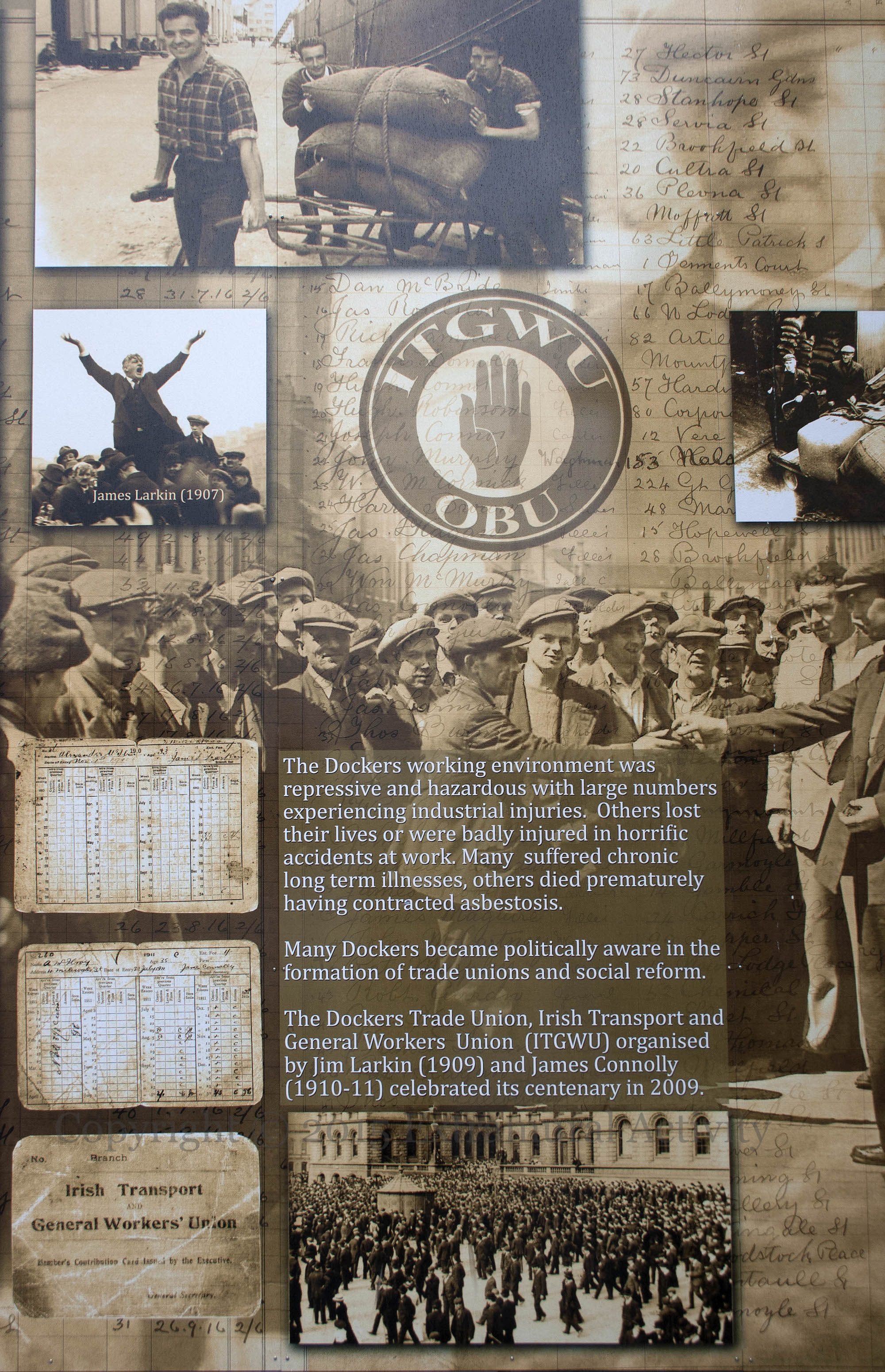
Every day, men would line up in schooling pens on the various docks of the port of Belfast to be hired by foremen. As mentioned on the left-hand side of the board above (recently erected on the New Lodge side of the Duncairn “peace” line) the rise of the shipping container in the 1970s spelled the end of the docker: “from 3000 listed dockers in 1970, the number had fallen to 280 by 1985.” Author and poet John Campbell recalls his first day on the docks in 1952, unloading cement, in this NVTv video.

See previously: Unite The Union | OBU | International Workers’ Day

Lepper Street, New Lodge, north Belfast

2015-06-22 BelfastDockersDetail+

2015-06-22 BelfastDockersWide+

Click image to enlarge
Copyright © 2015 Seosamh Mac Coılle
X02664 X02665 X02666

“This artwork celebrates the unique contribution that generations of dockers have made to the port and City of Belfast.”

“It was a physically demanding job, the hours were long, the conditions were tough and the availability of work was not constant. Without the Dockers, however, the Port of Belfast would not have been able to grow. / Transportation of goods by containers led to a revolution in working practices at Belfast Docks and the number of dockers decreased dramatically. From 3000 listed dockers in 1970, the number had fallen to 280 by 1985. Behind these figures lay the human story of vast social changes in the harbour area as well as the gradual dissappearance [sic] of an entire community who had earned their living from the sea and also through the loading and unloading of ships. These were the Dockers and their families, many of whom lived in Sailortown. / The workforce of dockers spanned both traditions. Red button and Blue button. Dockers had a common allegiance to the Port of Belfast which provided a living for men and families from both communities. / The work was backbreaking, yet the Docks educated us about life, integrity, discipline, about standing up for our rights, about having pride in our identity as working men, as Dockers. / The Dockers[‘] working environment was repressive and hazardous with large numbers experiencing industrial injuries. Others lost their lives or were badly injured in horrific accidents at work. Many suffered chronic long term illnesses, others died prematurely having contracted asbestosis. Many Dockers became politically aware in the formation of trade unions and social reforms. The Dockers Trade Union, Irish Transport and General Workers[‘] Union (ITGWU) organised by Jim Larkin (1909) and James Connolly (1910-11) celebrated its centenary in 2009.” OBU one big union

The Priest & The Cobbler

2015-05-28 ClonardDetail+

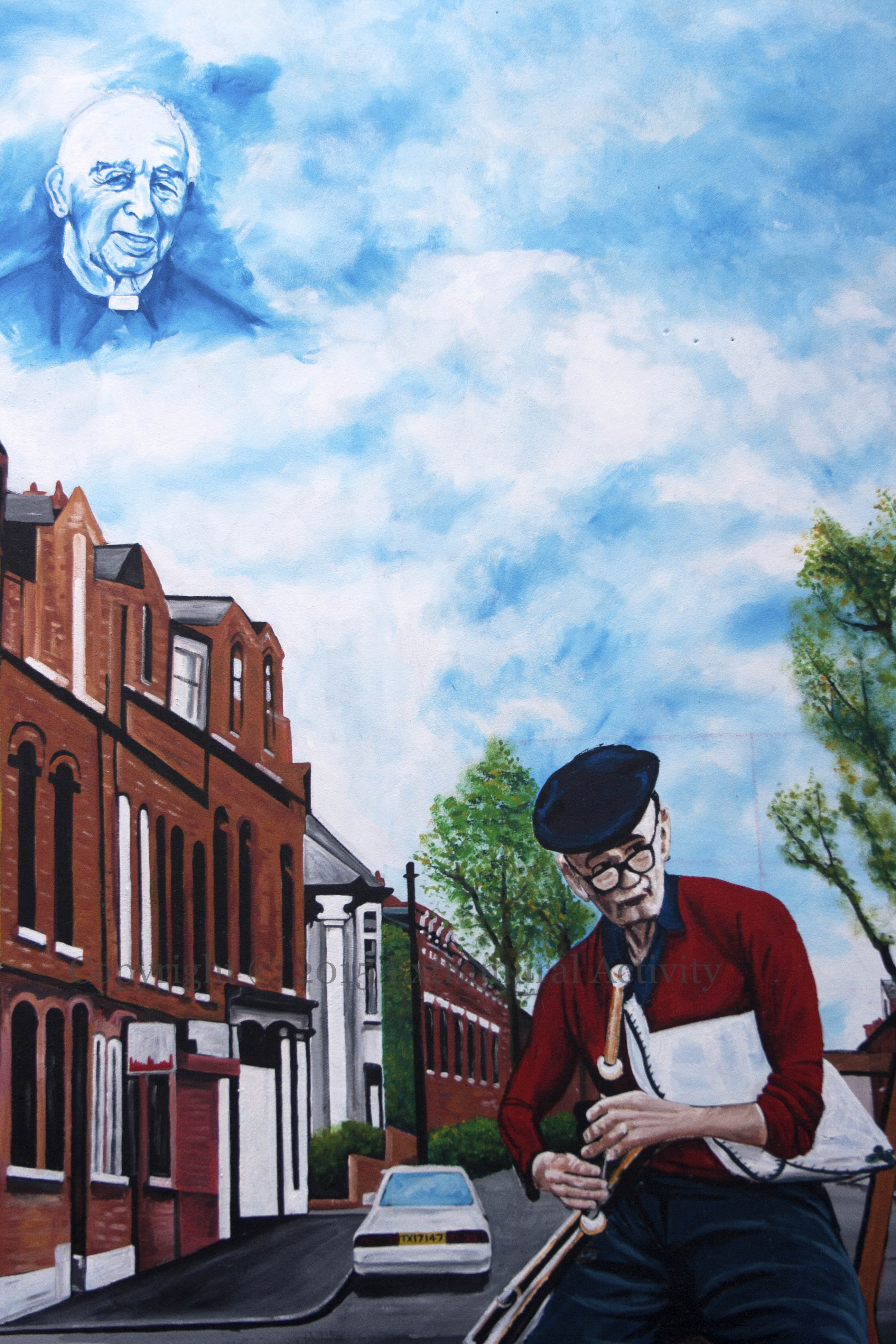
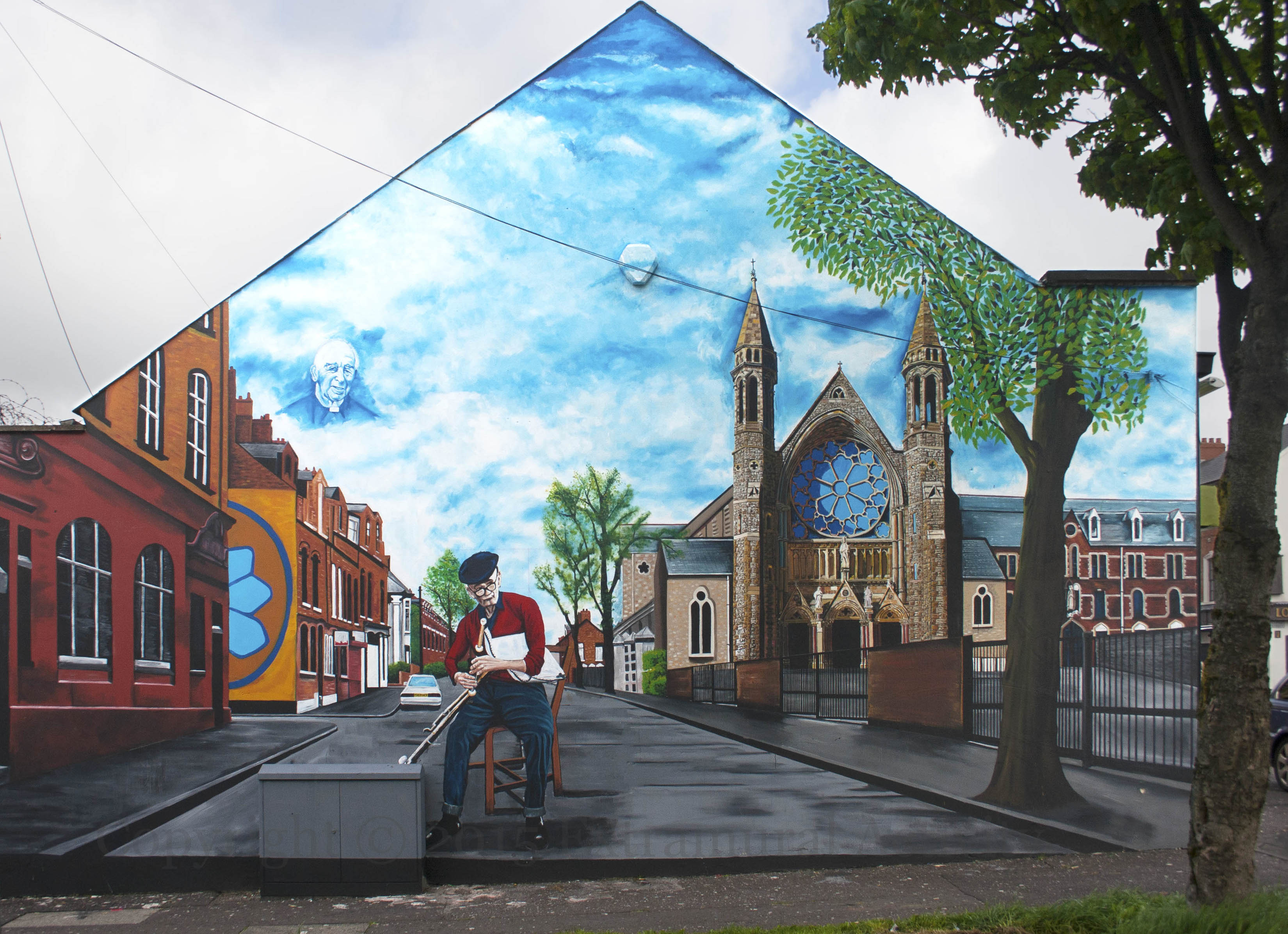
This new mural pays tribute to two long-time residents of Clonard. On a good day, Noel Fitzpatrick, a cobbler with a little shop on the corner of Odessa and Clonard streets, would take his chair out into the street and play the uıleann pipes. Looking down from above is Alec Reid, the Redemptorist priest who spent 40 years at Clonard monastery and played an important role in the peace process. He died in 2013 at age 82. (WP)

Painted by Marty Lyons & Mickey Doc in Springfield Drive. For the large ‘flower’ mural to the left of this mural (which imitates the stained glass in the cathedral), see C01044.

2015-05-28 ClonardFull+

2015-05-28 ClonardSquares+

2015-05-28 ClonardInProg+

Click image to enlarge
Copyright © 2015 Seosamh Mac Coılle
X02634 X02635 X02636 X02637

The Hopewell Gallery

2014-12-26 HopewellGallery+

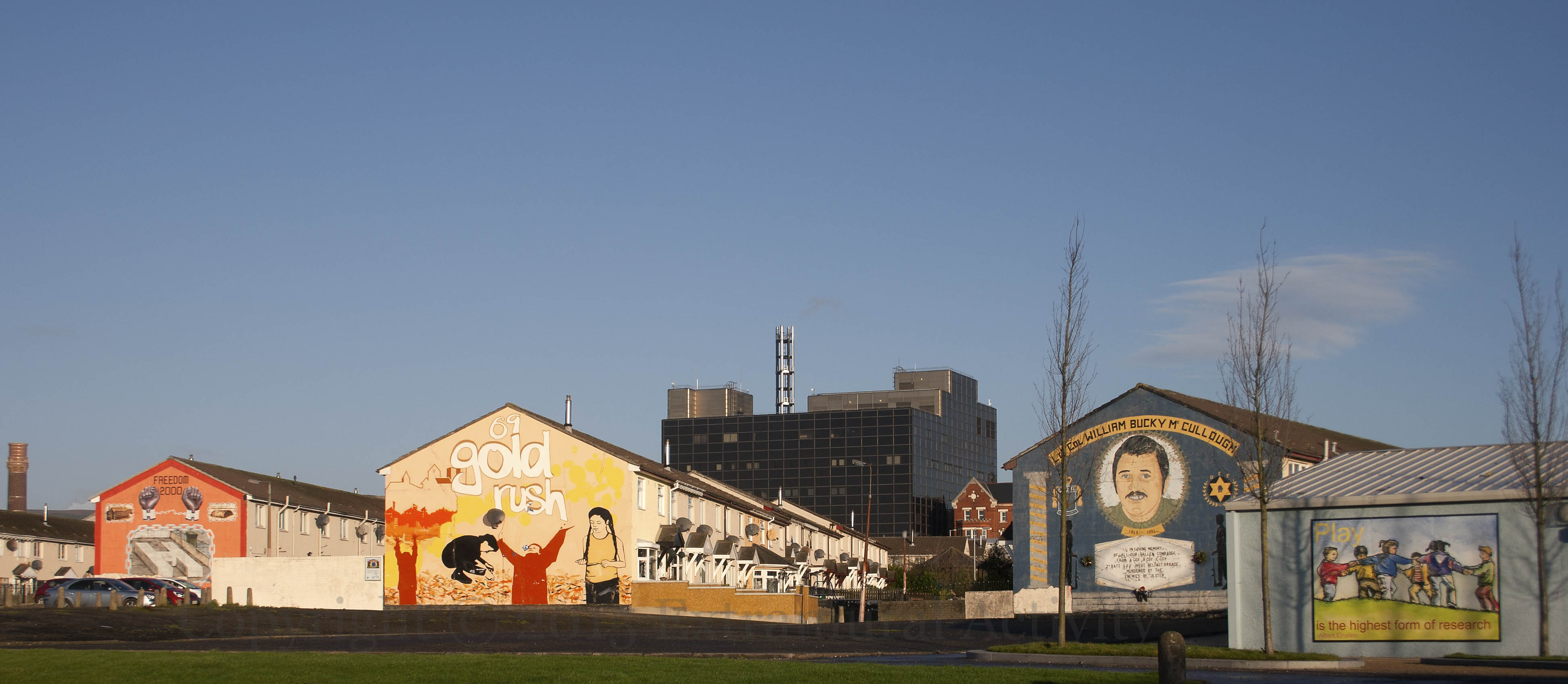
Here’s a wide shot of the right-hand side of the murals in the lower Shankill estate. These gables have remained in place while the estate has been redeveloped, causing the removal of the Red Hand, Martin Luther and Cuchulainn murals.

For closer views, see Freedom 2000Gold Rush | McCullough | Child’s Play

Click image to enlarge
Copyright © 2015 Seosamh Mac Coılle
X02453

Roads Through Life

14 05 06 North7Children+

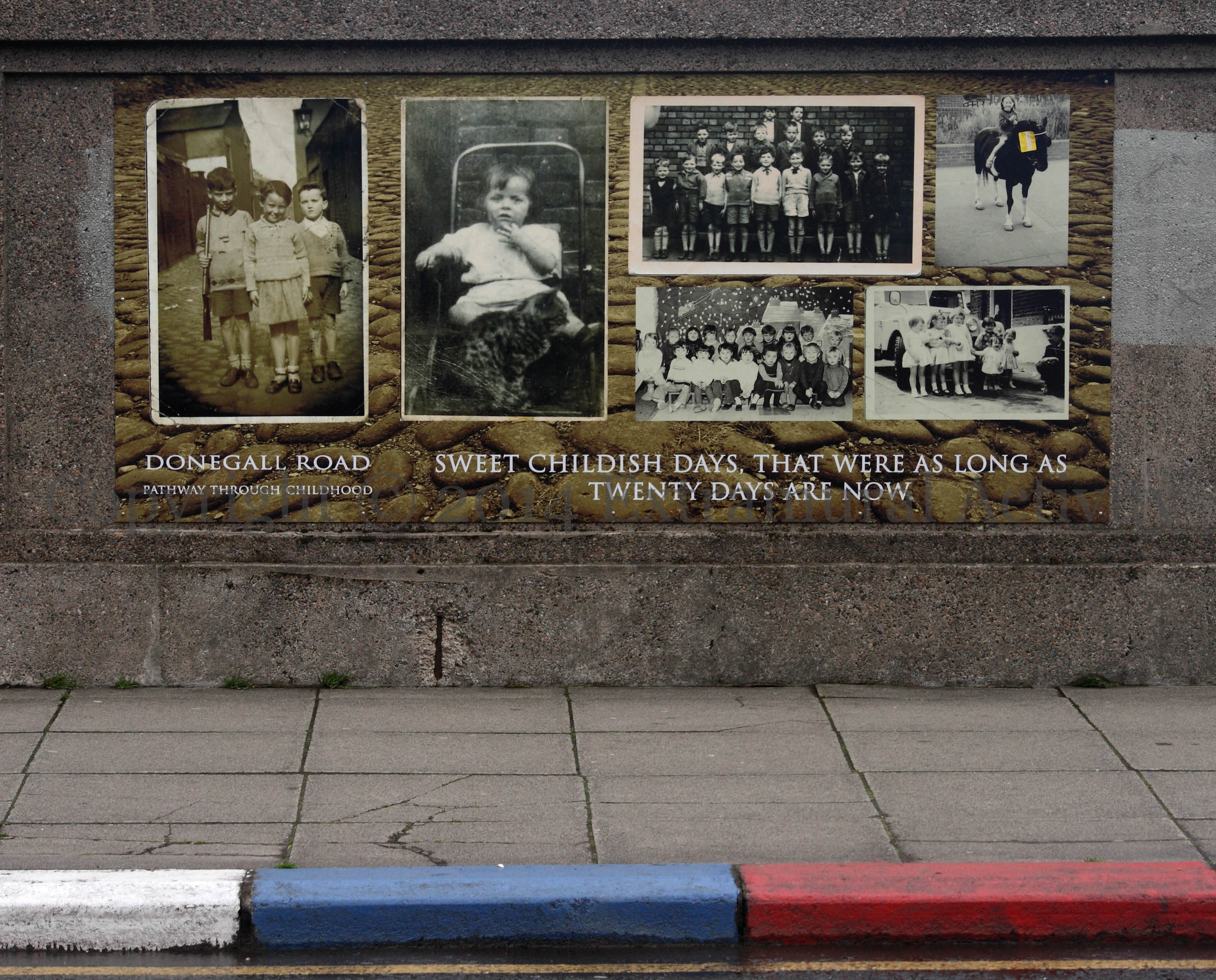
“Pathways through childhood – Sweet childish that were as long as twenty days are now.” The good old days in south Belfast and its streets are remembered in these three panels from the Donegall Road railway bridge.

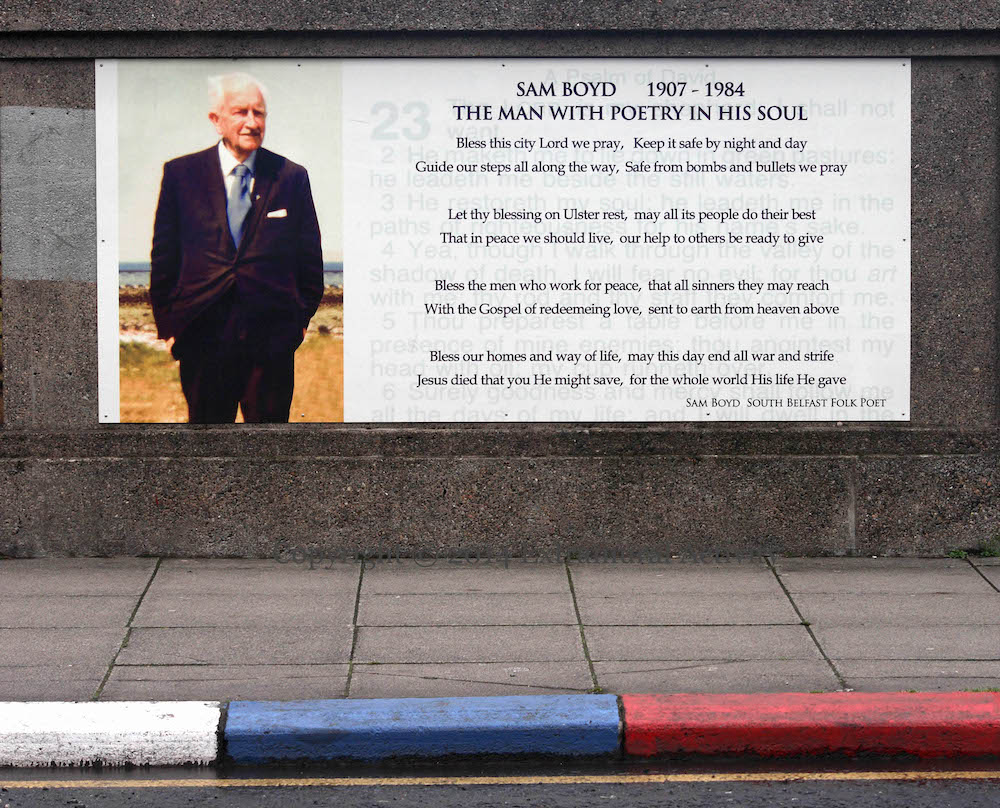
“Sam Boyd, 1907-1984 – the man with poetry in his soul.” “South Belfast folk poet.”

The “Streets of dreams”, some of them no longer in existence, are: Coolderry, Coolbeg, Coolfin, Fortuna, Egeria, Daphine, Pandora, Euterpe, Thalia, Coolmore, Abingdon, Colchester, Barrington, Empire, Maldon, Utility, Rydalmere, Rockland, Kitchener, Nubia, Soudan, Kilburn, Benburb, Ebor, Lecale, Moltke, Roden, Tavanagh, Rockview, Monarch Parade, Donegall Avenue.

These are seventh, eighth, and tenth panels on the north side of the bridge; for the other panels on this (north) side of the road, see also:

The Harvest of Love (1 & 9)
Those Days Are Over (2)
A Woman’s Place Is Everywhere (3)
The Thread Of History (4)
For Me There Will Be No More War (5)
In The Wars (6)
Roads Through Life (7, 8, 10)

X01842 2014-05-06 North8SamBoyd+

14 05 06 North10Streets+

Click image to enlarge
Copyright © 2014 Seosamh Mac Coılle
X01841 X01834 X01842

The Strand Bar

2015-03-27 StrandBar+

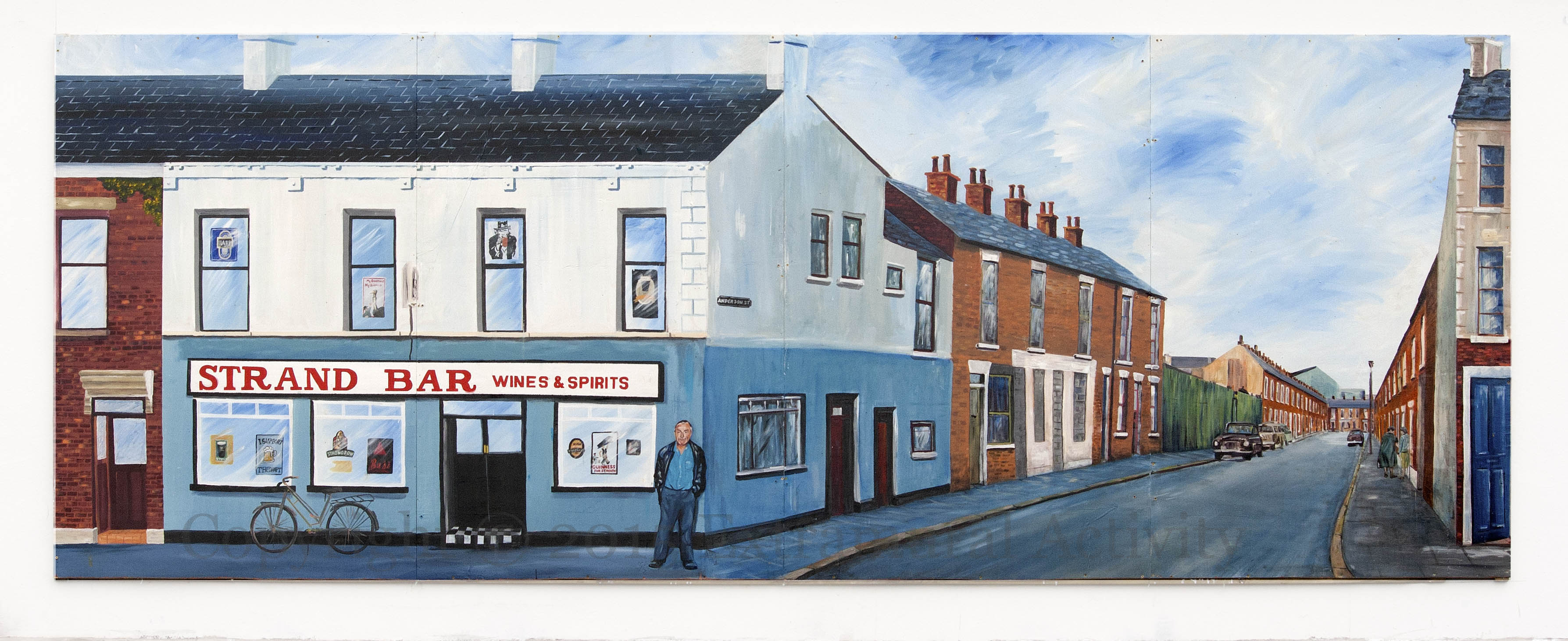
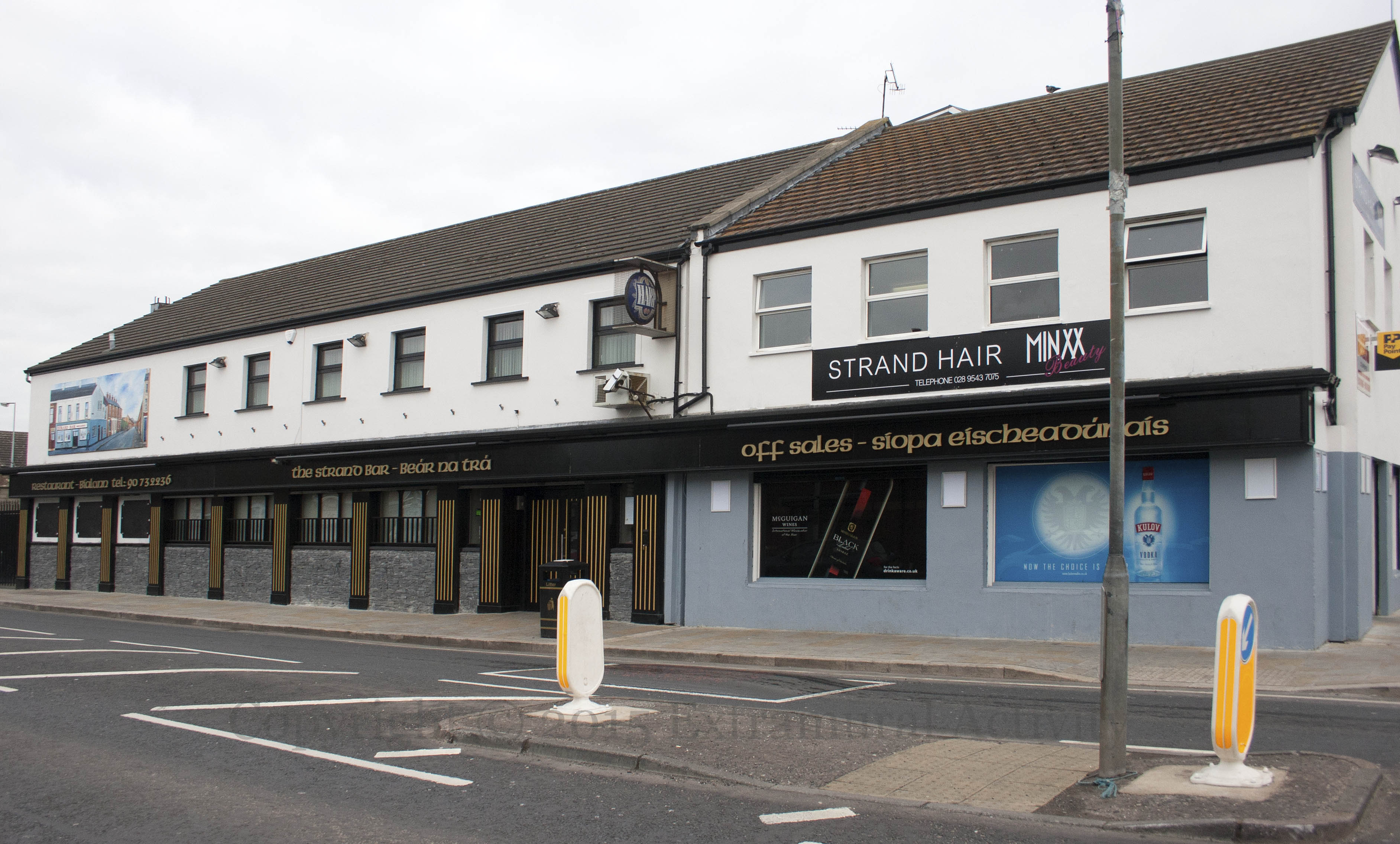
After adding windows to the downstairs, The Strand Bar has reinstated the mural previously at the front in the form of a painted board (above) showing the original bar in Anderson Street (the current Arran Street), which was attacked by the UVF in 1975 with the loss of six lives. The relative size can be gauged from the wide shot, below. The previous mural can be seen in the bottom two images. For photographs of the original bar, see the BelfastForum.

2015-03-27 StrandBarWide+

2011-00-00 StrandBarDetail+

2011-00-00 StrandBarWide+

Click image to enlarge
Copyright © 2011 Seosamh Mac Coılle
X02565 X02566 X00382 X00383 installed 2015-03-20 melting pot

By The Mutton Burn Stream

2015-04-20 BallycarryVillageDetail2+

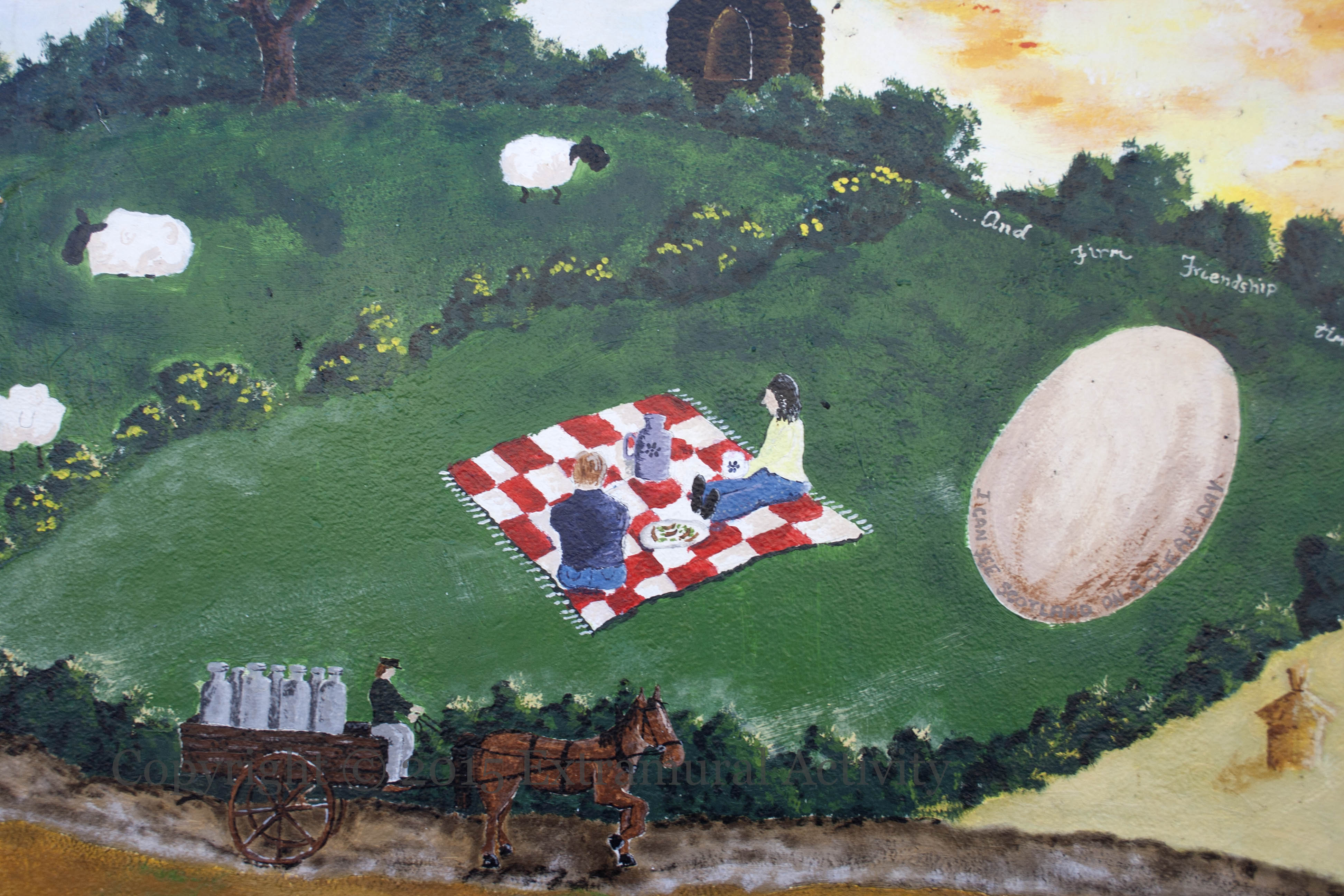
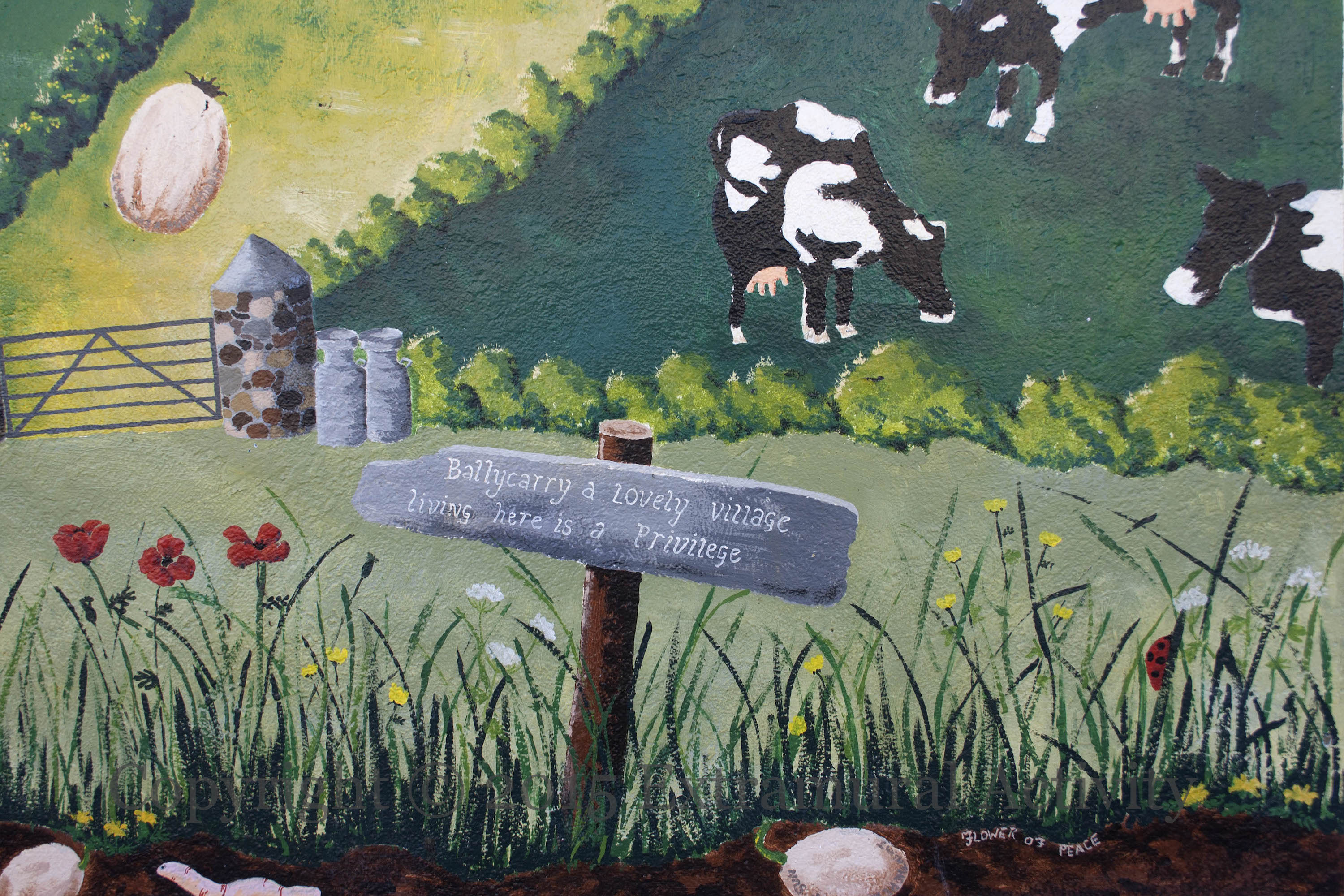
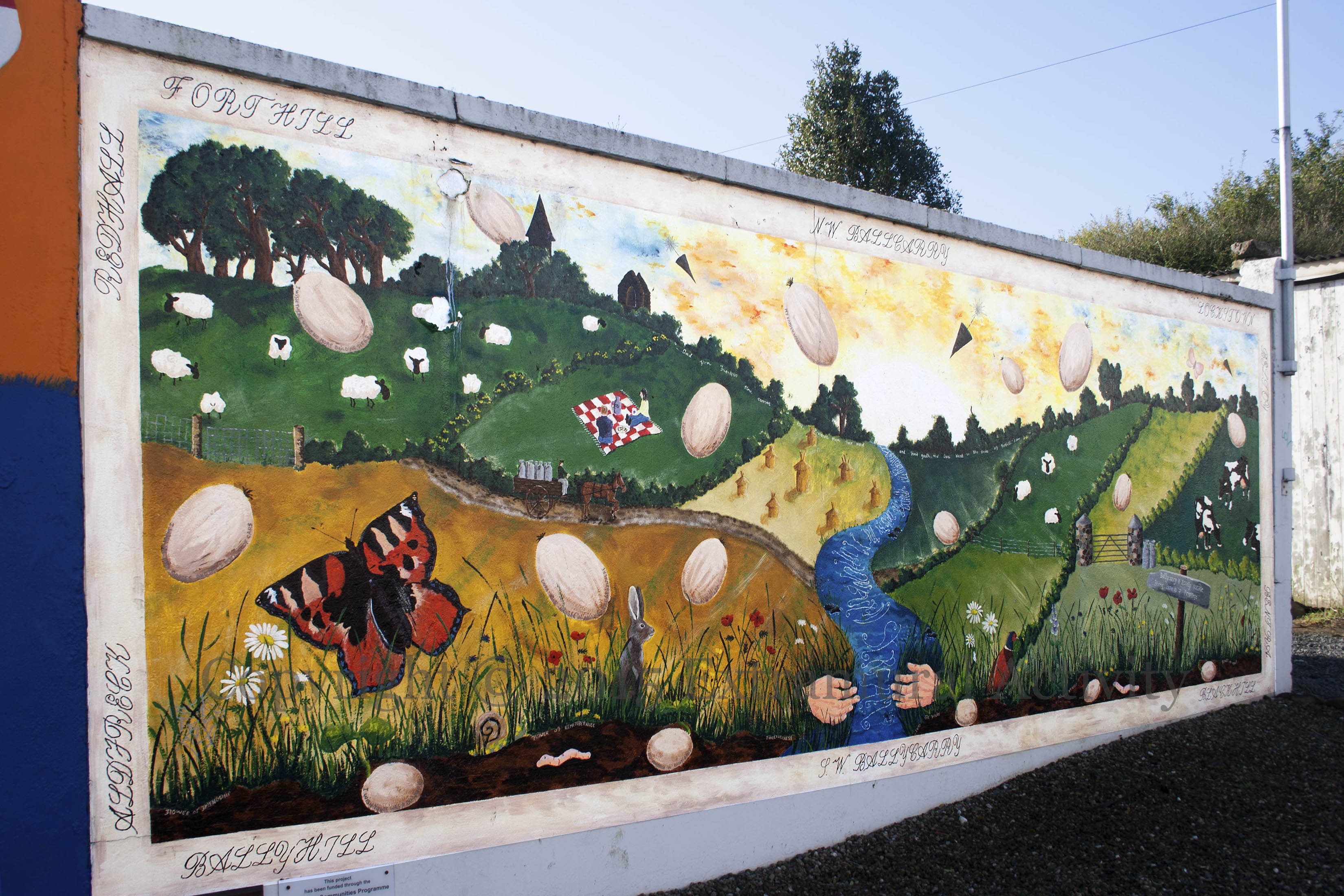
Ballycarry village sits in County Antrim countryside surrounded by the townlands of Ballyhill, Redhall, Forthill, Blackhill, Aldfreck, Lochstown, Beltoy, Bentra. The large pale oval to the right of the picnickers is one of many “seeds” falling from the sky and settling into the earth, which by growing make Ballycarry a pleasant place: “I can see Scotland on a clear day”. The Mutton Burn Stream (lyrics | music from the Ulster-Scots agency) is a song written by Ballycarry resident William Hume (QUB) about the river to the north-west of the village (WP). More about Ballycarry from the BBC’s Ulster-Scots page.

2015-04-20 BallycarryVillageDetail+

2015-04-20 BallycarryVillage+

Click image enlarge
Copyright © 2015 Seosamh Mac Coılle
X02596 X02595 X02594 firm friendship time cannot kill flower of remembrance togetherness fields cows butterfly pheasant horse cart milk sheep snail worm haystacks stream

Surviving The Titanic

2014-05-06 South5Titanic+

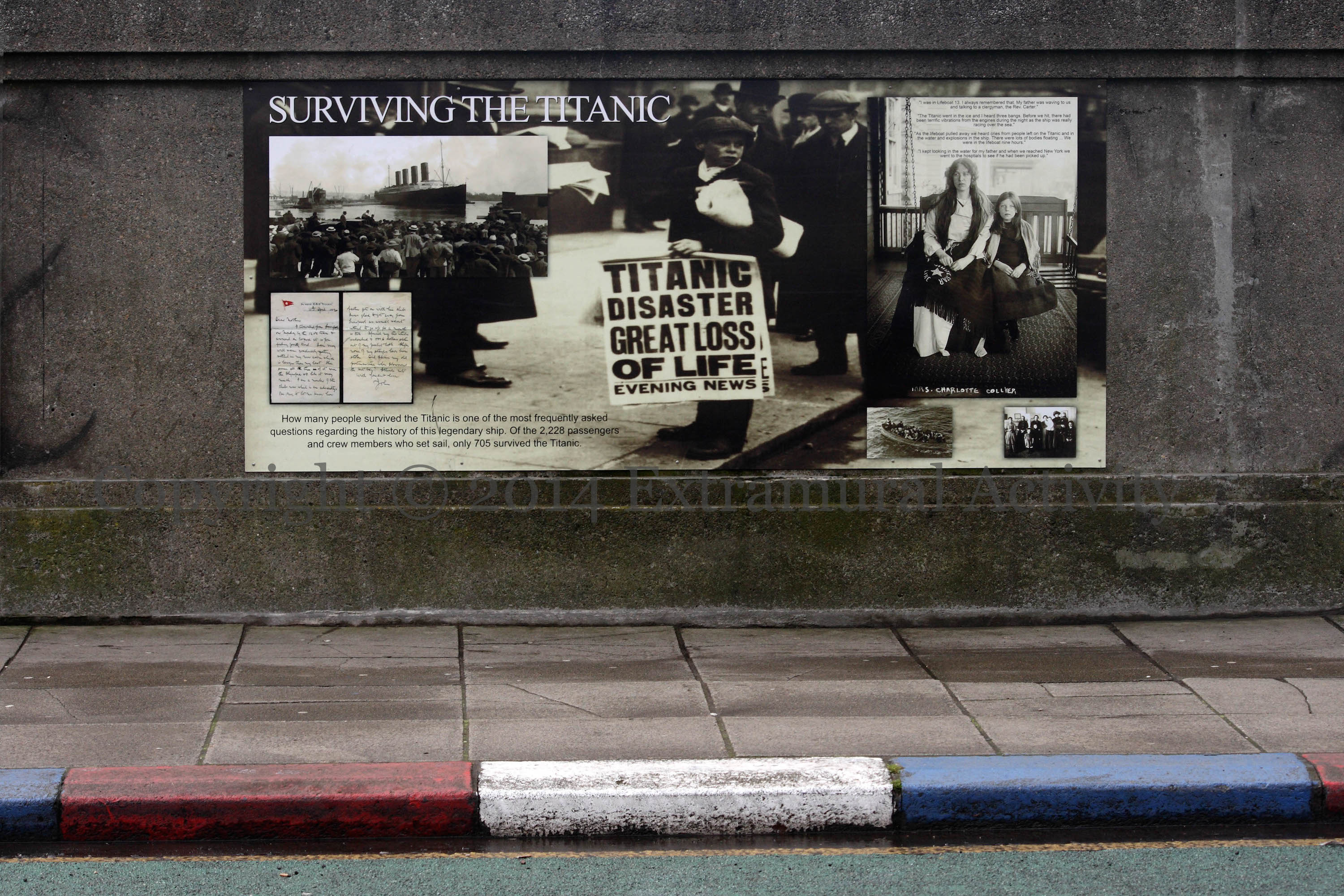
Here are two final images from the south side of the Donegall Road bridge over the Victoria Street line, one about Titanic and the other about locals awarded the MBE.

“I was in Lifeboat 13. I always remember that. My father was waving to us and talking to a clergyman, the Rev. Carter. The Titanic went in the ice and I heard three bangs. Before we hit, there had been terrific vibrations from the engines during the night as the ship was really racing over the sea. As the lifeboat pulled away we heard cries from the people left on the Titanic and in the water and explosions in the ship. There were lots of bodies floating … We were in the lifeboat nine hours. I kept looking in the water for my father and when we reached New York we went to the hospitals to see if he had been picked up.” Mrs. Charlotte Collier

How many people survived the Titanic is one of the most frequently asked questions regarding the history of this legendary ship. Of the 2,228 passengers and crew members who set sail, only 705 survived the Titanic.

See previously: Titanic Lifeboat | The Titanic Story and various other Titanic murals

1. Belfast Blitz #2
2 & 10. The Thread Of History (weavers)
3 & 9. Work Organises Life
4. In The Wars (Korea)
5  & 8. Surviving The Titanic
6. The Door Opens And Lets The Future In (Carnegie Library)
7. The Beautiful Blues (Linfield football)

2014-05-06 South8Choice+

2014-05-06 South+

Click image to enlarge
Copyright © 2014 Seosamh Mac Coılle
X01850 X01853 X01844 disaster great loss of life buckingham palace “Being a man or a women is a matter of birth. Being a man or women who makes a different is a matter of choice.” Tommy Wilson, MBE – for service to the community; Rita Mills MBE – for service to the civil service