The Wolfe Tones will headline the 2015 Ardoyne Fleadh Cheoıl (Fb) on August 15th. Last year, The Druids caused controversy by advising British Army forces and loyalists to go “back to England” (BelTel).
Along the bottom are various of the posters/programme covers from years past: (left to right) the 1998 cover, by Sean Doran, was also painted in Ardoyne Avenue; Cú Chulaınn on the 1999 poster was painted in Ardoyne Avenue (S00089); the fiddler and bodhrán player appeared on a t-shirt; a classic Wolfe Tones poster shows the four faces in profile; Fleadh Érıu on the 1995 poster (under the go-kart’s left wheel) was painted on this wall in 1994; the 1996 Fleadh poster, also by Sean Doran; disappearing on the right is Doran’s 1997 cover.
The Ardoyne Fleadh Cheoıl emblem (on the go-karter’s t-shirt and under the text on the left) was used in Maıreann An Spıorad. The festival began in 1970.
A new mural will be launched as part of this year’s festival: Boxing Champions.
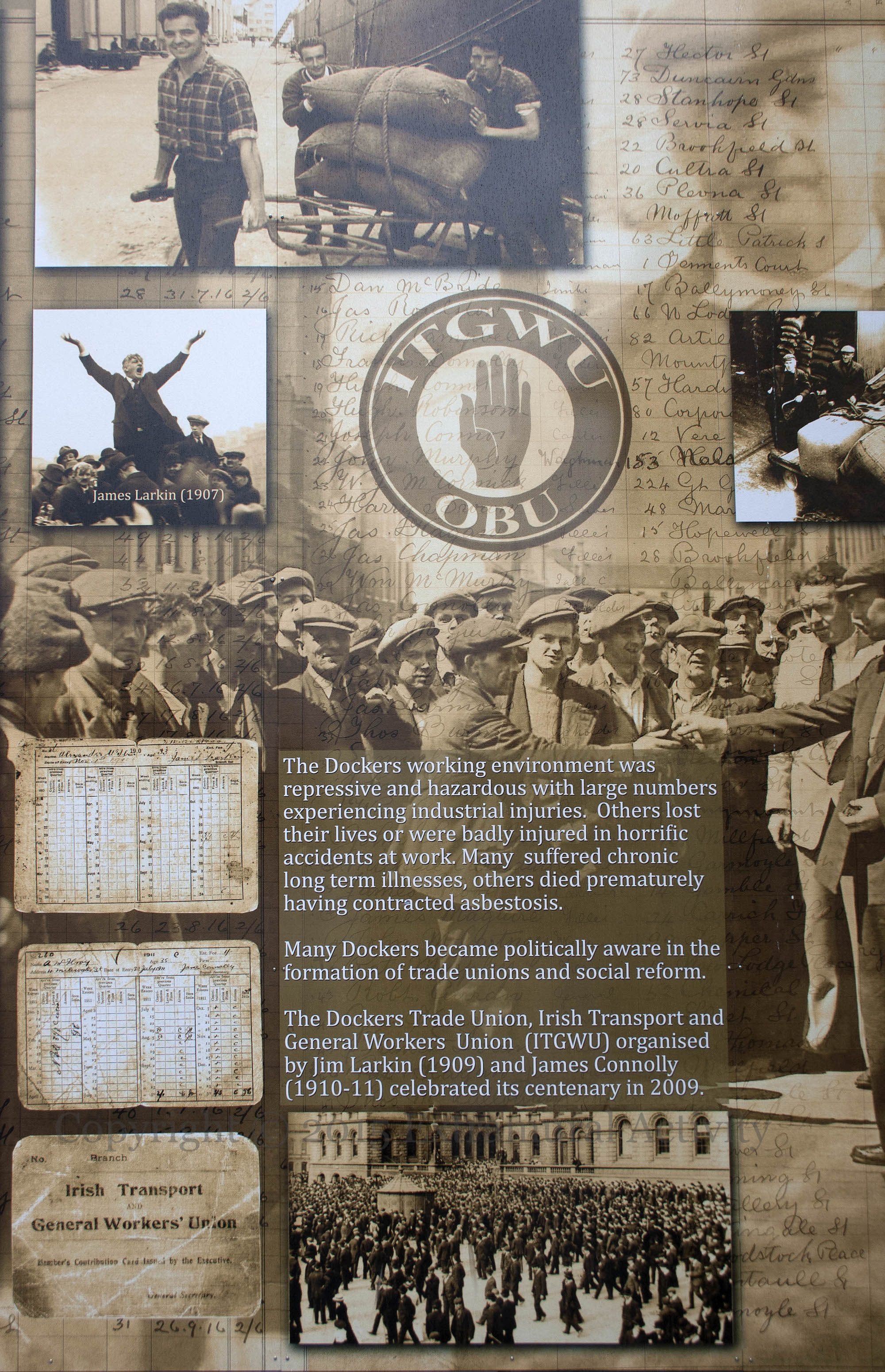
Every day, men would line up in schooling pens on the various docks of the port of Belfast to be hired by foremen. As mentioned on the left-hand side of the board above (recently erected on the New Lodge side of the Duncairn “peace” line) the rise of the shipping container in the 1970s spelled the end of the docker: “from 3000 listed dockers in 1970, the number had fallen to 280 by 1985.” Author and poet John Campbell recalls his first day on the docks in 1952, unloading cement, in this NVTv video.
“This artwork celebrates the unique contribution that generations of dockers have made to the port and City of Belfast.”
“It was a physically demanding job, the hours were long, the conditions were tough and the availability of work was not constant. Without the Dockers, however, the Port of Belfast would not have been able to grow. / Transportation of goods by containers led to a revolution in working practices at Belfast Docks and the number of dockers decreased dramatically. From 3000 listed dockers in 1970, the number had fallen to 280 by 1985. Behind these figures lay the human story of vast social changes in the harbour area as well as the gradual dissappearance [sic] of an entire community who had earned their living from the sea and also through the loading and unloading of ships. These were the Dockers and their families, many of whom lived in Sailortown. / The workforce of dockers spanned both traditions. Red button and Blue button. Dockers had a common allegiance to the Port of Belfast which provided a living for men and families from both communities. / The work was backbreaking, yet the Docks educated us about life, integrity, discipline, about standing up for our rights, about having pride in our identity as working men, as Dockers. / The Dockers[‘] working environment was repressive and hazardous with large numbers experiencing industrial injuries. Others lost their lives or were badly injured in horrific accidents at work. Many suffered chronic long term illnesses, others died prematurely having contracted asbestosis. Many Dockers became politically aware in the formation of trade unions and social reforms. The Dockers Trade Union, Irish Transport and General Workers[‘] Union (ITGWU) organised by Jim Larkin (1909) and James Connolly (1910-11) celebrated its centenary in 2009.” OBU one big union
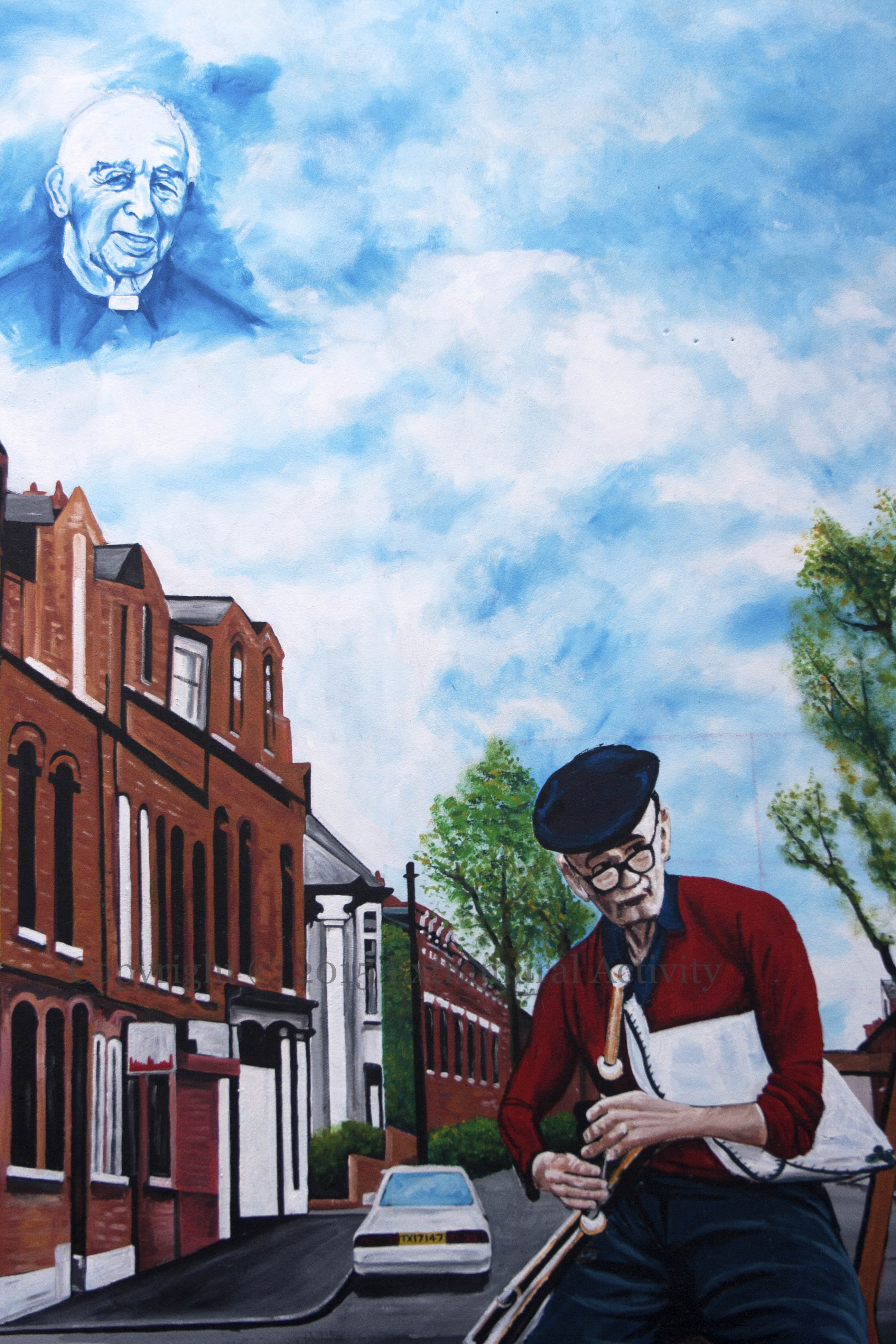
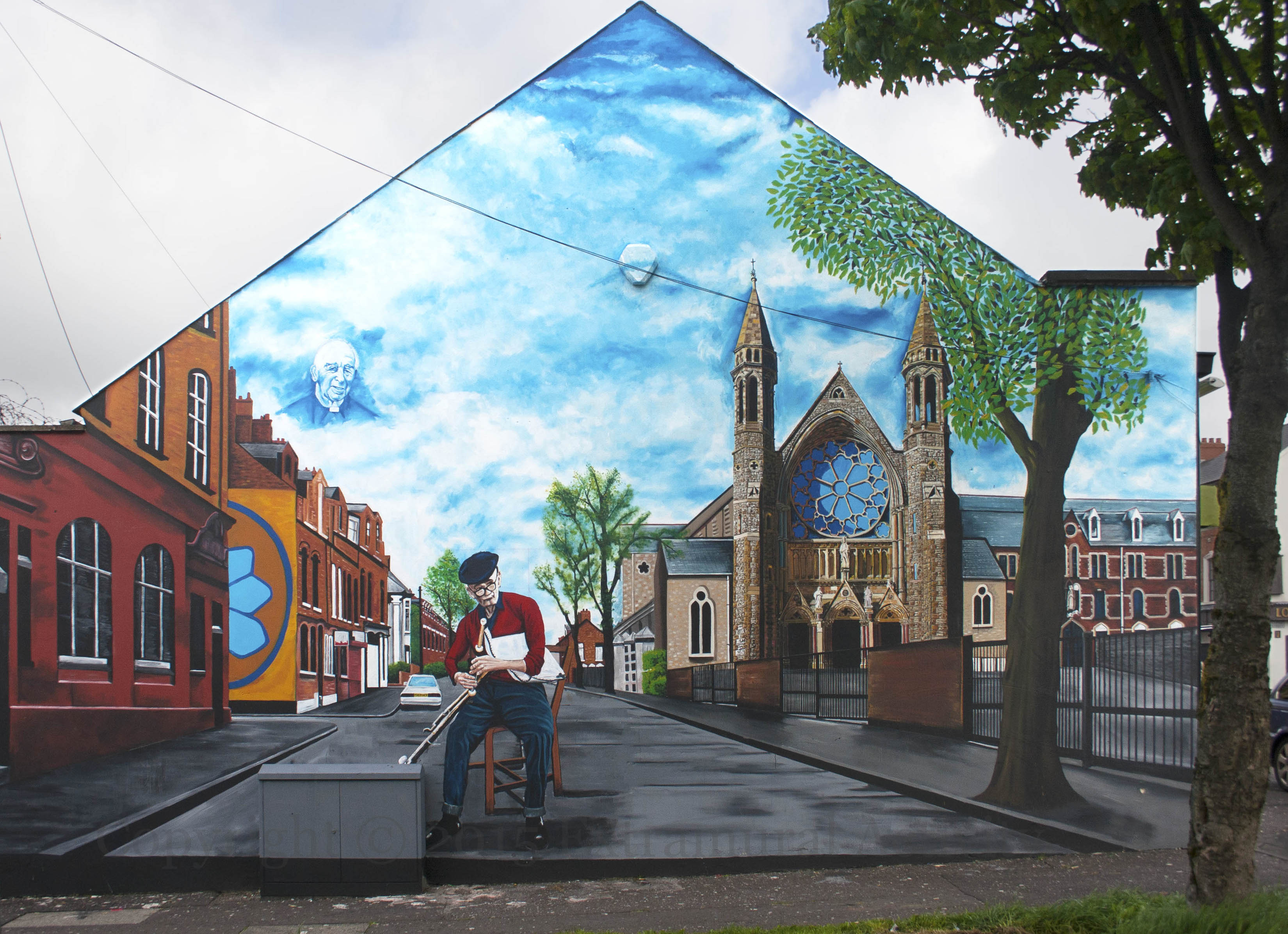
This new mural pays tribute to two long-time residents of Clonard. On a good day, Noel Fitzpatrick, a cobbler with a little shop on the corner of Odessa and Clonard streets, would take his chair out into the street and play the uıleann pipes. Looking down from above is Alec Reid, the Redemptorist priest who spent 40 years at Clonard monastery and played an important role in the peace process. He died in 2013 at age 82. (WP)
Painted by Marty Lyons & Mickey Doc in Springfield Drive. For the large ‘flower’ mural to the left of this mural (which imitates the stained glass in the cathedral), see C01044.
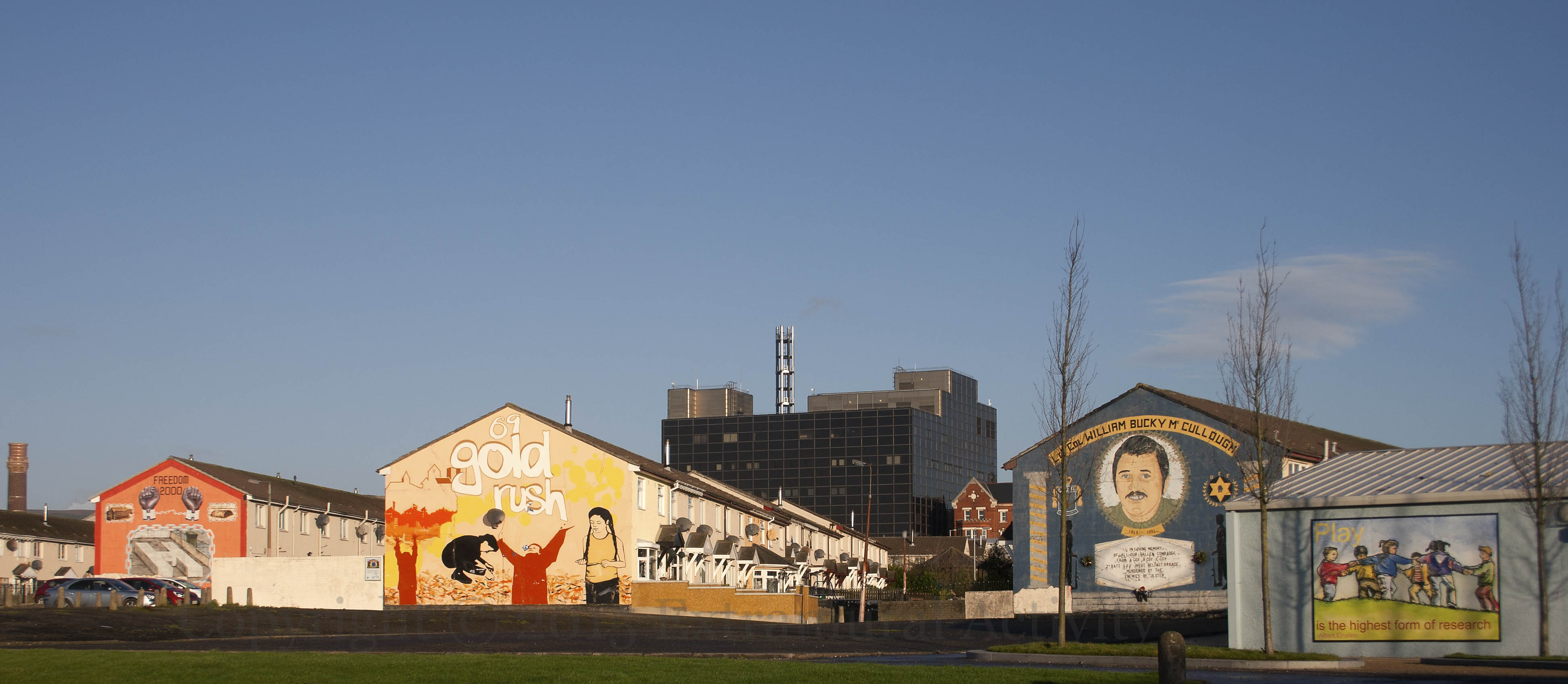
Here’s a wide shot of the right-hand side of the murals in the lower Shankill estate. These gables have remained in place while the estate has been redeveloped, causing the removal of the Red Hand, Martin Luther and Cuchulainn murals.
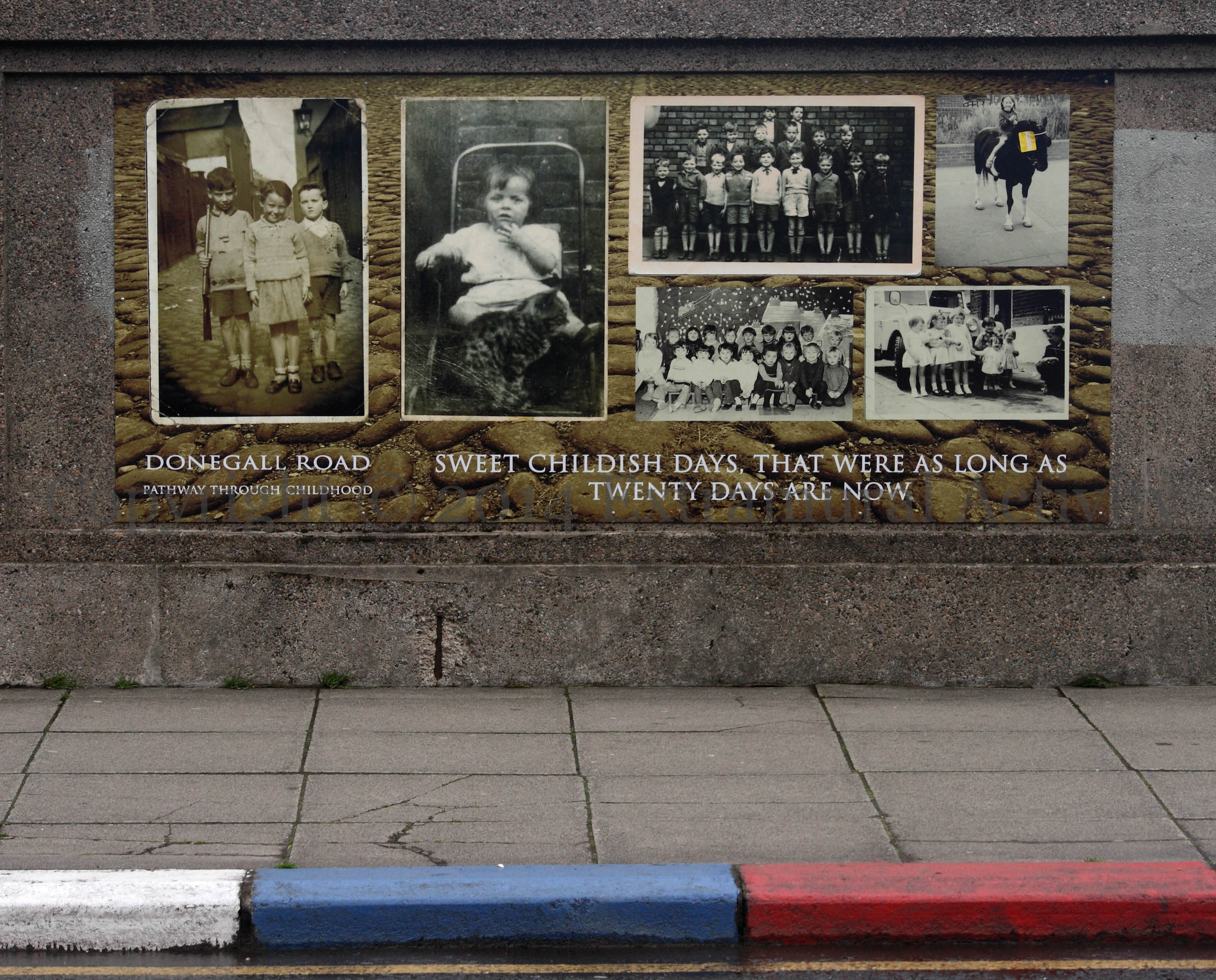
“Pathways through childhood – Sweet childish that were as long as twenty days are now.” The good old days in south Belfast and its streets are remembered in these three panels from the Donegall Road railway bridge.
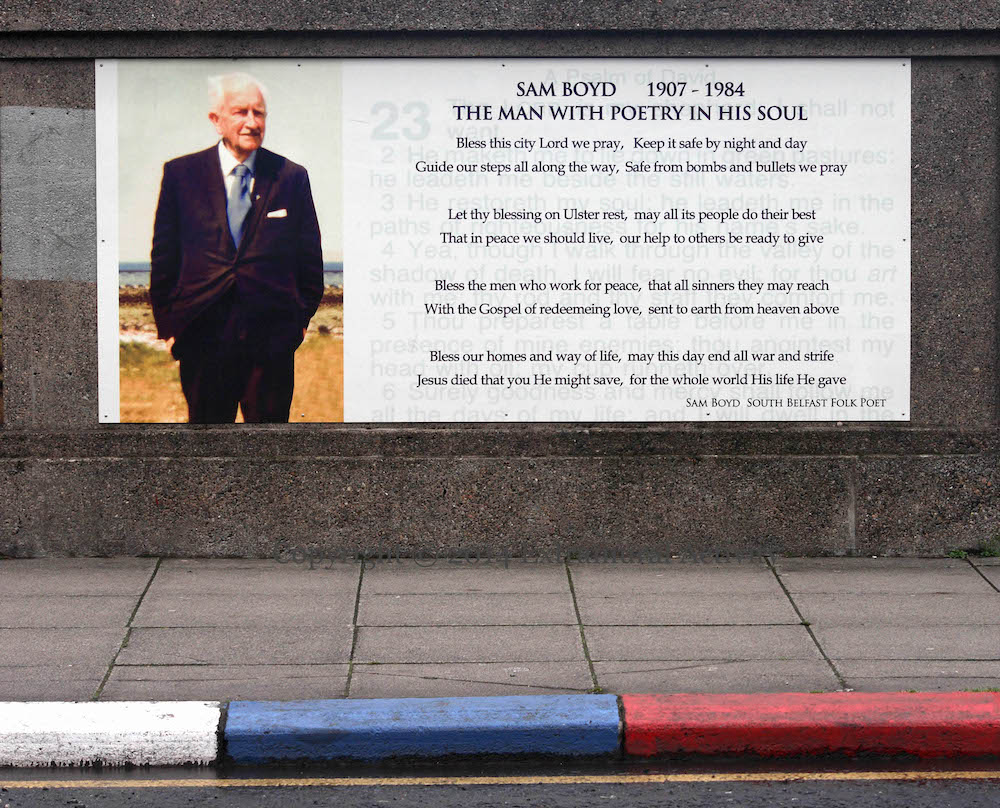
“Sam Boyd, 1907-1984 – the man with poetry in his soul.” “South Belfast folk poet.”
The “Streets of dreams”, some of them no longer in existence, are: Coolderry, Coolbeg, Coolfin, Fortuna, Egeria, Daphine, Pandora, Euterpe, Thalia, Coolmore, Abingdon, Colchester, Barrington, Empire, Maldon, Utility, Rydalmere, Rockland, Kitchener, Nubia, Soudan, Kilburn, Benburb, Ebor, Lecale, Moltke, Roden, Tavanagh, Rockview, Monarch Parade, Donegall Avenue.
These are seventh, eighth, and tenth panels on the north side of the bridge; for the other panels on this (north) side of the road, see also:
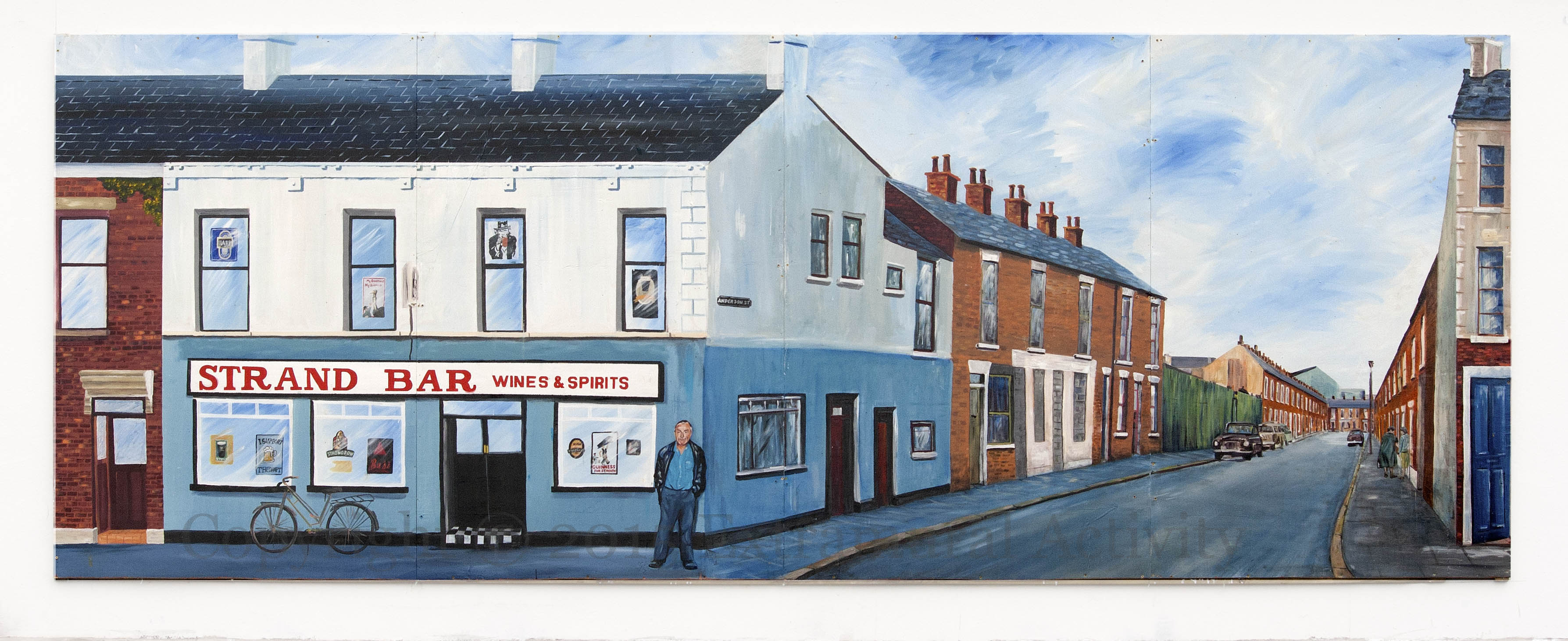
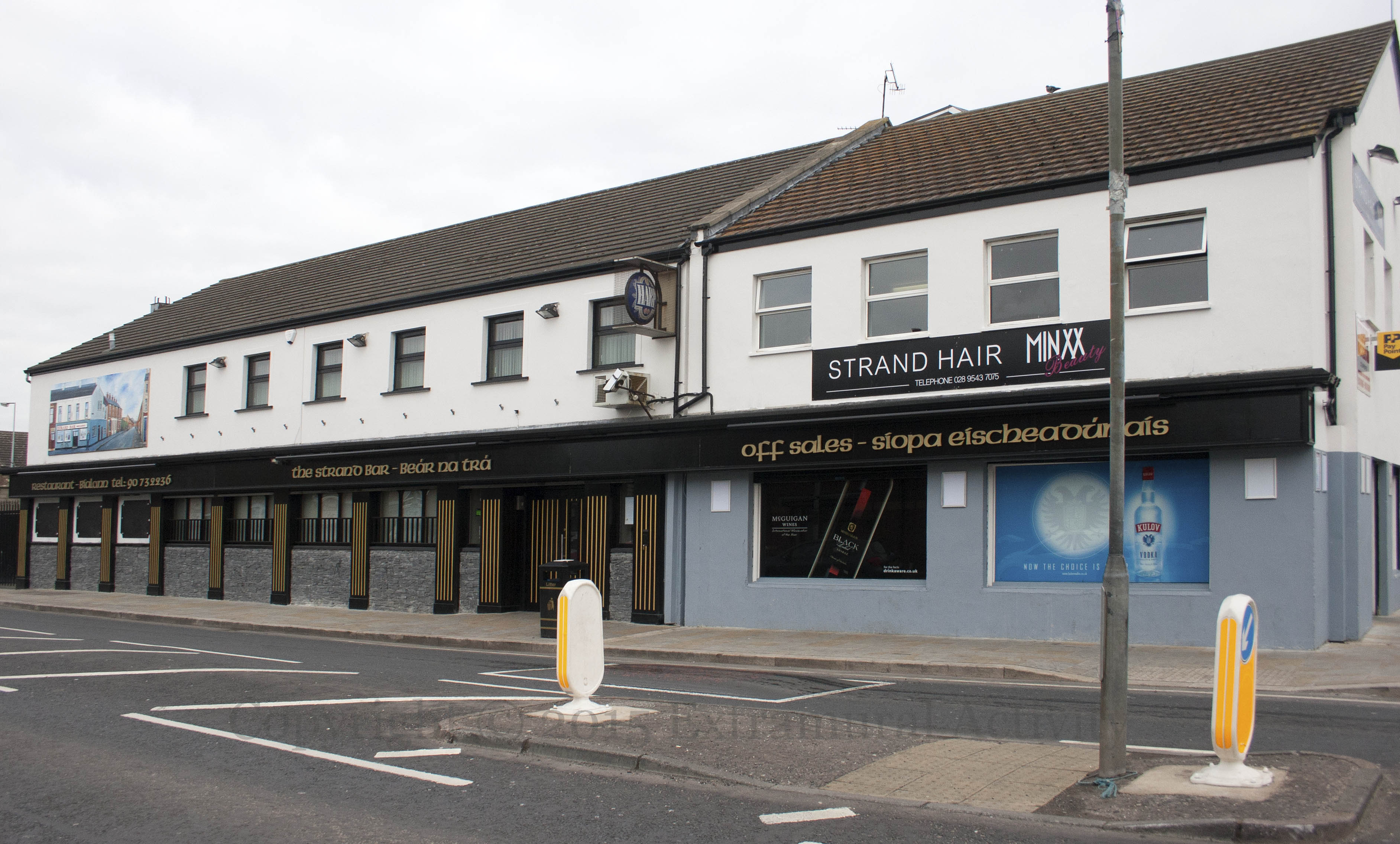
After adding windows to the downstairs, The Strand Bar has reinstated the mural previously at the front in the form of a painted board (above) showing the original bar in Anderson Street (the current Arran Street), which was attacked by the UVF in 1975 with the loss of six lives. The relative size can be gauged from the wide shot, below. The previous mural can be seen in the bottom two images. For photographs of the original bar, see the BelfastForum.
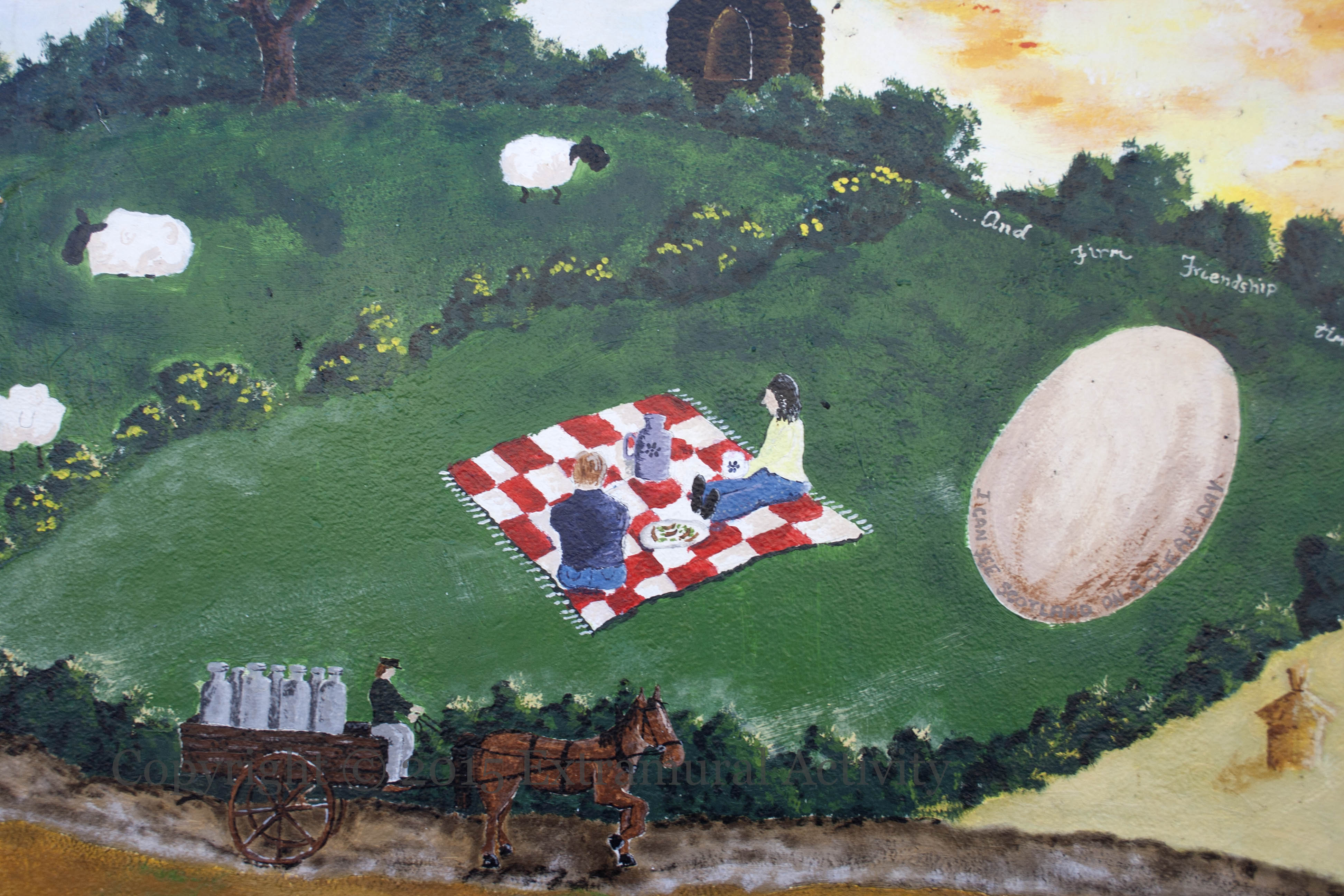
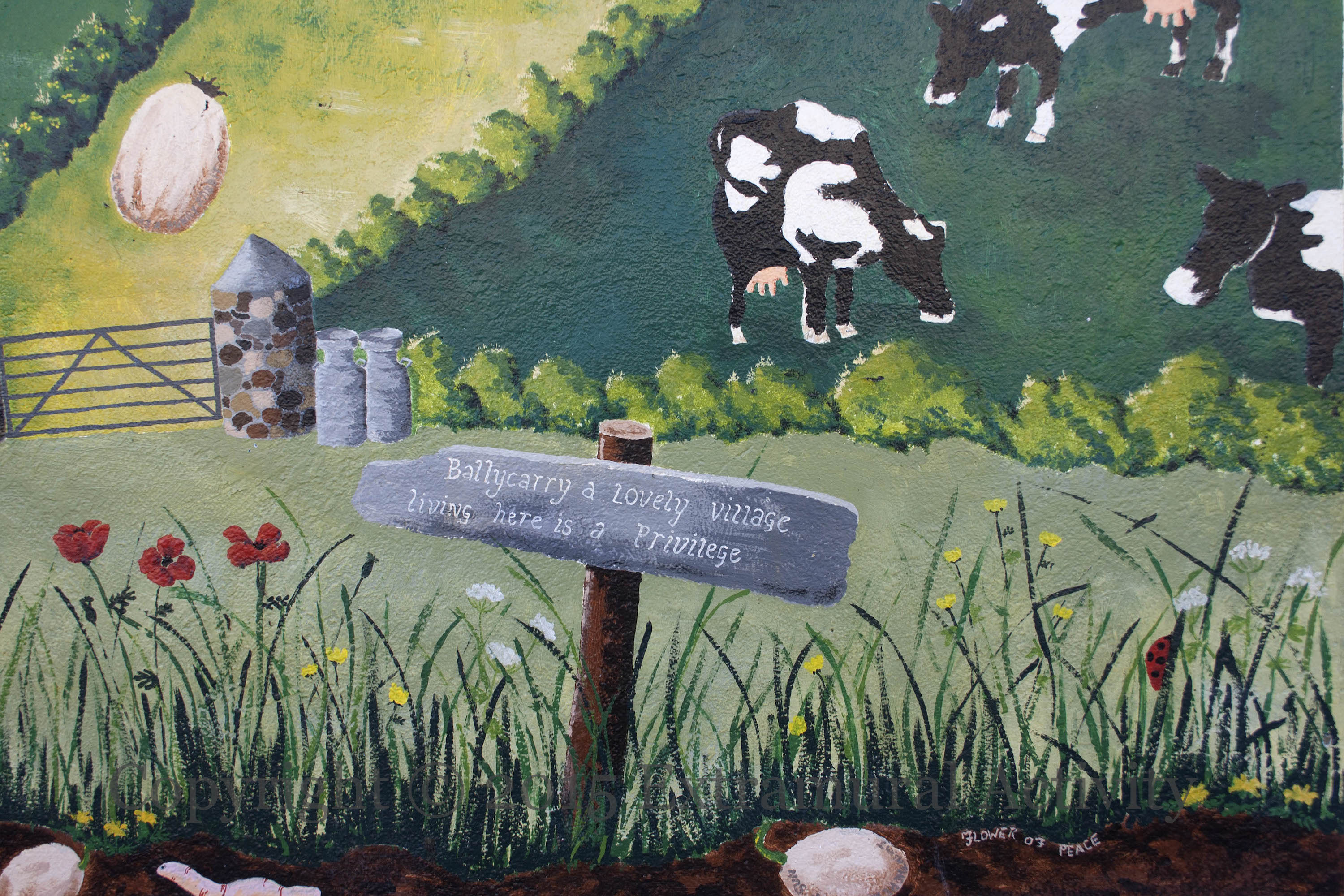
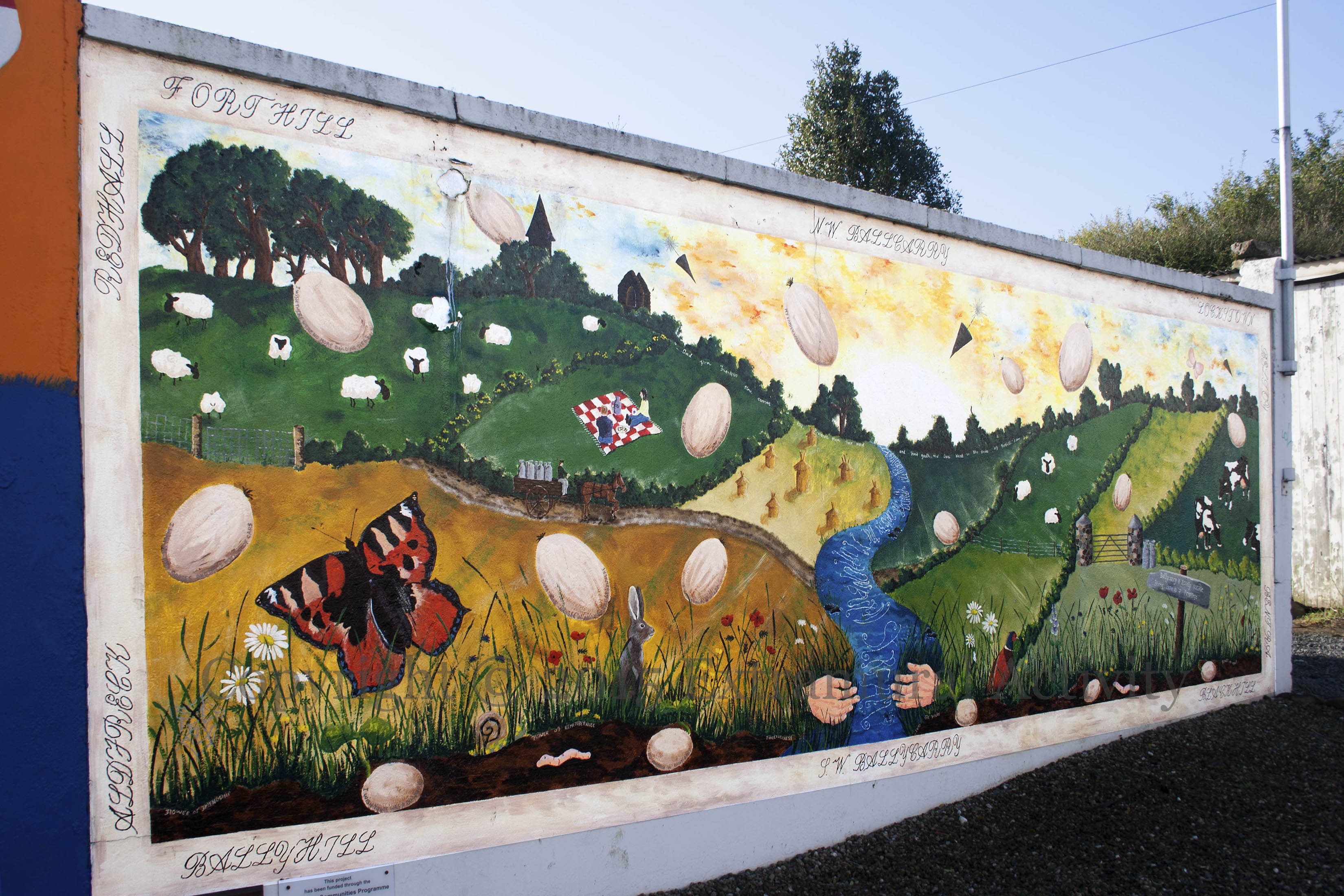
Ballycarry village sits in County Antrim countryside surrounded by the townlands of Ballyhill, Redhall, Forthill, Blackhill, Aldfreck, Lochstown, Beltoy, Bentra. The large pale oval to the right of the picnickers is one of many “seeds” falling from the sky and settling into the earth, which by growing make Ballycarry a pleasant place: “I can see Scotland on a clear day”. The Mutton Burn Stream (lyrics | music from the Ulster-Scots agency) is a song written by Ballycarry resident William Hume (QUB) about the river to the north-west of the village (WP). More about Ballycarry from the BBC’s Ulster-Scots page.
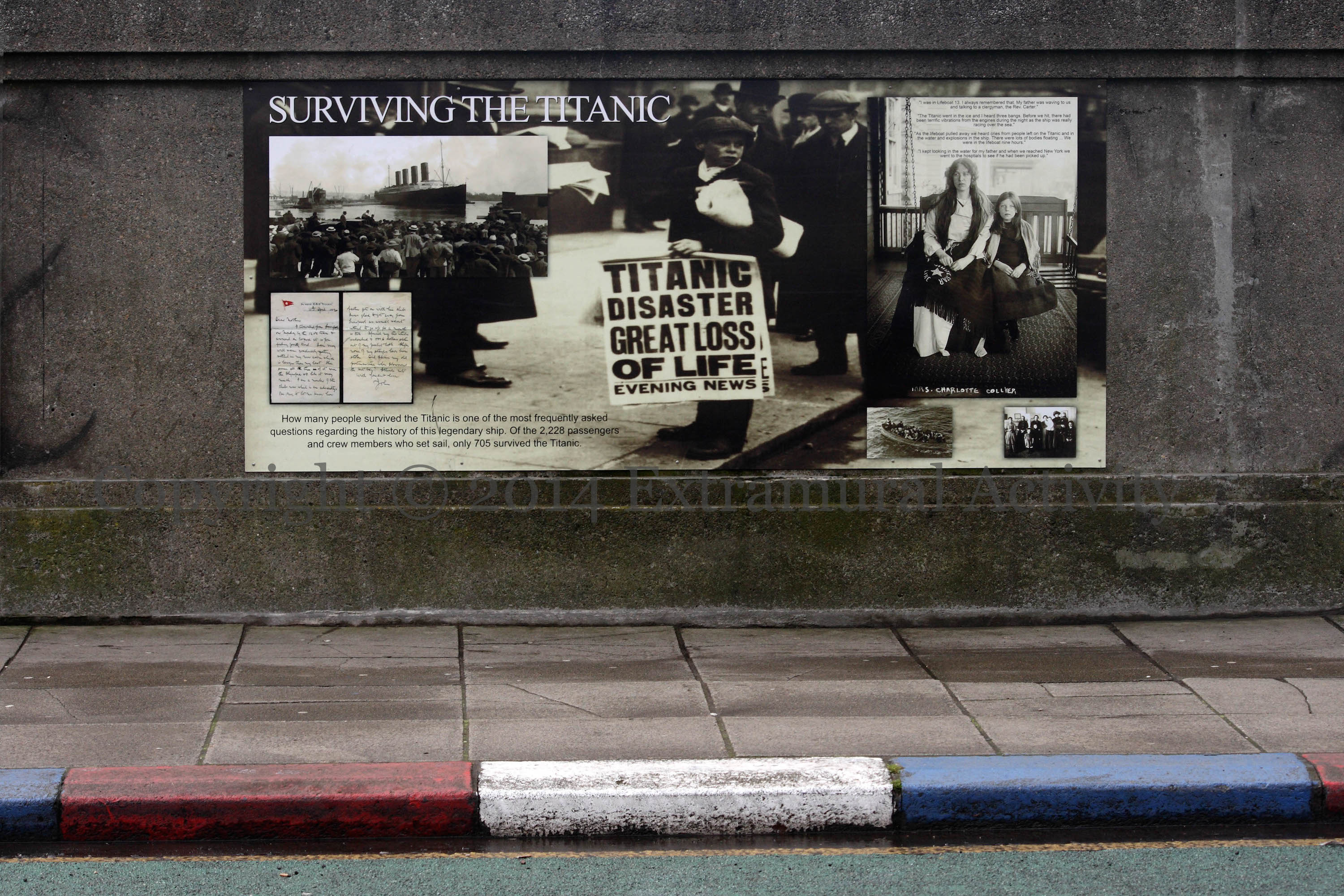
Here are two final images from the south side of the Donegall Road bridge over the Victoria Street line, one about Titanic and the other about locals awarded the MBE.
“I was in Lifeboat 13. I always remember that. My father was waving to us and talking to a clergyman, the Rev. Carter. The Titanic went in the ice and I heard three bangs. Before we hit, there had been terrific vibrations from the engines during the night as the ship was really racing over the sea. As the lifeboat pulled away we heard cries from the people left on the Titanic and in the water and explosions in the ship. There were lots of bodies floating … We were in the lifeboat nine hours. I kept looking in the water for my father and when we reached New York we went to the hospitals to see if he had been picked up.” Mrs. Charlotte Collier
How many people survived the Titanic is one of the most frequently asked questions regarding the history of this legendary ship. Of the 2,228 passengers and crew members who set sail, only 705 survived the Titanic.
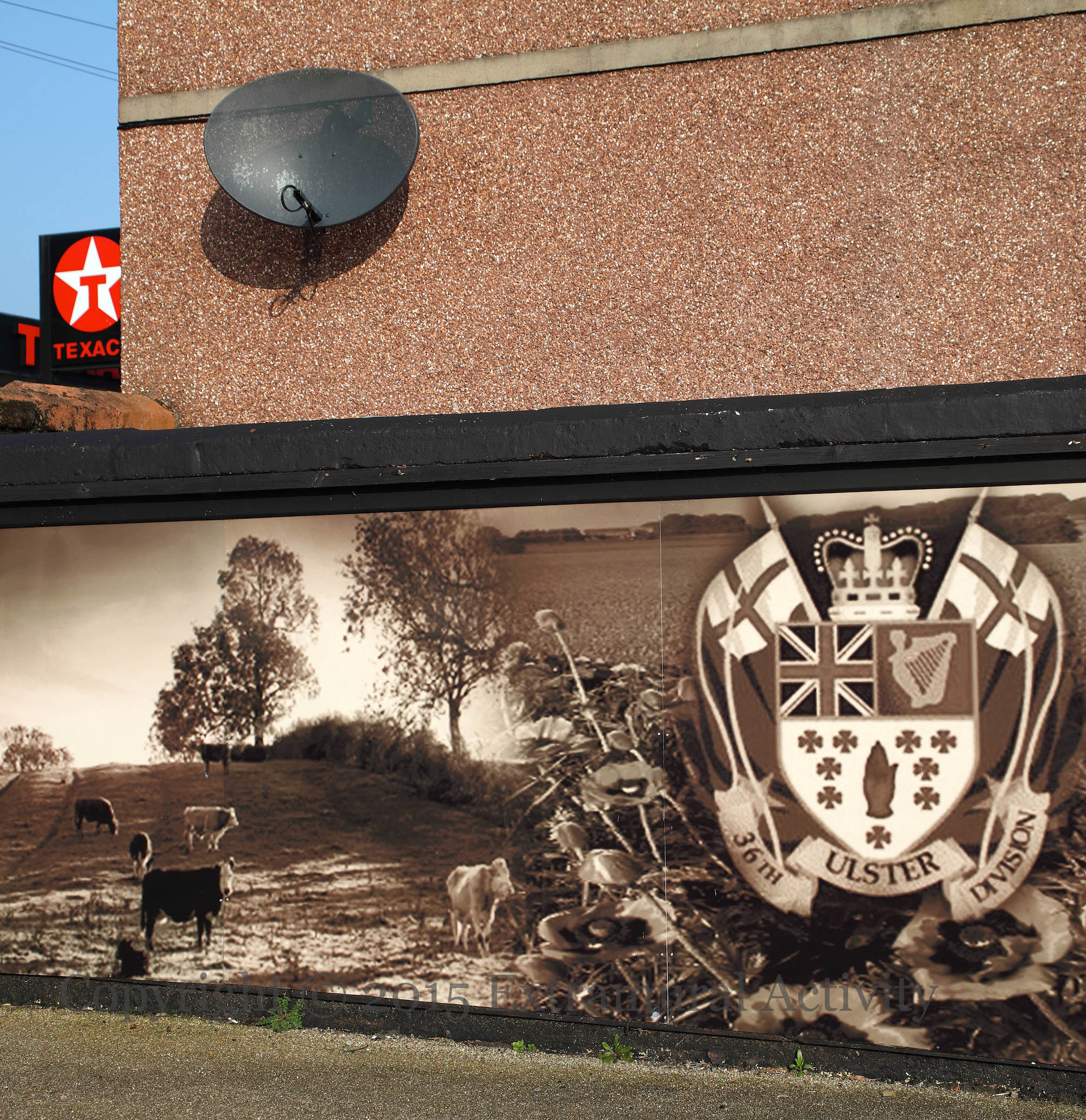
The Tullygarley mural in Larne, originally painted by Caroline Jeffrey, has been replaced with a computer-generated version reproducing most of the images. The bleaching green is gone; the Black Arch has been added, as has part of the mural that was on this site three generations of murals ago: God Save The Queen.
From the info-board for the previous version, included below:
“Tullygarley” means “Hillock of the Grey Calf” – thus the grey calf grazing with the cows.
The 36th Ulster Division – In September 1914 the Ulster Division was formed from the Ulster Volunteer Force which raised thirteen battalions for the three Irish regiments in Ulster.
Bleaching Green – Linen laid out in fields to bleach. The Bleaching Factory interior depicts the Bleaching process. (The building is currently derelict.) Blue Flax Flowers are the national floral emblem of Northern Ireland.
Local Primary School, Inver and Larne, known locally as “the Bridge”, as it looked in the 1930’s with the Inver River running through it. The bridge that the school was named after no longer exists.
Linen Factory of Glyn [Glynn] Road (no longer exists, site of abandoned garage) with inset depicting workers with weaving machines (circa 1924).
The old Tullygarley playground (mural site) with the Fountain in the foreground, and rows of houses on either side (Glynn Road and South Circular Road).
Sun Laundry Van. Sun Laundry showing people working inside (now Rea’s Furnishings, Bank Road).
Larne Lough – it is an area of special interest, a special protection area and a Ramsar site in order to protect the wetland environment.
SS Clyde Valley – launched in July 1886. Was used in 1914 to transport arms from Hamburg to Larne.
Roseate Tern – Larne Lough is the only breeding colony in Northern Ireland for the Roseate Tern, one of the UK’s rarest birds.
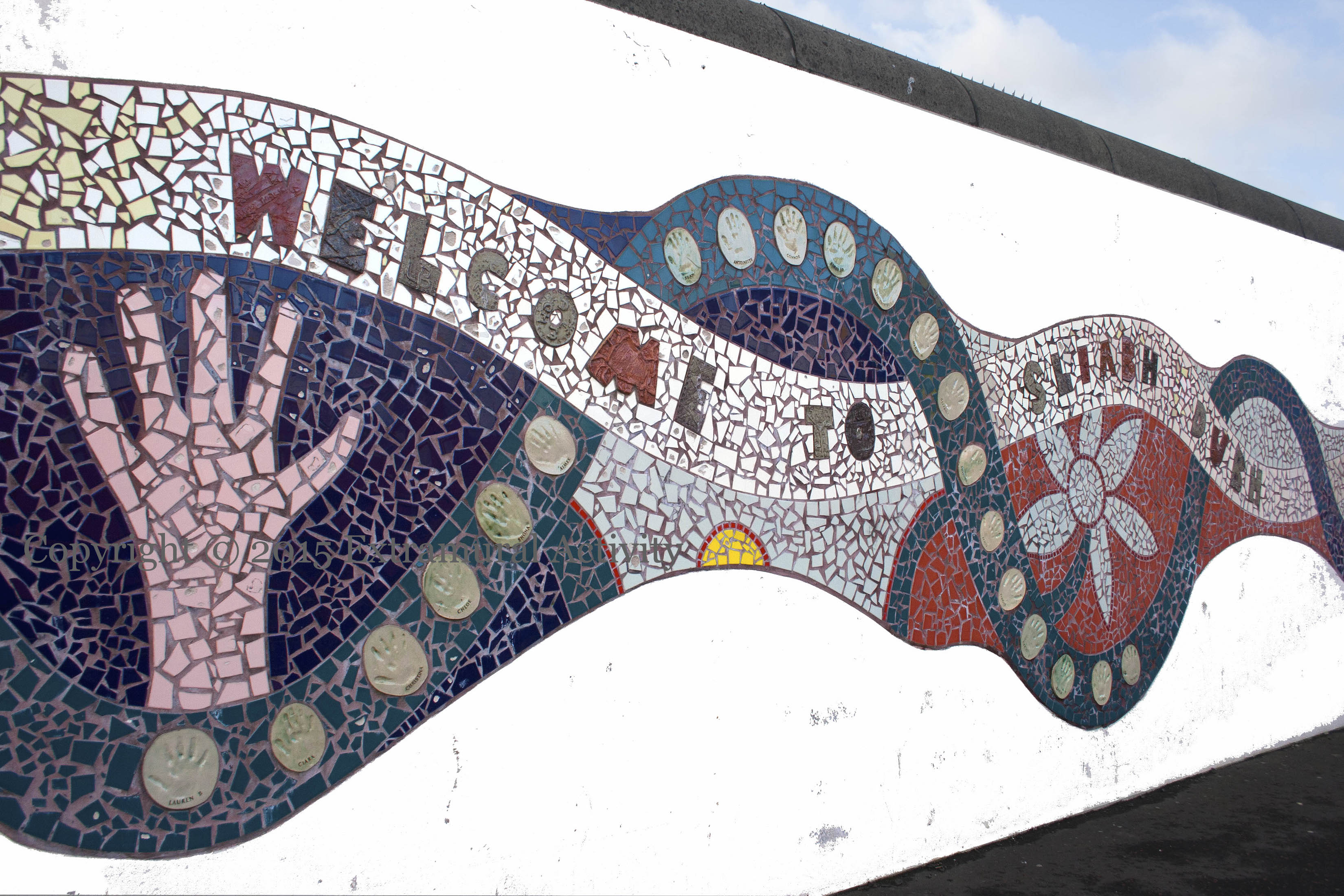
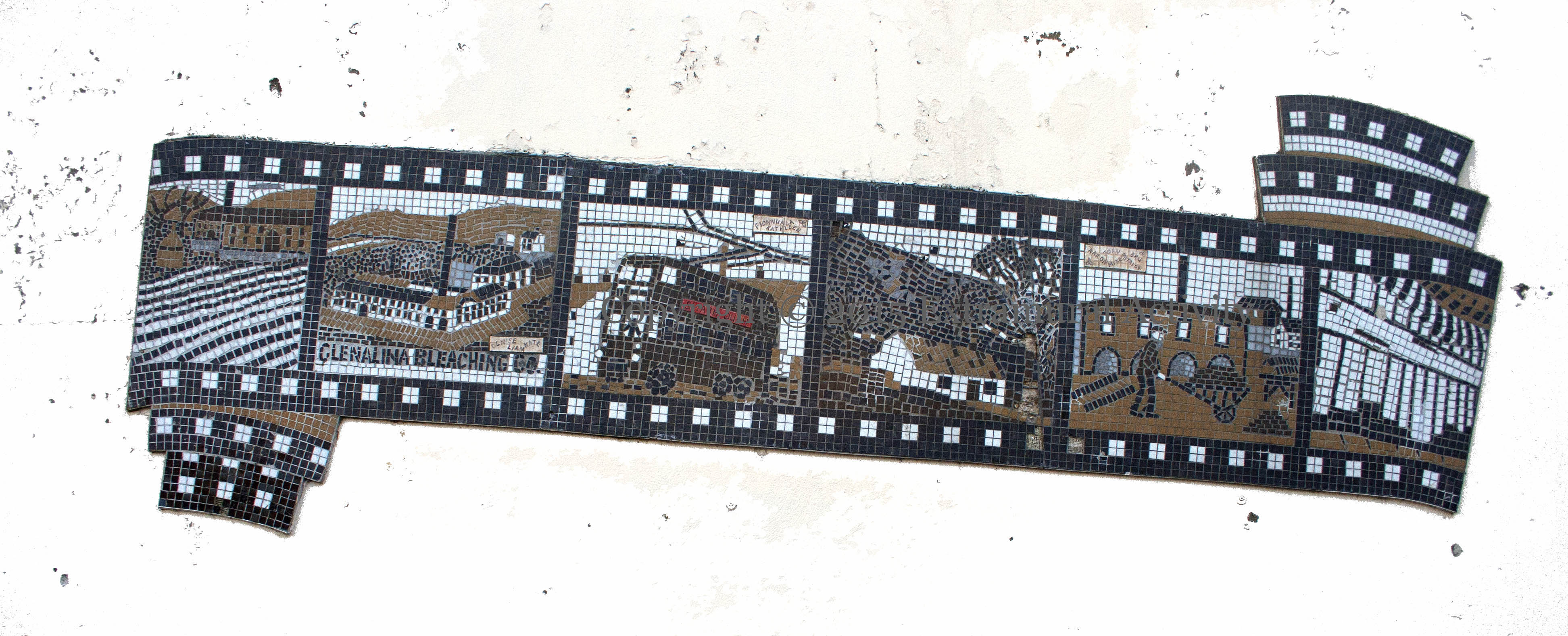
Local residents and children who helped construct the ‘Welcome To Sliabh Dubh’ mosaic at the top of the estate got to include their handprints as part of the artwork, under the direction of Martin McClure (according to a City Council brochure). As the other images (below) show, the area is also host to another mosaic depicting local landmarks from the past such as the Glenalina Bleaching Co and a cottage on the hills of Black Mountain as well as the superhero murals (Wallbusters | Cartoon World | Red-Eye) and Disney murals (some of which have been featured in If The Shoe Fits | Look Behind You! | Magic Mountain).












 Extramural Activity