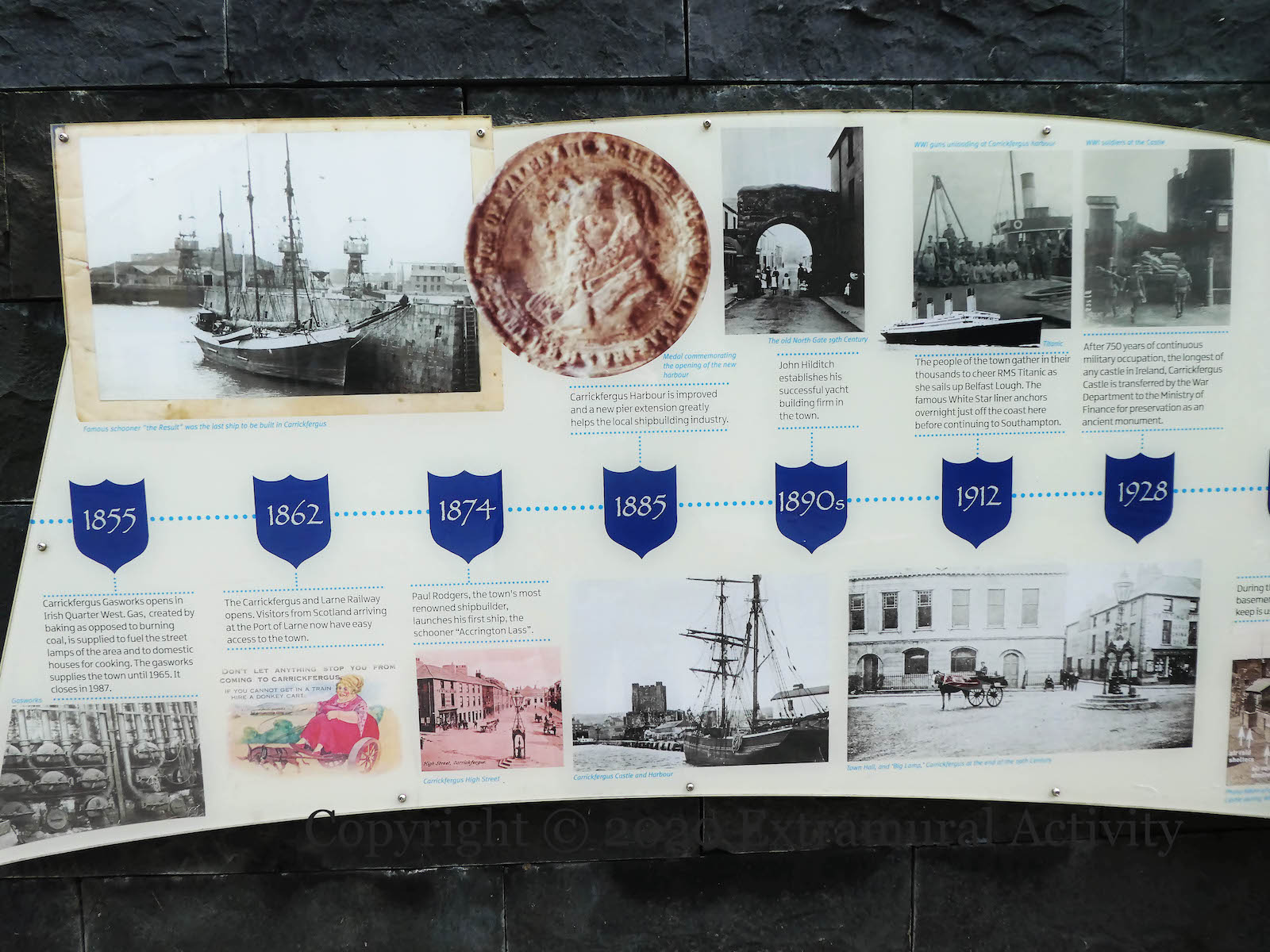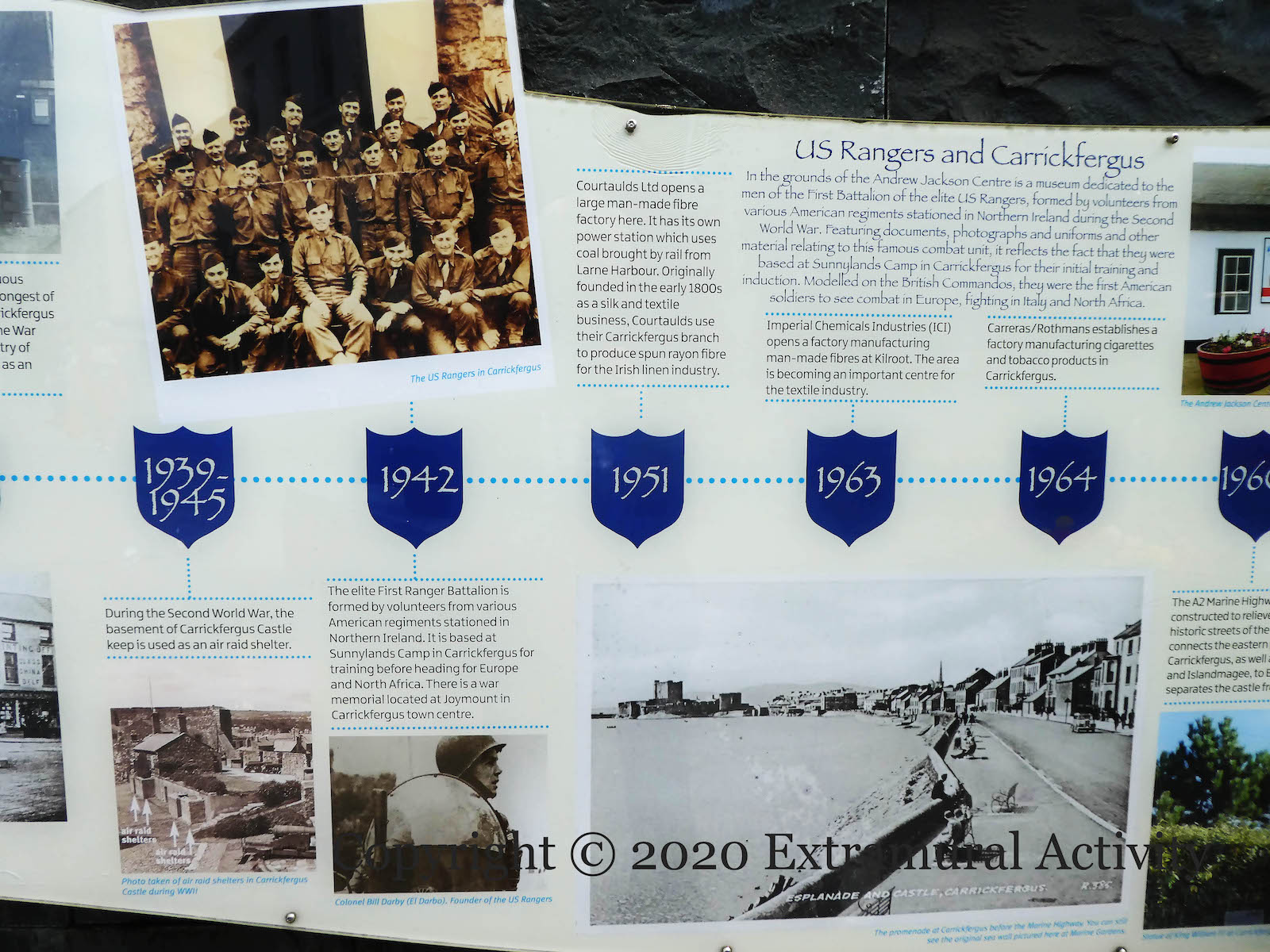
Don’t Let Anything Stop You From Coming To Carrickfergus

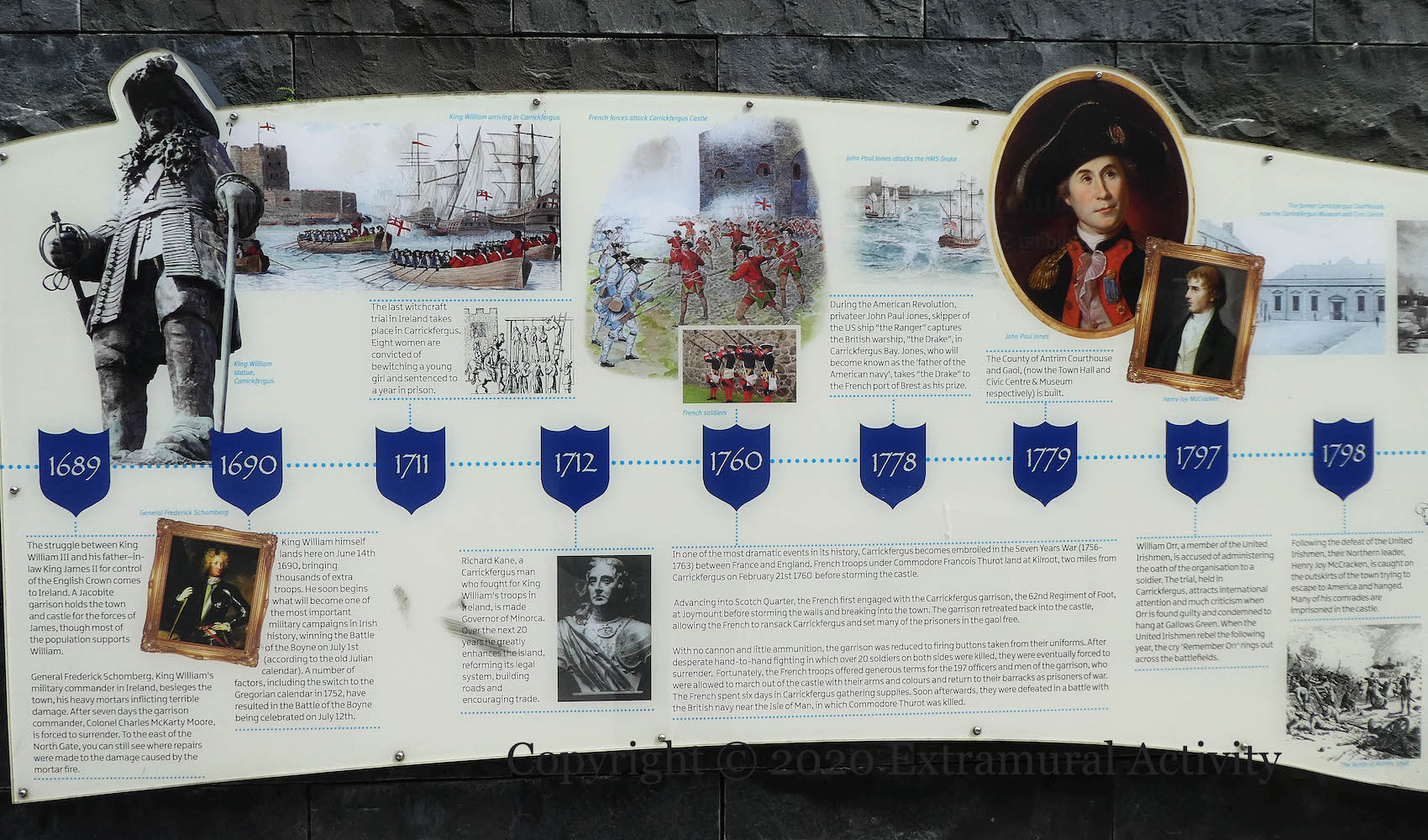
This is the second half of the Carrickfergus Timeline in Market Place, covering the history of the town from arrival of King William and General Schomberg to the modern day, including the last witch trial in Ireland and the construction of a railway allowing tourists sailing into Larne to reach the town easily: “Don’t let anything stop you from coming to Carrickfergus – if you cannot get on a train, hire a donkey cart”. The panels were written by Seth Linder.

Click image to enlarge
Copyright © 2020 Seosamh Mac Coılle
X07369 X07364 X07365 X07366 X07367 X07368

Welcome To Carrick Hill

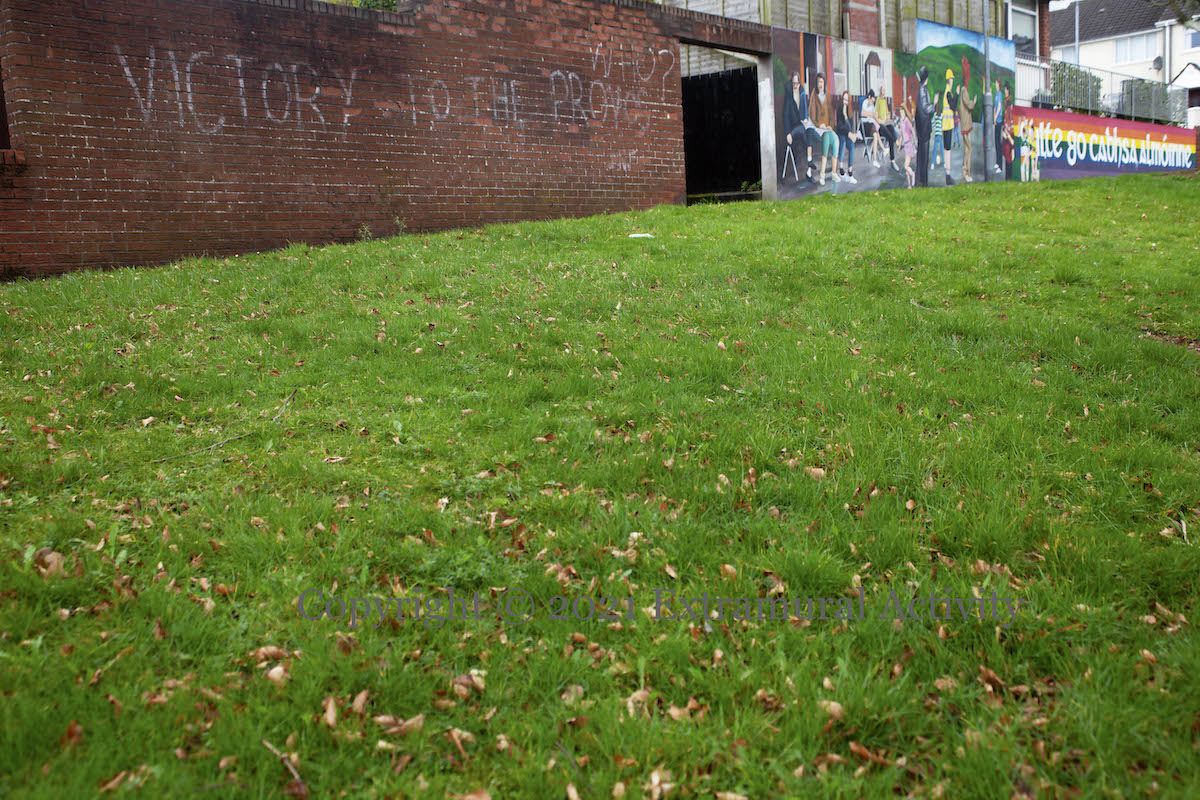
“Fáılte go Cnoc Na Carraıge” in the arch over the entrance to Carrick Hill, with a simplified United Irishmen symbol at the centre.

Click image to enlarge
Copyright © 2020 Seosamh Mac Coılle
X07451 [X07450] [X07449]

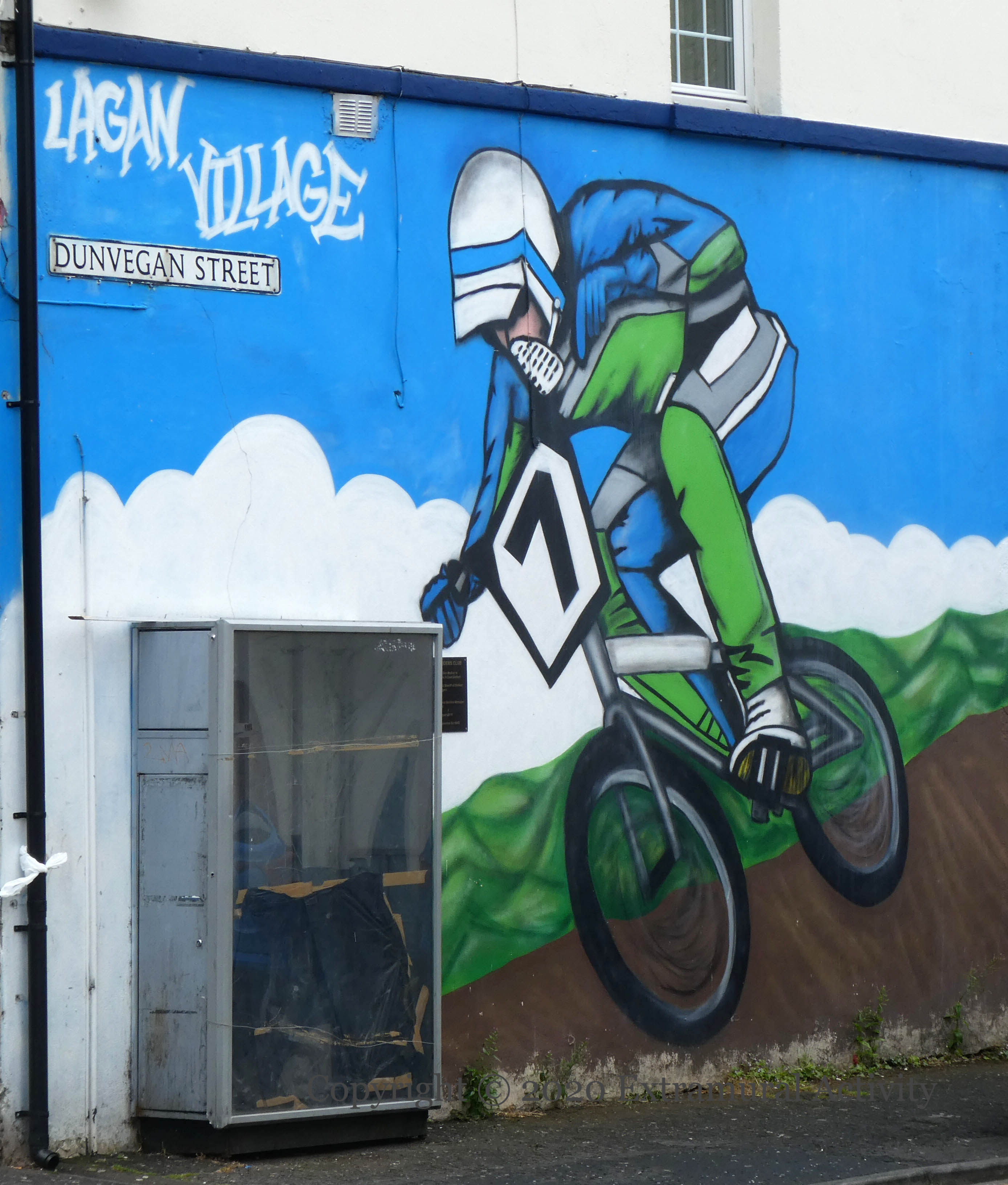
Lagan Village

In the 1860s, Ballymacarrett, Mount Pottinger, and Lagan Village, all on the east side of the Lagan, were not a part of Belfast (Lennon-Wylie). Lagan Village stretched from where Hutchinsons car dealership now is down to the modern Park Parade, just above Ormeau Park. In the 1880s Belfast expanded and Lagan Village Road became Ravenhill Road (NVTv). Ormeau Park opened in 1871 (WartimeNI). It did not then include the BMX track celebrated in this mural.

Click image to enlarge
Copyright © 2020 Seosamh Mac Coılle
X07255

Girls Club

“Miss McMinn (BEM) created a haven for “Her Girls” in Thorndyke Street Club. It was a home from home where you were encouraged to be yourself. ‘Her girls’ were here life: Her 27 years of service brought joy to the lives of young girls in an area of Belfast that had been devastated by the Blitz. Miss Margaret (Greta) McMinn (we never used Christian names) never married but devoted her life to ‘her girls’. So great was her dedication that during ‘The Troubles’, unable to get to her home in north Belfast, she slept on the premises. With her guidance we learned many arts and crafts which we shared with our family and friends on ‘display night’. We also entered many sports competitively in our own area and the Shankill Road. Many outings to the pantomime, circus, etc. and the annual holidays to Shimna House, Newcastle, County Down, were a real treat for children who had little or nothing in the way of luxury. Wonderful memories of a beautiful lady. – Peggy Bowden”. Part of the “East Side Lives Heritage Trail” which “celebrates the unsung people who built community in east Belfast.

Click image to enlarge
Copyright © 2020 Seosamh Mac Coılle
X07188 X07189 [X07190]

Fact And Myth Riveted Together

“Overlooked by the iconic Harland and Wolff cranes, Samson and Goliath, The Yardmen is a bronze sculpture depicting three shipyard workers returning home to East Belfast.” “At its peak 30,000 people were employed in the shipbuilding industry in Belfast. A high proportion of them lived in the terraced streets off the Newtownards Road. Not far away is one of the best preserved terraces of workers’ houses in Belfast – McMaster Street, begun in 1898. Most of the workforce was drawn from the countryside around Belfast, though many skilled workers were recruited in Britain. While shipbuilding was harsh and often dangerous work, the standard of living for workers was generally higher than that of shipyard employees in other British cities.”

X05215 2012-12-23 Titanic People+

Click image to enlarge
Copyright © Seosamh Mac Coılle
X07194 2015
X03179 X03172 X05215 2012
John harper baptist pastor glasgow mottpottinger tabernacle gave his life jacket to another man westbourne presbyterian ship of dreams mural dee street titanic mural discover ulster-scots belfast maritime trail 1700 large ships most famous being titanic a great ship now locked into worldwide history and romantic myth, fact and myth riveted together

Highfield Festival

Plans for the Highfield estate were drawn up and approved in 1945, converting a green-field site in the foothills of Black Mountain between the Ballygomartin, West Circular and Springfield roads. The first houses were completed in 1948 (Belfast Forum.) The community hall sits at the centre of the estate. UDA bomb-maker Michael Wright died there in a premature explosion in 1980 (Sutton) and there used to be a UFF mural on the side. This was replaced in 2000 (C01505) and again in 2006(?) (M04512) with the current mural (entitled “Whiterock Festival” after the cross-community event sponsored by the City Council’s ‘Good Relations’ fund (one | two) showing Highfield kids having fun with music provided by a DJ, band, and the Whiterock Flute Band (Fb) drum.

Click image to enlarge
Copyright © 2020 Seosamh Mac Coılle
X06997 X06998 X06999 X07000

The Body And Blood

Local artist Paul Morrison (webFb) was asked to paint a shrine for Corpus Christi church in Westrock/Springhill. As his main subject he chose Mother Teresa, who lived and worked in the area with four nuns from 1971 to 1973 before being put out (allegedly) by the Catholic church. Morrison also painted portraits of the sixteen victims of the Ballymurphy and Springhill/Westrock massacres of 1972, including the one of John Dougal, shown below, as well as clerics Noel Fitzpatrick (from St John’s) and Hugh Mullan (from Corpus Christi itself).

Click image to enlarge
Copyright © 2020 Seosamh Mac Coılle
X07004 X07002 X07003 X07001

Fish 4 The Bone

The streets in the Bone (or Marrowbone) area were built around the turn of the 20th century but before that the area was on the way to the ‘old park’. The name perhaps comes from the Irish “machaire botháin”, the “cabin field”, possibly in reference to a shepherd’s hut, and certainly nothing to do with punning fish-and-chip shops. Above the shops are pictures of local children, continuing from the Marrowbone Community Association which is out of picture to the left.

Click image to enlarge
Copyright © 2020 Seosamh Mac Coılle
X06979

This Was Once The Dole Office

The ‘jobs and benefit office’ in Exchange Street was originally built in 1926 for what was then the Northern Ireland Ministry of Labour and was the largest job centre in the UK. It functioned until 2016 and was demolished in 2017 (FutureBelfast). In its early life it was next to the Mariner’s Church of Ireland between Great and Little Patrick streets (FutureBelfast). The banner now on the site – This Was Once Little Italy – was designed by Deirdre McKenna and erected in July, 2019 (BelTel).

See previously: Jobs That Aren’t There in 2013

Click image to enlarge
Copyright © 2019 Seosamh Mac Coılle
[X06863] X06864 X06865

Welcome To The Shankill Road

This is the new ‘Welcome To The Shankill (Road)’ mural in Gardiner Street, which replaces the one that had been there since (at least) 2009 (see Welcome To The Shankill).

The mural is a version of the old Beverley Street ‘welcome’ mural (by Blaze FX), with the same four panels (parades/bonfire, blitz, sports, murals) and the same three hands. But instead of “Proud, Defiant, Welcoming” we now have “Proud, Resilient, Welcoming”. (I Am Not Resilient in the lower Shankill complains that the word is used to justify neglect and/or maltreatment.)

It escaped no one’s notice that, although the number of languages expressing a greeting is now much greater than the original ten, Irish is not included among them. Also Ulstèr Scots. (Also French, for some reason. Polish is included – “Witamy”). (See similarly “No Irish” in the lower Shankill estate but also All Flags Are Welcome in Divis, which omitted the Union Flag.)

The claim that the Shankill area dates back to AD 455 is used in The Original Belfast. The claim was made by the Greater Shankill Partnership.

Despite the appearance of bricks, the main panel is not in fact a mural but a board.

Held over from the old mural are the two strips of ‘famous faces’ on the left and right (see below).

Images of the July 10th launch from sponsors Alternatives.

Click image to enlarge
Copyright © 2019 Seosamh Mac Coılle
X06703 X06704 X06705 SignLink NI with local youth; norman whiteside baroness may blood william conor henry montgomery wayne mccullough jimm wornock james cunningham johnny mcquade