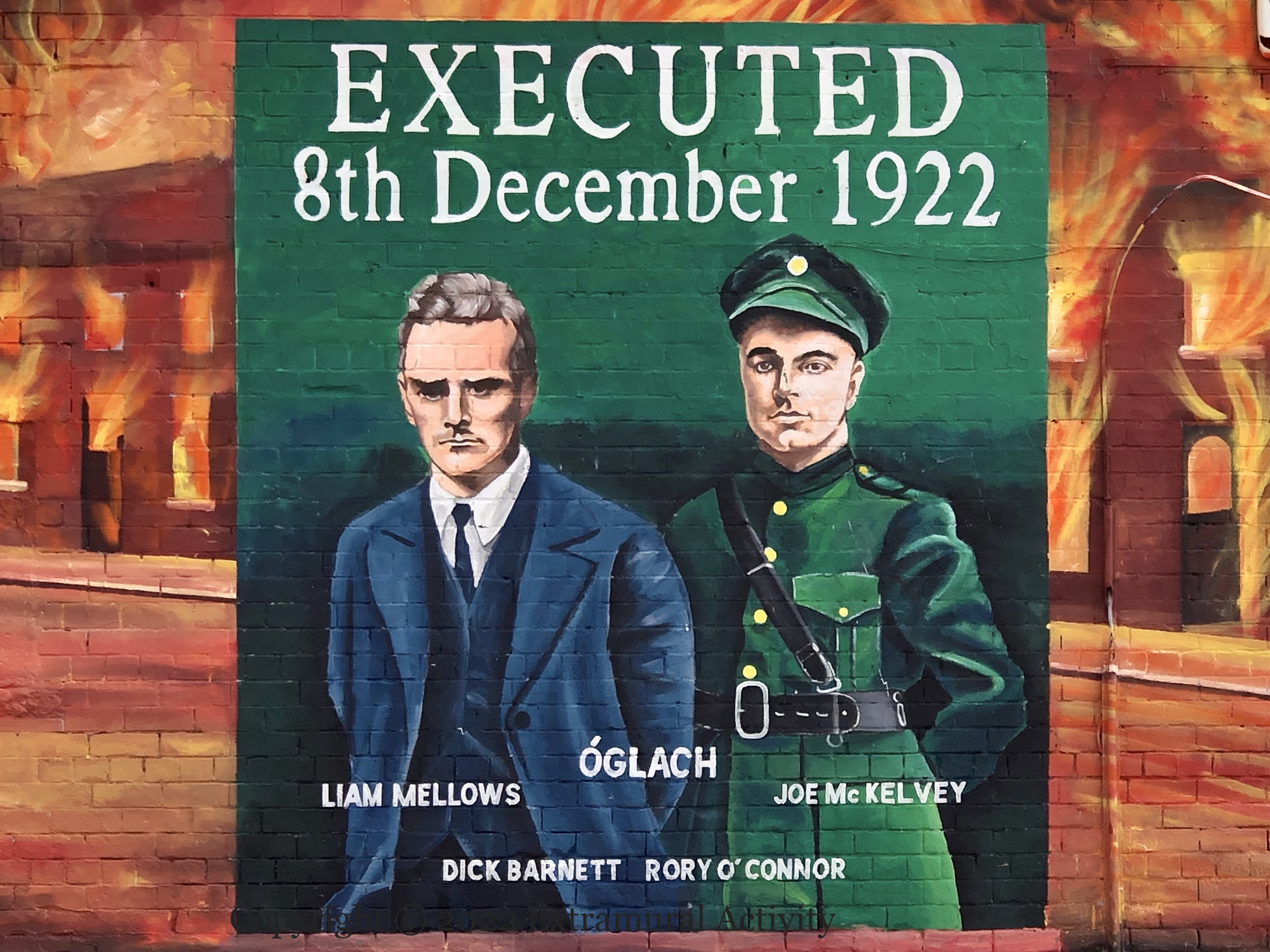
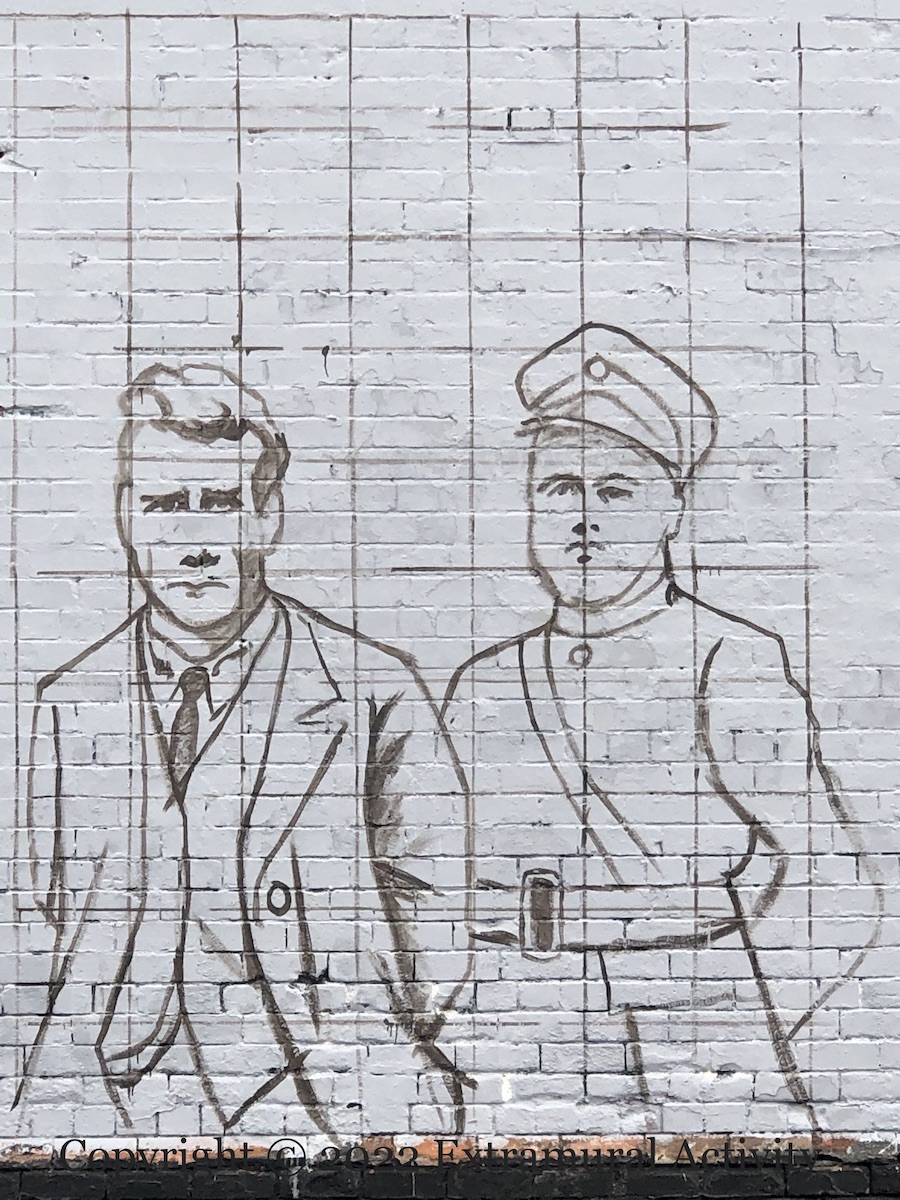
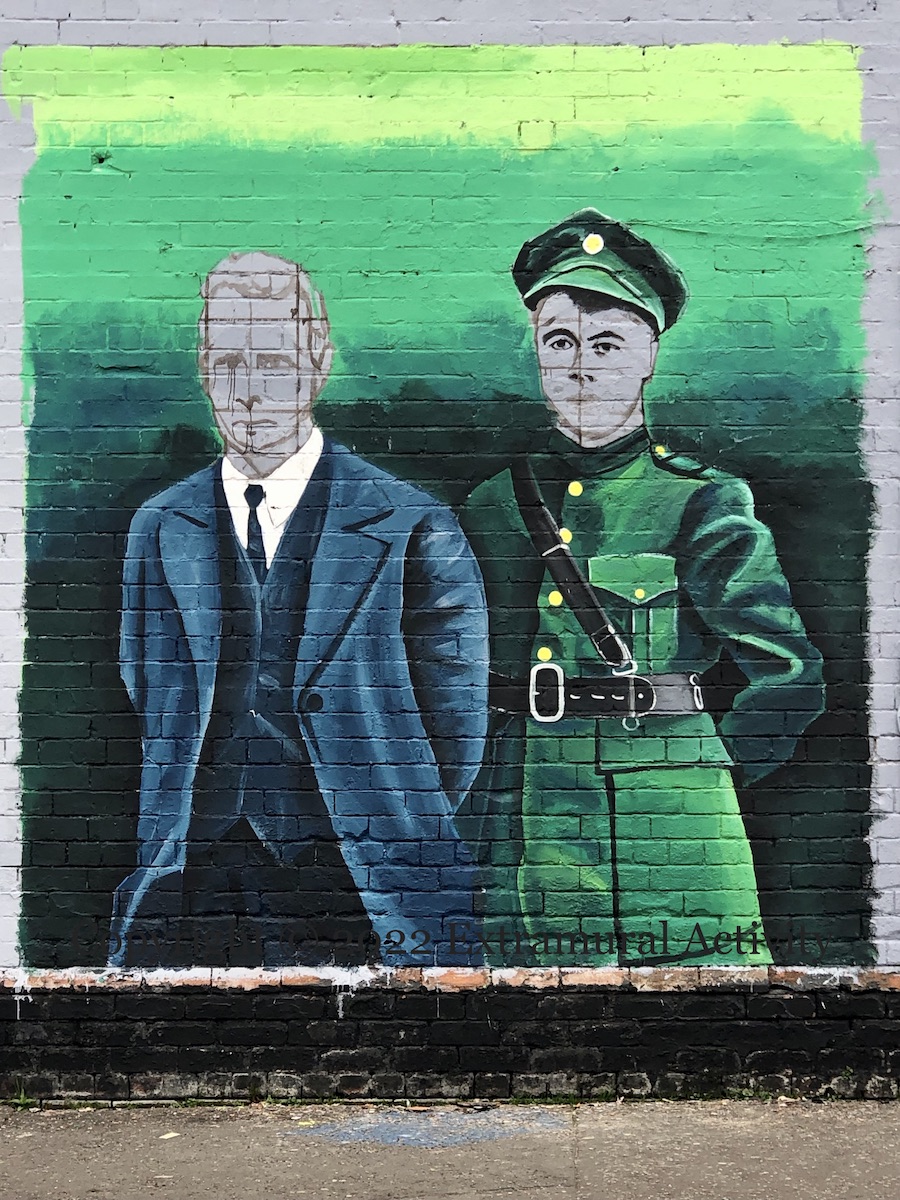
On October 18th, 1922, the third Dáıl/second Provisional Government Of Southern Ireland approved – in the absence of anti-Treaty members – a bill entitled the “Army Emergency Powers Resolution” which introduced martial law, including martial courts with the death penalty for anyone found in possession of an illegal firearm – “illegal” meaning not sanctioned by the nascent pro-Treaty Free State. Under these powers, seven IRA volunteers were executed on November 17th and 19th, followed on the 24th by Erskine Childers (a member of the team that negotiated the Treaty but subsequently against it). In response, the IRA declared that TDs who had voted for the bill were fair game, and on December 7th Seán Hales of Cork was shot and killed. In reprisal, the government ordered the execution of four more volunteers, one from each province: Liam Mellows, Joe McKelvey, Dick Barnett, Rory O’Connor. The four had been arrested five months earlier, on June 30th, 1922, at the start of the Civil War, after surrendering the Four Courts. By the end of the war, 81 executions had taken place. (An Phoblacht | Irish Times | The Irish Story | WP | WP)
For the left-hand side of the wall, on the shipyard clearings and the McMahon murders, see Belfast Butchery.
“Belfast Pogroms 1920-1922.” Against the backdrop of the first Dáıl, the War Of Independence, and the debate in Westminster over the fourth Home Rule bill (it would be passed in November 1920), northern Protestants began to assert their de facto independence from the rest of Ireland – both in economic and in military terms.
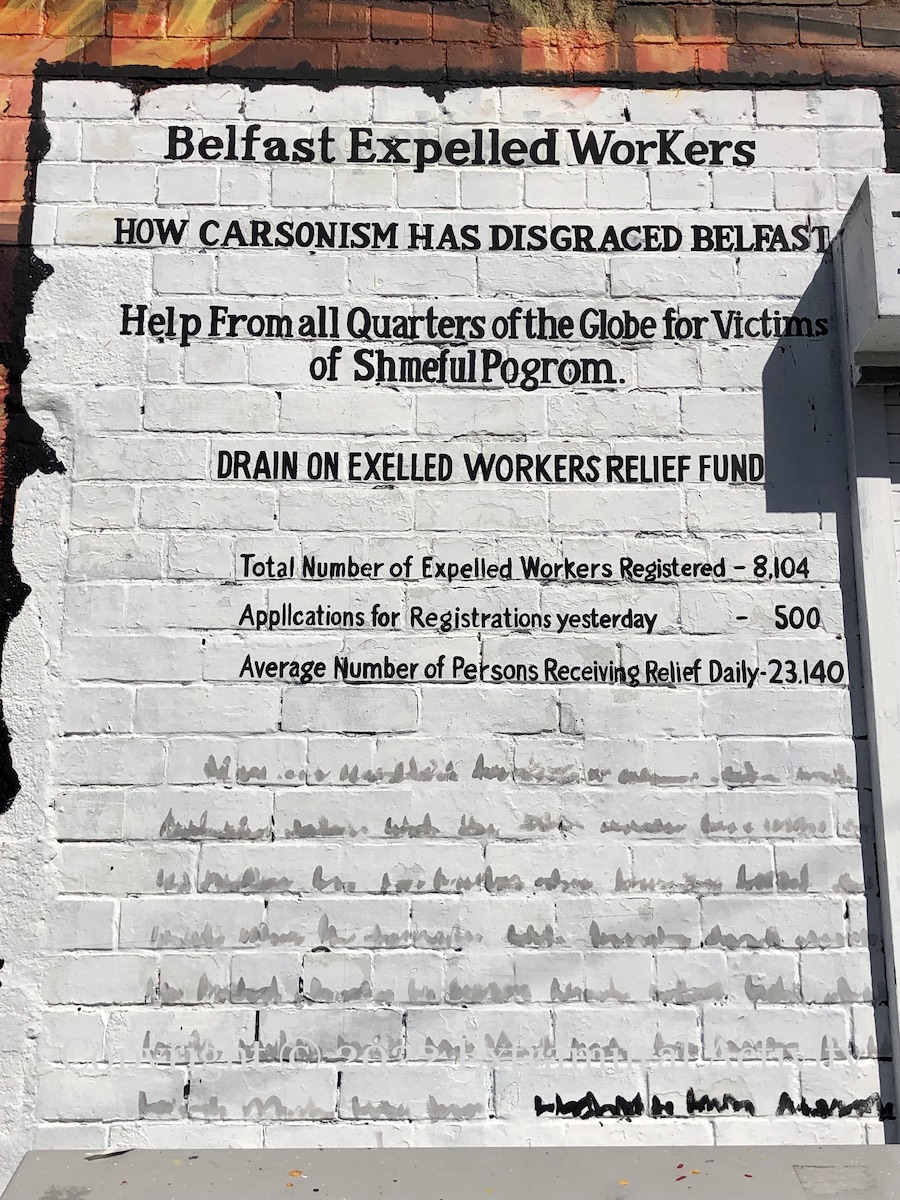
On July 12th, 1920, Edward Carson spoke to a crowd in Derry and, addressing the government in Westminster, said “if you are yourself unable to protect us from the machinations of Sınn Féın, and you won’t take our help; well, then, we tell you we will take the matter into our own hands.” (Treason Felony). Nine days later, the “clearings” of Catholics from Belfast shipyards and mills began, with about 5,700 Catholics and 1,850 socialists (“rotten Prods“) being expelled from Workman Clark and Harland & Wolff yards, and in total 10,000 workers from yards and mills over the next two weeks (History Ireland). In combination with the straitened economic circumstances of the time (post WWI) thousands (23,140 according to this mural, which reproduces a flyer derived from the Irish News of October 6th, 1920 – via The Irish Story’s account of the start of the “Belfast Pogrom”) were on relief.
Militarily, in October, 1920, the Ulster Special Constabulary was established (drawing on members of the Ulster Volunteers, which had been reconstituted in June 1920, and the 21,000 members of the Ulster Imperial Guards (WP)) as an alternative to the Royal Irish Constabulary in fighting actions by the IRA in Belfast, Derry, and elsewhere in the north. On March 23rd, 1922, two officers of the Specials were killed in Belfast city centre by the IRA. In reprisal, two Catholic civilians were killed in the Short Strand, and in the early hours of March 24th, a party of five men, four dressed in RIC uniforms, burst into the home of Catholic businessman Owen McMahon and shot McMahon, his six sons, and one of his employees – only two of the sons survived. District Inspector John Nixon of the RIC was suspected of leading the attack on the McMahon household – see The RIC Murder Gang and Pat And Dan Duffin. (The headlines are from the Freeman’s Journal of March 25th, 1922 – see Joe Baker’s 80-page account of the murders of summer 1922; the photograph of the McMahon corpses that is reproduced in the mural can be seen at Slugger.)
This is the first half a new mural in Ascaıll Ard Na bhFeá; the “1922” part can be seen in Executed.
“Belfast Expelled Workers – How Carsonism has disgraced Belfast – Help from all quarters of the globe for victims of sh[a]meful pogrom – Drain on Ex[p]elled Workers[‘] Relief Fund. Total number of expelled workers registered – 8,104; Applications for registrations yesterday – 500; Average number of persons receiving relief daily – 23,140.”
“Belfast Butchery – Horrif[y]ing story of massacre of McMahon family – Dying man[‘]s declaration – Murderers dressed in police uniform and spoke with Belfast accents.”
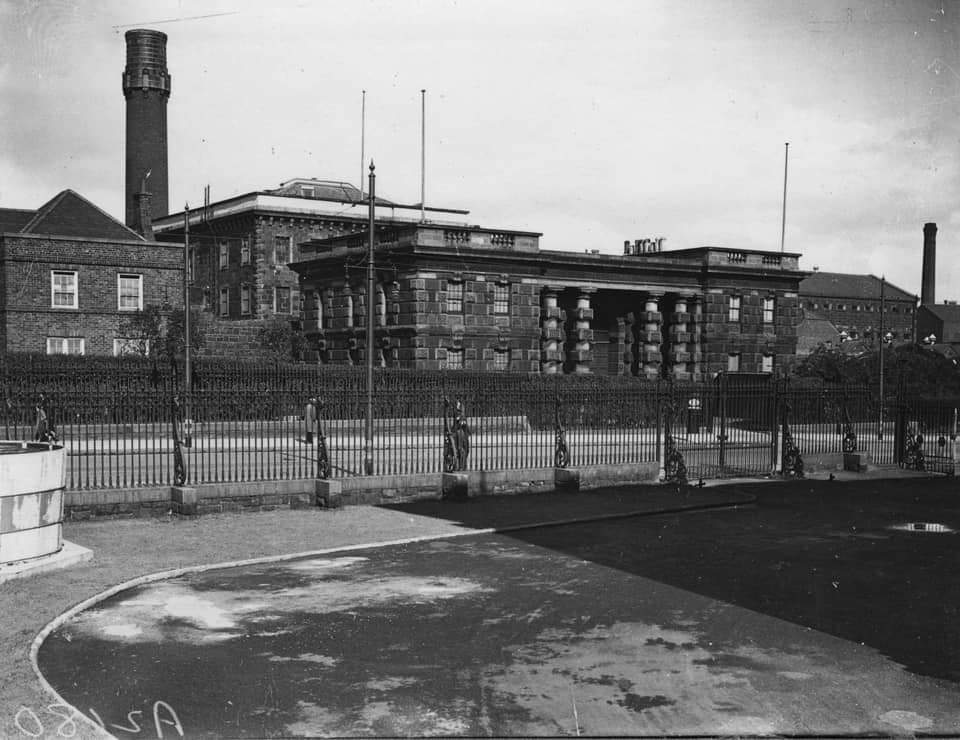
A crude engraving about the size of your hand found on the wall of the B-wing yard in Crumlin Road Gaol (now a tourist attraction and conference centre): a Celtic cross with knot-work and “Jim Keenan – Xmas 1942”.
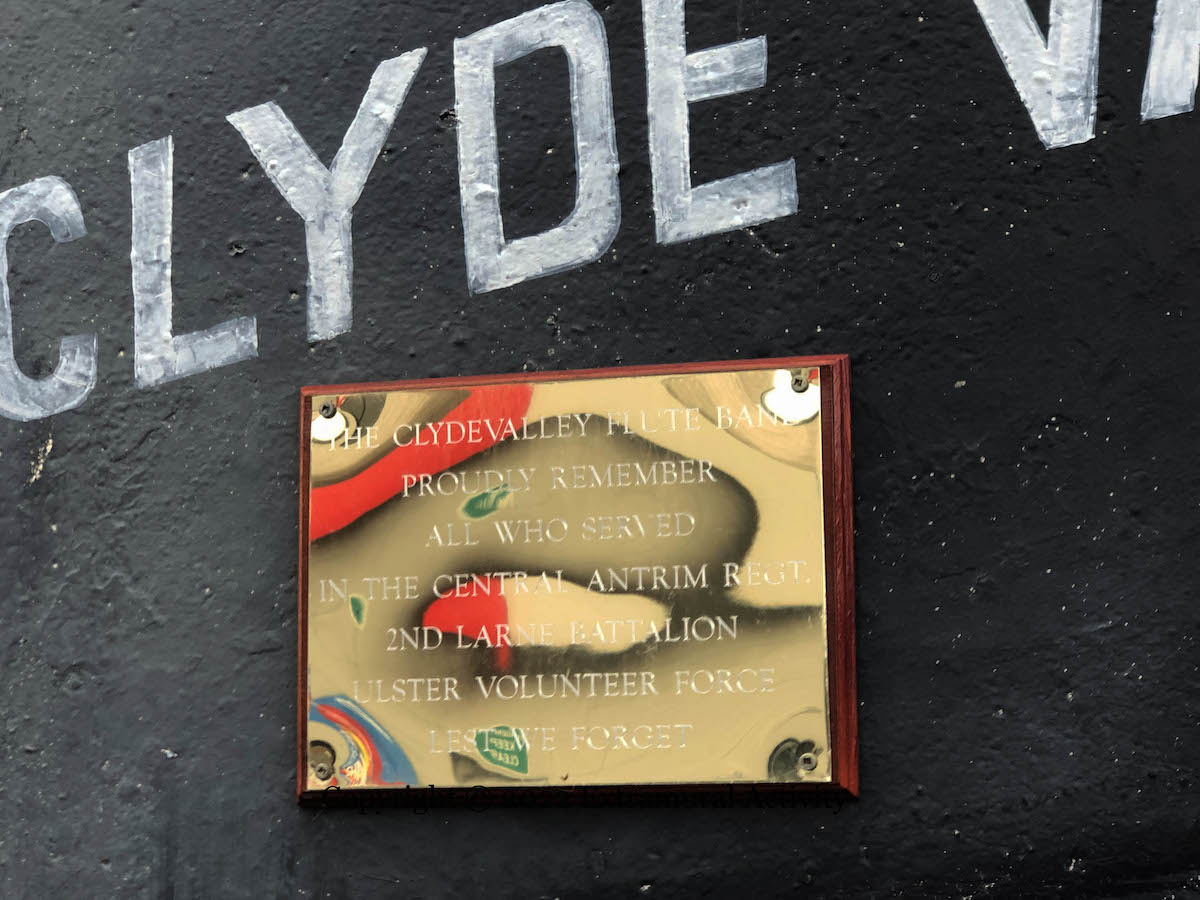
As this plaque in the Factory area of Larne indicates, the 2nd battalion of the Central Antrim regiment (of the Antrim division) of the Ulster Volunteers was drawn from Larne. Edward Carson reviewed the entire regiment at Drumalis in Larne on July 11th, 1914, (here is a postcard depicting the review) where he was presented with the colours of the 2nd from a Lady Smiley of First Larne Presbyterian. (The colours of the 1st and 2nd battalions are included below; the colours of the 3rd (Carrickfergus) Battalion can be seen at Sam’s Flags.) In the Royal Irish Rifles of WWI, Central Antrim became the 12th battalion (War Time Memories Project); its members included Larne man Rifleman Robert King.
“The Clydevalley flute band [Fb] proudly remembers all who served in the [Antrim Division,] Central Antrim Regt, 2nd Larne Battalion, Ulster Volunteer Force. Lest we forget.”
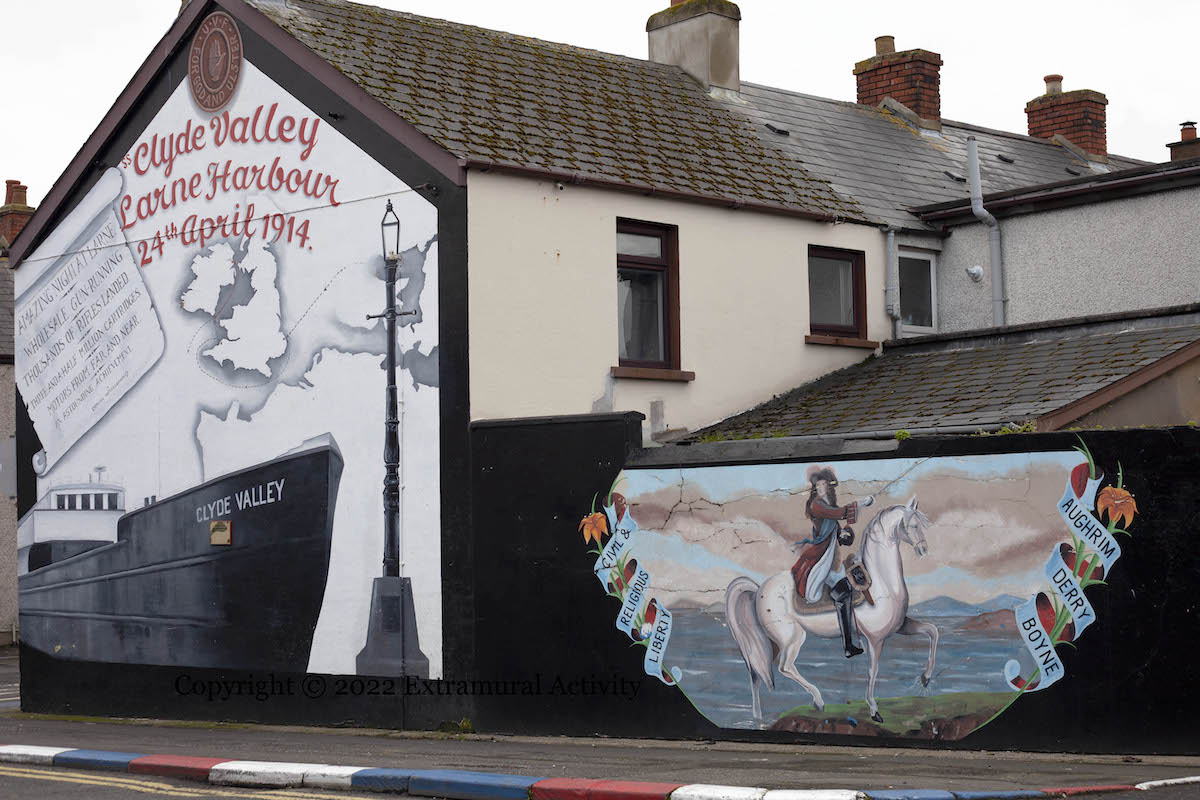
The plaque is on the gun-running mural and next to a King Billy mural in Greenland Drive. Both murals were seen previously in 2016; see Amazing Night At Larne and Civil & Religious Liberty.
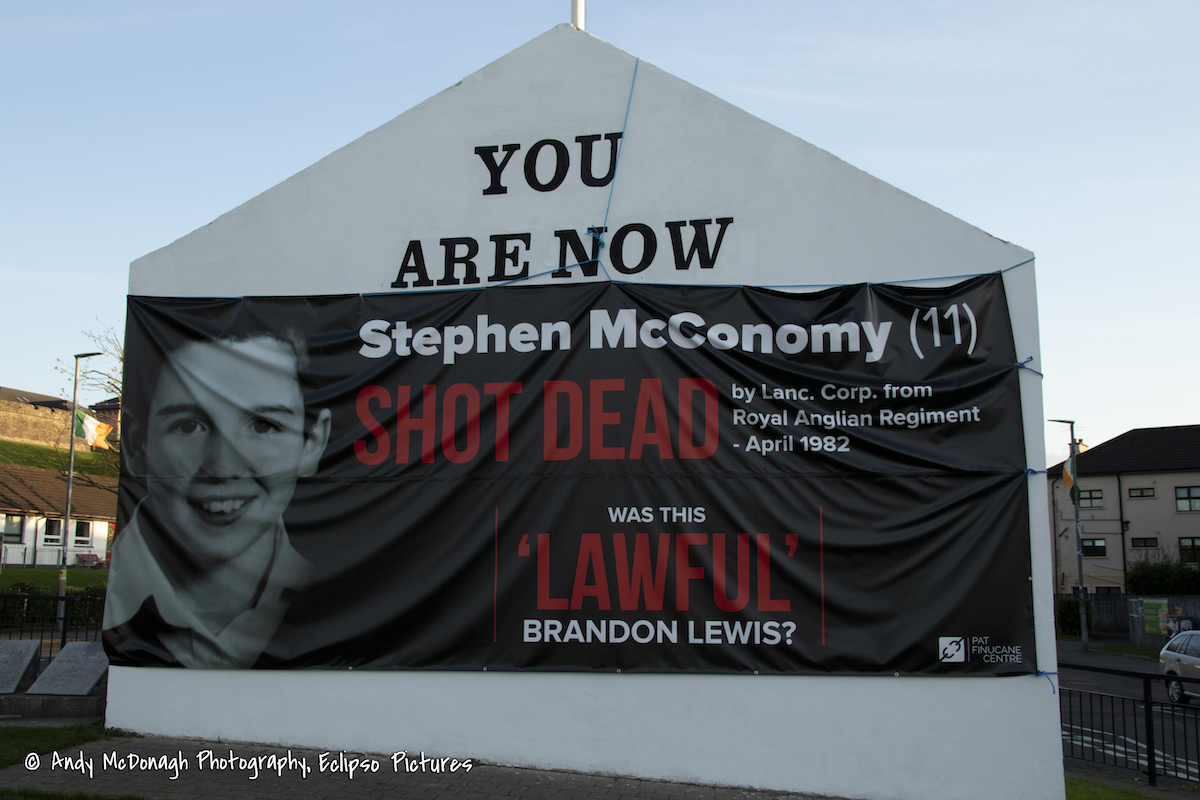
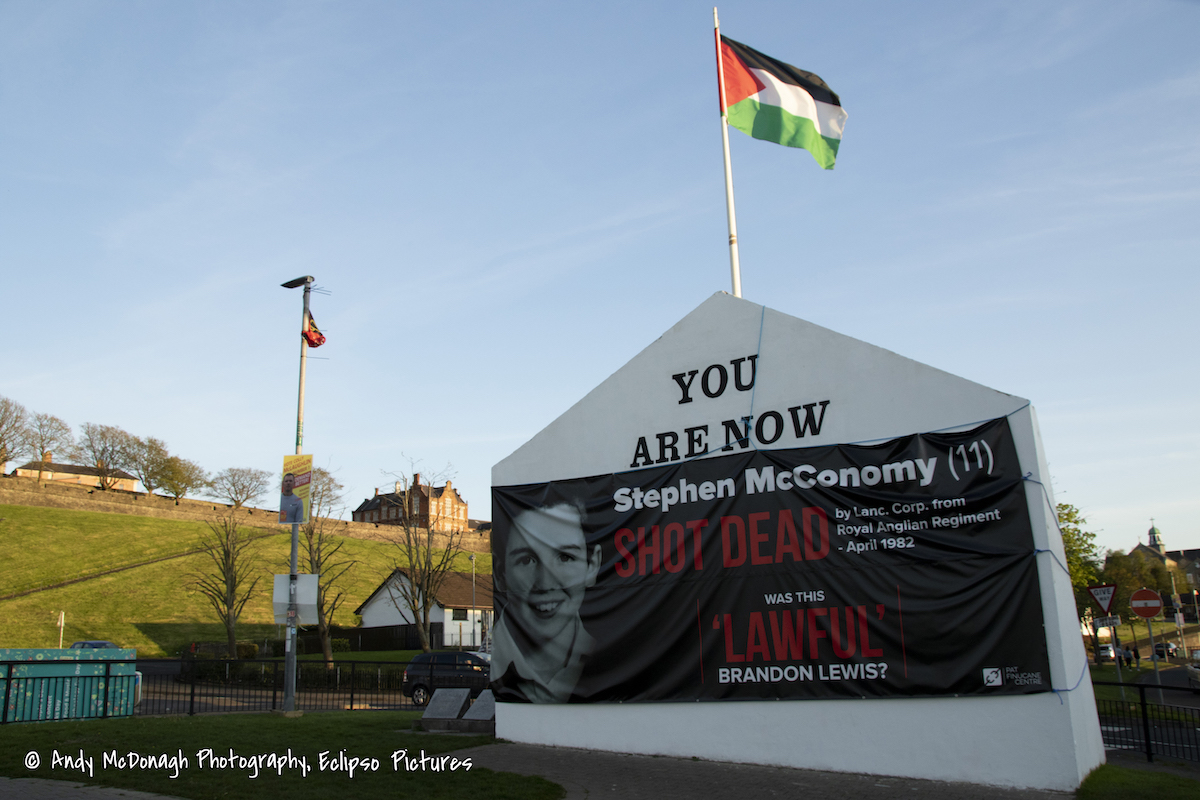
A 2021 command paper that proposed a statue of limitations and amnesty for so-called “legacy” killings included the claim that ‘the vast majority of security force killings were lawful’ (BelTel) and the comment has been attributed to NI Secretary Brandon Lewis (Pat Finucane Centre). (For background see e.g. this eamonnmallie.com piece.) The claim is used against him in this tarp commemorating Stephen McConomy was hit by a plastic bullet forty years ago this month, on April 16th, and died three days later: “Stephen McConomy (11) shot dead by Lanc. Corp. from Royal Anglian Regiment – April 1982. Was this ‘lawful’, Brandon Lewis?” Speaking at the memorial service, surviving family-members vowed to continue resisting the proposed limitations (Derry Journal).
This mural – which perhaps memorialises the RUC in particular – has evidently been rolling since 1984 and the two different styles of house and brick (in the image below) explain its longevity – it’s in a narrow alley between two different stages of construction on Sydney Street West, initially to where the old Harrybrook Street used to be and then extended out to Snugville Street.
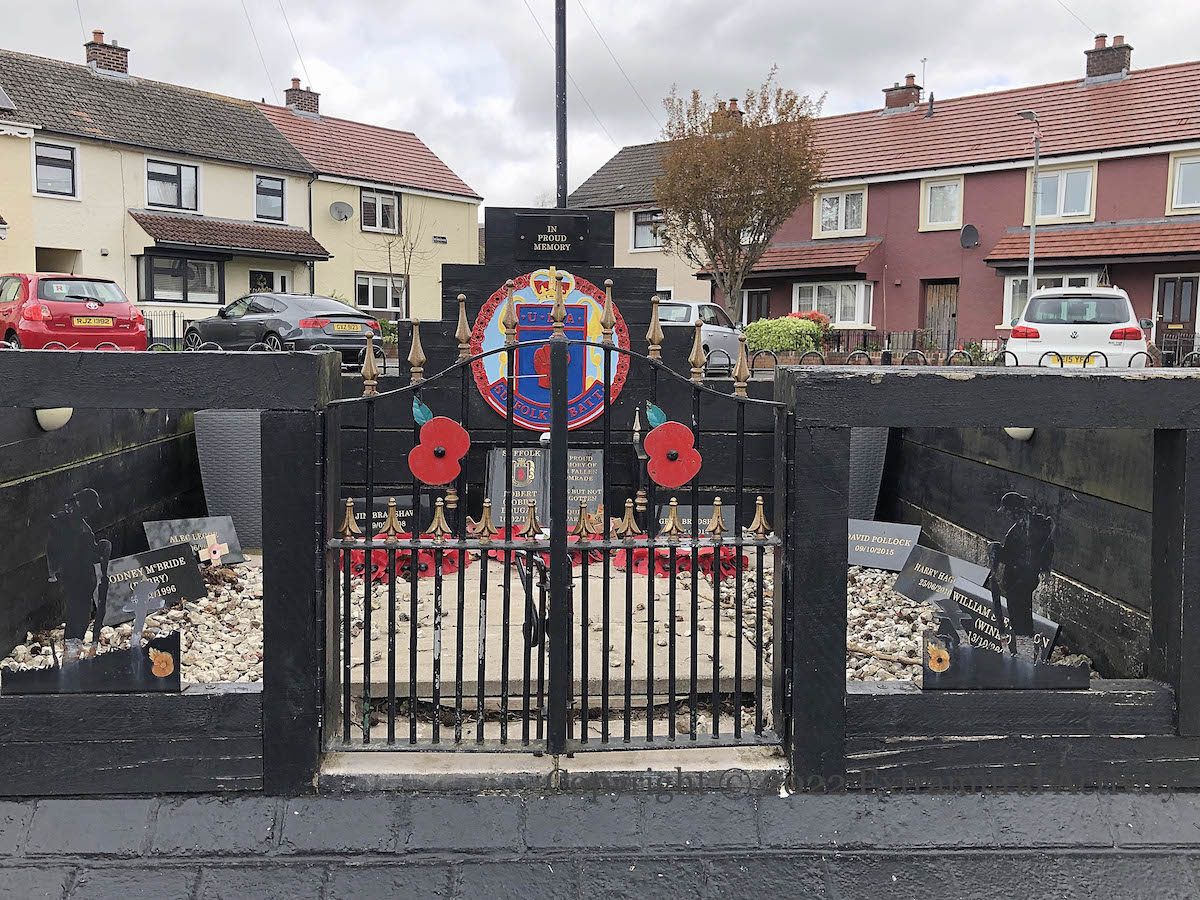
Robert Dougan was commander of the UDA South Belfast Brigade and lived Oranmore Drive (BelTel). He was killed by the IRA on February 10th, 1998 while sitting in a car outside Balmoral Textiles in Dunmurry, which led to a month-long expulsion of Sinn Féin from the peace talks taking place at the time (L.A. Times); two months later the Good Friday Agreement was signed. There had been attempts on his life in 1993 and 1994 (Irish Times).
The plaques, from left to right, are to Rodney McBride (1996), Alec Legge (2007), Jim Bradshaw (2008), Robert Dougan (1998), Greg Bradshaw (2014), David Pollock (2015). Harry Haggan (2010), William Stevenson (2008).
Tildarg Avenue. There is a mural to Dougan on Sandy Row – see Everyone’s Friend.
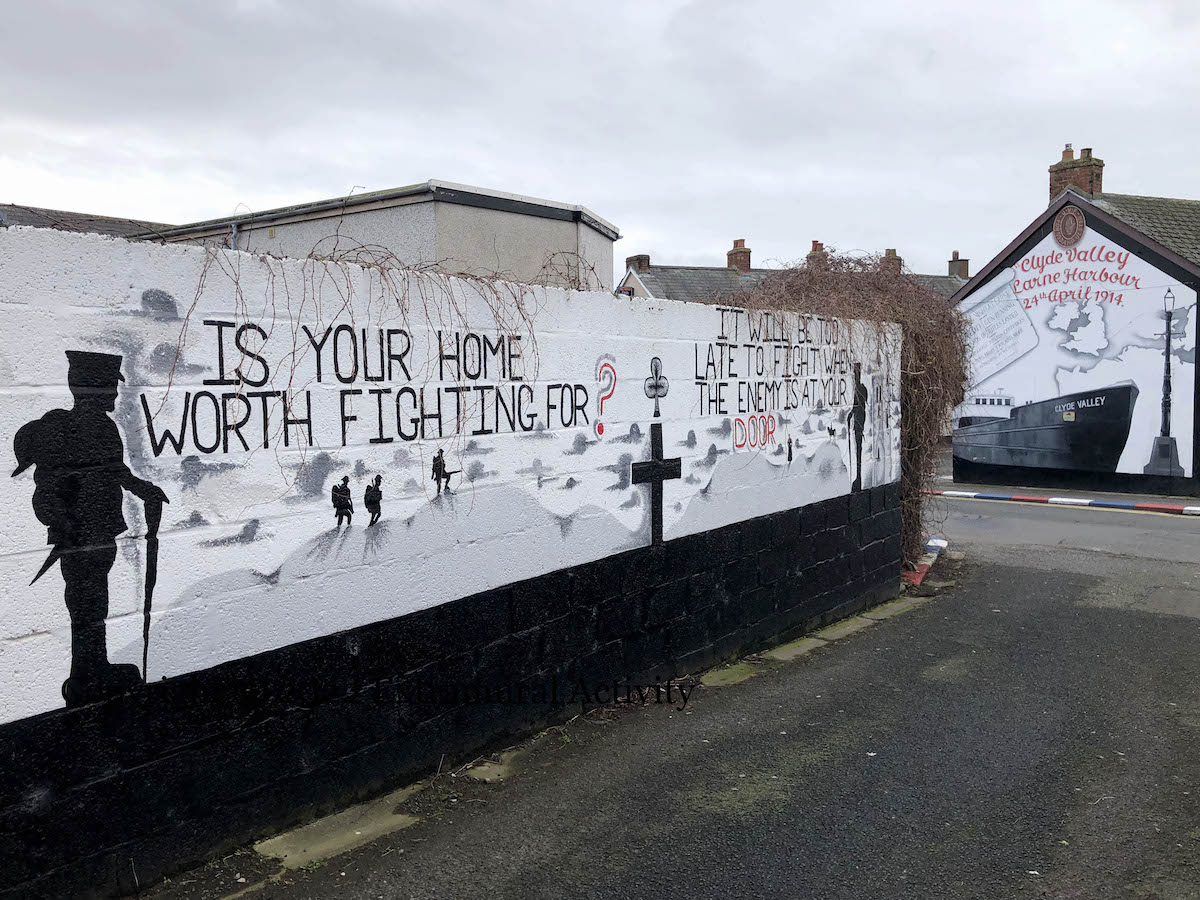
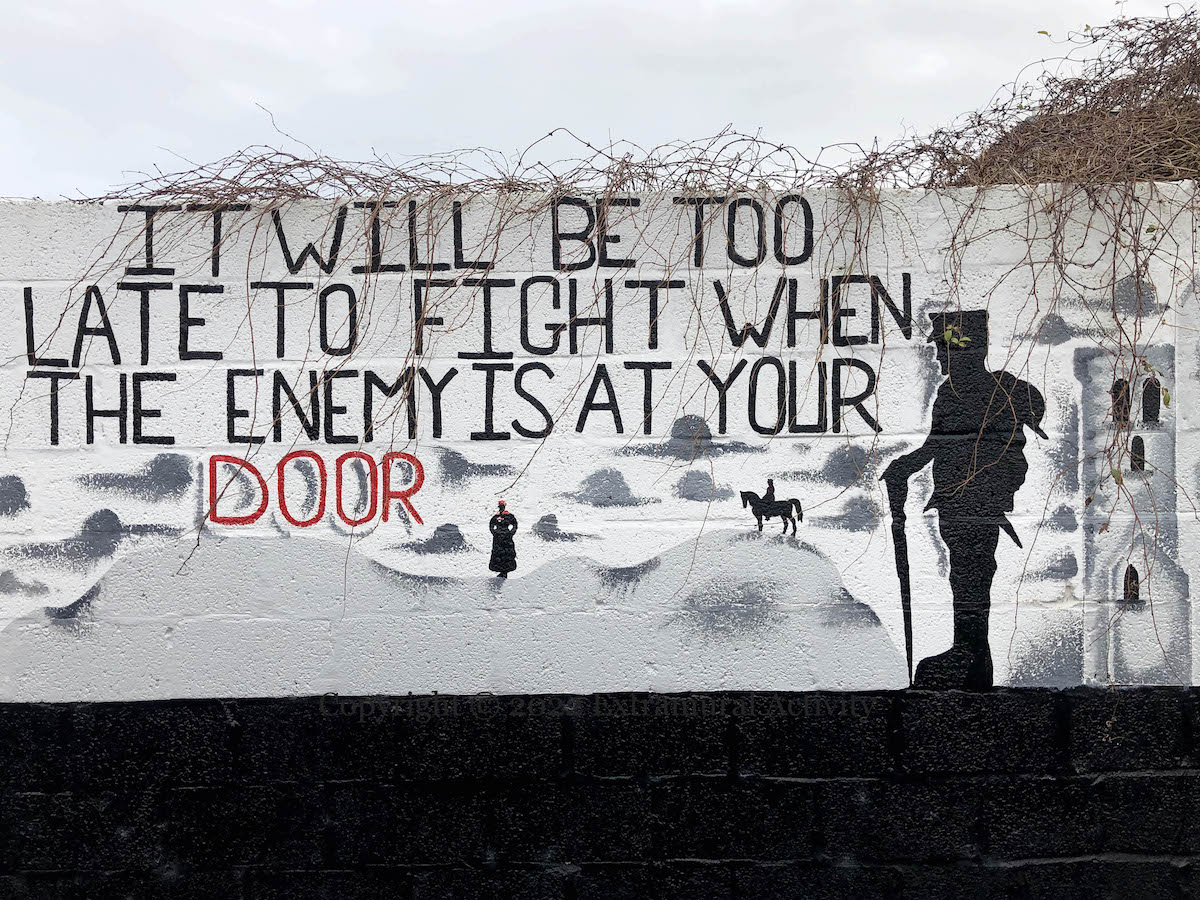
“… It will be too late to fight when the enemy is at your door.” In 1914, at the time of the Larne gun-running – see the mural in the second image and (previously) Amazing Night At Larne – the enemy was the threat of Home Rule and its enforcement by British Army forces and RIC that would remain under British control for at least three years after the commencement of home rule (Home Rule And Ulster’s Resistance p. 9). A bill to amend home rule by excluding some or all of the Ulster counties was introduced in July, 1914 (WP), but both Home Rule and the amendment were put aside when the Great War began; the enemy of Unionists then became the Central Powers. The contemporary enemy is the NI Protocol and Brexit, with the powers in Westminster again suggesting a separation of Britain and (Northern) Ireland.
Walker Clubs – one of the associated clubs of the Apprentice Boys – are named for George Walker, joint Governor of Derry (with Lundy) during the siege, who died at the Boyne, on July 1st/12th, 1690 while going to the aid of the Duke Of Schomberg. In the centre is the crest of Londonderry: “Vita, veritas, victoria“.
This board in Larne’s ‘Factory’ districts shows, (clockwise from bottom left): the apprentice boysshutting the gates, the breaking of the boom to relieve the siege, Walker (who was also an Anglican priest) inciting the apprentice boys to shut the gates with a cry of “No surrender”, and, clasped hands signifying the connection between Larne Walker Club (Fb) and Maybole Walker Club in South Ayrshire, Scotland. A list of all the Walker Clubs can be found at ABOD.
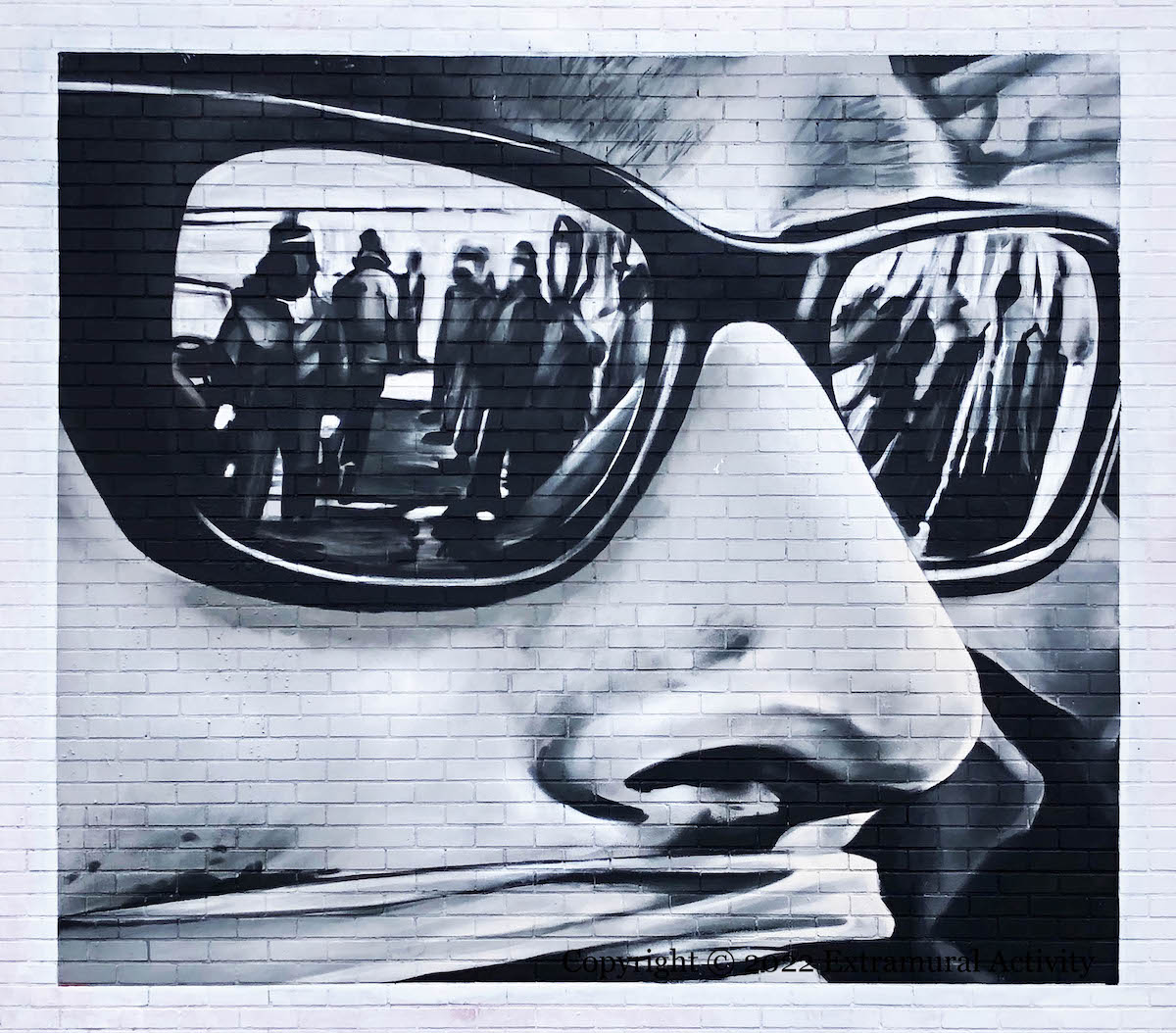
Perhaps because of the Covid pandemic, this mural of UDA volunteers on parade reflected in the sunglasses of one of their comrades took months to complete (it was started in late 2020 and was still unfinished last summer). It replaces the previous “UFF Formed 1973” mural – see Northern Island.
The photograph reproduced is from the 1974 Ulster Workers’ Strike; it appeared on the cover of Don Anderson’s Fourteen May Days (CAIN).












 Extramural Activity