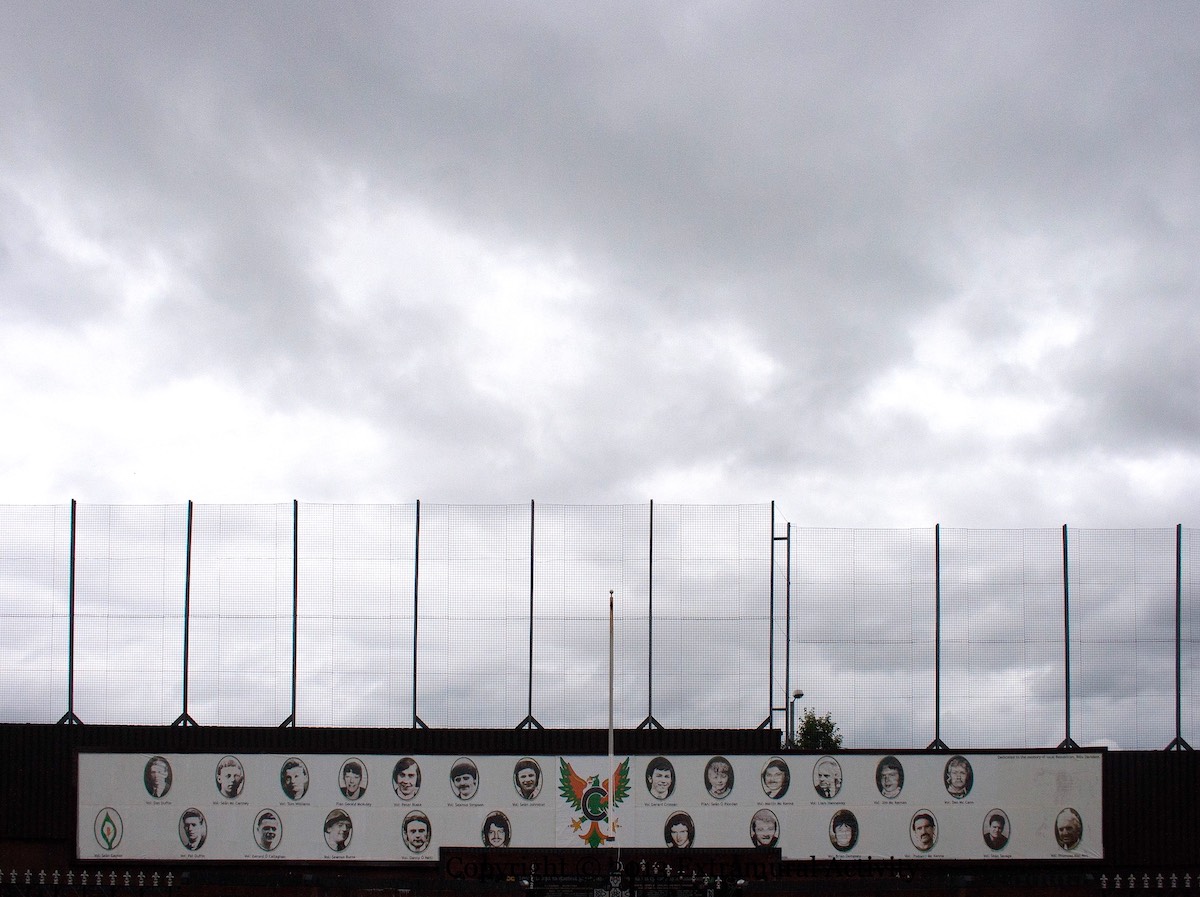
The back wall of Clonard Martyrs Memorial Garden – that is, the so-called “peace” line – is decorated with portraits of twenty-five local óglaıgh and fıanna who died from 1920 to 1992 (though an Easter lily takes the place of Sean Gaynor on the far left).
Left: Dan Duffin, Seán McCartney, Tom Williams, Gerard McAuley, Peter Blake, Seamus Simpson, Seán Johnston, Seán Gaynor, Pat Duffin, Gerard Ó Callaghan, Seamus Burns, Danny Ó Neill, Tom McCann.
Right: Gerard Crossan, Seán Ó Riordan, Martin McKenna, Liam Hannaway, Jim McKernan, Dan McCann, “dedicated to the memory of local republican, Billy Davidson”, Tony Lewis, Joe McKenna, Brian Dempsey, Finbarr McKenna, Seán Savage, Prionsais Mac Áirt.
They are also listed on one of the plaques inside the garden – see the second images in Clonard Martyrs.
The gable wall at the end of Columbia Street (on Ohio Street) has been rebuilt and the old WDA/Duke Elliott mural has been replaced. Above is the right side of the piece, which describes the transition from the Woodvale Defence Association to the Ulster Defence Association to the Ulster Freedom Fighters, and grounds all three in the Ulster Defence union of 1893.
In the second image, below, Ewart’s mill, on the Ardoyne side of the Crumlin Rd, can be seen in the background. From the WP page on the Crumlin Rd … “The mill was built for William Ewart, a cotton trader and politician who switched his interests to the production of linen, which at the time became the leading industry in the city. During the Second World War the mill was converted from the production of linen to the manufacture of munitions.” There is a statue diagonally across the street (at the corner of Cambrai and Crumlin Roads) of a millworker.
In 1971 in order to combat an increasingly aggressive republican movement, the WDA amalgamated with a number of other defence groups in form the UDA. This ensured a more organised and coherent response to the onslaught faced by the citizens of Northern Ireland.
The UFF was established in 1973 to take the war to republicanism. With tenacity, courage and resilience the members of the UFF distinguished themselves in battle by striking at the very heart of republican movement and ensuring that the attacks faced by their community didn’t go unanswered.
2013: The genesis of these groups can be traced right back to the formation of the UDU in 1893. Formed to resist Home Rule in the late 19th and 20th centuries, the UDU adapted the motto Quis Separabit. This motto was used by ulster defenders throughout the period known as “the troubles”.
Poster from the 1916 Societies (Fb), specifically the West Belfast Joe McKelvey Society, named after the anti-treaty IRA commander (WP). (There is also a society named after McKelvey in his home town of Stewartstown, Co Tyrone. (Fb)) The flag (shown below) is in the Republican Museum, Conway Mill.
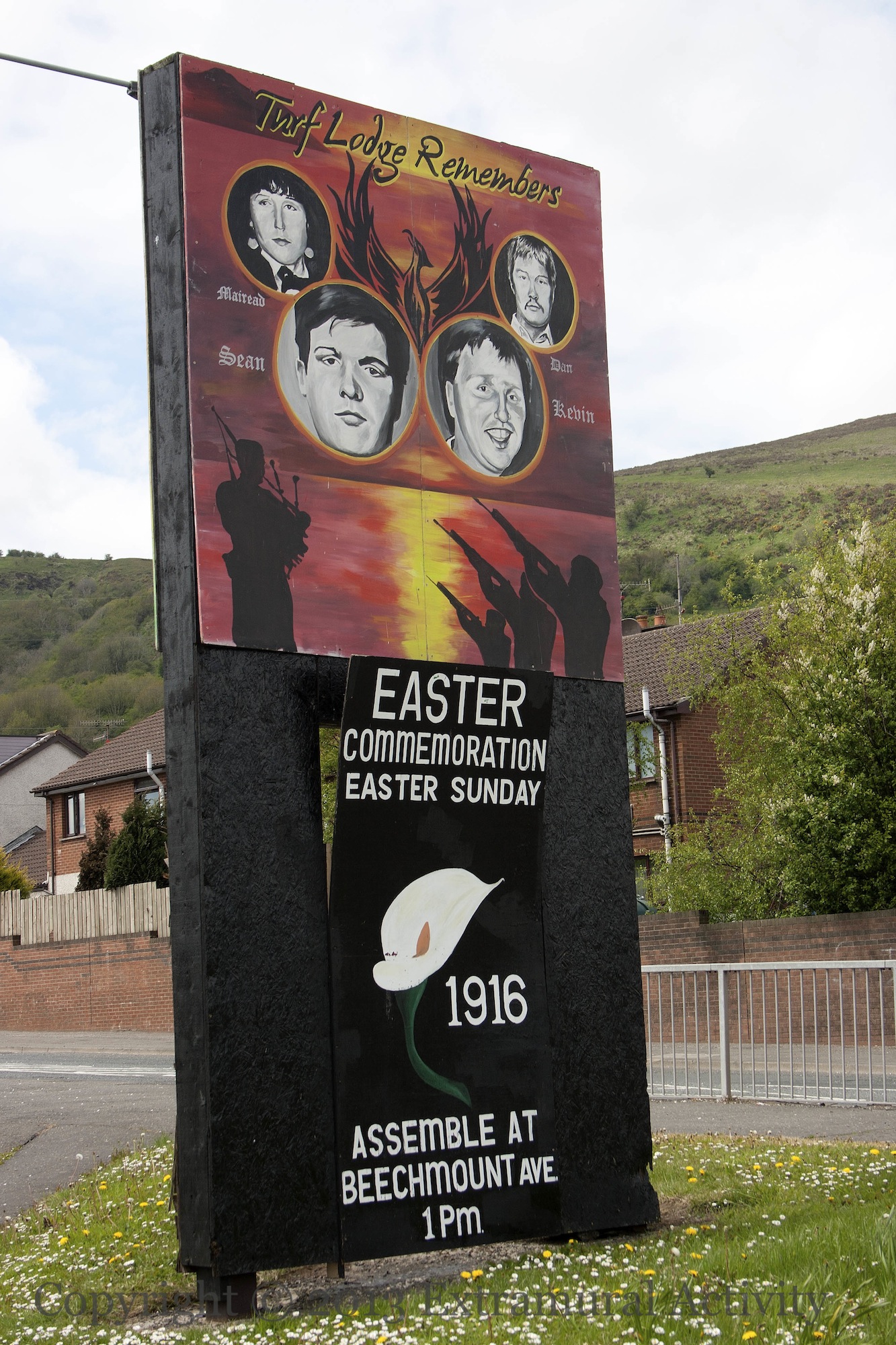
The eastern side of the H-Block ‘H’ at the top of Monagh Road as it was in May, 2013, with a board in memory of the Gibraltar three (Dan, Mairead, Sean ) and another volunteer killed a few days later (Kevin) (for background, see both 25 Years In Progress | Completed) and announcing an Easter Sunday rally commemorating the 1916 Rising.
The brothers in question are Raymond and Brian McCreesh, from Camlough, Co Armagh. Raymond is third in the list of the ten deceased 1981 hunger strikers. “In memory of the volunteers who died on hunger strike in H-Blocks 1981.” “H-Block is rock that the British monster shall perish upon for we in H-Block stand upon the unconquerable rock of the Irish socialist republic – Bobby Sands”.
The lower stone reads “These men made the supreme sacrifice for their country by dying on hunger strike from 1917 to 1976: 1917 Thomas Ashe; 1920 Michael Fitzgerald, Joseph Murphy, Terence McSwiney; 1923 Joseph Whitty, Denis Barry, Andy Sullivan; 1940 Tony Darcy Sean McNeela; 1946 Sean McCaughey; 1974 Michael Gaughan; 1976 Frank Stagg. “It is not those who can inflict the most but those that can suffer the most who will conquer” – Terence McSwiney.”
This is an Éırígí (web) stencil in support of their member Stephen Murney, who was arrested in November (2012) and subsequently transferred to Maghaberry on charges of supporting terrorism.
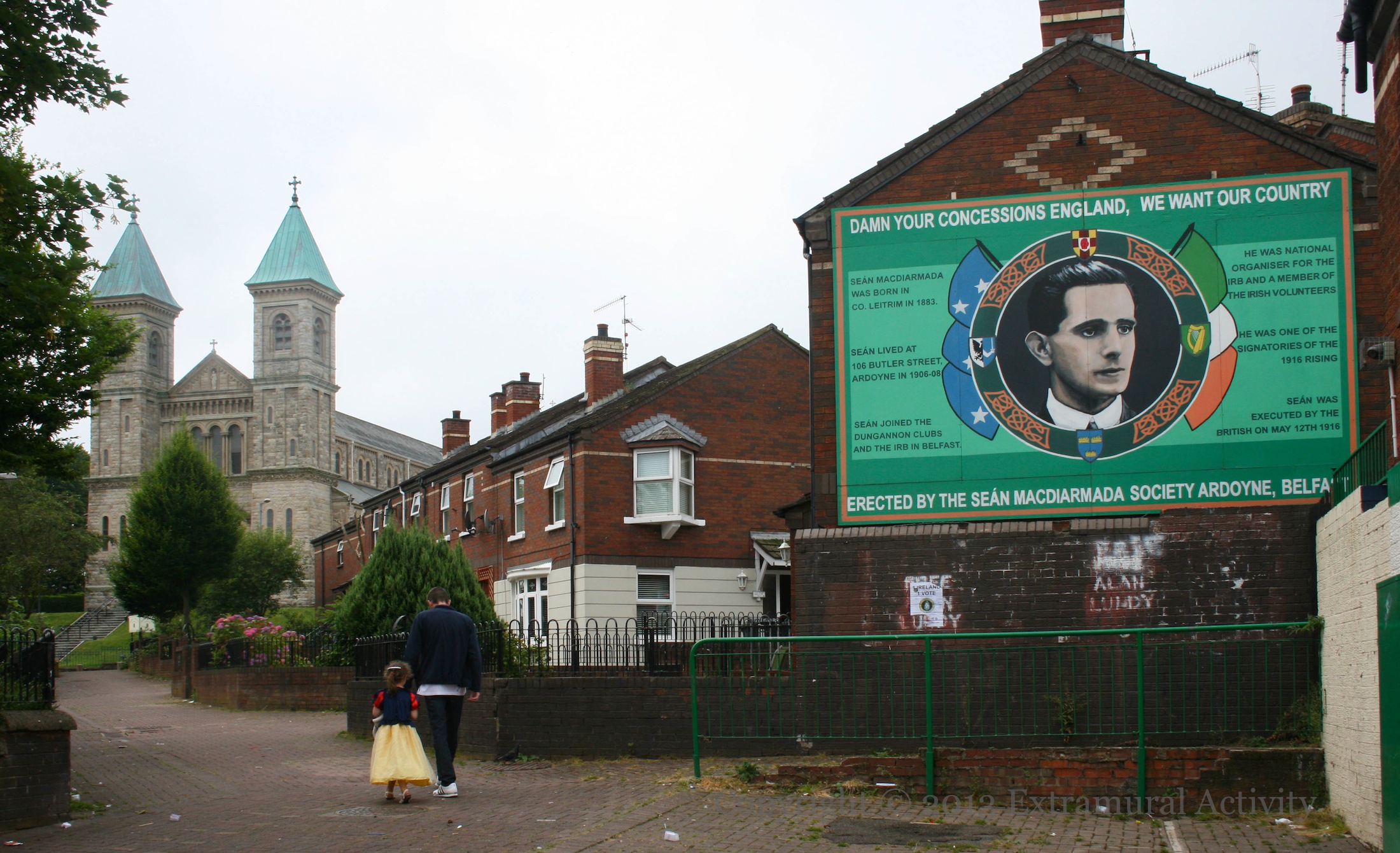
This board to Seán Mac Dıarmada in Ardoyne details his exploits leading up to and including the 1916 uprising and his earlier connection with the local area.
Below, a wide shot showing the end of Butler Walk and the Holy Cross church in the background. Painted by Rısteard ÓMurchú.
“This memorable [sic] plague [sic] is dedicated to the 1st victim of the present troubles, Sammy McLarnon, RIP, who was brutally murdered in his own home at 37 Herbert St by the RUC on 15th Aug., 1969.” For more, see this Irish Times article about a 1999 community inquest.
On the wider wall is the graffito “Cara don’t represent me”.
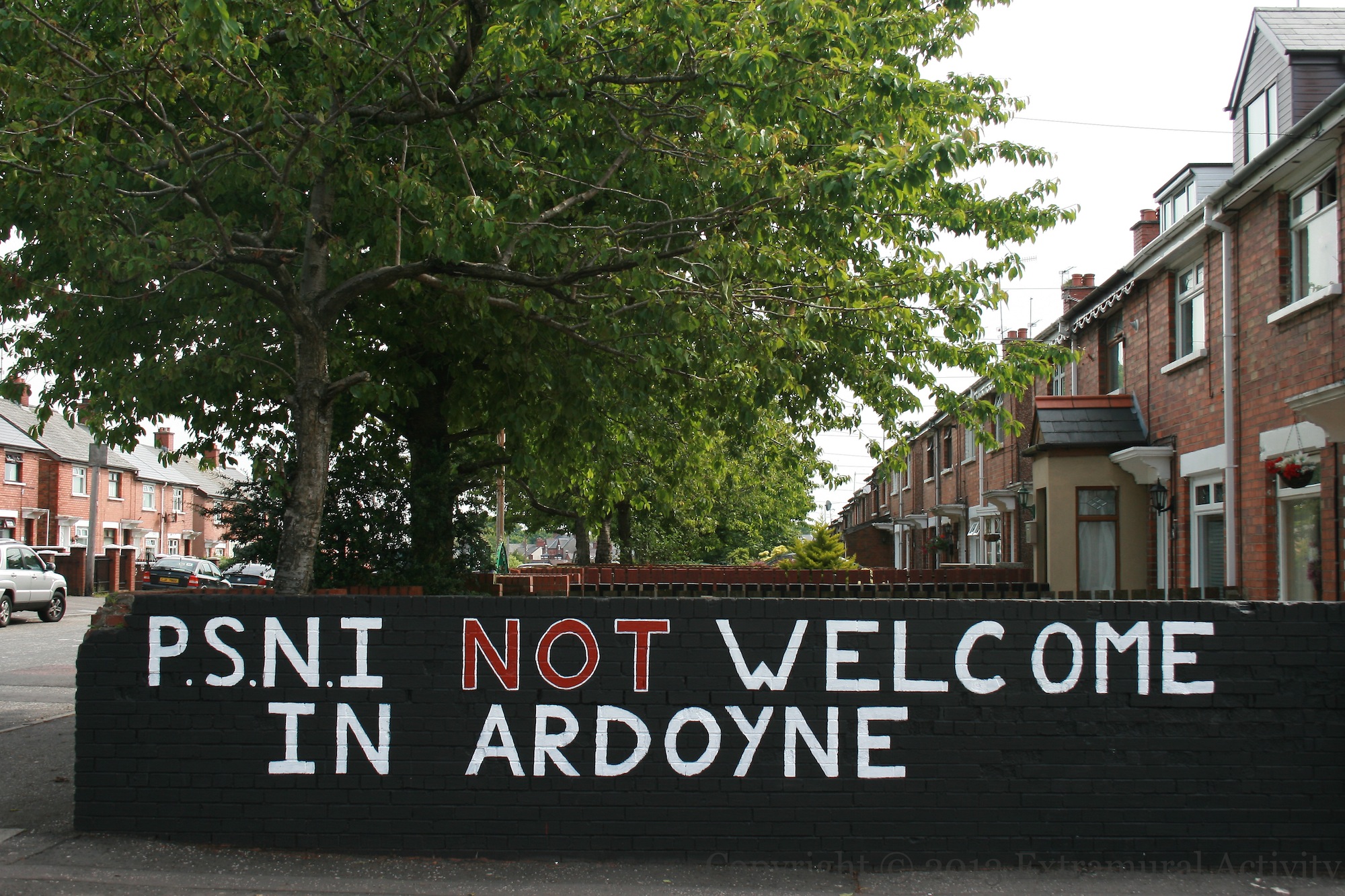
Painted signage at the north end of Berwick Road/Paráıd An Ardghleanna in Ardoyne/Ard Eoın (next to the Maıréad Farrell piece featured previously): “P.S.N.I. not welcome in Ardoyne”.
UVF flags are still flying in east Belfast (see previously for the controversy) and the advertising hoarding above the mural on the corner of Carrington Street again provides an interesting juxtaposition with the mural below.







 Extramural Activity