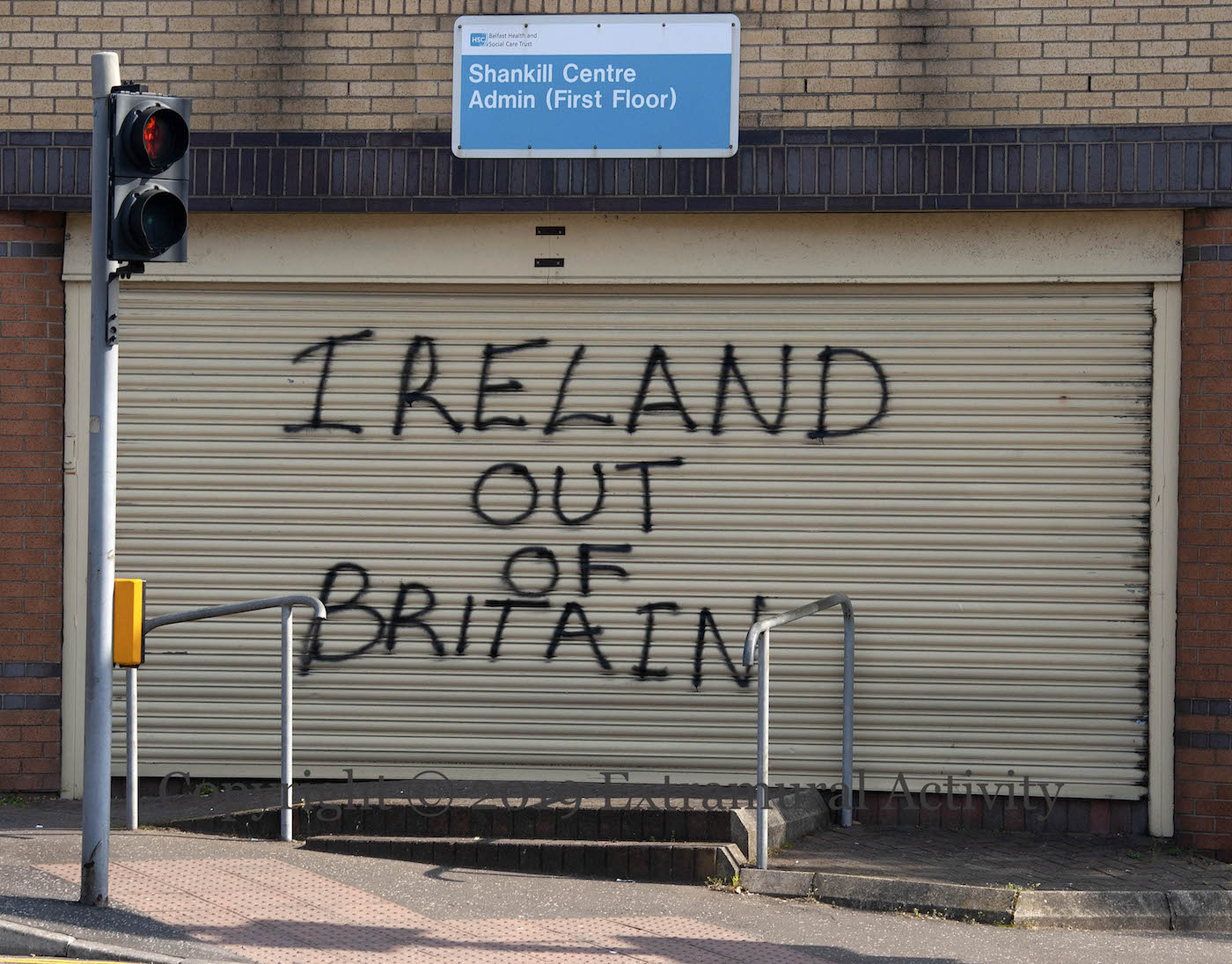
Sınn Féın leader Mary Lou McDonald drew criticism for appearing behind an “England get out of Ireland” banner at the St Patrick’s day parade in New York city (BBC-NI). This Shankill Road graffiti reverses the sentiment (replacing “Britain” with “England”), commenting perhaps on the difficulty the Northern Ireland border poses for the UK’s attempt to exit the European Union.
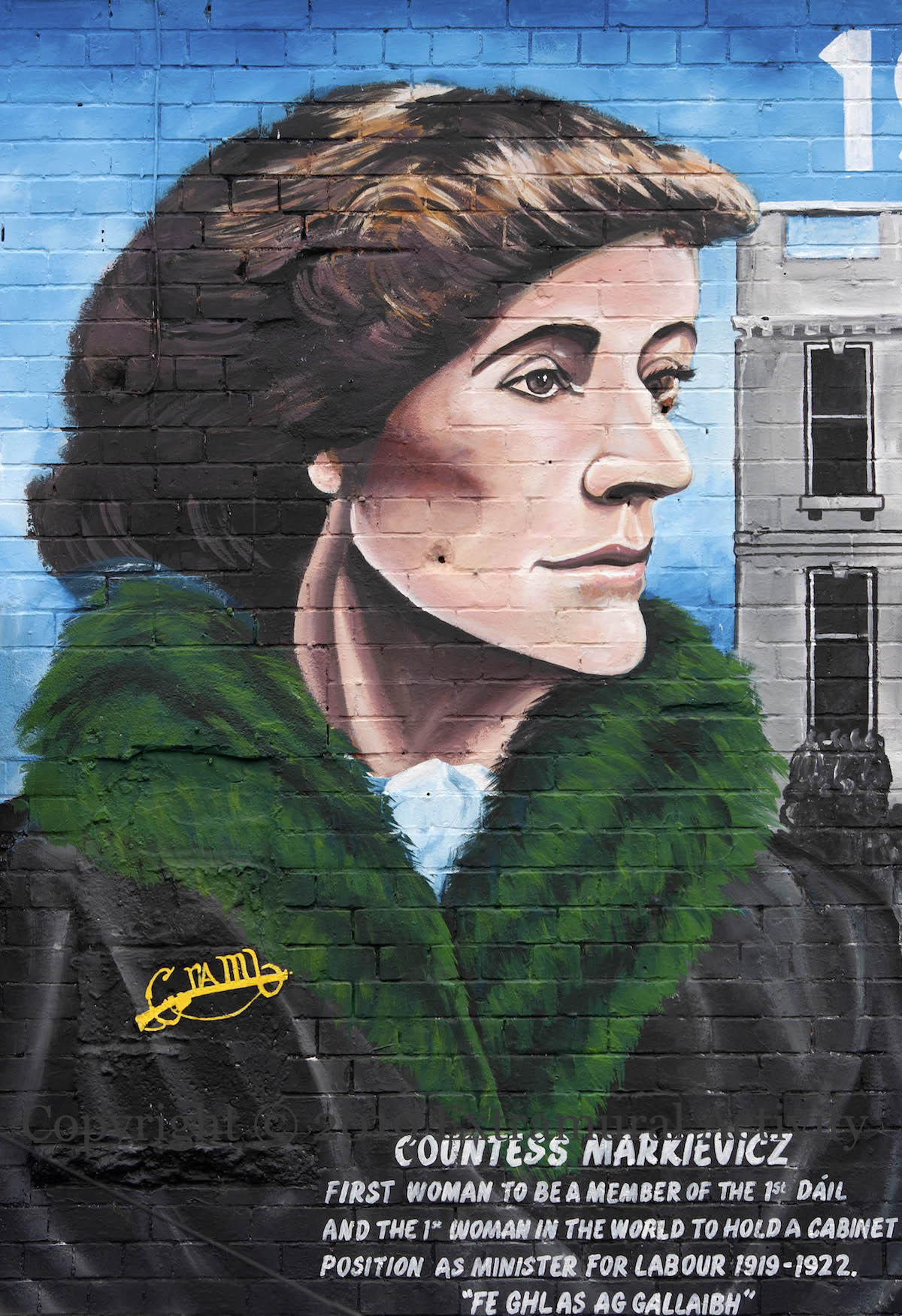
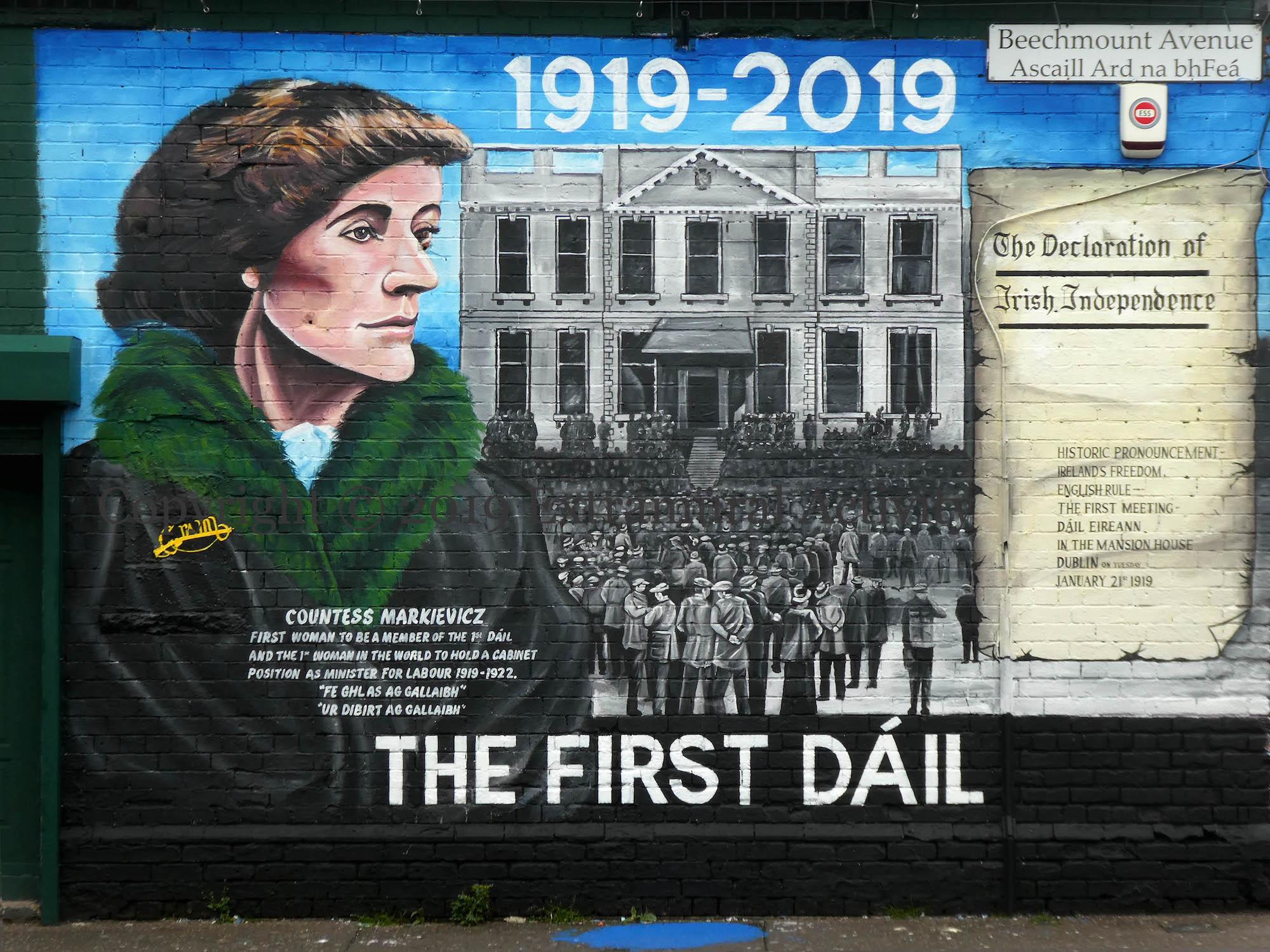
“Countess Markievicz – first woman to be a member of the 1st Dáıl and the 1st woman in the world to hold a cabinet position as minister for labour 1919-1922.” Markievicz is shown here in civilian garb with a Cumann na mBan pin – compare with the previous mural celebrating the centenary of CnamB. The first Dáil Éireann met in the Round Room of the Mansion House in Dublin (residence of the Lord Mayor) on January 21st, 1919. 35 Sinn Féin deputies – including Markievicz – were absent because they were “fé ghlas ag Gallaıbh” (“imprisoned by foreigners”) and four more “ar díbırt ag Gallaıbh” (deported by foreigners); Unionist members including Edward Carson did not attend (The Irish Story). Among its business was the adoption of a Declaration Of Irish Independence (title page shown on the right).
The photograph reproduced is of the crowd awaiting news of a truce in the War Of Independence in July 1921 (WP).
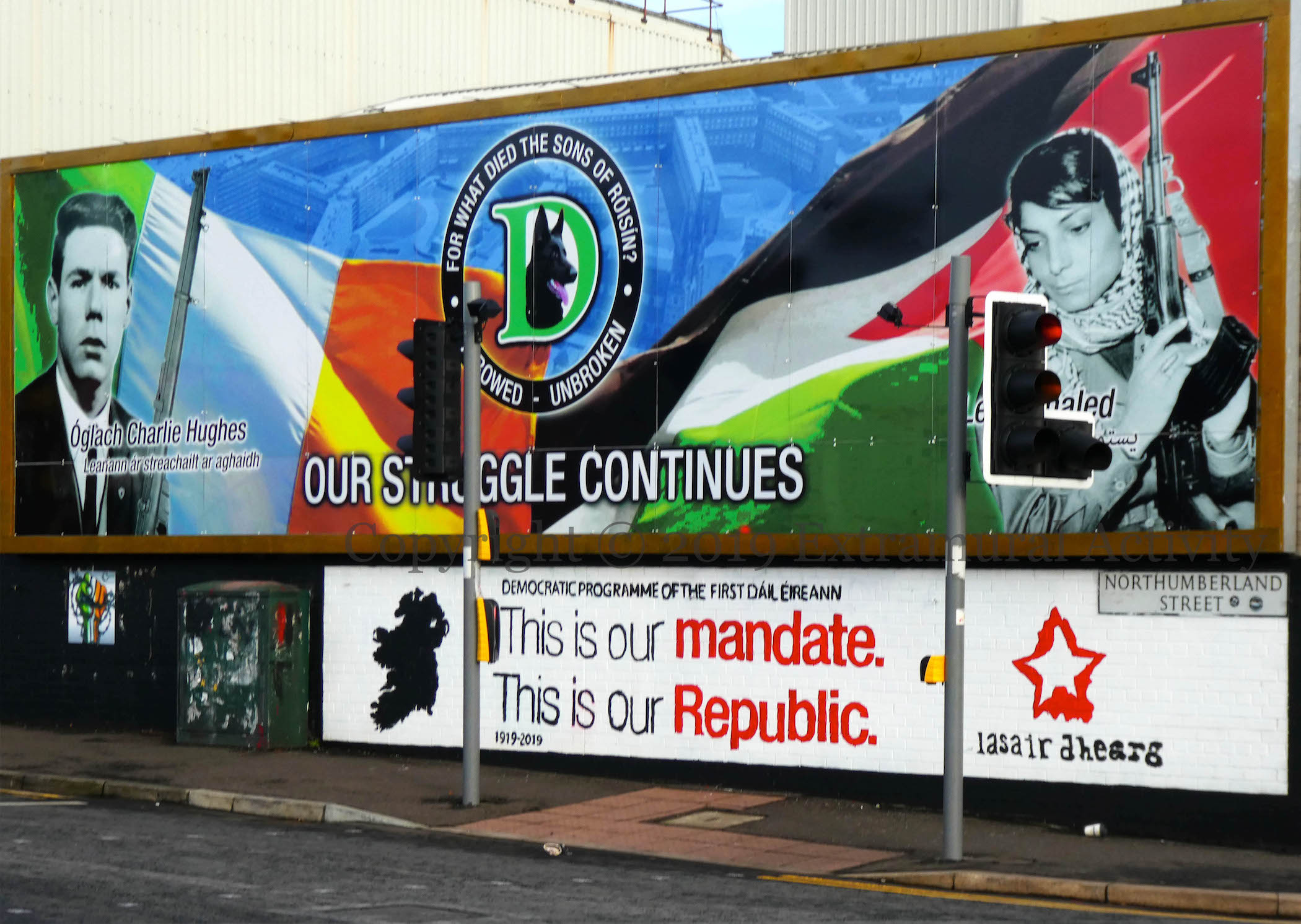
Sınn Féın won 73 of 105 seats in the Westminster election of 1918. Instead of taking their seats, they formed an independent Dáıl Éıreann, meeting for the first time on January 21st, 1919, in Dublin. On the same date, Irish Volunteers in Soloheadbeg, Tipperary, ambushed a convoy of gelignite, escorted by two RIC police, both of whom were killed – this attack would mark the opening of the War Of Independence. This new stencil by Lasaır Dhearg (web | tw) aims to promote the Democratic programme of the first Dáıl Éıreann. This is our mandate. This is our Republic.” beginning with the Proclamation of the Easter Rising.
The Union Flag/UVF side-wall is a new addition to the Ulster Volunteers/UVF memorial in London Road, east Belfast. The main panel shows WWI soldiers going over the top (see Between The Crosses) while the four portraits to its right are of deceased UVF volunteers of the 70s and 80s – Seymour, Long, Cordner, and Bennett – (see Ulster’s Brave).
In this grotesque image, a monk’s head serves as an instrument of the devil – a Reformation criticism of the Catholic church. The woodcut dates to c. 1530. The ogham script in the bottom pair of posters, which reads “Fucc [sic – there is no “k”] the DUP”, is not included in the original (British Museum). The modern reinterpretation is by TLO (ornamentalhermit.org). The ogham on the devil’s arm is unclear; it appears to read “cussfbelung” – comment if you can help.
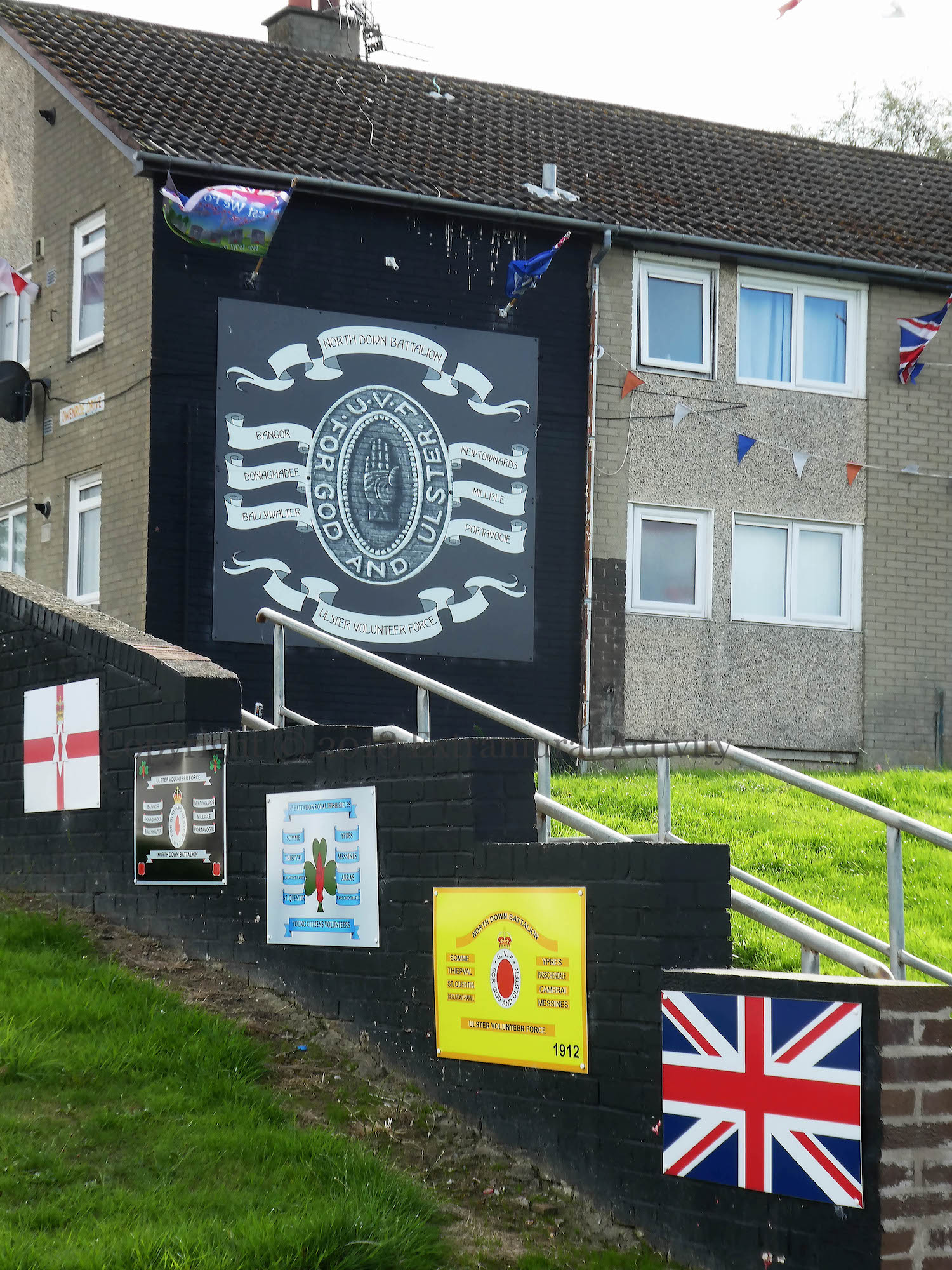
The yellow board in the foreground lists battles of the North Down Battalion in World War I (for a description of the battalion, see the previous 2017 post). Added to that since then is a large black-and-white board to the modern Ulster Volunteer Force and its divisions: Bangor, Donaghadee, Ballywalter, Newtownards, Millisle, and Portavogie. (It’s worth noting that although this is a board, the UVF emblem in the middle is depicted as having been painted on a brick wall, indicating a preference for old-school muraling.)
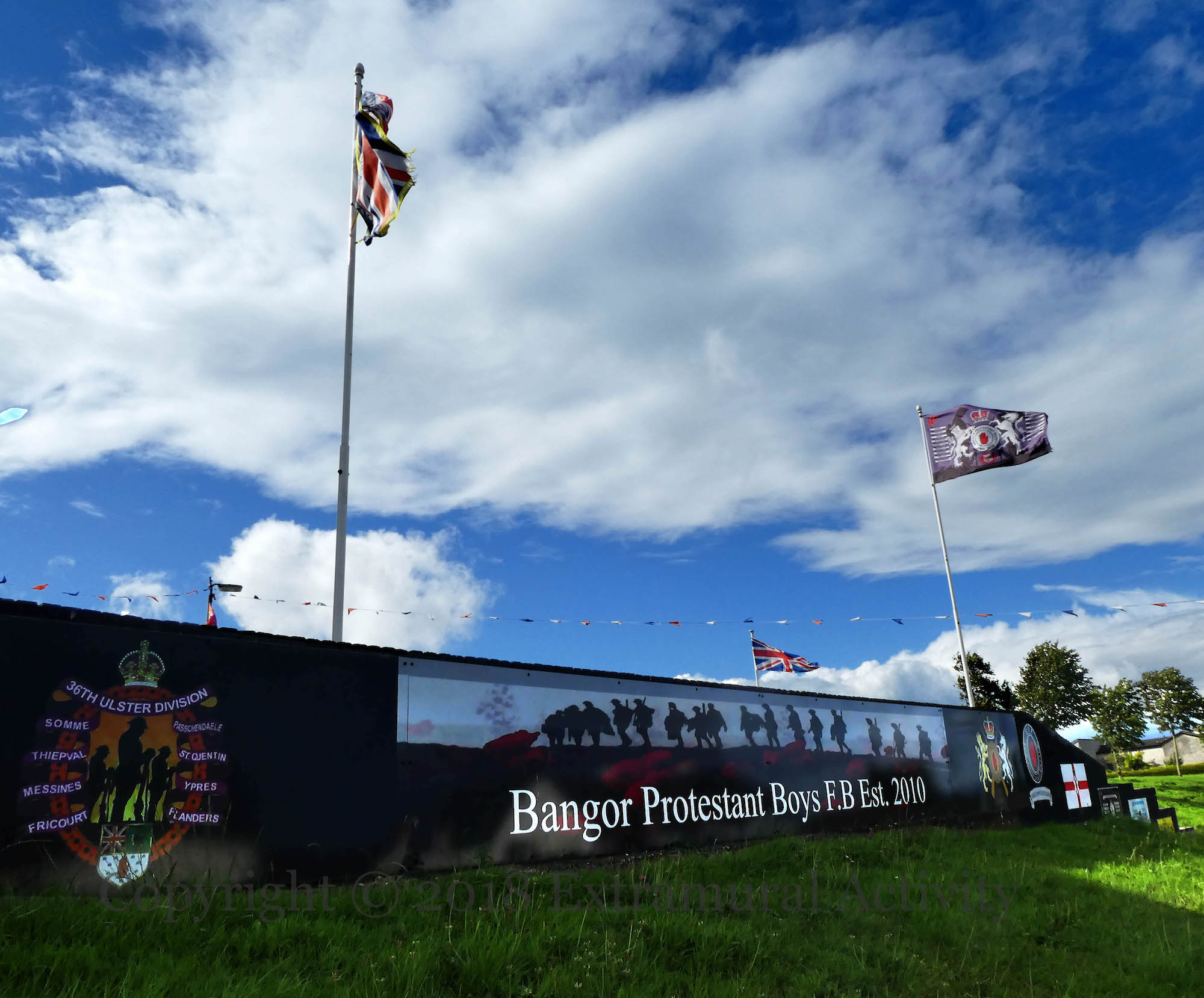
Below is a shot of the rest of the low wall, with Bangor Protestant Boys Flute Band (previously seen in 2017). Owenroe Drive, Bangor.
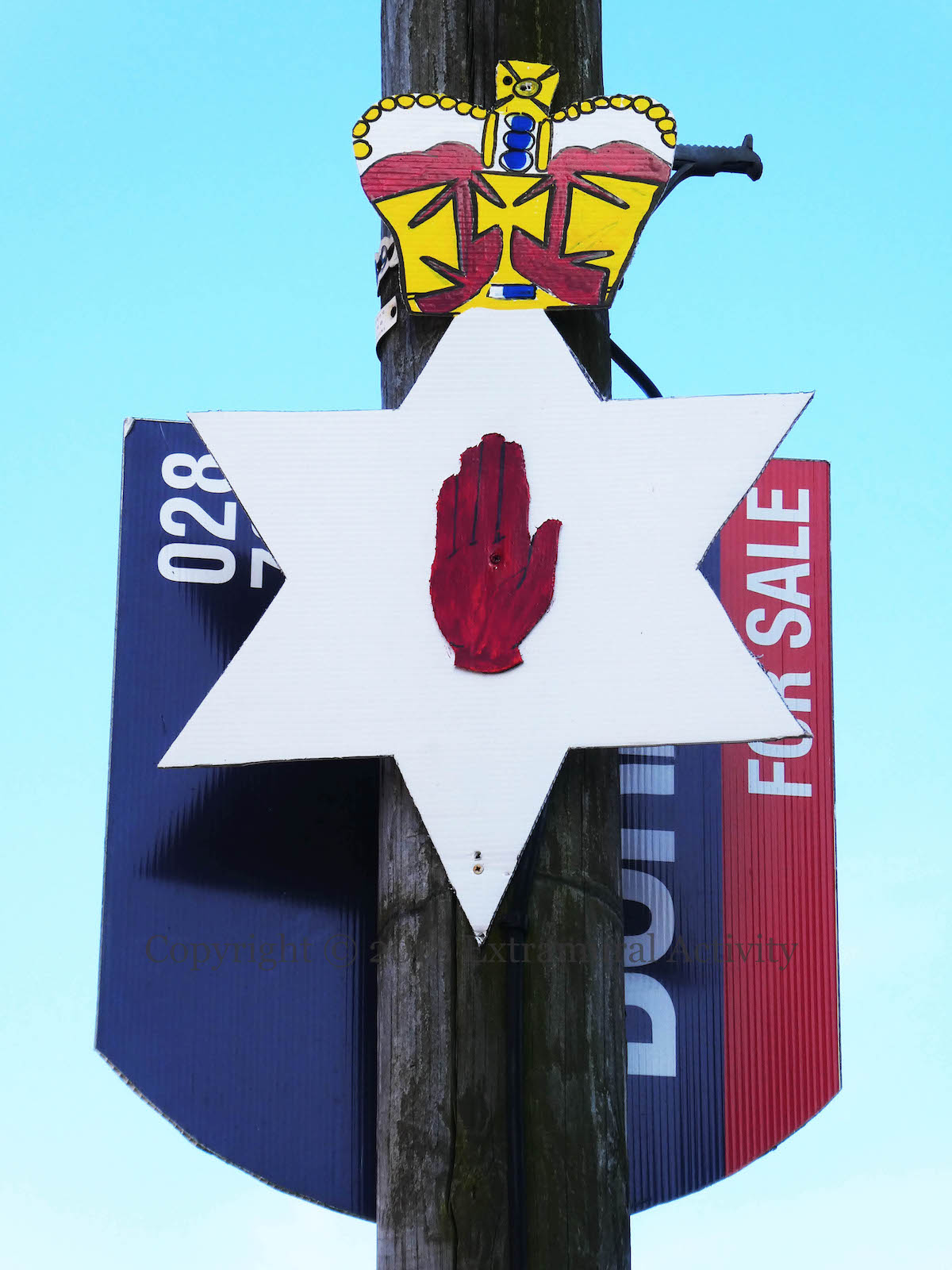
Use whatever you can find to express your identity: re-purpose the placards of capitalism, grab a pair of scissors and cut, draw the outline of your hand with a felt-tip pen.
John 15:13 reads “Greater love hath no man than this: to lay down his life for his friends.” Fighting in the Great War ceased at 11 a.m. on November 11th, 1918, after approximately 10 million military deaths, 10 million civilian deaths, and another 20 million injured.
It’s still anybody’s guess as to how Brexit will happen in March, 2019. This week, the ball is in the court of the hard-Brexiteers as they decide whether or not to challenge Theresa May’s leadership of the Conservative Party. Political parties in Northern Ireland claim to be “fighting” for their side – such as this Sinn Féin board on Falls Road – but in practice this means only looking on with fascination and anxiety. “The fight for rights continues – 1968-2018. Don’t let the DUP/Tories take away your rights through Brexit.”





 Extramural Activity