“The typist with the Webley: Winifred Carney – socialist, republican, freedom fighter, Irish Citizen Army, Cumann Na mBan, suffragist, trade unionist, revolutionary.”
Winifred Carney was a qualified secretary and typist, and became secretary of the Irish Textile Workers’ Union in 1912, in which position she met James Connolly, who was secretary of the Belfast branch of the ITGWU. She was a member of Cumann Na mBan and participated in the Easter Rising of 1916. Carney was in the GPO when it was taken over and was among those who surrendered at the end; during the occupation she typed up dispatches from the Moore Street headquarters – this is how she was portrayed in the the 1916 Centenary mural.
“She hasn’t a sword and she hasn’t a gun. But she’s doing her duty now fighting’s begun.” This entry updates the 2016 entry with details from the board – now almost a decade old – dedicated “To all the women of the Shankill” and highlighting the roles played by women during WWI as nurses and welders and in the Land Army.
The troops in the upper-middle part of the board are shown gathered outside the West Belfast Orange Hall, on the Shankill at Brookmount Street.
outside the Ulster Rangers Supporters Club (Fb) on the Shankill Road
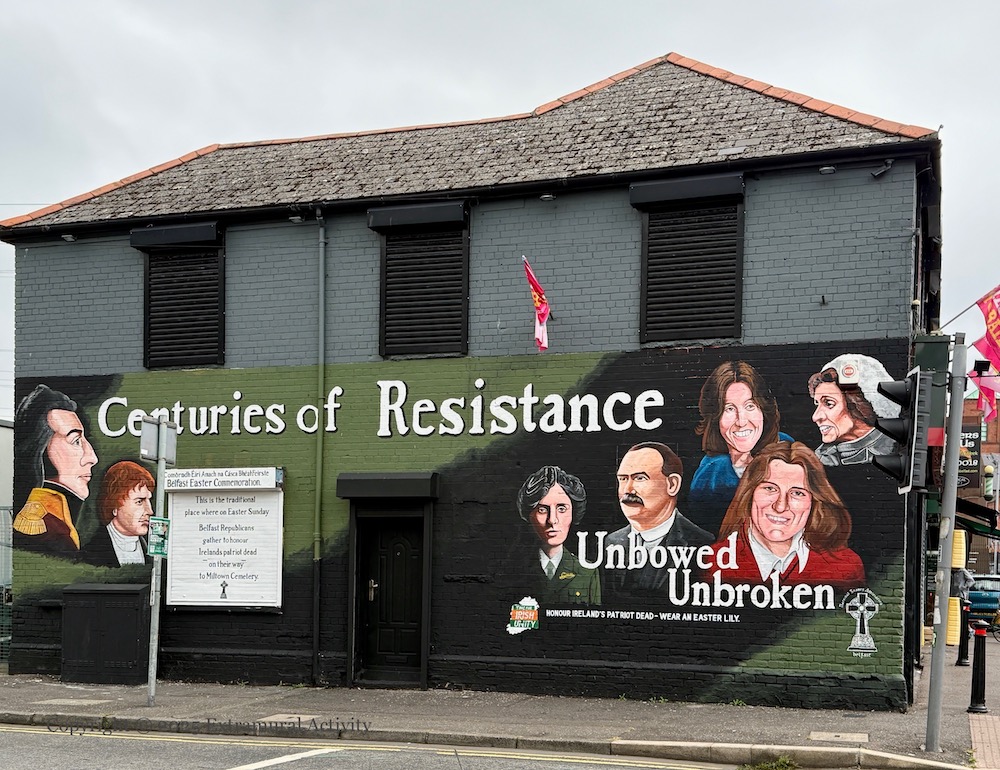
The United Kingdom Of Great Britain And Ireland was created in 1801, a reaction to the 1798 Rebellion, led by (amongst others) Wolfe Tone and Henry Joy McCracken, the pair also being founding members of the Society Of United Irishmen in 1791 in Belfast.
In this mural, Tone and McCracken on the left gaze across the “centuries of resistance” from 1798 to 1916 Rising revolutionaries Countess Markievicz and James Connolly, and beyond to Troubles-era figures Maıréad Farrell, Bobby Sands, and Máıre Drumm.
Around the same time as this mural was painted, a Féıle exhibition called ‘Vibrant Colours, Violent Past’ included A Panorama Of Republicanism which contains dozens of figures but again chooses 1798/Tone, 1916/Connolly, and the Troubles/Martin McGuinness as the pivotal moments and figures.
“Comóradh Éırí Amach Na Cásca Bhéal Feırste/Belfast Easter Commemoration. This is the traditional place where on Easter Sunday Belfast republicans gather to honour Ireland’s patriot dead on their way to Milltown Cemetery.” “Honour Ireland’s patriot dead – wear an Easter lily.” “Unbowed, unbroken.”
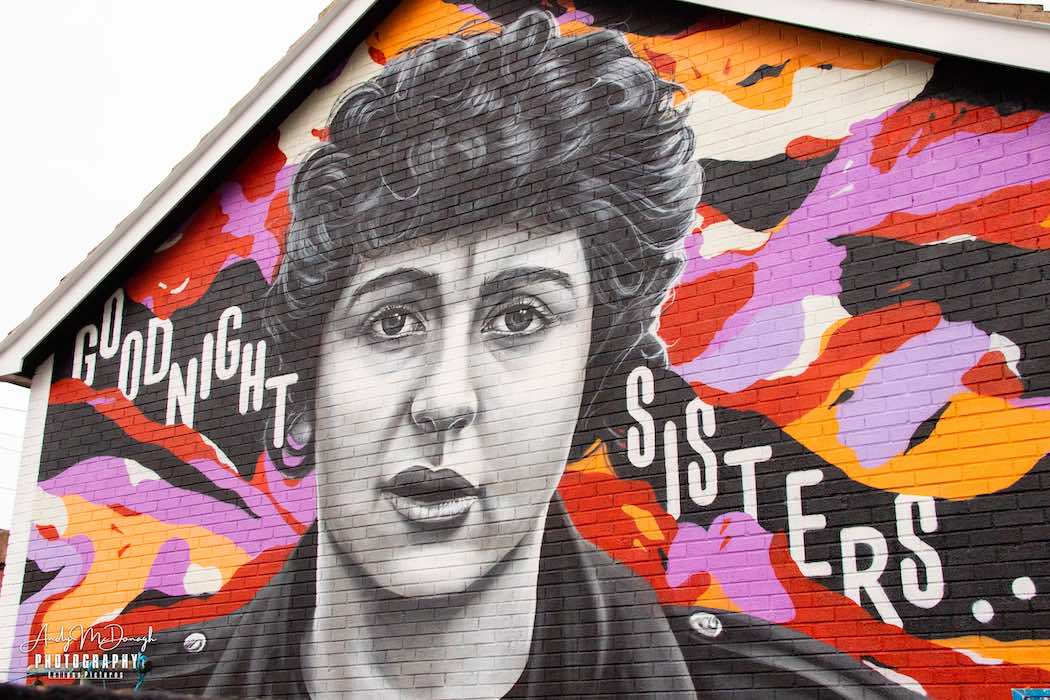
Derry native Nell McCafferty was commemorated by a new mural in the Maiden City, launched on International Women’s Day (March 8th), 2025, and the annual Femme Sesh event was also dedicated to McCafferty (ig | Derry Journal).
McCafferty died last year (2024) after a long career as a journalist and activist (BBC). “Goodnight, sisters” was her parting phrase at the end of her segments on The Women’s Programme, which aired on RTÉ between 1983 and 1986 (Journal).
Here is RTÉ footage of Nell and Marian Finucane on the Late Late in 1991 and in 1980.
The mural was painted by Peaball (web) on a gable in Lisfannon Park and is visible from Lecky Road. The portrait of McCafferty appeared on the cover of (the Penguin Ireland edition of) her autobiography Nell.
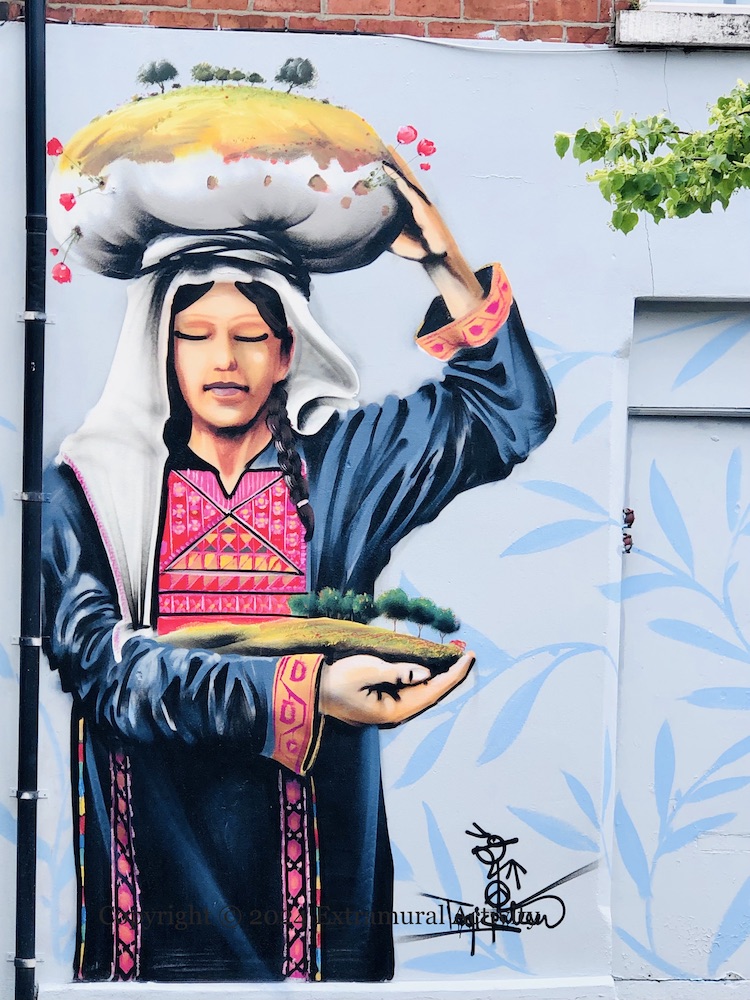
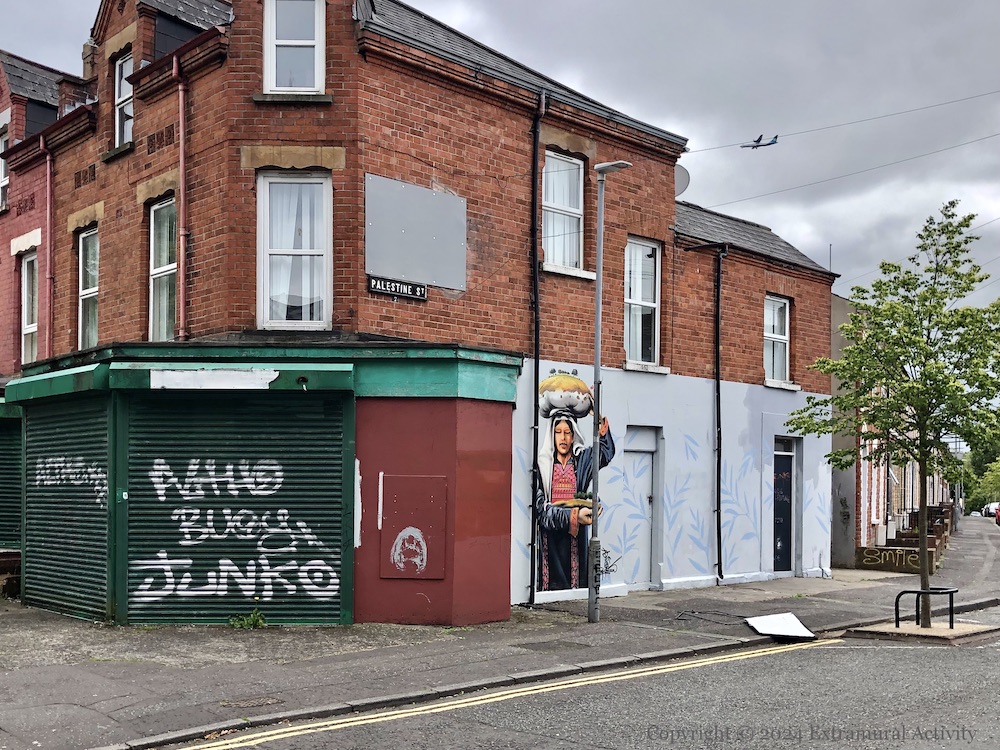
Palestinian artist Taqi Spateen’s (web | ig) second piece in Belfast is in Palestine Street in the Holylands of south Belfast, where he worked with Artists Against Genocide (ig) to produce a piece showing the strength of Palestinian women, carrying the land from which Palestinians have been evicted in the Nakba of 1948.
For the first piece, in Kent Street in the city centre, see Anatomy Of Oppression. A third piece was painted in Crocus Street, in west Belfast: see Life Finds A Way in the Paddy Duffy collection.
In this new statue in the grounds of Belfast city hall, Mary Ann McCracken is shown handing out abolitionist leaflets with a pleading enslaved woman above the words “Am I not a woman and a sister?” The same supplicant image is on the medallion (perhaps made by Wedgwood for the Society For The Abolition Of The Slave Trade – WP) worn at her throat. See also: The Blots On The Page Are So Black and The World Affords No Enjoyment Equal To That Of Promoting The Happiness Of Others.
“Mary Ann McCracken’s feminist ideals and commitment to the principles of Equality, Liberty, Fraternity applying equally to the Rights of Woman defined her participation in the United Irish Movement.” For McCracken’s connection to the 1798 Rebellion, see These Are Times That Try Men’s Souls.
“Mary Ann McCracken (1770-1866) Abolitionist, educator, social reformer and businesswoman. Sheas Mary Ann an fód ar son na mbocht, na mban, na bpáıstí agus ar son sıúd a bhí faoi dhaoırse. [Mary Ann stood up for the poor, women, children, and for those who were enslaved.]”
The statue was unveiled together with a statue to Winifred Carney on International Women’s Day (March 8th); they were produced by Ralf and Naomi Sander (BCC).
A statue to Winifred Carney was unveiled, along with another to Mary Ann McCracken, in the grounds of Belfast City Hall on Friday, March 8th (BCC). At her left hand is a typewriter. Carney was a qualified secretary and typist, and became secretary of the Irish Textile Workers’ Union in 1912, in which position she met James Connolly, who was secretary of the Belfast branch of the ITGWU. The 1913 manifesto addressed ‘To The Linen Slaves Of Belfast’ (marxists.org), exhorting “our toiling sisters” in the mills to join the organisation, was signed by Carney, Connolly, and Ellen Gordon.
Her uniform, and the amorphous pistol (or holster?) in her right hand, refer to her membership of Cumann Na mBan and participation in the Easter Rising of 1916. Carney was in the GPO when it was taken over and was among those who surrendered at the end; during the occupation she typed up dispatches from the Moore Street headquarters. A News Letter editorial described the statue as smuggling terrorists onto the grounds of city hall.
“Winifred Carney, born in Bangor, was a suffragist and a committed trade unionist. She was an organiser in the Irish Textile Workers’ Union and became James Connolly’s personal secretary, political confidante and friend. In 1913, She and Connolly wrote the Irish Textile Workers’ Union manifesto entitled ‘To the Linen Slaves of Belfast’. It was a time when Belfast workers, mostly women and children, were working long hours in horrific conditions, barefoot and hungry. “D’oıbrıgh Winnie ar son oıbrıthe Bhéal Feırste, go háırıthe ar son na mban agus na bpáıstí a bhíodh ag obaır sna muılte ar fud na cathrach. “Many Belfast mills are slaughterhouses for the women and penitentiaries for the children.” Chomh maıth leıs an obaır a rınne sí ar son na gceardchumann, ba Phoblachtánach í Winnie a bhí ına ball de Chumann na mBan agus d’Arm Cathartha na hÉıreann. As an officer in the Irish Citizen Army, Winnie was present with Connolly in the Dublin General Post Office during the 1916 Easter Rising and has since become known as ‘the typist with the Webley’. Carney stood as a Sınn Féın candidate in the 1918 elections, but in an ‘unwinnable’ seat. She retained her commitment to socialism and in 1924, Winifred joined the Northern Ireland Labour Party. Here she met her future husband, George McBride, like her a committed socialist. George was a Protestant from Shankill Road who fought at The Battle of the Somme with the 36th (Ulster) Division. Tá Winnie curtha ı Reılıg Bhaıle an Mhuılınn ar Bhóthar na bhFál ın ıarthar Bhéal Feırste.”
A shawlie is a working-class woman wearing a shawl to serve as a coat and hat. In Belfast they are particularly associated with the workers in the linen mills, such as the Brookfield Mill on the Crumlin Road. This statue, designed by Ross Wilson, was inspired by William Conor’s painting of mill workers (and pehaps specifically “Going to the mills, Crumlin Road, 1914” which is included in the info board, below) and installed at the top of Cambrai Street in 2010 (BelTel | BBC).
“The Mill Worker. Belfast was one of the fastest growing urban centres in Europe in the nineteenth-century, with the linen industry a major driver. The city’s status as the world’s biggest linen producer came about partly as a result of the cotton shortages in the 1860s caused by the American Civil War. In 1896, 96,000 people worked in linen in Belfast, making it the city’s biggest employer. The profits enabled other industries to grow, including engineering, shipbuilding, tobacco, whiskey and rope-making. Belfast became a world leader in all of these industries. The recession between the world wars led to a dramatic reduction in the demand for linen, reinforced by changes in fashion, so the industry went into almost terminal decline and nearly disappeared. Today, however, the supreme quality of linen is valued once again – not least on the Milan, Paris and London catwalks.”
“Wherever life plants you, bloom with grace.” When the Shankill Women’s Centre was first formed, in 1987, it was located in The Hummingbird on the lower Shankill (SWC). (When the Wellbeing Centre was built on that site, the Women’s Centre moved further up the Shankill to its current location in the Hammer.) A hummingbird features in one of the paintings on the hoarding around the construction site of a new “Shankill Shared Women’s Centre” on Lanark Way, a 6.5 million euro project funded by PEACE IV (Belfast CC).







 Extramural Activity