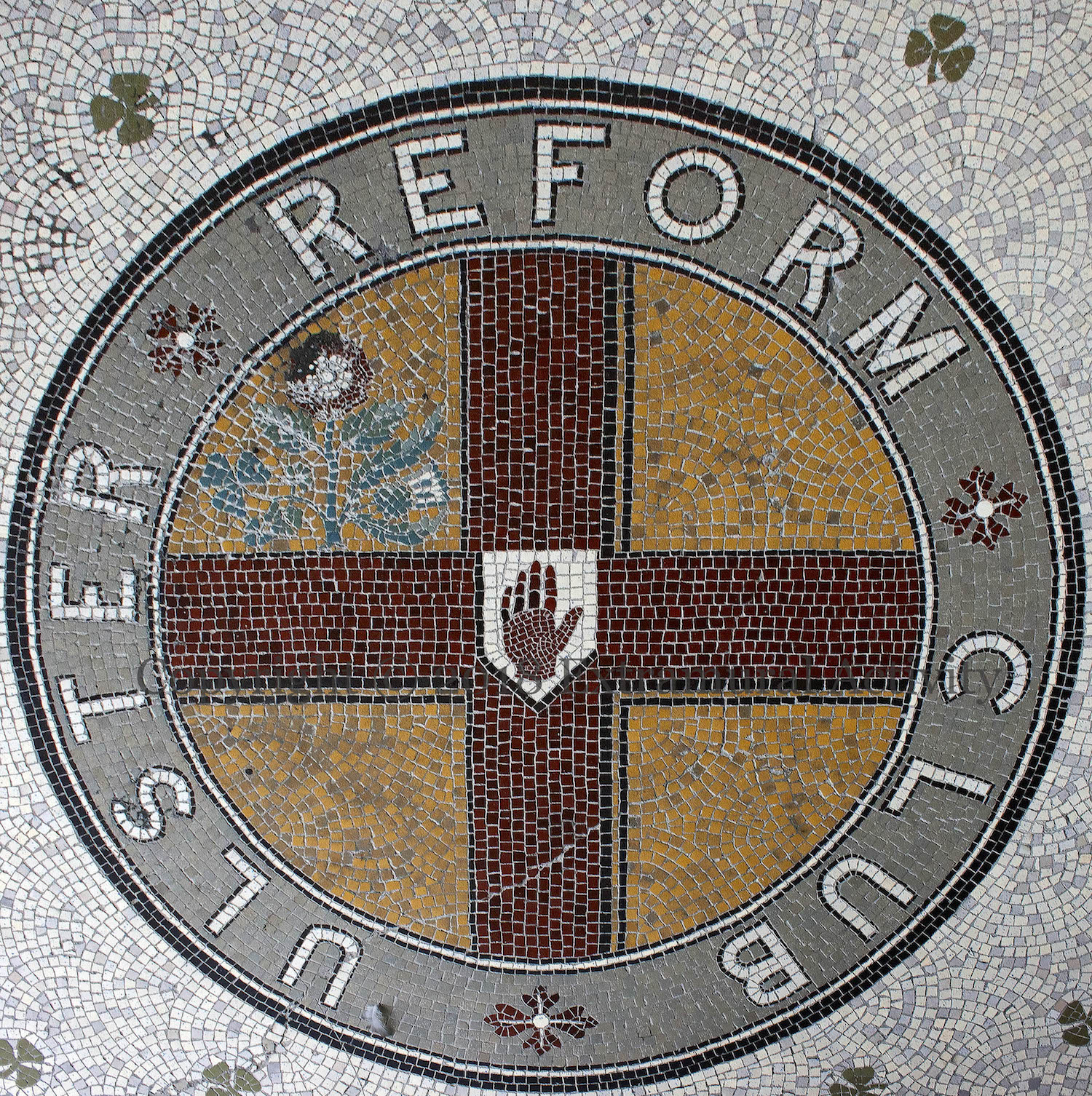
The Ulster Reform Club (web | tw) opened in 1885 and has resided at 4 Royal Avenue, Belfast since then. The mosaic is of the emblem of the club; it includes the flag of Ulster (red hand on a cross with yellow background) with a three-in-one shamrock (Ireland), rose (England), and thistle (Scotland) in the top-left quadrant
The HUBB community centre is host to a number of social groups, including those represented in the mosaic above: the Old Comrades group, the Seaview chapter of the Royal British Legion, North Shore and Ladies Somme memorial groups, a spotlight (perhaps in connection with the Civil Defence bowling club? – the HUBB is in what used to be a civil defence building), and the Kingdom of Dalaradia society. According to the eponymous web site, Dalaradia was “was a kingdom of the Cruthin in the north-east of Ireland and parts of Scotland in the first millennium.” Hence, perhaps, the red hand of Ulster together with the Scottish thistle.
A happier image from Oakfield Drive (after yesterday’s offering): the interests of local children are reflected in the tiles they made: a Union flag and Ulster banner but also a heart and “Liverpool”. One of four such tile collages on the front of the (now-defunct) Glenfield Community Association building.
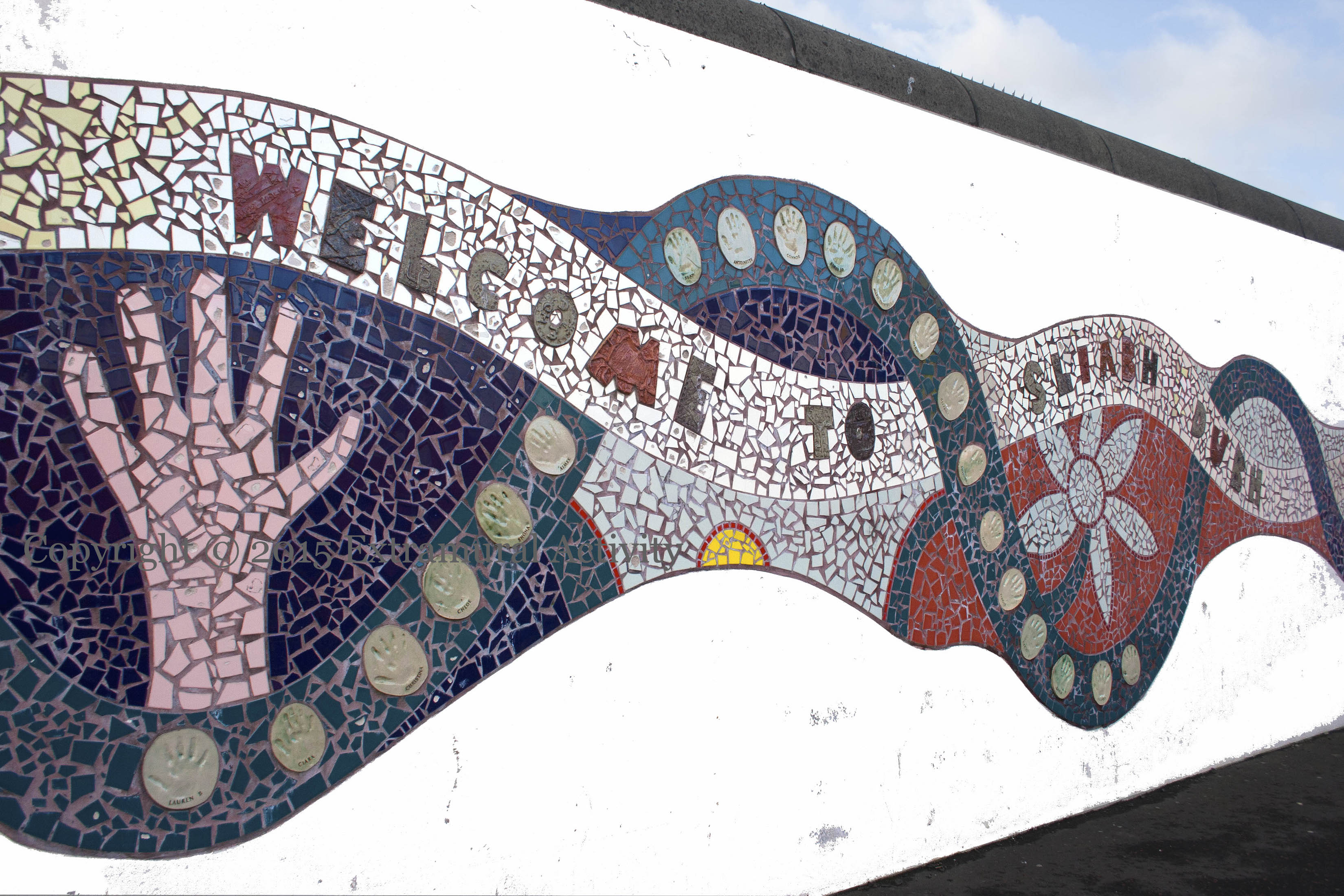
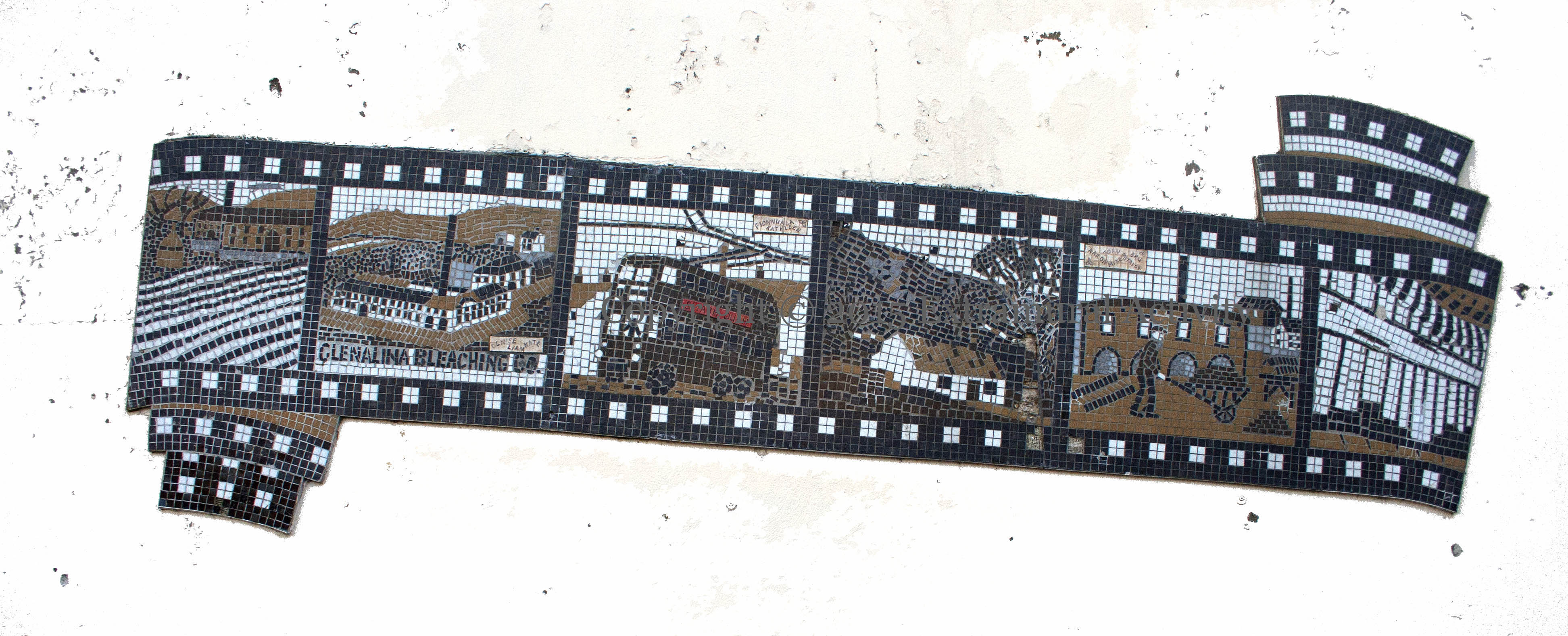
Local residents and children who helped construct the ‘Welcome To Sliabh Dubh’ mosaic at the top of the estate got to include their handprints as part of the artwork, under the direction of Martin McClure (according to a City Council brochure). As the other images (below) show, the area is also host to another mosaic depicting local landmarks from the past such as the Glenalina Bleaching Co and a cottage on the hills of Black Mountain as well as the superhero murals (Wallbusters | Cartoon World | Red-Eye) and Disney murals (some of which have been featured in If The Shoe Fits | Look Behind You! | Magic Mountain).
The Stella Maris Hostel (in Garmoyle Street) provides services to homeless alcoholics. Above their door is this mosaic of St. Brendan, off “crossing the Atlantic 600 AD” to discover (what would later become) North America (though perhaps it was only the Faroes or the Canaries or … ) in a boat clad in nothing more than leather.
The Clowney Street phoenix, which dates back to 1981 (see The Oldest Murals), has been repainted, and above, the blanketmen painting (see 1981-2011) has been replaced with a montage of photographs from the period, including prisoners on the blanket and dirty protest, the funeral of Sands and of McDonnell, and three pieces of graffiti: “Thirty thousands can’t be wrong” (Sands’s election to Westminster), “Bobby Sands murdered 1.17 am 5th May 1981”, and “My position is in total contrast to that of an ordinary prisoner. I am a political prisoner.”
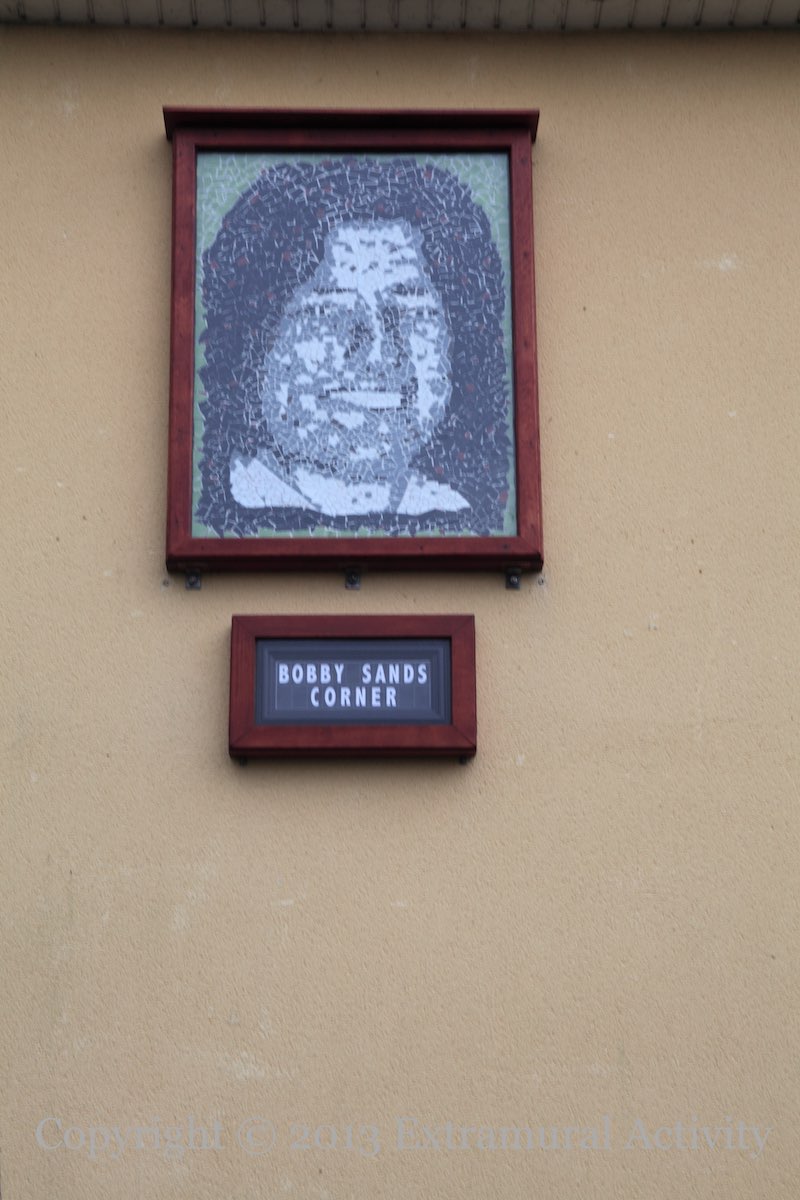
Bobby Sands grew up and went to school in Rathcoole but in 1972, when he was eighteen, the family home was attacked. They moved to Twinbrook, where Sands joined the IRA (Bobby Sands Trust | WP).
This mosaic is near the Twinbrook home, on the same wall that was the site of the Carol-Ann Kelly mural. Kelly was killed two weeks after Sands’s death.
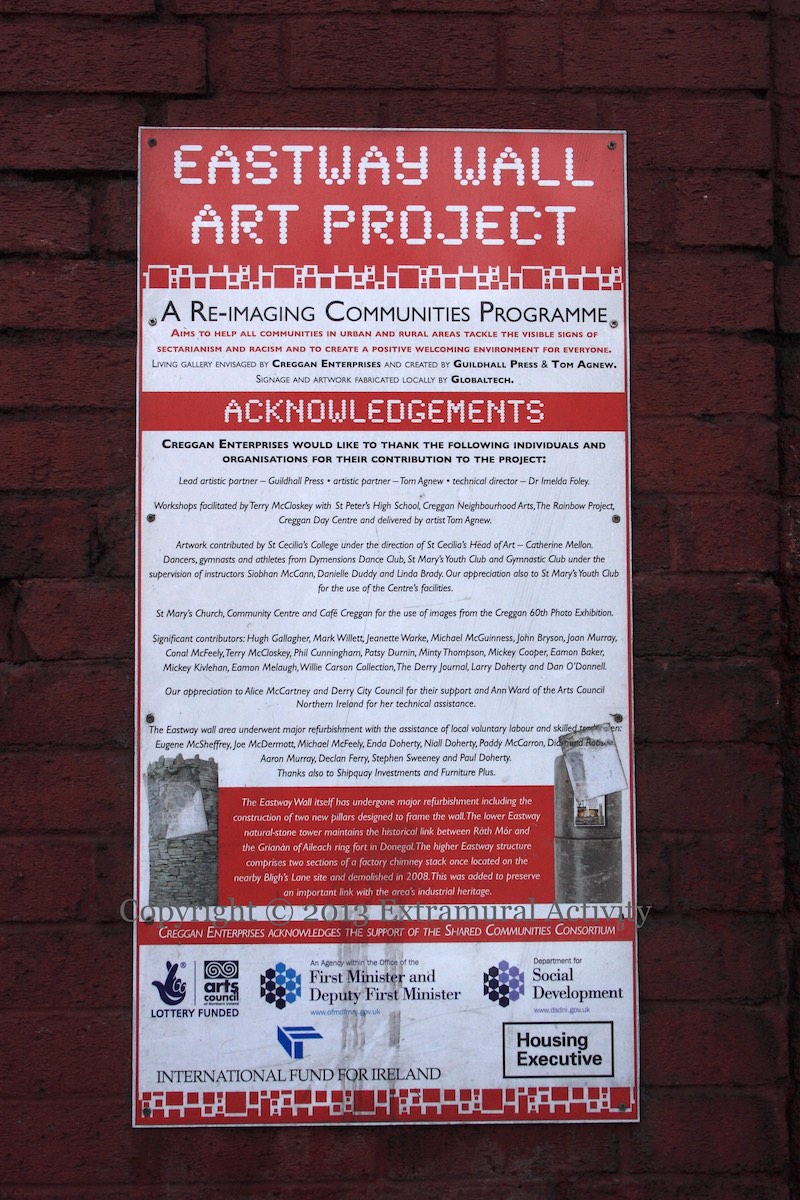
“Eastway Wall Art Project – a Re-Imaging Communities Programme – aims to help all communities in urban areas tackle the visible signs of sectarianism and racism and to create a positive welcoming environment for everyone. Living gallery envisaged by Creggan Enterprises and created by Guildhall Press & Tom Agnew. Signage and artwork fabricated locally by Globaltech. [acknowledgements] The Eastway Wall itself has undergone major refurbishment including the construction of two new pillars to frame the wall. The lower Eastway natural-stone tower maintains the historical link between Rath Mór and the Grianán of Aileach ring fort in Donegal. The higher Eastway structure comprises two sections of a factory chimney stack once located on the nearby Bligh’s Lane site and demolished in 2008. This was added to preserve an important link with the area’s industrial heritage.”
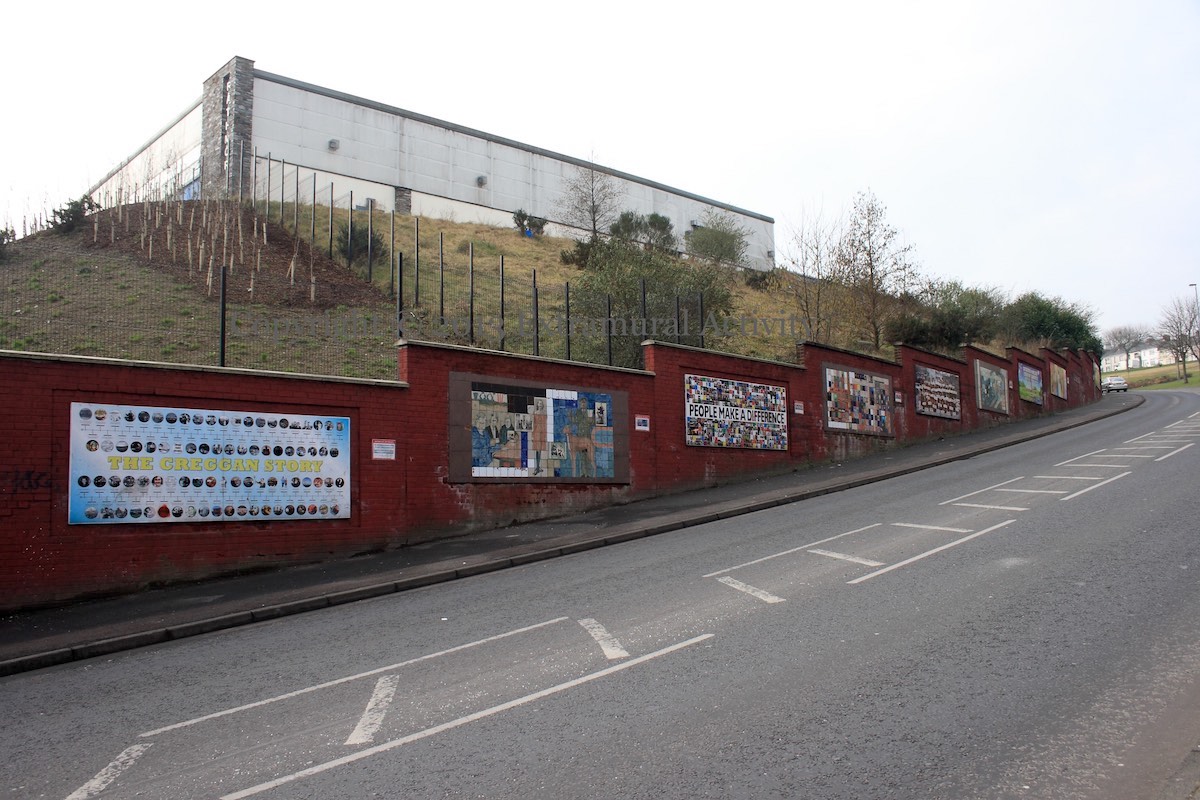
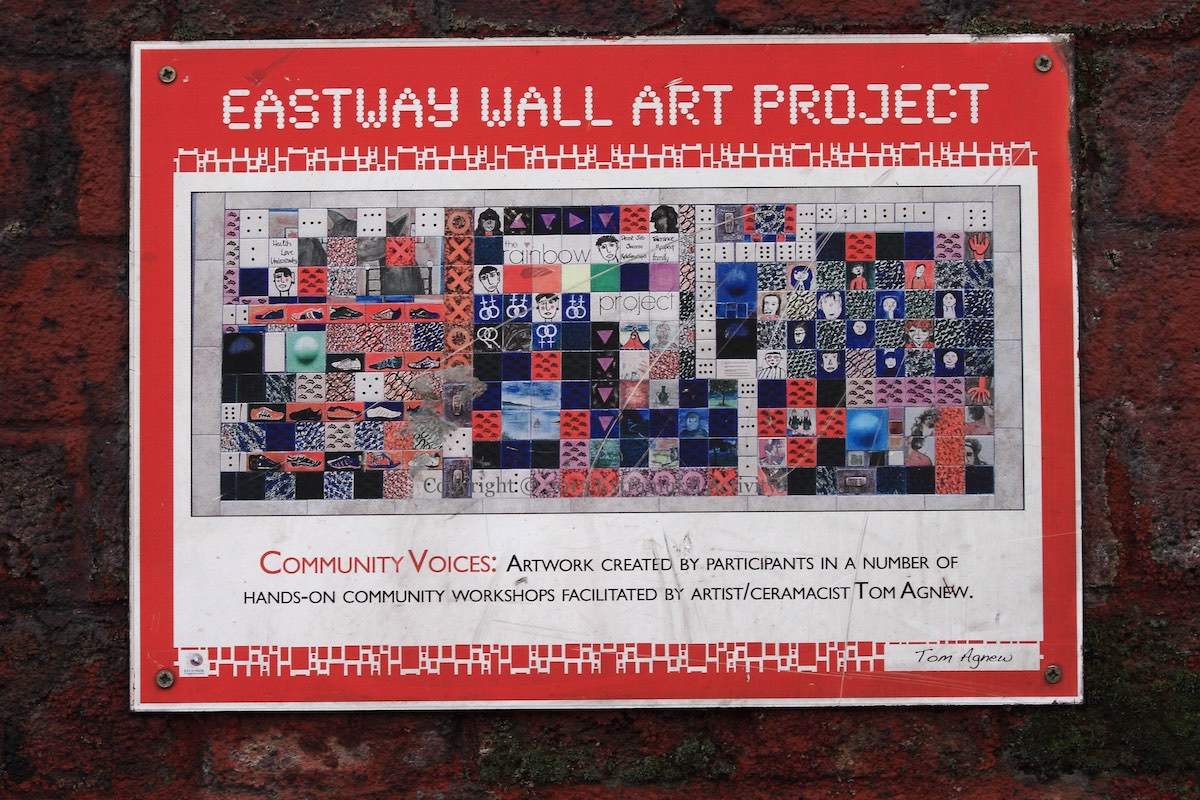
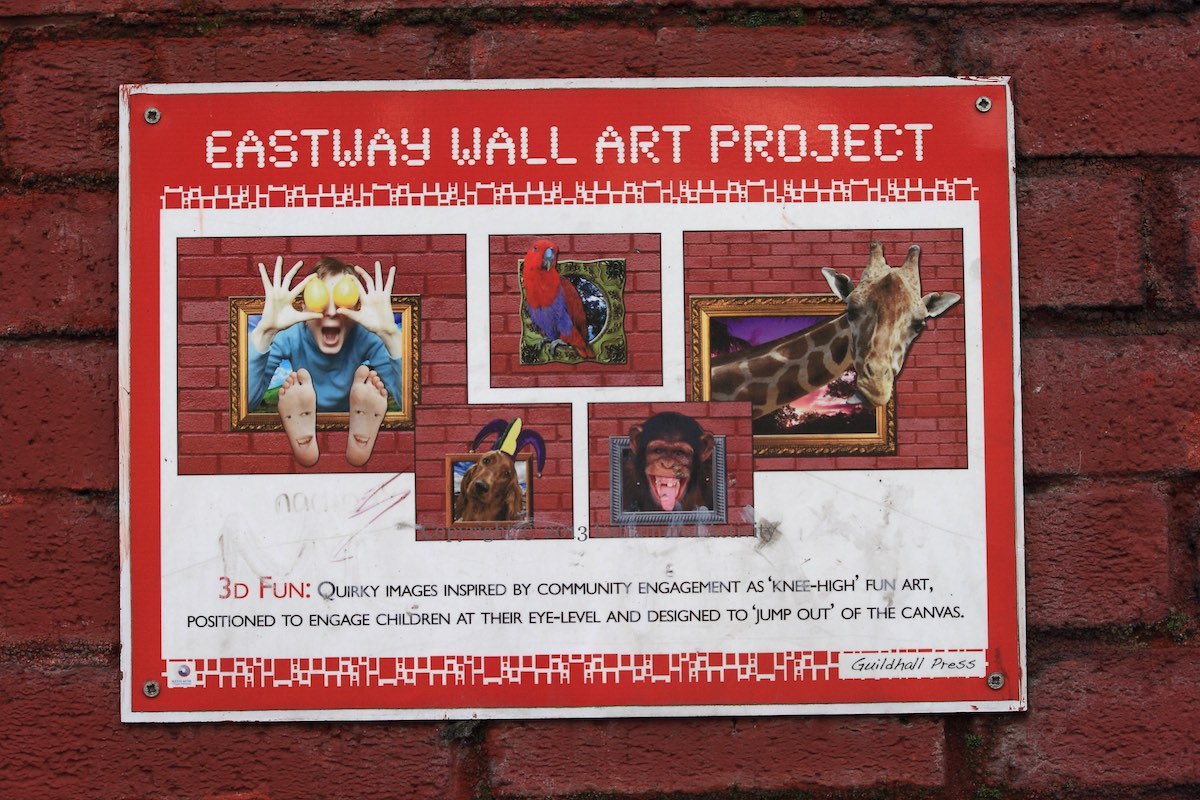
The image above shows the second through the eighth panel. A few of the info boards, including the main one, are shown below. (For the Creggan Story and its info board, see M05174.)
Above the panels shown, some panels just have single words in them – for five of these see Vibrant.
For the 30th anniversary of the second hunger strike, the mosaic portraits of the ten men to die (plus Michael Gaughan and Frank Stagg) used at the Falls Road end of Beechmount Avenue to commemorate the 25th anniversary, are placed around the blanketmen board above the Clowney Street phoenix.






 Extramural Activity