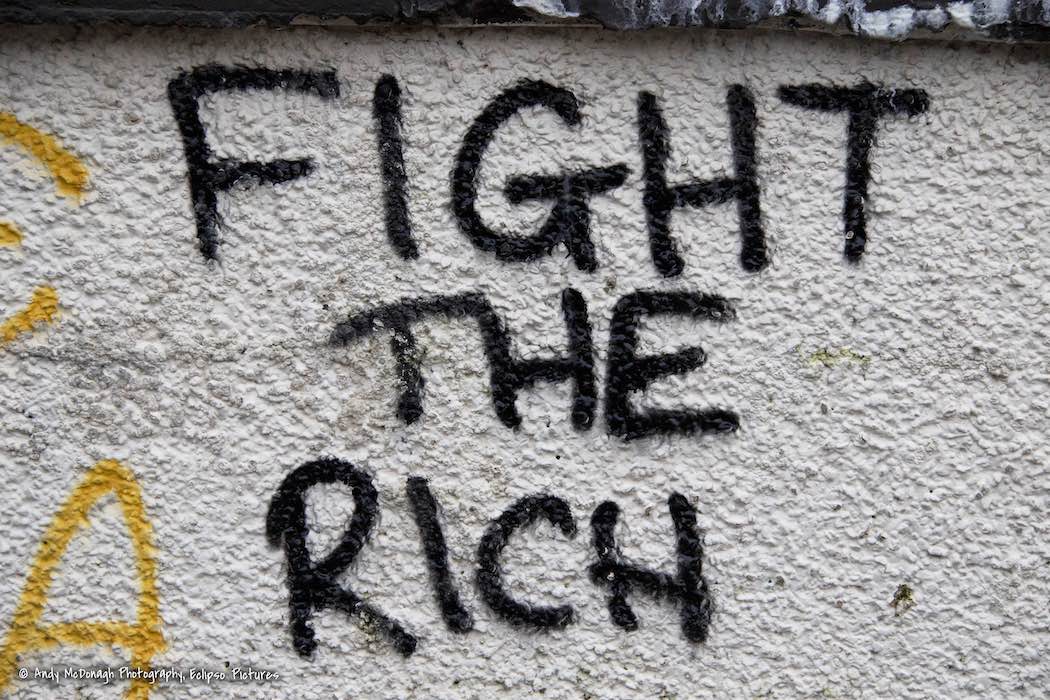
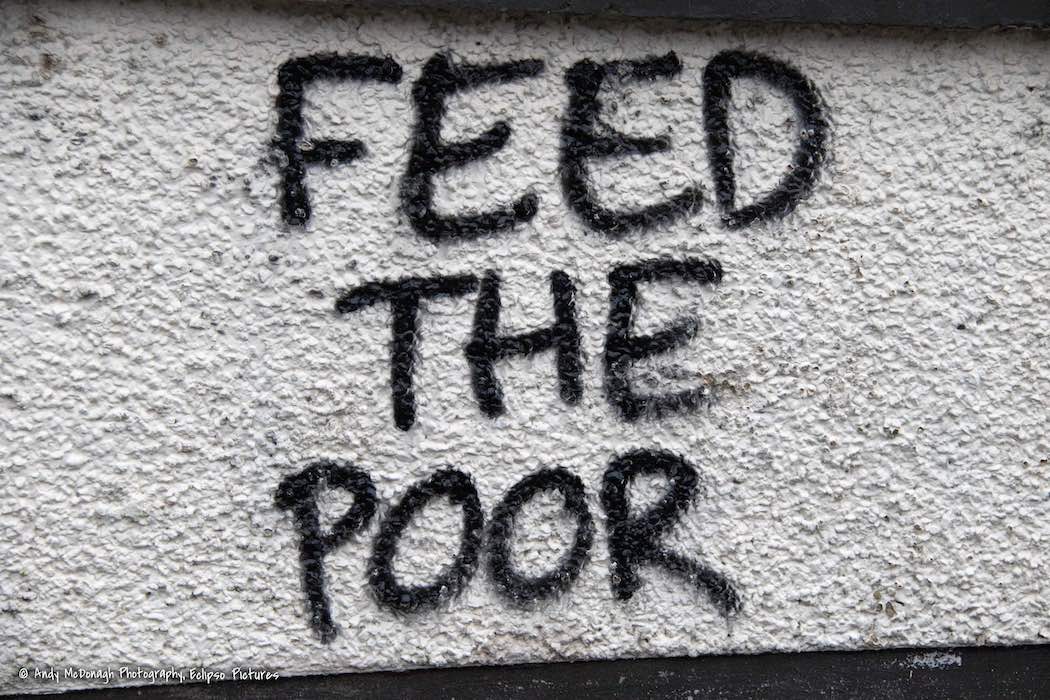
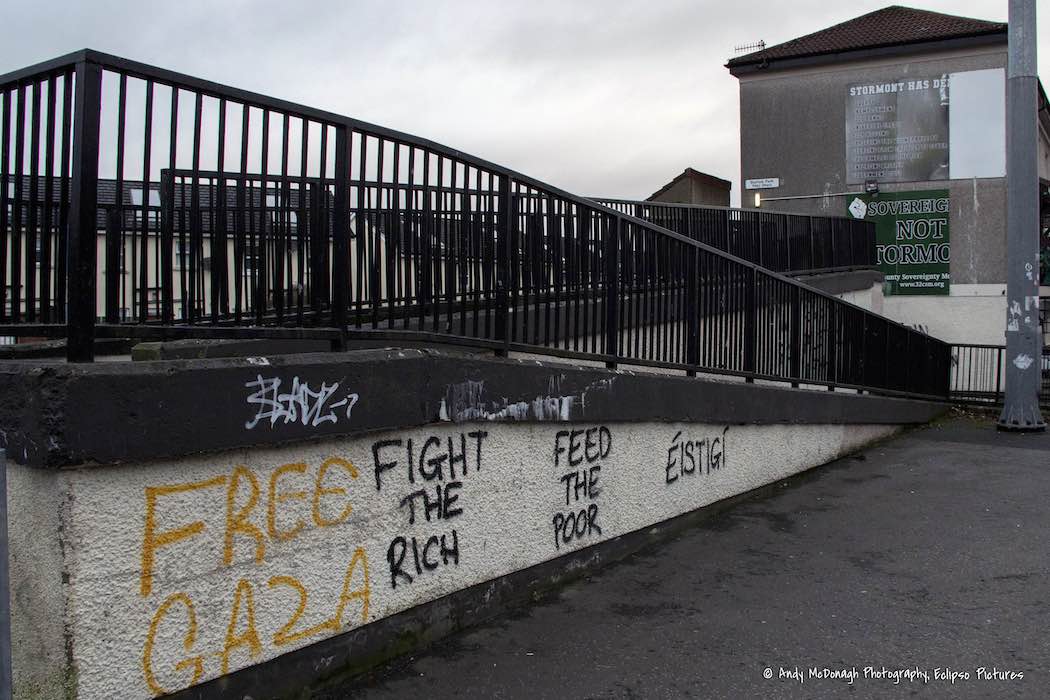
“Fight the rich, feed the poor – Éıstıgí” (also “Free Gaza”) along Lecky Road in Derry’s Bogside.
Éıstıgí, or “listen, yous-uns” in Derry/Doıre, is the youth organisation associated with Soaradh (web); it promotes a socialist (and republican) ideology.
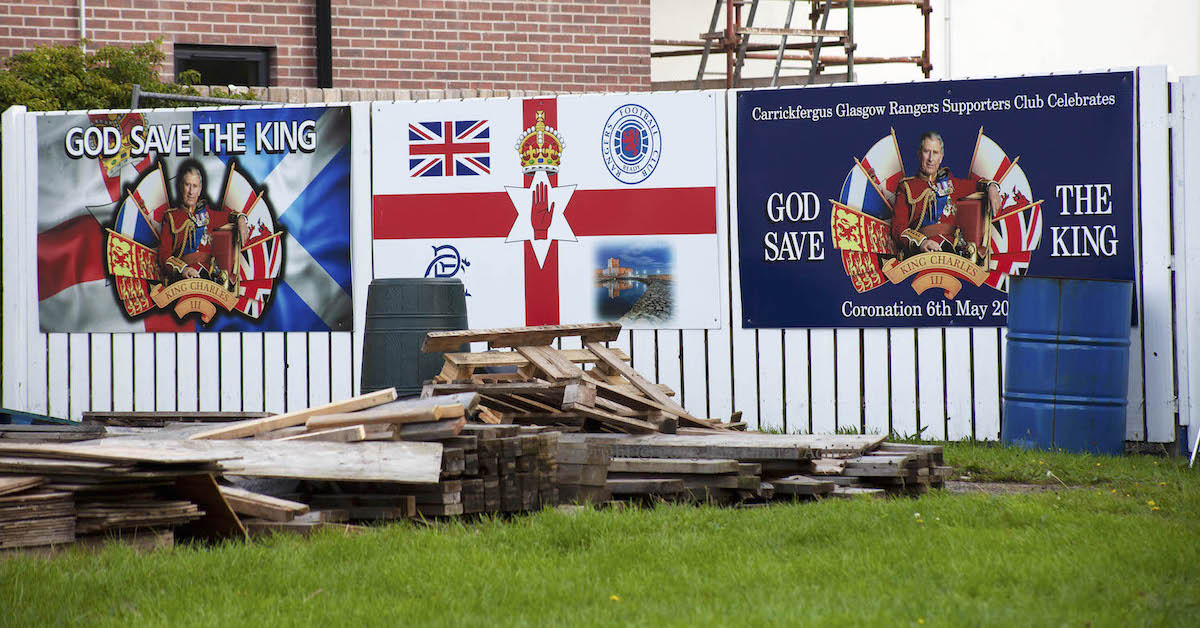
“Rangers ’til I die.” Here are images from the courtyard of the Carrickfergus Rangers Supporters Club, (Fb) and the approach to the clubhouse.
First, a pair of UVF boards above the courtyard listing both local (Carrickfergus, Ballyduff, Ballyclare, Greenisland, Glengormley, Monkstown, Rathcoole, Larne, Whitehead) and affiliated British units (Drumchapel (Glasgow, Scotland), Springburn (Glasgow) Possilpark (Glasgow), Paisley (Scotland), Falkirk (Scotland), Liverpool (England), Blackpool (England), Corby (England), and Blairgowrie (Scotland)) of the 1st East Antrim Battalion, “The people’s army”.
Second, the tarp on the back of the Men’s Shed.
Third and fourth, the boards on the lawn and the painted columns of the railway bridge on St Bride’s Street/North Road.
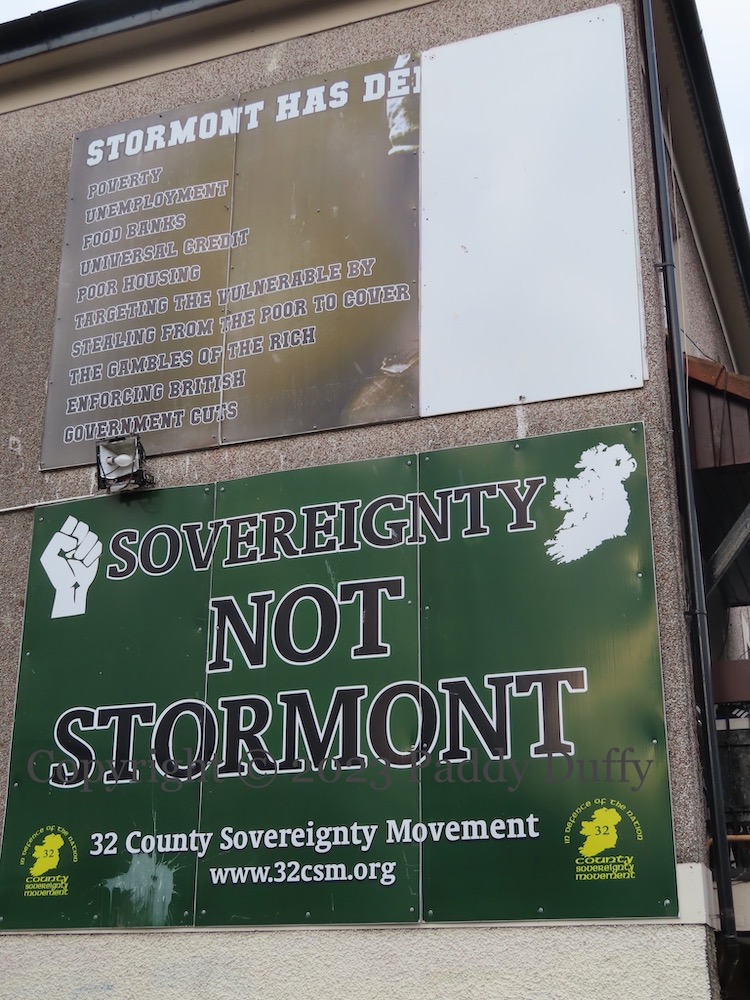
TUV (Traditional Unionist Voice) has put up placards attacking the DUP (Democratic Unionist Party) – including outside the office of DUP leader Jeffrey Donaldson – in response to the possibility that the DUP might re-enter Stormont – which has been defunct now for two years – and implement the NI Protocol (BBC | BelTel).
It hasn’t happened yet, but a combination of public dissatisfaction concerning inaction over strikes by transport workers on December 22 and a general strike planned for January 18 (ITv)) and a financial package for pay awards are keeping the pressure on (Shropshire Star).
The Clements coffee shops in Belfast city centre closed in October, leaving only the two at Queen’s and UUJ (BelTel).
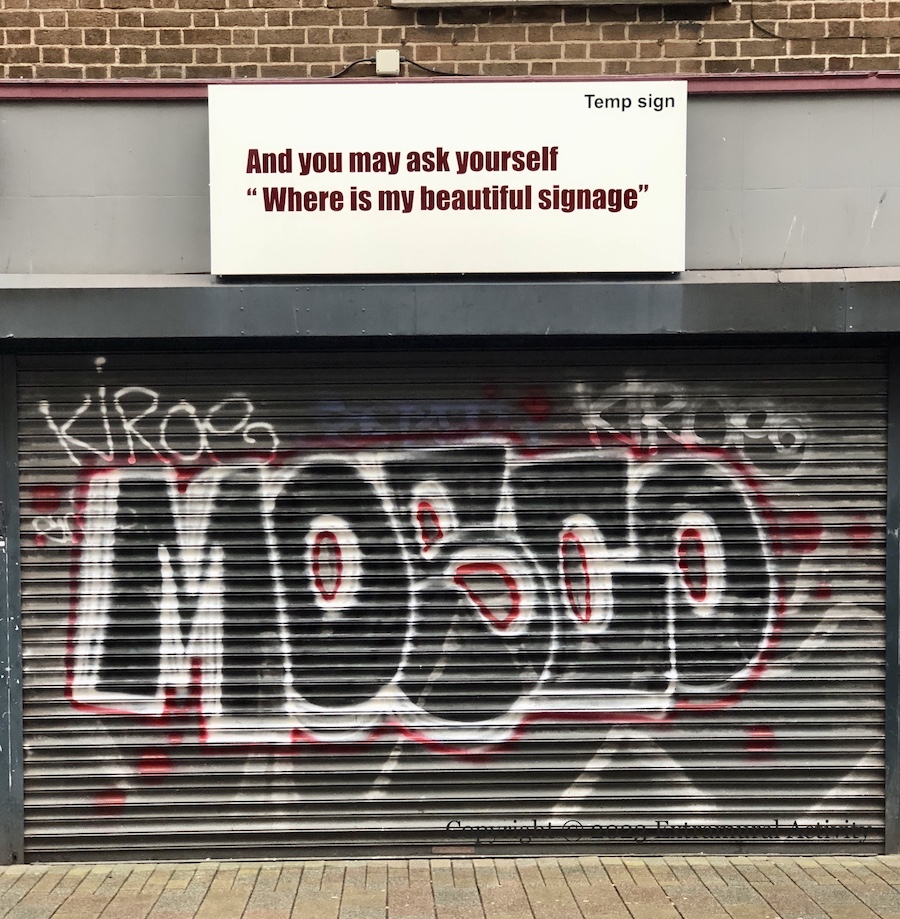
The abandonment of the Rosemary Street shop provides a space for art (see Visual History 11 on the rise of street art); replacing the Clements signage there is a “temp sign”: “And you may ask yourself, “Where is my beautiful signage[?]””.
Is this a plea for the return of Clements – a local chain – or investment in the city centre and a new business? Or perhaps it is meant ironically, as a protest against capitalism – the line is a modification of a lyric from the Talking Heads song ‘Once In A Lifetime’ (Stop Making Sense | Remain In Light), which describes a moment of awakening for the middle-aged and middle-classed: “How did I get here?”
On the permanently-closed shutters is a different kind of beautiful signage, a MOSCO throw-up.
The name “Ulster-Scots” refers to the emigrants to North America from Ulster that had previously come from Scotland and the English borders, and most of the Ulster-Scots murals in the 2000s focused on emigration to America and on US Presidents with Scotch-Irish heritage (see the Visual History page of Ulster-Scots murals).
In 2017, a series of boards along York Street focused on industrialists in Northern Ireland with Scottish backgrounds: 13 panels in five posts: one | two | three | four | five. And this new collection of “Ulster-Scots” luminaries (which is 100 paces away) likewise presents figures who are associated with Northern Ireland rather than America. Modern folk such as those portrayed in these new boards presumably have Scottish heritage rather than Scotch-Irish. (The title of this entry – The Scots In Ulster – comes from a Discover Ulster Scots poster about the Scots who came to Ulster in the 1600s, regardless of whether or not they or their descendants later moved to America.)
From left to right, the people shown are as follows. (Links are to previous entries in the Extramural collection.)
Mountcollyer: motorcyclist Rex McCandless, author CS Lewis, physicist John Stewart Bell, song-writer Jimmy Kennedy, medical inventor Frank Pantridge
William was granted the peerage “baron Carrickfergus” as a wedding present in 2011, which made Catherine/Kate baroness (WP). They visited the town in 2022 (BBC). The black-and-white photograph on the left is of Queen Elizabeth visiting in 1961 (youtube).
Replaces the kids mural We Are Friends in Hawthorn Avenue, Carrickfergus.
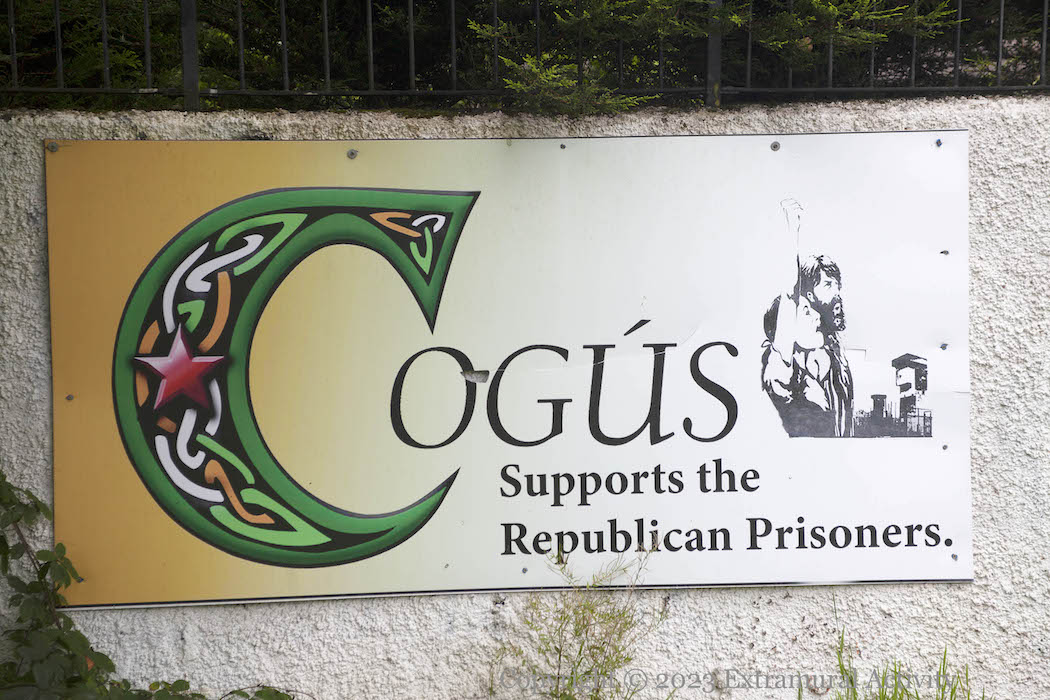
“Cogús supports the republican prisoners”. Cogús (Fb) is (was?) the prisoners’ welfare arm of the RNU. The board above — using a vintage illustration going back to 1981’s I’ll Wear No Convict’s Uniform — replaced More Blacks, More Gays, More Irish on Pantridge Road, Dunmurry, joining the “Join RNU” and mental health boards shown below.
This Castlemara, Carrickfergus, board is not remarkable so much for what it depicts — the new prince and princess of Wales, “baron & baroness of [sic] Carrickfergus” — but for what it replaces, namely, the Carrickfergus Eddie, which had been in place since (at least) 2000 — see Show No Mercy.
This means that there are no large murals of Eddie remaining; there are only some smaller versions of Eddie of boards or tarps. Eddie has his own Visual History page.
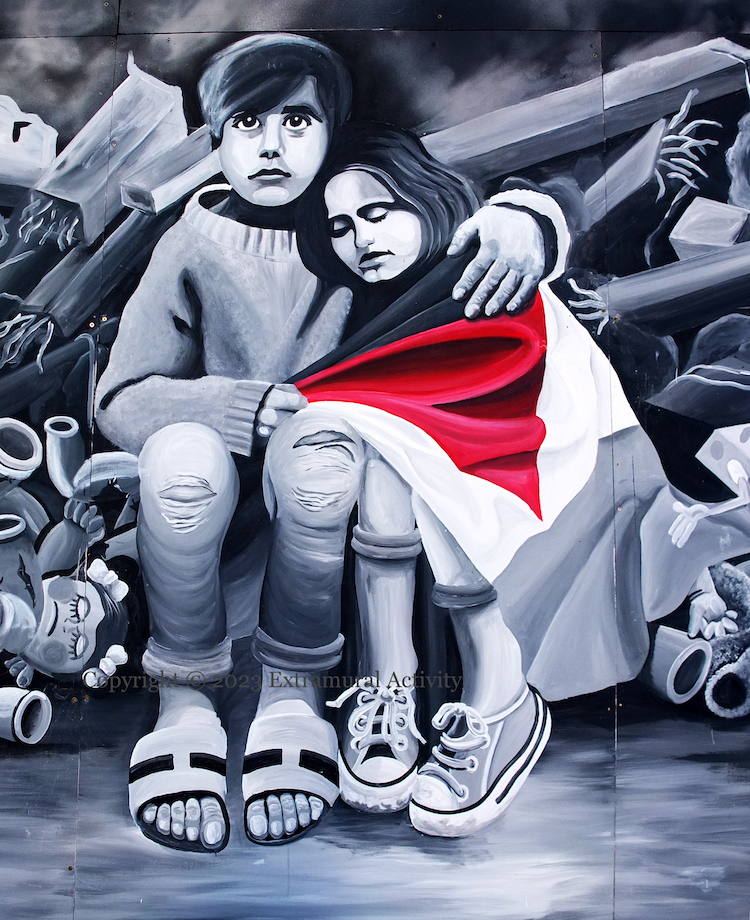
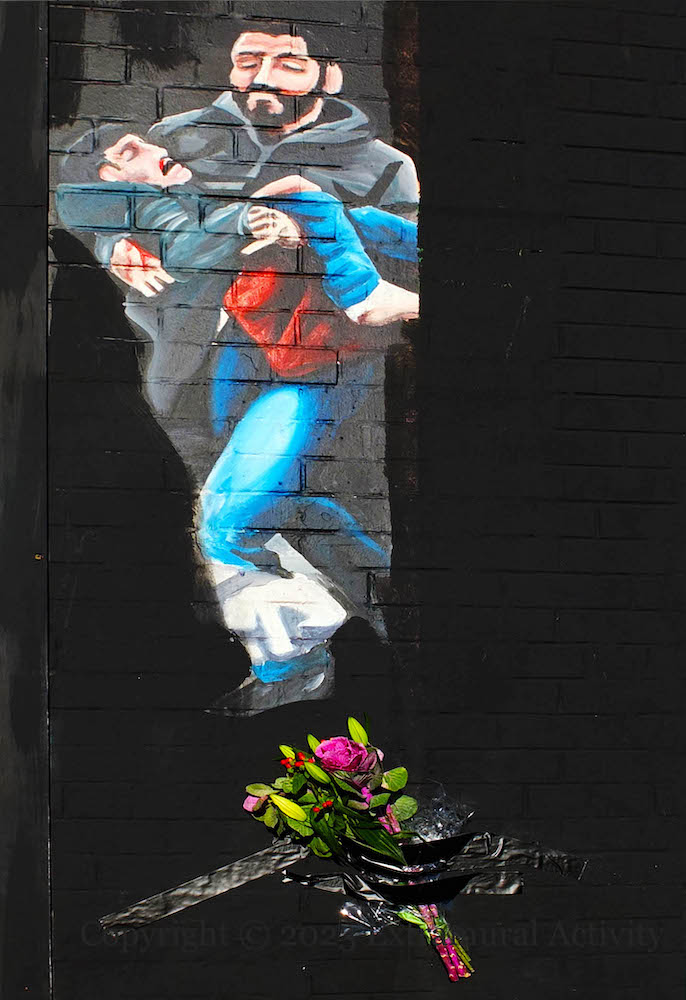
“Stop the slaughter – ceasefire now”. A pro-Palestinian board was added to the “International Wall”, Divis Street, and launched on November 4th. The previous Saber Al-Ashkar mural — His Land, His Legs, His Life — has been mostly painted over, with part of the mural remaining at the top and the image of a man carrying a wounded child perhaps deliberately left to the right of the board.
The image represented would appear to be an from social media (probably AI-generated, as no one can say who is depicted or where) of children sitting among their ruined house, surrounded by broken toys, including SpongeBob and Pudsey Bear, with the boy using an incorrect Palestinian flag to cover the girl.
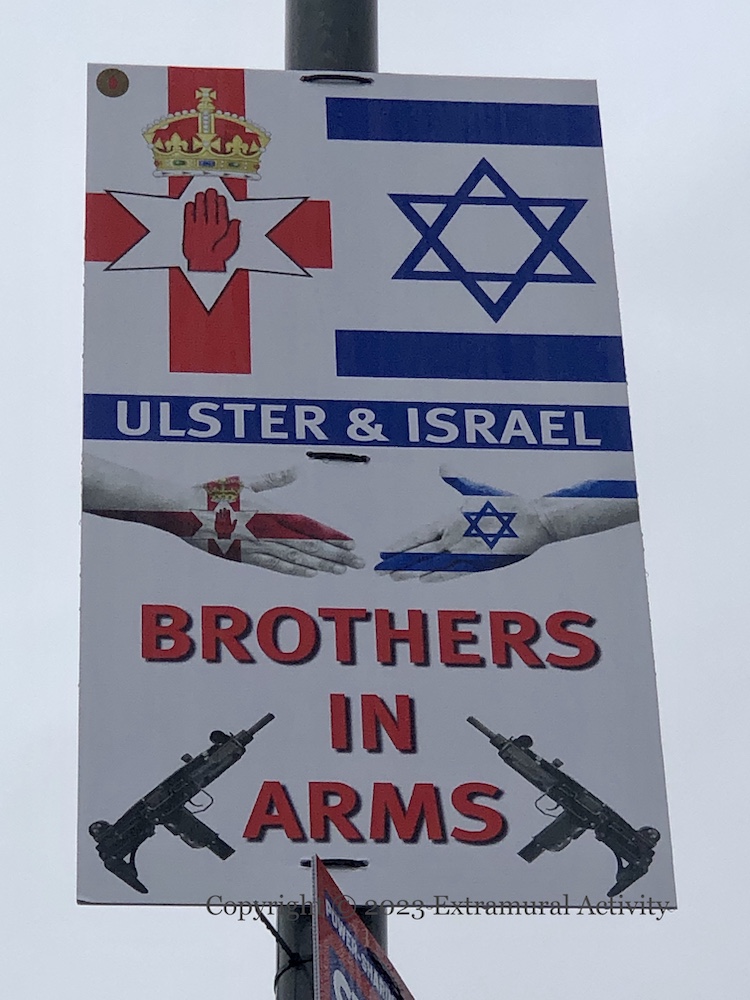
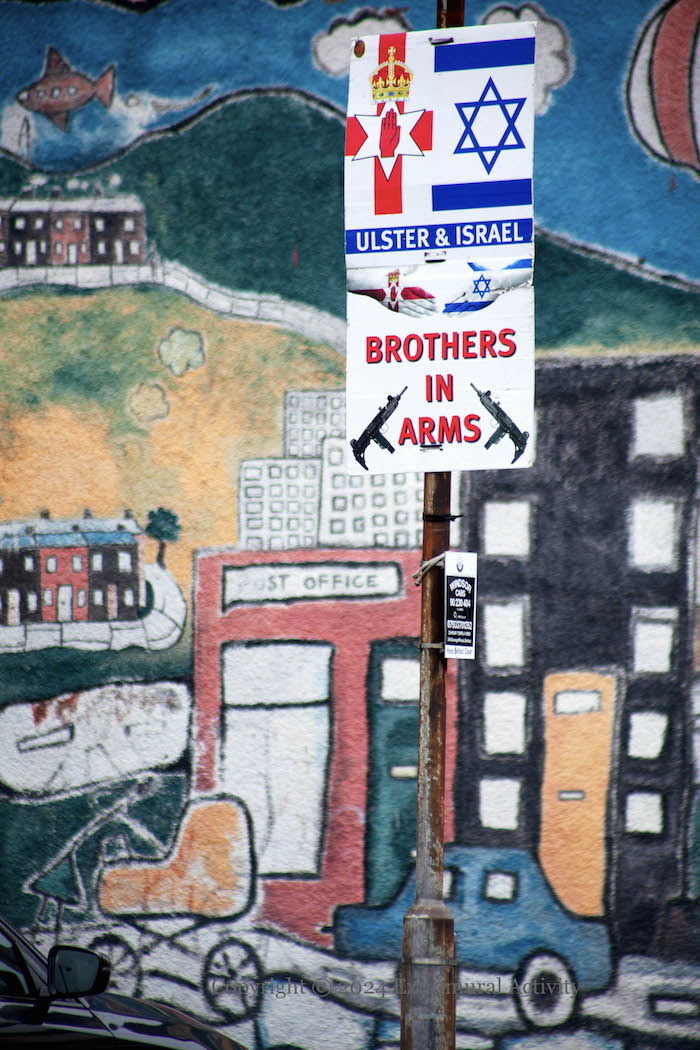
“Ulster & Israel – brothers in arms”. The Uzi was developed in Israel in the late 1940s and became a general-issue weapon in 1956 (WP). It was used (and copied) by loyalist paramilitaries in Northern Ireland (Balaclava Street has a comprehensive history of loyalist weaponry) and appeared in a both UDA and UVF murals and graffiti: The Elite | Ulster Says No! To The Politicians | Sandy Row 2nd Batt | UFF Uzi.
Tate’s Avenue, in the Village area of south #Belfast.
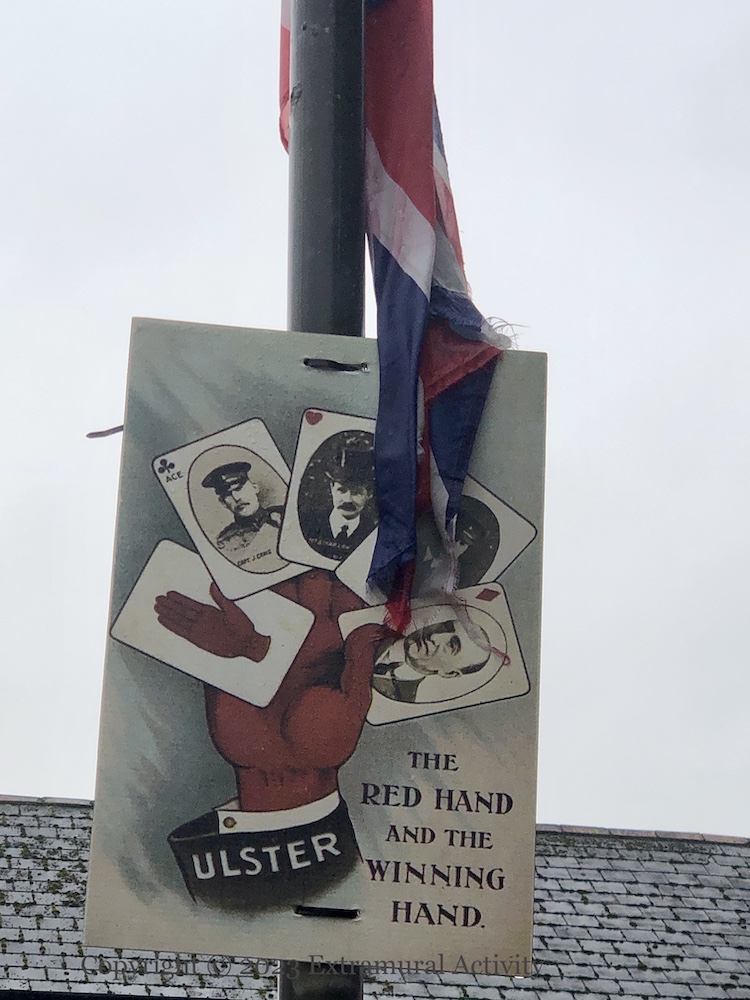
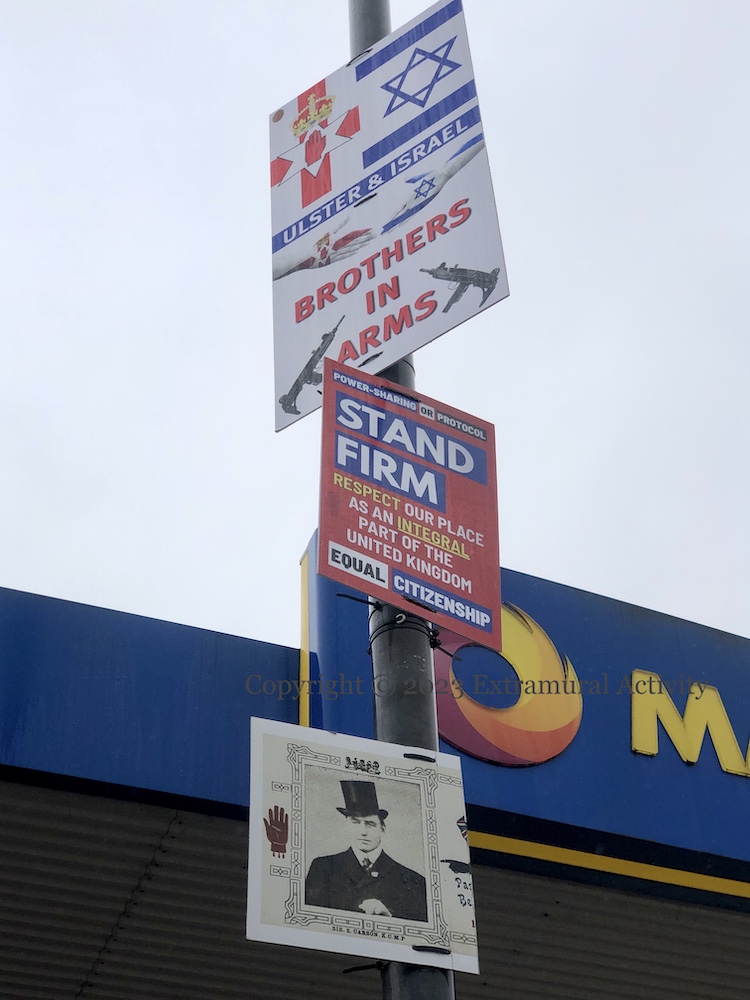
The placard in the middle, between Brothers In Arms and “Sir E. Carson K.C., M.P.” was discussed in Stand Firm. The Winning Hand was seen previously in The Red Hand And The Winning Hand.












 Extramural Activity