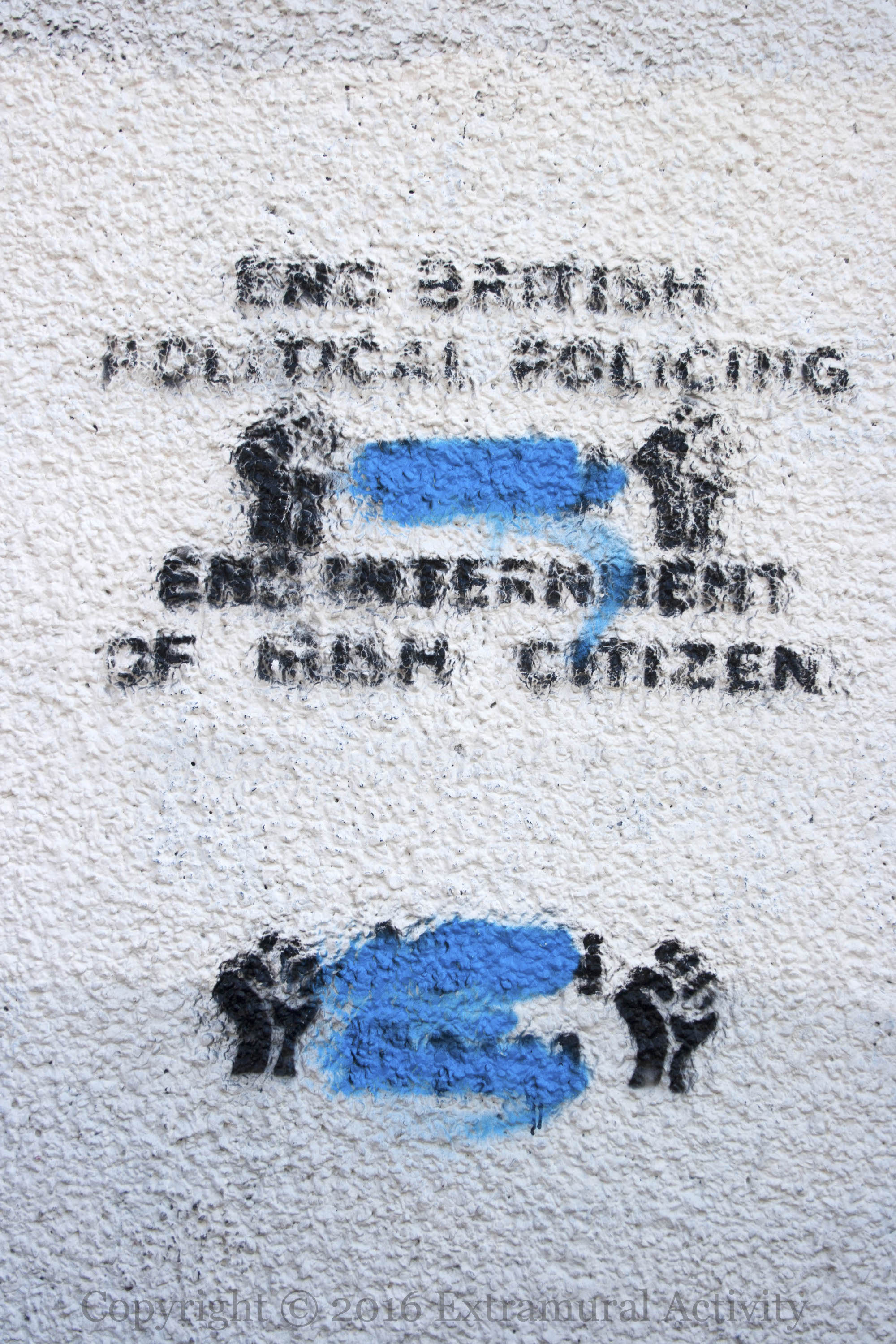
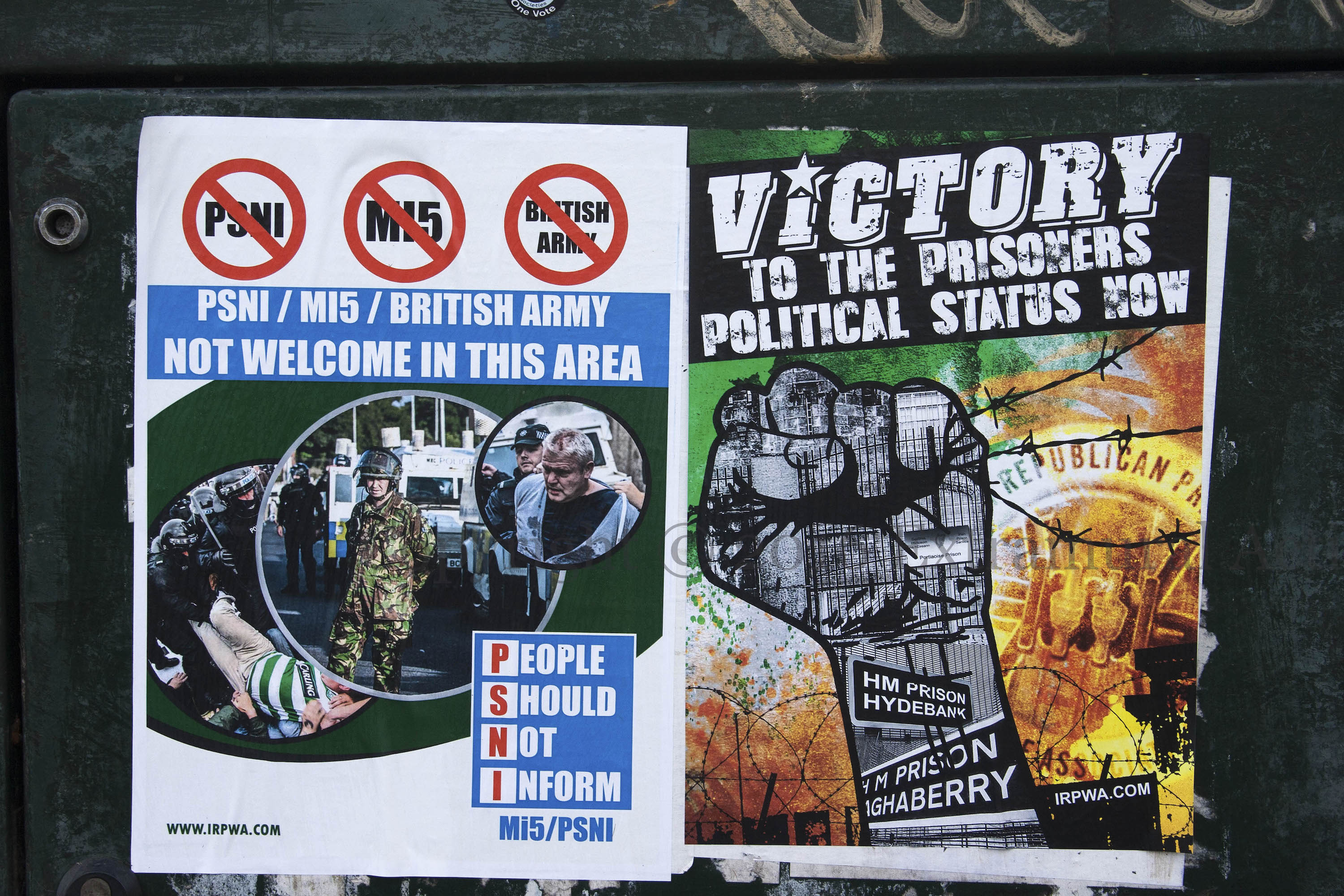
IRPWA board (and stencil) in Shantallow, Derry, articulating the forms of torture of Irish republicans in “British gaols in Ireland”: isolation, internment, strip searching, and controlled movement.
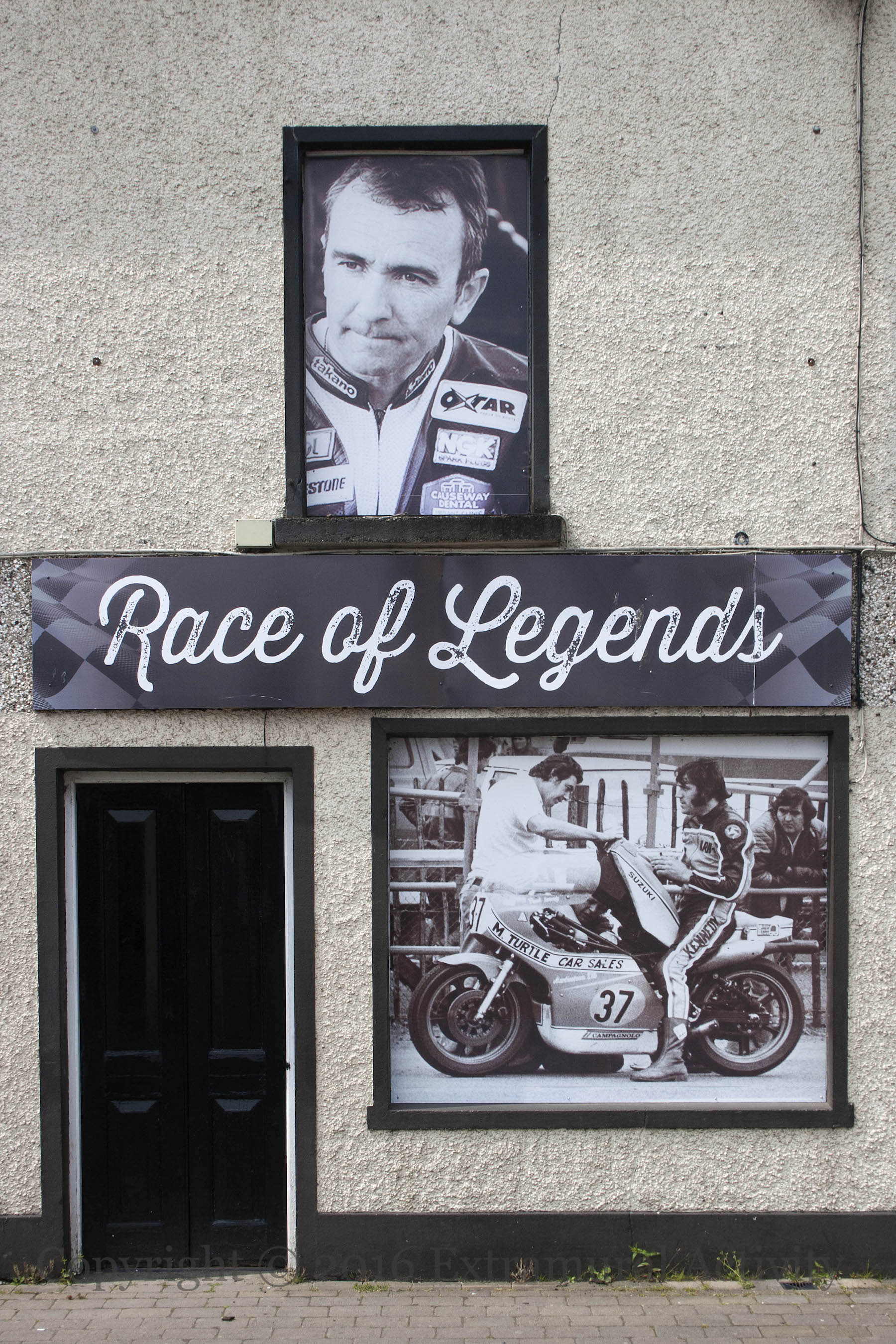
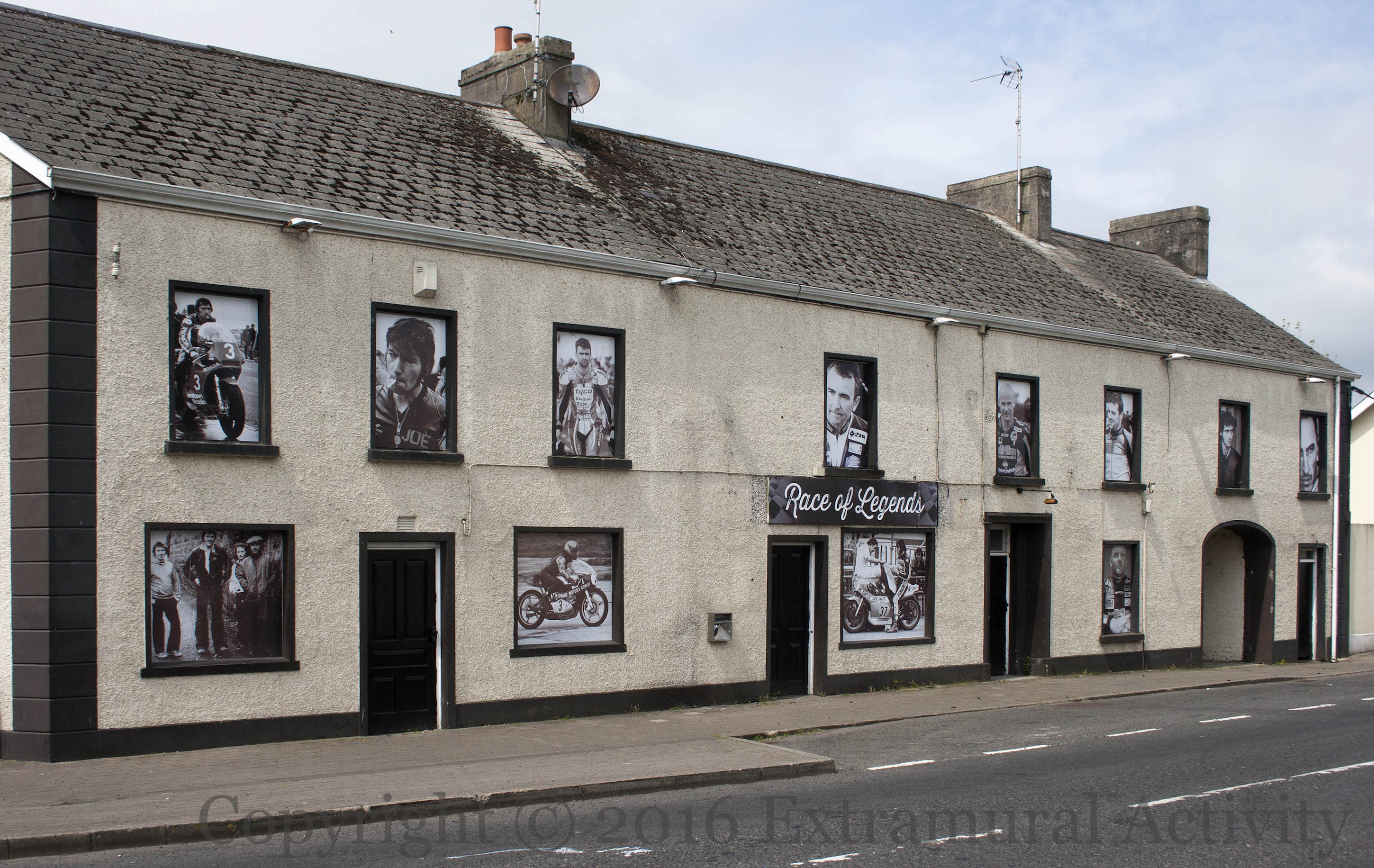
The town of Armoy, County Antrim, hosts an annual motorcycling road race, the Race Of Legends. The windows of the (closed) Victory Bar is filled with images of motorcyclists. Robert Dunlop is shown above and brother Joey is two windows to the left. Both brothers died as a result of racing accidents. Sons William and Michael are also featured.
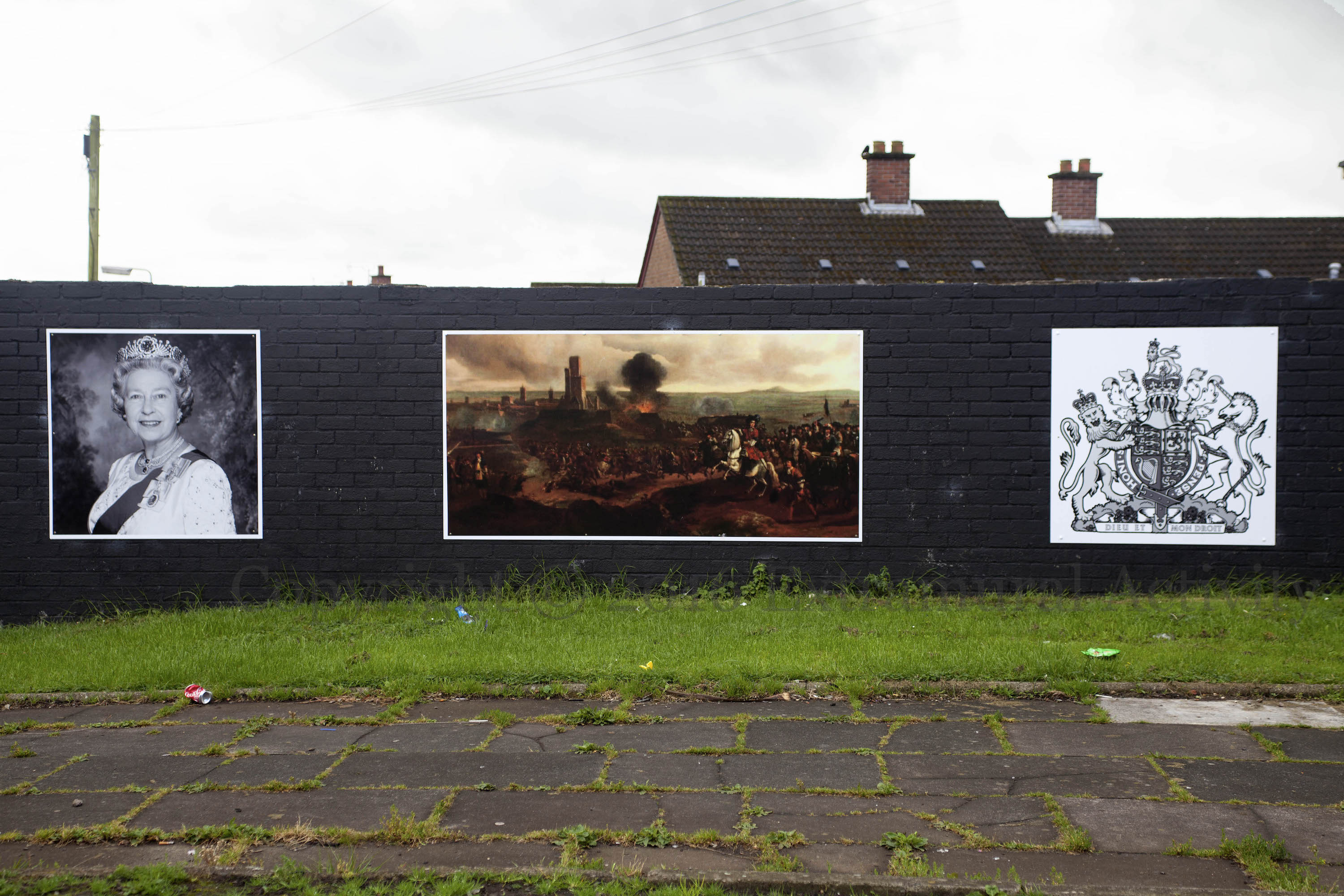
The experts’ best guess is that the gentleman on the white horse (on the right of the painting) is James Scott, Duke of Monmouth, at the siege of Maastricht in 1673. Scott was commander of the English forces fighting with the French during the Franco-Dutch war. It’s not clear, thus, what the connection is to the Antiville area of Larne or the wars fought in Ireland over the English crown. It was painted by Jan Wyck, who also did a painting of the Battle of the Boyne. On either side (as shown below) are a portrait of Queen Elizabeth II and the English version of the Royal coat of arms of the United Kingdom.
This trio of boards has been added to a wall behind the Antiville community centre, softening (somewhat) a very aggressive set of six UDA boards (seen in UDA Flag Bearer and Secret Army Silhouettes.)
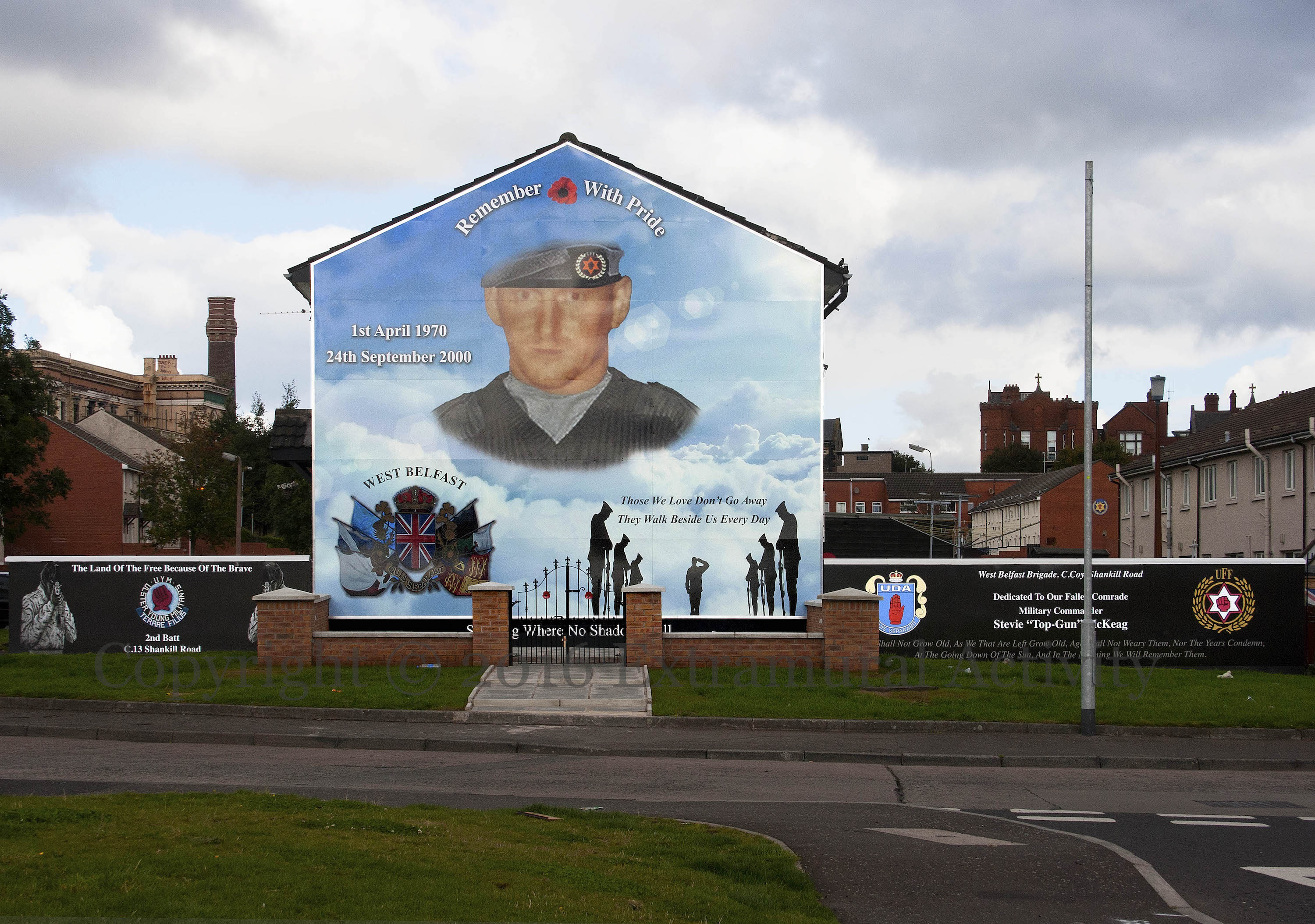
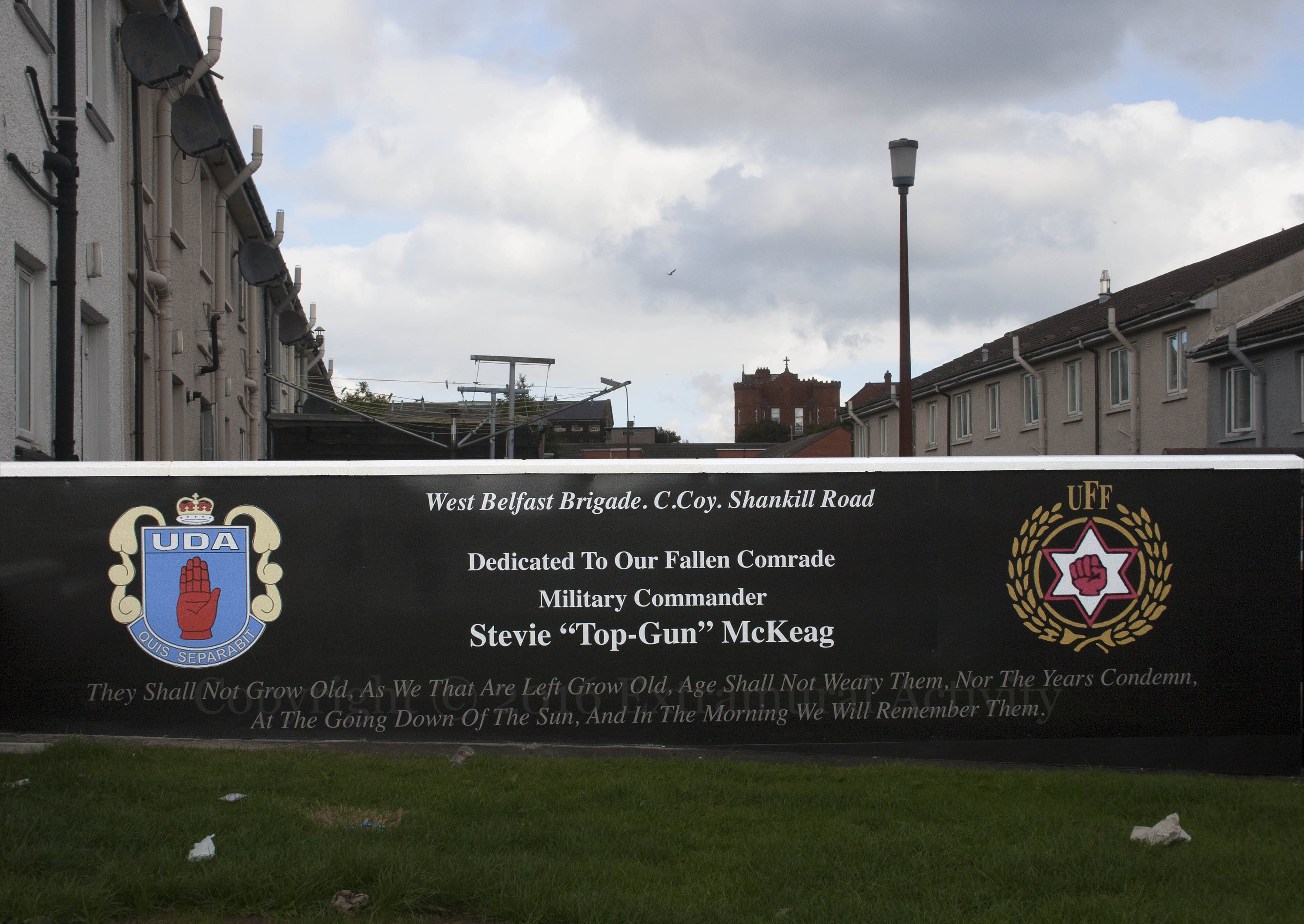
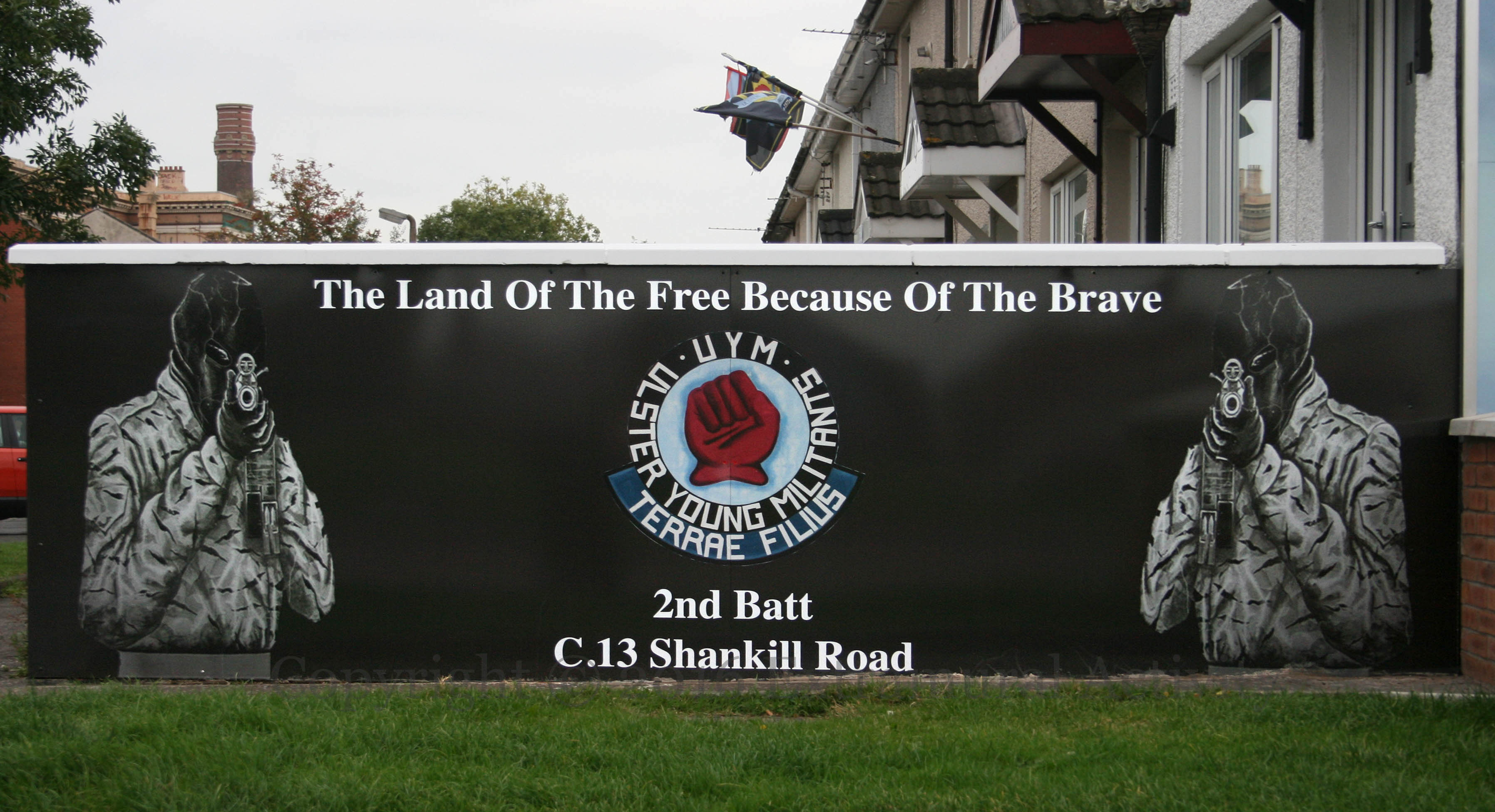
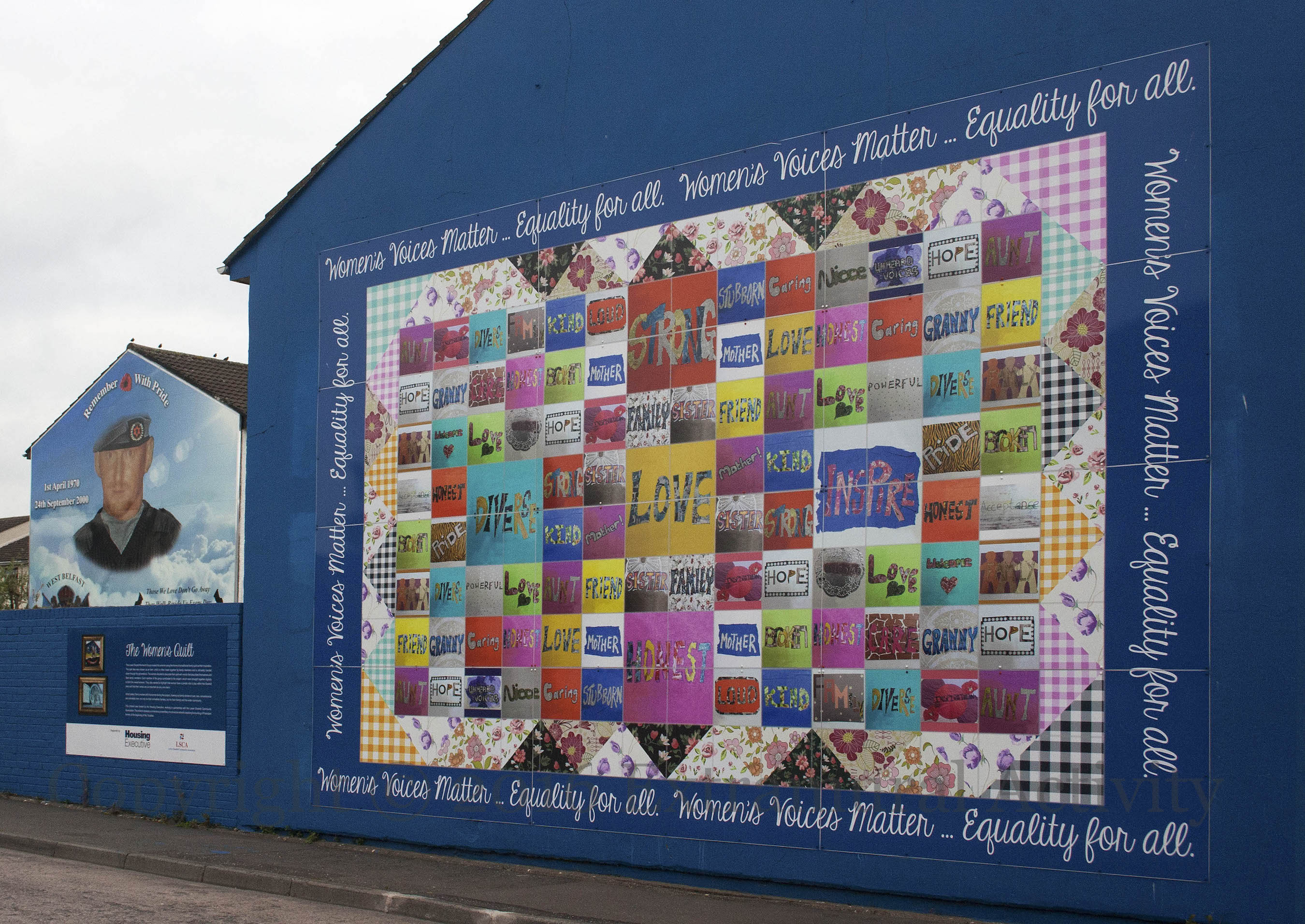
“Remember With Pride” (with a poppy). Although the dates of his birth and death are given, Stevie “Top Gun” McKeag’s name appears only on the side-wall of this new mural in the Lower Shankill estate. McKeag was the top assassin in the UDA during the 1990s, claiming at least 12 victims. Both his WP page and this Guardian article describe his career and preeminent standing within the UDA.
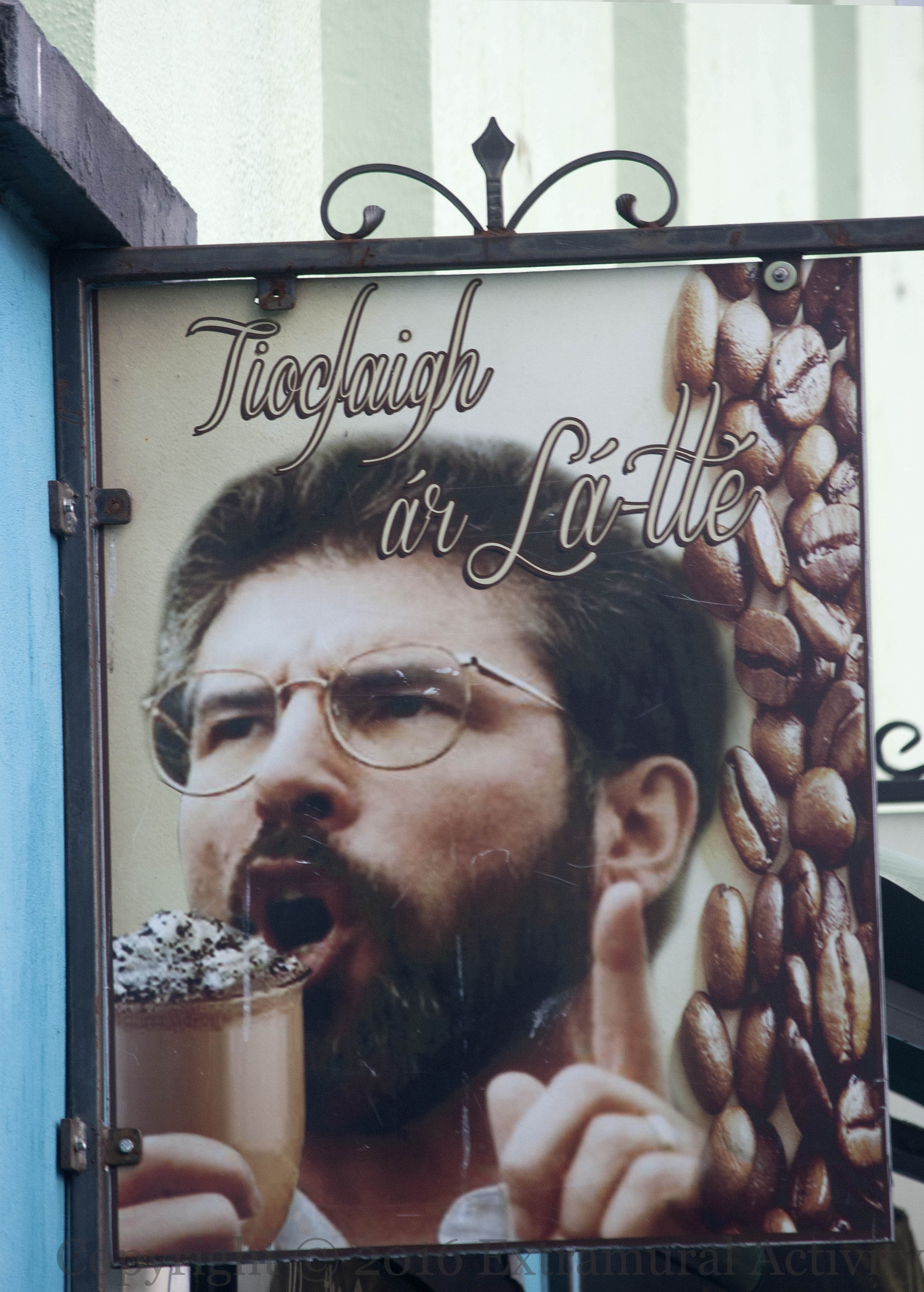
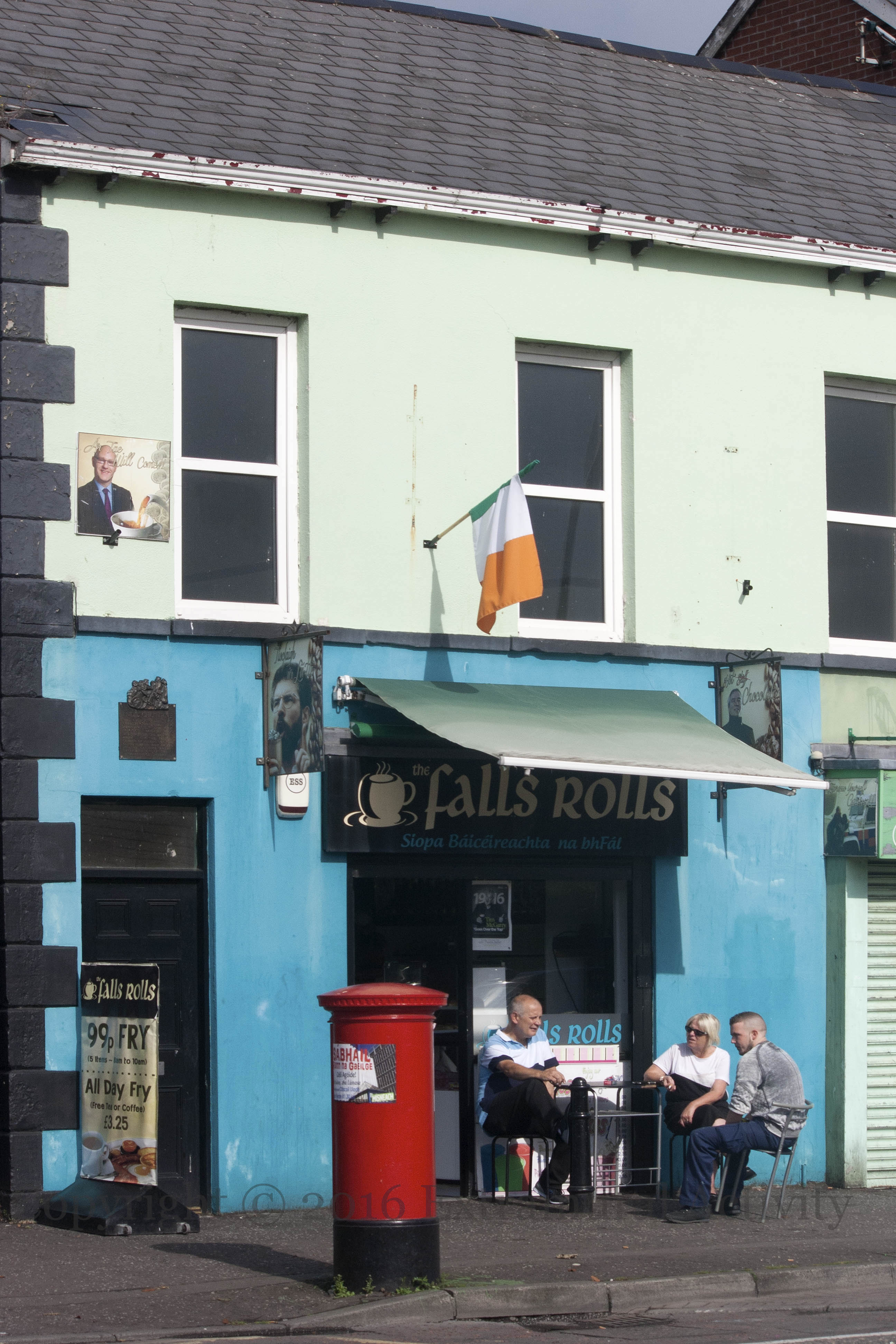
Sınn Féın representatives Paul Maskey (above), Gerry Adams, and Martin McGuinness are photoshopped into these beverage-themed, Irish-language puns outside the ‘Falls Rolls’ bakery: Ár tae will come, Tıocfaıgh [sic] ár látte, and Mocha-ra.
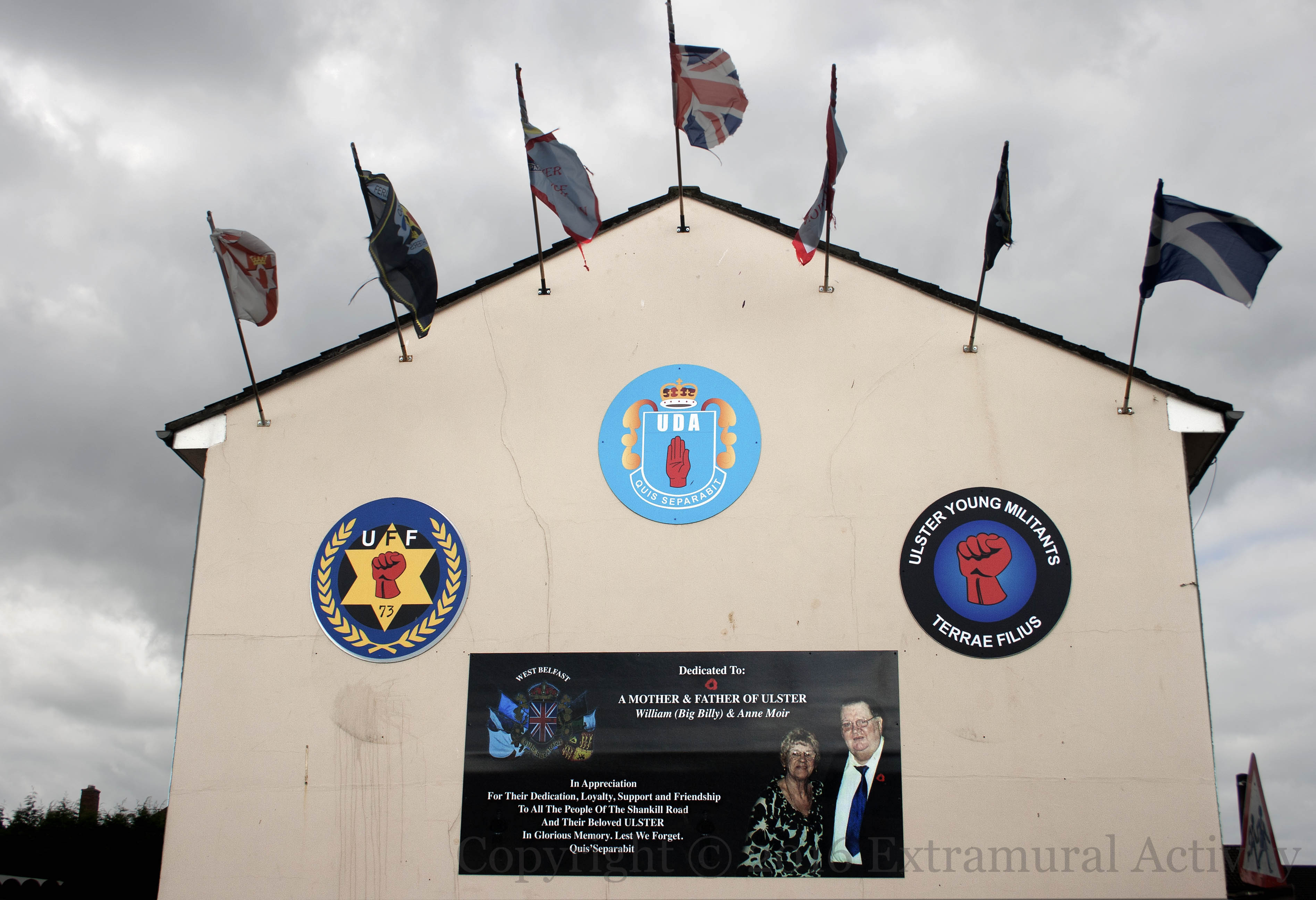
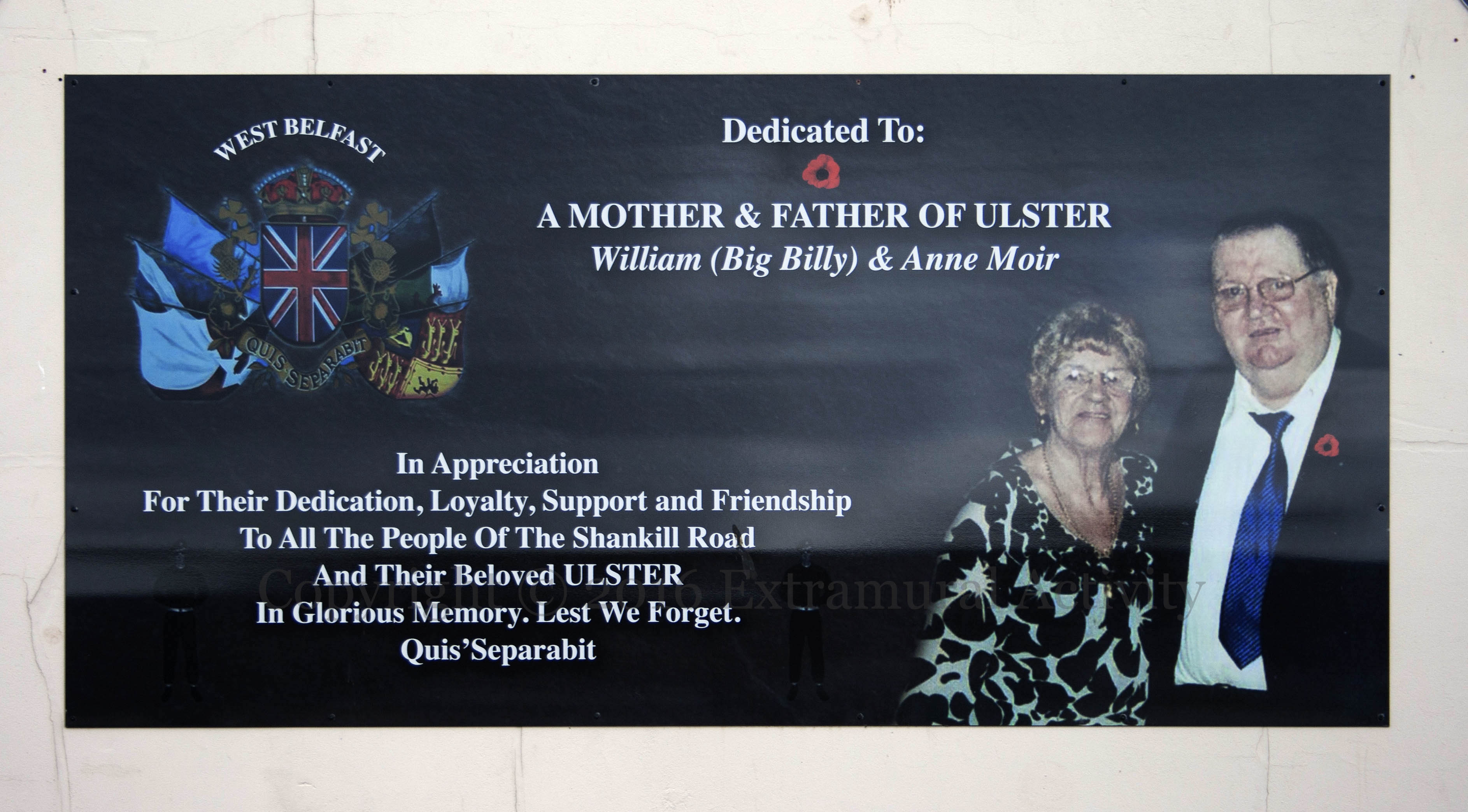
Billy Moir, who died this past May (2016) was a central figure in the Glasgow flute-band scene. The board above, dedicated to Billy and his wife Anne, is in the lower Shankill estate. “Dedicated to a mother & father of Ulster: William (Big Billy) & Anne Moir, in appreciation for their Dedication, Loyalty, Support and Friendship to all the people of the Shankill Road and their beloved ULSTER. In Glorious Memory, Lest We Forget, Quis Separabit.”
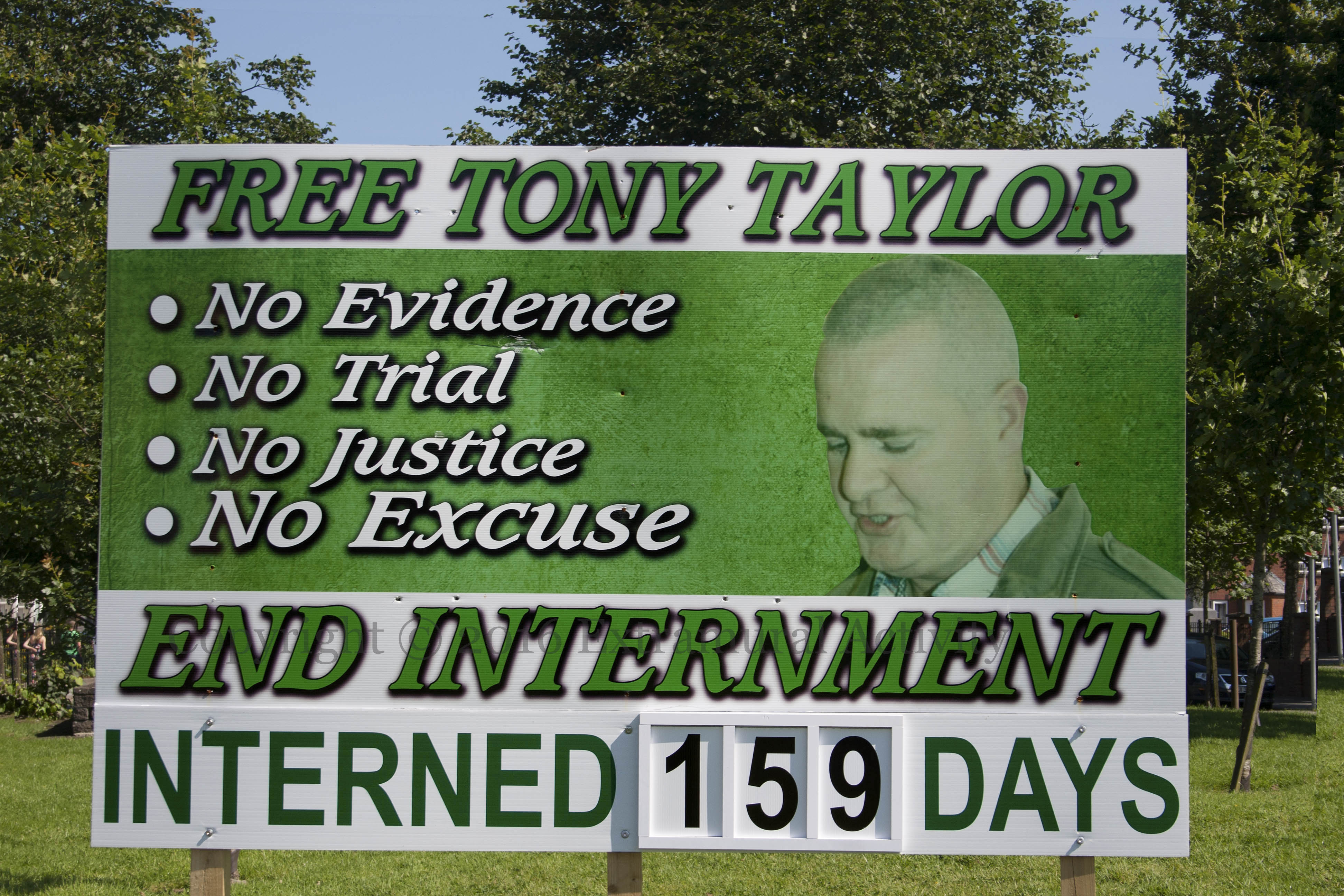
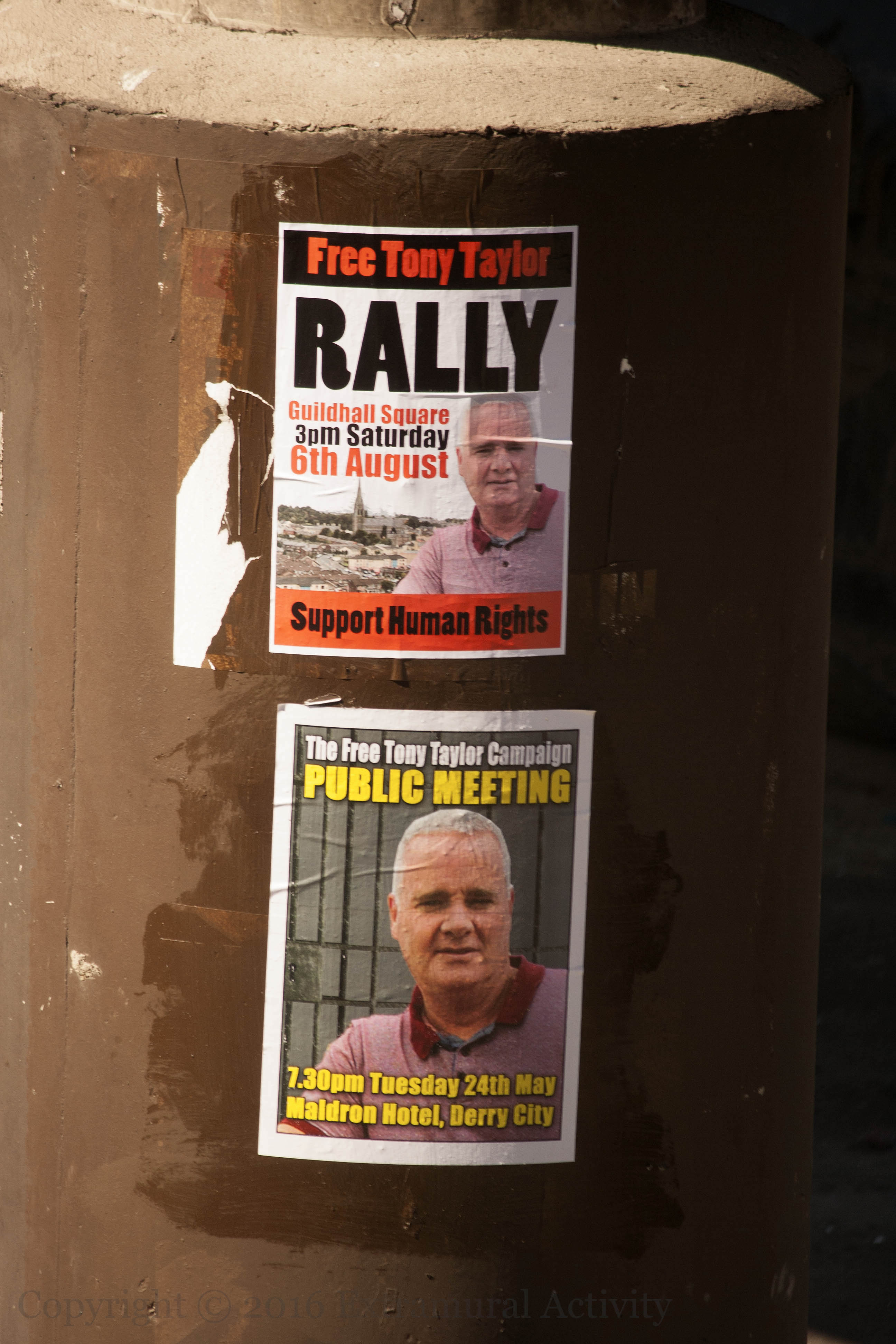
As a comparison of the first and third images – taken six weeks apart – show, a count of the days in prison has been added to the Tony Taylor board on the green in front of the H-Block memorial in Derry, reminiscent of the counts that were kept of the hunger strikers in 1981 (see, for example, Day 55 | Day 61 on the Peter Moloney Collection blog).
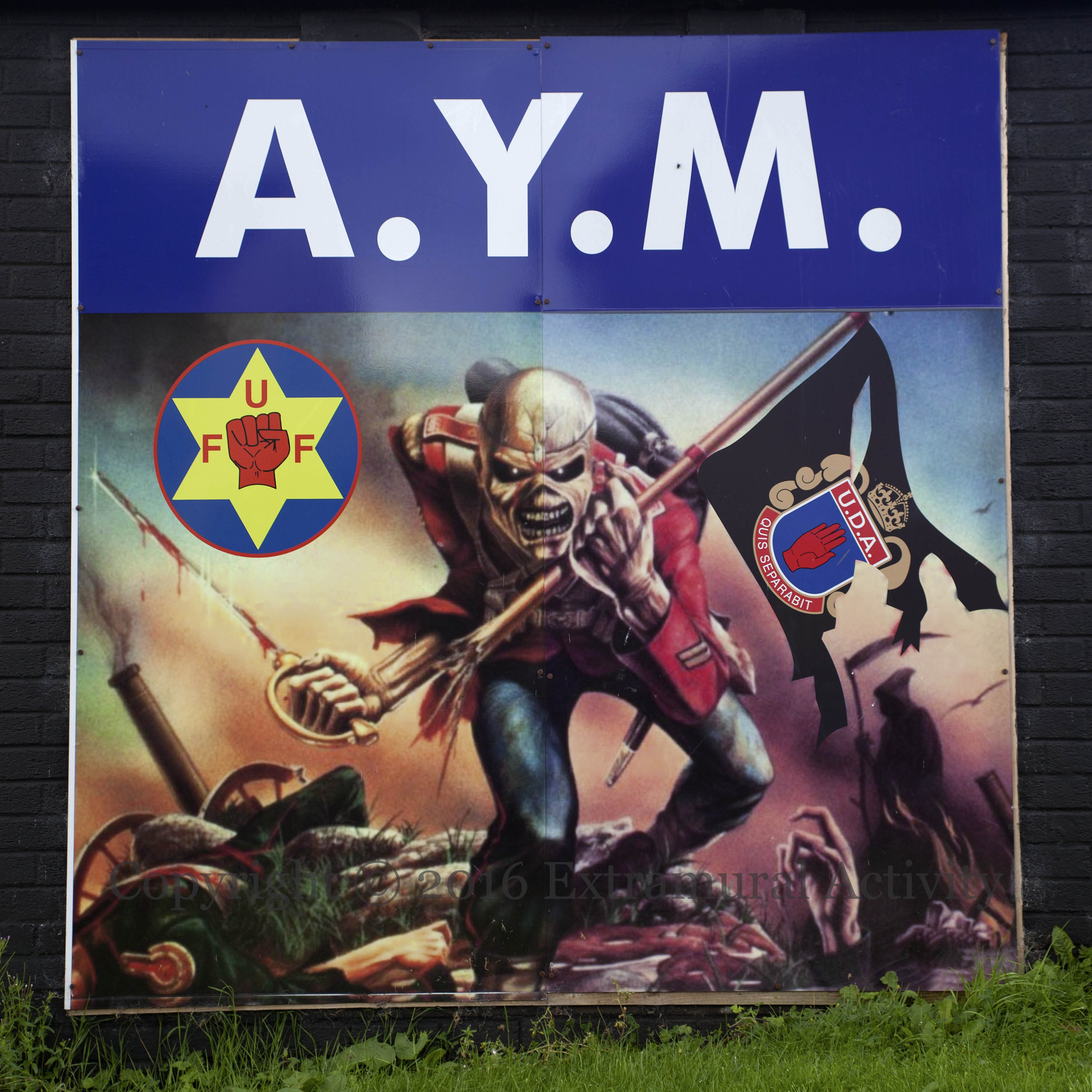
Rather than the Union flag that he carries in other murals and on the original Iron Maiden album cover (see The Trooper), in this version Eddie The Trooper carries a UDA flag (with the UFF symbol also shown). “AYM” is probably “Antiville Young Militants”.
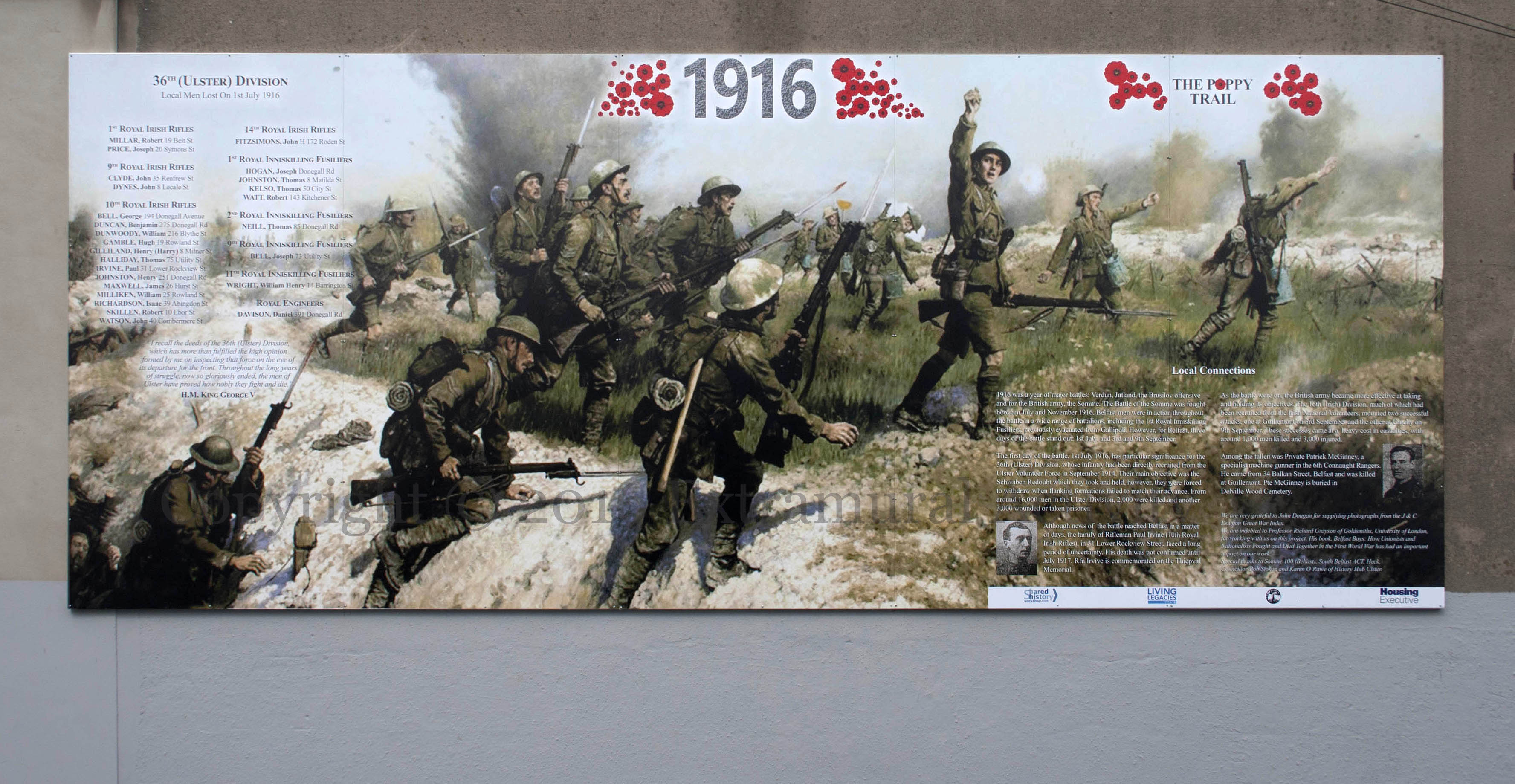
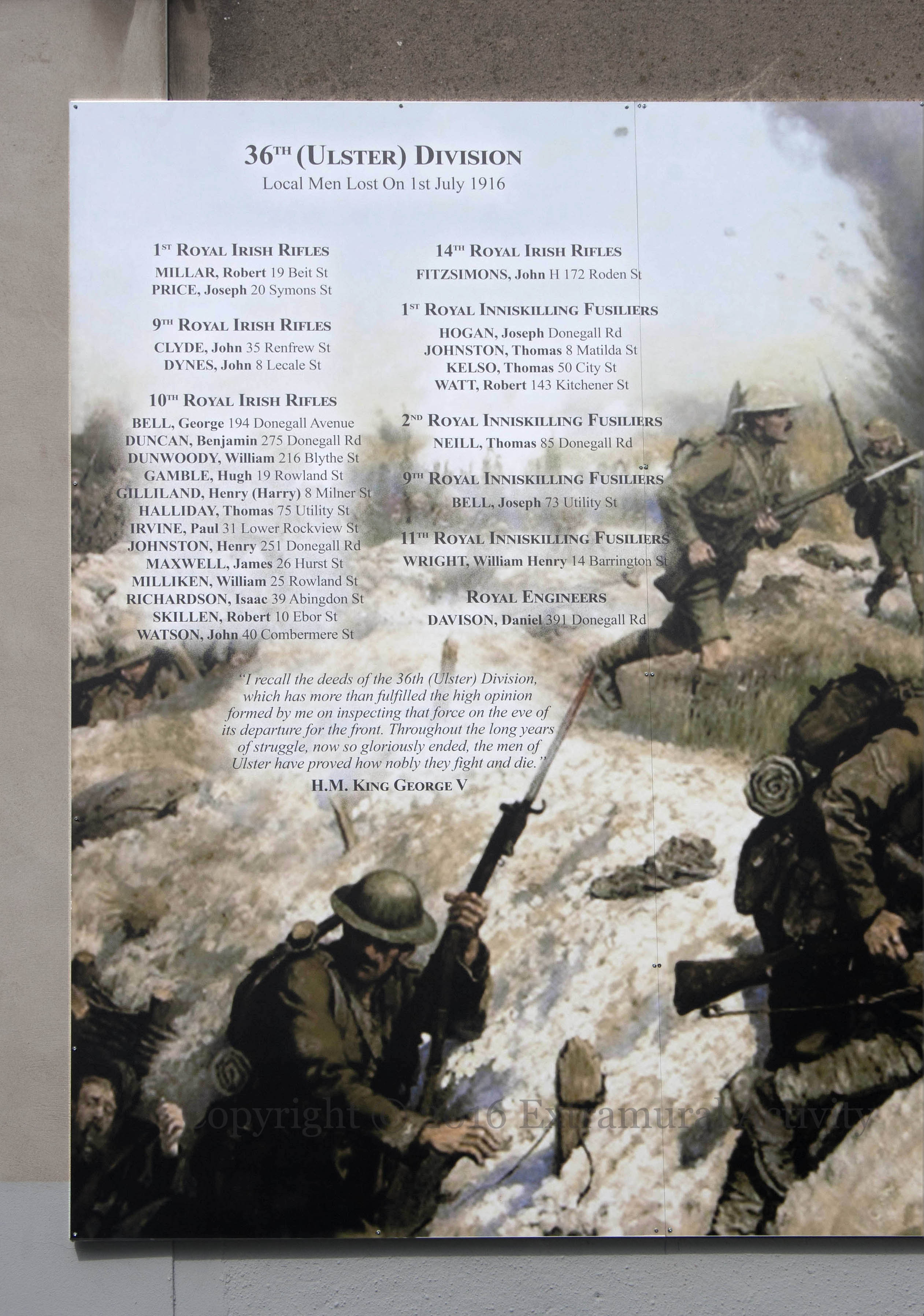
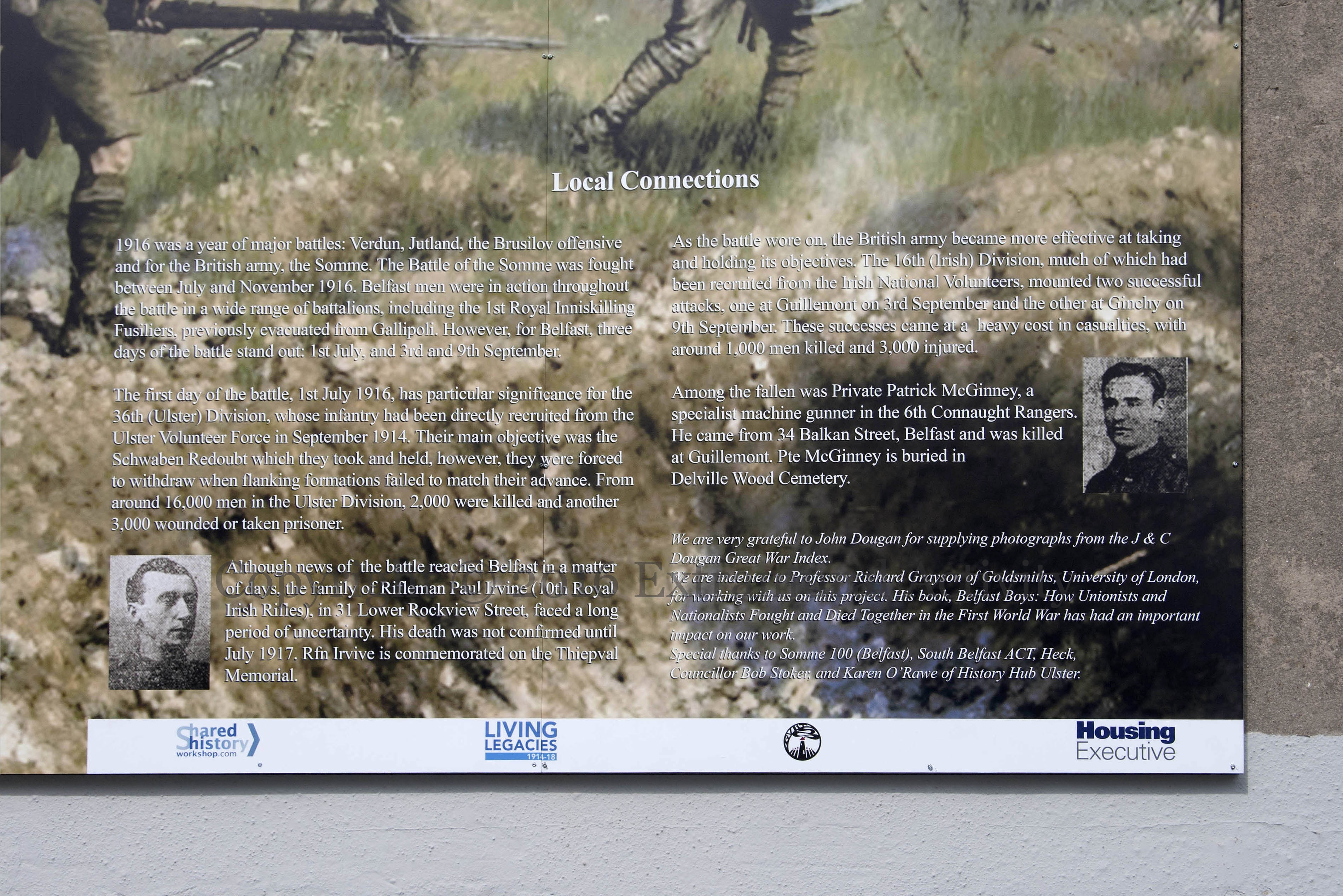
JP Beadle’s Battle Of The Somme, Attack Of The Ulster Division is reproduced in the 1916 installment of the Poppy Trail in south Belfast. (For more on the painting, see belfastsomme.com.) In addition to listing local men lost in on July 1st – from places such as Roden, Matilda, Kitchener, Barrington, Blythe, Ebor, Rowland, Abingdon, and Combermere Street – it also features an individual from each community who served and died, in this case, Rifleman Paul Irvine from Lower Rockview Street and Private Patrick McGinney from Balkan Street (in the Divis area).










 Extramural Activity