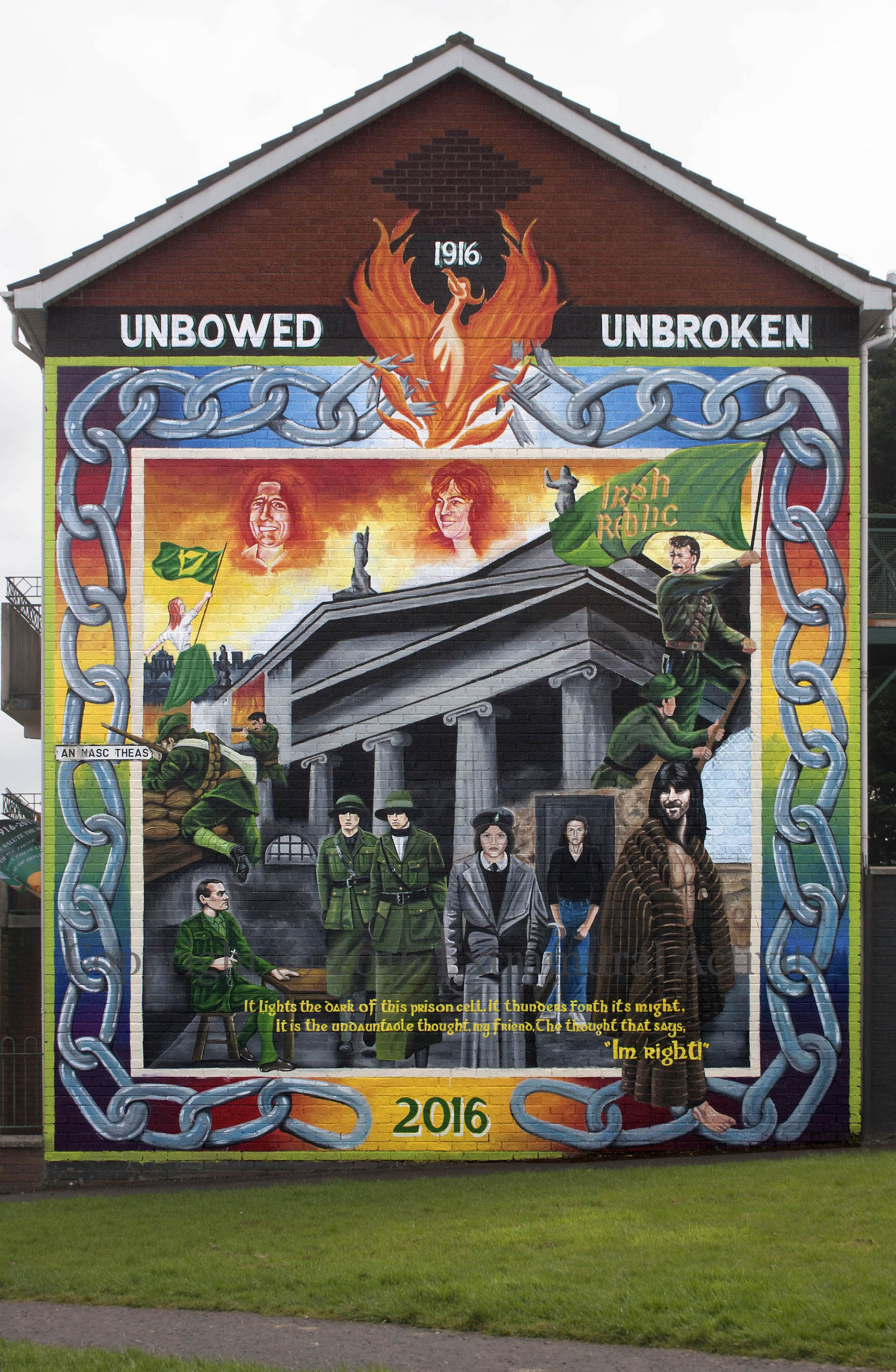
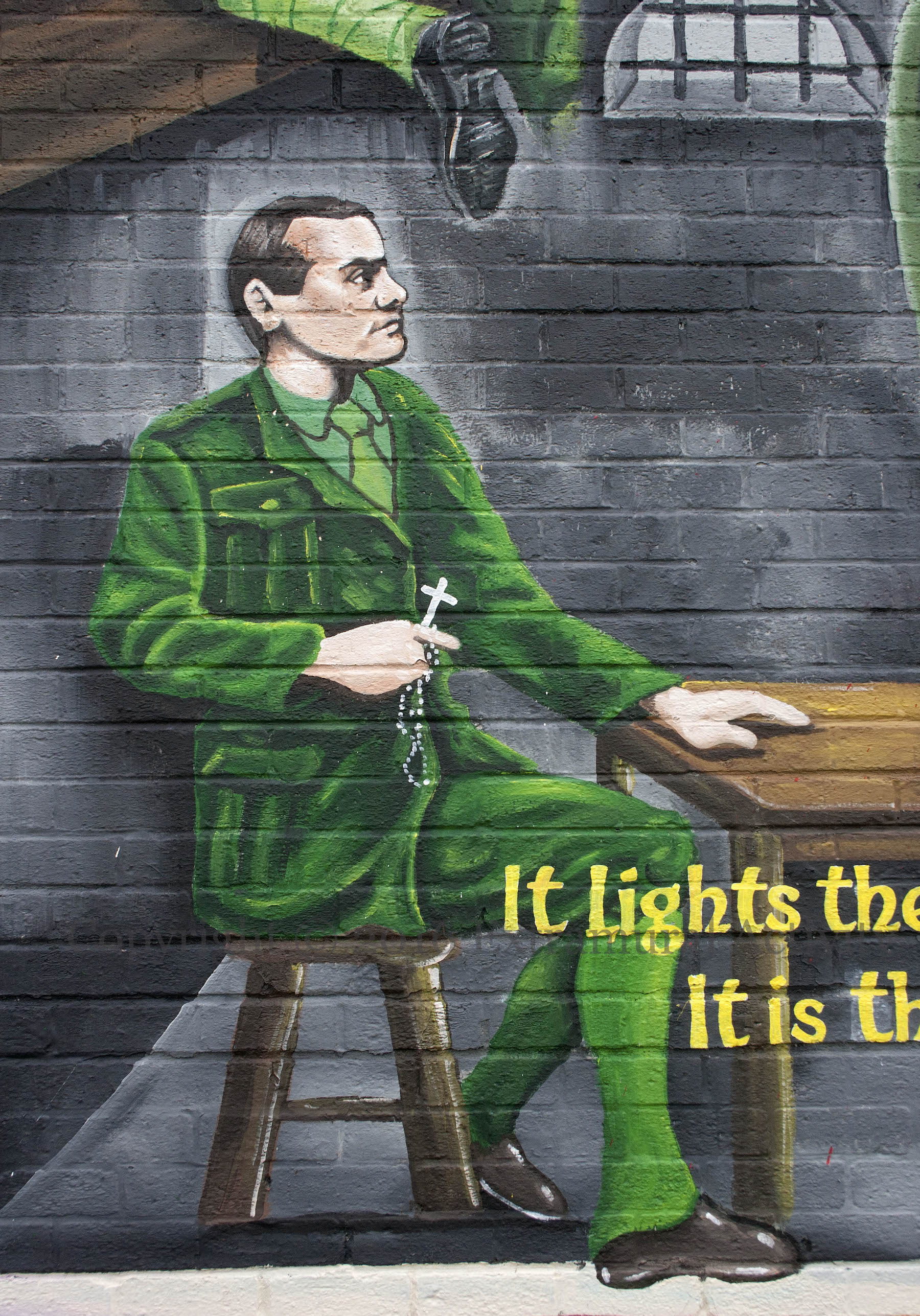
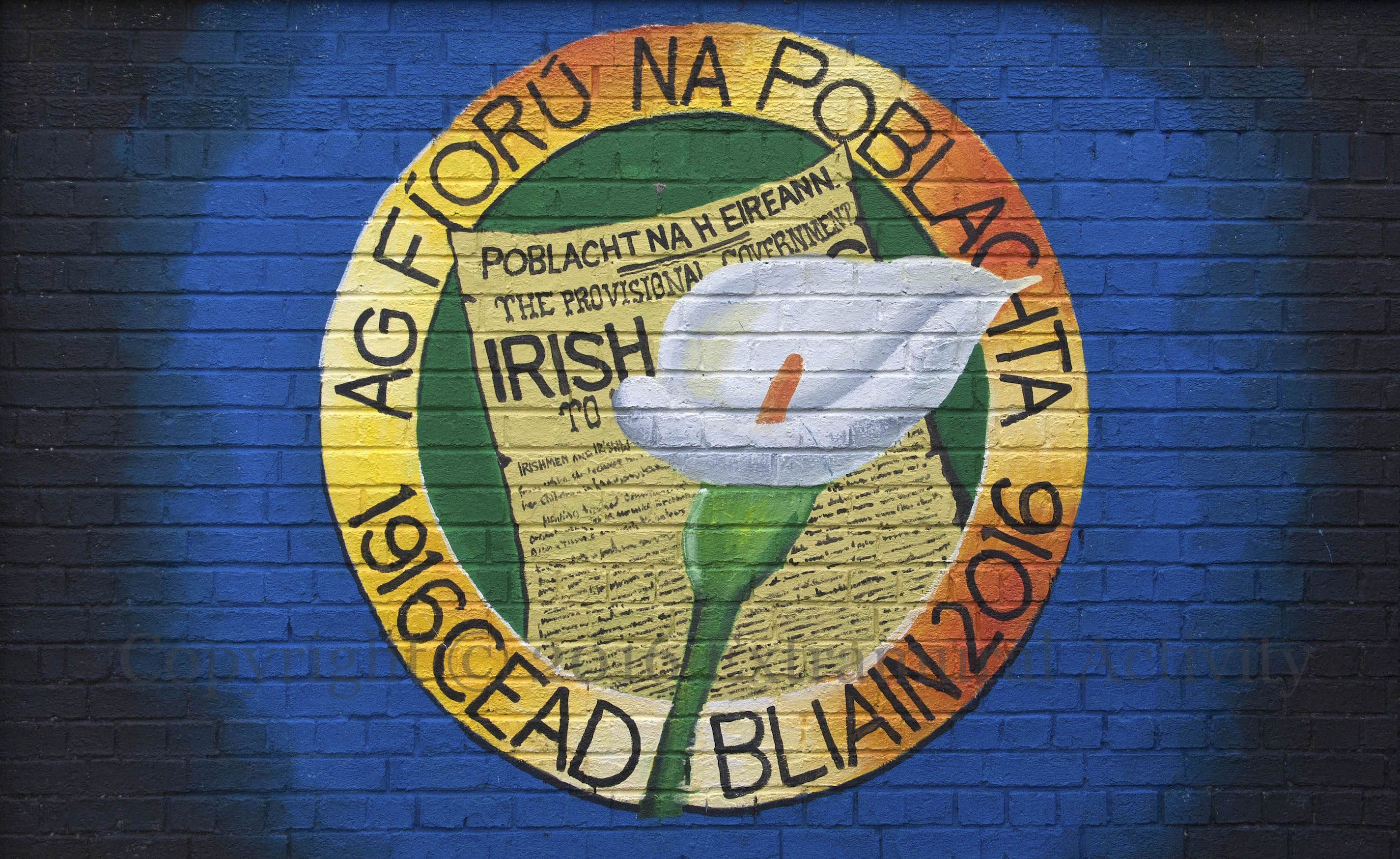
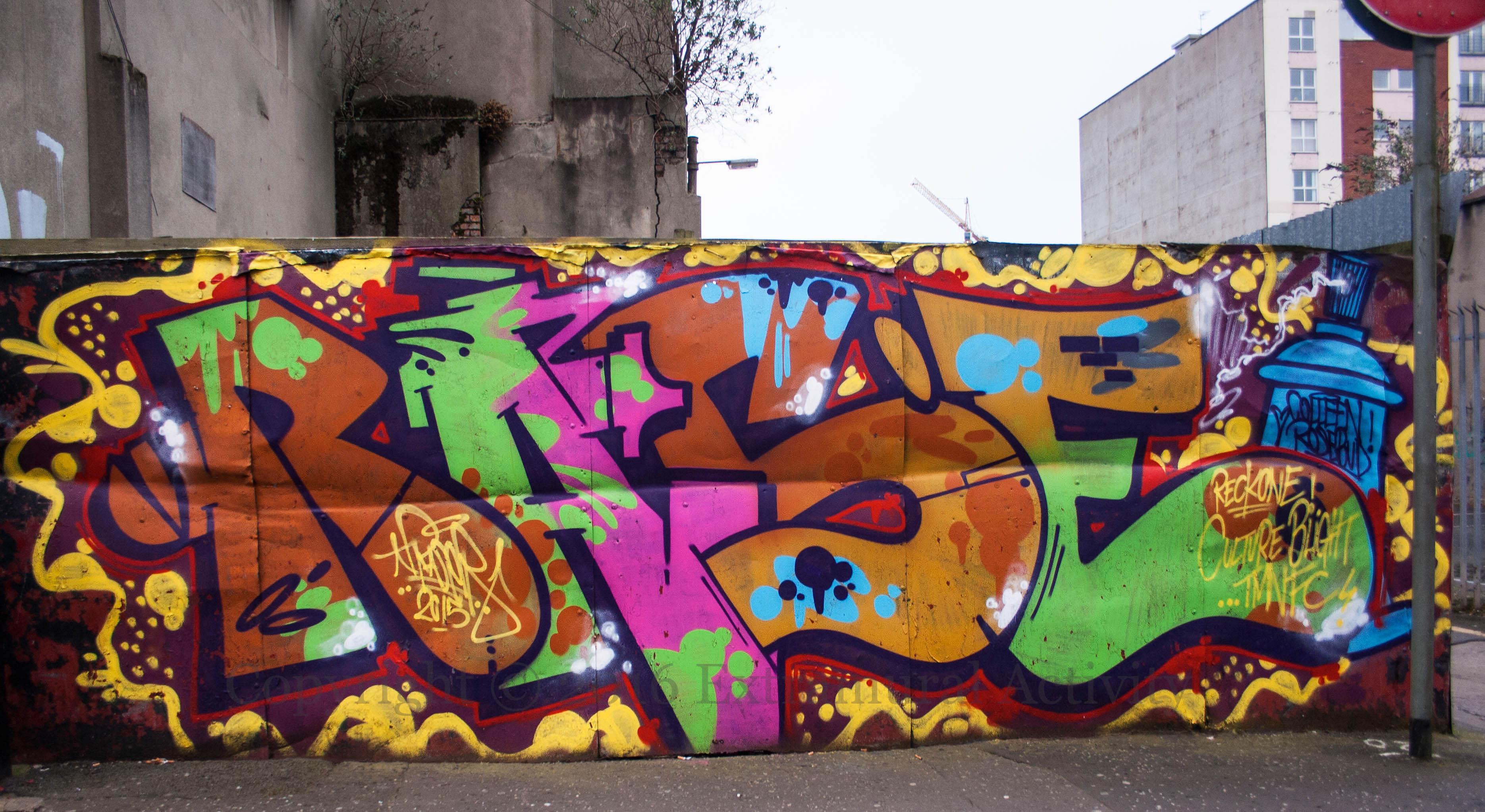
While taking part in the Easter Rising centenary parade, members of the James Connolly 1st Republican Flute Band from Glasgow (tw) pause on the Falls Road during a squall. Embroidered on the rear of their shirts are the words “We serve neither king nor kaiser, but Ireland”, the slogan which hung outside the ITGWU’s Liberty Hall during the first world war. Image courtesy of Bronagh Bowerman.
The images in the windows of the McLean’s bookies on the Shankill Road suggest that betting on sports – even on George Best – is like playing roulette. The gate to the left (with barbed wire on top) is marked with the letters “U” and “R” of the nearby Ulster Rangers supporters club. (For two murals there, see previously: Save The Shankill | Doing Her Duty).
You can let your Union flag fly across the rooftops with this “sky lantern”, for sale in the window of a shop on the Newtownards Road. “Ready to light … lift … and launch.”
Anti-Óglaıgh Na hÉıreann graffiti in Beechmount Street beneath a Sınn Féın banner using Martin Luther King to advocate for non-violent protest (featured previously in Always Avoid Violence).
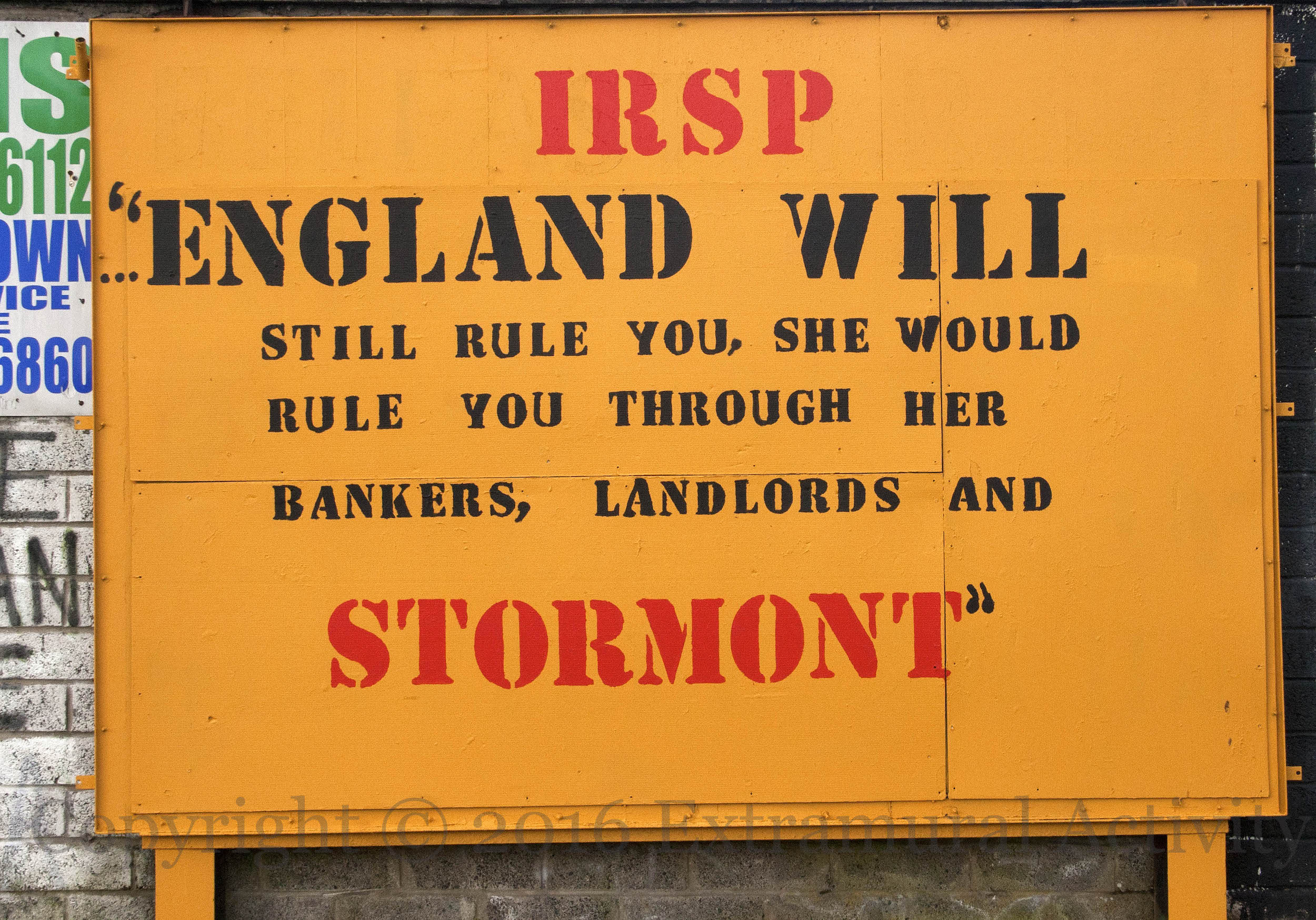
The Royal Ulster Constabulary, Police Service of ‘Northern Ireland’, and An Garda Síochána are branded as agents of the status quo, enforcing the partition of Ireland and the capitalist system in this IRSP mural on Northumberland Street: “Know your enemy – reject political policing”.
Here is an update to a mural featured previously in London-/Derry: The Trooper. British WWI Field-Marshall Douglas Haig’s “backs to the wall” quote originally stood above the image of Iron Maiden’s “Eddie” but this was replaced (when the mural was repainted in 2013 – see M10234) by the red fist and six-pointed star of the UFF on a black border.
A socially-themed mural in east Belfast: On the dark, down, side: (peer-)pressure, crime, consequence, death, illness, breakdown, suicide. On the up, bright, side; education, work, successful, “enable, empower, equip” (the motto of CharterNI)
Arrayed against the forces of the British Army (which are shown in armoured cars and in sniping positions in the foreground of the mural, along the whole length of the wall) are various symbols of Irish nationalism: Oliver Sheppard‘s 1911 statue of Cú Chulaınn dying; the pikemen of the 1798 Rebellion (featured yesterday: Éırí Amach 1798); the four provinces of Ireland; Érıu the mythological queen of Ireland/Éıre as designed by Richard J King/Rísteard Ó Cíonga; Easter lilies; the emblems of Na Fıanna Évreann and Cumann Na mBan on either side of a quote from (The Mainspring) Sean MacDiarmada “We bleed that the nation may live; I die that the nation may live. Damn your concessions, England: we want our country”; a phoenix rising from the flames of the burning Dublin GPO (inspired by Norman Teeling’s 1998 painting The GPO Burns In Dublin); the GPO flying an ‘Irish Republic’ flag; portraits of signatories and other rebels — (left) Padraig H. Pearse, Thomas J Clarke, Eamonn Ceannt, Thomas MacDonagh, (right) Countess Markievicz, James Connolly, Sean MacDiarmada, Thomas Plunkett; the declaration of independence, placed over the advertising box of AA Accountants – see the in-progress shot below. For more work-in-progess images, see yesterday’s post, Éırí Amach 1798. At the very bottom is a quote from the mother of Gerard ‘Mo Chara’ Kelly, Harriet Kelly: “We want the freedom of our country and your soldiers out.”
The pikemen of 1798 go into battle under the flag of the United Irishmen in a detail from a new mural on the Falls Road for the centenary of the 1916 Easter Rising. Below are work-in-progress images showing artists Gerard ‘Mo Chara’ Kelly and Bill Bradley.
In 1955, Ruby Murray — who was born and raised on Donegall Road — had a #1 hit with Softly, Softly (youtube) and it stayed at the top for three weeks. She went on to have six other top-ten hits that year and in one week five of her songs were in the top twenty.