This fake shopfront on the main Antrim Road through Glengormley pretends to be a bookstore but was once the Thyme Cafe. It’s not clear where the “restaurant” signage comes from.
St. Patrick’s on Donegall Street serves as the local Catholic church for the New Lodge. Its spire rises above the houses in a detail from the community mural at the bottom of the New Lodge, painted by Ed Reynolds (steadyhanded.com), based on vintage photographs of the area and its residents.
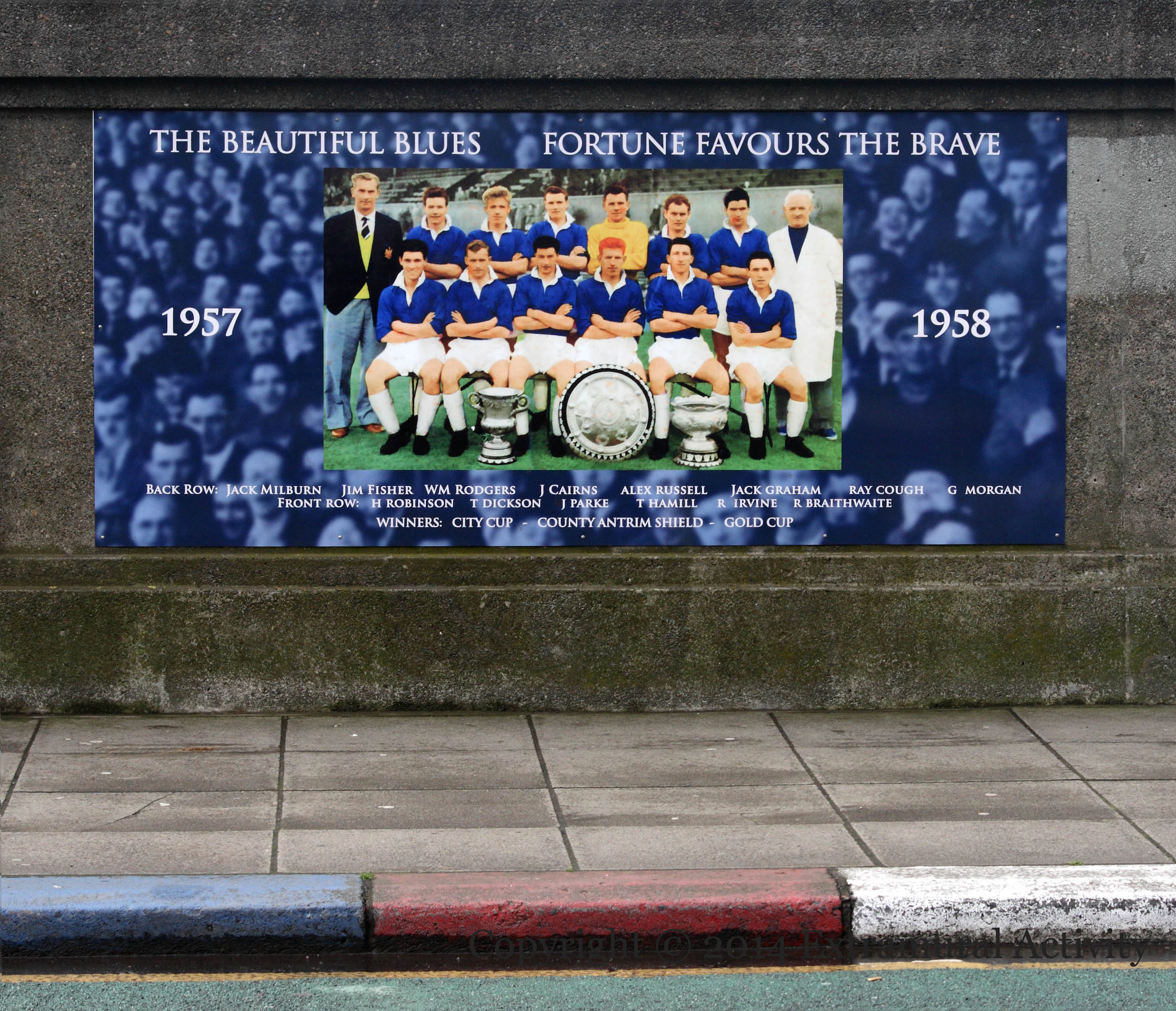
Two boards on the Donegall Road feature Linfield football club. The one above (at the bridge near Roden Street) features the 1957-1958 team; the one below (near the City Hospital station) has the founding team of 1886 and champions in 1890-1891 in the background (shown in Fortune Favours The Brave) “with Sandy Row former Linfield players Daryl Fordyce and Albert Watson, with the modern day youth of Sandy Row” (linfieldfc.com).
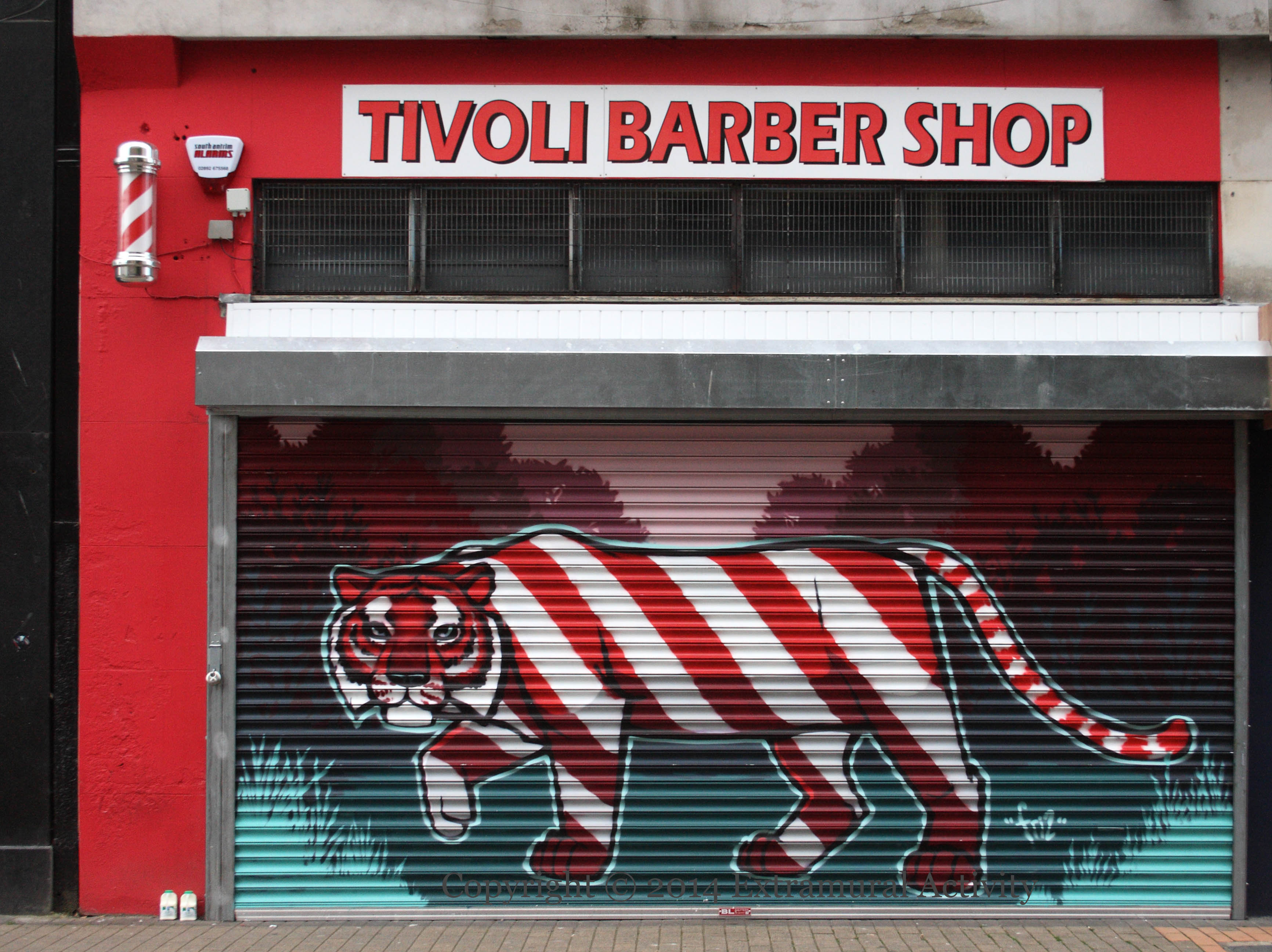
In Belfast city centre in the early morning, it’s generally safe for the milkman to leave the milk on the pavement outside business premises, but perhaps not when there’s a well-camouflaged tiger on the prowl – red and white striped to match the pole of the Tivoli barber shop.
“If stones could speake then London’s prayse should sounde who built this church and cittie from the grounde.” Above is the dedication stone for St. Columb’s Anglican church in Derry and within that is a smaller stone “said to have come from Derry’s mediaeval cathedral” (colmcille.org) which reads “In templo verus deus est vereq[ue] colendus” – In the temple is the true God and truly deserving to be worshipped.
“Ano do 1633” [Anno Domini – In the year of our Lord, 1633], “Car Regis” 9 [Caroli regis – in the ninth year of the reign of King Charles], Vaughan Aed [Vaughan aedificavit – built by Sir John Vaughan, Governor of the City of Londonderry; the builder was in fact William Parrott. Construction began in 1628 and was completed in 1633, at a cost of 4,000 pounds.]
“Today is yesterday’s tomorrow”. Vintage images of Sandy Row, including the Ulster Spinning Company and the Royal Bar, make up this “Heritage – Culture – Identity” board on Donegall Road. The central image is part of this photo montage.
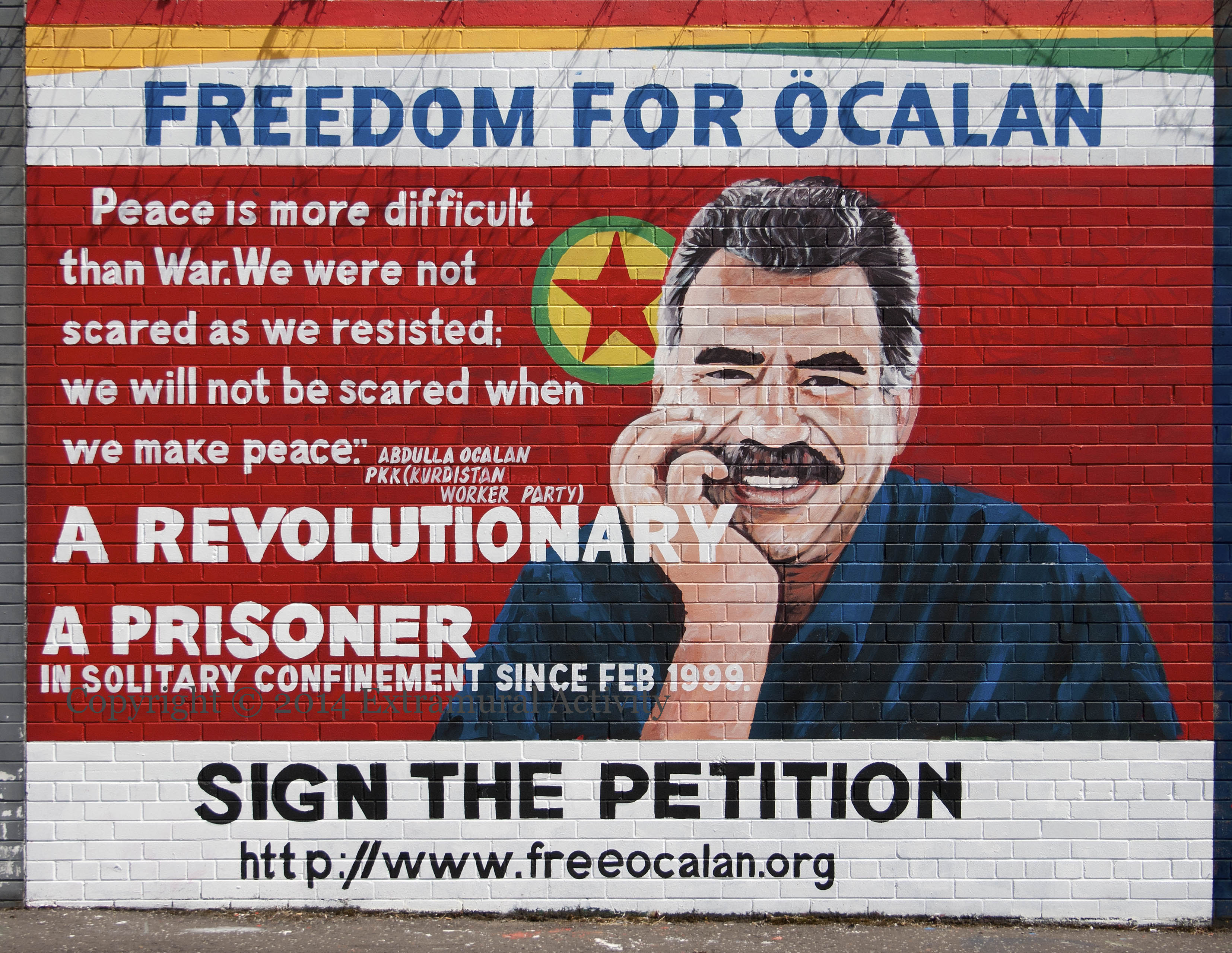
“Peace is more difficult than war. We were not scared as we resisted; we will not be scared when we make peace.” Turkish-born Kurdistan Workers’ Party founder Abdullah Öcalan has been in prison since 1999, during which time he has changed from advocating violence to advocating a political solution to the Kurdish situation in Turkey. (WP) The conflict has resulted in a minimum of 45,000 deaths. (WP)
The mural was launched on Sunday (2014-07-06); it replaces the Sands Family mural. Below is a shot from January 2017 showing damage to the mural.
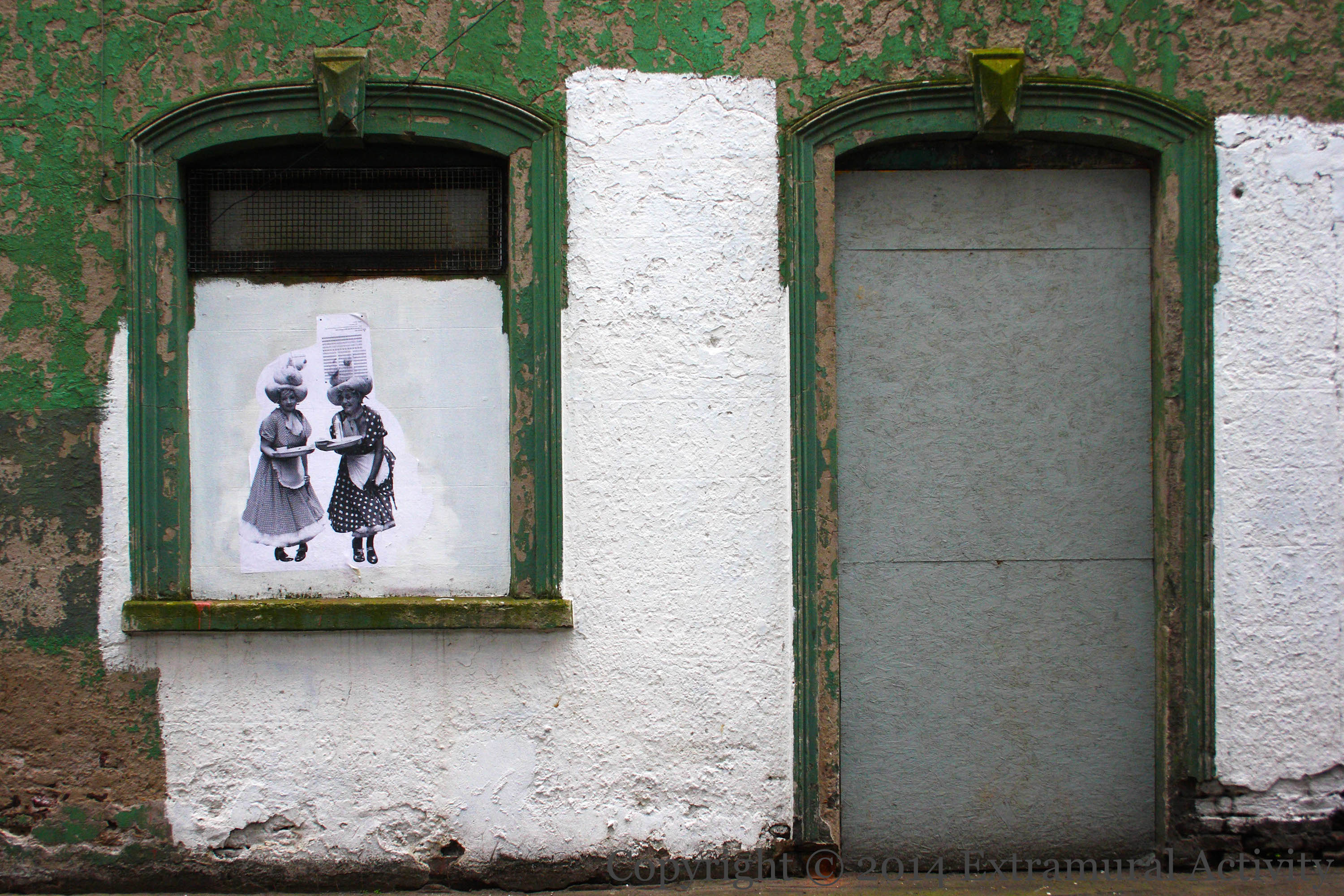
SWANK Street Theatre characters Madame Fondant and Mademoiselle Patti Cerie, who graced Festival Of Fools 2014 in May, have been immortalized in a paste-up in Garfield Street (below) and Kent Street (bottom).
Here is video of two other SWANK characters, usherettes Pearl & Deanie.
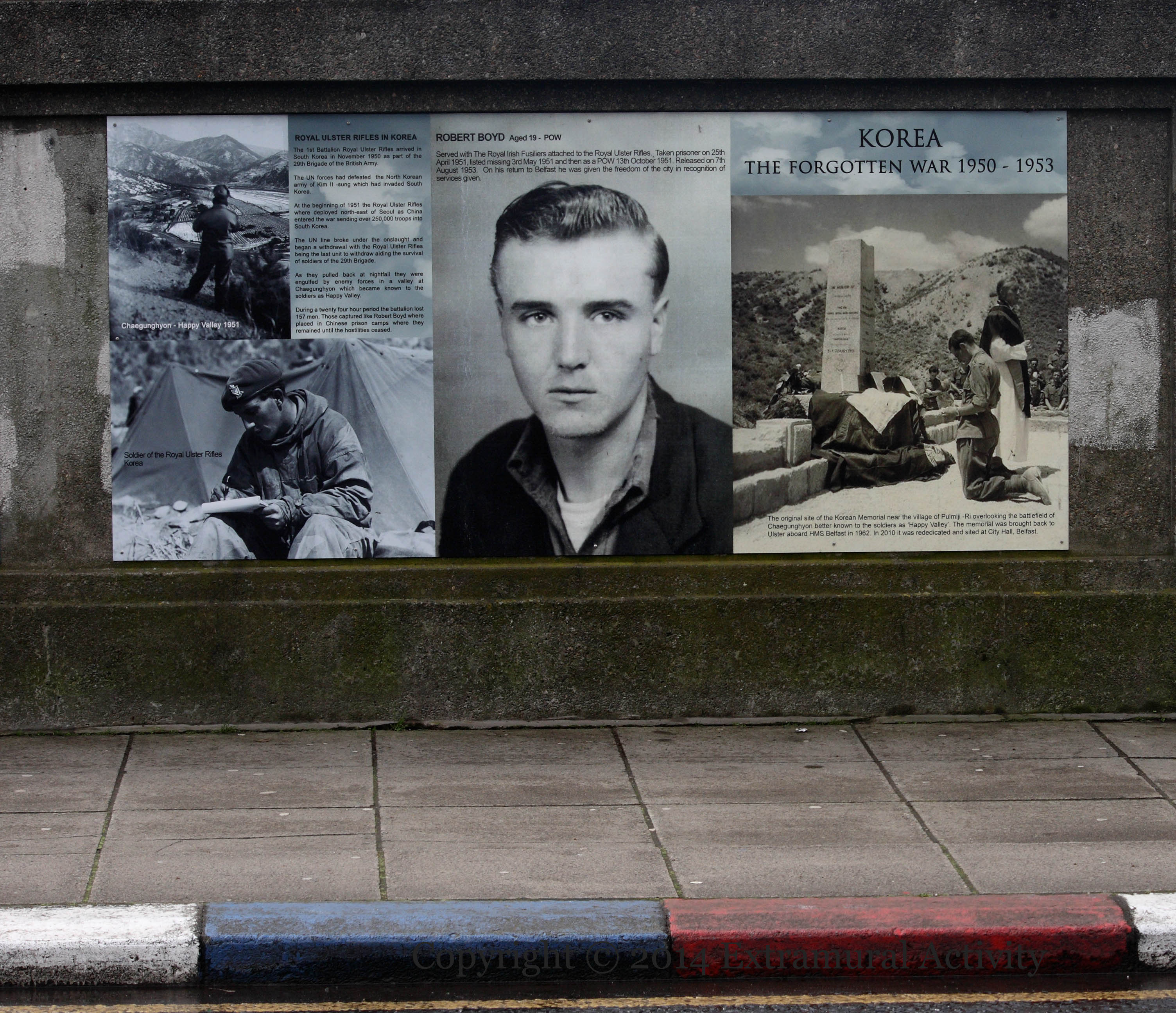
James Magennis, above, from east Belfast, won the Victoria Cross for service in WWII (as described in a post about a mural based on the image on the right in Tullycarnett). Robert Boyd, according to the image below, was awarded the freedom of the city of Belfast for service in Korean War. Two panels, one from each side of the Donegall Road bridge.
“Royal Ulster Rifles in Korea. The 1st battalion arrived in South Korea in November 1950 as part of the 29th brigade of the british army. The UN forces had degeated the North Koran army of Kim Il sung which had invaded south korea. At the beginning of 1951 deployed north-east of seoul as chine entered the war sending over 250,000 troops. The UN line broke under the onslaught and began a withdrawal being the last unit to withdraw aiding the survival of soldiers of the 29th brigade. As they pulled back at nightfall they were engulfed by enemy forces in a valley at Chaegunghyon which became know to the soldiers as Happy Valley. During a twenty four hour period the battalion lost 157 men. Those captured like Robert Boyd where were placed in Chinese prison camps where they remained until the hostilities ceased. Robert Boyd aged 19 POW. Served with the royal irish fusiliers. Taken prisoner on 25th April 1951, listed missing 3rd May 1951 and then as a POW 13th October 1851. released on 7th August 1953. On his return to Belfast he was given the freedom of the city in recognition of services given. The original site of the Korean Memorial near the village of Pulmiji-Ri overlooking the battlefield brought back to Ulster abroad HMS in 1962. In redidicated and sited at city hall.
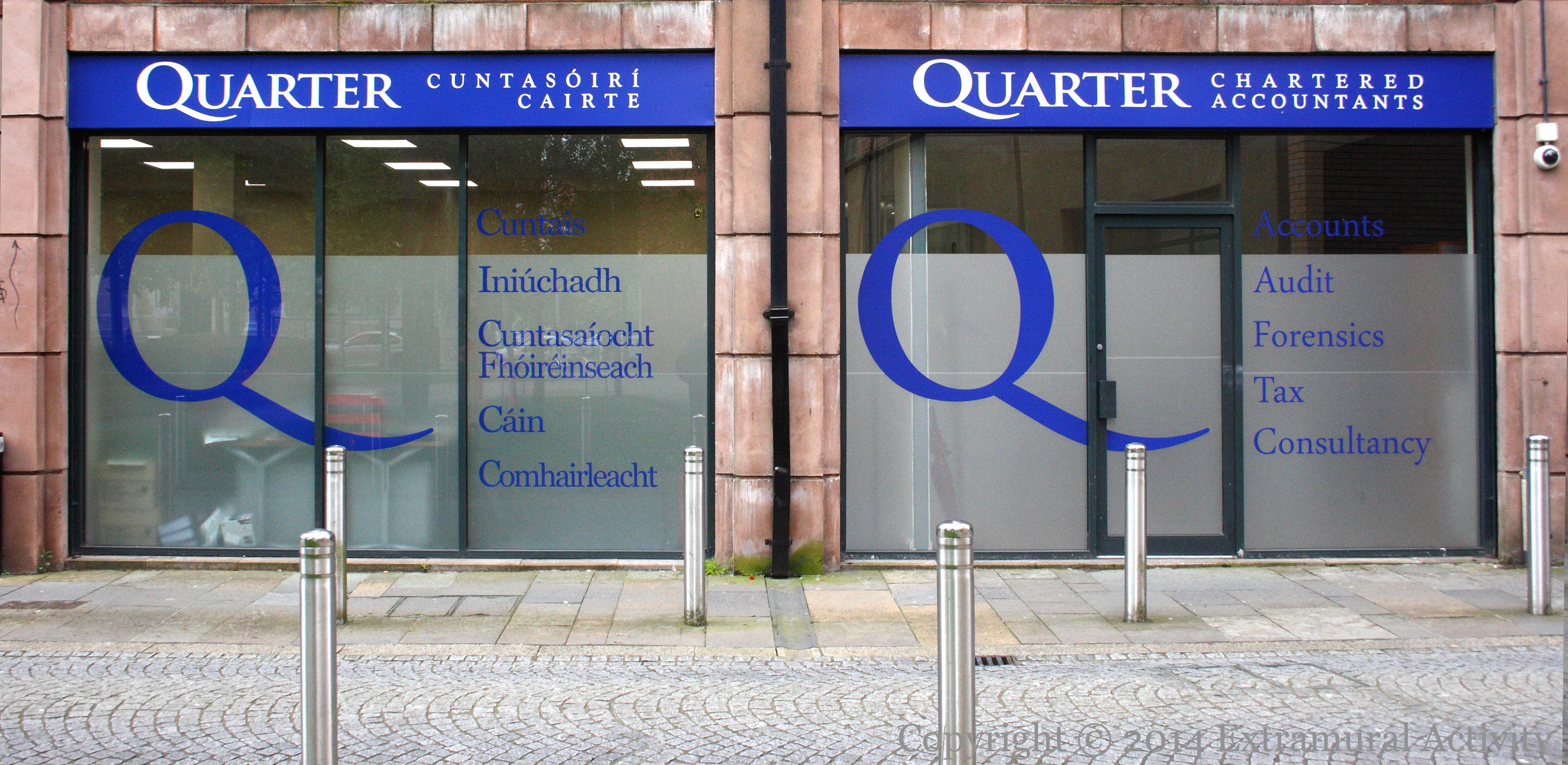
Belfast has seven geographical quarters and an eighth one in the form of Quarter Accountants/Cuntasóırí in Belfast’s city centre. Notably, the signage is in both English and Irish; the business is in the Cathedral Quarter rather than the Gaeltacht Quarter.








 Extramural Activity