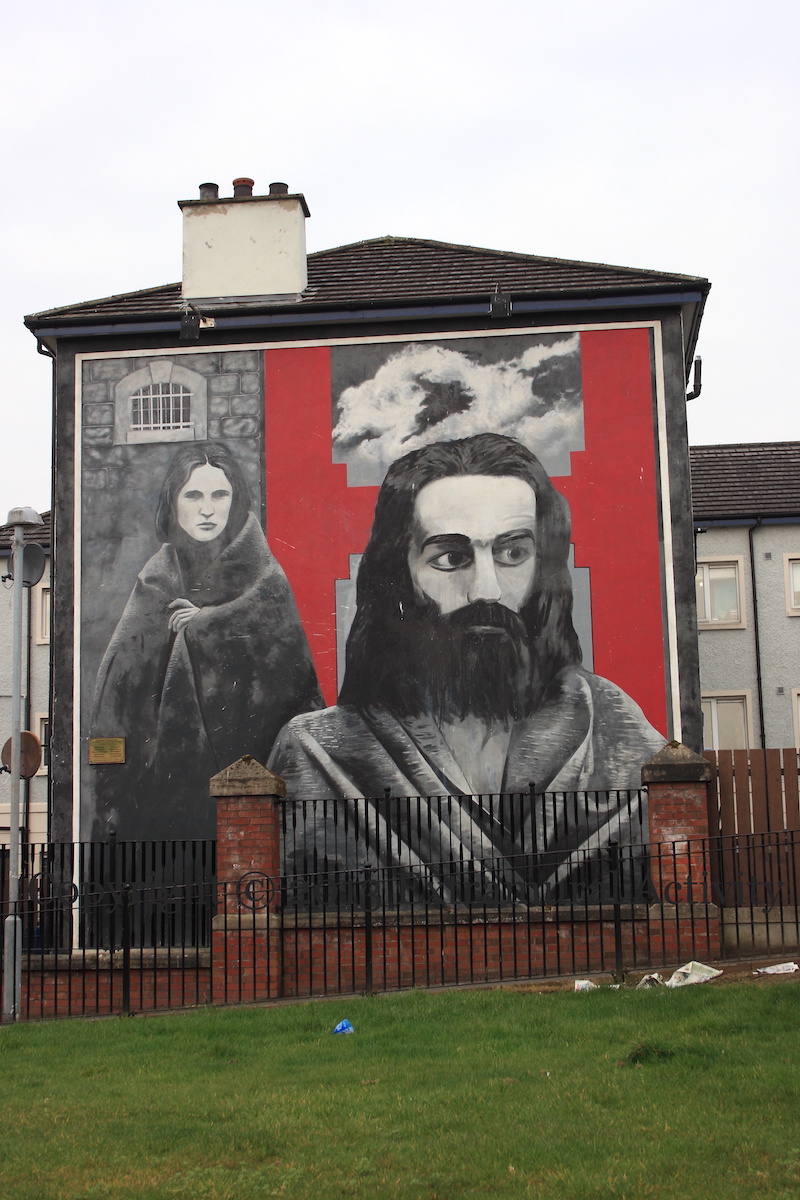
This is the sixth mural by the Bogside Artists, commemorating the hunger strike. The main figure is Raymond McCartney, shown after 53 days on hunger strike in 1980; the female figure is perhaps Mary Doyle (the other two female strikers were Maıréad Farrell and Maıréad Nugent).
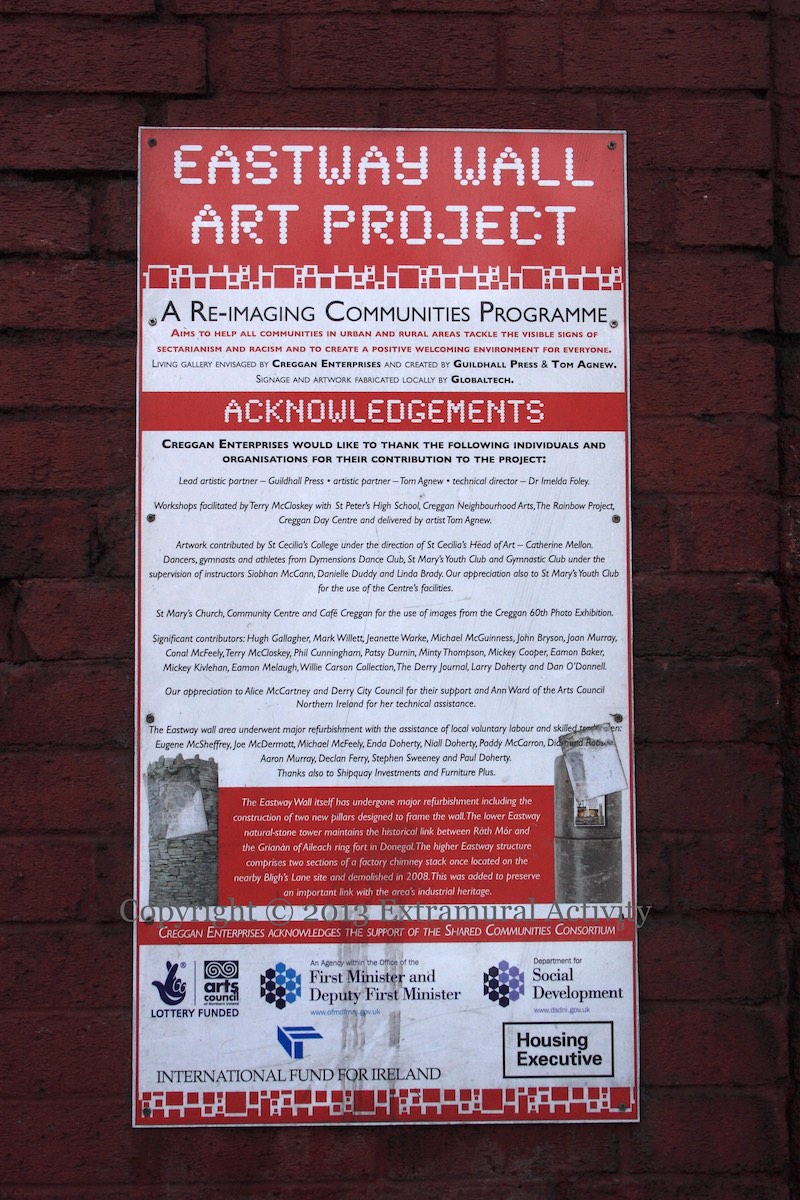
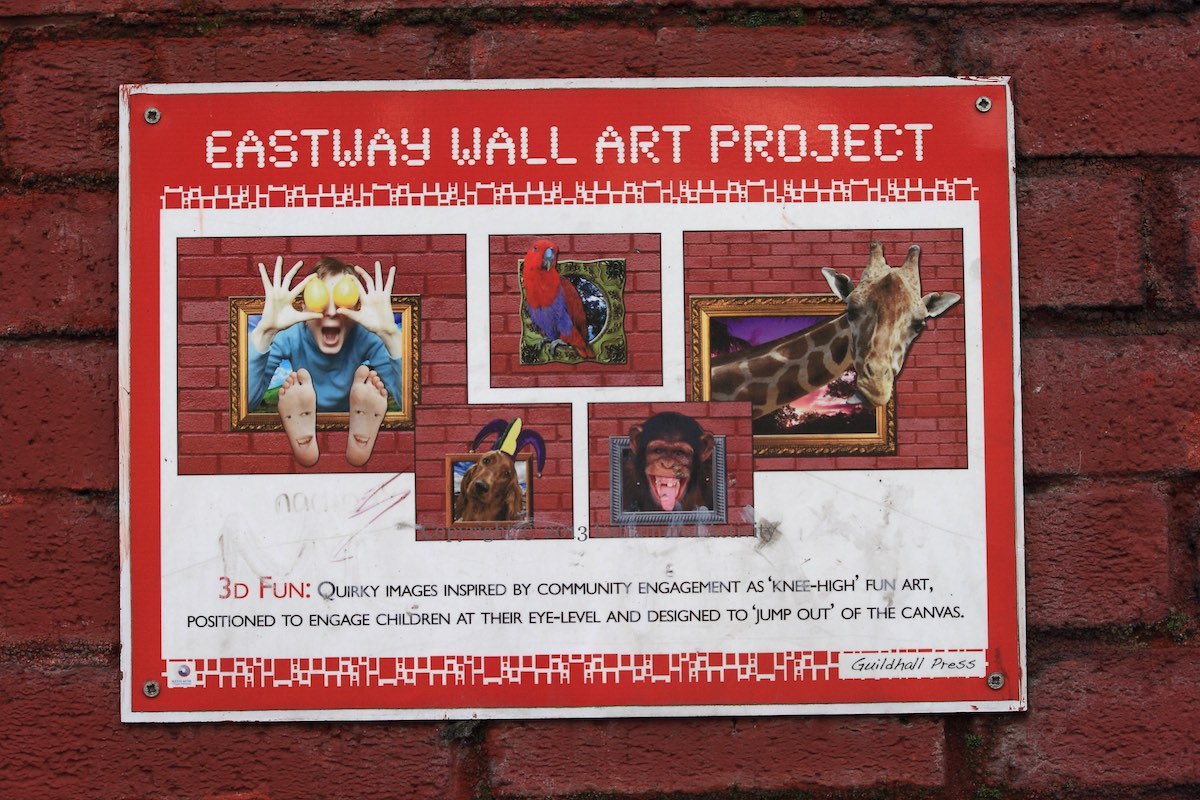
“Eastway Wall Art Project – a Re-Imaging Communities Programme – aims to help all communities in urban areas tackle the visible signs of sectarianism and racism and to create a positive welcoming environment for everyone. Living gallery envisaged by Creggan Enterprises and created by Guildhall Press & Tom Agnew. Signage and artwork fabricated locally by Globaltech. [acknowledgements] The Eastway Wall itself has undergone major refurbishment including the construction of two new pillars to frame the wall. The lower Eastway natural-stone tower maintains the historical link between Rath Mór and the Grianán of Aileach ring fort in Donegal. The higher Eastway structure comprises two sections of a factory chimney stack once located on the nearby Bligh’s Lane site and demolished in 2008. This was added to preserve an important link with the area’s industrial heritage.”
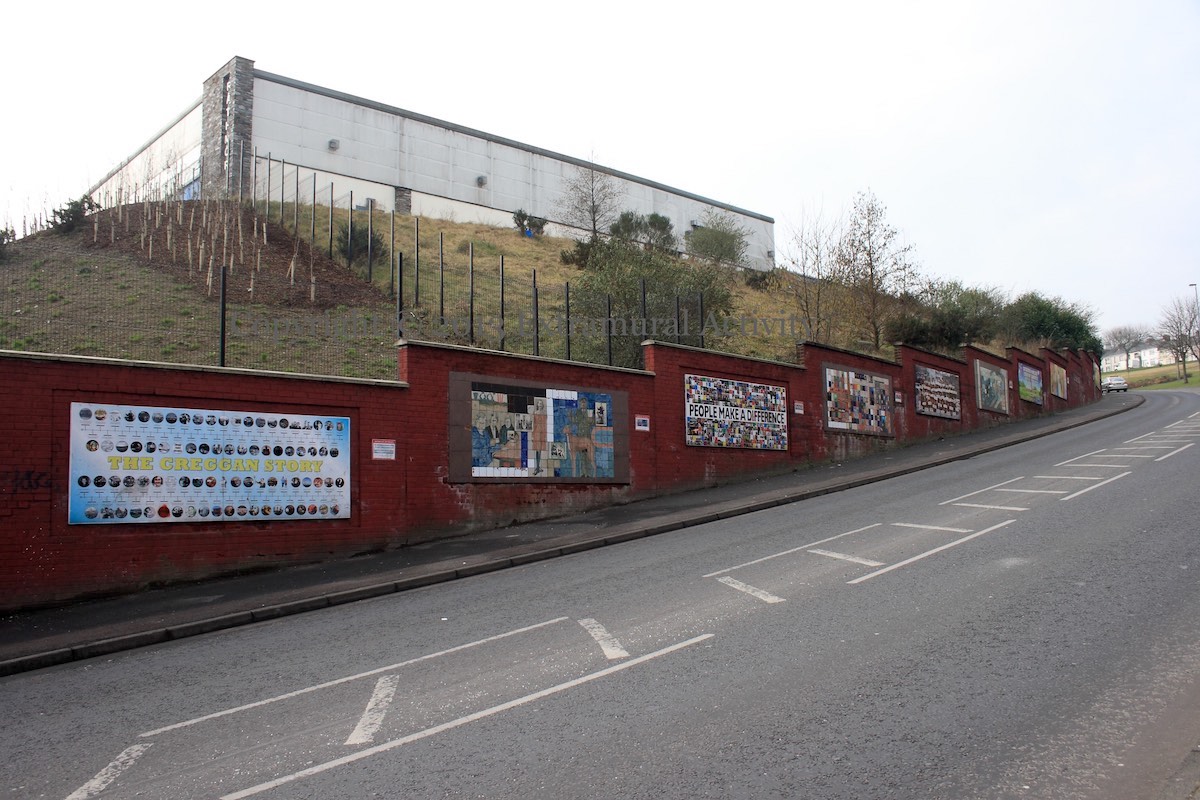
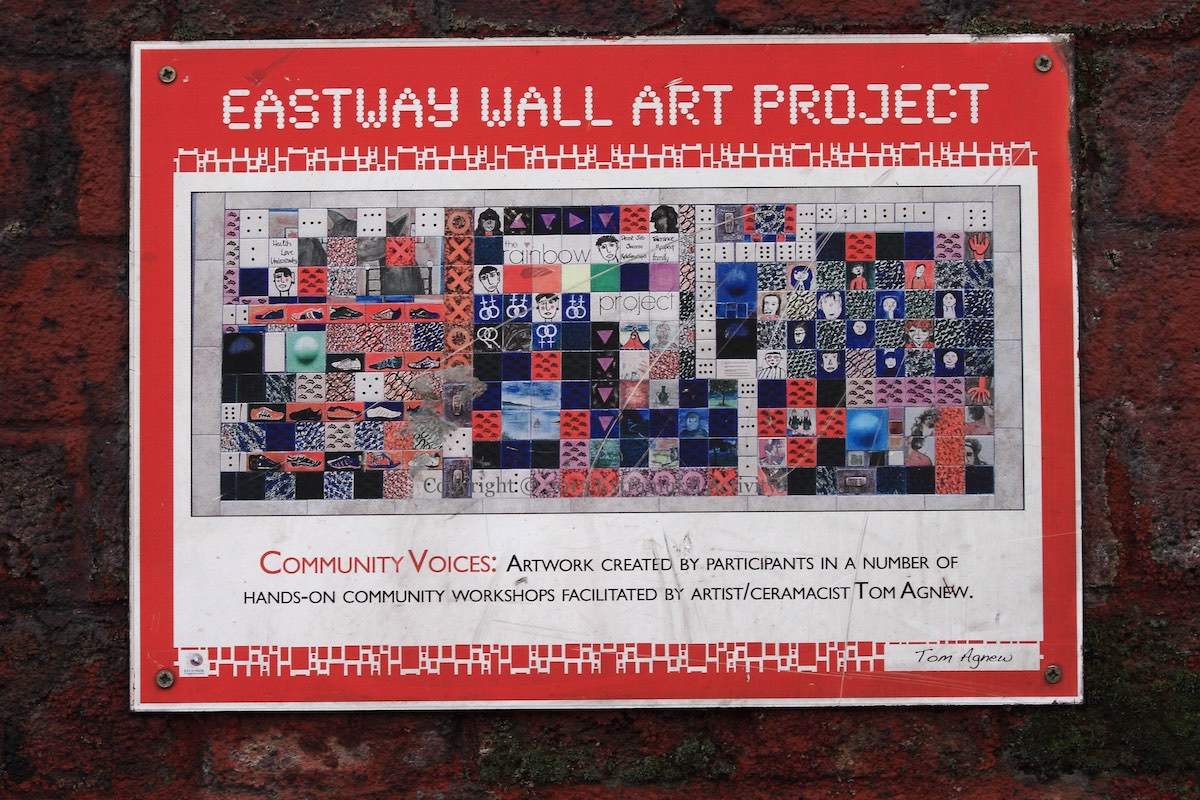
The image above shows the second through the eighth panel. A few of the info boards, including the main one, are shown below. (For the Creggan Story and its info board, see M05174.)
Above the panels shown, some panels just have single words in them – for five of these see Vibrant.
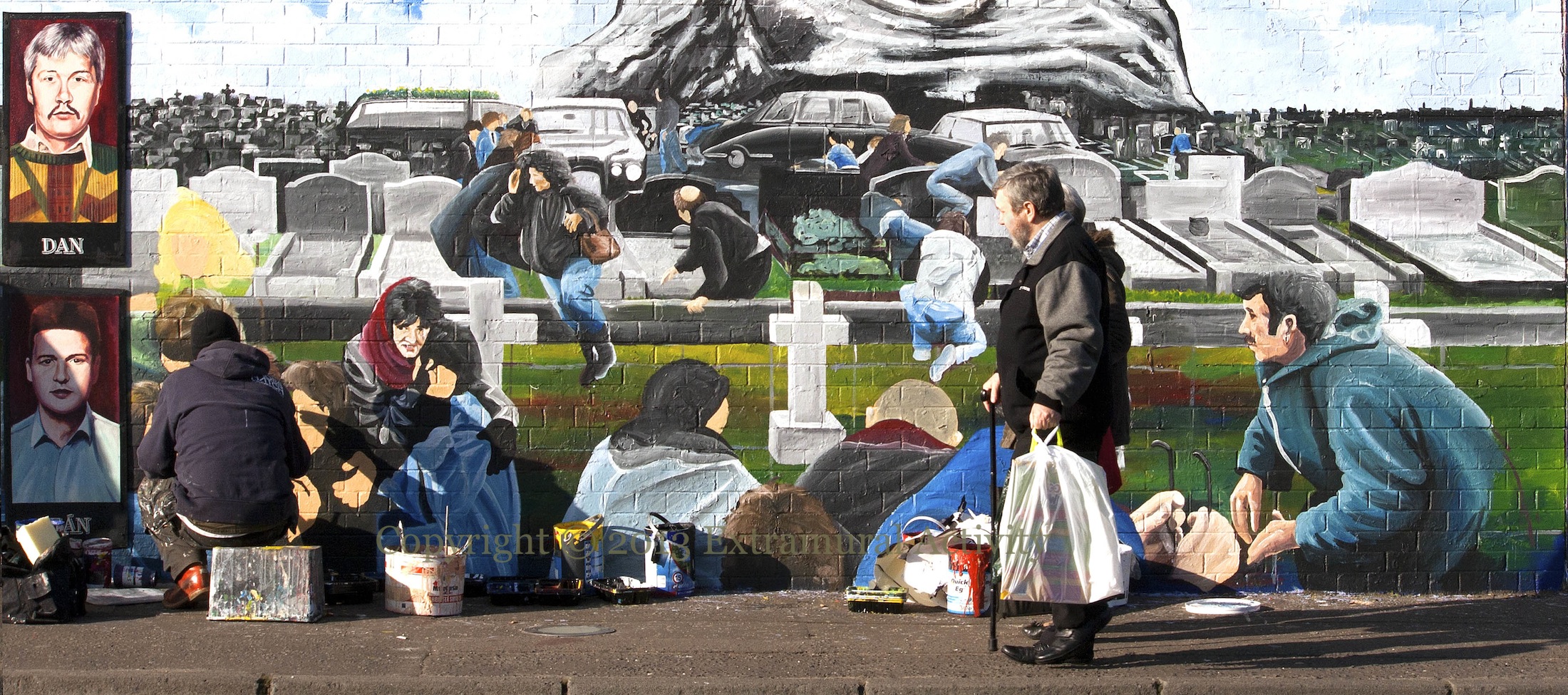
March 2013 is the 25th anniversary of the Michael Stone’s attack on mourners attending the burials of the Gibraltar 3 in Milltown cemetery. Stone killed three people. The mural combines images of mourners taking shelter from Stone’s attack with the civil war memorial in Ballyseedy, Co. Kerry (WP) which was famously connected to the Gibraltar 3 in a mural prepared for the return of the coffins to Belfast – see A Legitimate Right To Take Up Arms. (Here is a copy of Tragedies In Kerry.) Images of the mural in progress were presented in a previous entry. (See that post for the photographs on which the mural is based.) The Gibraltar 3 are portrayed on the left; Stone’s victims are on the right. In the top right is an IRA volunteer who had been shot two days earlier, on the night that the coffins of the Gibraltar 3 arrived in Belfast.
25 years ago – 1988 – puts us firmly in the era of video, and so you can see footage on youtube relating to each of these events:
Death On The Rock, a famous Thames Television production about the SAS killings of IRA members Maıréad Farrell, Danny McCann and Seán Savage on March 6th in Gibraltar.
Michael Stone’s attack on mourners at their funerals in Milltown cemetery, March 16th, which killed Thomas McErlean, John Murray, and Caoımhín Mac Brádaıgh (Kevin Brady).
The memorial depicted in the background of the mural is a civil war memorial in Ballyseedy, Co. Kerry (WP) which was famously connected to the Gibraltar 3 in a mural prepared for the return of the coffins to Belfast – see A Legitimate Right To Take Up Arms. Here is a copy of Tragedies In Kerry.
This piece in North Street, in the city centre, combines realistic buildings with honeycomb patterning run together with cloud-like spray-paint, threatening to envelope the impressionistic figure in the foreground. The surface is the shutter of a shop front. By emic/This Means Nothing for CNB 2012. (The hand in the bottom left can also be found around the corner in Garfield Street.)
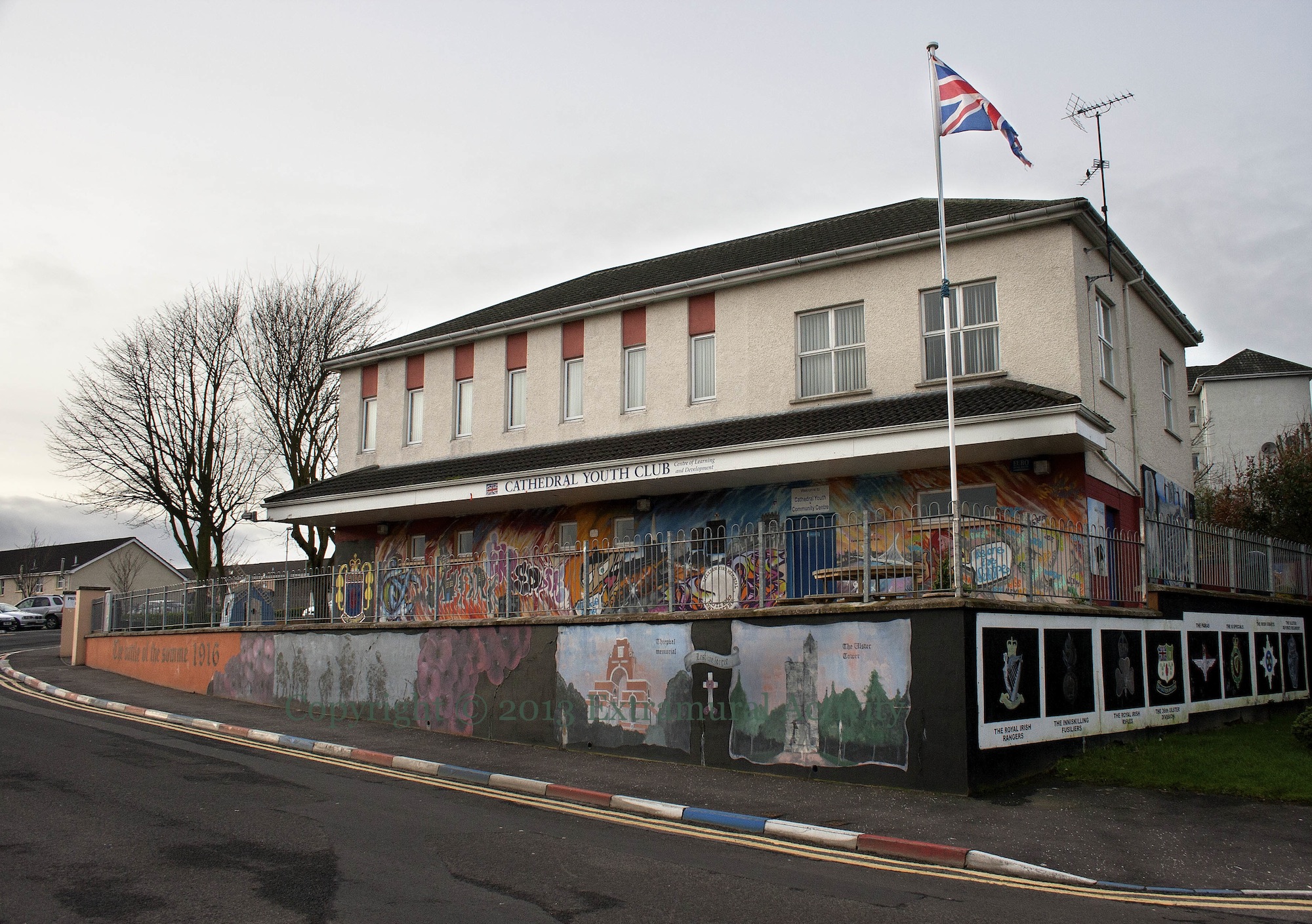
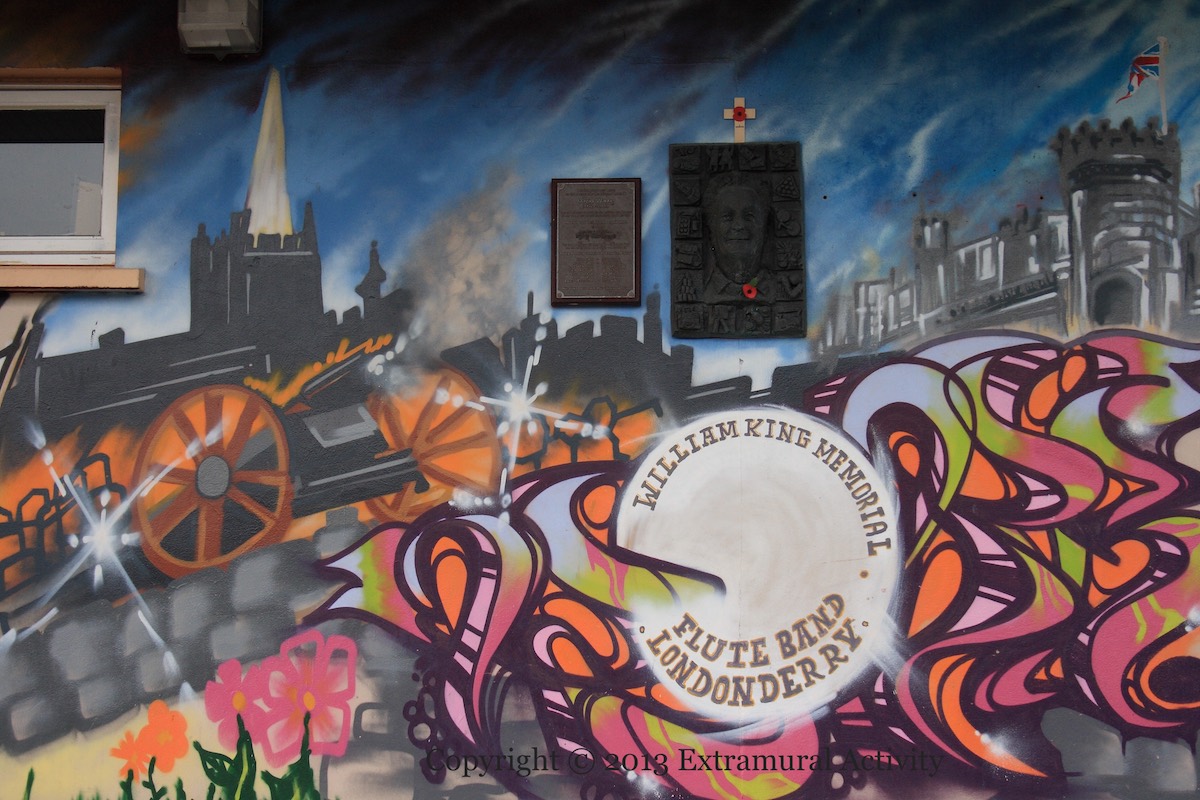
On closer inspection, one can see images relating to WWI, the UDA, the William King Flute Band, and various arms of the military such as the Paras and B Specials adorning the Cathedral Youth & Community Centre/Centre For Learning & Development in The Fountain, London-/Derry/Doire. The close-up below shows a plaque in honour of David Warke, who founded the club in 1972 (Yellow Tom); the profile is perhaps also of Warke.
Two new murals are going up side-by-side on the International Wall (Divis St.), a bookmark-style one for Marian Price and a large piece commemorating three IRA members killed in Gibraltar on March 6, 1988 (WP), IRA member Kevin McCracken who was killed on March 14th in Belfast, and the three who were killed by Michael Stone at the funerals of the ‘Gibraltar Three’ in Milltown cemetery, Belfast/Béal Feırste, on March 16th (WP).
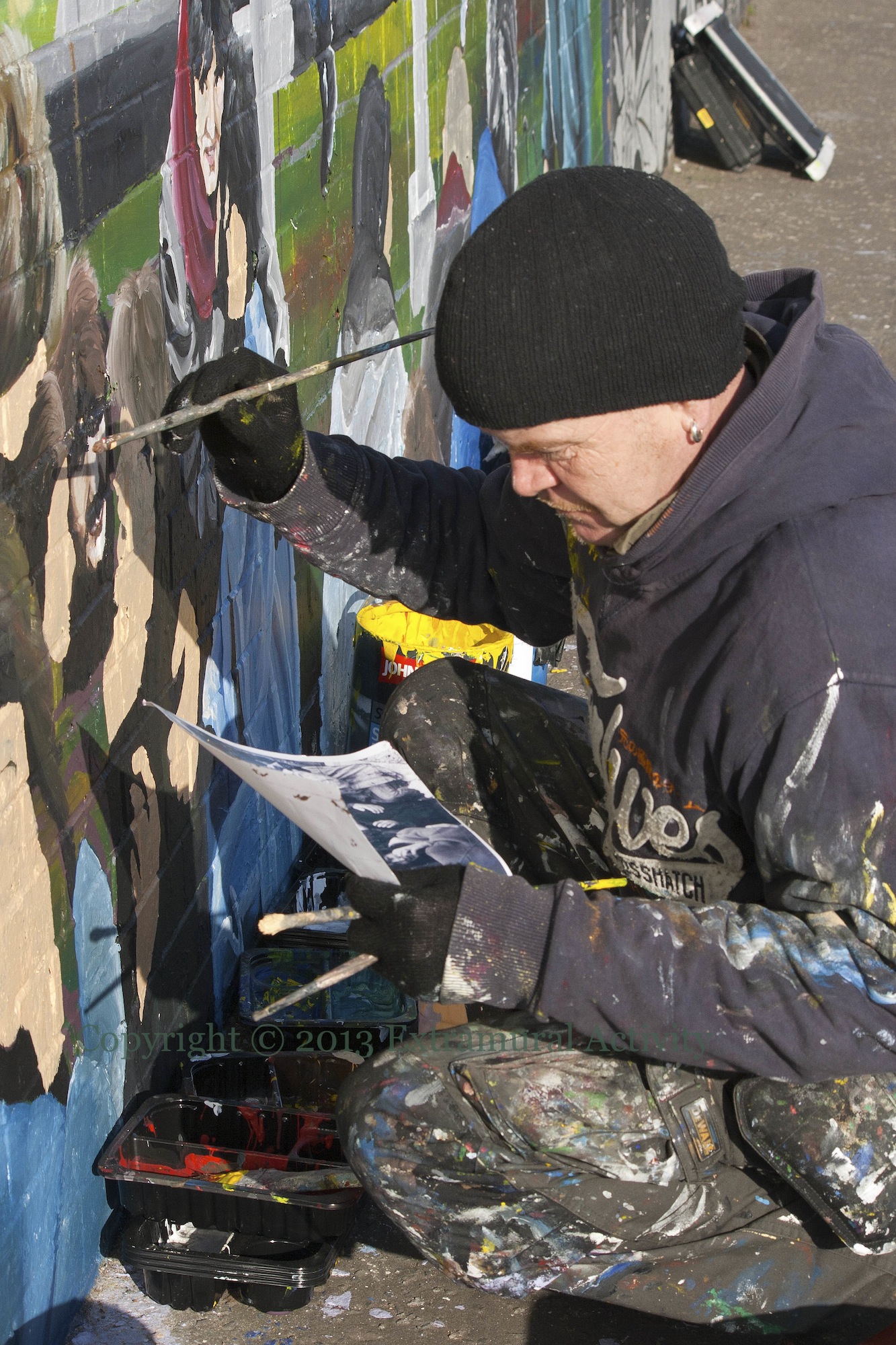
We’ll have the finished pieces in a few days. Below, a wide shot of the Milltown scene, in progress, and below that, Marty Lyons working from a photograph of the incident, perhaps this second in this set, on which the left side of the mural is based, while the center and right-hand side are based on this one (by Bobby Ingram).
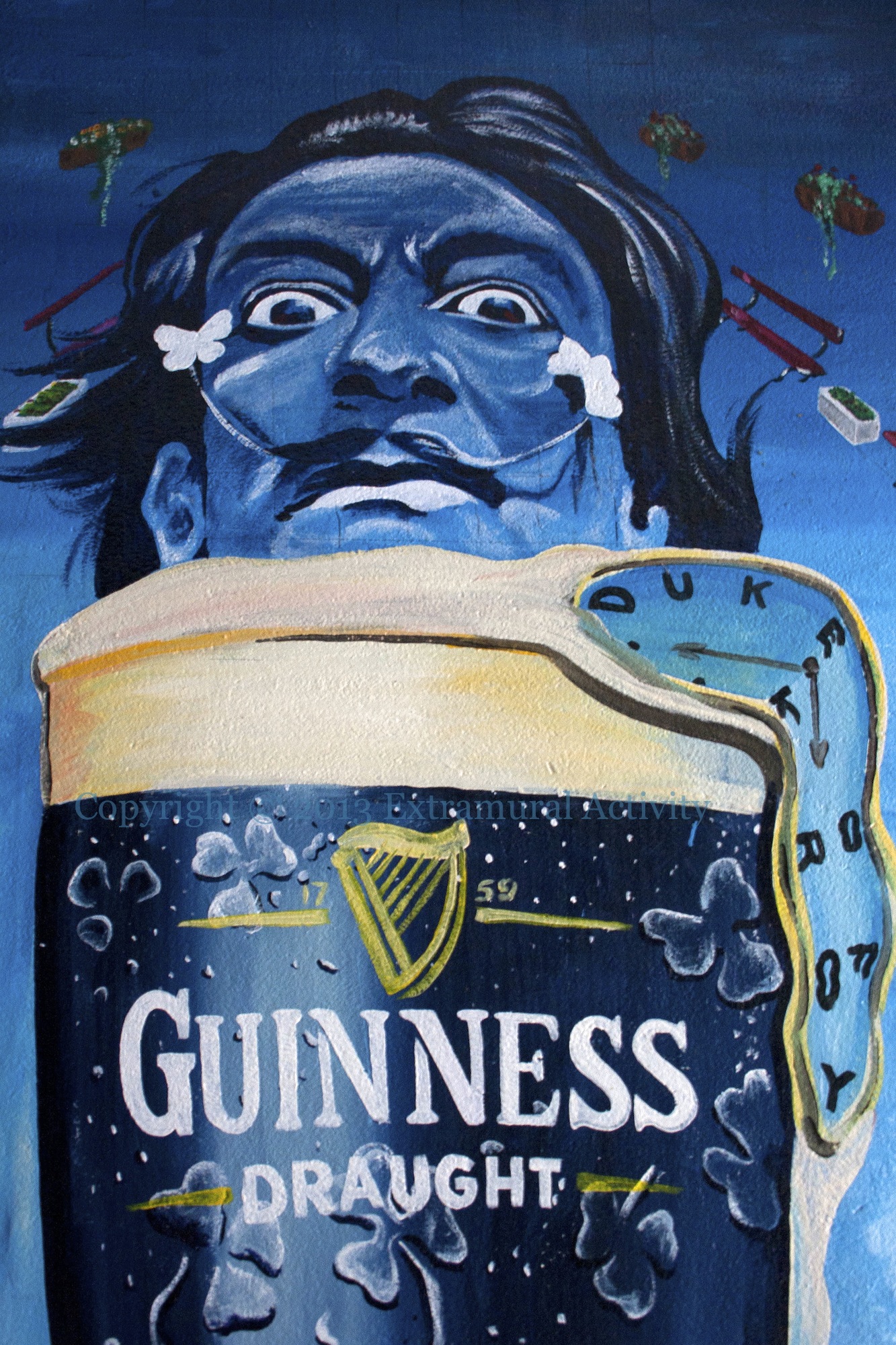
Time becomes distorted under the influence of Guinness and Salvador Dali and his Persistence of Memory at the Duke of York, or more precisely, in the archway that leads from Donegall Street to the pub. Dali’s original is only 9.5 x 13 inches. This is the centre part of a larger mural; there are also three images of Dali in the windows above the archway (see T00766). The Spaniard bar in Skipper Street (one block south of the Duke Of York) also featured Dali on its sign.
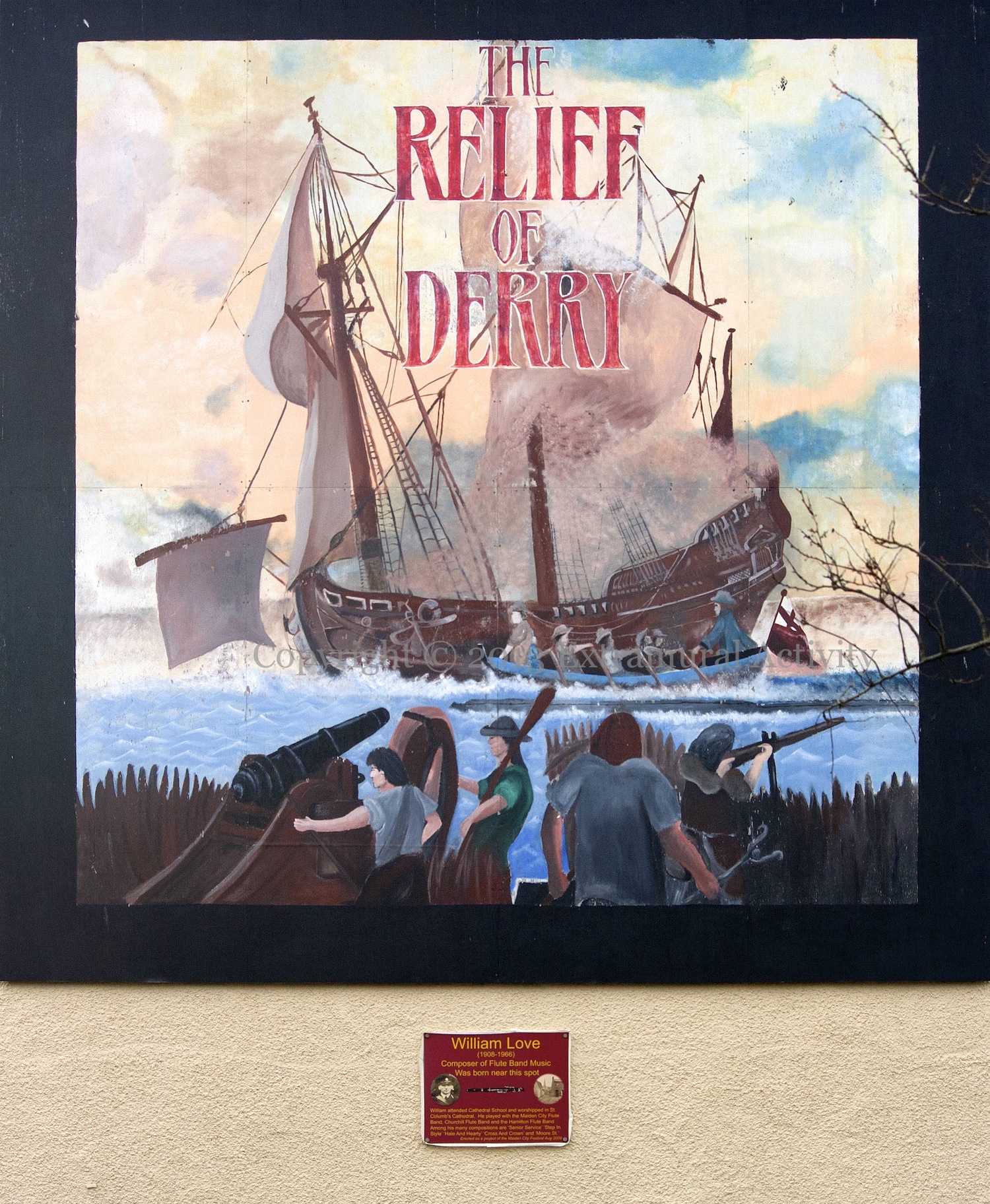
“Derry” became “Londonderry” in 1613, but in 1689 at the time of the siege, as now, it was commonly referred to as “Derry”. The slogan of the defenders was “No Surrender” and the successful resistance to penetration gave rise to the epithet “The Maiden City” (WP).
Pictures of the unveiling of the plaque in 2009, which commemorates William Love, can be seen here.
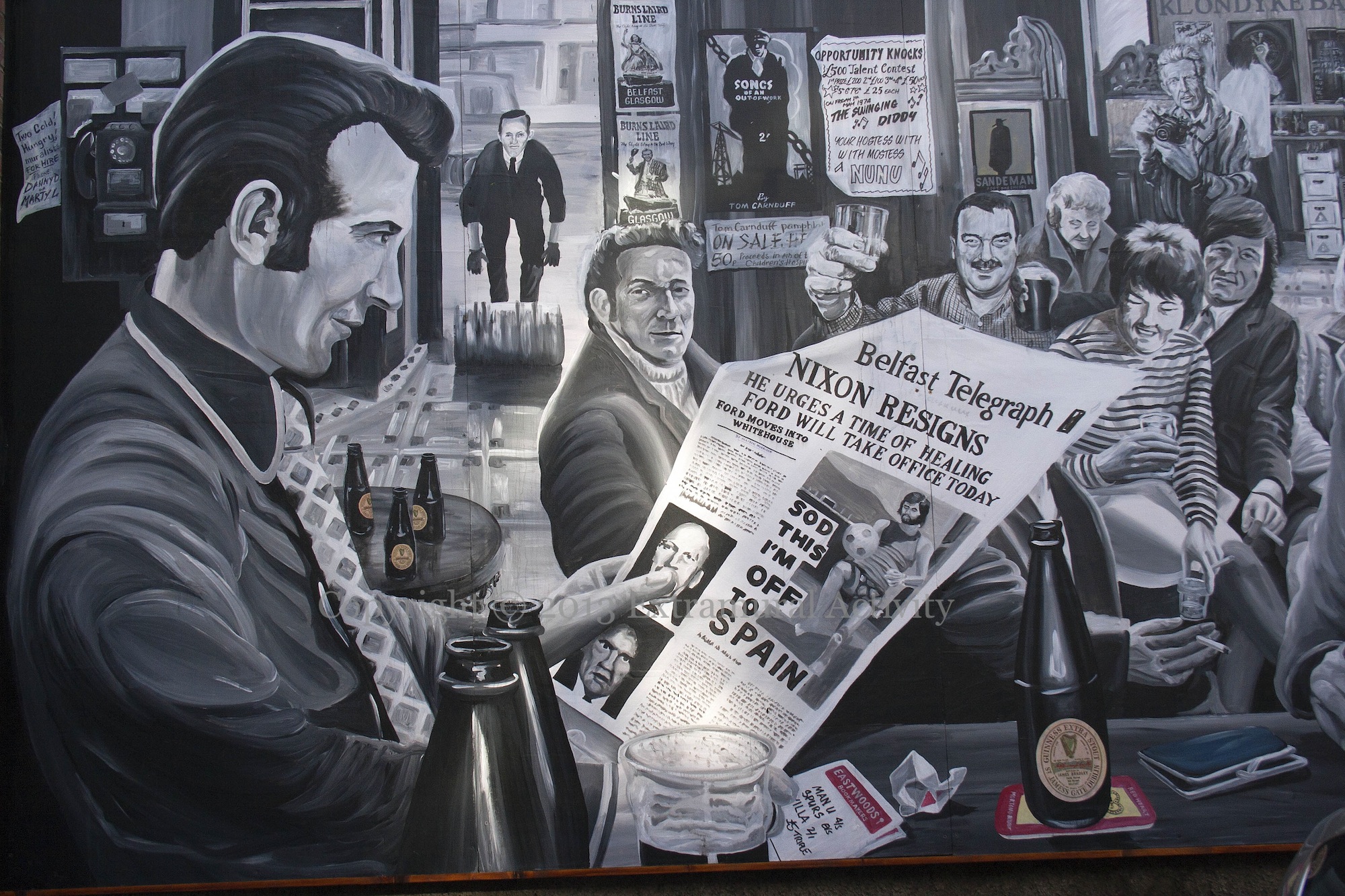
Another George Best reference in another mural at the Dark Horse/Duke of York. George Best quit Manchester United (temporarily) for Spain towards the end of the 1972 season (and quit United for good in 1974). The precise phrase — “Sod this, I’m off to Marbella” — and picture of Best playing keepsy-upsies in the sun come from a John Roberts book about Best. Nixon resigned on August 9, 1974 (WP). The Klondyke Bar was in (PUL) Sandy Row and bombed by the IRA in January, 1976.
This is just the left-most part of a large mural in the Dark Horse courtyard. (For the whole thing, see The Bar Is Called Heaven.) It is almost entirely black-and-white – the Guinness labels and betting slip from Eastwoods are exceptions. If you recognize any of the figures, please leave a comment. The photographer in the top right is Bill Kirk | some pictures at the RBG.
There is a signature of sorts in the top left: “Two cold, hungry muralists for hire. Phone Danny D[evenny] and Marty L[yons].”



 Extramural Activity