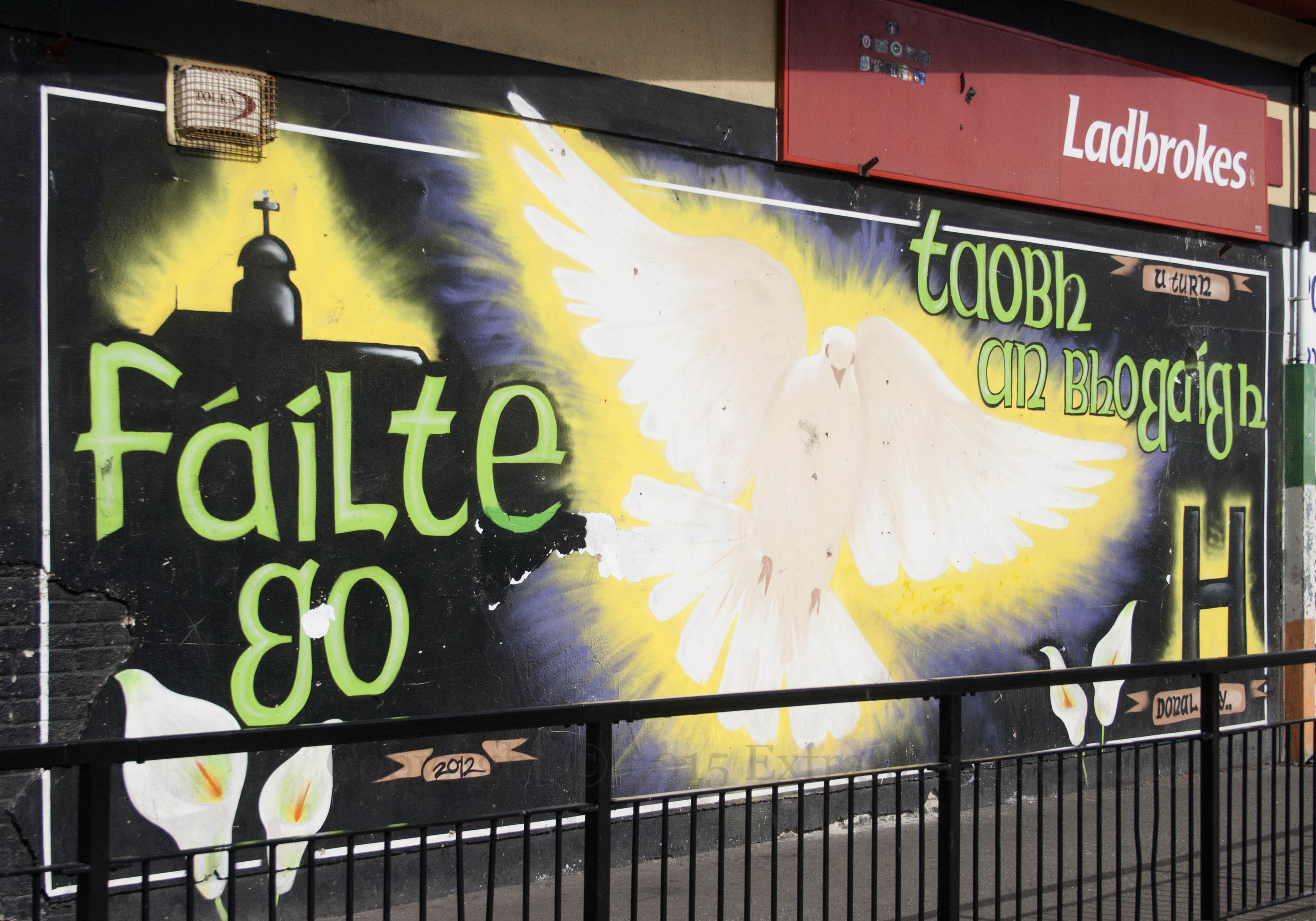
The wave of people seeking asylum from political strife in Europe continues.”Fáılte romhaıbh a chaırde” is Irish for “Welcome, friends” while “Qaxootiga soo Dhaweyn” is Somali for “Refugees welcome”. Somalis make up about 9% of the current wave of migrants from Africa and Syrians 33%. (Irish Times) 2,000 refugees are to be settled in Northern Ireland. (belfastlive) The yellow-on-black outline of parents and daughter running originates in the United States, used on ‘caution’ signs along highways near the US-Mexico border. For images of the mural’s launch on September 12th, see the WARN twitter feed.
Culture Night Belfast is on tonight (2015-09-18) and will include about 30 pieces of street art under the heading Hit The North. Above is a piece of London-/Derry/Doire street art by artists RTM and TDA representing (we think!) St. Brigid’s ‘Church of the Oak’ (Kildare) and the coming of Spring (after her feast day of February 1st).
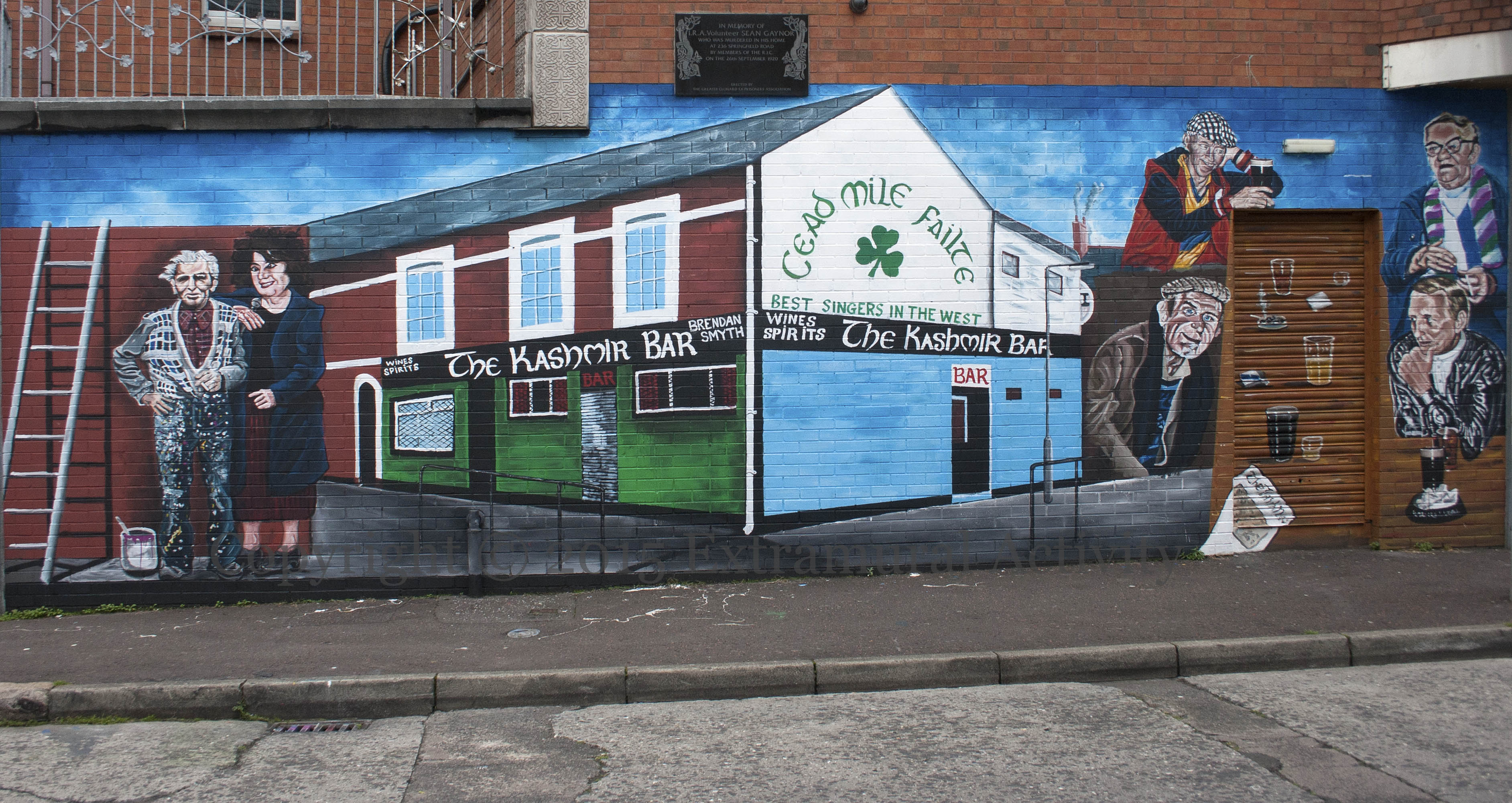
The Kashmir Bar on the Springfield Road gets a face-lift with a mural of the old Kashmir Bar, including the boast that it was home to the best singers in the west. A look at the Kashmir Bar Facebook page reveals that pool seems to be the foremost activity. For a photo of the old (green-fronted) bar, see D00283. (There is also a small image on the Belfast Forum.) If you can identify any of the locals pictured, please comment or e-mail.
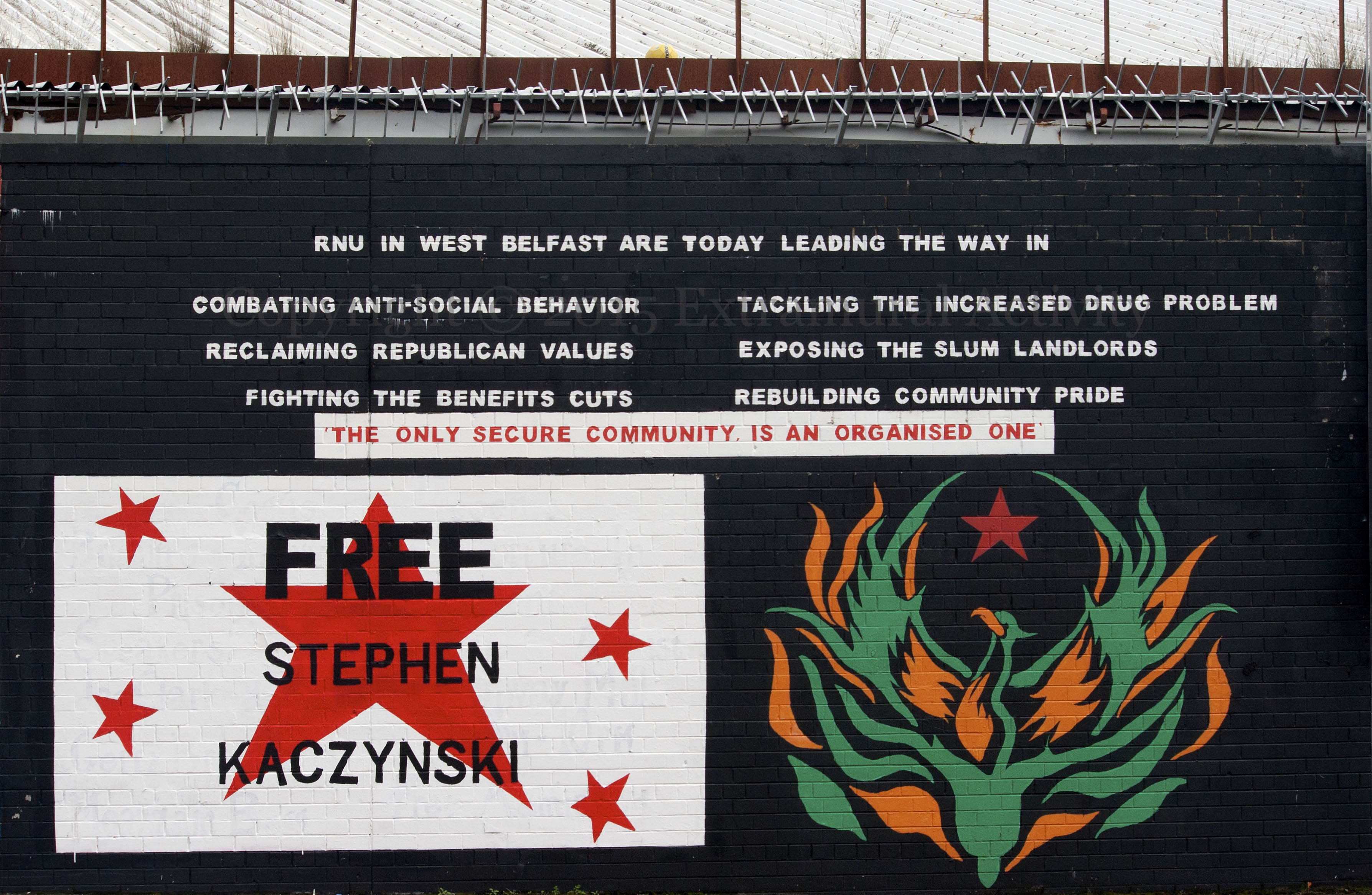
Stephen (or Stephan) “Steve” Kaczynski will go before a Turkish court on September 18th on charges of membership of the Marxist-Leninist ‘Revolutionary People’s Liberation Party-Front’ (DHKP-C). (WP) In April, members of the group took over a courtroom and held a state prosecutor hostage; when special forces stormed the building, the hostage and two of his captors died. (Independent) Kaczynski, a freelance journalist from Scotland, is alleged to be instrumental in financing the group. Alternatively, (according to various newspaper reports) he is an undercover agent of the Germans (Daily Sabah) or the British (Brian Shaw). He was on hunger-strike in protest at the conditions in Maltepe #3 from June 25th to August 12th.
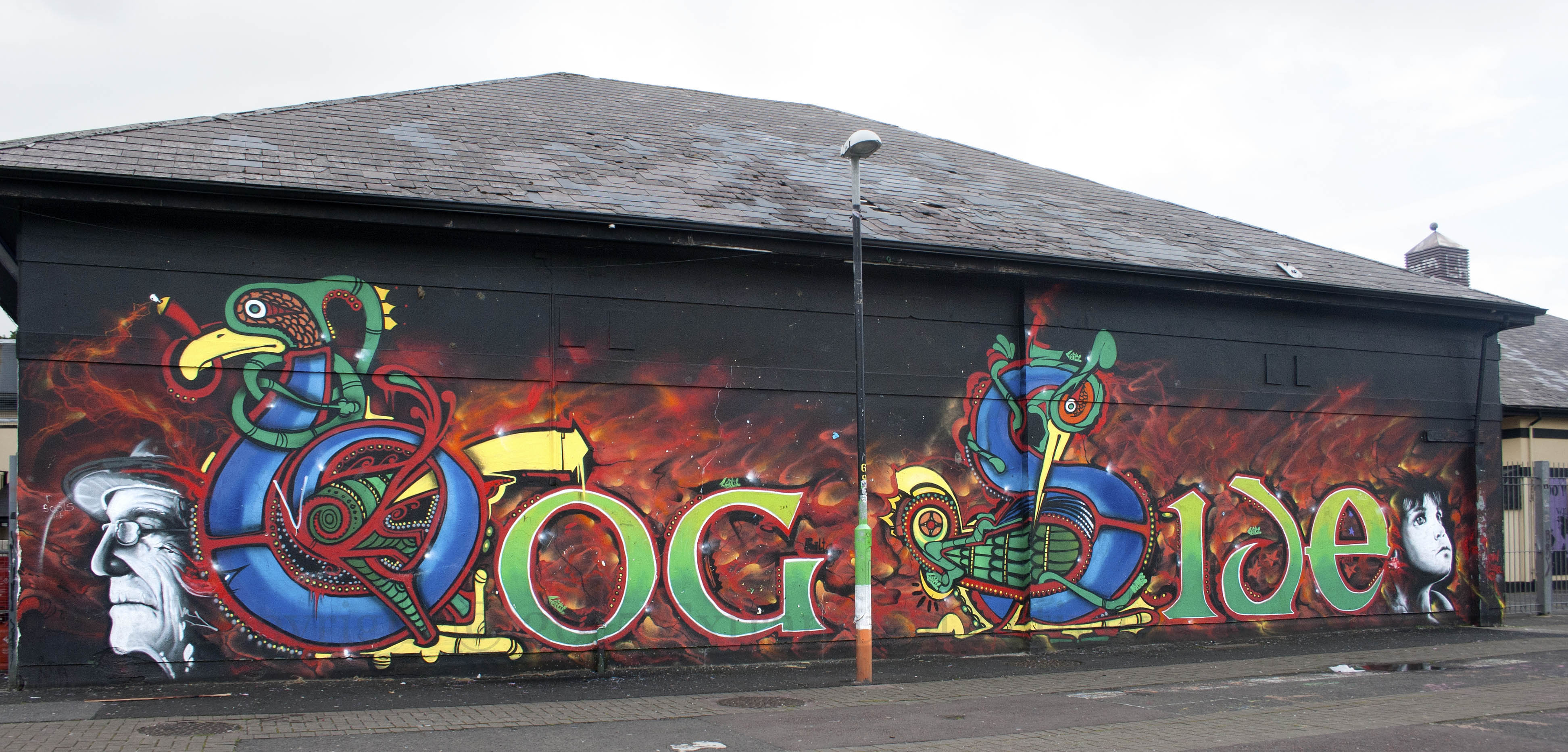
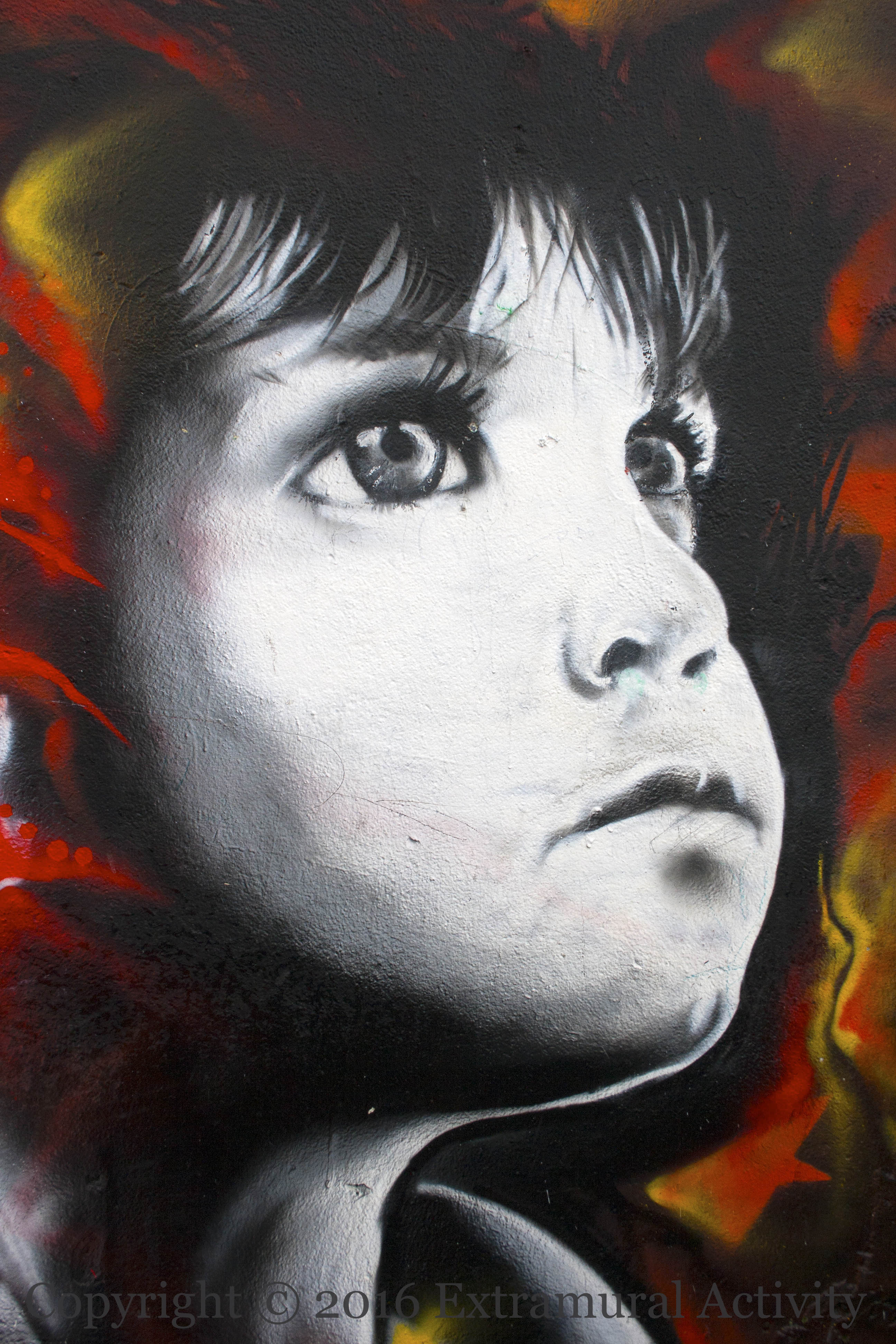
The eastern side of what was the island of Derry is called the Water side and the western side, although originally under water, became the Bog side in about 1600. The two murals shown here are on either side of the shops adjacent to the Bogside Inn. There is an excellent history of the area from 1162 to the construction of Rossville flats in 1966 at the Museum Of Free Derry.
Black taxis were first brought from England to Belfast in 1970 by locals who wanted to provide an alternative, and locally-based, transport system to augment the Citybuses which were sometimes cancelled and sometimes burned out. The board above commemorates eight drivers who were killed during the troubles: Michael Duggan, Jim Green, Harry Muldoon, Paddy McAllister, Caoimhín Mac Brádaigh, Thomas Hughes, Hugh Magee, and Paddy Clarke.
Two boards about collusion in Beechmount Avenue. The first chronicles (both in words and images) alleged instances of collusion between the RUC and loyalist paramilitaries, citing John Stevens, Peter Cory, and Nuala O’Loan – pages from the 2007 O’Loan report are shown in the second, below.
Calls for “truth” and “justice” concerning the killing in August, 1971, of 11 people from Ballymurphy, by the 1st Parachute Regiment during Operation Demetrius, the beginning of internment.
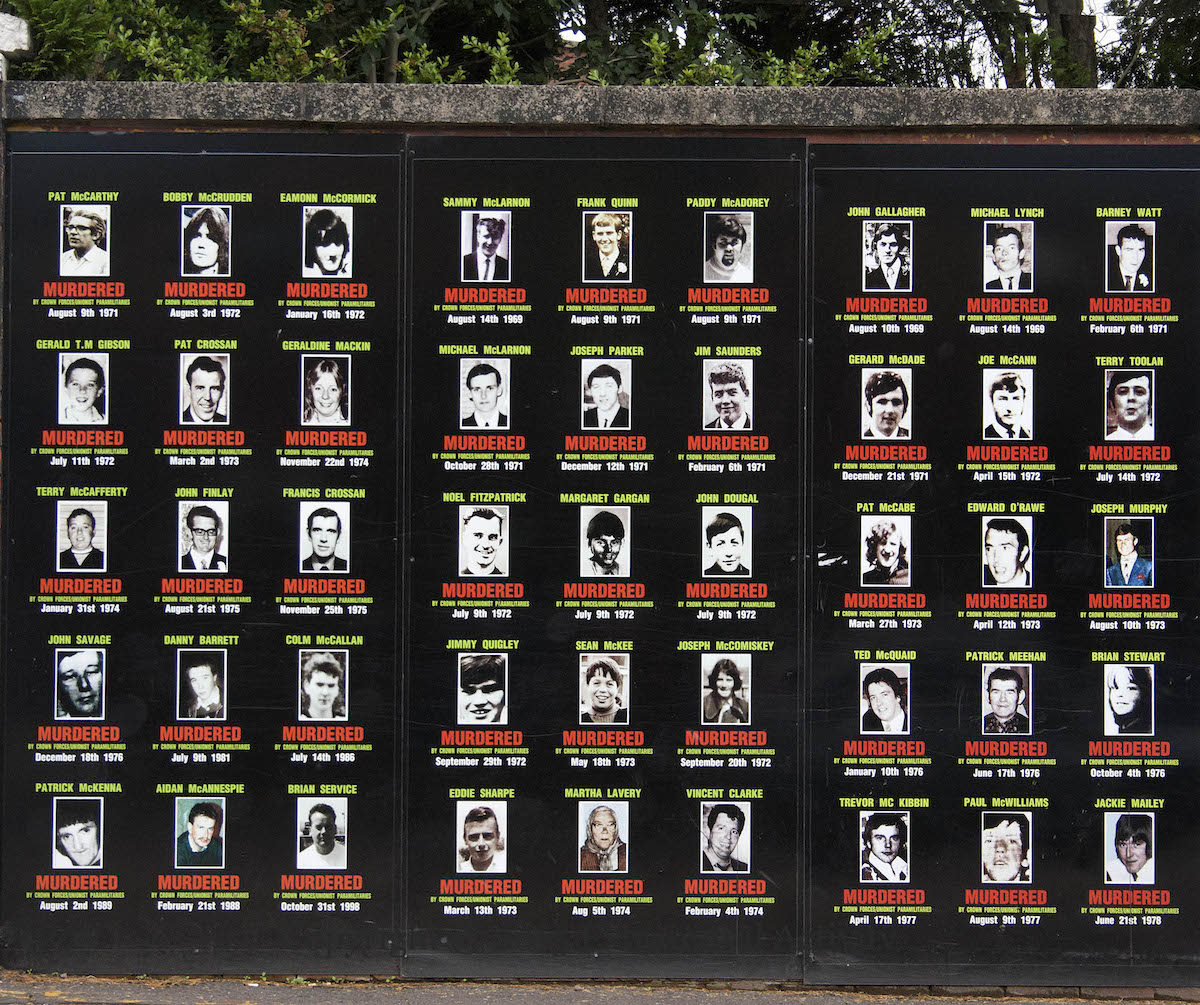
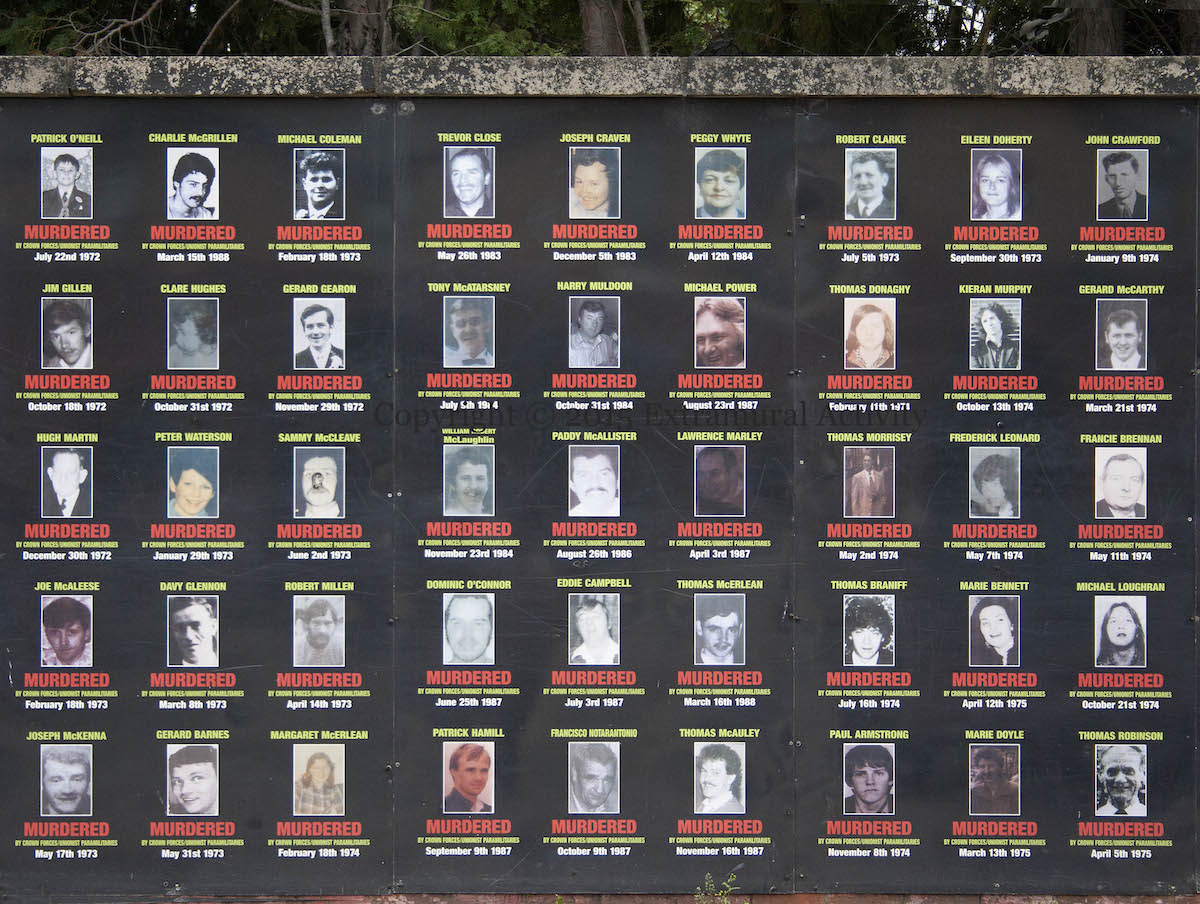
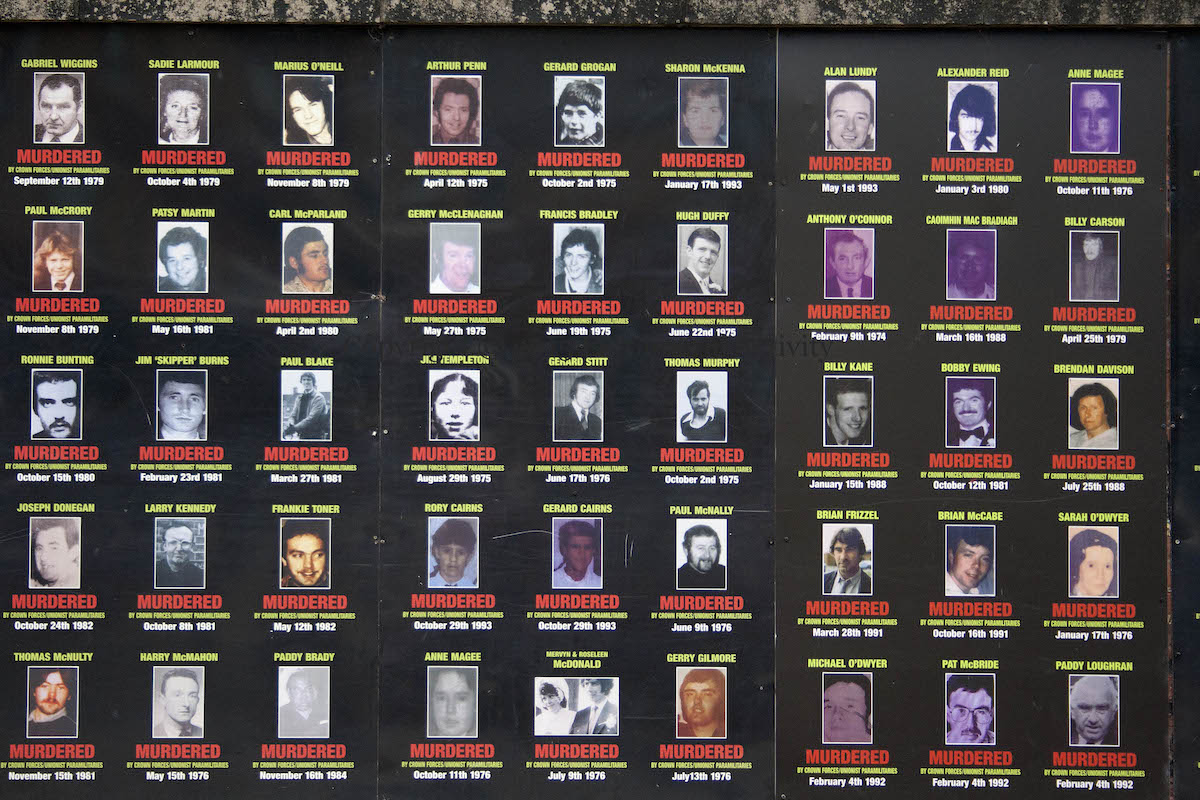
The final three panels (panels 16-18) of the ‘murdered’ follows to the right of the Ballymurphy board. (These are new additions, as compared with 2011.) They are then followed by the final board, to the WBTA.
“11 people in west Belfast from the Greater Ballymurphy neighbourhood were murdered by the British Army as internment without trial was violently carried out on August 9th, 1971. Proper police investigations were never undertaken and one has served a day in prison for causing these deaths. The familys of those murdered deserve and demand the truth be told by the state about its policies and actions of those who carried them out.”
The British soldiers on the right of the board above are given red berets to indicate the Paratroop Regiment, which was the regiment involved in Derry’s Bloody Sunday.
“Springhill–Westrock massacre. Belfast’s Bloody Sunday. Time for truth! On the 9th July 1972 a team of British Army snipers took up firing positions in Corry’s timber yard overlooking the nationalist Springhill/Westrock estates. Within less than an hour five civilians lay dead and two critically wounded. Among the dead were three teenagers, a father of six and a priest on his way to administer the last rites to the dead and injured. There has never been a proper police investigation, and not one solider has spent a single day in prison in connection with their deaths. The families deserve, and demand the comprehensive facts be told by the British establishment. The truth costs nothing.”
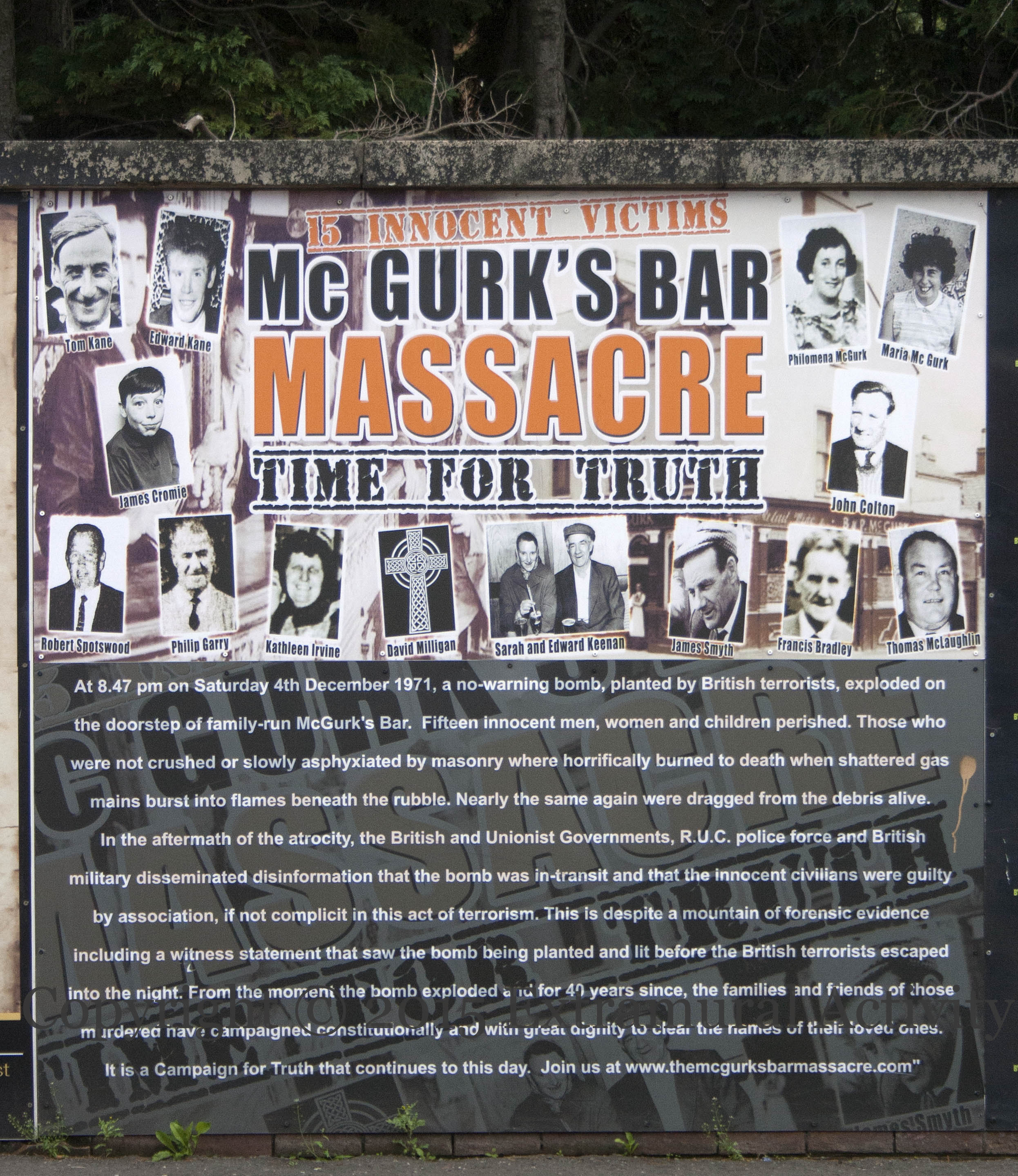
The McGurk’s Bar bombing of December, 1971 killed fifteen people – the most in a single incident during the troubles – capping what had already been a bloody year, including the “Ballymurphy Massacre” of July, in which 11 died, and starting another round of killings that would spread into the new year. Campaigners for an inquiry were busy this week in both Dublin and Belfast (Irish News).
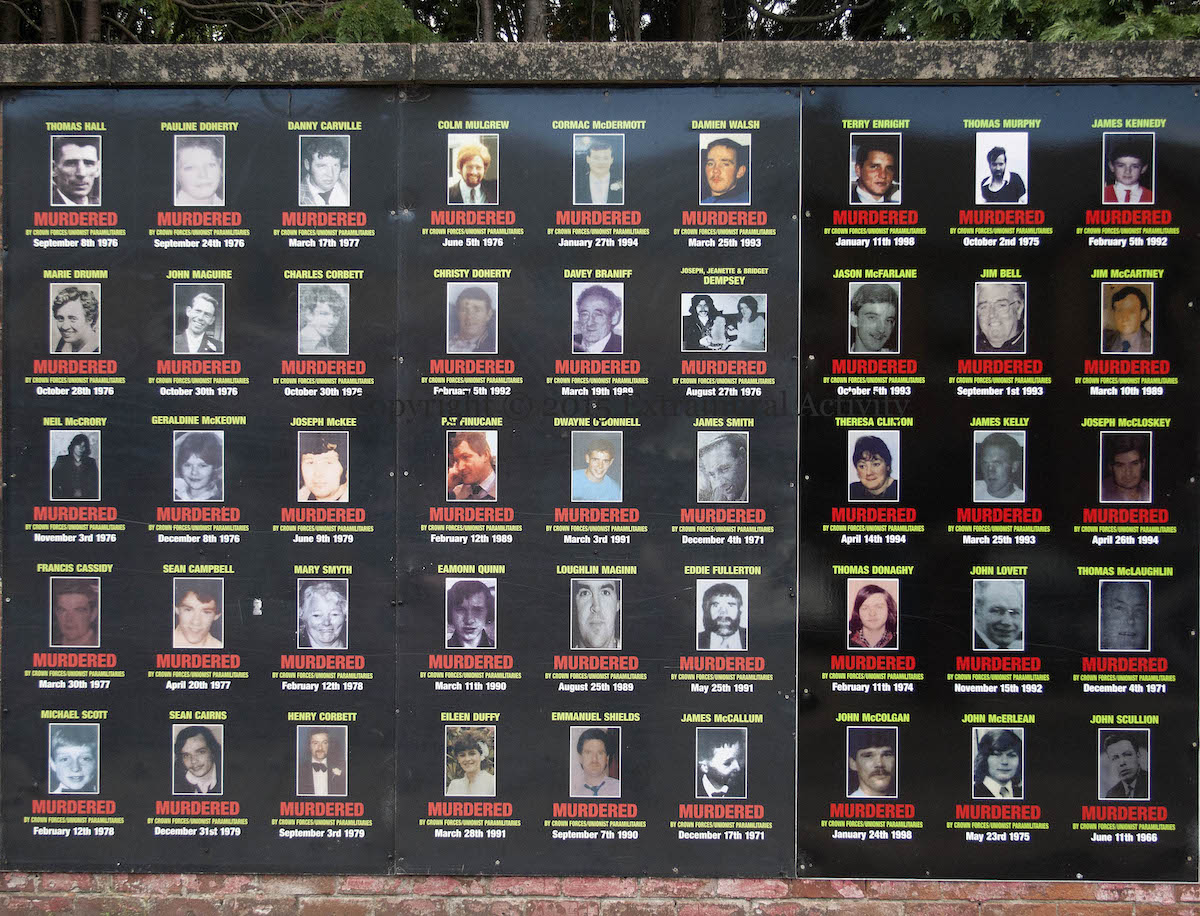
The first nine panels of the ‘murdered’ follow to the right of the McGurk’s Bar board, presented here three-at-a-time. Note that the ninth panel (with Terry Enright in the top left) was previously the 11th panel; it is not clear why it has been moved left.






 Extramural Activity