“Ní coırpıgh sınne! Éıreannaıgh sınne! [we are not criminals; we are Irish people] “There is that much to be done that no select or small portion of people can do; only the greater mass of the Irish nation will ensure the achievement of a socialist republic, and this can only be done by hard work and sacrifice.” – Bobby Sands [Hunger strike diary, March 14th, 1981]” With photographs of the ten deceased 1981 hunger strikers.
Kelly’s Bar at the top of the Rock was packed with punters watching a World Cup match between England and West Germany when a car bomb went off outside shortly after 5 p.m.. The bombing was followed by two nights of gun-battles, with loyalists firing from Springmartin, republicans (both PIRA and OIRA) from Ballymurphy, and British Army soldiers (the King’s Own and 1 Para) from Henry Taggart and other mobile locations. Within three hours following the explosion, barman Tommy McIlroy was killed in the gunfire from Springmartin as he helped with clean-up from the bomb, Alan Buckley of the King’s Own was killed by IRA fire, Michael Magee of Na Fıanna was killed by friendly fire, and Robert McMullan was killed by British Army fire. The next night (May 14th), John Pedlow was killed by British Army fire and Martha Campbell was shot by UVF fire from Springmartin (see her memorial plaque). (Lost Lives 352, 353, 354, 355, 358, 359 | Battle At Springmartin (WP))
As with the bombing of McGurk’s bar in north Belfast (see most recently Justice Delayed Is Justice Denied), the bombing was initially spun by the UK forces and government as an IRA attempt to stir up loyalists (An Phoblacht | Lost Lives 352). An inquest into Moran’s death (and thus into how the bombing was carried out) has been opened (BeTel | Independent).
The plaque dates back to 2004 (see M02243); the tarp was added for the 50th anniversary in 2022; the small mural is more recent.
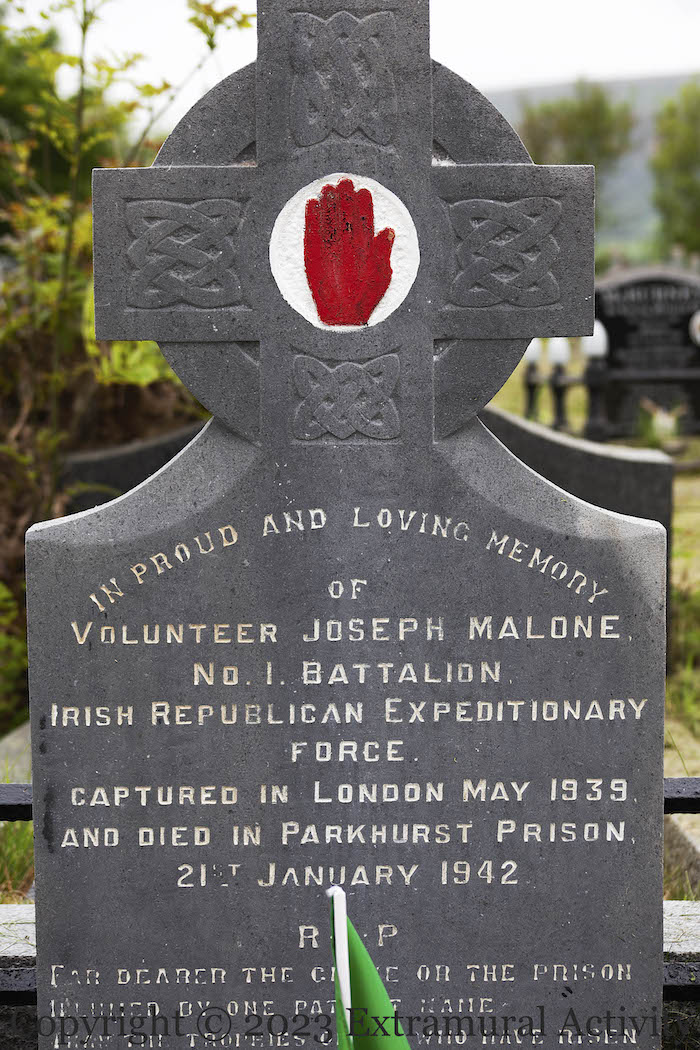
“Far dearer the grave or the prison, Illumed by one patriot name, Than the trophies of all who have risen On Liberty’s ruins to fame.”
Thomas Moore’s lyrics were written for the air The Lamentation of Aughrim, in honour of the Jacobites who died on 12 July, 1691, but they are applied here to Joe Malone of the IRA’s “Expeditionary Force”.
In January 1939 the IRA declared war against Britain and carried out a bombing campaign called the “sabotage plan” (WP S-Plan). Malone was arrested in May when a tear-gas bomb intended for the New Victoria cinema in London exploded prematurely in the cloakroom, injuring his arm and wrist (Belfast Battalion p. 103 | West Australian).
Malone and other prisoners refused to co-operate with prison authorities and began a hunger strike in January 1941; on day five of the strike, force-feeding began and Malone was injured and ordered off the strike by OC Conor McNessa; despite stomach surgery, he died a year later. (Belfast Battalion p. 126, 136)
“In proud and loving memory of Volunteer Joseph Malone, No. 1 battalion, Irish Republican Expeditionary Force. Captured in London May 1939 and died in Parkhurst prison 21st January 1942. RIP.”
As the info board points out, the red hand is used to denote the graves in Milltown of volunteers from the 1920s to 1940s.
“1891-1949” are the dates of the operation of Belfast Celtic, not the dates of forward Jimmy Ferris, who lived from 1894 to 1932. Ferris played for the club for nine years, and for various British clubs during the pogroms. He quit playing in 1930 because of a heart condition and died two years later, at the age of 37. The Ferris family grave, shown in today’s images, is in Milltown Cemetery. (Belfast Celtic | WP)
“Jimmy Ferris, known as Belfast Celtic’s ‘brilliant schemer’, he was on the team, which won four Irish League titles in the 1920s, for the loss of only one match. Also played for Chelsea and Preston North End.” With funding from the “European Regional Development Fund”.
“Pobal ag foghlaım, pobal ag forbaırt, pobal ag fás” [a community learning, developing, growing]
Students from “Naíscoıl & Gaelscoıl An Lonnáın (Fb) bun[aithe] 1999″ [Nursery-school and Irish-language [primary] school of the loney, founded 1999] are shown playing Gaelic games, Irish dancing, and playing traditional instruments (and the guitar). On the left are representations from Irish mythology: the Children Of Lear and Setanta killing Culann’s hound (and taking the name Cú Chulaınn in taking its place), along with hedge-row school (see Hedge Row School).
The origin of the name is unclear; the nearest loney [lane] was the “Pound” loney, so-called because of the animal pen just outside Barrack Street, used to store livestock before moving on to the markets the following day (Rushlight | Uachtar Na bhFál). (The Pound Loney is included in the mural in Durham Street – see Et In Arcadia Ego.)
The other well-known loney in Belfast is the “buttermilk loney” which was either/both what is now Ballysillan Park (that is, connecting Olpark with the horsehoe bend) or the top part of the loney that connected Wheatfield (the top of Ardoyne) to the Ligoniel junction and on towards the old Ligoneil House (there are a mixture of usages in this Belfast Forum thread); this image from the 1930s might show the lane in (what was still at the time) the hills above Oldpark; a new housing-development towards the top of the Ballysillan Park is euphemistically called “Buttermilk Loney”. (It is also said to have been a prior name of Skegoniell Avenue (Belfast History).)
(The Uachtar Na bhFál page also mentions “Turf” loney, “Mountain” loney, and “Killoney”.)
The history of the Irish word “lonnán” is unclear. Uachtar na bhFál says the word is of Scots origin (perhaps as “loanin”). (See this BelTel article on the opening of the Ulster-Scots centre in 2014.) Spelled “lonnen”, it is also a Geordie word (Heslop’s Northumberland Words | wiktionary). The Irish News and Belfast Live, working from the same (uncited) press-release about Páırc An Lonnáın (which is along the Westlink below Raıdıó Fáılte), state that “loney” comes from the English word “loaning”. The Irish word “lonnán” does not appear in Dinneen 1904; Dinneen 1953 defines it (hyper-specifically) as “a grassy recess running up into high basaltic cliffs”.
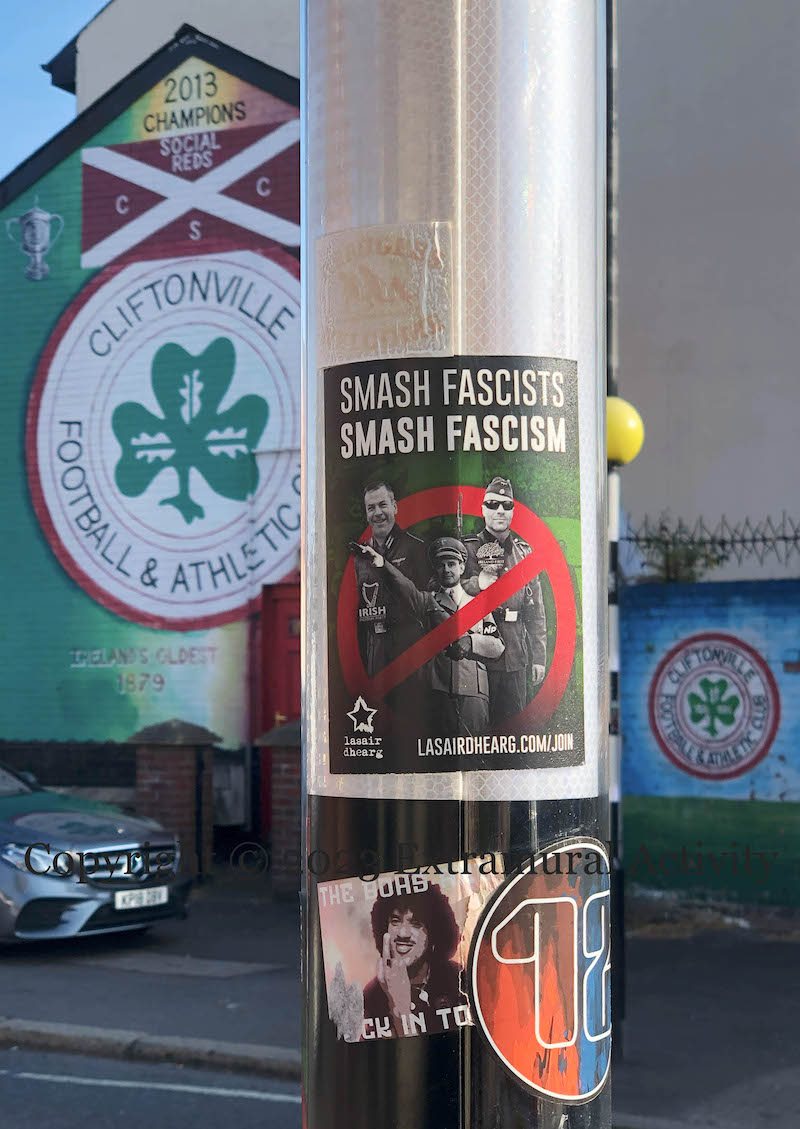
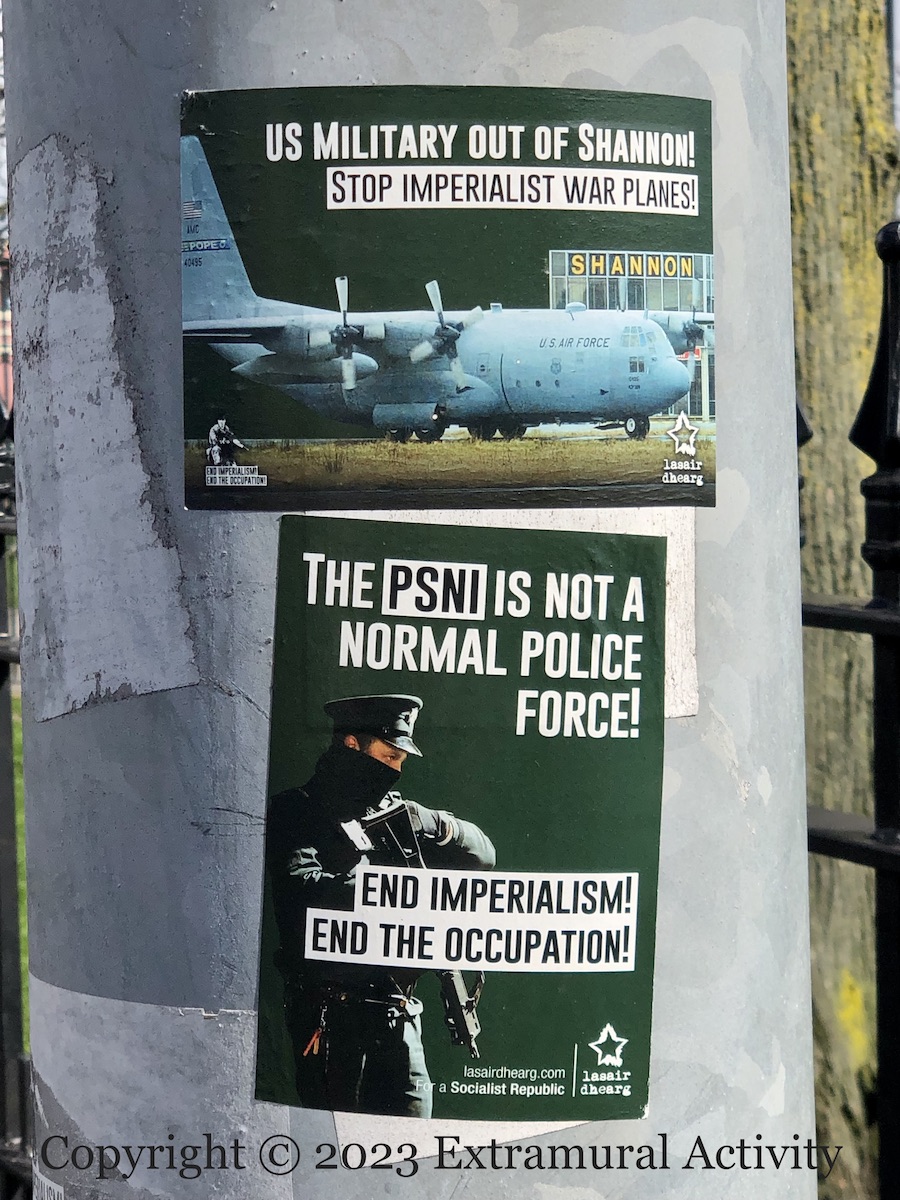
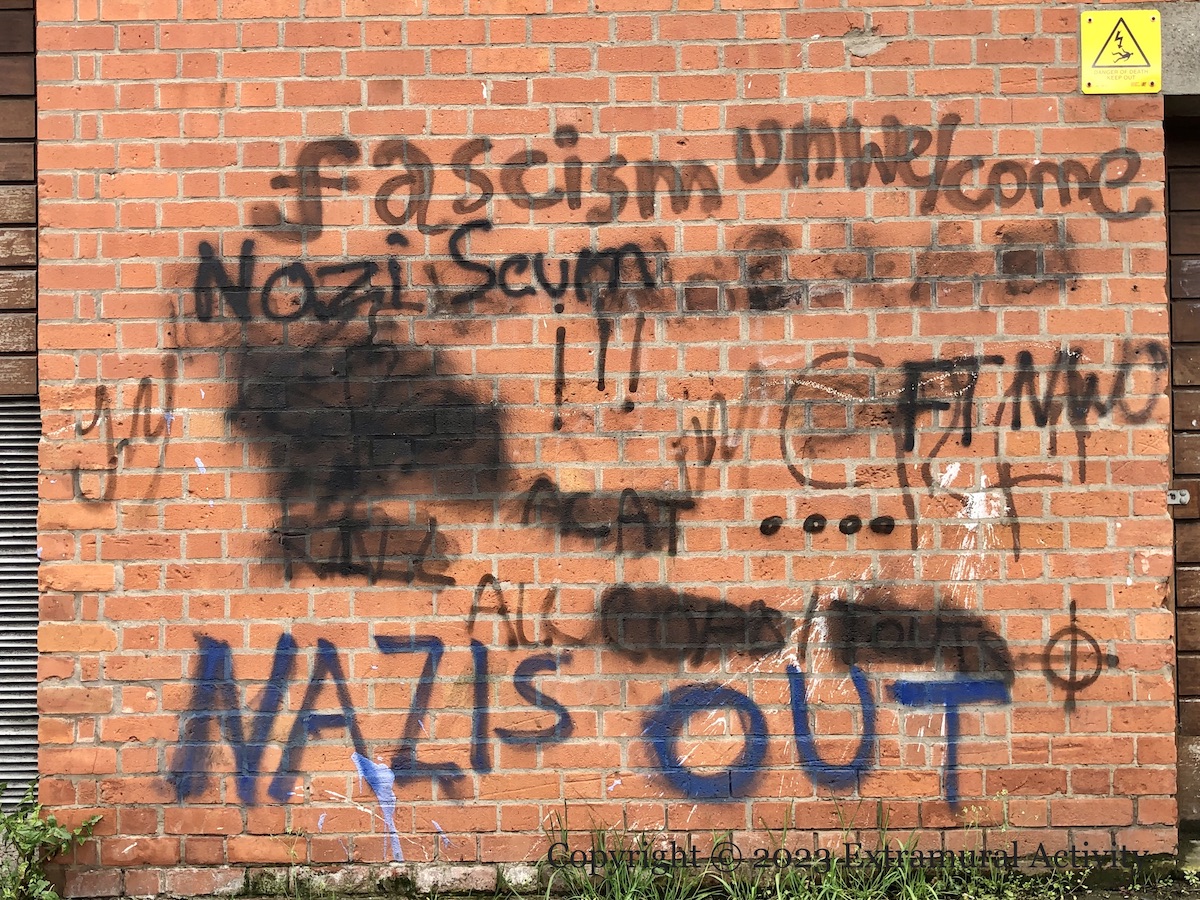
Here is a gallery of republican stickers on light poles – and one piece of graffiti – most from Lasaır Dhearg (web).
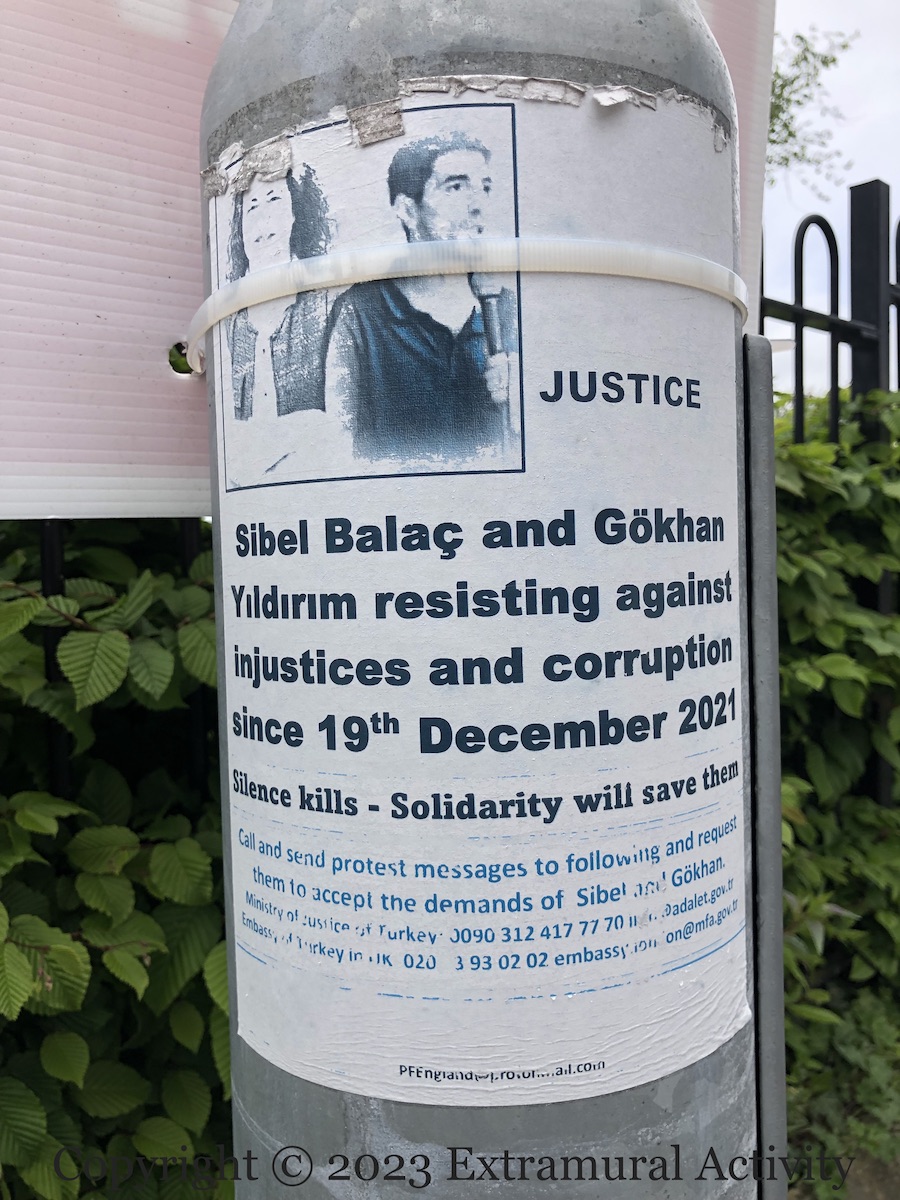
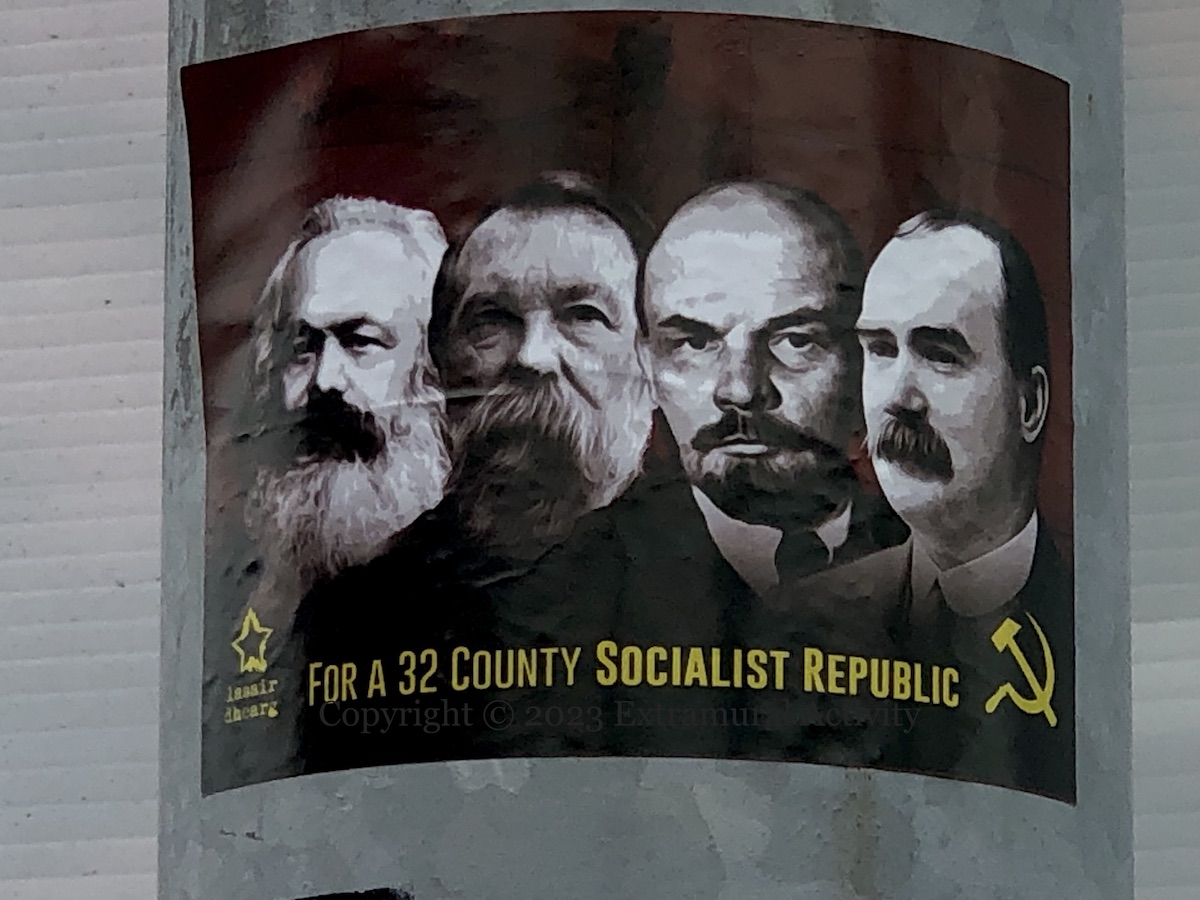
“Smash fascists, smash fascism.” For the Cliftonville murals in the background, see Red Army. “Stop imperialist war planes.” “The PSNI is not a normal police force.” “Fascism unwelcome” – graffiti on Broadway Maıréad Farrell “oppressed as a woman” – also used in Our Nation As A Whole; see also Just As Good As Others. “Stormont can’t deliver.” with “Refugees Welcome“ “Solidarity will save them” – hunger strikers Sibel Balaç and Gökhan Yıldırım. “Smash fascists, smash fascism.” Same sticker but in west Belfast. “For a 32 county socialist republic” – with that other “red army” Marx, Engels, Lenin, Connolly,
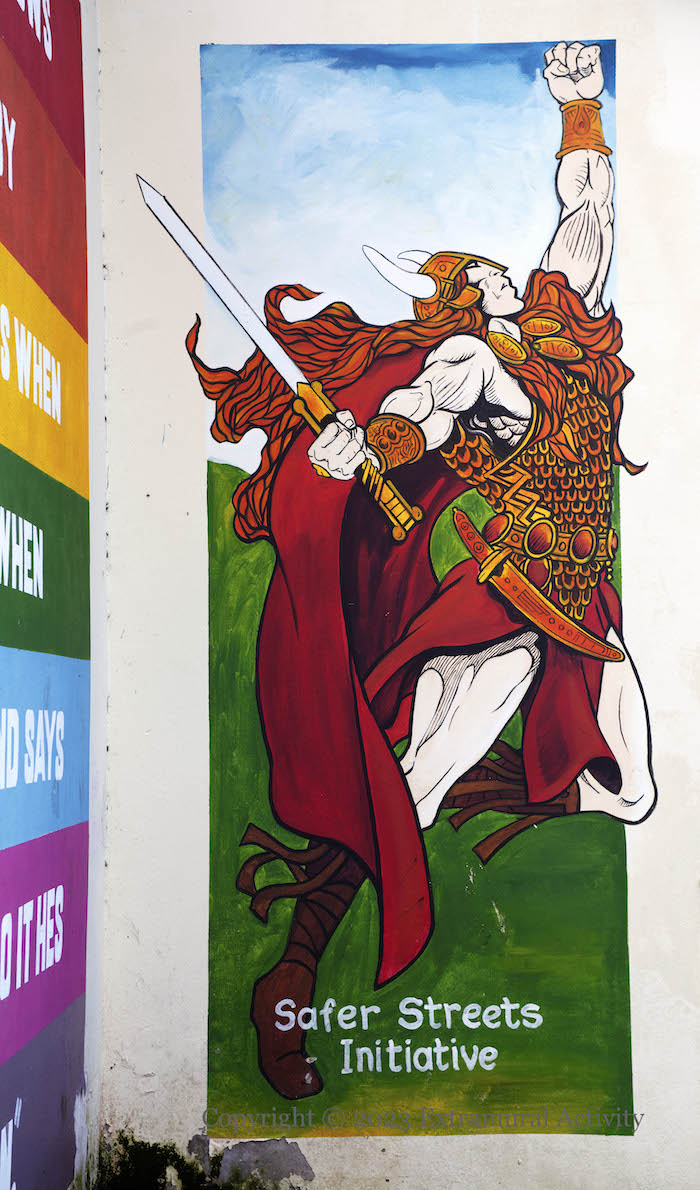
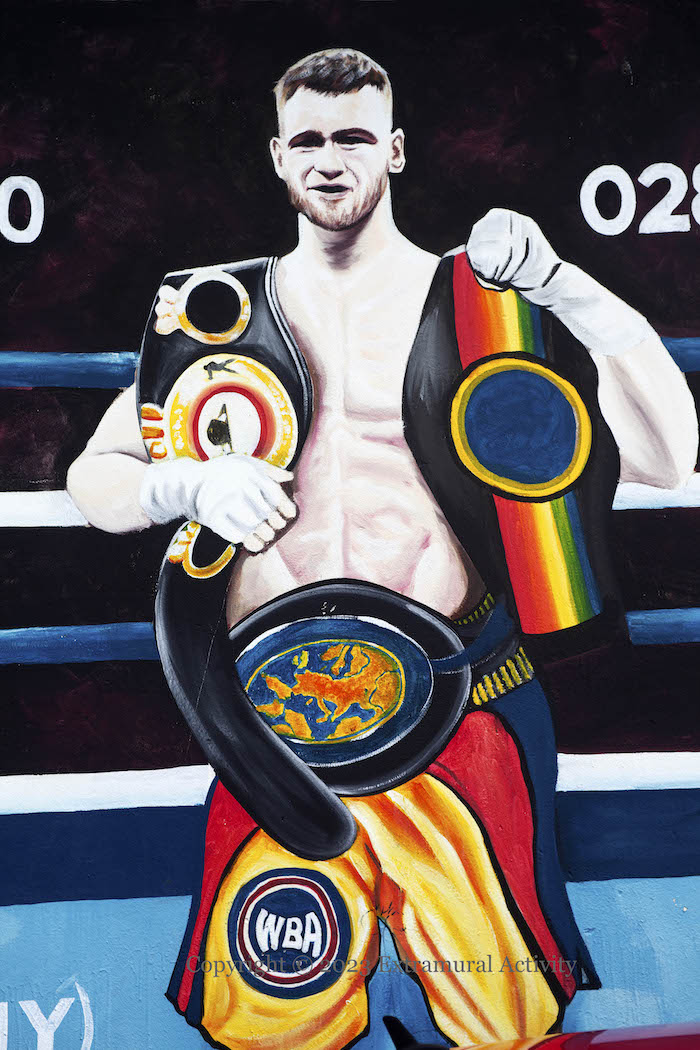
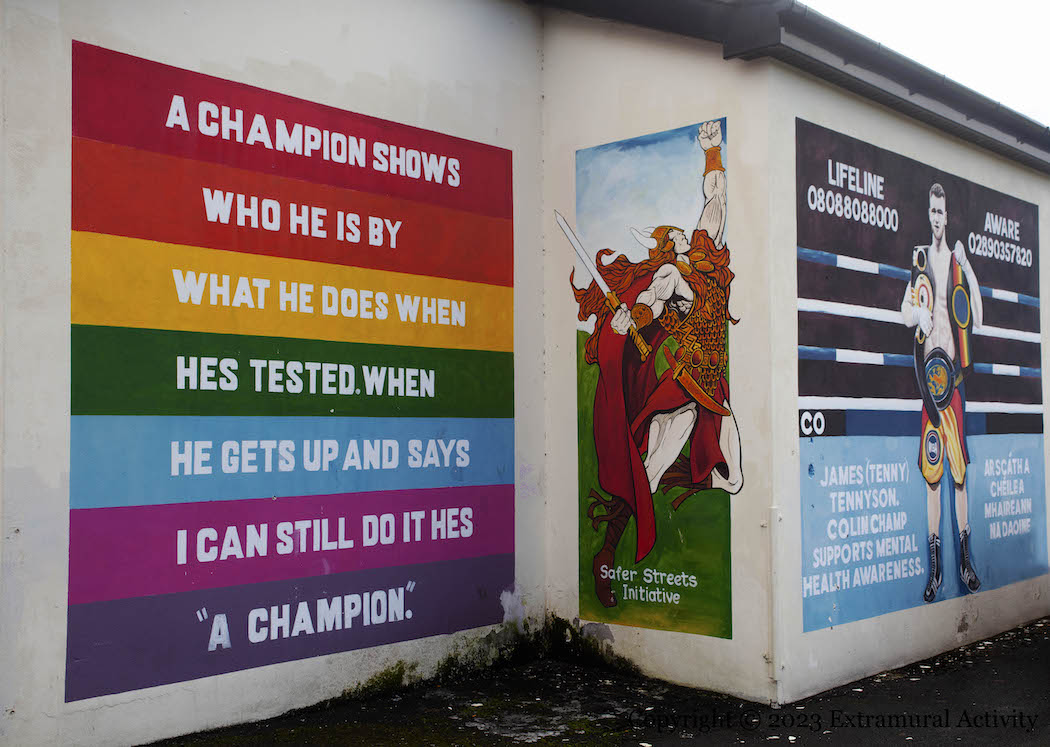
“A champion shows who he is by what he does when he’s tested. When he gets up and says “I can still do it”, he’s “a champion.” In Irish mythology, the Tuatha invade Ireland and battle the Fır Bolg. They are successful but their king Nuadha loses his arm and with it his kingship of the Tuatha. He had it replaced with an arm made of silver and regained his position. He is used here as an inspiration for those struggling with mental health, who are encouraged to call Lifeline or Aware.
(A history of Nuadha in murals is included in the Visual History page on Jim Fitzpatrick.)
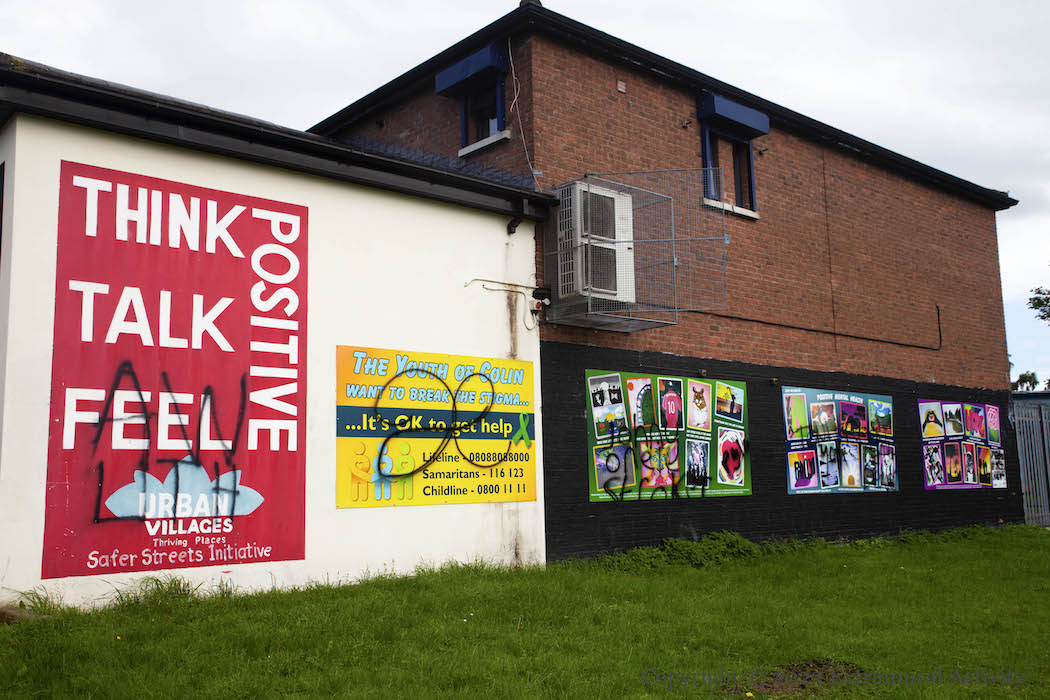
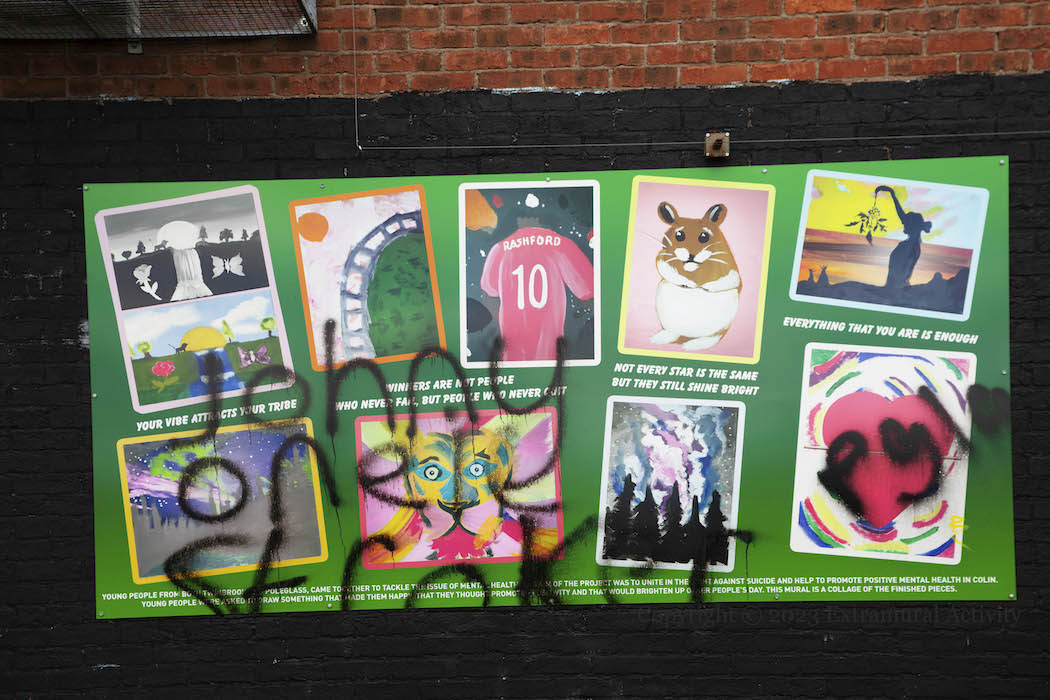
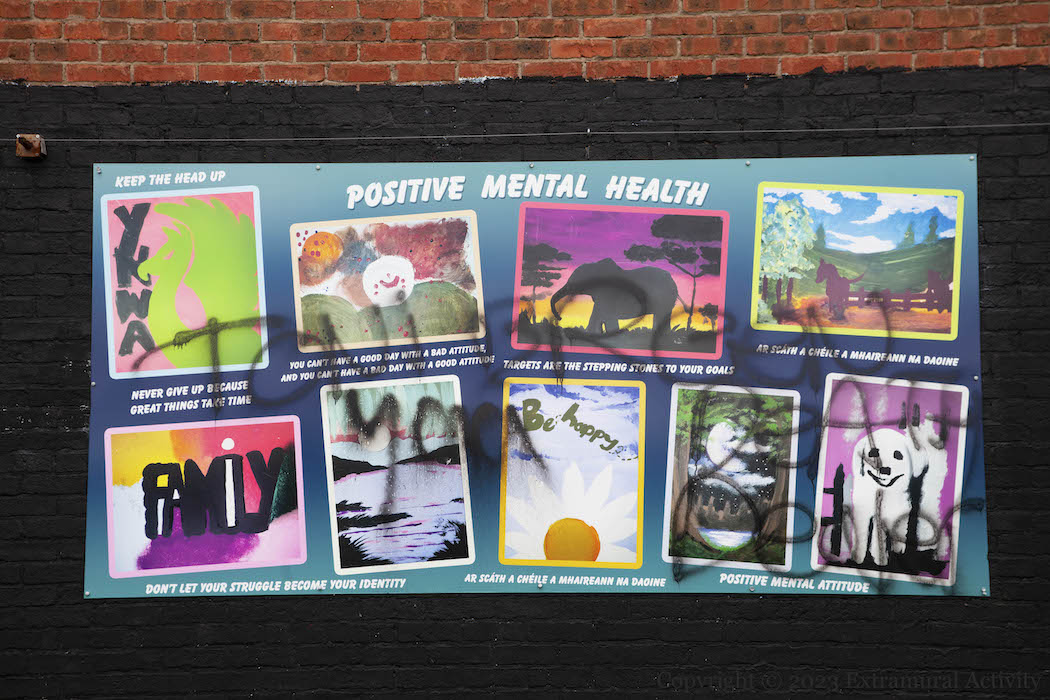
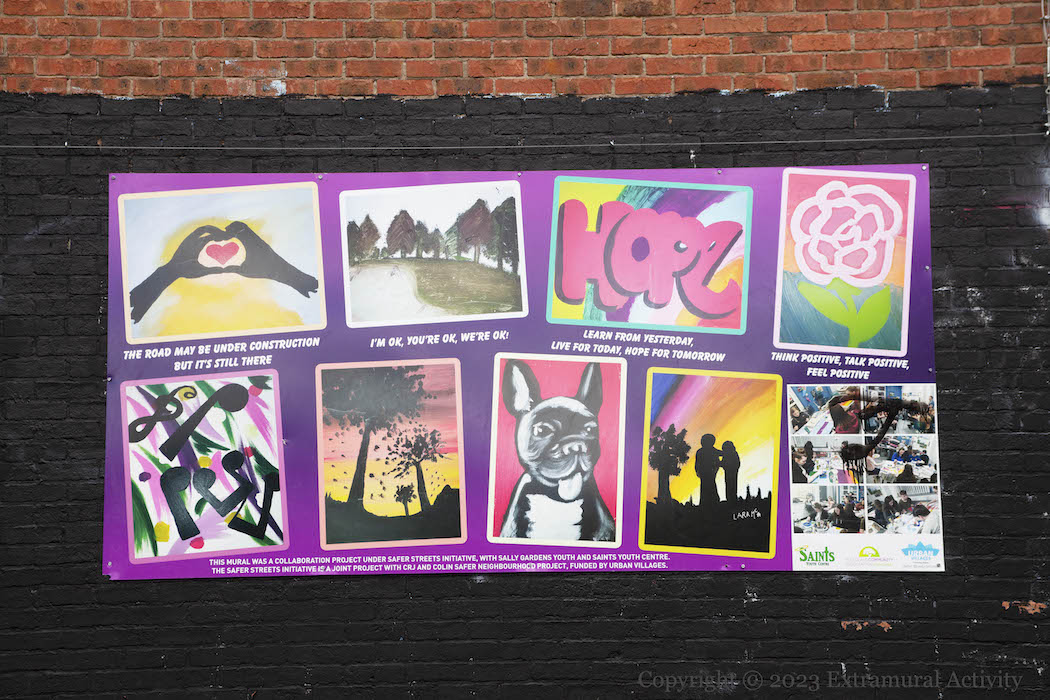
The modern-day hero accompanying Nuadha is boxer James “The Assassin” Tennyson, current Irish super-featherweight champion. There are also four mental health boards (shown below) around the corner from Urban Villages Colin Safer Streets Initiative with messages such as “Think, Talk, Feel – Positive”, “Everything that you are is enough”, “Learn from yesterday, live for today, hope for tomorrow”,
“Our revenge will be the laughter of our children” – The words of Bobby Sands are illustrated on an electrical box on the Whiterock Road, Belfast, with silhouettes of children at play in nature.
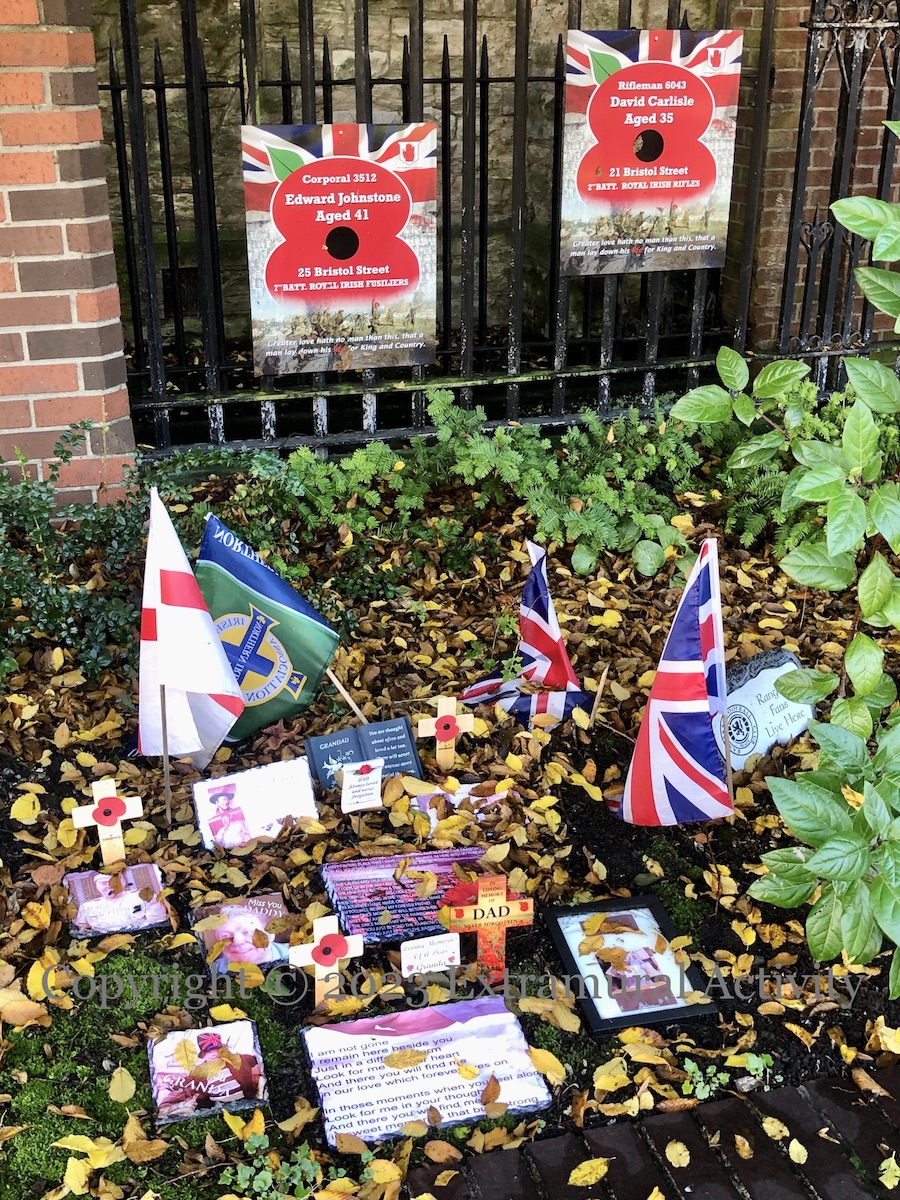
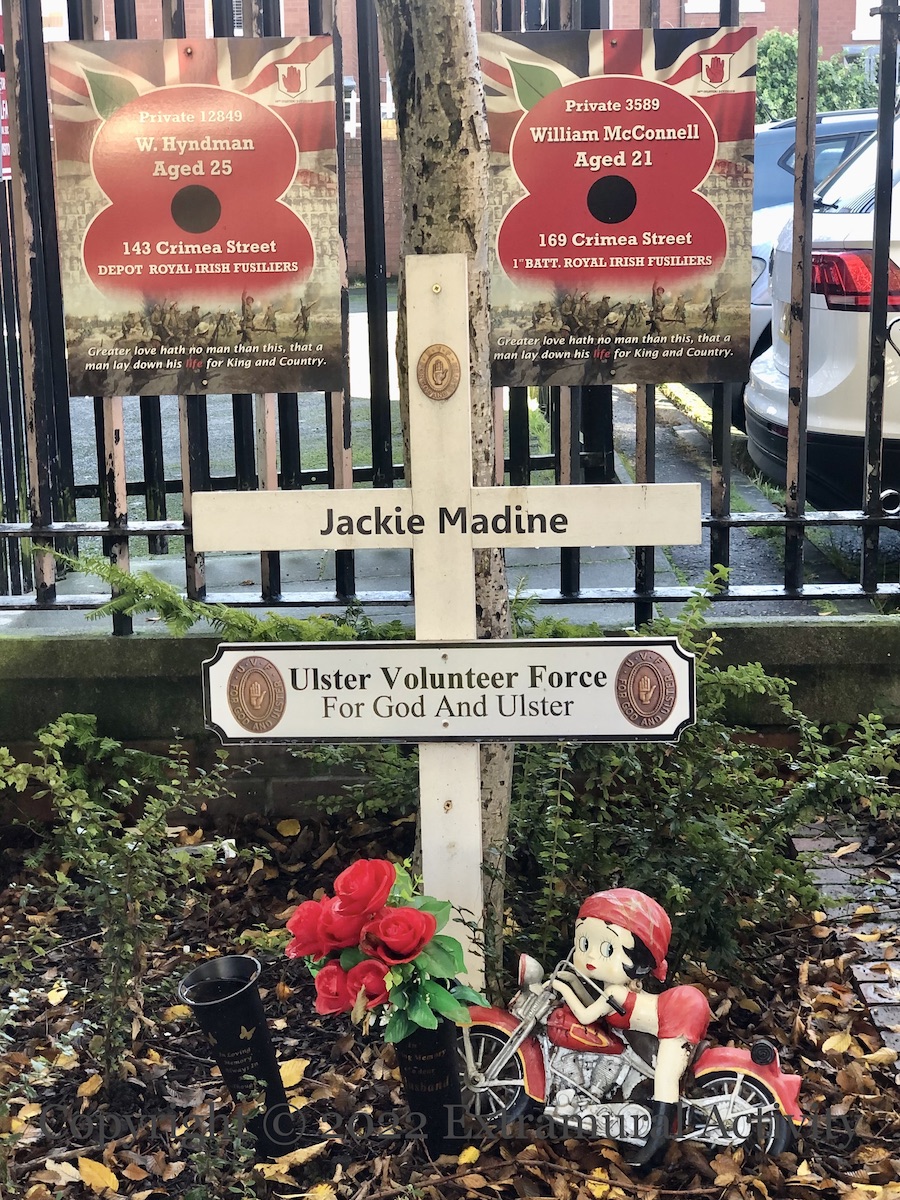
The Shankill Memorial Garden next to West Kirk Presbyterian is home to memorials to WWI (see Who Went To War And Never Returned) and the Shankill Bombing (see In The Shadow Of Death) . It has also become the site of many small memorials to local people, including volunteers in the UVF. For “S Company” see S Company, C Company.














 Extramural Activity