Tullycarnet Memorial

2013-05-22 TullMemLeft+

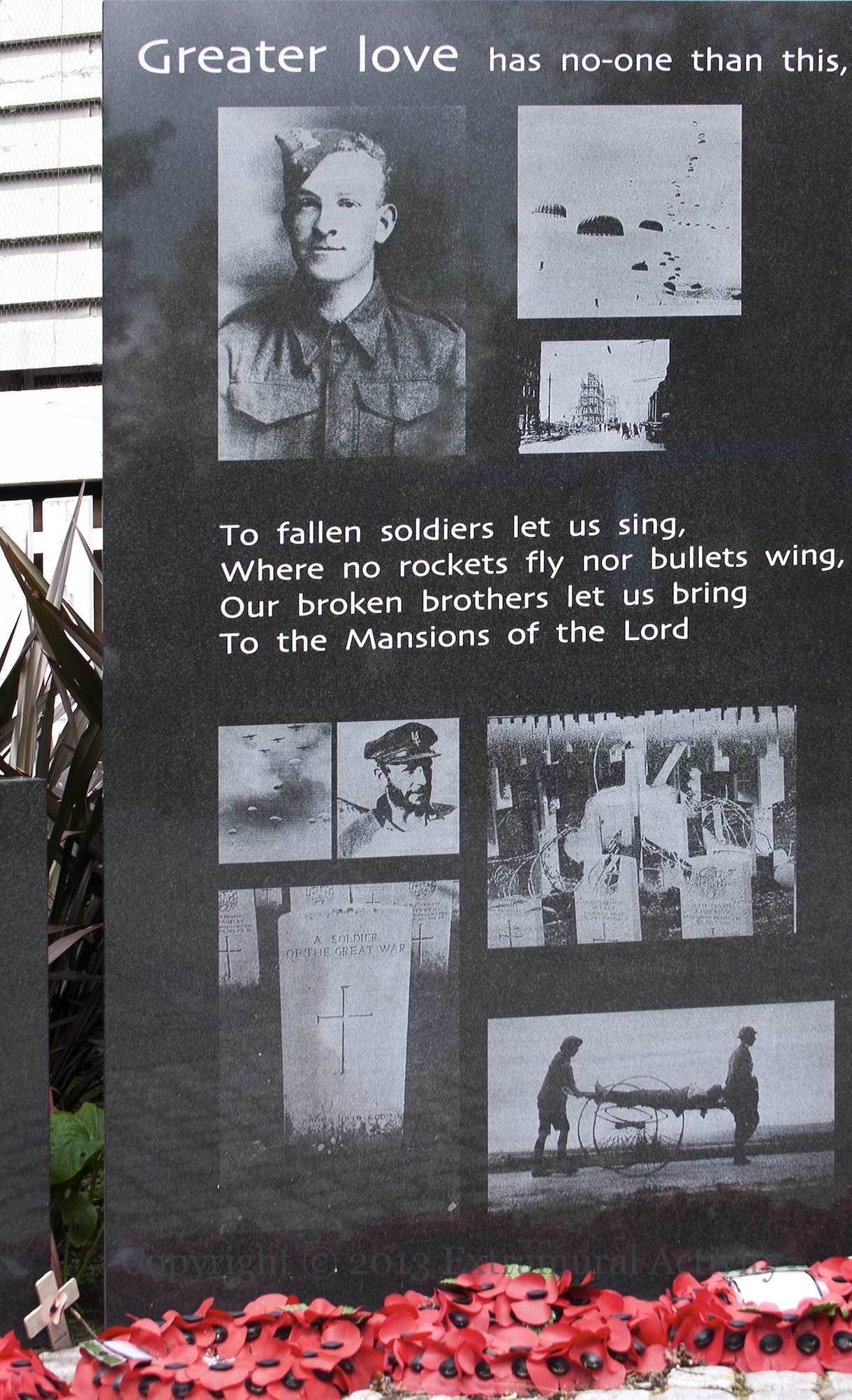
A three-stone memorial to army soldiers from both World Wards in Tullycarnet, featuring a line from the gospel of John (“Greater love has no-one than this, that a man lay down his life for his friends” 15:13) and a song by Randall Wallace for the 2002 movie We Were Soldiers called ‘The Mansions of the Lord’: To fallen soldiers let us sing, where no rockets fly nor bullets wing, our broken brothers let us bring, to the mansions of the Lord. No more weeping, no more fight, no prayers pleading through the night, just divine embrace, eternal light, in the mansions of the Lord. Where no mothers cry and no children weep, we will stand and guard though the angels sleep, Oh through the ages safely keep, the mansions of the Lord.”

By Ross Wilson with support from the International Fund For Ireland (IFI)

For a wide shot, see War And Peace.

2013-05-22 TullMemMiddle+

2013-05-22 TullMemRight+

Click image to enlarge
Copyright © 2013 Seosamh Mac Coılle
X01110  X01111 X01112

Out Of The Rubble

The Covenant and Somme boards originally on the corner of Barrington Gardens before demolition (see July 1st) have been mounted together on a metal frame inside the security gates.

Click image to enlarge
Copyright © 2013 Seosamh Mac Coılle
X01529

Thiepval St.

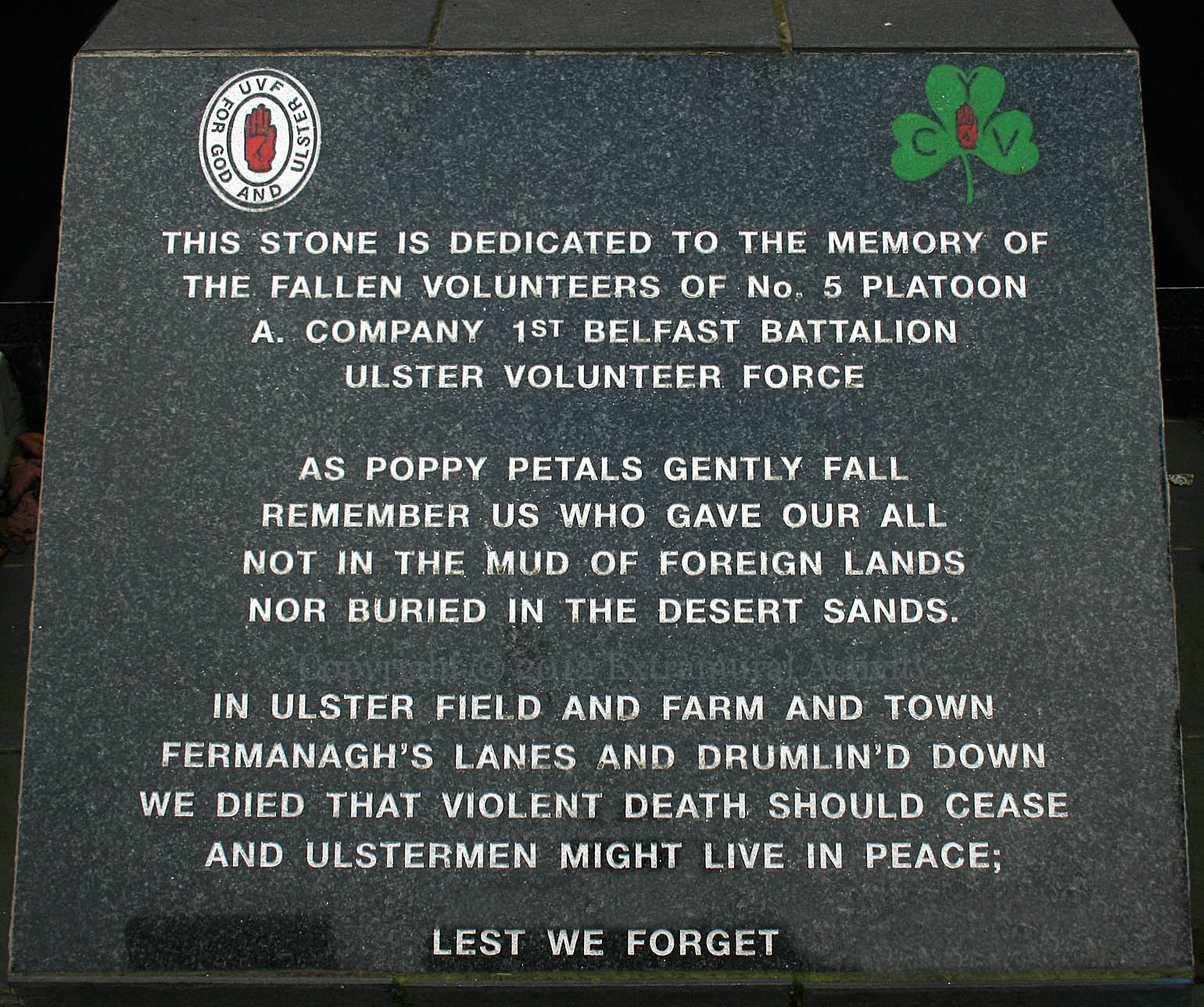
The nameplate on the lower corner of Northland Street now reads “Thiepval Street” and the Thiepval board above adorns the end wall (replacing an earlier mural to UVF A Company 5th platoon; the stone shown below, although not present in 2006, perhaps belongs to the era of the previous mural). On the other side of Conway Street is/was North Howard Walk where a plate now reads “Passchendaele Court“. It’s not clear whether the names have been changed officially or not. The names are unofficial (as of November 15th, 2012). In the New Lodge earlier this year (April-May, 2012), Fishers Court became McGurk’s Way (U.tvBBC-NI).

Close-ups of the board and the stones below …

Click image to enlarge
Copyright © 2012 Seosamh Mac Coılle
X00731 X00734 X00732 X00736 u.v.f. when the last war is waged and the last post is played when the last boy is laid and the last prayer is said when the last mother cries and the last tear drop dries when the son is gone we’ll now remember the somme. this stone is dedicated to the memory of the fallen volunteers of no. 5 platoon, a company 1st belfast battalion, ulster volunteer force, as poppy petals gently fall remember us who gave our all not in the mud of foreign lands nor buried in the desert sands, in ulster field and farm and town fermanagh’s lanes and drumlin’d down we died that violent death should cease and ulstermen might live in peace; for god and ulster, lest we forget, “I am not an ulsterman but yesterday 1st. july as I followed their amazing attack i felt that i would rather be an ulsterman than anything else in the world” captian [captain] wilfred [wilfrid] spender – the somme, in proud and loving memory of our fallen charge from thiepval wood 1916, sir edward carson, 36th ulster division

July 1st

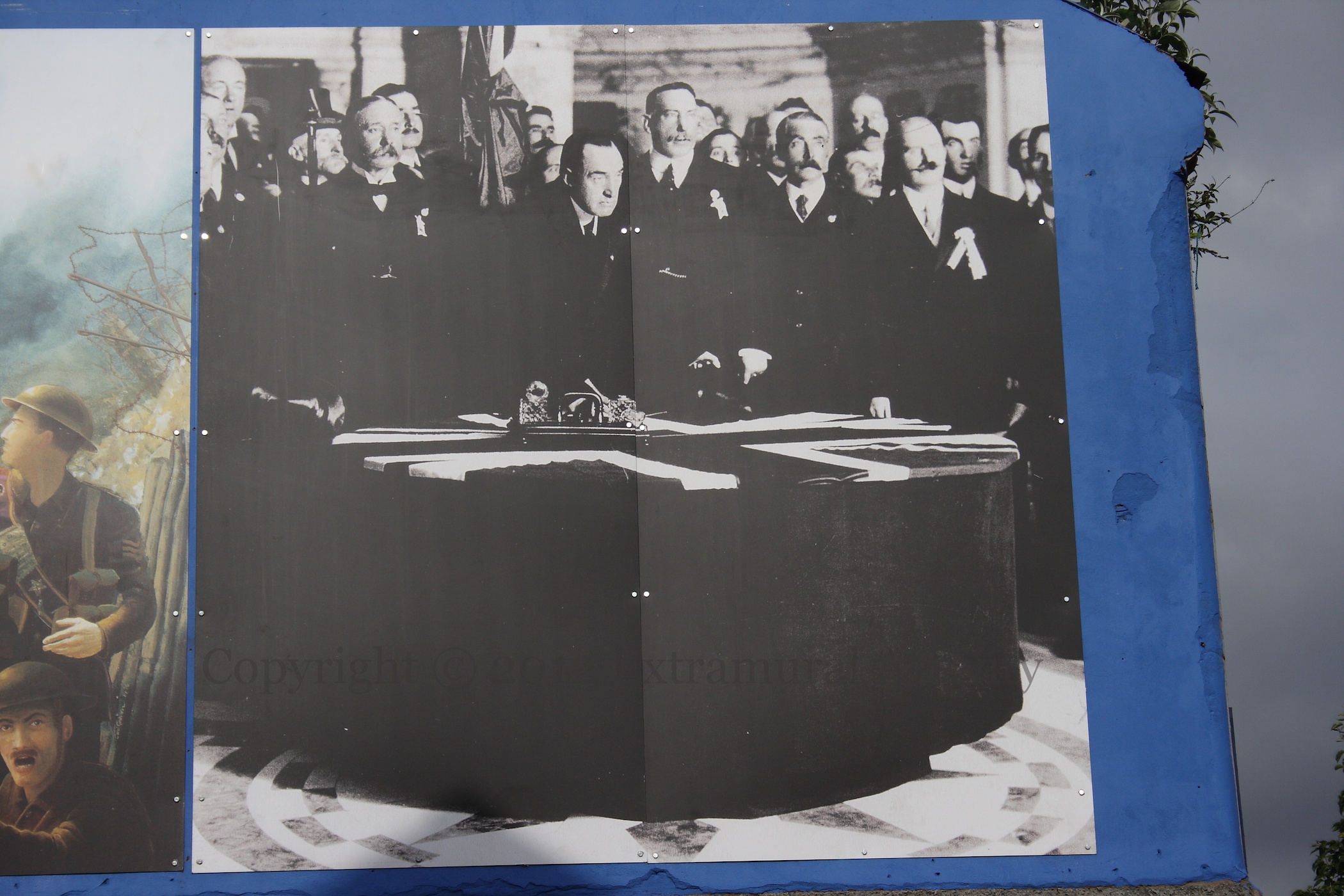
In the old style of calendar (prior to 1752), the Battle Of The Boyne took place on July 1st, the same date as the Battle Of The Somme (in the new style of calendar). It is reported that some soldiers from the 36th Division wore their Orange Order collarettes into battle. In the image above, which reproduces a painting by Carol Graham, they defend their trench from a German assault.

Carson signing the 1912 Covenant is the second of the pair.

Click image to enlarge
Copyright © 2012 Seosamh Mac Coılle
X00848 X00807

The World Wars In Lower Shankill

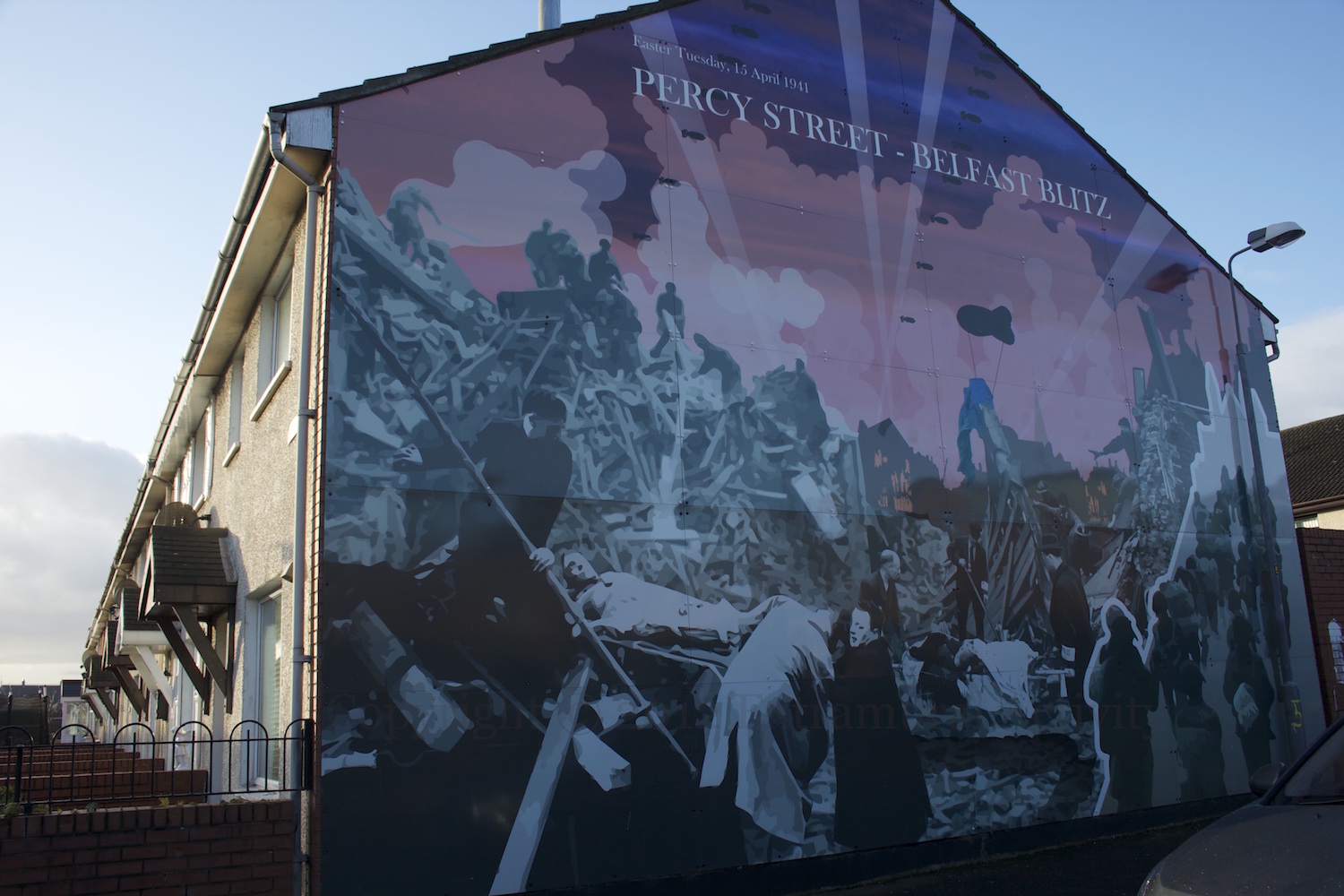
Here are three murals/boards by Steven Tunley for the Re-Imaging Communities programme in Dover Place, lower Shankill.

From left to right: “Fathers and sons of the Shankill enlist to fight in World War One”, “Belfast blitz – Easter Tuesday , 15 April 1941”, and “VE Day – 8th May 1945”.

Click image to enlarge
Copyright © 2012 Seosamh Mac Coılle
X00503 X00502 X00504

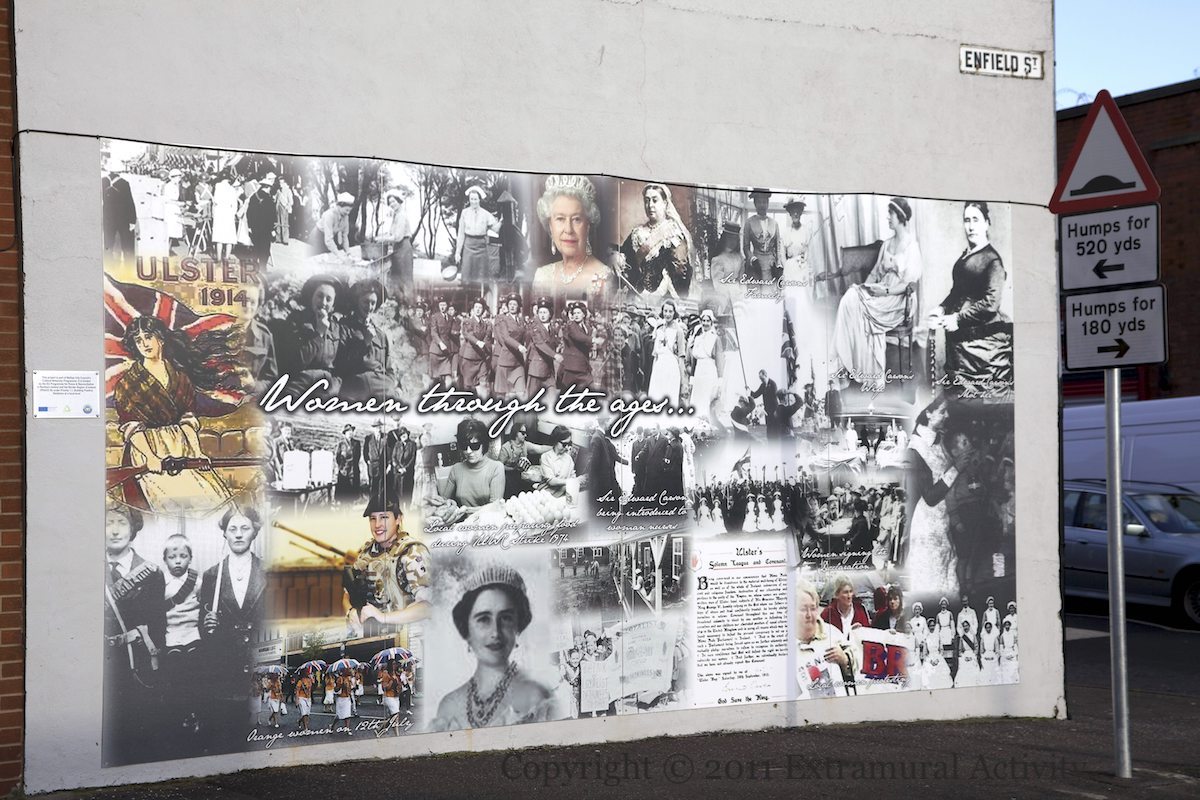
Women Through The Ages

A good part of this Enfield Street, Belfast, mural is in fact dedicated to Edward Carson – in the top left are “Sir Edward Carson’s family”, “Sir Edward Carson’s wife”, and “Sir Edward Carson’s mother” and below them is a photograph of Carson presenting colours to the South Belfast Volunteers (see We Won’t Have Home Rule) and another (to the middle) of “Sir Edward Carson being introduced to woman nurses”. In the centre are “Local women preparaing food during UWC strike 1974”. Other images include English monarchs Victoria (Queen Of Ireland, Empress Of India) and ElizabethUlster 1914, and the signing of the Ulster Covenant by women.

“This project is part of Belfast City Council’s Cultural Networks programme. It is funded by the EU Programme For Peace & Reconciliation In Northern Ireland And The Border Region Of Ireland (Peace III).”

Click image to enlarge
Copyright © 2011 Seosamh Mac Coılle
X00548

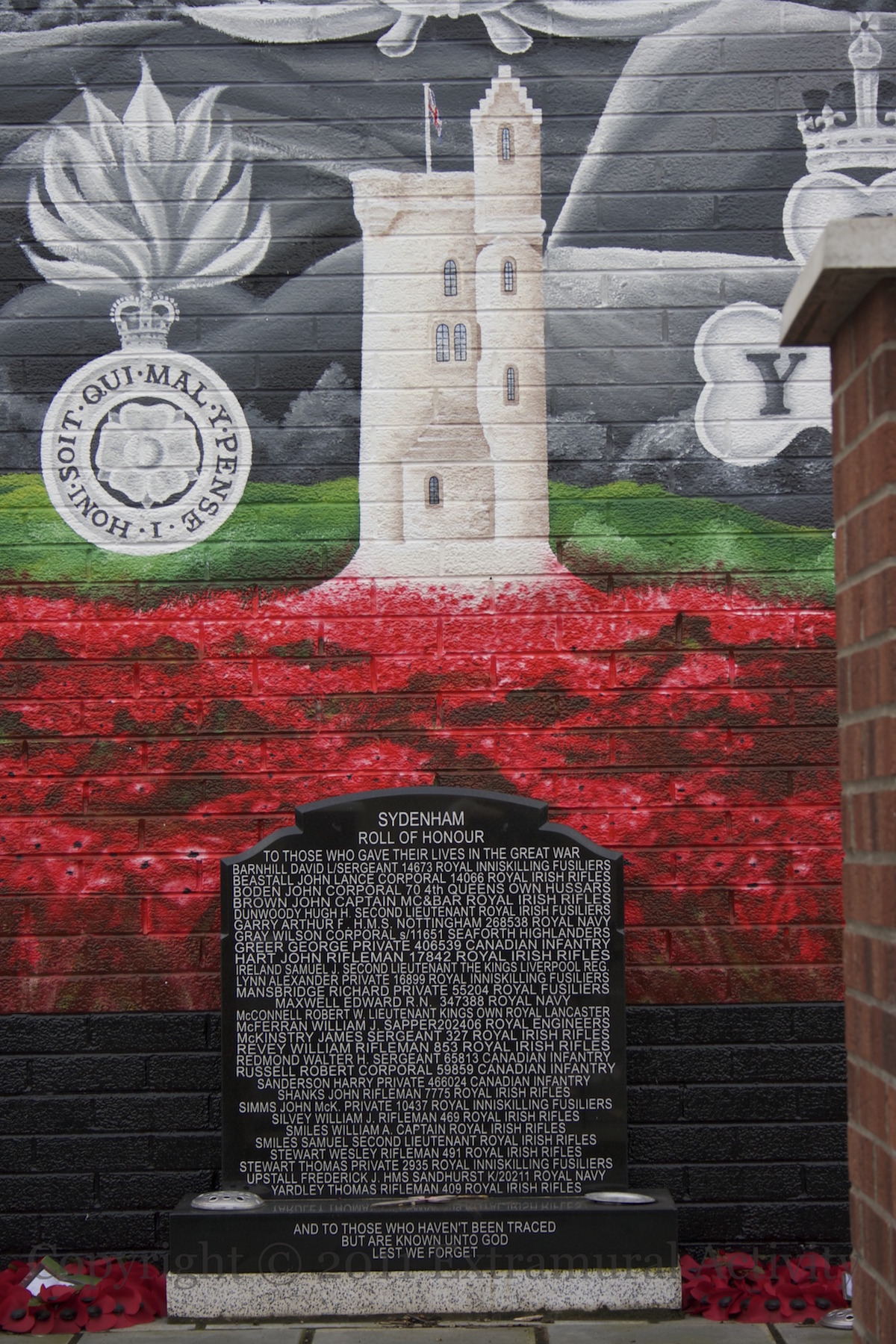
To Those Who Gave Their All For The Great War

William Frederick McFadzean of the 14th (Young Citizens) battalion Royal Irish Rifles, was awarded the Victoria Cross for throwing himself on a box of grenades that had fallen into the trench during the Battle Of The Somme, July 1st, 1916. The figure on the left is Edward Carson. The close-up below shows a “Sydenham roll of honour to those who gave their lives in the Great War and to those who haven’t been traced but are known unto God.”

Click image to enlarge
Copyright © 2011 Seosamh Mac Coılle
X00406 [X00405] X00404

Victoria Crosses

“Only by remembering these men, and others like them, can we ever repay their memory.” Nine Victoria Cross recipients from the 36th (Ulster) Division in World War I are honoured in this board on the Shankill at the Co-Op (which was previously across the road in Crimea Street).

The nine are (from 1917 and 1918) E[dmund] De Wind, E[rnest] Seaman, C[ecil] L[eonard] Knox, N[orman] Harvey, (from 1916) G[eoffrey] St. G[eorge] S[hillington] Cather, W[illiam] F[rederick] McFadzean, E[ric] N[orman] F[rankland] Bell, R[obert] Quigg, and J[ames] S[amuel] Emerson

The illustrations come from Cyril Falls’s book The History Of The 36th (Ulster) Division (from Project Gutenberg).

The poem In Flanders’ Fields is by Canadian John McCrea.

Click image to enlarge
Copyright © 2011 Seosamh Mac Coılle
X00413

Lay Them Away On The Hill Side

“Lay them away on the hill side/along with the brave and the bold/Inscribe their names on the role [sic] of fame/in letters of purest gold.” The Ulster Tower at Thiepval commemorates the WWI dead of the 36th (Ulster) Division. The words, however, come from a song about James Daly, who was executed by firing squad for taking part in a 1920 mutiny of the Connacht Rangers in India in protest of the activities of the Black and Tans. Above (and below – not shown) are the insignia and names of UVF volunteers from UVF South Belfast 2nd battalion – see Lay Them Away On The Hill Side.

On the side of The Hideout, Pine Street.

Click image to enlarge
Copyright © 2011 Extramural Activity
X00451

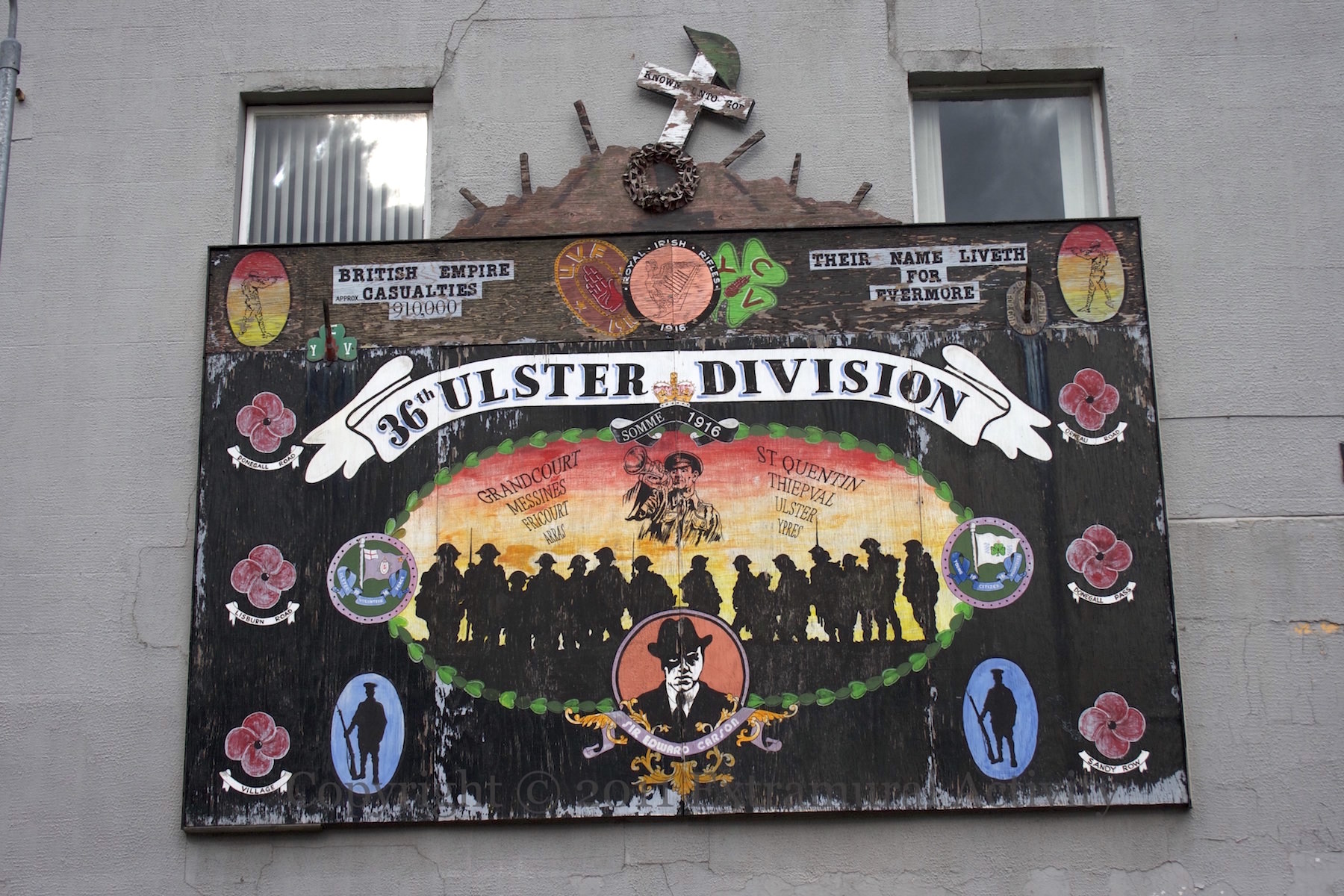
Their Name Liveth For Evermore

The apocryphal book of the Bible ‘Ecclesiasticus’ reads, “their bodies are buried in peace, but their name liveth for evermore” (44:14). The last clause is here applied to 910,000 “British empire casualties” from the Great War, including the Ulster Volunteers and Young Citizen Volunteers raised by “Sir Edward Carson” (here looking like Al Capone) which became the 36th (Ulster) Division and particularly the Royal Irish Rifles and fought at the Somme 1916.

Apsley Street, Donegall Pass, south Belfast.

Click image to enlarge
Copyright © 2011 Seosamh Mac Coılle
X00411 [X00412]