At the heart of this east Belfast homage to the healing power of soccer are German and British soldiers shaking hands over a ball in ‘no man’s land’ on the Western Front, on Christmas Day, 1914. The image is not from a contemporary photograph but a modern one of a 2014 sculpture depicting such an even by Andy Edwards (TruceStatue) (who also did the Pat Jennings sculpture in Newry – seen in Pat Jennings). For more images of the WWI soccer statue, see WWI Cemeteries.
It’s not clear that matches between opposing forces – rather than simple fraternisation – were actually played; see Wikipedia for a review of the evidence.
The rosette at the centre of the poppy wreath shows the UK armed services badge (with the crown overlaid by the Ulster Banner) surrounded by a verse from Binyon’s ‘For The Fallen’ and “Tiger’s Bay – York Street – Sailortown loyal”. That group’s Facebook page is private and no home-page seems to be available for ‘North Belfast Friends Of The Somme’.
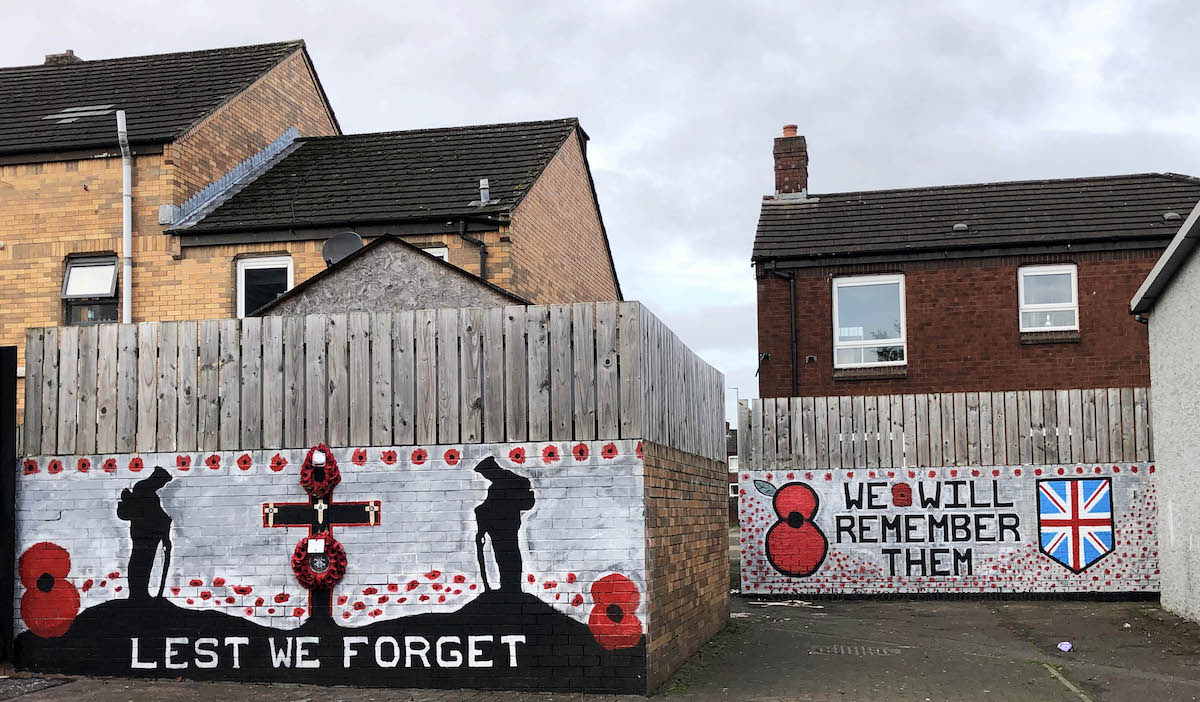
North Queen Street, Tiger’s Bay, Belfast, at the old Lewis Street.
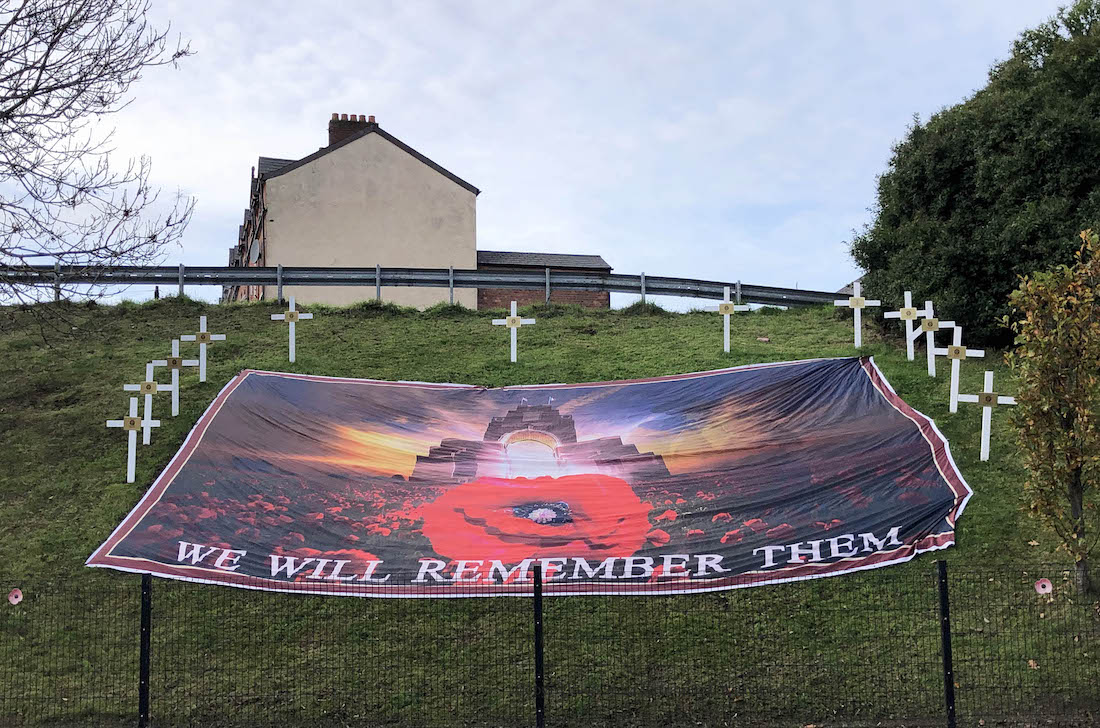
The large cloth on the Shore Road was also seen last year.
“In memory to all who fought and gave their lives.” This is the tribute to the Ulster Division at the Carrickfergus Rangers Supporters’ Club, citing the words of Wilfrid Spender “I am not an Ulsterman but yesterday, the First of July [1916], as I followed their amazing attack, I felt that I would rather be an Ulsterman than anything else in the world.” (For more of Spender’s tribute to the 36th Division, see I Am Not An Ulsterman.)
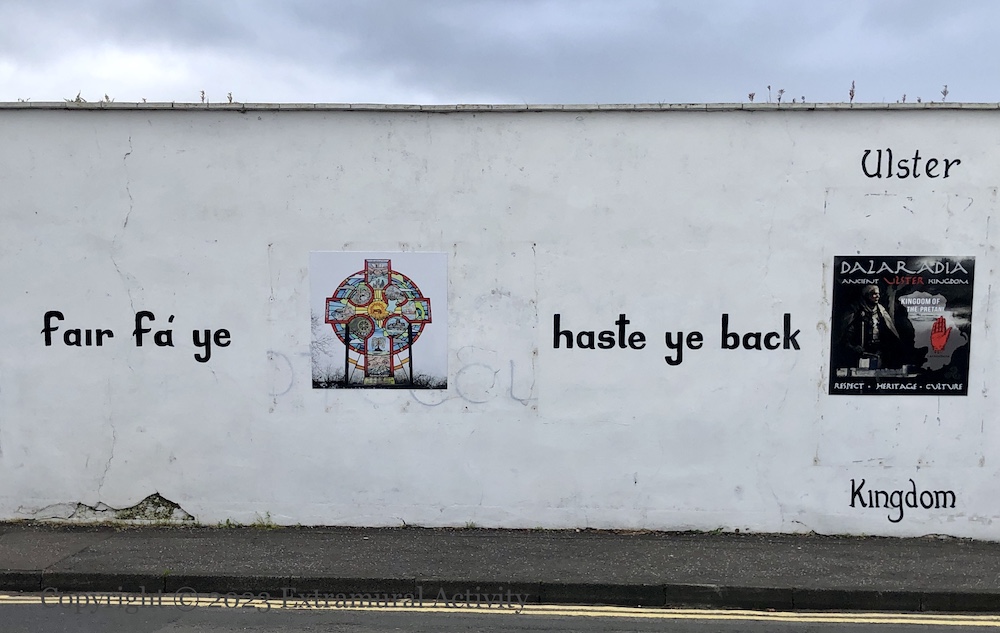
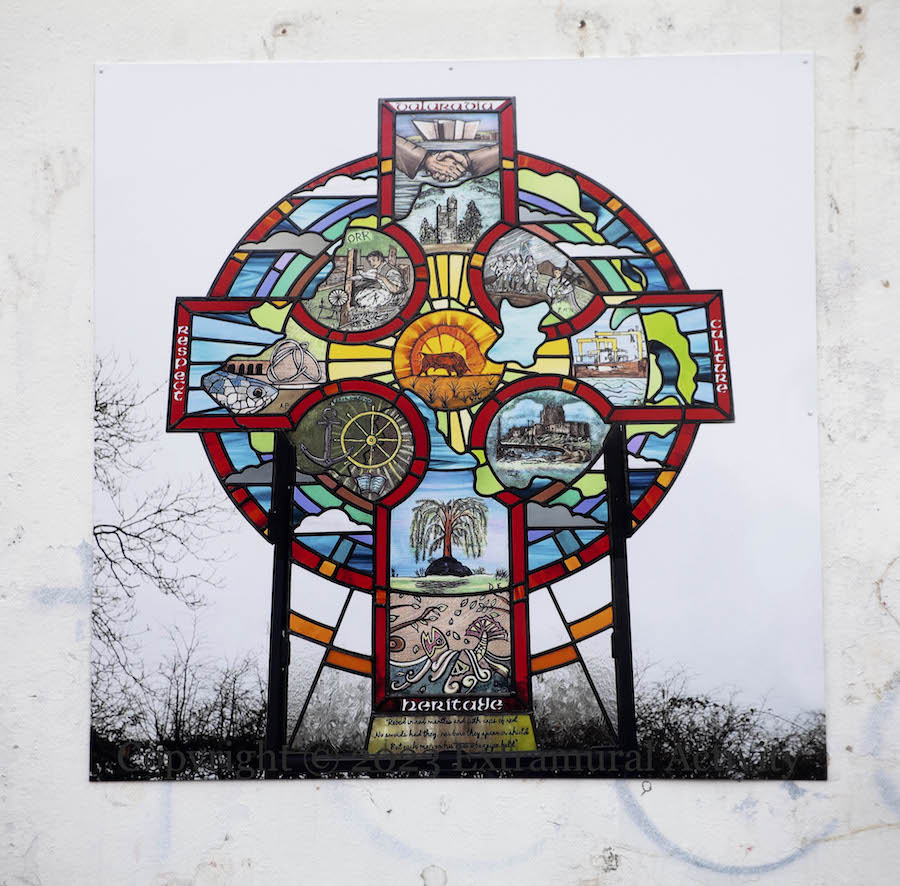
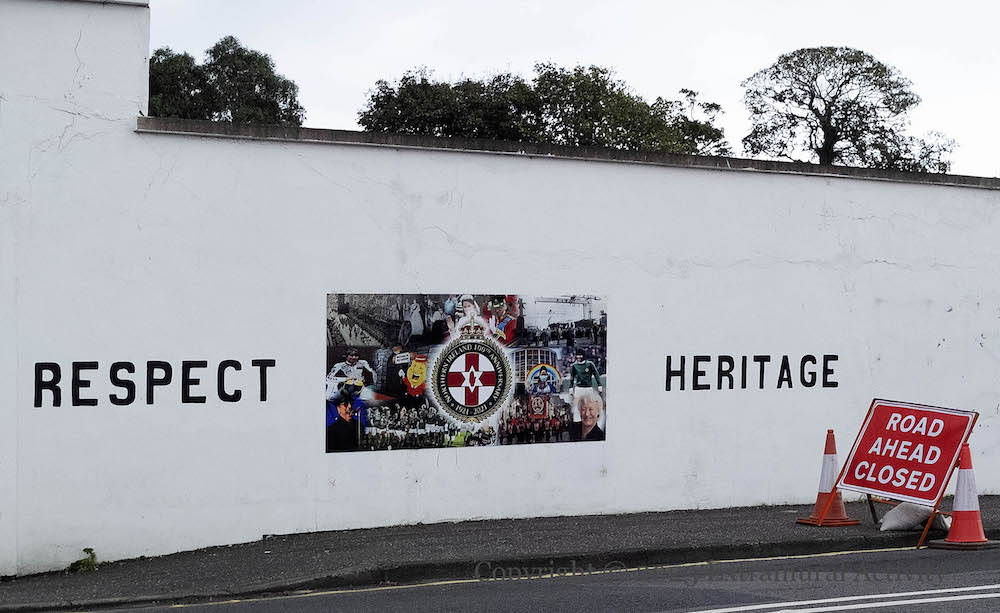
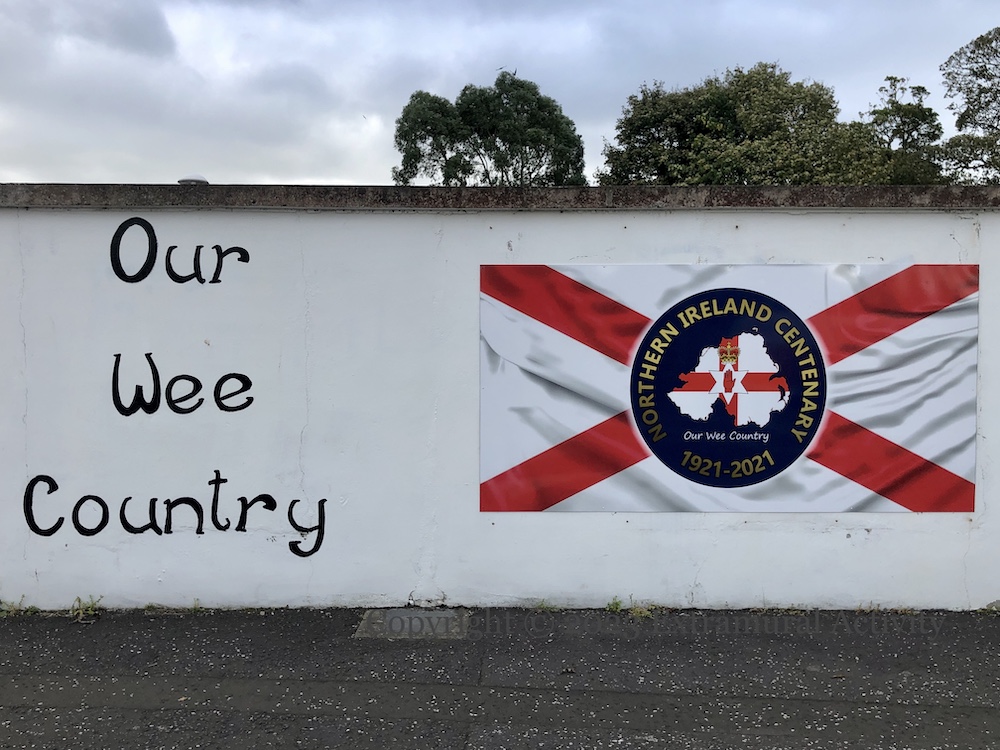
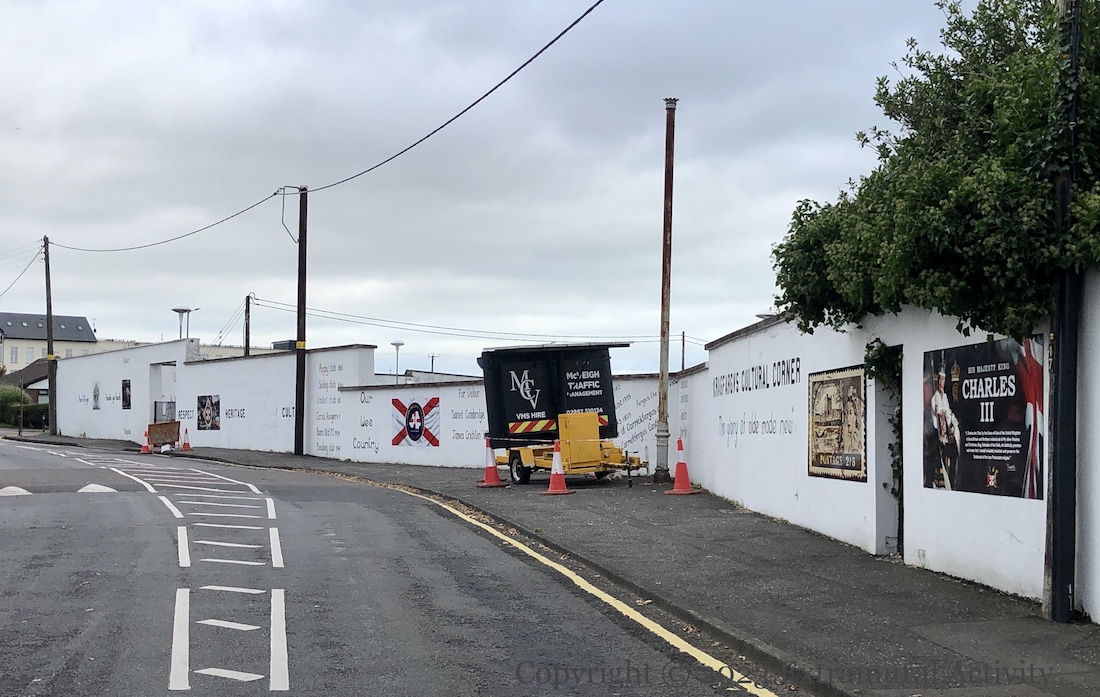
This is the second (at least) iteration of an installation along Taylor’s Avenue, Carrickfergus, showcasing the Ulster-Scots heritage of Carrickfergus and its later contributions to the United Kingdom.
The wall is 60 metres/200 feet in length and can be divided into about ten distinct panels – notes on the different panels are given below, following the order of presentation of images, which show the entire wall moving from left to right.
The original, as seen on Street View, included boards showing the Pretani Isles/British Isles, QEII, and Tom Moore. As seen here, there are now boards to King Charles III, a vintage postage stamp, ‘The Siege Of Carrickfergus’ in 1689, and ‘The Barn Mills Fallen’ of WWI.
James Orr, the ‘Bard Of Ballycarry’, was a contemporary of Robert Burns and a United Irishman. It does not appear that he wrote a poem with the line “I wish I was in Carrickfergus”.
Daniel Cambridge won his VC for service in the Crimean War (WP) and James Crichton for service in WWI (WP).
CarrickfergusHistory includes “the oldest know map of Carrickfergus” from 1560, employing the spelling “Kragfargus”.
The 2/6 postage stamp featuring Carrickfergus Castle was one of four in a “Castle series” in 1955 (WP).
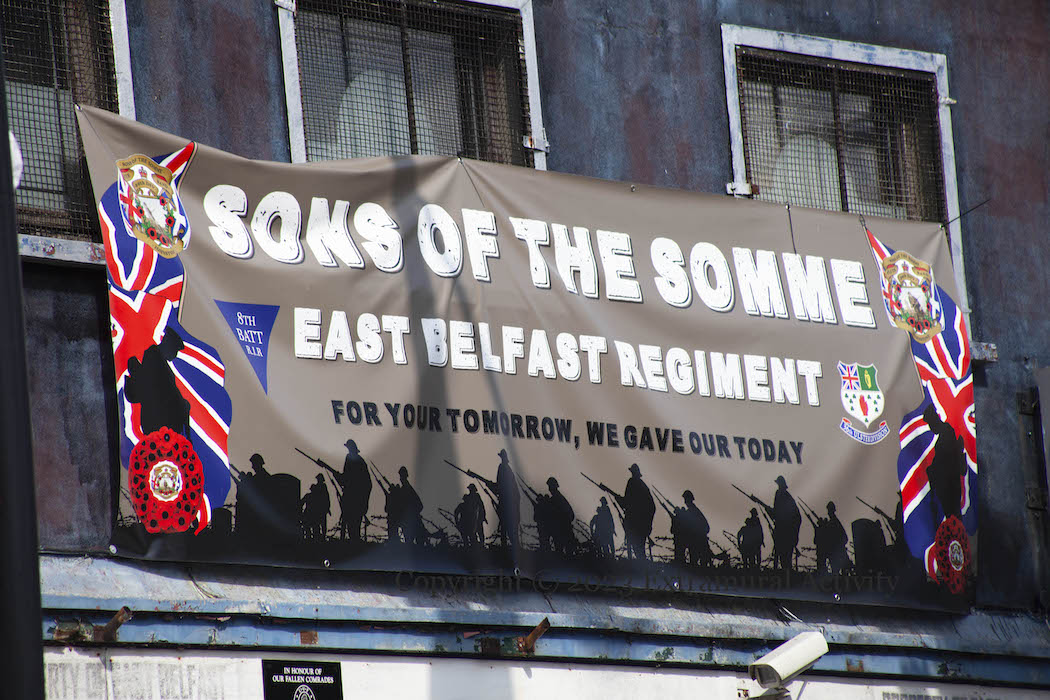
“For your tomorrow, we gave our today.” On either side of the central text are “8th battalion RIR” and the emblem of the 36th Division. The East Belfast regiment of the (1912) Ulster Volunteers became the 8th battalion of the Royal Irish Rifles and joined the 107th brigade in the 36th Division.
In the corners of the tarp above is the emblem of the Sons Of The Somme flute band, Johnstone (west of Glasgow) (Fb). The tarp is on the (closed) Belvoir Bar on the Newtownards Road. For the “property of East Belfast UVF” stencil and the plaque at the bottom, see Not For Sale.
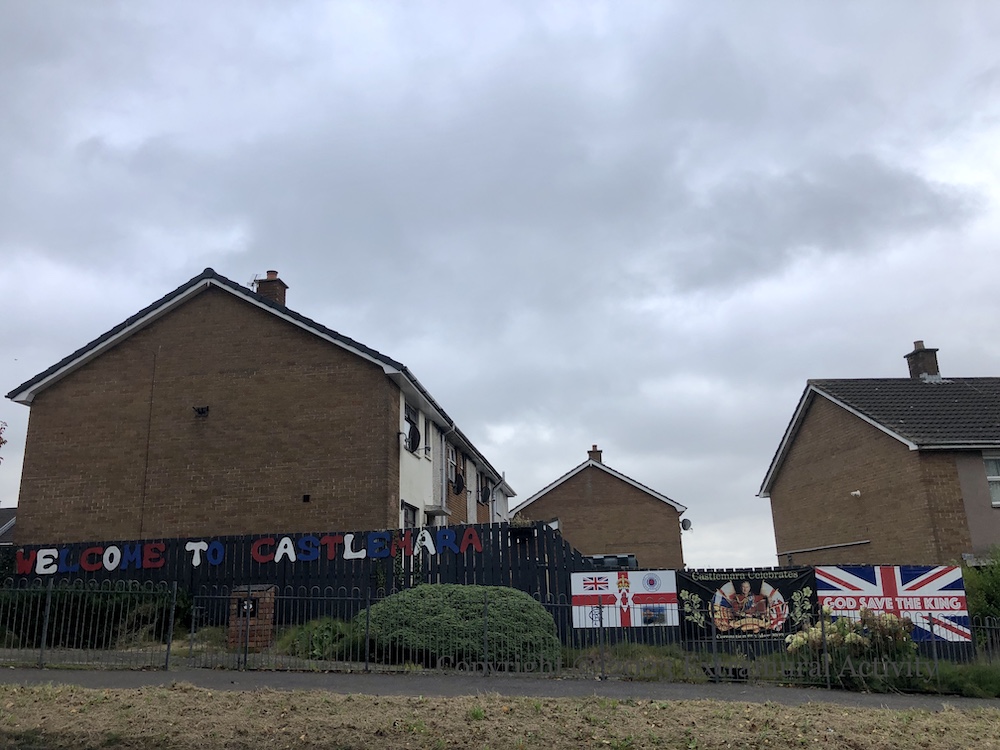
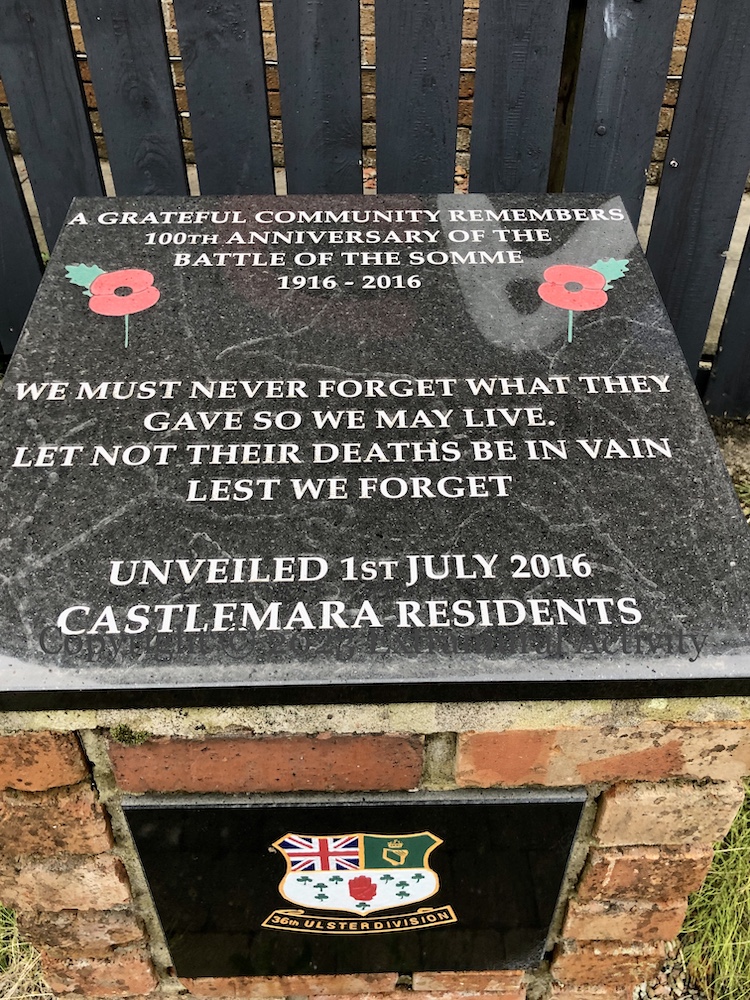
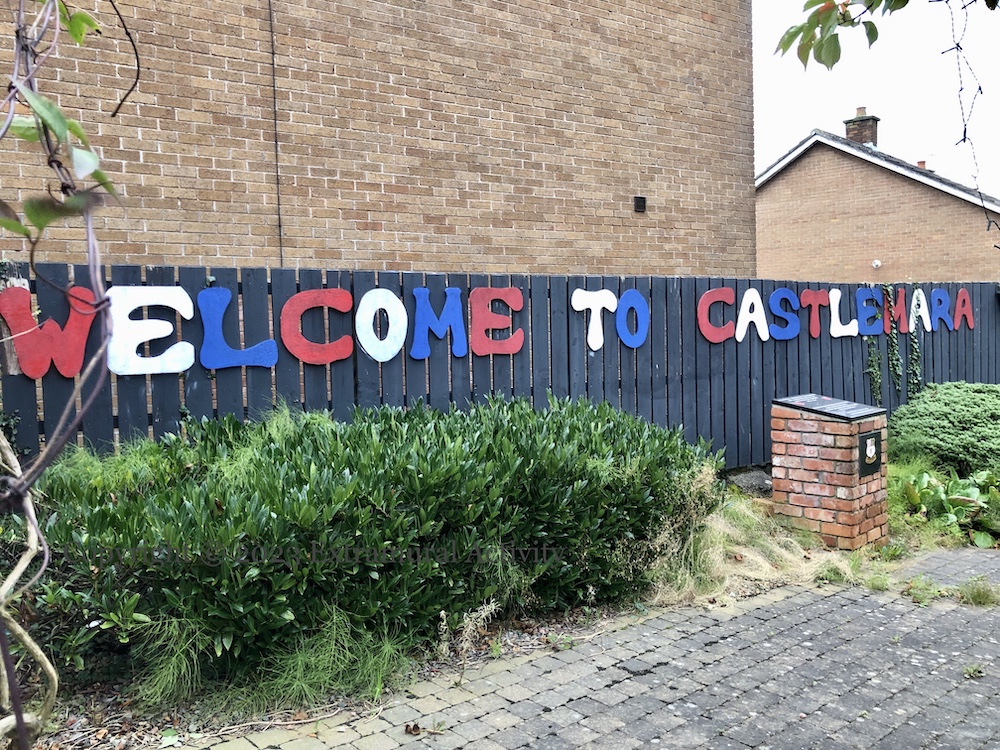
Castlemara residents’ various emotions are on display at the entrace to the estates: celebrating the jubilee of Elizabeth II, the coronation of Charles III, the creation of Northern Ireland in 1921, and Rangers’ 55th league title; saluting Tom Moore; commemorating Prince Philip, 1921-2021; and remembering with gratitude the “100th anniversary of the Battle Of The Somme”: “We must not forget what they gave so we may live. Let not their deaths be in vain. Lest we forget.”
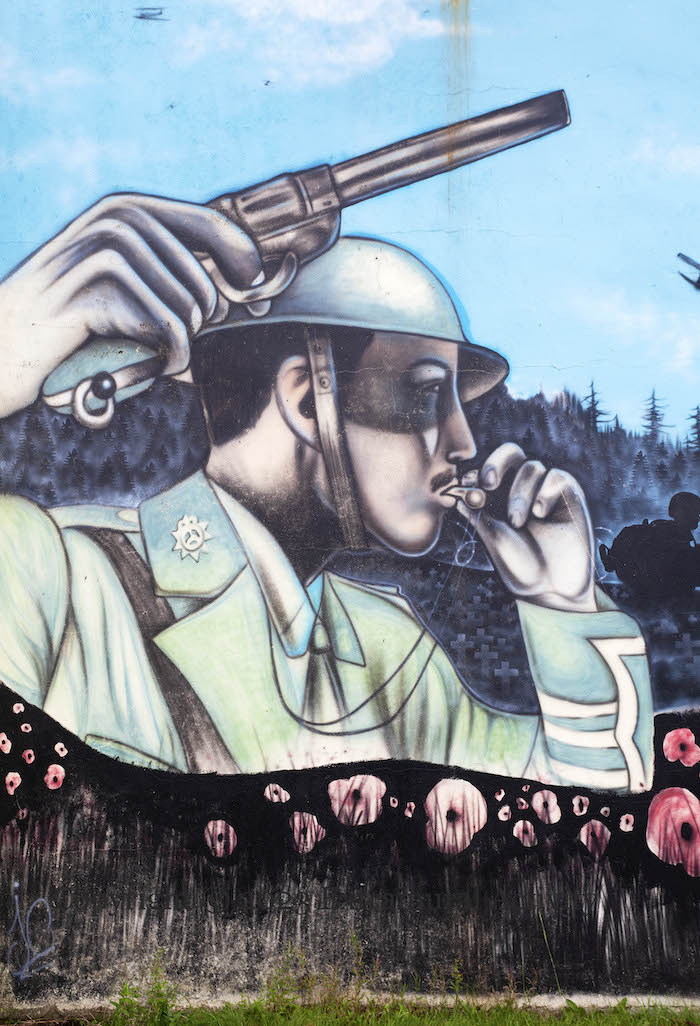
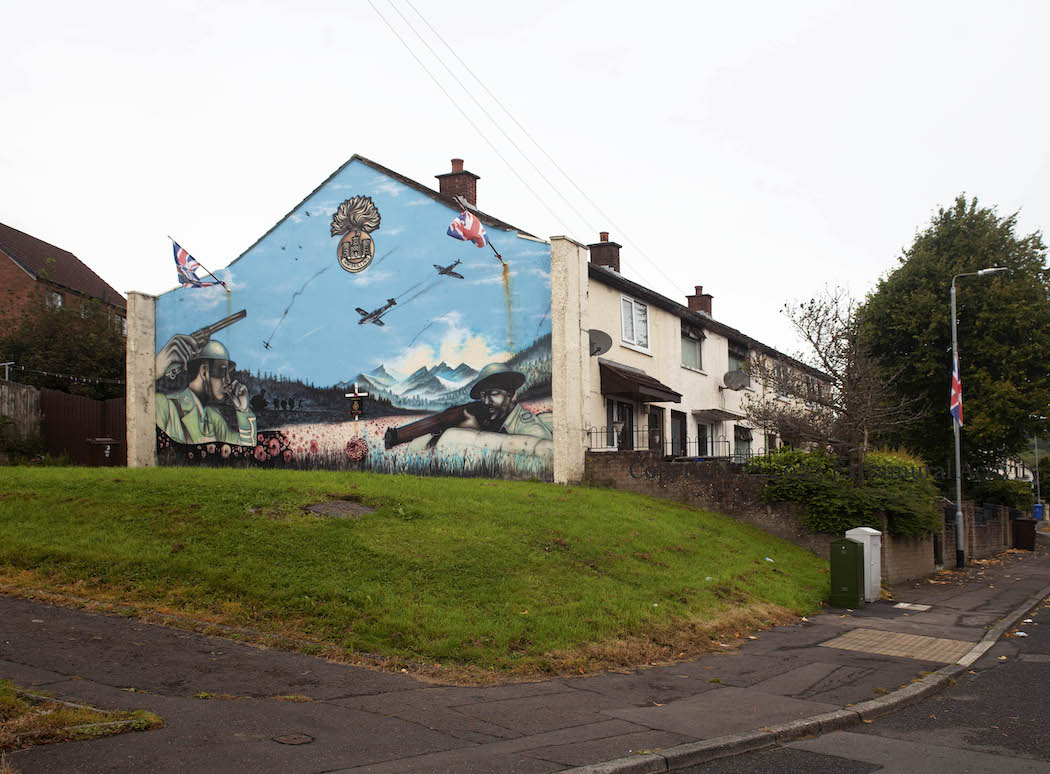
The Inniskilling Fusiliers were recruited from the four Ulster counties of Fermanagh, Tyrone, Derry, and Donegal. In WWI, battalions also served in the 4th, 29th, and 10th Divisions, as well as the 109 Brigade of the 36th Division. In WWII (represented here by the Spitfire in pursuit of the Messerschmitt) the Fusiliers served in France, India, and Italy. (Ciroca | Long Trail | WP)
(For a broader history, from the Williamite campaign to modern Afghanistan, see Inniskilling.)
This Tyndale mural appears to have be painted without fanfare in 2022.
After WWI, the Royal Irish Rifles became the Royal Ulster Rifles (and later became part of the Royal Irish Rangers). This board prioritises WWI as the Rifles were part of the 36th Division. The hero of WWI portrayed in the central panel is William McFadzean, awarded the VC for falling on two live grenades in the trenches on July 1st, 1916. McFadzean is familiar from many previous murals both individually and in the company of other VC winners; for his family home in Cregagh, see Rubicon.
Alongside McFadzean, the hero of WWII is Blair “Paddy” Mayne, who was only briefly in the Ulster Rifles before making his name in the Parachute Unit (later, and better, known as the SAS). His many medals of honour are shown in an old Newtownards mural though he was denied the VC.
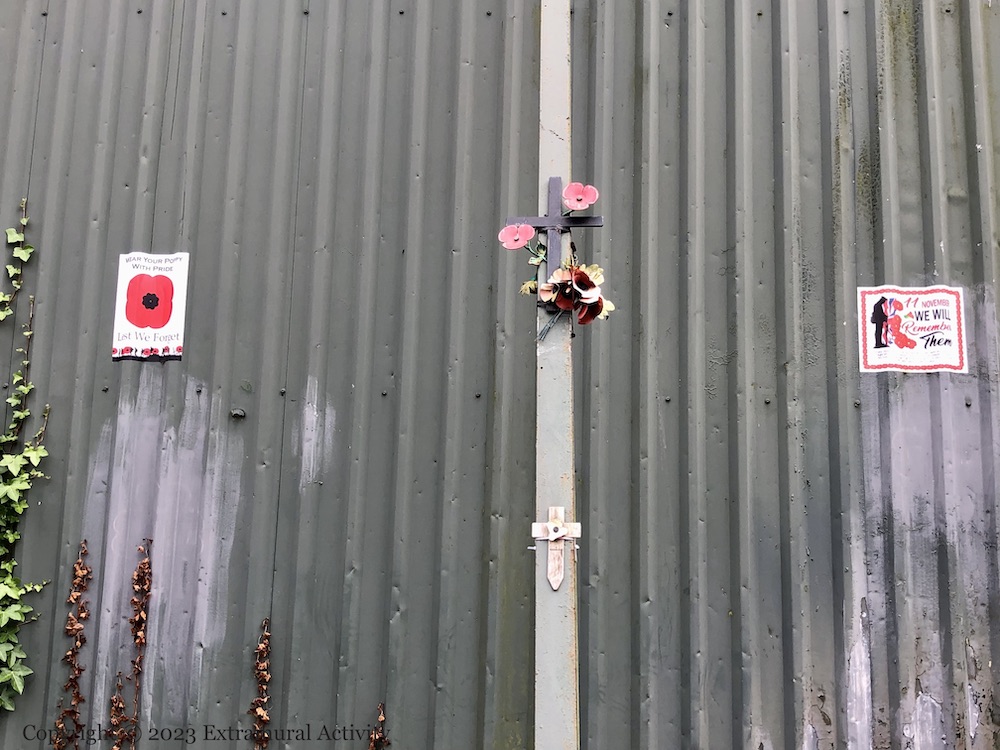
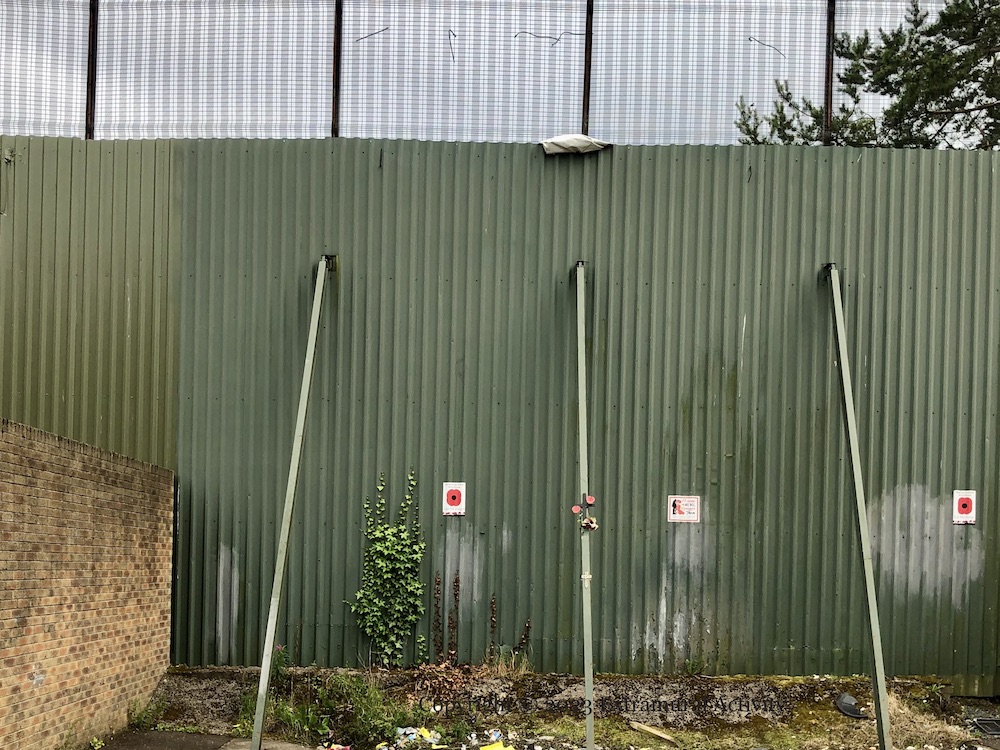
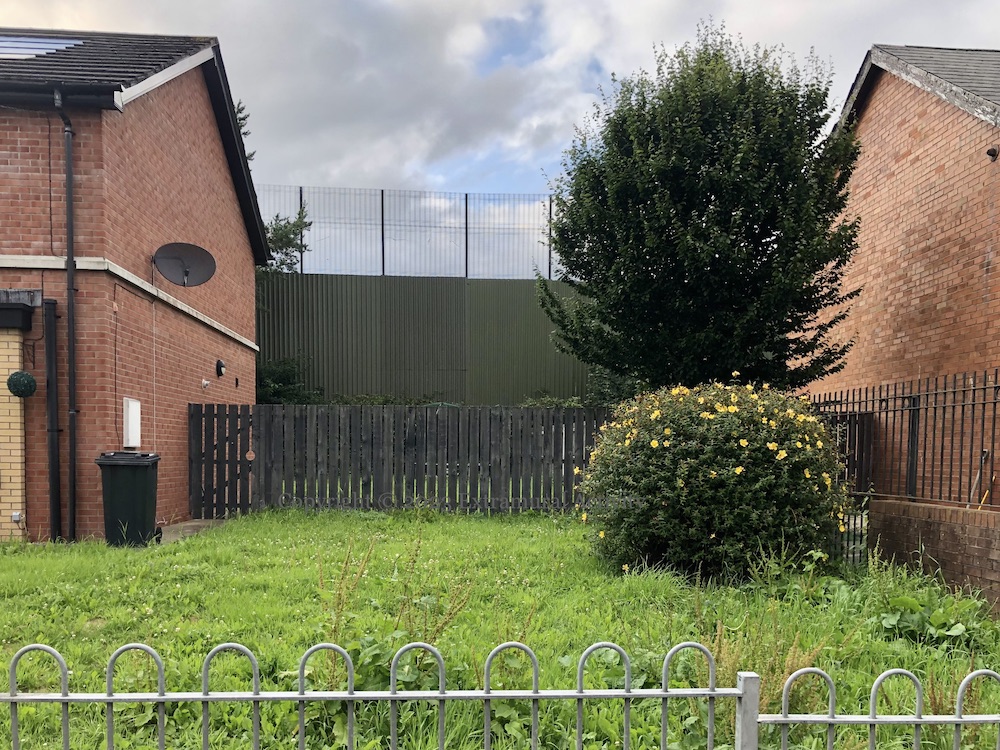
The first “peace” line along Alliance Avenue was a temporary barried constructed by the British Army in 1971 (Heatley at CAIN); parts of it today are nine metrers high (Belfast Interface Project). The central road in Ardoyne, Berwick Road/Paráıd An Ardghleanna was cut off by the line but in the recent redevelopment no house was built in front of the spot where the road ran through. Instead there are now support beams and a small cross in memory of WWI dead.
The final image is of the same spot on the Ardoyne side of the line.
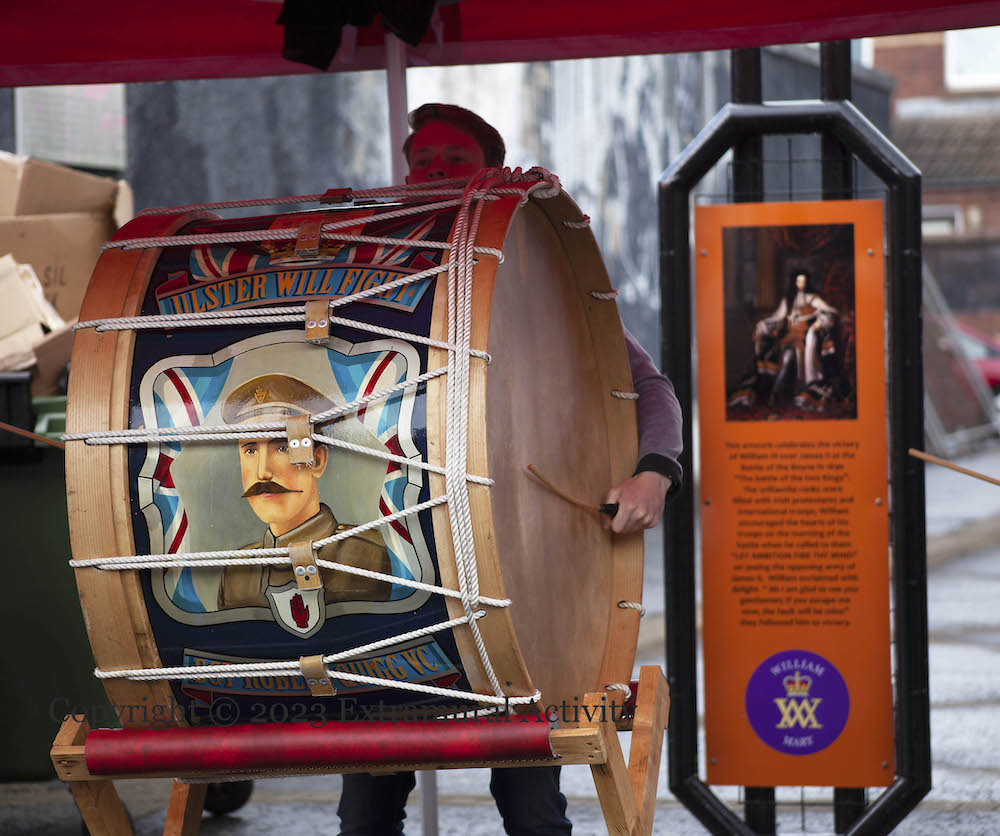
The “Lambeg drum” is named for the village near Lisburn, perhaps invented there to celebrate a visit by King Billy (LAD), or perhaps because it was there that the (already existing) drum was played with canes (WP).
As can be seen from these images, the drums are extemely large – three feet in diameter – which makes them difficult to use in parades, as does their immense noise (up to 120 dB); they are more frequently seen on their own at drumming displays such as this one on the Shankill yesterday (July 11th).

















 Extramural Activity