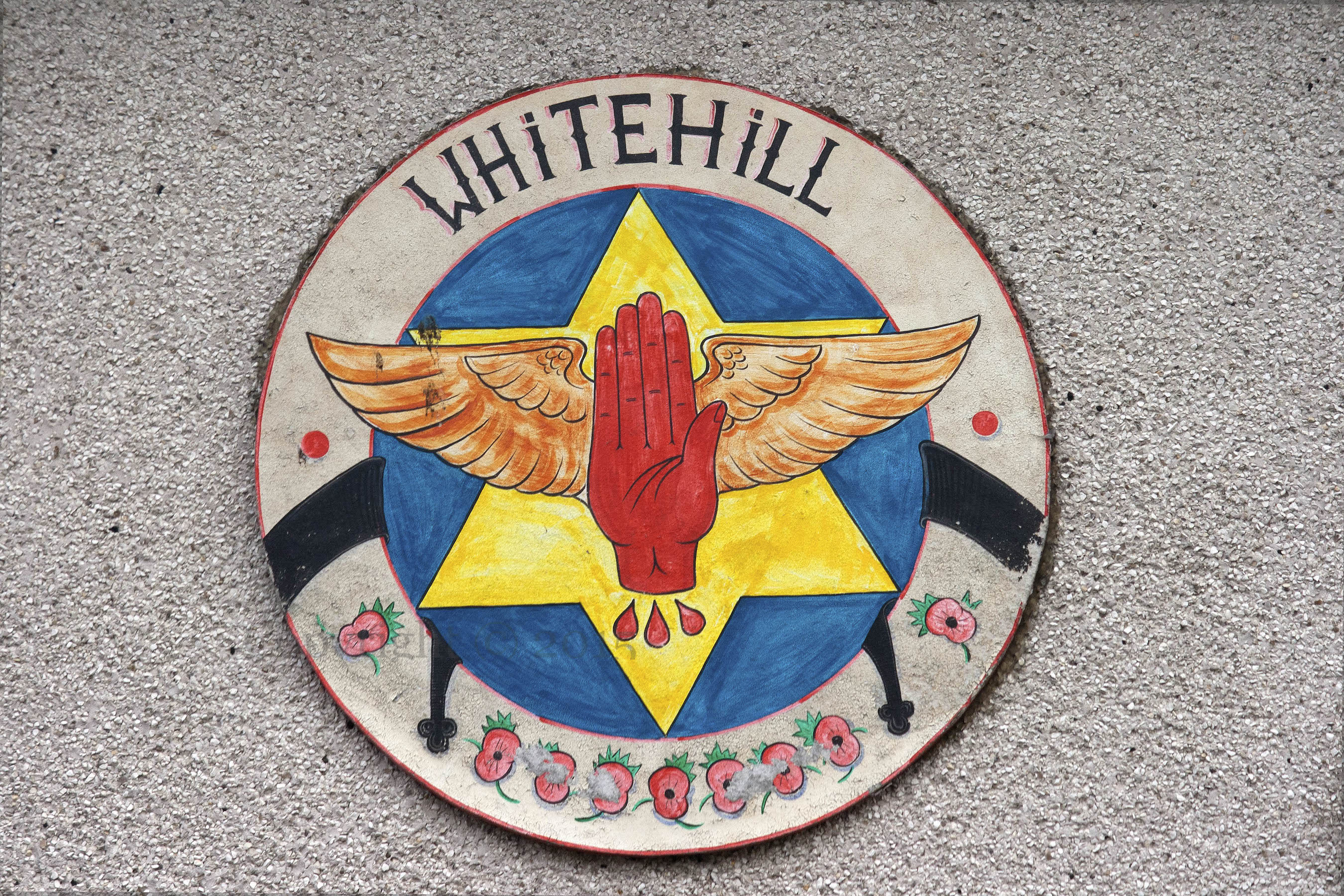
Here are three images of small boards in the Bloomfield and Whitehill estates in Bangor, Co. Down: above, one from the Ulster Freedom Fighters (UFF); below, from the Red Hand Commandos (RHC); and finally, the Ulster Volunteer Force and Young Citizen Volunteers.
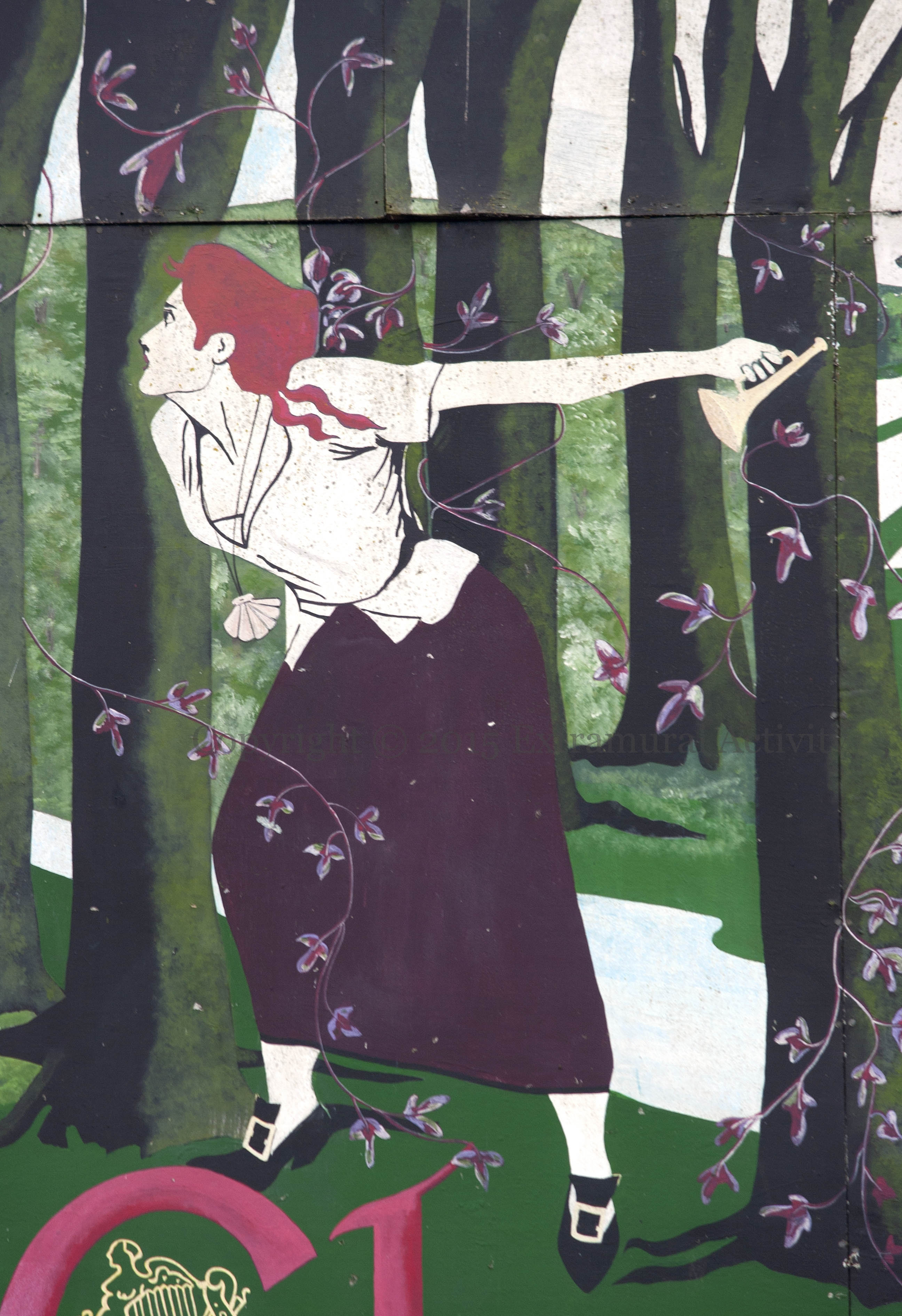
“Were you at the rock?” A red-headed lass (from an illustration in the Weekly Freeman of December 19th, 1891, commemorating 1798) with a horn stands watch for others at a mass rock – a stone in a remote location for Catholic worship, made necessary by a Penal law of 1695 which forbade the religious practice of Catholicism and “dissenter” forms of Protestantism (that is, anything other than Anglicism) (source). The harp, with a “cap of liberty” rather than a crown (WP), together the slogan “Equality – It is new strung and it shall be heard” is the emblem of the Society of United Irishmen (WP). On the other side of the mural (seen below) linen lies in the fields bleaching and a farmer and wife plough the land with a team of horses and distribute seed.
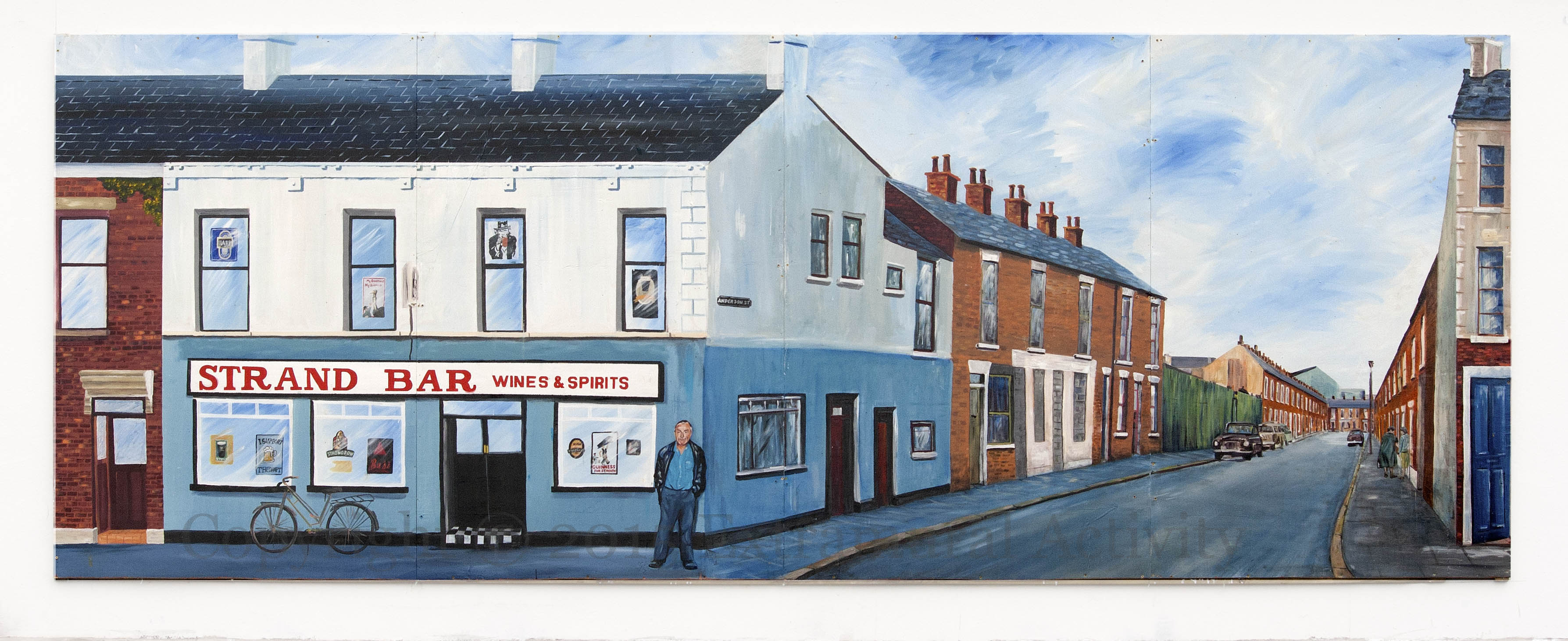
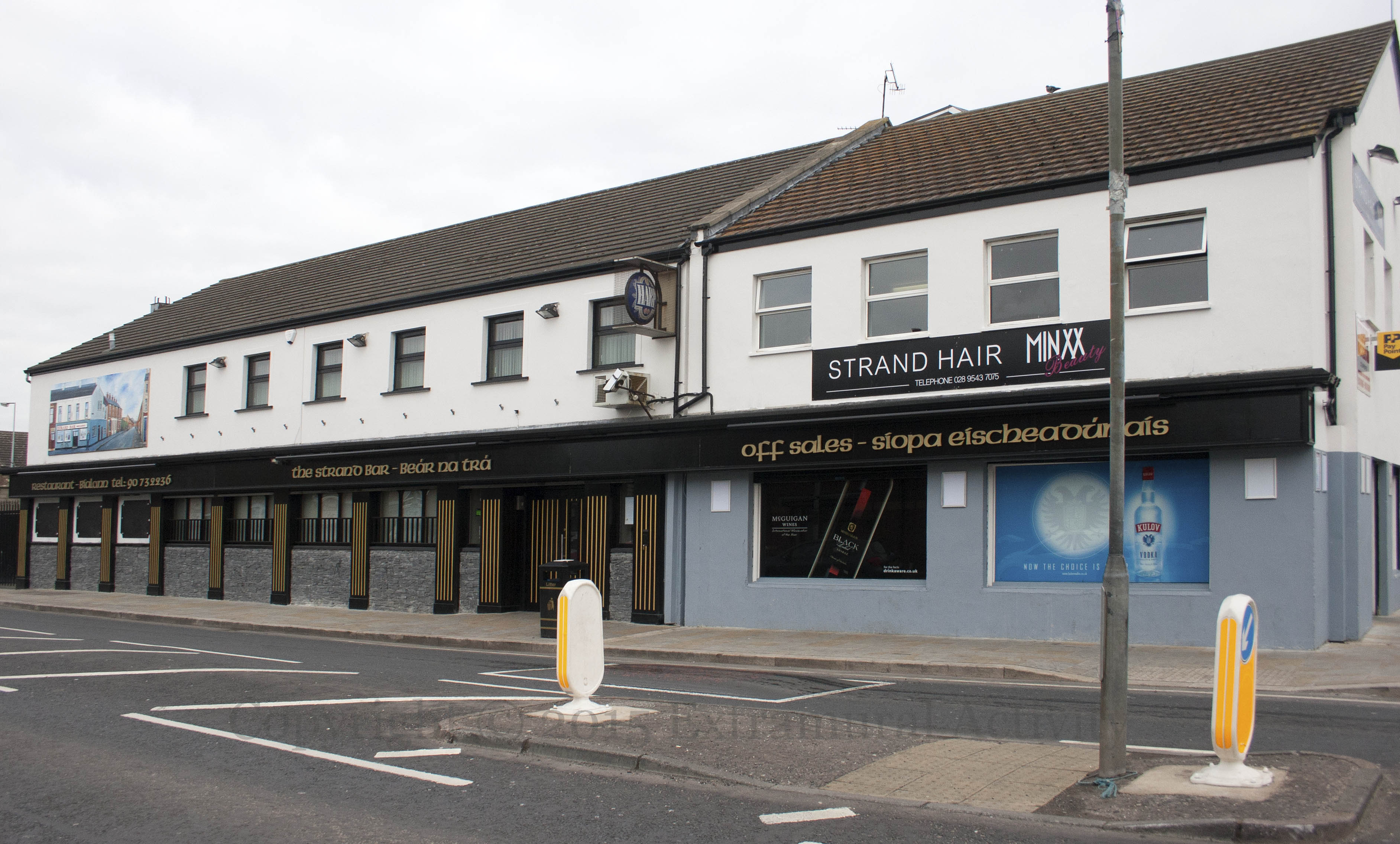
After adding windows to the downstairs, The Strand Bar has reinstated the mural previously at the front in the form of a painted board (above) showing the original bar in Anderson Street (the current Arran Street), which was attacked by the UVF in 1975 with the loss of six lives. The relative size can be gauged from the wide shot, below. The previous mural can be seen in the bottom two images. For photographs of the original bar, see the BelfastForum.
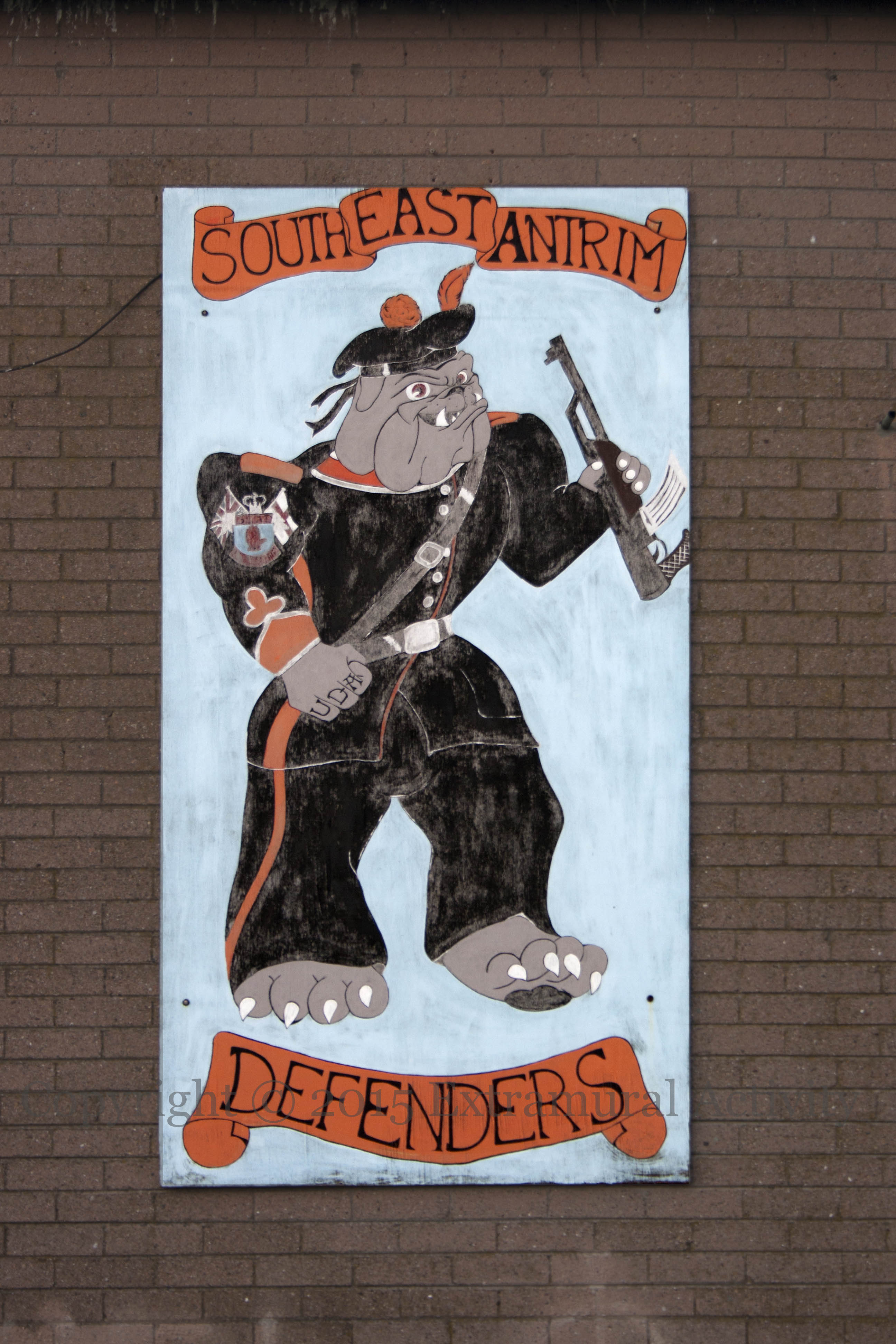
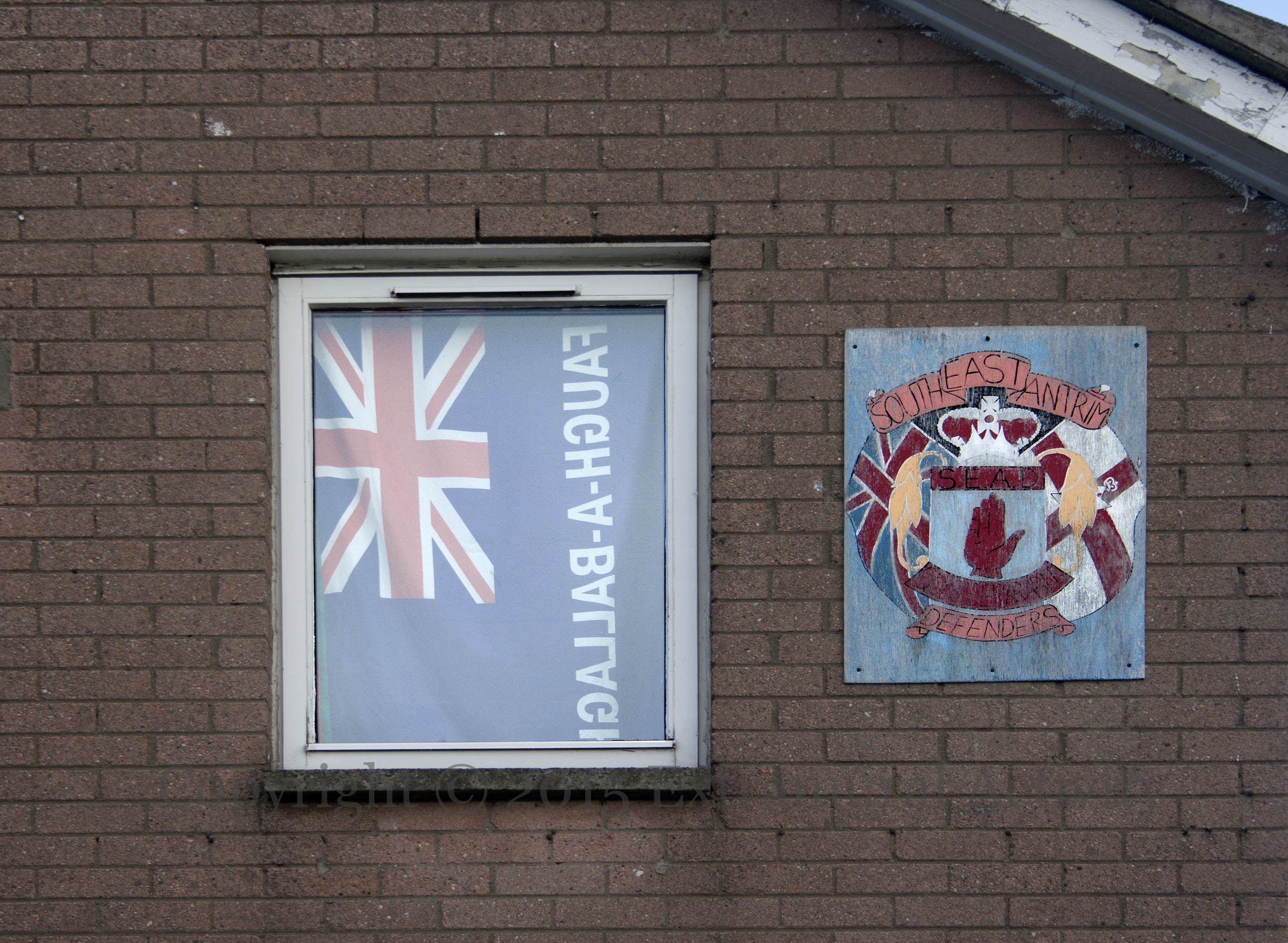
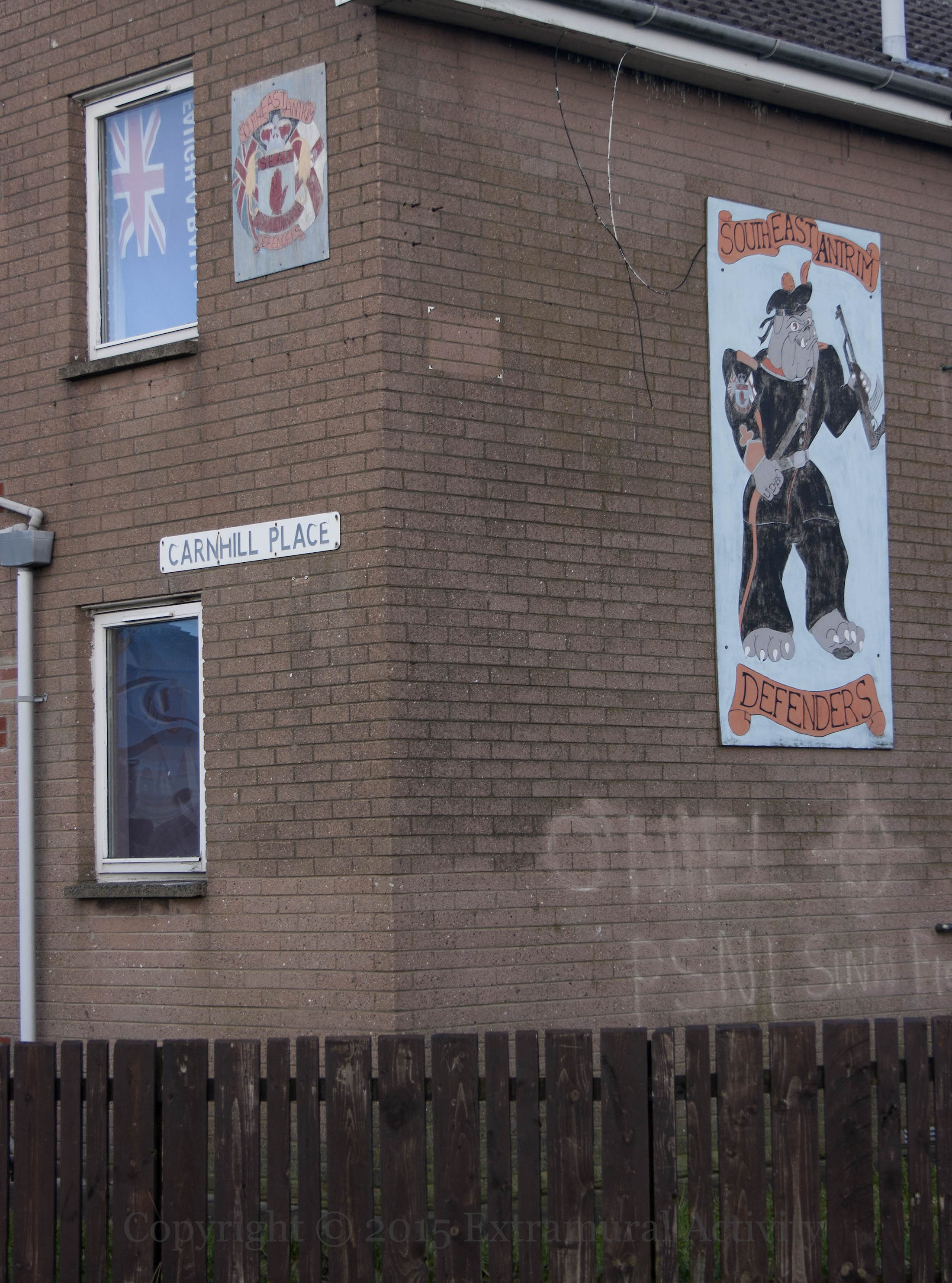
A “Faugh-a-ballagh” flag (the motto of the Royal Irish Regiment) and two South-East Antrim Defenders (a defunct flute band (Fb)) boards – the one above showing a bulldog marching with a rifle, with “UDA” across his knuckles and the UDA insignia on his lapel – adorn this house in the Castlemara estate in Carrickfergus.
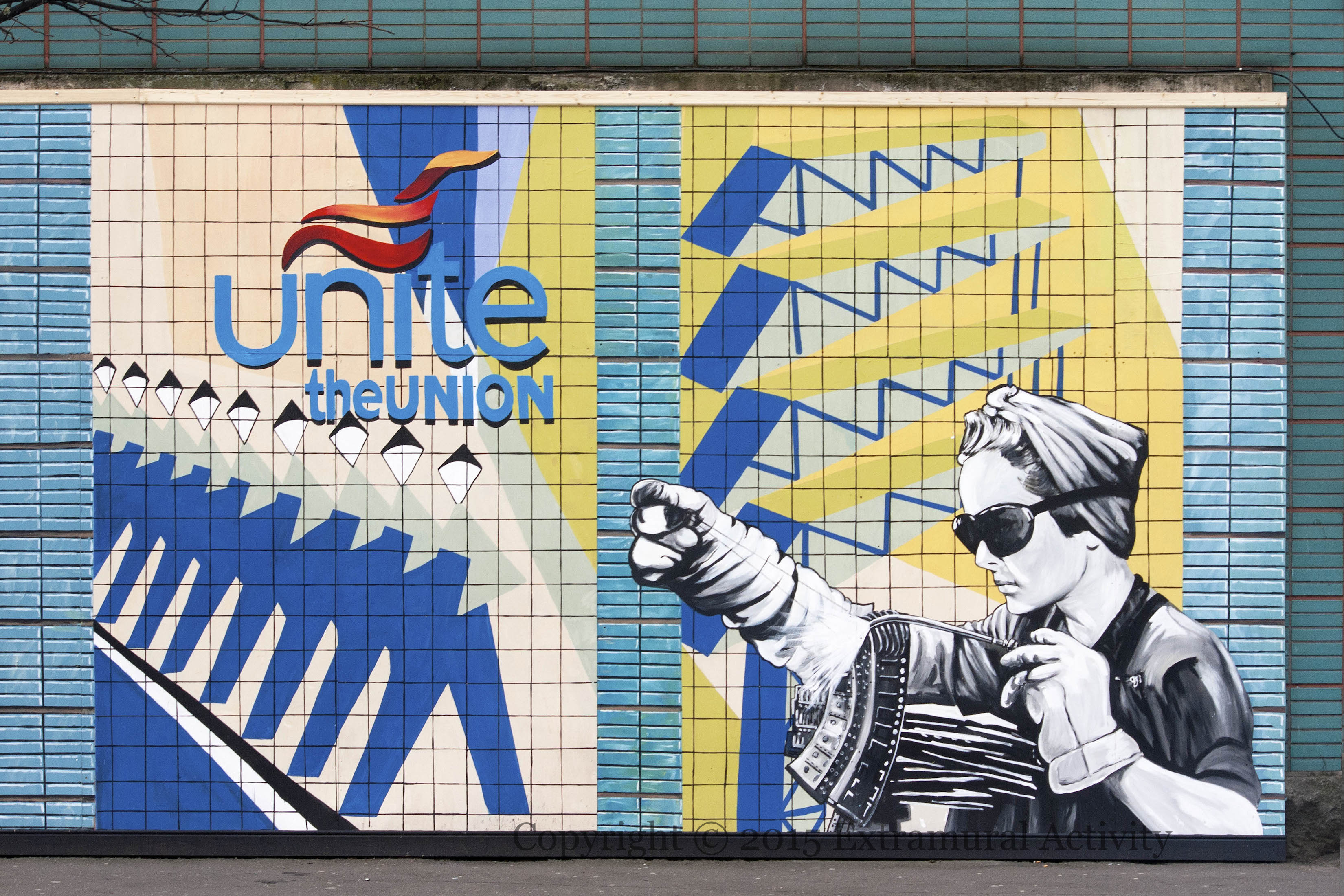
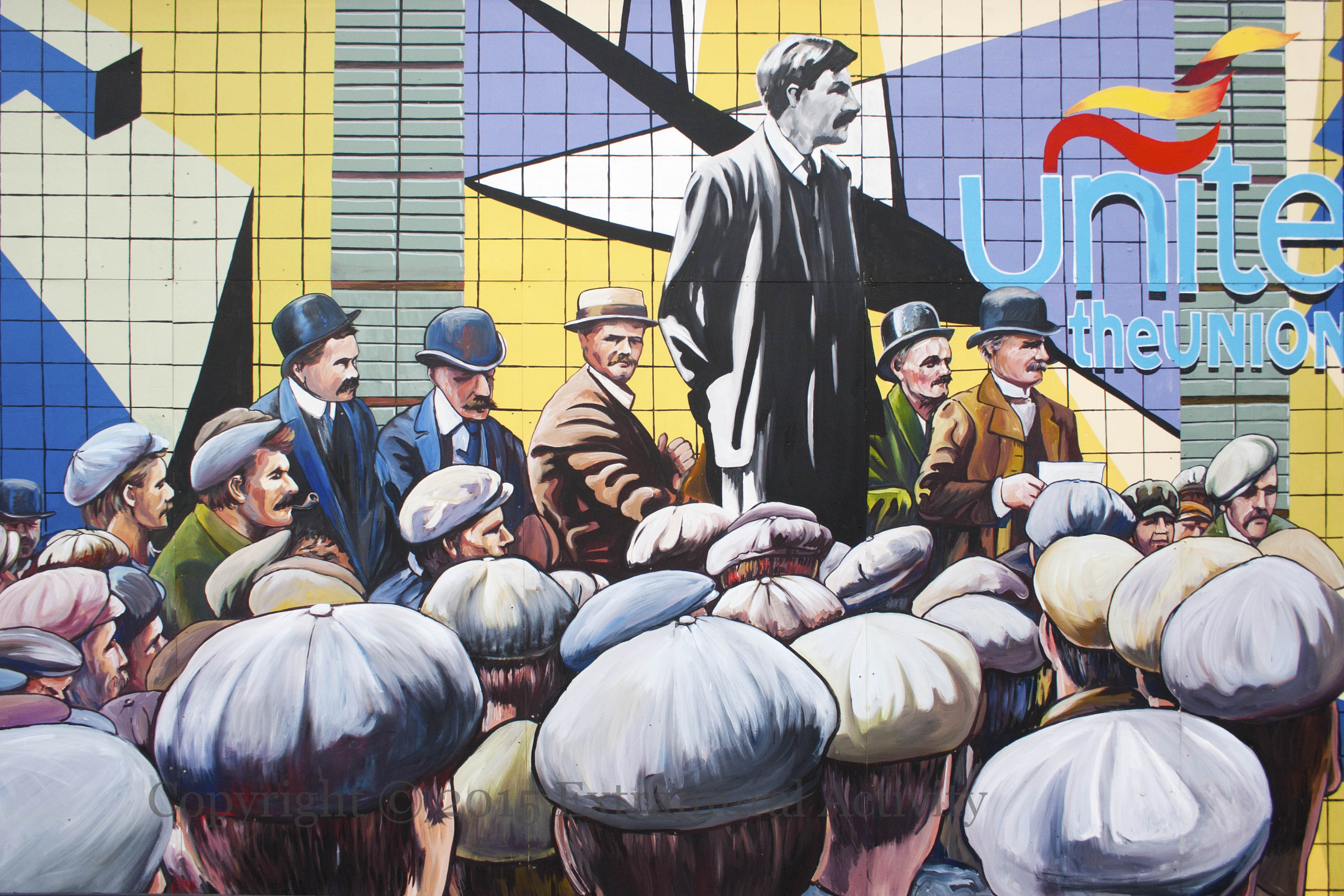
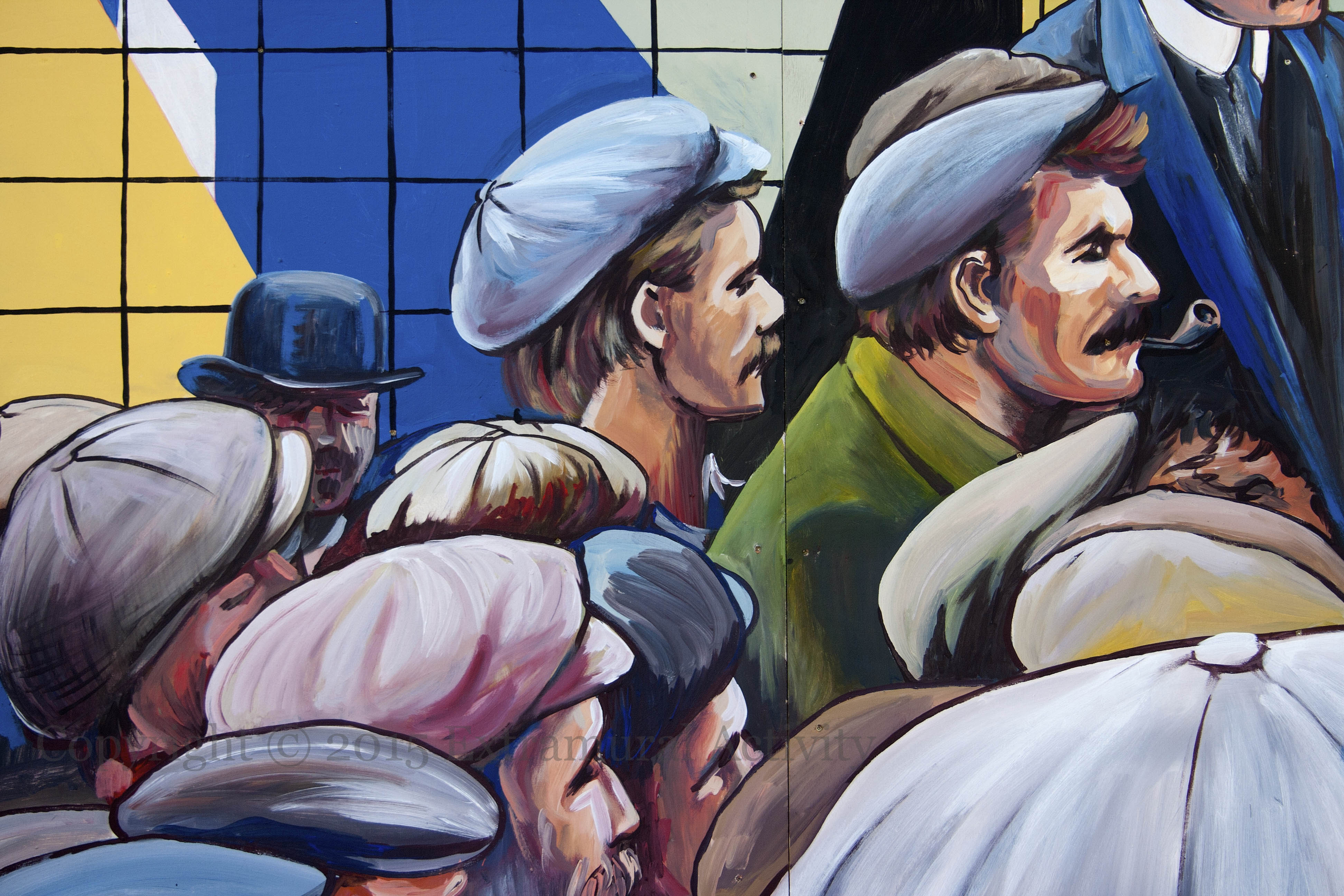
Here are more images from the new ‘Unite – the union’ mural at Transport House. Monday’s post featured Jim Larkin, who, after the Belfast lockout, founded the Irish Transport & General Workers Union in 1909. The separate (Amalgamated) Transport & General Workers Union (headquartered in London) was formed in 1922. (Larkin’s old union NUDL, renamed the National Union of Dock, Riverside and General Workers in Great Britain and Ireland, joined soon after in the same year.) In 2007, the T&G merged with Amicus to form the current Unite – The Union. The TGWU’s base in Belfast was Transport House, a 1959 building by architect J.J. Brennan in the International style (C20) and a B1 listed building (wikimedia). As can be seen from the image of a female welder above, the new mural features the green tile squares of the building itself, as well as the string of workers in the large mosaic on the front.
Big Jim Larkin spoke from the steps of the Custom House – a stone’s throw away from this new mural at Transport House in the city centre – in the early months of 1907, speaking on behalf of the dockers and other unskilled labourers, recruiting them to the National Union of Dock Workers, and ultimately organizing various strikes as part of what is now known as the ‘Belfast Lockout’, which stretched from April 26th to August 28th. Larkin was expelled from the NUDL and went on to form the Irish Transport & General Workers Union in 1909 and organize the Dublin Lockout in 1913. The rest of his history is equally dramatic, including arrest and imprisonment for ‘criminal anarchism’ in the US in 1919. (WP)
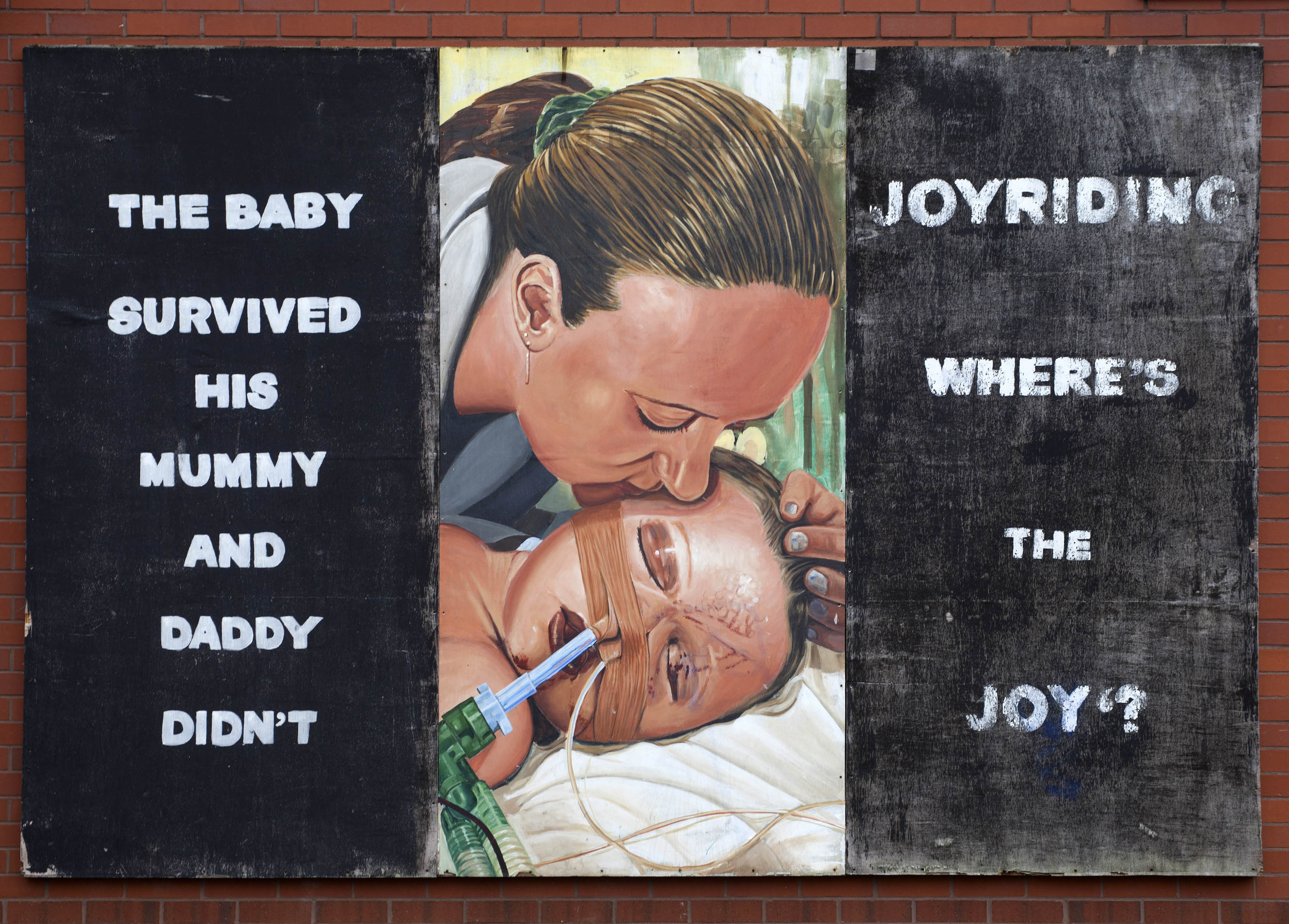
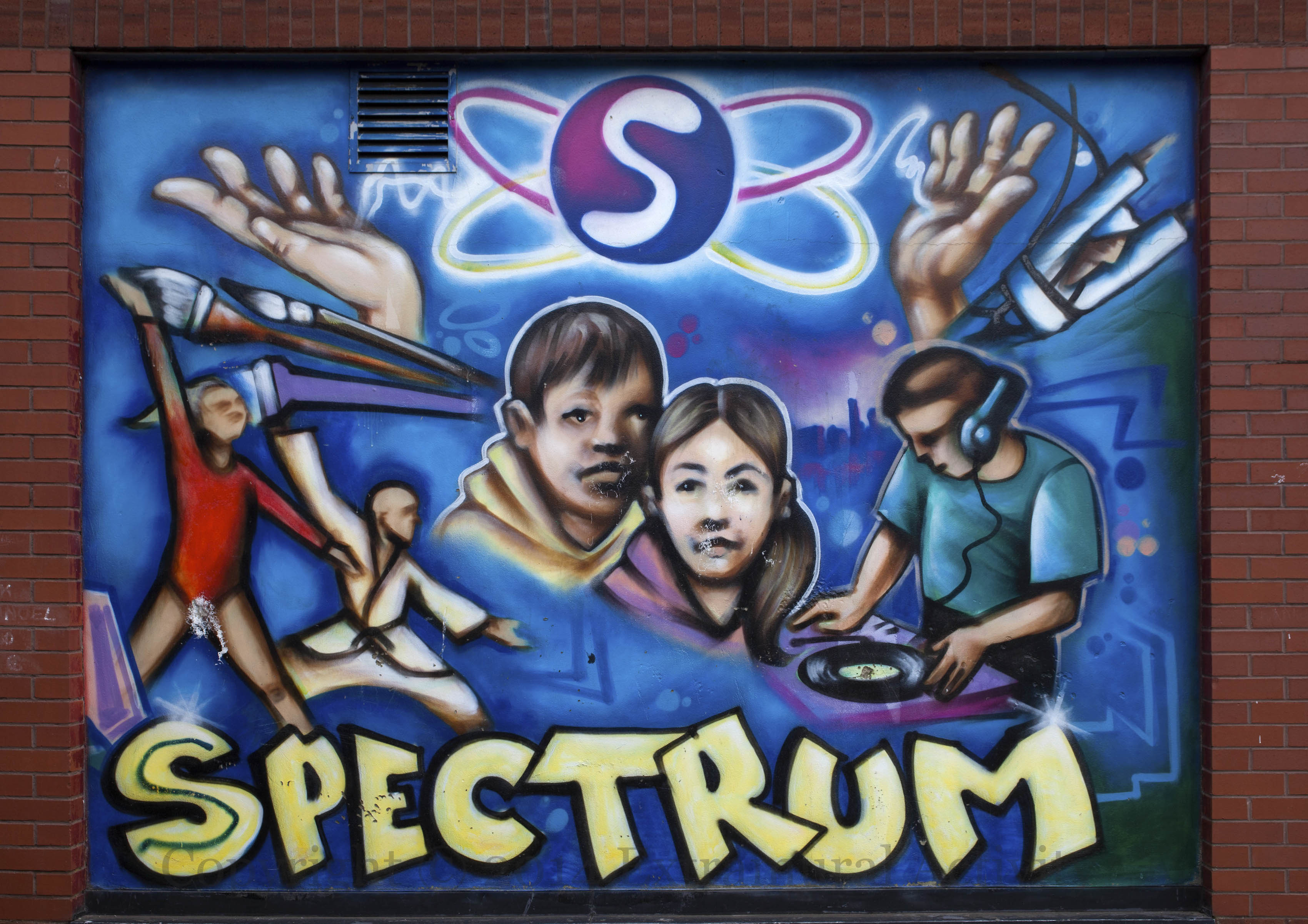
Here are two boards from outside the Spectrum Centre on the Shankill Road. “The baby survived, his mummy and daddy didn’t. Joyriding: Where’s the joy?”. (A similar board is at the junction of Whiterock and Springfield Roads and another in Duncairn Avenue). The board below features youth activities such as painting, martial arts, and DJing.
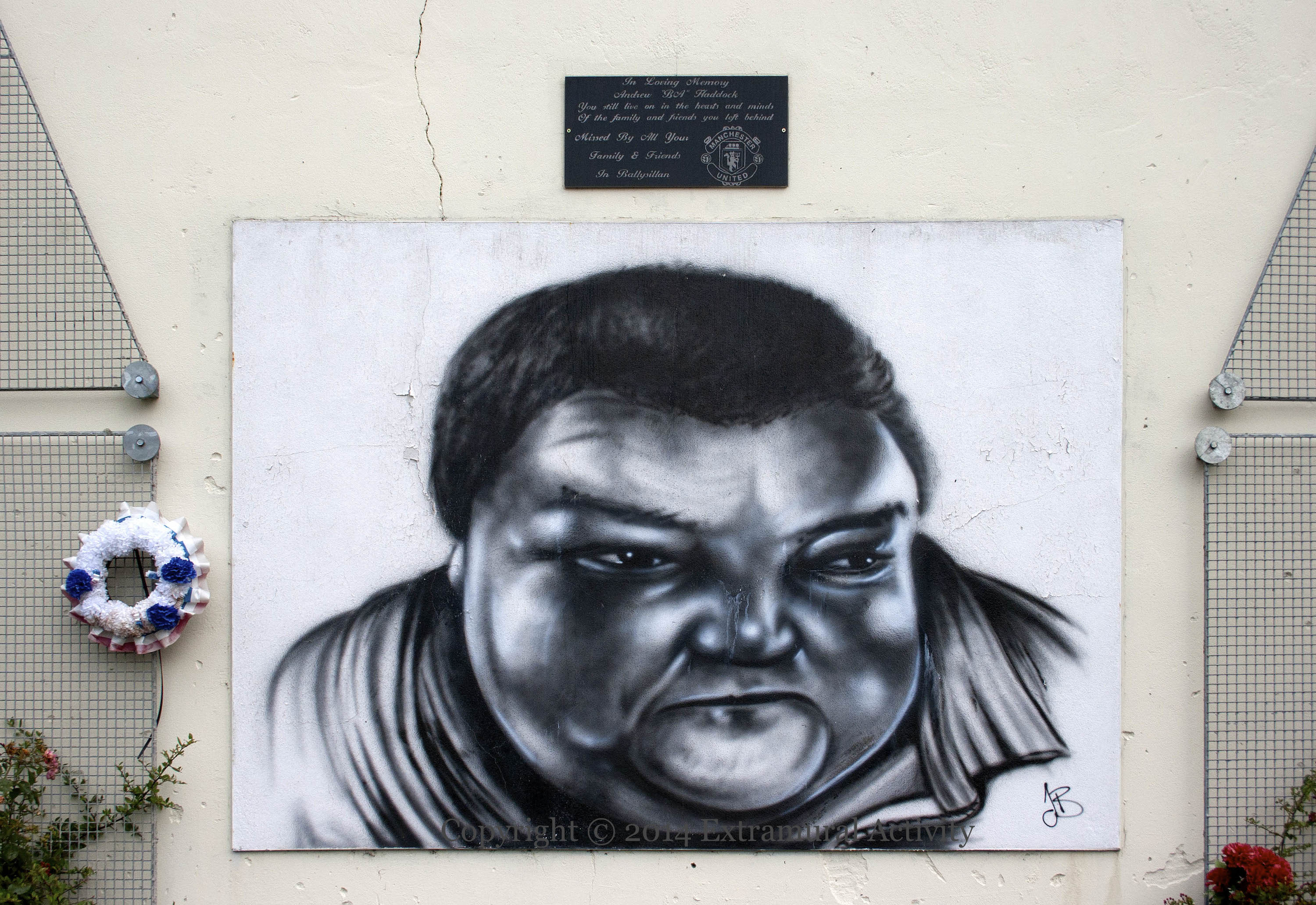
“In loving memory: Andrew “BA” Haddock. You still live on in the hearts and minds of the family and friends you left behind. Missed by all your family and friends in Ballysillan.” The board above to a local lad who died young sits next to rock-wall seating and a sculpture on Tyndale Drive in Ballysillan.
Here is the full width of the “upstairs” of Ciaran Gallgher’s Belfast Exposed, and with it the full expanse of the Klondyke Bar mural above it (featured previously in Nixon Resigns, Best Quits). For close shots of the ‘upstairs’, see Fifty Shades Of Belfast | Teenage Dreams.
To get some sense of the scale of these works, you should (get yourself a large monitor and) …
The three-storey mural above is in Ballysillan and replaced a UVF mural when it was added in 2011. The mural is the work of Jim Russell, shown below at Arts For All where he is artist-in-residence. The information below was provided by Arts For All.
The Great War: The first panel commemorates the Great War that ravaged Europe from 1914 to 1918 and shows troops advancing into battle, the Ulster Tower at Thiepval commemorating the sacrifice at the Somme and an image showing one of the war cemeteries and highlighting the true cost of war.
Second World War: The second panel features some of the devastation visited upon Belfast during a series of Luftwaffe raids during the early years of the Second World War. Belfast suffered greatly with over 1,000 people dying in four nights of bombing in April and May of 1941.
The Troubles: In the third panel highlight the dark history known as the Troubles. It features two events from the years of that time – the murder of the three young off-duty Scottish soldiers in 1971 [the monument depicted was featured in The Highland] and the Bloody Friday bombings of July 1972. In the midst of the horror that accompanied the early years of the Troubles these events still caused many to struggle to understand how people could carry out such atrocities.
Present Day Conflict: Panel four brings us up to the present day. Military service is a tradition for many in Northern Ireland and for many their first overseas trip came on the back of an overseas posting whilst serving in one of the Armed Forces. From times past, through the World Wars, the Korean War, to more recent conflicts in Iraq and Afghanistan soldiers and regiments drawn from Norther Ireland continue to play a role.









 Extramural Activity