“1891-1949” are the dates of the operation of Belfast Celtic, not the dates of forward Jimmy Ferris, who lived from 1894 to 1932. Ferris played for the club for nine years, and for various British clubs during the pogroms. He quit playing in 1930 because of a heart condition and died two years later, at the age of 37. The Ferris family grave, shown in today’s images, is in Milltown Cemetery. (Belfast Celtic | WP)
“Jimmy Ferris, known as Belfast Celtic’s ‘brilliant schemer’, he was on the team, which won four Irish League titles in the 1920s, for the loss of only one match. Also played for Chelsea and Preston North End.” With funding from the “European Regional Development Fund”.
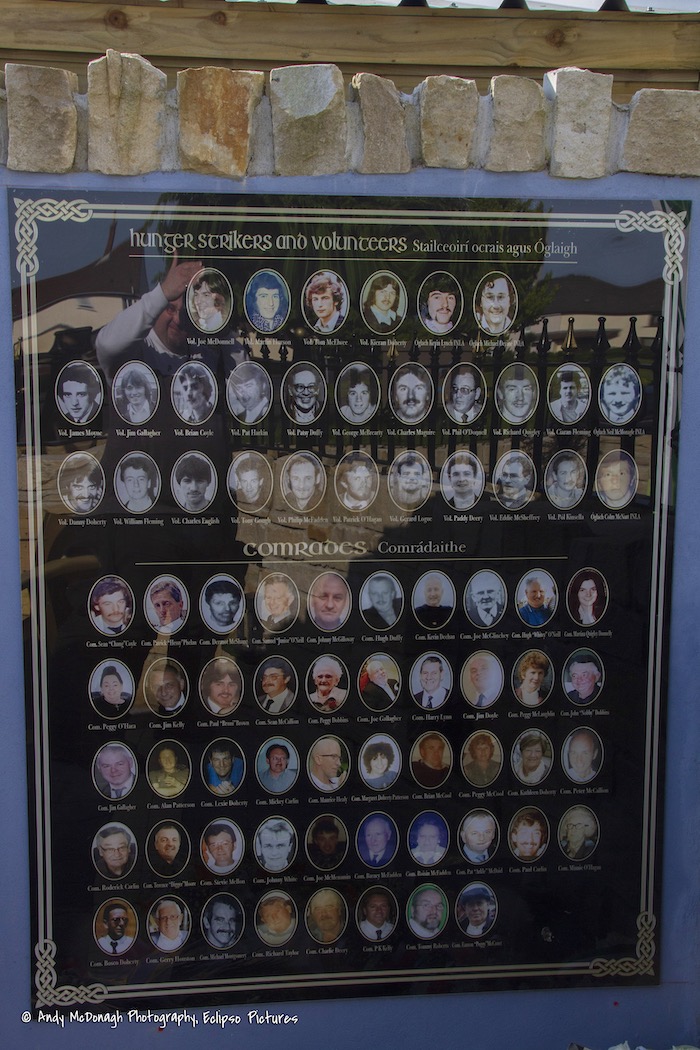
“At this place of reflection, we proudly honour our heroic volunteers, who made the ultimate sacrifice for the freedom & sovereignty of Ireland and the Irish people. We salute our many comrades, who spent numerous years in captivity, and who’s [sic] lives were often blighted by the experience. Never forgetting the WOMEN & MEN of Creggan and the Derry district, who stood steadfastly with the volunteers. BEIR BUA.” The 12 Troubles-era hunger strikers and 43 Derry brigade members are at the top of each panel with 115 named comrades/comrádaithe (and three unnamed) below (and on the side wall – first image below), with each name preceded by “Com.” as though establishing a new category of activist.
“This memorial was unveiled by The Worshipful The Mayor, Councillor Jim Montgomery [tw], in memory of those from Antrim and Newtownabbey who list their lives during the COVID-19 pandemic. May 2021. Always remembered.” According to the COVID dashboard for NI (NISRA), deaths did plateau in the spring and summer of 2021 – perhaps explaining the timing of the plaque above – before increasing again in the autumn. As of May 5th, 2023, 5,283 deaths in NI were attributable to COVID-19, including 463 in the Antrim & Newtownabbey borough area.
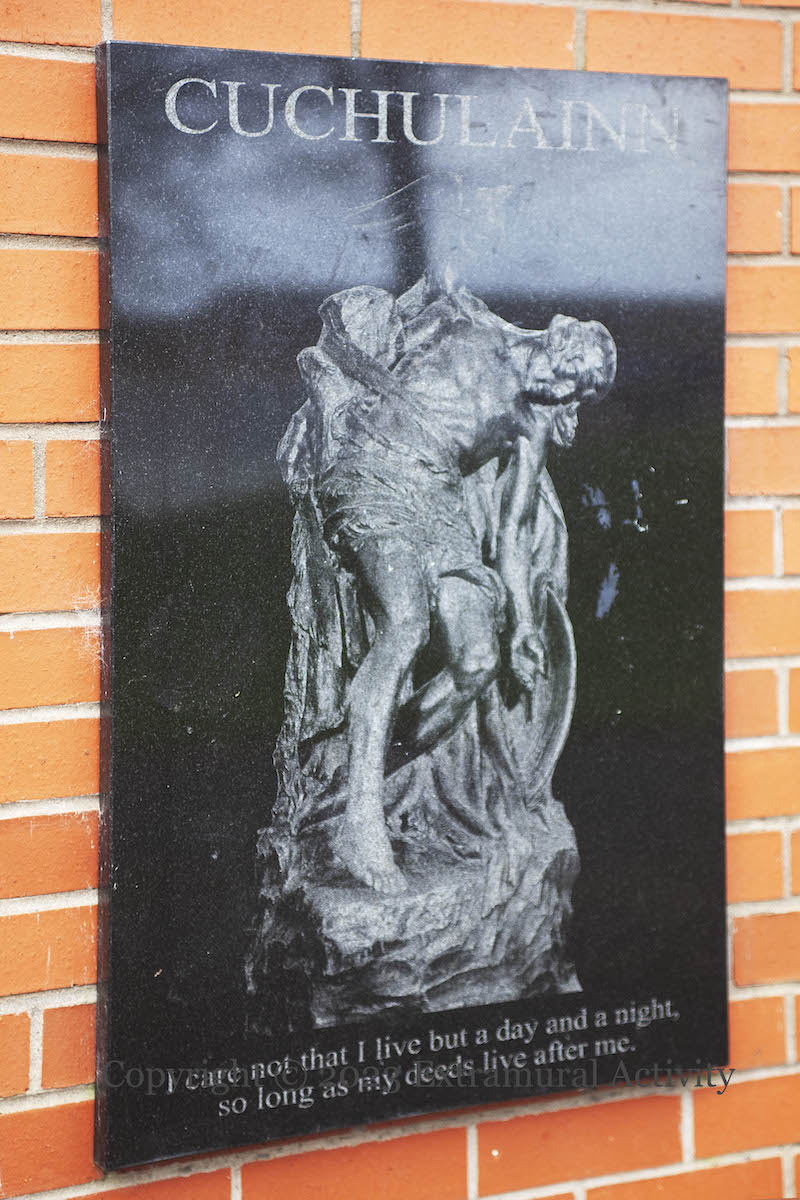
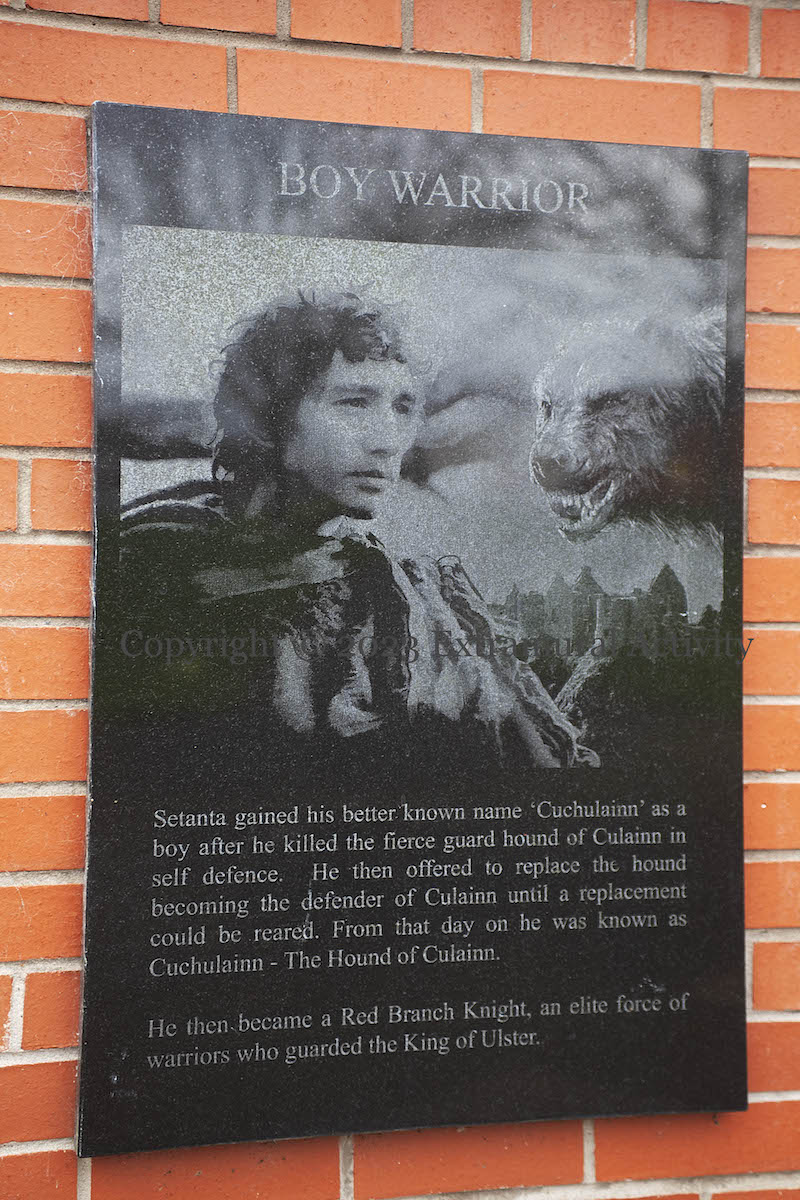
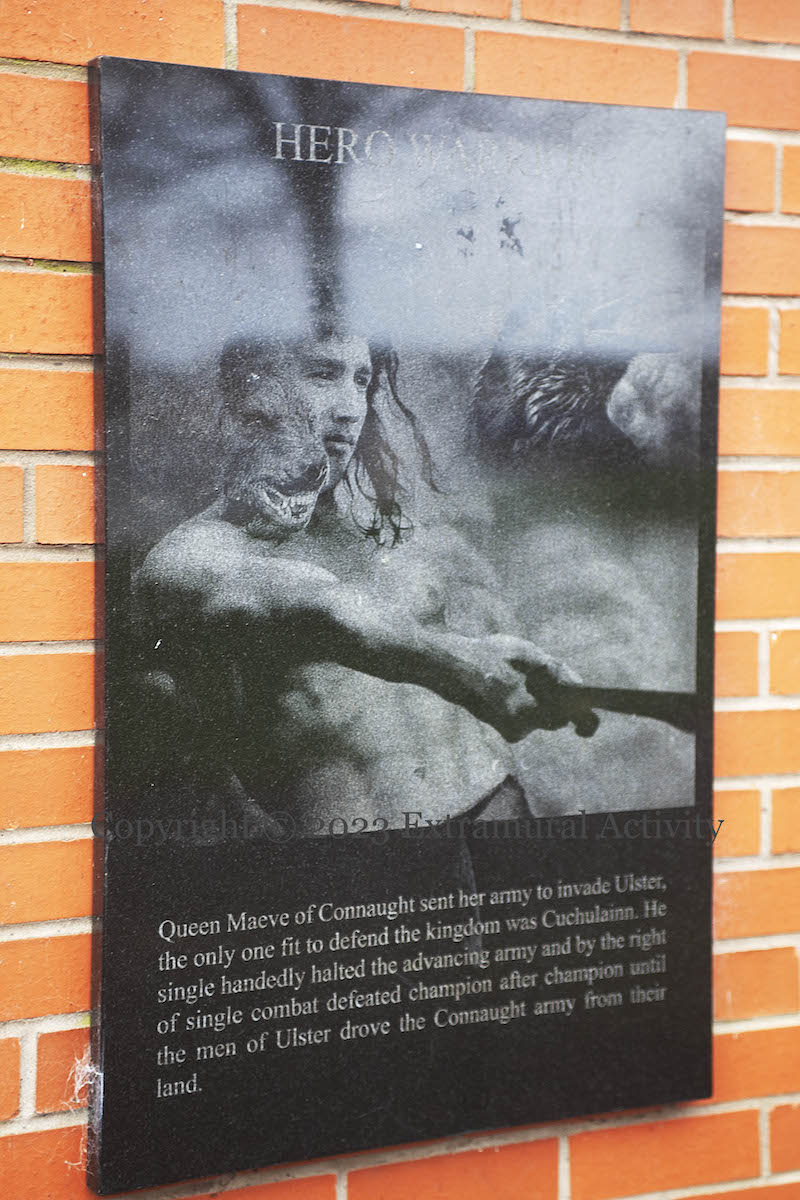
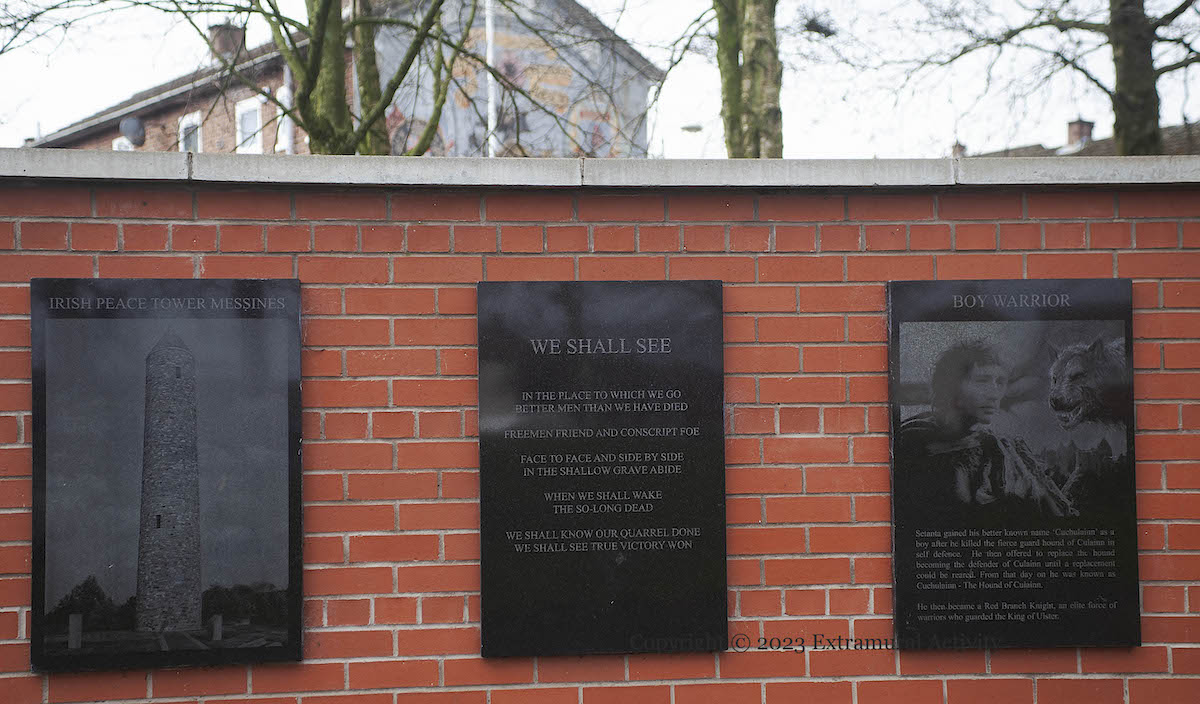
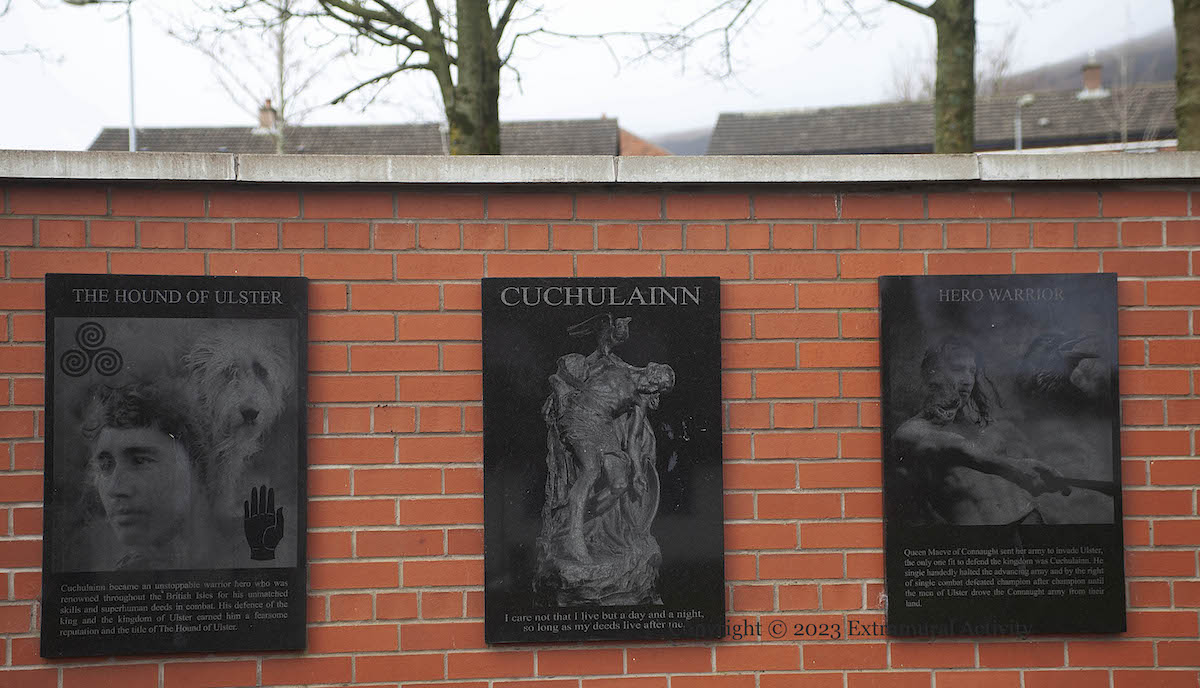
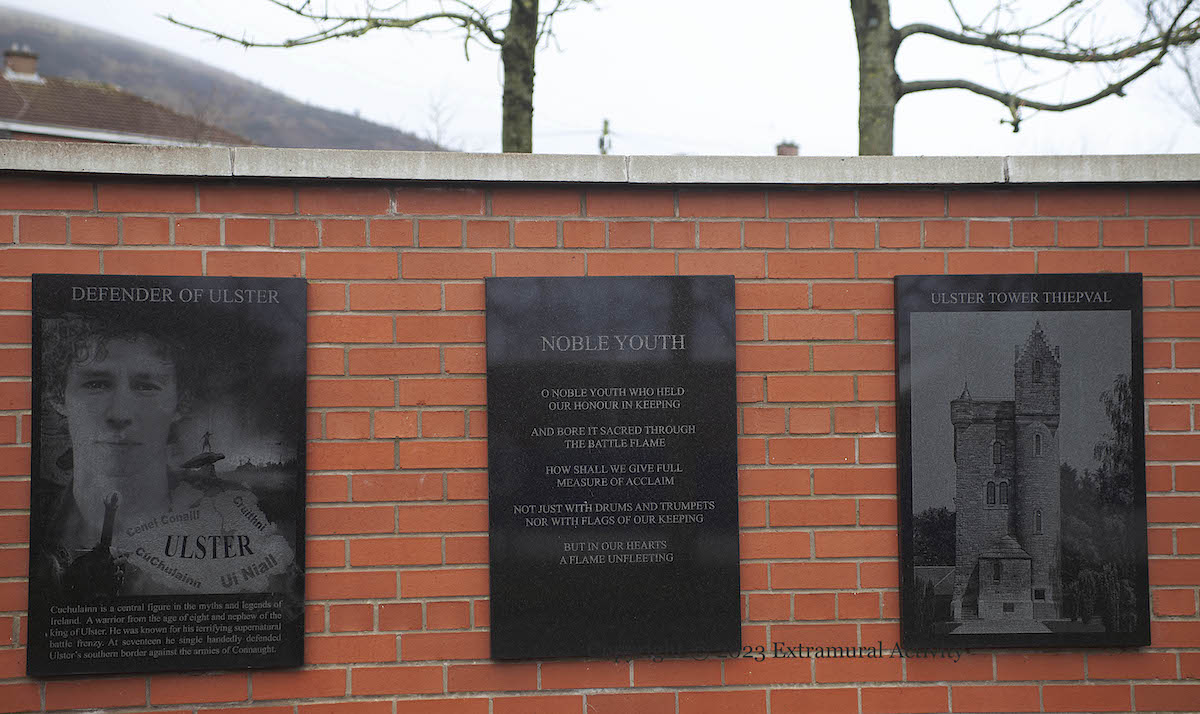
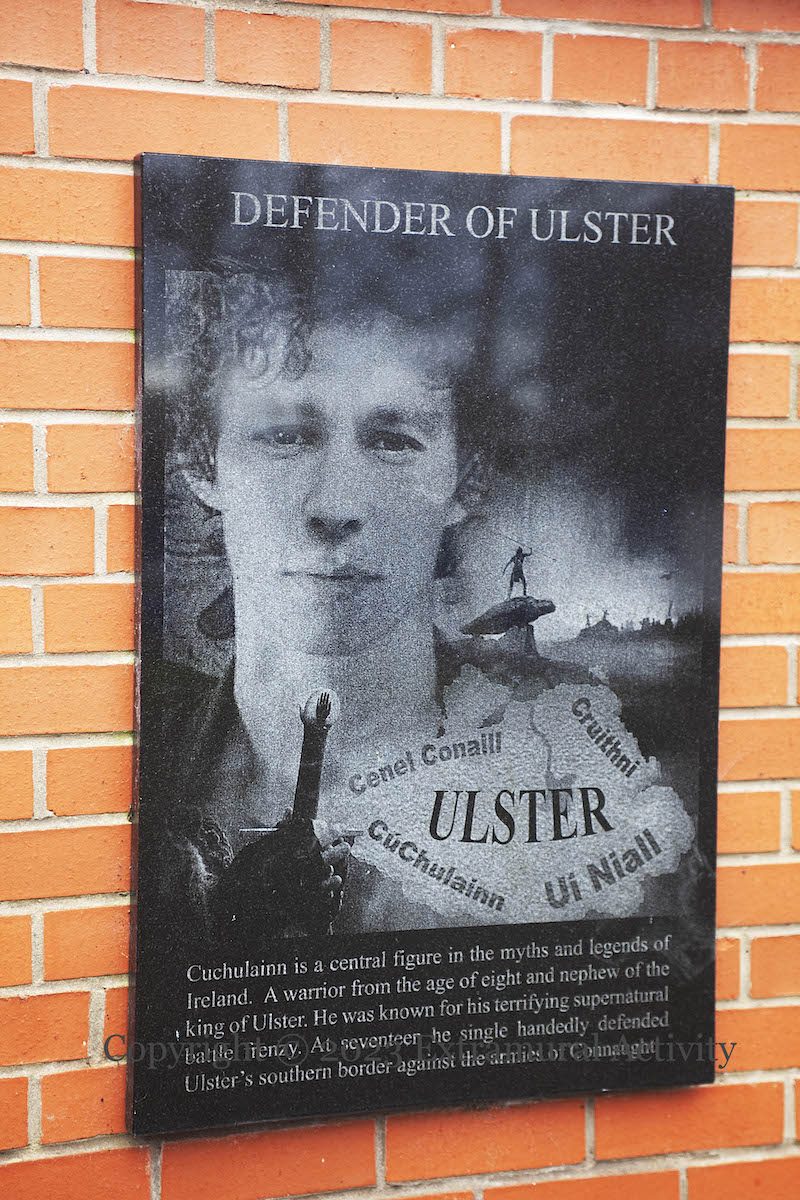
As the Visual History page on the role of Cú Chulaınn makes clear, in PUL muraling and iconography, Cú Chulainn serves as the “ancient defender of Ulster”, and the B Specials, UDR, and loyalist paramilitaries – primarily the UDA but also the UVF – then fit into that tradition. Using Cú Chulaınn as a precursor for service in the Ulster Division of WWI is unique to the panels on Highfield green, five of which are devoted to the hero Cú Chulaınn and four – two on each end – refer to the Great War.
The five Cú Chulaınn panels are (from left to right) Boy Warrior, Hound Of Ulster, Sheppard’s statue, Hero Warrior, and Defender Of Ulster – all shown individually in this post.
On the far left, there are two panels showing Messines tower and a few lines from a Ronald Lewis Carton poem Réveillé (though given a more ‘victorious’ ending) and on the far right, a few lines from Duncan Campbell Scott’s To A Canadian Lad Killed In The War and Thiepval tower. The words to I Vow To Thee My Country (lyrics) are along the bottom (see the wide shot, final image below).
The biographical panels focus on Cú Chulaınn’s age – the sixth panel emphasises that Cú Chulaınn was only 17 when he held off Maeve’s forces – which is perhaps a similarity with those who joined the 36th Division, but how the “defender of Ulster” is connected to the defense of Europe is obscure.
A candle-lit vigil (youtube | iTV) took place last Friday (February 3rd) to commemorate the 50th anniversary of the “New Lodge Six Massacre”. Shortly before midnight on the night of February 3rd-4th, 1973, Jim Sloan and James McCann were killed by the UDA outside a bar – or so the authorities alleged; the plaque shown below near the spot where they were shot reads “killed by British Forces”; full details of what is currently known about the killings can be found at Paper Trail.
Four more – Tony ‘TC’ Campbell, Ambrose Hardy, Brendan Maguire, John Loughran – were among those who came to the area of the initial shootings and were killed by British Army snipers from their positions on top of the flats, using night-vision sights.
The memorial mural in Donore Court was repainted for the event. From left to right, it shows Hardy, Maguire, Campbell, Loughran, Sloan, and McCann walking down New Lodge Road with (what was) Duncairn Presbyterian and (what was) the RUC station on the Antrim Road behind them. The previous (2011) version of the mural showed a body being carried whereas this new one shows them smiling as they walk, though still in the sights of a sniper’s rifle. Other changes were made: the six portraits in the medallions are now photographs rather than paintings; the background is green rather than pink.
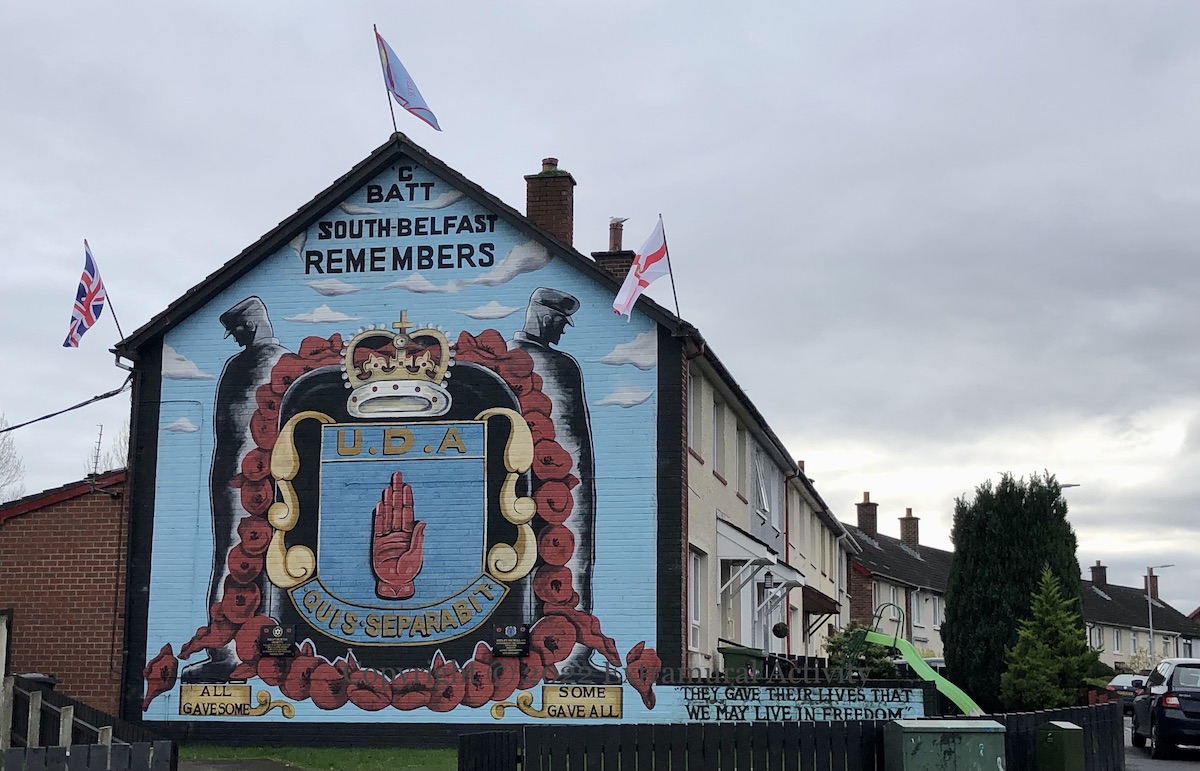
The old C Batt mural further up Hornbeam Road has long been painted over. It used the same line – “They gave their lives that we may live in freedom” – to remember Wesley Nicholl and Brian Morton. A plaque to Morton is now included on top of the new mural. “Brian Morton (Morty) killed in action 07/07/1997, a true Ulster patriot who gave his life in defence of his country. Feriens tego.” As with republican memorials, “active service” means that Morton was killed by a premature bomb exploding.
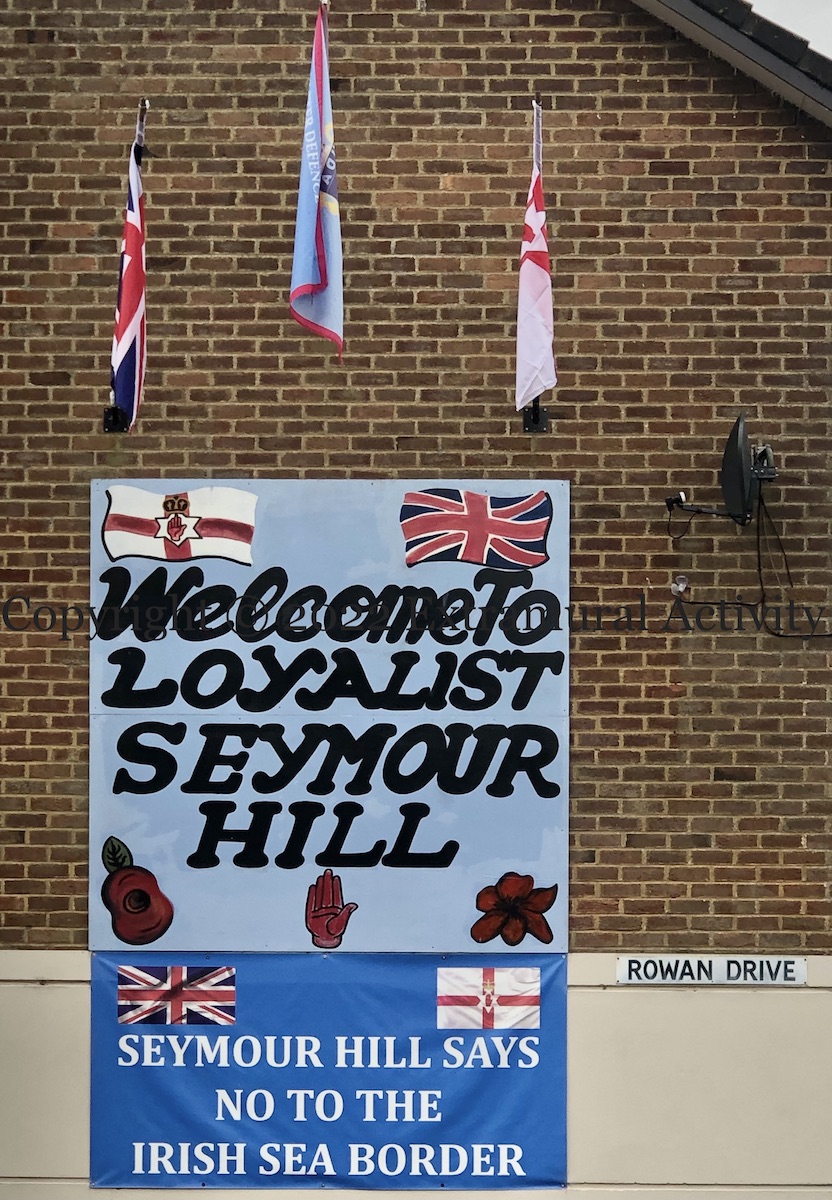
“In remembrance of all those Ulster men and women from the greater Dunmurry area who died during the Great Wars 1914-18 and 1939-45. Also those men and women who died during the recent conflict. Lest we forget.” These are the same words as appeared on a plaque on the previous memorial, which included the Special Constabulary. In the background is a “Welcome to loyalist Seymour Hill” board with flags and poppies, along with a 2021 tarp reading “Seymour Hill says no to the Irish Sea border”.
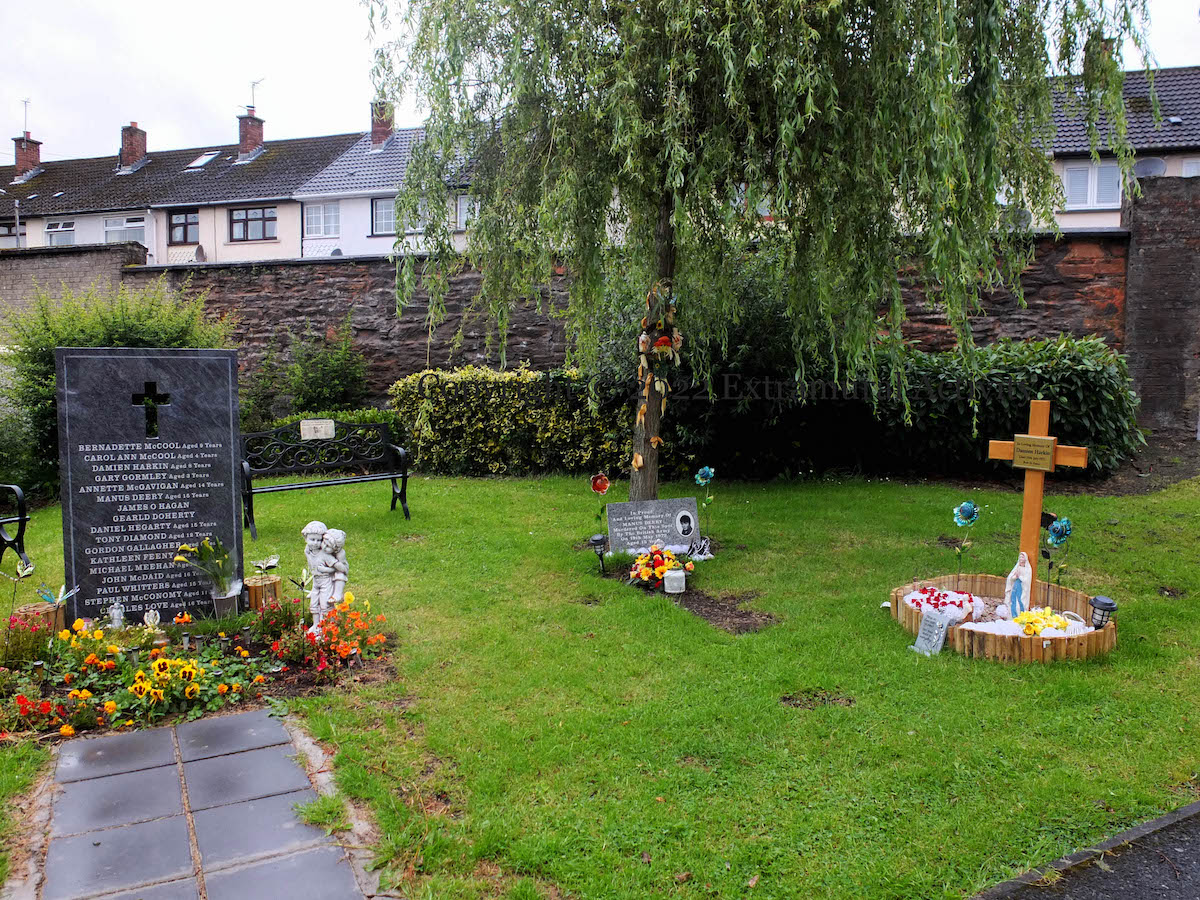
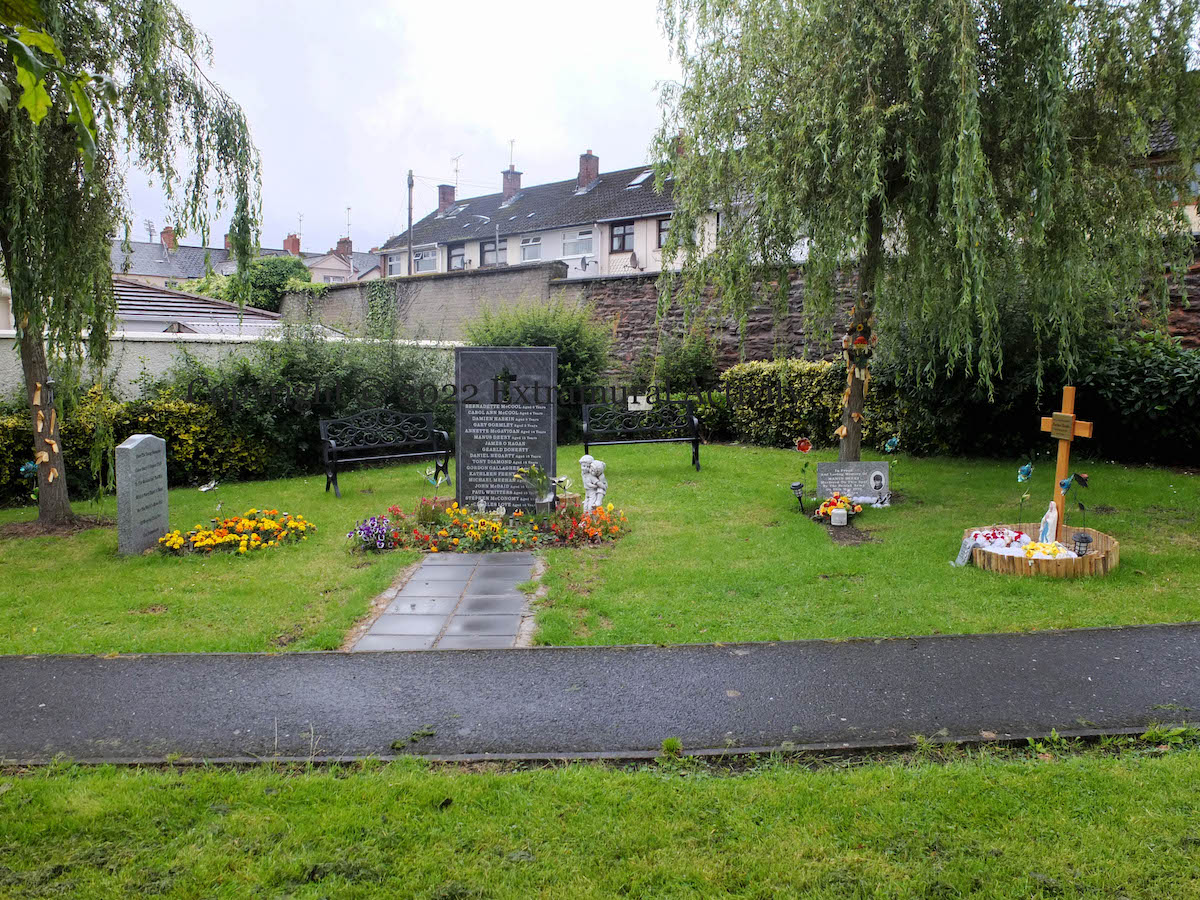
This is a memorial garden in Westland Street, Derry, in remembrance of children who have died during the Troubles.
They are listed in the following order on the main stone: Bernadette McCool, Carol Ann McCool, Damien Harkin, Gary Gormley, Annette McGavigan, Manus Deery, James O’Hagan, Gerald Doherty, Daniel Hegarty, Tony Diamond, Gordon Gallagher, Kathleen Feeny, Michael Meenan, John McDaid, Paul Whitters, Stephen McConomy, Charles Love.
McGavigan was the first to die at the hands of British forces, in September 1971, though the cross on the right is to nine-year-old Damien Harkin, who was crushed in July 1971 by a British Army lorry accident in the Bogside (MFD). Gary Gormley was also crushed by an armoured car (MFD). McGavigan is depicted in one of the murals in the ‘Bogside Gallery‘ series: The Death Of Innocence.
Other deaths were earlier but did not involve British forces: the McCool sisters died in a premature explosion in Creggan in 1970 and James (Jim) O’Hagan was killed in August 1971 by a fellow IRA member.
Gerry Doherty, Kathleen Feeney, Tony Diamond, Gordon Gallagher, Michael Meenan, John McDaid, and Charles Love also died accidentally by their own or IRA actions (MFD profiles, which lists 20 children, adding David Devine, Joseph Connolly, and Kathryn Eakin). Charles Love was killed by flying masonry from an IRA bomb; he is remembered by a plaque in Fahan Street. There is also a plaque to Stephen McConomy in Fahan Street and long ago he was depicted in a mural in Glenfada Park.
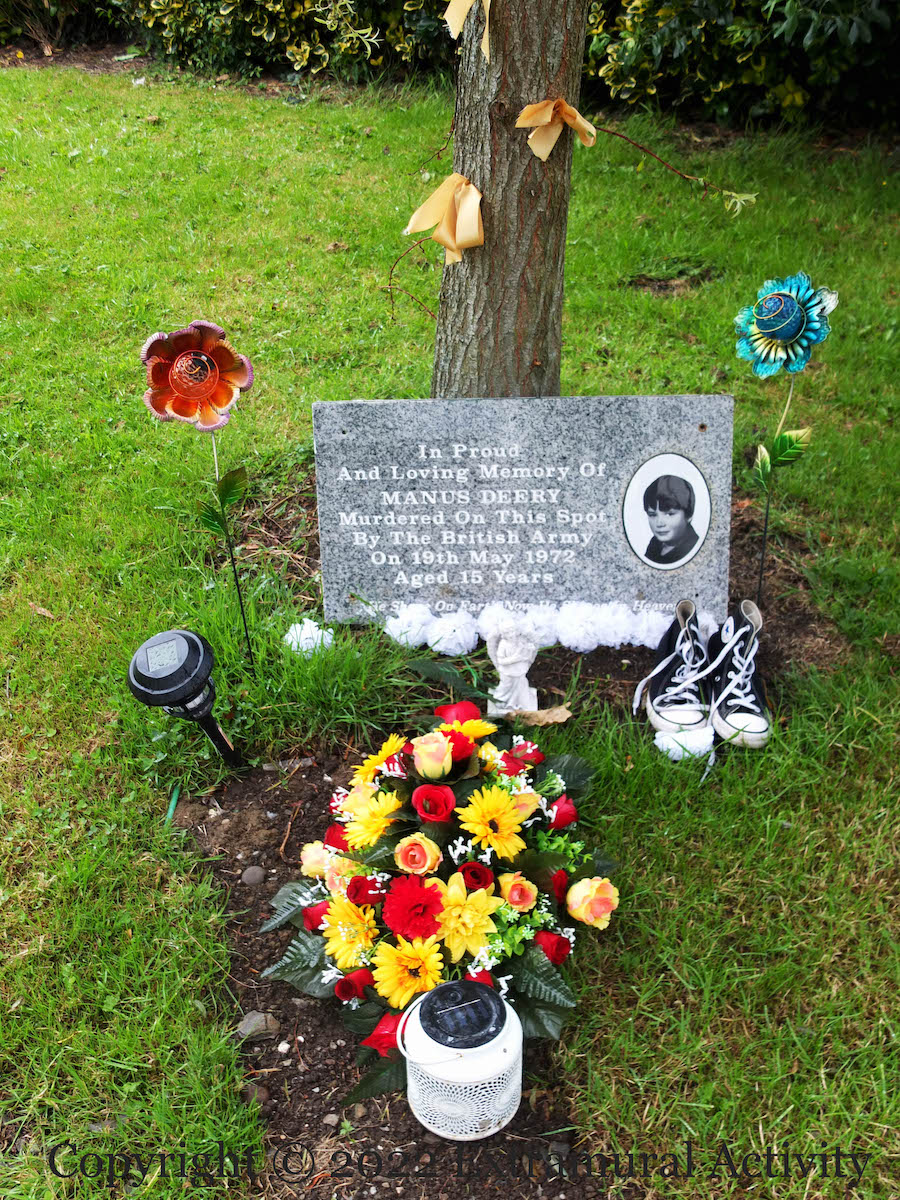
The Manus Deery plaque under the tree to the right was previously on a wall behind the Bogside Inn, before the pub was torn down – see M01919.
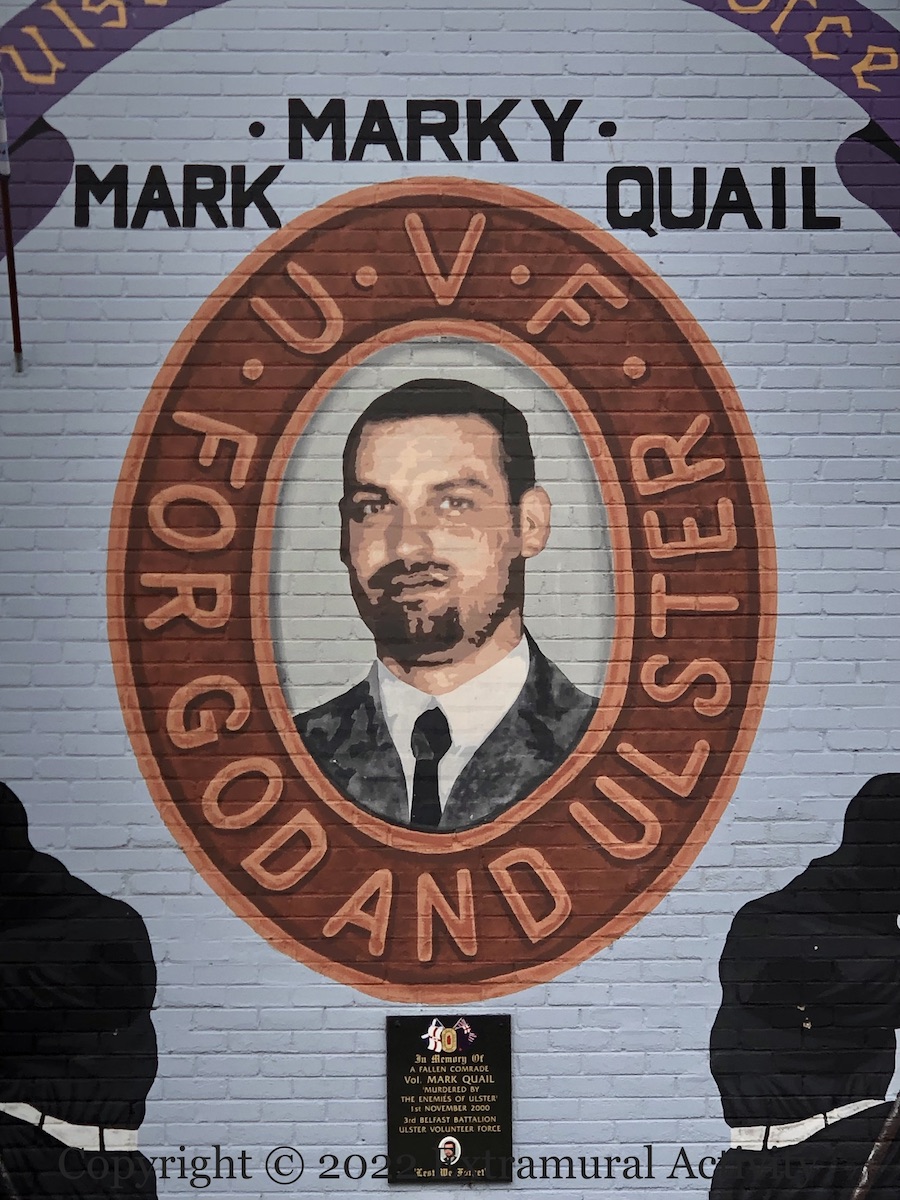
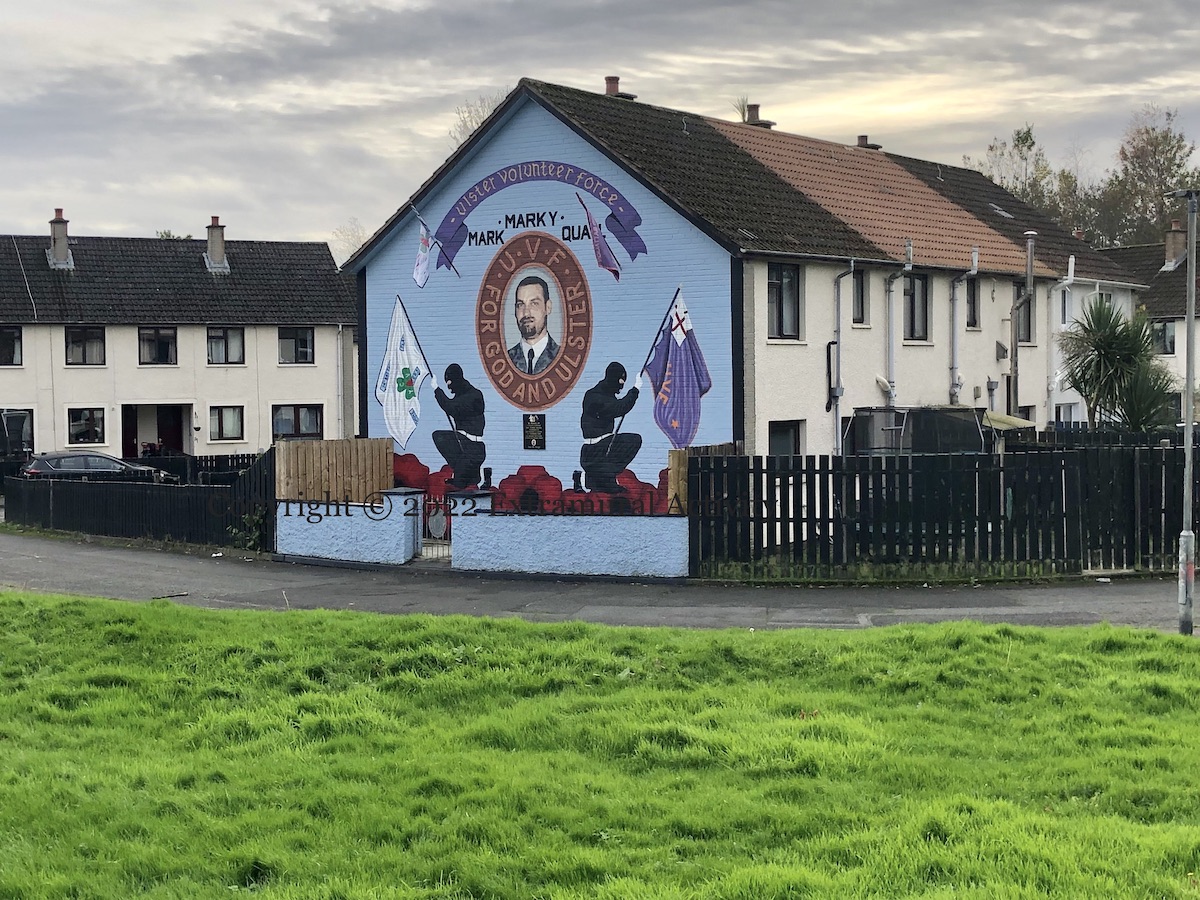
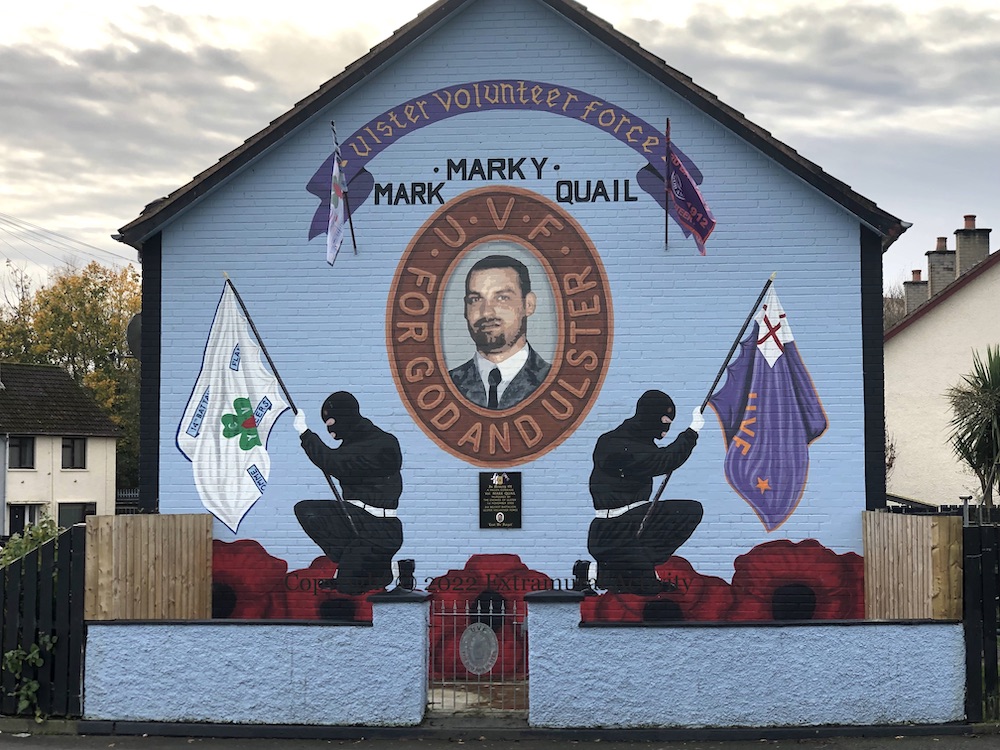
Mark Quail, of the UVF, was “murdered by the enemies of Ulster” – that is, shot by the UDA – at his Rathcoole home on November 1st, 2000. His was the fourth death in four days (after David Greer, Bertie Rice, Tommy English) (Irish Times) as the UVF-UDA feud that began in the Shankill with the infamous “loyalist day of culture” in August 2000 spread to north Belfast and Newtownabbey (though the BBC says they are unrelated). There were also attacks in east Belfast (BelTel) before the feud ended in mid-December (BBC | Guardian).
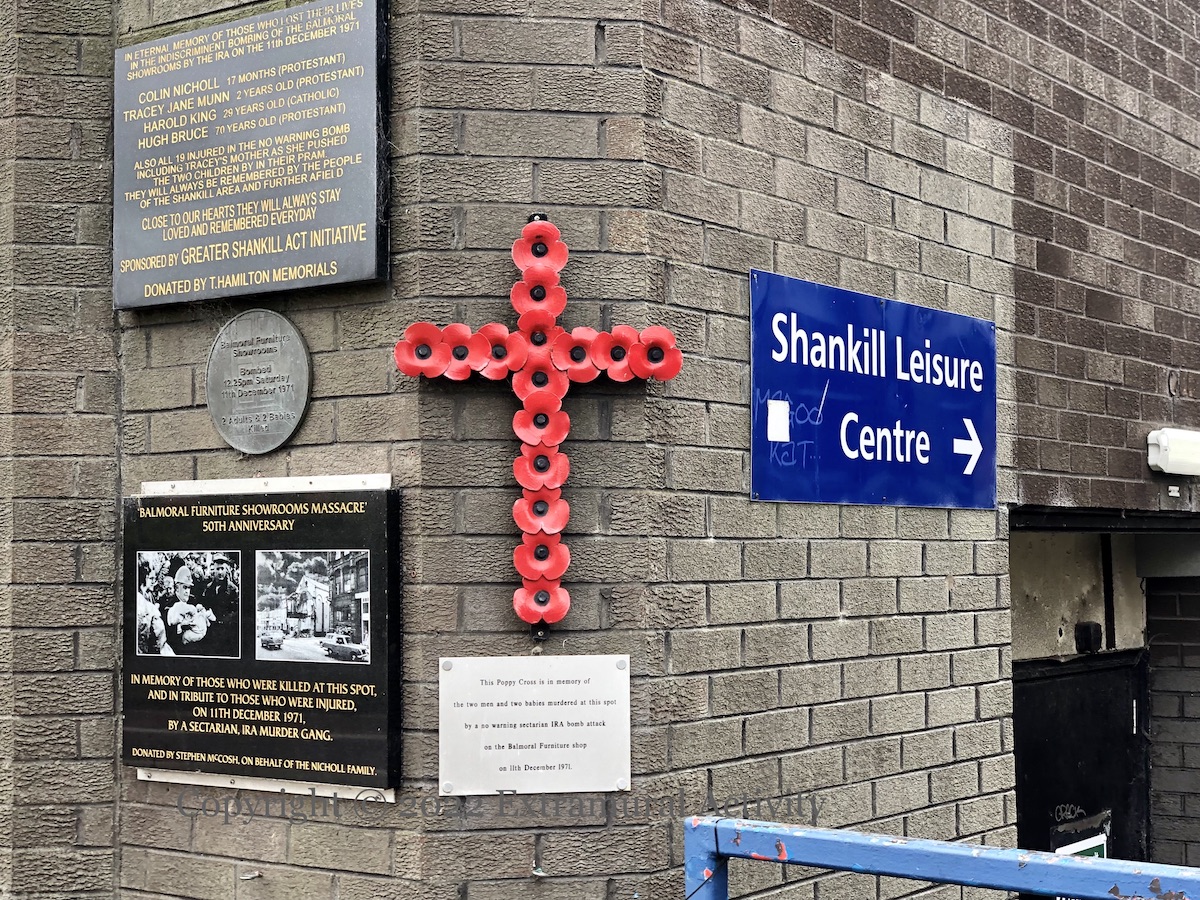
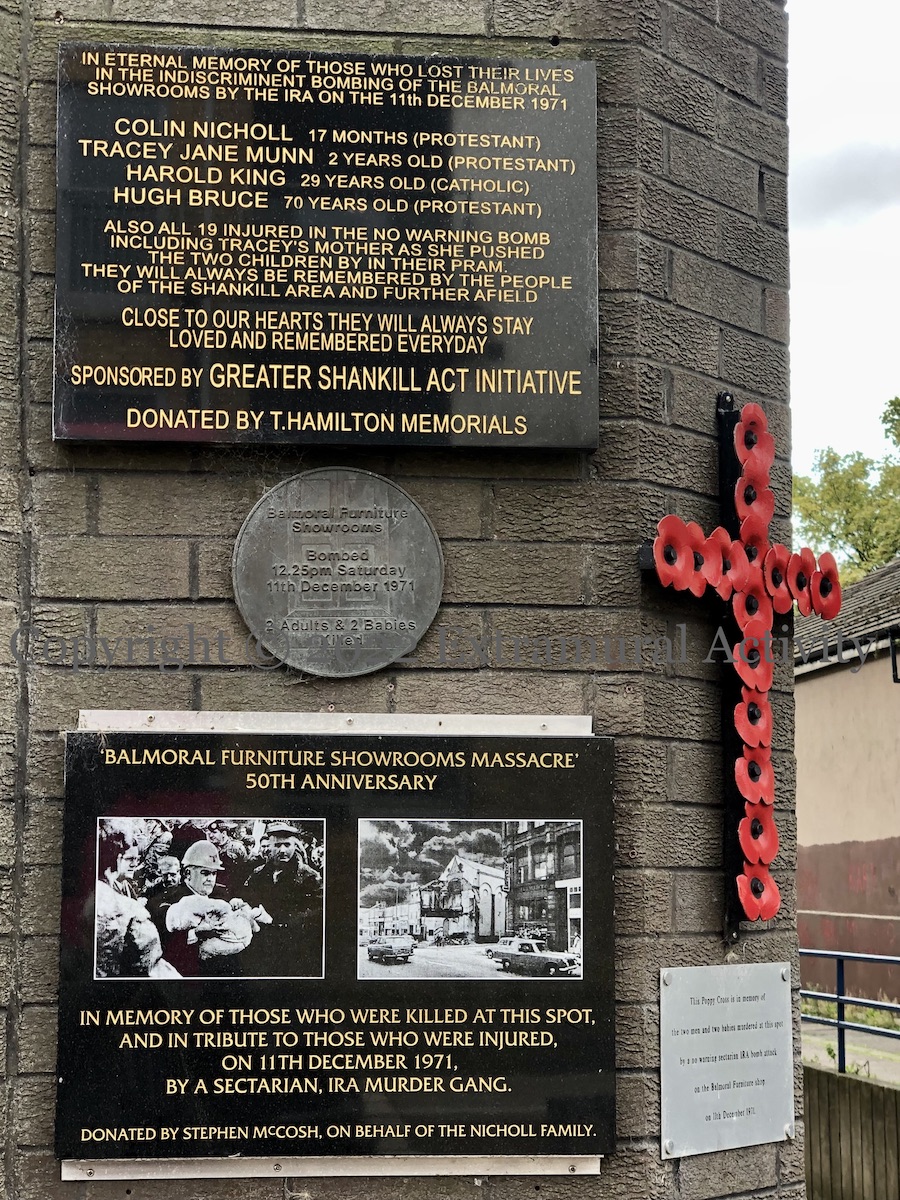
A fourth memorial was added to the side of the Shankill Leisure Centre for the 50th anniversary of the bombing of the Balmoral Furniture Showrooms on the Shankill Road, with two photographs from the aftermath. The one on the left, of a fireman carrying the body of Colin Nichol/Nicholl, was reproduced in the old mural in Bellevue Street and in Dundee Street in successive printed murals (one | two) of the four “Shankill atrocities”.
“In eternal memory of those who lost their lives in the indiscriminate bombing of the Balmoral Showrooms by the IRA on the 11th December 1971. Colin Nicholl 17 months (Protestant), Tracey Jane Munn 2 years old (Protestant), Harold King 29 years old (Catholic), Hugh Bruce 70 years old (Protestant). Also all 19 injured in the no warning bomb including Tracey’s mother as she pushed the two children by in their pram. They will always be remembered by the people of the Shankill area and further afield. Close to our hearts they will always stay/Loved and remembered everyday. Sponsored by Greater Shankill ACT Initiative. Donated by T. Hamilton Memorials.”
“Balmoral Furniture Showrooms massacre, 50th anniversary. In memory of those who were killed at this spot, and in tribute to those who were injured, on 11th December 1971, by a sectarian, IRA murder gang. Donated by Stephen McCosh, on behalf of the Nicholl family.”
“This poppy cross is in memory of the two men and two babies murdered at this spot by a no warning IRA bomb attack on the Balmoral Furniture shop on 11th December 1971.”














 Extramural Activity