The crew whiles away the hours sitting atop a Bogside stairwell, with IRA-emblazoned tricolour fluttering overhead, keeping an eye on a heap of bonfire wood. Below: another tricolour in the same area, with “Brits out now – IRA” board beneath.
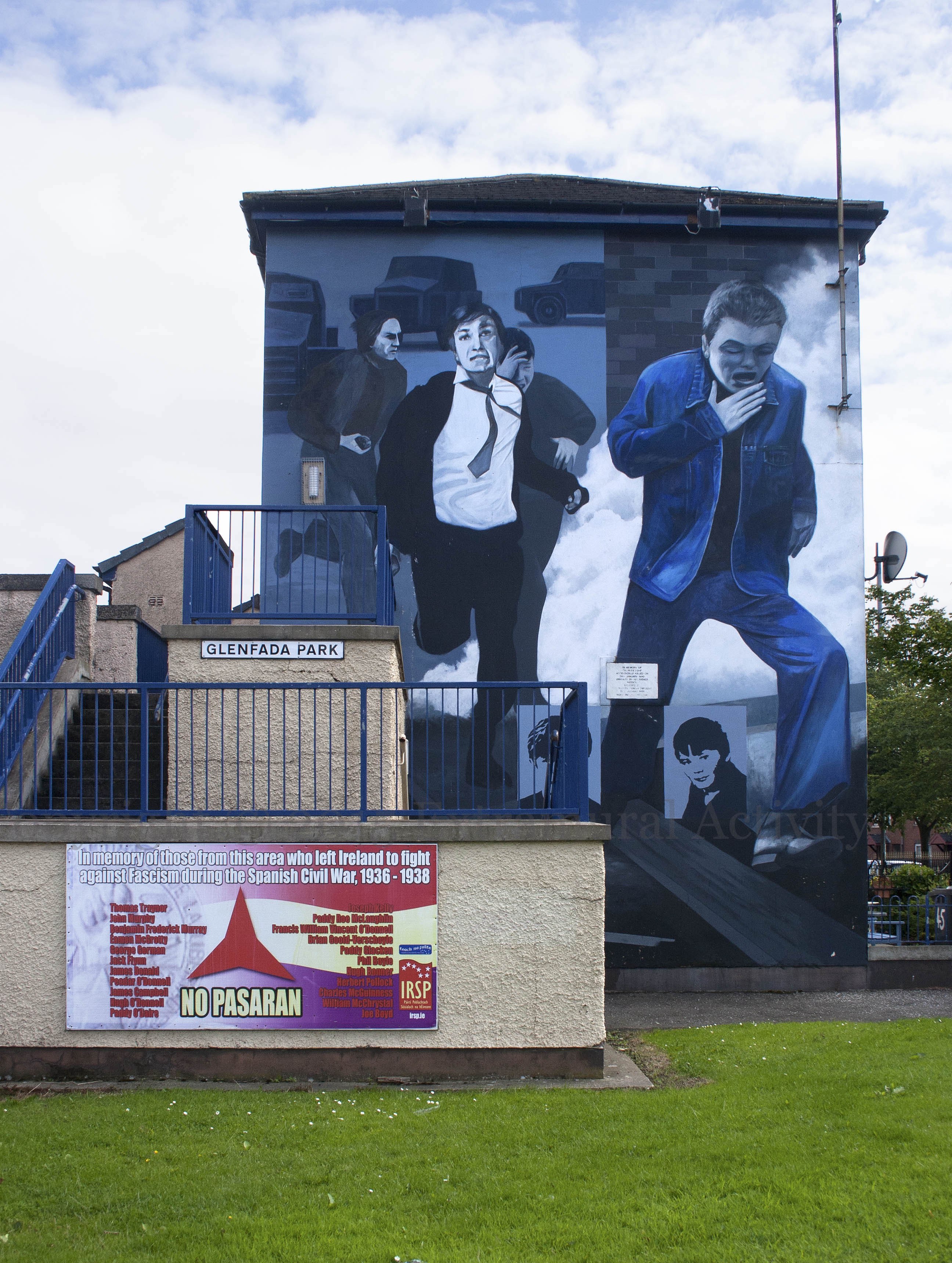
“No pasarán” is Spanish for “they shall not pass”, a phrase used by the Communists and Republicans as they tried (unsuccessfully) to defend the city of Madrid during the Spanish civil war. The board in front commemorates “those from this area who left Ireland to fight against Fascism during the Spanish Civil War 1936-1938”.
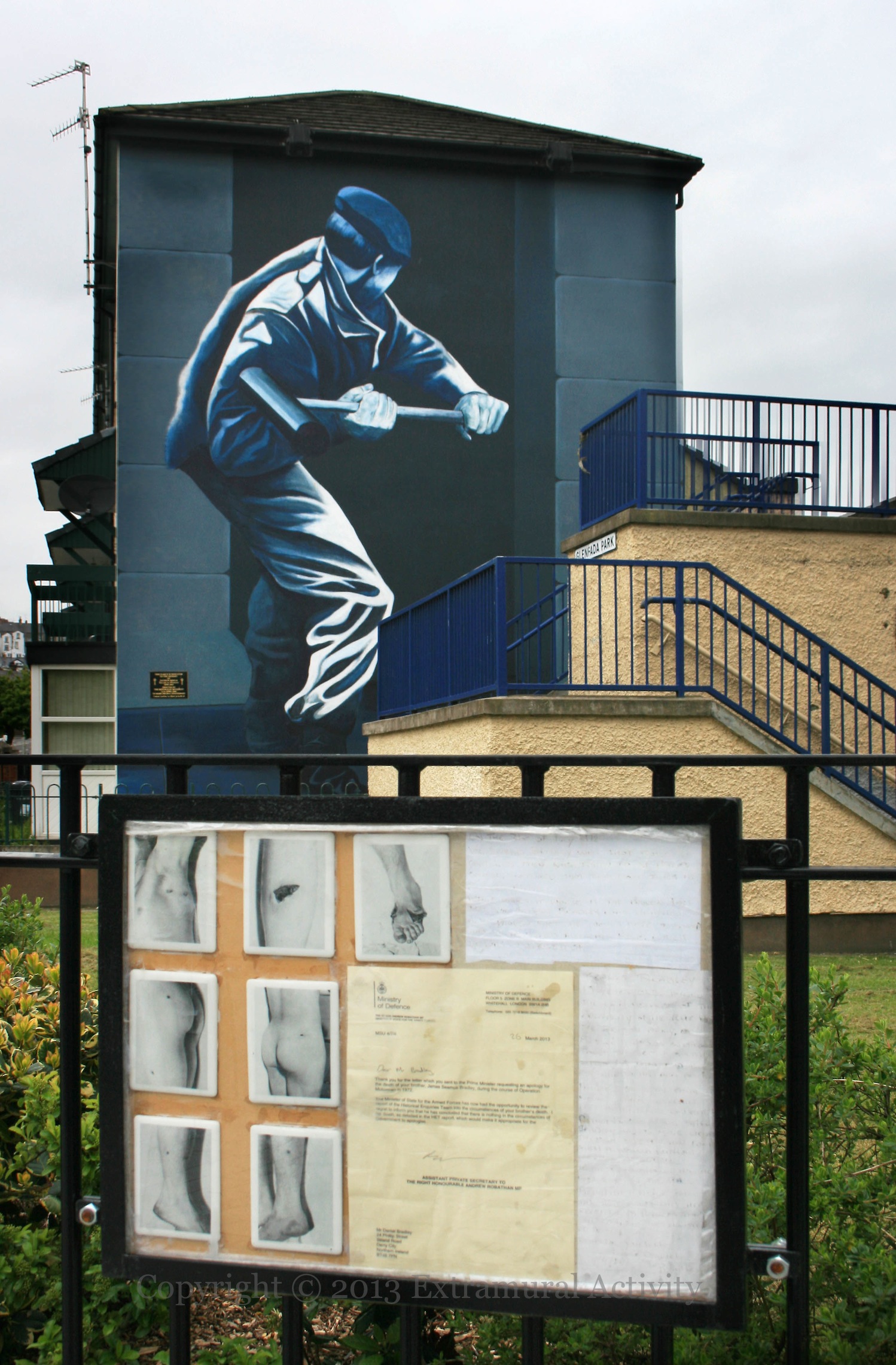
“The Runner” in the background mural (part of The People’s Gallery) is also having trouble holding his ground in the (repainted) famous Bogside Artists’ (web) work intended “to be a cautionary reminder to the young of the dangers inherent in civil conflict”. (CAIN)
Above is a local interpretation of Robert Ballagh’s 1970 rendering of Goya’s The Third Of May 1808 in Glenfada Park, Derry/Doıre, site of four deaths on Bloody Sunday, 1972.
The original commemorates Spanish resistance to the forces of Napoleon (WP). For this Derry version, features from the city’s skyline – the Guildhall, St. Columb’s Cathedral, and an intact Governor Walker column – have replaced the original’s outline of Madrid, as well as an insignia of the Paras on the arm of a soldier.
The three-storey mural above is in Ballysillan and replaced a UVF mural when it was added in 2011. The mural is the work of Jim Russell, shown below at Arts For All where he is artist-in-residence. The information below was provided by Arts For All.
The Great War: The first panel commemorates the Great War that ravaged Europe from 1914 to 1918 and shows troops advancing into battle, the Ulster Tower at Thiepval commemorating the sacrifice at the Somme and an image showing one of the war cemeteries and highlighting the true cost of war.
Second World War: The second panel features some of the devastation visited upon Belfast during a series of Luftwaffe raids during the early years of the Second World War. Belfast suffered greatly with over 1,000 people dying in four nights of bombing in April and May of 1941.
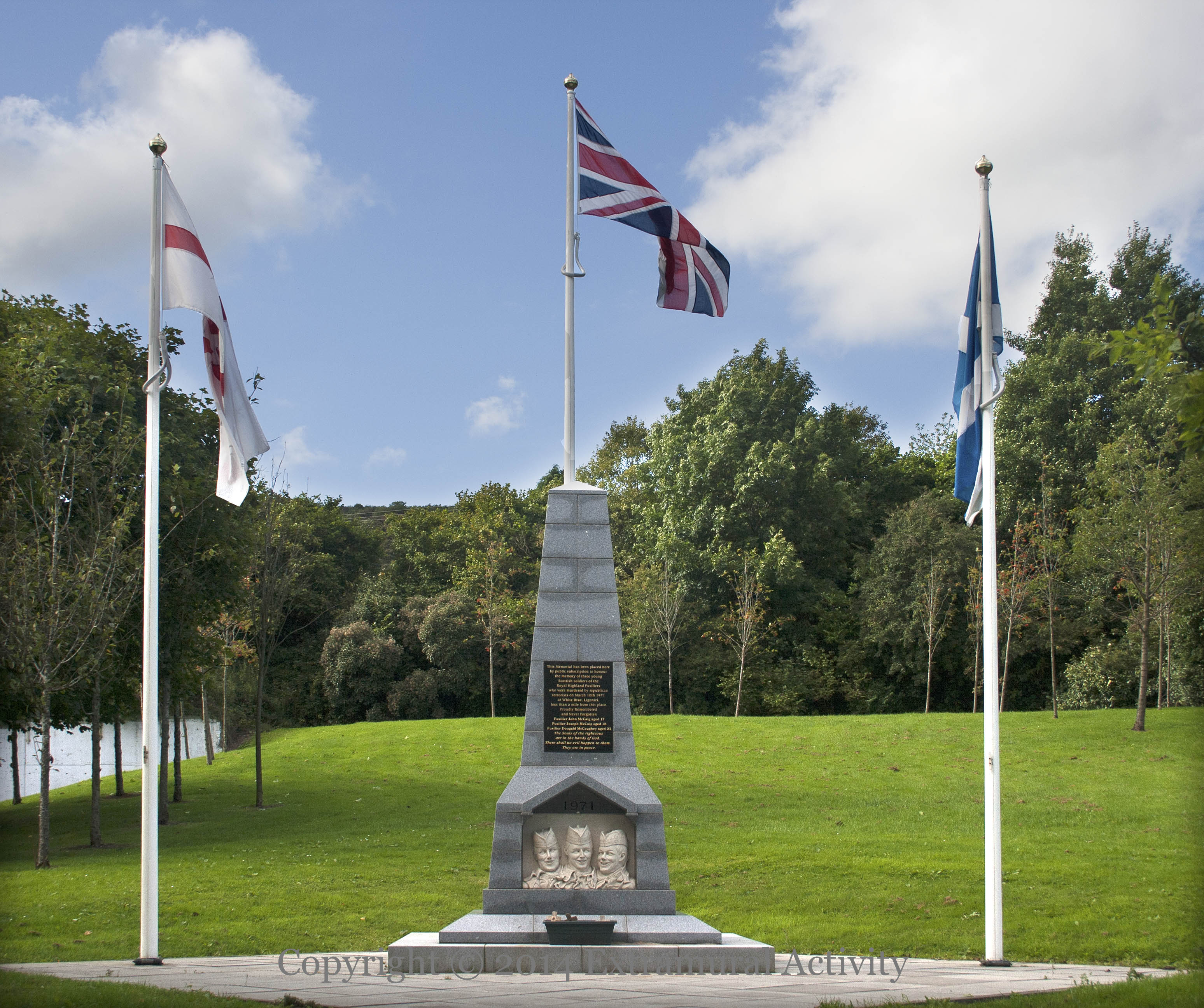
The Troubles: In the third panel highlight the dark history known as the Troubles. It features two events from the years of that time – the murder of the three young off-duty Scottish soldiers in 1971 [the monument depicted was featured in The Highland] and the Bloody Friday bombings of July 1972. In the midst of the horror that accompanied the early years of the Troubles these events still caused many to struggle to understand how people could carry out such atrocities.
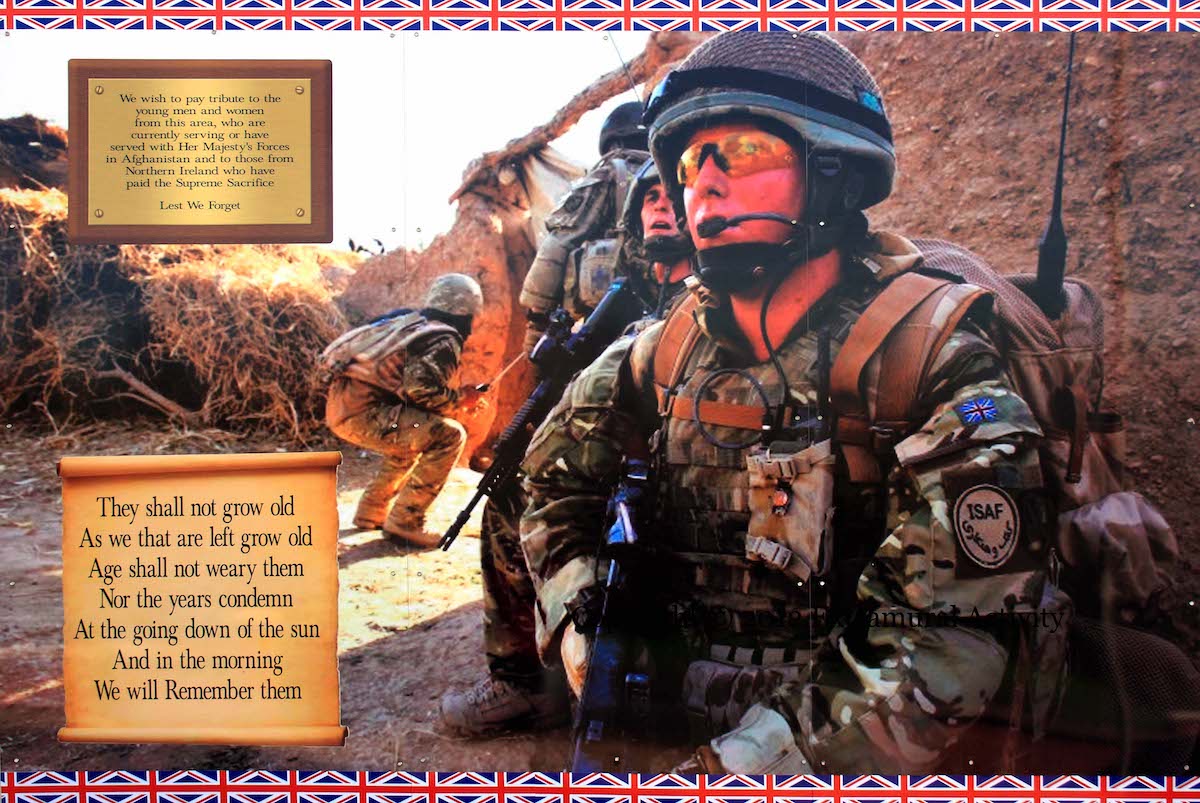
Present Day Conflict: Panel four brings us up to the present day. Military service is a tradition for many in Northern Ireland and for many their first overseas trip came on the back of an overseas posting whilst serving in one of the Armed Forces. From times past, through the World Wars, the Korean War, to more recent conflicts in Iraq and Afghanistan soldiers and regiments drawn from Norther Ireland continue to play a role.
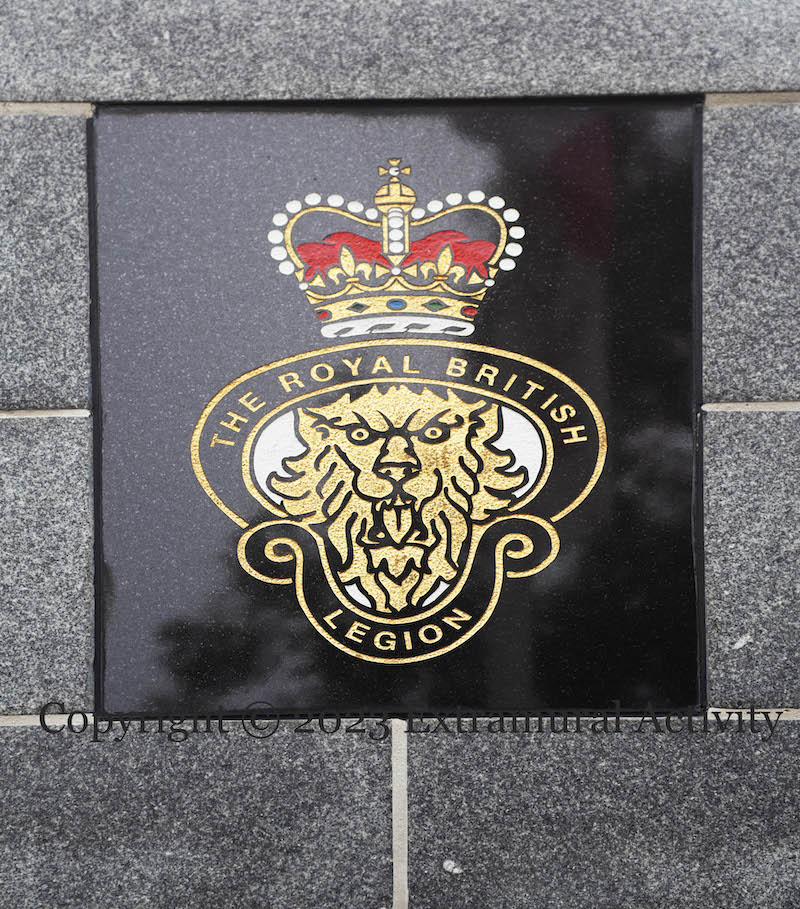
Highland Fusiliers John McCaig (17), Joseph McCaig (18), and Dougald McCaughey (23) were lured by the IRA from a city-centre pub to their deaths in Ligoniel in 1971 (WP). The memorial above is at the top of Ballysillan – a wide shot and close-up of the plaque are shown below.
A smaller stone is at the White Brae/Squire’s Hill site – shown below along with a wide shot of the area. The stone is frequently vandalised (BelTel | BBC | STV | BBC).
Update: 2018 video of a ceremony at the Ballysillan site.
This is the (second) memorial to Paul ‘Topper’ Thompson in Moyard. He was killed by the UDA on April 27th, 1994. Collusion is alleged – see Relatives For Justice.
“In memory of Topper Thompson, murdered by British death squads, 27th April 1994 aged 25. Deeply missed by never forgotten. Erected by his friends.”
Below is a close-up of the information board on Seamus Bradley, a 19 year-old IRA member who was killed during Operation Motorman, the British Army’s retaking of ‘Free Derry’ on July 31st, 1972. Bradley was found to be unarmed and bled to death while in British custody (according to the Pat Finucane Centre). The letter in the display case is addressed to Bradley’s brother, Daniel, from the MoD, and concludes “I regret to inform you … that there is nothing in the circumstances of his death, as detailed in the [Historical Enquiries Team] report, which would make it appropriate for the Government to apologise.”
“Get the real story – local history from local people – take a black taxi tour – West Belfast Taxi Association – 40 years unbroken service”. The tours of “local” history are of course aimed at non-locals as part of the ‘dark tourism’ or ‘Troubles tourism’ boom.
Here is the Getty Images photo of British Army soldiers on the Falls Road in 1969, on which the mural is based.
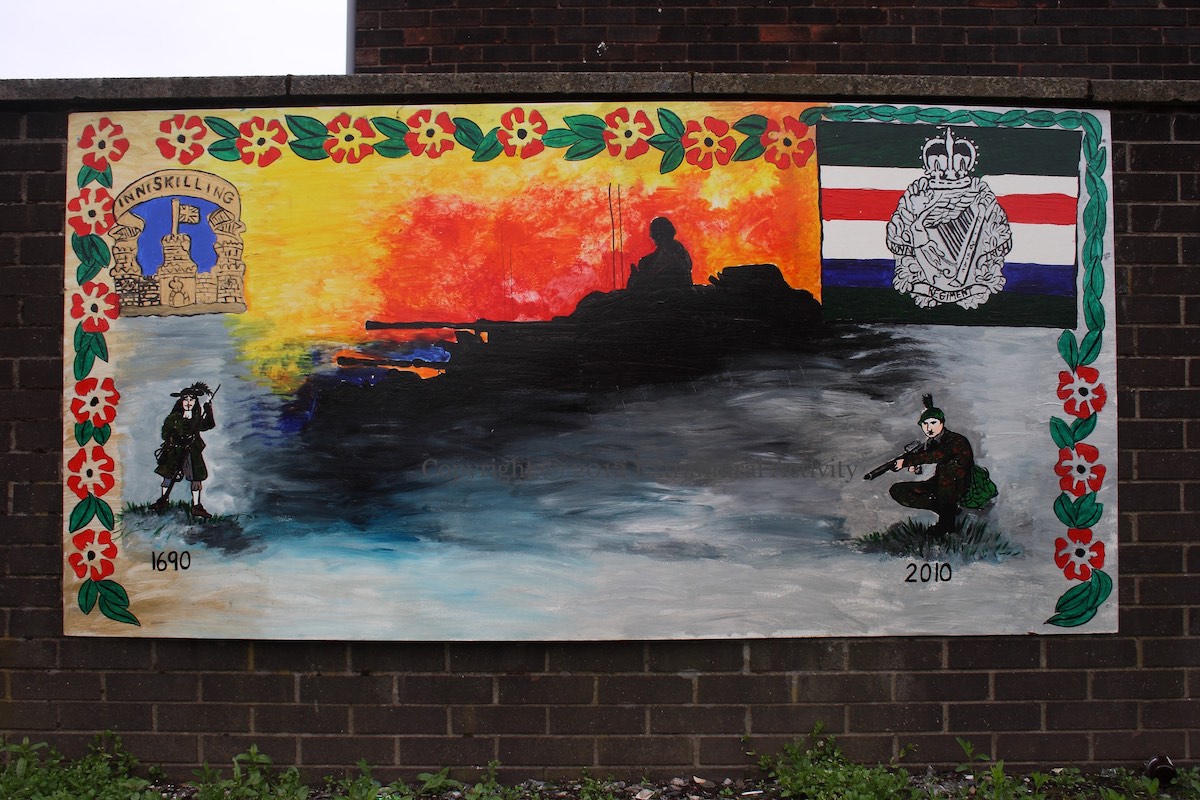
The 27th (Inniskilling) Regiment Of Foot was raised in 1689 at Enniskillen to fight against James II in Ireland (WP). It was folded into the Royal Inniskilling Fusiliers in 1881, which in turn was made part of the Royal Irish Rangers in 1968, which in turn was merged with the UDR in 1992 to form the Royal Irish Regiment, whose flag is in the top right – though the colours are incorrect; there are no white bars and two red bars (WP). This RIR served in both Iraq and Afghanistan.
The flowers around the outside are perhaps orange lilies rather than English roses.