Besties Barbers stands in the centre of Newtownards and the mural above is on the side wall (in Gibson Lane). It features footballer George Best in Northern Ireland strip and sponsorship by local taxi company, Kare Kabs. The interior of the shop is decorated with more Northern Ireland football heroes.
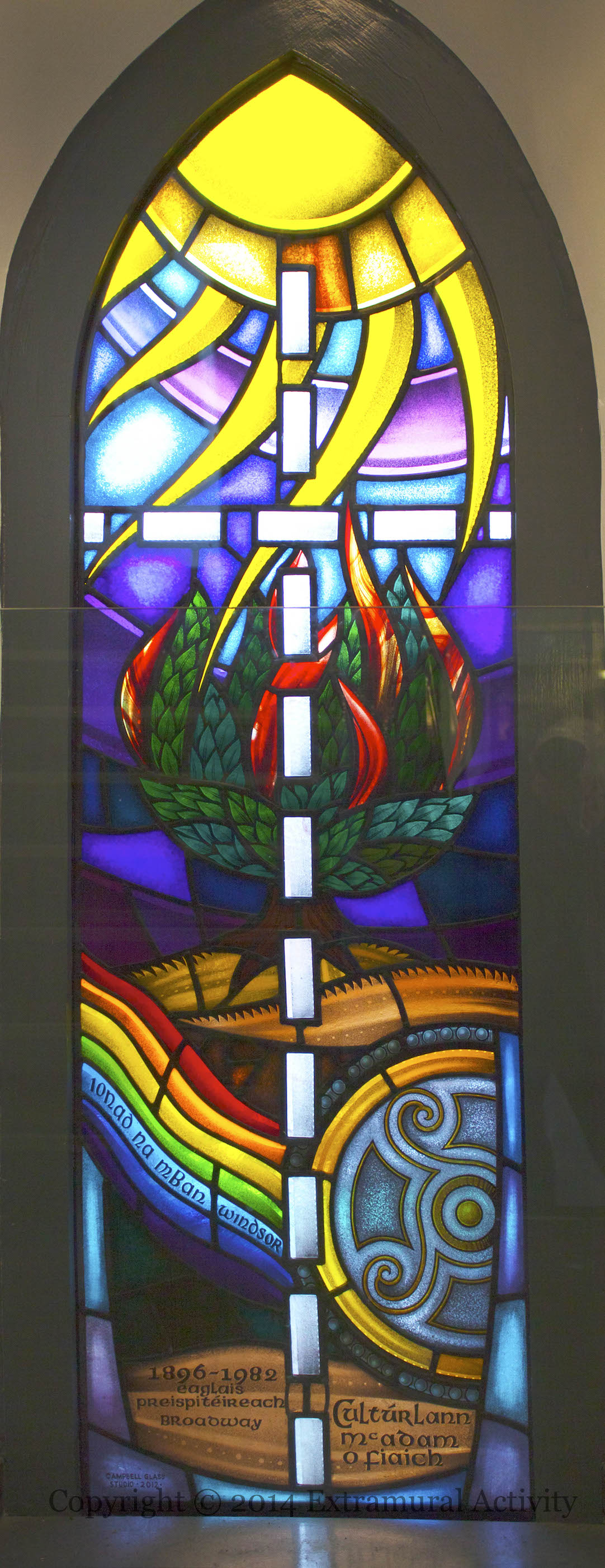
The stained-glass window shown above is on the stairs in An Chultúrlann. It was designed in conjunction with the Windsor Women’s group (Ionad Na mBan Windsor) to commemorate the fact that the place was formerly a Presbyterian church (1896-1982 Eaglaıs Preıspitéıreach, Broadway). The broken white lines which form the cross also stand for road markings. The glass also features the sun, a burning bush, a rainbow, and a Celtic shield. Unveiled June 22nd, 2012.
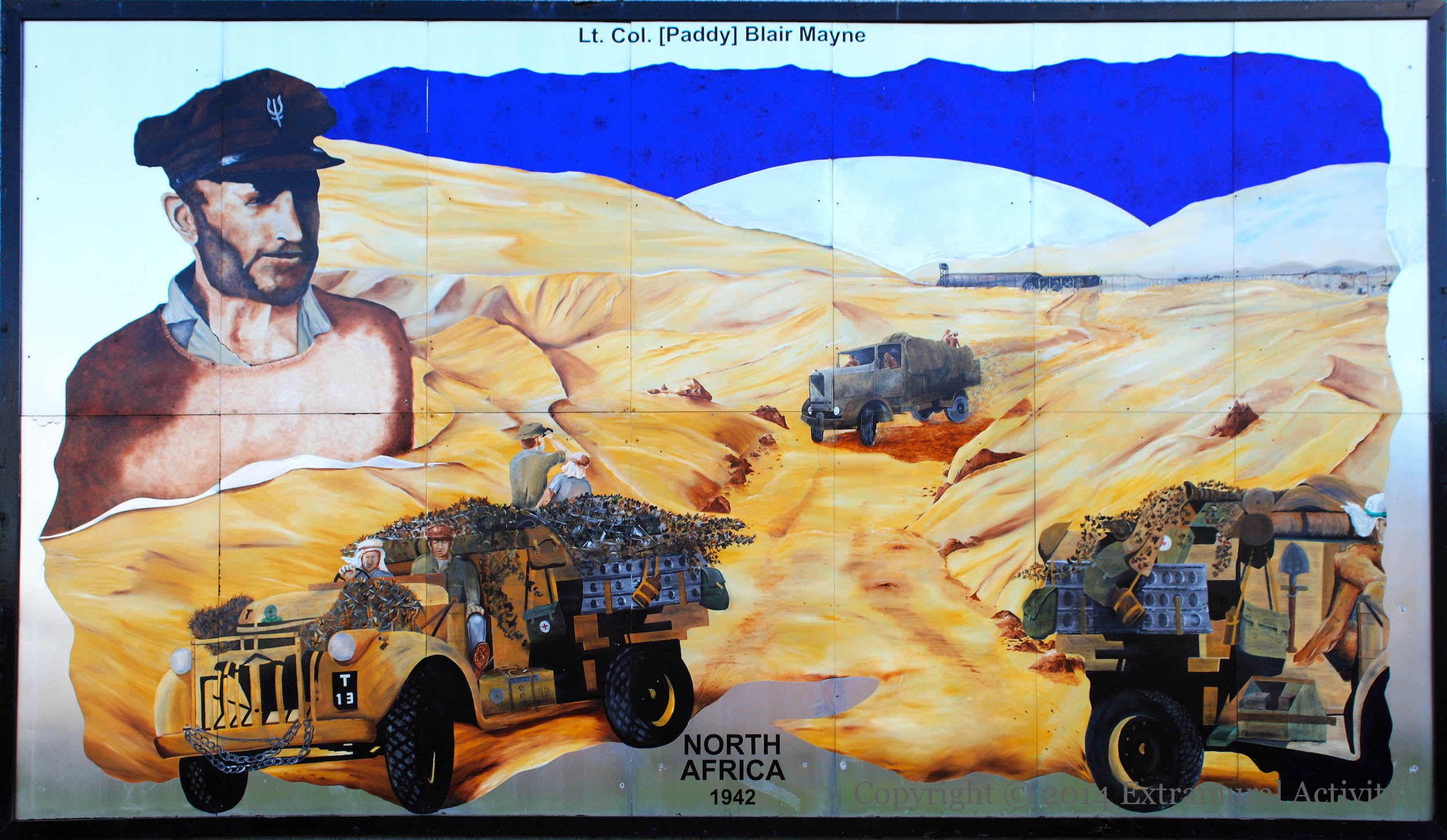
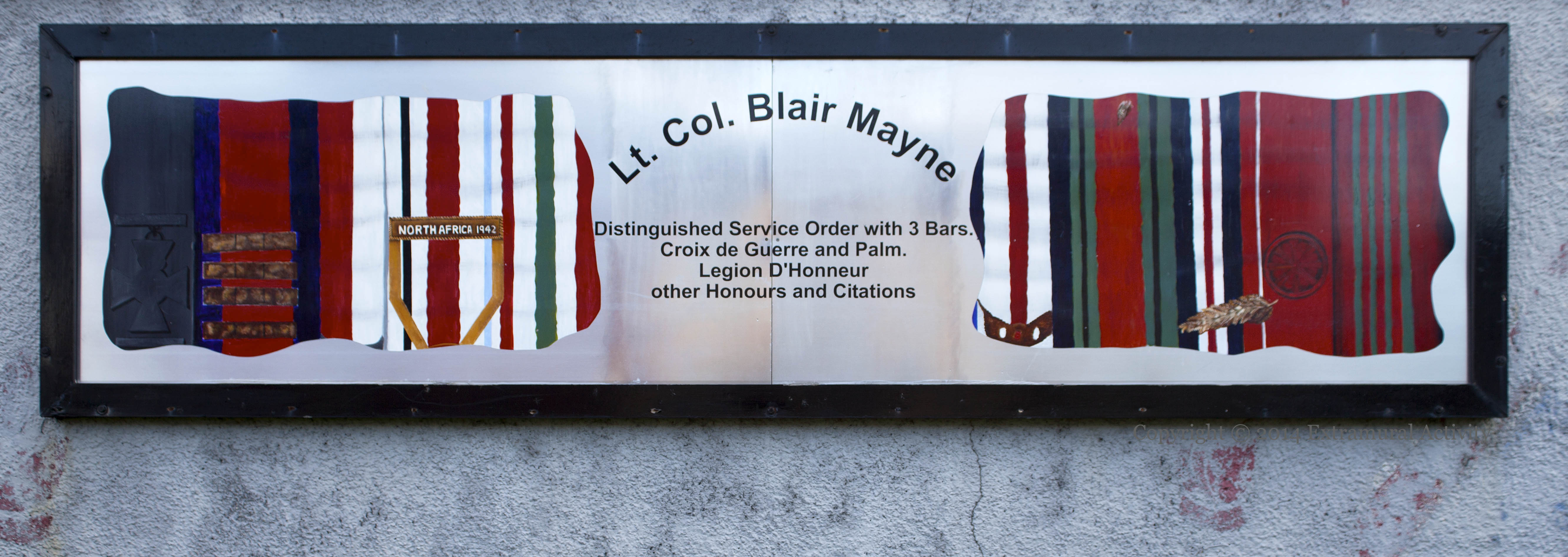
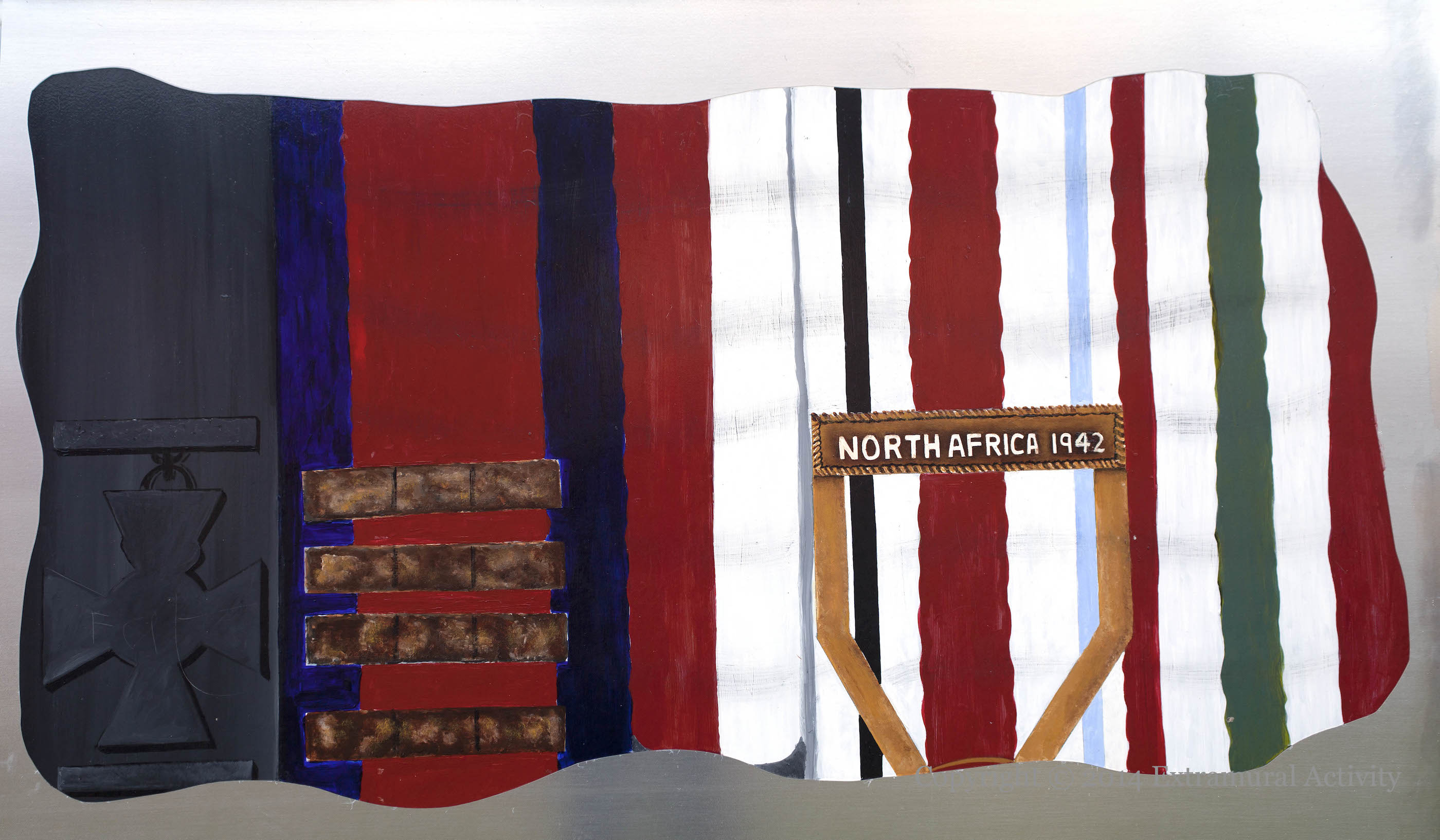
Robert Blair “Paddy” Mayne was a rugby player, boxer, golfer, and solicitor, and in WWII a commando and one of the first members of the SAS (Special Air Service), participating in raids behind enemy lines in Egypt and Libya (depicted in the board above), and later, as SAS commander, in France, Belgium and other countries. His many decorations, including the DSO (four times) and French Croix De Guerre and Legion D’Honneur, are pictured below. (His WP page includes an explanation of the ribbon bars.)
Mayne was born in Newtownards and returned there at the end of the war. His statue stands in the town’s Conway Square and this board can be found in Queen Street.
“As we scrambled over the trench ladders the Y.C.V. flag appeared.” One of the many panels in an extended mural in Thorndyke Street, this one inspired by a drawing by Jim Maultsaid, who joined the YCV in 1914 and kept a diary and sketch-book. More of his sketches can be found as part of the Friends Of The Somme’s account of the war in 1916. His portrait is included below.
The plaque reads: At the outbreak of the Great War in August 1914, when Lord Kitchener, the War Minister, was desperately looking for men, he had asked Sir Edward Carson for a brigade consisting of four battalions. Carson offered him a division consisting of twelve battalions, uniformed and equipped at Ulster’s expense. The UVF was transformed rapidly into the 36th (Ulster) Division. On the 1st July 1916 the 26 (Ulster) Division took part in the Somme Offensive. Nine Victoria Crosses were awarded for acts of valour on that day. Men of the 36th (Ulster) Division won four of these. Of those, three were awarded posthumously. Of the 9,000 men of the Division who took part in the attack, scarcely 2,500 answered roll call on 3 July; while of 400 officers, more than 250 were killed or wounded. The Division lost 5,500 officers and other ranks killed, wounded and missing as a result of the first two days of the Somme offensive. The illustration depicted is derived from a drawing by Jim Maultsaid, an American citizen. He joined the 14th Royal Irish Rifles, which was drawn from members of an organisation called the Young Citizen Volunteers (YCV).
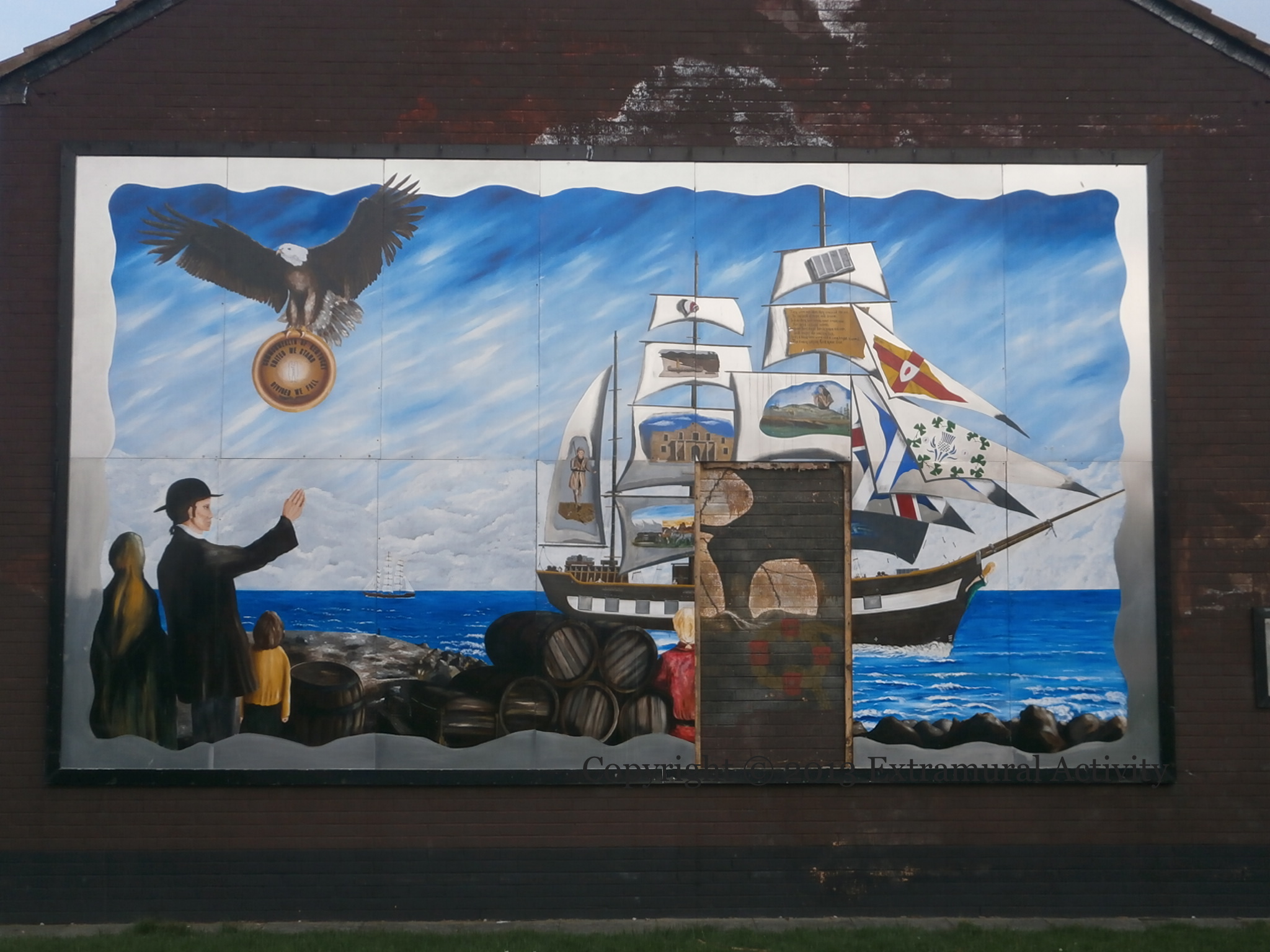
Three panels in Newtownards about the Scotch-Irish (or: Ulster Scots) emigration to the United States in the middle of the eighteenth century. Each of the three shows a stage of the experience: ‘Farewell Brothers’ shows family left behind looking out over the sea at the receding ships; ‘The Voyage’ shows sleeping conditions on-board; ‘The Arrival 1731’ shows the flags of the United States and Northern Ireland, with the statue of liberty superimposed upon a red hand.
The three panels are next to a larger, now damaged, board also portraying emigration to the States, shown in the final images below.
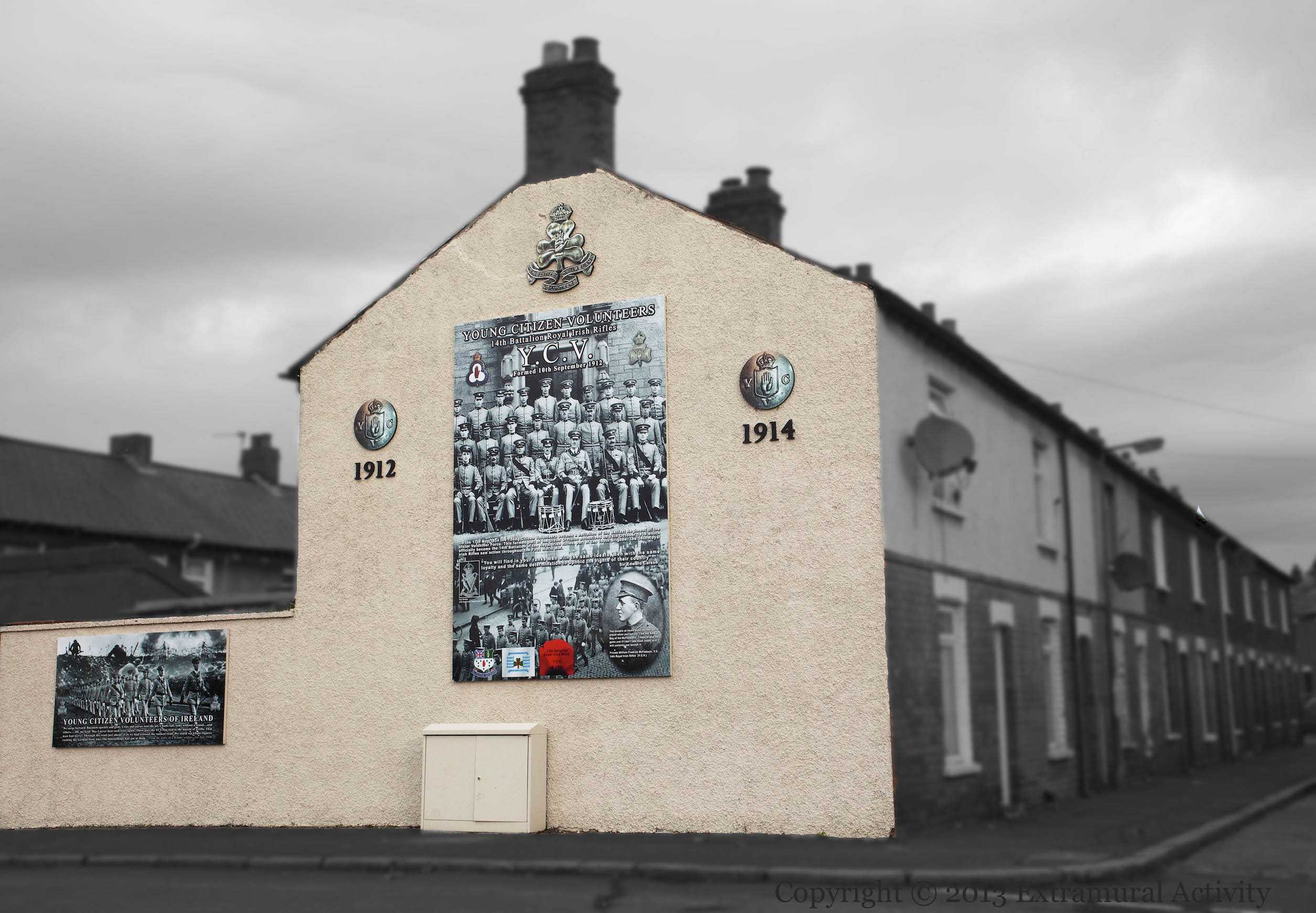
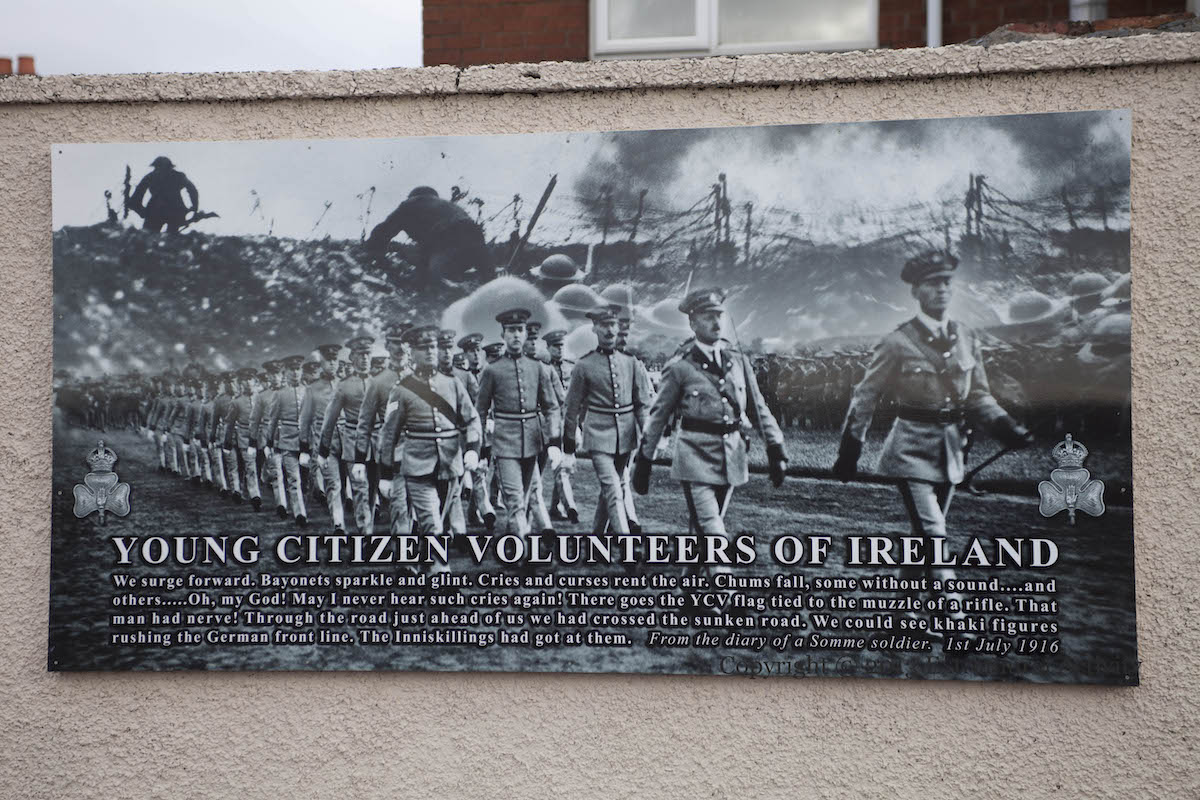
These Kilburn Street boards commemorate the “Young Citizen Volunteers Of Ireland” and the battle of the Somme. The text in the side-wall board (shown below) is from the diary of a Somme soldier: “We surge forward. Bayonets sparkle and glint. Cries and curses rent the air. Chums fall, some without a word … and others … Oh, my God! May I never hear such cries again! There goes the YCV flag tied to the muzzle of a rifle. That man had nerve! Through the road just ahead of us we had crossed the sunken road. We could see khaki figures rushing the German front line. The Inniskillings had got at them.”
The larger board, on the right, describes the transition from rebels to British Army soldiers: “On the 17th May 1914 the Young Citizen Volunteers became a battalion of the Belfast regiment of the Ulster Volunteer Force. This formed part of the Ulster Division authorised on 28th October 1914 which officially became the 14th battalion of the Royal Irish Rifles, part of the 109th brigade. The 14th saw action throughout the First World War.”
It includes a quote from Edward Carson, “You will find in your ranks men with the same ideals, men with the same loyalty and the same determination to uphold the rights of their country”, and a quote from VC winner William Fredrick McFadzean, “You people at home make me feel quite proud when you tell me I am the soldier boy of the McFadzeans. I hope to play the game and if I don’t add much lustre to it I certainly will not tarnish it.”
“No ball games” above a YCV mural in Benburb Street in the Village, south Belfast. The Young Citizen Volunteers formed a battalion of the Royal Irish Rifles and so part of the 36th (Ulster) Division during the first world war.
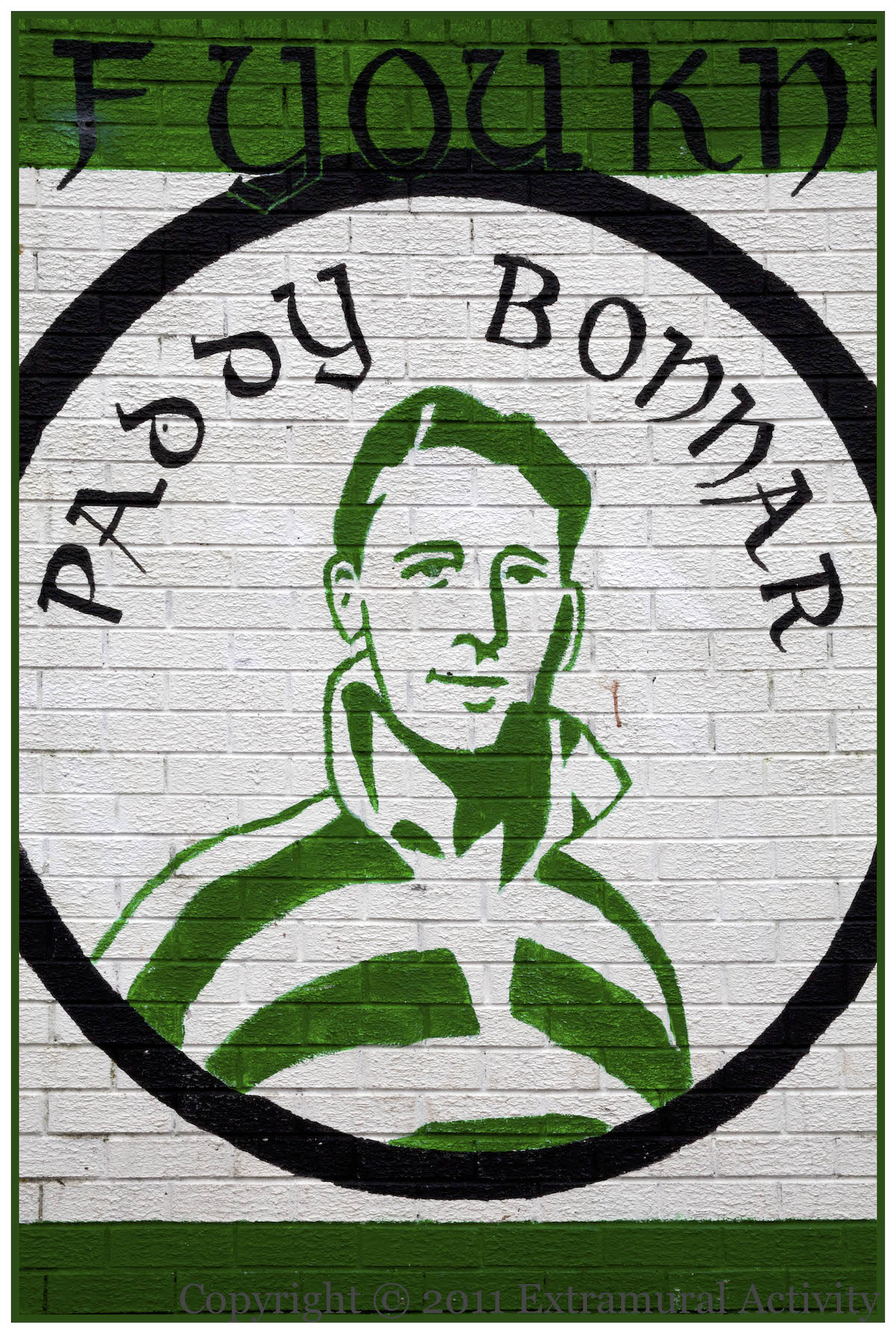
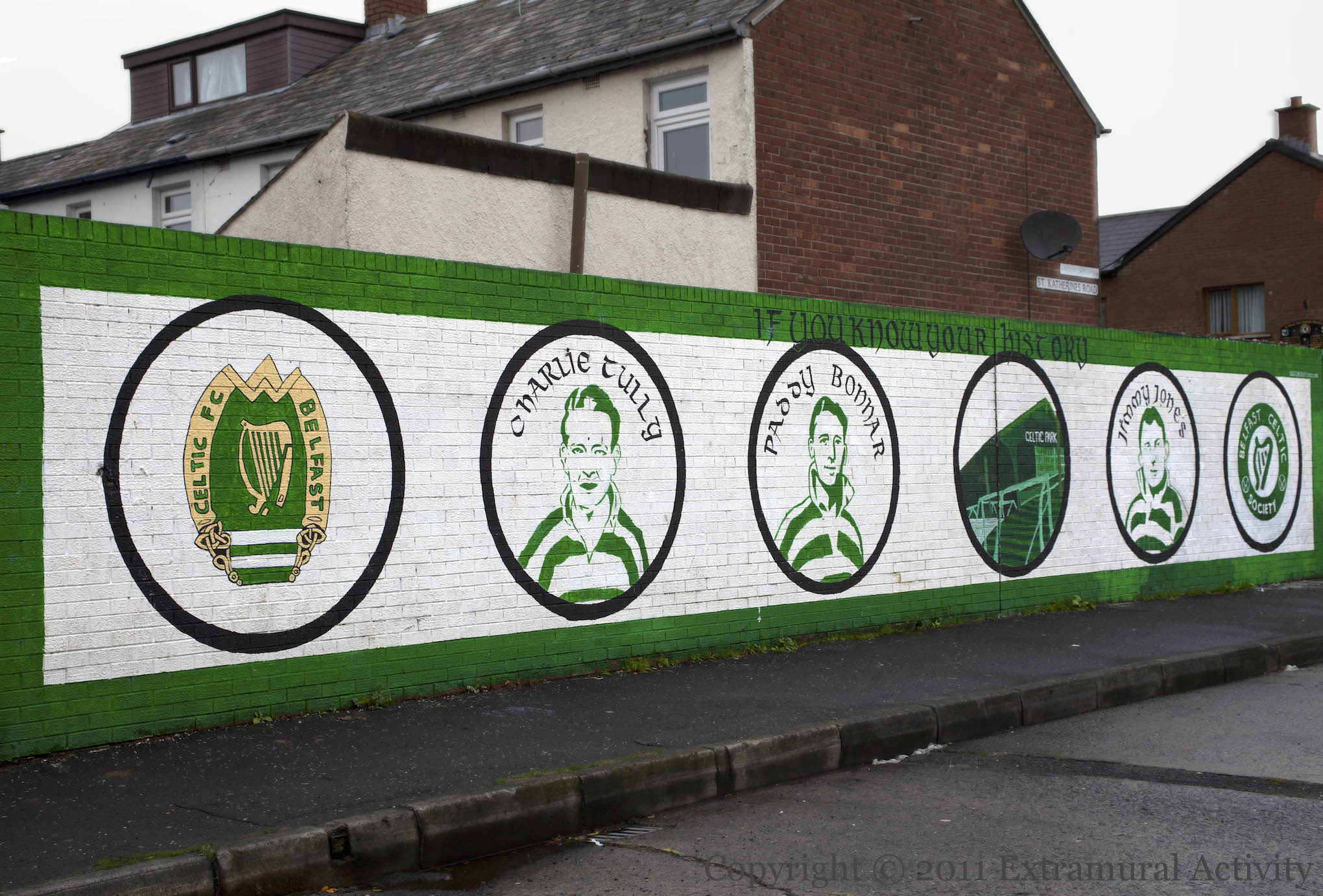
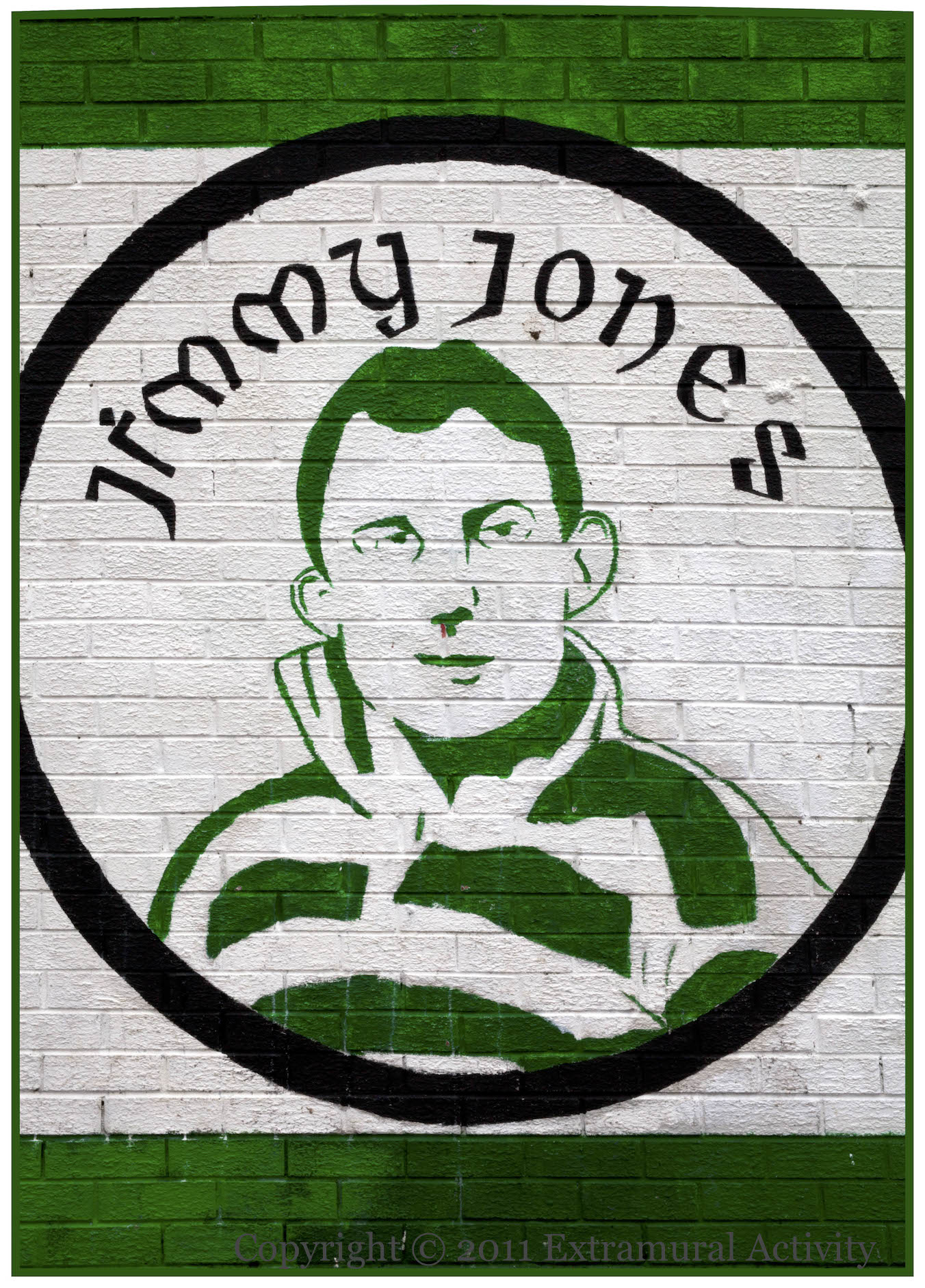
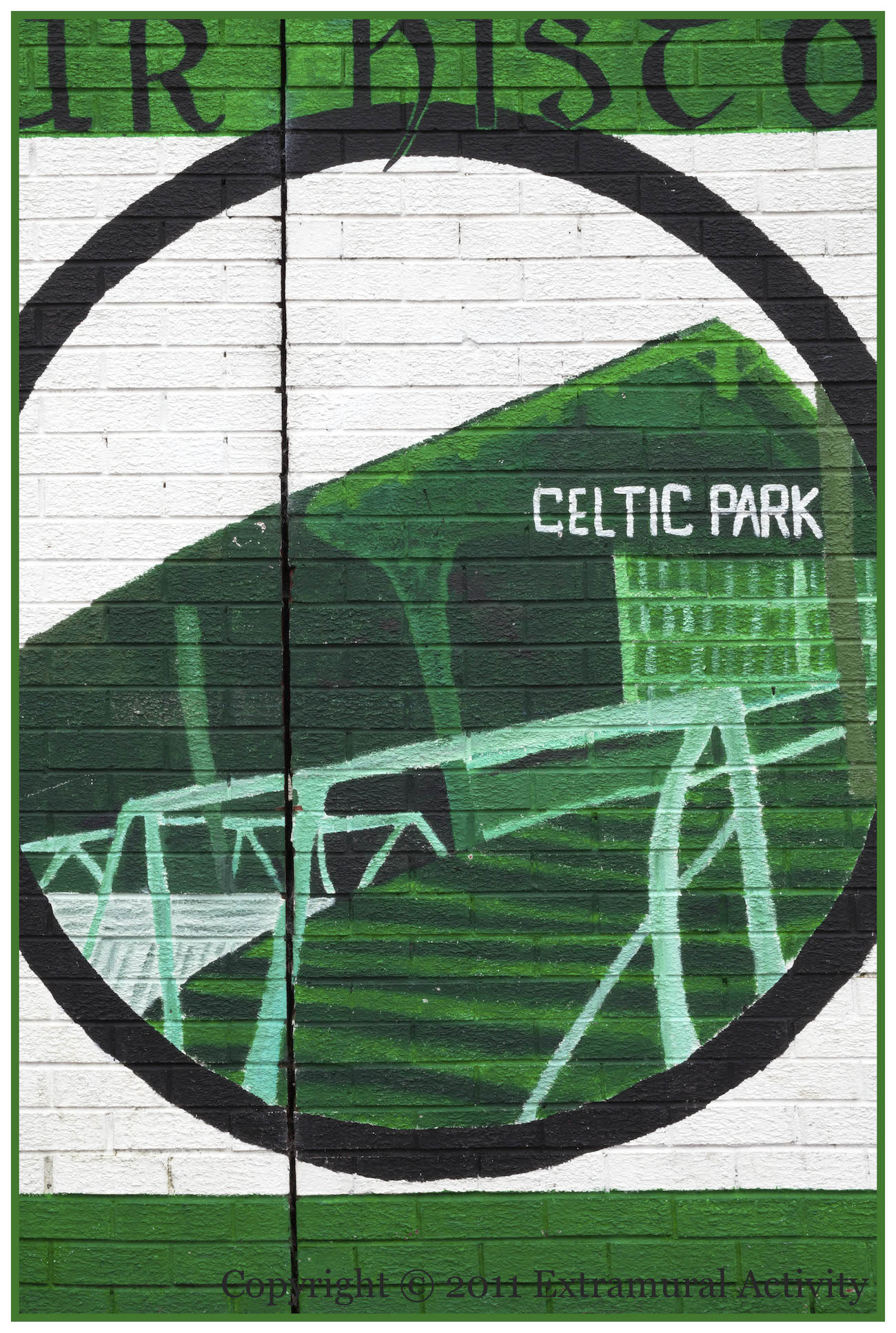
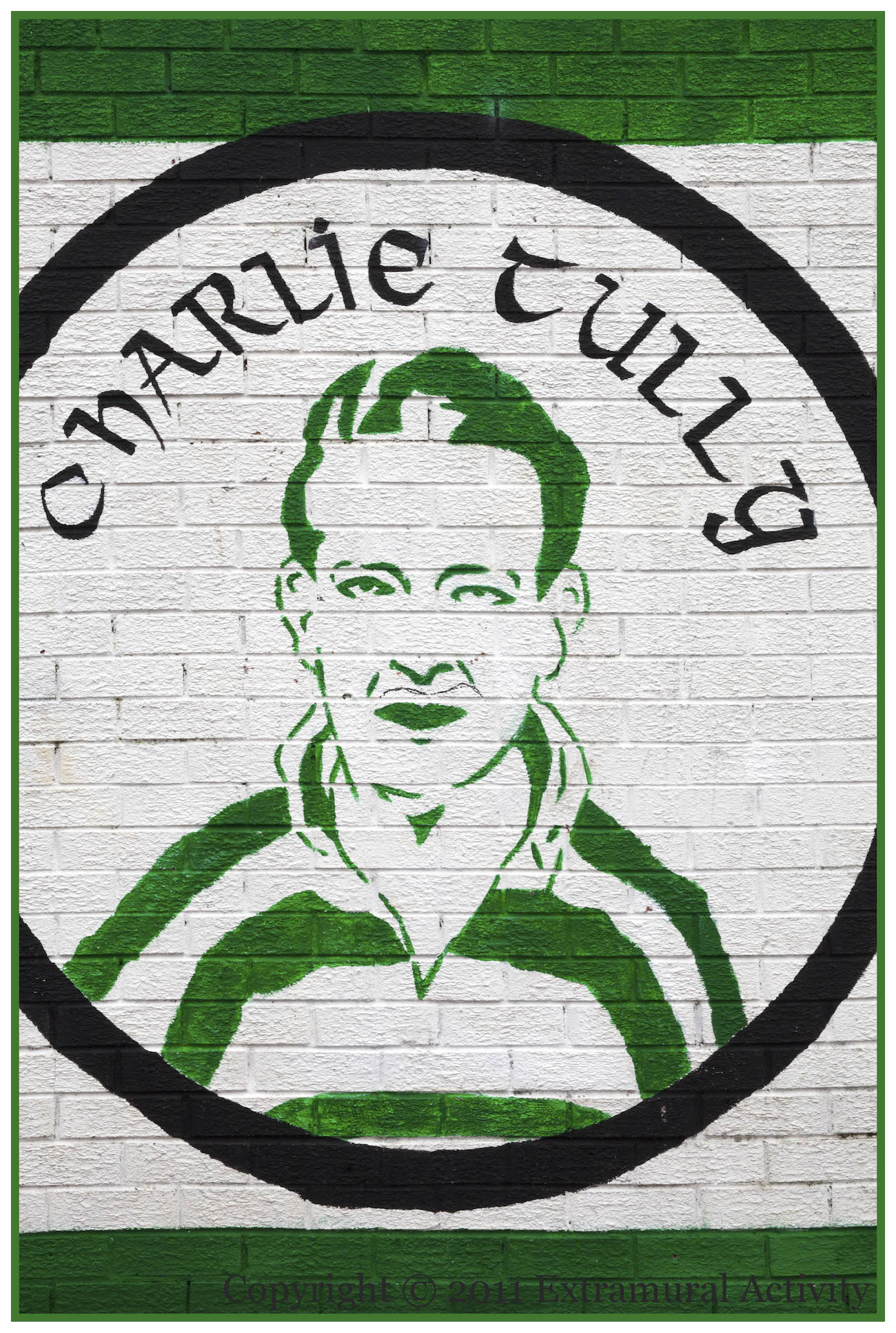
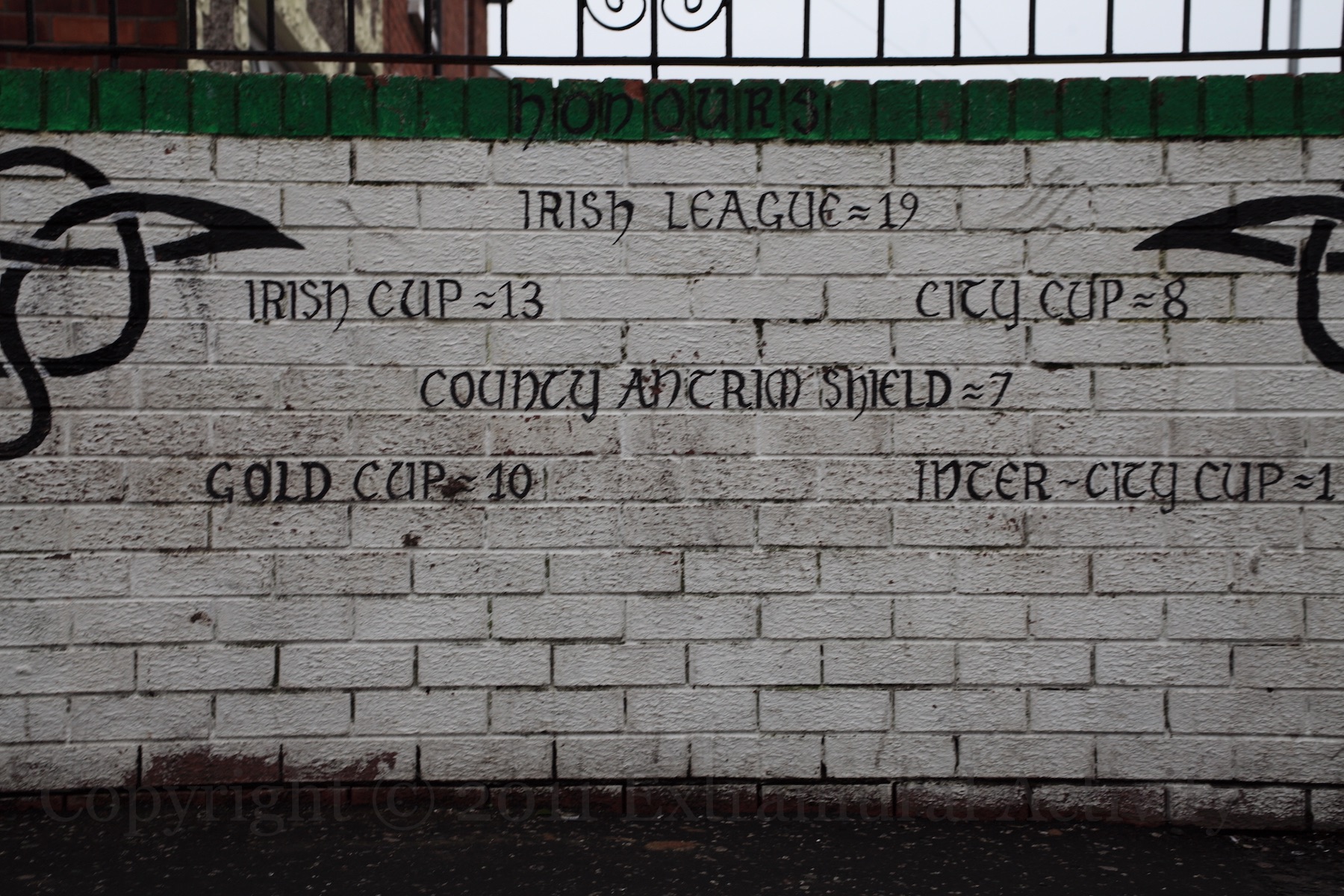
“If you know your history …” – a mural sponsored by the Belfast Celtic Society in St. James’s Crescent celebrates some star players – Charlie Tully (WP), Paddy Bonnar, and Jimmy Jones (WP) – and the old playing ground, Celtic Park or ‘Paradise’, on Donegall Road. Wide shot and close-ups below. (Belfast Telegraph write-up.)
Video from the Belfast Celtic Society of the work in progress and of the unveiling – Jimmy Jones was there in person.








 Extramural Activity