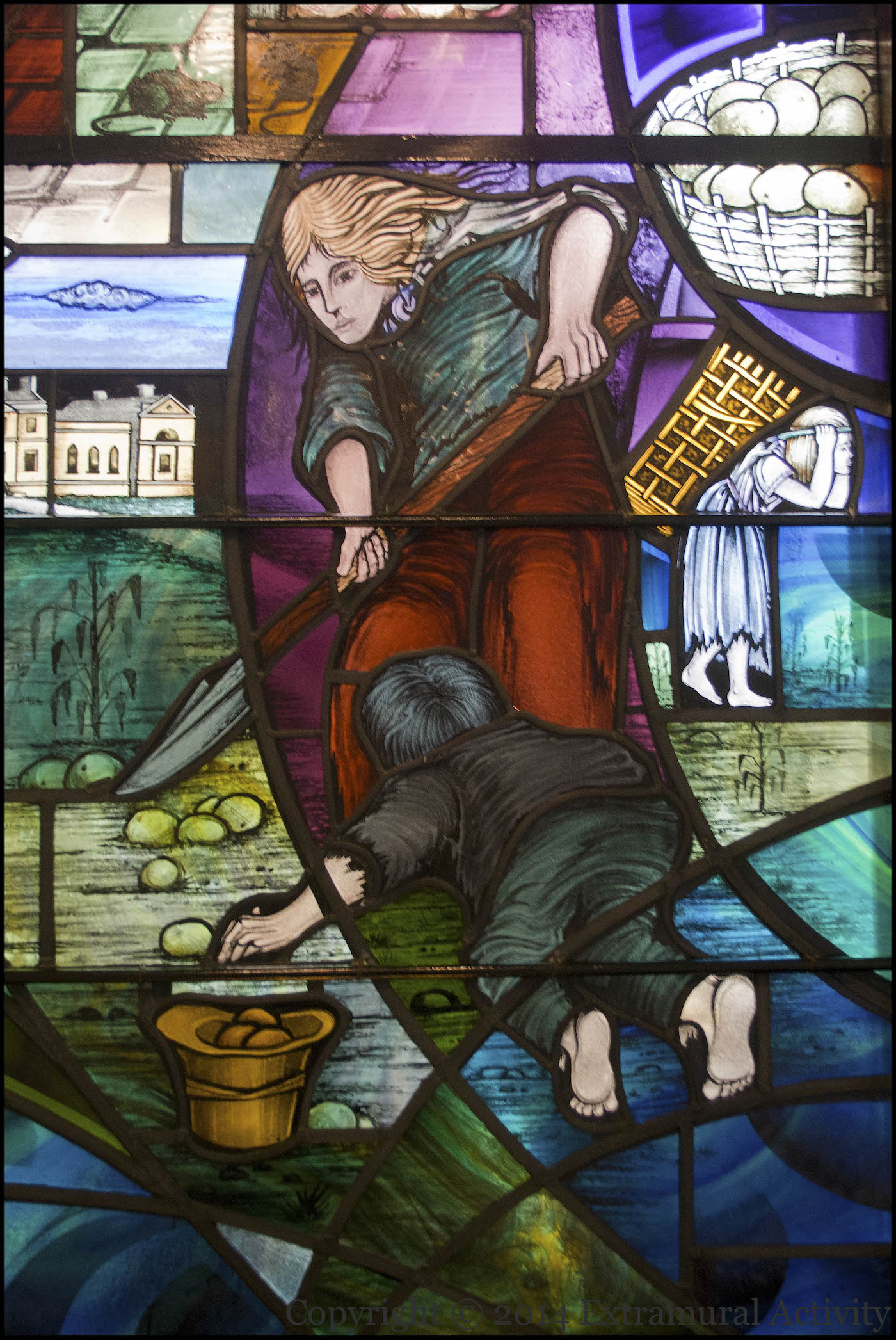
Above is a detail from, and below is the whole of, a stained glass window in Belfast City Hall commemorating emigration and the great hunger, commonly known as “the famine”. The piece is by Stephen Calderwood of GlassMarque. The window shows a sailing vessel and the coast of north America, scenes of destitution, Clifton House (home to the Belfast Charitable Society, on Clifton Street), and a potato harvest.
Friar’s Bush and Clifton Street graveyards both contain the remains of people in died in the famine (and in cholera epidemics).
Previously: One Big Union (stained glass in City Hall) | White Line (stained glass in the Cultúrlann)
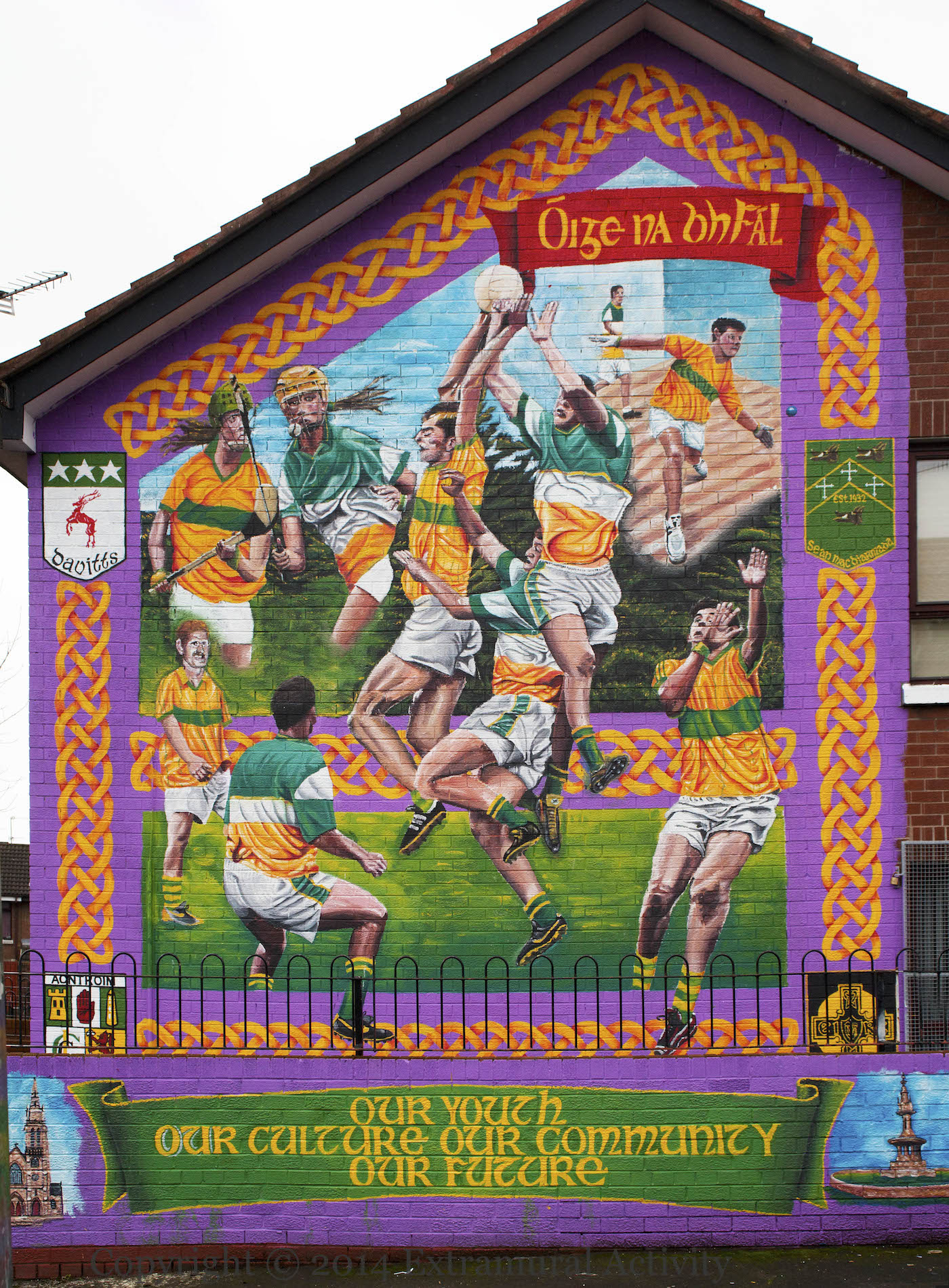
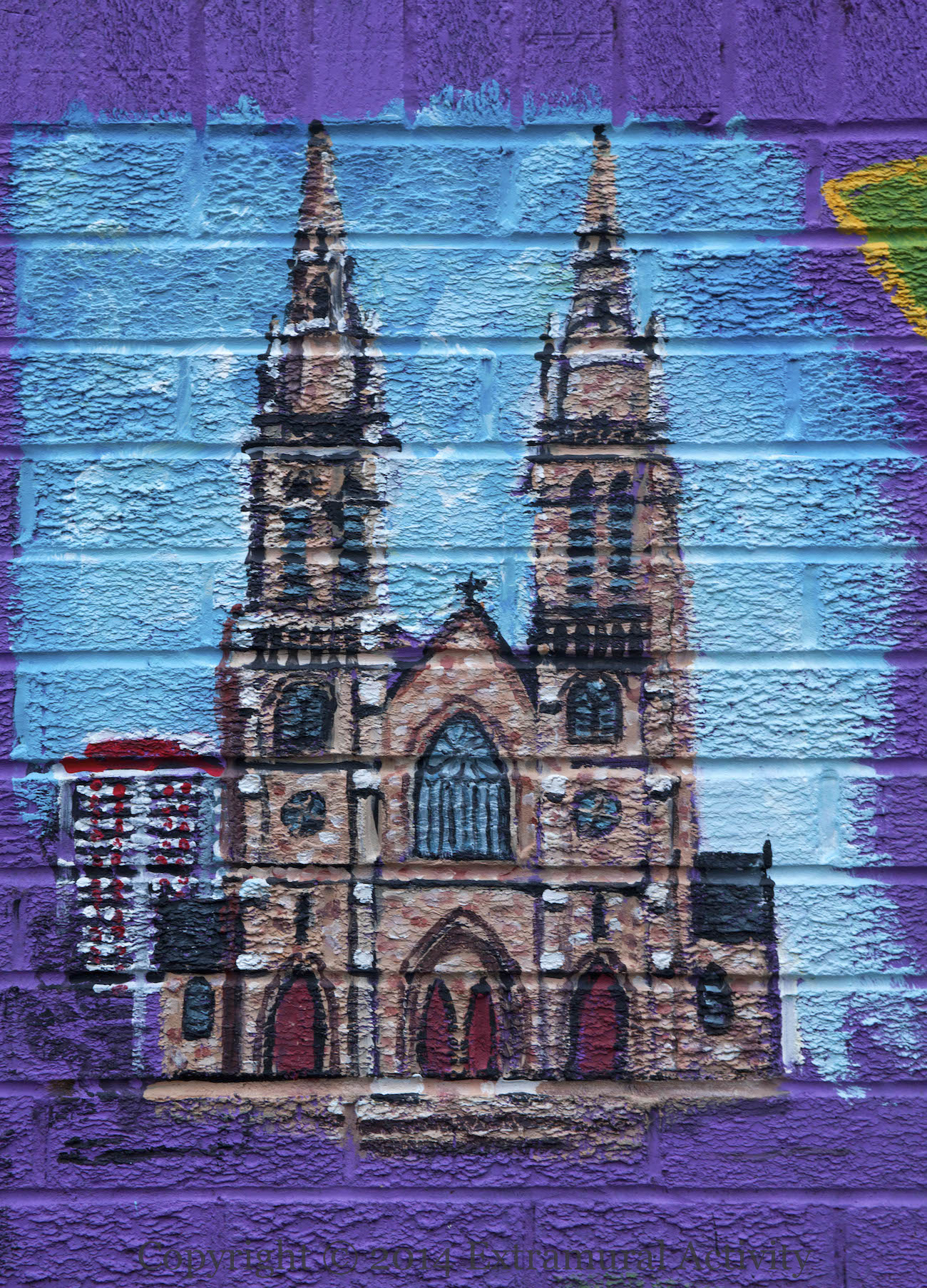
“Our youth, out culture, our community, our future”. Above is a new Ross Road mural celebrating gaelic games (football, hurling, and handball) and in particular Michael Davitt’s (green, white, and gold strip) and Sean MacDermott’s (yellow with green stripe) GAA/CLG clubs. The banner on the low wall is bookended by images of St. Peter’s cathedral and the fountain in Dunville Park, which are detailed below.
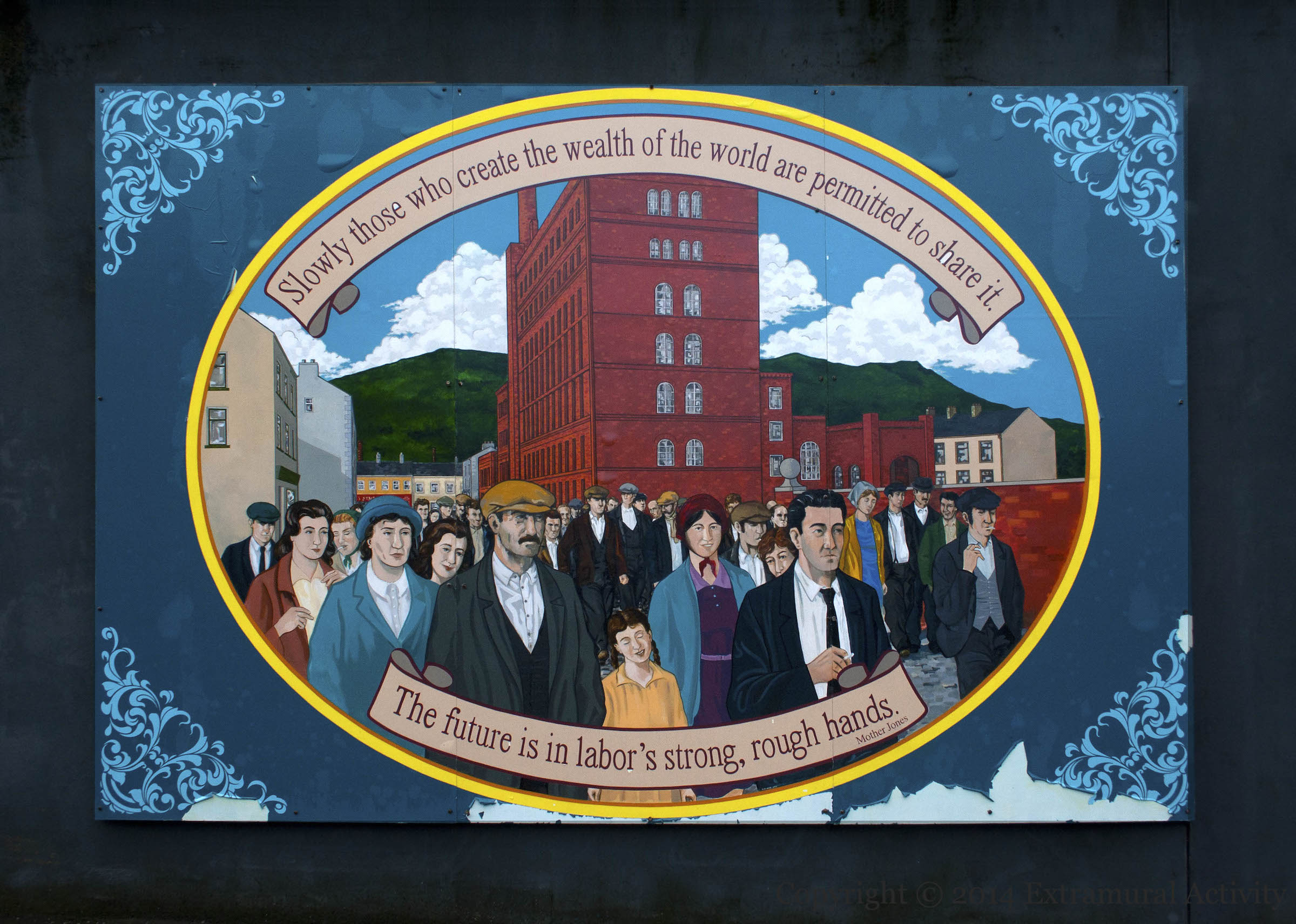
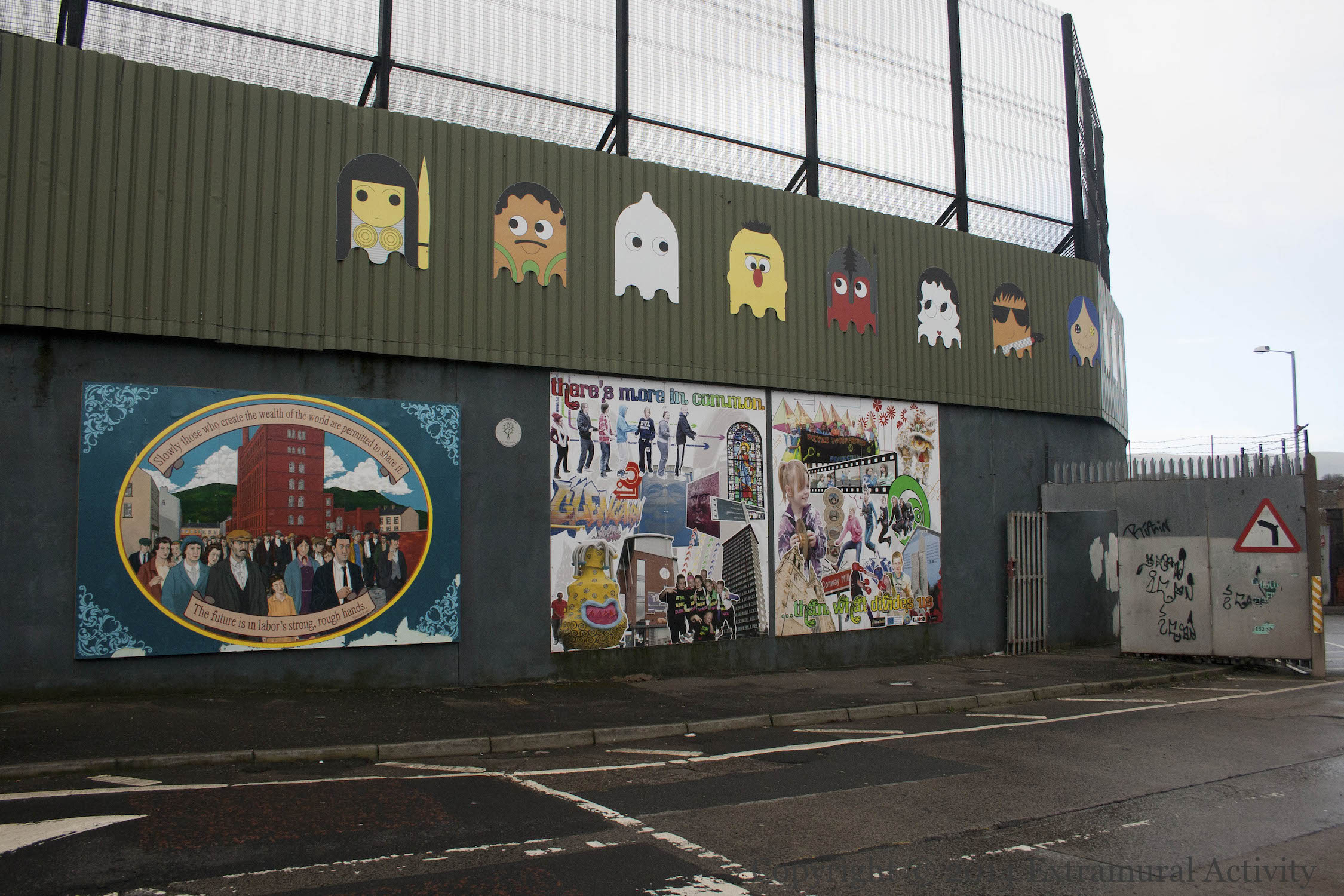
This board on the Cupar Way “peace” line at the North Howard Street gates features a quote by Mary Harris “Mother” Jones, “the most dangerous woman in America” for her labour organizing: Slowly those who create the wealth of the world are permitted to share it – The future is in labor’s strong, rough hands.” Wide shot below.
The two community boards to the right were featured previously: What Divides Us.
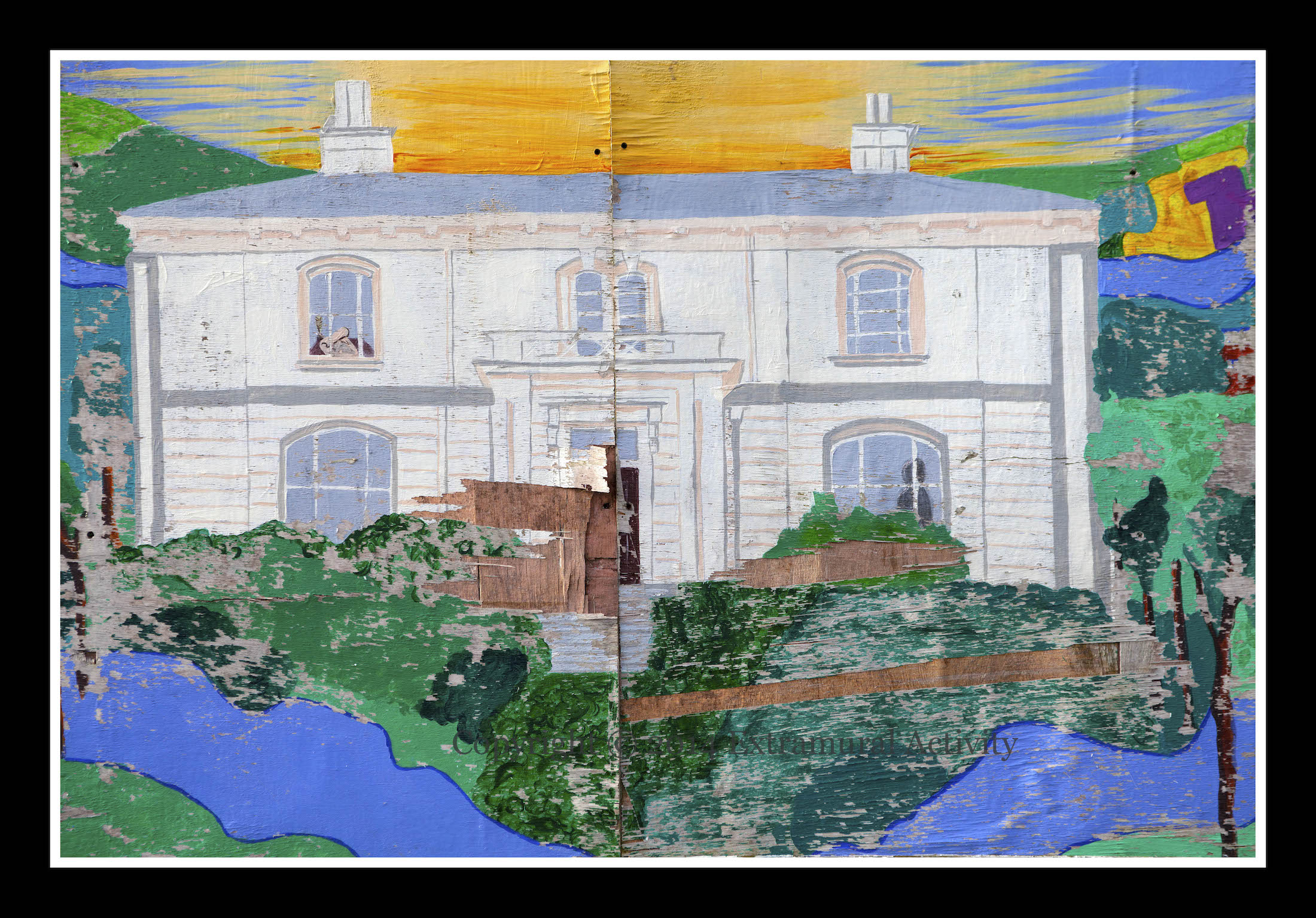
This image of Fernhill House is to be found on the wall of the community centre on the Forthriver Road; the house itself stands not far away on the other side of Glencairn park. Below is a video about the museum that was in the house; a video about the history of the house and grounds, which served as a training grounds for the west Belfast Volunteers and UVF at the time of the Ulster Covenant and WWI, is also available.
Above is an advertising hoarding (this one is at the junction of the Antrim and Limestone Roads) for an Irish-language one-man show entitled “The Wheelchair Monologues” by Gearóıd Ó Caırealláın, director of the Cultúrlann and Irish-language activist, about the stroke (in 2006) that has left him paralyzed on his left side. Below is a detail from the boards that surrounded the Cultúrlann during its renovation.
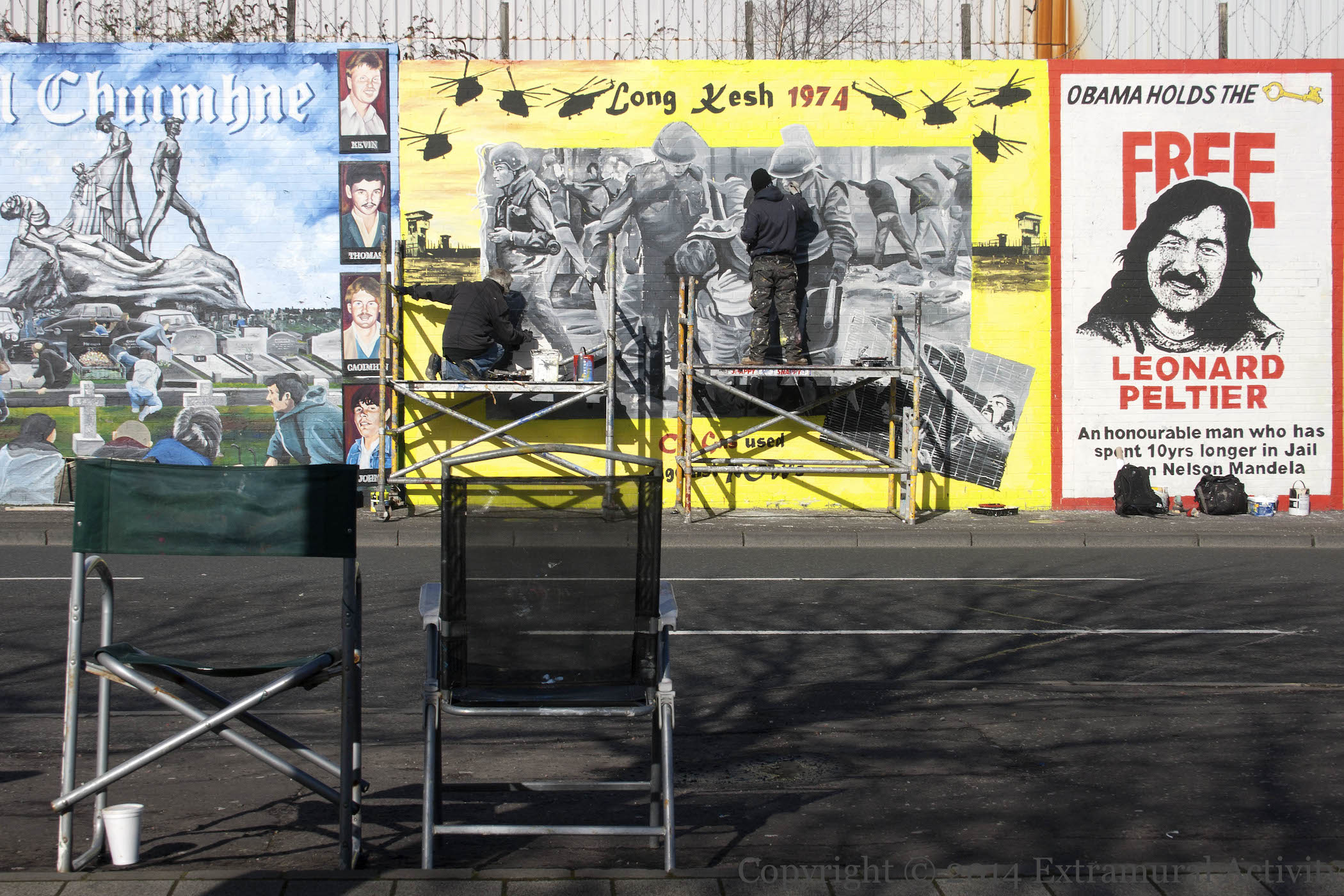
A new mural, above, on the International Wall commemorates the fortieth anniversary this year of the ‘Burning Of Long Kesh’ or the ‘Battle Of Long Kesh’, which took place on the night of October 15, 1974 and day of the 16th (when British Army units retook the camp).
The most comprehensive account available on-line of the conditions at the camp prior to the riot, the burning, and the battle on the morning of the 16th appears to be this 2004 piece in An Phoblacht by Joe Doherty and Christy Keenan. (For a virtual tour of the camp, see this video. Seamus Keenan’s Over The Wire (on again this month at the Derry Playhouse) attempts to recreate the scene.) Other accounts include those by Ronan Bennett, another inmate, in The Guardian, and by ‘Peter’, a British Army soldier, at Shared Troubles. Here is a brief BBC News report from the 16th.
All accounts mention the use of gas and republican accounts state that CR was used on the morning of the 16th in addition to CS, dropped from helicopters as at the top of the mural. The Guardian, in 2005, confirmed that CR had been authorized for use in controlling riots and was available at the prison. CR is a carcinogen (WP) and in a post on his blog Mairtin Óg Meehan suspects that exposure to CR is a cause of recent cancers among former prisoners. For some statistics based on interviews with prisoners, see this page at Clones Fáılte.
In the lower left corner is a quoted telegram from Fr. Denis Faul, Fr. Raymond Murray: “To international Red Cross … Visited Long Kesh today with others … Request immediate investigation into use of CR gas … sub-human conditions … SOS … come immediately …” 20 Oct. 1974. These two wrote an 80-page report on the conditions at the camp following the event, entitled The Flames Of Long Kesh. See this 1999 An Phoblacht page for an image of the shelters constructed after the battle.
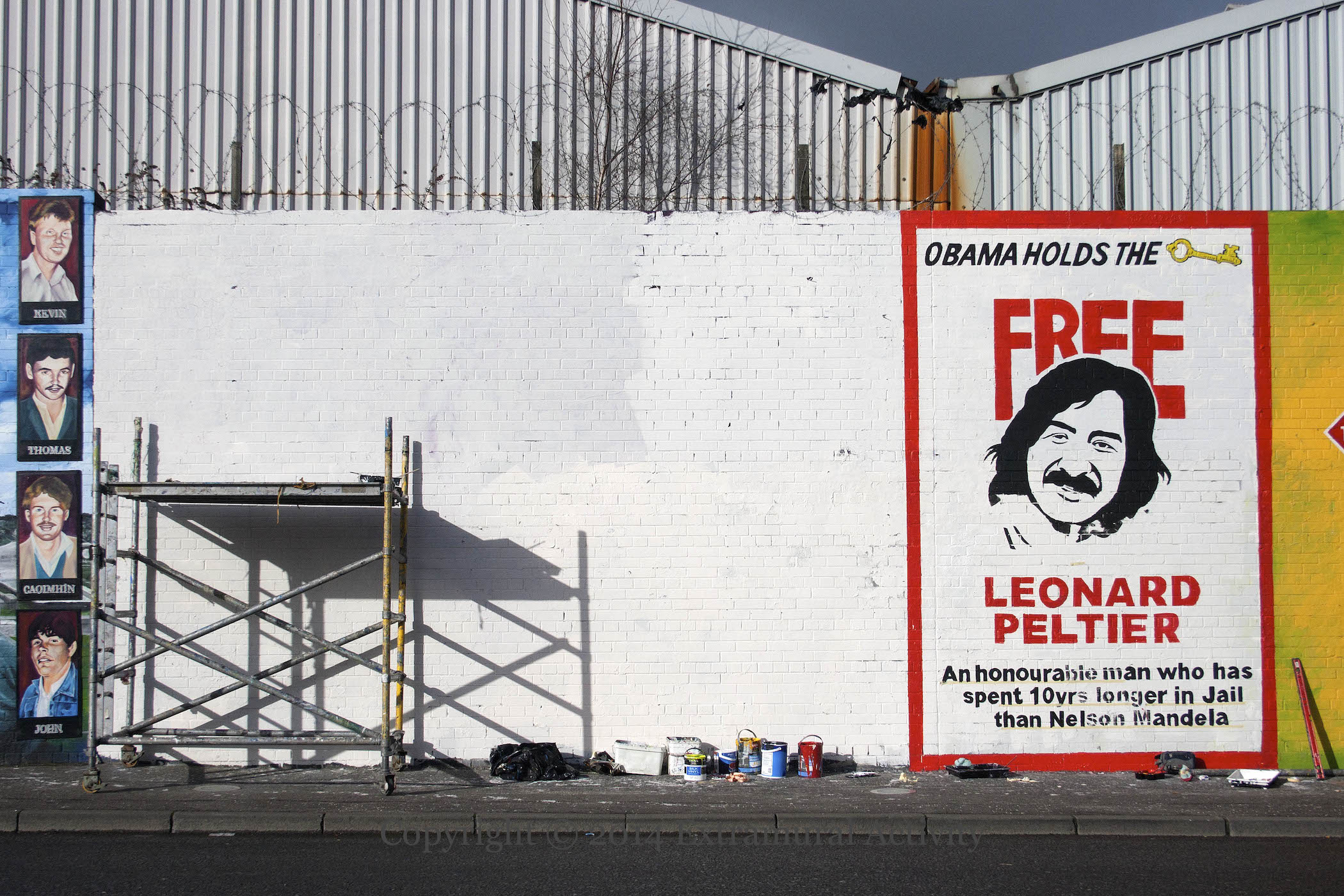
There are two new pieces on the International Wall on Divis Street. The first is the “Free Leonard Peltier” bookmark-sized piece shown in progress, above, and completed, below. (The second is a 40th anniversary piece concerning the burning of Long Kesh. We will have the finished version of that tomorrow. The two together take the place of the 2007 Guernica mural, which was in bad shape after six and a half years.) The text reads, “An honourable man who has spent 10yrs longer in jail than Nelson Mandela”. Peltier has been in jail since 1977, convicted of killing two FBI agents (WP).







 Extramural Activity